Omar says she won’t ‘be silenced’ by search of her home and blasts Trump’s ‘intimidation’ campaign
WASHINGTON — Federal agents on Monday searched the home of Democratic U.S. Rep. Ilhan Omar, a startling escalation in a criminal investigation that brings renewed scrutiny to the frequent target of Trump administration derision in the final weeks of her reelection bid.
Omar said she will “not be silenced” and called the search of her home the “latest escalation” in President Trump’s ‘‘intimidation” campaign.
The search of the Minnesota congresswoman’s home so close to next month’s midterm contests that will determine control of the House and the Senate was swiftly condemned by top Democrats in Congress and raised questions about the timing given longstanding Justice Department protocol to avoid overt investigative steps involving political candidates in the direct run-up to an election.
The Justice Department confirmed in a statement that Homeland Security Investigations agents executed a judicially authorized search warrant in the Washington, D.C., area in connection with an ongoing federal criminal investigation but provided no other details.
The nature and scope of the investigation were unclear, though officials in Trump’s administration have repeatedly hinted at the existence of an inquiry targeting Omar, a Somali-born Democrat whose status as an immigrant to the U.S. and left-wing views have repeatedly drawn criticism from Republicans and senior Trump officials.
Homeland Security Secretary Markwayne Mullin said last month that there was an “ongoing investigation” related in part to whether Omar lied on her immigration forms and that “something’s going to happen.”
Though the Republican focus on Omar’s background dates back years, the search of her home took place three weeks before the November midterms, in which Omar is on the ballot for reelection. The Justice Department has historically sought to avoid public investigative actions involving a candidate within 60 days of a primary or general election.
“For years, Donald Trump and far-right extremists have relentlessly targeted Congresswoman Omar with vile personal attacks and baseless accusations,” top House Democratic leaders said in a statement. “Now, less than 30 days until the midterm election, his violent mass deportation machine has descended upon the home of a duly elected Member of Congress and her family.”

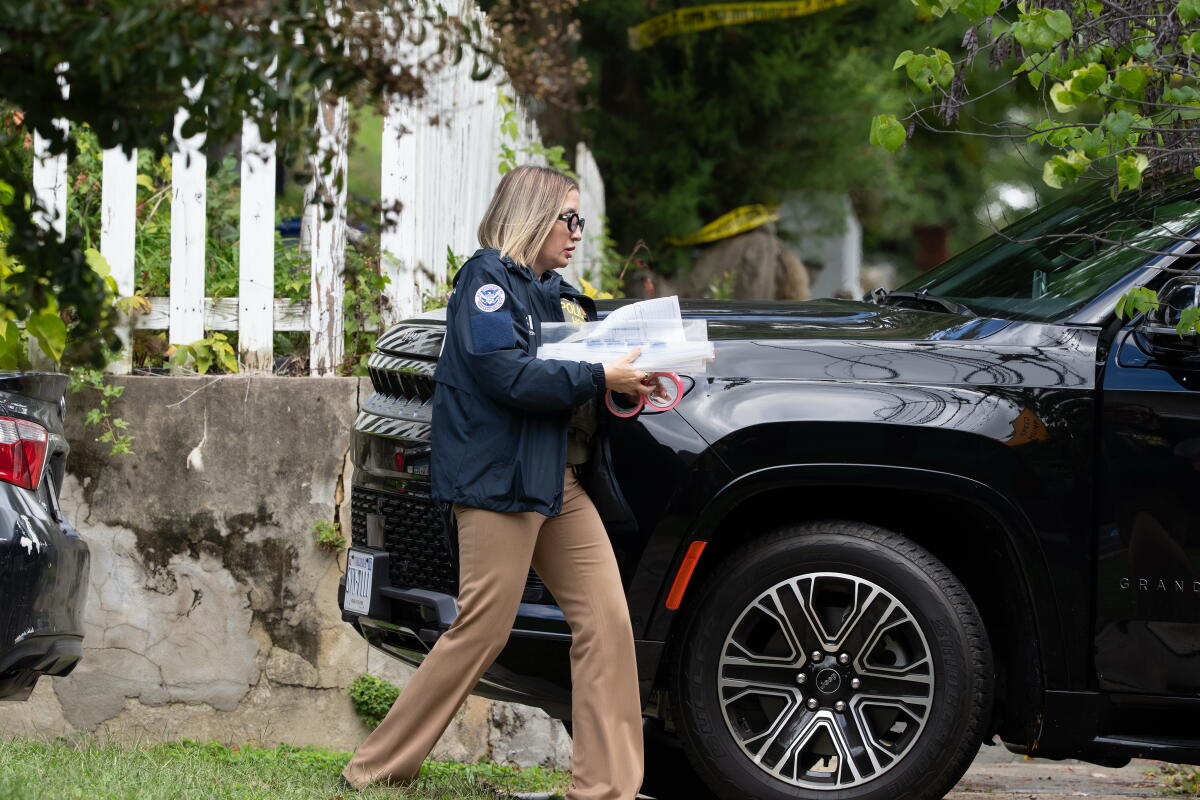
A Homeland Security officer walks out of the Washington residence of Rep. Ilhan Omar, D-Minn., during a search, Monday.
(J. Scott Applewhite / Associated Press)
Trump has frequently targeted Omar
Trump as recently as this past weekend brought up Omar at a rally in Tennessee, where he attacked her upbringing and suggested that Vice President JD Vance “and our people” were investigating her.
Vance has in the past accused Omar of committing immigration fraud — an allegation she has denied — and has said he and a top White House official were trying to figure out how to investigate her.
On Monday morning, the street
in Washington where Omar lives was blocked off as HSI agents remained near the home.
“This enforcement action is part of an ongoing federal criminal investigation,” the department said.
A spokesperson for the Department of Homeland Security, of which Homeland Security Investigations is part, referred questions about the search to the Justice Department.
Omar has long been a target for Republicans
Omar, who was first elected to the House in 2018, represents Minnesota’s 5th District, including Minneapolis. She is part of “The Squad,” progressive lawmakers who are a vibrant political force on the left wing of Congress but have also endured repeated attacks from Trump, dating to his first term. She was one of the first two Muslim American women in the House and the first African refugee to be elected to Congress.
When Republicans swept control of the House in 2023, they voted to oust Omar from the Foreign Affairs Committee, citing her anti-Israel remarks.
In January, Trump lashed out at Omar during a rally in Iowa hours before an assailant sprayed the congresswoman during a town hall meeting in Minneapolis with a substance that turned out to be vinegar. The attacker was sentenced to 14 months in prison.
Republicans have raised questions about Omar’s past since before she was elected, including asserting that she had married her brother and committed immigration fraud. Omar has broadly denied the allegations as “disgusting lies.”
“It certainly seems like something fishy is there, but everybody’s entitled to equal justice under the laws,” Vance told reporters in May. “So we’re going to investigate it. We’re going to take a look at it. If we think there’s a crime, we’re going to prosecute that crime.”
In a separate interview with conservative podcaster Benny Johnson, Vance said without offering evidence that “we actually think that Ilhan Omar definitely committed immigration fraud against the United States of America.”
He said that he and deputy White House chief of staff Stephen Miller had been discussing it.
“That’s the thing that we’re trying to figure out,” he said. “What are the legal remedies now that we know that she’s committed immigration fraud? … How do you build the case necessary to get some, some, some justice for the American people?”
Omar’s office has defended her against past allegations
Omar’s office in March dismissed Vance’s claims as fabricated and defamatory.
“This is rich coming from someone who literally said they were willing to ‘create stories’ to redirect the media,” Omar’s chief of staff, Connor McNutt, said in a statement.
“This is a ridiculous lie and desperate attempt to distract from the pedophile protection party’s unpopular war of choice, increasing gas prices, and rapidly dropping polling numbers,” McNutt said.
Tucker and Richer write for the Associated Press. AP writers Lisa Mascaro, Michelle L. Price and River Zhang in Washington, Kathy McCormack in Concord, N.H., Mike Catalini in Morrisville, Pa., and Meg Kinnard in Columbia, S.C., contributed to this report.