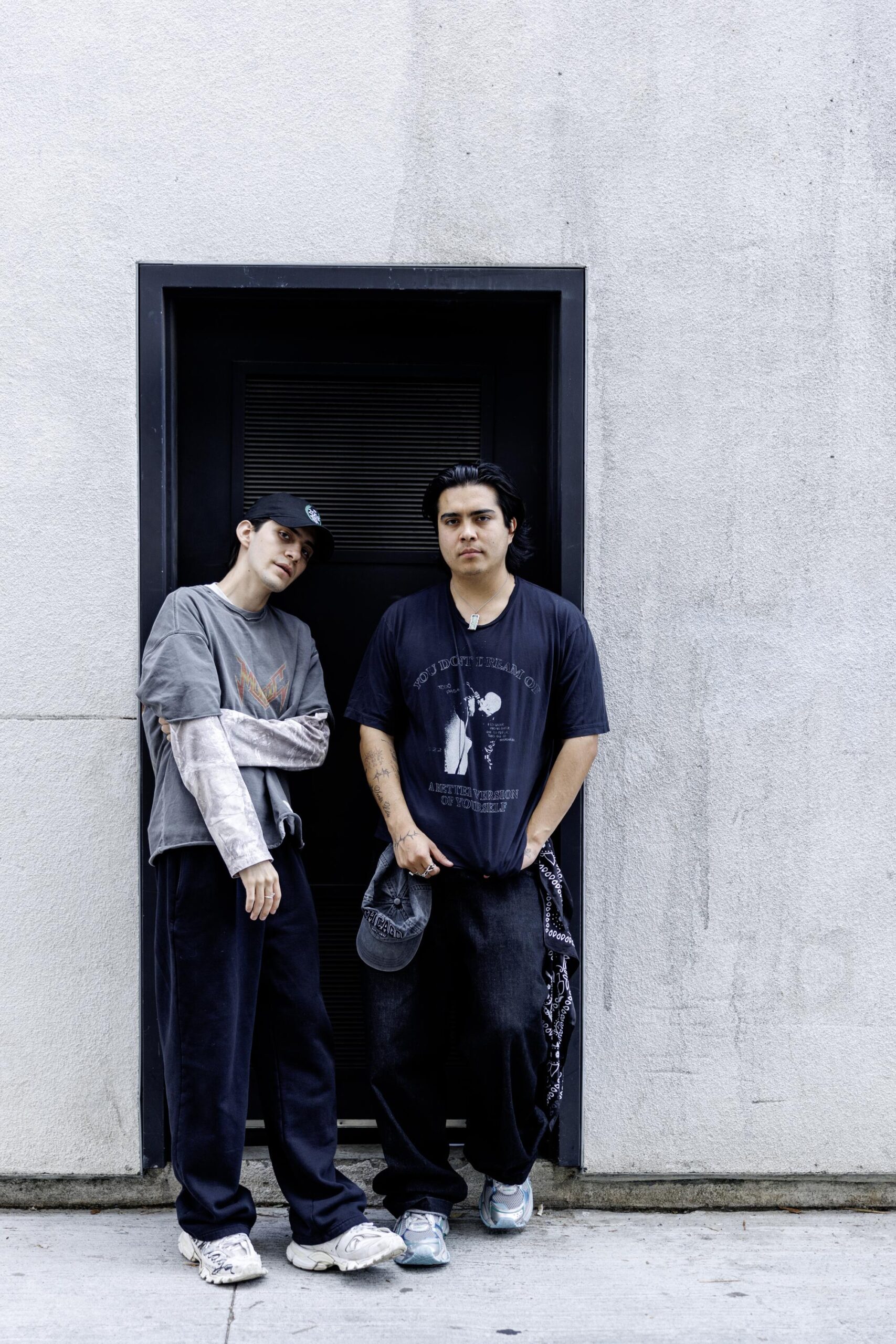
Hugo Lara and Manolo Cabrera — the Mexican DJ pair better known as RØZ — casually strolled through Sightglass Coffee in Hollywood, one gripping a half-melted iced coffee, the other an empty Erewhon juice bottle.
To any onlooker, they might appear as two standard Gen Z Angelenos in sardonic streetwear: 22-year-old Cabrera flaunted a hat that referenced the 2008 financial crisis while 25-year-old Lara’s faded tee read, “You don’t dream of a better version of yourself.”
But over the past year, this fresh-faced pair from Querétaro, a small state just outside Mexico City, has dominated the festival world circuit. Spinning heart-thumping electronic beats and Latin house rhythms, RØZ has taken the stage at many a popular event, such as the most recent Coachella Valley Music and Arts Festival, Lollapalooza Chicago, Hard Summer, EDC Las Vegas and Sueños.
“We’ve had huge crowds at festivals, even the workers on stage are like, ‘No way, you filled more venues than yesterday’s headliner,’” Cabrera told The Times. “We filled it up and people started leaving for the next person, which is obviously not cool. It feels awful. But you do think: good! They value Latinos and Mexicans now.”
Besides regaling ravers at their concerts — which will continue for the remainder of the calendar year, including a 20-city North American tour that kicks off in Boston on Oct. 21 — RØZ has landed another major artistic goal.

“Everyone will give [the album] a different interpretation, but I think the through line is the idea of drama, or poetic essence,” said Hugo Lara.
(Gina Ferazzi / Los Angeles Times)
Last Friday, they released their first full-length album, “Se Esta Haciendo Tarde.” It’s a 19-track, introspective debut that solidifies the duo’s standing in the EDM world as both masterful mixers and vocalists.
“We are neither fully DJs, or fully singers, but artists,” said Cabrera. “Our shows, with the album, are going to be us playing synths, at another point singing and at another point we mix some songs.”
Featuring cameos from Latin superstars like Peso Pluma, J Balvin and Ryan Castro, the LP itself is hard to define as simply house music; RØZ is known best for peppering its EDM with a heavy dose of Latino sazon. It’s a sonic recipe that the two former schoolmates have been mastering since they were under lockdown from COVID.
This era also saw the commercial rise of other Mexican artists in their generation: Natanael Cano and Latin Mafia were among the most prominent Mexican acts who maximized their creativity during the isolation period and used social media platforms like TikTok to gain traction.
“It’s like if Fred Again, Skrillex, Frank Ocean, Mora and Bad Bunny adopted a child and raised him,” said Cabrera about their own music, which they began uploading to the streaming platform Soundcloud in 2022.
At the start of their disc jockey journey, they remixed already established songs, from Bad Bunny and Bomba Estéreo’s “Ojitos Lindos” to Bellakath’s “Gatita.” By 2024, they would release their frosty original track, “Cora de Hielo” under Warner Music Mexico; this featured Natt Calma and Mau Moctezuma, artists whom they met through the local indie scene.
Their subsequent releases went viral — including the dark-synth pop “Flashes” with Yng Lvcas and atmospheric “Apaga la Luz” with a rather mellowed performance from Peso Pluma — which were released under LT:Vision Records, Queens Road Music and Atlantic Records.

“At that time, emotions were secondary [in the music],” said Cabrera when looking back on those early songs. “Perhaps we didn’t resonate with the artist’s lyrics, we might have helped with some ideas. But with this [new] project, we wanted to find more of a balance — we want to be transparent, while also releasing f— bangers.”
Inspired by the transient beauty of cherry blossoms, known in Japan as sakura — which is illustrated in their album cover, alongside a dark pegasus — much of the LP also hinges on melodrama. Glitchy beat drops in “Acelero Lento” (featuring Chitra) fade into acoustic ballads. The bouncy freestyle rhythm in “Soho” melts into feverish pop harmonies. There’s also an interlacing spiritual hymn in “Yo Gospel” (featuring Rodrii) that showcases the heavenly vocals of an American-style church choir.
“Everyone will give [the album] a different interpretation, but I think the through line is the drama, or poetic essence,” said Lara. “Perhaps in 10 years we will listen to the same song and have a different interpretation.”
The new LP is imbued with various Latin genre fusions. In “Ya es de Noche” (featuring Rodrii and Olisso) they open with neo-perreo rhythms that slowly wade in and out of a cumbia-guided trance. In “Hanami,” named after the traditional Japanese custom of observing a floral bloom, RØZ is joined by Colombian producer Sky Rompiendo, whose pulsating reggaeton beats undergo a warping process, as their lyrics harp on romantic tension.
“Cherry blossoms only last a while, so it was our way of saying that we must appreciate the moment in which beauty exists,” said Lara.

The magnetic pull of RØZ — whose stage name is pronounced like the second syllable in “arroz” — cannot be overstated. They’ve already sold out six shows in their upcoming tour, which will wrap up Feb. 27 in their home state of Querétaro. Their popularity comes at a time when electronic music was registered as the largest-growing genre in the U.S. in the first half of 2026, per Luminate’s 2026 data report, which also found that casual monthly listenership in Latin music peaked at 54% of streams in the first quarter.
The growing admiration for Latin-fused EDM by Latino listeners was most visually evident during their Coachella debut in April. One attendee uploaded a video to Instagram showing the jammed entrance to the Sonora Tent, which reached full capacity before the duo began their Sunday set: “Coachella underestimating the Latino crowds like [what do you mean] I can’t see RØZ [because] it’s at full capacity both weekends,” the subtext on the video read.
Even before their breakout year, on the night of their first U.S. performance on the rooftop of the Fonda Theatre in Los Angeles last August, the line to get inside stretched across the Hollywood Boulevard sidewalk with attendees eager to hear the pair’s early tracks.

Still, it doesn’t surprise RØZ that a Latino act like themselves might be early on the call sheet — or left to assemble a last-minute crew after their original team ran into visa processing delays ahead of the first Coachella weekend. “In this genre that we’re moving in, you’d never picture a Latino headliner. Latinos are always put down, down, down,” said Cabrera.
But some milestones have given them faith that the mainstream world is opening up to putting Latino acts at the top of the bill; including the fact that Colombian singer Karol G was the first Latina Coachella headliner this year. “And with music in Spanish, not English,” marveled Lara.
And rather than sulk about the conditions of Latino artists, RØZ is ready to put up a fight.
“Just because I’m Mexican or Latino doesn’t mean that I can’t connect with people the same way a person from the United States can,” said Cabrera. “Headlining is possible, without a doubt.”