lp

How Mexico City EDM duo RØZ turned Coachella buzz into a bold debut

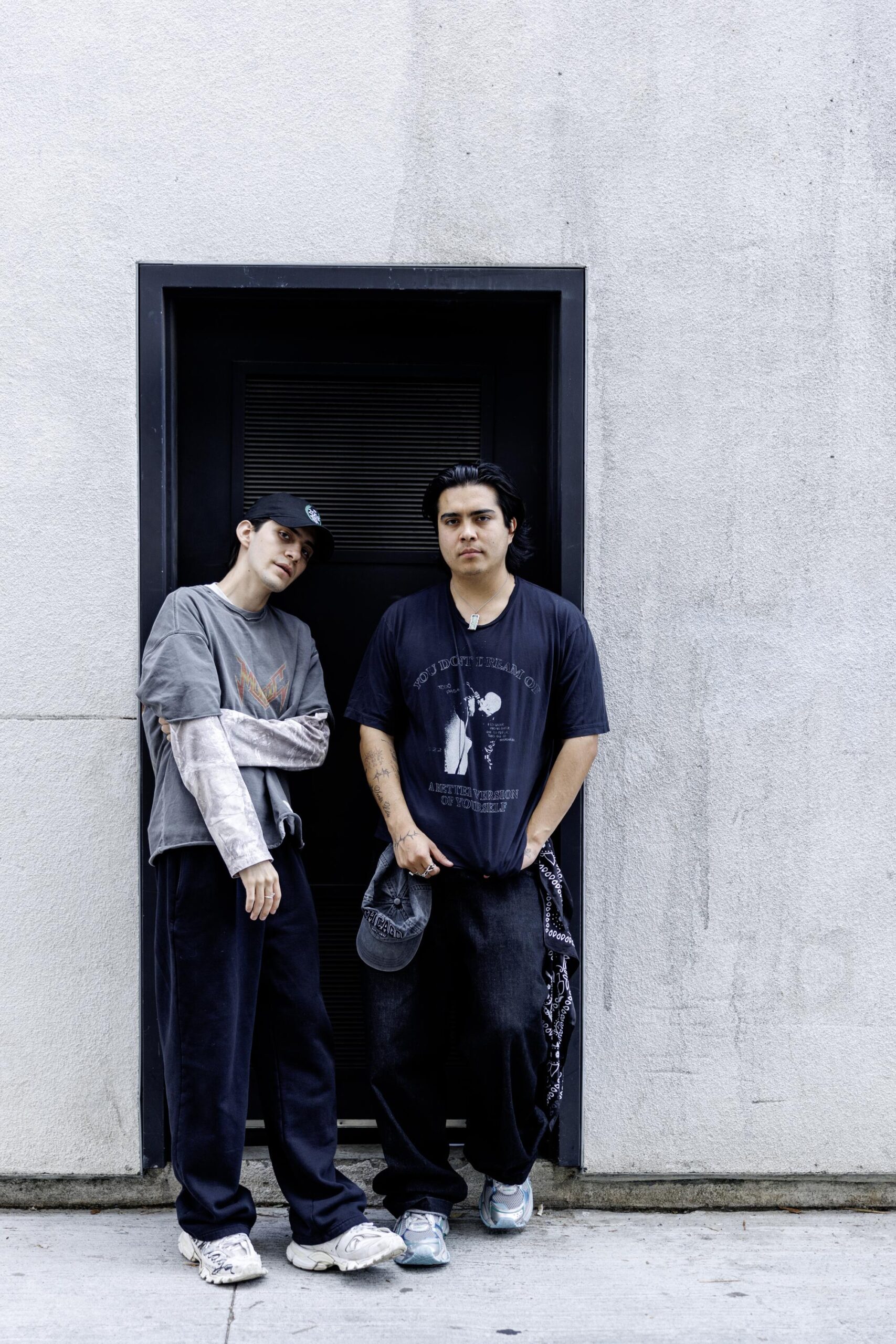
Hugo Lara and Manolo Cabrera — the Mexican DJ pair better known as RØZ — casually strolled through Sightglass Coffee in Hollywood, one gripping a half-melted iced coffee, the other an empty Erewhon juice bottle.

To any onlooker, they might appear as two standard Gen Z Angelenos in sardonic streetwear: 22-year-old Cabrera flaunted a hat that referenced the 2008 financial crisis while 25-year-old Lara’s faded tee read, “You don’t dream of a better version of yourself.”

But over the past year, this fresh-faced pair from Querétaro, a small state just outside Mexico City, has dominated the festival world circuit. Spinning heart-thumping electronic beats and Latin house rhythms, RØZ has taken the stage at many a popular event, such as the most recent Coachella Valley Music and Arts Festival, Lollapalooza Chicago, Hard Summer, EDC Las Vegas and Sueños.

“We’ve had huge crowds at festivals, even the workers on stage are like, ‘No way, you filled more venues than yesterday’s headliner,’” Cabrera told The Times. “We filled it up and people started leaving for the next person, which is obviously not cool. It feels awful. But you do think: good! They value Latinos and Mexicans now.”

Besides regaling ravers at their concerts — which will continue for the remainder of the calendar year, including a 20-city North American tour that kicks off in Boston on Oct. 21 — RØZ has landed another major artistic goal.

Manolo Cabrera, left, and Hugo Lara.

“Everyone will give [the album] a different interpretation, but I think the through line is the idea of drama, or poetic essence,” said Hugo Lara.

(Gina Ferazzi / Los Angeles Times)

Last Friday, they released their first full-length album, “Se Esta Haciendo Tarde.” It’s a 19-track, introspective debut that solidifies the duo’s standing in the EDM world as both masterful mixers and vocalists.

“We are neither fully DJs, or fully singers, but artists,” said Cabrera. “Our shows, with the album, are going to be us playing synths, at another point singing and at another point we mix some songs.”

Featuring cameos from Latin superstars like Peso Pluma, J Balvin and Ryan Castro, the LP itself is hard to define as simply house music; RØZ is known best for peppering its EDM with a heavy dose of Latino sazon. It’s a sonic recipe that the two former schoolmates have been mastering since they were under lockdown from COVID.

This era also saw the commercial rise of other Mexican artists in their generation: Natanael Cano and Latin Mafia were among the most prominent Mexican acts who maximized their creativity during the isolation period and used social media platforms like TikTok to gain traction.

“It’s like if Fred Again, Skrillex, Frank Ocean, Mora and Bad Bunny adopted a child and raised him,” said Cabrera about their own music, which they began uploading to the streaming platform Soundcloud in 2022.

At the start of their disc jockey journey, they remixed already established songs, from Bad Bunny and Bomba Estéreo’s “Ojitos Lindos” to Bellakath’s “Gatita.” By 2024, they would release their frosty original track, “Cora de Hielo” under Warner Music Mexico; this featured Natt Calma and Mau Moctezuma, artists whom they met through the local indie scene.

Their subsequent releases went viral — including the dark-synth pop “Flashes” with Yng Lvcas and atmospheric “Apaga la Luz” with a rather mellowed performance from Peso Pluma — which were released under LT:Vision Records, Queens Road Music and Atlantic Records.

“At that time, emotions were secondary [in the music],” said Cabrera when looking back on those early songs. “Perhaps we didn’t resonate with the artist’s lyrics, we might have helped with some ideas. But with this [new] project, we wanted to find more of a balance — we want to be transparent, while also releasing f— bangers.”

Inspired by the transient beauty of cherry blossoms, known in Japan as sakura — which is illustrated in their album cover, alongside a dark pegasus — much of the LP also hinges on melodrama. Glitchy beat drops in “Acelero Lento” (featuring Chitra) fade into acoustic ballads. The bouncy freestyle rhythm in “Soho” melts into feverish pop harmonies. There’s also an interlacing spiritual hymn in “Yo Gospel” (featuring Rodrii) that showcases the heavenly vocals of an American-style church choir.

“Everyone will give [the album] a different interpretation, but I think the through line is the drama, or poetic essence,” said Lara. “Perhaps in 10 years we will listen to the same song and have a different interpretation.”

The new LP is imbued with various Latin genre fusions. In “Ya es de Noche” (featuring Rodrii and Olisso) they open with neo-perreo rhythms that slowly wade in and out of a cumbia-guided trance. In “Hanami,” named after the traditional Japanese custom of observing a floral bloom, RØZ is joined by Colombian producer Sky Rompiendo, whose pulsating reggaeton beats undergo a warping process, as their lyrics harp on romantic tension.

“Cherry blossoms only last a while, so it was our way of saying that we must appreciate the moment in which beauty exists,” said Lara.

The magnetic pull of RØZ — whose stage name is pronounced like the second syllable in “arroz” — cannot be overstated. They’ve already sold out six shows in their upcoming tour, which will wrap up Feb. 27 in their home state of Querétaro. Their popularity comes at a time when electronic music was registered as the largest-growing genre in the U.S. in the first half of 2026, per Luminate’s 2026 data report, which also found that casual monthly listenership in Latin music peaked at 54% of streams in the first quarter.

The growing admiration for Latin-fused EDM by Latino listeners was most visually evident during their Coachella debut in April. One attendee uploaded a video to Instagram showing the jammed entrance to the Sonora Tent, which reached full capacity before the duo began their Sunday set: “Coachella underestimating the Latino crowds like [what do you mean] I can’t see RØZ [because] it’s at full capacity both weekends,” the subtext on the video read.

Even before their breakout year, on the night of their first U.S. performance on the rooftop of the Fonda Theatre in Los Angeles last August, the line to get inside stretched across the Hollywood Boulevard sidewalk with attendees eager to hear the pair’s early tracks.

Still, it doesn’t surprise RØZ that a Latino act like themselves might be early on the call sheet — or left to assemble a last-minute crew after their original team ran into visa processing delays ahead of the first Coachella weekend. “In this genre that we’re moving in, you’d never picture a Latino headliner. Latinos are always put down, down, down,” said Cabrera.

But some milestones have given them faith that the mainstream world is opening up to putting Latino acts at the top of the bill; including the fact that Colombian singer Karol G was the first Latina Coachella headliner this year. “And with music in Spanish, not English,” marveled Lara.

And rather than sulk about the conditions of Latino artists, RØZ is ready to put up a fight.

“Just because I’m Mexican or Latino doesn’t mean that I can’t connect with people the same way a person from the United States can,” said Cabrera. “Headlining is possible, without a doubt.”


Source link

William Orbit, producer behind Madonna’s ‘Ray of Light,’ dies at 69

William Orbit, the English musician and producer best known for his work with Madonna on her beloved 1998 album “Ray of Light,” died on July 23. He was 69.

His family announced his death Friday in an Instagram post that said he died at home but didn’t specify a cause. “He will be greatly missed by us and by so many whose lives he touched through his music, friendship and kindness,” the post reads.

Born William Wainwright in London in 1956, Orbit had already established himself in the worlds of dance music and movie soundtracks — he composed the score for the 1986 hockey movie “Youngblood,” with Rob Lowe and Patrick Swayze — when he linked up with Madonna at a moment of deep personal change for the pop superstar, who’d given birth to her first child and immersed herself in a variety of spiritual practices. Together the two developed a lush yet energetic sound that combined guitars, synths and throbbing club beats.

“Ray of Light,” which sold more than 4 million copies in the United States alone, spun off hit singles including “Frozen,” “The Power of Good-Bye” and the exuberant title track; the LP was nominated for album of the year at the Grammy Awards — Madonna’s only nod for that prestigious prize — and won the award for pop vocal album. Orbit won three Grammys in all over the course of his career.

In 2021, Orbit took pains in an interview with the Guardian to share credit for “Ray of Light” with the singer herself. Madonna, he said, is “a fabulous producer. When it says ‘produced by Madonna and William Orbit,’ people don’t always give her the credit for that. But she’s as responsible as me.”

Orbit and Madonna collaborated again for “Beautiful Stranger,” a Grammy-winning single from the soundtrack of 1999’s “Austin Powers: The Spy Who Shagged Me,” and for an electro-pop cover of Don McLean’s “American Pie” that featured in the 2000 movie “The Next Best Thing,” in which Madonna starred.

He also worked with Blur, U2, Beth Orton, Pink and All Saints, and he made music under his own name, including a 2000 LP, “Pieces in a Modern Style,” with high-tech interpretations of classical pieces by the likes of Samuel Barber and Erik Satie.


Source link

How Donny Hathaway turned this soft rock cover into America’s defining song

Donny Hathaway had already been expounding on the splendors and indignities of American life by the time he got to the Troubadour in West Hollywood in the last week of August 1971.

A classically trained pianist with a declamatory voice shaped by his years in the church, Hathaway closed Side 1 of his 1970 debut with an original called “Tryin’ Times” — “Maybe folks wouldn’t have to suffer,” he sang, “if there was more love for your brother” — and finished the LP with a stately rendition of Nina Simone’s “To Be Young, Gifted and Black.” Months after the album was released, he dropped a joy bomb of a holiday single, “This Christmas,” that unapologetically made space for a Black experience in the yuletide-industrial complex.

Donny Hathaway performs at Mister Kelly's in Chicago in 1971.

Donny Hathaway performs at Mister Kelly’s in Chicago in 1971.

(Val Mazzenga / Chicago Tribune / Tribune News Service via Getty Images)

Yet Hathaway captured something indelibly American during his week of shows at the Troubadour, which were recorded (along with a later gig at New York’s Bitter End) for the singer’s classic “Live” album that came out in February 1972. On an LP full of spine-tingling performances, the undeniable high point is Hathaway’s take on Carole King’s “You’ve Got a Friend” — a clear-eyed if optimistic portrait of resilience and cultural exchange.

King — who’d made her name in the 1960s as half of a prolific Brill Building songwriting duo with her husband, Gerry Goffin — wrote “You’ve Got a Friend” after leaving Goffin and moving to Los Angeles with her two young daughters. Here she remade herself as a low-key singer-songwriter dispensing wise yet unflashy tunes about love, home and family — part of a gentle resetting of pop’s mood after the turmoil of the previous decade.

Cut like the rest of the album at A&M Studios on La Brea Avenue, “You’ve Got a Friend” helped drive King’s 1971 “Tapestry” LP to sales of more than 10 million copies and to a boatload of trophies (including album, record and song of the year) at the Grammy Awards; the singer’s pal James Taylor, whom she’d performed with for the first time in late 1970 at the Troubadour, topped Billboard’s Hot 100 with his own cover of “Friend” featuring background vocals by Joni Mitchell.

On the advice of Atlantic Records’ Jerry Wexler, Hathaway also recorded “Friend” as a studio duet with Roberta Flack, a fellow Howard University alum; their take sat in the Top 20 of Billboard’s R&B chart as Hathaway began his run at the Troubadour — popular enough that the audience on “Live” erupts at the sound of Hathaway’s opening organ lick.

Carole King at A&M Studios in Los Angeles in 1970.

Carole King at A&M Studios in Los Angeles in 1970.

(Jim McCrary / Redferns via Getty Images)

Indeed, the crowd is really the thing in this live version of “You’ve Got a Friend.” Hathaway and his band — including guitarist Phil Upchurch, bassist Willie Weeks and 16-year-old Fred White (soon to be of Earth, Wind & Fire) on drums — are cooking, to be clear; the groove is funky and viscous, and Hathaway’s vocal is gorgeous, not least in his nimble ad-libs.

But it’s his interplay with the few hundred folks in the room that elevates the recording to a deeply moving piece of art.

For King (and Taylor), the song’s promise of unflagging support is an intimate one-to-one matter; their renditions use homey acoustic arrangements to create a picture of two people exchanging confidences. In Hathaway’s hands, “Friend” is about community: Before he even asks them to, the audience takes over for him on lead vocals in the song’s chorus, a congregation in all but name.

Given the proximity to the civil rights movement, it’s impossible to hear Hathaway’s “You’ve Got a Friend” as disconnected from the struggles of Black people. At the Troubadour (as in his and Flack’s duet), he nixes the song’s second verse to arrive more quickly at the bridge, in which he describes a cold world filled with those who’d “hurt you and try to desert you” — even “take your soul if you let them.”

As Emily J. Lordi notes in her 2016 book about “Donny Hathaway Live,” the crowd lays back during the bridge before rejoining Hathaway for the song’s second chorus; the decision, somehow spontaneous and collective at once, is an expert bit of record-making on the part of an audience that, according to legend, hadn’t been told the concert was being taped.

“From this perspective,” Lordi writes of Hathaway’s fans — some number of whom had surely availed themselves of the Troubadour’s bar, as she points out — “they are not stealing the show so much as they are holding him up, ensuring he won’t sing the duet alone.” Together, performer and audience are turning back (not that they necessarily had a choice) to the ugly truths that singer-songwriter music sometimes sought to move past.

In this way, Hathaway’s “Friend” becomes a reinvention of a reinvention — an act of moral imagination about as American as it gets.

This wasn’t the only instance of a Black soul singer interpreting a tune King had written as a single mom newly arrived in L.A.: In May 1972, the Isley Brothers released a sultry cover of “It’s Too Late”; a month after that, Aretha Franklin’s live “Amazing Grace” album mashed up “You’ve Got a Friend” with “Precious Lord, Take My Hand,” completing the gospel-ification that Hathaway had begun in a bastion of white rock culture temporarily remade as an African American church.

Yet in Hathaway’s “Friend” you can hear the whole story American music tells about identity and belonging (and about commercial ambition).

“This might be a record here,” Hathaway tells the crowd near the end of the song, and so it was — a document of adaptation, a testament to borrowing, a bulwark against pretty fictions.

Source link