WASHINGTON — At first glance, President Trump’s decision to relax U.S. sanctions on Russia despite its continuing invasion of Ukraine was a dramatic break from principles that guided American foreign policy for most of a century.
Since the end of World War II, U.S.-Russian relations have oscillated between hostility and friendship, but one element was consistent: When Russia tried to take over one if its neighbors, the United States pushed back.
“The Trump administration has abandoned any pretense of being an honest broker,” Richard N. Haass, a former senior State Department official under then-President George W. Bush, wrote last week. “It has gone all in on Russia’s side.”
The break from long-standing tradition was real, but it should not have been entirely surprising.
Trump has long expressed admiration for Russia’s autocratic leader, Vladimir Putin — part of a syndrome one of his former aides, Fiona Hill, has called “autocrat envy.”
“He wants to rule like them,” she said, referring to the president’s bromances with Putin, China’s Xi Jinping and other strongmen.
Meanwhile, Trump often expresses disdain for democratically elected leaders of smaller countries, and he reserves a special loathing for the president of Ukraine, Volodymyr Zelensky.
He has repeatedly said Zelensky was foolish to resist Russia’s 2022 invasion because, in his view, the larger country is almost certain to win the war.
“Russia is a massive country,” he said this month. “Even if it loses a million soldiers, it still has a million more. Ukraine doesn’t have that kind of manpower.”
Moreover, Trump has long believed U.S. companies could reap an economic bonanza from Russia’s resource-rich economy. As a real estate magnate, he spent 30 years seeking deals in Moscow; in 2008, his son Donald Jr. said Russians had provided the Trump Organization “a lot of our assets.”
In the short run, the president hopes to boost Republican prospects in next week’s midterm elections by buying diesel fuel from Russia — a move aimed at lowering prices at the cost of bolstering Putin’s war economy. (It hasn’t worked; the price of diesel has risen slightly since Trump’s decision.)
But he has a longer-term goals as well. He has long believed better relations between the United States and Russia would be good for both countries, no matter who’s in power in Moscow. And he has long yearned openly for a Nobel Peace Prize — and one way might be to arrange a durable ceasefire in Ukraine.
All those factors have led Trump to overturn two major elements of traditional U.S. foreign policy.
Instead of supporting Ukraine, the victim of a foreign military invasion, he’s been pressing the Zelensky to accept Putin’s demands for territory.
“President Trump still wants a personal relationship with Putin, and he wants to change the nature of the bilateral U.S.-Russian relationship. Ukraine is in the way. So what President Trump is trying to do is get Ukraine out of the way. … President Trump wants Zelensky to capitulate,” Hill said.
“Zelensky has to want to settle this war, and if he doesn’t, I think it’s going to be a very bad thing,” Trump said last week.
As he issued that advice, Ukraine’s army was experiencing interruptions with three forms of U.S. military help: Starlink, the communications system it uses to guide its anti-drone missiles; U.S.-provided early radar warnings of Russian missile attacks; and supplies of Patriot anti-missile weapons. U.S. officials claimed the three incidents were not deliberate — but to Ukrainians, they felt like a warning.
Meanwhile, instead of putting pressure on Putin through the traditional means of economic sanctions, Trump said he was trying to entice the Russian leader to negotiate by giving him preemptive rewards.
“I am in the process of negotiating Peace in the war between Russia and Ukraine, and don’t want to do anything that will drive, foolishly, Russia away from the bargaining table,” he explained on Truth Social. “Great progress is being made.”
But signs of that progress were hard to find. In St. Petersburg last week, Trump’s personal envoy, Steve Witkoff, presented Putin with a ceasefire proposal that the Americans negotiated with Ukraine and European countries. A top Putin aide dismissed the document, saying it “contained little of real value.”
Instead, the Russian president offered to increase Russian fertilizer exports to U.S. farmers. And he said he hoped Trump would join him at a summit meeting in China with Xi.
Ukraine has not been invited to that meeting, which prompted Haass to resurrect an old diplomatic aphorism: “If you’re not at the table, you’re on the menu.”
Haass and other veterans of U.S. negotiations with Russia fear that Putin is merely stalling for time and pocketing Trump’s concessions while he tries to grind Ukraine down with missile attacks on Kyiv and other cities.
“If Trump and Witkoff were serious, they would give Putin 15 days to say yes to their ceasefire proposal — and if he doesn’t, they would impose new and tougher sanctions,” said Steven Pifer, a former U.S. ambassador to Ukraine. “There are still a lot of things they can do that would put Russia in a corner.”
But that has not been Trump’s inclination so far.
The irony, Hill said, is that even if Trump gets his way, that may not produce the victory he appears to expect.
“Putin and Trump are not the only actors in this,” she said. “Ukraine is not anybody’s to give. Its not Putin’s to have, and it’s not Zelensky’s. … This whole war is about Ukrainians wanting the right to determine their own future. It’s not Putin’s right or anyone else’s. It’s not Donald Trump’s to give away.”
LAS VEGAS — The Strip is broiling on a recent afternoon, but it’s cool and dark inside Mary J. Blige’s dressing room at the Park MGM.
As a humidifier moistens the dry desert air, the 55-year-old R&B star sits on a sofa wearing a brown jumpsuit and matching gaucho hat; through the walls we can hear Blige’s band sound-checking for her My Life, My Story residency, which launched in May and will pick up again Friday night for shows through Oct. 31.
In some ways, Las Vegas is a funny fit for the Queen of Hip-Hop Soul, who’s been transforming pain into music since her 1992 debut, “What’s the 411?” Yet her stay in this glittering showbiz mecca comes amid a season of flower-getting for Blige: Two years ago, she was inducted into the Rock & Roll Hall of Fame; two years before that, she played the Super Bowl halftime show and landed a nomination for album of the year at the Grammy Awards.
“It definitely feels like people are taking notice of the fact that Mary J. Blige is one of the most important performers in R&B history,” she says. “I opened up a lane that hasn’t been closed yet. Female after female after female after female continue to do what Mary J. Blige has done and still does.”
Who opened that lane with you? Back in the ’90s, when we first came out, it was myself and SWV that were really, really strong. Then there was 702, then Jazmine Sullivan and SZA and Beyoncé, and now right down to Summer Walker, who’s singing her truth.
That’s how you define what you do. I’m not a great singer because I can sing better than everyone — I’m a great singer because I sing from my heart. Bono gave me that jewel. When Hurricane Katrina happened, we were doing [U2’s] “One,” and Bono was like, “Don’t worry about singing on key — people aren’t moved by you singing on key. What makes you a great singer is how you make them feel.” Not all of us are like the eighth wonders of the world — Aretha Franklin or Chaka Khan or Whitney Houston. They have pitch-perfect and they have emotion.
I saw Chaka Khan the other night and was thinking about how, even now, you never know where her voice is about to go. She’s Chaka Khan — there’s nothing else you could say, really.
Why’d you cover “Sweet Thing” on “What’s the 411?” First of all, when I was growing up, my mother played “Sweet Thing” all the time — it was our favorite song. So when I got to Uptown Records, Andre Harrell, the CEO, he was like, “You should do ‘Sweet Thing.’” I was like, “I don’t wanna do ‘Sweet Thing’! Chaka Khan could really sing — I can’t sing like that.” But he said I could do it, so I went and did the song and they all went crazy over it. My fans who didn’t know Chaka Khan, they thought it was my song. Same with Rose Royce’s “I’m Going Down” — to this day, a lot of people don’t know that’s a remake. I was afraid of both those songs. But I wanted to sing “I’m Going Down” all my life because I heard the song when I was 5 years old from the “Car Wash” soundtrack.
Tell me about your routine in Vegas. You stay on the Strip or you have a house somewhere? I have a house out here. I’m not staying here — this is a lot. So I go home after I finish my performance, and I get ready for my performance tomorrow: I rest, I drink water, I do whatever I need to do. Then it’s the same thing: I come here, go into glam, do my meet and greet.
Get the humidifier going. I got a steamer that I actually pull on over my mouth. Then I do my warmups, relax, keep my mind clear of any nonsense.
How do you think about doing your thing in a town built on glitz? Mary is not the slickest Vegas person. But you can let people see that you’ve evolved — that you wear gowns now.
Would 19-year-old Mary be surprised to see her future self in a gown? Hundred percent. Nineteen-year-old Mary was all tomboy — all baggy everything. Right now, I barely want to wear a gown, this Mary right here. But I’ve actually grown to like some of it when it looks good.
Did you look at anyone else’s residency when you were putting yours together? I saw two people’s shows, and I said, “That’s not it.”
Shows in Vegas tend to be on the shorter side. The casino wants people back out there gambling. I got 90 minutes — it’s a lot of time. People are very happy, but they’re standing there like they want more. I’m like, “I did 90 minutes! I don’t know how much more y’all want from me.”
Silk Sonic’s residency here was a no-phones show, which Bruno Mars told me was his attempt to preserve the freedom to make mistakes. Does it bum you out as a performer to know that everything winds up on the internet? I don’t care about that at all. Social media, it’s bull—. You know what’s gonna happen — you know they’re gonna say, “Oh, her jaw is swollen.” Whatever. As long as you live truthfully, what they’re recording doesn’t matter.
In a recent interview with Fat Joe and Jadakiss, you talked about keeping your romantic partner a “mystery man” to the world. I wondered how you came to the decision not to make everything available to the public. Because for so many years it has all been available. What you know already is what you know — I’ll elaborate on that. But what you don’t know, you will never know. I think I’ve given a lot, and it’s important to have something for myself. Nowadays, people just take things and ruin it for you. So if you have something beautiful, hold onto it, keep it to yourself. You have to protect the person that you’re with as well, because they don’t deserve to get beat up for something someone else did. I protect the ones I love — I’m not having anybody speaking ill about my family or the man that I love. I’m too old for that. Early in my life, if social media was around in 1991, I’d have been on that s— all day, cursing and going nuts on people.
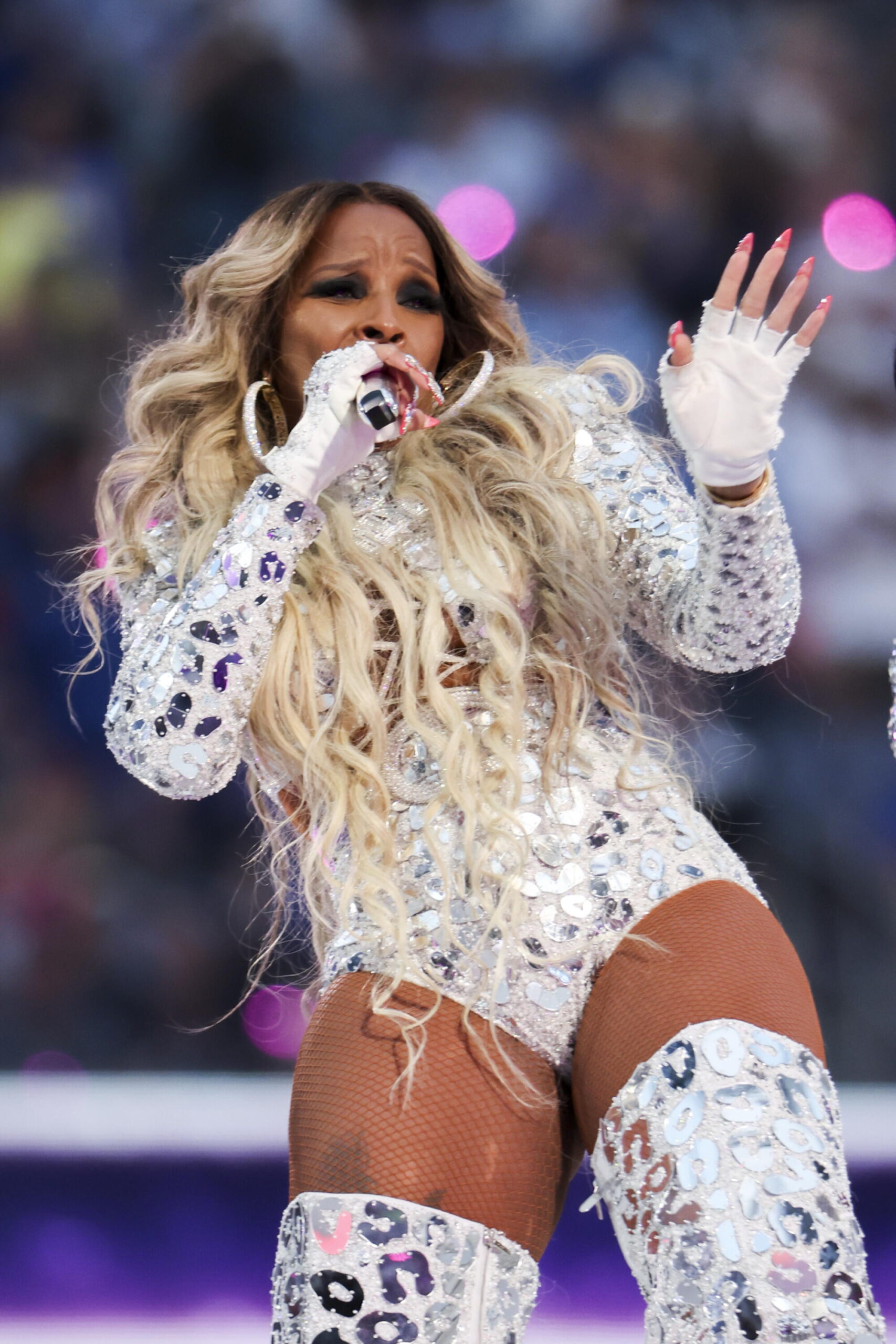
Mary J. Blige performs during halftime of Super Bowl LVI at Inglewood’s SoFi Stadium in 2022.
(Robert Gauthier / Los Angeles Times)
We were talking before about your accolades. Did the Rock Hall mean anything in particular to you? It was important to me because those things don’t happen to us.
To Black women. Yes. It happens to rock ’n’ roll stars every day, and they’re in their grave — there were people in their grave that they were honoring when I went. So when it happens to Mary J. Blige or Chaka Khan or Aretha Franklin, we have to honor that and raise it up. That’s a big deal.
Did Las Vegas feel like a place open to Black women? I’m trying to think of what Black females I’ve seen do Vegas.
Mariah Carey was here. Toni Braxton had a show. Yeah, but like me? But you know what I love? It’s time. And how I know it’s time is because my fans went up. When I made the announcement, they was going crazy — they still going crazy. I’m probably the first to open this door, and next it’ll be somebody else. You better believe they on their way. “Oh, Mary doing Vegas? I’m doing Vegas too.” That’s how it goes: “Mary did her hair blonde? I’m dying my hair blonde too.” That’s how my whole life has been, even actually before the music business.
Nosy question, but what’s an aspect of financial comfort that you especially enjoy? Flying private — that’s the best one for me.
Getting to bypass the grind of travel. That’s what I love about Vegas, because it’s not like tour. Tour, it’s a lot.
Are you soft now? Probably a little spoiled.
Last one: Name an artist that meant a lot to you when you were young that might surprise people. There were so many. I mean, Earth, Wind & Fire —
Everybody loves Earth, Wind & Fire. But that “Way of the World” song — that really does something to me. We loved George Michael — George Michael was always one of our favorite artists. Duran Duran, come on. Oh, “Everybody Wants to Rule the World” — Tears for Fears. And Hall & Oates! [Sings] “Private eyes, they’re watching you.” Ambrosia. The Eagles. I could keep going.
I didn’t expect you to hit me with Ambrosia. They were so soulful — I just got goosebumps. And Queen. That’s one of my favorite movies — “Bohemian Rhapsody.”
Who should play you in a movie about Mary J. Blige? She wasn’t born yet.
MILWAUKEE — It was an evening for pomp and pageantry, for celebrating a World Series between two of the five major league teams never to win one. But, before the first pitch of the first game, the commissioner of baseball and the head of the players’ union held separate media gatherings that only served to reinforce the notion that a lockout in December is a virtual certainty and Opening Day next March is in serious jeopardy.
Of all the major North American sports, baseball is the only one without a salary cap. The players and their union vow to keep it that way, and union chief Bruce Meyer said every proposal the owners make on every issue is contingent upon a salary cap. How, someone asked commissioner Rob Manfred, can the owners strike a deal if the union is entrenched against a cap?
“Re-thinking where you are is a really important part of trying to make a deal,” Manfred said. “It’s actually a skill in collective bargaining. It’s easy to say, ‘I’m here and I’m never moving.’ That’s not a particularly skilled approach to the process.”
That is perilously close to telling the other guy at the negotiating table how to negotiate. It’s also something you might say when you’re feeling pretty darn good that you’re going to win the negotiation.
“We have an unprecedented level of unanimity among ownership that it is something that we need to do,” Manfred said.
He wouldn’t say otherwise at this point, of course. The owners were unified in 1994, when they last demanded a salary cap. They didn’t win, and fans lost the final two months of the 1994 season and the first month of the 1995 season.
When the NHL got its salary cap, owners shut down the league for a full year. Would MLB owners forgo a year — or at least several months — of ticket sales and media revenue to get their cap? Would MLB players forgo a year — or at least several months — of their salaries to stave off a cap?
We won’t know the answer to either question until the spring, and until then a new collective bargaining agreement would require one side or the other to abandon its position.
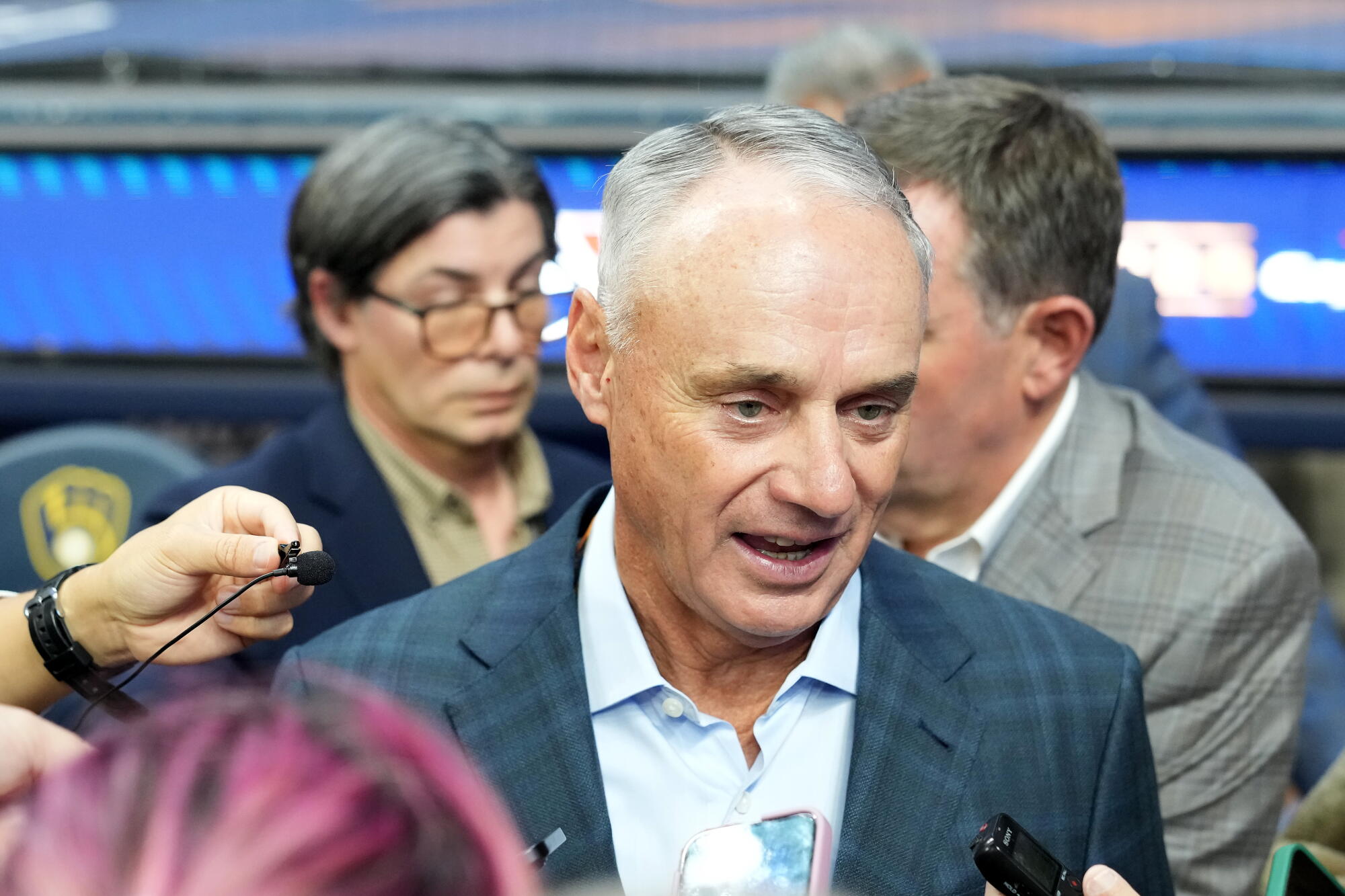
MLB commissioner Rob Manfred speaks with the media before Game 1 of the World Series in Milwaukee on Friday.
(John Fisher / Getty Images)
That makes this year’s World Series something of a Rorschach test: Is a Brewers-Rays series proof that the system actually works just fine the way it is?
To Manfred, the answer is no. A series featuring two of baseball’s smaller markets is an anomaly when history shows a correlation between payroll and success, not only in the regular season but in advancing through the playoffs.
“It’s not that no small market can win,” Manfred said. “It’s just that it’s pretty rare.”
To Meyer, the answer is yes.
“It has nothing to do with what the Dodgers are doing,” Meyer said. “There is no reason whatsoever that the Pirates can’t do what the Brewers have done, or what the Rays have done.”
The Pirates, Meyer said, do not spend all the money they are allotted to sign draft picks. The Brewers, playing in baseball’s smallest market, might not routinely hand out free-agent riches, but owner Mark Attanasio said his team ranks “right in the middle” of the 30 teams in spending on baseball operations.
Attanasio publicly stumped for a salary cap here Friday, saying it would “help us compete but more importantly all of the other teams with lower payrolls too.” He said Brewers fans already fear it might take another 44 years to return to the World Series.
Said Meyer: “That doesn’t seem like a great way, with all due respect, to try and generate excitement among your fans.”
Meyer said this year’s series “undermines their argument” for what he called “the nuclear bomb of a salary cap.” He said the owners are uninterested in the union’s proposals for addressing competitive balance, including increased revenue sharing among owners and a tax against teams that fail to win consistently, and he alleged the league’s argument is “a charade” for what the owners really want: “to suppress salaries and gut player rights.”
The takeaway: Don’t book non-refundable airline tickets and hotel rooms for spring training.
On other topics:
— As The Times has reported, MLB is keeping an eye on federal investigations into Dodgers owner Mark Walter and his insurance empire, which is under scrutiny for allegedly violating laws designed to protect investors. Walter also is a defendant in multiple civil lawsuits filed by investors alleging fraud and breach of contract.
“As always when we have an investigation — external, law enforcement, whatever — we monitor that,” Manfred said. “That’s where we are right now. We’re just watching what’s going on right now.”
Over the past two months, amid efforts to find what could be more than $20 billion to recapitalize insurance funds, Walter has sold his controlling interest in the Lakers and a minority share of Chelsea, the English Premier League club. On Friday, Bloomberg reported he is seeking to sell the Sparks. He has no plan to sell the Dodgers, team president Stan Kasten has said.
— Meyer said the MLBPA continues negotiations with LA28 over how major league players would be accommodated in the 2028 Olympics. “As of now, we’re not getting satisfaction on those things,” Meyer said.
Both the league and the union say they want to participate in the Games, but Manfred said MLB would normally start preparing its 2028 schedule early in 2027. The league has agreed to an extended All-Star break to accommodate the Olympics, but MLB also could tire of waiting for the union to agree with LA28, which badly wants MLB players to participate.
Tribute specials are always a bit macabre. They exist, and are sometimes quickly thrown together, to honor and celebrate an artist who impacted so many. They are also ratings and advertising cash grabs that air on major TV and streaming platforms.
“CMA Presents I Will Always Love You: A Celebration of Dolly Parton,” which aired Wednesday on ABC and Disney+, was a lovely tribute to the music and cultural icon who died from cancer in August. It also was a missed opportunity. As music superstar Vince Gill said toward the end of the two-hour program, “this is not a memorial; but a celebration of an undeniable force of nature. Dolly was somebody that everyone loved: City, country, young, old.”
But most likely because the event was put on by the Country Music Assn. — which naturally wanted to showcase its own talent — it lacked a chance to really celebrate that she and her music could not be contained by one genre.
This isn’t just ironic because Parton’s most-known song — a song that was both the title of the special and the end performance of it — was made all the more famous by Whitney Houston, another iconic performer and also one who happens to have been a woman a color and who did not have any other direct ties to the Nashville scene. Dolly herself, famously, appreciated so many other kinds of music. After her passing, Eminem shared on social media a letter she’d written to him to congratulate him on his 2022 induction to the Rock & Roll Hall of Fame.
“She definitely didn’t have to take the time to do it,” he said as part of the post. “Even for a kid who mostly listened to rap music, she was an icon. A superstar in every sense.”
That said, from Reba McEntire opening the show with stories of just how kind her friend was in real life to a pre-recorded tribute from Bono where his Irish accent briefly attempts to slip into a Southern one while emulating her conversations with him, there were some touching and memorable moments. We’ve rounded up five of them here:
Reba McEntire, “He’s Alive”
Technically, the song is meant to be the apostle Peter singing about Jesus Christ’s resurrection. But McEntire’s take on Parton’s take of the Don Francisco gospel brought in the very modern-day sense of fear that so many parents and partners feel when their loved ones go out to dangerous jobs or even just leave the house for school or concerts.
Carrie Underwood, “I Will Always Love You”
There’s no denying that this is a perfect song and that Underwood is a once-in-a-lifetime voice. And credit must be due to Underwood for pulling off an undertaking where any little slip would be pounced on by critics. But staging her to stand in front of one of the many animatronic butterflies that lined the stage in such a way that it looked like she had angel wings was … a choice.
Carly Pearce and Kristin Chenoweth, “9 to 5”
Both of these women, especially Tony winner Chenoweth, are masters of stage presence. Their banter with each other before singing, not to mention their duet itself, embraced the liveliness and feminine feminist-ness of that song.
Ella Langley, “Jolene”
This was not the most powerful performance of the night, as Langley seemed happier to dance on the stage than belt out the music. And it didn’t boil with the grief and seething rage of a scorned woman the way that Beyonce’s 2024 cover did. But it was nice to see a symbolic baton be passed to the “Choosin’ Texas” singer.
Zac Brown, “Butterfly”
Brown’s backstory of writing, and then recording, what would become his 2025 duet with Parton came off as sweet and genuine. It also helped it not feel awkward or gratuitous when he and the producers opted not to recast the Parton half of the song and instead let her voice carry through the speakers.
I was trying to discern whether I’d made a wrong turn when I heard a loud whoosh next to me. Somehow, I’d missed the red-tailed hawk perched on a small tree, watching me from an arm’s length away.
That was one of many delightful surprises I encountered as I developed a 6.7-mile urban hike that I will share in this edition of The Wild, our weekly outdoors newsletter.
You are reading The Wild newsletter
Sign up to get expert tips on the best of Southern California’s beaches, trails, parks, deserts, forests and mountains in your inbox every Thursday.
By continuing, you agree to our Terms of Service, which include arbitration and a class action waiver. You agree that we and our third-party vendors may collect and use your information, including through cookies, pixels and similar technologies, for the purposes set forth in our Privacy Policy such as personalizing your experience and ads.
Back in May, I published a 13.5-mile urban hike (see map) that connects trails along the Arroyo Seco and in Elephant Hill Open Space, Ascot Hills, Lincoln Park, Flat Top Park and Ernest E. Debs Park. I wanted to celebrate our local hillsides but also showcase natural areas that remain under threat of development.
I have wanted to expand the route ever since I published it. I got motivated, though, when I saw that the Mountains Recreation and Conservation Authority, or MRCA, will receive a $200,000 grant in Proposition 4money to develop a trail connecting open spaces in Northeast L.A.
MRCA will consider how to connect Elephant Hill Open Space with other land that it owns and manages, including Elyria Canyon and Rainbow Canyon, along with parks and open spaces owned by other public agencies.
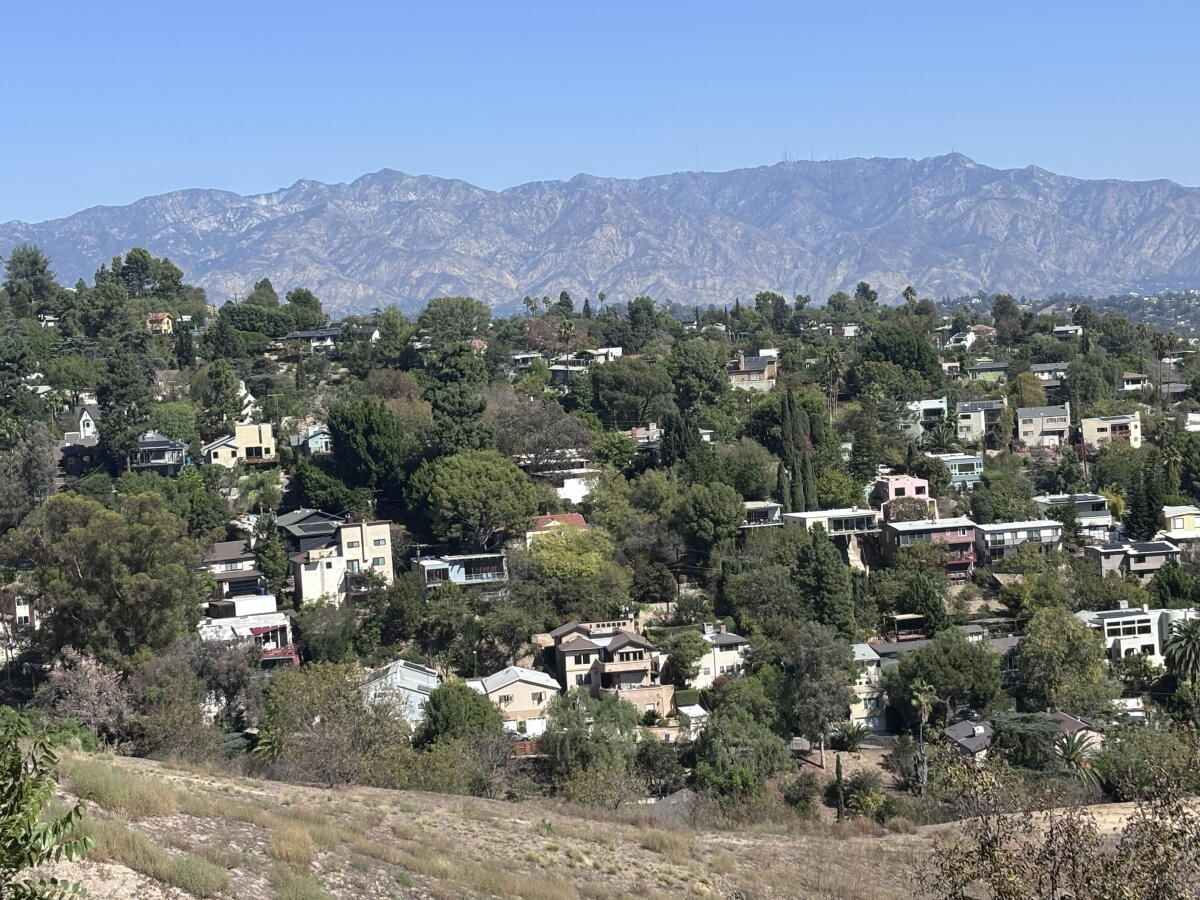
The view from Kite Hill, a high point in Mount Washington, from near North Avenue 37.
(Jaclyn Cosgrove / Los Angeles Times)
“We’ve been thinking about connectivity in Northeast L.A. for a while, the idea being that we connect the protected hilltops and canyons creating access to the Arroyo Seco, which ties up to the Angeles National Forest and down to the L.A. River,” said Sarah Kevorkian, deputy chief of wildfire resilience at MRCA, noting that there’s great energy and momentum built by community members who want to see their neighborhood open spaces protected.
I am eager to see what MRCA and its partners develop. Based on what I’ve experienced, urban hiking trails can lead to better connection among neighbors and a deeper appreciation for nature nearest to us. In the interim, I developed the trail below that envisions what a regional connector trail could look like.
The total extension to the River to the Hilltops route is about 9.4 miles when you include the three “connector” trails that I indicate via a dotted blue line on the map. In total, the full route is now about 23 miles. Below, I explain the heart of the extension through Cypress Park and Mount Washington, which is about 6.7 miles without the connectors, including the two that would take you to the larger original trail. I made this route in a “Choose Your Own Adventure” style, hoping to inspire folks to (legally!) explore their city, hence the flexibility (and complications in explaining mileage).
Some quick logistics before I dive into the route:
I developed the route using CalTopo, an online mapping software with a desktop site and mobile app. You can download the CalTopo app onto your phone and follow the route there; you can also download the trail from CalTopo to use on your Garmin or other device. I also uploaded it to my AllTrails profile.
In May, I dubbed the original trail “River to the Hilltops” in CalTopo and on AllTrails. Afterward, a reader suggested “Jewel Necklace” as a name. What do you think?
I haven’t marked everywhere you can find a restroom or water, but will try to add those as time allows. Please plan accordingly, as some stretches run through neighborhoods or open spaces where there isn’t much nearby.
There is no single place to start this route, although this newsletter will focus on the latest extension. You can start and stop this route in several spots though.
Trail access and conditions can change. Please follow all posted signage (and contact me if you encounter major issues).
This route travels through several neighborhoods. Please refrain from using Bluetooth speakers and anything else that would be disruptive to residents.
There are several places along the route where you will walk in the street of a neighborhood because it lacks sidewalks; please use caution!
At several junctures along the suggested route, you will have an option to take a different path that will essentially get you to the same place. Do what’s best for you, and most important: Have fun, be safe and don’t trespass!
A red-tailed hawk flies over Bob Scholfield Park in Mount Washington.
(Jaclyn Cosgrove / Los Angeles Times)
Now let’s talk more about the route (full map here).
To begin this extension into the neighborhoods of Mount Washington and, briefly, Cypress Park, I started at the Lincoln/Cypress Metro station off the A Line (previously, and forever in our hearts, the Gold Line). The station has a series of stairs and ramps that you can take down to West Avenue 26, which borders the station on its eastern-ish side.
You’ll quickly turn right (or northeast) onto Lacy Street, passing Lacy Street Neighborhood Park. I chose this option because, as you’ll see after about a quarter of a mile on Lacy, it leads to a pedestrian bridge.
A pedestrian path that leads to a bridge taking walkers and hikers over the 110 Freeway.
(Jaclyn Cosgrove / Los Angeles Times)
It is not a well-marked or particularly welcoming pedestrian bridge, but it exists nonetheless. You’ll see a narrow walkway lined with a green metal fence topped with spikes and, later, razor wire. Did I mention it’s not terribly welcoming?
Head over the 110 Freeway via this bridge, and turn right onto Arroyo Seco Avenue and then soon left on Amabel Street. But appreciate this little jaunt, as it’s the last bit of flat walking for a bit.
A pedestrian bridge over the 110 Freeway near Cypress Park.
(Jaclyn Cosgrove / Los Angeles Times)
Cross over North Figueroa Street, and trudge up the hill before you, which has an average grade of about 15%. You’ll pass a neighborhood sign for Mount Washington as you bear left on Isabel Street before making a quick right (north) turn onto Glenalbyn Drive. Continue northeast onto Beech Street and feel as amazed as I was when it becomes a dirt path.
As I trotted through here, I enjoyed watching a kettle of turkey vultures soaring high above the homes perched on the hillside, looking for a fine carrion brunch.
Rather than continuing on the dirt path that heads southeast, I headed up Montalvo Street. Be careful here, as there is no sidewalk. I headed north onto Andalusia Street, or Avenue on some maps, and then further northwest onto West Avenue 37.
A gate was installed on West Avenue 37 in the late 1980s to block rowdy visitors from driving to and partying on Kite Hill in Mount Washington. The route remains open to pedestrians.
You’ll soon arrive at Kite Hill, which The Times described in 1988 as “a scenic Mt. Washington location popular with kite-flyers by day and partying teenagers by night.”
The rambunctious youths were so noisy, L.A. City Council spent $1,200 — about $3,500 in today’s money — to install gates to prevent vehicle traffic. The route remains open to pedestrians.
“It’s like the Hollywood Bowl up there, but it goes on all night,” resident Bob Cummings, a real estate agent who had lived on Mount Washington for 18 years, told The Times in 1988. “It’s like a cancer that started. We’re asking for the city’s surgeons to cut it out.”
When I visited Monday, I saw no evidence of kites or parties, but I did appreciate the glorious views of our local hillsides and San Gabriel Mountains.
One perk of walking the Mount Washington leg of the route is the Halloween decor you’ll spy along the way.
(Jaclyn Cosgrove / Los Angeles Times)
At the juncture of West Avenue 37 and San Rafael Avenue, you have two options in terms of the route I’ve charted out: You can continue northwest on West Avenue 37, where you’ll quickly be frolicking in Elyria Canyon, or you can take San Rafael Avenue and a short winding path down to Rainbow Canyon, which is also lovely.
Although I designed this leg of the River to the Hilltops route to start at the Lincoln/Cypress Metro stop and end at the Southwest Museum Metro station, you can also turn it into a loop, as you’ll see on the map.
For the purposes of this newsletter, I’m going to explain the route via the first option, continuing northwest on West Avenue 37 and then right (or northwest) onto Killarney Avenue for about 400 feet until you turn right onto some wooden, dirt-covered steps. You’ve reached Elyria Canyon Park!
Wooden stairs lead down into Elyria Canyon Park, where hikers will find several species of native shrubs and trees.
(Jaclyn Cosgrove / Los Angeles Times)
Be mindful as you take the steps, as the loose dirt can be slippery. You will have lovely views of L.A. and its landscapes as you meander past native shrubs and trees, including black sage, toyon and wild cucumber. This 35-acre park “boasts one of the finest examples of California black walnut woodland in Southern California,” according to the Mountains Recreation and Conservation Authority, which manages the land.
That’s one reason that a 1996 Times story dubbed this park “a living example of the Los Angeles of 200 years ago.”
There are multiple routes, and I won’t discourage you from exploring beyond what I’ve mapped out, which from the map, you can see is a quick loop, passing through the park (including Akuutet Learning Nursery and the surrounding neighborhood. If you find yourself needing a snack break, you’re in luck. (I will admit that I wanted the same while in Elyria Canyon and took a short walk over to Little Barn Coffee House, one of my favorite spots in L.A.)
The path through Elyria Canyon travels through the 35-acre park that features a California black walnut woodland.
(Jaclyn Cosgrove / Los Angeles Times)
After the loop, you’ll head out of the canyon onto Elyria Drive and then make a left back onto San Rafael Avenue, which you’ll take for about a third of a mile. Continue north past San Rafael Avenue and Danforth Drive onto Sea View Avenue. In about a third of a mile, Sea View will transform into a dirt path as you enter Bob Scholfield Park (per the name etched into a rock under a tree).
Two red-tailed hawks flew overhead as I entered this charming stretch of the walk. I chatted with another hiker and petted his Great Pyrenees dog, as I grew up with the breed and have a soft spot for these giant fluffy goobers.
After following this dirt path as it curves around, you will return to a paved Sea View Drive. Head southeast, and you’ll quickly find yourself at Moon Canyon Park.
Moon Canyon Park in L.A.
(Jaclyn Cosgrove / Los Angeles Times)
Developers had wanted to construct 18 homes and a parking lot in this 4.5-acre canyon, but the L.A. City Council instead set aside $550,000 to preserve it, according to a 2003 Times story.
“I couldn’t be happier because the canyon will be left open,” resident Sharon Roesler, a member of a group opposing developing the canyon, said at the time. “We don’t have enough of these places to go to in Los Angeles.” (If you want to learn more about restoration efforts here, you can visit the Friends of Moon Canyon website, which is working to restore the canyon.)
You will walk southeast down a pleasant dirt path through the canyon, noticing those restoration efforts, before you hit pavement for just a moment and then immediately bear right onto West Pheasant Drive, another dirt path.
A Chevy van parked ahead on the trail.
(Jaclyn Cosgrove / Los Angeles Times)
I was enjoying my hike when I followed the bend of West Pheasant Drive and noticed a van parked ahead. Now, I’ve seen enough horror movies that I quickly started to write the opening scene to my demise.
EXT. DIRT HIKING TRAIL
“JAC, a well-meaning but unfortunately oblivious hiker, spots a vintage camper van on the trail. They have no idea what lurks ahead.”
Thankfully, there was nothing other than a funky DIY project lurking in the distance. I approached the van to find a cardboard sign attached (which, again, sounds creepier than it was).
“The process is as WiLD as the circumstances!” it read. “This van is unable to leave the road (you may have noticed 🙂 ) so we are resituating it to optimize space (something special, incoming!).”
A narrow dirt path called West Pheasant Drive on some maps.
(Jaclyn Cosgrove / Los Angeles Times)
After you pass the van art project, you’ll soon reach a nest of streets, as each has a bird name. You will turn right from West Pheasant onto Quail Drive and then quickly left onto Dove Drive. Follow Dove Drive southeast and quickly take a hard right (northwest) onto Glenalbyn Drive, followed by a hard left (southeast) onto Mavis Drive and then soon a right on Frontenac Avenue, then left on West Avenue 46 to head into the park area around the Carlin G. Smith Recreation Center.
You’ll pass through a gate and meander down the path, with an optional side quest to have a friend push you on the tire swing. After shenanigans, walk through the basketball court to where the path continues in the court’s southeast corner.
This route, when I traversed it, was loose and narrow. If it feels too sketchy, take the road or use a trekking pole if you’ve brought one. No reason to turn an ankle after you’ve had an otherwise splendid day!
At the end of this rustic route, take West Avenue 45 down to the Rainbow Canyon Test Plot, a publicly owned area where volunteers are readily restoring the canyon with native plants and shrubs. There is a pleasant little trail from the test plot that goes through the canyon. You will take it up to West Avenue 44.
A previous walker left a message on a utility pole to remind us of one reason we hike.
(Jaclyn Cosgrove / Los Angeles Times)
From here, you can either use the connector trail I’ve mapped out or head down West Avenue 44 to Marmion Way and the Southwest Museum Metro stop.
That is the end of the Mount Washington trail extension, but doesn’t have to be the end of your day. If you’re feeling adventurous, I have mapped out a connector route through Sycamore Grove Park that will take you to the Arroyo Seco and Debs Park — and beyond that!
The total route now includes about 23 miles of urban hiking. Where should I extend the route next? I’d love your feedback on how to connect our public lands.
3 things to do
The Devil’s Punchbowl Natural Area sits near the San Gabriel Mountains.
(Jaclyn Cosgrove / Los Angeles Times)
1. Be with the bats near Pearblossom L.A. County Parks and Recreation will host Bat Weekend on Saturday and Sunday, from 4 to 7 p.m. both days, at the Devil’s Punchbowl Natural Area near Pearblossom. Guests can participate in crafts and a night walk and visit educational booths. Learn more at the park’s Instagram page.
2. Seek out scares in Culver City Walk ‘n Rollers will host a Halloween-themed bike ride from 5:30 to 8 p.m. Sunday in Culver City. Cyclists will travel five miles on city streets and bike paths, exploring the best Halloween decor in the area. Riders will meet at Village Well Books + Coffee. Register at eventbrite.com.
3. Blend science and the spooky in Orange SoCal Science Hikes will host a Halloween-themed evening hike from 6 to 9 p.m. Saturday through Irvine Regional Park in Orange. Participants will first try to spot diurnal animals as they hike 2.5 miles, and then after, meet at a faux campfire for ghost stories. Costumes welcome, as long as you can hike in them. Register at eventbrite.com.
The must-read
Finley Kilgo pauses during a birdwatching bike ride through the Arcata Marsh and Wildlife Sanctuary at the northern end of the Humboldt Bay Trail. The trail could eventually become part of the Great Redwood Trail.
(Andrew Cullen / For The Times)
Advocates of the Great Redwood Trail, a proposed 307-mile route that follows defunct railroad lines, say the route could become as epic a bucket-list trip as other great multi-day scenic trails. But at what cost? Times staff writer Lila Seidman spoke to Perry Lincoln, a member of the Wailaki Tribe, who said he and other Indigenous people in the area have been left out of the planning process for a hiking trail that cuts through their ancestral land. “We’re barely getting access to these areas ourselves, but we’re going to allow outside communities to have full access to these places?” Lincoln’s daughter Tisanche Warren said. “That doesn’t seem fair.” About 40% of the trail is complete, with major efforts planned to clean up railroad pollution and restore fish habitat. The Kinest’e Community Coalition, composed of Lincoln and other tribal members and their allies, continues its fight to not only have a say in the project but also to reroute the trail to protect sacred sites, including graves.
Happy adventuring,
P.S.
Are you interested in getting into mountain biking? Or do you want to find a community of mountain bikers? The California Mountain Biking Coalition will host Rally for the Trails, a gathering of the Southern California cycling and trails community from 5:30 to 7:30 p.m. Friday at the Cub House in San Marino. You’ll learn from guest speakers, watch short films and learn about local ride events. Plus, you can meet volunteers from several local outdoors groups. Sounds like a great way to meet new pals!
For more insider tips on Southern California’s beaches, trails and parks, check out past editions of The Wild. And to view this newsletter in your browser, click here.
NEW YORK — “860,” the title of Billy Crystal’s tremendously moving new Broadway show at the Imperial Theatre, refers to the address of his house in the Pacific Palisades that was destroyed in last year’s fire.
Crystal re-creates the events of Jan. 7, 2025, as the wildfire that began in the Santa Monica Mountains started making its way down toward his home at 860 Chautauqua Blvd. Video clips of the escalating emergency are shown as a cardigan-clad Crystal, standing in a facsimile of his home office (the conjuring work of scenic designer Scott Pask), re-creates the horror of having to decide what to take with him as the evacuation orders come in.
The photos, awards and other memorabilia aren’t just souvenirs of his storied career. They are pieces of the life he built with his wife, Janice, and their two daughters as well as a record of the friendships that made Hollywood feel like a welcoming community for a wide-eyed Long Island kid.
“860,” impeccably directed by Scott Ellis, occurs in a series of flashbacks. Crystal brings us back to what it was like as he and his wife made their way across a jam-packed Sunset Boulevard in separate cars to the safety of their daughter’s house as smoke and flying embers turned their small-town paradise overlooking the Pacific Ocean into an apocalyptic war zone.
A baseball superfan, Crystal gives us the play-by-play as though he were calling a World Series game that had taken an unimaginable turn. Hana S. Kim and Kylee Loera’s video design turns us into eyewitnesses of that terrible day.
I was in Los Angeles when the Palisades and Eaton fires broke out, but I was far enough away not to feel the immediacy of the threat. Crystal had me in full fight-or-flight mode, as if I were in the car behind him going 5 mph along the only route out of danger.
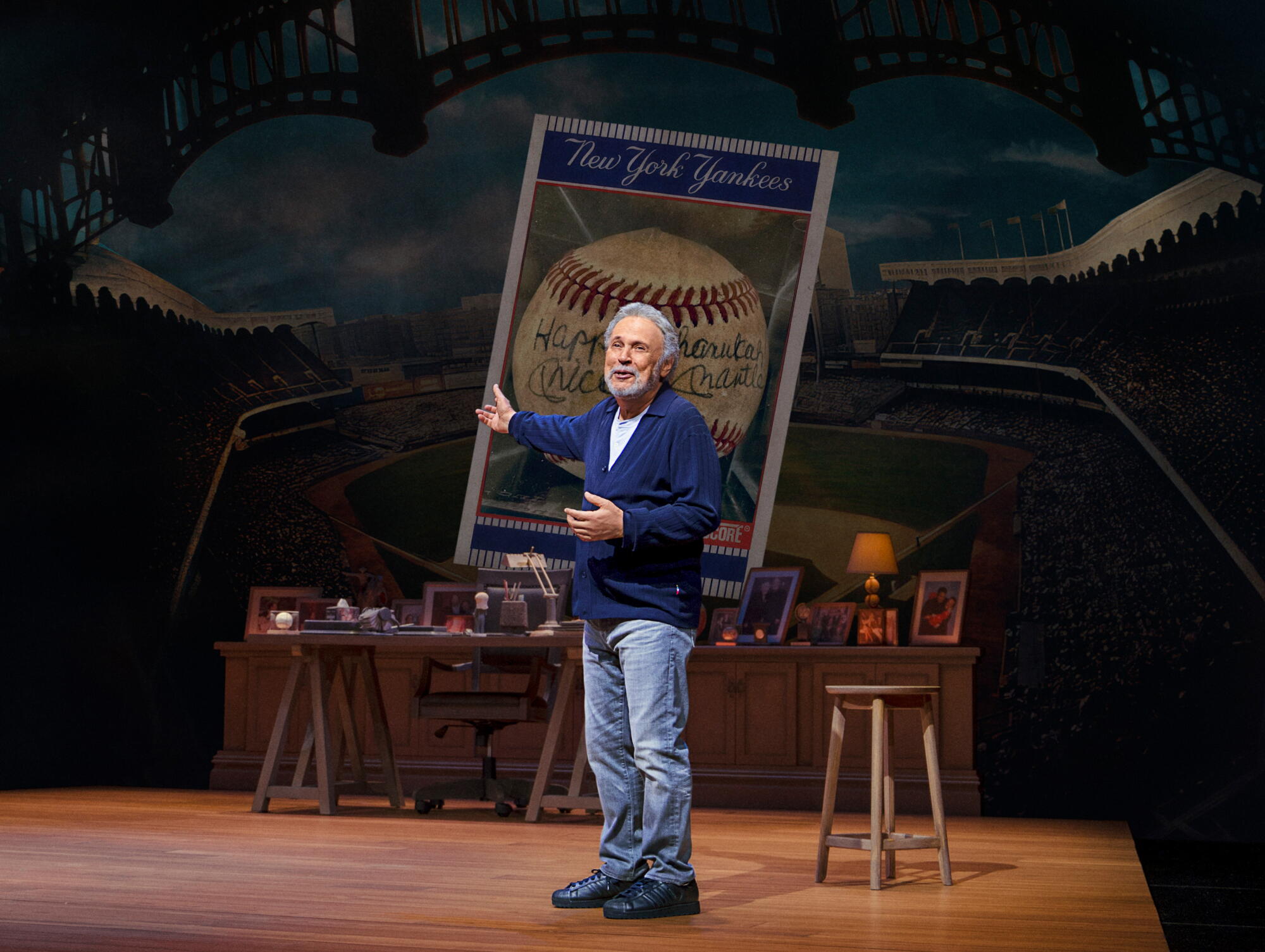
Billy Crystal in “860” at the Imperial Theatre on Broadway.
(Avery Brunkus)
Making a show about a recent public trauma isn’t easy to pull off, but Crystal has managed it as perhaps only he could. “860” is a meditation on loss, but it’s also a theatrical memoir of his multifarious career as a comic, actor, filmmaker and celebrated Oscar host. He returns to his days on “Soap,” the controversial nighttime parody of a daytime soap opera created by Susan Harris that featured Crystal in the role of Jodie Dallas, one of TV’s first openly gay characters.
Crystal was living in an apartment in then-smog-filled Hancock Park with his wife and daughters when he was filming the show’s third season. The couple wanted to move to an area that had better air quality for their children, and someone asked if he knew about the Pacific Palisades.
“It was a small town, good schools, beautiful afternoon breezes from the nearby ocean, one main street with some shops, a deli named Mort’s that had lean corned beef and a lot of people who didn’t put mayonnaise on pastrami,” Crystal recounts.
The house they came to see wasn’t for them, but a for-sale sign at 860 Chautauqua caught their eye. The real estate agent told them that the owners “were very motivated to sell because they were very motivated not to be together anymore.”
It was December 1979 when, with a 30-year mortgage in hand, they moved into the house. Two women who grew up at 860 (“Imagine the twins from ‘The Shining’ — but they’re 55”) paid a welcome call to say how pleased they were that their former home was back in the hands of show people.
The original owners were vaudevillians who had a mind-reading act and were passionately into the occult. They socialized with the comic luminaries of their day, including humorist Will Rogers, who would regularly stop by on his horse. Behind a secret wall, Crystal found a hidden room with a cork board that had clippings that suggested maybe it wasn’t such an accident that the house became his.
Crystal, the emcee of all emcees (as his performance at this year’s Hollywood Bowl Opening Night once again proved), tells the story of his home with buoyant humor and charm, turning loss into living memory. To set up the meaning of what was destroyed, he takes us back to his roots, starting with his graduation in 1970 from NYU, where he took a film production class with a young Martin Scorsese, who would critique his work in a manner that Crystal, the Al Hirschfeld of celebrity impersonators, hilariously captures.
Crystal’s comic timing was honed in the clubs doing stand-up. Jack Rollins, the producing titan who managed Mike Nichols, Elaine May and Woody Allen, imparted some wisdom after watching Crystal’s act. Crystal thought he killed it that night, but Rollins told him that he failed to “leave a tip,” meaning reveal something about himself in his jokes.
Opening for Blood, Sweat & Tears in Scranton, Pa., a huge opportunity, Crystal faced a hostile audience. But he won the crowd over and thought maybe he could really make this stand-up comedy thing work. But then he was sent back out onstage after lead singer David Clayton-Thomas decided he didn’t want to perform and had to win the jeering music fans over again — and then a third time. While driving home on the New Jersey Turnpike to his wife and baby that night, he felt his future in front of him, having found not only his calling but also his voice.
Crystal’s luckiest break may have been in not being drafted during the Vietnam War, but a close second was being invited to do his Howard Cosell-Muhammad Ali routine at a televised gala for the boxing legend. Crystal not only crushed it but he made a lifelong friend in Ali, who was already his personal hero.
Bonds forged in comedy, like the one he had with Robin Williams, deepened into a lasting brotherhood. Norman Lear cast Crystal as Rob Reiner’s best friend on “All in the Family,” and life imitated art. Their successful collaborations — crystallized in the fake orgasm scene at Katz’s Delicatessen in “When Harry Met Sally” — were an outgrowth of their telepathic comic rapport.
In reviewing his famous life, Crystal reanimates parts of our own. And it’s this shared history that helps us understand what he lost when his house went up in flames. The magnitude of the devastation is made personal for all of us.
But just when you think things can’t get any worse, something completely unthinkable happens. For Crystal, this occurred at the end of 2025, his annus horribilis, when Reiner and wife Michelle were found stabbed to death at their Brentwood home.
Some things are too painful for words, and Crystal knows that sense cannot be made from senselessness. But he’s already told us so much about this unique friendship that nothing more needs to be said.
Crystal doesn’t wallow in grief or self-pity. He bears the weight of his losses with his wit and generous spirit to help us carry the weight of our own. (When he walked into a store to buy a new wardrobe after the fire, he reports, the salesclerk looked at him and said, “Let me guess … Ozempic?”)
No one gets out of this world without becoming a master of the art of losing, to invoke the poet Elizabeth Bishop. But laughter can sustain us through our losses, and Crystal thinks it’s no accident that one of the few things that was salvaged from the ashes of his home was a stone from his garden with the word “laughter” engraved on it.
I found Crystal’s previous solo show “700 Sundays” to be a touch mawkish, so I wasn’t expecting to be so powerfully moved by “860.” But this is just a brilliantly conceived and executed piece, and I hope it yields Crystal another Tony Award.
But even more, I hope the production finds its way home to where it belongs, Los Angeles. We could really use the fortifying laughter.
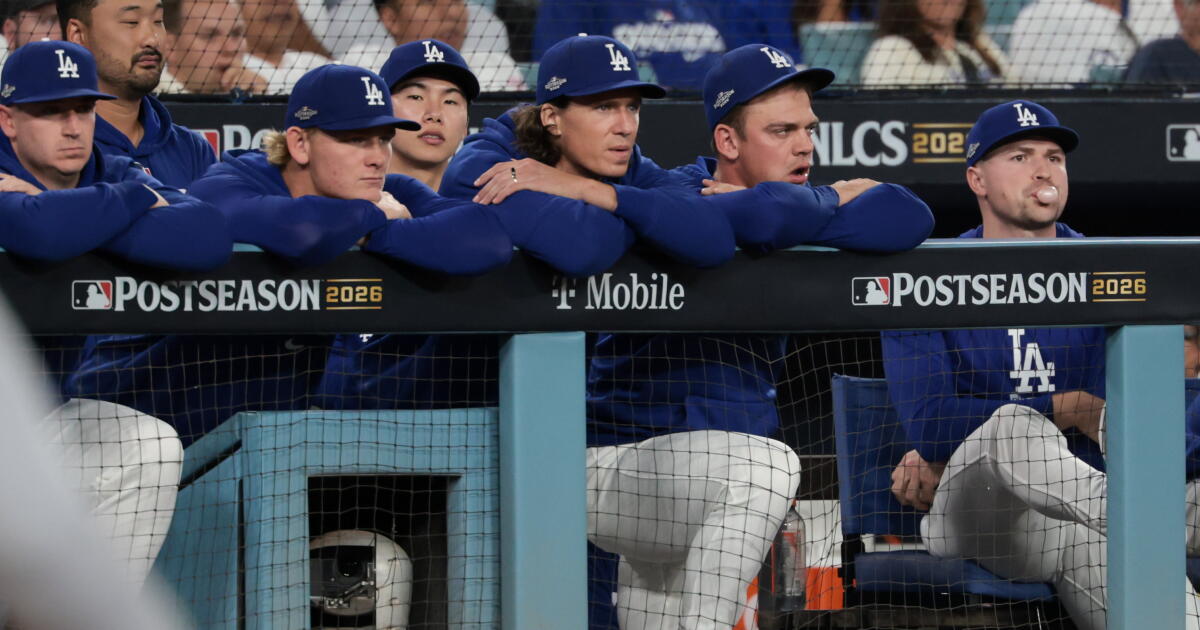
Dodger Stadium was eerily quiet on Wednesday, as a light rain fell over the already-yellowing grass. A crow perched on an empty seat. Scattered lights flickered in mostly-dark hallways.
Before the World Series had begun, the stadium was closed down for the season, hosting just one last event before officially wrapping up the 2026 slate.
In the interview room, tucked away at the entrance to the clubhouse, president of baseball operations Andrew Friedman and general manager Brandon Gomes took their seats at the podium for their end-of-season press conference.
There was the usual end-of-season checklist. Are you expecting any changes to the coaching staff or front office? “I expect status quo,” Friedman said. Is Shohei Ohtani going to undergo offseason surgery? “That’s not on the table,” Friedman said.
“I welcome it,” Friedman said of such claims. “For us, and we’ve talked about this a lot, even after successes and we winning a World Series and then winning back to back, everything we do is for our fans. And there’s a lot of noise around us in general. We don’t really pay much attention to it. It’s a partnership we feel with our fans, and so people saying that we’re done and we’re on the downside of this run — it’s just more noise to us because everything for us is about the motivation we have to have a parade in the streets of Los Angeles next November.”
Friedman also didn’t seem to anticipate any trickle down from Walter’s outside ventures — Walter’s insurance companies are under federal investigation and face several lawsuits — affecting the Dodgers’ offseason budget.
“It’s been business as usual for us,” Friedman said. “We talked to Mark after we lost, and he was obviously really disappointed. But so much of his focus was on, ‘OK, what can we do? What are our plans? What are our thoughts for the off season?’ And our brains weren’t quite there yet, but so much of his focus was how do we put ourselves in the best position to win in ‘27?”
How will the Dodgers go about picking themselves up from their NLCS exit?
The Dodgers’ 2026 season wasn’t exactly a failure. They won 100 games in the regular season and lost in the playoffs to the only team that won more than that — the Brewers. But the Dodgers, with their star power and payroll, aren’t in the business of accepting moral victories.
Though plenty went wrong in the postseason, from Ohtani’s struggles following hisinjured list stint, to stalwart Yoshinobu Yamamoto’s surprising short start in Game 2 of the NLCS, the overarching theme in the Dodgers’ four straight losses to the Brewers was a lack of offensive execution, especially with runners in scoring position.
“Obviously throughout the latter part of the year, it was stuff we were talking about and trying to put our finger on,” Friedman said of the offense. “And in a lot of ways, it’s a little bit of a game of whack-a-mole, where it can be one thing for some period of time, and then it’s something else, and then it’s something else. Sometimes it’s noise, and sometimes it’s real. And what’s important for us is to be able to sift out the noise and isolate what’s real and what things we can improve upon. We’ll spend a lot of time really focusing on that in the off season.”
Asked if the age of the lineup could be a contributing factor, Friedman pointed to the strong finishes of some of the more veteran players on the roster.
“I don’t think it’s as easy as to paint it with that broad of a stroke,” he said.
Friedman, in an effort to continue to extend the Dodgers’ run of success, has kept in mind the cliff that successful veteran teams can fall off of, if the roster isn’t properly backfilled.
“This isn’t something that we just woke up and were like, ‘Oh wow, the age of our position player group,’” Friedman said. “We knew what things were going to look like in ‘26, ‘27, but also how talented these guys are, the way they prepare. And so much of our long-term contract bats are betting on the human — betting on the person, betting on the work ethic, betting on them doing everything they can to keep themselves in the best position to have success. But when you couple the core talent that we have at the major league level with the position-player strengths that we have in our farm system, that’s what makes us excited, is the art of how to onboard some of these young, talented minor league players.”
The Dodgers had the No. 1 ranked farm system as of mid-August, according to MLB Pipeline. But many of those prospects, including the three outfielders who the Dodgers’ Top 3 (Josue De Paula, Eduardo Quintero and Mike Sirota), are blocked by veteran players.
“For us, it’s just about having as many many talented players as we can, and things tend to sort themselves out,” Friedman said.
This offseason, the Dodgers will also have to figure out what to do about their soon-to-be free agents, a group headlined by left-hander Tarik Skubal. The two-time Cy Young winner was not only the best pitcher available on the trade market when the Dodgers acquired him from the Tigers at the trade deadline, but he’s in line to be the best pitcher available this offseason as well.
“It’s not easy for a guy to get traded in the middle of a season to come to a new city, new clubhouse,” Friedman said. “You have set routines, and you have to make those adjustments. It’s not easy. The way he was able to seamlessly transition, not just in terms of on the field, but in the clubhouse, I can’t say enough good things about the impact that he made in such a short period of time.
“We have a tremendous amount of respect for him on and off the field. … He’s put himself in this position to go out and be a free agent. And for us, it’s, continue to talk to [his agent, Scott Boras]. But he and his family have to make a choice over where they want to spend the next X number of years, and obviously we wish him nothing but the best.”
When asked about negotiations, however, Friedman spoke generally, saying the Dodgers were still “wrapping [their] arms around” their offseason strategy.
The impending lockout, which is expected to go into effect on Dec. 1 as soon as the current CBA expires, and uncertainty over changes in the next CBA, will certainly affect the free agent and trade markets this offseason. And though MLB navigated a lockout just five years ago, the owners’ push for a salary cap has many around the industry bracing for a longer work stoppage and murkier landscape on the other side.
“I never have any feel for how a market’s going to play out,” Friedman said. “We’ve kidded ourselves in the past that, like, ‘Hey, we think this is going to happen,’ and it just takes on its own life form. So for us, it’s just about being as prepared as we possibly can be, and pouncing on opportunities.”
Dread is usually the first sensation Angelenos conjure when they hear “LAX.” It doesn’t have to be this way, L.A.
You might be preparing to check in toward a faraway destination, or doing what is often called the ultimate expression of love here: driving someone to or from one of the busiest airports in the world. Either way, if timed right, your journey can become a satisfying dip into the culinary scene surrounding our vice for the airborne, our awkward beauty, El Ay Ex.
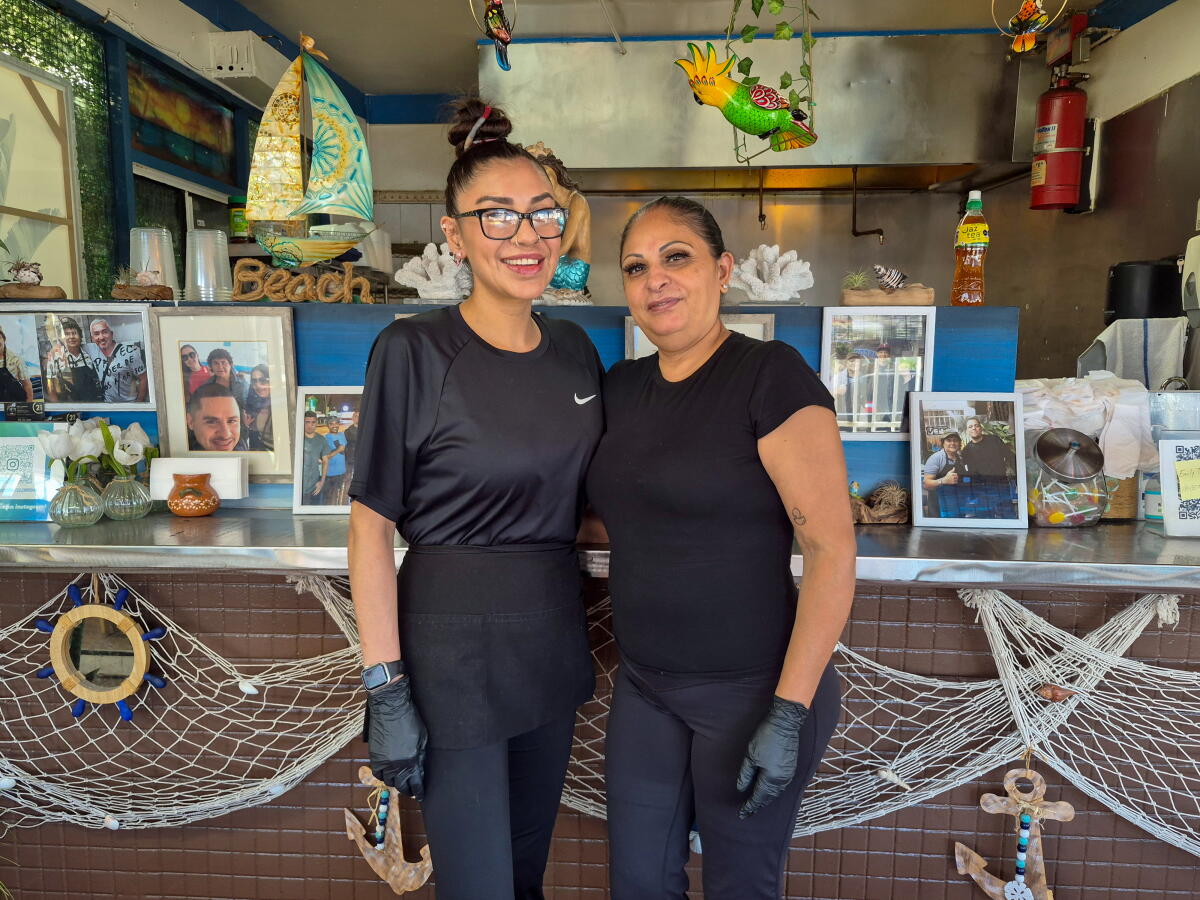
Mariscos El Chente staff members Denise Miranda and Maria Peñuelas.
(Daniel Hernandez / Los Angeles Times)
No, you don’t have to limit yourself to the touristy In-N-Out on Sepulveda Bouelvard. Skip Randy’s Donuts if you’ve done it before. For this guide, we’re zeroing in on local favorites in the quietly robust scene of dining and drinking within one mile of the airport’s perimeter. No hotel restaurants or lounges.
A tight proximity to the runways means you’re mostly surrounded by busy LAX workers and hardcore locals from the communities of Westchester, El Segundo, Lennox, Hawthorne and Inglewood. Sprinkle in people who’ve just landed from just about anywhere in the world, and the magic of the LAX cultural orbit comes alive. I’m no longer kidding or holding my secret: Because of the restaurants and bars, I actually love hanging out around the airport.
This makes me part of a low-key membrane of Angeleno who enjoys watching jetliners serenely glide their passengers through the sky, landing a kiss away from the gleaming Pacific, as we sip a nice lager or chomp into a mulita. I can trick my brain on any day into thinking I’m just about to take off myself.
UCLA football fans are accustomed to watching the Bruins struggle, so it took some time to believe new coach Bob Chesney really could back up his inspirational messages.
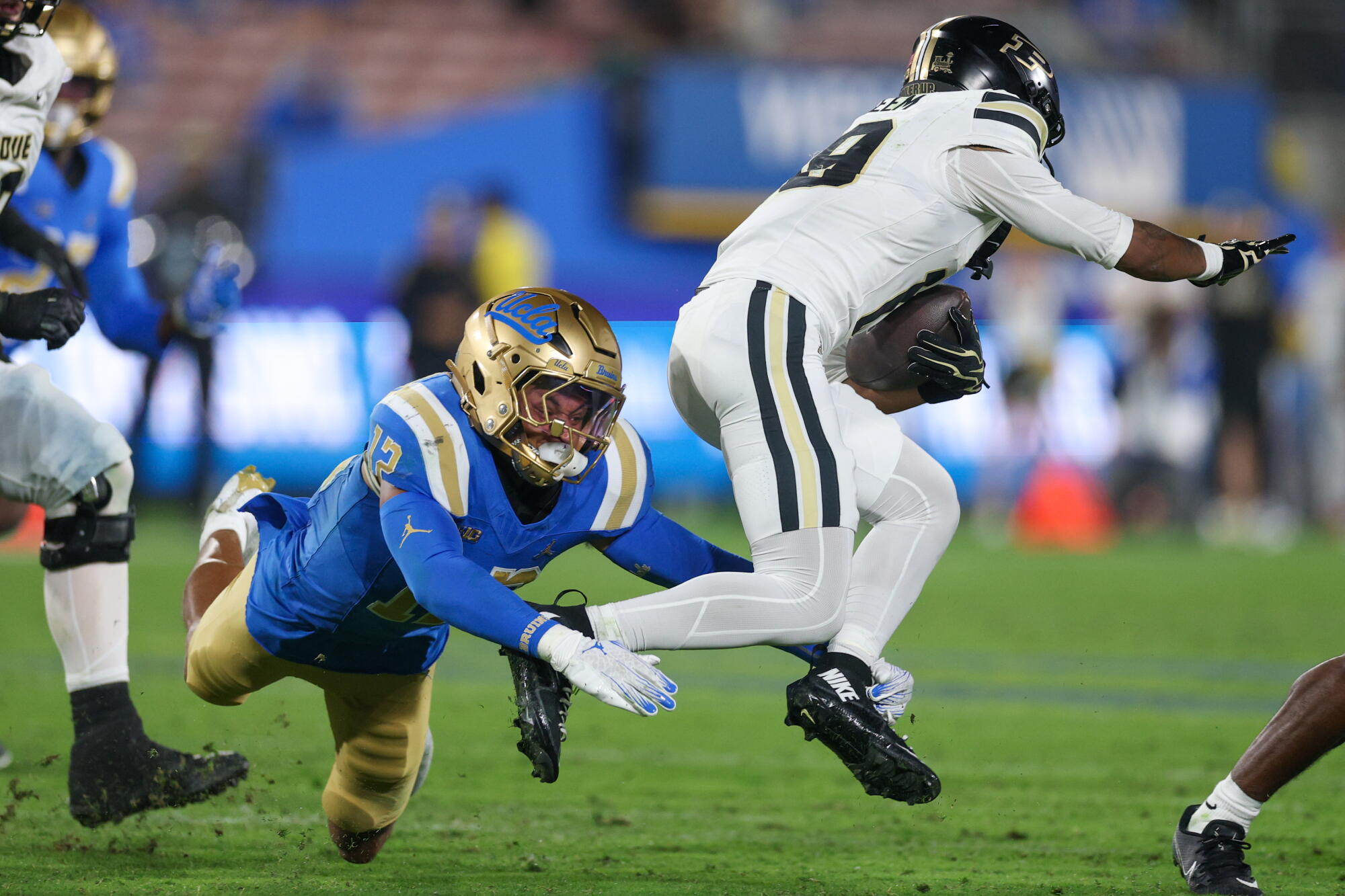
After a big road win against longtime nemesis Oregon, video posted online showed Chesney delivering a fiery speech to his team in the tunnel before facing the Ducks. He relayed the story of Hernán Cortes telling his crew to burn boats behind them so that there was no way out but forward. The Bruins, he said, had to burn the boats and fight through the Ducks.
“His speech before the Oregon game — where he talked about burning boats — that just fires you up. It makes me want to run through a wall,” said Brian Jacobsen, a 1987 UCLA graduate.
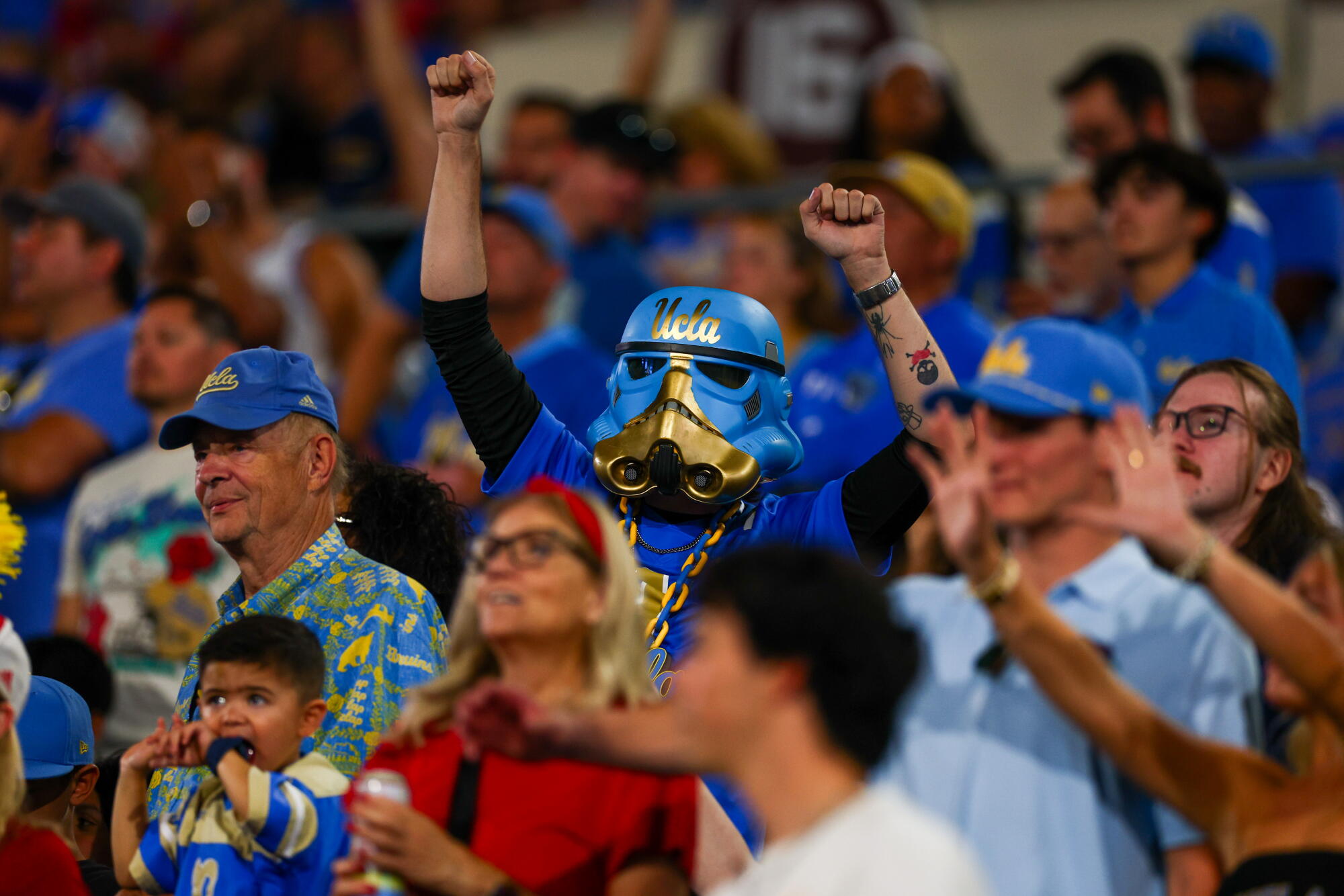
A fan with a UCLA themed Star Wars storm trooper mask dances during the Bruins’ win over Wisconsin at Rose Bowl on Saturday.
(Ronaldo Bolanos/Los Angeles Times)
UCLA fan Luis Flores, 54, grew up watching the Bruins and said he can’t recall feeling this excited about the team.
“It’s the culture and the way the coaches have these kids going the right direction. Where they are disciplined, they believe in [Bob] and they believe in the Bruins,” Flores said.
Jacobsen and Flores were among the 36,045 fans at the Rose Bowl Saturday during UCLA’s 17-7 win over Wisconsin. The Chesney train is picking up steam, but the Rose Bowl was still far from sold out Saturday.
Joel Fierberg, music director of the UCLA Alumni Band, has seen the football program’s highs and lows during his 30 years leading the band.
“There have been some up-and-down years, but I am excited for what’s been happening,” Fierberg said.
Fierberg values fans who have stayed with the Bruins through thick and thin, especially now that the program has given them wins to celebrate.
“There are a lot of fans, including a lot of my band [members], who are here every week regardless,” Fierberg said. “It’s always exciting for them, having lived through the difficult times, to have something to be excited about.”
UCLA fans haven’t seen this kind of dominance since the Bruins opened the 2022 season 6-0.
Jeremiah Calvillo, 15, said he remembers the Chip Kelly era, but he couldn’t be more excited about what this UCLA team has done for him.
“[Chesney] is a very good coach who is leading this program to better things,” Calvillo said.
UCLA running back Anthony Woods and quarterback Ty Dieffenbach celebrate after scoring a touchdown in the fourth quarter against Wisconsin at the Rose Bowl on Saturday.
(Ronaldo Bolanos/Los Angeles Times)
UCLA alum Garry Sakson enjoys seeing all the praise the Bruins have received on social media after beating Oregon in Eugene. Sakson attended as many games as possible during the Kelly era at UCLA.
“The mindset this team has is different,” Sakson said. “With Chesney, it’s the way he acts and carries himself.”
Fans are cautious about discussing UCLA’s chances of making the College Football Playoff, despite the Bruins becoming the last undefeated team in the Big Ten and SEC. That superstitious approach shows how quickly Chesney has raised expectations.
“I’m very optimistic about Chesney in his first year, but talking about the playoffs already is wild. Still, it’s amazing that we’re even in this position,” said 2009 UCLA alum Tim Dawson.
Dawson was a freshman when the Bruins started the 2005 season 8-0 and finished 10-2, during coach Karl Dorrell’s third year.
That season, the Bruins were known for their high-scoring offense and their ability to pull wins out, until they fell to Arizona in Week 9.
This season, the Bruins have a potent rushing game, a dynamic new starting quarterback and defense that has delivered explosive plays. Dawson said this feels different than the 2005 team because the defense is strong.
The players are proud of how quickly they shifted from going 3-9 last season to a 6-0 start.
Fans watch UCLA face Wisconsin at the Rose Bowl on Saturday.
(Ronaldo Bolanos/Los Angeles Times)
“Think the progress that we made from January, when we all arrived, till now is just out of this world,“ UCLA wide receiver Landon Ellis said. “It’ll be hard to look back into history and find teams that have turned it around this fast. So if you’re not all the way in, I don’t know what you are doing,”
Chesney said a bruising win over Wisconsin that shows UCLA can hold its own against brawny Big Ten terms should win over more fans unaccustomed to success.
“I think this win changes things a little bit,” Chesney said. “We won games in different ways, whether it be the offense or defense, but I think [Saturday] was a tough, physical game of football that you got to have a lot of pride in. And I think this should be the one that gives them a lot of confidence to understand just exactly what we are doing.”
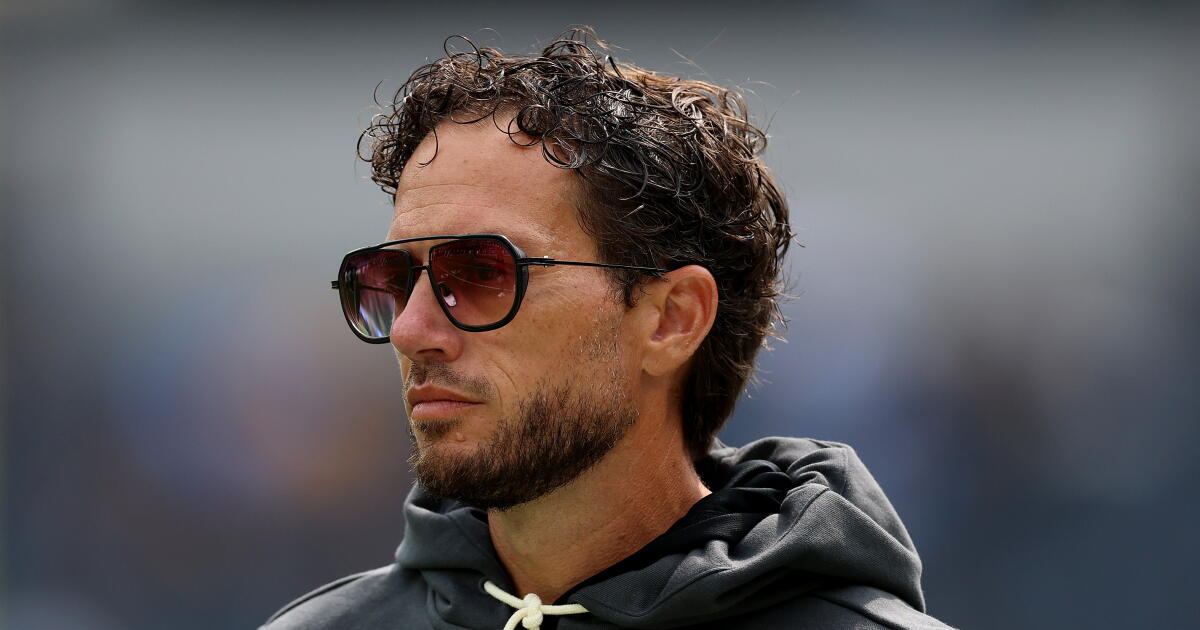
Chargers offensive coordinator Mike McDaniel didn’t shy away from discussing his job security Thursday amid a frustrating 0-5 start to the season.
“I feel like it’s core to my job to always feel that way,” McDaniel said when asked if he’s coaching for his job. “I need to do the very best I possibly can, all the time, because [of] the players, the organization, the fans.
“So, that’s second nature. … I think it’s disrespectful to all those that choose to invest in our game and our team to not look at things that way. The second you get comfortable in this league, it’s a wrap; it’s too good. I will be doing my very best, because from an integrity standpoint, I think it’s really insulting to do anything else. And that won’t change.”
McDaniel says his determination is unwavering. His place in the Chargers’ organization, however, might not be if things don’t change soon.
The Chargers, who rank 10th in total yards allowed per game on defense (311.6), enter Sunday’s road game against the undefeated Kansas City Chiefs averaging just 16.8 points per game, the third-lowest mark in the NFL above just the also-winless Miami Dolphins (14.0) and Tennessee Titans (11.6). Quarterback Justin Herbert ranks 22nd in passing (937 passing yards) and is last in the NFL in total quarterback rating (26.6).
Injuries have played a significant role in the Chargers’ offensive struggles. Eight offensive players either didn’t practice or were limited in practice because of injuries on Wednesday. Four rookies started on the offensive line in Sunday’s loss to the Denver Broncos and wide receivers Ladd McConkey, Quentin Johnston and Brenen Thompson, didn’t play.
McDaniel insists that he’s been giving the franchise all he has.
“I would be so embarrassed if I told you, ‘Well, now I’m going to try harder,’” McDaniel said. “Like, what? What have you been doing? I’m confident in the players that we have. The improvement that I see before the results generally lead to good things. But talk is cheap. We got to do.”
Three weeks after the autumnal equinox, it finally feels like fall.
Well, kind of.
This past weekend, Southern Californians breathed a collective sigh of relief as an oppressive heat wave broke. Temperatures in L.A. dropped 31 degrees, from 104 degrees on Oct. 4 to one week later, a high of 73 degrees, according to observed weather data.
I felt like a climatological grim reaper when, in the midst of my friends celebrating the drop in temperature, I told them it was temporary, as it was expected to get hot. Again. (I’m great at parties!)
But, even still, I want to help you get outdoors — safely. In this week’s edition of The Wild, our weekly outdoors newsletter, I will share three excellent L.A. hikes that each offer something different — great views or shade, for example — with caveats about the best time to go.
You are reading The Wild newsletter
Sign up to get expert tips on the best of Southern California’s beaches, trails, parks, deserts, forests and mountains in your inbox every Thursday.
By continuing, you agree to our Terms of Service, which include arbitration and a class action waiver. You agree that we and our third-party vendors may collect and use your information, including through cookies, pixels and similar technologies, for the purposes set forth in our Privacy Policy such as personalizing your experience and ads.
The first caveat is: The National Weather Service issued a red flag watch and warning, which signals an increased risk of fire danger, for much of L.A. and Ventura counties from Thursday morning through Saturday evening. It includes the San Gabriel and Santa Monica mountains. As a result, parks within Santa Monica Mountains National Recreation Area will be closed Thursday through Saturday. The closure applies to land managed by California State Parks, the National Park Service, the Santa Monica Mountains Conservancy and Mountains Recreation and Conservation Authority.
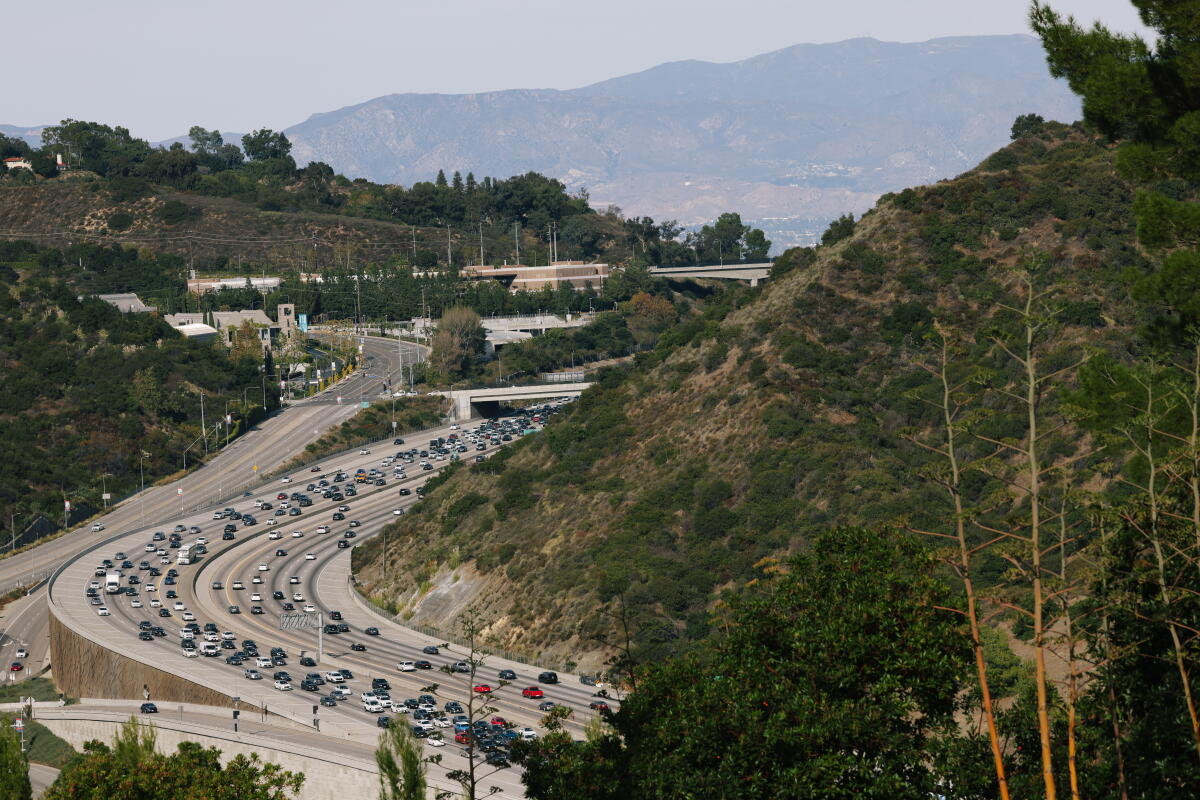
Daniel Swain, UC Agriculture and Natural Resources climate scientist, told my Times colleagues Terry Castleman and Rong-Gong Lin II in a recent story that the greater fire risk will be in communities and natural areas west of the 405 Freeway, as east of the 405 recently saw rain.
The 405 Freeway passes through several areas with hillsides covered in dense shrubs and trees.
(Dania Maxwell / Los Angeles Times)
“West of that point, almost no rain fell at all, and in early October we had a record-breaking heat wave,” Swain said. “East of the 405 in Southern California, the fire risk is lower because it recently rained.”
Bearing that in mind, two of the hikes below are east of the 405 and the third is an urban hike. All three avoid long drives far into the mountains. The two hikes closest to the foothills have large parking areas and clear exits. The urban hike usually offers clear views that should allow hikers to spot a fire near them and evacuate quickly.
Several children balance on rocks as they cross a segment of the Arroyo Seco near Pasadena.
(Jaclyn Cosgrove / Los Angeles Times)
1. A shady hike along a flowing river
Gould Mesa via Gabrielino Trail Distance: About 4 miles out and back Elevation gained: About 300 feet Difficulty: Easier end of moderate Dogs allowed: Yes Nearest to: Pasadena, La Cañada Flintridge and Altadena Accessible alternative: The first mile of this trail is paved. See notes below.
The Gabrielino National Recreation Trail is a 28.8-mile journey from Chantry Flat Recreation Area north of Sierra Madre all the way to the Ventura Street & Windsor Avenue trailhead near the Hahamongna Watershed Park in La Cañada Flintridge. It is a multi-use trail for hikers, mountain bikers and horse riders.
The trail has several beautiful sections, including from its western entrance in Hahamongna to the Gould Mesa Trail Camp. This segment is mostly shaded and great for a morning stroll, especially before 11 a.m. Saturday and Sunday.
To begin your hike, you’ll park at a large free dirt lot near the backside of NASA’s Jet Propulsion Lab. If hiking in a wheelchair or seeking an accessible paved path, I recommend parking at this smaller paved lot, as that’s where the paved portion of the trail begins. (Please leave this lot for folks seeking the accessibility alternative, as it’s smaller than the large dirt lot — and both are free!)
You can either take the paved trail or an unofficial dirt trail that follows the Arroyo Seco before leading you to the official trail. Either way, it’s primarily a mix of flat path and gentle inclines along the Arroyo Seco, shaded by coast live oaks, bay laurels and sycamore trees. After hiking about two miles, you’ll reach the Gould Mesa Trail Camp, where you can set up a picnic at one of the campground’s tables, or cool off along the creek.
And if you’d like to go a bit farther, you can continue onward to the Paul Little Picnic Site or the Brown Mountain Dam waterfall (see map). Regardless of where you stop, I promise you’ll be treated to a stunning landscape and likely hear the chirp and squawk of scrub jays, California quail and more.
The San Gabriel Mountains become blanketed in golden light in the early evening in Dunsmore Canyon in Deukmejian Wilderness Park, a Glendale park.
This 2.6-mile hike through the 709-acre Deukmejian Wilderness Park in Glendale will offer you not only great views of the surrounding cities but also an opportunity to spend time among healthy native trees and plants, including California buckwheat, black sage and California sagebrush (which you should smell).
You’ll park in a lot near the Stone Barn Nature Center. Several signs are usually posted around the lot warning visitors about when the park will close, and a staff member will lock the gate. I think that’s serious, so take note.
You’ll start your hike on Dunsmore Canyon Trail, headed northeast up a straight gravel path covered on both sides with thick ceanothus, yerba santa and more.
Although some hikes, like this path in Dunsmore Canyon in Glendale, may appear exposed during the day, you might find they’re shadier in the morning or evening, depending on their local topography.
(Jaclyn Cosgrove / Los Angeles Times)
Just 0.2 miles in, there’s a massive old coast live oak where kids could easily create an imaginary forest kingdom under its large branches.
As you continue to climb, you might hear Dunsmore Creek, which runs parallel to the trail. Remember to turn around as you gain elevation, as this trail rewards you with substantial views of Glendale and the Crescenta Valley soon after you start. All the while, you have the San Gabriel Mountains right in front of you, including Mt. Lukens, which you can hike to from the same park.
Half a mile in, you have the option to continue on the Dunsmore Canyon Trail or Le Mesnager Trail to make a shorter loop. Le Mesnager Trail includes a lookout point at about 2,750 feet, a great spot for sunset as long as you don’t get locked in! As you meander down the trail, you’ll find a nice shady canopy and continued views of the city below.
Given our weekend temperatures, this trail is best in the morning or evening. I personally prefer the latter, when golden hour paints the mountains a deep gold to red.
If you plan to hike it in the evening, though, keep the park hours in mind. It is open until 8 p.m. until Monday, when its hours shift to closing at 7 p.m., which remains until Daylight Saving Time ends Nov 1. This is relevant if you plan to park in the lot. Otherwise, you can walk out of the park and back to your car. Regardless, have fun!
Visitors reach the Baldwin Hills Scenic Overlook by climbing the Culver City Stairs.
(Myung J. Chun / Los Angeles Times)
3. An urban hike near a great picnic area
Culver City Stairs to Baldwin Hills Scenic Overlook Distance: 1.4 miles Elevation gained: About 350 feet Difficulty: Moderate Dogs allowed? Only on the paved road, not on trails Accessible alternative: Discovery Park and Bluff Creek Trail
This 1.4-mile out-and-back jaunt up 282 concrete steps, known locally as the Culver City Stairs, takes hikers to the stunning Baldwin Hills Scenic Overlook. From here, you’ll have one of L.A.’s most breathtaking — kind of literally — city views.
To begin, you’ll take the Baldwin Hills Scenic Overlook entrance off Jefferson Boulevard. You’ll follow a dirt path briefly east, follow a switchback to the west and soon find stairs. Head straight up, pausing to breathe and appreciate the views. The stairs vary in height, from about 3 to 20 inches, so it’s good to take your time.
At the top, you’ll have panoramic views that, on a clear day, include the Pacific Ocean. To return, you can either head back down the steps or take the meandering dirt trail down.
Culver City is expected to be cooler on Sunday than Saturday, with an expected high of 85 degrees. Why not make it a morning trek followed by brunch?
Regardless of where you go, I hope you have a safe and meaningful time on our public lands!
3 things to do
1. Prance up to a giant pumpkin in Norco The L.A. Fright Club will host a 1.6-mile moderate hike at 9 a.m. Sunday to Pumpkin Rock in Norco. Guests should wear comfortable hiking shoes and bring water. Costumes encouraged. Learn more, including how to register, at the club’s Instagram page.
2. Make marvelous marsh pics in Irvine The California Native Plant Society’s Orange County chapter will host a beginner nature photography course at 5:30 p.m. Thursday at the Duck Club at the San Joaquin Marsh in Irvine. At 5:30 p.m., photographer Bob Allen will guide attendees on a short walk in the marsh, followed by a presentation and discussion of technique at 7 p.m. Learn more at the organization’s Instagram page.
3. Witness the cosmos near Palm Springs The San Bernardino Valley Amateur Astronomers will host a star party from 8 to 10 p.m. Saturday at the Whitewater Preserve northwest of Palm Springs. Gates will open at 7:30 p.m. and close at 8:05 p.m. No late entry. Learn more at the preserve’s Instagram page.
The must-read
An Eastern box turtle at the Turtle Conservancy in Ojai.
(Julie Leopo / For The Times)
The 90-acre Turtle Conservancy in Ojai was founded in 2005 as a research center and advocate for turtle habitat. But over the past 10 years, its mission has shifted in response to illegal turtle poaching, prompting the small nonprofit to take in 810 turtles — more than 400 of which they received in the past six months. What should the conservancy do once it has the turtles? That question remains heavily debated (and underfunded), an issue covered in a recent Times story by writer Stuart Miller. “It’s so easy to pluck an animal out of the wild, but when you want to put one back there’s more roadblocks,” said conservancy founder Eric Goode. “Can we find a happy medium? Because the best thing for these turtles is not to keep them in holding areas for too long.”
Happy adventuring,
P.S.
Would you like to help scientists better understand where native species are thriving in L.A. County? Or how about researchers who are tracking where invasive species are taking up loads of space? The L.A. Nature Quest is a monthlong challenge that runs through Oct. 31. The L.A. Public Library helps host the challenge, which asks participants to download the citizen science app iNaturalist and then document the natural world in their neighborhood. This year, quest organizers are especially hoping people will pay attention to “cold spots,” where there is little to no data on habitat in an L.A. neighborhood. Check out the map at lapl.org to see how you can help.
For more insider tips on Southern California’s beaches, trails and parks, check out past editions of The Wild. And to view this newsletter in your browser, click here.
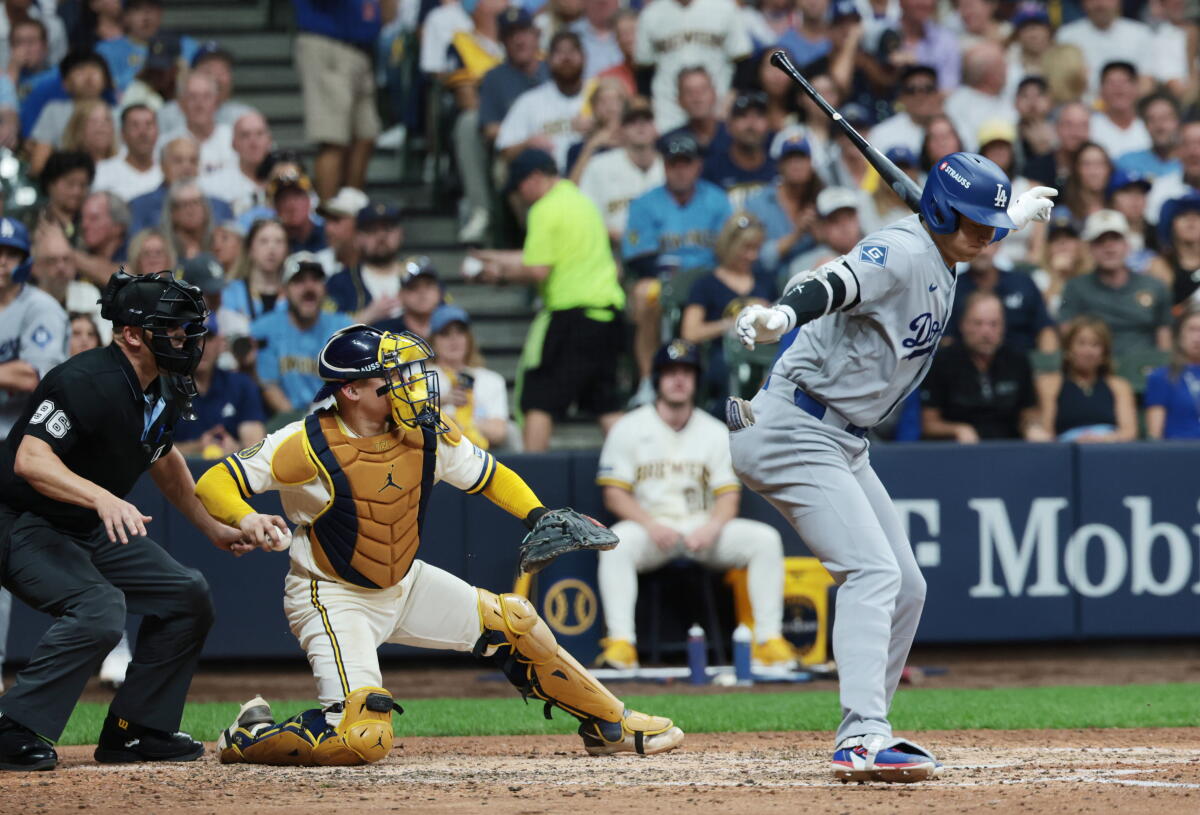
Shohei Ohtani emerged from the visiting dugout at American Family Field with a bat in his hand, and the mass of media members scattered in foul territory up the third-base line shifted his way, pulled by the magnetic force that is Ohtani’s stardom.
Monday marked the third straight day Ohtani had hit on the field, after a multi-round session off the pitching machine on the workout day and batting practice before each of the first two games of the National League Championship series against the Milwaukee Brewers. But the novelty of the move — Ohtani only took batting practice on the field a few times during the regular season, always in the midst of a slump — had yet to fully wear off.
“The results, take full responsibility,” Ohtani said through interpreter Will Ireton on Tuesday. “That’s all I can really say, why the results haven’t been where I wanted it to be. But I think there’s different approaches to this, whether that be focusing on reducing the symptoms and getting rid of the pain and/or just making sure that I’m moving well in the swing.”
That break of routine for the start of the NLCS did not pay off in terms of results. But after a conversation with Ohtani, manager Dave Roberts said Tuesday that he felt “great” about playing Ohtani in Game 3 of the NLCS, even though Ohtani is still physically compromised by nagging right biceps and left knee problems.
“He’s adamant he feels good enough to be in there,” Roberts said. “He’s close to finding something with his swing. … Yeah, he wants to be in there and help us win a ballgame and win a championship. Great conversation, and I’m excited about having him in there.”
Roberts made clear that he wasn’t ever considering “benching” Ohtani, but rather weighing whether it would make sense to give him a couple days to “reset,” similar to how they approached Freddie Freeman’s ankle injury in 2024, giving him two days off during that postseason run.
“The symptoms have subdued a lot, especially when I was on the IL, spending that time just being able to reduce the symptoms,” Ohtani said. “As of now with the swing, it’s a daily process of trying different things, different feel on a daily basis.”
Though Ohtani’s arrival kicked off the Dodgers’ back-to-back championships, this isn’t his first time slumping in the postseason. His bat went quiet in the 2024 World Series (two for 19). And between his two-homer game to open last year’s wild-card round, and Game 4 of the NLCS when the two-way star authored the best individual game ever played, he went four for 33.
The difference this time is Ohtani, who has hit three singles in 20 postseason at-bats, isn’t fully healthy. But he was adamant that he would still be able to find a way to produce regardless.
“Over the course of this long season, there’s only really a short period of time when my mechanics is completely in sync,” he said. “So it’s just really kind of just going back and forth, finding the right parts of the swing and managing just the different parts of the swing. So it’s a constant, ongoing process that’s headed in the right direction.”
When healthy, Ohtani has the ability to break out of even the most dire of slumps with an otherworldly performance, like that three-homer (as a hitter), 10-strikeout (as a pitcher) all-timer. Opposing pitchers still have taken a cautious approach to facing him.
This version of Ohtani, however, hasn’t hit a home run since Aug. 18, a little over three weeks before he landed on the injured list. He’d played through nagging knee and biceps injuries for most of the season. But by the first week of September, the Dodgers could no longer argue that his poor performance wasn’t necessarily connected to his ailments.
Shohei Ohtani strikes out during the sixth inning of Game 2.
(Robert Gauthier / Los Angeles Times)
Now, the stakes are as high as ever. Trailing the Brewers 2-0 in the best-of-seven series, the Dodgers desperately need to put themselves in the best possible position to win Game 3 and avoid four straight win-or-go-home contests. And to do so, they need to know what kind of production Ohtani is physically capable of.
“I’ve never wavered in my belief in him,” Roberts said. “The work that he’s putting in — shoot, he squared the bunt in Game 2 to potentially get on base. That just speaks to whatever it takes to help the team win. He’s always been about the team, whether it’s hitting first, second, fourth, or wherever, right? So for me, just hearing his conviction, that’s what I wanted to hear.”
The communication between Ohtani and the team on injuries has been a work in progress in his third year with the Dodgers.
“We certainly had a lot of communication with him throughout the year, and worked together really well in terms of how to go about this,” president of baseball operations Andrew Friedman said in late September.
“And I think in his mind, he just thought that what he was dealing with was more minor, because it wasn’t like he would see a doctor and go, ‘Oh my God, you have this ailment.’ There were just a number of different things that were bothering him. And I think in his mind, he thought the best way to help the team was to go out and play, which I respect. But us staying really connected and sharing that information, I think, will be really important going forward.
“And again, the communication back and forth has been awesome. The fully sharing exactly how he’s feeling, maybe not as awesome. But again, I would rather [have] that with a guy than the other side of that.”
So, Ohtani kept trying to work his way back to the mound for weeks after receiving a lubricating Orthovisc injection in his knee at the beginning of the All-Star break. And when his biceps injury flared again, and the discomfort extended up through his neck, the Dodgers put off an IL move as long as possible.
Roberts said Ohtani’s conviction lined up with what the manager was hearing from the Dodgers hitting coaches and medical staff.
“No one knows what’s going to happen tomorrow and the ensuing days,” Roberts said. “At the end of the day in this big moment, we’re listening to Shohei, and we’re going to support the crap out of him and believe in him, and that’s it.”
ANCHORAGE, Alaska — It’s a long way from Washington, has a small population and hasn’t backed a Democrat for Senate in nearly 20 years.
Yet President Trump on Tuesday will devote a big chunk of his dwindling time ahead of crucial midterm elections to head all the way to Alaska — attempting to bolster a Republican incumbent senator in another sign of GOP fears about retaining control of Congress after Election Day on Nov. 3.
Trump is headlining a rally for Sen. Dan Sullivan in Wasilla, about 45 miles north of Anchorage — famous for being the hometown of former Republican vice presidential nominee Sarah Palin and the headquarters of the Iditarod sled dog race across the state.
Trump’s stop is part of a western swing also taking him to rallies in Arizona and Montana on Wednesday.
“I’m right now going to Alaska to try and help Dan Sullivan. That’s a long way away,” Trump told reporters as he left the White House for the trip on Tuesday. “I would only do it if I thought he was good. And he’s very good. And so, I’m going to Alaska to help Dan Sullivan, and then I’m stopping in numerous places.”
Democrats last won a Senate seat in Alaska in 2008, and the state hasn’t elected a governor from that party since 1998. The only time Alaska didn’t vote Republican for president was during Lyndon B. Johnson’s landslide 1964 reelection.
Yet high gasoline prices from the Iran war and persistently elevated inflation have damaged Trump’s approval ratings enough to leave Democrats dreaming of Alaska upsets.
Trump and Vance have been trying to boost Sullivan repeatedly
Seeking his third Senate term, Sullivan faces Democrat Mary Peltola, a former congresswoman running to put “Alaska First,” emphasizing cost-of-living issues.
Alaska pollster Ivan Moore said he’s seen a decline in Trump’s support statewide that mirrors the president’s falling approval ratings nationally — meaning the Senate race may be decided by Trump 2024 voters who are now unsure they still back him.
“The visit is certainly appropriate. Whether the visit will be effective or not is another matter,” said Moore, who said when he first heard that Trump would visit Alaska, he didn’t believe it would actually happen.
The Trump administration has prioritized the opening of more of Alaska to oil and gas drilling. Vice President JD Vance already campaigned in Fairbanks for Sullivan.
The senator also recently joined Trump in the Oval Office where the president announced a $54 billion investment by South Korea’s government into an Alaska natural gas project. That’s despite South Korea saying the deal, and its total value, haven’t been finalized.
Still, Trump trekking four time zones west to get to Sullivan’s home turf — an unusually long trip so close to the midterms — is his strongest show of support.
Trump last campaigned in Alaska to try to defeat a fellow Republican
Alaska is home to around 740,000 people, making it slightly less populous than Denver. It ranks 48th out of 50 states in population, smaller than all but Vermont and Wyoming.
Trump nonetheless headlined a 2022 rally in Anchorage opposing Republican Alaska Sen. Lisa Murkowski after she voted to convict him on a charge of incitement of insurrection during his second impeachment trial, following the attack on the U.S. Capitol by a mob of his supporters on Jan. 6, 2021.
Trump endorsed Kelly Tshibaka, who challenged Murkowski that year, but that didn’t stop incumbent Murkowski from winning reelection.
This year, there are two Dan Sullivans on the ballot
Trump has complained about Alaska’s unique elections system. The state has open primaries, in which the four top vote-getters — regardless of party affiliation — advance to the general election, which uses ranked choice voting.
That’s led to a scenario where there also will be another Dan Sullivan on the ballot on Nov. 3: retired teacher Dan J. Sullivan, whom Trump and other allies of Sen. Sullivan have called a sham candidate. Dan J. Sullivan has denied this.
At his rally, Trump also plans to stump for Republican Rep. Nick Begich. Begich is facing a competitive challenge from Bill Hill, an independent.
Alaska has a history of rewarding candidates with an independent streak — something Vance acknowledged during his trip to Fairbanks last week. “In very deep red years, Alaska is competitive. In very deep blue years, Alaska is still competitive,” Vance said. “I think it’s just a reality of the politics of the state.”
Independence has been hard to find in the Republican Party where Trump for years had total control. Some Republicans facing tough elections have begun tiptoeing away from Trump on key issues like Iran and tariffs, but not Sullivan, who has been vocal in supporting both.
In a post last week, Trump questioned why three Republicans were running against a Democrat for governor. “How stupid are we to do this?” he said on social media. This comes at the same time state Republican party leaders are urging voters to rank Republicans on the ballot and leave the Democrats blank.
“We want to be clear: we do not support ranked choice voting. It is a confusing, burdensome and costly voting scheme,” party leaders, including GOP chair Carmela Warfield, said in a statement Saturday. “That said, ranked choice voting is the system Alaska will use for the 2026 General Election, and we must work within it for this election to keep Alaska’s recent momentum going strong.”
Trump’s trade war with Canada may also be a factor
Trump has also triggered a trade war with Canada, which shares a 1,500-plus-mile border with Alaska and is among the state’s most important trading partners.
The U.S. banned nearly $1 billion worth of imports from its neighbor to the north — including alcoholic beverages, dairy products and motorcycles — after previously imposing 50% tariffs on about $20 billion in Canadian products. Canada has responded with reciprocal bans and its own import levies, and the back-and-forth could raise prices for Alaska consumers.
Making Canada an enemy of sorts is “discomforting” for many Alaskans, said pollster Moore.
“We associate, I think, probably more closely with the Canadians — more than a lot of the Lower 48,” he said.
Weissert and Bohrer write for the Associated Press. Weissert reported from Washington. AP reporter Michelle L. Price contributed to this report.
And there have been, of course, prizes, including a Netflix movie, the Spanish maximalist melodrama “La Bola Negra,” winning Toronto’s People’s Choice Award. That’s a first for the streamer, which means we will again be asking the question: Can a Netflix film finally win the best picture Oscar?
If you’ve seen “The Odyssey,” you probably know the answer to that question. But with more than five months (!) until the 99th Academy Awards, it’s a bit early for ironclad guarantees, even if it feels like it would take the winds of Poseidon to blow “The Odyssey’s” best picture campaign off course.
But it’s not too soon to roll out a first set of Oscar power rankings for best picture. With apologies to “Obsession,” “Fjord,” “Possible Love,” “You Can See Everything,” “Elsinore,” and whatever other movies you love (or look forward to loving), let’s start counting.
10. ‘Tender Loving Care’
(Joseph Lynn / Thin Man Films / Bleecker Street)
Because of ongoing health issues, Mike Leigh has said that this warm and wrenching drama will be his last movie. If so, it’d be quite the capper to a career that has netted him seven Oscar nominations, five for his screenplays and two for direction. Yes, only one of his movies, “Secrets & Lies,” has been nominated for best picture. But “Tender Loving Care,” centered on two social service workers navigating the fraying social safety net and, in one case, anxiety about aging parents, possesses a bracing humanity full of compassion and urgency. It’s also quite funny. And it boasts a great cast, including newly minted Emmy winner Kate O’Flynn, as charming here as she is on “Widow’s Bay.” Leigh has more than earned a final curtain call with this one.
9. ‘Club Kid’
Jordan Firstman’s sincere, funny and genuinely moving debut feature has him playing a queer New York underground party promoter blindsided by the arrival of the 10-year-old son previously unknown to him. You could take issue with the uncomplicated perfection of the child, who has exquisite taste in music (Cocteau Twins, really?) and barely a trace of trauma despite the harrowing event that landed him in New York. But “Club Kid” is so assured and heartwarming that you can’t muster the energy to object. There’s probably going to be one feel-good movie nominated, and if it’s between this and “I Play Rocky,” I’ll cast my lot with the one that doesn’t rely so heavily on re-creating the familiar.
8. ‘All of a Sudden’
This 196-minute movie unfolds at, let’s just say, a leisurely pace, and includes a near-20-minute scene in which a character lays out the flaws of late-stage capitalism using a whiteboard. And it’s riveting. Or at least engaging. It’s certainly audacious, this drama about a hardworking director of a Parisian nursing home and the way a chance friendship changes her life. The Oscars’ best picture field now routinely includes two international movies, and Ryûsuke Hamaguchi’s dreamlike meditation on mortality and human connection feels like a sure bet to make the cut. Virginie Efira and Tao Okamoto shared the best actress prize at Cannes and merit attention from Oscar voters as well.
7. ‘The Debut’
Spoiler alert: One awards-season shoo-in is Julianne Moore winning every lead actress prize for her bravura work in this delightful Jesse Eisenberg comedy. Moore plays Mona, a meek, thoroughly unseen wife and mother who impulsively decides to audition for a community theater musical despite having no experience. The movie earned a huge response at its Telluride premiere, though there were some quibbles about the surprising, surreal turns the story takes. C’mon. Isn’t that precisely what we want from a film? With Moore, co-star Paul Giamatti, Eisenberg’s screenplay and original song (Eisenberg wrote several numbers for the film’s fictional musical) assured spots, a best picture nod feels undeniable.
6. ‘The Invite’
(Atsushi Nishijima / A24)
Olivia Wilde’s dinner-party dramedy boasts a killer quartet — Wilde and Seth Rogen as longtime marrieds nursing resentments, Penélope Cruz and Edward Norton playing their upstairs neighbors — and expert direction from Wilde, who navigates the movie’s tonal shifts with authority. It’s wickedly funny and unsentimental and pulls off a bittersweet ending that’s ambiguous enough to keep you talking long after the film ends. One of the year’s most satisfying pleasures.
5. ‘Project Hail Mary’
(Jonathan Olley / Amazon MGM Studios)
Speaking of endings, how many did “Project Hail Mary” have? Two? Three? I lost count. And it doesn’t matter. This was the upbeat end-of-the-world movie that audiences needed at a time when the possibility of human extinction feels uncomfortably real. In a year full of Spielberg knockoffs (and an uneven movie from the man himself), this will be the one left standing.
4. ‘Wild Horse Nine’
(Diego Araya Corvalan / Searchlight Pictures)
Martin McDonagh’s melancholy irreverence plays well with Oscar voters. His last two movies, “Three Billboards Outside Ebbing, Missouri” and “The Banshees of Inisherin,” earned best picture nominations and a combined 16 nods. “Wild Horse Nine,” a biting buddy dramedy about two mismatched CIA assassins (John Malkovich and Sam Rockwell), should continue the filmmaker’s success and may even catapult Malkovich to a long-overdue Oscar. At the very least, it gave him his best role in decades.
3. ‘La Bola Negra’
The filmmakers, Javier Calvo and Javier Ambrossi, are talented and charismatic, former romantic partners who still work together because that’s how Europeans roll. Los Javis (they even have a fun nickname) won the directing prize at Cannes, the first of several festivals that their movie conquered, culminating in that audience award at Toronto. With its three interconnected stories that follow queer men through nearly a century of Spanish history, “La Bola Negra” has an epic feel and emotional payoff that could carry it far. Netflix is all in, opening it in select theaters Oct. 16 and giving it an exclusive 46-day theatrical window, the longest it has afforded any movie. We’ll see if that puts it into the cultural conversation in a way that has eluded other Netflix contenders.
2. ‘Dune: Part Three’
Can Denis Villeneuve’s third and final “Dune” movie, which hasn’t screened widely for press, take the “Lord of the Rings” trilogy path to a best picture victory? If there’s resistance to giving Christopher Nolan back-to-back best picture winners, the greatest threat might come from a movie occupying the same lane, an auteur-driven epic lauded by critics and embraced by audiences. The second (and superior) “Dune” won just two Oscars, compared to the six taken by 2021’s “Dune: Part One.” Perhaps voters were playing the long game.
1. ‘The Odyssey’
(Melinda Sue Gordon / Universal Pictures)
Maybe you saw it when it opened in July, contributing to its $1.75-billion box office. Maybe you’re still trying to see it in Imax 70 mm, the way God (i.e., Christopher Nolan) intended. Maybe you agree with translator Emily Wilson, who thinks Nolan’s movie “lacks psychological, emotional, political and ethical depth” and that its writing is “abysmal.” Whichever side you’re on, “The Odyssey” is probably going to sweep through the Oscars, owing to its craft and thrilling showmanship, its stellar acting and that moment when Odysseus’ dog recognizes his long-absent master and wags his tail before heading off to Elysian Fields.
The Rams quarterback gave another masterclass last Sunday when he led the Rams to victory over the Philadelphia Eagles. It was Stafford’s 40th fourth-quarter comeback victory, leaving the 18th-year pro one shy of tying Ben Roethlisberger for third on the all-time list behind Tom Brady and Peyton Manning.
But through four games, this has not otherwise been a prodigious start for the reigning NFL most valuable player and future Hall of Famer.
Share via
Gary Klein breaks down what to watch for when the Rams face the Buffalo Bills at SoFi Stadium on Monday night.
Stafford, 38, has passed for six touchdowns, with six interceptions, for a team that is 2-2 going into its game on Monday night against the Buffalo Bills at SoFi Stadium.
Stafford is tied with the Chargers’ Justin Herbert for second-most interceptions in the NFL, trailing only the New England Patriots’ Drake Maye, who has seven.
And while Stafford’s numbers are more middling than fall-off-a-cliff poor, they rank among his slowest statistical starts.
Only twice in his career has Stafford had six passes intercepted in the first four games.
As a rookie in 2009, the No. 1 pick in the NFL draft had three passes intercepted in his first game, two in the second, none in the third and one in the fourth.
The same pattern repeated in 2022 during the Rams’ infamous Super Bowl hangover that ended with a 5-12 record, and Stafford on injured reserve.
Last season, in the Rams’ first four games, Stafford passed for eight touchdowns, with two interceptions, en route to a 3-1 start and what eventually became his run to a first MVP award.
So Stafford acknowledged that he personally has “room for improvement.”
“Some really bright moments, and some stuff I’m really proud of,” Stafford said, “and stuff that I definitely wish I could take back and help us be in a better position to win games. That comes with the position.”
The Rams’ — and Stafford’s — season began poorly after the team’s misguided decision to arrive in Australia the day before they played the San Francisco 49ers in the season opener. Stafford passed for only 155 yards, with an interception, in a 27-7 defeat.
Stafford rebounded by passing for four touchdowns, with an interception, in a 28-6 victory over the New York Giants at SoFi Stadium.
In the next game at Denver, Stafford completed 30 of 55 passes for 390 yards and two touchdowns. But Broncos safety Talanoa Hufanga intercepted two passes, one he returned for a touchdown and another in the end zone in the final seconds of a 30-26 Rams defeat.
Against the Eagles, Stafford completed 32 of 51 passes for 317 yards, with two interceptions.
“He was at his best in the most important moments,” coach Sean McVay said. “That’s the competitive greatness — to find a way in spite of some different things that maybe didn’t go our way.”
Stafford was asked this week how he managed to stay calm, not feel rattled and still take shots at clutch plays after committing turnovers in a hostile environment.
His answer: Trust his preparation and live with the results.
“The world’s going to have an opinion on how I played every single play of every single day — that’s something I’m used to,” he said. “Are there areas I want to be better that [reporters] don’t even pick up and talk about? Absolutely. Are there the obvious ones? For sure.”
Last season, starting in Week 4, Stafford put together a personal-best streak of eight games without an interception. He passed for 25 touchdowns during that stretch. In 17 games, he passed for a career-best 46 touchdowns, with eight interceptions.
Stafford has endured throughout his career by never getting too high or too low. So that won’t change.
“I want to do everything I can to put our team in the best position to succeed,” he said. “I’ve done that sometimes this year and other times I have not.
“I want to make sure that I do that at a more consistent clip moving forward.”
Brandon Flowers stands onstage at the Ford Theatre wearing a sharp black suit and a bejeweled bolo tie and tells the audience about his cousin Bobby’s job parking cars in the 110-degree heat of the Las Vegas Strip.
“That was gonna be me in another life, only my big plan was to work at the Bellagio,” he adds. “Nicer place, more tips.”
As the frontman of the Killers, Flowers, 45, has spent more than two decades singing about the struggles and the temptations at the heart of the American dream. But on his new solo album, “Thrasher,” he trades the Killers’ gleaming, synth-laced rock for the crackling sound of hand-played country music.
He cut the LP at Nashville’s historic RCA Studio A, where country giants like Dolly Parton and Waylon Jennings once worked; not only that, but to accompany him he recruited veteran session players including David Rawlings, Bruce Bouton and 85-year-old Charlie McCoy, who played harmonica on George Jones’ immortal “He Stopped Loving Her Today.”
Yet for all its old-school country cred, “Thrasher” also emphasizes Flowers’ roots as a Vegas showman — his tremulous croon, his go-for-broke emotion, his almost preacherly understanding of how to take a crowd up (and up) and how to take it back down. Think Glen Campbell or Donny Osmond.
“Or Wayne Newton,” says Rawlings with admiration. The guitarist, known for his long collaboration with Gillian Welch, performed with Flowers at July’s Newport Folk Festival. “It’s really thrilling to see the way he inhabits this stuff onstage,” he adds. “I have such incredible respect for anybody who knows how to entertain at that level because it’s an absolute gift — and it’s really hard work.”
Flowers, who grew up in Las Vegas and Utah and who shares three sons with his wife, spoke about the album in his dressing room last month a few hours before the Ford show. A sequel to “Thrasher,” recorded during the same sessions, is due out next year.
The Nashville OGs who played on these records — do you think they were impressed by you? I think they were refreshed. I think they didn’t quite know what they were getting into and were pleasantly surprised.
For you, it was a different way of working, right? These players are artists. But it’s also just another day on the job. You feel that: “Charlie’s got to leave at 4 to go to the Opry.” He still gets his licks in.
I wonder what it would’ve sounded like to cut 10 Killers classics with this band. Probably like the Traveling Wilburys or something. The second album has some of that DNA. This one was more of a narrative album — a lot of stories. The other one, it’s more in the romantic realm. I’m excited to get it out. I have another one cooking.
A third album? Well, because they’re so efficient. It’s opened up a door for me that I feel like I’ll always be able to explore. If I have 10 songs, I can go to Nashville for five days and cut the whole thing. We do two songs a day, no problem.
You’ve said there’s this idea in rock music that making an album needs to feel like climbing a mountain. I blame it on U2. You don’t feel like you’re doing it right if you’re not doing that. We really went into that on “Sam’s Town” — we climbed Everest, man. When we finished “Sam’s Town,” I remember the last day — it was like 6 in the morning, the sun was up and we were finally done. What a relief it was.
Now the veil has been lifted. It doesn’t have to be like that.
Did you get a feel for Nashville as a town while you were there? I got a breakfast spot: Cafe Roze. I don’t want to blow it up too much because I want to be able to get in. But you know Cafe Stella in Silver Lake? They used to have my favorite breakfast in the world: sourdough, soft scramble, prosciutto and Parmesan. And they have that exact thing at Cafe Roze — it’s like I’m transported back. I could eat it every day with a side of avocado.
“Thrasher” follows a number of country excursions by rappers and pop stars. Do you have any anxiety about being seen as a carpetbagger? No, because I’m not trying to bulldoze my way into the world and open a bar in Nashville. This is an authentic part of myself — I have an education in this music. People have a lot of preconceptions about country music, especially lately. Everyone says the same thing: cold beer, dirt road, Friday night. But there’s such an art to the tradition — it’s a soulful artistic endeavor. I’m trying to come at it from that angle.
What’s your relationship with modern country music — Morgan Wallen and Miranda Lambert and the like? I don’t have one. It’s more people that are on the fringes, I guess — Jason Isbell or Sturgill Simpson. I got Sturgill’s guitar player because I was a fan of that stuff.
Before I heard “Thrasher,” I expected kind of a stripped-down Isbell vibe. I could see him doing “In a Heartbeat” or “Miss America.” But once we got to Nashville and got the guys in the room, it just got a little more pep in its step.
Does being embraced by the Nashville industry feel like a reasonable goal? That’s a whole other nut to crack. You hear stories about Dwight Yoakam having a tough time — and he brought some heat. Or John Prine just because he was from Illinois and not from further south. I’m not gonna go on a campaign to prove how worthy I am.
You’ve been dinged by people who think you’re putting on an accent on this record. I feel like this is more how I speak than maybe they’re accustomed to. I don’t know, I might’ve leaned in a couple times. There is a Utah accent — it was something I was embarrassed by when I was younger. But now I’ve lived there 16 years of my life total, so it just starts feeding its way back in.
Is your vocal approach different for country than for rock? There’s more quiet in these songs — more room for the story to be told. In the rock band, I’m competing — everybody wants to be heard — whereas this one, there’s this beautiful thing where the guys don’t mind being in the background. They want to frame the picture, and I’m the picture.
Did you find yourself making more of an effort to enunciate? I’ve always been cognizant of that. Just today, there was a band — I won’t say who it was — but I was interested in hearing their new thing, and I didn’t understand a word until the chorus. I was rooting for the guy the whole time, but it’s like: How can I fall in love with this if I don’t know what’s happening?
Brandon Flowers performs last month at the Ford Theatre.
(Rob Loud)
Got some questions about specific songs. “One of Us” is about your brother-in-law, which made me realize how few people write songs about their in-laws. He passed away unexpectedly a few years ago. You know, I’m the youngest of six, and he married my oldest sister. She’s 17 years my senior, so when they got married, I was a kid — he became my big brother and was a masculine figure in my life and all that. There’s your family and then there’s your found family, and he’s part of my found family. I wanted to honor him, and this is my way of doing it.
I assume your sister’s heard the song. Oh yeah. A lot of those moments happen on this record where I had to play the song for the person, and you just can’t help but be brought closer together. You’re taking part in their grief but we’re also celebrating him. It was beautiful.
“Miss America” is about another one of your sisters. The one next in line.
She’s addressing an abusive ex, and you sing it from her point of view — from a woman’s perspective. It just started like that. I don’t remember a moment of thinking: Am I gonna do this from the outside or am I gonna step into her shoes? Maybe it’s something to do with that Tom Waits song [“Christmas Card from a Hooker in Minneapolis”] — something about that maybe gave me permission.
Did you play “Miss America” for that sister? It felt like the gentlemanly thing to do. If she’d said no, I would’ve been heartbroken because I think “Miss America” is gorgeous — I’m really proud to be part of it. But I would’ve honored her wishes.
In “An American Dream,” the point of view seems to keep shifting. At one point I think the narrator becomes Elvis Presley? Chorus 1, I’m singing with this man that used to give me cigars and tobacco when I was a kid — we’re singing it together. Giving a 13-year-old Red Man tobacco — there was nothing shady about it, or nothing too shady — but it was still a wild move. Then Chorus 2, Elvis and I are both singing — I see it that way.
Which era of Elvis are you envisioning? Whenever I think of him, I think of him in ’68. Nobody’s ever looked that good — it’s not fair.
You’re known for your flights of lyrical fancy: “Burning down the highway skyline in the back of a hurricane,” for instance, from the Killers’ “When You Were Young.” Did country music allow for those flourishes? Verse 2 of “Does It Ever Cross Your Mind?” is a great example: “I could’ve been born in Bangladesh but I wasn’t / I was born here with just enough jelly beans in my basket to ask you to go wishing on a star.” That’s fun.
In “An American Dream” you say, “We blew through starlight on bricklayers’ knees.” We’re performers, and we’re here to entertain you. But we’re working-class men, me and Elvis.
Some of these lines get at this crucial point that I think your music makes, which is that pageantry and sincerity can coexist. I think people get confused a lot — they might look at a line like the one you just talked about and think it’s total bulls—. It’s annoying to me to read a review and see where they just don’t get it — and they think they’re the smart one. I saw someone talking about my tropes, and they brought up the Bangladesh line. I thought: What are you talking about? That’s the most left-field line.
You’re challenging the listener to accept that over the top doesn’t necessarily mean phony. It’s so American to be over the top and to still have substance. That’s the chorus of “An American Dream”: “Gold and silver / God and glitter.” I guess I’m trying to spoon-feed it there a little bit.
Plenty of Killers songs involve people making bad decisions. How do you think about the degenerate’s place in country music? It’s funny how people aren’t quite familiar with how wild it was. The same person in me that was excited about old Depeche Mode stories still gets excited about old George Jones stories. And a part of me yearns for that. But I keep it under wraps.
Your oldest son is 19, which means you became a dad at a fairly young age. It was just par for the course. I grew up in an LDS family — my sisters were having kids when they were 17 and 18. So having Ammon at 26 — that was the oldest anyone had had their first child in my family. They were like, “Brandon might be gay.”
How did you reconcile the rock star and new dad halves of your life? It sort of gave me a direction early on because I was a little bit teetering in those days. Who’s ready to have this wild fame brought on them at such a young age? We weren’t the Beatles, but “Hot Fuss” and “Sam’s Town” were really successful records — we went straight to arenas. It was tough to navigate, and family gave me an anchor.
Do you hear before parenthood and after parenthood in your music? There’s a song called “Be Still” on the fourth record — a song to the kids. But I don’t know if the writing changed that much. Everybody was getting older in the band, so whatever happened, you can’t place the blame just on me.
When No. 21 UCLA football faces off against No. 13 Oregon on Saturday afternoon at Autzen Stadium, defensive coordinator Colin Hitschler wants the Bruins to toe the line between playing with emotion and playing emotional.
“Big-time environments tend to bring a little extra out of your guys, and when you do a little bit extra, you tend to do too much,” Hitschler said. “Football is a hard game, but you can’t make it harder than it already is. Sometimes when you press, you tend to give up big mistakes. In the Purdue game, looking back, we definitely pressed a little bit too hard and got a little emotional. … Got to play with emotions, but we can’t play emotional. We’re in a good spot of growing and understanding that. But this is a new atmosphere, a new environment.”
Aside from the national rankings, the long history between these former Pac-12 rivals and both teams’ chances to contend for the College Football Playoff, the memory of Oregon knocking James Madison out of the Dukes’ first playoff appearance last December remains fresh for many of their players and assistants who followed coach Bob Chesney to the Bruins.
And the 51 points and 514 total yards the Ducks garnered against Hitschler’s defense left a chip on his shoulder.
UCLA safety Malik Hartford trips Purdue receiver Asaad Waseem at the Rose Bowl on Sept. 19.
(Ronaldo Bolaños/Los Angeles Times)
“We’re going to continue to be aggressive and continue to find a way to create opportunities for our offense to get the ball in a positive field position,” Hitschler said. “But we got to be on top of our game because they will make you pay no matter who it is at quarterback. They are going to make you pay for your mistakes, and they’re going to find a way to create the explosives they always have, and we got to limit them.”
Although Oregon quarterback Dante Moore — who tallied 313 passing yards and five total touchdowns against Hitschler‘s defense in the playoff — was ruled out for Saturday because of a head injury suffered against USC on Sep. 26, the Ducks’ Dylan Raiola is not a typical backup.
He threw for 4,819 yards and 31 touchdowns in two years as Nebraska’s starter, then went 11 for 11 with three touchdown passes in his Ducks debut before stepping up with 289 yards and two touchdown passes after replacing Moore in a 41-27 win over USC at the Coliseum.
“When you watch him come in and complete that game and do what he did, there’s not a giant drop-off between the two of those guys. They’re both really, really good,” Chesney said. “Dylan obviously had a chance at the end of that USC game to really put himself in position to gain confidence in his teammates and teammates to gain confidence in him, and I thought he was on time. I thought he was accurate. He let those guys compete for footballs, and I’m sure there’s a lot of buy-in in that program right now in him.”
While Raiola is a proven passer, his impact is amplified by the weapons around him. In the backfield, Hitschler touted Dierre Hill Jr. and Jordon Davidson as the best running back duo in the country. While the Bruins have gone toe-to-toe with formidable tailbacks thus far, they have yet to face a one-two punch like Hill and Davidson, which could pose problems for an otherwise staunch run defense.
Raiola’s arsenal includes potent pass catchers, particularly the Ducks’ top two wideouts, Dakorien Moore and Evan Stewart, who have combined for 512 yards and seven touchdowns.
Chesney tabbed Stewart as a matchup “nightmare,” adding that Oregon is going to get him the ball in a multitude of ways by utilizing him in the slot and creating mismatches for Hitschler’s defense. Chesney also said that Dakorien Moore’s extreme speed allows him to take the top off the defense, and that the Ducks will not be afraid to take shots downfield, testing the Bruins’ secondary.
And if the Bruins let emotions get the best of them, like they did against Purdue — when quarterback Ryan Browne threw for 378 yards and two touchdowns — then it may be a long day for Hitschler’s secondary.
The Bruins’ biggest headache could be 6-foot-5 tight end Jamari Johnson, who caught seven passes for 159 yards against USC, particularly with all three of UCLA’s starting cornerbacks shorter than 6 feet.
“The tight end we faced last year, and he’s special. They do a really good job of getting into different personnel packages, and then if you go to a bigger group, they’re going to spread you out. They’re going to try to find a matchup with that tight end,” Chesney said. “He can catch everything in his general vicinity; he’s absolutely phenomenal.”
With an explosive Ducks offense set to perform in the friendly confines of Autzen Stadium, the Bruins trusting the playbook may be most important.
“Football is football no matter where we are,” fifth-year offensive lineman Hall Schmidt said. “We don’t have a magic potion for Oregon, but we definitely have ourselves, and we have the tools that we’re going to use.”
If I ever need to humble myself — if my head inflates with grand visions of becoming the next Steve Lopez or Bill Plaschke — I pull up the transcript of the secret recording that upended Los Angeles politics after The Times broke the story exactly four years ago.
It’s like a modern-day version of “Ozymandias,” except far more vulgar, nowhere near as poetic and a better warning against hubris than anything Shelley could have penned.
“The thing for us is to exercise our power,” said then-City Councilmember Gil Cedillo, about halfway through an hourlong conversation he was having with three of the city’s most powerful political figures.
Oh, did they ever — and nowhere near the way they intended.
Nury Martinez and Ron Herrera, the president of the City Council and head of the Los Angeles County Federation of Labor, respectively, quickly resigned for their roles in the racist, homophobic drivel on the recording. Cedillo — who was finishing out his term — and Councilmember Kevin de León refused to step down, besmirching their well-earned reputations as progressive lions.
The L.A. they sought to create — where Latinos ascend at the expense of the Black community, and anyone who gets in the way is crushed — never came to be. And the recording that exposed their machinations ultimately destroyed the type of ethnic politicking that made the careers of too many self-serving power grabbers, including this quartet.
The transcript of their back-and-forth now reads as prophecy — and we’re far better for it.
Much of the discussion, which happened in October 2021 at the headquarters of the L.A. County Federation of Labor, was devoted to whining that L.A.’s Latino-majority council districts, and some cities elsewhere in the county, were represented by Black leaders instead of Latinos, even as Latino residents far outnumbered Black ones.
“F—, the way I see it, all of the seats are Latino,” said Herrera, who hailed the rise of a “little Latino caucus of our … own” that he felt should reign permanently.
He and the others predicted a future in which vengeful Black politicians would try to sabotage future Latino leaders on their way out of office, creating “poor Latino districts with nothing,” as Martinez put it.
She was referring to redistricting proposals that would chop off assets like the Coliseum and Exposition Park from South L.A.’s District 9 — the most Latino district in the city, represented by a Black council member, Curren Price.
“So they f— a future Latino for CD 9,” De León whined. “That’s how arrogant, just how arrogant it is.”
That’s not what ended up happening.
Los Angeles City Councilmember Kevin de León at a council meeting in December 2022 after a two-month absence following his role in that year’s audio leak scandal.
(Myung J. Chun / Los Angeles Times)
District 9 didn’t lose any assets. Black leaders saw the writing on the wall and didn’t run a serious Black candidate to replace the termed-out Price this year. That created space for two Latinos — Estuardo Mazariegos and Jose Ugarte — to make it to the general election. No matter which candidate wins in November, the City Council will have fewer than three Black members for the first time in 63 years.
Both Mazariegos and Ugarte say that the anti-Black scheming of the audio leak villains inspired them to run campaigns focusing on Black and Latino residents as one constituency, reflecting how life is actually lived in South L.A., not how Latinos from elsewhere in the city imagine it to be.
Mazariegos attended the first City Council meeting after The Times dropped the audio leak bombshell in October 2022. He remembers Cedillo peeking at the angry audience and temporarily returning to the council’s back room.
“No community should have to lose power for another to gain it,” said Mazariegos, who would become the first Central American immigrant to serve on the council if he were to win. “Our power grows when we build it together.”
Ugarte, formerly one of Price’s top aides, agreed. He argued that the best way to lead in South L.A. as a Latino council member is “with respect for those who came before us, the humility to listen to those doing the work today, and the understanding that District 9 is strongest when [Black and Latino residents] move forward together.”
Born in Oaxaca, Ugarte would become L.A.’s first Indigenous council member if he wins. That would be a rich coda to the audio leak, considering that Oaxacans received some of the nastiest insults. Martinez described them as “ little short dark people” who were feos — ugly. Cedillo joked that they were “little ones,” while Herrera cracked that they were “indios.”
Who’s laughing now?
The Feos Four also spent time kvetching about Nithya Raman, who was finishing her first year on the council. In 2020, she had upset an incumbent to become the first democratic socialist council member.
At the time of the recording, rivals were trying to diminish Raman’s power by drawing boundaries that would put her district “in the blender and chop [it] up, left and right,” as De León described it.
“She’s not our ally,” Cedillo said. “She’s not going to help us. Her district is not a district we can count on.”
Give credit to Cedillo and his pendejo pals: They were already seeing Raman and other democratic socialists as an emerging force, even while downplaying the DSA’s chances. De León said that Raman’s politics were “about just her as an individual.” Herrera dismissed Hugo Soto-Martínez, then a no-name union organizer aiming to unseat Councilmember Mitch O’Farrell, as a “kid.” Nury Martinez blithely mispronounced Eunisses Hernandez’s name while cackling about the first-time candidate’s challenge to Cedillo.
If Cedillo and De León weren’t so convinced of their own political immortality, they could have helped check the DSA’s rise that has so vexed L.A.’s liberal leaders. Instead, Hernandez beat Cedillo in a shocking upset in 2022, while Soto-Martínez won in the fall. And fellow democratic socialist Ysabel Jurado took out De León in 2024. Those triumphs paved the path for DSA-LA-backed candidate Marissa Roy to make a strong run for city attorney this year. Mazariegos is also endorsed by DSA-LA, which is backing Raman for mayor against incumbent Karen Bass.
Then-Councilmember Gil Cedillo at the Los Angeles City Council meeting on Oct. 11, 2022, two days after the release of explosive audio involving him led to protesters demanding his resignation.
(Gary Coronado / Los Angeles Times)
The group should send Cedillo and De León bouquets of red roses as gracias for assisting their ascendancy. All of us owe the foursome a thanks for hastening the demise of the old Latino political machines that birthed them and kept the city stuck in tribalism for too long.
Now, Latino politicians must run on their bona fides for all Angelenos, instead of just their latinidad. Soto-Martínez and Hernandez won reelection outright in the June primary because their constituents appreciated their sewer socialism approach, focusing on quality of life issues instead of ideological revolution. Meanwhile, Chicanosauruses are wheezing with diminished power as they urge Latinos to back Bass. The message doesn’t seem to be landing: A recent Berkeley IGS/Times poll found that 45% of Latino voters favored Raman to Bass’ 21%, with 34% undecided.
Gone are the days when Latino voters blindly believed Latino leaders. Why bother, after Martinez and her crew proved the folly of ethnic politics?
Near the start of the recording, Martinez complained that voters and the media always seemed to forgive Black politicians caught up in scandal, while Latinos didn’t get the same treatment.
“They’re never done,” she complained. “They never close a chapter on us.”
L.A. did close the chapter. Now, the Feos Four’s only legacy is “that colossal wreck” of their conversation, to quote the finale of “Ozymandias,” left to rot forever.
Michael Kearns, a trailblazing AIDS activist and author credited as the first out gay actor, has died. He was 76.
Filmmaker and professor Roland Palencia confirmed the actor’s death on social media, writing that Kearns had died Monday evening after feeling unwell and calling the paramedics on Sunday. Palencia said that the actor had been in and out of emergency rooms more than five times in the last few months.
“Michael Kearns was a friend, mentor, neighbor, and my movie buddy,” Palencia wrote. “For the past year, we watched an average of a movie a month. Our favorite theater was the Vista Theater in Los Feliz, with a larger-than-life screen and within walking distance of where we both lived. Our favorite film this year was ‘The History of Sound.’
“It is a strange feeling to know we will not see the living Michael again, who spoke in hyperbolic, superlative tones. For him, nothing in life was small enough; everything had magnified significance. He himself and his legacy are larger than life,” he continued. “I will miss him deeply. Our next movie was going to be ‘La Bola Negra,’ a film based on Federico García Lorca’s first openly gay play, the Spanish playwright [was] killed in 1936 by the fascist Francisco Franco army. Michael was our Los Angeles García Lorca.”
Born Jan. 8, 1950, and raised in St. Louis, Kearns felt odd from an early age.
“I couldn’t throw a ball particularly well. I didn’t excel in sports,” he told talk show host Sheila Kuehl during a 1998 appearance on “Get Used to It.”
“But one day I was put in the school play, and I excelled. Suddenly I realized I could entertain, and from that moment on it was just like this realization, ‘Oh my God, here is something that I can do, I have found it,’ and I was only 8 years old. From that moment on, to this very moment, I’ve never ever veered from that path.”
Kearns realized along the way that his path to stardom wouldn’t be so simple. He had initially been drawn to the theater as a means to escape his home life, and himself, but he ultimately found the craft inspired the opposite: “As I got into my 20s, coinciding with an awakening of other areas of my life — spiritual, sexuality — I found that the theater and being an actor was more of a way to truly connect with who I was as a person,” he told Kuehl.
Around this time, Kearns made his way to Chicago, where he studied acting at the original Goodman School of Drama, which became the Theatre School at DePaul University, and graduated in 1972. It was here that Kearns got his first taste of casting bias, and realized that he was facing a real dilemma: Did he want to be gay or did he want to become a commercially successful actor?
“In spite of the fact that most of the teachers were gay or lesbian, they had that Hollywood philosophy that if they knew you to be a homosexual, you were not as eligible to play heterosexuals,” he continued. “By that point I was out, out, out. I mean, there was no way I was going to alter my offstage behavior to please anyone.”
Kearns acted across film and television from the 1970s through the aughts, including roles in “Body Double,” “Nine Lives,” “Street Asylum” and “Beverly Hills, 90210.” During an era when it could be dangerous to be queer, the actor was out, and in 1991, he made television history when he shared that he was HIV positive on NBC’s “A Closer Look,” and the next day, “Entertainment Tonight.” The following year, he appeared on a segment of ABC’s dramedy series “Life Goes On” and played a character with HIV.
In 1975, Kearns used his acting chops to pull off a literary stunt in which he posed, both in nude photographs and in extensive interviews, as author Grant Tracy Saxon, a pen name for TV writer Thom Racina who penned “The Happy Hustler,” a faux memoir (it was actually fictionalized erotica) about a high-priced male sex worker. Years later, Kearns became an author himself and published five theater books including “T-Cells & Sympathy” and “Acting = Life,” which were nominated for Lambda Literary Awards.
The actor’s first major theater role in Los Angeles was in Tom Eyen’s comedy “The Dirtiest Show in Town” in 1972. Perhaps his most celebrated performance was playing the title role in Charles Ludlam’s “Camille” at Highways Performance Space in 1993. He also acted in James Carroll Pickett’s “Dream Man,” in 1985 and toured with the production internationally.
Kearns, who considered himself “a political creature as well as an actor,” also garnered acclaim for his solo theater works, which were inspired by the AIDS epidemic and his grief surrounding the too-frequent death of his friends. “Intimacies” and “More Intimacies,” in which he played a dozen diverse characters with AIDS, as well as solo pieces “Rock” and “Going In: Once Upon a Time in South Africa,” made Kearns feel that he had found new purpose and depth in his work.
“Somewhere in that time, I became an artist,” Kearns told The Times in 1994. “Whatever that pain, that loss, that tragedy was, I managed to spin it like an alchemist into something passionate. And it’s been increasingly so since.”
In 1992, he married his husband, Philip Juwig, who died the same year. Bereft, Kearns spent three years thinking, “What now?” and kept coming back to the same thing: He wanted to be a dad. In 1995 he adopted a baby girl, Tia Katherine Kearns, whom he named after his grandmother.
In 2017, he interviewed his daughter for the summer issue of Honeysuckle Magazine about her identity as a Black woman, her work as an artist and her unique upbringing. She said that she attended a progressive school and didn’t feel judged, noting, “they doted on my dad because he had a skill set that other dads didn’t; for school fundraisers; he could climb a ladder and decorate with panache.”
Later in the interview, she revealed that she had her dad’s passion for political activism.
“I think my political consciousness was formed early on,” she said. “I think it would have been impossible for me not to have an awareness of the world and political climate with a dad who is an openly gay actor and activist. Your openness and courage forced me to be honest with myself and the world I live in.”
Kearns gushed in a 2015 interview that his dream creative collaboration would be directing a project written by his daughter that explored race.
In the last couple of decades, the social justice crusader worked with Angelenos to develop their own voices through writing workshops. He also served as an artistic associate at the Skylight Theatre in Los Angeles, artist-in-residence at Housing Works, and artistic director of QueerWise, a Spoken Word collective he founded in 2012.
Kearns was widely recognized for his work, including the Robert Chesley Playwrighting Award (2005), honoring lifetime achievement in LGBTQ+ theater, and a COLA Fellowship (2005) from the city of Los Angeles Cultural Affairs Department to fund major new creative works. His acting career was highlighted by a Drama-Logue Award and a Los Angeles Drama Critics Circle Award nomination for his lead role in “Camille.” Additionally, his national advocacy earned him the Victory Award (1999) from the Gay & Lesbian Victory Fund, alongside honors from the ACLU of Southern California (1987).
I miss the ease with which I used to hop into my car, gear and dog loaded, and head to the Mt. Waterman trailhead deep in Angeles National Forest for a day of serenity and adventure. It was one of my go-to happy places.
But the segment of Angeles Crest Highway to reach the trailhead has been closed since last December when heavy rain destroyed several sections of the roadway. I could technically reach the trail by taking the closed highway 3.8 miles on foot from the closure’s start to the trailhead, or the Pacific Crest Trail for part of the way. But as I said, I miss the ease of it all.
This winter, Southern California is expected to be pummeled by a “super” El Niño that could bring record-breaking amounts of rain — and maybe snow — to the region. I have been worried about whether storms will blast away the progress that construction crews have made repairing Angeles Crest Highway, a 66-mile stretch of California 2 through the San Gabriel Mountains, along with causing more damage.
In anticipation of further closures of California 2 in the San Gabriel Mountains, I have compiled a list of trails that would be most inaccessible should the roadway close. I hope you can use the list below to either hike trails you’ve never tried or haven’t visited in a while.
You are reading The Wild newsletter
Sign up to get expert tips on the best of Southern California’s beaches, trails, parks, deserts, forests and mountains in your inbox every Thursday.
By continuing, you agree to our Terms of Service, which include arbitration and a class action waiver. You agree that we and our third-party vendors may collect and use your information, including through cookies, pixels and similar technologies, for the purposes set forth in our Privacy Policy such as personalizing your experience and ads.
First, let’s talk about the current state of California 2.
Over the last four years, the route has seen multiple months-long closures after storms blasted out massive chunks of roadway, leading to lengthy repairs.
Since January, the California Department of Transportation and its contractors have worked on three emergency projects on Angeles Crest Highway. The work stretches over nearly 30 miles and includes about 40 places identified as needing to be repaired. The projects are noted below by postmile value, a numerical identifier used by state and federal officials to identify precise locations on a specific route:
From Postmile 79.2 in L.A. County to Postmile 1 in San Bernardino County; construction completed: 80%; anticipated completion date: Winter 2026/27
From Postmile 55 to 66.39; construction completed: 40%; anticipated completion date: Summer 2027
From Postmile 64 to 74.3; construction completed: 20%; anticipated completion date: Winter 2027/28
Crews have and will continue installing K-rail barriers around washed-out shoulders and road; repairing eroded slopes and embankments under the road; reconstructing shoulders and slopes to their “original design grades,” which is a feat of engineering I’m personally impressed by; and installing erosion control measures to better ensure a future storm does not cause the exact same issues that prompted previous repairs, according to a Caltrans fact sheet of the project.
Caltrans spokesperson Eric Menjivar said in an email Tuesday that at least some of the repairs are on hold as the agency obtains supplemental funding through an internal review process to finish the repairs.
Contractors have continued work to prep the roadway for El Niño, he said, including slope erosion control work.
An excavator works to repair a segment of Angeles Crest Highway.
(Jaclyn Cosgrove / Los Angeles Times)
In terms of the timing of when we will start to see rainfall, it could be as early as this month.
“Forecasters say there’s a 75% chance this latest El Niño — a climate pattern characterized by warmer ocean waters in the central and eastern tropical Pacific — will be stronger than any other since 1950,” Times staff writer Iris Kwok wrote. “There is a 98% chance that El Niño will be ‘very strong’ for the three-month period ending in December, according to the National Oceanic and Atmospheric Administration’s Climate Prediction Center.”
That’s why I wanted to dig into which trails would be most affected by a California 2 closure. Below, I’ve listed trails that are primarily accessed using a trailhead off the route, while also noting how hikers might still reach a peak or vantage point using another option.
I am not suggesting where damage will or won’t occur, but rather encouraging you to get out on these trails soon — especially if they’ve been on your list for a while — while it remains easy enough to drive to their trailheads. Additionally, we cannot predict how our trails will fare during a significant El Niño winter.
A sweeping view of Angeles Crest Highway and the San Gabriel Mountains from the Hoyt Mountain trail.
(Jaclyn Cosgrove / Los Angeles Times)
Here are trails primarily accessed off California 2:
The Gabrielino Trail is a multiuse trail frequented by hikers, bikers and horseback riders.
(Jaclyn Cosgrove / Los Angeles Times)
Grizzly Flat Trail: A challenging 7.4-mile out-and-back route where you climb up and then down the mountainside, reaching the Stonyvale picnic area where you can have a lunch break before clambering back up the mountain.
Hoyt Mountain via Grizzly Flat: A 4.6-mile steep jaunt up to Hoyt Mountain, a 4,415(ish)-foot peak in the front range of the San Gabriel Mountains in Angeles National Forest. There are multiple routes to reach it (see map), which you can read about in a previous Wild.
Switzer Falls and picnic area: The 4.6-mile Switzer Falls hike, one of the most popular in the forest, is primarily reached via the Switzer picnic area off California 2; note that my distance includes walking down from the parking area adjacent to the road, as the gate has been closed recently because of bear activity; if that trailhead became inaccessible, Switzer Falls could be reached off the Gabrielino Trail, but it’s a much longer hike (about 20 miles one way from Azusa, or about 8.8 miles one way from near Pasadena).
One cascade of Switzer Falls.
(Brian van der Brug / Los Angeles Times)
Colby Canyon Trail: This difficult 9.2-mile out-and-back trail takes hikers to Strawberry Meadow, a flat area in the San Gabriels with nice views. Note: Do not attempt to use the mountaineering route to reach Strawberry Peak. There is an option, as noted on the map, to also hike to Josephine Peak during the same excursion.
Strawberry Peak Trail: This 7-mile out-and-back route takes hikers to the highest peak in the front range of Angeles National Forest. Said to resemble an upside-down strawberry, the summit is reached through a moderately strenuous hike that offers great views of the surrounding mountains. The route is exposed and should not be attempted on warm weather days.
Mt. Wilson area: If California 2 shuts down before Mt. Wilson Red Box Road, which leads to the Mt. Wilson Observatory, several trails will be either inaccessible or much more challenging to reach. That includes reaching Mt. Disappointment, Mt. Deception or Mt. Markham. Hikers would technically be able to access those peaks by first summiting Mt. Wilson, but that requires a 7-mile journey up Little Santa Anita Canyon where you gain about 4,800 feet. There’s a limited number of people who want to hike more after that.
Redbox to Valley Forge: A beautiful 4.8-mile out-and-back trek to Valley Forge Trail Camp via the Gabrielino Trail, where hikers can go farther in multiple directions should they choose.
The Vetter Mountain lookout tower in Angeles National Forest.
(Jaclyn Cosgrove / Los Angeles Times)
Vetter Mountain Lookout: A 5(ish)-mile round trip that includes a stop at a fire lookout where you will get sweeping views of the surrounding peaks and valleys.
Devils Canyon Trail: A 5.8-mile out-and-back stretch down 1,400 feet into a shaded canyon where a seasonal stream runs.
Mt. Hillyer from Chilao via Silver Moccasin Trail: A 6(ish)-mile journey in a corner of the San Gabriel Mountains that has both high desert vibes and pine trees — and boulders! (One of my favorites.)
Three Points to Sulphur Springs: This is a 7.4-mile out-and-back hike along the Pacific Crest Trail where you reach Sulphur Springs Trail Camp. The camp sits at 5,300 feet and features about six tent-camping sites. Its campsites are shaded by tall pine trees, ideal for hanging a hammock. It has vault toilets but no potable water or bear boxes.
And more!
There are obviously others, including some I’m not listing because I know they’re not in great condition. Additionally, several hikes remain accessible under the current closures only by hiking or biking to them. That includes the Burkhart Trail, Cloudburst Summit to Cooper Canyon Trail Camp, Throop Peak, and, as mentioned, the Mt. Waterman Trail.
I found a few hikes I’ve never done thanks to this week’s Wild. I hope it serves a similar purpose for you. Let me know if you get out there and where you go! If you received this newsletter as an email, you can simply reply, and your messages come right to me. See you out there!
3 things to do
Skaters meander through Little Tokyo during a previous CicLAvia event.
(CicLAvia Los Angeles)
1. Dilly-dally through downtown L.A. CicLAvia will host a 6.5-mile open streets event from 9 a.m. to 4 p.m. Sunday via a route that connects Echo Park, downtown L.A., Chinatown, Little Tokyo, the Arts District and Boyle Heights. Guests are welcome to walk, bike or use other people-powered mobility devices to traverse the route. See rules for e-bikes. Learn more at ciclavia.org.
2. Craft local clay in L.A. Clay artist Evelyn Hernández will host from 10 a.m. to 1 p.m. Sunday a hike through Griffith Park and teach participants along the way to identify clay and earthen pigments in their natural habitat. Attendees will also create a ceramic piece using locally processed clay. Tickets are $48.05 to $63.63 based on your economic ability to pay. Register at events.humanitix.com.
3. Haunt the hillsides near Atwater Village Dance Quest will host a Halloween-themed silent disco from 9:30 to 10:30 a.m. Saturday through Griffith Park. Attendees will dance along a 1.5-mile loop trail while wearing headphones with a curated playlist. Halloween costumes and flair welcomed and encouraged. Suggested donation of $15 to $25. Register at eventbrite.com.
The must-read
George Jensen records audio of geese and ducks during a Los Angeles Field Recording meetup at the Sepulveda Basin Wildlife Reserve.
(Kayla Bartkowski / Los Angeles Times)
One of the best parts of hiking is the unexpected sounds that nature provides, from the crunch of your boots on the sandy soil to the surprisingly thunderous sounds a covey of quail makes as it leaves a shrub (which has maybe scared a certain outdoors journalist more than once). And because L.A. has a club for truly everyone, there’s now a place nature sound lovers can go to really appreciate what they find outdoors, the Los Angeles Field Recording Club. “I feel like now everything’s so … doctored. But when you’re recording, this is what’s really happening. You’re hearing real sound. You’re engaged with the world in a real way,” said George Jensen, founder of the Los Angeles Field Recording Club.
Happy adventuring,
P.S.
Everyone is looking for a way to escape this heat wave, including the black bears of the San Gabriel Mountains. Wildlife photographer Robert Martinez shared a video this week of one of our ursine neighbors taking a dip into cool water deep in Angeles National Forest. The bear even takes time to exfoliate, using what appears to be a concrete barrier to scratch its back. Now that’s self-care!
For more insider tips on Southern California’s beaches, trails and parks, check out past editions of The Wild. And to view this newsletter in your browser, click here.
California Republican gubernatorial candidate Steve Hilton dove deep into his housing platform and lobbed a few attacks at his Democratic opponent, Xavier Becerra, during a town hall with Los Angeles news outlets Tuesday.
Hilton also pointed to some disagreements with President Trump, providing daylight between himself and a president who remains deeply unpopular in California, during the event hosted and livestreamed by the Los Angeles Times and LAist.
Democratic Gov. Gavin Newsom’s final term ends in early January, providing California voters the opportunity to select a new governor at a time of conflict between the state and the Trump administration over environmental policies, immigration, healthcare and other pressing issues.
Ballots already have started to arrive in California voters’ mailboxes ahead of the Nov. 3 election.
Here are the top takeaways from the discussion with Hilton:
Walking the tightrope on Trump
Republicans running for statewide office already have an uphill battle because of California’s heavily Democratic electorate. It’s an acute challenge this year, campaign experts say, because many Democratic voters are itching to help their party regain control of Congress and neutralize Trump’s agenda.
Trump endorsed Hilton in April, which helped the former Fox News host pull ahead of his GOP rival, Riverside Sheriff Chad Bianco, and secure the second-place spot in the primary election, behind Becerra.
On the campaign trail, Hilton has remained supportive of Trump and said Democratic policies, not the war in Iran, are to blame for high prices.
The Republican said those differences are rooted in his strong support for states’ rights.
“The broader point I want to make, and you can track this back to the commentary and what I’ve written over the years, is I’m a strong believer in decentralizing power,” he said. “I think there’s far too much involvement of the federal government in our affairs in California, and I’m going to be a very strong advocate for bringing those powers back in all sorts of ways.”
Gas prices, taxes and housing permits
Hilton described California’s cost of living as “a nightmare” and a major contributor to residents and businesses moving out of the state.
He laid out an affordability plan, which he refers to as “Califordable,” that he would prioritize if elected governor. His plan includes:
Ending income taxes for Californians who earn $150,000 or less.
Slashing oil industry regulations and clean energy mandates for utility companies to achieve $3 gas and lower electric bills.
Ushering in a new construction boom of single-family homes, including by developing 10 new cities around the state, and capping government fees on newly constructed houses.
He blames the state’s affordability woes on Democrats, who have controlled the state legislative seats and held every elected statewide office since 2009.
“It’s not just that it’s time for some change in California, it’s time for balance. It’s time to try something different after 16 years of doing it the same way,” he said.
Republican gubernatorial candidate Steve Hilton said he does have some policy differences with President Trump during a town hall at the Los Angeles Times Building on Tuesday in El Segundo.
(Ronaldo Bolanos/Los Angeles Times)
Hilton said he would stop enforcing laws requiring communities to meet housing production goals and instead focus on building in undeveloped areas of the state that want new homes.
“We’ve got this attitude that the only place you can build is inside what’s currently developed, and that’s motivated by a desire to stop traffic and sprawl and all these things. But the consequence of that is that you end up finding [it] almost impossible to build anything” because of permitting battles and lawsuits, he said. “My plan is to open that up so that we build outwards, not just upwards, increasing the amount of space we use for housing.”
How he would pay for it all
Hilton said that Newsom and Democratic lawmakers have gotten accustomed to spending big and that he wants to return California’s state budget to its pre-pandemic size.
Earlier this year Newsom signed a budget just shy of $352 billion. His first budget as governor, in 2019, clocked in at nearly $215 billion.
The growth occurred during a time “when around 2 million people on net have moved out of the state,” Hilton said. “So we’re spending twice as much for a big reduction in population and worse results.”
He said he could offset the tax cuts by ending funding for high-speed rail, trimming state agencies by 5% and cracking down on Medicaid fraud. Together, he estimates those cuts would save about $25 billion annually. He has also promised to end state-funded healthcare for undocumented immigrants and to hollow out agencies that regulate the state’s air quality and coastlines.
Another round of attacks on Becerra
While he largely stayed focused on policy, Hilton criticized Becerra’s record as U.S. Health and Human Services secretary and dinged him for skipping the town hall.
“Looking forward to perhaps one day having another chance to sit down with my competitor in this race, Xavier Becerra. We’ve had one debate. He promised that there would be debates, plural. Not to be today. But hopefully we can have that conversation because Californians deserve a conversation about the future of our state,” he said during his opening remarks.
On Monday, Hilton attacked Becerra for having “pulled out” of the debate, though the Democratic candidate never agreed to attend a debate proposed by The Times and LAist. Becerra’s spokesperson said the campaign declined the invitation because of a full campaign schedule.
In the weeks following the June primary election, Becerra made himself scarce on the campaign trail and attended few public events. In August, he told reporters there would be multiple debates. He and Hilton faced off last week in an hourlong debate on CNN but no other debates have been announced.
Offshore wind projects “grotesque,” Hilton says
At a time when the Trump administration has systematically dismantled climate and environmental policies, Hilton took care to cast himself as an environmentalist who is concerned about climate change.
He criticized many of the policies favored by Democrats, however, as a “very one-dimensional way of thinking” and offered a more business-friendly approach to addressing climate change:
Planting 3 billion trees and restoring wetlands.
Expanding the use of climate-friendly geothermal energy near places such as the Salton Sea and Sonoma and Modoc counties.
Expanding oil production in California, which he said reduces the need to import foreign oil on tanker ships that spew carbon emissions.
“So that’s a way of reducing carbon emissions that doesn’t burden working people and small businesses with the highest energy costs in the country. We’ve got to get the balance right,” Hilton said.
Hilton aligns with Trump’s vehement opposition to offshore wind projects, a potential source of abundant renewable energy. This year, the Trump administration announced deals to pay wind project developers billions to abandon U.S. wind leases off the coasts of California, North Carolina, New York and New Jersey.
“I think offshore wind is an absolute abomination. I mean, you look at beautiful Morro Bay or Humboldt up in the northern part of our state,” Hilton said. “The industrialization of our coastline that offshore wind would create, I think, is just grotesque, and I’m dead against it.”
Working across the aisle
When asked how he would work with a Democratic majority in the state Legislature, Hilton said he has experience doing it — as an advisor to former United Kingdom Prime Minister David Cameron, he shared an office with a member of the opposite party.
“We worked together very well. Didn’t agree on everything,” he said. “That would be my attitude. I’m very open. I’m not tribal. I’m not particularly partisan. I’m a pragmatic, problem-solving kind of person, and I’m looking forward to working with the Legislature.”
He said he would press the Legislature to cut spending and “the endless number of bills that they pass every year. … But I want to work together to reduce costs for Californians.”
Hilton also found alignment with Democrats who ran in the gubernatorial primary, including former Orange County Rep. Katie Porter, San José Mayor Matt Mahan and former Los Angeles Mayor Antonio Villaraigosa.
“Katie Porter in the primary … actually endorsed my tax plan. Matt Mahan and I agree on a lot of things to help” cut costs and speed up housing constriction, he said. “Antonio Villaraigosa, we agreed on a lot of things to do with energy policy. So I think there are Democrats who we’ll be able to work with to get consensus on some of the things that we need to get done.”
I went to bed at a decent hour Monday night and got a pretty good sleep.
I woke up refreshed Tuesday morning, only to see the news that President Trump seemed to have told a crowd in Nebraska that it wouldn’t be such a bad thing if Iran attacked Southern California.
“Let ’em take out Los Angeles. Let ’em take out San Diego,” he said in a typically meandering speech, perhaps trying to justify a war he has repeatedly claimed is keeping the U.S. safe, even as gas prices have spiked. “This is a very small price to pay.”
“San Diego is not collateral damage,” said San Diego Mayor Todd Gloria.
Such “dangerous” remarks could “potentially compromise our safety,” said L.A. Mayor Karen Bass.
“He is deranged and dangerous,” said Gov. Gavin Newsom.
President Trump throws a pen into the crowd after he signed an executive order during a campaign rally at Pinnacle Bank Expo Center in Grand Island, Neb., on Oct. 5, 2026.
(Kent Nishimura / AFP via Getty Images)
About 8 a.m., I took my dog Philly out for our morning walk. This is usually a lovely time for us. I clear my head. For Philly, a 3-year-old beagle, these are essentially business trips.
I got to thinking about the similarities in the daily routines of Philly and the president of the United States.
The thing is, I carry bags with me and clean up after Philly. The president to my knowledge has nobody on his staff doing this. We are at a point in American politics at which we must consider posting signs, everywhere Trump travels, that say, “Please Curb Your President.”
Not that it would be easy to clean Trump’s daily messes. You’d need the equivalent of those parade attendants in overalls who run along behind the horses with shovels.
The White House does not use poop bags. Instead, it uses denial and spin.
Critical reactions to Trump’s Nebraska comments were “not rooted in reality,” said White House Director of Communications Steven Cheung, who claimed Trump was misrepresented.
We’ve got to respect Cheung’s opinion. Does anyone in the world have more experience when it comes to analyzing comments not rooted in reality?
Some of you may know there are two topics I often revisit in my column. One is the effects, good and bad, of aging. The other is failure of leadership.
So I feel eminently qualified to psychoanalyze the president.
I don’t mean to generalize, but as people age, it’s not unusual for them to undergo behavioral changes. Some folks mellow, they abide, they lean into the ride. Others can become churlish, combative or grouchy.
Not only is Trump the poster boy for the latter group, but as things go wrong, he becomes more obstinate.
And things have definitely gone wrong.
The war in Iran is a disaster. The president is personally responsible for rising gas prices. He’s ruined the economy with his tariffs. He’s picked a fight with Canada. He may cost his party the House and the Senate because his almost daily outrages have pumped oxygen back into the blood of long-slumping Democrats.
A normal person would have the good sense to scale back or shrink away.
President Trump at the campaign rally at Pinnacle Bank Expo Center on the Nebraska State Fairgrounds on Oct. 5, 2026, in Grand Island, Neb.
(Win McNamee / Getty Images)
Trump keeps doubling down, wants to put his name on everything, and lashes out the way someone does when it’s not clear what’s bigger — their ego or their insecurity.
I’ve been to Nebraska, by the way. Nice place, met a lot of lovely people.
I enjoy corn, on or off the cob.
Popcorn. Caramel corn.
Not wild about “Children of the Corn,” the slasher movie based on Stephen King’s short story. But thank you very much, Nebraska, for Fred Astaire, Johnny Carson and Henry Fonda, who, by the way, was born in Grand Island, where Trump made his cracks Monday about California.
Did it occur to any of the shuckers who cheered Trump’s throwaway line about an attack on San Diego and L.A. that:
A: It wasn’t funny.
B: San Diego has one of the nation’s largest military installations, with thousands of personnel currently deployed to the Middle East because of the war in Iran.
C: Maybe we should expect more from someone serving as president and commander in chief.
In defending Trump, the White House said news outlets had misunderstood and misrepresented the president’s comments in what amounted to a “media freakout.” A White House media post singled out an L.A. Times post that said Trump suggested “letting Iran take out” L.A. and San Diego.
“No, he didn’t, you buffoons,” said the White House. “He was saying the U.S. is fighting to STOP Iran from having the ability to take out LA and San Diego with a nuclear weapon — which they would if they had the chance.”
Please.
This buffoon would like to point out that this is yet another case of Trump using California as a punching bag to prop up support for the war and nail down what’s left of his diminishing base. But even some of his longtime disciples know that he has said on dozens of occasions that the war had ended, was ending, or had been won, and not once were any of those words rooted in reality.
It’s not clear whether we’re any safer in the U.S. as a result of the war, although it is clear that we have paid with lives and higher costs.
So maybe a gratuitous and unfunny line about anyone taking out American cities is better left unsaid.
I’m fresh out of muzzles, but I do have extra poop bags.