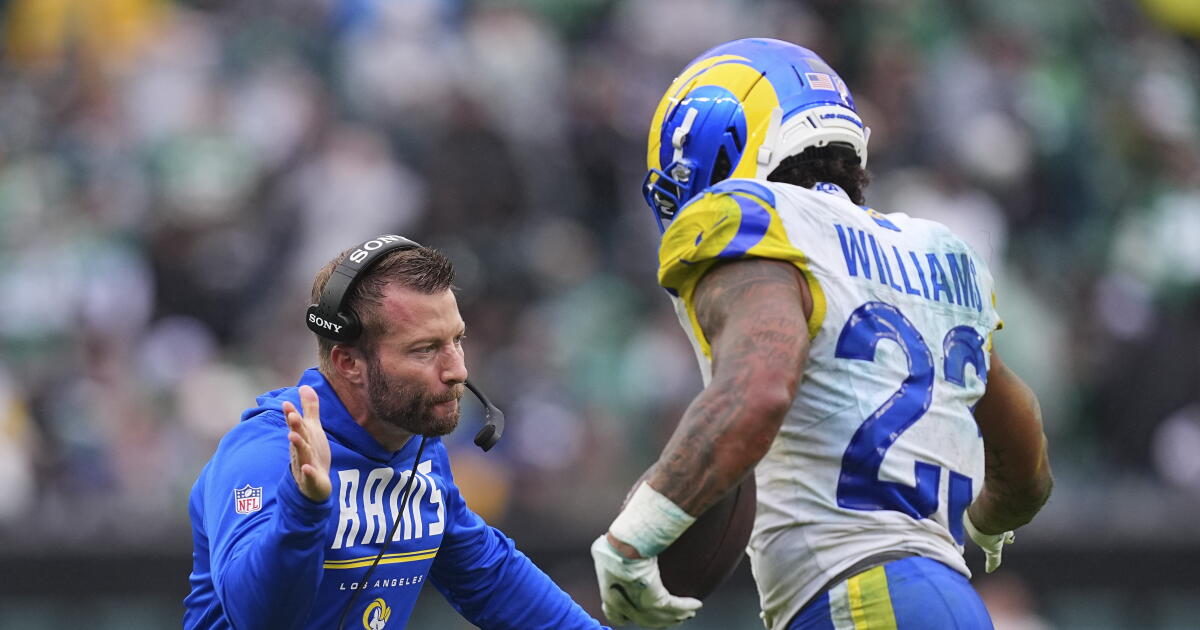
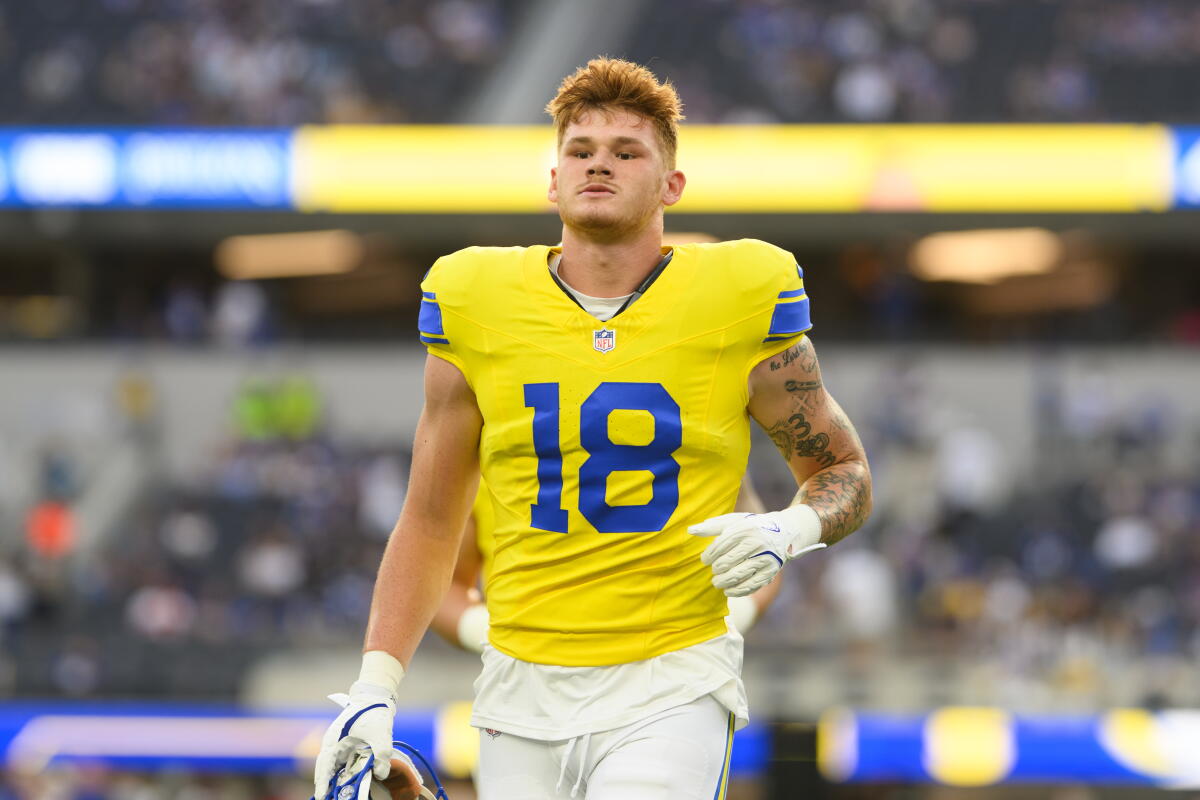
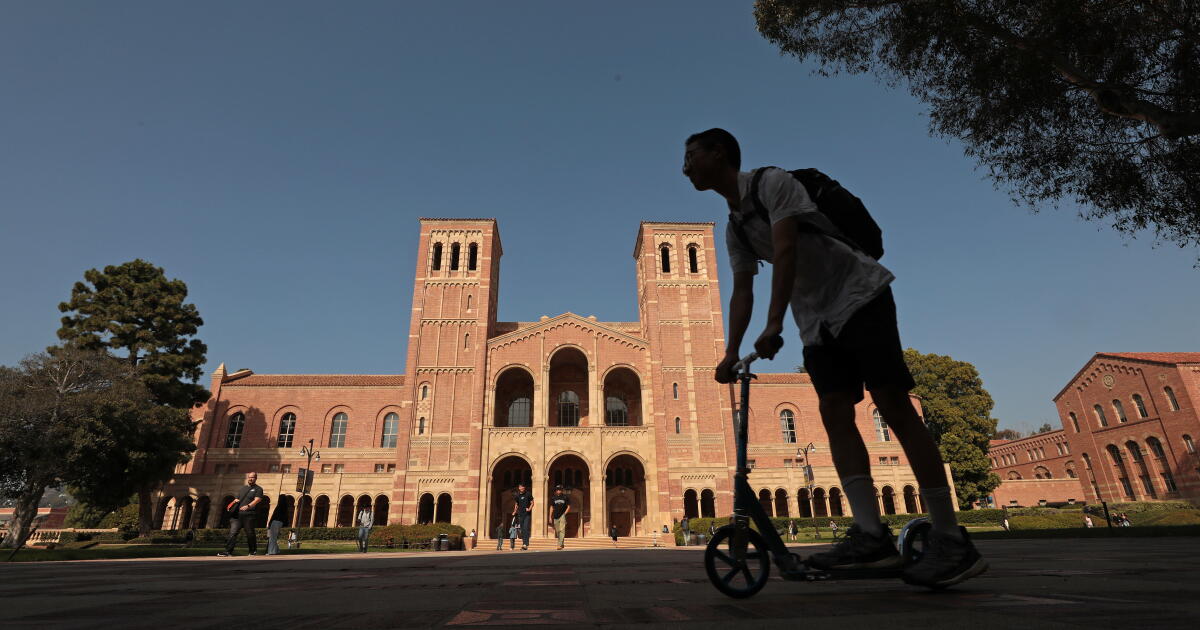
Rams coach Sean McVay told reporters Monday that he had spoken with his assistant coaches about the way some of them behaved toward the end of the team’s 24-20 win over the Philadelphia Eagles on Sunday at Lincoln Financial Field.
“We did talk about it,” McVay said, “and that won’t be an issue moving forward.”
Videos posted on X by user @RBPhillyTake appear to show some Rams coaches inside a glass-enclosed booth interacting with Eagles fans sitting outside directly below them. The caption on one of the videos says the coaching staff was “taunting Eagles fans after the game-winning touchdown.”
“The Rams coaches started to bang on the windows and flip off Eagles fans which caused retaliation (which also isn’t right),” the caption reads. At least one person in the Rams’ booth can be seen giving the middle finger to those outside. A fan appeared to throw a water bottle at the glass window, while others yelled and displayed their own middle fingers.
In another post, the user wrote that “the Rams coaches started banging on the windows for about 30 seconds after the touchdown which then resulted in the Eagles’ fans turning around and chirping back.”
Trailing 20-10 late in the fourth quarter, the Rams appeared to be on their way to a second-straight loss and a 1-3 start to a season in which they were considered by many to be the Super Bowl favorites. But Kyren Williams rushed for touchdowns of one and seven yards in the final four minutes to lift the Rams to a stunning comeback victory.
The sudden turn of events may have gotten folks in the Rams’ coaching booth a little too amped up.
“We’ll be better in those situations,” said McVay, a former assistant coach in Washington. “I’ve been a part of that situation where when I was with Washington calling it from the booth, and you get excited and emotional. … You know, we’ll learn from that. We’ll be better.
“Those fans are really into it. But I know we want to make sure we’re representing the class and just the calm steadiness that we want to have while also being emotionally into it. And there’s ways that we can have that reflected.”
The NFL did not immediately respond to a request for comment on the matter. Its personal conduct policy states that “everyone who is a part of the league” must refrain from behavior detrimental to the integrity of and public confidence in the NFL. Earlier Monday, two officials were suspended for separate instances of “unprofessional conduct toward a player” during Sunday’s games.
Staff writer Gary Klein contributed to this report.
SEATTLE — In a game that looked lopsided for the better part of three quarters, the Chargers did enough Sunday to scare the defending Super Bowl champions.
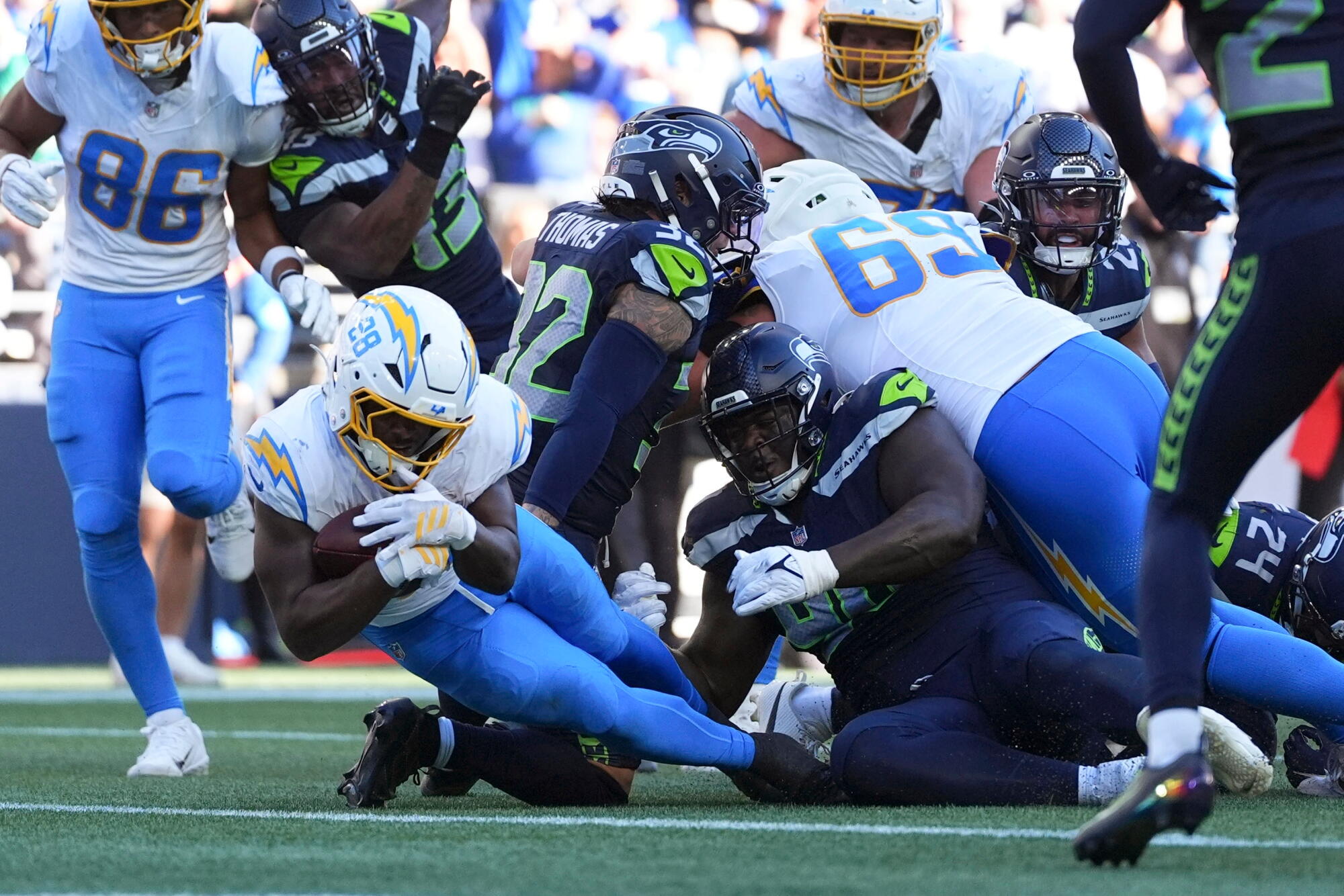
Small victory, but at least it was something for the winless Chargers, who scored a touchdown and field goal in the fourth quarter before falling to the Seattle Seahawks, 30-23.
The visitors, who trailed by 19 in the third quarter, were behind by a touchdown when they took over at their 11 with 1:42 remaining. Three plays into that against-all-odds drive, the Seahawks stripped the ball from Justin Herbert, recovered the fumble and ran out the clock.
The Chargers dropped to 0-4, likely crossing the point of no return. The last time the Chargers started 0-4 was 2017, their first season back in Los Angeles.
Only one team — the 1992 San Diego Chargers — made the playoffs after losing its first four games, and that Bobby Ross-coached squad won 11 of its final 12 games.
These Chargers have 13 games left, and identifying potential wins on the remaining schedule is a nearly impossible task.
Remember the thought that new offensive coordinator Mike McDaniel would unlock all the potential of Herbert? Almost sounds silly now, with the way the team has stumbled and bumbled its way through the first four games.
Previous little rhythm or continuity. Nowhere to go but up.
Sunday was the first time the Chargers finished within a touchdown of their opponent.
For much of the game, Herbert looked lost. His pass was intercepted on the first play from scrimmage and again late in the first half, when his throw landed right in the belly of linebacker Ernest Jones IV.
Chargers running back Kimani Vidal scores a touchdown during the fourth quarter of a 30-23 loss to the Seahawks on Sunday.
(Lindsey Wasson / Associated Press)
Injuries didn’t help. All-Pro safety Derwin James Jr. was deactivated by the Chargers because of a hamstring injury, and the team subsequently lost No. 1 receiver Ladd McConkey (foot) and right tackle Joe Alt (neck) for the second half. In the fourth quarter, left tackle Rashawn Slater lay for several moments on the turf and was examined by medical staff before rising to his feet and walking gingerly to the sideline with an ankle injury.
Herbert took a beating. He was sacked four times, and the Seahawks were flagged twice for roughing the passer. He had three turnovers. His toughness was not in question, though, not after some of those crushing hits.
At least last season the Chargers could point to a specific positional breakdown. Their offensive line was a disaster. This year, nothing is working well — although the defense did turn in a gem for three quarters in the Week 3 loss at Buffalo, including five takeaways.
It has been a disastrous and unfamiliar start for Chargers coach Jim Harbaugh, who before this season had never lost his first two games, either in college or the pros.
Chargers coach Jim Harbaugh reacts during the third quarter Sunday.
(Steph Chambers / Getty Images)
As unpleasant as his job might be at the moment, Harbaugh is ostensibly safe. He’s signed for two more seasons, and the Chargers would owe him more than $30 million were they to part ways with him. Cutting loose McDaniel would be expensive, too, and there’s no clear successor waiting in the wings.
There’s little respite to be found in the Chargers’ upcoming games. They play host to Denver next Sunday, then are at Kansas City, and play the Rams after a week off. Then, the Chargers have a home game against Houston — also surprisingly winless — then play at Baltimore, where the 3-1 Ravens are coached by former Chargers defensive coordinator Jesse Minter.
The Seahawks, defending Super Bowl champions, got a collective whiff of smelling salts before Sunday’s game, having suffered an embarrassing loss at Washington a week earlier. They weren’t about to lose back-to-back games for the first time since 2024.
They were far from perfect, however. After the Seahawks picked off Herbert on the first play from scrimmage, the Chargers returned the favor on Seattle’s first play, intercepting a Sam Darnold pass. That set up a field goal drive and a fleeting 3-0 lead by the visitors.
According to Elias Sports Bureau, the Chargers-Seahawks game marked the first since 1978 — as far back as the stats go — that began with consecutive interceptions.
The advantage didn’t last long. The Seahawks pulled away as the second half wore on, scoring three unanswered touchdowns and tearing through the heart of the Chargers’ defense, sometimes scarcely touched.
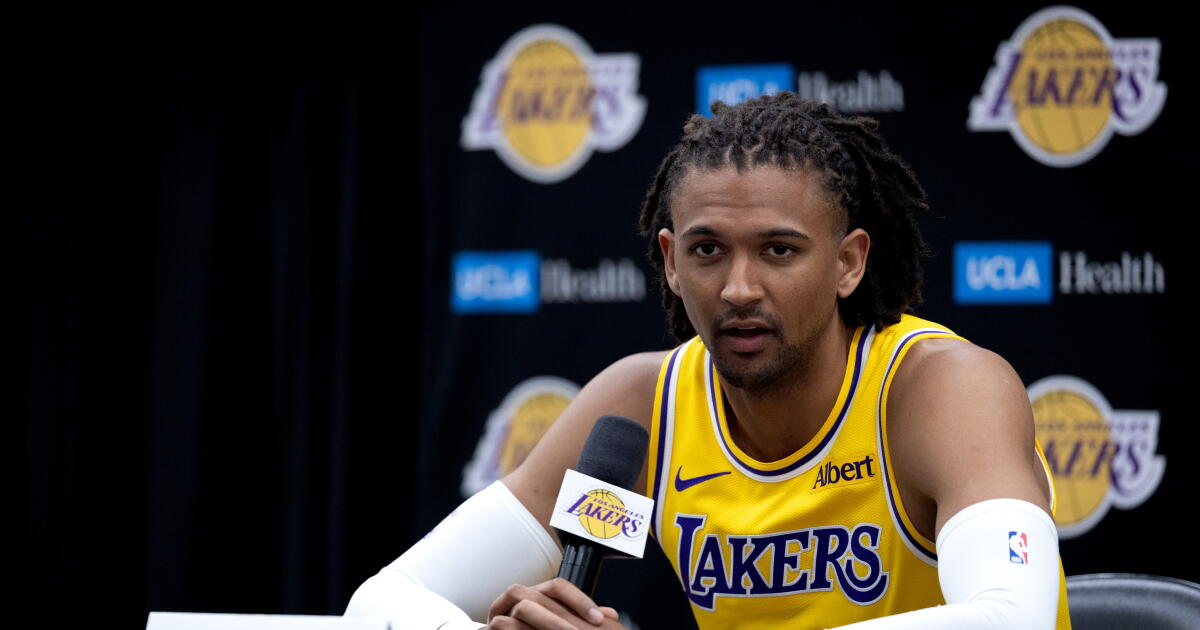
“I mean, you have to work soooo hard. They’re soooo talented,” Thybulle said, laughing. “And it’s just … I think for me it’s great because getting to play against two of the best offensive players in the NBA every day just primes you for — I think it primes all of us, but me specifically — just primes you for what to expect. And I think it was a big thing when you’re growing up that practice should be harder than the games. And I think in the NBA it’s a little different because you just have to pace yourself for such a long season. But guarding Luka and AR, practice is definitely going to be harder than the games.”
During the first four days of Lakers training camp, Thybulle was frequently listed as one of the players who has been a menace on defense.
Austin Reaves said Matisse Thybulle “annoys” him. How do Luka and Austin annoy him? “You have to work soooo hard! They’re so talented.” pic.twitter.com/Qz8g1NLGSt
It was why the Lakers signed the 6-foot-5 free-agent wing to a one-year, $3.2-million contract.
Thybulle, along with Ziaire Williams and Adou Thiero, has been praised for how disruptive he has been during workouts.
“I just think naturally it’s going to be a healthy competition and it gets you better. It’s going to make Austin better when Ziaire is picking them up full court every possession and Matisse is in the passing lane trying to blow things up,” Lakers coach JJ Redick said. “I think [Thybulle and Williams] — [and] Adou with his physicality — those guys are getting better from practicing that way. It goes both ways.”
Thybulle made a name for himself on the defensive end of the floor. He is a two-time NBA all-defensive second team selection, both times with the Philadelphia 76ers in 2021 and 2022.
Still, Thybulle said he’s picking up new skills.
“I think, like the best offensive players in the league — Luka being probably one of the best — change pace so well,” Thybulle said. “And I think as I’m growing in this league, growing as a defender, learning when to change pace and go for steals versus sitting back and being solid and make it more of a cat-and-mouse game as opposed to trying to be in every passing lane every single time.”
On offense, Thybulle will try to mold his game around Doncic and Reaves.
Thybulle will be asked to knock down corner threes and fill the lane on the fast break.
Over the course of his seven-year career, he has made 34.9% of his three-pointers.
“I think luckily for me, I started my career in an offense that was similar to that, and just understanding you never know when it’s going to come, but just to be ready,” Thybulle said. “And just for me personally, at this point, having the confidence in my shot to know that when it comes, I’m ready for it, as opposed to just hoping for the best. I think it goes a long way as well.”
Health has been an issue for Thybulle during the past two seasons with the Portland Trail Blazers.
He played in just 30 games last season while recovering from a torn ulnar collateral ligament in his left thumb and in just 15 games during the 2024-25 season because of right knee and right ankle injuries.
But he’s healthy now and ready for a breakout season.
He’s one of nine new players on the roster and he’s one of the Lakers that will compete for a starting role.
“I leave those decisions up to the coaches,” Thybulle said. “Yeah, so for me, if my teammates are happy with how I’m playing and the coaches are happy with how I’m playing, that’s a good sign to me that I’m doing a good job. But if that means I’m coming off the bench or that means I’m starting, I trust that the coaches know how to use me best to create the most impact, and we’ll go with that.”
Two starting spots up for grabs
When the Lakers play their first exhibition game Monday night in Sacramento, the big story line will be the starting five.
Redick has said Doncic, Reaves and Walker Kessler will for sure start and that the other two spots will be decided by an open competition.
Redick was asked who would be available in Sacramento.
“Obviously, [we’re] still working through stuff,” he said.
The Dodgers are better than you. They’re smarter than you. They’re richer and deeper and more popular than you. You know it, they know it, there’s no point pretending otherwise.
So, yes, they went into the National League Divisional Series looking past the threadbare Atlanta Braves and thinking about the National League Championship Series.
Who does that? In the playoffs?
Your two-time World Series champions with the world’s best starting pitching rotation and a 1-0 NLDS series lead, that’s who.
The way the Dodgers did the math, it made sense to save their ace of aces, Yoshinobu Yamamoto — who last postseason went 5-1, had an ERA of 1.45 and 33 strikeouts in six appearances and won the World Series MVP — for Game 3 of the NLDS.
Not for the tone-setting Game 1 and, potentially, Game 5 on regular rest.
But Game 3.
Because to the Dodgers, that’s not even much of a calculated risk. It was a math problem specific to them, before they beat the Atlanta Braves 5-3 in Game 1 in 100-degree heat Saturday afternoon.
They figured they’d be able to throw two consecutive left-handers at the lefty-averse Braves lineup, starting Saturday with recently acquired two-time Cy Young winner Tarik Skubal, followed Sunday by Blake Snell, also a two-time Cy Young winner.
Additionally, this way they could have Yamamoto pitch Tuesday on the road, where his ERA is 1.77 instead of at home, where it’s 3.13. And where he’s given up 14 home runs compared with six on the road, where he’s made four fewer starts.
But mostly the Dodgers’ calculus was that having Yamamoto pitch Game 3 means it will line up so that they’ll have him for Game 2 in the NLCS and, if necessary, Game 6 against the Milwaukee Brewers or San Diego Padres. (Or, if you really want to plan ahead — and the Dodgers with their leaky bullpen absolutely should not — for Game 1 of the World Series.)
“That just sets up the rotation and Yamamoto better looking forward,” Dodgers manager Dave Roberts explained before Saturday’s game.
“Not discounting this series, because you’ve got to win this series first, but you start from the fact that they’re all going to pitch — the three [Skubal, Snell and Yamamoto] are going to pitch for sure … and then what sets them up going forward.”
It feels like a faux pas, to be that forward-thinking, and to be saying the quiet part out loud!
“If you can kind of line it up in such a way to give guys ample rest, it puts you in a better position for more options down the road,” Roberts said. “That’s kind of some of the math we had.”
I mean, it adds up. And for these Dodgers — whose fourth starter, Tyler Glasnow, was a key cog in last year’s World Series-winning rotation — it’s a fair assessment.
Though it’s nice of Roberts to pay enough lip service that he’s not totally discounting the best-of-five current series they’re in.
Predictably on Saturday, Skubal, who previously had a 2.04 ERA, a 0.73 WHIP and 56 strikeouts in 39⅔ playoff innings for the Detroit Tigers, brought his own October heat.
The 29-year-old from Kingman, Ariz., gave up just one run and two hits, walked two and struck out seven — giving him 64 in the postseason, the second most in his first seven postseason appearances behind only Bob Gibson (74), per MLB’s Sarah Langs.
Skubal retired 15 consecutive, hit 101 on the radar gun in the second inning and didn’t have a three-ball count until the fifth inning.
“We knew,” Braves manager Walt Weiss said, “it was going to be a rough ride.”
But Weiss did not know, immediately after Saturday’s loss, when he’d be able to deploy his sole ace, 37-year-old Chris Sale, the 10-time All-Star who just pitched in the Braves’ Game 3 wild-card closeout.
“To me it’s not that big a deal when he pitches,” Weiss said. “The Dodgers can’t win it in two.”
A true statement and a matter of fact: The Dodgers can’t win in two, but they’re not shy about expecting to win.
“It’s prudent to kind of map out potentially how they could line up,” Roberts said Friday. “And that’s just doing your due diligence.
“We are very fortunate because we have four guys essentially that you could really kind of pick through to figure out what’s the best way to deploy all four starters, that’s the exercise. But it starts with having four talented guys.”
Andrew Friedman, the Dodgers’ president of baseball operations, reveled in the notion that his club might actually be disproving the rule that you can never have enough pitching — at least when it comes to their elite quartet of starters.
And that, Friedman said, “is very impactful for quality of life.”
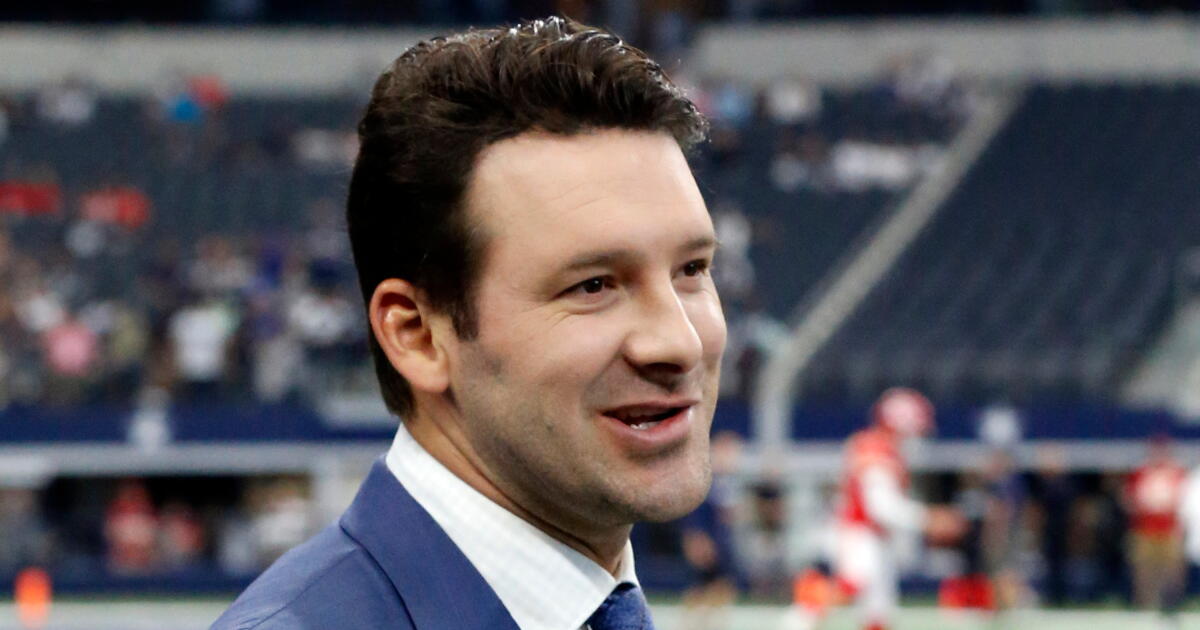
“We thank Tony for his contributions over the past nine years and wish him the best moving forward,” CBS Sports said in a statement.
J.J. Watt, who has been filling in for Romo as the color commentator on CBS Sports’ lead NFL broadcast team, will continue in the role for the remainder of the season. Romo, a former four-time Pro Bowl quarterback for the Dallas Cowboys, has been booth partners with play-by-play announcer Jim Nantz since 2017.
“I’m proud of what I accomplished at CBS Sports over the last nine years,” Romo said in a statement released soon after CBS announced the move. “I approached my role as a game analyst the way I’ve approached everything in my life — with a desire to win and be the best that I can be.
“I’m going to use this time to take a break,” he added, “something I’ve never done before, and focus on my health and my family before moving on to my next opportunity.”
On Sept. 1, Romo entered a a no-contest plea to the OWI charge from his July 23 arrest in Wisconsin. A Milwaukee County judge found Romo guilty of the charge and took away his driving privileges for six months. Romo also was ordered to pay $834, and have an ignition interlock device installed on his vehicles for a minimum of one year.
Afterward, Romo said in a statement that multiple back injuries from his playing career led to “a dependence on pain medication, and my efforts to get off those medications led to an over-reliance on alcohol.”
“None of this is an excuse,” he wrote. “These are my failures, and I take responsibility for them.”
As Olivia Rodrigo kicked off the Unraveled Tour in support of her third album, “You Seem Pretty Sad for a Girl So in Love,” the internet had plenty to talk about—from her dissolving dress and flower-covered stage design to her custom-made, pink heart-shaped guitar.
The guitar was built by Luis Muñoz, a Mexican American guitar technician and luthier who operates out of a tiny repair shop in East L.A.
Originally from El Paso, Muñoz moved to Los Angeles in 2009 and took guitar repair classes in Hollywood, hoping to find his way into the music industry.
Music was always around Muñoz. He remembers discovering Slash after his family got cable television. Mesmerized by the Guns N’ Roses guitarist, who stole the spotlight with his top hat and searing guitar solos in videos for “Welcome to the Jungle” and “Sweet Child O’ Mine” on MTV’s Hot 100 music video countdown, Muñoz knew that was what he wanted to do.
He picked up his father’s old guitar and began learning to play, experimenting with the strings and teaching himself along the way.
His first opportunity came with singer-songwriter LP as a guitar technician. Muñoz admits he exaggerated his skill set to get his foot in the door, but he was determined to make the opportunity count.
“Once you’re in, you’re in,” he said.
Share via
Over the years, Muñoz has toured with artists including Smashing Pumpkins, Deftones, Bush, Anthrax, Fall Out Boy and his most recent touring job was with Rodrigo, after his wife, the pop star’s former bassist, told him she was looking for a new guitar tech.
Rodrigo’s heart-shaped guitar was another opportunity to put his craftsmanship on display.
“I’m sure Olivia has every guitar company in the world in her DMs, and she still trusted a small shop in East L.A.,” Muñoz wrote on Instagram, alongside photos of Rodrigo with the guitar.
“Five prototypes before I got the body right. It had to look cool, play easy, feel comfortable, and most of all, sound good. Built completely by hand, late nights after shop hours.”
Muñoz recalled the moment Rodrigo’s team reached out to request a custom-made guitar. He knew he had one shot to get it right: “In the back of my mind, I’m like, I only got one shot and it has to be made with love.”
The guitar took several months to complete and was built entirely by hand. He later hinted that it is currently one-of-one for now. After Rodrigo shared the guitar with her fans, Muñoz’s one-of-a-kind creation quickly became part of the visual identity of the tour — but for him, the significance went beyond the instrument itself.
Now retired from touring to spend more time with his family, including his 18-month-old daughter, Rosie, Muñoz says moments like seeing young fans in the crowd are what stay with him.
“One of my favorite things being on tour was seeing all the little girls lose their minds. The power of seeing that. Immediately in their head it’s like, ‘I can do that too.’ Imagine if I’m playing a tiny little role in that, yeah … all day.”
Star receiver Puka Nacua will play against the Philadelphia Eagles on Sunday in Philadelphia, but star defensive lineman Aaron Donald is out because of a back issue, Rams coach Sean McVay said Friday.
Donald, a three-time defensive player of the year, has not practiced this week following the Rams’ loss to the Denver Broncos on Sunday in Denver. McVay said Donald, 35, was experiencing back soreness.
“He’s as tough as it gets. Just not feeling good enough,” McVay said, adding, “He would do it and he could probably go be productive but part of our job is to protect these tough dudes like him from themselves.”
Donald has played in two games since ending a two-year retirement in late August. He did not make the trip to Australia for the season opener against the San Francisco 49ers, but made three tackles in the Rams’ 28-6 victory over the New York Giants at SoFi Stadium.
Donald had one tackle and one quarterback hit in the 30-26 loss to the Broncos.
“He’s working as hard as he can to get himself feeling as good as possible and we’re hopeful and optimistic that good days are ahead,” McVay said.
Nacua sat out the last two games because of a hip injury that caused hip, groin and abdominal soreness.
McVay said Nacua has been “strong, looks sturdy, looks explosive,” during practice this week.
“I think it will really just be a feel for the overall conditioning,” McVay said, adding that he hopes “the magic of the [game] jersey” will help Nacua have a productive game against the Eagles.
Tight end Terrance Ferguson (ankle) and cornerback Jaylen Watson (shoulder) will not play on Sunday, McVay said. Tight end Colby Parkinson (shoulder, knee) and edge rusher Josaiah Stewart (groin) are questionable.
Rams place Terrance Ferguson on injured reserve
Rams tight end Terrance Ferguson jogs back to the locker room against the Giants on Sept. 21.
(Kyusung Gong / Associated Press)
The Rams opened the season with five tight ends on the roster, which some might have regarded as a surplus.
But the Rams need the depth.
On Friday, the team put Terrance Ferguson on injured reserve because of an ankle injury.
Ferguson, a 2025 second-round draft pick, was injured Sept. 21 against the Giants, but he played through it against the Broncos.
Ferguson has seven catches for 63 yards and a touchdown.
Ferguson must sit out at least the next four games against the Eagles, Buffalo Bills, Arizona Cardinals and Las Vegas Raiders. He is eligible to return for the Nov. 1 game against the Chargers.
The Rams began the season with five tight ends on the roster. Tyler Higbee and Davis Allen are at full strength. Max Klare, a second-round draft pick from Michigan, could get his first action on offense against the Eagles.
Rams release punt returner Xavier Smith
Rams wide receiver Xavier Smith runs the ball against the Kansas City Chiefs during a preseason game in August.
(Charlie Riedel / Associated Press)
What a difference a day makes.
Less than 24 hours after Rams special teams coordinator Bubba Ventrone said the team was not going to replace punt returner Xavier Smith, the team released him.
“We just need better production out of that position,” McVay said, adding that some of the “decisions” that Smith made in last Sunday’s loss to the Denver Broncos proved costly.
“We’ve got to make better decisions,” McVay said. “We’ve got to be able to field it.”
Receiver Alex Bachman is expected to be promoted from the practice squad to handle punt returns. McVay said he was “optimistic that I think we’re going to see some good stuff from Alex on Sunday.”
Smith, 29, is a third-year pro who signed with the Rams as an undrafted free agent and worked his way into a role as a kick returner and rotational receiver.
Smith appeared to be on his way to overcoming a major error in last season’s NFC championship game, when he lost a fumble in the 31-27 defeat by the Seattle Seahawks.
But through three games, Ventrone on Thursday described Smith’s performance as “inconsistent.”
“We need to do a better job of tracking the ball, judging the ball, fielding the ball when necessary, not fielding it in other situations,” Ventrone told reporters. “He knows that and hopefully we’ll get the improvements that we need in that area.”
Ventrone was asked if there was any thought about replacing Smith as the punt returner.
“No, we have a lot of trust in ‘X’, I really do,” Ventrone said. “He’s put in a lot of time and effort in training camp and obviously moving into the season. I think that he’ll do the necessary things to be able to sustain at that position for us.”
But on Friday morning, the Rams announced they had waived Smith.
McVay said the Rams “weren’t thinking” about making a change when Ventrone spoke to reporters Thursday.
“As you get a chance to kind of take a step back, evaluate the totality of our group, what’s the best way to try to be able to put together all three phases, did feel like that was in the best interest of the group,” McVay said, adding, “and that decision was made kind of later [Thursday night].”
This summer, Southern California hiker Mark Orr spotted a hazard he struggled to stop thinking about: a crumbling, narrowing section of the Devil’s Backbone Trail near Mt. Baldy.
Orr wanted to help.
In early August, he trekked about 5.6 miles from the trailhead near Manker Flat campground to the site, hauling 85 pounds of gear with him over two trips. Orr first spent two hours digging out a wider route and then built what he dubbed an “anti-erosion fence” by installing 30-inch rebar stakes, stainless steel wire, clamps, aluminum flashing and zip ties. A few weeks later, Orr posted a video documenting his work to his YouTube channel, where he’d previously shared about hiking and other DIY projects. In the video, which Orr has since made private, he said he’d never performed trail work.
A view from Baldy Road leading up the Mt. Baldy Notch in the San Gabriel Mountains.
(Jaclyn Cosgrove / Los Angeles Times)
The people of the internet were initially grateful. “I can’t imagine doing this in my backyard let alone at 9,350 ft. You are THE MAN,” one YouTube user wrote. “I’ve hiked the backbone dozens of times and will remember you with gratitude every time I come across this section,” another person said. One person said his son was one of the three people who died while hiking the Backbone Trail in late December, and he wanted to connect with Orr.
But, as the video’s view count ticked up, concern over Orr’s work mounted into rage.
Two camps developed: Those who lauded Orr’s efforts and those who felt he should be held accountable for what they argued was damage to the trail. “I give this guy an A+ on his intentions and effort,” a Reddit user wrote on a post about Orr’s video. “If a section is dangerous, it should ‘look’ dangerous. To make it look safe, creates a bigger hazard as people will come to rely/trust in what is actually a DIY retaining wall. What happens when that eventually gives way? What if someone is hurt/killed as a direct result of this DIY project?”
You are reading The Wild newsletter
Sign up to get expert tips on the best of Southern California’s beaches, trails, parks, deserts, forests and mountains in your inbox every Thursday.
By continuing, you agree to our Terms of Service, which include arbitration and a class action waiver. You agree that we and our third-party vendors may collect and use your information, including through cookies, pixels and similar technologies, for the purposes set forth in our Privacy Policy such as personalizing your experience and ads.
In this edition of The Wild, our weekly outdoors newsletter, I will report out the current status of the trail where Orr completed his work. I will discuss how we got here — where an individual, not the U.S. Forest Service, tackled a trail repair — and where we go from here, including how you can do your part without upsetting half the outdoors corner of the internet and violating federal policy.
First, let’s talk about Mt. Baldy and how people usually get there.
A segment of the Devil’s Backbone Trail that hikers take to the Mt. Baldy summit.
(Jaclyn Cosgrove / Los Angeles Times)
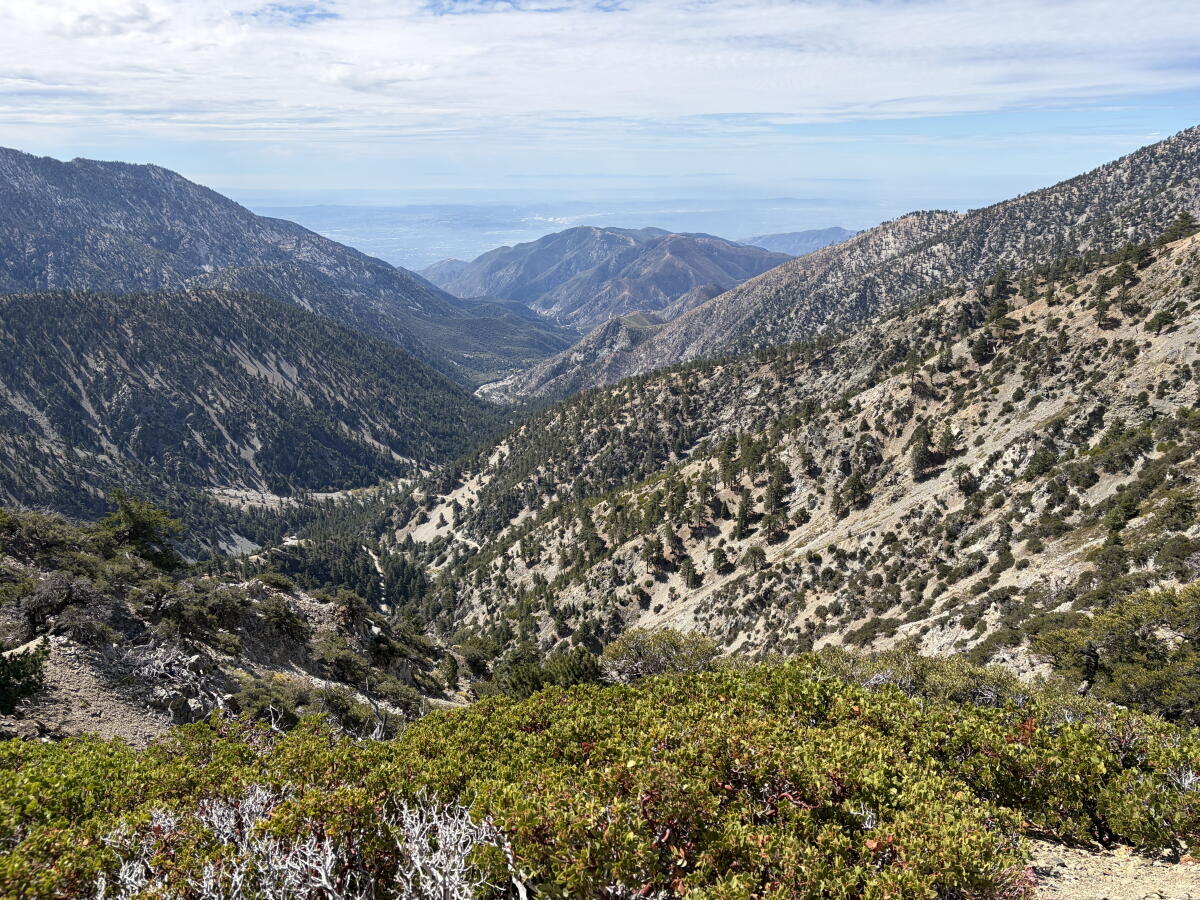
Mt. San Antonio, commonly referred to as Mt. Baldy for its appearance, is a 10,064-foot peak in the San Gabriel Mountains and is the highest point in Los Angeles County.
Outside of winter, when much of the trail can become covered in snow and ice, most hikers reach Mt. Baldy via two routes. They start near the Manker Flat campground and walk Falls and Baldy roads until they either turn north-ish onto the Baldy Bowl Trail, often referred to as the “Ski Hut” route because hikers pass the Sierra Club’s green building, or hikers continue on Baldy Road until they reach the Mt. Baldy Notch. From here, hikers start the Devil’s Backbone Trail first by trekking up a fire road and then taking on a grueling, narrow 1.9(ish)-mile jaunt that gains about 1,500 feet and always makes me question my life choices about halfway through.
The Devil’s Backbone is named as such because of its shape, including segments where hikers walk a narrow stretch with steep drop-offs on both sides. This steepness is part of what makes it susceptible to erosion — and why only serious, well-equipped mountaineers should traverse it during the winter.
The Devil’s Backbone Trail, per the U.S. Forest Service, is 3.24 miles long, starting at Baldy Notch and ends at Mt. Baldy Summit.
(Jaclyn Cosgrove / Los Angeles Times)
On Sunday, I headed up Baldy Road to see how Orr’s repairs were holding. I am active in the r/socalhiking Reddit community, where I first learned of the story, and had already seen images showing a hole developing at the start of Orr’s repairs.
But no one had pinpointed exactly where they were.
Once I reached the Devil’s Backbone, a hiker warned me about a particularly steep and narrow section he’d just traversed.
“Is this the part with the repairs?” I asked.
“No, that part is way up, and it is already breaking down,” he told me.
I then chatted with two high schoolers coming back from summiting Baldy, one of whom hopes to attend a University of California school to study environmental science. “A little bit of rain,” and it’s gone, he said of Orr’s repairs.
A segment of a repair performed by a local hiker that has started to fail.
(Jaclyn Cosgrove / Los Angeles Times)
Just over a mile into the Devil’s Backbone, I spotted the shiny aluminum of Orr’s anti-erosion fence. And I spotted the hole where fill dirt has fallen through. Before Orr started his work, the trail was narrow — his work did widen the route, but how long will it hold?
Alan Coles, a trail crew leader with the San Gabriel Mountains Trailbuilders, which maintains routes in the backcountry and Baldy area, told me the answer is probably not long, especially given the rain and snow we could get this winter from El Niño.
A segment of the Devil’s Backbone Trail where a hiker attempted to widen and repair the crumbly trail.
(Jaclyn Cosgrove / Los Angeles Times)
“Taking another look at the video, the problem with the trail may be due to a buildup of material washing down from above,” said Coles, who has 35 years of trail maintenance experience. “Often the best solution is to dig it out and lower the trail to the original alignment, which will also widen it. The problem with the repair is that the hardware he installed would make that difficult. In time, the material he used will come apart, and those stakes will get more exposed, leading to problems with people tripping on them, especially if there is snow.”
Coles said to begin work in Angeles National Forest, he must submit a list of trails that his organization wants to work on to the U.S. Forest Service. The agency’s archaeologist, biologist and other technical experts will review his list. If there are any issues with a particular trail that Coles has identified needs repairs — like if an endangered species is known to live in a creek next to the trail — the Forest Service could deny his request, thus leaving the trail unmaintained.
A hiker walks near the hole created by unauthorized repairs performed in early August.
(Jaclyn Cosgrove / Los Angeles Times)
Coles said the Devil’s Backbone Trail is a “very difficult repair” for a lot of reasons, including its high altitude and the need for a crew to get permission to use the fire roads to shorten the distance they have to haul their gear. Coles said hikers often ask him when his crew will work on the Three T’s Trail, as the route has several downed trees and other issues, and his crew faces similar access issues.
Coles said he sympathizes with Orr’s reasoning for repairing the trail: People died in that area.
“His heart’s in the right place, but it really needs to be done with someone who says, ‘OK, here’s how you properly do a repair like that,’” Coles said.
It’s impossible when thinking about Orr’s repairs not to think about the old adage of, “The road to hell is paved with good intentions,” and the brutal irony is that, once you reach the Devil’s Backbone, you’re going to need more than that.
Two hikers navigate down the Devil’s Backbone Trail after summiting Mt. Baldy, the highest point in L.A. County.
(Jaclyn Cosgrove / Los Angeles Times)
When I spoke to Orr after my hike, he said he hopes that he can join the trail crew to remove what he did and repair the trail properly.
“The first thing is, it was nothing but well intentions by somebody who loves the mountain and wants it to be safer for everybody,” Orr said. “I totally get that my first crack at this, I didn’t do everything right, and I’m actively working with the San Gabriel Mountains Trailbuilders to get it right before this winter.”
The final challenge, though, will be getting officials at the U.S. Forest Service to approve the work plan. A spokesperson at Angeles National Forest did not respond to my request for a comment or an interview for this story.
Orr’s trail repairs come at a time when outdoors lovers are feeling particularly protective of public lands. The Trump administration has continued its efforts to peel back layers of environmental protections, like the Roadless Rule, raising the alarm of park advocates who fear not even Yosemite is safe from development.
The sunset as viewed Sunday on a trail often referred to as the “Ski Hut” route.
(Jaclyn Cosgrove / Los Angeles Times)
At the same time, the U.S. Forest Service and National Park Service have both seen massive staffing cuts during Trump’s second term, and this comes after decades of underfunded trail construction and repair.
In the early 1980s, “each of the five Angeles Forest districts had a full-time, paid trail crew of eight to 10 members. Now there are only summertime crews with three to four members. Forest Service officials and the agency’s critics agree that if it were not for the volunteer corps of 700 trail builders, the mountain paths would not be repaired for years,” according to a 1993 Times story.
Those crews, Coles said, were one of the casualties from a swath of federal budget cuts in the 1980s. A 1986 Times story noted that, in just four years, “the amount of federal money allocated for trail maintenance nationwide and in Southern California … dropped about 50%.”
“For the most part, without the volunteers, you wouldn’t have a trail system today,” Angeles National Forest official Don Gilliland told The Times in 1993.
The sun goes down, casting orange and pink hues through the clouds above the San Gabriel Mountains near Mt. Baldy Village.
(Jaclyn Cosgrove / Los Angeles Times)
The agency continues to rely heavily on volunteers. The U.S. Forest Service estimates that it has about $10.8 billion in deferred maintenance, including $241 million in deferred trail maintenance and almost $70 million in trail-bridge deferred maintenance, according to a recent budget document.
In an analysis of that backlog of work, officials with the U.S. Government Accountability Office heard from one regional official who told them that the trail maintenance program “is held together by Band-Aids and baling wire.”
If you’d like to be part of that baling wire, you can join Orr in joining a local trail crew. There are several who service the San Gabriel Mountains and their foothills.
It is easy to read about Orr’s efforts and point out the obvious mistakes he made. It’s another thing to take action, whether that’s donating to local trail crews or volunteering on their work days. I’ll see you out there, focusing on the latter.
3 things to do
A coyote drinks water puddling near the golf course at Griffith Park.
(Mel Melcon / Los Angeles Times)
1. Document dicots and deer in L.A. The Los Angeles Public Library, along with other city agencies, will launch this year’s L.A. Nature Quest at 9 a.m. Saturday at the Griffith Park Visitor Center. The L.A. Nature Quest is an annual monthlong effort to document as much of L.A.’s flora and fauna as possible using iNaturalist, a citizen science app. Attendees will be guided by rangers and other experts in a morning of outdoor exploration and nature journaling. Downloading iNaturalist beforehand is recommended. Register at eventbrite.com.
2. Sit down and spy birds in Pasadena The Pasadena Audubon Society will host a seated birding experience at 8 a.m. Saturday on the Gamble House lawn (4 Westmoreland Place in Pasadena). Guests should bring water, sunscreen, a lawn chair or blanket, and a hat. Participants can bring their own binoculars, but there will be some to loan out for those without. Register at eventbrite.com.
3. Marvel at mushrooms in Monrovia Monrovia’s Canyon Park Nature Center will host the opening reception for the Mushrooms of the San Gabriel Mountains at 10 a.m. Sunday. Mycologist Aaron Tupac will share with guests about how and why they photographed the specimens shown in the exhibit, along with sharing information about our local fungi populations. Learn more at Tupac’s Instagram page.
The must-read
Biologists collect olive ridley sea turtle eggs from nests on Southern California beaches.
(Huntington Beach Police Dept.)
In mid-September, two heart-shaped olive ridley sea turtles made history when they dug nests on Seal and Huntington beaches, marking the first documented natural sea turtle nests on the U.S. West Coast. Times staff writer Corinne Purtill wrote that biologists and cheloniophiles barely had time to celebrate before realizing that these nests were at risk of being destroyed by incoming storm surges and high tides. Biologists recovered just over 200 eggs. “We had to make some quick decisions,” said biologist Jonathan Snyder of the U.S. Fish and Wildlife Service at the Aquarium of the Pacific in Long Beach on Friday. “This is the decision that we made, and I think it’s the best one for species recovery.”
Happy adventuring,
P.S.
Montrose Search and Rescue recently highlighted the perils of taking the wrong route to hike Strawberry Peak. Strawberry Peak, visible from several L.A. hikes, is the highest point in the front range of the San Gabriel Mountains. Montrose Search and Rescue recently rescued hikers, though, who’ve ended up on the mountaineering route. Their video highlights how crucial it is to know your route before you go — and to ensure you have a physical map with you in case you get lost. Stay safe out there, folks! (And don’t hike Strawberry Peak right now — it’s too hot.)
For more insider tips on Southern California’s beaches, trails and parks, check out past editions of The Wild. And to view this newsletter in your browser, click here.
The California I grew up in had its pluses and minuses, just like the state I’m living in now.
But consider this:
In 1974, I wrote a check for a semester of college.
The fee was $98.
That was the cost of registration, by the way. Tuition for in-state residents was free at San José State University and other public universities in California. The state’s leaders believed subsidized higher education would serve the greater good and seed economic growth.
Two years after graduating, I was working as a sportswriter for a small Bay Area newspaper. My spouse was a drug store clerk. Together we made less than $20,000 a year.
And we bought a brand-new house, 45 minutes east of Oakland, for just under $50,000.
In a thousand ways, we’re living in a different California today. Tuition and fees for a semester on a Cal State campus now run about $4,500, and the average mid-tier home costs about $775,000 in some places and far more in others, which is out of reach for nearly 80% of working people.
So as I watched the gubernatorial debate Wednesday night between the two men who want to lead us into the future, I was wondering which California is better in terms of hope, opportunity and livability?
The one I was born in during the postwar boom, or the one we’re living in now?
There’s no easy answer. The California of my youth was more affordable, but it was no utopian dreamscape. Housing discrimination and segregation were deep-seated, and the Los Angeles sky was the color of swamp water.
In the last half of the 20th century, California went on to become a global leader in technology, aerospace, the arts and healthcare, and its investment in public education helped build an economic superpower. Even the air got cleaned up, to a degree.
But for all of California’s riches and unrivaled natural beauty, it’s fair to say things are out of whack at the moment. How is it that the world’s fourth-largest economy also has the nation’s highest poverty rate?
There’s a flotilla of yachts, but millions of have-nots, and enough homeless people to fill stadiums. If we’re so progressive, and swimming in more venture capital than the rest of the nation combined, why are the masses crippled by a housing shortage and the high cost of living, and why did we build a soaring higher education model while letting our once exalted K-12 system sink in national rankings?
If California weren’t so lopsidedly blue, Republican candidate Steve Hilton might get a little more traction with a campaign built around the idea that there’s an easy explanation for the state’s misery of problems: Democrats have been in charge for years, they’ve mucked things up, and Xavier Becerra is yet another textbook California liberal who will stay the course.
“It’s impossible for regular working people to live in this state anymore,” Hilton charged during the debate, calling out over-regulation, the high cost of living, the housing shortage and a homelessness problem that “shames” our state. “And all you’re offering,” Hilton continued, “is more of the same, backed by the same corrupt machine in Sacramento.”
Becerra, meanwhile, kept handcuffing Hilton to President Trump, a good move, given that the president has helped launch an idiotic war, gummed up the economy, and seen his favorability plummet.
Hilton is not entirely off base, although there’s no evidence he has plausible solutions.
What he doesn’t tell you is that other states have their own problems, many of which have more to do with global economic forces — and President Trump’s war-mongering and tariff tirades — than with public policy decisions at the state level.
When I was a lad, my father drove a milk truck, and then a bread truck, and then he sold candy and tobacco for a wholesale distributor based in Oakland, near the Coliseum, where he’d take me to A’s games but save a few bucks by parking next to the railroad tracks a half-mile away from the parking lot.
His jobs were mostly unionized. Unions were plentiful in the private sector back then. My family saved up for a house while we lived in an apartment, and then I paid next to nothing for a college degree.
The boldness of that idea — a free education at an elite university, with a lofty if unfulfilled goal of equal access for all — is still a testament to California’s long-ago grand ambition, even if Gov. Ronald Reagan eventually ended free tuition.
In her new book, “California Dreams: The Making and Remaking of the University of California,” Miriam Pawel references a quote from UC Berkeley alum Joan Didion, who called the system “the most coherent expression of the California possibility.”
The staircase I climbed was the essence of what USC professor Natalia Molina called “the infrastructure” of upward mobility. In her immigrant family, her grandmother established an Echo Park restaurant that Molina wrote a book about — “A Place at the Nayarit” — and her mother ran the bar there after attending bartending school.
Molina went to UCLA, and is now both a MacArthur Foundation fellow (the “genius” grant) and a Guggenheim fellow.
“There’s not that same path for upward mobility,” Molina said. “But there sure seems to be a path for downward mobility.”
That brings me back to the economy, and lessons I learned in 2018, when I spent several weeks in and around Telfair Elementary School in Pacoima, looking into why nearly a quarter of the students were homeless.
The answer? Several once-bustling manufacturing and aerospace companies in the area had shut down. The new economy was fast food and big box stores. Pay dropped; housing prices spiked. It was a snapshot of a changing world — one we haven’t yet adapted to.
Modern politics is not built to foster long-term thinking about such challenges, said longtime political strategist Darry Sragow.
“What are the dreams, what are the aspirations, where do you want to go?” said Sragow, who doesn’t know the answers but would like to at least hear the questions. “I keep looking for somebody who will do that.”
Agoura Hills resident and attorney Dan Douglass, 80, who detests President Trump and isn’t a fan of Hilton, told me that as a moderate Republican, he feels like “a man without a party.” But he is not without an answer to California’s housing problem.
“They’ve made it too complicated to build anything,” Douglass said. “Too many permits. Too much time to build.”
“California must reduce regulatory costs that fall disproportionately on low- and middle-income residents,” Trachtman wrote in a recent four-part analysis.
“The state has “long led the nation in regulations promoting safety, sustainability, and quality,” he went on. “These policies can produce strong benefits. But they can also drive up the cost of essentials — costs that hit the poor hardest. This amounts to regressively funded progressivism.”
California was, and is, a work in progress, richly endowed and deeply flawed. Fixing complicated problems isn’t easy, but what I’d like to see from the next governor is more of the striving, imagination and sense of collective purpose that made California great.
There’s no way and no reason to go back to the state of my youth, but Trachtman had a thought about where to go next.
“In some ways we can use the past as a model,” he told me. “But in other ways we need to be more innovative and think about charting a path forward.”
Toward the most coherent expression of the California possibility.
Vintage-inspired mini golf in San Clemente. Mai tais on a sunken ship in Anaheim. Sprawling red rocks in Trabuco Canyon. It’s time to go deeper into great, big, always juicy O.C.
Earlier this summer, Akriila flew to Los Angeles and played two nights at the Roxy in West Hollywood. At 22, the Chilean singer-songwriter, most identifiable by her fire engine red tresses, is one of the most visionary newcomers in the latest wave of post-urbano Latin artists.
Fittingly, Akriila kick-started her career with a trap mixtape. The most-streamed tracks on her debut, 2024’s dazzling “Epistolares,” favor a progressive reggaeton vein. She also collaborated with Milo J on “Llora Llora” — a folksy lullaby off the Argentine rapper’s masterpiece “La Vida Era Más Corta.”
“Hot gays listen to Akriila” became a celebrated slogan on social media.
Turns out she was just getting started. Released Sept. 3, her latest album, “Lucy Miró al Mundo y Notó Que Está Girando” — its title a delicious riff on Beatles lore — eschews reggaeton altogether, in favor of a hallucinogenic collage of shoegaze, electronic glitch pop and South American roots sounds.
A guidepost of Chilean hyper-pop, it is also a heart-wrenching mash of tenderness and distortion. The lyrics describe the trauma of a recent transition, after she left her father’s home and ventured to live on her own — and though she’s now an established artist signed to Atlantic Records, her music is still aching and vulnerable.
“She is a reference point for all of us in contemporary music,” says producer Diego Raposo, a Dominican tastemaker who featured Akriila on his 2023 debut album. “I believe we’re witnessing something that we’ll probably never see again. Her music reminds me of Björk, Aphex Twin, even Shakira — but it’s also incredibly fresh and original.”
A few days before traveling to London for her inaugural European tour, Akriila spoke to De Los about the seduction of second verses, her obsession with ’90s dream pop and the growing pains of living alone.
This is such a dreamlike record. Was that intentional? I wanted it to feel not necessarily ethereal, but hazy, like you’re inside a bubble. I love the way my voice is processed, sharing the space with so many layers. It’s really cool when the vocals are part of a track instead of lying there in the center of the mix.
I was your age in the ’90s, and this album has a very strange emotional effect on me: It reminds me of what it felt like to be in my 20s, listening to dream pop for the first time. That makes perfect sense, and it connects with a favorite exercise of mine: Every week — ideally, every day — I listen to a full album from beginning to end. I started with new releases, but then set my sights on the classics.
The Sundays’ [1990 masterpiece] “Reading, Writing and Arithmetic” was the album that opened up the space mentally for what I wanted to do. I always say that I make alternative pop. I start with something that’s catchy and easily digestible, and then mix it with sounds that feel uncomfortable. As I was starting to work on this album, I listened to the Sundays, the Cardigans, and every single record that Prince ever made.
I can definitely feel the ’90s vibe in the closing track, “Lucy.” It’s gorgeous. That’s inspired by the Sundays’ “Gone,” and the drums sound like Cocteau Twins. I love the art of collage — stealing from different artists, but doing it my way. There are samples of PJ Harvey, Patti Smith, but also Rosalía. When I make videos, I’m always thinking of something that MTV would have played back in the day.
I keep thinking of this record as a concept album, even though the actual concept is more of a feeling than anything else. I totally get you. It’s not an album like the Who’s “Tommy” — an actual musical that takes the conceptual deal to another level. I feel we’ve forgotten the art of making albums now that we’re so focused on playlists and TikTok. I invest a lot of effort in making my albums conceptual, since I’m not into records that are random collections of tracks. “Epistolares” was all about sending letters and dedications. The deluxe version was more sentimental. This one is a concept album for sure. I could outline in detail why every moment of the record happens when it does.
The bridge on “Abrázame” is incredibly romantic. That bit really freaked me out in a good way. It was shorter at first, but then I asked [producer] Vinco to make it longer. Those guitars on the bridge are the most beautiful thing he’s ever done. The contradiction of “Abrázame” is that everyone kept telling me that it should continue going up and explode at the end, but I had already overused that device on “Epistolares.” So I did the opposite and gave it a happy ending. That ethereal, ambient thing at the end kills me.
Talking about songwriting devices, here’s a trademark Akriila move: A song may be moving forward, and suddenly there’s a fracture — everything breaks and decomposes. Why? I think I have ADHD and need things to be constantly changing. I’ve tried to make songs that are plain, but I just can’t do it. My favorite part of songwriting is working on the second verse. You’ve already presented the main idea and shown what the chorus is like. On the second verse you can change the beat or the lyrics, and do anything you like. [Producer] Clemente is just like me in that respect. Sometimes we take things to the limit, and then step back. It’s one of the great things about my creative team: We’re not married to the demos. We may do five versions of the same tune until it sounds right.
Your Chilean roots shine through on “Partedemipartedeti.” I listened to those folk bits and thought: Here’s someone who grew up listening to Los Jaivas and Inti-Illimani. When I first started obsessing about music, the stuff that I liked was all in Spanish. I listened to tons of records from Chile, Argentina and Mexico. “Carta a Mi Papá” is like a traditional balada from Chile. I stole those chords from “Quizás, Porque” by [Argentine supergroup] Sui Generis. I listened to a lot of Pescado Rabioso when I was a teen. My partner has a cassette deck in her car, and she’s always playing [Charly García’s] “Piano Bar.” I don’t identify only with Chilean music. It’s more of a música latinoamericana thing. I don’t think gringos are that good in the lyric writing department. Artists like Bandalos Chinos, Alex Anwandter and Zoé are really great composers.
Do you think you’re an old soul? People always tell me that [smiles]. We’re a team of three; I think Clemente is a really young soul. Vinco and I are the old ones.
Before making this record, you stopped living with your dad, moved to a place of your own, and experienced a time of profound loneliness. What does your father think of the finished album? He loves it. He is a musician himself, and it must have been hard for him when we started living apart. It was also difficult for me to get home and feel so lonely because there was no one waiting for me anymore. My dad still comes to my place once a week; he doesn’t want to bother me, so he leaves food in the reception area. It’s his way of making sure that I’m doing fine.
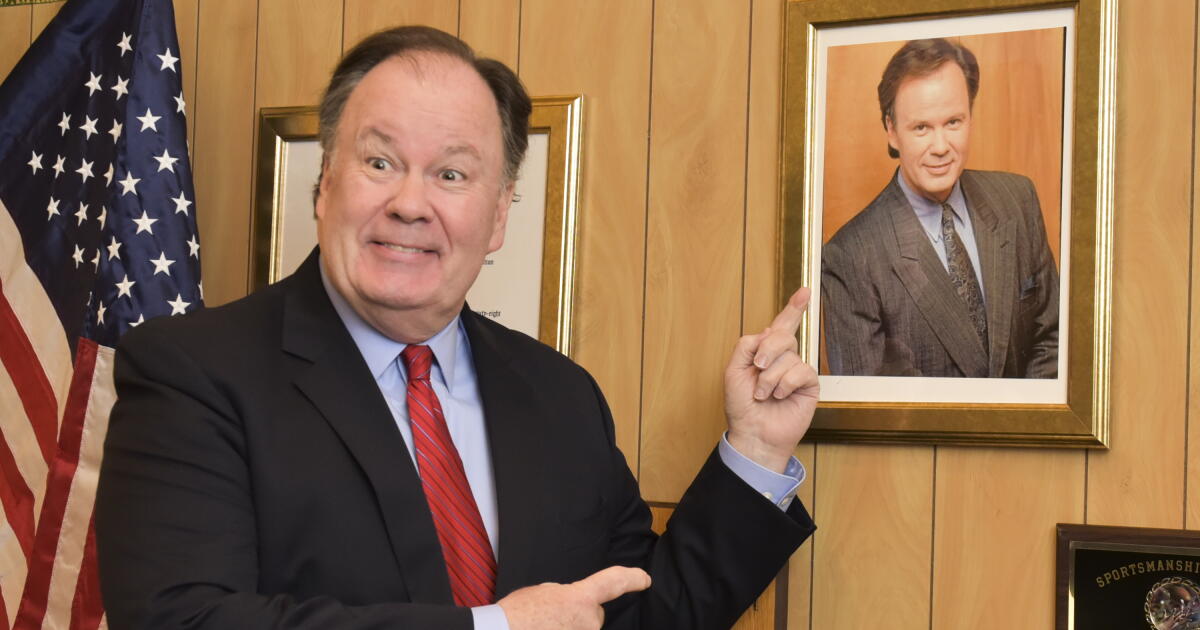
Dennis Haskins, an actor known best for playing Principal Richard Belding on the 1990s high school sitcom “Saved by the Bell,” died on Sunday night. He was 75.
Haskins’ friend and longtime caretaker, Kimberly Snow, confirmed the actor’s death. A cause of death is unknown, but Haskins had quietly battled Parkinson’s and was candid about other health issues. According to Snow, the actor died around 11 p.m. in a Burbank assisted living facility.
Snow, a former manager of Burbank’s since-shuttered Dimples Karaoke, shared the news of the actor’s death on Instagram, writing that Haskins was a staple at the joint, so much so that many of the patrons thought he owned it.
“A lot of people thought he owned it, but he didn’t,” the tribute read. “He just loved the place and its people. He enjoyed singing for people, meeting them, and taking selfies with his fans. Dimples closed down about 11 years ago, and people still associate him with his beloved ‘second home.’ He was known to most as Mr. Belding from Saved by the Bell, but to us, he was much more than that.
“About eight years ago, he became ill,” the post continued. “He had been silent about his fight with Parkinson’s, among other health concerns, because he did not want the attention. He did not want to have to tell people. He would say, ‘What do I even say?’ So I respected his wishes and stayed quiet, and I helped him through his journey into the next chapter of his life.
“Late last night, that journey ended for him. He is now at peace and is probably entertaining the people in the sky. Just know that if you tried to reach out to him in the last few years, I did read your messages to him, and you were heard.”
Haskins played the earnest and beloved Mr. Belding across the “Saved by the Bell” franchise for 12 years, from 1988 to 2000. As recently as 2015, he reprised the role for a sketch on “The Tonight Show Starring Jimmy Fallon,” alongside Bayside High School alums Mark-Paul Gosselaar, Elizabeth Berkley, Mario Lopez and Tiffani Thiessen.
Haskins was born in Chattanooga, Tenn., on Nov. 18, 1950, to parents Dennis Button Haskins IV and Veneta Marilyn Yarbrough. One of three boys, he attended Notre Dame High School in Chattanooga and, later, the University of Tennessee at Chattanooga.
He ultimately made his way to Los Angeles where he broke into acting, with his first on-screen gig playing a workman in “Archie Bunker’s Place” in 1981. He acted regularly through the ’80s, landing parts in television shows “Magnum P.I.” and “The Dukes of Hazzard” before finding his way to the part that would make him America’s favorite principal.
He played Mr. Belding across seven different series, including, “Good Morning, Miss Bliss,” “Saved by the Bell,” “Saved by the Bell: The College Years,” “Saved by the Bell: The New Class,” “The Rerun Show,” “Robot Chicken,” and “Victorious.”
“It’s a tragic loss,” Jay Schachter, head of film and television for Stewart Talent in New York City, said in a statement to NBC.
“Everyone loved Mr. Belding and those of us who got to know Dennis, loved him even more,” Schachter said. “He was a great person, and he loved, I mean absolutely LOVED his fans.”
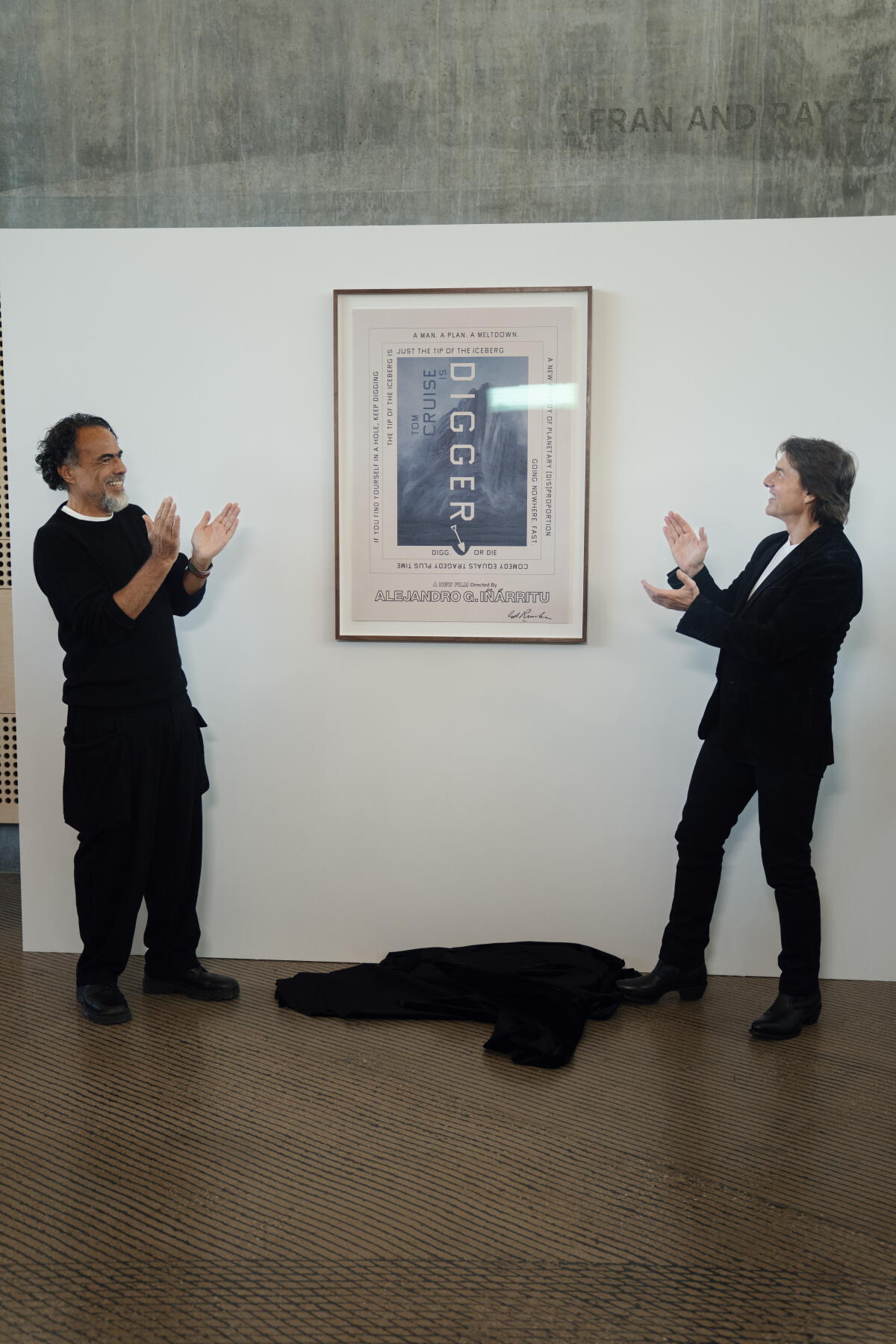
Academy Award-winning filmmaker Alejandro González Iñárritu and Pop artist Ed Ruscha have a long history of admiring each other’s work. Twenty-four years ago, a nervous Iñárritu visited Ruscha’s Venice studio to offer him the role of the gynecologist in “21 Grams.” They needed a doctor with noble features and blue, believable eyes. That plan didn’t pan out, schedule-wise, but the filmmaker and the artist finally found a way to collaborate.
The result — a Ruscha-designed poster for Iñárritu’s new film “Digger,” starring Tom Cruise — was unveiled Sunday at an intimate brunch at the Los Angeles County Museum of Art, attended by Iñárritu, Ruscha and Cruise, as well as “Digger” actors John Goodman, Jesse Plemons, Michael Stuhlbarg and Ross Hatt.
Iñárritu and Cruise laughed as they made a clumsy attempt at a countdown before whipping aside a black velvet curtain to reveal the poster for the first time: a very Ruscha, text-heavy work on a slate gray background with a beige border. A looming ice shelf in the background is surrounded by phrases including, “A Man. A Plan. A Meltdown,” and “Comedy equals tragedy plus time.”
Filmmaker Alejandro Iñárritu and “Digger” star Tom Cruise unveil Ed Ruscha’s new poster for the film. (They just pulled off the black velvet curtain on the floor below.)
(Kevin Garrison)
“Well, the movie blew my hair back,” Ruscha said at the unveiling brunch inside LACMA’s new (still unopened) restaurant, with LACMA Director and Chief Executive Michael Govan by his side. “And not only that, it parted it down the middle. It has since grown back.”
The crowd laughed knowingly. “Digger,” which opens Friday, is a satirical black comedy that follows oil tycoon Digger Rockwell as one of his drilling rigs in Greenland explodes, dislodging an ice shelf that floats away to cause a global disaster. As a dark parable for the dangers of climate change, the film has already proved polarizing, with early reviews coming in mixed.
Ruscha noted that he first saw “Digger” at a screening about six months ago, alongside Govan. “I knew I had seen an epic production, an epic product from an epic producer,” Ruscha said. “So I jumped at the idea of doing the poster. And I thought about it, and I think about this movie, and it reminded me of a kaleidoscope. It’s got so many running-around ideas. It was kaleidoscopic in its message, and its content and its humor.”
Ruscha turned his attention to Iñárritu, “It’s got something to offer to the world, and I thank you for that.”
The filmmaker loved the poster, and the fact that the ice shelf sat front and center.
From left to right — “Digger” actors John Goodman and Jesse Plemons, filmmaker Alejandro G. Iñárritu, artist Ed Ruscha, actor Tom Cruise, LACMA director Michael Govan and actors Ross Hatt and Michael Stuhlbarg — pose with Ruscha’s new poster for the film.
(David Jon)
“The billing is nature: We are human beings, we are in a war against nature,” Iñárritu said — describing what he feels the poster relays — in a phone interview from Mexico City a day before the event. “We think that we are different from nature. So nature, in a way, becomes our enemy. We are fighting a fight against nature, and the enemy is an ice shelf going to Europe. And he just put [that] in the center of it, [like] a disaster movie, which is very clever, as he always is.”
“Those decisions that he made with a very prominent element in a simple way, with one or two words, it just says so much with so little,” Iñárritu continued. “And then he [put] some lines around [it], very Ruscha, that in a way convey the spine or the character itself.”
The director had the same feelings two years ago, at LACMA’s Ruscha retrospective. He said so much with so little, Iñárritu thought, and that “less is more” thinking could hold so much power in a film poster.
Iñárritu, too, has been exhibited at LACMA: earlier this year, with the film installation “Sueño Perro,” a resurrection of lost footage from “Amores Perros;” and in 2017-2018, with the virtual reality installation “CARNE y ARENA,” which explored the human condition of immigrants and refugees.
The director’s collaboration with Ruscha is proof of concept for LACMA’s annual Art + Film gala, entering its 15th year, which seeks to highlight and strengthen the connections between film and visual art by bringing the two communities together at a splashy party — often creating lasting connections between the two groups.
Both Ruscha and Iñárritu have been honored at the gala, the former in 2012 (with Stanley Kubrick) and the latter in 2015 (with James Turrell). “This is a beautiful encounter of art and film,” Govan said at the unveiling.
“Digger” has evolved over nine years, Iñárritu said. It’s been a long journey of taking note of current events, including where the world is going, as well as people’s obsessions and fears.
“The film is a love letter for the young generation,” Iñárritu said. “I think it’s kind of a warning, or a wake-up call. But you can have fun about it, because it’s the only way to — humor allows us to have space and recognize ourselves in that absurdity. So I feel that it’s a human, urgent, now film.”
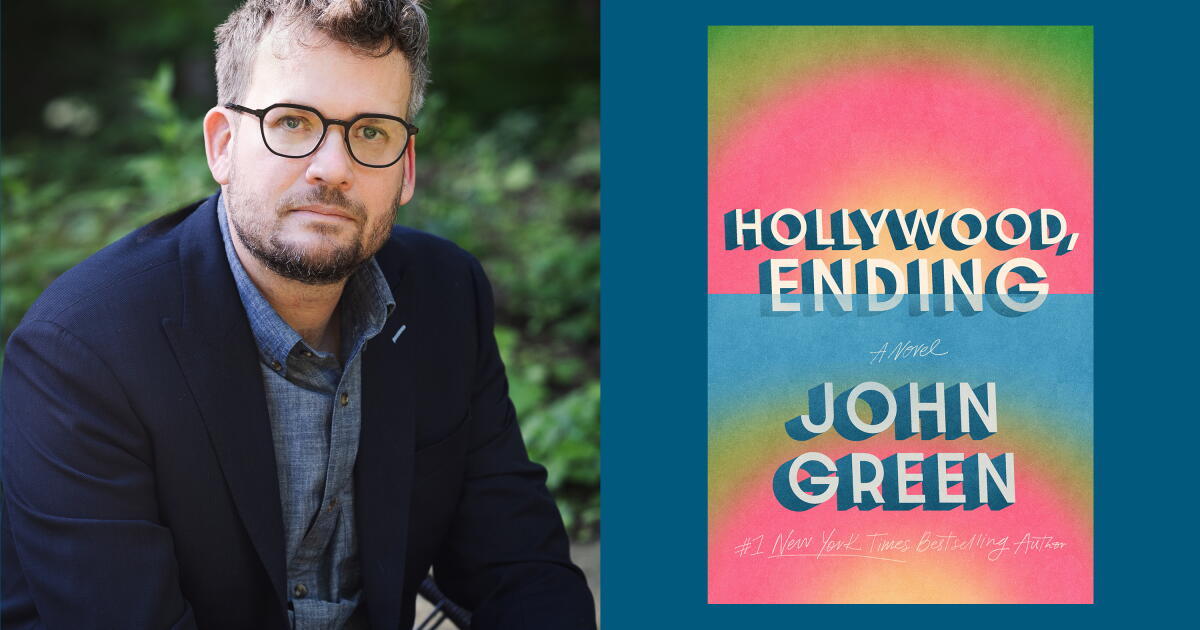
John Green’s nine-year hiatus from fiction has ended, and his adult debut, “Hollywood, Ending,” comes right on time to explore the dark side of fame.
The novel centers on former child actor Juniper Castillo and Hollywood newbie Kai Laramie, who are cast in the artsy biopic “Andy Warhol Never Gets Old,” with hotshot movie star Matthew Malone in the title role. It’s Juniper’s chance to establish herself as an adult actor and Kai’s first foray into the spotlight, a position he quickly realizes doesn’t come without a personal cost.
“There’s no way I could have written this book without spending a lot of time on film sets,” Green told The Times in a recent call.
On the Shelf
Hollywood Ending
By John Green Dutton: 304 pages, $32
If you buy books linked on our site, The Times may earn a commission from Bookshop.org, whose fees support independent bookstores.
Over the last two decades, several of the author’s bestselling young-adult novels have been adapted for the screen. His debut, “Looking for Alaska” (2005), was adapted as a Hulu limited series in 2019, the same year Netflix released the feature film adaptation of his co-authored holiday anthology, “Let It Snow” (2008). On the big screen, “Paper Towns” (2008) made its film debut in 2015, while his bestseller “The Fault in Our Stars” (2012) became a box-office hit in 2014. Most recently, his 2017 novel, “Turtles All the Way Down,” received a feature film adaptation in 2024.
“I hope the book is a love letter to movies. But I also wanted to be honest about how difficult it is to make a work of art that, in order to be commercially successful, has to be loved by millions of people,” Green said. That’s where the Hollywood machine comes in. “It’s really hard to figure out how to get millions of people to pay to watch something, and that challenge leads to all kinds of compromises and sacrifices.”
While Green’s young-adult novels have often explored the teenage experience, he never felt confined by the YA genre. “I think teenagers have infinite intellectual capacity,” he said, adding that he doesn’t really think about which shelf will hold his novels inside a bookstore. In “Hollywood, Ending,” his main characters are navigating their early 20s, a period which Green finds especially interesting.
“The questions in this novel explore how it feels in those early years of adulthood when there are still so many possibilities, so many directions you might go,” he said.
The following conversation has been edited for length and clarity.
How did you land on Andy Warhol as a celebrity figure and metaphor to use in telling this story about Kai and Juniper?
I think Andy Warhol saw so much of our world coming. He saw that three-dimensional experience was going to be rendered in two dimensions. He’s most famous for taking cylindrical soup cans and making them flat, but he also saw celebrity culture coming.
There’s the famous quote about everybody being world-famous for 15 minutes. I think he understood that normal people were going to experience celebrity, and he also saw the way that the repetition of images, as I write about in the novel, would lead to a certain desensitization. So I think everything from screen-based experience to the ways that technology was going to reshape our lives, he was the patron saint of all of that.
One of the images that really struck me is when you talk about him dying wigless and being too uncomfortable with that to have friends come and visit him in the hospital.
I think Juniper says at one point that fame is a kind of armor. I don’t know how Warhol thought of his wigs, but I wanted it to be a sort of emblem of protection for him.
Your wife, Sarah, is an Andy Warhol scholar. Was that a major strength while you were writing this?
There’s a huge advantage to being able to fact-check something by shouting down the hall. I also wanted to include Warhol partly as a love note to Sarah … She co-wrote a book about Andy Warhol’s relationship with money and business called “Andy Warhol Enterprises.” After 25 years, our way of looking at art and the art that we’ve shared together is so deeply intertwined that anything I write is unimaginable without her. She’s my first reader and most important reader … It’s only thanks to her that Warhol’s in the book.
You really humanize the young actors in “Hollywood, Ending,” which, unfortunately, is a unique thing. This is an intimate, vulnerable portrayal of behind-the-scenes Hollywood — why was that important for you to examine?
I wanted to write about the machine that takes private experience and commodifies it, and I think that machine is especially challenging to navigate when you’re young, when you’re in early adulthood, because you don’t yet have those relationships that are going to carry you through. You don’t have the love that you need to survive all that you’ve got to survive. When my work became very successful, I was in my 30s. I was married. I had two kids. I lived in Indianapolis. I had best friends. I was pretty grounded, and it was still very disorienting.
How so?
It’s a completely different life to have everybody have opinions about your work than it is to take your kids to school every day. So I was thinking partly about that, but I was also thinking about the influencers I’ve known, and the actors I’ve known who’ve had to go through that [while] much younger, and what that’s been like for them as well.
You do a really good job of examining the dark side of the attention economy. Why was this especially of interest?
Well, it used to be that the attention economy was mostly a problem for actors and other celebrities, but now the attention economy is something we all participate in. We’re all taking our private experiences and packaging them up for public consumption on Facebook and Instagram and Twitter and Reddit, and I think we gain something from that, or we wouldn’t do it. But we also lose a lot.
I wanted to try to be honest about what we gain, and also be honest about what we lose. My last novel, nine long years ago, was about a young woman with OCD. I also have OCD, and I had to make a decision when I was promoting that book, about whether I would talk about having OCD, and I decided that I would, and that became a huge part of talking about the novel — talking about my own experiences with mental illness, and it was a gift in many ways because so many people have said to me that it helped them to see that it’s possible to have a good and fulfilling life while living with a serious mental illness, and it was helpful for me because it helped me feel less alone in it.
But it was also complicated because there are real costs when you share something. It’s not yours anymore in ways that are a relief, but also in ways that are difficult.
You’re offering it up for scrutiny in a way that can be really scary.
It is really scary to have your private life scrutinized in that way, right? And there’s an element of judgment that comes with creative expression that’s a natural and healthy part of conversations about what art is and what art should be, but being in the middle of those conversations isn’t always fun.
I think you capture that in Kai’s experience.He is really pressured to come out and talk about his traumatic experience, and he doesn’t want to. The “machine” wants to sell tickets and exploit his trauma in the process.
It’s one thing to try to make good art. It’s another thing to try to make good art that lots of people interact with, and a portion of that second issue is inevitably finding ways to interest an audience, and nothing interests an audience quite like a personal story, especially a personal story of overcoming difficulty.
Was the movie star Matthew Malone based on anyone specifically?
I have aphantasia, this brain condition that causes me not to be able to imagine anything visually. I have no visual imagination, and so I can’t see actors when I’m writing. I can’t see characters when I’m writing. I can’t see anything. Everything’s made out of language, and so there’s no way I could have cast the movie in my mind or had somebody in mind for the character. It’s been great to hear all the folks who people were thinking of. I’m curious who you were thinking of.
I thought of Tom Cruise a couple of times. Have other people said that?
A couple people have said that as well. Yeah.
That’s so interesting about your work with language solely. Do you think that’s been a strength with you as a writer? Because you create such vibrant visuals for your readers.
It’s the only way I’ve ever been. I never knew that other people had this vibrant visual imagination until I was in my 40s, and my wife said I think maybe the reason you don’t have a sense of direction and you have to open up all the cabinets when you put away the dishes and you don’t know whether there’s a rug in the living room is because you don’t have a visual imagination, and I was like, of course I don’t. Nobody does, and she was like, you can’t picture an apple in your head? And I was like, no, nobody can picture an apple in their head. They say they can, but they mean it metaphorically … And Sarah explained to me that, in fact, the vast majority of people can see an apple, which still seems fictional to me, like science fiction stuff.
Some people don’t have that inner voice in their head (anendophasia).
I do have an inner voice. I think. But this all gets to something really interesting about being a person, though, which is that you’re stuck the whole time you’re here inside of one consciousness and looking at the world through one set of eyes. And I have no idea what it’s like to be you. The great thing about writing fiction for me is that act of imagination, that attempt to empathize, that attempt to escape the self and imagine what it would be like to be somebody else with some clarity, but of course, there’s always a limit to my ability to do that, and that problem has fascinated me my whole career.
Your books have meant so much to so many people, and in recent years, I’ve reported quite a bit on your book, “Looking for Alaska,” being one of the most commonly banned books. How do you feel about that?
I’m really concerned about attempts to limit intellectual freedom in the U.S., especially when it comes to libraries and schools. We have professionals we’ve trained to make collection decisions and to make curricular decisions in schools, and those professionals are teachers and librarians, and I’m very disturbed when other people come into that conversation and try to usurp the work that teachers and librarians are doing. I think a lot of times authors get most of the credit for the fight against book bans, and the truth is, all the credit should go to the teachers and librarians who are often putting their jobs on the line, making really difficult decisions to try to do the best by the kids that they’re representing and working with.
John Green will be in conversation with Julia Whelan to discuss “Hollywood, Ending” at 7 p.m. Tuesday, Oct. 13, at a ticketed ALOUD event hosted at Saban Theatre. 8440 Wilshire Blvd., Beverly Hills.