WASHINGTON — The U.S. Department of Justice civil rights division was created in 1957 with an initial focus on combating racial inequality and protecting voting rights.
But in the first two years of President Trump’s second term, its mission has been reimagined.
Now, the division is focused on combating diversity initiatives, rolling back pro-transgender policies and rooting out allegations of election fraud.
It had for decades investigated police departments for using excessive force. Now it investigates police departments with excessive delays in approving gun permits.
California has served as the division’s laboratory for all of these changes, or, as one former civil rights staffer put it, its “punching bag.”
The civil rights division has been involved in twice as many cases in California as in any other state, according to a Times analysis of cases brought by the Justice Department.
And an examination of press statements by the civil rights division shows that California has accounted for a higher proportion of actions in the second Trump administration than during the same time period in the Biden administration.
The division is led by Harmeet Dhillon, a Californian and a conservative legal crusader, who made her name bringing legal challenges against many of the state’s institutions and once served as the chair of the San Francisco Republican Party.
More recently, she was a leading legal figure in challenges to COVID-19 mandates and has shown steadfast support for Trump; her firm represented him in his successful 2024 fight to remain on the ballot in Colorado.
The Times spoke with a dozen former attorneys in the division, nearly all of whom said that the division has taken on a more partisan approach under Dhillon’s leadership and that the changes in the second Trump administration are far more dramatic than anything that occurred during Trump’s first term.
“It is an ideological civil rights division in a way that we’ve never seen before,” said Regan Rush, the former chief of the division’s special litigation section, which largely focused on investigations into police departments and prisons.
Rush is now director of the Red Line for Civil Rights at Democracy Forward, a nonprofit group that tracks the division’s activities.
In response to questions from The Times, Dhillon wrote that the division’s actions aren’t political.
“This Department speaks plainly and directly when we identify violations of federal law. Being clear about violations of federal civil rights law isn’t political or combative — it’s transparent,” Dhillon said. “I stand behind the work we’ve done since I took over the Civil Rights Division.”
While California produced President Reagan — a hero on the right who as governor frequently sparred with UC Berkeley, as Dillon does today — the state has now become, in conservative circles, a symbol of everything wrong in America.
“If there’s any state that is the antithesis of the Trump administration, it’s California,” said Erwin Chemerinsky, dean of the law school at UC Berkeley.
Dhillon said the division brings cases wherever it sees violations of federal law.
“California is where some of the most significant violations of federal civil rights law have occurred, as our enforcement actions demonstrate,” she said.
Former attorneys in the division said the desire to target California was obvious to them.
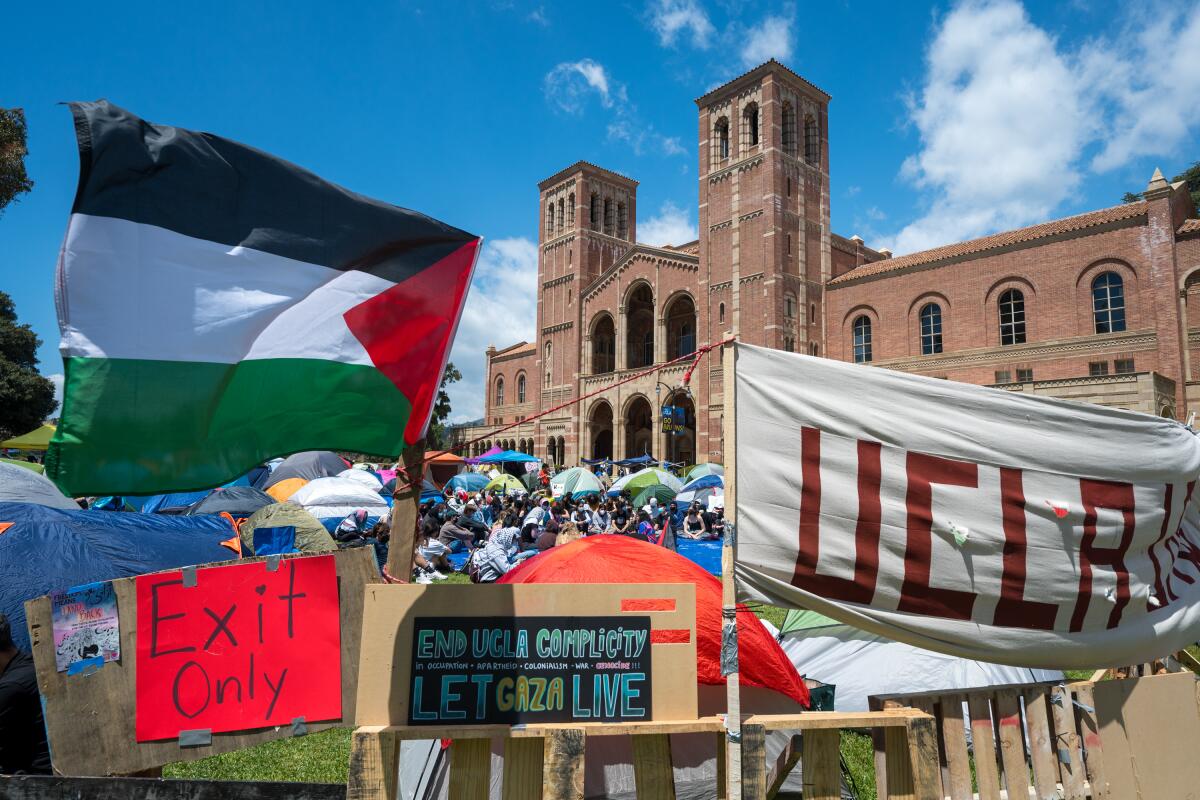
As one example, the division has announced more than a dozen actions involving universities in California, largely focused on allegations of antisemitism — the subject of an earlier Trump executive order — at University of California campuses and alleged racial preferences in hiring in the UC system and in the admissions practices at several medical schools in the state.
The division concluded that the medical schools at UC Davis and UCLA racially discriminated against white and Asian applicants and that UCLA failed to adequately respond to complaints of antisemitic harassment of Jewish and Israeli students. Other investigations are ongoing.

A pro-Palestinian encampment at UCLA in 2024.
(Michael Owen Baker / For The Times)
“We were never explicitly told that California institutions are of a particular interest, but it was something that was very easy to notice,” said Ejaz Baluch, a former Justice Department attorney who worked on the employment litigation team that looked into allegations that antisemitism at UC campuses had created a hostile work environment.
Trump’s priorities
Dhillon told podcast host Michael Malice in May that she was in “constant contact” with the White House on a “daily, sometimes several-times-a-day basis.”
That represents a major shift from how the division previously operated, said her predecessor, Kristen Clarke, who was the assistant attorney general overseeing the division during the Biden administration.
“There was a fairly sturdy and necessary wall between the Justice Department and the White House,” Clarke said. “This is a complete 180.”
Dhillon has said she sees her job as enforcing civil rights law through the lens of Trump’s executive orders, which took aim at diversity, equity and inclusion efforts, immigration and pro-transgender policies, among other conservative priorities.
She said that while the division “operates within the administration’s law enforcement priorities … investigative and prosecutorial decisions, including which matters to pursue and how, are made by the Division based on the law and the facts.”
Sen. Adam Schiff (D-Calif.), a former federal prosecutor in Los Angeles, said that the division’s changes under Dhillon represent a stark shift from how it operated in the past.
“It is now very much the anti-civil rights department,” Schiff said. “We’re living in this upside-down world where departments that were set up for one purpose are acting in a way that’s antithetical to the purpose of the department.”
Dhillon said that under her leadership, the division “enforces federal civil rights laws evenhandedly, on behalf of all Americans.
“That includes protecting religious liberty, Second Amendment rights, and women’s and girls’ spaces, standing against illegal race-based policymaking and DEI, and defending parents’ fundamental right to direct their children’s upbringing and education.”
Her reorientation of the division led to a mass exodus of career staff — nearly three-quarters of the roughly 400 attorneys who were there at the beginning of 2025, by Dhillon’s telling.
That’s far more departures than in the first Trump administration.
“I said, ‘My way or the highway,’ and my way isn’t my way, it’s President Trump’s way,” Dhillon told Malice.
Dhillon told The Times that the division has added 100 new lawyers and staff in the last 15 months and plans to hire 100 more.
Prisons and police
As the division has shifted its focus to align with the priorities laid out in Trump’s executive orders, it has shut down a number of cases brought during prior administrations.
Former attorneys in the division worry that other preexisting cases are languishing.
In March, the division opened an investigation into two women’s prisons in California — California Institution for Women in Chino and the Central California Women’s Facility in Chowchilla, 35 miles northwest of Fresno — over whether they had violated the rights of other female inmates by housing transgender women in the facilities.
“There have been allegations of sexual assaults, rape, voyeurism and a pervasive climate of sexual intimidation due to the presence of males in the women’s prison,” the Justice Department said in announcing the investigation, misgendering transgender inmates.
Former attorneys in the division said that leadership also sought to open an investigation into the impact of transgender housing policies on juvenile institutions in California, but didn’t find sufficient evidence to warrant opening an investigation.
The investigation into transgender inmates at the women’s prisons came as a prior investigation into the same two prisons remains unresolved over reports from hundreds of women that they had been sexually abused by guards, even as evidence supporting the allegations mounts.
Separate from the civil rights investigation, one of the former guards at the Chowchilla facility was found guilty in January 2025 of more than 60 counts of sexual abuse of inmates and sentenced to 224 years in prison.
“We haven’t seen any kind of relief,” said Megan Marks, former deputy chief in the division’s special litigation section and the deputy director and managing editor for the Red Line for Civil Rights at Democracy Forward.
Dhillon said both investigations into the two women’s prisons are “being pursued vigorously and simultaneously.”
For the last three decades, the division has investigated allegations of police misconduct, authority it was granted by Congress after the 1991 beating of Rodney King by Los Angeles Police Department officers.
But in the second Trump administration, the division has closed a number of active police investigations and moved away from what Dhillon characterized to Malice as a “standing order to persecute police departments and impose nonsense restrictions on them.”
Instead, the division has brought actions against law enforcement agencies deemed to have failed to protect the rights of gun owners.
California was the first target.
The division filed a first-of-its-kind lawsuit in September 2025, alleging that the Los Angeles County Sheriff’s Department had systemically denied people their 2nd Amendment rights because of long delays in approving concealed carry permits.
Last month, it filed a second gun rights lawsuit in California, this time against the state and Atty. Gen. Rob Bonta, over the state’s ban on Glock pistols, which acting U.S. Atty. Gen. Todd Blanche characterized as a “blatant trampling of our rights by the California government.”
Changing tone
Former attorneys in the civil rights division say the pugnacious tone in press releases, such as the one announcing the lawsuit opposing the Glock ban, and in numerous social media posts by Dhillon announcing her intent to open investigations, represents a major shift from how the department has operated in the past.
“What really stands out more than any other civil rights division is how much they demonize and personalize,” said Christy Lopez, a former attorney in the division who is now a professor at Georgetown Law. “We tried to build rapport with the jurisdiction.”
Dhillon defended the approach she and the division have taken.
“Our job is to enforce the law and ensure compliance,” Dhillon said. “That includes public messaging to ensure the public is both aware of what the law requires and knows when others violate the law. We’ve designed our messaging strategy with this goal in mind, and we are pleased with the effect it’s had.”
Numerous former lawyers in the division also said that the current leadership has put its thumb on the scale at the outset of investigations.
“We were basically fed an answer before we conducted an investigation, which is the total antithesis of how these investigations are supposed to be conducted,” said one former Justice Department attorney who worked on the investigation into allegations of antisemitism in the UC system and requested anonymity for fear of reprisal.
Attorneys visited UC Berkeley and UC Davis, but found enough evidence only at UCLA to bring a lawsuit on claims that antisemitism created a hostile work environment.
One of Dhillon’s early top deputies, former Huntington Beach City Atty. Michael Gates, denied that politics played a role in decision-making in his time in the division.
“We evaluated every case on a case-by-case basis,” he said. “There was nothing about politics that influenced any of that.”
Gates, who left the department in November, is now the Republican candidate challenging Bonta to be state attorney general.
Dhillon said to The Times that she is “proud of the record we’ve built” and believes the division has been “active and effective.”
But its former leaders worry that with the exodus of attorneys and the changing nature of the division’s approach, it has lost the ability to fulfill its mission.
“Where does it leave the division today?” said Clarke, its former leader. “It’s a broken agency not able to adequately stand up and defend the civil rights of all Americans.”