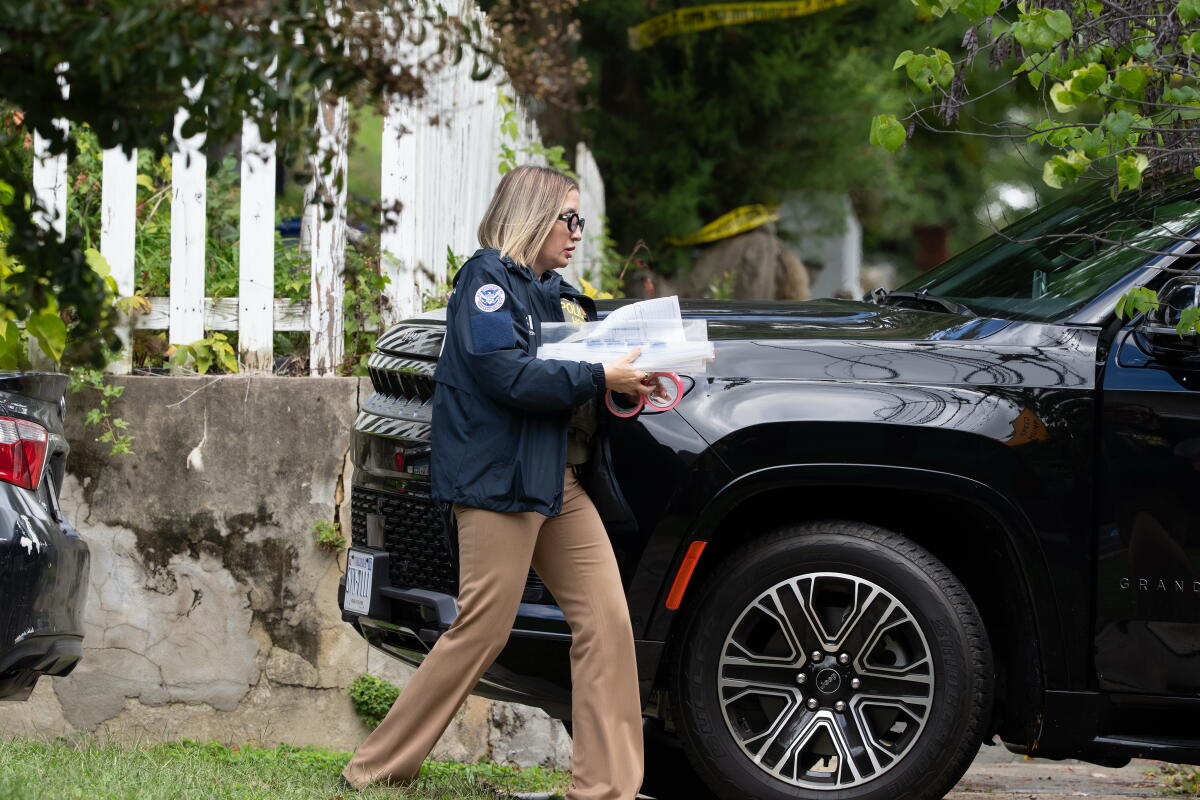
justice department

Ex-national security advisor John Bolton will plead guilty in classified information case: AP source

Former Trump administration national security advisor John Bolton has agreed to plead guilty to a single count of retaining classified information under a deal with the Justice Department that could allow him to avoid prison time, a person familiar with the matter said Thursday.

The deal would resolve a criminal case filed in October that charged Bolton with 18 counts of either retaining or disseminating classified information, including diary-like notes from his time in government that officials say he shared with his family members as he was preparing a memoir about his time in office.

Under the agreement, Bolton would also face a $2.25-million fine, said the person, who insisted on anonymity to discuss a deal that had not been made public. Any prison sentence would be capped at five years, but the agreement allows for him to avoid time behind bars, though the punishment will ultimately be up to a judge.

The case against Bolton, filed weeks after prosecutors secured indictments against former FBI Director James Comey and New York Atty. Gen. Letitia James, unfolded against the backdrop of concerns that the Justice Department was using its law enforcement powers to pursue perceived adversaries of President Trump. The investigation burst into public view last August when FBI agents served search warrants at his Maryland home and Washington office, but it had been well underway by the time Trump returned to the White House in January 2025.

Bolton is a longtime fixture in Republican foreign policy circles who became known for his hawkish views on U.S. power. He served for more than a year in Trump’s first administration before being fired in 2019 and publishing a critical book that portrayed the Republican president as deeply misinformed, an unflattering portrait of his leadership and decision-making.

Trump’s administration fought unsuccessfully to block the publication of “The Room Where it Happened” on the grounds that the book risked disclosing classified information. The plea deal that Bolton will enter covers the notes he shared with relatives as opposed to information published in the tell-all book.

A rearraignment, which typically signals a plea agreement, is scheduled for June 26 in federal court in Greenbelt, Md.

The Justice Department declined to comment.

The indictment’s 18 counts carried a threat of a substantial prison sentence in the event of conviction.

Court documents alleged that he shared with two family members “diary-like” entries with information classified as high as top secret that he had learned from meetings with other U.S. government officials, from intelligence briefings or talks with foreign leaders. After sending one document, Bolton wrote in a message to his relatives, “None of which we talk about!!!” In response, one of his relatives wrote, “Shhhhh,” prosecutors said.

The indictment said that among the material shared was information about foreign adversaries that in some cases revealed details about sources and methods used by the U.S. government to collect intelligence. One document related to a foreign adversary’s plans for a missile launch, while another detailed U.S. government plans for covert action and included intelligence blaming an adversary for an attack, court papers say.

In a statement released after his indictment, Bolton described the charges as part of an “intensive effort” by Trump to intimidate his opponents, to ensure that he alone determines what is said about his conduct.”

Bolton also served in the Department of Justice during President Reagan’s administration and was a State Department point person on arms control during George W. Bush’s presidency.

Bolton was nominated by Bush to serve as U.S. ambassador to the United Nations, but the strong supporter of the Iraq war was unable to win Senate confirmation. He resigned after serving 17 months through a recess appointment that allowed him to hold the job on a temporary basis without Senate approval.

In 2018, Bolton was appointed to serve as Trump’s third national security advisor. His brief tenure was characterized by disputes with the president over North Korea, Iran and Ukraine.

Those rifts ultimately led to Bolton’s departure, with Trump announcing on social media in September 2019 that he had accepted Bolton’s resignation.

Bolton subsequently criticized Trump’s approach to foreign policy and government in his book, alleging that Trump directly tied providing military aid to Ukraine to that country’s willingness to conduct investigations into Joe Biden, who was soon to be Trump’s Democratic rival in the 2020 presidential election, and members of the Biden family.

Trump responded by slamming Bolton as a “washed-up guy” and a “crazy” warmonger who would have led the country into “World War Six.”

Tucker writes for the Associated Press. AP writer Alanna Durkin Richer contributed to this report.

Source link

Paramount’s Delrahim slams ‘fear-mongering’ and partisan politics clouding Warner Bros. deal

Paramount Chief Executive David Ellison has been circling the globe, meeting government regulators who will ultimately decide the fate of his controversial $111-billion takeover of Warner Bros. Discovery.

Last week, Ellison spent two hours answering questions from U.S. Justice Department antitrust lawyers in a bid to secure a key government approval — one that few people believe is in doubt because of President Trump’s strong support of tech billionaire Larry Ellison and his son’s ambitions to amass more power.

Throughout his travels, David Ellison has been accompanied by a savvy wingman: Makan Delrahim.

Delrahim, Paramount’s chief legal officer, served as the nation’s top antitrust regulator in the Justice Department during Trump’s first term. The 56-year-old Iranian American, who grew up in Los Angeles, is the architect of shrewd moves that have brought Paramount within reach of its blockbuster merger that would redefine Hollywood.

Politics have permeated the process — even before Trump announced he would get involved. Opponents have been suspicious of the Ellisons, given the family’s ties to Trump and programming changes to redefine Paramount’s CBS, including last month’s departure of late-night comedian Stephen Colbert and a shakeup at “60 Minutes,” CBS’ newsmagazine.

Buying Warner Bros. Discovery would give the Ellisons control of both CBS News and CNN.

Paramount’s bid for Warner Bros. has sparked dread in Hollywood for another reason, too: Thousands of jobs already have vanished through a string of media mergers.

More than 5,000 artists and entertainment industry workers have signed an open letter, calling on California Atty. General Rob Bonta to try to block the deal on antitrust grounds.

In an interview with The Times, Delrahim responded to concerns and criticisms. This interview has been edited for length and clarity:

Where does the regulatory process stand?

We are still going through the regulatory approval process. We actually started planning for the regulatory approval filings last summer. We knew we were going to be pursuing this transaction but it took a few months longer to sign the transaction than we thought. There were some interveners [Netflix, Comcast], but we planned ahead.

Do you have a commitment from Trump or his administration that you’ll get a thumbs up?

There are no deals with the president. We have a deal with the Warner Bros. shareholders. We’ve submitted [applications] to the governments of Europe, Canada, U.K. and the U.S., and that’s where it is.

You got a head-start because you filed a regulatory approval in December — months before Paramount had a deal with Warner. Why so soon?

We were always very skeptical [the Netflix deal] would ever go through. The only way to really show the [Warner] board that our deal would get through — because it doesn’t have antitrust problems — was to move as fast as we could.

One of the benefits being a former [DOJ] enforcer and having a team of outside lawyers who are also former colleagues and enforcers was that we anticipated what the government would ask for. Those were questions that we would have asked, and so we provided those answers.

Your timeline is aggressive. Some suggest Paramount wants this deal done before the mid-term elections.

I don’t think it’s aggressive. It has nothing to do with the midterms. The midterms do not change the officials at the Justice Department or the FCC — we have that minor application there. The midterms have no effect on the European Commission or anybody else. We’ve been very transparent and proactive with members of Congress and with the state attorneys general and the federal authorities.

Are you preparing to defend a potential antitrust challenge from Atty. General Bonta?

Well, no matter what field you’re in, whether it’s antitrust or whether you’re preparing for a football game, you always prepare the best you can for the worst, and you hope it never gets there. So, we’re preparing for challenges from anybody and everybody. But I don’t think any serious antitrust enforcer who looks at the facts, the law, the economics of this transaction will see an antitrust violation.

Why are you so confident?

There’s no element of this merger that is anti-competitive. Once you look at it, it’s incredibly pro-competitive. It increases output, it increases jobs, and it lowers the cost to the consumers. If you actually try to block this deal, you’re going to harm consumers, you’re going to harm creative talent, because you’re going to harm the creative ecosystem — the vision that David [Ellison] is trying to deploy here. It’s transformative from the efficiencies that it creates.

David Ellison has promised to release 30 films a year. Was that commitment to show that this merger will not be a repeat of Walt Disney Co.’s 2019 purchase of Fox?

I’m quite familiar with that one because I was at the Justice Department and reviewed it. Disney-Fox was a transaction with a different thesis. Disney wanted to get into streaming and they wanted to get scripted series. It wasn’t about studios trying to increase output.

Our transaction, as David has described, is motivated to create more content to feed the theaters, then streaming. We have a natural economic incentive to create more content. We’ll still be in fourth place after this transaction on the streaming side — almost half the size of Netflix.

David Ellison hasn’t made any commitments on the television side or pledged pledge to keep the various TV studios intact. Why?

I don’t think there’s much of an overlap on the television studios. Look, you have incredible studios in HBO, Warner Bros. Television, certainly our own studio. We’re not paying money to limit supply. It’s the exact opposite.

There is overlap between CBS News and CNN. How are regulators looking at that issue?

We’re very proud of CBS News and hopefully CNN, post-transaction. There is very limited overlap. Why? Because CBS News only airs a few hours a week of programming whereas CNN is 24/7, and it has international reach.

Antitrust regulators are going to see that it’s going to create synergistic effects. You might be able to cross-program and more people will be exposed to the incredible programming of CBS News. They’ll benefit from each other’s independent strengths.

During the first Trump administration, you said merger conditions were problematic because it’s difficult for the government to enforce behavioral remedies. Has your thinking changed?

No, I’ve been quite consistent. If there’s an antitrust problem, you need a divestiture [selling assets]. I don’t think there’s a remedy needed in this transaction. But having said that, we’re happy to engage with regulators to discuss where they see a problem and a possible solution. We’re always wanting to engage in constructive dialogue.

Would Paramount spin off CNN?

I don’t see that. I can’t see any antitrust reason to do so. That would be a weaponization of the antitrust law, and that would not be appropriate.

Many people in Hollywood view the merger with trepidation because of the prospect of more job losses. Others see it through a political lens. How do you evaluate the politics?

Politics is part of life. It’s part of the beautiful process of democracy. Generally, we are very empathetic to the folks in Hollywood, but this transaction will actually create more and better and exciting jobs. David is an absolute lover of films; he’s a filmmaker himself. For the first time, you are getting an owner who comes from the creative side.

Let’s be honest. There’s a lot of fear-mongering, particularly from people in Washington, D.C. They are running a political campaign. Some of these people are trying to inflict harm on this transaction really because of their own antisemitic views. Regulators and law enforcement officials will see right through that.

Do regulators share others’ concerns about the merger debt — $79 billion — for the combined company?

Some regulators appropriately have asked about it. They say: ‘This is what we have heard, that you guys are not going to be around because of this debt,’ which is just silliness. David and his family are owner-operators. They’re not rented CEOs. They have over 50% ownership. They put their money at stake and my money is on them.

Source link

Democrats call Bondi’s Epstein files interview a ‘sham’

Democrats on Friday called former Atty. Gen. Pam Bondi’s interview with the House Oversight Committee about her handling of the Epstein files a “sham” and a “coverup,” and said she refused to answer numerous questions about President Trump in the closed-door session with lawmakers.

“It’s a sham in there. They’re not answering any questions,” Rep. Dave Min (D-Irvine) told reporters during a break from the interview.

Bondi was joined in her interview by attorneys from the Department of Justice, including Assistant Atty. Gen. Harmeet Dhillon, who intervened to prevent answers to some questions about Trump, Democrats said.

“The DOJ is in there right now stopping questions about President Trump and about what happened in the release of these files,” said Rep. Robert Garcia (D-Long Beach), the ranking Democrat on the committee.

He said Bondi, who was not under oath, declined to answer five questions he posed about the president.

The committee said it will release a transcript of the interview, which was not recorded on video.

The committee subpoenaed Bondi in March to appear for a deposition when she was still in office, but she didn’t initially comply, agreeing to the voluntary interview only after Democrats filed a resolution last month seeking to hold her in contempt.

Dhillon, a San Francisco attorney and longtime Republican activist who has been floated as a potential future attorney general, wouldn’t say whether she expressly prevented Bondi from answering questions about Bondi’s interactions with the president.

“There were ground rules laid with the committee before we walked in there and we simply wanted to stick to those,” Dhillon said.

Garcia said that Bondi blamed Acting Atty. Gen. Todd Blanche, then her deputy, for problems with the release of the files.

Bondi, who didn’t meet with reporters after her interview, disputed Garcia’s characterization.

“NOT TRUE. I praised Acting AG Blanche’s management of this Herculean task. I said his ethics are beyond reproach and that he is an incredible Attorney General,” Bondi wrote on X.

The department was criticized for not releasing the files as quickly as required under a law passed last year mandating release of all records from the department’s investigations into sex trafficker Jeffrey Epstein, who died in federal custody in 2019.

The department also came under fire for failing to redact the names of some of Epstein’s victims, while redacting the names of some of Epstein’s alleged co-conspirators, as well as for its removal of some of the files it initially posted.

A group of Epstein victims who spoke with reporters in front of the closed doors of the Bondi interview criticized the department’s rollout of the files and the department’s lack of communication with victims.

“Pam Bondi and Todd Blanche have derailed the lives of so many survivors,” said Dani Bensky, who said she was abused by Epstein when she was a 17-year-old high school student in New York City.

Rep. Melanie Stansbury (D-N.M) said that in the interview, Bondi acknowledged she had never met with any of Epstein’s victims.

In Bondi’s opening statement, reviewed by The Times, she acknowledged issues with the rollout of the files, but defended the administration’s handling of the release.

“There were redaction errors,” Bondi’s opening statement said. “But since day one of this process, this Department has been committed to accountability and transparency.”

Bondi was fired by Trump on April 2 and faced questions throughout her tenure about the department’s investigations into Epstein.

In February 2025, she claimed on Fox News that she had a copy of Epstein’s supposed client list, showing the names of the financier’s high-powered friends that he had directed girls to have sex with.

But in July 2025, as Trump faced questions about his relationship with Epstein, whom he knew socially, the Justice Department closed its investigation into Epstein’s alleged crimes and said no such client list existed.

Rep. Ro Khanna (D-Fremont) and Rep. Thomas Massie (R-Ky.) introduced the bipartisan Epstein Files Transparency Act soon after, requiring the Justice Department to release all of the records from its investigation into Epstein. Despite initially opposing it, Trump signed it into law on Nov. 19, 2025.

When asked about what Trump might have known about Epstein’s crimes, Bondi said she did not know, according to Rep. James Walkinshaw (D-Va.)

“I’m not certain of the extent of his knowledge,” Bondi said, according to Walkinshaw.

Bondi responded to Walkinshaw’s claims, writing on X: “MISREPRESENTATION by Walkinshaw. What the world knows to be true is President Trump banned Epstein from Mar a Lago decades ago bc Epstein was a despicable creep!!”

Garcia, the top Democrat on the committee, said Democrats would seek to speak with Blanche and FBI Director Kash Patel next about the handling of the Epstein files and the department’s investigations into Epstein and his alleged co-conspirators.

Rep. James Comer (R-Ky.) was the only Republican member of Congress to attend the interview and Democrats called out their Republican colleagues for not joining.

“I have an election in four days, a very important one,” said Min, the Democrat from Irvine. “But I’m here, rather than in my district, because this is important.”

Source link

Justice Department opens investigation into E. Jean Carroll, who accused Trump of assault: AP source

The Justice Department has opened an investigation into whether E. Jean Carroll, the longtime advice columnist who has said Donald Trump sexually assaulted her in a New York department store 30 years ago, lied during the course of civil litigation against the Republican president, according to a person familiar with the matter.

The person who confirmed the existence of the investigation was not authorized to publicly discuss an ongoing inquiry and spoke on the condition of anonymity. The perjury investigation is being led by the federal prosecutors’ office in Chicago, and acting Atty. Gen. Todd Blanche has had no involvement because of his prior work as Trump’s personal attorney, the person said.

Lawyers for Carroll did not immediately respond to requests for comment from the Associated Press on Thursday.

It’s the latest in a series of investigations the Trump administration Justice Department has opened into perceived adversaries of the president. The actions, including securing an indictment last month against former FBI Director James Comey, have raised alarm from Democrats and former officials that an institution meant to make prosecutorial decisions independent of the White House is being weaponized.

Carroll has said a flirtatious, chance encounter with Trump in 1996 at Bergdorf Goodman’s Fifth Avenue store in Manhattan ended violently. She said Trump slammed her against a dressing room wall, pulled down her tights and forced himself on her. Trump has called the allegations a “made-up scam,” and he has attacked her motivations, saying they were politically driven or arose from a desire to promote her memoir.

A jury in 2023 found Trump liable for sexually abusing Carroll, awarding her $5 million. The following year, another jury awarded Carroll $83.3 million in a defamation case related to Trump’s social media attacks on her.

The Justice Department is scrutinizing a statement Carroll made in the course of the civil litigation that no one else was paying her legal fees. It later became public that a Chicago-based organization backed by Reid Hoffman, the co-founder of LinkedIn, had helped fund Carroll’s case. Trump’s lawyers in the civil case accused Carroll of concealing that information, which they said called into question whether the case was politically motivated.

A court entry earlier this month said Trump won’t have to pay the award until the U.S. Supreme Court gets a chance to review the case or reject an appeal. The 2nd U.S. Circuit Court of Appeals agreed to a request by one of Trump’s lawyers that it let the president delay the payment to Carroll, though it required that he post a $7.4 million bond to cover any additional interest costs, a request Carroll’s attorney had made.

The Carroll investigation was first reported by CNN.

Richer and Tucker write for the Associated Press.

Source link

Bondi will be asked about the Epstein files at committee hearing

Former Atty. Gen. Pam Bondi is scheduled to meet with the House Oversight Committee on Friday to discuss the Justice Department’s investigations into deceased sex trafficker Jeffrey Epstein and its release of files related to that investigation.

But the circumstances surrounding her meeting with the committee raise questions about how much the committee will actually learn about either.

For one, the former attorney general will not be under oath in a sworn deposition but will provide a transcribed interview, which is voluntary. Bondi’s interview with the committee will happen behind closed doors with members of the committee and staff and will not be filmed. The committee says it plans to release a transcript soon after the hearing.

And Bondi will be represented at her interview by Assistant Atty. Gen. Harmeet Dhillon, which legal experts say raises the prospects that the Department of Justice could direct Bondi to not answer some questions posed by the committee.

Former Atty. Gen. William Barr, former President Clinton and former Secretary of State Hillary Clinton all gave sworn depositions.

Rep. James Comer (R-Ky.), the chair of the committee, rejected the Clintons’ offer to provide a transcribed interview, rather than sit for a deposition, out of concern that someone giving a transcribed interview could “refuse to answer whatever questions he wanted for whatever reasons he wanted.”

Comer’s spokesperson said Bondi was allowed to sit for a transcribed interview, rather than a deposition, because the former attorney general was “cooperative.”

“Unlike the Clintons who defied subpoenas for seven months, former Attorney General Pam Bondi voluntarily and quickly cooperated with the Committee to identify a mutually agreeable date,” spokesperson Austin Hacker said in a statement.

Bondi had, in fact, refused to comply with the committee’s subpoena while she was still in office, and the ranking Democrat on the committee, Rep. Robert Garcia (D-Long Beach), filed a resolution on April 29 to hold Bondi in contempt for not complying with the committee’s subpoena a month earlier. Bondi’s agreement to provide a transcribed interview was announced the same day.

The committee subpoenaed Bondi in March to learn more about the department’s long-running investigations into Epstein — the financier accused of abusing more than 1,000 women and girls and directing some of them to have sex with his high-powered friends — and the department’s release of files in response to the 2025 Epstein Files Transparency Act, which mandated disclosure of the investigative records.

Asked whether Dhillon’s participation indicated that the department planned to invoke privilege and bar Bondi from sharing some information, the department said in a statement that Dhillon and other agency officials would attend Bondi’s interview “solely to ensure accurate representation of Department processes, facilitate any necessary clarifications, and support a complete factual record for the Committee.”

The department added that it “routinely provides staff” to assist with “congressional engagement involving past Department staff actions.”

But a former DOJ ethics official, speaking on the condition of anonymity for fear of retribution, said that Dhillon’s participation in the proceedings was anything but routine.

Typically, this type of work would be handled by a less senior attorney at the department who had more direct involvement with the subject matter at hand, the former official said. Dhillon oversees the department’s civil rights division, while the investigations into Epstein were criminal matters.

“I don’t see where Harmeet Dhillon has the experience or the normal level of authority that this would be delegated to,” the official said. “Everything about this seems unusual.”

Bondi would also need to have submitted a formal request for representation from the department.

“It doesn’t just happen willy-nilly,” the former ethics official said.

The department didn’t say how Bondi came to be represented by the agency’s attorneys. Bondi, who said this week she is being treated for thyroid cancer, didn’t respond to a request for comment.

The presence of Dhillon — a San Francisco attorney and Republican party insider who has been talked about as a potential pick for attorney general — could also present a conflict of interest, experts said.

“It’s unclear if she is representing the interests of Bondi, the department, or herself,” said Dave Rapallo, a former staff director of the House Oversight Committee.

He said that Dhillon would not have been able to represent Bondi if her testimony was provided in a deposition because the committee’s rules prevent agency lawyers from attending depositions.

Bondi was fired by President Trump on April 2. She was dogged by questions about her handling of the Epstein investigation throughout her time in office.

Trump campaigned on the promise of releasing information about the government’s investigation into Epstein in 2024 and in February 2025, Bondi told Fox News that she had on her desk a list of clients of Epstein — who died in federal custody in 2019.

But months later, as questions swirled about Trump’s relationship with Epstein, the Justice Department announced that it was closing its investigation into Epstein and said that, in fact, no such client list existed.

Soon after, Rep. Ro Khanna (D-Fremont) and Rep. Thomas Massie (R-Ky.) introduced the bipartisan Epstein Files Transparency Act, requiring the Justice Department to release all of the records from its investigation into Epstein. Trump initially opposed the legislation but ultimately signed it into law.

The department has released millions of pages of records in response to the law. While Acting Atty. Gen. Todd Blanche said in January that there are millions of additional pages of records that are not yet public, the department has indicated that it doesn’t plan to release these additional files.

Source link

Biden sues Justice Department to stop release of audio and transcripts tied to special counsel probe

Joe Biden sued the Justice Department on Tuesday in an effort to block the release of audio recordings and transcripts of the former president’s interview with a ghostwriter that were obtained by the special counsel who investigated his handling of classified documents.

Biden’s lawyers said in a lawsuit filed in Washington’s federal court that the Justice Department plans to release the files to Congress and a conservative group, the Heritage Foundation, after the department had previously argued that they were exempt from disclosure under the public records law.

Biden’s lawyers argued that the disclosure would “constitute an unwarranted invasion of President Biden’s privacy.”

“Every American, including a sitting or former Vice President, has a right to privacy in the personal conversations he has within his own home,” his attorneys wrote. “And when the U.S. Department of Justice obtains that private information through a criminal investigation, the Department bears a particular responsibility to protect it from disclosure.”

At issue in the case are audio recordings and transcripts of Biden’s interviews at his home in 2016 and 2017 with Mark Zwonitzer, who worked with Biden on his two memoirs. The files were scrutinized by special counsel Robert Hur as part of his investigation into the president’s improper retention of classified documents, from his time as a senator and as vice president.

Hur’s yearlong investigation led to a 345-page report that questioned Biden’s age and mental competence but recommended no criminal charges against the then-81-year-old. Hur said he found insufficient evidence to successfully prosecute a case in court.

Biden has separately fought the release of the audio of his interview with Hur. The House in 2024 voted to hold Biden Atty. Gen. Merrick Garland in contempt of Congress for refusing to turn over that audio after the White House exerted executive privilege, shielding it from Congress.

The transcripts of five hours of Biden interviews with federal prosecutors was released that same year. While Biden was adamant that he treated classified information seriously, the transcript shows that he was at times fuzzy about dates and details and he said he was unfamiliar with the paper trail for some of the sensitive documents he handled.

Republicans have argued Biden was being given a pass by his own Justice Department and that Trump had been unfairly victimized by prosecutors. Democrats, for their part, stressed Biden’s cooperation in the investigation and strongly contrasted that with the separate criminal case against Trump, who was accused of refusing to return classified documents requested by the National Archives that he had at his Florida estate.

Richer writes for the Associated Press.

Source link

Trump’s Justice Department scrubs its website of news releases about Jan. 6 defendants

The U.S. Department of Justice has acknowledged removing from its website news releases about criminal cases related to the Jan. 6, 2021, riot and insurrection, calling the information about the prosecutions “partisan propaganda.”

The purge of news releases documenting criminal charges, convictions and sentencings is the latest step by the Trump administration to reimagine the history of the assault on the U.S. Capitol, when hundreds of supporters of President Trump stormed the building in an effort to halt the congressional certification of his 2020 election loss to Joe Biden.

Trump, on his first day back in office in January 2025, pardoned, commuted the prison sentences or vowed to dismiss the cases of all of the 1,500-plus people charged with crimes during the Capitol assault, including those convicted of sedition and of attacking officers with makeshift weapons such as flagpoles, a hockey stick and crutch. More than 100 police officers were injured, many of them seriously, and five died as a consequence.

On Monday, the Justice Department announced the creation of a $1.776-billion fund meant to compensate Trump allies who claim they were unjustly investigated and prosecuted. Acting Atty. Gen. Todd Blanche has not ruled out that Jan. 6 rioters convicted of violence will be eligible for payouts, prompting bipartisan anger in Congress.

After a journalist on Friday observed on the social media platform X that the Justice Department was “quietly” removing news releases on its website that were related to the Jan. 6 attack, including about a Texas man who pleaded guilty to assault and also faced separate state charges of soliciting a minor, the department responded through its “rapid response” account that there was “nothing ‘quiet’ about it.”

“We are proud to reverse the DOJ’s weaponization under the Biden administration. We will do everything in our power to make whole those who were persecuted for political purposes,” the post said. “This includes stripping DOJ’s website of partisan propaganda.”

Among the releases removed from the site were those concerning seditious conspiracy cases against members of the Proud Boys and Oath Keepers, far-right extremist groups, some of which resulted in convictions and long prison sentences.

The Justice Department, in an unopposed motion last month, asked a federal appeals court to vacate those seditious conspiracy convictions, a request that was granted Thursday. The department on Friday moved to dismiss the cases against the group members.

Trump was impeached for inciting an insurrection on Jan. 6 and was indicted on felony charges related to his actions. Those charges were dismissed after his 2024 election victory.

Tucker writes for the Associated Press.

Source link

Judge dismisses human smuggling charges against Kilmar Abrego Garcia, who was mistakenly deported

A federal judge on Friday dismissed a human smuggling case against Kilmar Abrego Garcia, finding that the Justice Department’s pursuit of criminal charges was designed to punish him for challenging his mistaken deportation to El Salvador last year.

The ruling amounted to an extraordinary rebuke of a Justice Department that under President Trump has repeatedly been accused of targeting defendants for political purposes. The Trump administration touted the charges against Abrego Garcia last year at a press conference in which then-Atty. Gen. Pam Bondi declared, “This is what American justice looks like.”

“The evidence before this court sadly reflects an abuse of prosecuting power,” U.S. District Judge Waverly Crenshaw, in Nashville, said in his ruling granting Abrego Garcia’s motion to dismiss for “selective or vindictive prosecution.” Without Abrego Garcia’s “successful lawsuit challenging his removal to El Salvador, the government would not have brought this prosecution.”

Abrego Garcia’s deportation became an embarrassment for Trump officials when they were ordered to return him to the U.S. In his motion to dismiss, Abrego Garcia claimed that the timing of the criminal charges and inflammatory statements about him by top Trump officials demonstrated that the prosecution was vindictive.

“Kilmar Abrego Garcia is a victim of a politicized, vindictive White House and its lawyers at what used to be an independent Justice Department,” his criminal defense attorneys said in a statement after Friday’s ruling. “We are so pleased that he is a free man.”

The Justice Department vowed to appeal, calling the judge’s order “wrong and dangerous.”

Crenshaw stopped short of finding the government acted with “actual vindictiveness,” a rarely met standard that usually requires evidence like a prosecutor admitting that charges were filed in retaliation against someone. But the judge did find there was enough evidence of “presumptive vindictiveness” — including the timing of the indictment, statements made by then-U.S. Deputy Aty. Gen. Todd Blanche, and the sustained oversight of the case by other top Justice Department officials — that the case against Abrego Garcia was thoroughly tainted.

The government’s own explanations weren’t convincing, Crenshaw wrote.

Abrego Garcia was charged with human smuggling and conspiracy to commit human smuggling, with prosecutors claiming that he accepted money to transport within the United States people who were in the country illegally.

The charges stem from a 2022 traffic stop in Tennessee for speeding. Body camera footage from a Tennessee Highway Patrol officer shows a calm exchange with Abrego Garcia. There were nine passengers in the car, and the officers discussed among themselves their suspicions of smuggling. However, Abrego Garcia was eventually allowed to continue driving with only a warning.

In the Friday ruling, Crenshaw wrote that the timing of the charges was central to the presumption of vindictiveness. Homeland Security had been aware of the traffic stop for two years and had closed the case against Abrego Garcia when it deported him. Once the U.S. Supreme Court ruled that he should be brought back to the U.S., they reopened the case. While the government bore the responsibility to rebut the presumption of vindictiveness, prosecutors did not call as a witness the person who reopened the case, to explain why. Instead they offered only “secondhand testimony.”

In a statement released by the group We are CASA, which has been supporting Abrego Garcia and his family, he thanked God for the dismissal of the criminal charges.

“Justice is a big word and an even bigger promise to fulfill; and I am grateful that today, justice has taken a step forward,” he said.

Abrego Garcia’s deportation violated a 2019 immigration court order granting him protection from deportation to his home country, after the judge found he faced danger there from a gang that targeted his family. Abrego Garcia is a Salvadoran citizen with an American wife and child who has lived in Maryland for years although he immigrated to the U.S. illegally as a teenager. The 2019 order allowed him to live and work in the U.S. under Immigration and Customs Enforcement supervision, but he was not given residency status.

Meanwhile, Trump administration officials have said Abrego Garcia cannot remain in the U.S. They have vowed to deport him to a third country, most recently Liberia.

Loller writes for the Associated Press.

Source link

‘A bridge too far?’: As GOP senators revolt, Trump defends fund and attacks defectors

For much of President Trump’s second term, Republican senators have largely stayed in line, wary of the consequences of defying a president with a history of targeting those who cross him. This week, that dynamic noticeably shifted.

Senate Republicans blocked two of Trump’s legislative priorities, angered by the push to create a $1.8-billion federal fund to compensate people who claim to have been politically persecuted, including rioters who assaulted the Capitol on Jan. 6, 2021. The revolt forced Republican leaders to pull a planned vote on legislation to fund the president’s immigration crackdown and security features for the president’s White House ballroom project.

In response, the president defended the fund and lashed out at its critics.

“I gave up a lot of money in allowing the just announced Anti-Weaponization Fund to go forward,” Trump wrote in a post on Truth Social. “Instead, I am helping others, who were so badly abused by an evil, corrupt and weaponized Biden Administration, receive, at long last, JUSTICE”!

The president also called Republican senators who broke with him quitters who are “screwing the Republican Party.”

The friction, which has been building for weeks, is being watched as potential test to the limits of Trump’s grip on his party amid an already tense political environment heading into the midterm elections.

“This is kind of a perfect storm,” former Sen. Jeff Flake (R-Ariz.) said on NBC’s “Meet the Press.” “It may be that this time you can point to it and say this is when the great migration begins, away from some of the president’s policies and away from the fear that the president can target you.”

Whether this week marks the beginning of that moment — or simply another episode of political turbulence that fades — is the central question now handing over Trump’s second term.

Not the first break — but an escalation

This is not the first time Republicans have broken with the president. In November, Congress overwhelmingly voted to force the Justice Department to release of the Jeffrey Epstein files, an effort that Trump unsuccessfully tried to thwart for months.

The Epstein vote showed that on the right issue, under the right circumstances, Republicans could be moved to defy Trump. This week, the creation of the fund changed the circumstances again, and the number of Republican senators willing to act quickly grew.

This moment comes after months of rising costs during the war in Iran, efforts by the president to oust members of his own party and now a set of proposals that are proving hard to defend in an election year.

“What you have is basically a bunch of people who feel a bit under siege,” said Bob Olinksy, the senior vice president of Structural Reform and Governance at the Center for American Progress. “At the same time, they know that most of what the president is doing is unpopular, and they’re the ones who are going to be standing for reelection in November.”

Republicans push back

Senate Republicans leaders are now asking the Department of Justice to reconsider the terms of the fund, underscoring just how politically toxic the idea has become within the president’s own party.

Sen. Kevin Cramer (R-N.D.) told reporters that the politically speaking, the fund is “unexplainable.” Sen. Susan Collins (R-Maine) told the New York Times the fund should be in real trouble. Sen. Mitch McConnell (R-Ky) called the fund “utterly stupid” and “morally wrong.”

Sen. Thom Tillis, a North Carolina Republican whom Trump has singled out for going against him, was equally unsparing, saying he opposed “using billions of taxpayer dollars to compensate convicted felons and thugs who attacked police.” He also criticized the administration for pushing domestic and foreign policy issues that he says are bad for housing and the military.

“If opposing these things makes me a RINO [Republican In Name Only], then I gladly accept that nickname,” Tillis wrote on X. “We need Republicans to do well in November, but the stupid stuff is killing our chances!”

The Republican push back comes as the concern about self-dealing runs deep across the electorate.

A recent poll Economist/YouGov poll found that 59% of Americans believe Trump is using his office for personal gain, though that belief is sharply divided among partisan lines. A CNN poll found that 37% of Americans say Trump puts the good of the country above his personal gain, while 32% say he is in touch with the problems of ordinary Americans.

Asked if the political environment influenced the actions this week, Senate Majority Leader John Thune (R-S.D.) told reporters that there is a “political component to everything we do around here.”

Funds and tax immunity clauses

Senate Democrats are wondering if the fund will mark a watershed moment for Republicans.

“Have Republicans finally found a bridge too far?” Sen. Richard Durbin (D-Ill.) told reporters after Republicans left Washington without funding Trump’s priorities.

Democrats have called the fund an illegal abuse of power designed to line the pockets of Trump’s allies with taxpayer dollars. Sen. Chris Van Hollen (D-Md.) called it a “pure theft of public funds.”

The fund was created as part of a settlement resolving a $10-billion lawsuit Trump personally brought against the Internal Revenue Service over the leak of his tax returns. Alongside it, the deal says the IRS is “forever barred and precluded” from pursuing any tax claims against Trump and his businesses.

Under the tax immunity clause, Trump and his family could save more than $600 million, according to an analysis by Forbes.

The fund, however, has been the target of most of the bipartisan ire. Mostly because Trump and administration officials have not ruled out that it could stand to benefit people who carried out violence during the Jan. 6 riot.

The public funds, if disbursed, would come from the federal judgment fund, which is a Congress-approved ongoing appropriation that allows the Justice Department to settle cases and make payouts. In the past, Republicans have taken issue with the fund. The GOP-controlled House Judiciary Committee characterized it an abuse in 2017.

Several of the president’s allies have already talked about tapping into the fund.

Michael Cohen, Trump’s former attorney who served prison time in relation to campaign finance violations, said he plans to apply for compensation.

Former Proud Boys leader Enrique Tarrio, who was convicted of seditious conspiracy and later pardoned by Trump, told CBS News he would seek a payout from the fund.

“I was targeted,” Tarrio said. “And I do believe that this fund does apply to me.”

Source link

GOP senators balk at Trump’s $1.8-billion ‘anti-weaponization’ fund, force delay in key vote

President Trump’s grip on his party slipped on Thursday as anger boiled over among Senate Republicans about a growing list of issues.

In a striking display of defiance, GOP senators abruptly derailed plans to vote on legislation to fund Trump’s immigration crackdown amid deep disagreements over security funding for a White House ballroom and a $1.8-billion fund to pay people who claim to have been politically persecuted.

The discontent had been building for weeks. Many senators had grown frustrated over Trump’s decision to endorse candidates running against longtime Republican incumbents.

Others, worried about rising costs as a result from the war in Iran, had aired concerns ahead of the midterm elections. But the breaking point came when the Justice Department, with little warning, pushed to create what it termed the “anti-weaponization fund.”

Senate Majority Leader John Thune (R-S.D.) acknowledged the concerns over the fund Thursday after a reportedly contentious private meeting about it between Senate Republicans and acting Atty. Gen. Todd Blanche. He also conceded midterm politics had added to the tension.

“It’s hard to divorce anything that happens here from what’s happening in the political atmosphere around us,” Thune told reporters. “You can’t disconnect those things.”

A day earlier, Sen. Bill Cassidy, a Louisiana Republican who lost his primary race on Saturday to a Trump-backed challenger, expressed strong disagreement with the creation of the fund, which would be controlled by appointees without congressional oversight.

“People are concerned about paying their mortgage or rent, affording groceries and paying for gas, not putting together a $1.8 billion fund for the president and his allies to pay whomever they wish with no legal precedent or accountability,” Cassidy wrote on X. “If there needs to be a settlement, the administration should bring it to Congress to decide.”

Sen. Mitch McConnell (R-Ky.) also had harsh criticism for the fund.

“So the nation’s top law enforcement official is asking for a slush fund to pay people who assault cops? Utterly stupid, morally wrong — take your pick,” he said in a statement.

The discord was striking, partly because Republicans have largely steered clear of checking the president’s power, and Congress has been largely sidelined under the second Trump administration on the war in Iran and other issues.

“I don’t think the Republicans had any choice but to pull the plug until we come back in June, because they’re facing a bit of a mutiny within their conference,” Sen. Adam Schiff (D-Calif.) told The Times, saying he had heard that the meeting between Blanche and Republicans “didn’t go well.”

As tension simmered on the background, Trump seemed unbothered by the group of Republicans’ public rebellion against his agenda. When asked whether he was losing control of the Senate, he said he didn’t know.

“I only do what is right,” he told reporters in the Oval Office.

However, he expressed annoyance at lawmakers who would not support $1 billion in federal funding for security costs related to the ballroom project. He said the structure is being privately funded by him and other “great patriots.”

“We are making a gift to the United States,” Trump said. “This is being made as a gift from me and other people that are great patriots and spent a lot of money. We are building what will be the finest ballroom anywhere in the world.”

The $1 billion for security funding would be “very much a good expenditure,” he said. If Congress does not sign off on the money, Trump said the “White House won’t be a very secure place.”

Trump did not immediately comment on Thursday about the Senate’s delaying of the funding bill. The White House declined to comment on the matter.

Trump’s second-term actions have frequently tested the loyalty of Republican lawmakers, who have largely stayed in line. The settlement fund, with its ethical questions, appears to have crossed a line for some senators in a party that has traditionally opposed wasting taxpayer funds.

The money comes from the judgment fund, which is a Congress-approved ongoing appropriation that allows the Justice Department to settle cases and make payments.

Stephen Miller, a top aide to Trump, told reporters at the White House that the $1.8-billion settlement was “just a small measure of the justice” that many people are owed after being targeted by the federal government. Miller declined to say whether the White House was reaching out to senators to ease concerns about the fund.

Republicans in Congress decried the use of similar third-party settlements during the Obama administration, with House lawmakers repeatedly passing a bill aimed at stopping settlement slush funds, noted Molly Nixon, a senior fellow at the Cato Institute.

Though the Trump administration’s plan is novel because the settlement money isn’t going to a third party, the general concept has been offensive to Republicans in the past; the Republican-controlled House Judiciary Committee termed it an abuse in 2017.

“If you’re taking a consistent view, you’d be at least equally as opposed to this settlement,” Nixon said of Republican lawmakers.

That could be driving some of the opposition now, along with concerns about who is going to get the money and whether it could be distributed to people who wouldn’t have been able to make a successful case before a court of law, Nixon said.

“The fund is going to plaintiffs who were victims of lawfare or weaponization. … Those are pretty ambiguous terms. They’re sort of in the eye of the beholder,” Nixon said. “It’s pretty easy to see how this could very easily become a quiet political claims process.”

Police officers who defended the U.S. Capitol during the Jan. 6, 2021, riot have already filed a federal lawsuit seeking to block the creation of the fund, arguing in part that it would compensate extremist convicted of committing violent crimes.

“The fund’s mere existence sends a clear and chilling message: those who enact violence in President Trump’s name will not just avoid punishment, they will be rewarded with riches,” the lawsuit says.

When Trump returned to office in January 2025, one of his first acts was pardoning or commuting the prison sentences of the 1,500 people who were charged in connection with the attack. Vice President JD Vance on Wednesday did not rule out that settlement money could go to those rioters, saying the money would be given out on a “case-by-case basis.”

Thune told reporters on Thursday that the Justice Department would have to come up with some guardrails to ease concerns among senators.

“We need to get some clarity,” he said.

Though the number of Republicans angry with Trump is significant enough to make or break legislation, the caucus appeared far from falling apart.

Senate Republicans blocked an attempt by Sen. Alex Padilla (D-Calif.) on Thursday to pass a bill to prohibit federal funds from reaching Jan. 6 rioters, an attempt to prevent the fund from being used to compensate them.

“I’m encouraged hearing some of my Republican colleagues agreeing with me,” Padilla said on the Senate floor. “Let’s stand up for congressional oversight as a unified Senate.”

Sen. Tommy Tuberville (R-Ala.) objected to Padilla’s bill, later writing on X: “PROUD to object today to Senator Padilla’s RIDICULOUS bill and stand up for ALL FREEDOM-LOVING AMERICANS.”

Schiff, who is working on an amendment that would target the fund, said other Republican colleagues he spoke to Wednesday evening were unhappy with the position Trump has put them in. He said Trump’s actions have helped underscore Democrats’ arguments against his party.

“All [it’s] doing is helping us make the case that the Republicans couldn’t care less about people’s cost of living … that there’s plenty of money for golden ballrooms for the president, there’s plenty of money for the president’s cronies, but there’s no money for the average family,” Schiff said.

Source link

Blanche doesn’t rule out payments to violent Jan. 6 rioters as he defends $1.8B fund

Acting Atty. Gen. Todd Blanche on Tuesday wouldn’t rule out the possibility that people who carried out violence during the Jan. 6, 2021 riot at the U.S. Capitol will be considered for payouts from a new $1.776 billion fund to pay individuals who believe they were targeted politically.

Pressed during a Congressional hearing over whether those who assaulted police officers would be eligible for compensation from the “Anti-Weaponization Fund,” Blanche responded that all people can apply if “they believe they were a victim of weaponization.” The acting attorney general also refused to say whether he would direct those responsible for deciding who receives payments — a commission whose members he is tasked with appointing — to restrict funds to those convicted of violence.

“What I will commit to is making sure that the commissioners are effectively doing their jobs, and that includes setting guidelines as you’re describing,” Blanche told Sen. Jeff Merkley, an Oregon Democrat. The decisions on payouts will be made a five-member commission appointed by the attorney general.

Appearing before Congress for the first time since taking the reins of the Justice Department last month, Blanche was peppered with questions about the fund announced on Monday to compensate those who believe they were mistreated by prior administrations’ Justice Department. Blanche said the fund was “unusual” but not unprecedented, adding that those who benefit will not be limited to Republicans or to people who were investigated or prosecuted by the Biden administration. At one point, Blanche said President Joe Biden’s son, Hunter — who faced gun and tax prosecutions under his father’s administration — could also apply.

Blanche defends $1.8 billion fund

Tuesday’s hearing was meant to address the Trump administration’s budget request for the Justice Department but quickly delved into other controversies that have escalated concerns about the erosion of the law enforcement agency’s tradition of independence from the White House. Blanche defended the creation of the fund without any acknowledgment that the Trump administration has pursued investigations of Trump’s political opponents, sparking criticism that the department is being weaponized in precisely the same way they allege it was under Biden’s administration to prosecute Trump.

In the weeks since assuming control of the Justice Department after Pam Bondi’s firing, Blanche has moved aggressively to advance the president’s priorities — pushing forward cases against Trump’s political foes, cracking down on leaks to media outlets and establishing the new fund to resolve Trump’s $10 billion lawsuit against the Internal Revenue Service over the leak of his tax returns.

Democrats described it as an illegal abuse of power designed to line the pockets of Trump supporters with taxpayer dollars. Sen. Chris Van Hollen, the top Democrat on the Senate appropriations subcommittee holding the hearing, blasted the move as a “pure theft of public funds.”

“Rewarding individuals who committed crimes is obscene,” the Maryland Democrat said. “Every American can see through this illegal, corrupt, self-dealing scheme.”

The fund is in keeping with Trump’s long-running claims that the Justice Department during the Biden administration was weaponized against him, even though then-President Biden himself was investigated during that time and his son was prosecuted. Merrick Garland, who served as attorney general during the Biden administration, has repeatedly denied allegations of politicization and has said his decisions followed facts, the evidence and the law.

Trump administration has been rewriting the history of Jan. 6

The mere possibility that violent rioters at the Capitol could be considered for payouts is consistent with a Trump administration pattern of rewriting the dark history of Jan. 6, a trend that began when the president pardoned and commuted the prison sentences of the participants in the melee and that continued with the Justice Department firing some prosecutors who put them behind bars.

Under questioning from Merkley, Blanche said that he “will definitely encourage the commission” responsible for deciding on the payouts to “take everything into account.” But when asked whether he believes those convicted of violence should be entitled to compensation, Blanche said: “My feelings don’t matter.”

When Merkley suggested that Trump was using the Justice Department to target his political enemies, Blanche replied that this was precisely the sort of “disgusting” behavior of the Biden administration that the fund was meant to address.

“That is completely inappropriate and wrong,’ Merkley said. “There is no comparison to the absolute fair minded pursuit of justice under the previous administration, and this administration’s pursuit of an enemies list.”

Questions over the meaning of ‘weaponization’

In announcing the fund Monday, the Trump administration did not name specific individuals who might stand to benefit from it. The money itself would come from the federal judgment fund, which pays out court judgments and compromise settlements of lawsuits against the government.

Blanche told lawmakers that the Justice Department is committed to “full transparency” in providing public information about beneficiaries of the new fund.

“It’s not limited to Republicans. It’s not limited to Democrats. It’s not limited to January 6th defendants. It’s limited only by the term weaponization,” Blanche said, though the administration has not said how it will define “weaponization.”

Meanwhile, there were signs of discomfort about the fund even among some Republican members of Congress. Senate Majority Leader John Thune told reporters that he’s “not a big fan,” adding that he isn’t sure how the administration intends to use it, but doesn’t “see a purpose for that.”

Thune’s comments come after Louisiana Sen. Bill Cassidy, who lost reelection in a GOP primary on Saturday, called it a “slush fund.”

“We are a nation of laws,” Cassidy said. “You can’t just make up things.”

Richer and Tucker write for the Associated Press. AP reporter Mary Clare Jalonick in Washington contributed to this report.

Source link

Senate confirms Trump pick Warsh as chairman of the Federal Reserve

The Senate confirmed President Trump’s nominee to lead the Federal Reserve, Kevin Warsh, bringing new leadership to the world’s most powerful central bank at a fraught moment for the global economy.

Warsh was confirmed Wednesday in a largely party-line vote. His nomination had been thrown into doubt in recent months after Republican Sen. Thom Tillis of North Carolina said he would block the nomination while the Justice Department investigated Fed Chair Jerome H. Powell. The Powell inquiry was dropped in April, clearing the way for the Senate to confirm Warsh.

Senate Majority Leader John Thune (R-S.D.) urged colleagues to support Warsh during a floor speech Wednesday morning, saying it’s crucial that a Fed chair “understand not only the macro” but also “appreciate the microeconomy: and that’s the hardworking Americans, their jobs and their livelihoods.”

“Kevin Warsh is just such a person,” Thune said.

Warsh, 56, a former top Fed official, will become chair at an unusually difficult time for the independent agency.

Inflation has topped the Fed’s 2% target for five years and is now rising faster because of surging gas prices. The Fed’s interest rate-setting committee is divided and saw the most dissenting votes in more than three decades last month. And Powell, after years of personal attacks from the Republican president and an unprecedented legal investigation by the Justice Department, plans to stay on the Fed’s board even after his term as chair ends, potentially creating a competing power center.

Trump has demanded change at the Federal Reserve

The Fed has faced numerous threats to its independence from Trump, who has repeatedly attacked Powell for not cutting interest rates. Trump also sought to fire Fed Gov. Lisa Cook and launched an investigation into brief Senate testimony by Powell on a building renovation.

Kevin Hassett, director of the White House’s National Economic Council, said in a Fox News interview on Sunday that he believes the markets are relieved that Warsh “is going to help lower interest rates over time.”

“Obviously, data driven,” said Hassett. “I’m not putting any pressure on Kevin Warsh.”

In December, Trump said on his social media platform that he wanted a Fed chair who would cut interest rates when the stock market rose — the opposite of what traditional economics would prescribe — and added, “Anyone that disagrees with me will never be the Fed chairman!”

Trump’s comments have fueled concerns over whether Warsh will set rates based on economic conditions or seek to cut rates to appease Trump, even if doing so could worsen inflation. At Warsh’s confirmation hearing last month, Sen. Elizabeth Warren, a Democrat from Massachusetts, derided him as a “sock puppet” for Trump. Warsh declined to say that Democrat Joe Biden had won the 2020 election against Trump, who has falsely claimed that voter fraud cost him reelection.

Still, Warsh denied at the hearing that Trump had pressured him to reduce the Fed’s key rate.

“The president never once asked me to commit to any particular interest rate decision, period,” Warsh said then. “Nor would I ever agree to do so if he had. … I will be an independent actor if confirmed as chair of the Federal Reserve.”

A critic of the Fed’s leadership in the past

Warsh has been highly critical of the Fed’s recent track record, particularly the inflation spike in 2021-22, the worst in four decades, and has called for “regime change.” Yet he has provided only broad outlines of what that change would involve.

He has called for limiting the Fed’s communications, which would be a sharp shift after decades of increasing transparency. He has argued that some of its communications tools, such as quarterly forecasts of where its key rate may head, have made it harder for officials to switch gears.

Senate Democrats also have condemned Warsh for not fully divulging the details of his extensive wealth, which disclosures show amounts to at least $100 million. His investments include stakes in Polymarket and SpaceX, but he hasn’t revealed how large those holdings are. He promised to sell all such assets within 90 days of being sworn in.

“He will be the wealthiest Fed chair in history, but he refuses to provide transparency to the American people about who he is entangled with,” Warren said.

Warsh faces difficult economic conditions

The Fed is still grappling with how to respond to the 50% jump in gas prices from the Iran war. The increase has boosted inflation, which reached 3.8% in April.

The Fed is tasked by Congress with keeping prices stable, which it seeks to do by raising its short-term rate to make borrowing and spending more expensive, cooling growth and inflation.

The Fed typically looks past temporary price increases that stem from supply disruptions, such as the war’s cutoff of oil through the Strait of Hormuz, because those prices typically level off — or even fall back down — once the supply is restored.

But the Fed also followed that approach after the COVID-19 pandemic snarled global supply chains for goods, lifting prices for things such as cars, furniture and electronics. Inflation turned out to last longer than expected, and Powell and other Fed officials have acknowledged they waited too long to raise rates. Inflation surged to 9.1% by June 2022.

The Fed’s rate-setting committee has kept rates unchanged for three straight meetings as it evaluates the effect of the gas price spike. At its most recent meeting last month, three members of the committee objected to language that suggested its next move would be a rate cut. They preferred more neutral language that would allow for a hike. Many Fed watchers saw those dissents as a warning shot to Warsh that he won’t be able to easily engineer rate reductions.

A fourth member of the 12-member committee, Stephen Miran, dissented in favor of a rate cut, as he has at every meeting since Trump appointed him to the Fed’s board last September. Miran is serving until a replacement is named, and Warsh will take his spot.

Powell, meanwhile, said at a news conference April 29 that he would remain as a Fed governor until the Justice Department closes its investigation into the Fed’s building project, the first time a chair may stay on the board for an extended period since 1948. His term as a governor lasts until January 2028.

U.S. Atty. Jeanine Pirro has dropped the government’s investigation, but she has said it could be reopened if the Fed’s inspector general office, which has looked into the renovation project since last July, finds evidence of criminal activity.

Rugaber and Cappelletti write for the Associated Press.

Source link

FBI searches Virginia Senate leader’s office as part of corruption probe, AP source says

The FBI searched the Virginia state Senate leader’s office on Wednesday as part of a corruption investigation, a person familiar with the matter said. Federal agents also were seen at the senator’s nearby cannabis business.

The search at Virginia Sen. L. Louise Lucas’s district office in Portsmouth comes after the Democrat helped lead the state’s recent redistricting effort.

The FBI said only that it was conducting a court-authorized search warrant in Portsmouth. The person who confirmed the FBI’s search was not authorized to discuss an ongoing investigation by name and spoke to the Associated Press on condition of anonymity.

Besides the search at Lucas’ office, agents in FBI T-shirts also went into the nearby Cannabis Outlet, which she opened in 2021. Several entrances to its cannabis store parking lot were blocked by unmarked vehicles with flashing blue lights.

Lucas — a prominent backer of legalizing marijuana — has said the store sells legal hemp and CBD products. It has drawn scrutiny from local media amid allegations that some products were mislabeled.

Virginia has legalized pot possession, but retail sales of recreational marijuana remain illegal in the state.

A message seeking comment was left Wednesday on a cellphone for Lucas, who has been a state senator for 34 years.

State House Speaker Don Scott said he was deeply concerned by the FBI search.

“Right now, there is far more theatrics and speculation than actual information available to the public,” Scott, a Democrat, said in a statement, adding that more facts were needed “before anyone rushes to political conclusions.”

Gov. Abigail Spanberger declined to comment. Some other Virginia Democrats were quick to note that the search comes as the FBI and Justice Department have opened a spate of politically charged investigations into perceived adversaries of President Trump.

The context “must be acknowledged,” U.S. Rep. Bobby Scott said in a social media post.

Last week, the Justice Department charged former FBI Director James Comey with making a threatening Instagram post against Trump, an accusation that Comey — who for nearly a decade has drawn the president’s ire — has denied. A separate mortgage fraud case, ultimately dismissed by a court, targeted Democratic New York Atty. Gen. Letitia James, who had brought a major civil fraud lawsuit against Trump and his business.

The FBI and Justice Department have also provoked concerns among Democrats about ongoing election-related investigations, including the seizure by agents of ballots and other information from Fulton County, Ga.

Lucas has been a vocal leader of Virginia’s redistricting effort, which voters approved last month. A sign urging people to “vote yes” to “stop the MAGA power grab” still hung Wednesday on a fence separating her office’s parking lot from the parking for the cannabis shop.

Amid a national, state-by-state partisan redistricting fight kicked off by Trump’s desire to aid his fellow Republicans, Virginia voters OK’d a Democrat-backed constitutional amendment authorizing new U.S. House districts. The plan could help the party win up to four additional seats.

“We are not going to let anyone tilt the system without a response,” Lucas said after the vote. Trump, meanwhile, denounced the results.

The state Supreme Court let the referendum proceed but has yet to rule whether the effort is legal. The court is considering an appeal of a lower-court judge’s ruling that the amendment is invalid because lawmakers violated procedural requirements.

Voting districts typically are redrawn once a decade, after each census. But Trump last year urged Texas Republicans to redraw House districts to give the GOP an edge in the midterms. California Democrats reciprocated, and redistricting efforts soon cascaded across states.

Lucas, 82, has been a figure in Virginia politics since the 1980s, when she became the first Black woman elected to a City Council seat in her native Portsmouth. She now is the first woman and first African American to serve as the body’s president pro tempore.

Earlier in life, she was the Norfolk Naval Shipyard’s first female shipfitter, according to her biography in the state library. The job entails making, installing and repairing sometimes enormous metal assemblies for vessels.

In recent years, she has been the chief executive of a Portsmouth business that runs residences, day programs and transportation for intellectually disabled adults.

Tucker, Breed and Peltz write for the Associated Press. AP writers Dylan Lovan in Louisville, Ky.; Jake Offenhartz in New York; and Claudia Lauder in Philadelphia contributed to this report.

Source link

Justice Department seeks the names of 2020 election workers in Georgia’s Fulton County

The Department of Justice is seeking the names of every person who worked in the 2020 election in Georgia’s Fulton County, a Democratic stronghold that Donald Trump has long accused of widespread voter fraud he falsely says cost him victory against Joe Biden in the state that year.

Lawyers for the county filed a motion on Monday night to quash a grand jury subpoena that asks for the names and personal contact information of county employees and volunteer poll workers. This latest action comes after the FBI in January went to a Fulton County elections warehouse and seized ballots and other documents from the 2020 election, which Georgia’s certified totals showed Trump lost in the state to Biden by 11,779 votes out of nearly 5 million cast. Trump, a Republican, still insists the election was stolen from him even though judges and his own attorney general concluded otherwise.

Monday’s court filing says the subpoena is meant to “target, harass and punish the President’s perceived political opponents.” The request is “grossly overbroad and untethered to any reasonable need,” the county’s lawyers argue. It “cannot yield any evidence that could result in a criminal prosecution,” they wrote, arguing that the statute of limitations on any federal crime related to the 2020 election has already expired.

The Justice Department did not immediately respond to an email seeking comment Tuesday.

County Board of Commissioners Chairman Robb Pitts, in an emailed statement, called the subpoena “yet another act of outrageous federal overreach designed to intimidate and chill participation in elections.”

“Let me be crystal clear. Fulton County will not be intimidated,” said Pitts, a Democrat who’s running for reelection.

Since the 2020 election, Trump “has obsessively propagated the debunked conspiracy theory that Fulton County ‘stole’ the 2020 election from him,” the county’s lawyers wrote. “And he has made it clear that he seeks retribution against those who refuse to indulge his baseless claims.”

Trump has already targeted individual poll workers like Ruby Freeman, who was attacked by him and his supporters after the election. Freeman, who’s Black, has said she was forced to flee her home after false claims of election fraud against her led to racist threats and strangers showing up at her home.

The grand jury subpoena, dated April 17, was served on the county’s director of elections on April 20, the county’s court filing says. It seeks the “name, position/function, residential and email addresses, and personal telephone number(s)” for thousands of election workers “ranging from county employees who assisted on election day, to bus drivers who operated a mobile voting location, to volunteers and temporary poll workers,” the filing says.

The subpoena “is a chilling escalation in the campaign to terrorize Fulton County election workers,” the county’s lawyers wrote, adding that threats arising from the current political environment have caused election workers to “fear for their physical safety.” That and other stresses “including the likelihood of being scapegoated by public officials” are causing election workers to leave their jobs “in unprecedented numbers,” they wrote.

The county’s lawyers note that the subpoena directs the county to provide the records not to the grand jury but to an out-of-state Justice Department lawyer or to the FBI agent who wrote the affidavit used for the seizure of the county’s 2020 ballots in January.

The January seizure of the ballots and other records from Fulton County was one in a string of moves by Trump’s administration to obtain past election records from critical swing states. The FBI in March used a subpoena to get records related to an audit of the 2020 presidential election in Maricopa County in Arizona. And the Justice Department in April demanded that Michigan’s Wayne County turn over its ballots from the 2024 election, which Trump won against Biden’s vice president, Kamala Harris.

The Justice Department is also fighting numerous states in court for access to voter data that includes sensitive personal information. Election officials, including some Republicans, have said handing over the information would violate state and federal privacy laws.

Brumback writes for the Associated Press.

Source link

Comey appears in court in Trump threat case that’s likely to pose a challenge for Justice Department

Former FBI Director James Comey appeared in court on Wednesday, kick-starting a criminal case against him that legal experts say presents significant hurdles for the prosecution and will likely be a challenge for the Justice Department to win.

Comey, who didn’t enter a plea, was indicted in North Carolina on Tuesday on charges of making threats against President Trump related to a photograph he posted on social media last year of seashells arranged in the numbers “86 47.” The Justice Department contends those numbers amounted to a threat against Trump, the 47th president. Comey has said he assumed the numbers reflected a political message, not a call to violence against the Republican president, and removed the post as soon as he saw some people were interpreting it that way.

The indictment is the second against Comey, a longtime adversary of Trump dating back to his time as FBI director, over the past year. The first one, on unrelated false-statement and obstruction charges, was tossed out by a judge last year. Now prosecutors pursuing the threats case face their own challenge of proving that Comey intended to communicate a true threat or at least recklessly discounted the possibility that the statement could be understood as a threat.

The indictment accuses Comey of acting “knowingly and willfully,” but its sparse language offers no support for that assertion. Acting Atty. Gen. Todd Blanche declined to elaborate at a news conference on what evidence of intent the government has. But broad 1st Amendment protections for free speech, Supreme Court precedent and Comey’s public statements indicating that he did not intend to convey a threat will likely impose a tall burden for the government.

“Here, ‘86’ is ambiguous — it doesn’t necessarily threaten violence and the fact that it was the FBI Director posting this openly and notoriously on a public social media site suggests that he didn’t intend to convey a threat of violence,” John Keller, a former senior Justice Department official who led a task force to prosecute violent threats against election workers, wrote in a text message.

The case was charged in the Eastern District of North Carolina, the location of the beach where Comey has said he found the shells. He is set to make his first court appearance Wednesday at the federal courthouse in Alexandria, Va., the state where he lives.

What the law says on threats

The Supreme Court has held that statements are not protected by the 1st Amendment if they meet the legal threshold of a “true threat.”

That requires prosecutors to prove, at a minimum, that a defendant recklessly disregarded the risk that a statement could be perceived as threatening violence. In a 2023 Supreme Court case, the majority held that prosecutors have to show that the “defendant had some subjective understanding of the threatening nature of his statements.”

Meanwhile, the Supreme Court has found that hyperbolic political speech is protected. In a 1969 case, the justices held that a Vietnam War protester did not make a knowing and willful threat against the president when he remarked that “If they ever make me carry a rifle the first man I want to get in my sights is L.B.J,” referring to President Lyndon B. Johnson. The court noted that laughter in the crowd when the protester made the statement, among other things, showed it wasn’t a serious threat of violence.

Regarding the current case, Merriam-Webster, the dictionary used by the Associated Press, says 86 is slang meaning “to throw out,” “to get rid of” or “to refuse service to.” It notes: “Among the most recent senses adopted is a logical extension of the previous ones, with the meaning of ‘to kill.’ We do not enter this sense, due to its relative recency and sparseness of use.”

Comey deleted the post shortly after it was made, writing: “I didn’t realize some folks associate those numbers with violence” and “I oppose violence of any kind so I took the post down.”

What the government will try to prove

John Fishwick, a former U.S. attorney in the Western District of Virginia, said the government will likely try to prove that Comey should have known better as a former FBI director.

“I think they’re going to try to circumstantially say that you were head of the FBI, you knew what these terms meant and you said them out to the whole world as a threat to the president,” Fishwick said, though he noted that such an argument would be challenging in light of Comey’s obvious 1st Amendment defenses.

Comey was voluntarily interviewed by the Secret Service last year, and the fact that he was not charged with making a false statement suggests that prosecutors do not have evidence that he lied to agents, Fishwick said.

Jonathan Turley, a George Washington University law professor, wrote in an opinion piece published Tuesday that “despite being one of Comey’s longest critics, the indictment raises troubling free speech issues. In the end, it must be the Constitution, not Comey, that drives the analysis and this indictment is unlikely to withstand constitutional scrutiny.”

“If it did,” he added, “it would allow the government to criminalize a huge swath of political speech in the United States.”

Tucker, Richer and Kunzelman write for the Associated Press. Kunzelman reported from Alexandria, Va.

Source link

Former Fauci adviser indicted for allegedly concealing communications related to COVID-19 research

A former senior adviser to Dr. Anthony Fauci was indicted on federal charges alleging he conspired to hide his communications related to COVID-19 research as the pandemic raged across the country, the Justice Department said Tuesday.

Dr. David Morens, 78, is accused of using his private email account to intentionally circumvent public records laws while employed at the National Institutes of Health. The Justice Department alleges that he concealed or destroyed records of discussions related to COVID-19 research grants, including an effort to revive a controversial coronavirus grant.

“These allegations represent a profound abuse of trust at a time when the American people needed it most — during the height of a global pandemic,” acting Atty. Gen. Todd Blanche said in a statement Tuesday. “Government officials have a solemn duty to provide honest, well-grounded facts and advice in service of the public interest — not to advance their own personal or ideological agendas.”

Morens faces charges of conspiracy against the United States; destruction, alteration or falsification of records in federal investigations; concealment, removal or mutilation of records; and aiding and abetting, according to a Justice Department news release. If convicted, he could face decades in prison. An attorney for Morens declined to comment.

The indictment reflects Republicans’ long-held belief that the federal government covered up key information about COVID-19 as the pandemic unfolded. Despite numerous probes, the origins of COVID have never been proven. Scientists are unsure whether the virus jumped from an animal, as many other viruses have, or came from a laboratory accident. A U.S. intelligence analysis released in 2023 said there is insufficient evidence to prove either theory.

Blanche said Morens’ alleged conduct was part of an effort to “suppress alternative theories” about COVID-19’s origins. The Justice Department also accused Morens of having an improper relationship with a collaborator, including allegedly accepting a gift of wine and discussing COVID-19 research and potential publications in a prominent medical journal.

The indictment follows a probe by House Republicans into the origins of the COVID-19 pandemic that scrutinized Morens’ email communications and accused him of intentionally concealing records. In congressional testimony, Morens denied attempting to evade federal transparency laws by using his personal email.

Source link

Ex-FBI Director Comey indicted in probe over online post officials say constituted Trump threat

Former FBI Director James Comey was indicted Tuesday in an investigation over a social media photo of seashells arranged on a beach that officials said constituted a threat against President Trump, according to a person familiar with the matter.

The person was not authorized to publicly discuss the matter and confirmed the indictment to the Associated Press on the condition of anonymity. The charge or charges against Comey were not immediately known.

It’s the second criminal case the Justice Department has brought against the longtime Trump foe, who said he assumed the arrangement of shells he saw on a walk, reading “86 47,” was a political message, not a call to violence. Comey is among multiple foes of the Republican president to come under scrutiny by the Justice Department over the last year, as acting Atty. Gen. Todd Blanche aims to position himself as the right person to hold the job permanently.

Comey was interviewed by the Secret Service in May after Trump administration officials asserted that he was advocating the assassination of Trump, the 47th president. Comey deleted the post shortly after it was made, writing: “I didn’t realize some folks associate those numbers with violence” and “I oppose violence of any kind so I took the post down.”

His lawyer did not immediately respond to a request seeking comment Tuesday.

Merriam-Webster, the dictionary used by the Associated Press, says 86 is slang meaning “to throw out,” “to get rid of” or “to refuse service to.” It notes: “Among the most recent senses adopted is a logical extension of the previous ones, with the meaning of ‘to kill.’ We do not enter this sense, due to its relative recency and sparseness of use.”

Trump, in a Fox News Channel interview in May, accused Comey of knowing “exactly what that meant.”

“A child knows what that meant,” Trump said. “If you’re the FBI director and you don’t know what that meant, that meant assassination. And it says it loud and clear.”

The fact that the Justice Department pursued a new case against the ex-FBI director months after a separate and unrelated indictment was dismissed will likely spark defense claims that the Trump administration is going out of its way to target Comey, who had overseen the early months of an investigation into whether the Republican president’s 2016 campaign had coordinated with Russia to sway the outcome of that year’s election.

The former FBI director was indicted in September on charges that he lied to and obstructed Congress related to testimony he gave in 2020 about whether he had authorized inside information about an investigation to be provided to a journalist. He denied any wrongdoing, and the case was subsequently dismissed after a judge concluded that the prosecutor who brought the indictment was illegally appointed.

Comey was the FBI director when Trump took office in 2017, having been appointed by then-President Obama, a Democrat, and serving before that as a senior Justice Department official in President George W. Bush’s Republican administration.

But the relationship was strained from the start, including after Comey resisted a request by Trump at a private dinner to pledge his personal loyalty to the president — an overture that so unnerved the FBI director that he documented it in a contemporaneous memorandum.

Trump fired Comey in May 2017 amid an FBI investigation into potential ties between Russia and Trump’s presidential campaign. That inquiry, later taken over by special counsel Robert Mueller, would ultimately find that while Russia interfered in the 2016 election and the Trump team welcomed the help, there was insufficient evidence to prove a criminal collaboration.

The department, for instance, is also pursuing a criminal investigation into former CIA Director John Brennan, another key figure in the Russia investigation — one of Trump’s chief grievances and a saga for which he and his supporters have long sought retaliation.

CNN was the first to report the second indictment against Comey.

Richer and Tucker write for the Associated Press.

Source link

Justice Department to allow firing squads for executions in move to ramp up capital punishment

The Justice Department will adopt firing squads as a permitted method of execution as the Trump administration moves to ramp up and expedite capital punishment cases, officials said Friday.

The Justice Department is also reauthorizing the use of single-drug lethal injections with pentobarbital that were used to carry out 13 executions during the first Trump administration — more than under any president in modern history. The Biden administration had removed pentobarbital from the federal protocol over concerns about the potential for unnecessary pain and suffering.

The moves were announced as part of a broader push to step up federal executions after a moratorium under the Biden administration. Only three defendants remain on federal death row after Democratic President Biden converted 37 sentences to life in prison, though the Trump administration has so far authorized seeking death sentences against 44 defendants.

“The prior administration failed in its duty to protect the American people by refusing to pursue and carry out the ultimate punishment against the most dangerous criminals, including terrorists, child murderers, and cop killers,” Acting Atty. Gen. Todd Blanche said in a statement. “Under President Trump’s leadership, the Department of Justice is once again enforcing the law and standing with victims.”

The federal government has not previously included firing squad as a method of execution in its protocols, according to the Death Penalty Information Center. Five states currently allow executions by firing squad: Idaho, Mississippi, Oklahoma, South Carolina, and Utah.

The pentobarbital protocol was adopted by William Barr, attorney general during Trump’s first term, to replace a three-drug mix used in the 2000s, the last time federal executions were carried out before Trump’s first term in office.

Atty. Gen. Merrick Garland in the final days of the Biden administration withdrew the pentobarbital lethal injection policy after a government review of scientific and medical research found there remains “significant uncertainty” about whether its use causes unnecessary pain and suffering.”

In 2020, under Barr’s leadership, the Justice Department published a rule in the Federal Register to allow the federal government to conduct executions by lethal injection or use “any other manner prescribed by the law of the state in which the sentence was imposed.”

A number of states allow other methods of execution, including electrocution and inhalation of nitrogen gas.

The Trump administration, in a report released Friday, said the Biden administration “got the standard and the science wrong.” The Biden administration’s findings, among other things, “failed to address the overwhelming evidence” that a person injected with pentobarbital “quickly loses consciousness — rendering him unable to experience pain,” the report said.

Currently on death row are are Dylann Roof, who carried out the 2015 slayings of nine Black members of Mother Emanuel AME Church in Charleston, S.C.; 2013 Boston Marathon bomber Dzhokhar Tsarnaev; and Robert Bowers, who fatally shot 11 congregants at Pittsburgh’s Tree of Life synagogue in 2018, the deadliest antisemitic attack in U.S history.

Richer writes for the Associated Press.

Source link

Justice Department drops criminal probe of Fed chair Powell, likely clearing way for Warsh

The Justice Department has ended its probe into Federal Reserve chair Jerome Powell, clearing a major roadblock to the confirmation of his successor, Kevin Warsh.

U.S. Attorney for the District of Columbia Jeannine Pirro said on X that her office was ending its probe into the Fed’s extensive building renovations because the Fed’s Inspector General would scrutinize them instead.

The decision ends an investigation, one of several undertaken by the Justice Department into President Trump’s perceived adversaries, that for months had failed to gain traction as prosecutors struggled to articulate a basis to suspect criminal conduct.

A prosecutor handling the case conceded at a closed-door court hearing in March that the government hadn’t yet found any evidence of a crime, and a judge subsequently quashed subpoenas issued to the Federal Reserve. The judge, James Boasberg, said prosecutors had produced “essentially zero evidence” to suspect Powell of a crime. Boasberg prosecutors’ justification for the subpoenas as “thin and unsubstantiated.”

More recently, prosecutors made an unannounced visit to a construction site at the Fed’s headquarters but were turned away, drawing a rebuke from a defense attorney in the case who called the maneuver “not appropriate.”

The move could lead to a swift confirmation vote by the Senate for Warsh, a former top Fed official whom Trump, a Republican, nominated in January to replace Powell, whose term as chair ends May 15. Sen. Thom Tillis, a North Carolina Republican, has said he would oppose Warsh until the investigation was resolved, effectively blocking his confirmation.

Warsh said Tuesday that he never promised the White House that he would cut interest rates, even as the president renewed his calls for the central bank to do so.

“The president never once asked me to commit to any particular interest rate decision, period,” Kevin Warsh, a former top Fed official, said under questioning by the Senate Banking Committee. “Nor would I ever agree to do so if he had. … I will be an independent actor if confirmed as chair of the Federal Reserve.”

Warsh’s comments came just hours after Trump, in an interview on CNBC, was asked if he would be disappointed if Warsh didn’t immediately cut rates and responded, “I would.”

Source link

Civil rights groups condemn Southern Poverty Law Center’s indictment and prepare for legal fights

The criminal indictment of the Southern Poverty Law Center this week was met with much outrage but little surprise from civil rights leaders, who have for more than a year prepared for heightened legal scrutiny from the Trump administration, and how to mount a coordinated response.

In rounds of calls immediately following the indictment, civil rights leaders discussed how to support the SPLC, a Montgomery, Ala.-based civil rights group founded in 1971 that has tracked white supremacist groups and been outspoken on voting rights, immigration and policing. Organizers on one call agreed that winning in the court of public opinion would be crucial as judicial proceedings began, leading to dozens of public statements of support and planned rallies.

And legal advisors to civil rights groups urged organizers to prepare themselves for similar criminal indictments, protracted legal action that may exhaust their resources and audits of their staff and internal documents.

The flurry of behind-the-scenes coordination represented a marked escalation and mobilization of plans for activist groups that have been at odds with the Justice Department since President Trump’s return to the White House last year. Organizers say they are prepared to back the SPLC in its legal fight.

“It’s a blatantly obvious attack on civil rights and civil liberties to whitewash the foot soldiers of the great replacement theory and other extremists. This coalition isn’t going silent,” said Maya Wiley, president and chief executive of the Leadership Conference on Civil and Human Rights, an umbrella organization of hundreds of civil rights groups.

Without addressing the indictment, a coalition of more than 100 activist groups on Tuesday published a letter vowing solidarity with groups that are “unjustly targeted” by the federal government. SPLC was a signatory to the pact.

“An attack on one is an attack on all,” the coalition declared. “We will share knowledge, resources, and support with any organization threatened by abuses of power.”

DOJ alleges criminal conduct in SPLC’s longtime informant network

The Justice Department alleges that the SPLC, which rose to prominence for its work prosecuting and tracking hate groups like the Ku Klux Klan, violated federal law through its network of paid informants in extremist groups. The DOJ claims the payments funded hate groups and misled the SPLC’s donors.

The SPLC now faces charges of wire fraud, bank fraud and conspiracy to commit money laundering in the case brought in the federal court in Alabama, where the organization is based.

“The SPLC is manufacturing racism to justify its existence,” said acting Atty. Gen. Todd Blanche at a news conference announcing the charges. Blanche promised the department “will hold the SPLC and every other fraudulent organization operating with the same deceptive playbook accountable.”

Longtime civil rights activists found the claims to be a disingenuous and partisan move that may empower extremist groups.

“The indictment is nakedly political and represents the Justice Department turning on itself,” said Marc Morial, president of the National Urban League. “It places the Justice Department in the posture of, in effect, defending white supremacist groups like the Ku Klux Klan and others.”

Advocates also view the indictment as part of the administration’s broader upending of civil rights law and the Justice Department’s prosecution of Trump’s political opponents.

The SPLC in recent years became a bogeyman among conservatives who resented that the watchdog designated several rightwing organizations that engage in Republican politics as hateful or extremist.

In October, FBI Director Kash Patel canceled the agency’s longtime anti-extremism partnerships with the SPLC and the Anti-Defamation League, which combats antisemitism. Patel at the time called the SPLC a “partisan smear machine.”

The Justice Department and SPLC did not respond to requests for comment.

Indictment represents marked shift for civil rights work

Advocates dispute the DOJ’s characterization of the SPLC’s work, which civil rights activists credit to combating extremist groups across the country.

“The problem is that the indictment essentially claims that it was a fraud on SPLC’s donors to use their funds to fight the Klan, the neo-Nazis and other white supremacist groups, when that is exactly why people gave to the organization,” said Norm Eisen, founder of Democracy Defenders Action, a legal group that works with organizations in legal disputes with the Trump administration.

Eisen added: “The notion that there’s something wrong with using informants and protecting their identities to prevent white supremacist violence is belied by the fact that that is not only what the SPLC did, but it is also the stock and trade of the FBI itself.”

Civil rights organizations are now preparing for further legal action against other organizations that disagree with or actively oppose the Trump administration. Organizations have reviewed their document retention, tax compliance and auditing policies over the last year to safeguard against any probes or lawsuits.

Some civil rights organizations have also floated creating new organizational structures that may better withstand legal scrutiny. On another recent call, activists floated restructuring some groups into for-profit entities, or potentially crafting new financial conduits for donors to give through to ensure that staff could receive pay if an organization’s assets were seized or frozen.

The preparations represent a marked shift for many civil rights leaders, who in recent years counted the Justice Department under both Democratic and Republican administrations as a reliable ally in key civil rights battles.

“What we are seeing in real time is an administration seeking to leverage its position to target individuals and organizations that do not agree with its political thought,” said NAACP President Derrick Johnson, who said the Justice Department has been “weaponized by dangerous forces.”

But for other leaders, the SPLC indictment raised the specter of a return to a previous era, when the Justice Department monitored — and at times prosecuted — civil rights leaders to disrupt their activities.

“We’re not backing down, but we are clear-eyed. Everyone could be in some form of jeopardy if you’re in the crosshairs of this administration,” said Juan Proaño, CEO of the League of United Latin American Citizens, a civil rights group suing the Trump administration over executive orders addressing birthright citizenship and mail-in voting.

“That’s what they’re looking for; they want this to have a chilling effect,” Proaño said.

Brown writes for the Associated Press.

Source link

Warner Bros. shareholders approve controversial $111-billion Paramount takeover

Paramount Skydance’s proposed takeover of Warner Bros. Discovery cleared a major hurdle Thursday as Warner stockholders overwhelmingly embraced the $111-billion deal.

Approval was expected. Paramount Chairman David Ellison’s proposal would pay Warner investors $31 a share — four times the price of the company’s stock a year ago. Warner Bros. officials did not disclose the precise vote count during the nine-minute special shareholder meeting beyond saying the merger “received sufficient votes and has overwhelmingly passed.”

Paramount offered the generous premium to compete with, and ultimately triumph over, Netflix, which withdrew from the auction in late February after Ellison’s father, Oracle billionaire Larry Ellison, agreed to guarantee the financing of his son’s deal.

The merger would create a new Hollywood behemoth by giving Paramount, which owns CBS and the Melrose Avenue film studio, such valuable assets as HBO, HBO Max, CNN, TBS, Food Network and Warner Bros.’ film and television studios in Burbank. Warner controls beloved TV shows, franchises and movies, including “Casablanca,” Harry Potter, D.C. Comics, “Game of Thrones,” “Euphoria,” “The Pitt,” and “Rooster.”

“Shareholder approval marks another important milestone towards completing our acquisition of Warner Bros. Discovery, building on our successful equity and debt syndications and progress across regulatory approvals,” Paramount said Thursday in a statement. “We look forward to closing the transaction in the coming months and realizing the creation of a next-generation media and entertainment company that better serves both the creative community and consumers.”

Paramount now must secure regulatory approvals in the U.S. and abroad. Ellison, who is poised to honor President Trump with a dinner Thursday evening in Washington, hopes to complete the deal by late summer.

Shareholders, however, made known their disdain for Warner Chief Executive David Zaslav’s proposed golden parachute, which could swell to $887 million, depending on when the transaction closes. His cash, stock and options would be valued at more than $550 million. Warner board members also agreed to pay his tax bill, which could approach $330 million, should the merger be completed by year’s end.

Shareholders, in a non-binding vote, voted against Zaslav’s package.

Paramount’s deal has encountered significant opposition in Hollywood and beyond.

More than 4,000 filmmakers, actors and industry workers, including Ben Stiller, Bryan Cranston, Ted Danson, J.J. Abrams and Kristen Stewart have signed an open letter asking California Atty. Gen. Rob Bonta and other regulators to block the deal.

Opponents fear the consolidation would be lead to massive layoffs and diminish the quality of programming that Warner Bros., CNN and HBO are known for. Hollywood has sustained thousands of layoffs over the last six years; the film production economy hasn’t recovered from shutdowns during the 2023 labor strikes.

“This is already an incredibly consolidated industry where writers have seen merger after merger leave fewer and fewer companies in control of what our members can get paid to write,” Michele Mulroney, president of the Writers Guild of America West, said Wednesday during a press briefing organized by Free Press and other progressive groups that oppose the merger.

“A combined Warner Bros. and Paramount would create a media behemoth with tremendous leverage to reduce content, to raise prices, to increase control of production, to suppress member compensation, worsen working conditions and silence the voices of our members,” Mulroney said.

Trump has long agitated for changes at CNN, and few expect his Justice Department to block the transaction. Defense Department Secretary Pete Hegseth echoed the sentiment. “The sooner David Ellison takes over that network the better,” Hegseth told reporters in March.

It’s unclear whether Bonta or other state attorney generals will file a lawsuit to try to stop the deal. Bonta previously told The Times that his office is reviewing the consolidation.

“This deal can get blocked. I personally think it will get blocked — or undone,” Alvaro Bedoya, former Federal Trade Commission member who now serves as a senior adviser to the American Economic Liberties Project, told reporters Wednesday. He pointed to other proposed mergers that unraveled due to fierce opposition, including the proposed combinations of grocery giants Kroger and Albertson’s.

David Ellison has promised to keep HBO entact and the Paramount and Warner Bros. movie studios humming. He promised cinema owners last week that a combined Paramount-Warner Bros. would release 30 movies into theaters each year.

“This transaction uniquely brings together complementary strengths to create a company that can greenlight more projects, back bold ideas, support talent across multiple stages of their careers,” Paramount said in a statement to push back on the opposition. The company would have the power to “bring stories to audiences at a truly global scale — while strengthening competition by ensuring multiple scaled players are investing in creative talent.”

To finance the Warner takeover, Ellison’s billionaire father, Larry Ellison, has agreed to guarantee the $45.7 billion in equity needed. Bank of America, Citibank and Apollo Global have agreed to provide Paramount with more than $54 billion in debt financing.

Paramount has enlisted a former Trump administration official, lawyer Makan Delrahim, who served as Trump’s antitrust chief during the president’s first term.

In a confident move, Delrahim filed to win the Justice Department’s blessing in December — even though Paramount didn’t have an agreement with Warner Bros. Discovery’s board at the time. In February, a key deadline for the Justice Department to raise issues with Paramount’s proposed Warner takeover passed without comment from the Trump regulators.

Source link

Witnesses subpoenaed to testify before D.C. grand jury in John Brennan investigation, AP sources say

The Justice Department has subpoenaed several witnesses to testify before a federal grand jury in Washington as part of its investigation into former CIA Director John Brennan, three people familiar with the matter said Monday.

The subpoenas were issued in recent days and represent an effort by the Justice Department to press forward with the investigation even as a Florida-based career prosecutor who’d been helping lead the inquiry left the case after expressing doubts about the legal viability of a potential prosecution.

A former Justice Department lawyer who served as a top prosecutor in the 1980s and later supported legal efforts by President Trump to overturn his 2020 election loss has since been sworn in to serve as a special counselor to the attorney general, and is expected to work on the investigation.

The months-old Brennan investigation is one of several criminal probes the Justice Department has opened over the last year against Trump’s perceived adversaries. It centers on one of the Republican president’s chief grievances — a U.S. intelligence community finding that Russia interfered on his behalf during his successful 2016 presidential campaign.

The subpoenas were described by people with knowledge of them who spoke on condition of anonymity to the Associated Press to discuss an ongoing criminal investigation. At least three were said to have been issued, said two of the people. CBS News earlier reported the issuance of subpoenas.

Brennan served as CIA director under President Obama and was in that role when the intelligence community in January 2017 published an assessment detailing Russian interference aimed at helping Trump defeat Democratic nominee Hillary Clinton in 2016. An investigation led by special counsel Robert S. Mueller III concluded that Russia meddled on Trump’s behalf and that his campaign welcomed the assistance, but it did not find sufficient evidence to prove a criminal conspiracy.

The Justice Department last year received a criminal referral from Rep. Jim Jordan of Ohio, the Republican chairman of the House Judiciary Committee, alleging that Brennan made false statements before the panel in 2023 about the preparation of the intelligence community assessment. Brennan and his lawyers have vigorously denied any wrongdoing.

The investigation has been unfolding for months in Florida, with investigators having lined up interviews and issued subpoenas for records. The latest subpoenas seek grand jury testimony in Washington, an indication that prosecutors expect they would have to bring any criminal case in Washington since that is where Brennan’s testimony took place.

On Friday, it was revealed that a key national security prosecutor in Florida who’d been handling the investigation, Maria Medetis Long, left the case. She expressed doubts about the case and was removed, another person familiar with the matter said.

The Justice Department since then has tapped Joseph diGenova, 81, a Trump loyalist who served as the U.S. attorney in Washington for part of the 1980s, to serve as a special counselor to the attorney general. He was sworn in Monday in Florida and is expected to work on the Brennan investigation.

DiGenova supported Trump’s false claims that the 2020 election was stolen from him. He made headlines that year when he said Chris Krebs, a top Trump administration cybersecurity official who said the election was not tainted by fraud, should be killed. DiGenova later apologized and a lawsuit filed against him by Krebs was withdrawn.

Tucker writes for the Associated Press. AP writer Alanna Durkin Richer in Washington contributed to this report.

Source link