justice department

Bondi will be asked about the Epstein files at committee hearing

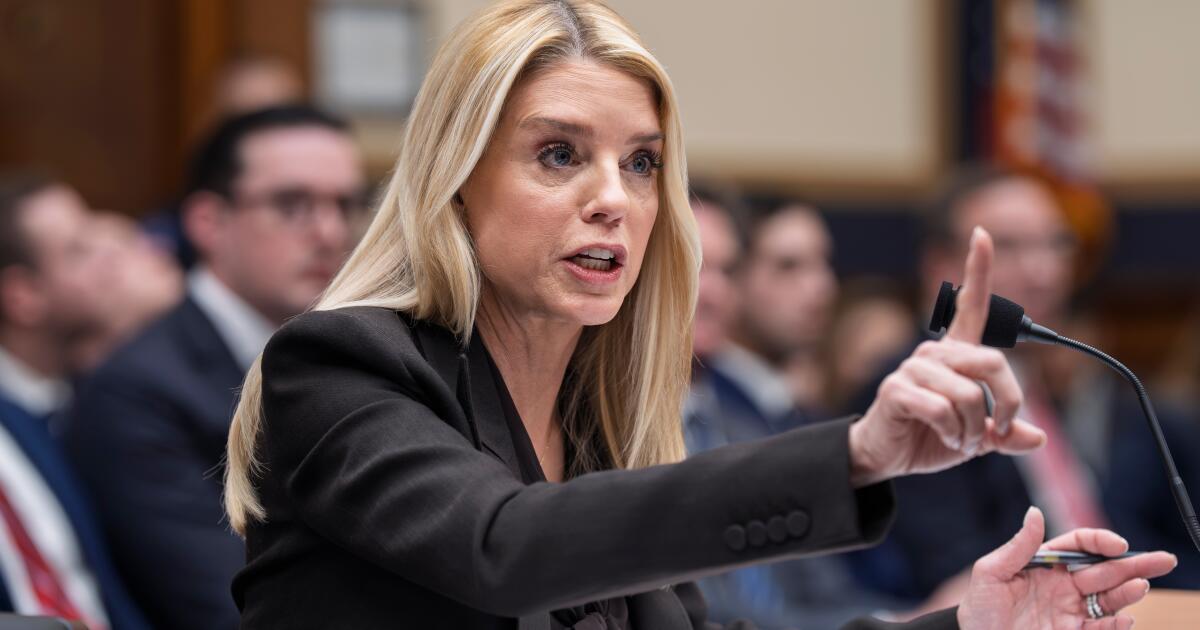
Former Atty. Gen. Pam Bondi is scheduled to meet with the House Oversight Committee on Friday to discuss the Justice Department’s investigations into deceased sex trafficker Jeffrey Epstein and its release of files related to that investigation.

But the circumstances surrounding her meeting with the committee raise questions about how much the committee will actually learn about either.

For one, the former attorney general will not be under oath in a sworn deposition but will provide a transcribed interview, which is voluntary. Bondi’s interview with the committee will happen behind closed doors with members of the committee and staff and will not be filmed. The committee says it plans to release a transcript soon after the hearing.

And Bondi will be represented at her interview by Assistant Atty. Gen. Harmeet Dhillon, which legal experts say raises the prospects that the Department of Justice could direct Bondi to not answer some questions posed by the committee.

Former Atty. Gen. William Barr, former President Clinton and former Secretary of State Hillary Clinton all gave sworn depositions.

Rep. James Comer (R-Ky.), the chair of the committee, rejected the Clintons’ offer to provide a transcribed interview, rather than sit for a deposition, out of concern that someone giving a transcribed interview could “refuse to answer whatever questions he wanted for whatever reasons he wanted.”

Comer’s spokesperson said Bondi was allowed to sit for a transcribed interview, rather than a deposition, because the former attorney general was “cooperative.”

“Unlike the Clintons who defied subpoenas for seven months, former Attorney General Pam Bondi voluntarily and quickly cooperated with the Committee to identify a mutually agreeable date,” spokesperson Austin Hacker said in a statement.

Bondi had, in fact, refused to comply with the committee’s subpoena while she was still in office, and the ranking Democrat on the committee, Rep. Robert Garcia (D-Long Beach), filed a resolution on April 29 to hold Bondi in contempt for not complying with the committee’s subpoena a month earlier. Bondi’s agreement to provide a transcribed interview was announced the same day.

The committee subpoenaed Bondi in March to learn more about the department’s long-running investigations into Epstein — the financier accused of abusing more than 1,000 women and girls and directing some of them to have sex with his high-powered friends — and the department’s release of files in response to the 2025 Epstein Files Transparency Act, which mandated disclosure of the investigative records.

Asked whether Dhillon’s participation indicated that the department planned to invoke privilege and bar Bondi from sharing some information, the department said in a statement that Dhillon and other agency officials would attend Bondi’s interview “solely to ensure accurate representation of Department processes, facilitate any necessary clarifications, and support a complete factual record for the Committee.”

The department added that it “routinely provides staff” to assist with “congressional engagement involving past Department staff actions.”

But a former DOJ ethics official, speaking on the condition of anonymity for fear of retribution, said that Dhillon’s participation in the proceedings was anything but routine.

Typically, this type of work would be handled by a less senior attorney at the department who had more direct involvement with the subject matter at hand, the former official said. Dhillon oversees the department’s civil rights division, while the investigations into Epstein were criminal matters.

“I don’t see where Harmeet Dhillon has the experience or the normal level of authority that this would be delegated to,” the official said. “Everything about this seems unusual.”

Bondi would also need to have submitted a formal request for representation from the department.

“It doesn’t just happen willy-nilly,” the former ethics official said.

The department didn’t say how Bondi came to be represented by the agency’s attorneys. Bondi, who said this week she is being treated for thyroid cancer, didn’t respond to a request for comment.

The presence of Dhillon — a San Francisco attorney and Republican party insider who has been talked about as a potential pick for attorney general — could also present a conflict of interest, experts said.

“It’s unclear if she is representing the interests of Bondi, the department, or herself,” said Dave Rapallo, a former staff director of the House Oversight Committee.

He said that Dhillon would not have been able to represent Bondi if her testimony was provided in a deposition because the committee’s rules prevent agency lawyers from attending depositions.

Bondi was fired by President Trump on April 2. She was dogged by questions about her handling of the Epstein investigation throughout her time in office.

Trump campaigned on the promise of releasing information about the government’s investigation into Epstein in 2024 and in February 2025, Bondi told Fox News that she had on her desk a list of clients of Epstein — who died in federal custody in 2019.

But months later, as questions swirled about Trump’s relationship with Epstein, the Justice Department announced that it was closing its investigation into Epstein and said that, in fact, no such client list existed.

Soon after, Rep. Ro Khanna (D-Fremont) and Rep. Thomas Massie (R-Ky.) introduced the bipartisan Epstein Files Transparency Act, requiring the Justice Department to release all of the records from its investigation into Epstein. Trump initially opposed the legislation but ultimately signed it into law.

The department has released millions of pages of records in response to the law. While Acting Atty. Gen. Todd Blanche said in January that there are millions of additional pages of records that are not yet public, the department has indicated that it doesn’t plan to release these additional files.
Source link

Biden sues Justice Department to stop release of audio and transcripts tied to special counsel probe

Joe Biden sued the Justice Department on Tuesday in an effort to block the release of audio recordings and transcripts of the former president’s interview with a ghostwriter that were obtained by the special counsel who investigated his handling of classified documents.

Biden’s lawyers said in a lawsuit filed in Washington’s federal court that the Justice Department plans to release the files to Congress and a conservative group, the Heritage Foundation, after the department had previously argued that they were exempt from disclosure under the public records law.

Biden’s lawyers argued that the disclosure would “constitute an unwarranted invasion of President Biden’s privacy.”

“Every American, including a sitting or former Vice President, has a right to privacy in the personal conversations he has within his own home,” his attorneys wrote. “And when the U.S. Department of Justice obtains that private information through a criminal investigation, the Department bears a particular responsibility to protect it from disclosure.”

At issue in the case are audio recordings and transcripts of Biden’s interviews at his home in 2016 and 2017 with Mark Zwonitzer, who worked with Biden on his two memoirs. The files were scrutinized by special counsel Robert Hur as part of his investigation into the president’s improper retention of classified documents, from his time as a senator and as vice president.

Hur’s yearlong investigation led to a 345-page report that questioned Biden’s age and mental competence but recommended no criminal charges against the then-81-year-old. Hur said he found insufficient evidence to successfully prosecute a case in court.

Biden has separately fought the release of the audio of his interview with Hur. The House in 2024 voted to hold Biden Atty. Gen. Merrick Garland in contempt of Congress for refusing to turn over that audio after the White House exerted executive privilege, shielding it from Congress.

The transcripts of five hours of Biden interviews with federal prosecutors was released that same year. While Biden was adamant that he treated classified information seriously, the transcript shows that he was at times fuzzy about dates and details and he said he was unfamiliar with the paper trail for some of the sensitive documents he handled.

Republicans have argued Biden was being given a pass by his own Justice Department and that Trump had been unfairly victimized by prosecutors. Democrats, for their part, stressed Biden’s cooperation in the investigation and strongly contrasted that with the separate criminal case against Trump, who was accused of refusing to return classified documents requested by the National Archives that he had at his Florida estate.

Richer writes for the Associated Press.

Source link

Trump’s Justice Department scrubs its website of news releases about Jan. 6 defendants

The U.S. Department of Justice has acknowledged removing from its website news releases about criminal cases related to the Jan. 6, 2021, riot and insurrection, calling the information about the prosecutions “partisan propaganda.”

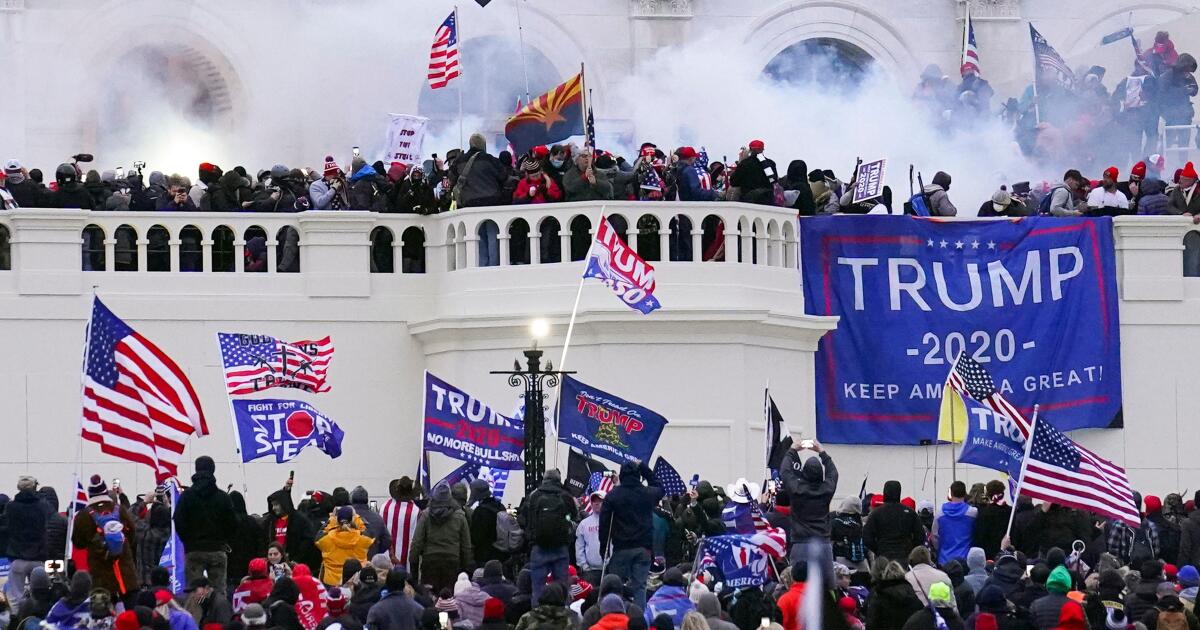
The purge of news releases documenting criminal charges, convictions and sentencings is the latest step by the Trump administration to reimagine the history of the assault on the U.S. Capitol, when hundreds of supporters of President Trump stormed the building in an effort to halt the congressional certification of his 2020 election loss to Joe Biden.

Trump, on his first day back in office in January 2025, pardoned, commuted the prison sentences or vowed to dismiss the cases of all of the 1,500-plus people charged with crimes during the Capitol assault, including those convicted of sedition and of attacking officers with makeshift weapons such as flagpoles, a hockey stick and crutch. More than 100 police officers were injured, many of them seriously, and five died as a consequence.

On Monday, the Justice Department announced the creation of a $1.776-billion fund meant to compensate Trump allies who claim they were unjustly investigated and prosecuted. Acting Atty. Gen. Todd Blanche has not ruled out that Jan. 6 rioters convicted of violence will be eligible for payouts, prompting bipartisan anger in Congress.

After a journalist on Friday observed on the social media platform X that the Justice Department was “quietly” removing news releases on its website that were related to the Jan. 6 attack, including about a Texas man who pleaded guilty to assault and also faced separate state charges of soliciting a minor, the department responded through its “rapid response” account that there was “nothing ‘quiet’ about it.”

“We are proud to reverse the DOJ’s weaponization under the Biden administration. We will do everything in our power to make whole those who were persecuted for political purposes,” the post said. “This includes stripping DOJ’s website of partisan propaganda.”

Among the releases removed from the site were those concerning seditious conspiracy cases against members of the Proud Boys and Oath Keepers, far-right extremist groups, some of which resulted in convictions and long prison sentences.

The Justice Department, in an unopposed motion last month, asked a federal appeals court to vacate those seditious conspiracy convictions, a request that was granted Thursday. The department on Friday moved to dismiss the cases against the group members.

Trump was impeached for inciting an insurrection on Jan. 6 and was indicted on felony charges related to his actions. Those charges were dismissed after his 2024 election victory.

Tucker writes for the Associated Press.

Source link

Judge dismisses human smuggling charges against Kilmar Abrego Garcia, who was mistakenly deported

A federal judge on Friday dismissed a human smuggling case against Kilmar Abrego Garcia, finding that the Justice Department’s pursuit of criminal charges was designed to punish him for challenging his mistaken deportation to El Salvador last year.

The ruling amounted to an extraordinary rebuke of a Justice Department that under President Trump has repeatedly been accused of targeting defendants for political purposes. The Trump administration touted the charges against Abrego Garcia last year at a press conference in which then-Atty. Gen. Pam Bondi declared, “This is what American justice looks like.”

“The evidence before this court sadly reflects an abuse of prosecuting power,” U.S. District Judge Waverly Crenshaw, in Nashville, said in his ruling granting Abrego Garcia’s motion to dismiss for “selective or vindictive prosecution.” Without Abrego Garcia’s “successful lawsuit challenging his removal to El Salvador, the government would not have brought this prosecution.”

Abrego Garcia’s deportation became an embarrassment for Trump officials when they were ordered to return him to the U.S. In his motion to dismiss, Abrego Garcia claimed that the timing of the criminal charges and inflammatory statements about him by top Trump officials demonstrated that the prosecution was vindictive.

“Kilmar Abrego Garcia is a victim of a politicized, vindictive White House and its lawyers at what used to be an independent Justice Department,” his criminal defense attorneys said in a statement after Friday’s ruling. “We are so pleased that he is a free man.”

The Justice Department vowed to appeal, calling the judge’s order “wrong and dangerous.”

Crenshaw stopped short of finding the government acted with “actual vindictiveness,” a rarely met standard that usually requires evidence like a prosecutor admitting that charges were filed in retaliation against someone. But the judge did find there was enough evidence of “presumptive vindictiveness” — including the timing of the indictment, statements made by then-U.S. Deputy Aty. Gen. Todd Blanche, and the sustained oversight of the case by other top Justice Department officials — that the case against Abrego Garcia was thoroughly tainted.

The government’s own explanations weren’t convincing, Crenshaw wrote.

Abrego Garcia was charged with human smuggling and conspiracy to commit human smuggling, with prosecutors claiming that he accepted money to transport within the United States people who were in the country illegally.

The charges stem from a 2022 traffic stop in Tennessee for speeding. Body camera footage from a Tennessee Highway Patrol officer shows a calm exchange with Abrego Garcia. There were nine passengers in the car, and the officers discussed among themselves their suspicions of smuggling. However, Abrego Garcia was eventually allowed to continue driving with only a warning.

In the Friday ruling, Crenshaw wrote that the timing of the charges was central to the presumption of vindictiveness. Homeland Security had been aware of the traffic stop for two years and had closed the case against Abrego Garcia when it deported him. Once the U.S. Supreme Court ruled that he should be brought back to the U.S., they reopened the case. While the government bore the responsibility to rebut the presumption of vindictiveness, prosecutors did not call as a witness the person who reopened the case, to explain why. Instead they offered only “secondhand testimony.”

In a statement released by the group We are CASA, which has been supporting Abrego Garcia and his family, he thanked God for the dismissal of the criminal charges.

“Justice is a big word and an even bigger promise to fulfill; and I am grateful that today, justice has taken a step forward,” he said.

Abrego Garcia’s deportation violated a 2019 immigration court order granting him protection from deportation to his home country, after the judge found he faced danger there from a gang that targeted his family. Abrego Garcia is a Salvadoran citizen with an American wife and child who has lived in Maryland for years although he immigrated to the U.S. illegally as a teenager. The 2019 order allowed him to live and work in the U.S. under Immigration and Customs Enforcement supervision, but he was not given residency status.

Meanwhile, Trump administration officials have said Abrego Garcia cannot remain in the U.S. They have vowed to deport him to a third country, most recently Liberia.

Loller writes for the Associated Press.

Source link

‘A bridge too far?’: As GOP senators revolt, Trump defends fund and attacks defectors

For much of President Trump’s second term, Republican senators have largely stayed in line, wary of the consequences of defying a president with a history of targeting those who cross him. This week, that dynamic noticeably shifted.

Senate Republicans blocked two of Trump’s legislative priorities, angered by the push to create a $1.8-billion federal fund to compensate people who claim to have been politically persecuted, including rioters who assaulted the Capitol on Jan. 6, 2021. The revolt forced Republican leaders to pull a planned vote on legislation to fund the president’s immigration crackdown and security features for the president’s White House ballroom project.

In response, the president defended the fund and lashed out at its critics.

“I gave up a lot of money in allowing the just announced Anti-Weaponization Fund to go forward,” Trump wrote in a post on Truth Social. “Instead, I am helping others, who were so badly abused by an evil, corrupt and weaponized Biden Administration, receive, at long last, JUSTICE”!

The president also called Republican senators who broke with him quitters who are “screwing the Republican Party.”

The friction, which has been building for weeks, is being watched as potential test to the limits of Trump’s grip on his party amid an already tense political environment heading into the midterm elections.

“This is kind of a perfect storm,” former Sen. Jeff Flake (R-Ariz.) said on NBC’s “Meet the Press.” “It may be that this time you can point to it and say this is when the great migration begins, away from some of the president’s policies and away from the fear that the president can target you.”

Whether this week marks the beginning of that moment — or simply another episode of political turbulence that fades — is the central question now handing over Trump’s second term.

Not the first break — but an escalation

This is not the first time Republicans have broken with the president. In November, Congress overwhelmingly voted to force the Justice Department to release of the Jeffrey Epstein files, an effort that Trump unsuccessfully tried to thwart for months.

The Epstein vote showed that on the right issue, under the right circumstances, Republicans could be moved to defy Trump. This week, the creation of the fund changed the circumstances again, and the number of Republican senators willing to act quickly grew.

This moment comes after months of rising costs during the war in Iran, efforts by the president to oust members of his own party and now a set of proposals that are proving hard to defend in an election year.

“What you have is basically a bunch of people who feel a bit under siege,” said Bob Olinksy, the senior vice president of Structural Reform and Governance at the Center for American Progress. “At the same time, they know that most of what the president is doing is unpopular, and they’re the ones who are going to be standing for reelection in November.”

Republicans push back

Senate Republicans leaders are now asking the Department of Justice to reconsider the terms of the fund, underscoring just how politically toxic the idea has become within the president’s own party.

Sen. Kevin Cramer (R-N.D.) told reporters that the politically speaking, the fund is “unexplainable.” Sen. Susan Collins (R-Maine) told the New York Times the fund should be in real trouble. Sen. Mitch McConnell (R-Ky) called the fund “utterly stupid” and “morally wrong.”

Sen. Thom Tillis, a North Carolina Republican whom Trump has singled out for going against him, was equally unsparing, saying he opposed “using billions of taxpayer dollars to compensate convicted felons and thugs who attacked police.” He also criticized the administration for pushing domestic and foreign policy issues that he says are bad for housing and the military.

“If opposing these things makes me a RINO [Republican In Name Only], then I gladly accept that nickname,” Tillis wrote on X. “We need Republicans to do well in November, but the stupid stuff is killing our chances!”

The Republican push back comes as the concern about self-dealing runs deep across the electorate.

A recent poll Economist/YouGov poll found that 59% of Americans believe Trump is using his office for personal gain, though that belief is sharply divided among partisan lines. A CNN poll found that 37% of Americans say Trump puts the good of the country above his personal gain, while 32% say he is in touch with the problems of ordinary Americans.

Asked if the political environment influenced the actions this week, Senate Majority Leader John Thune (R-S.D.) told reporters that there is a “political component to everything we do around here.”

Funds and tax immunity clauses

Senate Democrats are wondering if the fund will mark a watershed moment for Republicans.

“Have Republicans finally found a bridge too far?” Sen. Richard Durbin (D-Ill.) told reporters after Republicans left Washington without funding Trump’s priorities.

Democrats have called the fund an illegal abuse of power designed to line the pockets of Trump’s allies with taxpayer dollars. Sen. Chris Van Hollen (D-Md.) called it a “pure theft of public funds.”

The fund was created as part of a settlement resolving a $10-billion lawsuit Trump personally brought against the Internal Revenue Service over the leak of his tax returns. Alongside it, the deal says the IRS is “forever barred and precluded” from pursuing any tax claims against Trump and his businesses.

Under the tax immunity clause, Trump and his family could save more than $600 million, according to an analysis by Forbes.

The fund, however, has been the target of most of the bipartisan ire. Mostly because Trump and administration officials have not ruled out that it could stand to benefit people who carried out violence during the Jan. 6 riot.

The public funds, if disbursed, would come from the federal judgment fund, which is a Congress-approved ongoing appropriation that allows the Justice Department to settle cases and make payouts. In the past, Republicans have taken issue with the fund. The GOP-controlled House Judiciary Committee characterized it an abuse in 2017.

Several of the president’s allies have already talked about tapping into the fund.

Michael Cohen, Trump’s former attorney who served prison time in relation to campaign finance violations, said he plans to apply for compensation.

Former Proud Boys leader Enrique Tarrio, who was convicted of seditious conspiracy and later pardoned by Trump, told CBS News he would seek a payout from the fund.

“I was targeted,” Tarrio said. “And I do believe that this fund does apply to me.”

Source link

GOP senators balk at Trump’s $1.8-billion ‘anti-weaponization’ fund, force delay in key vote

President Trump’s grip on his party slipped on Thursday as anger boiled over among Senate Republicans about a growing list of issues.

In a striking display of defiance, GOP senators abruptly derailed plans to vote on legislation to fund Trump’s immigration crackdown amid deep disagreements over security funding for a White House ballroom and a $1.8-billion fund to pay people who claim to have been politically persecuted.

The discontent had been building for weeks. Many senators had grown frustrated over Trump’s decision to endorse candidates running against longtime Republican incumbents.

Others, worried about rising costs as a result from the war in Iran, had aired concerns ahead of the midterm elections. But the breaking point came when the Justice Department, with little warning, pushed to create what it termed the “anti-weaponization fund.”

Senate Majority Leader John Thune (R-S.D.) acknowledged the concerns over the fund Thursday after a reportedly contentious private meeting about it between Senate Republicans and acting Atty. Gen. Todd Blanche. He also conceded midterm politics had added to the tension.

“It’s hard to divorce anything that happens here from what’s happening in the political atmosphere around us,” Thune told reporters. “You can’t disconnect those things.”

A day earlier, Sen. Bill Cassidy, a Louisiana Republican who lost his primary race on Saturday to a Trump-backed challenger, expressed strong disagreement with the creation of the fund, which would be controlled by appointees without congressional oversight.

“People are concerned about paying their mortgage or rent, affording groceries and paying for gas, not putting together a $1.8 billion fund for the president and his allies to pay whomever they wish with no legal precedent or accountability,” Cassidy wrote on X. “If there needs to be a settlement, the administration should bring it to Congress to decide.”

Sen. Mitch McConnell (R-Ky.) also had harsh criticism for the fund.

“So the nation’s top law enforcement official is asking for a slush fund to pay people who assault cops? Utterly stupid, morally wrong — take your pick,” he said in a statement.

The discord was striking, partly because Republicans have largely steered clear of checking the president’s power, and Congress has been largely sidelined under the second Trump administration on the war in Iran and other issues.

“I don’t think the Republicans had any choice but to pull the plug until we come back in June, because they’re facing a bit of a mutiny within their conference,” Sen. Adam Schiff (D-Calif.) told The Times, saying he had heard that the meeting between Blanche and Republicans “didn’t go well.”

As tension simmered on the background, Trump seemed unbothered by the group of Republicans’ public rebellion against his agenda. When asked whether he was losing control of the Senate, he said he didn’t know.

“I only do what is right,” he told reporters in the Oval Office.

However, he expressed annoyance at lawmakers who would not support $1 billion in federal funding for security costs related to the ballroom project. He said the structure is being privately funded by him and other “great patriots.”

“We are making a gift to the United States,” Trump said. “This is being made as a gift from me and other people that are great patriots and spent a lot of money. We are building what will be the finest ballroom anywhere in the world.”

The $1 billion for security funding would be “very much a good expenditure,” he said. If Congress does not sign off on the money, Trump said the “White House won’t be a very secure place.”

Trump did not immediately comment on Thursday about the Senate’s delaying of the funding bill. The White House declined to comment on the matter.

Trump’s second-term actions have frequently tested the loyalty of Republican lawmakers, who have largely stayed in line. The settlement fund, with its ethical questions, appears to have crossed a line for some senators in a party that has traditionally opposed wasting taxpayer funds.

The money comes from the judgment fund, which is a Congress-approved ongoing appropriation that allows the Justice Department to settle cases and make payments.

Stephen Miller, a top aide to Trump, told reporters at the White House that the $1.8-billion settlement was “just a small measure of the justice” that many people are owed after being targeted by the federal government. Miller declined to say whether the White House was reaching out to senators to ease concerns about the fund.

Republicans in Congress decried the use of similar third-party settlements during the Obama administration, with House lawmakers repeatedly passing a bill aimed at stopping settlement slush funds, noted Molly Nixon, a senior fellow at the Cato Institute.

Though the Trump administration’s plan is novel because the settlement money isn’t going to a third party, the general concept has been offensive to Republicans in the past; the Republican-controlled House Judiciary Committee termed it an abuse in 2017.

“If you’re taking a consistent view, you’d be at least equally as opposed to this settlement,” Nixon said of Republican lawmakers.

That could be driving some of the opposition now, along with concerns about who is going to get the money and whether it could be distributed to people who wouldn’t have been able to make a successful case before a court of law, Nixon said.

“The fund is going to plaintiffs who were victims of lawfare or weaponization. … Those are pretty ambiguous terms. They’re sort of in the eye of the beholder,” Nixon said. “It’s pretty easy to see how this could very easily become a quiet political claims process.”

Police officers who defended the U.S. Capitol during the Jan. 6, 2021, riot have already filed a federal lawsuit seeking to block the creation of the fund, arguing in part that it would compensate extremist convicted of committing violent crimes.

“The fund’s mere existence sends a clear and chilling message: those who enact violence in President Trump’s name will not just avoid punishment, they will be rewarded with riches,” the lawsuit says.

When Trump returned to office in January 2025, one of his first acts was pardoning or commuting the prison sentences of the 1,500 people who were charged in connection with the attack. Vice President JD Vance on Wednesday did not rule out that settlement money could go to those rioters, saying the money would be given out on a “case-by-case basis.”

Thune told reporters on Thursday that the Justice Department would have to come up with some guardrails to ease concerns among senators.

“We need to get some clarity,” he said.

Though the number of Republicans angry with Trump is significant enough to make or break legislation, the caucus appeared far from falling apart.

Senate Republicans blocked an attempt by Sen. Alex Padilla (D-Calif.) on Thursday to pass a bill to prohibit federal funds from reaching Jan. 6 rioters, an attempt to prevent the fund from being used to compensate them.

“I’m encouraged hearing some of my Republican colleagues agreeing with me,” Padilla said on the Senate floor. “Let’s stand up for congressional oversight as a unified Senate.”

Sen. Tommy Tuberville (R-Ala.) objected to Padilla’s bill, later writing on X: “PROUD to object today to Senator Padilla’s RIDICULOUS bill and stand up for ALL FREEDOM-LOVING AMERICANS.”

Schiff, who is working on an amendment that would target the fund, said other Republican colleagues he spoke to Wednesday evening were unhappy with the position Trump has put them in. He said Trump’s actions have helped underscore Democrats’ arguments against his party.

“All [it’s] doing is helping us make the case that the Republicans couldn’t care less about people’s cost of living … that there’s plenty of money for golden ballrooms for the president, there’s plenty of money for the president’s cronies, but there’s no money for the average family,” Schiff said.

Source link

Blanche doesn’t rule out payments to violent Jan. 6 rioters as he defends $1.8B fund

Acting Atty. Gen. Todd Blanche on Tuesday wouldn’t rule out the possibility that people who carried out violence during the Jan. 6, 2021 riot at the U.S. Capitol will be considered for payouts from a new $1.776 billion fund to pay individuals who believe they were targeted politically.

Pressed during a Congressional hearing over whether those who assaulted police officers would be eligible for compensation from the “Anti-Weaponization Fund,” Blanche responded that all people can apply if “they believe they were a victim of weaponization.” The acting attorney general also refused to say whether he would direct those responsible for deciding who receives payments — a commission whose members he is tasked with appointing — to restrict funds to those convicted of violence.

“What I will commit to is making sure that the commissioners are effectively doing their jobs, and that includes setting guidelines as you’re describing,” Blanche told Sen. Jeff Merkley, an Oregon Democrat. The decisions on payouts will be made a five-member commission appointed by the attorney general.

Appearing before Congress for the first time since taking the reins of the Justice Department last month, Blanche was peppered with questions about the fund announced on Monday to compensate those who believe they were mistreated by prior administrations’ Justice Department. Blanche said the fund was “unusual” but not unprecedented, adding that those who benefit will not be limited to Republicans or to people who were investigated or prosecuted by the Biden administration. At one point, Blanche said President Joe Biden’s son, Hunter — who faced gun and tax prosecutions under his father’s administration — could also apply.

Blanche defends $1.8 billion fund

Tuesday’s hearing was meant to address the Trump administration’s budget request for the Justice Department but quickly delved into other controversies that have escalated concerns about the erosion of the law enforcement agency’s tradition of independence from the White House. Blanche defended the creation of the fund without any acknowledgment that the Trump administration has pursued investigations of Trump’s political opponents, sparking criticism that the department is being weaponized in precisely the same way they allege it was under Biden’s administration to prosecute Trump.

In the weeks since assuming control of the Justice Department after Pam Bondi’s firing, Blanche has moved aggressively to advance the president’s priorities — pushing forward cases against Trump’s political foes, cracking down on leaks to media outlets and establishing the new fund to resolve Trump’s $10 billion lawsuit against the Internal Revenue Service over the leak of his tax returns.

Democrats described it as an illegal abuse of power designed to line the pockets of Trump supporters with taxpayer dollars. Sen. Chris Van Hollen, the top Democrat on the Senate appropriations subcommittee holding the hearing, blasted the move as a “pure theft of public funds.”

“Rewarding individuals who committed crimes is obscene,” the Maryland Democrat said. “Every American can see through this illegal, corrupt, self-dealing scheme.”

The fund is in keeping with Trump’s long-running claims that the Justice Department during the Biden administration was weaponized against him, even though then-President Biden himself was investigated during that time and his son was prosecuted. Merrick Garland, who served as attorney general during the Biden administration, has repeatedly denied allegations of politicization and has said his decisions followed facts, the evidence and the law.

Trump administration has been rewriting the history of Jan. 6

The mere possibility that violent rioters at the Capitol could be considered for payouts is consistent with a Trump administration pattern of rewriting the dark history of Jan. 6, a trend that began when the president pardoned and commuted the prison sentences of the participants in the melee and that continued with the Justice Department firing some prosecutors who put them behind bars.

Under questioning from Merkley, Blanche said that he “will definitely encourage the commission” responsible for deciding on the payouts to “take everything into account.” But when asked whether he believes those convicted of violence should be entitled to compensation, Blanche said: “My feelings don’t matter.”

When Merkley suggested that Trump was using the Justice Department to target his political enemies, Blanche replied that this was precisely the sort of “disgusting” behavior of the Biden administration that the fund was meant to address.

“That is completely inappropriate and wrong,’ Merkley said. “There is no comparison to the absolute fair minded pursuit of justice under the previous administration, and this administration’s pursuit of an enemies list.”

Questions over the meaning of ‘weaponization’

In announcing the fund Monday, the Trump administration did not name specific individuals who might stand to benefit from it. The money itself would come from the federal judgment fund, which pays out court judgments and compromise settlements of lawsuits against the government.

Blanche told lawmakers that the Justice Department is committed to “full transparency” in providing public information about beneficiaries of the new fund.

“It’s not limited to Republicans. It’s not limited to Democrats. It’s not limited to January 6th defendants. It’s limited only by the term weaponization,” Blanche said, though the administration has not said how it will define “weaponization.”

Meanwhile, there were signs of discomfort about the fund even among some Republican members of Congress. Senate Majority Leader John Thune told reporters that he’s “not a big fan,” adding that he isn’t sure how the administration intends to use it, but doesn’t “see a purpose for that.”

Thune’s comments come after Louisiana Sen. Bill Cassidy, who lost reelection in a GOP primary on Saturday, called it a “slush fund.”

“We are a nation of laws,” Cassidy said. “You can’t just make up things.”

Richer and Tucker write for the Associated Press. AP reporter Mary Clare Jalonick in Washington contributed to this report.

Source link