allegation

Trump’s ambassador to Greece, Kimberly Guilfoyle, resigns after allegations of improper conduct

President Trump’s ambassador to Greece, Kimberly Guilfoyle, resigned on Tuesday after allegations of improper conduct but insisted she’ll “vigorously defend” herself.

Trump’s administration said earlier Tuesday it had asked Guilfoyle to leave her post after she faced severe criticism over allegations she engaged in improper and possibly illegal conduct before and during her tenure in Athens.

The announcement, after days of comments and speculation, came in response to a question to freshly minted White House press secretary Katie Zacharia at her first media briefing Tuesday morning. Zacharia said Guilfoyle “has been a wonderful asset to the team, and we wish her well.”

Guilfoyle’s departure comes after its possibility was previewed to the Associated Press over the weekend and Trump registered his unhappiness on Monday at reports about her alleged conduct.

“Well, we’re looking at it,” Trump told reporters at the White House when asked if he was considering firing Guilfoyle. “We’re not happy.”

Those comments came a day after the AP, citing a senior U.S. official, reported that Trump and Secretary of State Marco Rubio are “extremely pissed off” by Guilfoyle’s reported conduct and would likely decide on her future this week.

In a series of stories dating to late last month, The Wall Street Journal has reported questionable conduct by Guilfoyle, including an alleged threat to a host country official, accepting improper gifts and services and offering to use her influence inside the Republican administration in return for the payment of a large credit card bill.

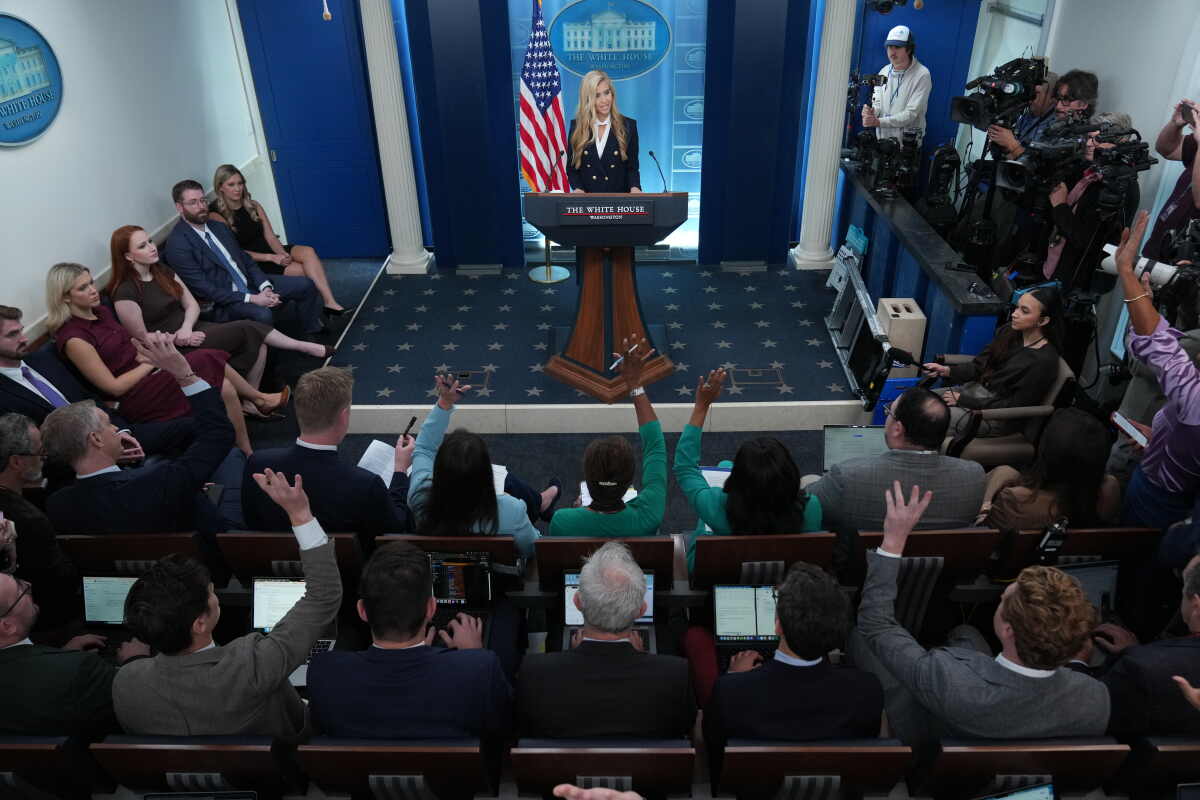
White House press secretary Katie Zacharia speaks with reporters in the James Brady Press Briefing Room

White House press secretary Katie Zacharia speaks with reporters in the James Brady Press Briefing Room at the White House, Tuesday, Oct. 13, 2026, in Washington.

(Julia Demaree Nikhinson / Associated Press)

Guilfoyle addressed the allegations directly in a post on X, saying, “These allegations are false, and I intend to vigorously defend my name, my reputation, and my integrity.”

“I have dedicated my professional life to fighting for justice, standing up for what is right, and defending the values that make America exceptional,” she said. “I will not allow false accusations to define my decades of public service.”

In a statement released late Sunday, Guilfoyle’s lawyers denied she had done anything wrong and claimed that the money she was seeking from a Trump donor was payment for services — public appearances and speaking engagements that predate her ambassadorial nomination — that had not been paid.

The lawyers, David Schwartz and Jesse Binnall, also rejected allegations of impropriety related to Guilfoyle’s travel on private planes, saying that before every such trip she “sought, obtained and followed State Department guidance and followed the Department’s travel regulations.”

The allegations began surfacing weeks ago

After defending Guilfoyle following the first report, Rubio has declined to comment publicly on the growing allegations. Last week, Rubio said: “Our ambassador has been a strong ambassador here.”

But after another report appeared later, Rubio — speaking Thursday before leaving Athens — berated journalists for asking about the allegations. He said that he didn’t know if they were true and that he would not respond if he could not confirm them.

“You guys walk around thinking that because some source told you something and you reported it, it’s the gospel. It’s not the gospel. It’s not the gospel for me. That’s not the way we do things,” Rubio said at the foot of his plane as Guilfoyle, who was there to see him depart, looked on.

A second U.S. official, who also spoke on the condition of anonymity to discuss personnel matters, said the State Department’s inspector general was looking into the allegations, which first began surfacing in the Journal late last month and have since multiplied.

The second official could not say if a formal IG probe had begun. Inspectors general often conduct informal inquiries into complaints against staffers, and many times those inquiries do not result in a full-on investigation, which can result in disciplinary action up to and including dismissal.

The State Department has declined to comment on a potential IG investigation.

There was no immediate response to Zacharia’s statement from the Greek government or Cabinet members.

Ahead of Tuesday’s announcement, Greek opposition parties had called on the Foreign Ministry to summon Guilfoyle to respond to the allegations made against her. “This, most importantly, is an issue of national dignity,” Sia Anagnostopoulou, a former deputy foreign minister, said in parliament Friday. Foreign Minister Giorgos Gerapetritis responded that Guilfoyle had been treated “the same way as every other ambassador” and argued that an official summons had not been necessary.

Hours earlier, Guilfoyle had posted photos of her meeting this week with the Spanish ambassador to Athens as well as birthday wishes for Lara Trump, the president’s daughter-in-law, accompanied by Dua Lipa’s “Dance the Night,” from the 2023 soundtrack of the movie “Barbie.”

Democrats call for an investigation

The top two Democrats on the House Foreign Affairs and Senate Foreign Relations committees, Rep. Gregory Meeks of New York and Sen. Jeanne Shaheen of New Hampshire, as well as the ranking member on the House Committee for Oversight and Government Reform, Rep. Robert Garcia, D-Calif., have already called for an investigation into Guilfoyle.

Since late September, the Journal has detailed numerous accounts of questionable conduct by Guilfoyle. Its first report said that she had told guests at a reception that the United States could undermine the Greek government if it chose to, promoted the business interests of one particular Greek construction and energy company and allowed its lobbyist into private diplomatic meetings.

While Rubio was in Athens, the Journal reported — citing text messages — that Guilfoyle had asked a Trump donor and supporter to pay a $100,000 credit card bill just before her confirmation hearing, promising him access to administration officials if he did.

The Journal then reported that Guilfoyle had been enraged about not being invited to a Greek-themed event at the World Economic Forum in Davos, Switzerland, earlier this year and demanded to attend while boasting about luxury travel to France with energy company executives.

Another report, from the British tabloid The Daily Mail, said that Guilfoyle had alienated staff at the U.S. Embassy in Athens and had pushed the bounds of behavior appropriate for the top representative of the U.S. government to Greece.

Guilfoyle is a former Fox News Channel host and California prosecutor who was once married to California’s Democratic Gov. Gavin Newsom and was engaged to Trump’s son Donald Jr.

Lee writes for the Associated Press. AP journalist Derek Gatapoulos in Athens contributed to this report.

Source link

Sean Combs release delayed after posh prison lifestyle allegations

Sean “Diddy” Combs’ release date has been pushed back following allegations of a plush prison lifestyle.

The disgraced music mogul is currently serving a 50-month sentence after he was convicted of transporting prostitutes across state lines for drug-fueled sex performances known as “freak-offs.”

While earlier October reports indicated that the artist and producer would be released on Jan. 21, 2028 — which shaved months off his original June 2028 discharge — an updated search on the Federal Bureau of Prisons inmate database reveals his new revised date as March 2, 2028.

News of his release date comes as the “Bad Boy for Life” singer was reportedly placed and remained in solitary confinement at FCI Fort Dix, a low-security federal prison in New Jersey, following allegations of a pampered prison lifestyle.

On Sept. 29, an NBC report detailed the accounts of four anonymous inmates who claim that the 56-year-old had been paying men for special services.

Sources told NBC News that Combs paid inmates to clean and cook special meals for him, including curry chicken, pizza and empanadas, and that the hip-hop and R&B music producer also receives Chinese-style massages.

To pay for the labor, inmates allege that individuals outside of the prison are depositing thousands of dollars into the commissary accounts of those waiting on the “Satisfy You” singer.

The news outlet also published an image of Combs using a contraband phone, a prohibited item across state and federal prisons; multiple inmates said that he uses it to scroll Instagram and view explicit nude content shared by an old girlfriend.

Two sources also shared that Diddy has access to a “jailbroken” tablet where he watches movies and documentaries, including “Sean Combs: The Reckoning,” the Netflix docuseries produced by his adversary Curtis “50 Cent” Jackson.

Sources also allege that Combs is smuggling an illegal stash of alcohol and purchasing an antidepressant drug known as Remeron, or “rem-roms,” from other inmates.

“This is not some normal s— you see in jail. This is some rich s—. It looks crazy, but again, it’s Diddy,” one source told NBC.

The Times reached out to Combs’ representatives, but did not hear back.

A representative from the Federal Bureau of Prisons said they “do not comment on the conditions of confinement for any incarcerated individuals, including quarters assignment, release plans, or whether a particular individual is the subject of allegations, investigations, or sanctions.”

Legal troubles hit a high note last year for Combs when he was involved in a lengthy and public trial involving allegations of sexual assault and other violence. His former girlfriend Casandra “Cassie” Ventura and producer Rodney “Lil Rod” Jones lodged civil complaints against the music tycoon.

In July 2025, Combs was found guilty on two counts of a prostitution-related charge, but not guilty of racketeering conspiracy and sex trafficking, which carried heavier penalties, including a maximum sentence of life in prison.

Source link

ICE detainees who were sprayed with a cleaning agent reach settlement

Six years after he was released from a California immigrant detention facility, Wilfredo Gonzalez Mena has to sleep with his back propped up by pillows, nearly in a seated position, to avoid gasping for air.

He blames his lasting medical issues on the 10 months he spent in custody until September 2020 at the Adelanto ICE Processing Center, about 60 miles northeast of Los Angeles, during which guards sprayed him and fellow detainees nearly around the clock with a concentrated disinfectant meant to guard against COVID-19.

Now Gonzalez Mena, who is one of six named plaintiffs in a class-action lawsuit filed in 2023 over the use of the cleaning solution, is expected to get a six-figure payout as part of a proposed settlement in the case, which was given preliminary approval on Sept. 25 by a federal judge in Riverside. The settlement applies to around 2,700 people detained at the Adelanto facility between March 11 and Sept. 30, 2020, who were exposed to the disinfectant called HDQ Neutral.

“When you least expected it, you would feel the mist,” Gonzalez Mena said. “They would spray us like we were animals.”

The Adelanto facility is operated by the GEO Group, a Florida-based private prison corporation that has faced criticism for years over conditions at its immigrant detention facilities. The company has also pushed back against California laws seeking to increase oversight of its facilities and inform the public about health and safety shortcomings.

Under the settlement, GEO Group and Spartan Chemical Co. Inc., the company that manufactures HDQ Neutral, acknowledged that HDQ Neutral — which is classified as a pesticide — can cause symptoms including blistering, chemical burns, vomiting, permanent eye damage, and damage to the respiratory tract, throat and stomach.

Those findings can now be used by class members who weren’t named plaintiffs and may pursue their own lawsuits, the settlement says.

Neither GEO Group nor the Department of Homeland Security responded to requests for comment. After the lawsuit was filed, GEO Group denied its allegations and said cleaning products are used safely and securely, in accordance with the manufacturer’s guidelines and sanitation standards, at all detention centers.

At the time, a GEO Group spokesperson called the allegations “part of a radical politically motivated campaign to attack ICE contractors, abolish ICE and end federal immigration detention.”

The company later swapped HDQ Neutral for a different cleaning product.

Lawyers from the Los Angeles-based civil rights nonprofit Trial Impact Project who are representing the former detainees called the settlement a victory.

Executive Director Sara Haji referenced other pending lawsuits addressing allegations such as medical neglect, retaliation and substandard food and water. Each one is a different lens into the same problem, she said.

“When a company like GEO settles instead of defending itself at trial, and when it admits that the pesticide it sprayed everywhere can cause serious health problems, it should cause us all to sit up and pay attention to what detained people have been telling us about the everyday cruelty of immigration detention,” Haji said.

The lawsuit alleged that GEO Group engaged in a “months-long poisoning” of detainees when its employees sprayed HDQ Neutral inside the facility. Before the pandemic, staffers had used it as a cleaning product. But as COVID-19 spread, they began spraying the concentrated solution across wide areas, “directly into the air and on all types of surfaces,” the lawsuit said.

Detained immigrants quickly began experiencing the effects, the lawsuit claimed, including nosebleeds, headaches and dizziness.

Spartan Chemical warns that inappropriate exposure can cause the types of effects detainees experienced. Long-term exposure has been linked to asthma and, in laboratory studies on animals, reproductive issues and birth defects.

In 2021, the Environmental Protection Agency found that GEO Group had violated federal law by misusing HDQ Neutral. The report found that staff and detainees were instructed to apply the pesticide inside the facility as often as every 30 minutes, without proper ventilation and at a dilution rate of 2 ounces per gallon of water, which is double the amount allowed for disinfectant use.

In September 2021, a federal judge ordered GEO Group to discontinue use of HDQ Neutral at the Adelanto facility, writing that it had been used “with a callous disregard for the safety of Adelanto’s detainees.”

Among the more than 100,000 pages of documents released during discovery for the lawsuit was an email from a nurse at the facility to Wendy Baca, who was acting health services administrator at the Adelanto facility for Wellpath, the company providing its medical care at the time.

The nurse wrote that patients were arriving with headaches, rashes and blisters, “we believe, due to the chemicals being used to spray.”

“Some of the officers have also reported ‘feeling burned’ after touching their skin with the same gloves that were used to handle the chemical. Please look into this so we do not endanger everyone we are trying to protect,” the nurse wrote.

Baca appeared dismissive of the nurse’s concern. She forwarded the email to GEO Group’s chief of security, asking him to look into it.

“Please also remind them not to put metal into light sockets, run with scissors, or anything usually avoided with a little common sense,” she wrote.

Mark Anthony Ferretiz, a former GEO Group cook supervisor who worked at the Adelanto facility for 14 years until March 2025, wrote in a declaration that his team was told to spray the red chemical “like Lysol.”

“I could taste the spray in my mouth when I used it, and it felt heavy in my lungs,” he wrote.

At some point, the facility’s safety manager brought men from HD Supply to talk to the staff about HDQ Neutral. After learning how often the chemical was being sprayed, one of the men told Ferretiz that it was “rat poison” and that “you’re going to kill someone like that,” he said.

Years later, former detainees such as Gonzalez Mena say they’re still living with the fallout. The former long-haul truck driver said his health deteriorated so significantly while he was detained that, afterward, he could no longer pass the required physical assessment because of his vision and breathing issues.

To make ends meet, he has turned to online resale.

“My wife says that after I was released, I didn’t go back to being the same person,” he said. “I’ve had depression and I often dream that I am there, in that place, and I want to get out.”

Source link

Sean Combs placed in solitary amid reports of lavish prison lifestyle

Sean “Diddy” Combs has reportedly been placed in solitary confinement following allegations of his lavish federal prison lifestyle.

The action follows NBC News’ Tuesday reporting of detailed accounts of four anonymous inmates who alleged that the 56-year-old has been paying men for special services including massages, using a contraband phone and keeping an illegal stash of alcohol.

Combs is currently serving a 50-month sentence at FCI Fort Dix, a low-security federal prison in New Jersey, after he was convicted of transporting prostitutes across state lines for drug-fueled sex performances known as “freak-offs.”

Following the news, Combs was placed in a Special Housing Unit (SHU), better known as solitary confinement, a source told the outlet.

This is not the first time the disgraced music mogul has stepped foot inside the SHU. In July, the music artist and producer spent some solo time after getting into a prison fight, sources told TMZ and NBC News.

Allegations of Combs’ pampered incarcerated lifestyle emerged just as his release date moved up again, according to the Federal Bureau of Prisons inmate database.

He is now scheduled to be released on Jan. 21, 2028.

Sources told NBC News that Combs pays inmates to clean and cook special meals for him, including curry chicken, pizza and empanadas and that the hip-hop artist also receives Chinese-style massages.

To pay for this labor, inmates allege that individuals outside of prison are depositing thousands of dollars into the commissary accounts of those serving the “Bad Boy for Life” rapper.

One source told NBC, “This is not some normal s— you see in jail. This is some rich s—. It looks crazy, but again, it’s Diddy.”

The news outlet also reviewed footage obtained from inside the correctional facility which showed Combs using a phone, a prohibited item across state and federal prisons. Multiple inmates claim he uses it to scroll Instagram and view explicit nude content shared by an old girlfriend.

Two sources also say Diddy has access to a “jailbroken” tablet where he watches movies and documentaries, including “Sean Combs: The Reckoning,” the Netflix docuseries produced by his adversary Curtis “50 Cent” Jackson.

(After learning of this detail, the “In Da Club” reacted with amusement on his Instagram account, sharing an image of the article and stating in his caption: “coming to a prison near you”).

Other claims state that the “Mo Money Mo Problems” rapper is purchasing an antidepressant drug known as Remeron, or “rem-roms,” from other inmates and keeping a stash of smuggled liquor.

“Hell yeah, I drank with him,” one of the men, who recounted drinking Hennessy with Combs, told NBC.

Combs’ representatives on Friday claimed to be unaware of any actions taken against the rapper: “We have no idea that he’s there. And we have no idea when he’s exiting, if he is. BOP doesn’t share that information with us.”

They also shared a statement on Wednesday following allegations against Combs.

“The continued scrutiny of every mundane detail of Sean Combs’s life in prison has reached the point where the media characterizes ordinary prison life as news,” the spokesperson said via email. “The only real news is that Sean continues to serve his sentence within the rules and he patiently awaits the court’s decision on his appeal.”

The Federal Bureau of Prisons did not immediately respond to a request for comment on Friday; however, a FCI Fort Dix spokesperson on Wednesday said they cannot comment on the “conditions of confinement for any incarcerated individual,” nor can they “confirm or deny the existence of a corresponding investigation.”

“Like all correctional agencies, contraband, particularly cell phones, narcotics, and weapons, remains a constant challenge, and we continue to tackle the problem of contraband being introduced into our facilities,” the spokesperson said on Wednesday. “Inmates are not permitted to have access to cell phones, and all incarcerated individuals in the Federal Bureau of Prisons (BOP) who are found to violate the ‘Inmate Discipline Program’ policy are subject to sanctions.”

Last year, Combs’ was involved in a lengthy and public trial involving allegations of sexual assault and other violence. His former girlfriend Casandra “Cassie” Ventura and producer Rodney “Lil Rod” Jones lodged civil complaints against the music tycoon.

In July 2025, Combs was found guilty on two counts of a prostitution-related charge, but the magnate was found not guilty of racketeering conspiracy and sex trafficking, which carried heavier penalties, including a maximum sentence of life in prison.


Source link

Harvey Weinstein’s prison sentences, criminal convictions explained

Harvey Weinstein’s winding legal saga took a new turn this week, one that reaffirmed that the former Hollywood kingmaker — whose alleged history of sexual assault and abuse sparked the cross-industry #MeToo reckoning — will likely spend the rest of his life in prison.

Weinstein, 74, was sentenced on Wednesday to 15 years in prison for a felony sex crime tied to allegations from former “Project Runway” production assistant Miriam “Mimi” Haley. After a retrial last year, a majority-female jury found the disgraced Hollywood mogul and co-founder of the defunct Weinstein Co. guilty of sexually assaulting Haley in 2006 at his New York apartment.

Haley described the lasting and “devastating” effects of Weinstein’s assault as she addressed the court during Wednesday’s sentencing.

“Making the decision to speak up will have me looking over my shoulder for years to come,” she said. “It’s a life sentence for me.”

Weinstein said he has “remorse for Miriam Haley’s pain,” but maintained that he’s innocent.

The New York sentencing this week was not the first time Weinstein received a lengthy prison sentence for sex crimes. Since the damning sexual assault and harassment allegations against Weinstein first entered the legal spotlight in 2017, the Oscar-winning producer has faced convictions for rape and sexual assault over the course of trials — and retrials — from 2020 to 2025.

Weinstein has already served more than six years in New York, leaving him with about nine years left on that sentence. A pending resentencing in California — he was sentenced to more than a decade for a 2013 rape — could keep the mogul behind bars for life, the Associated Press reported.

Here’s a look back on Weinstein’s previous convictions and the prison sentences that followed.

March 2020: 23-year prison sentence in New York

Weinstein was first sentenced for his sex crimes against women in New York almost three years after the #MeToo movement upended his career as a prolific movie producer.

The mogul’s 2020 sexual assault trial, the first in a handful that would follow in the coming years, ended in February 2020 with a jury delivering a mixed verdict. The jury convicted Weinstein of committing a criminal sexual act and third-degree rape based on accusations from Haley and former actor Jessica Mann, respectively. The jury acquitted him on the most serious charges, including two counts of predatory sexual assault.

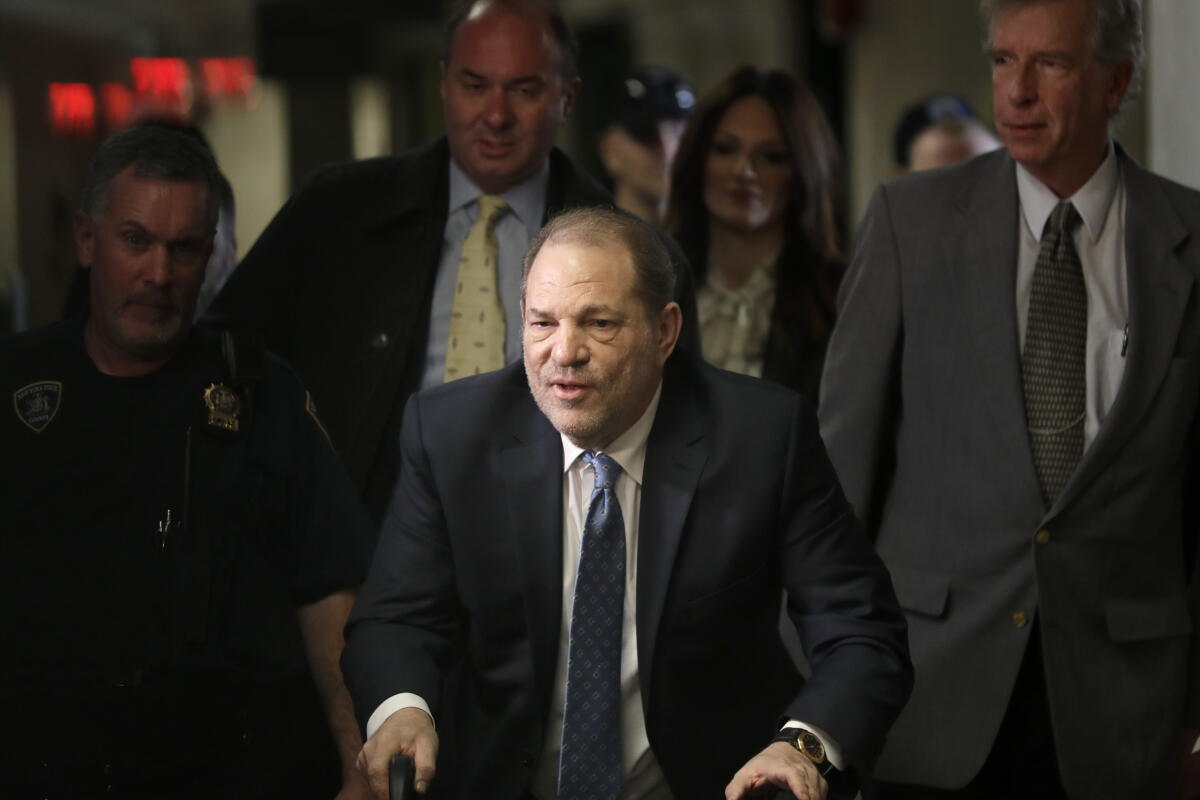
Harvey Weinstein in a suit holding onto a walker as he arrives at a Manhattan courthouse.

Harvey Weinstein arrives at a Manhattan courthouse for jury deliberations in his rape trial, Monday, Feb. 24, 2020, in New York.

(Seth Wenig / Associated Press)

A month later, New York Supreme Court Judge James Burke announced that Weinstein would carry out a 23-year prison sentence for his crimes. He was ordered to serve 20 years for his 2006 attack against Haley in his Manhattan apartment. The judge added three years to Weinstein’s sentence for raping Mann in a Manhattan hotel in 2013. Weinstein was to serve those sentences consecutively.

At the time, the Miramax co-founder denied all wrongdoing and planned to appeal. Those efforts come into play in 2024.

February 2023: 16 years in California

Weinstein, a movie titan who once dominated Hollywood and produced some of the modern film industry’s most defining titles, including “Pulp Fiction” and the divisive Oscar best picture winner “Shakespeare in Love,” was tried in his stamping grounds in October 2022. He was prosecuted for allegations that he raped and attacked four women in Beverly Hills hotel rooms between 2004 and 2013. Before the trial, Weinstein was indicted on 11 counts of rape, forcible oral copulation and sexual battery in Los Angeles and Beverly Hills. He denied all wrongdoing.

The acrimonious trial, which stretched more than a month, ended in December 2022 with a jury convicting Weinstein of forcible rape, forcible oral copulation and sexual penetration by a foreign object. The jury acquitted Weinstein of the sexual battery of a massage therapist and failed to reach verdicts on counts involving two other women. Los Angeles County Superior Court Judge Lisa Lench declared a mistrial on the charges that left the jury deadlocked.

Weinstein’s conviction hinged on an account from an Italian model and actor identified in court as Jane Doe 1. She said the producer barged into her hotel room in Beverly Hills, where she was staying while attending a film festival, to assault her. He was sentenced to 16 years in prison in February 2023.

Harvey Weinstein with a somber expression. He wears a suit and sits in a courtroom.

Harvey Weinstein appears in court at the Clara Shortridge Foltz Criminal Justice Center on Oct. 4, 2022, in Los Angeles.

(Pool / Getty Images)

“There is no prison sentence long enough to erase the damage,” Doe said during the sentencing. “He deserves to experience the same shame, humiliation and fear as I did.”

Lench ruled at the time that Weinstein cannot serve his New York and Los Angeles sentences concurrently. His attorney said the producer would return to New York to carry out the remainder of that sentence before going to prison in California.

Earlier this year, a three-panel judge from California’s 2nd District Court of Appeal unanimously agreed to deny Weinstein’s efforts to appeal the Los Angeles conviction. The Los Angeles trial judge was also ordered to resentence the mogul.

“This is not the end of the appellate process,” Juda Engelmayer, Weinstein’s publicist, said in June. “We intend to seek review in the California Supreme Court because we continue to believe significant legal errors affected the proceedings and warrant further review.”

Weinstein is awaiting resentencing for this case.

April 2024 to now: New York retrial leads to an updated prison sentence

Weinstein, imprisoned and suffering from declining health, sought relief in both California and New York. A glimmer of that relief arrived in April 2024, when a New York appeals court overturned the sex assault conviction that launched his first lengthy prison sentence.

In a dramatic reversal of the landmark #MeToo case, a state appeals court found that the judge who presided over Weinstein’s 2020 trial prejudiced his case by allowing four women who said Weinstein had assaulted them to serve as witnesses, even though their allegations were not part of the case. The appeals court also ruled the judge made a mistake in ruling prosecutors could cross-examine Weinstein about uncharged and decades-old allegations if he decided to testify.

What ensued was a retrial in 2025 that exceeded a month and featured emotional testimony from former accusers Haley and Mann, and model Kaja Sokola, who did not testify against the mogul in the 2020 trial.

The fallen Hollywood boss was retried on the allegations that led to his original rape and criminal sex act convictions. He was also tried on a new sexual assault charge stemming from Sokola’s allegation that he forced oral sex on her in 2006 when she was 19. Weinstein pleaded not guilty and his defense maintained the alleged sexual encounters were consensual. He did not take the stand, similar to his first trial in New York and his rape trial in Los Angeles.

Before Weinstein was convicted in June 2025 of forcing oral sex on Haley, he declared “it’s just not fair.”

“My life is on the line, and you know what? It’s not fair,” he said at the time. “It’s time, it’s time, it’s time, it’s time to say this trial is over.”

Time, it appears, is of the utmost importance for Weinstein, considering his renewed prison sentences in New York and an incoming sentence in California. Weinstein spoke at length with the Hollywood Reporter in March about carrying out his sentence and the possibility of dying behind bars. The former executive was jailed at the notorious Riker’s Island jail complex in New York at the time of the interview.

“It scares the s— out of me. Cold and heartless,” he told THR. “It’s incredible to have the life that I had and the things that I did for society and not have the leniency to deal with me in a kinder way. Whatever they think I did bad in my life, I didn’t get the death penalty.

“I don’t want to die in here.”

The Associated Press contributed to this report.

Source link

Maine Democrats hammer Collins over report of pay-to-play probe. GOP senator calls it ‘totally false’

Patrick Whittle and Lisa Mascaro

Maine Democrats on Wednesday assailed U.S. Sen. Susan Collins over a news report that the FBI investigated how much she knew about illegal campaign contributions that sent one of her donors to prison.

The ProPublica report, published Tuesday, states that the FBI in 2024 planned to launch an investigation into Collins’ dealings with Navatek, a Hawaii defense contractor and donor to her campaign. The investigation, which focused on an alleged pay-to-play scheme, failed to commence after President Trump took office after winning the election, according to ProPublica.

The report arrived six weeks before an election in which Collins is seeking a sixth term against Democrat Troy Jackson. Democrats have targeted the seat, in a state that Trump lost in 2024, as the party tries to win control of the Senate, making it one of the most competitive races on the November ballot.

Collins on Tuesday called the entire story “absolutely outrageous” and said it is frustrating and unfair to have such claims made against her so close to the election. Her campaign manager, Steve Abbott, also said Wednesday that the allegation that “we charge people to have meetings” is categorically false and Collins accepting campaign cash for contracts “did not happen.”

Jackson called the allegation “corruption of the highest order.” He was not present Wednesday when a group of Maine Democrats held a news conference near Collins’ Portland office, calling the allegations a betrayal of trust.

“I cannot stress enough here today the seriousness of these allegations. Maine people deserve clear and real answers from Susan Collins right now,” Maine Democratic Party Executive Director Devon Murphy-Anderson said.

FBI says allegations were already investigated

The ProPublica report stated that the head of a Collins super PAC met with executives from defense contractor Navatek in 2019 and asked them for a $500,000 campaign donation. The company’s chief executive, Martin Kao, sent an initial $150,000 donation using a shell company, the report stated. ProPublica reported that it reviewed an internal company email from Kao in which the CEO later told Navatek executives that Collins committed to getting the company $32 million in Navy contracts.

Kao and two other Navatek executives were later indicted on charges of funneling illegal donations to Collins. Kao sought to reduce his prison sentence by revealing to the FBI the full scope of illegal contributions to Collins, ProPublica reported.

Collins said Kao is “a liar” whose story is untrustworthy.

“He has been twice convicted in separate federal court cases. He’s been convicted of money laundering. He’s been convicted of bank fraud. He has been convicted of false submissions to the FEC. He’s being convicted of a lot of crimes,” she said.

An FBI spokesperson said in a statement that the allegations “had already been investigated by the FBI years ago and ultimately found nothing implicating Senator Collins or Senator Collins’ campaign. Any suggestion otherwise is totally false.”

The ProPublica article also states that Trump’s return to the White House left the Justice Department unable to perform the investigation.

Corruption investigations have decreased in Trump’s second term

The number of FBI agents and Justice Department prosecutors specializing in corruption investigations plummeted in the first months of the Trump administration. The Justice Department, for instance, decimated its elite Public Integrity Section in early 2025 and the FBI disbanded a white-collar fraud and public corruption squad based out of its Washington field office.

The administration has also fired numerous law enforcement officials who participated in investigations into Trump, including over his efforts to undo the 2020 presidential election he lost and his retention of classified records at his Mar-a-Lago estate in Palm Beach, Fla.

An email seeking comment was sent to the Justice Department on Wednesday.

Collins said she first learned of the company through the University of Maine because of the research the Navy found to be valuable, which had to do with 3D printing for production.

She said the Justice Department has already reviewed the matter.

“I’m telling you this is completely false,” Collins said.

Senate Majority Leader John Thune dismissed the idea that Collins would be implicated in a pay-to-play scheme, calling the allegations “a political hit job.”

Whittle and Mascaro write for the Associated Press. Mascaro reported from Washington. AP writers Mary Clare Jalonick and Eric Tucker in Washington and Kimberlee Kruesi in Providence, R.I., contributed to this report.

Source link