The governing body of football in Europe, Uefa, said it was investigating the role of both clubs during the events at the stadium.
It said charges against CSKA Sofia include damage to the stadium, throwing objects, racist and/or discriminatory behaviour, crowd disturbances and violating decent behaviour.
Charges against Derry City include effective invasion of the field of play, throwing objects, crowd disturbances and insufficient protection of the playing area against intruders.
In a statement, Derry City Football Club said it “unequivocally condemns the violence witnessed at tonight’s match”.
“The club is working closely with UEFA, the PSNI, CSKA Sofia and our security partners to establish the full facts surrounding the incidents,” it added.
LAS VEGAS — NBA commissioner Adam Silver reiterated Tuesday night after the Board of Governors meeting that the investigation into whether the Clippers circumvented the salary cap by funneling money to Kawhi Leonard for an endorsement deal he allegedly never fulfilled still is not completed.
Silver said his “timeline remains this summer” to make his findings known after high-powered New York law firm Wachtell, Lipton, Rosen & Katz wraps up its investigation and presents the findings to the NBA.
The investigation centers on a $28-million endorsement deal to Leonard from a company called Aspiration that Clippers owner Steve Ballmer invested $60 million into.
With the investigation being about 11 months old, Silver was asked about a timeline for the NBA to announce the results.
“As you know, I am not conducting the investigation, nor is the league office,” Silver said. “It’s being conducted by the Wachtell law firm, independent of the league. Of course, as I have said previously, we all have an interest in wrapping this up and as I most recently said in an interview, that I’m hopeful that it will wrap up this summer so that will continue to be the goal here.”
The Clippers traded Leonard to the Raptors for Brandon Ingram, Gradey Dick, two first-round picks, a pick swap and two second-round picks. Leonard, who spent the last seven seasons with the Clippers, led the Raptors to the NBA championship in 2019. The Raptors then decided to put the trade on hold until the investigation is over.
“And I just want to clarify, so everyone understands, the league did not pause the trade,” Silver said. “The parties that did the trade made the decision not to go forward given that the investigation would remain open and the possible impact on Kawhi or his contract was yet to be known and so they chose not to live with that uncertainty. But, that was well-known before the trade was proposed and I didn’t think there was any reason for people to believe that the status of Kawhi Leonard would change merely because he was traded. The investigation needs to run its course.”
The Clippers have consistently denied any wrongdoing regarding the investigation.
Because of the probable length of the report, Silver was asked about reading such a voluminous amount of information and if things would be resolved before the start of next season.
Silver also didn’t talk about whether Leonard is being investigated for any other side deals.
“I don’t know specifically what will be in the report,” Silver said. “To the best of my information, the report is not done. I do get regular updates from our general counsel, who is Rick Buchanan, and he deals with on a weekly basis on who they are talking to and what they are finding on a preliminary basis. But my understanding is that Wachtell is now in the process of going through the information they’ve gathered and drawing conclusions from that information. And I think, yes, it is realistic to think that this can be wrapped up, and I would say needs to be wrapped up before the beginning of next season.”
MINNEAPOLIS — Minnesota prosecutors announced Monday that they have obtained key evidence in their ongoing investigations into fatal shootings of Renee Good and Alex Pretti during pitched protests against a federal immigration enforcement crackdown in the state earlier this year.
“Through the cooperation of our federal partners we have obtained the hard drives of previously withheld evidence in the killings of Renee Good and Alex Pretti and the shooting of Julio Sosa-Celis,” Hennepin County Attorney Mary Moriarty said. “We have also obtained some of the physical evidence that was previously withheld, including Renee Good’s car.”
Statements, police body camera video and other evidence had previously been withheld by federal officials in the killings.
She said state and local investigators now also have in their possession Good’s damaged car.
Good, a 37-year-old mother of three, was shot and killed in her car while leaving an anti-immigration enforcement protest in Minneapolis on Jan. 7 as U.S. Immigration and Customs Enforcement agents surged through the region.
Her death and that of Pretti, a 37-year-old intensive care nurse shot and killed by federal officers just weeks later during a Jan. 24 protest, sparked outrage across the country and calls to rein in immigration enforcement.
“The wonderful thing now is we have all the evidence,” Moriarty said.
Investigators are going through all the evidence, including hard drives with statements, hours of video recorded by body-worn cameras and the car, Moriarty said.
“We need transparency. We need cooperation. Our community needs it,” she said. “Our democracy requires it.”
At the end of June, Minnesota Atty. Gen. Keith Ellison and Moriarty asked a federal judge to push out the deadlines in their lawsuit against the U.S. Department of Justice because they said they were in the midst of recently reinitiated “ongoing discussions” with the FBI about information sharing.
Those ongoing discussions with the FBI about information sharing are likely to affect Minnesota’s request for summary judgment in the case, Ellison and Moriarty wrote in their motion to the court.
The attorneys representing the federal government signed onto the motion.
Ellison said he remains “deeply troubled that the federal government spent more than half a year attempting to conceal this evidence from state investigators.”
“It should never have taken this long for Minnesota law enforcement to gain access to the federal government’s evidence,” he said in a statement. “I hope that this is the beginning of a major course correction on the part of the federal government.”
There have been at least eight deaths since the Trump administration’s immigration enforcement campaign began last year, but nobody has been charged in connection with them.
A Minneapolis resident, Julio Cesar Sosa-Celis, was also shot and injured in his home while ICE agents were in pursuit of another man.
In May, Christian Castro, an ICE agent, was arrested and charged with assault as well as falsely reporting a crime in connection with that Jan. 14 nonfatal shooting.
Prosecutors say Castro, 52, fired through a home’s front door and shot Sosa-Celis in the thigh.
In April, Gregory Donnell Morgan Jr., another ICE agent, was charged with pointing his gun at a motorist and passenger on a Minneapolis highway.
Prosecutors said at the time it was the first criminal case against a federal officer involved in the Minnesota immigration crackdown.
On Monday, ICE was involved in the fatal shooting in Maine, according to state House Speaker Ryan Fecteau, a Democrat.
Details of what transpired in Biddeford, a coastal city of about 23,000 people roughly 15 miles southwest of Portland, remain unclear.
Last week, an ICE agent in Houston fatally shot a Mexican national who had lived in the U.S. for decades as the homebuilder drove his construction crew to a job site.
The federal Department of Homeland Security, which oversees ICE, has acknowledged officers were looking for someone else when they attempted to stop Lorenzo Salgado Araujo’s vehicle. The agency maintains Salgado Araujo rammed an ICE vehicle, prompting an officer to open fire in self-defense.
At least 27 people were killed and 63 injured, many critically, after a fire ripped through a popular pub in Bangkok. Authorities are investigating whether the pub, located near the iconic Chatuchak Weekend Market, had adequate escape routes.
A 26-year-old man has been arrested on suspicion of murder following the death of former MP and government minister Ann Widdecombe.
Devon and Cornwall Police confirmed the man, who is a white British national, was arrested at an address in Newton Abbot, Devon, on Friday and is in custody.
The body of the 78-year-old former Conservative minister and Reform UK spokesperson was found by police with serious injuries at her home in Haytor, a rural village on Dartmoor in Devon, at about 11:40 BST on Thursday.
The incident is not being treated as terrorism, after counter-terror policing was involved as part of “initial enquiries”.
Assistant Chief Constable Matt Longman told a news conference on Friday they currently have “no information to believe that that is a politically motivated crime” – and it was “too early” to comment on whether or not the suspect was known to Widdecombe.
He said the investigation was in the early stages and urged anyone with information to come forward.
Widdecombe’s next of kin have been informed and are being supported by specially trained officers.
The prime minister and other political leaders said they were stunned by the development on Friday afternoon.
Sir Keir Starmer said it was “really shocking”, while Conservative leader Kemi Badenoch said she was “stunned to hear this awful news”.
Reform UK leader Nigel Farage said he was “deeply, deeply upset by the nature of her death”.
Widdecombe’s political career spanned decades. She served as MP for Maidstone in Kent for 23 years, and worked as a Home Office and employment minister in Sir John Major’s government between 1994 to 1997.
After leaving Parliament she embarked on a showbiz career, appearing on Strictly Come Dancing in 2010 and Celebrity Big Brother in 2018.
A staunch supporter of the UK’s departure from the EU, she became an MEP for the Brexit Party, representing South West England in the European Parliament between 2019 and 2020.
In 2023, Widdecombe joined Farage’s Reform UK party, after it changed its name from the Brexit Party, and made a number of appearances as the party’s immigration and justice spokesperson.
The family of a man killed by an Immigration and Customs Enforcement (ICE) agent in Texas has called for an investigation into the incident.
The appeal on Wednesday came a day after the ICE agent fatally shot Lorenzo Salgado Araujo in Houston during a traffic stop, the most recent high-profile killing by immigration enforcement agents amid the administration of US President Donald Trump’s mass deportation drive.
Recommended Stories
list of 3 itemsend of list
Salgado Araujo’s family said he was working at the time he was killed, driving a crew to a home build in the area. They said he may have been scared that the individuals in the unmarked vehicles that stopped him were trying to steal his tools.
They further said the Mexican national had lived in the US for 35 years and was working towards getting legal status. He had no criminal record and worked tirelessly to support his three US sons, all US citizens.
“He did not deserve to die. He did not deserve to be reduced to a headline of ‘Mexican man shot and killed by ICE’,” son Ronaldo Salgado said during a news conference.
“He deserved to live a quiet life as Lorenzo Salgado Araujo, a husband, a father and a job creator for dozens of men who also wanted the American dream,” he said.
The US Department of Homeland Security (DHS) has said Salgado Araujo attempted to ram an ICE agent, who opened fire in response. Prior to that, they said Salgado Araujo’s car had struck an ICE vehicle.
No video or images of the incident have been released, although a bystander recorded its aftermath.
DHS said Salgado Araujo had been targeted by the agents because he was living in the US without documentation.
While the Trump administration had initially said it would only target criminals in its mass deportation push, it quickly said that it considered anyone in the US without documentation a criminal. Irregularly entering the US is a civil, not a criminal, violation.
Rights groups have accused immigration agents of using “dragnet” techniques under pressure to meet detainment quotas. The Trump administration has denied such quotas exist.
Speaking at the news conference on Wednesday, League of United Latin American Citizens President Roman Palomares said the immigration crackdown has created a country where it is “open season on Latinos” by officers who think they can “shoot and explain later”.
The initial details of the Texas killing resemble the killing of Renee Nicole Good in Minneapolis, Minnesota in January. DHS officials initially said that Good, a US citizen, was attempting to ram an ICE agent when she was fatally shot, although video appeared to show her steering around the agent, who opened fire after stepping to the side of her vehicle.
Just days later, 37-year-old Alex Pretti was fatally shot by a Border Patrol agent and a Customs and Border Protection officer as he sought to document immigration enforcement actions in Minneapolis.
Little has emerged from federal probes into the killings, which came amid an enforcement surge in the city. In a rare move, the Department of Justice declined a separate civil-rights probe into Nicole Good’s killing.
‘Working to give us the American dream’
Speaking at the news conference on Wednesday, Ronaldo Salgado recounted frantically looking for his father at his job site after his mother had been told something bad had happened.
At some point during the search, he was shown the video of his fatally wounded father.
“I recognised him, not from his appearance but from his voice crying for help as he lay on the street,” Salgado said.
“After nearly 35 years of working to give us the American dream, he made the choice to begin the process of obtaining his American dream through a work permit,” Salgado said.
“We dotted every I, crossed every T, filled every document, and attended every appointment. He was close to obtaining his legal status.”
Mexico’s President Claudia Sheinbaum also condemned the killing, saying she was considering legal measures or an appeal to the United Nations.
“There has been another tragic death of one of our compatriots in the United States due to detention issues, even though their only ‘offence’ is not yet having proper documentation,” Sheinbaum said.
The shooting was at least the eighth known death during an encounter with federal immigration officers since the start of the Trump administration’s immigration crackdown.
ATLANTA — The U.S. Department of Justice cannot have the names of and contact information for every person who worked during the 2020 election in Georgia’s Fulton County, a federal judge ruled Tuesday.
The Justice Department in April obtained a grand jury subpoena seeking the names and personal contact information of county employees and volunteer poll workers. President Trump has long claimed without evidence that widespread voter fraud in Georgia’s most populous county, a Democratic stronghold, cost him victory in the state in 2020.
Fulton County asked a judge to quash the subpoena, arguing it was meant to “target, harass and punish the President’s perceived political opponents” and that it was “grossly over broad and untethered to any reasonable need.”
“Given the low need for the subpoenaed information and the highly burdensome nature of the disclosure of the same, the Subpoena is unreasonable and must be quashed,” U.S. District Judge William Ray wrote in his ruling, calling the scope of the request “staggering.”
Emails seeking comment were sent to both the Justice Department and Fulton County.
Although grand juries often work with federal prosecutors to investigate alleged crimes, “that does not give the DOJ the right to use the Grand Jury to do whatever the DOJ wants,” he wrote.
Even if the records sought by the Justice Department could help find people who worked for the county during the 2020 election who support the theory that the election was unfair, the information couldn’t be used to charge anyone, Ray wrote.
“That is because the statute of limitations for any possible crime arising from the 2020 Election has long expired,” he wrote.
The subpoena came after the FBI in January served a search warrant at the Fulton County election hub and seized hundreds of boxes of ballots and other documents from the 2020 election. A federal judge in May denied the county’s request to force the federal government to return the ballots.
The Justice Department argued in a court filing that the subpoena was the “next step in the normal investigative process” and that it seeks “records identifying persons with relevant knowledge.”
Kamal Ghali, a lawyer for the county, argued that the subpoena “will chill participation by election workers” and that the statute of limitations for any of the alleged misconduct had already lapsed.
Justice Department lawyer William McComb argued the statute of limitations issue is not relevant at the investigative stage. The point of the investigation is to figure out what charges can be brought, he said.
“My point is, as we sit here now, we are not sure what charges can be brought. That’s the whole point of the investigation,” he said.
The request for election workers’ contact information, McComb said, “would simply be a pathway to determine and speak with and interview certain individuals who worked at the polls who may have seen, heard or done something in and of themselves.”
The judge noted that the Justice Department had expressed concern about possible criminal actions in the years that followed the election, including an alleged failure by the county to preserve electronic ballot images. But he pointed out that the subpoena seeks information related to what happened during the 2020 election and its immediate aftermath.
“In these hyper-political times in which we currently live, there are sure to be some who disagree with this decision because they believe the allegations of fraud in the 2020 Election and believe that ‘light’ should be brought to those claims,” Ray wrote.
He added that nothing prevents continued investigation into those allegations by people who believe those claims — such as Congress or even the Justice Department — but the power of the grand jury, “which exists to investigate potential crimes and to bring viable indictments” cannot be used for that purpose. Otherwise, anyone in power could use the grand jury process to subpoena personal information of citizens “with no legitimate law enforcement purpose,” he wrote.
“Thus, everyone, whether you support the President or you do not, or whether you believe the 2020 Election was fair or believe that it was not, should be concerned about the DOJ’s ability to utilize the power of the Grand Jury to appropriate your private information without a legitimate purpose,” Ray wrote.
Dramatic video shows the moment an explosion rocked a building in Tacoma, sending flames and debris toward firefighters as they were investigating reports of smoke rising from an electrical room within the residential complex. No injuries were reported.
WASHINGTON — Former CIA Director John Brennan sued the Trump administration on Wednesday, demanding a court order that would require officials to preserve records from investigations that he says are targeting him for “phantom criminal conduct.”
Brennan said in the lawsuit that the records would be essential for him to mount a defense on vindictive prosecution grounds in the event of an indictment brought by the administration. Such a defense, his lawyers said, would be supported by the more than 100 verbal or written statements that President Trump has made since 2017 lambasting Brennan and by the Republican president’s directives to his Department of Justice to initiate cases “without regard to factual or legal justification.”
“To fully consider those motions, the reviewing judge would need to scrutinize the motivations of the Justice Department officials who directed, oversaw, or undertook those actions to determine whether they violated Director Brennan’s rights, and specifically whether they were motivated by a desire to vindictively prosecute him as an act of retribution,” Brennan’s lawyers wrote in the lawsuit filed in federal court in Washington.
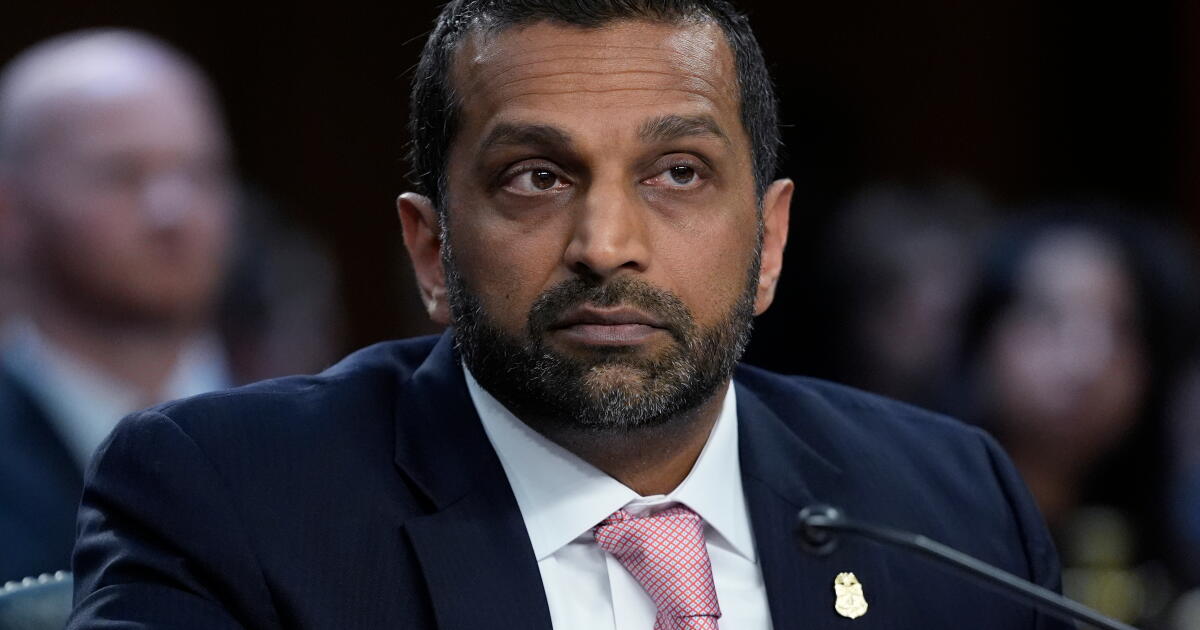
The lawsuit names as defendants Trump and other top law enforcement officials from his administration, including acting Atty. Gen. Todd Blanche, FBI Director Kash Patel and the prosecutors in Florida who have been overseeing investigations related to Brennan and other perceived Trump adversaries.
The lawsuit says Brennan is facing separate investigations in Florida, including one examining whether he made a false statement to Congress related to an assessment by intelligence agencies documenting Russian interference in the 2016 presidential election, in which Trump defeated Democrat Hillary Clinton. The other investigation aims to determine whether former law enforcement and intelligence officials conspired to undermine Trump, including during the course of the Russian interference investigation.
No charges have been brought. The Department of Justice has denied claims of weaponization.
A number of senior politicians have been detained in a wave of arrests.
For more than two decades, corruption has been a serious issue in Iraq.
The oil-rich nation has consistently been ranked as one of the most corrupt in the world.
Recommended Stories
list of 4 itemsend of list
But this week, its new government has embarked on an unprecedented anti-corruption crackdown.
It’s targeting many high-profile politicians and other senior figures accused of making illicit wealth and abuse of office.
Iraqis have repeatedly protested against what they say is rampant corruption in their nation.
Now, they hope the new government keeps this promise to eradicate what they call a ‘pandemic of fraudulent activities’ at the highest echelons of power.
But what are the challenges ahead in this battle?
Presenter: Imran Khan
Guests:
Ahmed Rushdi – President of the think-tank, House of Iraqi Expertise Foundation.
Renad Mansour – Deputy Director of the Middle East and North Africa Programme at Chatham House.
Manuel Pirino – Regional Advisor for Middle East and North Africa at Transparency International.
Elite security personnel carry out a large-scale operation at dawn in the Green Zone and several neighbourhoods in Baghdad, security source says.
Published On 28 Jun 202628 Jun 2026
Several Iraqi politicians, lawmakers and officials have been arrested on corruption charges, Iraqi state-run media report.
Several people, including members of parliament “whose immunity had been lifted and officials whose names appeared in … confessions”, were arrested early on Sunday in the capital, Baghdad, the Iraqi News Agency reported, quoting a security source.
Recommended Stories
list of 3 itemsend of list
It was not immediately clear who had been arrested. There was no immediate official statement on the arrests from the Iraqi government or security forces.
A security source told Al Jazeera that elite Iraqi security forces carried out a large-scale arrest operation at dawn in the fortified International Zone (Green Zone) and several neighbourhoods in Baghdad.
The source said the arrests were carried out by the Counter Terrorism Service and were based on statements provided by Adnan al-Jumaili, deputy oil minister, after his arrest last month on corruption charges.
Iraq’s new prime minister, Ali al-Zaidi, has pledged to fight corruption and mismanagement that have plagued Iraq for decades.
Authorities seized about $86m in cash this month that was allegedly part of the corruption case against al-Jumaili.
The Associated Press news agency reported that seven people were arrested on Sunday, including five members of parliament. It cited a security agency report it obtained. The AP said some of those arrested were from the political bloc of former Prime Minister Mohammed Shia al-Sudani.
During November’s parliamentary elections, al-Sudani’s bloc won the largest share of seats, but he did not return as prime minister. He stepped aside amid a deadlock in the Coordination Framework, a group of Shia parties allied with Iran that brought al-Sudani to power. They disagreed for months over their preferred candidate for the post.
JUNEAU, Alaska — A man with the same name and party affiliation as Alaska Republican U.S. Sen. Dan Sullivan on Monday challenged a decision by a top state elections official to disqualify his candidacy and remove him from the August primary ballot.
A court filing, on behalf of the challenger Sullivan by his attorneys, said the decision by Division of Elections Director Carol Beecher disqualifying him violates state and federal law. It asks that he be placed on the ballot. Sullivan, a retired teacher from the small fishing community of Petersburg, has maintained that he’s a qualified candidate for U.S. Senate and that election officials lacked a legal basis to boot him from the ballot.
The U.S. Constitution lays out three exclusive qualifications for the Senate, addressing age, citizenship and residency, his attorneys wrote.
“Nothing in Alaska law regulates in any way the private motivations that draw individuals to declare or campaign for office,” the filing by attorneys Jeffrey Robinson, Bryn Pallesen and Zoe Eisberg states.
Sullivan’s entrance into the race, days before the June 1 filing deadline, drew condemnation from Sen. Sullivan and the National Republican Senatorial Committee. They called the challenger a sham candidate and alleged he was working with Democrats to boost Democratic former U.S. Rep. Mary Peltola’s chances in the race. Peltola’s campaign and state Democrats have denied the allegation, as has the challenger.
Sen. Sullivan and Peltola are the highest-profile contenders in a race with more than a dozen candidates. It’s one of the most prominent U.S. Senate races in this year’s midterm elections — one both parties consider crucial to their efforts to control the chamber.
Steve Kirch, a spokesperson for the division, said the agency had no comment and does not discuss “ongoing reviews, investigations or related proceedings.” Beecher has previously noted that ballots are due to be printed on Sunday.
Alaska Department of Law spokesperson Sam Curtis said the agency will defend the division’s finding and looked forward to a swift ruling from the court.
On June 15, a week after Republican Lt. Gov. Nancy Dahlstrom announced an investigation into the challenger Sullivan’s run, Beecher disqualified him. She concluded that his declaration of candidacy “was not filed in order to declare an actual good-faith candidacy for the office of United States Senator, but was instead filed with a purpose to confuse or mislead and to thereby compromise the ballot’s fairness or neutrality.”
In announcing an investigation, Dahlstrom cited “credible allegations” that Sullivan declared his candidacy “in coordination with another candidate and campaign” with an intent to confuse and “manipulate” voters. But in removing the challenger from the ballot, Beecher did not mention finding any evidence of alleged coordination with Peltola or Democratic Party officials.
The challenger Sullivan, when asked in an interview with the Associated Press earlier this month if he’d had any contact with Peltola’s campaign, responded ”zero, none, zilch.”
Beecher said she based her decision on factors including that he had registered to vote as Daniel J. Sullivan Jr. and in conjunction with his candidacy changed his party affiliation to Republican. She cited similarities between his campaign website and the senator’s, and his work with a consultant whose clients have included some Democrats.
The form congressional candidates in Alaska complete asks them how they would like to be referred to on the ballot and their preferred party affiliation.
Beecher said she acted in line with a regulation that says a candidate’s name may not appear on a ballot with academic or professional titles or “in a manner that is confusing or misleading to voters or compromises the fairness or neutrality of the ballot.”
In response to questions from Democratic state Rep. Andrew Gray, legislative attorney Andrew Dunmire last week said the regulation cited by Beecher does not forbid placing Sullivan’s name on the ballot. He said the elections division could comply with it by designing the ballot in a way that allows voters to distinguish between both Sullivans.
It’s a position echoed by the attorneys for the challenger Sullivan.
The challenger initially had been certified and listed on the state’s candidate list as Dan J. Sullivan. The senator was listed as Dan S. Sullivan and denoted as the incumbent.
Alaska has open primaries in which the top four vote-getters, regardless of party affiliation, advance to the ranked-choice general election.
Colombia’s outgoing leftist president, Gustavo Petro, has alleged electoral fraud after preliminary results from a presidential run-off saw his handpicked candidate lose by a small margin.
In a barrage of posts on the social media site X on Monday, Petro alleged that the opposition bought votes and Israel and the United States interfered to help opposition far-right candidate Abelardo de la Espriella win.
Recommended Stories
list of 4 itemsend of list
Petro has refused to recognise the results and has called for an investigation by the judiciary.
The president, who was barred by the constitution from running for a second term, was Colombia’s first leftist president, putting him at odds with the US.
His administration is praised for reforms that boosted social spending, raised the minimum wage and redistributed land to poorer families. Petro also cut ties with Israel over Israel’s genocidal war on Gaza and distanced himself from US President Donald Trump’s administration.
However, critics said his refusal to accept the election results risks inflaming political tensions – and violence. Here’s what we know:
Presidential candidate Abelardo de la Espriella of the opposition Defenders of the Motherland movement and his vice presidential running mate, Jose Manuel Restrepo, ride inside a bulletproof enclosure towards a victory rally in Barranquilla on June 21, 2026 [Rodrigo Abd/AP]
What are the election results?
The first round of the presidential election was held on May 31. Neither of the two leading candidates – Abelardo de la Espriella of the right-wing Defenders of the Homeland movement and Senator Ivan Cepeda of the ruling Historic Pact – secured at least 50 percent of the vote, leading to a run-off on Sunday.
De la Espriella narrowly won with 49.66 percent over Cepeda’s 48.7 percent, according to preliminary results released on Monday by the National Registry, which manages vote numbers.
The razor-thin difference amounts to less than 1 percent of the vote and represents one of Colombia’s closest elections.
Trump-backed de la Espriella, 47, is to take office on August 7. The criminal lawyer is a multimillionaire who campaigned on tougher security and anti-leftist policies. He also has US citizenship.
De la Espriella’s win is part of a recent trend of Latin American countries electing far-right, populist leaders who are pro-Trump. Argentina’s Javier Milei, Honduras’s Nasry “Tito” Asfura, El Salvador’s Nayib Bukele and Costa Rica’s Laura Fernandez Delgado all have close ties to the Trump administration.
Why is Petro alleging fraud?
Petro took to X to denounce in a series of posts what he said was voter fraud committed with the help of Israel and Prime Minister Benjamin Netanyahu.
Petro said there was evidence of manipulation of Form E-14, the official, handwritten tally of sheets filled out by poll workers at each voting station.
The form is a physical record of the vote count and is meant to prevent electoral fraud. It is filled out by hand, and digital scans are also uploaded to the National Registry’s portal for public auditing. If found to have errors, parties may request a recount.
Petro alleged that foreign actors accessed the National Registry’s website and rewrote voting data on some E-14 forms.
“Today we have evidence of a change in IP addresses of several servers of the national registry,” he posted.
“This means that the software was compromised and others wrote data for polling stations and voting posts. The only entity in the world capable of doing that is the state of Israel,” Petro added without providing evidence of Israel’s alleged involvement.
Petro said his party had requested a “technical audit” of the voting software before the elections and asked authorities to retrieve the digital footprints of all digitally transmitted documents to avoid modification. He claimed those requests were ignored.
The outgoing president shared videos of what he alleged captured the “premeditated” modification of E-14 forms. He also claimed the manipulation was done “from the offices of the Bautista brothers”.
Electoral workers, observers and party delegates attend the official vote count the day after the presidential run-off in Bogota on June 22, 2026 [Fernando Vergara/AP]
Who are the Bautista brothers?
Petro was referring to Thomas Greg & Sons, an influential private logistics and security printing firm that runs Colombia’s electoral infrastructure. Until recently, it also printed Colombian passports.
It is run by brothers Fernando and Camilo Bautista Palacio. The duo was convicted of bank fraud in the US in the 1980s.
Thomas Greg & Sons, which was founded by their father, Gregorio, has been contracted by the National Registry for more than a decade to manage election logistics, preliminary vote counting and vote-tallying software.
Petro in April accused the Bautista brothers of negotiating a deal with de la Espriella that would see them secure the presidency for the far-right candidate in return for clinching passport printing contracts once more.
At the time, de la Espriella refuted the claims, and his lawyers threatened Petro with a lawsuit.
What are authorities saying?
Attorney General Gregorio Eljach has dismissed the allegations and told reporters there is “no evidence of fraud” with more than 99 percent of the votes counted.
De la Espriella, meanwhile, has so far not responded directly to Petro.
Is de la Espriella linked with Israel?
Yes, de la Espriella has consistently voiced support for Israel and campaigned in Colombia’s Jewish community, making pro-Israel promises and saying his government would “defend Judeo-Christian principles”.
He pledged to reverse Petro’s 2024 decision to cut ties with Israel and has promised to relocate the Colombian embassy to Jerusalem.
Netanyahu congratulated de la Espriella on Monday, saying: “I look forward to working with you to strengthen the bond between Israel and Colombia.”
How has the US reacted?
In his posts, Petro also blamed Trump for interfering in the elections by publicly endorsing a candidate and thus swaying voters.
Trump endorsed de la Espriella on his Truth Social platform weeks before the run-off.
Trump and US Secretary of State Marco Rubio also congratulated de la Espriella on his preliminary win, and Trump took credit for the far-right candidate’s victory.
“He was in 10th place. I endorsed him, and he won the election. He called me last night and thanked me for the endorsement,” Trump told reporters at the White House on Monday.
Rubio wrote on X: “The Trump administration looks forward to working closely with your incoming administration to advance regional security cooperation, end illegal immigration to the United States, and strengthen our economic ties.”
Petro has invited Trump to make a statement on the electoral fraud allegations.
“I formally invite President Donald Trump to speak,” Petro wrote, adding that the US president bears responsibility for “having supported a candidate and not the freedom of the Colombian people”.
What is the US-Colombian relationship like?
Although both countries have close trade ties, diplomatic relations have often been strained over drug trafficking policies and relations with Israel, among other issues.
But relations essentially collapsed under the Trump and Petro administrations.
Petro in January last year refused to allow US migrant deportation planes to land in his country and said on X that the US “cannot treat Colombian migrants like criminals”.
In October, the US sanctioned Petro, his family and key officials in his government based on unproven allegations of involvement in the drug trade.
In January this year, the US military abducted leftist Venezuelan President Nicolas Maduro from his Caracas home after the Trump administration accused him of “narcoterrorism”.
MINNEAPOLIS — A federal judge has blocked an attempt by the Trump administration to subpoena Minnesota Gov. Tim Walz and other state officials, calling it an effort to “harass and retaliate against them.”
In a ruling unsealed Monday, U.S. District Judge Patrick Schlitz found the “dominant purpose” of the subpoenas was to “coerce Minnesota officials into assisting the federal government with enforcing civil immigration law and to harass and retaliate against them for failing to do so.”
The subpoenas were served in January as part of an investigation into whether Walz and other officials obstructed or impeded law enforcement during a sweeping immigration operation in the Minneapolis-St. Paul area.
The subpoenas, which seek records, were sent to the offices of Walz, Atty. Gen. Keith Ellison, Minneapolis Mayor Jacob Frey, St. Paul Mayor Kaohly Her and officials in Ramsey and Hennepin counties.
The judge ruled that there appeared to be “extremely weak to nonexistent” connections between the information sought in the subpoenas and any possible criminal violation. The subpoenas seek materials “that largely if not entirely relate to constitutionally protected conduct,” the judge wrote, noting that Minnesota has the legal right not to devote its resources to enforcing federal immigration law.
The Justice Department “is not conducting a criminal investigation,” the judge wrote, “but is instead using the grand jury process for other (unlawful) purposes.”
The evidence that the subpoenas were issued for unlawful reasons is overwhelming, the judge said, arguing that the Justice Department “has struggled — without success — to identify a single plausible investigatory justification” for them.
Walz, in a statement, called the ruling “a victory for the rule of law and our democracy.”
“The U.S. Justice Department is pursuing criminal investigations into the President’s political opponents,” said Walz, the 2024 Democratic nominee for vice president. “This case was just one example of that, but we are seeing daily reminders of this administration’s lawlessness — in Minnesota and around the country. We all must continue to seek justice and uphold the rule of law.”
Ellison said “it should disturb every American that Donald Trump is weaponizing the criminal justice system against people he disagrees with.”
The subpoenas are “a politically motivated retaliation against our city for lawfully standing up to ICE and fighting for our residents,” Her said in a statement, referring to U.S. Immigration and Customs Enforcement.
Frey said the investigation was “never about justice, law, and order, but the absence of it.”
“Subpoenaing political opponents because they spoke on behalf of their constituents violates the core tenets of our democracy and human decency,” he said.
Frey also observed that criticizing government action is not a crime.
“One of the defining strengths of our democracy is the ability to challenge those in power without fear of retribution. Elected officials have both the right and the responsibility to speak honestly about how government decisions affect the people they serve,” he said.
Bauer and Richer write for the Associated Press. AP writer Eric Tucker in Washington contributed to this report.
SACRAMENTO — Gov. Gavin Newsom did something this week that most politicians would only in a nightmare: He announced that the federal government is investigating him and his wife.
The revelation, delivered in a direct-to-camera 4½-minute video set against a backdrop of U.S. and California flags, became a top headline across the country.
In the upside-down politics of the Trump era, that was exactly as intended.
“He seems to be wearing this as a badge of honor because his brand is being the strongest opponent of Donald Trump,” said Thad Kousser, a professor of political science at UC San Diego. “The ability to show that you’re going on offense and that you know how to effectively fight back against this president is part of making your case for office.”
As he eyes a run for president in 2028, an antagonistic relationship with President Trump is Newsom’s political currency.
So when friends and former employees said the FBI and Internal Revenue Service had knocked on their doors and asked about him and his wife, Jennifer Siebel Newsom, last Wednesday, the governor took advantage of the situation to boost his political profile.
“Mr. President, come after me,” Newsom said in the video he posted online. “I’m not going anywhere, and the country is watching.”
Newsom, who is in his final year as California’s governor, has not declared his intent to run for president, though his claim that Trump is targeting him because he’s considering a bid for the White House was an open acknowledgment of his thoughts about the future. Announcing the probe himself — before federal authorities had a chance to describe it on their terms — allowed him to get ahead of and try to discredit any findings as a “personal vendetta” long before potential charges are brought.
Celinda Lake, a Democratic strategist and national pollster, said Newsom publicly defending his wife could also play well with voters.
“He’s positioned himself as the front-runner because he’s the one who’s under attack,” Lake said. “Primary voters love it when he engages Trump, and I think the combination of engaging Trump and then also the sexism of going after your wife is just a real home run for a primary electorate that’s 59% female.”
The video released Monday seemed similar to a speech Newsom delivered after Trump sent federal troops to Los Angeles last summer.
That address, in which he countered Trump’s version of events and challenged the president to come after him instead of women and child immigrants, made Newsom the captain of the Democratic response to the unprecedented deployment and ended his attempt to play the part of respectful statesman and ease political tensions following the 2024 election.
Liberals have since seemed to relish Newsom’s near-constant derision of the president on social media.
But David McCuan, a professor of political science at Sonoma State University, said casting the case as another instance of Trump’s political weaponization ignores questions about the murky timeline and origin of the investigation.
Newsom’s aides point to Trump saying that the governor should be arrested during last summer’s anti-ICE protests as evidence that he personally called for the inquiry. The claim has gained oxygen — and been echoed by other Democratic leaders in the state — while going largely unchallenged by federal officials. The Justice Department has declined to comment, as has the White House.
A source familiar with the matter, who requested anonymity because they were not authorized to discuss it publicly, said two federal probes have been going on for about a year, and that they originated not from Washington, D.C. but from conversations between whistleblowers and federal prosecutors based in Sacramento. The probes are linked to Newsom’s former chief-of-staff, Dana Williamson, and Siebel Newsom’s taxes, the source said.
Newsom’s critics have also noted that federal prosecutors under the Biden administration had pursued questions about his involvement in a state lawsuit against Activision Blizzard Inc., a major video game distributor, before Trump retook office.
“This is something that could lead to other elements that blow up, so there’s a risk,” McCuan said.
Newsom’s aides described the investigation as a fishing expedition, with federal authorities searching for anything they can use against the governor.
They said federal authorities appeared to initially investigate allegations that turned up nothing about the Activision case before refocusing their questions on nonprofits and other entities tied to the couple. Investigators also asked about personal information related to the family’s household, Newsom’s office said.
McCuan said three nonprofits that surround the couple have received millions of dollars from donors and political interests and are not subject to campaign finance limits.
The California Partners Project is a nonprofit that promotes gender equity. The Representation Project is an avenue for Siebel Newsom’s documentary films. The California State Protocol Foundation uses private donations to pay for gubernatorial expenses and was founded under former Republican Gov. Arnold Schwarzenegger.
“It’s a long-running game,” McCuan said. “It’s just the Newsom first couple has perfected it and moved it forward.”
Newsom getting out ahead of prosecutors and framing their probes as nothing but a “witch hunt” — borrowing a phrase often used by Trump during his own previous prosecutions — carries risk.
If prosecutors do turn up evidence of wrongdoing, Newsom’s decision to parade his indignation could backfire.
Publicly challenging Trump also runs the risk that the president could instruct the Justice Department to dig in deeper on an investigation that might have otherwise petered out.
But Lake and others said there’s no placating Trump, who has targeted Newsom and other Democrats.
While traditional politics suggest facing federal charges could sink Newsom’s political ambitions, the rules have been thrown out under Trump.
“You know the last person who got tied up in courts on the campaign trail?” Kousser asked. “That was Donald Trump, and nothing elevated Donald Trump more than doing courthouse press appearances and being seen as the target of an unfair political prosecution.”
Gov. Gavin Newsom on Monday accused the Justice Department of launching — at President Trump’s request — a baseless and politically-motivated investigation into him and his wife, First Partner Jennifer Siebel Newsom.
“After calling for my arrest last year, Donald Trump directed his Department of Justice to investigate me,” Newsom said. “And just in the last week, I’ve learned his campaign has reached my own home: to get me, he’s coming after my wife, Jen.”
Newsom adamantly denied any wrongdoing by him or his wife. The White House referred questions to the Justice Department, which declined to comment.
A source familiar with the matter who requested anonymity because they were not authorized to discuss it publicly told The Times that there are two probes underway, one related to Newsom’s former chief of staff, Dana Williamson, and one related to Siebel Newsom’s taxes.
Share via
The source said both investigations have been ongoing for about a year; were launched by prosecutors in Sacramento based on information provided by whistleblowers and other local sources in California; and were not the result of directives out of Washington or the White House.
Newsom said that in recent days, “federal agents have knocked on the doors of family friends and former employees,” and have been “demanding records,” “digging through years and years of random documents” and “abusing the grand jury process” in a quest to find any kind of wrongdoing by him or his wife.
“Not because they found a crime. Because they are simply trying to find one,” he said.
Newsom did not describe the specific nature of the alleged probe, the line of questioning faced by friends and employees or the types of records taken or reviewed by federal investigators. But he alleged that Trump instigated the probe because Newsom is considering running for president in 2028, and because Trump “hates that I’ve consistently called him out — over and over again — for his lies and deceit.”
“He has turned the levers of government into his own personal power ministries to reward cronies and to try to jail his opponents,” Newsom said.
Newsom cited Justice Department investigations of several other of the president’s political opponents, including Sen. Adam Schiff (D-Calif.), New York Atty. Gen. Letitia James, former FBI director James Comey, former Federal Reserve Chair Jerome Powell and former vice presidential candidate Minnesota Gov. Tim Walz.
“One by one, anyone who has challenged Donald Trump has ended up on his hit list,” he said. “And today, I proudly join that list.”
Al Jazeera’s Basel Ghazoghli traces the documented record from 1948 to the present. Sexual violence against Palestinians in Israeli custody is often framed as a post-October 7 issue. But historical records, academic research, and legal testimony suggest a much longer history.
First Assistant U.S. Atty. Bill Essayli — President Trump’s loyalist federal prosecutor in Los Angeles — has not been shy in recent days about his intention to ferret out voter fraud in California’s primary election and criminally charge those responsible.
He has announced that his office “has multiple election fraud investigations underway” in coordination with the FBI, urged Californians on social media to submit evidence of “potential election fraud” directly to his office, and said flatly he “will be charging some people” with election fraud — just as soon as California certifies its vote count and his office “can prove some of the allegations.”
Essayli’s public callouts and promises are highly unusual and in direct conflict with Justice Department guidance on ballot fraud investigations at the federal level, which states federal prosecutors should not publicly pursue such claims amid of vote counting.
The Justice Manual — which regulates the actions of federal prosecutors nationwide — says the department “should not engage in overt criminal investigative measures in matters involving alleged ballot fraud until the election in question has been concluded, its results certified, and all recounts and election contests concluded,” in part because doing so “runs the risk of chilling legitimate voting and campaign activities and of interjecting the investigation itself into ongoing campaigns and the adjudication of any ensuing election contest.”
Ciaran McEvoy, a spokesman for Essayli’s office, said neither Essayli nor the office had any comment.
Essayli has repeatedly acknowledged in other interviews that he has no evidence of widespread fraud that could sway the results of races, and he even shot down one prominent online conspiracy that falsely alleged Democratic cheating in the Los Angeles mayoral race.
But he has also pointed to more isolated instances of fraud as potentially indicative of bigger problems. He added that there’s no proof such rampant fraud isn’t occurring, partly because of resistance from California to a federal audit of its voter rolls.
Essayli’s remarks are part of a much wider battle to frame fraud in California as pivotal or not, in which Republicans cite individual instances of alleged fraud as evidence of some grand scheme by Democrats to steal the election from them, and Democrats — along with many elections experts — say there is no evidence that isolated crimes reflect fraud on a scale large enough to impact election outcomes.
His remarks have added fuel to baseless claims from Trump and other influential conservative voices that California’s elections have been poorly compromised by coordinated Democratic “cheating.” They have made Essayli one of the most prominent Trump administration figures in the nationwide debate around election integrity — which election experts expect to intensify ahead of November’s midterms.
A public campaign
Essayli has made his case in recent days on various alternative and right-wing news programs and podcasts, arguing that California’s slow process for counting votes had undermined public trust and needs to be audited.
On One America News Network, Essayli said his office has been “sounding the alarm on California’s election system” because it’s ripe for fraud.
“We believe that it has major vulnerabilities. We believe California does not have sufficient safeguards to make sure only eligible U.S. citizens are voting in elections in California, and that is why we’ve been demanding an audit of the California voter rolls,” he said.
On NewsNation with Chris Cuomo, Essayli said he doesn’t “care what the outcome of the election is,” but wants voters “to have confidence in the systems, and that the laws are being followed.”
“I guarantee you, when we do bring cases, we will have plenty of evidence to prove beyond a reasonable doubt, in a court of law — that is how we work,” he said.
On the podcast of conservative commentator Glenn Beck, Essayli said he was “prohibited from discussing ongoing investigations,” but that “election fraud is not a theory” but “a real thing” — noting his office recently secured a guilty plea from a woman who paid homeless people to register to vote.
He said California is “a fraudster’s paradise,” accused the state Legislature of “going out of their way to make it as easy as possible for people to commit fraud,” and repeated oft-cited complaints about California’s voter ID policies being lax, its universal mail ballot policies sending ballots to the wrong places, its ballot collection policies allowing “harvesting” and its voter rolls being “dirty,” or filled with ineligible voters.
Essayli said all of that makes his job “incredibly difficult,” because “California has removed the paper trail, they’ve removed the chain of custody, they’ve removed any meaningful way for us to basically have a forensic audit of where a ballot came from,” but that he will nonetheless be bringing election fraud charges in the next “one to two months.”
State and local elections officials in California have defended the state’s policies as facilitating voting by as many eligible voters as possible, which they say is more important than a quick count. They’ve said there are robust procedures in place to ensure ballots are cast fairly and counted accurately, and to identify any problems and audit the results.
Elections experts say instances of fraud do exist, both in California and everywhere else in the country, but that robust efforts in past years to investigate and identify widespread fraud that could sway an election — including by Trump and his lawyers but also outside organizations — have always failed.
Essayli’s efforts have drawn sharp criticism from elections experts, leading Democrats and former prosecutors in the office.
Justin Levitt, a Loyola Law School professor who studies elections and was a senior policy adviser on democracy and voting rights in the Biden White House, said what Essayli is doing — throwing out unspecified claims of fraud amid an ongoing election and before he has built a case — is “absolutely nuts” and “not a thing that real prosecutors do.”
Before the current administration, the “mantra” of federal prosecutors, he said, was that “you only hold a press conference about a not-yet-concluded investigation when the public is already aware of a large crime,” such as a mass shooting. “Absent that, you wait for the facts to come in, and you see whether there has been a legal violation, and then and only then do you issue a press release — usually hand in hand with an indictment or a conviction.”
In an election, Levitt said the standard is even higher, and “the ethos of a federal prosecutor should be to never become the story, and to never make the prosecutorial job itself an impact in the election you are investigating.”
In an MS NOW interview, Sen. Adam Schiff (D-Calif.), a former federal prosecutor in the L.A. office, blasted Essayli as wildly searching for fraud to please Trump — despite it and other efforts to please Trump, including on immigration, causing an exodus of experienced career prosecutors from the office.
Schiff said Essayli was “basically making a plea to the public: ‘Please send me evidence. I’m asserting there’s fraud. We don’t have evidence of it, but please send me something. I need to make the boss happy.’”
Another former prosecutor in the office, who requested anonymity to avoid retaliation, said Essayli is pursuing alleged election fraud cases as hard as he is only because “Trump told him to,” and he’s “constantly auditioning for a bigger D.C. job in case he gets kicked out of his current one.”
Essayli is not the U.S. attorney for Los Angeles — only the “first assistant” — because he has been unable to win confirmation from the U.S. Senate and has only remained in charge through a legal loophole.
Investigations in the works
It’s unclear what specific issues or incidents Essayli’s office is investigating.
Essayli has said his investigations so far lean toward individuals rather than networks, and he told the California Post that he would be investigating a report that thousands of people were registered to vote at homeless shelters with far fewer beds.
His office also looked into false claims that an election night ballot update in Los Angeles County include no votes for Spencer Pratt, the Republican candidate. He said his office “reviewed official county records” and determined the claim was false.
“My office will continue monitoring the election counting process and will follow the evidence wherever it leads,” he said.
One person involved in investigating the latter case was Assistant U.S. Atty. Robert Renner, who joined the office in March after previously serving as deputy general counsel for the Center for Individual Rights, a nonprofit Washington, D.C., law firm where he worked on lawsuits focused on conservative free-speech issues, according to his LinkedIn page.
A worker carries ballots at the Los Angeles County Ballot Processing Center.
(Eric Thayer / Los Angeles Times)
Renner, who referred questions to the office spokesperson, visited an L.A. County ballot processing center as part of the investigation, where he questioned election officials about the ballot update, according to a law enforcement source with knowledge of the situation who spoke on the condition of anonymity for fear of retaliation.
Election officials have said their numbers were always correct and that the discrepancy was based on a one-minute lag in vote updates for Pratt by The Associated Press, which also confirmed the lag.
Renner also grilled election officials about whether or not post office officials had backdated postmarks on mail ballots sent after election day so they could still be counted, the source said.
Essayli’s elevation to the top prosecutor position in L.A. was part of a broader push by the Trump administration to fill key Justice Department roles with people loyal to the president and open to his election skepticism. Earlier this year, a Times investigation detailed how disgraced ex-L.A. County prosecutor Eric Neff was named “acting chief” of the Justice Department’s voting section.
Neff led a bungled election integrity case at the L.A. County district attorney’s office that was thrown out after an internal review revealed it hinged on the word of “Stop The Steal” activists who had pushed Trump’s discredited theory that the 2020 presidential election was “rigged.”
It was one of two election integrity cases Neff tried in his entire career before being elevated to the voting chief post by Asst. Atty. Gen. Harmeet Dhillon, another proud Trump loyalist from California.
Michael Sanchez, a spokesperson for Dean Logan, head of the Los Angeles County Registrar-Recorder/County Clerk, said the office has not received any formal document requests or investigation notices from Essayli’s office, only “routine questions about operations.”
What will come of Essayli’s investigations is also unclear. He will have to prove whatever allegations he makes in court — which he has repeatedly appeared to begrudge in recent interviews.
“Instead of putting the burden on the system to reassure the people [that] only legal citizens are voting, one person one vote is the law of the land, and the burden on the system to assure us that there’s integrity and we can believe in it,” he complained to Beck, “they’ve flipped it and now it’s on us to prove every allegation of fraud.”
Friday marks one year since a deadly Air India Boeing crash, which killed 260 people in a densely populated suburb of the city of Ahmedabad in India’s western state of Gujarat.
Families of those killed gathered at the site on Friday to mark the anniversary of the disaster, but they are still waiting for answers about what caused the plane to come down shortly after takeoff from the nearby airport.
Indian authorities are expected to issue an interim report in the coming days, another source of frustration for the victims’ relatives, who had been hoping for a definitive finding and a final disclosure. Media reports, citing unnamed sources, suggest that Indian investigators will delay issuing a final report into the crash, citing the need to complete an analysis of the plane’s engines.
Under international aviation rules, a final report is due “if possible” within a year of an accident. If an investigation goes on for longer, an interim statement should be issued on each anniversary.
What happened to the Air India plane?
Flight AI171, an Air India Boeing 787 Dreamliner plane which had taken off only moments before, en route to London Gatwick, crashed into a medical college hostel in the residential area of Meghani Nagar, close to the international airport on the edge of India’s western city of Ahmedabad.
According to flight tracking website Flightradar24, the plane’s final signal was received seconds after takeoff at 1:38pm local time (08:08 GMT). It had reached an altitude of 625 feet (190 metres) before crashing back to the ground outside the airport.
The plane had issued a mayday alert to air traffic control just before all communications from the aircraft ceased.
(Al Jazeera)
How many people died in the crash?
Of the 242 people on board, all except one passenger were killed. These included 169 Indian nationals and 52 British nationals. A total of 260 people died, as 19 people on the ground close to the crash site were also killed. Another 67 people near the site were injured.
The sole survivor on board the plane, Vishwash Kumar Ramesh, is a British national whose brother was killed in the crash.
On Thursday, Ramesh’s representative, Sanjiv Patel, told the UK’s Guardian newspaper that Air India had paid £21,500 ($28,800) in compensation to Ramesh to help support his wife and their five-year-old son. It is not clear whether similar payments have been made to other families.
Relatives of the victims are meeting on Friday at a conference organised by lawyers, along with aviation and air safety experts, in Ahmedabad. They are due to hold a candlelight vigil after sunset.
Officials inspect the site of the crash near Sardar Vallabhbhai Patel International Airport in Ahmedabad, Gujarat, western India, on June 13, 2025. Air India flight AI171, bound for London, carrying 242 passengers and crew members, crashed minutes after takeoff in the Meghani Nagar area of Ahmedabad [Rajat Gupta/EPA]
What have preliminary reports shown?
This was the world’s first airliner crash involving a 787 Dreamliner, a Boeing model that has been in service since 2011.
In accordance with international aviation law, India’s Aircraft Accident Investigation Bureau (AAIB) published a preliminary report one month after the disaster.
That 15-page document said the fuel supply to the jet’s engines had been cut off moments before the crash, raising questions about possible pilot error.
It also published a conversation between the captain and his copilot about the fuel supply being cut off – two brief sentences that prompted theories of pilot suicide.
The report was met with strong criticism.
It did not state why the fuel switches were turned off – whether it was the fault of a pilot, or a result of a malfunction.
The preliminary report did not make any safety recommendations to Boeing or engine maker GE Aerospace, suggesting no technical issues had been discovered.
The crash also hit Air India at a sensitive stage of its post-privatisation turnaround, which has been slowed by supply-chain snags, an airspace ban imposed by Pakistan on Indian carriers and, more recently, the US-Israeli war on Iran.
What’s the latest on the investigation?
Under international rules, a final report is due “if possible” within a year of an accident, but sometimes investigations take longer. If it cannot be completed, therefore, an interim statement should be issued on each anniversary. With investigations continuing, the AAIB is expected to issue only an interim report at this stage.
The Federation of Indian Pilots union has been pushing for investigators to seek more technical data about the plane from Boeing and Air India to allow for a “rebuttal of the pilot suicide theory being explored by the AAIB”.
“It [an interim report only] will cause more speculation and more misunderstanding,” Charanvir Randhawa, the union’s president, told reporters at a packed news conference in Ahmedabad ahead of the anniversary of the crash.
“We have requested the Indian government and India’s Aircraft Accident Investigation Bureau (AAIB) not to come out with any interim report.”
A cockpit recording of dialogue between the two pilots of the Air India 787 before it crashed supported the view that the captain cut the flow of fuel to its engines, according to US officials’ early assessment reported by Reuters last year.
But the AAIB said at the time it was “too early to reach any definite conclusions”.
Investigators conducted engine testing in April and visited France last month as part of their analysis of the engine management unit, a source told Reuters on the condition of anonymity, as the information is not public.
On Thursday, Bloomberg also reported that the final report into the crash can be expected within three months, once studies of the engines, which had been sent to the US for examination, are concluded.
The captain’s father has asked India’s top court to order an independent investigation that examines possible causes other than deliberate pilot action – a cause that has been suspected in some other fatal crashes and was confirmed in the case of Germanwings Flight 9525, which crashed into the French Alps in 2015, killing all 150 people on board.
WASHINGTON — Mismanagement at a massive Immigration and Customs Enforcement facility in Texas created unsafe conditions that contributed to detainee deaths and suffering even as millions of wasted tax dollars enriched contractors, according to a federal report released Tuesday.
The Government Accountability Office report documents serious problems at Camp East Montana, a sprawling tent facility at Ft. Bliss in El Paso where three detainees have died in a little more than six months. Evidence in one of those deaths, of a 55-year-old Cuban migrant who died in January after being held down by guards, was “missing or destroyed,” the report found.
ICE rushed to open the camp in August before construction was complete and failed to conduct required oversight to ensure detainees were held in sanitary conditions and receiving adequate medical care, according to the report.
The Department of Homeland Security noted that ICE has replaced the contractor running the facility. “This new contractor will allow Camp East Montana to continue abiding by the highest detention standards with the ability to provide more medical care on-site,” said Homeland Security spokesperson Lauren Bis.
The GAO’s findings echo past reporting by the Associated Press and other news outlets about dangerous conditions at Camp East Montana, which quickly became the nation’s largest immigration detention facility.
But the government report also details previously undisclosed incidents, including a detainee escape in October due to what ICE called the contractor’s oversight failure. In January, a security guard lost a loaded firearm inside the facility that was never recovered.
The contractor failed to administer skin tests to screen detainees for tuberculosis, relying on a questionnaire instead, the report said. The inadequate screening allowed a detainee with tuberculosis to be housed with the general population, which later suffered an outbreak.
GAO is an independent, nonpartisan agency in Congress that investigates how federal funds are spent and evaluates whether programs and policies are operating effectively. The office opened its review into Camp East Montana at the request of Democrats in the House and Senate.
Sen. Dick Durbin of Illinois called the report’s findings “damning.”
“We now know even more details of how dangerous and irresponsible the Trump administration’s mass deportation campaign truly is,” said Durbin, the ranking Democrat on the Senate Judiciary Committee, adding that “those detained are experiencing conditions that shock the conscience.”
A rush to build led to an inexperienced contractor
Facing pressure to increase its detention capacity, the Trump administration routed the contract to build Camp East Montana through the Army to speed construction after ICE twice failed to successfully award one. That resulted in the selection of a small, little-known contractor, Acquisition Logistics, for the $1.3-billion deal despite it having no prior experience operating detention facilities and facing what ICE called a “significant learning curve.”
The Army — and later ICE after the camp was transferred to the agency — wasted millions of dollars paying for services it did not need because the contract did not account for fluctuations in the detainee population, the report said.
The Army blew as much as $11.5 million paying for guards, medical services, transportation and meals in the weeks before the camp held detainees. Millions more were wasted because the government was contracted to pay the cost of meals for the camp’s maximum population of 5,000, even when the number of detainees there dropped to around 1,600, the report said.
The facility did not meet ICE detention standards or the contract’s requirements in several ways when it opened, in part because it had not been inspected as required by ICE policy, the report said. The camp lacked security cameras on the perimeter and had other surveillance blind spots that raised the risk of sexual assaults or escapes.
The camp could not accommodate detainees using wheelchairs and had no showers compliant with the Americans With Disabilities Act, resulting in the disabled being held in medical care rooms.
The recreation area wasn’t available for several days, and after one yard was opened, it wasn’t enough space to provide required time for detainees. The law library, space to meet with attorneys and a visitation area did not open for weeks, resulting in detainees being deprived of legal resources and contact with family and friends, the report found.
The problems persisted as ICE began transporting more detainees there from across the country, the GAO found. While built to house up to 5,000 immigrants for short-term stays, its population has averaged about half of that from October until April, according to ICE’s most recent data.
Missing evidence and other problems
Detainees held at the facility didn’t receive comprehensive health assessments, which meant that those with chronic conditions received substandard care, the report said.
The contractor cleaned the dormitories weekly rather than daily as required, resulting in unsanitary conditions. Some guards offered detainees cookies if they would clean their own rooms. Acquisition Logistics didn’t reply to messages seeking comment.
The GAO report says investigations into the January death of Geraldo Lunas Campos were undermined after “evidence associated with the incident was missing or destroyed.” It did not elaborate. Campos died after he was restrained by guards and an outside autopsy report ruled the death a homicide due to asphyxia. The contractor at the facility did not provide use-of-force and death reports to ICE as required, according to the new report.
An investigation by ICE’s Office of Professional Responsibility into the death is on hold pending a criminal investigation by the FBI.
On Jan. 14, Nicaraguan detainee Victor Manuel Diaz, 36, died of suicide after staff put him in a medical holding room instead of suicide-resistant cell and left him unattended for intervals longer than 15 minutes, the report said. Staff could not see into the room because the contractor had failed to install vision panels that had been requested months earlier, it found.
“These are huge discrepancies in their failure to prevent suicides,” said Diaz family attorney Randall Kallinen, noting that the report strengthens a potential wrongful death claim he’s considering. “They are part of an entire laundry list of problems at Camp East Montana.”
Biesecker and Foley write for the Associated Press. Foley reported from Iowa City, Iowa.
The European Commission has demanded that Meta allow other AI companies access without charge while it investigates the company for antitrust violations. File Photo by Gian Ehrenzeller/EPA
June 9 (UPI) — The European Commission ordered Meta to allow competing artificial intelligence assistants to access WhatsApp while it investigates the company for antitrust violations.
The company must restore access by next week as it was until October, when the competition could use WhatsApp for free.
“In rapidly evolving markets, competition can be lost long before a final decision is adopted. This is why these interim measures will remain in place for the duration of the investigation, in order to prevent harm that would be almost impossible to repair,” Teresa Ribera, executive vice president for Clean, Just and Competitive Transition, said in a statement. “These interim measures will safeguard competition in the growing market for AI assistants, by preserving a key entry point to reach consumers in Europe — WhatsApp — and allowing AI companies to innovate, scale up and reach their full potential.”
The EC began its investigation in December around the same time Italy called foul of the alleged anti-competitive move by the company. Italy folded its complaint into the EC probe. After Brussels warned in February that it may force the company to open back up, in March Meta allowed the other companies in but began charging them fees. Brazil has levied similar complaints.
Meta has said WhatsApp’s business platform was not built to carry AI chatbots and that competitors can reach users through other channels.
“The European Commission has decided that OpenAI and some of the largest companies in the world can use the paid-for WhatsApp Business product for free. This is regulatory overreach subsidized by the many European companies that pay. We will appeal,” a Meta spokesperson told Politico.
Meta is also appealing a $228.34 million fine from the EU for violations of the Digital Markets Act.
If the company ignores the order, it can face fines of up to 10% of its annual revenue.
Troops in landing craft approach Omaha Beach on D-Day in Normandy, France, on June 6, 1944. D-Day was the largest seaborne invasion in history and turned the tide of World War II. Photo by UPI | License Photo
PORTLAND, Ore. — Former Sen. Bob Packwood, a moderate Oregon Republican whose reputation as a champion of women’s rights was tainted late in his career by a sexual harassment scandal, has died. He was 93.
Packwood’s death Saturday was announced in an obituary sent to media outlets by his family. The release didn’t include additional details.
As the scandal unfolded, Packwood initially refused to quit the chamber in which he had served for 27 years, saying he didn’t want to be remembered only for that.
Before the #MeToo era, Packwood stood out as an example of private behavior undermining a man’s public image. He previously had been praised by Planned Parenthood and others.
The great-grandson of a member of the 1857 Oregon Constitutional Convention, Packwood established himself as a social moderate and fiscal conservative who often voted across party lines. He considered running for president in 1980.
Elected to the Senate in 1968, Packwood was best known as the leading Republican advocate of abortion rights — at a time when the position had bipartisan support — and was widely admired by women’s groups throughout the country until the Senate Ethics Committee launched an investigation into the allegations of sexual and official misconduct in 1993.
More than two dozen women, former employees and acquaintances, accused him of making unwanted or uninvited sexual advances.
The allegations remained the target of an ethics inquiry that widened to include other alleged acts of official misconduct. He resigned in September 1995, and went on to start a lucrative lobbying business in Washington.
Democratic Sen. Ron Wyden, who replaced Packwood in 1996, said that although he should be praised for his record on abortion rights and tax reform, how Packwood treated women overshadows it all.
“His horrible history as documented in his own diaries will forever overshadow that public record. Simply put, historians’ first line about Bob Packwood must include those women who he abused and assaulted for years and years,” Wyden said in a statement.
As chair and then ranking Republican on the Senate Finance Committee, Packwood was a master of cutting deals and forging compromises needed to pass tax legislation through Congress. He was most proud of the lead role he played in a sweeping tax reform of 1986 that lowered the top income tax bracket and eliminated many itemized deductions.
Over his career, he was described as a blunt, independent, outspoken politician who was a boat-rocker, loose cannon, skilled partisan, and — for most of his career — political survivor.
“I think they probably all ring true,” Packwood told the Associated Press in December 1992.
“I would like to think that I am nobody’s lackey. I try to reach conclusions independently and then I’m willing to fight for those conclusions; if necessary, having to fight against my party or my party’s president,” he said.
Packwood won his first Senate election at age 36, narrowly defeating Democratic Sen. Wayne L. Morse, an Oregon legend who had held the seat for 23 years. He quickly grabbed attention as a rising star in the GOP. By 1980, he was elected chairman of the National Republican Senatorial Committee.
But he lost the seat when the White House backed a competitor after Packwood publicly accused President Reagan of alienating women, African Americans and Jews.
Just two weeks after Packwood’s reelection in 1992, the Washington Post printed allegations from former female employees and acquaintances that the senator had subjected them to uninvited sexual advances.
The Senate Ethics Committee also investigated allegations that Packwood solicited jobs from lobbyists for his ex-wife, used his staff to try to threaten the female accusers into keeping quiet and obstructed the investigation by altering his personal diaries.
The Senate held two days of extraordinary debate in 1993 over whether Packwood should have to comply with an Ethics Committee subpoena for his diaries, in which he reportedly made entries relevant to the investigation. The Senate voted 94 to 6 to enforce the subpoena.
Packwood took the case to federal court and lost, ending when Supreme Court Chief Justice William Rehnquist refused the senator’s request for the high court to intercede.
Packwood launched his lobbying business, Sunrise Research Corp., in 1997. By 1999, the firm was grossing $1.5 million a year. His business slowed in later years, but he told a City Club of Portland audience in 2010 that he was still spending about half his time in Washington lobbying for a number of clients.
It was interesting work, Packwood told the audience, according to the Oregonian, but “it is not as much fun as being in the Senate.”
As Congress became increasingly partisan after his departure, Packwood continued to advocate a centrist tack and in his 2010 City Club speech called for Oregon to create nonpartisan elections.