Let’s get the rose-colored story line out of the way, right away.
The postseason starts Tuesday, and it could be the last we see of Major League Baseball for a long, long time. The owners expect to lock out the players when the collective bargaining agreement expires Dec. 1, and the owners have made their pitch loud and clear: No new agreement without a salary cap, for they believe there can be no true competitive balance without one.
You’ll hear a lot about how the way this postseason sets up, or how it plays out, could impact the bargaining.
Don’t believe a word of it. Nothing that happens this October will be relevant to the new labor agreement.
Come on. The team with the lowest payroll — the Cleveland Guardians — won their division. So competitive balance can’t be completely out of whack, can it?
Cleveland hasn’t won the World Series since 1948. The opponent was the Boston Braves, who subsequently moved to Milwaukee and then Atlanta.
What about the team with the best record in the American League: the Tampa Bay Rays, who beat up on big-market bullies in the New York Yankees and Boston Red Sox?
The Rays never have won the World Series.
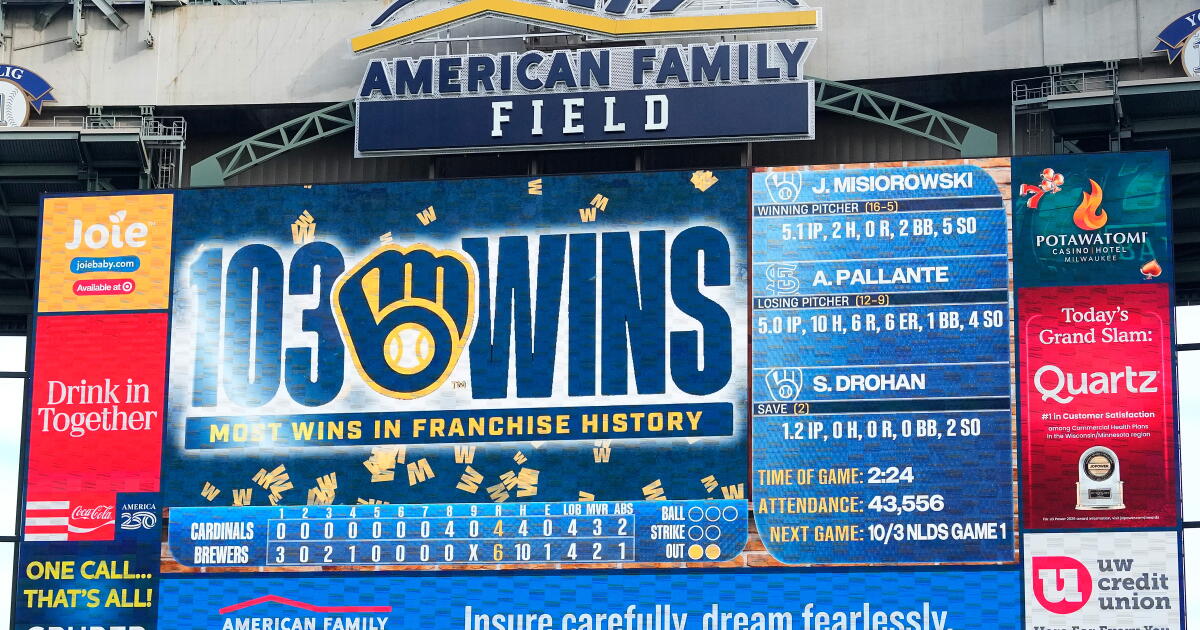
Well, what about the Milwaukee Brewers? For the second consecutive season, the team in baseball’s smallest market posted baseball’s best record.
The Brewers got swept in last year’s National League Championship Series. They never have won the World Series.
But aren’t the Brewers the best example of a team playing beyond its payroll instead of using it as an excuse?
Isn’t that what got everyone agitated? Doesn’t everyone outside L.A. know the Dodgers have destroyed competitive balance, and the owners are trying to fix it?
The owners were ready to fight for more than a year before the Dodgers helped themselves to Díaz, Tucker and Skubal. For years, the commissioner’s office touted baseball’s competitive balance, citing in part how the league championship series and World Series matchups changed almost every year.
After the Dodgers won in 2024, the commissioner’s office redefined competitive balance as how often a small-market team won the World Series, last accomplished by the 2015 Kansas City Royals. The seeds for this winter’s labor war had been planted.
If the Dodgers flop this October, the owners are not going to suddenly back off a salary cap. If, say, the Brewers or Rays win, the owners will say that’s the exception that proves the rule.
There are ways for owners to direct more revenue to small-market teams without the salary cap the players insist they will not accept, and without limiting the definition of success to winning the World Series, which risks devaluing the product among 29 fan bases every year. Whether the owners wish to consider them without the cost certainty that comes with a salary cap will be the story line of the cold winter ahead.
The Dodgers are scheduled to open next season on March 25. Neither owners nor players would have lost any significant revenue by then — ticket sales and broadcasting rights for owners, salaries for players — so a new agreement by then is uncertain at best.
So enjoy the postseason.
So, at least for now, isn’t the postseason tilted toward the Dodgers and Yankees?
Those screams you hear are coming from New York, where Yankees fans are annoyed that their team finished with the second-best record in the AL and still could be eliminated in two or three days. The Yankees finished behind the Rays and received a wild card.
The Yankees lost 13 fewer games than the AL West champion Houston Astros and 10 fewer games than the AL Central champion Guardians, both seeded ahead of them. The Astros are a .500 team, the worst record a division champion has taken into the postseason. The Guardians get a bye, just like the Dodgers.
The Yankees drew the Red Sox, which means painful amounts of national commentary will focus on (1) how the system victimized the Yankees and the Red Sox; and (2) baseball’s most hyped rivalry.
Until baseball realigns its divisions or seeds its playoffs by wins, regardless of division, the Yankees should simply do what Aaron Judge said about how they should respond to criticism of their fundamentally frightening 2024 World Series: “Play better.” And baseball’s best rivalry will be on October display only if the Dodgers and San Diego Padres meet in the NL Championship Series.
Still laughing, though, at sanctimonious Yankees fans believing baseball is somehow unfair to the poor, gutty Yankees.
Can anyone save baseball in 2027?
We should try Pope Leo. He’s a long-suffering Chicago White Sox fan. In his first full year as pope — and after three consecutive 100-loss seasons — the White Sox made the playoffs.
Some fans call it a miracle, a reporter told the pope. Did the pope have anything to do with the turnaround?
He smiled.
“No comment,” he said, then paused.
“Great things happen in Chicago,” he said.
The Cubs made the postseason too. The Cubs and White Sox have shared Chicago since 1901. This is the fourth time both have qualified for postseason play. Deep dish pizza for all, but a World Series in Chicago this fall might truly require divine intervention.
Alexandre Pantoja and Joshua Van hope their fight Saturday at Crypto.com Arena will last longer than 26 seconds.
It has been nine months since their first bout, which ended in less than a minute because of a Pantoja injury and made Van the UFC flyweight champion. Pantoja aims to reclaim the belt he lost at UFC 331, with the main event beginning at 6 p.m. and streaming on Paramount+.
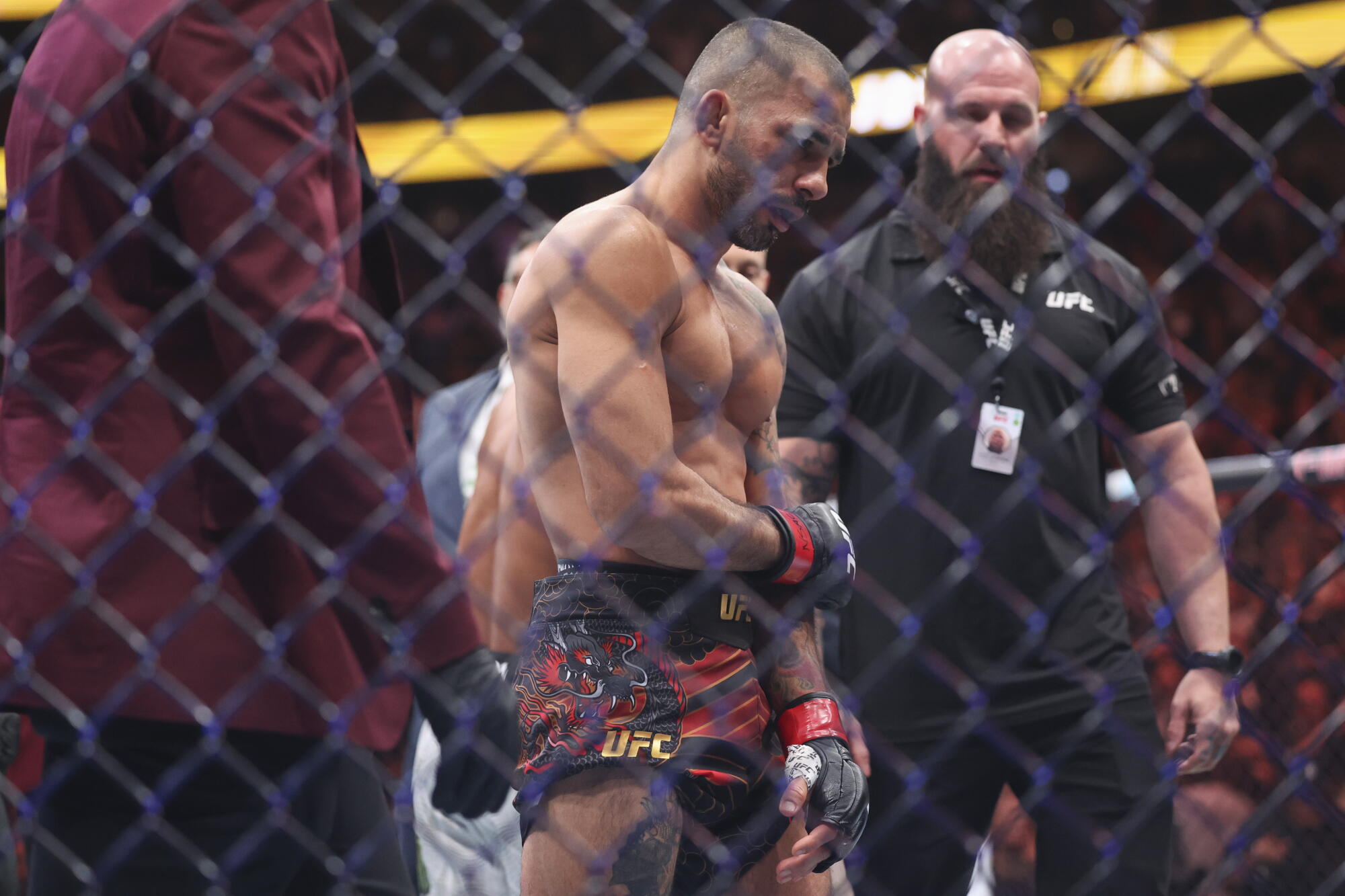
Pantoja dislocated his elbow when he fell while trying to defend against one of Van’s moves on Dec. 6 at UFC 323 in Las Vegas. The fight ended immediately.
Van celebrated winning the 125-pound title, but both fighters walked away from that night feeling everyone deserved more than the premature result.
Alexandre Pantoja holds his arm after losing his flyweight title fight on Dec. 6 in Las Vegas.
(Ian Maule / Getty Images)
Pantoja, of Brazil, has not competed since that night. He has spent most of the past nine months recovering from the injury, while Van successfully defended his title once against Tatsuro Taira in May, winning by stoppage in the final round.
“It’s been [nine] long months,” Pantoja said. “I’ve been working hard. And at a certain point, I think that after two years as champion, five title fights — almost six title fights — at a certain point it’s good to take some time off, enjoy my family, enjoy myself. But at the same time, I’m really hungry to win again.”
Pantoja said he returned to the gym two days after that first fight. Although the injury kept him out of the octagon, he didn’t want to stay away from training for too long because he said that would have made it harder to get back to fighting at the championship level.
During his time out of the octagon, he observed how the division changed.
“I see a lot of good fights. We’re seeing the top 10 change almost completely,” Pantoja said Wednesday. “I see incredible fights in the flyweight division. And I think this Saturday, with my fight against Joshua Van in the main event here in Los Angeles, is very special.”
Van, meanwhile, enters the rematch coming off a five-round championship bout.
“I’ve been working on my ground game, and you’ll see it,” said Van, who holds dual American and Myanmar citizenship. “I tried it in the fight against Taira, but I didn’t quite pull it off. But this time, you’ll see a different level from Joshua Van.”
The champion’s confidence remains undiminished, as he sees the rematch as an opportunity to put any debate surrounding that first fight in 2025 to rest and prove his place in the division.
“When I beat him, I’ll be one of the greats in this division, and then the next challenger will come and try to take the belt from me,” Van said.
Pantoja said Van has changed since December, highlighting the fight against Taira and noting the champion has refined aspects of his fighting style.
Joshua Van celebrates after defeating Alexandre Pantoja in a flyweight title bout during UFC 323 on Dec. 6 in Las Vegas.
(Ian Maule / Getty Images)
“I think Van definitely evolved a lot after our fight,” Pantoja said. “He had the fight against Tatsuro Taira; I think he evolved and corrected some mistakes he made in that fight. So I think it’s going to be completely different.”
Pantoja doesn’t consider himself the same fighter who will face Van.
“The drive is always the same,” Pantoja said. “I’ve had the same drive since I was a kid — I’ve always wanted to fight the best fighters in the world. The drive is the same; it’s just that I think I’m much more mature now.”
Pantoja said Van is a top-tier fighter, but he believes the injury prevented both of them from showing everything they were capable of.
“He’s an incredible fighter,” said Pantoja, 36. “When you watch Joshua Van fight, his expression never changes — he always tries to stay in control. And that proves just how good you are.”
Although Pantoja officially lost that night, the injury changed the course of the fight before it could truly get underway.
“I injured my arm. I know that, as an athlete, I lost that fight, and now I have the opportunity to fight world champion Joshua Van — and that’s what I want. I want him at his best because I’m at my best too,” Pantoja said.
Tensions have escalated since their first encounter.
At a news conference in August in Los Angeles, the fighters got into an exchange that forced UFC president Dana White to intervene. Pantoja stood up from his seat after Van interrupted him, but the situation did not escalate into a physical confrontation.
“As far as I’m concerned, I’m his dad,” Van said. “He was being respectful before the fight, and I don’t know what he’s doing in interviews and stuff like that to make me look like the bad guy.”
Pantoja offered a different explanation.
“He does a very good job,” Pantoja said. “He needed a lesson. When I stood up, I tried to teach him a lesson. I’m from the ‘90s. Back then, if you didn’t respect your mother or father, you’d get a slap.”
Despite the disagreement, both have shown respect for their opponent’s skills. Van described Pantoja as a “very, very dangerous” fighter.
“He’s going to be motivated, he’s going to be hungrier, and I think this will be the best Pantoja we’ll see,” Van said. “So I’m very well prepared for this fight.”
Pantoja, for his part, knows he’s facing a champion who’s already had the chance to prove he can go the distance for five rounds. The Brazilian also viewed Van’s fight against Taira as a source of insight for his preparation.
“An incredible fight, very good,” Pantoja said of his 24-year-old opponent. “I think it’s a good fight for all the fans. It showed me something, but I know Joshua Van is very young and can fix a lot of things from that fight.”
For the Brazilian, the goal this weekend is clear.
“At the end of the day, what matters is the victory,” said Pantoja. “However it plays out — whether it’s by decision, split decision, KO or submission — I think the closer we get to the fight, the less those things matter. The closer we get to the fight, the championship doesn’t matter anymore, the money doesn’t matter — all that really matters is the win.”
Van doesn’t expect to let the fight go to the scorecards.
“I don’t think it’ll go five rounds; I’ll finish it within the first three rounds,” he said confidently. “It’ll be by knockout or submission, but I’m leaning more toward a knockout.”
If Pantoja regains the championship, he would become only the third flyweight champion in UFC history to reclaim the belt after losing it, joining Deiveson Figueiredo and Brandon Moreno.
For the Brazilian, returning to Los Angeles also holds personal significance. He recalled that it was the first city he visited when he arrived in the United States in 2014 and that, back then, he slept in a gym.
Now he’ll return as a title challenger in the main event of UFC 331.
“It’s so nice that people see where I started here and see how far I’ve come,” Pantoja recalled. “For me, the best part is being the same guy I was when I arrived here in 2014; I’m the same guy right now, and I’m very happy and proud of myself.”
Hi, and welcome to another edition of Dodgers Dugout. My name is Houston Mitchell. Thirteen division titles in 14 seasons, and in the year they didn’t win, they had 106 victories. We don’t have a lot to complain about.
Are you a true-blue fan?
Get our Dodgers Dugout newsletter for insights, news and much more.
By continuing, you agree to our Terms of Service, which include arbitration and a class action waiver. You agree that we and our third-party vendors may collect and use your information, including through cookies, pixels and similar technologies, for the purposes set forth in our Privacy Policy such as personalizing your experience and ads.
Division titles and Ryan Ward
—The Dodgers won the division title again, clinching it Thursday with their win over the Reds. Remember the olden days of yesteryear when winning the division was a huge deal? Now it is blasé. Dodgers fans live in a time where they have an embarrassment of riches,
Let’s look at how many NL West titles each team has won since divisional play began in 1969:
Dodgers, 24 San Francisco, 9 Cincinnati, 7 Arizona, 5 Atlanta, 5 San Diego, 5 Houston, 2
There was no official winner in 1994, which was ended by a labor dispute.
I guess I’m feeling extra nostalgic today, but I remember growing up the Dodgers’ biggest divisional rival was the Cincinnati Reds, who moved to the Central division in 1994 and have since won a grand total of zero division titles.
If we narrow NL West titles since 2000, we get:
Dodgers, 16 San Francisco, 5 Arizona, 4 San Diego, 2
Poor Colorado.
—The Dodgers made room for pitcher Kris Bubic on the 40-man roster by designating outfielder Ryan Ward for assignment. Ward has been a favorite of newsletter readers for a couple of seasons now, but he really had no place on the team anymore. He’s too old (28) to really be a prospect and his best triple-A season came in his third season at that level. His numbers declined in triple-A this season (you can see his numbers here).
He’s not great defensively, and the team already has corner outfielders who aren’t great defensively. They passed him over for Josue De Paula when they needed someone to fill in for Shohei Ohtani, and there are several outfielders in the system who are considered better than Ward.
In all likelihood, another team will pick him up and give him more playing time in the majors, something he wasn’t going to get with the Dodgers. Hopefully we see him next season in the “There names seem familiar” section of this newsletter.
Evidence of Dave Roberts’ growth
One of the knocks on Dave Roberts has always been his poor postseason managing. But his postseason managing has dramatically improved the last few seasons, and I’m not just saying that because they won the last two World Series. His decisions appear to not always be guided by analytics, like they are during the regular season. And it appears Roberts has indeed learned some things during his tenure. He recently appeared on the 6-1-1 podcast, hosted by former major leaguers Ryan Howard and Jimmy Rollins, and had this to say:
“When you’re talking about winning 11 games in October, I couldn’t believe more that it’s about people, and players you can bet on,” Roberts said. “The heartbeat that the analytics doesn’t line up with. I think that early on, my mistake was I continued to use that same method of the regular season in the postseason….
He also had high praise for two of his players.
“Mookie has said to me, ‘Doc, we wouldn’t have won the World Series if it wasn’t for Shohei and Yamamoto. And his point was, the discipline that they had every single day, how they worked with intention every single day … it raised the level even higher for our guys.”
Forgotten Dodger: Pete Reiser
Pete Reiser in 1941.
(Associated Press)
Pete Reiser never met an outfield fence he didn’t like crashing into and it may have cost him a Hall of Fame career.
Harold Patrick Reiser was born on March 17, 1919, in St. Louis. He loved westerns and as a child often walked around wearing a cowboy hat and carrying toy guns, so people started calling him Pistol Pete, which stuck with him throughout his baseball career.
After playing in 58 games with the Dodgers in 1940, Reiser came into his own in 1941 when he hit a league-leading .343 to go with 117 runs, 39 doubles, 17 triples, 14 homers and 76 RBIs. He also played great defense in center. That got him second place in NL MVP voting behind teammate Dolph Camilli (Reiser should have won). Reiser led the league in nine categories.
He followed that by hitting .310 with 33 doubles and 10 homers in 1942, leading the league with 20 steals and making his second straight All-Star team. However, on July 18 of that year, he crashed full speed into the center-field fence, which was made of concrete, while chasing a fly ball. He ended up with a separated shoulder and fractured skull. In those days though, you didn’t let little things like a fractured skull slow you down. He returned to the lineup a week later, but he wasn’t the same. He hit .244 the rest of the season.
He then enlisted in the Army and spent three years there. In 1944, after a long march in below-zero weather, Reiser was diagnosed with pneumonia. The Army decided to put him in Fort Riley, Kan., so he could play for the camp’s baseball team. With Reiser on the team, they were virtually unbeatable and Reiser was given his own room and excused from all other duties.
Reiser returned to the majors in 1946 and broke his leg while stealing second. He crashed into the fence in St. Louis and missed some time. But he still led the league with 34 steals, though his batting average dropped to .277.
In 1947, he was chasing another fly ball when he crashed into the wall face first. This caused another fractured skull. He was given the Last Rites by a priest in the hospital before making a miraculous recovery. He ended up playing 110 games that season.
He was a bench player the following season, as he had put on a little weight and had been slowed tremendously by his numerous injuries. The Dodgers traded him to the Boston Braves after the season for Nanny Fernandez and Mike McCormick.
By unofficial count, Reiser’s injuries over the years included four fracture skulls, multiple dislocated shoulders, two broken ankles, torn ligaments in both knees and and two beanings. He was carried off the field on a stretcher eleven times—five times when he was unconscious.
He retired after the 1952 season and came back to the Dodger organization as a roving minor-league hitting instructor. He joined Walter Alston’s coaching staff in L.A. in 1960 and helped tutor Maury Wills on how to steal bases. In an interview with this newsletter a few years ago, Wills made sure to give praise to Reiser as being a big part of his 104-steal season.
Reiser had a heart attack in 1965, went on to coach for other teams. He smoked a pack of cigarettes a day throughout his adult life and died of emphysema in Palm Springs in 1981. He was only 62.
The postseason race
Here are the postseason seedings as of Thursday’s games. The three division winners get the top three seeds, followed by the three teams with the best records. The top two division winners get a first-round bye. Milwaukee and the Dodgers have clinched division titles.
Remember, there are no extra games to break ties anymore. It all comes down to tiebreakers. Atlanta and Milwaukee have the tiebreaker over the Dodgers. For the wild card, the Cubs have the advantage over the Phillies, having won six of seven games against each other. The Diamondbacks and Padres have split 10 games, but their final three games this season are against each other, so that very well could determine the final wild-card spot.
These names seem familiar
How notable players who were with the Dodgers the last couple of seasons are doing with their new teams (through Wednesday). Click on the player’s name to be taken to their full stats page:
Anthony Banda, Twins: 2-0, 4.46 ERA, 2 saves, 34.1 IP, 31 hits, 15 walks, 33 K’s, 95 ERA+, out for the season
Have a comment or something you’d like to see in a future Dodgers newsletter? Email me at houston.mitchell@latimes.com. To get this newsletter in your inbox, click here.
LAS VEGAS — After taking 10 years to win his first world championship, Ryan Garcia needed only 4 minutes and 25 seconds to finish off Conor Benn on Saturday night in the first defense of his WBC welterweight title.
“I kind of figured he would just come at me crazy,” Garcia said. “Second round, I said I’m tired of him coming forward; I’m gonna stand my ground a little bit … and then he got caught with a hellacious one.”
Garcia’s sharp right hand to the jaw put Benn on the canvas early in the second round. Moments later, with the Englishman on the ropes, Garcia (26-2, 21 KOs) served a flurry of punches that prompted referee Thomas Taylor to step in and end the contest at the 1:25 mark and send the announced sold-out crowd of 18,855 into a frenzy.
”He’s exactly what I thought he was; he went in and tried to fight me. I think he needs to be a little bit more patient,” Garcia said. “I don’t think he has enough experience. I think he will be back. I have a new level of respect for him.”
Garcia closed -300 at BetMGM, meaning bettors would have had to put down $300 to win $100.
WBC welterweight champion Ryan Garcia celebrates after defeating Conor Benn in the second round Saturday.
(Steve Marcus / Getty Images)
The bout was more than another high-profile main event, as it marked a career-defining crossroads for both fighters.
For Garcia, he solidified himself in the 147-pound weight class as a durable, legitimate titleholder rather than a gifted attraction whose career has often been defined by controversy, inconsistency and unrealized potential.
The convincing victory positioned Garcia for a lucrative welterweight fight against the division’s other leading names, including Teofimo Lopez, who was ringside, or another major showdown with Devin Haney, who was also in attendance.
For the 29-year-old Benn (25-2), it’s likely back to the middleweight division after failing in his first world-title opportunity and a chance to escape the considerable shadow of his father, former two-division champion Nigel Benn.
Benn was transported to a hospital after the fight for observation.
In the co-main event, Jai Opetaia (31-0, 24 KOs) patiently weathered several cagey rounds before stopping Noel Mikaelian in the ninth round of their scheduled 12-round lineal cruiserweight championship fight.
Opetaia stunned Mikaelian (28-4) with a multi-punch combination and two crushing hooks, then sent him backward into the ropes with a powerful right hand. Referee Harvey Dock administered a standing eight-count before determining Mikaelian could not continue, ending the competitive fight by TKO at 1:30.
Da’Mazion Vanhouter (13-0, 10 KOs) wasted no time in his scheduled eight-round heavyweight bout, delivering a crushing right hand at the 1:58 mark of the first round for a knockout of Raphael Akpejiori (19-4).
In the 10-round lightweight bout that opened the main card, Andres Cortes (26-0) retained his belt with a unanimous decision over Mark Magsayo (29-3), with all three judges scoring the fight 97-93.
From the moment they arrive at school, Dos Pueblos High seniors Ruby Streatfeild and Brooklyn Hedricks are practically inseparable.
Whether in class, at lunch or in practice, the two spend so much of their time together they can finish each other’s sentences, and that synergy is one reason the Chargers are in the hunt for a CIF flag football championship. Their competitiveness is another.
“Me and Brooklyn are besties,” Streatfeild said. ”The biggest thing we have in common is we both want to win.”
Streatfeild began the season as a receiver but transitioned to quarterback when Ava Taiji sustained a tricep strain at the Chargers Invitational. She has flourished in her new role, passing for 823 yards and 18 touchdowns.
“It’s a lot harder, but I like it,” said Streatfeild, who has also rushed for 248 yards and five touchdowns. “I like getting the ball every play and being able to make more plays. It’s taught me to be a leader. It’s not just about being vocal, it’s about the energy you bring to the field and not letting a loss bring you down.”
The Chargers are 10-2 and have shut out five opponents. Their only defeats came within hours of each other at the Chargers Invitational, to reigning Southern Section Division I champion JSerra and Bonita Vista, the second-ranked team in the San Diego Section. They have won seven straight, giving up only 25 points in the process.
Naturally, Hedricks is Streatfeild’s favorite target.
“Brooklyn has the best hands and really good speed,” Streatfeild said. “If I throw her the ball, it’ll be caught.”
Hedricks, a receiver on offense and a linebacker on defense, has mutual trust in her quarterback. She already has 27 receptions for 355 yards and eight touchdowns.
“I know when Ruby throws it, it’s going to get there,” she said.
Both grew up playing soccer and their AYSO teams were once matched against each other at a tournament in Bakersfield when they were 12, although neither knew it at the time.
Dos Pueblos quarterback Ruby Streatfeild throws on the run during a 31-0 win over Santa Barbara.
(Steve Galluzzo / For The Times)
“My family figured it out later,” said Streatfeild, who ended the first drive of last week’s nonleague game at Santa Barbara by rolling to her left and zipping a perfect pass to Hedricks in the corner of the end zone. Hedricks later scored on a 40-yard interception return in the team’s 31-0 victory.
“Ruby and Brooklyn have been with us since Day 1, they’re both three-sport athletes and both have sisters who also play,” said Dos Pueblos coach Doug Caines, who started the program in 2023. “It’s incredible for Ruby to be clicking this fast at a new position. As for Brooklyn, she’s so gifted at reading the quarterback. She had two pick-sixes at the Ventura Showcase.”
In the winter, the two play on the varsity soccer team (Hedricks plays forward; Streatfeild left back) under the guidance of Hedricks’ father George, who is also the head baseball coach.
“I don’t think we’ve ever assisted each other in soccer,” said Hedricks, who tallied six goals and three assists last season.
Asked which is more exhilarating — scoring a goal or a touchdown — the two looked at each other and said in unison: “A touchdown!”
Hedricks plays outfield in softball and will move from right field to center in the spring.
“I got a promotion,” she joked.
1
2
1.Dos Pueblos receiver Brooklyn Hedricks catches a pass.2.Dos Pueblos quarterback Ruby Streatfeild runs with the ball.(Steve Galluzzo / For The Times)
Hedricks had 30 hits, 23 RBIs and 20 runs with 26 putouts in 26 chances last season as Dos Pueblos advanced to the Division 3 semifinals.
Streatfeild’s spring activity is track and field, where she competes in the 100-meter dash, long jump and both relays. She ran the anchor leg as the Chargers set a school record in the 4×100 meters with a time of 48.66 seconds at the Division 2 prelims last year.
However, both consider flag football their primary sport and have received offers to play in college.
“My dad encouraged me to try out and I loved it from the start,” said Hedricks, who is the school’s all-time leader in interceptions with 45. “I’ve never struggled learning plays.”
Hedricks’ sister Reagan is a freshman linebacker and punter on the junior varsity team.
Streatfeild’s inspiration was her sister Sterling, who was a tailback and free safety and now attends Vanderbilt. Last June, the sisters helped the Conquer Chargers’ U17 team win the inaugural Roma Bowl in Italy after Sterling’s graduation. Ruby was named the tournament MVP.
“She was in ninth grade and came to watch her older sister try out and after that first day she said ‘I want to do that,’” Caines said of Ruby, who caught a team-best 104 passes for 1,101 yards and 18 touchdowns last fall.
Ruby Streatfeild has thrown for 823 yards and 18 touchdowns since switching from receiver to quarterback early in the season.
(Steve Galluzzo / For The Times)
Streatfeild and Hedricks’ bond grew even stronger as teammates on the Conquer Chargers, which won the high school girls division at the NFL Flag championships in July in Westfield, Ind. That roster also featured Kacey Hurley, who quarterbacked Dos Pueblos to the Southern Section semifinals last fall and is now a freshman at Cal Poly San Luis Obispo.
“We tried out in November and were with the team for eight months prior to nationals,” Hedricks said. “We trained once or twice a week in Camarillo and some days we carpooled.”
“It was fun experience but that was five-on-five not seven-on-seven, which is a whole different format,” added Streatfeild, who was thrilled to learn the next morning that a play she made — diving to catch the ball before it hit the ground — was No. 1 on the ESPN “SportsCenter Top 10.” She also made the list for her 60-yard touchdown catch in the playoffs last season against Edison.
“That just shows what a game-changer Ruby is,” Caines said. “I mean, to make an ESPN highlight not once but twice? Amazing!”
While they do not socialize much off campus, the hours they spend together on it have forged a close friendship.
“It’s harder to hang out after school because of where we both live,” said Hedricks, who has a 45-minute commute from Lompoc to Goleta. “Not a big deal — I’m used to it by now.”
Caines is grateful for the attention his stars have brought to Dos Pueblos, located in the foothills across the 101 Freeway from UC Santa Barbara.
Dos Pueblos’ Brooklyn Hedricks, left, celebrates with teammate Kindah Ahmad-Reda after returning an interception for a touchdown against Santa Barbara.
(Steve Galluzzo / For The Times)
“We’re not in Orange County or San Diego, we’re the northernmost school in the Southern Section and we don’t get as much exposure but we’re fighting for relevancy,” he said. “It was so cool seeing 805 [area code] girls beat more established club teams from Texas and Florida. It shows we have good teams up here.”
Dos Pueblos finished 24-3 last season and played even with JSerra for almost three quarters before losing 20-0 in the Division 1 semifinals. This year’s goal is to make it to the finals.
“We’ve had a different quarterback every season, so this is nothing new,” Streatfeild said. “We’re still progressing but beating Westlake was huge. We have the best coach, so I think we can make the top division. We’re going to give it our all.”