way

In ‘Half Man,’ Richard Gadd mines toxic masculinity via brothers at odds

Plucked from a previous life as a working actor, Richard Gadd experienced a disorienting whirlwind less than two years ago. “Baby Reindeer,” his painfully personal 2024 Netflix show, based on the sexual assault he survived, instantly opened the floodgates of fame for him.

“The show came out on Thursday, and by Sunday, I could barely walk anywhere without being recognized, without being stopped,” Gadd says while visiting The Times’ offices earlier this month. “That’s an adjustment because I always thought if anything like that ever happened, it would be a bit more of a gradual process. But it was overnight, so I didn’t have time to adjust.”

Now the winner of three Emmy Awards and a slew of other accolades for that series, which he starred in, wrote and served as showrunner, Gadd, 36, has already helmed a new emotionally ferocious show.

Probing the tropes of rigid masculinity, “Half Man,” premiering Thursday on HBO, chronicles the destructive bond between two men over several decades. Niall and Ruben — whose respective mothers are romantic partners — call themselves brothers but they couldn’t be more dissimilar.

Bullied at school, meek Niall (played by Mitchell Robertson in his youth and Jamie Bell in adulthood) lost his father as a young boy. He dreams of being a writer. Meanwhile, the insolent and hyper-confident Ruben (Stuart Campbell as a teen and Gadd as a grown-up) has been in trouble with the law from a tender age. Facing any conflict, he resorts to brutal violence. When Ruben takes Niall under his wing, the two become inseparable. But as the years and resentments pile on, their cancerous brotherhood threatens to obliterate them both.

A shirtless man leans his head against another man. His hands are covered in white boxing tape.

“Half Man” follows the destructive bond between Ruben (Richard Gadd), left, and Niall (Jamie Bell) over several decades.

(Anne Binckebanck / HBO)

“Richard’s writing is really unique and really singular,” Bell says on a video call from England, where he’s currently shooting the “Peaky Blinders” sequel series and is sporting a shorter haircut. “He identifies that real gray area of humanity really well and he puts a voice to the most uncomfortable places that we go into or things that we think when we’re alone in the dark, when we think no one’s watching.”

Gadd wrote the first episode of what would become “Half Man” back in 2019, while he still was performing the live version of “Baby Reindeer,” which he turned into the series. At the time, he recalls, society at large was seriously engaging in conversations around toxic masculinity and sexual violence as the #MeToo movement gained strength.

“It wasn’t necessarily that I set out going, ‘Oh, I want to make a show about that,’” Gadd says. “It was more that something must have just drifted into my head thinking, ‘You take two men repressed in their current life, repressed in the modern world. And then you go all the way back to their childhood. You contextualize learned behavior; you contextualize trauma and things they learned that make them these repressed adults. And you bring a bit of context to, I suppose, difficult male behavior in the present.’”

As “Baby Reindeer” launched his career as a creator, Gadd put “Half Man” on ice for four years but couldn’t stop thinking about returning to it. “Even as I was coming to the end of ‘Baby Reindeer,’ I thought, ‘I’m really looking forward to getting back to that project,” he recalls. “The second ‘Baby Reindeer’ finished, I thought, ‘This is what I’m going to do now.’”

Sitting across from the mild-mannered Gadd, the magnitude of his transformation on screen for “Half Man” becomes even more impressive. Gadd comes off as thoughtful and emphatic, while Ruben, his physically imposing character, commands trepidation.

A profile view of a man with shadows partially covering his face.

“The second ‘Baby Reindeer’ finished, I thought, ‘This is what I’m going to do now,’” Gadd says about working on “Half Man.”

(Ian Spanier / For The Times)

Watching Gadd as the rage-fueled Ruben, one might be surprised to learn he originally had no intention of acting in “Half Man.” After wearing multiple hats on “Baby Reindeer,” Gadd thought this time around he could get a purely external bird’s-eye view of a project as showrunner and writer of “Half Man.” But eventually people around him suggested he should be in front of the camera once again.

“My initial response was always, ‘That’s just so far away from anything I’ve done before. It’s so far away from me. Are people going to buy it?’” he recalls. “And behind every single fear-based thought was a worry of what people might think, which in my opinion, isn’t a good enough reason to not do something.”

Convinced audiences would struggle to see the guy from “Baby Reindeer” as this “hard man,” a U.K. term for tough and intimidating men, he had to physically morph. To inhabit a new body, Gadd underwent a strict exercise regimen, and most importantly, a new diet.

“I had a chef make these meals in England, fun enough, and send them up to Scotland where I was filming,” he recalls. “I’d eat them at specific times. You go through periods of fasting and through dehydration whenever you had your top off. There was a real science to it.”

And yet, though he at first worried he wouldn’t look big enough, Gadd refused to portray Ruben with a chiseled physique conceived for mere aesthetics.

“I didn’t want him to have a six pack, I wanted him to feel like a real person,” Gadd says. “Sometimes when you see someone on TV and they’re ripped, I almost don’t think that’s real strength. Someone like Ruben, they wear their life in their body, they’re heavy set. It’s not ripped. It’s bulky. It’s natural to him.”

Before he agreed to play the character, Gadd auditioned numerous actors for the part, but with all of them he felt they were too focused on his appearance as an imposing figure and not his inner turmoil. “Ruben is extremely sad as a person. He’s terribly broken and traumatized,” he says.

Two men seated across from each other at a dining booth.
A man in dark clothing sitting on a hospital bed.
A shirtless bearded man with tattoos on various parts of his body.

For the series, Gadd bulked up to become more physically imposing: “Someone like Ruben, they wear their life in their body, they’re heavy set. It’s not ripped. It’s bulky. It’s natural to him.” Richard Gadd in “Half Man.” (Anne Binckebanck / HBO)

When asked if he sees himself as Ruben, Gadd contemplates the question, debating whether it’s his “jetlagged brain” or ambivalence about finding some of Ruben within him.

“Do I see myself in Ruben?” After a pause, he concedes: “All of his behavior is a reaction to a deep traumatic happening in his life. I can relate to finding it extremely difficult to get past big traumatic events and coming to terms with them and coming to terms with yourself even as a result of them.”

With less hesitation, Bell, 40, acknowledges that he finds a certain kinship with his character. As a teenager, Bell flocked to people with a defiant edge. “I grew up without a father in an all-female household and I felt very naked as a child in terms of needing to be protected by someone who was dominant and aggressive,” he says. “I totally understand why Niall seeks solace in someone like him. No one will touch Ruben. There is a safety in that.”

Gadd says he doesn’t think about celebrities when searching for the actors. “I’m quite fame-averse when it comes to casting because I think sometimes it can get in the way,” he explains. “You can have a show, which starts up with all the best intentions, turn into a sort of acting vehicle for someone, or the discussion becomes about the actor doing this role.”

That said, when the casting director on “Half Man” asked him about his “dream cast,” Gadd expressed Bell was the only one who would genuinely excite him. But could that happen? “In my head, I was still in pre-‘Baby Reindeer’ time where I thought, ‘Well, somebody like him is not going to be interested.’ And then I thought, ‘Well, he might be,’” Gadd says.

For his part, Bell found the “nihilism” in Niall, a man desperately running from his true self and living in Ruben’s shadow, an enticing and complex character to play. “[Niall] conceals himself in many different ways, and has a lot of self-loathing, but at the same time has all these ambitions and actually is incredibly egotistical and thinks that his way is the correct way, and that other people don’t understand that he is terminally unique,” Bell explains with a chuckle.

A man in a navy blue suit leans against a brick wall.

Bell, who plays Niall, says his character “conceals himself in many different ways, and has a lot of self-loathing, but at the same time has all these ambitions and actually is incredibly egotistical …”

(Anne Binckebanck / HBO)

Aside from a tight schedule to produce “Half Man,” the challenge for Bell was adjusting to the dramatic intensity that Gadd was after. “I wasn’t particularly prepared for that, therefore sometimes my reading of certain scenes I’d get wrong. We’d start scenes and Richard was like, ‘You are pitching it at like a six, and this is very much an 11,’” Bell recalls laughing. I was like, ‘Oh, OK.’ That took some modulating.”

In Gadd’s mind, Bell remains an “underrated” artist. A proud Scotsman, Gadd recalls loving Bell in the 2007 romantic dramedy “Hallam Foe,” where the British actor played Scottish. For “Half Man,” Gadd thought Bell could convey the pain that haunts Niall, even as his actions paint him less like Ruben’s victim and more like a vengeful participant in the chaos.

“There’s always something I find so vulnerable about Jamie and I knew that I was going to take Niall in some really big journeys where he was going to almost test the audience’s love for him,” Gadd says. That Niall finds Ruben so alluring is natural to Gadd, who believes the notion of a valiant male figure has been bred into everyone via fables and fairy tales.

Gadd adds that whether or not we like to admit it, we’re drawn to alpha male characters. “Because from an early age, we’ve been told they are always at the top of the social hierarchy. And as a result, we’ve always, as a society, answered to those kinds of people as some sort of leaders.”

And though he says he’s unfamiliar with the “manosphere,” the misogynistic and chauvinistic online community, Gadd doesn’t believe Ruben would fall for the gurus in those circles who claim to have the answers for young guys to become “real men.”

“Ruben carved his own masculinity. To give him credit, if that’s even something you can give him, those spaces wouldn’t hold any weight for him. He’s his own man,” Gad says. “He would never follow anyone on social media. He’s the person to be followed.”

Based on the tone of Gadd’s output thus far, it may come as a surprise that as a young person he dreamed of creating a show along the lines of the U.K.’s “The Office,” which he considers a “perfect piece of art.” The stories he is telling now better reflect his “neuroses” and the experiences he’s endured.

“My life just took a very dramatic turn, and my sensibilities weren’t workplace sitcoms anymore. When I grew up and I was doing comedy I thought, ‘I’ll write a sitcom one day and every character will be sort of funny in it,’” he says. “But my life just took a turn to the point where I needed my writing and my art darkened because what I went through was very dark.”

Humor is not entirely absent from “Half Man,” some of the characters’ reactions to their distressing realities earn a chuckle. Still, Gadd’s funny bone might also find an outlet in other people’s narratives. He was recently announced as part of the cast in Apple TV’s upcoming high-concept series “Husbands,” for which he already shot his scenes. Adapted from a bestselling novel of the same name, it stars Juno Temple as a woman who gets to experience life with a different partner every time she changes the light bulb in her attic.

“I’m very picky with stuff I take on. Because I love writing my own work so much, anything that takes me out on someone else’s show has to be very special. And this was very special,” Gadd says.

“Everything I do doesn’t have to be dark,” he adds with a soft smile.

Source link

‘Shrinking’ Season 3 finale explained: Jason Segel on being ‘Jimmy-ed’

The third season of Apple TV’s “Shrinking” concludes with Jimmy (Jason Segel) being, well, “Jimmy-ed.”

For three seasons, Jimmy, a therapist grieving the loss of his wife, has used unconventional methods —think taking someone with aggression issues to a boxing ring — to get through to his patients. In the last moments of “And That’s Our Time,” Jimmy’s mentor and fellow therapist Paul (Harrison Ford) turns that approach on its namesake, flying across the country to give Jimmy a much needed push to move forward with his life. “Jimmy needed permission and encouragement from someone to say, ‘All right, it’s time,’” Segel says. “This is the end of this story and it’s time to start a new one.”

In the scene, Paul finally tells Jimmy he’s like a son to him. “I found ourselves writing a conversation that if we were lucky enough to have a conversation like that with our own fathers, we’d be grateful,” executive producer Bill Lawrence says. “A lot of my shows have an element of mentorship in them. To see Jimmy’s mentor come through for him in the way that I would always hope he would meant a lot to me.”

Lawrence had always envisioned the three-season arc for Jimmy ending this way. But when they found out the comedy would be returning for a fourth season, he and his fellow executive producers were faced with a dilemma: End the season the way they would have the series or push their original ending out for one more season. After much discussion, they decided to stick the landing.

“It still felt right,” Lawrence says. “This particular story with these characters has been told and you should feel, in a good way, like it’s gonna be OK for Jimmy. Jason is so good at it, watching him play the agony of trying to get through it all and come out on the other side was my favorite kind of journey on the whole show.”

Segel spoke to The Envelope about filming this pivotal scene and bringing the third season to a close.

What did filming this final scene mean to you? To play this part of Jimmy’s journey coming to an end?

I’m always really interested in, “What is the dirty underneath? If we go one level deeper, what is the thing that the person is not saying?” This arc with Jimmy over the three seasons had been building up to Jimmy finally saying the actual thing, which is some version of, “Who’s gonna want me now?”

Paul answers that question by telling Jimmy that his scars are “evidence of a life welllived.”

I had a therapist I was talking to about having to show up somewhere with people I knew from 25 years ago. I remember having a little bit of apprehension because I’ve had a twisty-turny life. I thought, “God, there’s so much to catch up on and I’m showing up covered in scars.” And this therapist said to me, just matter of fact, “What a shame it would be to show up anywhere at 45 years old not covered in scars.” And I went straight to Bill and [executive producer] Neil [Goldman], this is a year ago, and I said, “This is what Harrison says to Jimmy at the end of this arc.” And we worked it in.

What was the actual day of filming the scene like for you?

It was a difficult day. It was loud that day. There was a little bit of discombobulation on the street. There was construction and they couldn’t hold the cars right. It wasn’t the ideal environment for a scene like this where you would love to hear a pin drop. People were coming into the restaurant asking, “Are you guys open?” It almost felt like we were making a student film. And Harrison and I took a minute and we walked away from the set and we started running the scene, walking up and down the busy street to kind of acclimate ourselves. And I’m walking up and down the street with this man who I idolize and we are at that moment like equals and teammates. We have to go build this scene together. It is a real honor to have that dynamic with him.

Do you think it was important to have such a pivotal scene outdoors?

They’re a good reminder that the show takes place in the real world and that you’re like a representative of reality almost. I think that there’s something vulnerable about all that taking place outside. … There’s other patrons there. It’s surrounded by people, surrounded by life, and Paul is showing up and telling Jimmy, “It’s time to step into it. Look, it’s all around you.”

This season we met Jimmy’s father (played by Jeff Daniels), who never really connected with his son and, in a heartbreaking moment, chooses a fishing trip with his buddies over staying for Alice’s (Lukita Maxwell) high school graduation.

One of the things this show does really well is handle these situations honestly. Whether it’s Parkinson’s or loss or a complicated relationship with a family member. It’s not gonna magically change. None of it. And so the show is very much true to, “How do we get through it with each other?” That’s really the theme of the show. These issues are gonna be there. What are we gonna do with the realities of life? I think the reason they brought Jeff Daniels in is to highlight why Jimmy so desperately wants Paul’s affection. Where is this coming from? Bill is a genius in terms of setting something up in a previous episode so that there’s a payoff in the finale. I think that we understand suddenly how desperate Jimmy is to have somebody say, “You’re my son and I love you.” And he finally gets that at the end from Paul.

The other major event that happens in the finale is that Alice leaves for college.

To me, [Jimmy’s relationship with Alice] has been the heart of the show and the most important storyline. The show started out with Alice parenting a troubled child in her father. And that dynamic slowly, slowly, slowly shifted to being the right direction. Until finally he is able to see her off to college and she feels safe to leave him behind. He is the parent and she is the child and everything is the right size again. I think watching Lukita as an actor and a human being grow up over these past four years, it’s been really the joy of my career. When I met her, she called me Mr. Segel. I realized she grew up with my “Muppet” movie. I have the real honor of being more of a mentor than a contemporary to Lukita. To get to the point where I am being surprised and challenged and blown away and moved to tears in scenes with Lukita is like the coolest thing in the world.

A woman and a man seated outside at a cafe.

Cobie Smulders and Jason Segel in “Shrinking.”

(Apple TV)

We see Jimmy sit down at the restaurant with his potential love interest Sofi (Cobie Smulders), but we don’t hear their conversation.

It originally ended with a hard cut to black. Then then they did this beautiful cinematic pullback. I think the most important line is, “Hello.”

As the scene ends, Paul tells Jimmy that he can either “stay stuck” or “go make new scars.” Paul advises Jimmy to “choose wisely” and then winks at Jimmy. It’s a subtle nod to the famous “choose wisely” scene from “Indiana Jones and the Last Crusade.”

Harrison is not so secretly one of the funnier people I know. He always knows exactly what he’s doing and we’ve had a few of those throughout the season, some little nods to Harrison’s body of work. It was a perfect way to end that scene. Paul slash Harrison is always just a little smarter than you. One of the great qualities that they have is they’re just a little bit ahead of you, which a great mentor should be, right?

Have you thought about how it will be to play Jimmy in the show’s fourth season now that this particular story arc has come to an end?

I think an equally interesting and complicated and fun area is someone deciding they’re ready to be happy. Because God knows it’s one thing in your house alone in front of the mirror [to say], “Now I’m gonna be happy.” And then you go out and in practice, it’s its own set of complications, right? And so, I’m actually really excited about that idea of someone saying, “OK, I’m ready to take it for a spin.” And then seeing that’s its own thing.

Source link

Letters to Sports: Clippers were oh so close, yet so far

p]:text-cms-story-body-color-text clearfix”>

The Clippers’ season has come to an end but better than anyone expected. No consolation but a great job by head coach Tyronn Lue for guiding the Clippers from a disastrous 6-21 start and finishing with more than 40 wins.

Coach Lue led the team, overcoming major obstacles throughout the season with a player investigation, injuries, internal strife and major roster changes at the trade deadline. As usual for Clipper fans, wait till next year.

Wayne Muramatsu
Cerritos


The Clippers are the NBA’s version of Stealers Wheel’s “Stuck in the Middle With You.” Yes, they have had 15 straight seasons of playing .500 or better, and owner Steve Ballmer has brought them respectability, but for their entire 56-year existence — which has contained many clowns and jokers — they still have never [attained] their goal of winning (or even reaching) the NBA Finals.

Ken Feldman
Tarzana

Source link

Contributor: Trump’s empty bluster worked until he took on the pope and Iran

Until recently, President Trump always found a way to fail forward, through a combination of spin, threats, payoffs and bluster.

OK, that’s the simplistic interpretation. The fine print tells a less-glamorous story: a man born on third base who spent decades insisting he’d hit a triple.

Still, it’s hard to argue with success. When Trump entered politics, he redefined the rules of the game. Rivals who tried to outflank him on policy detail, ideological consistency and institutional norms found themselves either vanquished or assimilated by the Borg.

By my lights, only once during Trump’s admittedly chaotic first term did he run into something that his playbook couldn’t at least mitigate or parry: the COVID-19 pandemic. For the final year of his presidency, reality refused to negotiate, and political gravity reasserted itself. It turns out, viruses aren’t susceptible to the Art of The Deal.

But then, miraculously, Trump wriggled through legal jeopardy, bulldozed his way past more conventional Republicans and Democrats, and re-emerged victorious in 2024.

If anything, that comeback reinforced the idea that Trump could survive anything by virtue of his playbook.

By the start of his second term, he’d made impressive headway in co-opting not only individuals but also major institutions within big tech, the media and academia.

Even in foreign affairs, Trump’s sense that any problem could be solved via force, intimidation or money was confirmed when he captured Venezuelan President Nicolás Maduro and installed Maduro’s vice president, Delcy Rodríguez, as a sort of puppet leader. Everyone has a price, right?

Unfortunately for Trump, no. Not everyone does.

Lately, the president has encountered a different kind of resistance — adversaries motivated by something bigger and more transcendent than money, power or the avoidance of pain.

In dealing with Iran, for instance, Trump has confronted people operating under a wholly different set of incentives. It’s a regime guided by a mix of ideology, radical religious doctrine and long-term strategic interests that don’t always align with short-term material gain.

(Now perhaps, having punished Trump enough already, Iran will finally come to the negotiating table. But even if that happens, it will have occurred after exacting a steep price — so steep, in fact, that it may already be too late for Trump to plausibly claim a win.)

It turns out, you can’t easily intimidate or pay off a true believer who isn’t afraid to die and believes they have God on their side.

A similar (though obviously not morally equivalent) dynamic is now also on display in the form of Trump’s skirmish with Pope Leo XIV, a man who commands moral authority. He opposes the war in Iran (“Blessed are the peacemakers”) and has demonstrated a stubborn refusal to back down to Trump’s attempts at bullying.

“Woe to those who manipulate religion and the very name of God for their own military, economic and political gain, dragging that which is sacred into darkness and filth,” Leo said during a tour of Africa. It’s a remark that the American pope seemed to implicitly be aiming at the American president.

Here’s what Trump doesn’t understand: There are still pockets of the world where concepts like faith and national identity outweigh tangible incentives. Where sacrifice and suffering are an accepted part of the plan.

When facing these sorts of foes, Trump’s usual operating system starts to look less like a cheat code and more like a category error.

But he can’t see this because Trump is always prone to a sort of cynical projection — of assuming everyone views the world in the same base, carnal, corrupt way he sees it.

Whether it was his incredulity that Denmark wouldn’t sell Greenland, rhetoric that seemed to discount the motivations of those who serve and sacrifice in the military, or his affinity for nakedly transactional gulf states, the pattern is familiar: a tendency to view decisions through a cost-benefit lens that not everyone shares.

To be fair, that lens has often served him well. In arenas where power, money and leverage dominate, Trump’s approach is eerily effective.

But after years of taming secular, “rational” opponents, he is fighting a two-front war against people who see their struggles as moral and spiritual.

They aren’t stronger in a conventional sense. But they are, in a very real sense, less susceptible to Trump’s methods.

For perhaps the first time in his life, Donald Trump finds himself facing adversaries who aren’t just immune to his usual Trumpian playbook but are playing a different game altogether.

Matt K. Lewis is the author of “Filthy Rich Politicians” and “Too Dumb to Fail.”

Source link

How to find L.A. hikes where spring is in full bloom

I’ve come to resent the frenzy around superblooms.

You are reading The Wild newsletter

Sign up to get expert tips on the best of Southern California’s beaches, trails, parks, deserts, forests and mountains in your inbox every Thursday

Not because I don’t love seeing our hillsides blanketed with nature’s bounty, but because it misses the point that every wildflower that bursts out of the ground is its own sort of miracle. Have you ever slowed down on the trail just to stare at an individual California poppy and considered how in the world a seed that’s a fraction of an inch (1/20 to be exact-ish) became this bright orange delicate thing before you?

For me, each wildflower I spot on the trail is an opportunity to practice gratitude. I hope I can persuade you to consider the same.

With that same energy, I’d like to teach you how I find wildflowers and other plants I love, both as a hiker and outdoors journalist. Here is what I consider as I’m searching for the best spring hikes.

A large gnarled tree with huge brown branches with small green leaves over a dirt path.

A large oak tree provides shade over a trail in Franklin Canyon Park.

(Jaclyn Cosgrove / Los Angeles Times)

1. Learn the landscapes

L.A. County is home to a multitude of diverse plant habitats, with each offering its own range of wildflowers, shrubs, trees and more. And often, these landscapes can be interspersed among each other.

Hikers around L.A. commonly encounter plant habitats and ecosystems that include:

  • Coastal sage scrub: Found at lower elevations (generally below 3,000 feet), this fire-adapted plant community often includes bright yellow bush sunflower, sticky monkey flower (orange blooms), deerweed (orange and yellow blooms) and fragrant California sagebrush and black sage, which features white and bluish blooms; this is a great plant habitat to hike when you want to really stop and smell things.
  • Chaparral: Often said to be the most extensive vegetation type in California, chaparral is found throughout Southern California’s mountain ranges up to about 5,000 feet, although it does grow higher; chaparral is a “continuous cover of low-growing shrubs creating a mosaic in shades of green,” according to research by the U.S. Forest Service; common flowering plants found in chaparral include woolly bluecurls, chamise (white flowers), ceanothus (shrubs with fragrant purple, white and sometimes pink blooms) and manzanitas.
  • Oak woodlands: A plant habitat often found in low- to mid-elevations (generally below 5,000 feet) in foothills and valleys, this ecosystem is “officially defined as an oak stand in which at least 10% of the land is covered by oaks and other species, mostly hardwoods,” writes author Kate Marianchild in “Secrets of the Oak Woodlands”; wildflowers that often grow here include California buttercup (yellow blooms), Collinsia heterophylla (purple and white blooms), hummingbird sage (super cool plant with magenta flowers) and more.
A coast live oak with a swing, a flowering golden yarrow and a Bush monkeyflower, sometimes called sticky monkey flower.

Several coast live oaks, including this one with a swing, live along the Gabrielino Trail, left. Top right, there are several native plants and wildflowers along the Gabrielino Trail, including golden yarrow. Bottom right, Bush monkey flower, sometimes called sticky monkey flower, is a native shrub found along the Gabrielino Trail.

(Jaclyn Cosgrove / Los Angeles Times)

  • Riparian habitats: This is the term used to describe the lush landscape found around rivers, creeks and in moisture-rich canyons and includes riparian woodlands; it is less defined by elevation and more so is used to describe the life found around water. Wildflowers and plants that bloom include western columbine, scarlet monkey flower and miner’s lettuce (white and pale pink blooms). You can often also find California bay laurels, which have a zesty pungent smell (that not everyone loves).
    • Where to see it: Essentially anywhere along the 28.8-mile Gabrielino Trail, which runs parallel in several sections to the San Gabriel River and Arroyo Seco.
A funky short red plant pokes out of pine needles.

The snow plant (sarcodes sanguinea Torr.) is starting to come up around pine trees at the Chilao Picnic Area in the Angeles National Forest. It grows in the spring, after snow has melted, has no chlorophyll and gets its nutrition from fungi growing on conifer roots in the soil.

(Raul Roa / Los Angeles Times)

2. Go higher for late-season blooms

Thanks to our proximity to the San Gabriel Mountains, the wildflower season often extends into late spring and early summer.

In Angeles National Forest, you can easily hike above 5,000 feet and even farther into the sub-alpine regions where you’ll find mixed conifer forests and a range of wildflowers and other interesting plants. One of my favorites to spot is the snow plant, a funky red parasitic plant that “derives sustenance and nutrients from mycorrhizal fungi that attach to roots of trees,” according to the California Native Plant Society. Other blooms you might spot include various types of lupine, pumice alpine gold and some types of paintbrushes.

Grape soda lupine grows in Angeles National Forest, including here along the Cooper Canyon trail.

Grape soda lupine grows in Angeles National Forest, including here along the Cooper Canyon trail.

(Jaclyn Cosgrove / Los Angeles Times)

3. Determine whether an area has burned in recent years

Many of the most beloved areas of the Santa Monica and San Gabriel mountains have burned in recent years. The immediate aftermath is devastating to witness: blackened hillsides with shrubs and trees burned down to nubs and stumps.

But, as the ecosystem starts to heal, several wildflowers known as “fire followers” will start popping up.

“Often boasting beautiful blooms, some germinate only when their seeds are exposed to heat, while others take advantage of the charred, mineral-rich soil left behind, helping to secure the land and reduce erosion,” according to TreePeople.

I’ve found this to be true in areas that burned in the 2020 Bobcat fire, where trails burst with blooms from several types of lupine (including grape-soda lupine, my personal favorite), phacelias, including large flowered phacelia and caterpillar phacelia, and withered snapdragon.

A field of thick orange flowers.

California poppies bloom next to the California State Route 138 near the Antelope Valley California Poppy Reserve State Natural Reserve on March 12. The state’s wildflowers typically bloom from mid-March through April.

(Kayla Bartkowski / Los Angeles Times)

4. Check the data and help others do the same

Before heading out, I often head to iNaturalist, a citizen science app where users submit photos of animals, plants and other living organisms they observe. I will usually look at what other users have submitted in recent weeks. And on every hike, I typically submit at least 20 observations of wildflowers, lizards and trees I noticed. (As of today, I’ve submitted 675 observations of 341 species, including eight California poppy observations and seven black bear observations, which are really just photos of scat.)

To use iNaturalist, you can either visit its desktop site or use the app, which is available for iPhone and Android. You can easily search specific plants — although rare and endangered specimens will have their locations hidden — to discern whether any have been spotted along the trail you’re headed to. This is one of the ways I discovered an abundant showing of wildflowers in Towsley Canyon and in the Santa Monica Mountains, which hopefully is still there thanks to the recent rainfall.

As you can tell, there is much to learn about the diverse landscapes covering Southern California. I hope this newsletter prompts you to learn even more as you venture out there.

May your adventures lead you to a day full of springtime color and a deep sense of gratitude for whatever you find!

A wiggly line break

3 things to do

A person carries a bag of weeds.

Violet Tiul, 12, removes invasive mustard weed at Friends of the Los Angeles River’s Habitat Restoration & Earth Month Celebration at the Sepulveda Basin Wildlife Preserve in Los Angeles on May 24, 2025.

(Carlin Stiehl / Los Angeles Times)

1. Celebrate Earth Month at the L.A. River
Friends of the L.A. River needs volunteers from 8 to 11 a.m. Saturday at the Sepulveda Basin for its Earth Month habitat restoration day. Other local groups at the event will include the California Native Plant Society and the L.A. and San Fernando Valley chapters of the Audubon Society. Volunteers will yank weeds and install native plants and be rewarded with guided nature walks around the native reserve. Binoculars will be provided. Learn more at support.folar.org.

2. Explore the night sky in Joshua Tree
The Mojave Desert Land Trust will host an interactive evening exploring the night skies from 7 to 10 p.m. Friday at its headquarters in Joshua Tree. Interns from the trust’s Women In Science Discovering Our Mojave (or WISDOM) will share their research findings, and afterward, guests will be treated to s’mores and a night sky viewing with a National Park Service ranger. Learn more and register at mdlt.org.

3. Hike with bats and more in Calabasas
Malibu Creek State Park will host a guided night hike from 7:30 to 9 p.m. in Calabasas. Guests will learn about nocturnal animals as they hike about three miles round trip. Register at eventbrite.com.

A wiggly line break

The must-read

A visitor stands before wildflowers in a beautiful landscape.

Carrizo Plain National Monument in San Luis Obispo County.

(Christopher Reynolds / Los Angeles Times)

If you’re feeling up for a road trip, may I suggest heading to the Carrizo Plain National Monument? Times staff writer Christopher Reynolds outlined how, even though we are past its peak wildflower season, the monument is still a gorgeous display of springtime blooms. “By the time my wife and I arrived in the first days of April, the flowers were past their peak, but the hills were still green and many meadows popped with yellow, purple and blue,” Reynolds wrote. “If I’m reading my wildflowers handbook right, these were tidy tips, Goldfields, Owl’s Clover, thistle sage, Valley Larkspur, coreopsis, phacelia and hillside daisies.”

We are so lucky to live among such rich biodiversity!

Happy adventuring,

Jaclyn Cosgrove's signature

P.S.

Would you like to meet me IRL? I am hosting “L.A. Hiking 101” at 1:45 p.m. Sunday at Mudd Hall 203 during the L.A. Times’ Festival of Books at USC. The festival is free to attend, as are several of the panels, mine included. I will share how to find some of the best hikes around L.A., what I’ve learned writing about our local wildlands and, as a fun show-and-tell, what I carry in my pack when I’m out on a day hike. Space is limited, so grab your ticket now for my talk. I am eager to hear what questions you have. See you there!

For more insider tips on Southern California’s beaches, trails and parks, check out past editions of The Wild. And to view this newsletter in your browser, click here.

Source link

Families in ‘Margo’s Got Money Troubles’ and ‘Big Mistakes’ are easy to love

Families, in their various flavors, have been essential to television since that light first flickered on. They may be ideal or nightmarish, or both, or in between, and we take to them — be they Waltons or Addamses or Simpsons — according to our own experience or desires, having known families of our own or wanted something other than what we had.

In “Schitt’s Creek,” Dan Levy co-created — with his father, Eugene, yet — one of the medium’s greatest family comedies. It was a show that grew over time from a basic premise about rich people who lose their money and are forced to live at close quarters in adjoining motel rooms to a paean to love, understanding and acceptance. It swept the comedy categories at the 2020 Emmys, including acting awards for both Levys, Catherine O’Hara and Annie Murphy and writing and directing trophies for Dan.

“To family” are in fact the last words spoken in the first season of “Bad Mistakes,” Levy’s noisy, funny new show, co-created with Rachel Sennott and now streaming on Netflix — though given what precedes it, it’s less a blessing than a curse. Levy plays Nicky, a pastor at a sparsely attended suburban New Jersey church of no evident denomination. He’s out as gay, but supposedly celibate; that he has a boyfriend, Tareq (Jacob Gutierrez), is known only to Tareq; this, of course, creates a secret, which will create pressure, which will create comedy.

Sister Morgan (Taylor Ortega) is an elementary school teacher, a job that doesn’t quite jibe with everything else we see about her — it’s barely represented, anyway, summer having come — and a very longtime boyfriend, Max (Jack Innanen), who has decided that now is the moment to propose. She had once tried acting in New York, which means that she lived a wilder life once and is something of an improviser. Their mother, Linda (Laurie Metcalf), who owns a hardware store, is running for mayor and the campaign is being managed by extra daughter Natalie (Abby Quinn).

The series begins as their grandmother is dying, and at Linda’s command, they rush out to buy her a present — Linda is trying to squeeze in an “early birthday” before her mother passes. And because she is that sort of person, Morgan shoplifts what she imagines is a cheap necklace from a convenience store. (Attendant Yusuf, played by Boran Kuzum, will have much to do.) The necklace isn’t cheap, it turns out, for no particularly good reason, and the convenience store isn’t just a convenience store, but a kind of waystation for stolen goods run by local Russian mobsters. As a result, Morgan and Nicky find themselves forced to run errands for them, under threat of death, or worse.

The show gets very complicated on its way to a circular semi-conclusion; there is a lot going on, with Linda’s mayoral ambitions and various relationship issues. (Elizabeth Perkins plays Max’s mother, bridging storylines.) But it’s a good ride, and classic in its way; searching the phrase “get mixed up with gangsters” brings forth a host of old comedies. Through the dodgiest situations, brother and sister do not hesitate to argue. Nicky would love to be anywhere else, while Morgan finds it invigorating. Though it is all improbable, the parts do mesh neatly; they make television sense.
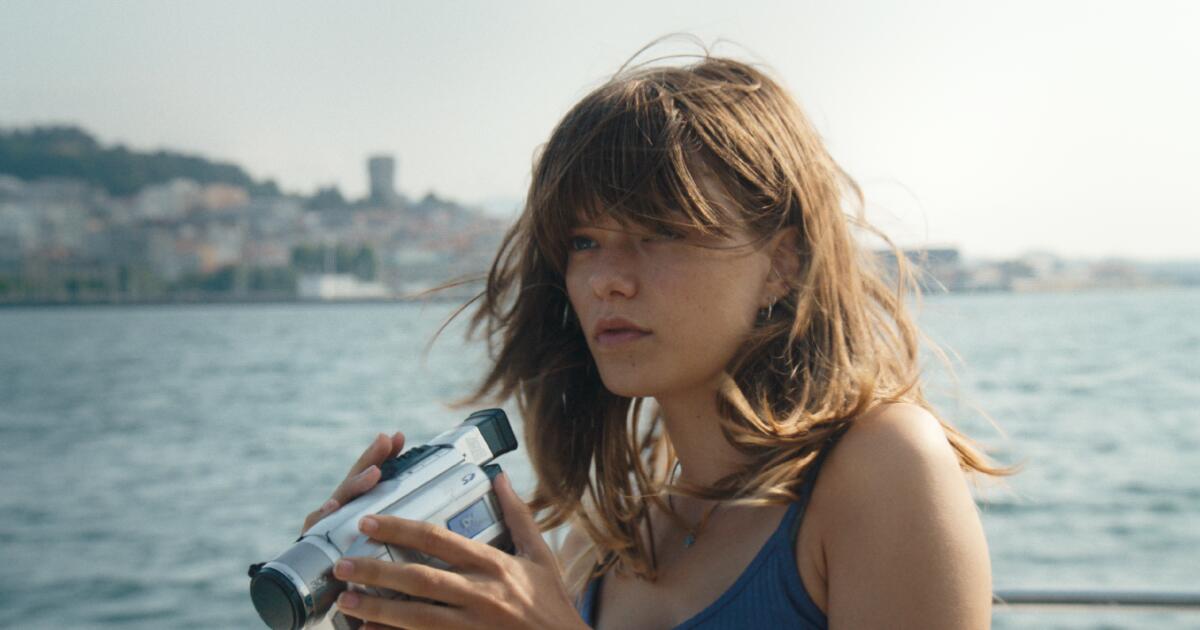
Finally, the series rests on the shoulders of the three principal players, who are just a pleasure to watch; the camera obliges by moving in close. Levy brings a soft-spoken breathlessness you may recognize from his David Rose on “Schitt’s”; his softly muttered “OK,” which might just mean “stop talking,” is almost a trademark. Ortega brings a kind of poignance to her reborn wild child, while Metcalf plays Linda with a kind of small-town operatic intensity, eyes popped and pronunciation precise — she’s like a country cousin to O’Hara’s Moira Rose — as if she were onstage pitching to the back row of the theater.

A pregnant woman in a striped dress lays on the floor while a woman in a beige top and jeans stands by her.

Michelle Pfeiffer and Elle Fanning in “Margo’s Got Money Troubles,” premiering April 15, 2026 on Apple TV.

(Allyson Riggs/Courtesy of Apple)

In “Margo’s Got Money Problems, premiering Wednesday on Apple TV, Elle Fanning plays the title character, a college student flattered into bed by her married-with-children writing professor, Mark (Michael Angarano), despite my shouting at the screen for her not to do it. Soon she is pregnant, and soon after that the essentially single mother of baby Bodhi, unable to find work or the time to write. (As the heroine, we assume her talent.)

Presumably in search of some normalcy, Margo’s mother, Shyanne (Michelle Pfeiffer), a former good time girl — but still sparkly — has become engaged to Kenny (Greg Kinnear), Christian, square and sincere; the Ralph Bellamy of the piece, you are not asked to take him quite seriously (though Kinnear plays him straight). Shyanne’s ex-husband is Jinx, a former professional wrestler, played by Nick Offerman with the low-key affect of Ron Swanson, dialed down even further; depression and drug addiction will do that to you. Fresh out of rehab, he trades a championship belt for a motorcycle and joins the household; though he left Margo early, and unlike Shyanne, he proves to have a marvelous, easy way with Bodhi. (The baby himself, or babies — they use twins for this job — are themselves marvelous.)

Also in residence is roommate Susie (Thaddea Graham), a chirpy cosplayer — and coincidentally Jinx’s biggest fan — whose skills will become valuable as Margo, needing cash, sets off into the world of OnlyFans. First picking up tips describing followers’ penises in terms of Pokémon (no explanation has been thought necessary), she pivots to video, mounting increasingly elaborate sexy sci-fi productions alongside Susie (sets and costumes), Jinx (narrative advice, stunt coordinator) and OnlyFans veterans KC (Rico Nasty) and Rose (Lindsey Normington), a fabulous tag team to whom Margo turns for advice. (Margo does seem to take things over, but it’s her name in the title, so there you go.) This introduces an element of Mickey and Judy, my uncle’s got a barn, let’s put on a show comedy. More important, it creates a team, melding the family you make with the family you have.

It’s as sweet as can be. Apart from sleeping with one’s professor — students, do not do this! — the show is positive about just about everything: motherhood, daughterhood, professional wrestling, second chances, sex work, cosplaying and the way art shows up in strange places. Only Marcia Gay Harden, as Mark’s mother, Elizabeth, is an outright villain, and you will hate her.

The series was created by David E. Kelley (Mr. Michelle Pfeiffer), from Rufi Thorpe’s 2024 novel, once again under the umbrella of Nicole Kidman’s Blossom Films (following their collaborations on “Big Little Lies,” “Nine Perfect Strangers” and “Love & Death”), with its house style of well-upholstered capital-Q Quality (as distinct, in its pop-cult, way, from prestige). (Kidman has a small role as a wrestler-turned-lawyer and it’s been a while since I’ve seen her this well used.) “Margo’s Got Money Problems” can be terribly sentimental, almost corny — the climax is pure Hollywood — but undeniably effective. And if its mix of comedy and drama can be a little destabilizing, you won’t need to worry about where it ends up.

Source link