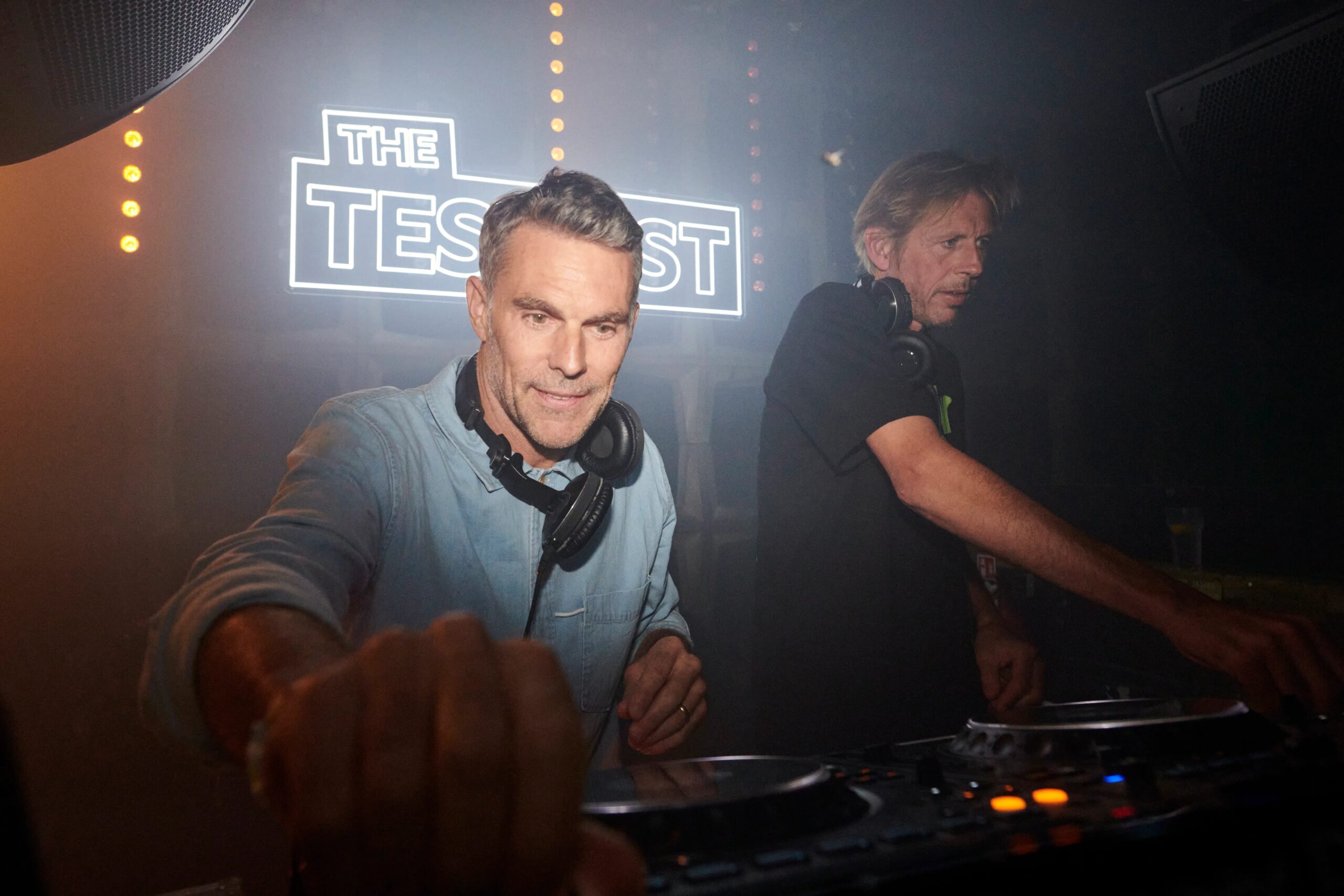
duo

Cuban French duo Ibeyi on spiritual undercurrents of new LP ‘Offering’

One balmy October day in Havana, as the Cuban French sister act Ibeyi plotted the video for “Offerings” — an electro-spiritual ballad from the new album “Offering,” released in June — Lisa-Kaindé Díaz unceremoniously asked her twin Naomi Díaz, to ceremoniously shave her head on camera.

Naomi was accustomed to Lisa-Kaindé’s whims long before they became professional artists. But to take a blade to her sister’s voluminous curls would be a bridge too far.

“I was like, ‘Hell no. I’m not doing that!’” Naomi recalled to The Times, over a Zoom call from Paris.

“As always, when I come with my woo-woo stuff, Naomi is eye rolling like, ‘Girl, what is this s—?’” said Lisa-Kaindé. “But this time around, Naomi was like, ‘OK.’”

The music video ended with Lisa-Kaindé releasing her locks into the sea.

At the core of Ibeyi, which translates to “twins” in the Yoruba language, is the polarity between sisters. Lisa-Kaindé is the bleeding heart who whispers divinity into her lyrics, and Naomi grounds them with the beating pulse of her percussion. They sing in unison, both in tension and harmony. This is the synergy that illuminates their atmospheric approach to the Afro-Cuban jazz tradition.

Born into a musical family in Paris — their mother the French Venezuelan singer Maya Dagnino, their father the Grammy-winning Cuban percussionist Anga Díaz (of Irakere and Buena Vista Social Club) — the 31-year-old sisters jump-started their music careers at 18 when they were discovered by British producer Richard Russell, who also helms the indie powerhouse XL Recordings. After releasing a self-titled debut in 2015, the Díaz sisters appeared in the utopian short film for Beyoncé’s “Lemonade,” then released two more albums under XL: 2017’s “Ash” and 2022’s “Spell31,” which Lisa-Kaindé admitted underperformed expectations.

For “Offering,” they parted with XL and braved the studio as independent artists, inviting new collaborators into the project such as producer Michael Brun (J Balvin, Victoria Monét)and the famed Cuban conguero Pedrito Martinez.

“Things didn’t go the way you wanted them to go, now what does it free?” said Lisa-Kaindé. “It freed a lot of things, in our personal and professional lives,” she added.

The duo returned to their roots in Havana last fall to film the visuals for “Offerings” — as well as other singles “Aset” and “Hurry Hurry,” which were co-directed by Corry Van Rhijn and Roman Pichon Herrera. Family, friends and neighbors filled the frames with dancing and dominoes; their apartments painted in shades of mint, butter yellow and palomino pink, flecked with a patina cultivated by humidity and time.

As Cuba remains a topic of heated debate in the U.S. — or a political football — the Díaz sisters remind listeners that the island nation is still home to over 10 million people, including their relatives, whom they’ve visited regularly since they were little girls.

In 2027, Ibeyi will embark on a North American tour, which kicks off Jan. 27 at the Fillmore in San Francisco and includes a stop at Pacific Electric in Los Angeles on Jan. 29. (“I want everybody to cry, dance and twerk that ass at our shows!” said Naomi.) The Díaz sisters spoke to The Times about their season of upheaval and the recovery that informed their first independent outing yet.

This interview has been edited and condensed for clarity.

Lisa-Kaindé Díaz gets her hair cut by Naomi Díaz

What has changed for you the most since you released “Spell31?”

Lisa-Kaindé: A lot has changed, personally and in the world. We needed to stop for a little bit and gather our thoughts, reflect on our career and all that we have done. We went from anger to sadness to acceptance. We left XL Recordings, which was our home for 10 years [and] three albums. We also stopped working with Richard Russell, whom we love. He was one of the first people to hear the album. But we really needed to experience something new.

Naomi: We started when we were 18, and now we’re independent and more in control than ever. We tried to find new producers with whom we felt a deep connection. That was like leaving a marriage and going on Tinder and having lots of bad dates… Our sound is so strong that we’d eat them, so we had to find producers whose sound could stay strong with ours.

I hear a lot of heartbreak in this album, but also making peace with that. How do you personally heal from the pain of such endings?

Lisa-Kaindé: We just go through the s—. There’s no other way. I think we should all be courageous to change. Look into the mirror and be like: “Who am I? What do I want to do?” And just live. L-I-V-E. It could also be L-E-A-V-E.

You have a T-shirt that says, “I used to make spells, now I make offerings.” What does that mean to you?

Lisa-Kaindé: “Spell31” [went] hand-in-hand with my high expectations. I felt like we needed to put a spell on the world, so that the world would love us. When “Spell31” didn’t meet the expectations I had, it was painful. I went into a meditation and came out thinking: “I used to make spells. Now I make offerings.” Suddenly it was so obvious I was trying to feed myself from the wrong source of protein. What if I just gave without expecting anything?

Some of your lyrics name orishas from the Yoruba religion, such as Elegua and Olokun. What does your spiritual practice look like?

Lisa-Kaindé: The older we grow, the more religious I’m becoming … but Naomi lives her spirituality in very different ways. For her, twerking in a sweaty club can be one of the most spiritual things ever. She’s getting more and more gangster.

Naomi: It’s how we grew up. We never use the word “spiritual,” but spirituality can be a lot of things. To me, there’s nothing more spiritual than being in [famed Atlanta strip club] Magic City. Some people are gonna light a candle. Everybody can do whatever the f— they want.

Lisa-Kaindé: It’s about living in a way that is aligned with what makes you vibrate, what makes you feel alive.

What was it like for Naomi to cut Lisa’s hair in the video for ‘Offerings?’

Naomi: I was scared that she would not like her reflection. She came [to me] with, “Can you be the one shaving my head?” And I was like, “Hell no. I’m not doing that!” She was like, “Please, [it’s] really important for me as a twin.”

We didn’t have any mirrors. It was tough, but [as] I was doing it, I was like, “I hope she’s gonna love herself.” At one point I looked at her and I was like, “Oh, you’re so beautiful!” And she was like, “If Naomi tells me I look beautiful, I am.” It was really powerful.

Lisa-Kaindé: Funny enough, we’ve never talked about this to the press. … But I went kind of cuckoo with the manifestation while making “Spell31.” I started writing three times a day: “It’s gonna do well.” It was the first time I ever did that. And when it didn’t work, I was like, “What do you mean? I did all of the things y’all told me to do!” And that’s why I’m saying we can’t manifest for s—. What happened was exactly what was supposed to happen.

My own outlook changed after a priestess told me to keep an altar to bring offerings to my ancestors. If you want something … you have to give the universe something to work with!

Lisa-Kaindé: You need to give! That doesn’t need to be a religion or whatever. Just be kind. It’s an exchange. There’s always a price — and that doesn’t have to be a terrible thing. It could be a very beautiful thing. I think it’s better if there’s a price. You’re not just demanding the universe to give you something just because you say it enough times.

I sense more thunder in the sounds of ‘Offering,’ especially in Naomi’s percussion. ‘Mosh Pit’ is a storm of trap and acoustic elements. Can you talk about making this song?

Naomi: This was the first song we made for the album. We met Michael Brun, who is Haitian and lives in New York. We wanted a tough energy, we wanted dragon energy in this song. I listen to a lot of rap and trap, so there’s a little more of myself in this. Ibeyi is like a needle between Lisa and I; for 10 years, the needle moved a little more toward Lisa, but now it’s moving toward me. Life is like that.

You shot multiple music videos in Cuba. What made you decide it was time to make these videos in Havana?

Naomi: We recorded the videos in September and October. We wanted to show Cuba because it’s remembering our dad. Home is Paris, London and Havana for us.

Lisa-Kaindé: After having done the visuals from “Spell31” inside the studios … we needed something more personal. We had never done visuals in Cuba, but I think it’s because we’re very protective of Cuba. We’re protective of what the world sees Cuba as, whether it’s the old ladies smoking cigars, or the American cause. We’d go there in the summers [for] our whole lives. We wanted to show something beyond what tourists see. These are the people who actually live there. It’s important to know how people live.

Naomi: We wanted to be with our people and show the real Yoruba, Cuban way of living. Parties full of elderly people, young people … everybody twerking!

This big house party happens in the video for the song ‘Aset.’ Can you tell me about shooting the party scene?

Lisa-Kaindé: Funnily enough, I think our family was more involved behind the scenes. Naomi’s best friend helped with all of the wardrobe because she’s a fashion girlie. One of the directors we’ve known since we were 15 years old, he’s like a brother to us. We also worked with a conguero, like our dad, his name is Karín. We filmed the “Offerings” video in his house. Then we went to La Playita 26, which is not far from our old house, to look at the sea.

Naomi: What’s beautiful is that it was all real. It was also [full of] people we didn’t f— know. But it was raw.

Lisa-Kaindé: The day we filmed “Aset,” when I saw Naomi dance, I was like: “Here we are. Here is that freedom [we’ve been] missing.”

Source link

Contributor: How Dean Martin and Jerry Lewis forever changed comedy

Eighty years ago, though the Arsenal of Democracy had vanquished the Axis and weathered a withering Depression, the recovering American people found themselves rich in bills but short on laughs. Enter Dean Martin and Jerry Lewis, who debuted together on July 25, 1946.

Unlike Laurel and Hardy, Abbott and Costello, or Hope and Crosby, who relied on tightly scripted setups, this disparate yet kindred duo captured America’s heart by being viscerally, uproariously and unpredictably wild.

Martin and Lewis were the founding fathers of an anarchic, side-splitting brand of comedy that combined pratfalls, ad-libbed wordplay and a sustained demolition of the fourth floor. Orson Welles observed that the duo’s combustible zaniness was so hilarious that it made you wet your pants.

The boys cavorted about the stage, kibitzing with bandleaders and the audience alike. In between trading impromptu quips, Martin and Lewis overturned tables, cut ties, sheared suits and spritzed seltzer on one and all.

The suave, dashingly handsome Italian crooner clowning around with his gawky, rubbery Jewish buddy brought the house down every time. It was nonstop, jocular pandemonium: Commedia dell’arte 2.0.

Saturday Night Live,” Second City, David Letterman, Jerry Seinfeld and Adam Sandler all owe a debt to the artists who started life as Dino Crocetti and Joseph Levitch.

Martin and Lewis created a novus ordo seclorum, in its way innovating like America’s founders, spawning a new comedic order of the ages.

Their alchemy was as ineffable as it was infectious. Variety’s first review of the act noted, “All they do cannot be detailed, but virtually every bit of it is good for solid laughs.” Carl Reiner similarly declared: “I saw what I thought was the funniest ad-libbed thing I had ever seen. It was a riot, and we never stopped laughing.”

In their own madcap way, Dino and Jer epitomized Cicero’s notion that comedy is the imitation of life, the mirror of custom and the image of truth.

Martin and Lewis became the monarchs of all media, conquering radio, nightclubs, television and the silver screen. In 1948, they appeared on Ed Sullivan’s first television show, “Toast of the Town.” From 1950 to 1955, the Martin-and-Lewis-hosted “Colgate Comedy Hour” frequently bested Sullivan in the ratings.

When Hollywood beckoned, the boys answered the call, cavorting, cutting up and reconfiguring reality on the silver screen. They starred in 16 films, bringing their boisterous bromance to capacity-crowd movie theaters.

Though their big-screen adventures could not capture the comedic chaos of their stage act, Martin and Lewis transformed even the most pedestrian screenplay into box-office gold. As film critic Ciara Maloney explained, “Their brilliance shines through the weakest material: the ineffable, bewitching something between them — an intimacy, an immediacy, an ingenuity — frozen in amber for those of us who would never see it in the Copacabana.”

The essence of this duo was the outré interplay between the Prince and the Putz, the Leading Man and the Monkey. Though he was the comedian by trade, Lewis fully credited Martin as the “genius” of the pairing: “He kept the center. He was the spine of the act. And the monkey was constantly attached to that spine, on the spine, next to it.”

From “Sailor Beware” to “The Stooge,” “Living It Up” and “Artists and Models,” theirs was a comedy partnership that came to symbolize America. It is little wonder that presidential historian Tevi Troy called the 1950s “The Martin and Lewis Decade.”

However, many Americans didn’t see these two celebrities as distant icons. Film critic Jenna Ipcar has described how “a perfect comedy duo will make their audience feel like a lucky participant instead of just a passive observer, a welcome guest in a secret world.” Martin and Lewis embodied that ideal.

The boys’ bittersweet final performance took place at New York’s Copacabana on July 25, 1956. Exactly 10 years after their debut in Atlantic City, N.J., Dean Martin and Jerry Lewis had pioneered a new brand of comedy, soothed postwar America’s psyche and made a nation laugh again.

Rosario A. Iaconis, chairman of the Italic Institute of America, writes about Italy and its cultural influence. He is at work on a novel about Harry S. Truman.

Source link

Jack White hires satanic duo after Charley Crockett firing drama

Jack White stepped in when Charley Crockett accidentally hired, then fired, a satanic doo-wop duo. Happens to everyone, right?

The outlaw country singer apparently thought the husband-and-wife duo known as Twin Temple were like Black Sabbath when he invited them to open two shows for him this week, a July 14 date in Troutdale, Ore., and another on July 18 in Paso Robles. With songs including “Satan’s a Woman,” “Lucifer, My Love,” “Let’s Have a Satanic Orgy” and “Burn Your Bible,” it’s anyone’s guess how Crockett missed the duo’s shtick.

“Today we were informed that Charley Crockett has decided to remove Twin Temple from his upcoming shows next week due to our Satanic imagery,” the musicians wrote on Instagram last week.

“Unfortunately, that means we will not be able to perform for you next week as planned. We are really disappointed as we were looking forward to getting back out and seeing you, and also what it meant as far as bringing different types of people and music lovers together. We are sorry to everyone who was planning to see us.

“We’re grateful for your support, not only of Twin Temple, but more importantly of artistic freedom. HAIL SATAN! 93/93”

Crockett, who dropped his 16th studio album, “Age of the Ram,” in April, posted his own since-deleted message on social media, writing, “Hail Satan? Not me Jack.”

Twin Temple, composed of married couple Alexandra and Zachary James, weren’t out of work for long. White, the former White Stripes frontman, who happened to be kicking off a world tour in support of his new album, “Frozen Charlotte,” caught wind of the debacle and stepped in.

“Twin Temple, Would you like to open my show in L.A. on September 29th at the Hollywood Palladium? Let me know,” White posted on Friday, adding, “Get in front of me Satan!”

The duo was quick to accept, commenting on White’s invite, “Unholy hell…. Sir Jack, you have no idea what this means to us. Lifelong fans- dead leaves on the dirty ground was one of the first songs I (Alex) ever learned on guitar. We were actually planning on coming to this show. It would be a most infernal pleasure to play the devils music with you.”

On Tuesday, Twin Temple announced their third record, “Doomed Lovers,” produced by Shooter Jennings (who also produced Crockett’s “Age of the Ram” and other recent albums). The album will drop Oct. 9 via their own Pentagrammaton Records. The duo told Rolling Stone on Tuesday that they were sad about the turn of events with Crockett but confirmed that their swanky Satan-loving doo-wop isn’t a sham.

“Satan’s the original outlaw, right? He’s a rebel angel,” Alexandra told the outlet. “He’s the one who questioned authority, fought for himself, refused to bow down or conform, and was like non serviam. That was a metaphor that resonated very strongly with me.”

She added, “It’s really fun to go shopping for a human skull and a Ronettes record in the same day, and we get to do that with our band.”

While Twin Temple has been booking shows and working on the album announcement, Crockett has continued to post about the drama from the road. “Well, now I know how it feels when they try to cancel you on the right AND the left,” he wrote on Facebook on Monday. “The thing is, I never subscribed. America can be a One Eyed Jack, but I’ve seen your other side.”

Source link

Gogglebox fans say ‘about time’ as much-loved duo return to Channel 4 show

A brand-new series of Celebrity Gogglebox kicked off this month as Channel 4 fans saw some familiar faces on their screens.

There’s good news for Celebrity Gogglebox fans as a beloved duo has made their return to the programme.

The popular Channel 4 programme, which first aired almost seven years ago, made its return to screens last week for a brand new season.

Last week, viewers saw some familiar favourites back on the show, giving their thoughts and reactions to the latest television offerings.

These included the likes of Shaun Ryder and Mark ‘Bez’ Berry, Vicky Pattison and Pete Wicks and Jennifer Saunders with her daughter Beattie.

While there were also some new additions, such as George Clarke and Max Balegde, Julian Clary and Nigel Havers and Olivia Attwood with her mum Jennifer, one duo was noticeably absent.

Rylan Clark and his mum, Linda, first joined the programme back in 2019 and have been firm staples on the beloved show.

Although they may have missed the first episode of the new series, they were back in action this Friday (June 12).

Sharing a clip on Instagram, the 37-year-old said: “Guess who’s back on Gogglebox… It’s Linda! We are very excited to be back this Friday night.”

Content cannot be displayed without consent

Turning the camera to his mum, Rylan asked if she was excited to be back on the show, and she confirmed she was. He finished off the video by adding: “Right, we’ll see you Friday night!”

It wasn’t long before people commented on the post, with many thrilled to see them back on the show.

One person said: “Love you guys. So good to see you back and looking lovely as always.” Someone else shared: “Hey Linda, about bl**dy time.”

Another fan added: “Glad you are both back, was hoping you would.” While one person commented: “I wondered where you guys were last week!!! Good to have you back again. Love your banter.”

Someone else shared: “Delighted to hear this news – missed the pair of you last week & was hoping you would be back.” As another person added: “Good to see you back Linda..and Rylan of course. Cannot wait to see you both back on.”

While on X, one person said: “Rylan and his mum back.” As another added: “I love @Rylan’s mum so much.”

Celebrity Gogglebox is available to watch on Channel 4

Source link

‘Hacks’ finale is a fairy-tale ending for an oddball comedic duo

This article contains spoilers for the series finale of “Hacks.”

After five seasons and (thus far) 12 Emmys, “Hacks” has come to an end. The story of how Deborah Vance (Jean Smart), a 70-something comedian of the Joan Rivers type, and Ava Daniels (Hannah Einbinder), a prickly 20-something comedy writer, came together to resurrect both their careers was a roller coaster ride of intergenerational judgment, wins, setbacks, ruthless behavior, personal growth, power reclamation and much general hilarity.

Deborah sees Ava as entitled and self-righteous, Ava sees Deborah as washed-up and boring. Eventually, of course, they realize they are kindred spirits who do their best work together.

In Season 5, Deborah attempts yet another comeback. Having walked off her late-night show rather than fire Ava in Season 4, she is determined to rewrite her premature obituary by playing Madison Square Garden. When that too is snatched away, she pivots (with much difficulty and hilarity, including a show-stopping monologue by Laurie Metcalf’s tour manager Weed) to Central Park, where she is finally allowed a moment of glory, basking in the adulation of applauding thousands.

But that is not the end of “Hacks.” In the final episode, Deborah reveals she has cancer and rather than undergo treatment, she is choosing to “go out on top” with the aid of a Zurich clinic. She asks Ava to accompany her, after they take a girls trip to Paris. After an emotional meltdown, Ava agrees, hoping to persuade Deborah to change her mind. She does, but only after Deborah realizes that she cannot bear to walk away from the jokes she could write about dying. And so the show ends, with the two women walking arm in arm, first in Paris and then in Las Vegas, working on Deborah Vance’s final show.

Here, Times TV and culture critics Robert Lloyd and Mary McNamara discuss the ending, and legacy, of “Hacks.”

Two women sitting outdoors at a table covered in glasses and plates.

Deborah, left, decides she doesn’t want to get treatment for cancer despite Ava’s protests. Deborah changes her mind when she realizes she could write jokes about dying.

(HBO Max)

Mary McNamara: Hey there, Robert; are you as devastated as I am that we have no more “Hacks” to look forward to? The only solace I can find is the news that creators Lucia Aniello, Paul W. Downs and Jen Statsky are planning to release a DVD box set of the series. And the possibility that there could be a movie sequel — I for one want to see Deborah Vance’s death tour, especially since you know she’ll beat the odds and survive.

Seriously, though, sad as I am to contemplate life without “Hacks,” I am equally thrilled that the show so thoroughly stuck its landing. Finales are always a crap shoot and I appreciated how this season managed to show growth and cosmic justice while never tipping into treacle. I love that everyone ended on a win — including Marty! (Christopher McDonald) — and I didn’t even mind that suddenly Deborah had cancer (what?), was choosing assisted suicide (double what?) or that we were whisked to Paris (sure, I guess, why not?) because it made just enough narrative sense to set up Deborah’s decision to live because she just couldn’t leave good material on the table. “I may not have 30 years, but I do have one more hour,” may be the best line from a TV finale ever.

It is too easy to think of people like Deborah as clawing back their careers for fame, validation or money rather than a deep and essential love of their art. Having Deborah decide to prolong her life with chemo because she could not resist mining this final seam of comedic gold was a coup de grace.

What did you think?

Robert Lloyd: Hail, Mary. Reviewing the first-season finale, I wrote that the series was at heart a romantic comedy. And though many timely points were made along the way about artificial intelligence, the fate of late-night television and the awfulness of rich jerks who control media companies — Deborah’s Madison Square Garden show was undermined by the network head she named on national television in her resignation speech — the show asserted itself as a love story once again in the end. Where earlier seasons had depended on creating friction between Deborah and Ava, this one was mostly of concord, their only real clash being Deborah’s decision, introduced late in the season, to end her life (in a clean, posh way); her climactic change of heart spared us a medical tearjerker, but, believe me, I shed plenty of tears along the way. Unlike most seasons of “Hacks,” the fifth and final was orchestrated very much as a feel-good experience — “Ted Lasso” has nothing on it. A fairy tale, almost, as you point out, full of fairy-tale endings and plot points that were as good as magic. It could be contrived and improbable and old-fashioned in its triumphs snatched from the jaws of defeat, and I completely loved it.

A woman with blond updo holding a microphone on an outdoor stage.

Deborah Vance (Jean Smart) didn’t get the Madison Square Garden show she imagined, but she did get one at Central Park.

(HBO Max)

McNamara: The series had a lot to say about a lot of things (including vengeful power brokers/network executives) that feel particularly pointed now. But I deeply appreciated that while underlining the real obstacles Deborah and Ava faced, the writers showcased and explored how the bad choices each women had made, and defended, also contributed to their situations. Obviously having the great Jean Smart in the driver’s seat helped a lot — she revealed the woman beneath the diva even in Deborah’s most outrageous actions. The writers did not shy away from calling attention to the blatant sexism female comedians faced (and continue to face) or how the “woke” women of Ava’s generation are often able to see that kind of injustice more clearly.

It was, as you say, more rom-com than morality play, and rom-coms are often based on discovering that the differences that initially divide are too often based on, well, to put it in its original form, pride and prejudice. So while there was some hilarious and spot-on commentary about intergenerational miscommunication, there was also a clear message of how important it is for people with vastly different experiences to listen to, and learn from each other, which also feels incredibly important at this moment in time, especially given the show’s essential, and deeply human, respect for creative work. What motivated Deborah and Ava, and virtually every character in “Hacks” — agent Jimmy (Downs), his assistant Kayla (Megan Stalter) and later Randi (Robby Hoffman); Deborah’s staff, including Marcus (Carl Clemons Hopkins), Damien (Mark Indelicato) and Josefina (Rose Abdoo) — was a belief in the importance, and difficulty, of the creative process. It’s something that is rarely, if ever, the work of a single individual — as Deborah finally acknowledges at the opening of the Diva casino. Or as Laurie Metcalf’s Weed makes clear in her hilarious monologue before the Central Park gig.

1

Three people wearing yellow hard hats.

2

A group of people sit and stand to the side of stage near lights.

1. Creativity isn’t the work of a single individual: Damien (Mark Indelicato), Marcus (Carl Clemons-Hopkins) and Deborah (Jean Smart) at work on the casino. (HBO Max) 2. Deborah’s crew at her Central Park show. (HBO Max)

Lloyd: In a way Deborah’s speech summed up what we’d already been seeing through an especially generous season that served as “Hacks’” tribute to itself and its people. It was a party to which most every significant and many minor characters were invited, including Metcalf and McDonald; Luenell as comedian Miss Loretta; Poppy Liu as Deborah’s personal blackjack dealer, Kiki; Jane Adams as Ava’s mother, Nina; J. Smith-Cameron as Deborah’s estranged sister, Kathy; and Kaitlin Olson as Deborah’s daughter, DJ, who finally got her mom to partner with her on “The Amazing Race” and was allowed to sell her detachable earrings on QVC.

Gifts were distributed widely, including a previously unseen interview with Deborah’s late husband and co-star, Frank (Peter Strauss), giving her credit for their success — credit he had previously accepted for himself — and thus removing a giant thorn that drove the early plot. These kind-hearted acts of closure were performed both for the benefit of these very real, made-up people, and for We the Viewers, who have made them our family. Declarations, or at least demonstrations of love, were abundant, not merely between Deborah and Ava, with the characters acting as our proxies, feeling what we want them to feel, and what we feel for them ourselves. (There are moments this year when Einbinder — whose brilliance Smart could seem to outshine, but who was never less than an equal partner — absolutely killed me, just in the tender way she gazed upon Deborah.) That’s why it’s so hard to let go of a show like this, even when we know it’s time to say goodbye. You can only stretch an arc so far before it breaks.

McNamara: You’re right, of course. But I still want to see the “Hacks” movie.

Source link

Rob Base, rapper known for ‘It Takes Two,’ dies at 59

Rapper Rob Base, one-half of the hip-hop duo Rob Base & DJ E-Z Rock, died on Friday after a battle with cancer. He was 59.

“Rob’s music, energy, and legacy helped shape a generation and brought joy to millions around the world. Beyond the stage, he was a loving father, family man, friend and creative force whose impact will never be forgotten,” a statement on Base’s Instagram read.

The statement also expressed gratitude to Base, who was surrounded by family as he died, for “the music, the memories and the moments that became the soundtrack to our lives.”

Rob Base was born Robert Ginyard in May 1967. He was best known for his collaborations with DJ E-Z Rock. The two were lifelong friends, meeting in fifth grade while living in Harlem. Their song “It Takes Two” was released in 1988 by Profile Records. The song became a breakout single for the duo and peaked at No. 3 on the Billboard U.S. dance club songs chart, with The Times calling “It Takes Two” “the rage of the rap underground.”

The duo followed up the hit with the release of the singles “Joy and Pain” and “Get On the Dance Floor.” Base released his solo album, “The Incredible Base,” in 1989.

Base was an ardent supporter of the rap genre, explaining to The Times in 1989 the nuance of the music.

“People outside rap don’t understand it. There’s all sorts of subtle things — key things — happening over and above the beat in rap songs. The fans want new stuff all the time,” Base said.

Base had two children, De’Jené Ginyard and Robert Ginyard Jr. His wife, April, died in 2013.


Source link

Rob Base dead aged 59: It Takes Two rapper in duo with DJ E-Z Rock dies after cancer battle

HARLEM rapper Rob Base, one-half of Rob Base & DJ E-Z Rock, has died aged 59.

The musician, whose real name is Robert Ginyard, passed away after a private battle with cancer, his family announced in a statement.

Rob Base was best known for the hit ‘It Takes Two’ Credit: WireImage
Base made up one half of rap group Rob Base & DJ E-Z Rock Credit: Getty Images

Base, best known for the hit “It Takes Two”, celebrated his birthday just four days ago.

A statement posted on his social media account read: “Rob’s music, energy, and legacy helped shape a generation and brought joy to millions around the world.

“Beyond the stage, he was a loving father, family man, friend, and creative force whose impact will never be forgotten.

“Thank you for the music, the memories, and the moments that became the soundtrack to our lives.”

Base and E-Z Rock brought a unique blend of house music and hip-hop to the mainstream in the 1980s.

E-Z Rock died from complications of diabetes in 2014.

Their breakaway hit, “It Takes Two”, reached number three on the Billboard Hot Dance/Club Songs chart in 1988.

What began as a neighbourhood party record from the streets of Harlem blew up into an iconic anthem.

Rob Base (L) and DJ E-Z Rock perform during the Legends Of Hip Hop Reunion Tour in 2012 Credit: Getty
Base continued performing in recent years including at the I Love The 90’s tour in 2016 Credit: Getty

Since its release the track has been sampled by everyone from Snoop Dogg to Black Eyd Peas.

Base and E-Z Rock met in the fifth grade while growing up in Harlem.

They became inspired to form a duo as teenagers leading Base to buy a mic and E-Z Rock a mixer and turntables.

More recently, Base continued performing on the “I Love the ’90s Tour” alongside acts like Vanilla Ice and Young MC.

He also mentored up-and-coming artists under his company Funky Base inc.

Base also worked as an executive producer on the horror film “Urban Flesh Easters”, released last year.

More to follow… For the latest news on this story keep checking back at The Sun Online

Thesun.co.uk is your go-to destination for the best celebrity news, real-life stories, jaw-dropping pictures and must-see video.

Like us on Facebook at www.facebook.com/thesun and follow us on TikTok @TheSun.


Source link