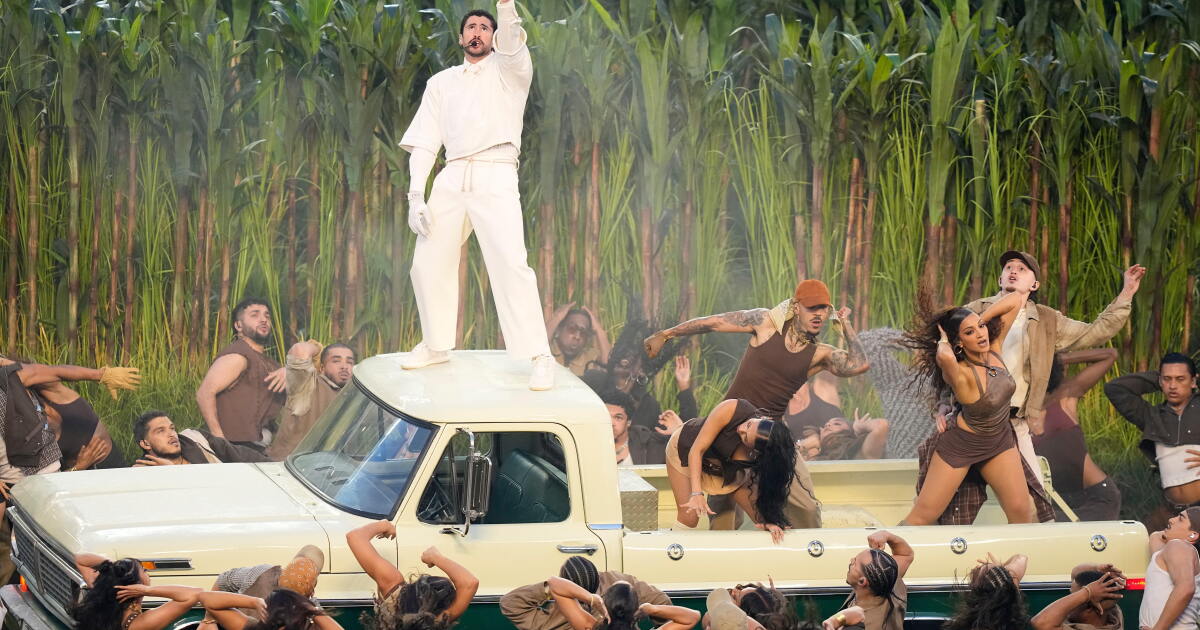
bad bunny

How Mexico City EDM duo RØZ turned Coachella buzz into a bold debut

Hugo Lara and Manolo Cabrera — the Mexican DJ pair better known as RØZ — casually strolled through Sightglass Coffee in Hollywood, one gripping a half-melted iced coffee, the other an empty Erewhon juice bottle.

To any onlooker, they might appear as two standard Gen Z Angelenos in sardonic streetwear: 22-year-old Cabrera flaunted a hat that referenced the 2008 financial crisis while 25-year-old Lara’s faded tee read, “You don’t dream of a better version of yourself.”

But over the past year, this fresh-faced pair from Querétaro, a small state just outside Mexico City, has dominated the festival world circuit. Spinning heart-thumping electronic beats and Latin house rhythms, RØZ has taken the stage at many a popular event, such as the most recent Coachella Valley Music and Arts Festival, Lollapalooza Chicago, Hard Summer, EDC Las Vegas and Sueños.

“We’ve had huge crowds at festivals, even the workers on stage are like, ‘No way, you filled more venues than yesterday’s headliner,’” Cabrera told The Times. “We filled it up and people started leaving for the next person, which is obviously not cool. It feels awful. But you do think: good! They value Latinos and Mexicans now.”

Besides regaling ravers at their concerts — which will continue for the remainder of the calendar year, including a 20-city North American tour that kicks off in Boston on Oct. 21 — RØZ has landed another major artistic goal.

Manolo Cabrera, left, and Hugo Lara.

“Everyone will give [the album] a different interpretation, but I think the through line is the idea of drama, or poetic essence,” said Hugo Lara.

(Gina Ferazzi / Los Angeles Times)

Last Friday, they released their first full-length album, “Se Esta Haciendo Tarde.” It’s a 19-track, introspective debut that solidifies the duo’s standing in the EDM world as both masterful mixers and vocalists.

“We are neither fully DJs, or fully singers, but artists,” said Cabrera. “Our shows, with the album, are going to be us playing synths, at another point singing and at another point we mix some songs.”

Featuring cameos from Latin superstars like Peso Pluma, J Balvin and Ryan Castro, the LP itself is hard to define as simply house music; RØZ is known best for peppering its EDM with a heavy dose of Latino sazon. It’s a sonic recipe that the two former schoolmates have been mastering since they were under lockdown from COVID.

This era also saw the commercial rise of other Mexican artists in their generation: Natanael Cano and Latin Mafia were among the most prominent Mexican acts who maximized their creativity during the isolation period and used social media platforms like TikTok to gain traction.

“It’s like if Fred Again, Skrillex, Frank Ocean, Mora and Bad Bunny adopted a child and raised him,” said Cabrera about their own music, which they began uploading to the streaming platform Soundcloud in 2022.

At the start of their disc jockey journey, they remixed already established songs, from Bad Bunny and Bomba Estéreo’s “Ojitos Lindos” to Bellakath’s “Gatita.” By 2024, they would release their frosty original track, “Cora de Hielo” under Warner Music Mexico; this featured Natt Calma and Mau Moctezuma, artists whom they met through the local indie scene.

Their subsequent releases went viral — including the dark-synth pop “Flashes” with Yng Lvcas and atmospheric “Apaga la Luz” with a rather mellowed performance from Peso Pluma — which were released under LT:Vision Records, Queens Road Music and Atlantic Records.

“At that time, emotions were secondary [in the music],” said Cabrera when looking back on those early songs. “Perhaps we didn’t resonate with the artist’s lyrics, we might have helped with some ideas. But with this [new] project, we wanted to find more of a balance — we want to be transparent, while also releasing f— bangers.”

Inspired by the transient beauty of cherry blossoms, known in Japan as sakura — which is illustrated in their album cover, alongside a dark pegasus — much of the LP also hinges on melodrama. Glitchy beat drops in “Acelero Lento” (featuring Chitra) fade into acoustic ballads. The bouncy freestyle rhythm in “Soho” melts into feverish pop harmonies. There’s also an interlacing spiritual hymn in “Yo Gospel” (featuring Rodrii) that showcases the heavenly vocals of an American-style church choir.

“Everyone will give [the album] a different interpretation, but I think the through line is the drama, or poetic essence,” said Lara. “Perhaps in 10 years we will listen to the same song and have a different interpretation.”

The new LP is imbued with various Latin genre fusions. In “Ya es de Noche” (featuring Rodrii and Olisso) they open with neo-perreo rhythms that slowly wade in and out of a cumbia-guided trance. In “Hanami,” named after the traditional Japanese custom of observing a floral bloom, RØZ is joined by Colombian producer Sky Rompiendo, whose pulsating reggaeton beats undergo a warping process, as their lyrics harp on romantic tension.

“Cherry blossoms only last a while, so it was our way of saying that we must appreciate the moment in which beauty exists,” said Lara.

The magnetic pull of RØZ — whose stage name is pronounced like the second syllable in “arroz” — cannot be overstated. They’ve already sold out six shows in their upcoming tour, which will wrap up Feb. 27 in their home state of Querétaro. Their popularity comes at a time when electronic music was registered as the largest-growing genre in the U.S. in the first half of 2026, per Luminate’s 2026 data report, which also found that casual monthly listenership in Latin music peaked at 54% of streams in the first quarter.

The growing admiration for Latin-fused EDM by Latino listeners was most visually evident during their Coachella debut in April. One attendee uploaded a video to Instagram showing the jammed entrance to the Sonora Tent, which reached full capacity before the duo began their Sunday set: “Coachella underestimating the Latino crowds like [what do you mean] I can’t see RØZ [because] it’s at full capacity both weekends,” the subtext on the video read.

Even before their breakout year, on the night of their first U.S. performance on the rooftop of the Fonda Theatre in Los Angeles last August, the line to get inside stretched across the Hollywood Boulevard sidewalk with attendees eager to hear the pair’s early tracks.

Still, it doesn’t surprise RØZ that a Latino act like themselves might be early on the call sheet — or left to assemble a last-minute crew after their original team ran into visa processing delays ahead of the first Coachella weekend. “In this genre that we’re moving in, you’d never picture a Latino headliner. Latinos are always put down, down, down,” said Cabrera.

But some milestones have given them faith that the mainstream world is opening up to putting Latino acts at the top of the bill; including the fact that Colombian singer Karol G was the first Latina Coachella headliner this year. “And with music in Spanish, not English,” marveled Lara.

And rather than sulk about the conditions of Latino artists, RØZ is ready to put up a fight.

“Just because I’m Mexican or Latino doesn’t mean that I can’t connect with people the same way a person from the United States can,” said Cabrera. “Headlining is possible, without a doubt.”


Source link

‘The De Los Podcast’: editors talk best Latin music of 2026, so far

As 2026 reaches its halfway point, the editors of De Los are eager to talk about Latin artists to watch — and share their hottest music takes. Over the years, award-winning music journalist Suzy Exposito and Director of Latino Initiatives Fidel Martinez have documented the rise of genres like reggaeton and música Mexicana in mainstream culture.

In her work for Vogue, The Times and Rolling Stone, Exposito has interviewed influential artists like Shakira, Cardi B and Bad Bunny (the last of which made history as the first Rolling Stone cover story written by a Latina journalist).

Martinez has an impressive roster of his own, having interviewed many stars in the Mexican and Chicano music scenes, from Fuerza Regida to Natalia Lafourcade.

Reflecting on a landmark year for Latin music

On this week’s episode of “The De Los Podcast,” they weigh in on the explosive impact of 2025 on the genre: between Bad Bunny‘s Super Bowl halftime show and Karol G‘s Coachella headlining performance, last year was nothing short of a groundbreaking for Latin music.

“Being there, you could feel barriers coming down,” Martinez, who reported live from the Super Bowl in February, said. “It wasn’t Bad Bunny trying to validate us in front of others. It was him saying, ‘This is who we are, and we are proud of who we are.’”

According to the RIAA, 2025 was the first year that Latin music sales in the U.S. reached $1 billion, in its 10th consecutive year of growth. In 2016, American Latin music sales were at just below $150 million.

“It highlights how quickly and with what speed the genre has been taking off,” Martinez said.

However, as Exposito notes, at times, it came at the cost of originality.

A Latin music trend that De Los is leaving behind this year

“Our generation is too married to the past,” Exposito said. “How can we evolve musically if we keep trying to re-create our grandparents’ music?”

Nostalgia, De Los editors note, has driven the wide-ranging popularity of last year’s most successful Latin projects. As Exposito says, the artists “mine the past in their own ways.”

In Bad Bunny’s “DtMF” and Karol G’s “Tropicoqueta,” classic genres like salsa, plena and cumbia took center stage. “DtMF” samples El Gran Combo de Puerto Rico while in Fuerza Regida samples Mexican classics like Vicente Fernández.

While comforting and educational for younger generations, Martinez argues that artists relying on nostalgia could turn that effort into becoming more experimental with their sound.

Some artists, however, are resisting the nostalgia trend, making De Los’ best albums list of 2026 … so far.

De Los’ 2026 Latin albums you need to hear

Suzy’s picks:

Alvaro Díaz, “Omakase”

“He’s experimental … and taking bold swings, with producers like Tainy,” Exposito said.

“Omakase,” which the Puerto Rican star released in May, blends Latin trap elements with electronic, R&B and in one track, cumbia, for a diverse, thoughtful album that Diaz equates in his De Los story to the Japanese dish omakase, or a platter decided by the chef.

RaiNao, “Marcría”

With a worldplay title that blends the words “malcriada” (badly raised woman) and “cria por el mar” (born in the sea), RaiNao’s project promises earthly, intimate lyricism with experimental musicianship.

“The way she melds jazz with reggaeton and folkloric elements, I really enjoy,” Exposito said. “I really appreciate people (like RaiNao) who can remix but also introduce seemingly disparate elements, like saxophone and Caribbean music.”

Other picks include Ibeyi’s “Offering” and Diles Que No Me Maten’s “Escrito en Agua.”

Fidel’s picks:

Julieta Venegas, “Norteña”

Venegas, who De Los interviewed last month, wrote a memoir alongside this album, which delves into her Tijuana heritage with Mexican collaborators like Bronco, is what Martinez calls “a chef’s kiss.”

“She’s such a fascinating character because she started as an indie rocker,” Martinez said. “This album is a love letter to Tijuana. It’s just the perfect fusion of tradition and pop.”

Hermanos Espinoza, “Linaje”

Two brothers from the Rio Grande Valley, Hermanos Espinoza performed at De Los’ SXSW showcase and blew the audience away with their live energy and accordion work.

“Their project talks about lineage. This album certainly has a point of view,” Martinez said. “With this album, they said, música Mexicana can be like rock and roll.”

Also on the list are Tito Doble P’s “Acomodo” and Trio Asesino’s self-titled.

To hear more about 2026’s emerging artists and De Los’ music hot takes, check out “The De Los Podcast.”

Source link

Pope Leo hopes to bridge Spain’s political divide on papal visit

1 of 2 | Pope Leo XIV blesses infants on his visit to the Caritas Charity Centrer in the Lucero neighborhood of Madrid Saturday. The pontiff is visiting Spain from from June 6 through June 12, with stops in Madrid, Barcelona and the Canary Islands. Photo by Ciro Fusco/EPA

June 6 (UPI) — Pope Leo XIV landed in Madrid Saturday to begin his one-week papal visit to the country, the first in 15 years.

Leo was greeted at the airport by King Felipe VI and his wife Queen Letizia, then addressed them at the Royal Palace along with politicians and diplomats.

He acknowledged political polarization and called for an end to it in Spain and elsewhere in the West.

“I come among you to affirm, encourage and instill a renewed fidelity to the Gospel among believers, as well as a deeper reconciliation and collaboration among the various elements of this nation,” the first American pope said.

“In reality, the message of peace, which at present unfortunately strikes some as naive and others as confrontational, is welcomed by those who do not shut themselves off in preconceived ideologies, but are rather open to the truth,” Leo said.

Spanish Deputy Prime Minister Yolanda Díaz told the Washington Post that the left in Spain embraces the pope.

“The [left’s] alignment with Pope Francis was immediate: He defended Spain’s labor reform and the Episcopal Conference also supported it, something that would have seemed unthinkable 20 years ago,” she said. “With Leo XIV, that alignment deepens.”

The Spanish far-right are battling the Church, which they believed an ally. They are particularly upset over the church’s advocacy for migrants, The Washington Post reported. The left once saw the Church as complicit in the Franco dictatorship.

“The far right in Spain wants to copy the far right in the United States,” Bishop José Mazuelos Pérez, who heads a Canary Islands diocese providing shelter, food, blankets and medical care for arriving migrants, told The Post. “To go to war with the bishops over the issue of migration.”

On Monday, Leo will address the Spanish parliament, which is gridlocked. He’s expected to discuss that type of polarization, and his other visits around the country highlight differing segments of the Church.

He will have a prayer vigil with young people Saturday, then march Sunday in a traditional Spanish street procession.

On Thursday, Leo plans to visit the Canary Islands, a landing for Latin American migrants and for those arriving by sea from the African coast. He is planning to visit Lampedusa on July 4, an Italian island where migrants from Africa and beyond land.

On his flight to Spain, Leo acknowledged that he would be competing popular with Puerto Rican singer Bad Bunny, who played the Super Bowl halftime show this year, for Spanish attention. Bad Bunny is scheduled to perform in Madrid Saturday night.

Leo said that more young people are turning to the Church, looking for something more.

“If they are confronted with the question: do they want to see Bad Bunny or do they want to see the pope, I think many will see Bad Bunny,” Leo said. “But I think there will also be a few here to see the pope. And that says something.”

On Sunday, the pope will celebrate mass on the feast of Corpus Christi in the Plaza de Cibeles. There will be a Corpus Christi procession, the Vatican said. He will also meet privately with members of the Order of St. Augustine to which he belongs.

Later, he will go to a gathering of representatives of culture, arts, business and sports at Madrid’s Movistar Arena.

The Vatican spokesperson Matteo Bruni said, “Leo XIV’s trip to Spain is a sign that, despite the secularization of society, the pope still has something to say in many areas, in Spain and in Europe, where he can play a constructive role in public debate,” Euro News reported.

Russian Mirra Andreeva plays against Ukrainian Marta Kostyuk in their semi-final match during the 2026 French Open in Paris on June 4, 2026. Andreeva won 6-1, 6-3. Photo by Maya Vidon-White/UPI | License Photo

Source link