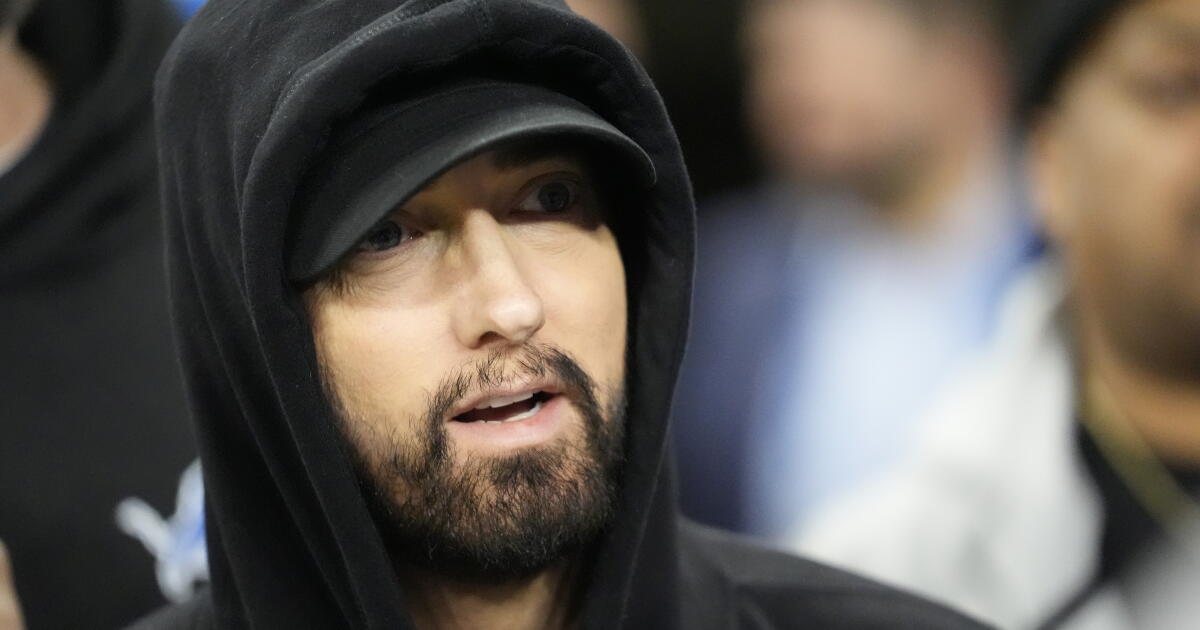
A Michigan man and former studio engineer is facing the music for his theft of rapper Eminem’s unreleased works.
Joseph Strange, a 48-year-old Michigan resident, pleaded guilty to criminal copyright infringement and will be sentenced to prison in January, the Department of Justice announced Thursday. He faces up to five years in prison. Federal prosecutors accused Strange in March 2025 of stealing and selling unreleased work by Eminem (legal name Marshall Mathers III).
An attorney for Strange did not immediately respond Friday to The Times’ request for comment, but told Variety in a statement that his client is a “good” man and his “children have suffered greatly in all of this.” The attorney said the case is “far more complicated and nuanced matter” beyond the theft.
“Nevertheless, my client has taken accountability for what he has done, has tremendous remorse for what has happened to his family,” the attorney reportedly added, “and has great faith, as do I, in the judges of our district to see this case for what it is.”
A spokesperson for 15-time Grammy winner, maker of hits “The Monster” and “Lose Yourself,” did not comment.
Strange was charged in 2025 with copyright infringement and interstate transportation of stolen goods, federal prosecutors announced. Investigators said at the time that more than 25 songs had been played or distributed online without permission from Eminem or the group that owns his music, Capitol Labels Group. Investigators discovered the music on password-protected hard drives stored in a safe at Eminem’s studio in Ferndale, Mich., an FBI affidavit said. At the time, an attorney for Strange denied the “untested allegations.”
The charges against Strange arose after studio employees alerted the FBI of the theft in January 2025, alleging the unfinished releases were shared to a number of online platforms. Files from a hard drive in a safe were transferred to an external hard drive in October 2019 and January 2020, around the time when Strange was working at the studio.
A Canadian resident informed investigators that he purchased 25 unreleased Eminem songs from Strange for about $50,000 in Bitcoin and that he raised the funds through the support of a group of Eminem fans. He also claimed Strange also put some of Eminem’s handwritten lyrics up for sale.
The affidavit says a federal search of Strange’s home in January 2025 led to the discovery of numerous lyric sheets and notes handwritten by Eminem, a VHS tape of an unreleased video and hard drives with about 12,000 audio files.
“Joseph Strange abused a position of trust to unlawfully copy and sell unreleased music belonging to Eminem, profiting from works that were not yet authorized for public distribution,” said A. Tysen Duva, assistant attorney general for the Department of Justice Criminal Division. “His conduct undermined both legal and artistic rights.”
WITH Halloween fast approaching, our Spotlight on column focuses on Londonderry, Northern Ireland.
The city is home to Europe’s biggest Halloween festival – now in its 40th year.
To celebrate, the city is launching a year-round Derry Samhain Experience and a permanent Halloween mural.
Here are some other top tips from us, including where to stay and some hidden gems.
Sign up for the Travel newsletter
Thank you!
MUST SEE/DO
From October 28 to November 1, The Awakening The Walled City Trail fills the city centre with light installations, street theatre, fire performers and live music, while the Little Horrors programme keeps younger children busy.
On Halloween night the Carnival Parade sets off at 7pm, followed by fireworks over the River Foyle.
Pack a costume, as locals take dressing up seriously.
The trail, parade and fireworks are all free, but if you plan to visit make sure you book a bed as soon as possible.
BEST VIEW
Derry‘s 17th-century walls, built between 1613 and 1618 to protect English and Scottish settlers, are the only fully preserved city walls in Ireland.
They have never been breached, not even during the 105-day siege of 1689.
The mile-long loop takes you past seven gates and 24 restored cannons, including Roaring Meg, stamped “Fishmongers, London, 1642” after the livery company that paid for it.
From the ramparts you can look down over the Bogside, where murals and Free Derry Corner tell the story of the Troubles.
schoolchildren and teachers dressed as orange pumpkins parade down shipquay street Halloween Derry IrelandCredit: Alamy
HIDDEN GEM
The Dickensian-style Derry Craft Village in the heart of the city is a reconstruction of an 18th-century street and 19th-century square, home to more than 70 local makers.
It was built by the Inner City Trust, a charity set up in 1976 to rebuild the city centre during the Troubles. Its cafes are good for a coffee or a bite.
Derry Girls fans should then pop next door to the Tower Museum, home of the Derry Girls Experience.
RATED RESTAURANT
Browns Bonds Hill, on the east bank of the River Foyle, serves modern dishes made with local, seasonal produce.
Opened in 2009 by chef patron Ian Orr, Michelin‘s inspectors single it out for its good value.
For something more casual, sister restaurant Browns in Town is across the river on Strand Road and serves classic burgers, steak sandwiches and pasta.
Derry Girls mural, Derry Londonderry, IrelandCredit: AlamyDerry City, Londonderry, Co Derry, Northern IrelandCredit: Alamy
BEST BAR
Peadar O’Donnell’s on Waterloo Street has live traditional Irish music every night, in a pub done up like an old-fashioned grocer’s and hung with flags.
It’s a top spot to pull up a stool and sink a pint of Guinness. If it’s too busy, try the Gweedore Bar, under the same roof with an equally buzzy atmosphere.
HOTEL PICK
The Walled City Hotel opened last autumn with 40 rooms in a 1920s former Bank of Ireland building on Strand Road, a two-minute walk from the Guildhall.
Its vaulted ceilings now look down on a bar and restaurant. Rooms cost from £102 per night. See walledcityhotel.com.
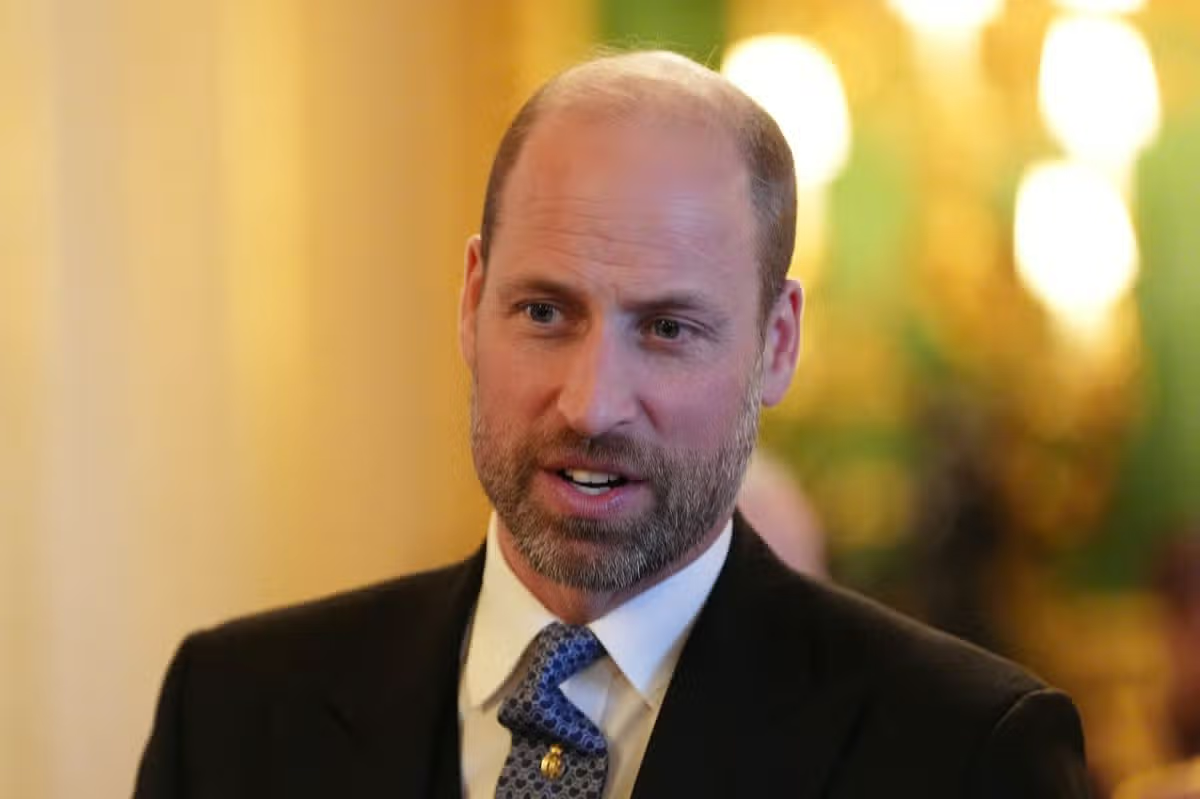
Prince WIlliam once dreamed about being a policeman before he turned his hand to DJing – but The Prince of Wales has been brutally honest about his talents during a surprise TV interview
Prince WIlliam grew up with hopes and dreams just like every little boy(Image: POOL/AFP via Getty Images)
Prince WIlliam has revealed his childhood dreams of becoming a DJ live on TV.
He joined Cate Blanchett, Robert Irwin and Hannah Waddingham on The Graham Norton Show last night. During the episode William was asked whether he had wanted a different career growing up, other than becoming the future King, to which he surprised the audience by saying he had.
His dream role was once to be a policeman, and he even said he wanted to be a DJ. He said: “I did want to be a policeman when I was younger; I thought I could make a good policeman.” Graham interjected saying: “Well, you’re tall.” Then Robert chipped in: “There’s a bit more to it than that mate.”
Graham continued: “Well, you’d look good in the uniform and the hat.” Prince WIlliam added: “I wasn’t on the catwalk. Yeah, being a policeman I thought was quite cool and then I went through a phase of wanting to be a DJ – which didn’t go very well and I came up with a name, I was called DJ Xara with an ‘X’, it wasn’t good.”
Graham asked: “Did you DJ at school parties?” To which Prince William said: “No, I didn’t, I never got that good.”
To see more of the stories you love from The Mirror and to find them easily in Google, then make us your preferred source. Free and easy to do, just click on the link here to find more from The Mirror at the top of your feed.
The audience is heard laughing along, prompting many royal fans to take to X to comment on the prince’s sense of humour, with many referring to William as “funny”.
One fan commented: “Prince William is articulate, funny and an intelligent decent man,” another added: “Prince William is pretty funny and bet he would look good in a police uniform.”
Another added: “I [red-heart emoji] seeing people realise just how charismatic and funny Prince William is, and that he has absolutely no problem laughing at himself. This clip of him on The Graham Norton Show is the perfect example of that. The poor man was absolutely red in the face from laughing so much.”
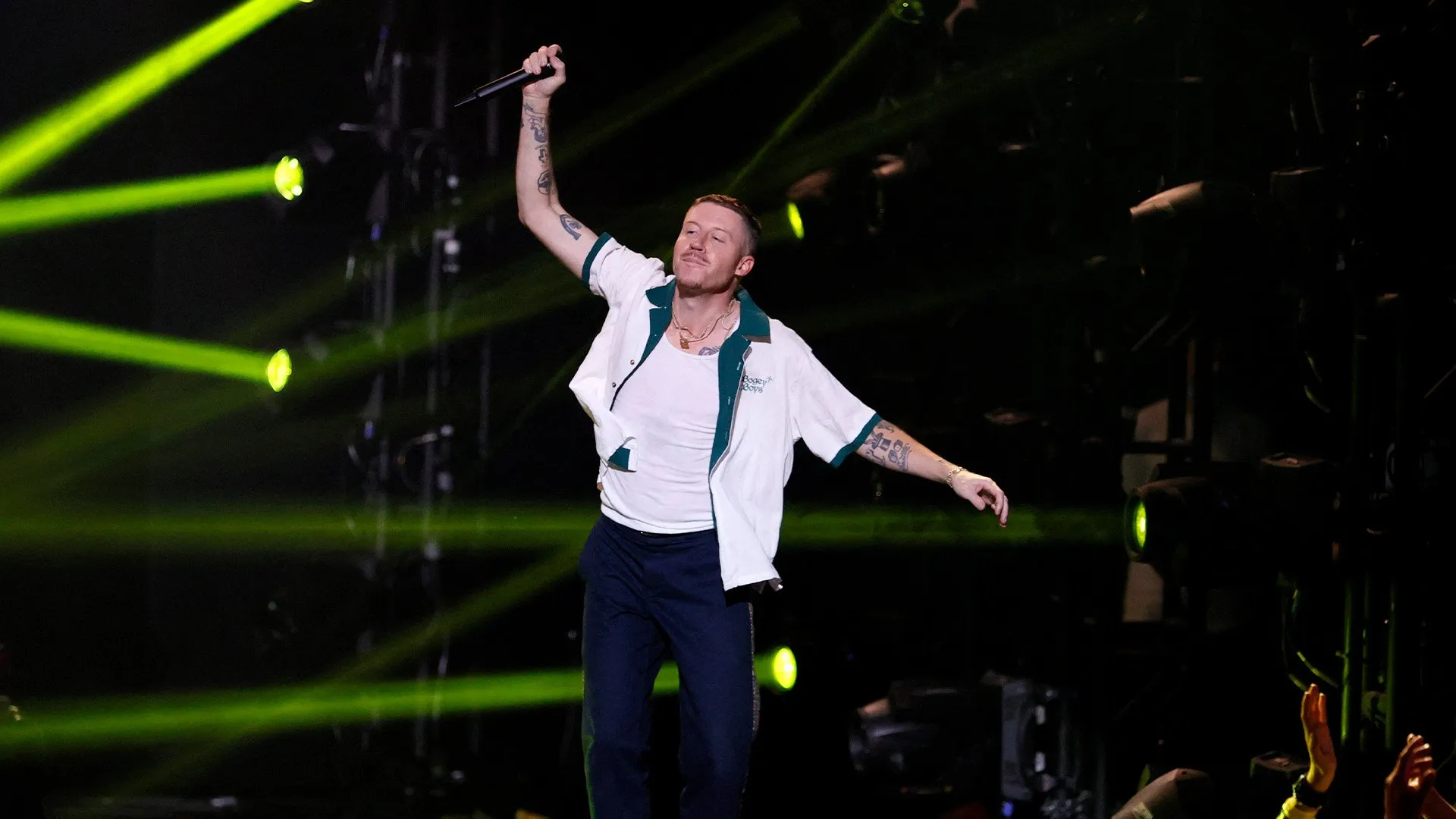
Macklemore says ‘being human is not complicated’ as he kicked off his Free Palestine tour on Thursday night. He returned to the stage for the first time since he was dropped as Ed Sheeran’s supporting act after making pro-Palestinian comments onstage.
RAZORLIGHT are keen to show they’ve still got the golden touch as they prepare for their 28-date tour across the UK and Europe.
The new shows will see Johnny Borrell and Andy Burrows celebrating the 20th anniversary of their self-titled second record, which spawned hits including America, In The Morning and Before I Fall To Pieces.
Razorlight are keen to show they’ve still got the golden touch as they prepare for their 28-date tour across the UK and EuropeCredit: SuppliedThe Sun’s Ellie at the Ovo Arena Wembley with Johnny and Andy
Speaking at the Ovo Arena Wembley, where the band plays on December 4, frontman Johnny recalls: “The first time we played here was supporting the Manic Street Preachers, it was a great show.”
Buzzing to be back, drummer Andy adds: “We feel very lucky, but at the same time we also feel like we did something really cool.”
Sign up for the Showbiz newsletter
Thank you!
The tour starts in Europe and reaches the UK with Glasgow on November 26, before cities including Nottingham, Bristol and Leeds.
And time on the road means more time to make new music.
“I’m hoping we do some writing on the road because we used to do that a lot,” Johnny says.
“Now we’re going out on the tour bus again, I think we’ll have a good chance of doing that.
“We’ve got a couple of really good songs at the moment and the next step is bringing it to the band and we’ll see how it sounds.
“I like where we’re at with Razorlight at the minute, we’ve got the bit between our teeth.”
Andy says: “These shows and playing together will fuel that. It would be easy to play some gigs, earn some money and be like, ‘See you in two years.’
“But we have that drive to say, ‘F**k, we need to do this again and do it better’.”
Johnny adds: “Everyone has to bring their A-game, then we need to meld together because then it creates something incredible.”
Johnny thinks the group — which first formed in 2002 — have some exciting years ahead.
Bjorn Agren, Andy, Johnny and Carl Dalemo perform on stage in 2023Credit: GettyAndy and Johnny perform at the Camden BarflyCredit: Getty
He explains: “I think a band needs that hunger. And I think we have that right now.
“We’re writing new material and we’ve got that drive.
“I always feel most comfortable in that kind of position where I’m fighting and trying to prove something. I like being the underdog and I like taking it on. When we play live, we’re not playing along to a backing track or anything pre- recorded or a click track or something like that, which 90 per cent of bands are doing now.
“It’s depressing. People do it because it’s easier and it’s cheaper to do. Anyone can go off and do 364 days of something else, then turn up and get a haircut and look like they’re in a band, you know?
“But we’re doing it the real way.
“It doesn’t matter if you’re the biggest band in the world. It doesn’t matter if you’re like the newest, youngest band starting out.
“If you’re doing it properly and you’re doing it for the love of the music, it’s a long road and you just have to keep fighting.
“And that’s our vibe right now.”
FLUFF LUCK FOR RAYE
Raye was the big winner at the Mercury Prize do after taking home the coveted gongCredit: GettyThe singer was snapped leaving in a faux fur coat and fluffly slippers while holding her trophy out for the waiting photographersCredit: BackGridOlivia Dean left the night empty-handed but made up for her loss by partying until 3am with her pals in NewcastleCredit: BackGridA source said: ‘Olivia might have lost to Raye but she was in great spirits’Credit: Getty
RAYE was the big winner at the Mercury Prize do after taking home the coveted gong.
She received the award for her incredible second record, This Album May Contain Hope.
After the bash at Newcastle’s Utilita Arena, the star was snapped leaving in a faux fur coat and fluffy slippers while holding her trophy out for the waiting photographers.
Raye, who turns 29 today, said: “I just poured so much heart into this album, I really did. This accolade is serious and something that I always dreamed to one day receive. I just feel really grateful.
“It’s the best birthday present I could have asked for.”
Olivia Dean left the night empty-handed but made up for her loss by partying until 3am with her pals in Newcastle.
One of my mates spotted the Man I Need singer heading off with her friends to cool DIY music venue The Lubber Fiend.
They told me: “Olivia might have lost to Raye but she was in great spirits. She went dancing with her mates and was having the time of her life. She’s a great girl and a proper good laugh.”
WIGHT MOVE BY ROBBIE AND CO
Robbie Williams has been announced as a headliner for the 25th Sky Presents Isle Of Wight FestivalCredit: Getty
ROBBIE WILLIAMS, Kings of Leon and Fatboy Slim have been announced as the headliners for the 25th Sky Presents Isle Of Wight Festival.
They will be joined by a slew of stars including Becky Hill, Kaiser Chiefs, Myles Smith, Cruz Beckham& The Breakers, Courteeners, Rudimental and Scouting for Girls.
The event, which takes place across four days from June 17 next year, still has some more acts to be announced.
Tickets go on sale at 8am on Monday,
Festival director Caroline Giddings said: “There’s a real mix of artists for different generations and tastes, and there’s still more to come.
“We put a lot of thought into what happens beyond the main stages, too.”
JoJo in a good lace
Jojo Siwa wows in lace as she attends the 2026 Dancers Against Cancer Gala in Beverly HillsCredit: Shutterstock Editorial
SINGER Jojo Siwa wows in lace as she attends the 2026 Dancers Against Cancer Gala in Beverly Hills.
The former child star looked worlds away from her wild pop star persona as she walked the red carpet in a stunning white dress.
The singer was in good company at the glitzy bash, with actress Carmen Electra and singer Janet Jackson also in attendance.
JoJo is currently enjoying some downtime in America after releasing a series of singles following her stint in the Celebrity Big Brother house last year.
GEORGE MICHAEL’s estate is hosting a free screening for NHS staff of his film, The Faith Tour, at London’s Roundhouse .
The show comes 20 years after his gig at the same venue for nurses, to thank them for caring for his mum who died of cancer in 1997.
Tickets will be distributed by NHS England.
Noel Gallagher with Amelia Dimoldenberg on Chicken Shop DateCredit: Instagram/@chickenshopdate
STRIP away his rock star status and Noel Gallagher is just like us.
In the new episode of Chicken Shop Date, he tells host Amelia Dimoldenberg: “I’m pretty low-key. My children live with me. We played a gig in São Paulo to 90,000 and I got home and came downstairs to find my two lads arguing over what was left in a box of Coco Pops. I thought to myself: ‘48 hours ago I was on stage – now I am arguing with two bellends about Coco Pops.’”
Tribute specials are always a bit macabre. They exist, and are sometimes quickly thrown together, to honor and celebrate an artist who impacted so many. They are also ratings and advertising cash grabs that air on major TV and streaming platforms.
“CMA Presents I Will Always Love You: A Celebration of Dolly Parton,” which aired Wednesday on ABC and Disney+, was a lovely tribute to the music and cultural icon who died from cancer in August. It also was a missed opportunity. As music superstar Vince Gill said toward the end of the two-hour program, “this is not a memorial; but a celebration of an undeniable force of nature. Dolly was somebody that everyone loved: City, country, young, old.”
But most likely because the event was put on by the Country Music Assn. — which naturally wanted to showcase its own talent — it lacked a chance to really celebrate that she and her music could not be contained by one genre.
This isn’t just ironic because Parton’s most-known song — a song that was both the title of the special and the end performance of it — was made all the more famous by Whitney Houston, another iconic performer and also one who happens to have been a woman a color and who did not have any other direct ties to the Nashville scene. Dolly herself, famously, appreciated so many other kinds of music. After her passing, Eminem shared on social media a letter she’d written to him to congratulate him on his 2022 induction to the Rock & Roll Hall of Fame.
“She definitely didn’t have to take the time to do it,” he said as part of the post. “Even for a kid who mostly listened to rap music, she was an icon. A superstar in every sense.”
That said, from Reba McEntire opening the show with stories of just how kind her friend was in real life to a pre-recorded tribute from Bono where his Irish accent briefly attempts to slip into a Southern one while emulating her conversations with him, there were some touching and memorable moments. We’ve rounded up five of them here:
Reba McEntire, “He’s Alive”
Technically, the song is meant to be the apostle Peter singing about Jesus Christ’s resurrection. But McEntire’s take on Parton’s take of the Don Francisco gospel brought in the very modern-day sense of fear that so many parents and partners feel when their loved ones go out to dangerous jobs or even just leave the house for school or concerts.
Carrie Underwood, “I Will Always Love You”
There’s no denying that this is a perfect song and that Underwood is a once-in-a-lifetime voice. And credit must be due to Underwood for pulling off an undertaking where any little slip would be pounced on by critics. But staging her to stand in front of one of the many animatronic butterflies that lined the stage in such a way that it looked like she had angel wings was … a choice.
Carly Pearce and Kristin Chenoweth, “9 to 5”
Both of these women, especially Tony winner Chenoweth, are masters of stage presence. Their banter with each other before singing, not to mention their duet itself, embraced the liveliness and feminine feminist-ness of that song.
Ella Langley, “Jolene”
This was not the most powerful performance of the night, as Langley seemed happier to dance on the stage than belt out the music. And it didn’t boil with the grief and seething rage of a scorned woman the way that Beyonce’s 2024 cover did. But it was nice to see a symbolic baton be passed to the “Choosin’ Texas” singer.
Zac Brown, “Butterfly”
Brown’s backstory of writing, and then recording, what would become his 2025 duet with Parton came off as sweet and genuine. It also helped it not feel awkward or gratuitous when he and the producers opted not to recast the Parton half of the song and instead let her voice carry through the speakers.
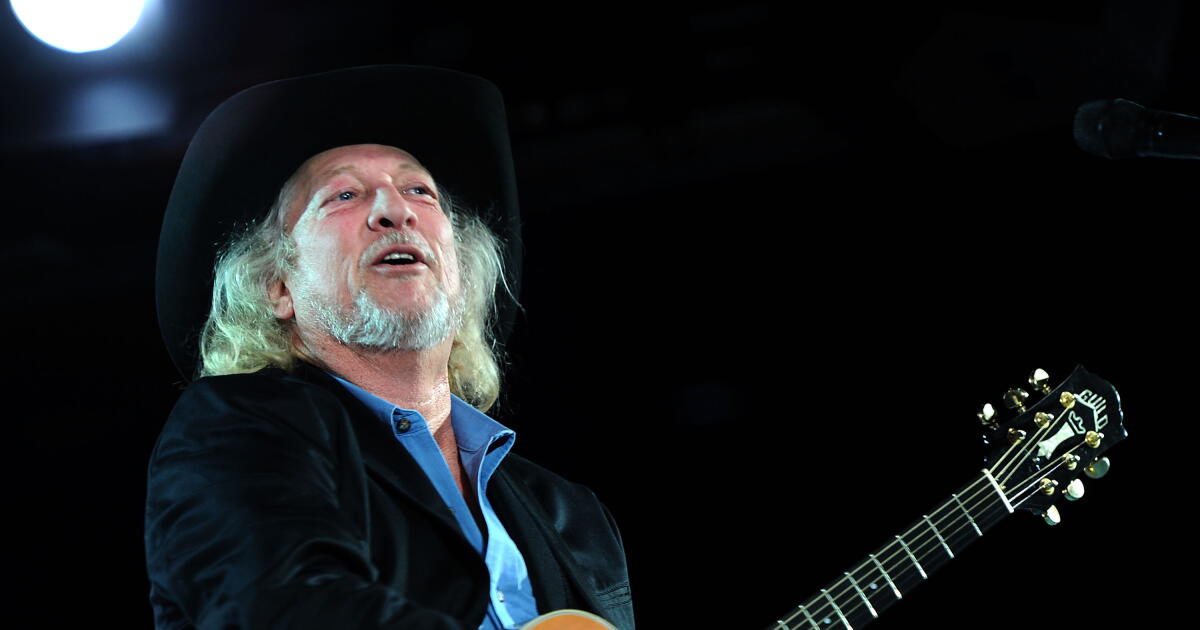
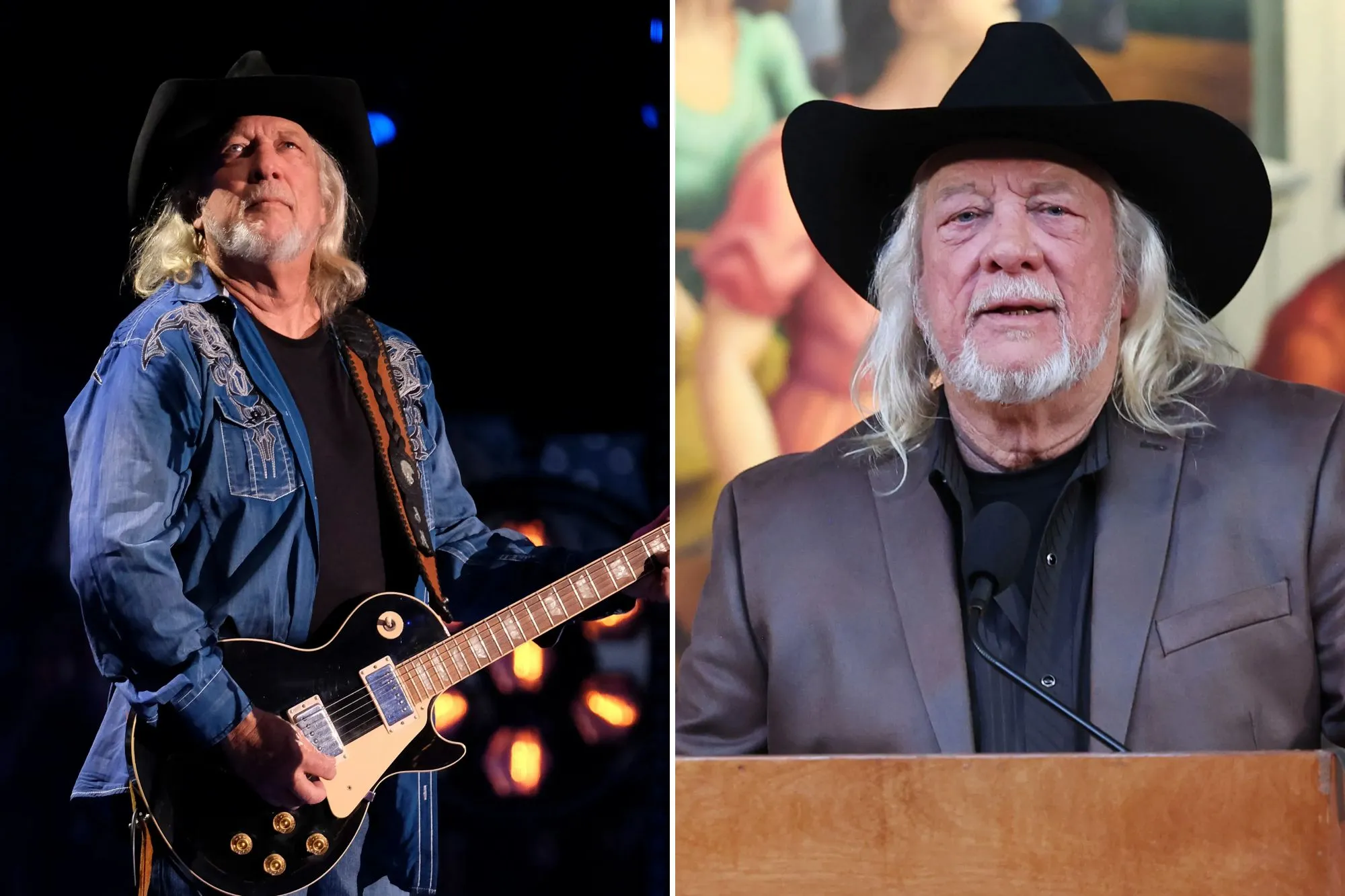
John Anderson, a country western star known for his traditional tunes and twangy voice, has died.
A representative for Anderson confirmed to The Times that the storied singer-songwriter died in his sleep at his home in Smithville, Tenn., on Wednesday. He was 71.
“It is with the heaviest of hearts that we share the passing of our beloved husband, father, grandfather, and best friend,” a statement from Anderson’s family read. “To the world, he was a gifted country music singer whose voice and songs touched countless lives. To us, he was so much more. He was the heart of our family, the one who made us laugh, loved us fiercely, and made every ordinary moment feel special. We are completely heartbroken. His music will live on, but for us, his greatest legacy will always be the love he gave his family and the memories we will carry with us forever. Please keep our family in your thoughts and prayers as we grieve this unimaginable loss.”
Born in Apopka, Fla., on Dec. 13, 1954, Anderson got his first guitar when he was 7 years old and played in garage bands as a teen. When he finished high school, Anderson packed his bags for Music City. He gigged at Nashville nightclubs until he landed his first record contract with the support of music publisher Al Gallico; he signed with Warner Bros. Records in 1976.
Over his storied career, Anderson earned 20 top 10 country hits, including five No. 1s. Through the 1980s and ’90s, Anderson was a leader in the explosion of neotraditional country tunes, and honky-tonks were filled with couples two-stepping to hits including “Swingin’,” “Seminole Wind,” “Straight Tequila Night,” “Wild and Blue” and “Black Sheep.”
In 1993, Anderson received the Academy of Country Music career achievement award. Introducing the award, Reba McEntire said Anderson was an early new traditionalist who “combined a sweet and pure country sound with great energy and emotion.” Billy Dean gave remarks, too, saying, “Back in the early ’80s, John’s sound and material struck the exact right chord with country record buyers and inspired a whole bunch of up-and-coming artists just like myself.”
In 2014, Anderson was inducted into the Nashville Songwriters Hall of Fame, and in 2024, Anderson he was inducted into the Country Music Hall of Fame alongside Toby Keith and James Burton.
“This is an institution that preserves greatness,” Anderson said of the honor. “That I get the chance to be amongst this kind of greatness, words can’t explain.”
COUNTRY music legend John Anderson has died at the age of 71.
The iconic voice behind Swingin and Straight Tequila Night was inducted into the Country Music Hall of Fame in 2024 with his heartbroken family paying a touching tribute.
Country music legend John Anderson has died at the age of 71Credit: GettyJohn was the iconic voice behind Swingin and Straight Tequila NightCredit: Getty
John, a native of Apopka, Florida, passed away on Wednesday.
His cause of death is yet to be announced.
Sign up for the Showbiz newsletter
Thank you!
An emotional statement from John’s family read: “It is with the heaviest of hearts that we share the passing of our beloved husband, father, grandfather, and best friend.
“To the world, he was a gifted country music singer whose voice and songs touched countless lives.
“To us, he was so much more. He was the heart of our family, the one who made us laugh, loved us fiercely, and made every ordinary moment feel special.
“We are completely heartbroken.
“His music will live on, but for us, his greatest legacy will always be the love he gave his family and the memories we will carry with us forever.
“Please keep our family in your thoughts and prayers as we grieve this unimaginable loss.”
Most read in Entertainment
John with his wife of 43 years Jamie Anderson at the Country Music Hall of Fame in 2026Credit: GettyJohn with Tim McGraw just four days agoCredit: Getty
He boasted a trio of hugely popular number one hits on the country charts for Wild and Blue, Black Sheep and his signature song Swingin.
John’s last public appearance saw him appear alongside his fellow inductees at the Country Music Hall of Fame Medallion Ceremony in Nashville on October 18.
They were inducting the 2026 stars Tim McGraw, Paul Overstreet and the Stanley Brothers.
John said his own induction into the elusive club was one of his best achievements.
He told Rolling Stone at the time: “One of the main gratifications is I got to live to see it.
“Several of my friends were inducted posthumously.”
John leaves behind his wife of 43 years Jamie Anderson and their two daughters Brionna and Alexa.
Eric Dangerfield is surrounded by senior citizens.
After a packed set at Riot Fest the previous weekend, the 25-year-old lead singer and rhythm guitarist of the Paradox welcomed the quiet of his boomer-dominated neighborhood.
“I’m a suburban dude,” he said, smiling from his home in metro Atlanta, his cropped two-toned dreads bobbing as he spoke.
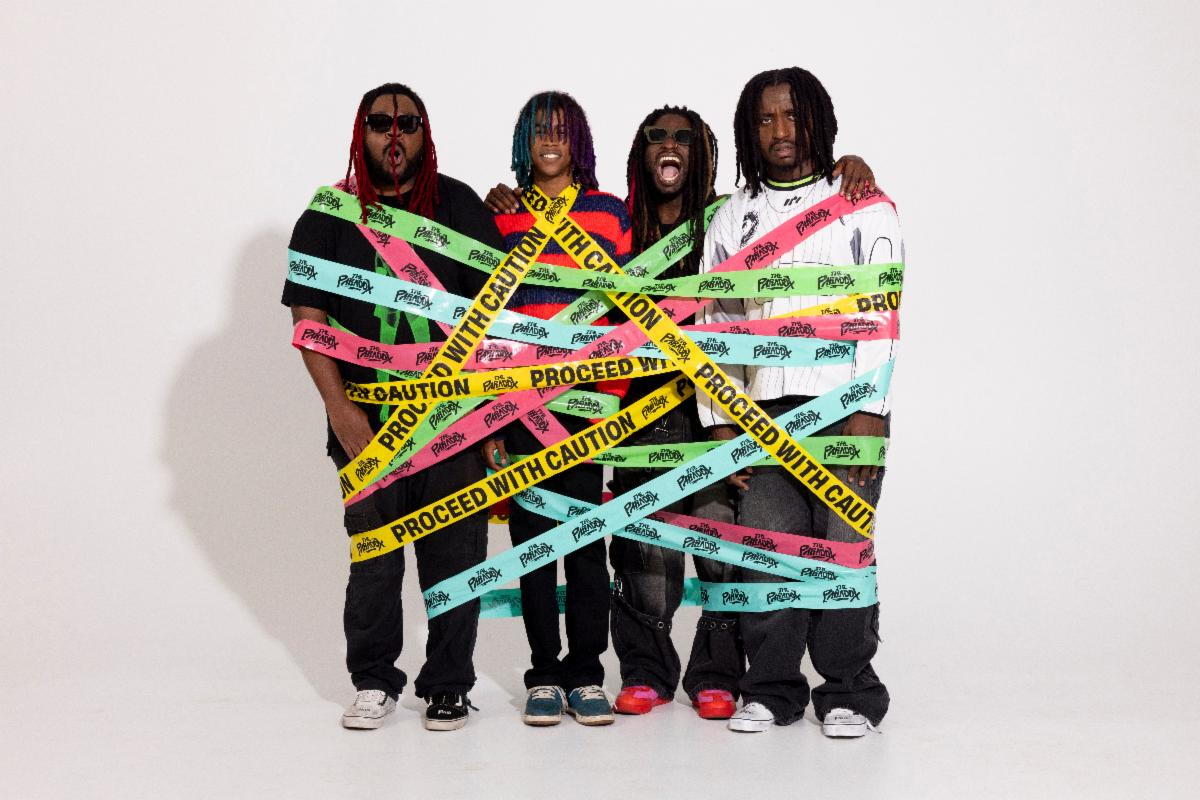
The Paradox spent much of the summer on the festival circuit, powering through a growing discography of pop-punk gems, so Dangerfield and the three other band members are taking a brief breather before their Proceed With Caution Tour starts this month — their first as headliners.
It’s peaceful. That is, “Except when the boys come over,” he adds.
On a late morning in September, the boys are here and accounted for: patching in to a video call, minutes apart, from their homes, also in suburban ATL. Dangerfield, born with the perfect stage name, has ideas that flow faster than he can seem to get them out. Then there’s Donald Bryant on bass. Yin to Dangerfield’s yang, with a quiet, commanding presence.
Percy “PC3” Crews has been playing drums since he was 3, and his vicious skills on the drum kit contrast with a cheery, relaxed demeanor. Finally, there’s Christopher Bernard, a.k.a. Xelan — the lead guitarist and Dangerfield’s vocal complement.
Dangerfield likens the four to musical superheroes from a Marvel series. But not so much the “Earth’s mightiest heroes” variety.
On their first headlining tour, the band brings its new EP, “Proceed With Caution,” to Los Angeles while claiming space in a historically white genre and weaving social commentary into its pop-punk sound.
(Shorefire Media)
“I’m like Mister Fantastic and Donald’s my Invisible Woman. Xelan’s the Thing, and Percy is John Storm,” he says of his partners in musical mischief. “If I’m ugly, just say that,” quips Xelan, the band’s oldest member at 30. “Yeah. Because you’re strong, bro,” reassures Eric.
By this time, the interview has devolved into fun-loving chaos.
They finish each other’s sentences and switch up their Google Meet backgrounds, cracking up as an awkward graduation portrait pops up. At some point, Bernard decides to give a bedroom tour, showing off his collection of Blink-182 and Fall Out Boy posters.
A photo of him with Travis Barker hangs next to a framed Billboard plaque on a nightstand. Barker was featured on the Paradox’s 2025 single “Bender” and performed with the group at Vans Warped Tour the same year.
The Billboard plaque commemorates the band’s song “Get the Message” from its debut EP, “NSFW,” reaching No. 1 on the Alternative Airplay chart in January — a great achievement for any rock artist — but the Paradox also happens to be the first all-Black band to do so.
The success, although rapid, didn’t come from nowhere. All of the members have been working toward music in some form for years.
Dangerfield had a deal with a small label where he was originally making a go of it as a pop and R&B soloist. He also put out his music online. Looking for something different, he remembered his passing interest in pop-punk from his days growing up in Palm Coast, Fla. It was the “Fat Lip” video by Sum 41 that sealed the deal.
Yearning to be in a band, he started working with Bernard, whom he met online and shared his passion for the genre. Bryant was Dangerfield’s childhood friend from Palm Coast who had also moved to Atlanta, while Crews had been a fixture on the local music scene. And the name? It came from Dangerfield’s love of quantum physics.
Shortly after the group officially formed in June 2024, Dangerfield’s then-girlfriend — now wife and band “momager” Lexi Dangerfield — opened Instagram and TikTok accounts filming and posting their homey videos. The band’s song “Kaitlyn” and some covers blew up. The artists’ perspective, filtered through a Gen Z lens, struck a multigenerational nerve.
Attention came so quickly that Dangerfield felt the need to defend against online detractors who were convinced the group was an industry plant.
From there, the fairy-tale plot thickened. Billie Joe Armstrong followed Dangerfield on Instagram, and the two struck up a friendship that led to the Paradox opening for Green Day on the Atlanta stop of its Saviors Tour. But this was, of course, after Jack White’s people called — who the group ended up opening for at Basement East in Nashville.
Things haven’t slowed down in the two years since, with opportunities coming fast and furious. In the spring of last year, the band signed a deal with Hundred Days Records, a subsidiary of Virgin Music Group, and teamed up with producers Mike Pepe and Robopop to work on “NSFW.”
“Bender,” the group’s collaboration with Barker, and “Do Me Like That” are featured on Madden NFL 27 and NBA 2K26 video game soundtracks. Last month, the musicians streamed a concert from Twitch superstar Kai Cenat’s house. And now, instead of opening for their idols, they are inviting them up on stage as guests. For their second Warped Tour in Long Beach, that meant Deryck Whibley of Sum 41 and Logan Henderson from Big Time Rush.
The embrace from established musicians has definitely helped the band navigate its rise. In a moment of doubt, Crews said Good Charlotte’s Joel Madden, in particular, came through with sage advice.
“He asked me a question: ‘How does it feel being where we were?’ And I was like, ‘It feels like a dream.’ It felt like I was gonna wake up on my desk sophomore year with drool on my f— table. And I was telling him that, and he was like, ‘You know, it may feel that way, but it is real … It’s real, and it’s you … you belong in these rooms.’”
The irony of being embraced in a mostly white subgenre of punk rock while Black American culture formed its foundation is not lost on the group. Had the band come about during one of Dangerfield’s favorite eras of music, the ’50s and ’60s — there would likely have been rooms in which they weren’t welcomed.
While the band members understand the impact their visibility has — especially for non-white kids who grew up in the suburbs as they did: skating, riding BMX, building Legos, watching anime, dreaming of a life onstage — it does require some balance. “They’re not asking Taking Back Sunday this stuff,” Dangerfield acknowledged when asked if they might tire of the representation mantle. “Or Blink, but … We are a minority in this space and in this country, and I think that you know the stuff that comes with being Black should definitely be talked about. I think those conversations are important.”
He said as much in August, when the group made its Tiny Desk debut in celebration of NPR’s Black Music Month. “Now, like they said, we made history,” he said, leaning into the mic after the first song. “And the Paradox is in the business of bringing rock ’n’ roll back to the originators.”
A glance at the comment section under the video makes clear the group’s authenticity resonates with those who haven’t felt seen or heard in certain spaces.
“I’m a black girl from the suburbs of Metro ATL,” wrote @rainjojo. “And I’m glad to see representation of people who are like me indulging in punk rock. I got into this genre from childhood shows like “16,” “Stoked”, and other early 2000 to 2010 shows, and I remember being bullied for being whitewashed. Please keep making more music like this.”
The tour is named after “Proceed With Caution,” the band’s sophomore EP released on Oct. 2. Across six tracks, it continues in the same vein as “NSFW,” with sharp melodies and a dash of humor thrown in. But on “That’s Not Fair,” the group wades deeper into social commentary. It was also the most difficult to record, cut raw with no click track.
“We were just trying to think of things that were not fair, [from] small and trivial like losing your keys to, I don’t know, using it as a bridge to talk about larger issues and things like that,” Dangerfield says of the song. “I think a big thing for me personally, it’s not political … is kind of the fact that everything is getting so expensive. The price of everything is rising so rapidly, and the salaries that people are being paid are not really growing to match that.”
The Paradox perform at The Moroccan Lounge on Thursday, Oct. 22.
(Hunter Lyon)
“And it’s like, we got very lucky, but the thing is, most people don’t,” he continued. “If you’re gonna sacrifice all your time, slaving away working for big corporations and stuff like that, you should at least be able to, you know, buy a candy bar or something.”
So far, the musicians aren’t taking anything for granted and are trying to enjoy the in-between moments.
Dangerfield and his wife took their daughter on a Disney cruise for her second birthday — she’s spent much of her young life traveling with the band.
With some of his publishing money, Bernard indulged his love of vintage Japanese fashion and has a 2000s-era Tuscan house on his vision board. Crews stays healthy, listens to lots of Snarky Puppy, and looks forward to the relaxed cannabis laws of L.A. when the tour stops at the Moroccan Lounge on Oct. 22 and 23. If time allows, he might even have time to surf in Malibu.
Bryant, who counts Mike Dirnt, Mark Hoppus and James Jamerson among his biggest influences, balances a dream of seeing his band play for thousands with looking forward to a life lived like his older brother: a chiropractor with a nice family.
But some dreams will have to wait as the band goes back to making music, hopefully with lasting impact. The members want to become household names, “like Nirvana,” with music people will play for hundreds of years. Why not?
Anything is possible when you are a fantastic foursome.
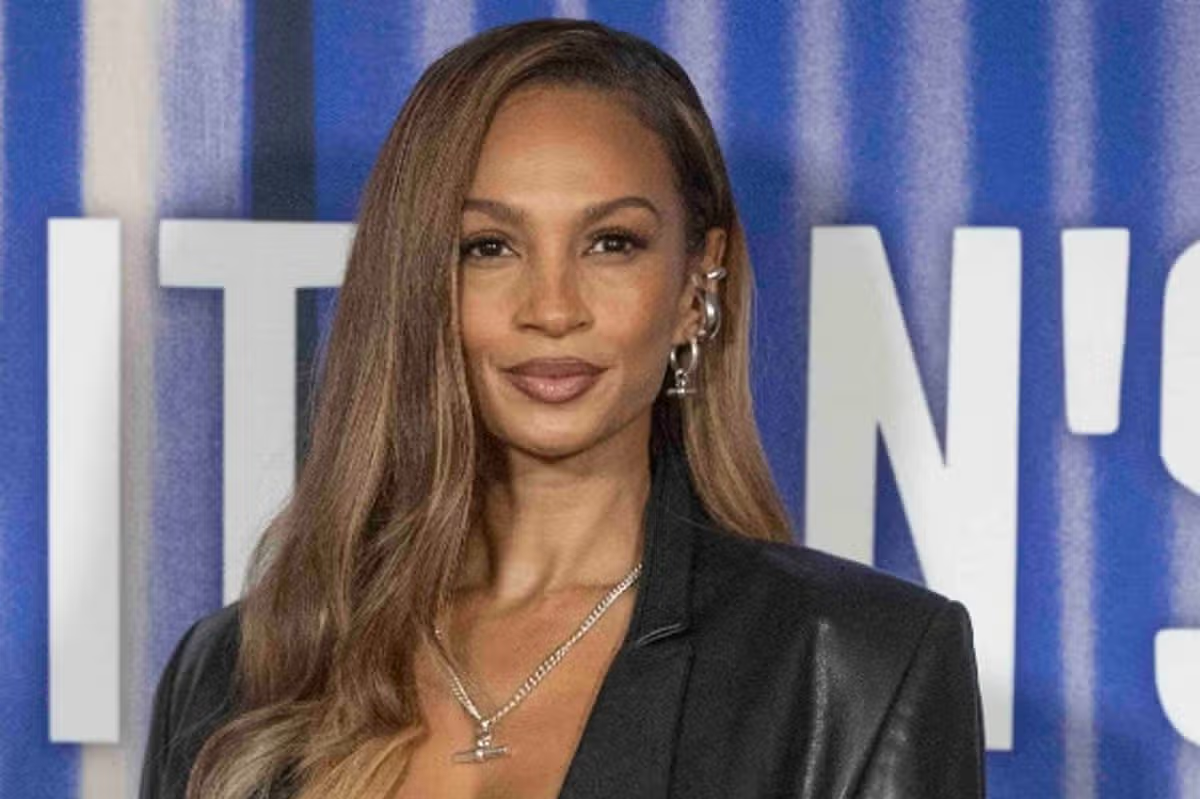
Alesha Dixon leapt to the defence of her The Voice UK co-star Cheryl Tweedy after a contestant on Britain’s Got Talent attempted to criticise the Girls Aloud singer
Alesha Dixon is said to have furiously defended Cheryl Tweedy(Image: Getty Images)
The singer will join Stacey Solomon, taking over from Emma Willis, as the pair join forces to host The Voice UK. The singing competition, which also airs on ITV, has undergone a major shake-up, with longstanding coach Sir Jom Jones axed.
To see more of the stories you love from The Mirror and to find them easily in Google, make us your preferred source. Free and easy to do, just click on the link here to find more from The Mirror at the top of your feed.
During filming for Britain’s Got Talent in Blackpool, it’s reported that a contestant attempted to criticise Cheryl’s vocal abilities. The Sun reports that Alesha hit back instantly.
The Mis-Teeq star slammed her red buzzer halfway through the hopeful’s act and used her feedback to make it clear that she wouldn’t allow his comments. “You don’t come after a mate of mine,” the singer fumed.
Although fans won’t see Cheryl taking on her full-time role as a coach until next year, they were, however, treated to a glimpse earlier this month. The singer joined her pal Will during the Battles Round of the ITV competition.
During the episode, Will revealed that he had been trying to get Cheryl to join him for the past 13 years. Cheryl knows exactly what it takes to make it in the music industry, having found fame after being selected for Girls Aloud on Popstars: The Rivals in 2002.
Speaking to Team Will, the Call My Name songstress said: “I’m so excited for you. You couldn’t be in better hands than you are with my man Will. Will and I have collaborated a lot over the years, so we know what it’s like for two very different artists to come together. I wish you all the very best for what you’ve got today, and I’m excited to see you all!”
Reflecting on her own experience, having found fame on Popstars, Cheryl said during a solo interview: “I have stood in the shoes that the contestants are standing in, and I know what it feels like to perform in this environment. You’ve just got to know that you’re good, or you wouldn’t be here.”
Cheryl’s decision to sign up for the show marks a return to television after a lengthy break from the spotlight. In recent years, Cheryl has turned her attention to family life and has only taken on brief work spells, including her West End debut in 2:22 A Ghost Story.
While she once dominated the music industry and became the first female artist to have five records debut at Number One, her last single, Let You, was released in 2019 and peaked at Number 57 on the Official Charts Company.
One answer arrived this year in the form of “Music, Fashion, Film,” Charli XCX’s bracing follow-up to 2024’s Grammy-winning “Brat.” An emotionally complicated dance-pop album about the relationship between power and vulnerability, “Brat” struck a nerve in a weird cultural moment and finally brought Charli the kind of stardom she’d been openly seeking for ages. In the LP’s immediate aftermath, the English musician hungrily scooped up the spoils of her success — playing Coachella’s main stage, starring in a highbrow mockumentary, soundtracking Hollywood’s latest take on “Wuthering Heights.”
Yet “Music, Fashion, Film” wonders what it all meant. It’s a digitally enhanced rock record — probably 2026’s best thing-with-guitar — that cycles through thoughts on ambition and trend-chasing before landing with a moving sense of serenity on the idea that everybody dies and takes their accomplishments with them.
Share via
“No One Lasts Forever” is the album’s final track, and Sunday night that was also Charli’s closer at Inglewood’s Kia Forum, where she headlined the second of two shows over the weekend.
Structurally, the concert bookended songs from “Brat” (for which she was accompanied by prerecorded tracks) with stuff from “Music, Fashion, Film” (for which a scuzzy live band backed her up). There were stray oldies too, including “Constant Repeat,” which she introduced as one of the first songs she wrote about her husband, George Daniel — “even though it’s not exactly truthful,” she added — and the landmark hyperpop cut “Vroom Vroom.”
She also did “House,” a spooky goth-folk song from “Wuthering Heights” that had her writhing on the stage in the white-hot heat of a single spotlight — a sex kitten turned scream queen (or perhaps vice versa). And she brought out Adéla, the Slovakian singer famously booted from the reality show that created Katseye, to do her viral hit “Nicole Kidman,” which is just one of a handful of rough-edged pop hits this year that demonstrate “Brat’s” lasting influence.
Indeed, what was illuminating about the middle of the show — basically a half-hour-long club night with strobes cranked happily to here’s-the-seizure-you-ordered — was seeing how very un-tired Charli’s fans are of being pulverized by songs like “Club Classics,” for which she donned her Superman’s-cape sunglasses, and “Guess,” during which pairs of underwear rained down on the audience in a nod to the music video for the song’s remix with Billie Eilish.
Charli had opened with the new album’s “Rock Music,” in which she declares that “the dance floor is dead”; here, her sarcasm fooled precisely nobody.
My favorite part was the home stretch of tunes from “Music, Fashion, Film”: “Camera,” a startlingly frank confession of her movie-star aspirations; “Magic Metal Montana,” a deeply tender ode to her friend and collaborator A.G. Cook; “SS26,” a jittery electro-punk jam about “walking on a runway that goes straight to hell.”
I love the strange emotion in these songs — the feeling that you might as well say what you want because the only thing more embarrassing than taking a risk is not taking one.
At some point, Charli lit up a cigarette and waved it around like someone who’d discovered a critical truth. What were they gonna do — make her end the concert early?
BRITISH holidaymakers are increasingly planning their travel around music, sporting and cultural events, according to a study.
Whether considering a trip for a concert, music or food festival, exhibition or sporting fixture in 2027, 36 per cent now more likely to do so than they were this time a year ago.
This shift towards event-led travel is reshaping behaviour, with 45 per cent having already visited cities and countries they wouldn’t otherwise have considered.
Similarly, out of those who have stayed somewhere overnight for an event in the past four years, 62 per cent based their most recent travel plans entirely around it.
Sign up for the Travel newsletter
Thank you!
For sports fans, the commitment to being there for the moment can stretch well beyond a weekend.
The poll of 2,000 adults found 56 per cent would use annual leave to follow their team or country, while 31 per cent would travel abroad to see them play.
With hotels near almost every NFL stadium, MarriottBonvoy, which is an Official Sponsor of the NFL, is helping travellers create a game plan for this season’s trips by appointing Efe Obada as its Check-In Coach.
Efe Obada said: “In the NFL, preparation gives you a strong starting point, but you’ve also got to trust your team and be ready to adapt when things change.
“I approach travel in the same way. If you’ve only got a few days in a city, be tactical, adaptable and make a game plan.
“Book your hotel, know how you’re getting to the main event and ask people who know the city for advice. That’s how to make the most of every trip.”
The research found many are embracing spontaneity, as 52 per cent said an unplanned discovery has gone on to become one of the highlights of their holiday.
While 37 per cent will only book their hotel, transport, and key activities in advance, leaving the rest flexible.
NFL veteran Efe Obada is Marriott Bonvoy’s new ‘Check-In Coach’ to help travellers plan their holiday with an all-star strategyCredit: Will Ireland/PinPep
While spontaneity plays an important role, travellers still value a strong start to the day, with 52 per cent saying hotel breakfast is a non-negotiable part of their trip.
The study also uncovered four NFL-inspired travel personalities, revealing the roles travellers are most likely to play when travelling.
A quarter (25 per cent) identify as ‘The Quarterback’, the on-trip leader who brings everyone together, makes key decisions, and adapts the plan when things change.
The same number (25 per cent) see themselves as ‘The Coach’, the planner who has the logistics covered, from accommodation and transport to activities and timings.
While 24 per cent take the role of ‘Rookie’, the explorer who is experiencing a destination or event for the first time and turns to others for guidance and local recommendations.
Whereas 19 per cent were categorised as ‘The Receiver’, the spontaneous adventurer who spots opportunities, suggests unexpected detours, and helps create memorable moments.
Andrew Watson from Marriott International, said: “This research highlights what we see in our hotels, that travellers are increasingly planning trips around the things they are passionate about.
“Our partnership with the NFL is just one example of a wider commitment to helping our members pursue what they love.
Efe, who applied the strategy to his hometown, London, added: “London is one of those cities where every neighbourhood has its own personality.
“For a perfect weekend, I’d book at stay at citizenM Tower of London then grab a coffee at Qima Café in Covent Garden, walk along the Thames around Southbank or spend an afternoon at Hampstead Heath for unbeatable London views.
“For food, you can’t beat 2210 by NattyCanCook in Herne Hill or head to Passyunk Avenue in Waterloo for unmatched game-day vibes and a Philly cheese steak.”
EFE’S PLAYBOOK FOR A TACTICAL WEEKEND TRIP:
1. Do your pre-match analysis: Book your hotel early, check journey times and map out the key moments you don’t want to miss.
2. Kick off strong: Give yourself time to fuel up before heading out. A good game plan always starts with the essentials.
3. Teamwork is key: Local knowledge can make all the difference. Ask hotel staff for recommendations and insider tips.
4. Don’t be afraid to adapt: Leave room for unexpected discoveries – be that a bar, restaurant or neighbourhood. Sometimes the highlights aren’t part of the original strategy.
EXCLUSIVE: Richard Marx, a friend of Sir Tom Jones, has said the decision to axe the music icon from The Voice UK coaching panel was ‘handled badly’ amidst the public backlash
19:47, 17 Oct 2026Updated 19:47, 17 Oct 2026
A friend of Sir Tom Jones has said that his axing from The Voice was handled ‘badly’(Image: ITV)
Sir Tom Jones’ friend has said the backlash surrounding ITV axing him from The Voice UK is “pretty significant”. The music icon, 86, was sensationally dropped by the ITV talent show after 13 years as part of a major shake-up.
Bosses had hoped to offer Sir Tom a role on the show, but in a “different capacity”. Although he’s currently appearing on series 14, next year will be very different. Long-standing coach will.i.am will be joined by returning coach, Kelly Rowland, as well as newbies Cheryl Tweedy and rapper Aitch.
To see more of the stories you love from The Mirror and to find them easily in Google, make us your preferred source. Free and easy to do, just click on the link hereto find more from The Mirror at the top of your feed.
Speaking to the Mirror, Sir Tom’s pal and The Voice Australia coach, Richard Marx, said: “The way that went down, and I don’t know the behind-the-scenes details, but I know Tom a little bit, and he’s such a class act, and I think however they handled it, they handled it badly, it seems.
“And the backlash, the public backlash, has been pretty significant.” Richard went on to add: “I haven’t seen him in a while, but I actually spent some time in the studio with him years ago, and I grew up idolising him. When I was a little kid, it was Tom and Elvis; they were my guys.
“Years later, his son, who manages him, reached out to me, and we went into the studio together, Tom and I, and nothing ever really came of what we did in the studio, but he and I hit it off and got to spend some time together. He’s just such a lovely guy. I absolutely love Tom.”
Richard went on to say that despite Sir Tom’s health struggles, his pal is “remarkable”. He said: “I just saw a clip on TikTok yesterday from a gig like a week ago, and he came out, and you could tell he was like, ‘Ugh, my hips hurt!’ or whatever, you know, like, but then he sits down, and his voice is the same! It’s unbelievable, he’s 86. Holy s*8t!
“That’s goals for me, man! I want to be that. Tony Bennett was able to do that, and I look at Tom; there are so few people whose voices don’t just ultimately leave them in some way, shape, or form. And I think it’s a testament to Tom, and Tony Bennett also, if you just never stop singing, you just got to go—you just got to stay—sing all the time, and that’s what they do..”
After a career spanning decades and 14 albums, Richard also disclosed that trying to pick a setlist for his recent shows at the London Palladium had been “tricky”. “Especially in America,” he laughed, adding: “But in such an incredibly wonderful way. Which is why sometimes, I don’t play all the singles. I’ve done a few gigs here, where I didn’t do anything but hits.
“But when I was putting that setlist together, I thought ‘Man, I am the luckiest guy in the world to be able to have a setlist like that.’ I know that first of all, I cater to the people who’ve supported me all these years, and I know that they want to hear the hits. I get it, because I’m the same way when I go see um when I go see a band play, if they don’t do most of the material that I know and love, I’m going to be a little bummed out.”
His shows, he says, are a journey for fans to kick back and relax, listening to their favourite hits live, while also being introduced to new material. He’s also a fan of Niall Horan, explaining: “I’ve never seen Niall, but I’m a fan of his. If you’re the kind of performer I am, who talks to the audience a lot, once you build a rapport with that particular audience, they’re in.
“It’s almost like you saying to your friends at a dinner party, ‘Hey, listen, can we pause the Sade station here for a few minutes, because I want to play you a couple of songs I’m really into?’ Of course, your friends are going to go, ‘Yeah, show me! What do you got?’ It’s kind of like the same thing. I tell everybody, ‘If you come to see me live, I’m very proud of the music that we play.”
Rock band Pavlov’s Dog is mourning the loss of singer-songwriter and lead vocalist David Surkamp, who died Monday at age 74.
Violinist and Pavlov’s Dog member Abbie Steiling announced Surkamp’s death Wednesday on Facebook. Additional information about Surkamp’s passing, including a cause of death, was not revealed.
“David leaves behind a legacy of endless creativity, unmistakable artistry, and a body of music that has touched lives across generations and around the world,” Steiling said on the band’s behalf.
Pavlov’s Dog also remembered its vocalist for his “profoundly poetic spirit and a romantic heart that found its way into every note, every lyric and every performance.”
Surkamp was born May 23, 1952, and led Pavlov’s Dog, known for songs “Julia” and “Late November,” since its founding in 1973 in St. Louis. He founded the band alongside bassist Rick Stockton, violinist Siegfried Carver and drummer Mike Safron, according to the band’s website. The group, which first signed to ABC Records under a six-figure deal, released its debut album “Pampered Menial” in 1975. The release featured the band’s most popular songs and showcased Surkamp’s high-pitched and trembling, yet powerful, vocals.
Pavlov’s Dog’s second release “At the Sound of the Bell” followed in 1976 and its third, “Lost in America,” came more than a decade later in 1990. Surkamp departed Pavlov’s Dog while recording its junior album and traveled to Seattle to further develop his musical talents. This led to a collaboration with British musician Iain Matthews and their power pop duo Hi-Fi.
Surkamp and his Pavlov’s Dog collaborators reunited in the early 2000s and Surkamp’s wife, Sara, joined as a vocalist and guitarist. The group went on to tour Europe, including playing the Netherlands’ Arrow Rock Festival in 2006. Over the years, Pavlov’s Dog saw members come and go: Some musicians departed the group because of conflicting commitments and others — including founding members Carver and Rayburn — died in the late aughts and early 2010s.
The group, with Surkamp still at the helm, later released albums “Echo & Boo” in 2011, “Wonderlust” in 2025 alongside some live albums, remasters and unreleased demos.
“He always allowed the musicians around him to shine in their strengths, generous with the spotlight and appreciative of what each brought to the music,” Steiling continued in the band’s Facebook post. “No matter what life held for him, he came alive onstage. Even on his hardest days, when the lights came up and the count-off began, he was a consummate performer. If he was playing music, it was a great day.”
Surkamp was preceded in death by his wife Sara, who died in 2025 at age 72. He is survived by children Saylor and Evan.
Holidaymakers are increasingly planning their next destination around music, sporting and cultural events
NFL veteran Efe Obada is Marriott Bonvoy’s new ‘Check-In Coach’ (Image: PinPep)
More and more British holidaymakers are planning their trips around music, sports, and cultural events, according to a recent study. This surge in event-driven travel is shifting how people holiday, prompting 45% of respondents to explore destinations they’d never even thought of visiting before.
What’s more, out of all the travellers who stayed overnight for an event in the past four years, 62% planned their entire trip specifically around it. Looking ahead to 2027, 36% say they’re even more excited to travel for a concert, festival, exhibition, or big game than they were last year.
The survey of 2,000 adults revealed that 56% of sports fans would happily use their annual leave to follow their favourite team anywhere they play—and 31% are willing to head abroad to do it.
With hotels right near nearly every NFL stadium, Marriott Bonvoy—an Official Sponsor of the NFL—is helping fans build the ultimate game plan by bringing on Efe Obada as their official Check-In Coach.
Efe Obada said: “In the NFL, preparation gives you a strong starting point, but you’ve also got to trust your team and be ready to adapt when things change.
“I approach travel in the same way. If you’ve only got a few days in a city, be tactical, adaptable and make a game plan.
“Book your hotel, know how you’re getting to the main event and ask people who know the city for advice. That’s how to make the most of every trip.”
The research also identified four NFL-inspired traveller types, showing the roles people typically adopt while on holiday.
A quarter (25%) see themselves as ‘The Quarterback’, the trip leader who unites the group, takes charge of major choices, and adjusts plans when circumstances shift.
An equal proportion (25%) regard themselves as ‘The Coach’, the organiser who handles the practicalities, from accommodation and transport to excursions and schedules.
Meanwhile, 24% assume the position of ‘Rookie’, the first-timer who is discovering a location or occasion for the first time and seeks advice and insider tips from companions.
In contrast, 19% fell into ‘The Receiver’ category, the impulsive explorer who identifies possibilities, proposes unplanned diversions, and contributes to unforgettable experiences.
Andrew Watson from Marriott International, said: “This research highlights what we see in our hotels, that travellers are increasingly planning trips around the things they are passionate about.
“Our partnership with the NFL is just one example of a wider commitment to helping our members pursue what they love.”
Efe, who applied the strategy to his hometown, London, added: “London is one of those cities where every neighbourhood has its own personality.
“For a perfect weekend, I’d book at stay at citizenM Tower of London then grab a coffee at Qima Café in Covent Garden, walk along the Thames around Southbank or spend an afternoon at Hampstead Heath for unbeatable London views.
“For food, you can’t beat 2210 by NattyCanCook in Herne Hill or head to Passyunk Avenue in Waterloo for unmatched game-day vibes and a Philly cheese steak.”
EFE’S PLAYBOOK FOR A TACTICAL WEEKEND TRIP:
Do your pre-match analysis: Book your hotel early, check journey times and map out the key moments you don’t want to miss.
Kick off strong: Give yourself time to fuel up before heading out. A good game plan always starts with the essentials.
Teamwork is key: Local knowledge can make all the difference. Ask hotel staff for recommendations and insider tips.
Don’t be afraid to adapt: Leave room for unexpected discoveries – be that a bar, restaurant or neighbourhood. Sometimes the highlights aren’t part of the original strategy.
One word that could describe Aria Vega’s whirlwind 2026? Chévere.
The Colombian expression for “awesome” is also the name of the fast-rising star’s global smash hit. Released in January, the breezy tropical swing of “Chévere” — and the rest of her sun-kissed singles — embodies the spirit of Colombia’s Caribbean coast where she hails from.
Ahead of the Latin Grammys on Nov. 12, where Vega will be in the running for the best new artist award, Vega is taking what she calls her “Costeñita Core” pop movement on the road, with her first-ever U.S. tour.
“Looking back at all the dreams I’ve accomplished and made come true, it’s all blessings,” a wide-grinning Vega says over Zoom from Miami.
“I’ve been crying tears of joy with my family, my friends and my combo chévere, as I like to call my fandom. Every artist wishes and dreams of a Latin Grammy, and for me, just to be one of the nominees is like, ‘Yo, I’m a winner!’”
Vega was born Mariana Padilla Pérez in Barranquilla, where she lived the lifestyle of the costeños — or the people of Colombia’s Caribbean coastal region. She has been steadily chasing her dreams of superstardom since competing on “Idol Colombia” in 2014; but Vega finally started making waves last year when she integrated more costeño culture, rhythms and slang into her mellowed, Spanglish pop flow.
“Chévere” exploded in popularity after fellow Colombian singer Ryan Castro jumped on the remix in February. Since then, Vega has pushed “Costeñita Core” further into the mainstream with songs like the alluring “Cule Poco (Sirena_Besarico_Costeña),” and the sultry “Compa Coleto (Uy_Como),” offering unhurried takes on champeta and other Afro-Caribbean rhythms.
Vega just kicked off her U.S. Cariavales Tour, which includes a stop at the Roxy in Los Angeles on Oct. 13. Just a week before, she was handpicked by her pop foremother and icon from Barranquilla — Shakira — to perform as part of her 12-show residency in Madrid.
In an interview with The Times, Aria Vega opened up about her Latin Grammy nomination, representing costeños and getting a co-sign from Shakira.
How did the success of the song “Chévere” change your life? I didn’t expect to be on [so many] airplanes and flights. Right now, I’m starting to feel the weight of that. I’ve seen what it’s like to live on the road. The remix happened after Ryan [Castro] sent me a DM on Instagram saying, “‘Chévere’ is a banger!’” I was really excited to even get that message from him, because I’m a fan of his music. That was a really cool moment.
What can you tell us about your upcoming debut album? It’s Afro-Caribbean-inspired music. Right now, the album is really long. I have recorded more than 30 songs for it. I’m working on cutting it down to hopefully 15 songs that will touch your heart and soul … I want to make people vibe with my songs, feel cool, and feel chévere. That’s my goal with this album [I call] “Costeñita Core.”
What does “Costeñita Core” mean to you? It’s an energy that you either vibe with or you don’t. It’s like our food, our slang and experimental fashion. Caribbean maximalism and shifting [mainstream] culture. Overall, it’s about making bold choices and being rebellious.
How do you feel about representing costeño culture through your music and visuals? It’s a big responsibility. I feel really happy and excited when I see comments that say things like, “It’s an honor for you to represent us, and we love what you’re doing.” I get emotional because I don’t always get that response … There’s also people that say, “I feel that I’m not represented by her in any way.” It’s a mixture of feelings. What can I say? I’m doing this with a lot of love for Barranquilla, Colombia and Colombia’s Caribbean coast. I want to be a voice of the Caribbean coast.
What did it mean for you when Shakira selected you to perform for her residency in Madrid? As soon as my team told me about this opportunity with Shakira, I was going crazy because she’s so inspiring. She’s also from Barranquilla. Her music has been a part of [my] life. It has been like a companion for me. Since I was like 5 years old, there’s always been a Shakira song that I was vibing with. I’m really excited even about the possibility of meeting her.
How do you feel about performing in L.A. for the first time on your U.S. tour? I’ve been to Los Angeles before in meetings with my agents and stuff like that, and it felt like a movie. It’s Hollywood vibes and I’ve never felt that energy in my life. It’s really special getting to perform all my songs that are not just in Spanish, but in Costeñol [the costeño dialect of Spanish] at the Roxy. I’m going to wear outfits with cultural designs and perform traditional dances that have been part of my life, ever since I was literally in my mom’s belly. Los Angeles is a coastal city too, so there’s something that connects us.
What are your thoughts about being nominated in the category of best new artist at this year’s Latin Grammys? Everyone says it’s a really important category, because you can’t be nominated twice. You can only be nominated once in your career. Hopefully I’ll go to Las Vegas for that Latin Grammy and I’ll take it over to la costa.
What will you do if you win the award? Maybe I’ll do a concert at home. I want to do something that feels honest and authentic, because that’s what led me to being nominated. I dream of becoming a bearer of my culture. What better way to do it than being recognized in the eyes of the Latin Recording Academy?
What was the inspiration for your latest single “Compa Coleto (Uy_Como)”? My muse is always my tiburón, my shark. It’s no secret that I’m in love. It just makes sense to talk about him in these really loving and cool songs. It’s a song with flirtatious vibes. When you understand the song’s lyrics, it just makes sense to flirt that way and have fun with it.
Who do you want to collaborate with in the future? I would love to collaborate with Shakira and Beéle. I feel they do a lot for Barranquilla as well. I would love to collaborate with Bomba Estéreo from Santa Marta. Maybe I’ll do vallenato music with Silvestre Dangond. That would be really cool. Felipe Peláez has an amazing voice. It would be cool to bring these sounds of our own to the world.
Cheryl has made a surprise early return to The Voice UK and is set to appear in Saturday night’s episode for the Battle Rounds, joining long-time friend Will.i.am as his assistant coach
Cheryl’s appointment is part of a wider shake-up for The Voice UK(Image: ITV/Rachel Joseph/Shutterstock)
The Girls Aloud star, 43, appeared in the latest episode as the ITV singing competition continues its Battle Rounds, joining her longtime friend Will.i.am to help him decide which contestants deserve a place in the semi-finals.
Cheryl was confirmed as a coach for the next series last month, replacing Sir Tom Jones on the panel. Her appearance this weekend will give viewers an early taste of what to expect when she officially takes up the role. The singer arrived alongside Black Eyed Peas star Will.i.am, 51, looking stylish in a red tasselled leather jacket and light blue flared jeans.
To see more of the stories you love from The Mirror and to find them easily in Google, make us your preferred source. Free and easy to do, just click on the link here to find more from The Mirror at the top of your feed.
The pair embraced as they reunited for filming, having worked together on music projects over the years. Will revealed that he had been trying to have Cheryl join him for the last 13 years. Cheryl knows exactly what it takes to make it in the music industry, having found fame after being selected for Girls Aloud on Popstars: The Rivals in 2002.
Speaking to Team Will, the Call My Name songstress said: “I’m so excited for you. You couldn’t be in better hands than you are with my man Will. Will and I have collaborated a lot over the years, so we know what it’s like for two very different artists to come together. I wish you all the very best for what you’ve got today, and I’m excited to see you all!”
Reflecting on her own experience, having found fame on Popstars, Cheryl said during a solo interview: “I have stood in the shoes that the contestants are standing in, and I know what it feels like to perform in this environment. You’ve just got to know that you’re good, or you wouldn’t be here.”
And fans were overjoyed to see Cheryl back on screens. One said on X, formerly known as Twitter: “Cheryl looks amazing, oh my gosh.” “CHERYL ON #TheVoice Saturday night TV is SO back,” said a second. “Ah I’m buzzing,” commented a third. A fourth exclaimed: “So excited.” “I’m excited to see Cheryl and Will back together,” commented another.
Her appearance marks a return to television after a lengthy break from the spotlight following the death of her former partner, Liam Payne, in October 2024.
The singer had largely stepped back from public life in the wake of the tragedy, making her new coaching role a significant career move. While Cheryl once dominated the music industry and became the first female artist to have five records debut at Number One, her last single, Let You, was released in 2019 and peaked at Number 57 on the Official Charts Company.
Prior to this, her last album, Only Human, which peaked at Number 7, boasted the singles Crazy Stupid Love and Only Human, and was released in November 2014.
Cheryl’s appointment is part of a wider shake-up for The Voice UK, with Stacey Solomon and Alesha Dixon confirmed as the show’s new presenters. The pair will take over from Emma Willis, who is moving on after landing a presenting role on Strictly Come Dancing.
The Voice Australia coach and current Strictly Come Dancing contestant, Delta Goodrem, is helping Kelly after spending eight seasons on the Aussie edition of the programme.
Also, Danny and Tom were joined by their McFly band members Dougie Poynter and Harry Judd as they tried to win The Voice UK two consecutive years in a row following their success with AVA in 2024.
Last Saturday (October 3), the final round of the blind auditions aired, and the coaches finalised their teams, which consist of eight acts each.
Team will.i.am is made up of Diogo Ferreira, Sonna Rele, BMG, Triple Threat, Teodora Sava, Naná Aldrin-Quaye, Ardú, and Bella Popera. Team Kelly has Monique Nicholson-Porter, Ray Gelato, Lascel Wood, Aaren James, Cris Quammie, Samantha Udeke, Turah Sadiq, and Jessica Beth.
Cate McHugh, Vadé Amãlia Estradas, Harry Linacre, Eric & Jensen, Dakari Love, Molly J, Robbie McMinn represent Team Sir Tom and Ellie Harney, Ross McGuire, Ciiara Nyx, Finlay McKillop, Jack Algar, Frank Raven, Regan Preece, Adam Tucker have joined Team Tom and Danny.
The coaches and their advisors will now work with the acts to try to help them secure their place in the competition but not every act can progress.
The Voice UK returns to ITV1 and ITVX on Saturday, October 17 at 8.35pm
Famous hits from Steps, Bucks Fizz, JLS, the Celebrity Weekender breaks are perfect for those who miss the anthems of the eighties, nineties and noughties
This article contains affiliate links, we will receive a commission on any sales we generate from it. Learn more
Eight music-themed weekends will take place(Image: Parkdean Resorts)
Holidaymakers seeking inspiration on where to book their next break can enjoy an autumn getaway with a twist at a series of star-studded weekends at holiday parks across England and Wales. Parkdean Resorts has announced Celebrity Weekenders, mini-breaks filled with the music of the eighties, nineties and noughties with some famous faces joining the party.
Priced from £179, these themed weekends are taking place at five parks across North Yorkshire, Norfolk, Dorset and Wales, with celebrity guests including Chesney Hawkes, The Cheeky Girls, and Claire and H from Steps, plus members of Bucks Fizz, Atomic Kitten, JLS and loads more.
Music lovers can step back to the eighties at Cayton Bay Holiday Park this November, or enjoy nineties nostalgia at Ty Mawr Holiday Park. Elsewhere, Vauxhall Holiday Park will play host to a 90s vs 00s Weekend, as well as a Boybands vs Girlbands celebration and a Celebrity Tribute line-up, while Trecco Bay holiday park is the place for classic disco and retro dance music with its Disco for Grown-Ups weekend.
READ MORE:
These Celebrity Weekenders also offer plenty of activities to keep the celebrations going between music acts, from silent discos and bottomless brunches to bingo and fancy dress competitions, with the line-up varying by holiday park. Sites are also home to everything from amusement arcades and arts and crafts to high ropes courses, adventure golf and bungee trampolines.
However, Parkdean Resorts notes that while children are welcome to join a Celebrity Weekender, there will be limited entertainment and activities running for children, so these breaks are best suited to grown-ups. Those seeking a family-friendly staycation this autumn can check out Parkdean’s standard offering, as well as the likes of Haven, who are running Halloween-themed breaks throughout October, and Butlin’s, who have The Masked Singer Live shows on offer during October half term plus up to 20% off all 2026 and 2027 breaks.
There are eight weekends to choose from across five Parkdean Resorts holiday parks.
Vauxhall Holiday Park, Great Yarmouth
Boybands vs Girlbands: Kerry Katona, JLS star Oritsé Williams, East 17, Liberty X, and Atomic Kitten’s Natasha Hamilton are among the celebrity guests joining the festivities at this weekend for music lovers. Starting on November 6, prices start from £164 for three nights.
90s vs 00s: Nineties icon Chesney Hawkes will be bringing his best hits to this weekend, while D:Ream and Betty Boo will also be flying the flag for the nineties, and DJ sets from Marvin Humes, Chris Moyles, Toby Anstis will ramp up the party atmosphere. Taking place from November 20, a three-night break over this weekend starts from £179.
Celebrity Tribute: This jam-packed weekend features tribute shows to legends like Elvis, Michael Jackson, Cher, Freddie Mercury, Elton John and Tina Turner, as well as sets celebrating modern icons including Take That, Taylor Swift, Lady Gaga, Kylie Minogue, Ed Sheeran, Harry Styles, Bruno Mars and more. From November 13, this weekend is priced from £178 for three nights.
Sandford Holiday Park, Dorset
Hitman: The Hitman himself Pete Waterman will be joined by 911, Sybil and Brother Beyond’s Nathan Moore at this weekender, which is also a true treat for classic Neighbours fans with activities including a Kylie vs Jason fancy dress competition, Kylie karaoke, and a big-screen showing of Scott and Charlene’s wedding, as well as a dance class, lip sync battle, a Grease sing-a-long, and a retro-themed brunch. Taking place from November 13, prices start from £194 for three nights.
Celebrity Christmas: East 17, The Cheeky Girls, Marvin Humes, Pat Sharp, Kerry Katona and Black Lace will all be in attendance to end November with a bang and begin the countdown to Christmas with DJ sets and dance floor hits. Starting on November 27, this weekend is priced from £224 for three nights.
Trecco Bay Holiday Park, Porthcawl
Disco for Grown-Ups: Steps legends Claire Richards and Ian ‘H’ Watkins will be joined by Gareth Gates and Bucks Fizz stars Cheryl Baker and Jay Aston for non-stop famous hits, while In Da Bungalow legends Dick & Dom will host a DJ set. From November 13, prices start from £194 for three nights.
Ty Mawr Holiday Park, Conwy
90s Weekender: Vernon Kay will host a DJ set in this weekend enjoying the anthems of the nineties, joined by the likes of Big Brovaz & Booty Luv, Honeyz and A1. Re-Take That will also be bringing all the hits from the beloved pop group, while a live rock show will celebrate the female artists who defined the alternative music scene of the nineties. From November 20, prices start from £193 for three nights.
Cayton Bay Holiday Park, North Yorkshire
80s Weekender: The Real Thing, Black Lace, Thereza Bazar’s Dollar and Deniece Pearson Five Star are among the celebrity guests in attendance at this weekend celebrating all things eighties. Taking place from November 20, prices start from £238 for three nights.
Sass Jordan, the Canadian rock star known for hits such as “Make You a Believer” and “Tell Somebody” who served as a judge on all six season of “Canadian Idol,” has died. She was 65.
Jordan died Friday surrounded by her family, according to an announcement posted to Instagram Saturday. No cause of death was provided, but she had reportedly canceled a number of performances in Ontario, Canada, in September “due to a serious medical condition.”
“She remains in our hearts, an inimitable force of nature,” her family wrote in the statement accompanying a photo of Jordan cuddling a cat. “An irreplaceable being of light and joy!”
Jordan made her solo debut with her 1988 album, “Tell Somebody,” which led to her winning the Juno Award — the Canadian equivalent of a Grammy — for most promising female vocalist the following year. She moved to Los Angeles in 1990 before releasing her follow-up album, “Racine,” in 1992.
“Racine” remained one of Jordan’s biggest solo albums, with tracks including “Make You a Believer,” “I Want to Believe,” “You Don’t Have to Remind Me” and “Goin’ Back Again.” She also recorded a duet with Joe Cocker, “Trust in Me,” for the 1992 film “The Bodyguard” that year.
“I always think of music as medicine and as healing for myself and for anyone else who wants to join in,” Jordan said in a 2023 interview with the CBC about audiences still responding to her earlier hits when she performed. “[S]o it’s an extremely uplifting thing. … It’s amazing and it’s incredible to see that. It’s incredible to see people responding to something that is genuinely, like you said, 20 years old.”
Born on Dec. 23, 1960, in Birmingham, England, Sarah “Sass” Jordan moved from France to Montreal with her family at age 3 when her father, a French literature professor, took a job at Concordia University, according to a statement shared by her publicist Eric Alper after her death. Seeing David Bowie in concert as a young teenager inspired Jordan to dream of a career in music. She began singing and playing guitar with friends in Westmount Park and by age 16 she was performing with bands in downtown Montreal nightclubs.
“I’m an expert on rebellion,” Jordan told The Times in 1992, reflecting on why she ran away from home at 14. “I didn’t want that clean, wholesome life … It felt so fake. I identified with real people, oppressed people who were outside that life. I wanted to taste real life — street life.”
Throughout her career, Jordan would tour alongside acts including Aerosmith, the Rolling Stones, AC/DC and Van Halen. Her touring band in 1994 included Taylor Hawkins, who would go on to become the drummer for the Foo Fighters. Jordan’s most recent release is the live album from that tour, titled “Live in New York Ninety-Four.” Hawkins died in 2022 at age 50.
For six seasons, Jordan served as one of the judges on the reality competition series “Canadian Idol.” The show aired from 2003 to 2008 and mirrored the format of shows like “Pop Idol” and “American Idol.”
“Over four decades, she gave Canadian rock one of its most recognizable voices, carved out space for women in a genre long dominated by men, and opened doors for the young musicians who came through her band,” Alper said in his statement. “Sass Jordan leaves a catalogue that shaped Canadian rock through the late ’80s and ’90s, a blues renaissance in which her voice grew richer with each record, and a generation of artists, from Idol hopefuls to a future Foo Fighter, who learned from her what it means to give a song everything.”
Jordan is survived by her husband Derek Sharp, daughter Stella Jordan-Sharp, stepdaughter Brianne Sharp and brother Daniel Jordan.
Hannah Britt answered the millennial call to see 90s heartthrobs the Backstreet Boys at their 10-night residency in Dusseldorf, and found it to be the very best tonic ☆☆☆☆☆
10:31, 05 Oct 2026Updated 10:49, 05 Oct 2026
This article contains affiliate links, we will receive a commission on any sales we generate from it. Learn more
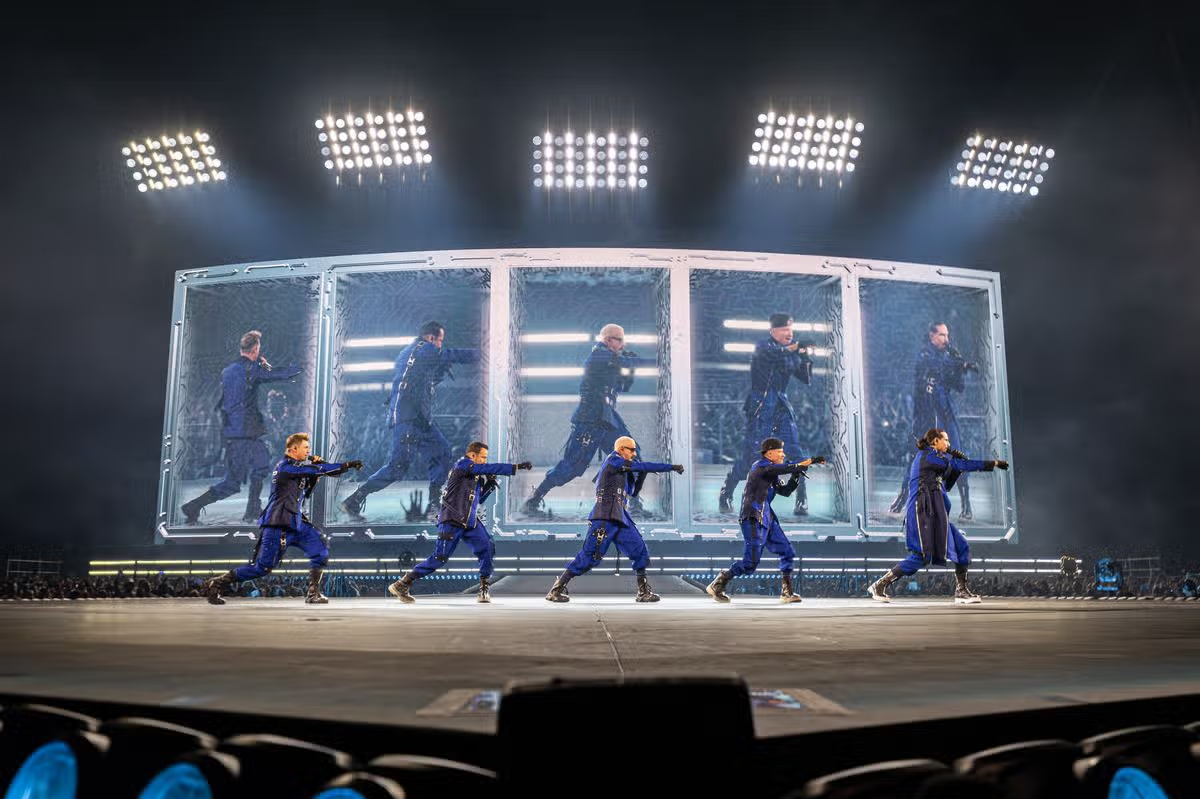
Backstreet Boys are playing to over 450,000 fans in Dusseldorf over the course of their 10-night residency(Image: Justin Segura)
The new trend among some of the world’s biggest artists is turning concert-going into a musical pilgrimage. Indeed, from Celine Dion’s 26 nights in Paris, to Harry Styles‘ 12 at London’s Wembley Stadium, for many fans a gig ticket now comes with a city break.
Music residencies, which used to be the preserve of Las Vegas mega hotels, have hit the mainstream, with more and more acts opting to stay put and, instead of touring around from place to place, have their fans come directly to them. Talking about his run of Together, Together shows, Harry Styles explained that playing in one place instead of embarking on a traditional world tour would improve the quality of the performance and better support his personal wellbeing.
And the idea is catching. After a run of sold out shows at The Sphere in Las Vegas, everyone’s favourite 90s heartthrobs the Backstreet Boys announced 10 nights at the Merkur Spiel-Arena in Dusseldorf, a location chosen as it was the first place the I Want It That Way band cracked outside of America.
A homecoming, they told fans. Wear white. The millennial in me couldn’t resist. I used to kiss a picture of Nick Carter before retiring to my bunk bed each night aged eight. This was my chance to see him in the flesh. What’s more, compared to Vegas, Dusseldorf was practically next door. I simply had to go. And I’m so pleased I did.
A residency turns a pop concert into a cultural phenomenon. I’ll admit, other than knowing Dusseldorf was in Germany, I didn’t know anything about it. But I diligently booked my flight, enlisting my best friend Emily to join the fun.
I saw my first Backstreet Boys T-shirt on the plane. And a quick glance around showed me it was not the only one. Millennial white and baby blue adorned many of the passengers before they’d even left Manchester airport, and their number would only grow as we landed.
Once in the passport control queue in Dusseldorf, the singing began. And by the time Emily and I reached the city centre, we had found full blown boyband mania. Checking into our hotel, the chic and homely 25hours Hotel Das Tour which I’d found on Tripadvisor, and which was situated to the north of the city centre, life size cardboard cutouts of Nick, Kevin, Brian, AJ and Howie greeted us, along with a cocktail list inspired by the band, and a playlist to match.
In the foyer, an excited throng of diamanté-bedazzled women in their 30s buzzed excitedly. With partners and kids at home, a deliciously childlike giddiness replaced the adulthood we’d left behind. I found myself wishing I’d brought blue eyeshadow and butterfly clips.
Venturing out in search of sustenance, Düsseldorf’s bustling centre delivered mania still. A huge hopeful crowd was gathered outside of the band’s hotel, Breidenbacher. In the old town, the city’s bars blasted out the band’s biggest hits, from Larger Than Life to Incomplete.
White and blue balloons decorated the banks of the Rhine, and in the Marktplatz square a Backstreet Boys experience and merch shop drew huge queues. If you’d come to Dusseldorf for a quiet city break you’d have been most confused. But for those of us there for the show, it all added to the fun.
I found the mania endearing. It was exciting, intoxicating. It reminded me of Manchester before Oasis’ comeback shows in the city last year, only with less guitars and more earnest key changes. Even Emily, who arrived knowing one Backstreet Boys song in total, soon declared her desire for a tour T-shirt.
With some time to kill before the main event, we explored the Dusseldorf. Lunch was mussels and chips at the chic Robert restaurant on the riverbank, and views came courtesy of a boat trip down the Rhine, booked with ease on Get Your Guide.
We then partook in what appeared to be the city’s main occupation – drinking beer. Dusseldorf’s Altstadt (Old Town) is famously known as the “longest bar in the world” (längste Theke der Welt) because it packs around 260 to 300 bars, pubs, clubs, and traditional breweries into a compact area of just half a square km. It was brilliant fun, set of course to an ever-present soundtrack of our favourite five piece.
Producing bobbles, we put our hair in 90s bunches. Back home we’d have drawn stares. In Dusseldorf when the population was at a rough estimate 96% Backstreet Boys fans, we looked like we belonged. As we walked back to 25hr we smiled as we heard screaming coming from the Breidenbacher. The Boys had emerged from the hotel to say hello.
That evening, before heading to the arena we went to The Paris Bar on the 17th floor of 25hr. I had a Brian, Emily a Nick. Then we made our way to the show. A sea of denim, white combat trousers and glitter guided us there.
As the Backstreet Boys took the stage, the mania came to a head, but so did the joy. So began a setlist stuffed with nostalgia, dance routines, and all their biggest hits. It was like an injection of pure serotonin. The ticket may have come with a city break attached, but it turned out to be the very best therapy. And as everyone’s favourite key change came in the closing bars of Drowning, you could feel 60,000 millennials healing their inner child all at once.
*For tickets, see here; for more information about 25hr Hotel Das Tour, see here; for more information about Get Your Guide, see here; and for all things Tripadvisor, see here
In 2011, Joe Kay debuted Soulection as a college radio show at Cal State Long Beach, spinning rare B-sides, progressive beats, inventive flips of classic records and soulful underground tracks.
Fifteen years later, the niche local broadcast on K-Beach Radio has ballooned into a cultural movement that extends far behind his alma mater’s campus. Beyond its flagship on Apple Music with nearly 750 episodes (Grammy-winning producer Swizz Beatz was a recent guest DJ), Soulection is also an independent record label, live event and clothing brand. Operating under the banner “the Sound of Tomorrow,” the collective championed artists like Kaytranada, Brent Faiyaz, Bryson Tiller and Snoh Aalegra before they were household names.
Still, Kay remains hungry for more. “There’s so much more to do,” says Kay, who released his first project “If Not Now, Then When?” last year.
“We’re at this breaking point of not just being underground,” he adds. “It’s like we’ve been D-1. We’ve been to the playoffs. Now we’re like how do we get to the championship and not just show up to the championship, how do we win?”
On Saturday, Kay and his tight-knit crew are celebrating Soulection’s 15th anniversary with a festival at Reframe Studios Outdoors in Atwater Village. The lineup includes DJ sets from Kay, Grammy-winning producer and artist Kaytranada, Sango, Esta, DJ Miss Milan (who DJs for Doechii), Ayanna Heaven and surprise guests. (Kay doesn’t even know who all will show up.)
Ahead of the hallmark event, Kay spoke about how he continues to find emerging talent when everyone’s an artist or DJ these days, building long-term staying power, his new dance music concept and why he’s nowhere near done pushing the limits of what Soulection can do.
Joe Kay and his team are celebrating 15 years of Soulection on Saturday at Reframe Studios Outdoors in Atwater Village.
(Jason Armond / Los Angeles Times)
This weekend, you are celebrating the 15th anniversary of Soulection with several guests, including Kaytranda, who has been connected to the brand for years but has yet to be on an official Soulection lineup until now. What does this homecoming mean for you?
It’s special. Just having Kaytranada, it’s been long overdue but right on time, and to me that’s all that matters. About four years ago, we did a private party in L.A. in between Coachella, and it was him, Peggy Gou and myself, and it was a really cool party. So we played together, but in terms of a public, front-facing event, this is the first time he’s been on one of our lineups. What I appreciate about him is his work ethic. That man just doesn’t love to DJ, but this man works so hard. I work really hard, and then I see him and it makes me just want to go harder. This man is constantly on tour and he just finds a way to keep putting out music that people care about so much. I think that alignment between him, Esta and Sango is special. Even having Miss Milan, it’s one thing to be a DJ for someone like Doechii, but to also see what she does independently, I really admire that. There’s not a lot of women in the space who are moving like that and are recognized. She’s a boss on stage. Then, Ayanna Heaven is from New York, but she’s Jamaican and we’re lucky to have her.
What else can we expect at the show?
We’ll have a sunset set of Soulection and Friends, so special guests will pop out to do a couple songs. We’re not even sure who’s going to be popping out completely, but we have a handful of names and there’s some good people who I feel like have been part of the Soulection sound and Soulection radio. In London, people were like :We wanted a party. There were a lot of performances.” So now we’re giving people the party and we’re trying to move, but there will be a portion where everyone does a couple of songs. I love how we listen to feedback from one event and we make adjustments. I think that’s part of why we’re still around.
Soulection was pivotal in giving early platforms to artists like Brent Faiyaz, Bryson Tiller and Anderson .Paak before they became global superstars. What is your internal filter for spotting rising talent and has this changed over the years?
It’s a loaded question because talent and gifted people are everywhere. I find those people everyday. But in terms of who has the “it factor,” that one takes more layers. It’s not about “Does this person have to have that ‘factor’ for me to give them an opportunity or to be excited about them?” It’s more so an internal feeling. Nowadays, content is important so it’s the music and it’s mainly how they message themselves. How are they communicating their work, their vision and is it resonating with me? Then I scan their socials. I have no problem following anyone. I’m not one of those guys like “I have to have my following ratio at a certain amount and I’m too cool to follow you.” If I’m interested, I’m interested. I think today it takes a lot more to stand out. It’s a saturated [market], but I feel if you can break off and stand out now, it says a lot more than ever because everyone’s an artist and a DJ. Whereas 10 to 30-plus years ago, it was so much more of a rarity. It was a lot harder to be an artist so now that’s what makes it a bit more complicated.
It’s been over a year since you released your debut project “If Not Now, Then When?” You’ve talked about overcoming impostor syndrome to make it. What did you learn about yourself throughout the process?
It went by really quick. I’m really glad we dropped that project. It taught me a lot. When people ask, “So what do you do? Or can I find you on Apple or Spotify?” It’s nice to have something to direct people to outside of the radio show, there’s a body of work. I get emails every week of how many people are still discovering the music even though it might be old to us. Working on this project taught me a lot about accountability. I realized putting out a project as a label head and allowing artists to share their vision versus how I would do things are two different worlds even under Soulection. I’m so used to being on the executive or A&R side and letting people cook like “We’re here to help market it, but this is your work.” I honestly was proud of it because in my opinion “This is how I think you should do a rollout” and it was nice to show proof of concept. Also, working with all these great artists. I’m still in awe when I think about D-Mile being on two records. Bruno Mars is on tour right now, selling out SoFi Stadium. He’s doing like 8-10 times what we’re doing and D-Mile is a big part of his sound. To know we had him be a part of my project was a blessing and says a lot about the work that has been done.
Last year, you talked about potentially releasing an album this year. Are you still planning to do that?
It truly is extremely difficult to get a project done when you’re on tour and that’s why it didn’t get done. I did about 30 cities and when you’re going city to city, country to country, there’s really no time. When you’re putting together these projects, I feel like you have to literally be stationary for weeks at a time when you wake up and that’s all you think about. It’s very difficult when you’re stopping and going and nowadays. There’s a lot of chasing with the artists. Even if they are down, artists have their own projects, their own rollouts, their own tours. We’ve also been working on this 15-year celebration for the last year and a half, so I would say the album is the next focus.
You’ve been cooking up a new concept called Tempo. Can you tell us about that?
I’m very passionate about Tempo. If I could launch it today, I would. I’ve been using that word so much because I keep trying to tell people we’re trying to make people dance. If the women move and are having a good time, everyone’s moving. That’s why we love dancehall, Afrobeats, amapiano and now as we’ve seen in the last years, Afro House, and these other genres. It’s essentially dance music. I’m also very close to South Africa, specifically Cape Town and Johannesburg. That’s a place I’ve been going since 2015 and I’ve built a really good connection with people out there. As these new subgenres started to come out in like 2018, I’ve been very passionate and researching that music. A couple years ago, I was there and I curated these shows with some really great local artists and producers. I’m just very passionate about trying to push those artists to a higher scale. Imagine Brent [Faiyaz], Leon [Thomas], SiR or Snoh Aalegra or Kwn, hearing their vocals on an Afro House record or just the right tune that has that tempo. Now all of a sudden, you have Shimza, Keinemusik or Francis Mercier playing the records in front of 30,000 to 50,000 people. I feel like we have those relationships with the artists. They need to be told like, “This is who you need to work with. Trust me.” Then bringing them together and not feeling like we have to make it pop or saturate the music or make the drums lighter and more radio-friendly. I think we do it in an organic Soulection style. To me, that’s really the goal of Tempo. It’s not just an event, but it’s also like a sub label of Soulection that focuses on electronic music, a lot of Afro electronic music but not just that — just house music in general. There’s no boxes or boundaries to it. If it moves you, we’re going to put it out.
Joe Kay will be DJing alongside Kaytranda, Sango, Esta, DJ Miss Milan and Ayanna Heaven at the Soulection anniversary show on Saturday.
(Jason Armond / Los Angeles Times)
Looking back on the last 15 years, what are you most proud of what you’ve built with Soulection?
There’s a couple things. One, it’s nice to have my team who have been with us for over a decade. It’s a testament to what we’ve built, that people still want to be here. It makes me feel good that I have a loyal group of people who are my friends, who I’m grateful to call my family and who go up to bat for me and the team everyday. It’s not easy. Now that we’re older, I feel like, we choose to be here. Secondly, to think about all the artists and collectives that have been motivated by Soulection and have gone on to create their own businesses or have gone on to sign to agencies or get a manager. To know they were listening to Soulection at one point, that’s all it was meant to be — to inspire. It’s not about being on Soulection, it’s more of how do you take this motivation and create your own. It’s nice to be a part of that, but also they did the work.
That’s cool because it makes me think of how you were heavily inspired by labels like Stones Throw. You wanted to intern for them, but ended up creating your own thing and now Soulection is a blueprint for others.
I’m still inspired by Stones Throw. They literally just hit 30 years, so they’re literally two times what we’re doing. That had me thinking like, “Damn, what are we at year 30?” To see them still doing it, it’s very admirable. To be [a blueprint] is still great, but I don’t feel complacent. We just feel like there’s so much more to do. You asked, “How do I stay excited to show up to work everyday amongst all the craziness” and I think it’s my curiosity. I’m just grateful to provide for my family and for so many others for just doing something that I love everyday. Being about music, arts and highlighting people, that’s a blessing. I think we can take that for granted, but I don’t and I really do wake up everyday like, “How are we going to change someone’s life?” That’s the best part about it.
A couple of years ago, in a column about Father Greg Boyle, I noted that he is quite particular and even a bit preachy about the right way to eat a steak.
It should be medium rare, never well-done, and served with a proper elixir.
Doors drummer John Densmore took note. One thing led to another, and in July, Densmore, Boyle, former Times reporter Greg Krikorian and I went to dinner at the Smoke House in Burbank.
We did not necessarily follow Boyle’s meat and beverage protocols, but we jabbered away in a red leather booth, and a good time was had by all.
Then, in August, I got an email from Boyle.
“John walks into the Homeboy Art Academy,” he wrote, “and starts jamming as the homies are playing ‘Stand By Me.’”
Boyle sent a short video, and there’s Densmore, still keeping perfect time at 81.
John Densmore enjoys an upbeat moment while teaching a music class at Homeboy Art Academy.
I wasn’t surprised. Densmore’s a busy guy, with various charitable causes and artistic ventures. He and former Public Enemy rapper Chuck D just fused music genres on an album called “No Country for Old Men.” But he’s an admirer of Boyle and his decades-long mission of gang intervention and rehabilitation.
“Hey,” Densmore told the musicians he played with that day, “maybe I can do something here.”
He suggested that he return and stage a music workshop or a drum circle.
They said of course.
On Wednesday, before the music began, Densmore insisted that I see the Homeboy Art Academy, whose founder is artist Fabian Debora.
“I grew up in the projects when Father Greg first came in,” Debora told me, referring to Homeboy’s early days in the 1980s, when Boyle was pastor of Dolores Mission Church in Boyle Heights. “Through the arts, I found my way to healing and transformation. Then I said, ‘How can I fulfill a need that was missing in my life?’”
The answer is the academy he now runs with Dre Comers, located near Metro’s Chinatown station, providing art instruction to tens of thousands of people. On Wednesday, teachers were busy helping students with artwork in various stages of completion, including a painting of Boyle with a halo.
Most of the participants are young adults, many of whom were born decades after the Doors’ last album was released. One student, in his 20s, welcomed us and asked Densmore what he was known for.
“I’m a drummer,” Densmore said.
He was known to far more people in the music room, including longtime musician/instructors Joe Calderon and Martin Flores. They’re part of the Young Musicians Foundation’s Music Heals program, funded in large part by legendary songwriter Mike Stoller, who co-wrote dozens of hit songs including “Jailhouse Rock,” “Hound Dog,” “Poison Ivy” and “Stand by Me.”
The latter song appears on a brand new “Music Heals” album designed by art academy participants and released Tuesday, so with Densmore’s arrival on Wednesday, it was a big week for Homeboy arts.
“When you’re playing music,” Densmore told about 30 students and instructors, you can enter a state of timelessness. “It’s kind of like a meditation … A little bit of infinity creeps in … And everybody can get into that space. If you want to be a professional musician, cool. If you wind up playing the piano in a closet and nobody hears it, you’re still getting into this space that kind of heals and feeds you.”
And then it was concert time, with Densmore on drums and instructors Calderon on guitar, Flores on percussion and Mackenzie Azela on bass. Fabian Debora Jr. (bass and vocals) and Ralph Quintero (vocals) are both in the Homeboy rehabilitation program.
The band kicked off with a blues number called “Got My Mojo Working,” then it was Ben E. King’s “Stand by Me” followed by Cream’s “Sunshine of Your Love.”
It all went off pretty smoothly for a group that hadn’t worked together except for a quick minute on Densmore’s previous visit. The musicians were smiling, the spectators tapped and clapped, and that magical sense of timelessness was real, spanning multiple generations.
In a place filled with people confronting the challenge of rebuilding their lives, the lyrics of one particular song were a reverie.
No, I won’t be afraid.
Oh, I won’t be afraid.
Just as long as you stand by me.
Doors drummer John Densmore, right, leads a jam session while teaching a music class at Homeboy Art Academy in downtown Los Angeles.
Debora Jr., 27, told me it was pretty cool to be playing with a member of the Doors, a band he knew about through his elders. Quintero, 50, who is studying psychology and wants to be a drug counselor, said he still couldn’t believe he had just performed with a member of the Doors.
“It’s an honor,” he said.
Everyone in the room grabbed either shakers or a small drum, and with Densmore instructing and conducting, the ensemble conjured what he called the heartbeat of Mother Earth. The music rose and fell, rose and fell as the players became one, followed by an orchestrated hush that served as a silent accent.
“Like sex,” Densmore said.
He moved on to a brief Q&A, and one of the first questions was about what it was like to be around Doors lead man Jim Morrison.
“I miss his artistry,” Densmore said. “I don’t miss his self-destruction. So I’m 81. He died at 27. And there’s different ways to do this. Hopefully you guys will keep on breathing like I am.”
As Densmore packed up his things, a young man named Jeremiah asked the drummer if he’d record a short video for the family of his girlfriend. She had just lost her grandfather, a longtime Doors fan.
“That was their go-to music, every car trip,” Jeremiah said.
He sent the clip to his girlfriend and asked her what the family’s favorite songs were. “Riders on the Storm” was one. Along with “Break on Through,” “Touch Me,” and “L.A. Woman.”
John Densmore, right, congratulates musicians Joe Calderon, from left, Fabian Debora Jr., with bass, and Ralph Quintero after they performed.
At Homeboy, Boyle’s mission has been twofold, in a sense. To show love to his charges while preparing them for lives unlike the ones they’ve known. And through his books and teachings, to remind us all that we belong to each other.
There was a bit of that gospel in the note that Flores, program director at Music Heals, sent Densmore after his visit. He thanked him, telling Densmore he had “provided our students with not only an incredible artistic experience, but also a deep sense of connection, inspiration and hope as they navigate their journeys.”
Densmore answered immediately.
“I think I might have gotten more out of it than I gave.”