Based on the words of President Trump, America is well on the way to becoming a “global superpower in manufacturing” — indeed, as he declared in a Father’s Day social media post, we are already experiencing the “BEST ECONOMY EVER.” (Capitalization’s his.)
Here’s what the government’s own statistics tell us: Manufacturing investment has crashed during his watch, with construction spending in the manufacturing sector down 26.4% from Trump’s inauguration through May, to $174.8 billion. That’s the lowest figure since February 2023, when the economy was in the midst of a post-pandemic recovery.
White House spokesman Kush Desai told me by email that “the last two jobs reports” showed manufacturing job growth. The Bureau of Labor Statistics reported a seasonally-adjusted decline of 2,000 manufacturing workers in May and a gain of 3,000 in June. But the June 2026 figure was 38,000 jobs, or about 0.3% below the level in June 2025, and 75,000 or about 0.6% below the level in January 2025, when Trump took office.
Desai said that “thanks to President Trump’s proven agenda of tariffs, deregulation, and tax cuts, American manufacturing will continue to rebound.”
There’s little mystery about what has come between Trump’s ambition and the real world. To a large extent it’s Trump’s economic program, particularly his tariff policies and, more recently, his war with Iran. Those have injected a level of uncertainty for corporate managements pondering whether to spend money on expansion that they haven’t had to confront in years.
From where we’re standing, we are not seeing signs of a manufacturing renaissance in the U.S.
— Didi Caldwell, Global Location Strategies
The tariffs and the war have driven up manufacturers’ costs for raw materials and overseas shipping. The general economic atmosphere doesn’t help. U.S. gross domestic product growth came in at a 2.1% annualized rate in the first quarter of this year, but the Federal Reserve Bank of Atlanta expects it to have fallen to 1.3% in the second quarter ended June 30.
Meanwhile, the University of Michigan consumer confidence index reached 44.8 in May, its lowest level ever (though it improved to 49.5 in June). Wages have been rising modestly, according to the Bureau of Labor Statistics, but those gains have been eaten up by higher prices, especially for gasoline and food.
To put things another way, the actual figures show the U.S. economy to be sputtering, and the “vibe economy” as measured by consumer confidence is doing even worse.
Now that Trump’s second term is about to reach its 18-month mark, let’s unpack the factors causing the discrepancy between his ambitions and claims, and the reality.
Trump declared economic victory just as his term was starting. On March 20, 2025, he proclaimed a “manufacturing renaissance” in the U.S. That was based on what he said were “trillions of dollars in new investments” he had “already secured in tech-based manufacturing.”
A White House statement said “the list of manufacturing wins is endless.” The provided list was a roster of announcements, not groundbreakings, much less completed ventures.
Business executives quite properly have taken these pledges with mounds of salt. “Announcements are what people say they’re going to do, but dollars spent is what’s actually happening,” Didi Caldwell, chief executive of a firm that helps companies find factory sites, told the Financial Times. “From where we’re standing, we are not seeing signs of a manufacturing renaissance in the U.S.”
Indeed, at least some of these announcements have had the flavor of performative efforts to satisfy Trump’s amour propre and extract government concessions.
For example, Apple Chief Executive Tim Cook appeared with Trump at the White House in August to announce a $600-billion U.S. spending plan to take place over four years. That was a $100-billion increase over its previously-announced program.
More to the point, however, it incorporated spending with suppliers that Apple had been working with for years. Mentioned in the news announcement was a commitment to buy cover glass for iPhones from Corning. But Corning has been supplying that glass since the first iPhone appeared in 2007. In any case, the announcement appeared to secure a commitment from Trump to exempt Apple from tariffs imposed on imported chips.
Apple’s announcement Wednesday that it will spend $30 billion to buy chips from Broadcom was similarly ambiguous. The announcement didn’t provide details about the terms of the commitment or the timing of its expenditures. I asked Apple for details and whether the deal was related to a desire to remain in Trump’s favor, but didn’t hear back.
A similar phenomenon occurred during Trump’s first term; Trump had built much of his 2016 presidential campaign on a promise to increase manufacturing jobs in the United States. He blamed shrinkage in the manufacturing sector on trade agreements such as NAFTA and the policies of the Chinese, and took credit when an American manufacturer agreed to create or save jobs in the United States.
As I reported in 2019, many of those arrangements turned out to be exaggerated or bogus, or predated Trump’s claim. Some disappeared as soon as public attention turned elsewhere, or were outweighed by job cuts made elsewhere by the same companies.
Trump’s tariffs appear to have had a direct effect on manufacturing employment in the U.S. Since Trump’s inauguration, the manufacturing sector has shed about 75,000 jobs, or 0.6%. After April 2, 2025, when he announced global “liberation day” tariffs supposedly as a response to years of unfair treatment of American exports, the decline picked up pace, with a shrinkage of 68,000 manufacturing jobs.
The Supreme Court invalidated those tariffs in February, but others are still in place, including tariffs on imported steel and aluminum and on goods from China. Nor has he ceased threatening partners with trade wars. As recently as Tuesday, he said he would cut off all trade with Spain because of that country’s disagreement with him over its defense spending and its criticism of his Iran war.
As it happens, Spain is one of the few countries with which the U.S. has a trade surplus. That means that any cutoff, which trade experts think will be unlikely, would come at a cost to the U.S.
One might have hoped that Trump had learned a lesson from his first-term trade war with China. That conflict provoked a sharp contraction in the manufacturing economy, with the Institute for Supply Management’s purchasing managers index falling to 49.1 by mid-2019. (A reading below 50 signifies contraction.)
The ISM index began to recover toward the end of Trump’s term but fell again during the pandemic. Lately it has been falling again, to 53.3 in June from 54 in May.
The Iran war is another deadweight on domestic manufacturing. That’s partially the consequence of blockages of the Strait of Hormuz, the crucial thoroughfare not only for middle eastern oil, but also for such industrial inputs as fertilizer and aluminum. Cement, concrete, olive oil and spices are also among commodities produced in the region that use the strait as an outlet to reach the outside world.
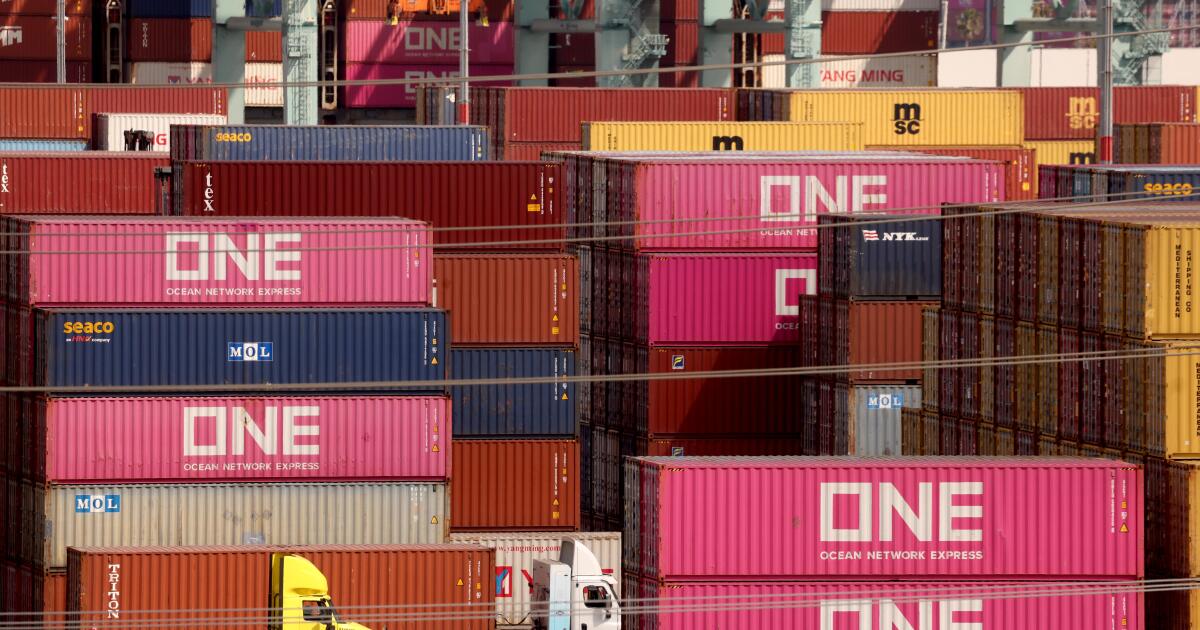
Uncertainties in the region, tensions between the U.S. and China, and heightened concerns over the safety of shipping overall have driven up shipping costs between the far east and the U.S. The price of shipping a benchmark 40-foot container from China to the West Coast has nearly quadrupled to $6,687 now from about $1,700 just before the Iran war began, according to an index maintained by the cargo firm Freightos — even though shipping prices typically decline during this time of year.
There can be little doubt that the U.S. would benefit from an industrial policy — if it’s coherent. China supplanted America as the world’s leading exporter of manufactured goods in 2010, and the gap has only widened since then. China’s dominance may be hard to reverse, as it’s built on lower labor costs and transport infrastructure that enjoys focused government investment.
Tariffs could be a component of a new industrial policy, but Trump’s tariffs aren’t rationally geared to protecting domestic industries that need protection. They’re expressions of his whims, and as such they’re totally ineffective. If there are government investment policies targeting industries that need assistance, they’re not apparent to economists or industrialists.
Trump can talk as much as he likes about a golden age for U.S. manufacturing, but from his first term through this one, it’s nothing but talk. And talk, of course, is cheap.