Almost five years ago, “Spider-Man: No Way Home” swung into theaters in the teeth of a COVID-19 surge and did what almost nothing else could that winter: drove cooped-up moviegoers to cinemas and opened to one of the biggest domestic debuts on record, pulling in $260 million.
This weekend, Peter Parker is back — a little older, more world-weary and facing a far less forgiving market.
The genre’s floor has dropped out since then.
Annual box office revenue for superhero movies is down, on average, about $3.5 billion, about half of what it was during the pre-pandemic years of 2017 to 2019, according to data from the FranchiseRe industry newsletter. Sony Pictures is betting that more real-world stunts, a relatable narrative and Spidey’s lasting popularity are enough to put “Spider-Man: Brand New Day” on the other side of that trend.
Whatever the approach, the commercial appetite is there. Pre-sales for the film, which stars Tom Holland and Zendaya, have been robust, and industry tracking estimates an opening weekend haul of at least $195 million in the U.S. and Canada. If that holds, it would be the year’s biggest domestic debut, beating Walt Disney Co. and Pixar’s “Toy Story 5” ($159.7 million). The movie cost about $225 million to produce and is produced by Sony’s Columbia Pictures, Marvel Studios and Pascal Pictures.
“This movie takes a grounded, emotional approach to the story, and I actually believe that’s what audiences are hungry for,” said Tom Rothman, chairman of Sony’s motion picture group. “It’s got all the whiz-bang wow visuals. But at its heart, it’s more a superperson movie, if you will, rather than a superhero movie.”
“Brand New Day” picks up where the last film left off. A spell has erased Peter Parker from the world’s memory — the price of undoing the public exposure of his identity — leaving him a stranger to his best friend, Ned, and to MJ. Without those friendships, he pours himself into his crime-fighting work to stave off his loneliness.
That feeling of being adrift without knowing where to turn is what the filmmakers built the movie around.
“We’re all really isolated from each other,” said Amy Pascal, one of the film’s producers who has overseen the entire franchise. “That kind of longing for connection between people and not knowing how to make it happen and living in a world where we become more and more remote, matched the moment that people are going through.”
The smaller scale was also a reaction to what came before it. “No Way Home” brought back Tobey Maguire and Andrew Garfield in a time-bending multiverse crossover, and there was no topping it.
“That was a movie that was 20 years in the making,” Pascal said. “There was no way to be bigger than that. So we went smaller. We went internal instead of external, and we found the bigness in that.”
Peter Parker’s isolation is what drew director Destin Daniel Cretton, who made 2021’s “Shang-Chi and the Legend of the Ten Rings” and was an executive producer on the Marvel Television series “Wonder Man.” He said he related to the pain and tragedy the character goes through, and to the idea of a superhero story that felt like it was happening in a real place.
The production’s rule of thumb became trying to execute scenes practically, in front of a lens, wherever possible.
That included a tank chase shot largely on a street in Glasgow, Scotland, on the first day of filming, complete with a rig that let an actor swing with explosions going off behind him. Thousands of people showed up to watch, which was “a big adrenaline rush on day one,” Cretton said.
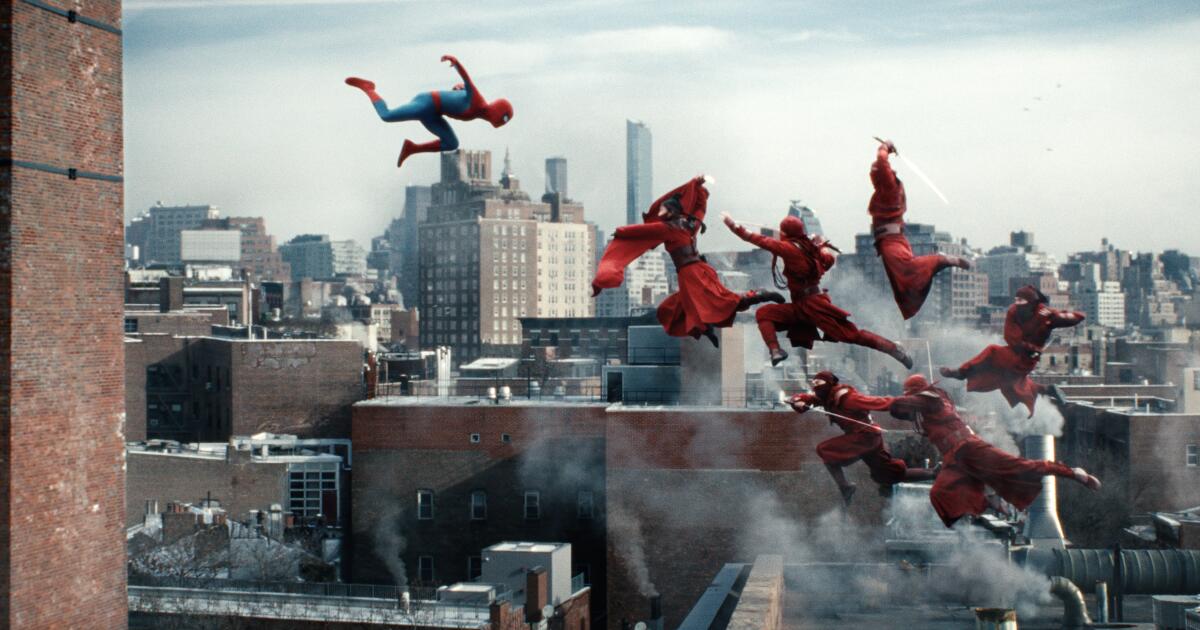
A later set piece — Spider-Man against a group of red-clad ninjas known as the Hand — was shot at a former prison outside London.
Cretton’s insistence on real locations has an argument behind it. At a moment when audiences want to know what goes into moviemaking and are increasingly unsure whether the myriad images they’re looking at were generated by artificial intelligence, the answer is visible labor.
“Right now, more than ever, I think it’s important for audiences to really feel that people made the thing that they’re watching, and people went through an experience to make the thing they’re watching,” said Cretton, who grew up watching behind-the-scenes segments on his favorite DVDs. “All of that, I think, is just as important as the thing that they’re watching.”
Effects alone don’t carry a superhero movie — or any movie, for that matter — anymore, Cretton said.
“The action can be great, the [visual effects] can be fantastic, the explosions can be huge, but if there isn’t some type of emotional spine that connects with people where they are and what they’re going through, it’s just another big, explosive movie,” he said.
The slump itself isn’t in dispute. Many of Marvel’s newer films haven’t come close to the heights its predecessors once cleared, and this year, movies like Amazon MGM Studios’ “Masters of the Universe” and Warner Bros. and DC Studios’ “Supergirl” underperformed in theaters.
What’s driving it is contested.
“I don’t think it’s fatigue of the genre,” Rothman said. “I think it’s the audience wanting new things and less predictability.”
For Marvel, long treated as the genre’s gold standard, part of the problem was volume; a dense web of interconnected films and TV shows that made casual viewers feel like they had too much homework to do before a new premiere.
The likeliest near-term explanation for that estimated $195-million opening, though, may have less to do with tone than with supply and brand. “Brand New Day” is the first Marvel superhero film since last year’s “The Fantastic Four: First Steps,” and Spider-Man remains one of the most commercially durable characters in the genre.
The calendar is also less accommodating than it was. The latest “Spider-Man” installment opens against Christopher Nolan’s “The Odyssey” and holdovers including “Toy Story 5” — a considerably more crowded field than the thin, pandemic-era slate its predecessor benefited from on the way to $1.9 billion.
And the movie has a second job. With Disney and Marvel’s “Avengers: Doomsday” arriving at the end of the year, “Brand New Day” has to leave audiences wanting it.
“It’s got a lot riding on it,” said Steve Granelli, a teaching professor and division head of communication studies at Northeastern University. “Not just in terms of this being yet another ‘Spider-Man’ film, but also this being a huge storytelling device in the larger [Marvel franchise].”
Which is the tension at the center of the pitch. The filmmaking team went internal on purpose, and built a movie about a young man nobody remembers. It also has to set up the largest external event on Marvel’s calendar.