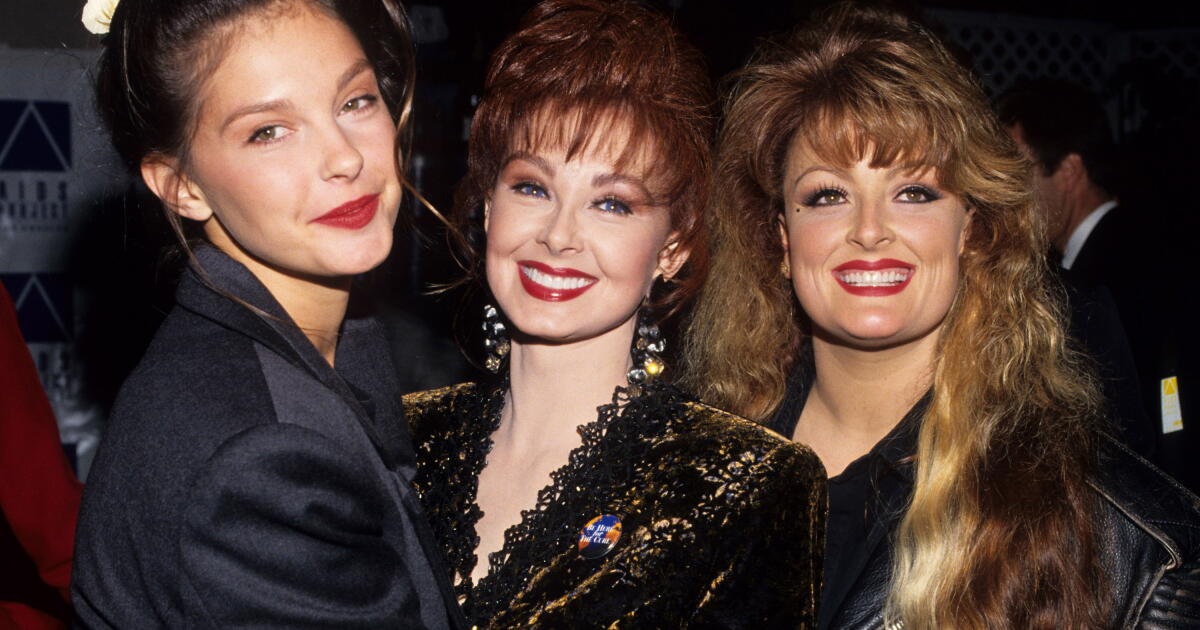
Country western star Wynonna Judd is confirming that she and her sister, Emmy Award-nominated actor Ashley Judd, do not have a relationship.
She spoke with People ahead of the release of her 10th solo studio album, “The Hard Truth,” which drops Friday, and revealed that the rift between the sisters is still there after years of on and off disharmony.
Wynonna told the outlet that Ashley hadn’t heard the album, as the sisters are not “connected.”
“We’re taking a break, which all families can relate to,” she said. “She’s doing her thing, and I’m doing mine.”
In April 2022, Wynonna and Ashley’s mother, Naomi Judd, died by suicide at 76 after a lifelong battle with depression. Naomi and Wynonna made up the Grammy-winning duo the Judds.
At the time, the sisters released a statement together, writing, “Today we sisters experienced a tragedy. We lost our beautiful mother to the disease of mental illness. … We are shattered. We are navigating profound grief and know that as we loved her, she was loved by her public. We are in unknown territory.”
The following month, the two appeared at the annual Medallion Ceremony, where the Judds were inducted into the Country Music Hall of Fame, and the sisters spoke on behalf of their mother.
“While this is so much about the Judds as a duo, I want to take a moment to recognize my sister, a GOAT,” Ashley said at the ceremony. “Do you know what that means? I don’t think she knows I’m calling her the greatest of all time. She lives on a farm. She’s being a little literal.”
Ashley told the crowd that growing up as the younger sister of Wynonna, she got to “bask in this voice that was around the house, and I’ve always been so proud of the music and so proud of you. … So I know that we’re talking a lot about Mom tonight, as we should be. Our beautiful mother, and I want you to know that you also are being inducted to the Hall of Fame tonight. And newspapers don’t get much right these days, but when the Los Angeles Times said you were Elvis-like, they got it right. And I love you, and I’m proud of you. And Mom is proud of you, and she always was.”
By October 2022, rumors were flying that the sisters were fighting over their mother’s will, a claim that Wynonna shot down while speaking with People.
“Someone told me while I was at Ashley’s house, ‘Hey, did you know that they’re saying this about you?’ I went, ‘Huh? I’m fighting with Ashley?’” Wynonna said. “Fighting over what? I have such a great life. Ashley has a great life. Why would we be fighting over the will?”
This wasn’t the first time a feud was reported between the two. Back in January 2015, Wynonna gave a teary-eyed account of the disconnect during an appearance on AXS TV’s “The Big Interview With Dan Rather.”
“The only thing I have in common with my sister is a father missing and a mother that’s both of ours. She and I are very different. We don’t communicate, nor do we spend time together, and that’s a long history of being apart,” Wynonna told Rather.
Wynonna said that she and Ashley were dysfunctional, didn’t agree on anything and developed separate lives, but she cared for her younger sister growing up.
“I raised Ashley, so I think there’s a lot of work we still have to do about where do we find the ‘sister’ in all of this,” she said. “She called me sister mommy, and I really had a hard time with that, because I was like, I don’t want to be your mommy. I want to be your sister.”
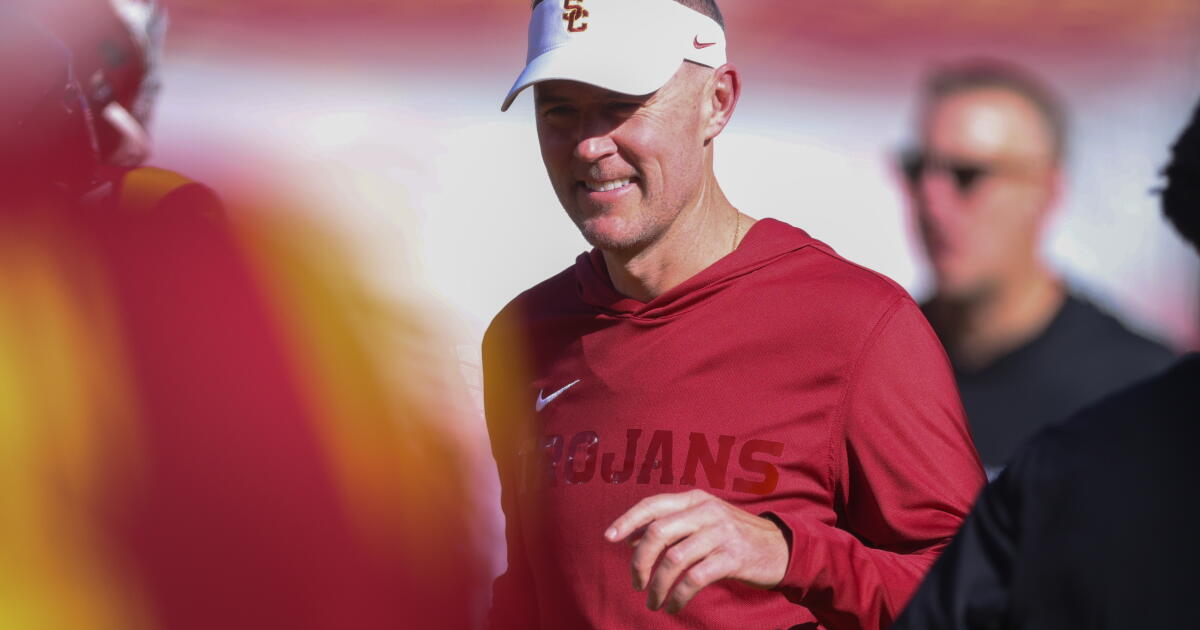
After 72 particularly miserable hours for his football program, Lincoln Riley took his place behind a lectern Tuesday and tried to assure that things at USC weren’t as bad as they looked.
“There’s a lot of things to be proud of in this football program right now,” Riley assured. “Those that really look into it and look at what’s happening here will see that and understand that. There’s people on the outside that just don’t.”
But the optics at USC, since Saturday’s 41-27 home loss to Oregon, certainly couldn’t have been much worse for Riley. Because it wasn’t just that his Trojans lost a critical game to a bitter rival, one framed for weeks — months, even — as a must-win. Or that in its wake, Ducks coach Dan Lanning had savaged him or his program multiple times.
It was what happened in the midst of that loss, as well as the reactions after, that only made matters much worse for USC.
The days since have prompted questions across the country about Riley’s future at USC, where he’s midway through his fifth season as coach. One person familiar with the situation but not authorized to speak publicly on the matter told The Times that “all options are on the table” with Riley after the loss and the events of last weekend.
The chain of regrettable decisions began the moment Trojan linebacker Desman Stephens lowered his shoulder into the helmet of sliding Oregon quarterback Dante Moore in the second quarter Saturday evening. Moore’s head slammed hard into the ground, and he laid motionless for several minutes surrounded by medical personnel, until he was lifted onto a backboard and loaded into an ambulance that had driven onto the field.
The whole unsettling scene was made far worse by Stephens’ reaction in the immediate aftermath of the hit. After jawing with Oregon players, the junior linebacker was seen taunting the Oregon sideline and celebrating on his way back to USC’s side of the field. He continued high-fiving teammates while the Ducks surrounded their quarterback, who was diagnosed with a concussion but no other serious injuries.
The next morning, both Stephens and his coach said in a statement that his actions were “unacceptable,” “inexcusable” and “completely inappropriate.” But after the game, Riley first said he didn’t see Stephens celebrate the hit. And when Riley was asked why Stephens was allowed to stay on the sideline for the second half, the coach responded, incredulously, “‘cause he’s on our football team.” He wished Moore well, but said nothing further about Stephens or his vicious hit.
“It’s an easy answer,” said Petros Papadakis, a local radio host and former USC captain. “I understand you can’t have eyes everywhere as a head coach. But even if you didn’t see it, by the end of the game you know most of college football has turned against you in the last hour.
“The story didn’t go away because Lincoln didn’t get in front of it.”
It was clear that night, among USC’s leadership, that the immediate response wasn’t adequate enough. So the next morning, athletic director Jen Cohen met with Riley to discuss a suspension for Stephens. They settled on one game.
On Tuesday, Riley took a different tone. He said he was “disappointed with how [Stephens] handled it” and that he “needs to have more awareness.”
Riley also asked for understanding from those who have been critical of Stephens, whom he described as “a young person who made a mistake.”
“Consider if that was your son,” he said, “how would you want it handled?”
But three days later, the college football world was still litigating Stephens’ hit. The story was still alive, in part, due to a short documentary from the game, published by Oregon on Tuesday morning. In it was a clip that would unexpectedly make things even worse at USC.
The clip is of USC’s radio booth, where Pete Arbogast has been the Trojans’ play-by-play guy for the past quarter century. From his perch in the Coliseum press box, Arbogast is painting the scene of the play when Moore was injured. Except, in this case, listeners heard a different account of his slide and Stephens’ hit than what happened on the field.
“He did not try to slide feet first!” Arbogast said in the moment.
Arbogast went on to say that Moore “ducked into that hit. I did not see him put his feet out first. I saw him dive forward.”
When confronted with the replay moments later, Arbogast stood by what he said, claiming that Moore’s slide was “more of a knee-first slide.” Even Arbogast’s radio partner — former Trojan defensive tackle Shaun Cody — raised his eyebrows at the suggestion.
Both Arbogast and the university declined to comment on the situation when reached by The Times.
Papadakis, who previously worked on the broadcast with Arbogast, called it “a bad look,” but explained that Arbogast was “usually defending USC or trying to spin something positive.”
That job was left to Riley and his players on Tuesday. Though, some were more convincing than others.
“This is a time of adversity, the best time to come together as one,” left tackle Elijah Paige said.
“Times like these you tend to see teams fall apart,” quarterback Jayden Maiava added, “but this team is such a tight team and we’re all bought into each other.”
Riley, meanwhile, pointed for the second day in a row to a stretch early in Saturday’s fourth quarter against Oregon, when the Coliseum had reached a fevered pitch and momentum seemed to be swinging in the Trojans’ favor.
Except, it never did. USC allowed two fourth-quarter touchdowns after that. Riley still tried to find the silver lining.
“We didn’t get run out of the stadium,” Riley said. “There’s a lot of good on that tape. You don’t have a chance to win a game like that if you don’t do some things pretty well.”
It’s about moving on, or attempting to, after the franchise endured a nightmare offseason.
“My entire summer’s been basketball,” guard Darius Garland nonchalantly said during media day at Intuit Dome. “My main thing is to come in here and win games. So, that’s my main focus.”
The Clippers’ offseason was engulfed by the NBA’s salary-cap circumvention investigation into the team’s endorsement deals with Kawhi Leonard. The NBA fined the Clippers $30 million, stripped them of five first-round picks, dealt suspensions to owner Steve Ballmer and president of basketball operations Lawrence Frank — and the Clippers ultimately traded Leonard, who was fined merely $700,000, back to Toronto.
Garland represented his teammates in prioritizing hoops.
But for Trent Redden, the Clippers’ interim president of basketball operations, things weren’t that simple. The admittedly nervous executive started Monday’s news conferences by apologizing to the Clippers’ faithful for the aftermath of the Leonard situation.
“Our fans deserve to hear from us before this, and for that we’re sorry,” Redden said. “We’ve been listening to the thoughts, the concerns, and feeling the emotions of our fan base. They mean everything to us. … We hope to fulfill our promises to them, to build their trust and move forward through this time.
“This franchise often has done its best work with its back against the wall … We hope to represent our fans the same way we always have in dark times, by coming out fighting.”
Fighting is all the new-look Clippers can do as they enter the 2026-27 season.
Leonard is back north of the border. Other stars, such as Paul George, James Harden and the recently retired Russell Westbrook, are distant memories in L.A. For the first time in years, the Clippers aren’t entering a season with championship aspirations.
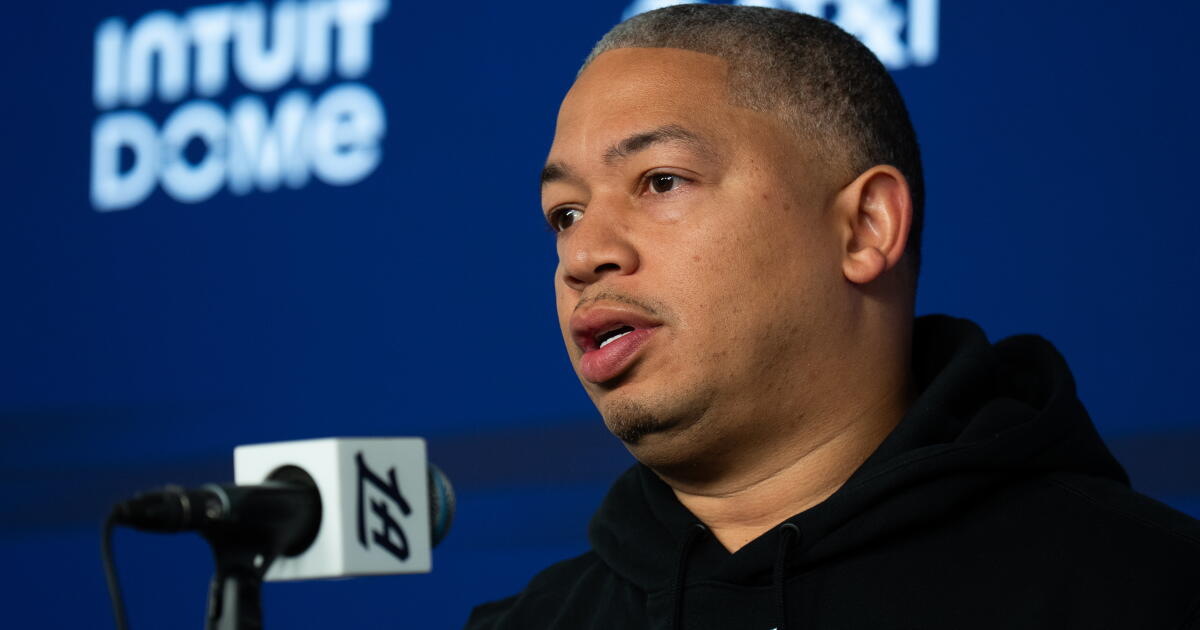
“It’s been difficult,” said Ty Lue, who enters his seventh season as the Clippers’ coach. “But I give our players a lot of credit … the leadership is great [and] the morale is great, even in these tough situations. That’s good to see, when you have your players coming in every day, giving everything they have; a lot of teams don’t have that.”
The Clippers’ league-record streak of 15 consecutive winning seasons is in jeopardy. Nonetheless, the team will still feature plenty of intrigue roster-wise, with a mix of youngsters “doing TikToks” and “old heads” trying to keep up, as Garland described it.
“I think we can surprise a lot of people,” he said.
Garland himself, 26, enters his first full season in L.A. as the team’s go-to scorer. A two-time All-Star, he’s primed to lead a promising backcourt alongside 19-year-old rookie Keaton Wagler, the Clippers’ No. 5 pick in the 2026 draft.
Wagler is one of the team’s promising young players, alongside fellow rookie Baba Miller, Kobe Sanders and the rehabbing Jordan Miller and Yanic Konan Niederhauser.
“I’m just going to do my best to stay mentally focused,” Wagler said when asked about the pressure of being the team’s first top-five pick since Blake Griffin in 2009. “Not worry about all the outside noise.”
The Clippers return key role players like Derrick Jones Jr., Kris Dunn, Bradley Beal and Brook Lopez, and sport new ones like Max Strus and Gradey Dick via trades.
However, the team’s ceiling will rest on the influence of new forwards Brandon Ingram and Rui Hachimura. Hachimura is coming off a strong playoff run and four-year stint with the Lakers.
“One thing about here … everybody talks about how they take really good care of their players,” Hachimura said of signing a two-year, $28-million contract with the Clippers this offseason.
Ingram, the centerpiece of the Leonard trade, is a solid three-level scorer and will shoulder much of the offensive load alongside Garland — when healthy.
Redden shockingly shared that Ingram is recovering from a partially torn Achilles tendon in addition to heel surgery.
“I had been dealing with some pain throughout the year with the Raptors, especially coming down crunch time with the Raptors,” Ingram said. “I didn’t quite know what it was. Near the end of the season, we figured out what it was, and surgery was the best thing to do.”
The 29-year-old Ingram, though, should make a full recovery and claims his best days are still ahead of him.
He feels the same way about his new Clippers team.
“I know [there are] little to no expectations for us this year,” Ingram said. “We have enough in the building to compete. This is what we love to do. So, we’ll go out and compete every single night, learn, go on to the next game and get better and better.”
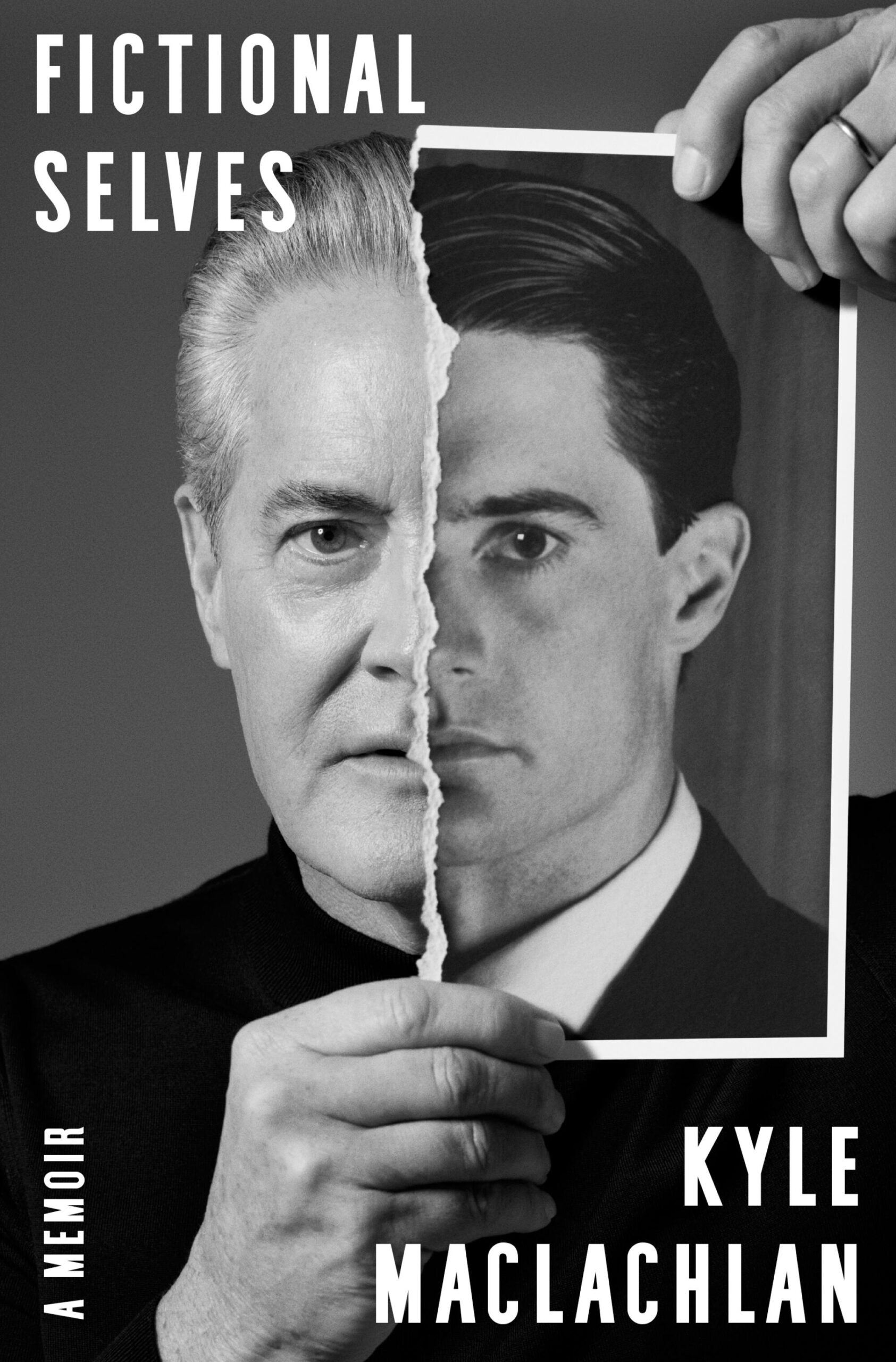
Kyle MacLachlan is living up to his reputation as the Internet’s Dad.
It’s an especially warm day in August, and the bespectacled actor, best known for his many projects with the late auteur David Lynch, is approaching with a coffee (black, naturally) in one hand and a massive cookie in the other. The snack, it turns out, is meant for us to share.
On the Shelf
Fictional Selves: A Memoir
By Kyle Maclachlan Crown: 320 pages, $34
If you buy books linked on our site, The Times may earn a commission from Bookshop.org, whose fees support independent bookstores.
“Whatever it is, it’s very healthy,” he says when I ask what sort of confection he chose. “It’s cranberry, oatmeal and gluten-free. Who knows if there’s any sugar in there?”
At 67, MacLachlan isn’t necessarily a health nut. But he is highly amenable and willing to roll with my vegan cafe selection, which is conveniently located near our photo shoot location. “I come from Eastern Washington state — it’s a desert,” he says assuringly when I offer to move us to an indoor seat with air conditioning. Later, as we prepare to leave for the shoot, he clocks my car, a rare station wagon, and dubs it “spec-TAC-u-lar.”
That’s MacLachlan for you — all it takes is one word (he also drops an “Aces!” during our meeting) or enthusiastic gesture (very likely a swooping thumbs up) to channel the type of eccentric and upbeat characters he’s spent the last 40 years playing. Now, with the release of his thoughtful new memoir, “Fictional Selves,” MacLachlan gives us a much closer look at the man behind the chin-jutting grin, and, in doing so, introduces us to his doppelganger, “Other Kyle,” an image-conscious shadow figure constantly trailing behind, questioning his choices.
“There’s definitely another entity, an observer, the ego, the harder self,” MacLachlan says of how he would describe Other Kyle, whom ghostwriter Jon Sternfeld first identified after noticing the way MacLachlan tended to fall into conversation with himself while recounting his life. “[He’s] the kind of person that I’m not comfortable leading within the world. But he’s definitely in there commenting on the things that I do.”
Other Kyle first began to taunt MacLachlan after he saw himself on a gargantuan billboard for “Dune” in Times Square. (In his early 20s, MacLachlan was famously plucked from obscurity to lead David Lynch’s 1984 adaptation of Frank Herbert’s sci-fi epic.)
Well before his alter ego materialized, and well before Hollywood found him, MacLachlan was prone to anxiety and fears of never fitting in. Born in Yakima, Wash., MacLachlan grew up the oldest of three boys; his parents were solidly middle-class, with his father working as a lawyer, and then stockbroker. His mother was a homemaker known in the community for her civic involvement, particularly in local arts programs. In fact, it was MacLachlan’s mother who first encouraged him to try a “Teen Theater” program, drawing him in with the promise that there might also be girls in attendance.
But it took a minute for MacLachlan to genuinely embrace his calling. As a young adult, his father pushed him to study business, while his mother urged him to try PR or communications. His studies at the University of Washington weren’t going well, so he dropped out and worked at a manufacturing plant back in Yakima. It wasn’t until a girlfriend recommended a summer theater program in North Carolina that MacLachlan leaned back into his first real passion, eventually returned to school with a newfound focus, and was accepted into the University of Washington’s professional acting program.
Kyle MacLachlan at the glass and mirror shop LA Mirror Man on La Cienega Boulevard.
(Christopher Patey / For The Times)
Fast-forward 40 years, it’s impossible to imagine that MacLachlan would have anything else for Other Kyle to latch onto. For one, his acting resume is the stuff of thespian fantasy. Sure, “Dune” infamously flopped hard upon arrival, and all planned sequels were immediately canceled. But it wasn’t long before MacLachlan had teamed back up with his mentor, with whom he had developed an almost telepathic bond on “Dune,” to lead Lynch’s much more kindly received 1986 neo-noir arthouse entry, “Blue Velvet.” A few years later, the overwhelming success of the TV mystery series “Twin Peaks” propelled the actor to the upper stratosphere of celebrity.
“When we were working together creating Jeffrey in ‘Blue Velvet’ or [Coop in] ‘Twin Peaks,’ we would sit and talk or not talk, we melded together in some weird way, we were like one person,” MacLachlan says of his bond with Lynch, who died in early 2025 of cardiac arrest due to chronic obstructive pulmonary disease. “It was this very symbiotic kind of thing in front of the camera,” MacLachlan continues. “It was like this weird circular energy. … He’s the only director I share that with.”
And yet, breaking out of what MacLachlan refers to as “The Black Suit,” worn by his unceasingly chipper “Twin Peaks” character, Special Agent Dale Cooper, proved challenging. By the time “Twin Peaks” left the air in 1991, MacLachlan had grown ambivalent about the job that changed his life, partially because he felt Lynch didn’t fight hard enough to keep artistic control of the show’s second season, which saw the network upping its creative involvement and Lynch distancing himself until the final few episodes.
MacLachlan longed to diversify his output — to show that he was capable of being a mainstream Hollywood leading man, one who could interface with a variety of directors. In the book, he writes about jobs he comes so close to booking — roles in Robert Redford’s “A River Runs Through It” and Francis Ford Coppola’s “Dracula” — but losing out at the last minute.
Kyle MacLachlan explores his alter ego “Other Kyle” in his new memoir.
(Christopher Patey / For The Times)
He took these rejections hard at the time. Many decades later, however, he can see how he was the one holding himself back. “I felt like people were only seeing the black suit,” MacLachlan says. “Now, the truth is, they would probably have been more than happy to see me as somebody else, but I was not able to deliver. … I think there was a lot of insecurity,” he continues. “I was like, ‘Maybe it’s not the suit. Maybe it’s me.’”
As the 1990s played out, MacLachlan fought an on-again, off-again existential crisis regarding the type of actor he was really meant to be. His friend and former “Doors” co-star Val Kilmer urged him to accept a lead role in a BBC adaptation of Kafka’s “The Trial,” which didn’t move the cultural needle in the States, but did put him in the same room as enormously pedigreed actors like Anthony Hopkins and Alfred Molina. He snagged a role in a Paul Verhoeven film about topless dancers — a career risk he hoped would pay off but ultimately felt like “walking into a buzz saw,” as he writes in the book.
Despite the cult reappraisal of “Showgirls,” and the lasting popularity of “Sex and the City,” Other Kyle had a few things to say about both of these roles, but the Kyle sitting across from me has a much more measured approach, particularly to “Showgirls.”
“I think it’s fun that it’s still around,” MacLachlan says. “I’ll still argue with anyone that [says] it’s a good movie. It’s not a good movie, but it’s definitely an appreciated movie, and that is kind of where I leave it.”
In the early 2000s, his wife, Full Picture founder and chief executive Desiree Gruber, pushed him to accept a role in HBO’s “Sex and the City,” playing an Upper East Side doctor with erectile issues.
Portraying Trey MacDougal was a mixed bag for MacLachlan. On one hand, he was thrilled to be part of such a cultural juggernaut, and he delighted in the emphasis the show placed on female friendship and sexual agency.
“I want to keep being challenged,” says Kyle MacLachlan, looking ahead to the next chapter of his 40-year career.
(Christopher Patey / For The Times)
At the same time, he had mixed feelings about playing an old-money mama’s boy with a Freudian Madonna-whore complex. Not to mention the sheer ridiculousness of the things the writers would have him do: One scene had him bent over a bathroom sink, masturbating to a pornographic magazine. A passage of “Fictional Selves” also recalls the cringe-inducing moment when Trey gives his wife, Charlotte (Kristin Davis), a cardboard cutout of a baby in an effort to make light of their struggle to conceive.
In the book, MacLachlan recalls being utterly dumbfounded at having been asked to do something so oblivious at best and cruel at worst. Eventually, however, he writes that he realized the writers just needed a way to foist him off the show. (His and Davis’ characters get divorced soon after the cardboard baby incident.)
“Every time I got a script, I’d be like, ‘Oh boy, OK, what’s going to happen here?’” MacLachlan says. “And then it would be, like, whatever they’ve come up with, ‘how can I shape it? What is it that [Trey’s] wrestling with? What are the issues here? Then, you know, realizing that in some cases it was just going to be a sight gag. Like, the Juggs magazine is going to be a sight gag. And as I said in the book, in my mind, I would sort of float away. I would be like, ‘That’s not really me. I don’t know who that is down there doing that.’”
As MacLachlan moved into middle age, he gradually grew more comfortable with the clean-cut oddball characters he’d so often be asked to play: a refined but possibly murderous dentist on “Desperate Housewives,” an idiosyncratic boat obsessive on “How I Met Your Mother,” an over-the-top civic leader on “Portlandia,” and, once again, Special Agent Dale Cooper (plus his doppelgängers) on “Twin Peaks: The Return.”
The 2017 “Twin Peaks” reboot would be the last big project MacLachlan would work on with Lynch, but MacLachlan would frequently visit the director in their shared Hollywood Hills neighborhood. “It’s many things,” MacLachlan says when I ask what he misses most about his friend and mentor. “The voice on the phone — ‘HEY, KALE! Come on up for coffee!’” he continues in a pitch-perfect Lynch imitation. (“Kale” became Lynch’s nickname for MacLachlan, referencing “Dune” producer Dino De Laurentiis’ Italian pronunciation.)
“Towards the end, I would go to visit him, and I would sometimes take my phone and record things. I still have these stories loaded in my iPhone — about ‘Dune,’ or a story about a moment in ‘Blue Velvet,’ or a story about when he met John Huston, or when he got a kiss from Elizabeth Taylor. … I have these little gems, and I savor those.”
Lately, Other Kyle has been replaced by Online Kyle, a goofy, lighthearted version of MacLachlan who primarily lives on TikTok and Instagram — thus the wholesome, Gen Z title of “Internet’s Dad.” And when he’s not playing a father to Ella Purnell on Prime Video’s hit “Fallout,” or interviewing a younger generation of entertainers on his podcast, “What Are We Even Doing,” MacLachlan is also someone’s real dad. One of the most endearing moments in our afternoon happens when his teenage son, Callum, calls looking for something around the house. “Oh, it’s in the fridge in the gym. In a foil. And there’s chicken in the fridge. Love you too,” MacLachlan tells his son.
There’s certainly no doubt that this Kyle doesn’t get in his head — or in his own way — the way earlier versions did. He’s still eager to test his limits as an actor, but he’s comfortable with the thought that there is no plan. “I want to keep working with interesting people,” he says with his trademark buoyancy. “I want to keep doing fun things. I want to keep being challenged. … I don’t really know where I’m going, but something will excite me, and I’d be like, ‘OK, what the hell?’ And I jump in.”
Brodsky is an L.A. culture and music writer. Her biography of Stevie Nicks “Lessons & Lace” is out now.
That’s why the seventh-year quarterback cut off a reporter’s question about whether the team’s locker room needs heightened vocal leadership as the Chargers carry an 0-2 record into Sunday’s road game against the unbeaten Buffalo Bills.
“I think I’m going to stop you right there,” Herbert said. “We’ve got great leadership on this team. I trust those guys in that locker room, so I don’t think anyone has panicked or worried because that’s not going to do us any good.
“It’s [about] moving on to the next play and understanding we’re close, we made mistakes, how do we fix it and how do we move on?”
Herbert’s intense messaging was surprising. The quarterback usually speaks in emotionless platitudes during news conferences.
But that response, or leadership — a trait teammates and coaches see far more from Herbert than the public — is one of several reasons why the Chargers are supporting their quarterback despite the offense’s sloppy start to the season.
“Ain’t anybody giving up on anything,” wide receiver Tre’ Harris said. “Everybody’s still on the same page. Everybody has extreme belief in 10 — I know I do — and extreme belief in [offensive coordinator Mike McDaniel] as well. We’ll go out there and do what we need to do.”
The Chargers are averaging just 14 points per game, above only the winless Miami Dolphins (13) and the 1-1 Pittsburgh Steelers (11.5).
And Herbert is partially responsible.
He ranks 27th in completion percentage (59.3%) through two weeks and is 23rd in passing yards (401) with the second-most interceptions (3).
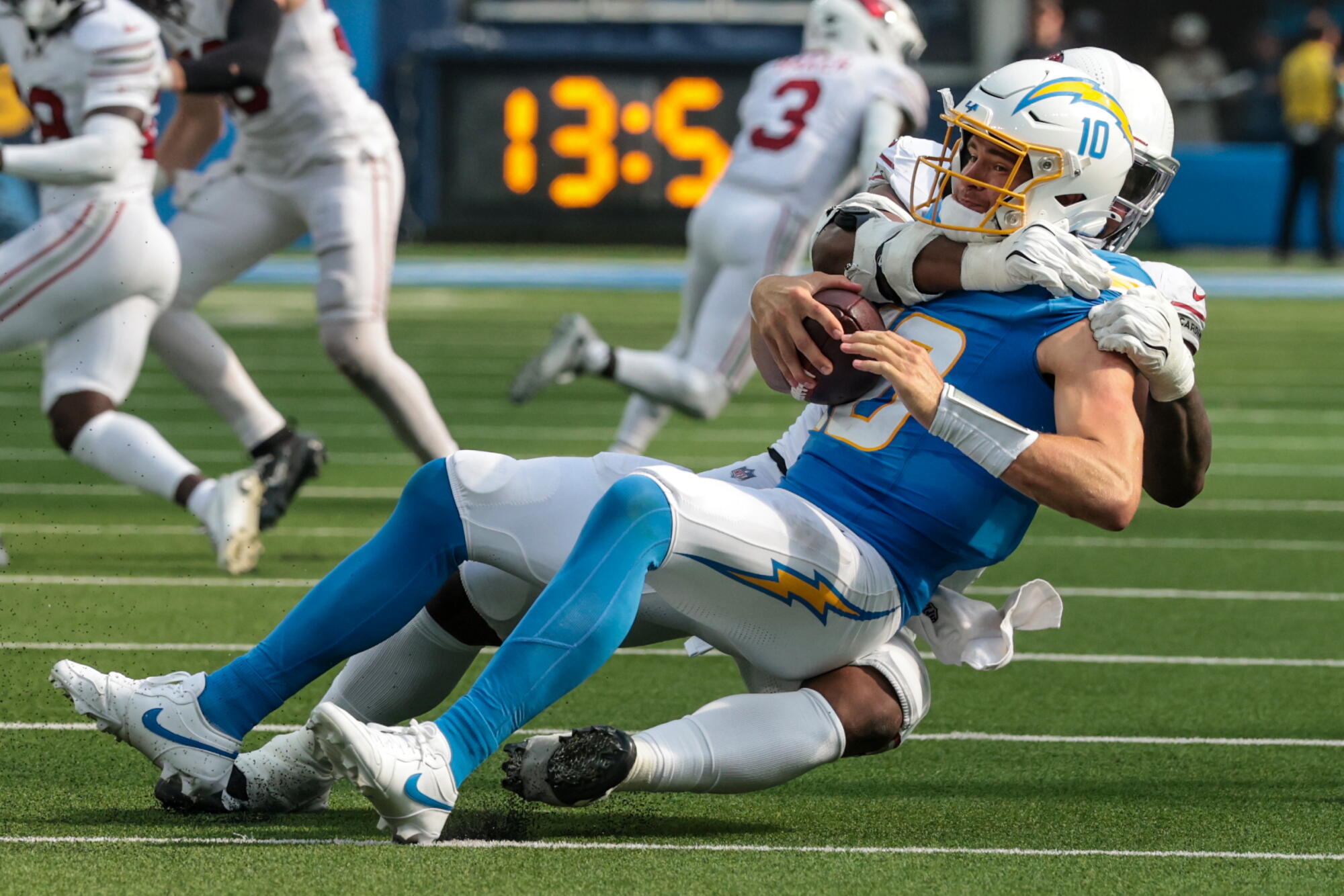
Chargers quarterback Justin Herbert is sacked by Arizona Cardinals linebacker Jordan Burch on Sept. 13.
(Robert Gauthier / Los Angeles Times)
Herbert just hasn’t looked comfortable in yet another new scheme. But, as usual with him, context is key.
With a revolving door at left guard and rookie Jake Slaughter starting at center, the Chargers have allowed the league’s second-highest pressure rate (45.5%), according to Pro Football Focus.
Herbert’s pass-catchers have been inconsistent, too, struggling with pre-snap communication, frustrating — sometimes comical — drops and, of course, injuries.
The offense overall is having too many fumbles (7), penalties (15 for 109 yards) and other self-inflicted wounds. So while Herbert’s stats aren’t pretty, the Chargers’ woes go beyond his performances.
They have Herbert’s back, though, as they collectively sort things out.
“He’s been locked in [and] dialed in, man,” safety Derwin James Jr. said. “He’s working hard in the weight room [and] making all his throws out there. So, I can’t wait to try to get him some stops on Sunday.”
Then, there’s the McDaniel factor.
He admitted that he thought the Chargers would score more than 28 points thus far. As a result, he is considering “everything” moving forward, including shrinking the playbook.
McDaniel added that he and Herbert are “much closer” than they were two weeks ago as they work through the offensive struggles.
“It can be a lonely world as a starting quarterback — that’s a franchise quarterback — when you have successive losses,” McDaniel said. “It can be lonely as a playcaller [or] offensive coordinator. And the only way to approach it is that you’re not alone.”
The Chargers and their turbulent offense are on the verge of starting 0-3 for the first time since 2017.
Many outsiders are looking to Herbert to save the franchise from an abysmal season not many projected.
But to those in the building? They just want Herbert to be Herbert.
“One thing that separates him from a lot of other leaders … he’s the same person, each and every day, consistently great at everything he does,” said reserve quarterback DJ Uiagalelei.
After all, when Herbert’s comfortable, he’s arguably among the league’s top signal-callers.
“Since I’ve been with Justin, there’s not a thing I’d change about Justin,” coach Jim Harbaugh said.
For many celebrities, getting a Funko Pop! doll modeled after themselves is a sign they’ve made it in Hollywood. The 4-inch vinyl “Pop!” figurines, with their oversize heads and black dot eyes, symbolize being ingrained in pop culture — objects fans buy, celebrate and display.
At Funko’s flagship Hollywood store, there are thousands to choose from, ranging from NFL players to Disney princesses and characters from the Netflix period drama “Bridgerton.”
But the publicly traded company behind the popular dolls has been facing significant headwinds.
Funko Inc. last year posted a loss of $67.4 million on sales of $908.2 million, down 13% from the previous year. The company disclosed it had debts of $225 million.
The Everett, Wash.-based company warned investors in filings that there was “substantial doubt” about its ability to generate enough cash to meet its debt payments, citing the effects of tariffs in China, where most of its toys were made, canceled retail orders and loan covenants it expected to breach.
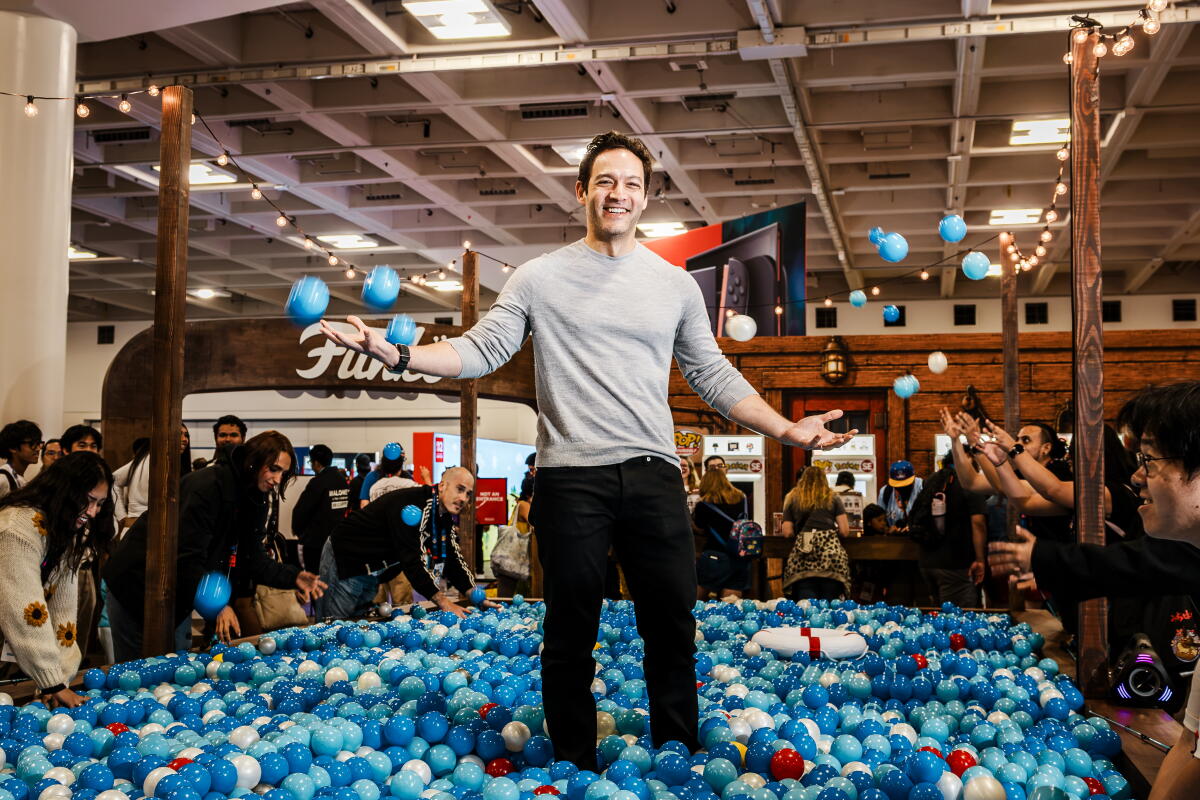
Funko Chief Executive Josh Simon, pictured at the Pokémon convention, says he took over the company at an “inflection point.”
(Carolyn Fong / For The Times)
Now the company is looking to stage a comeback.
Leading the turnaround challenge is Josh Simon, who left his job running global consumer products at Netflix to become Funko’s chief executive in September 2025 — the third person to hold the title in two years.
“Funko was at an interesting inflection point,” said 48-year-old Simon, who lives in Los Feliz. “I felt there was still a lot of really deep fandom and enthusiasm from retailers and at the same time, there were a lot of problems that had to be sorted out at the company. I thought it would be an interesting adventure and hopefully a way to help turn things around a bit and restore it back to that level of fan passion and glory that existed years ago.”
The rise and fall of Funko
Funko began in 1998 when entrepreneur Mike Becker decided bobbleheads would be the next big thing and shipped them out of his garage. After entrepreneur Brian Mariotti bought Funko in 2005, the business began licensing more characters. Sales took off with the launch of its big-headed “Pop!” figurines in 2010.
The company changed ownership over the years, added backpacks and other products, and went public in 2017. Most of its revenue still comes from making licensed characters and selling them through retailers, online and at events.
Funko survived a decline in sales with the rise of kidults — adults who collect toys.
(Carolyn Fong / For The Times)
But Funko’s sales plunged in 2025 following a global trade war.
The company overestimated demand, picked the wrong characters and made too many of dolls, said Gerrick Johnson, senior research analyst at Seaport Research Partners, which has a buy rating on Funko.
President Trump’s heavy tariffs imposed on China substantially raised the costs of making Funko dolls.
Amid lagging sales, retailers marked down the figurines, alienating collectors who want to see items appreciate in value.
“Collectors hate buying things 50% off,” Johnson said. “One of the biggest turnoffs in collectibles is a bargain bin.”
What kept the brand alive through the slump was the rise of kidults — adults who collect toys. Simon was one, picking up Pop! figurines from “Toy Story” and “Back to the Future” long before he worked there. Funko’s job, he said, is to distill what people love about a character into a stylized version of it.
“The number of inbound requests we get from musicians and athletes and celebrities — everyone is excited and pitching us they want a Funko Pop! made of themselves, because in some ways it suggests a mark of establishment in pop culture,” Simon said. “It’s like akin to getting your star on the Hollywood Walk of Fame in some way.”
Convention-goers create custom dolls at a Funko Pop! kiosk.
(Carolyn Fong / For The Times)
One expert said Funko’s job is to distill what people love about a character into a stylized version of it.
(Carolyn Fong / For The Times)
A turnaround plan
Though based in Washington, Funko has a large presence in L.A., where most of its senior leadership is based. They work out of the same offices as the flagship Hollywood store. The company also has employees in Arizona, London, Hong Kong and other markets.
Under Simon, Funko has diversified its supply chain, shifting production out of China to Vietnam and other countries. To improve cash flow, Funko renegotiated the timing of its debt payments and pushed products to market faster.
For example, Funko turned around figurines of the characters from “KPop Demon Hunters” — the Netflix film that became the streamer’s most-watched movie ever after its June 2025 release — in about four months, well ahead of Mattel, whose first items reached stores this spring.
When John Cena stepped into the ring for his final WWE match in December, there were pre-orders for a Funko figure wearing the same outfit down to the shirt reading, “The Last Time is Now,” built from an image Funko received a week earlier. The doll became a bestseller, said Scott Zanghellini, executive vice president of WWE Consumer Products.
“It’s happening in real time and his team being able to move quickly, and us always moving quickly in this world of we have seven hours of programming a week — how do you take advantage of that and give the fans what they want?” Zanghellini said.
Funko is also widening what counts as a license, making figures from “The Folk of the Air,” Holly Black’s fantasy series revived by book lovers on TikTok, as well as creating more original characters that aren’t licensed.
“We really want to make sure that we can be a part of these cultural moments while they’re happening,” Simon said.
Reaching out to fans is another priority. At PokémonXP, the first official Pokémon fan convention held last month at San Francisco’s Moscone Center, Funko ran a Pop! Yourself booth where attendees built custom figures in exclusive Trainer uniforms with a Pokémon of their choice.
“We really want to make sure that we can be a part of these cultural moments while they’re happening,” Funko’s chief executive said.
(Carolyn Fong / For The Times)
Jeff Leu, 40, of San Francisco spent about $100 there on two figures modeled after his kids. He already owns 40 to 50 “The Simpsons” Pop! figures and tracks his collection in a spreadsheet.
“I feel like there is a Funko for everything,” Leu said.
Now he feels the pull of the Pokémon ones.
“As they add more, there’s more pressure to buy it because I like to collect things,” Leu said. “Luckily I have a lot of room to display my toys.”
So far, the turnaround plan has yielded some positive signs.
Second-quarter sales rose 7% to $207.7 million and the company reported net income of $15.4 million, against a $40.5-million loss a year earlier. The quarter, however, included a $25.4-million benefit from expected tariff refunds, without which Funko would have lost money.
Funko’s share price closed Friday around $5.50, up about 1%. The stock has climbed 38% in the last year but is 60% below what it trade at in January 2025.
“It’s way too early to make any sort of calls on Josh at this point, but I like what he’s doing,” Johnson said. “It’s an interesting point in Funko’s history, and it’s a great opportunity for him to grow this business.”
Rams star receiver Puka Nacua remains sidelined because of groin soreness and his status for Sunday’s game against the Denver Broncos is unclear, coach Sean McVay said Wednesday.
Nacua was not scheduled to participate in a light team jog-through. Asked if he expected Nacua to play against the Broncos, McVay said, “I’m not sure.”
Will Nacua practice this week?
“I would say it’s more likely than not, but we’ll see,” McVay said.
Nacua, the NFL’s receptions leader in 2025, sat out the Rams’ victory over the New York Giants on Monday night.
Are the Rams concerned that Nacua’s injury could be a longer-term issue?
“I don’t think so,” McVay said, adding. “When you’re a skill player and you’re really trying to hit high-speed yards and really open up… it’s like some of the things that can almost be pre-hernia is kind of what he’s feeling.
“You err on the side of caution. Usually time is the best thing that allows that thing to heal.”
McVay said Nacua does not have a hernia, and that the team’s training and medical staff did not feel the issue was “any type of long term threat.”
“I just know that he’s frustrated,” McVay said, “and we all want him to be able to be out there. But we want him to be able to return to performance, not just be able to just kind of gut through it.”
Quarterback Matthew Stafford said Nacua is an “unbelievable” player and loves having him on the field. But he trusts in all Rams receivers.
“Certain things that he does at a high level that maybe move down the list a little bit on things that we might run,” Stafford said. “But once the play’s called and things that we do, I trust all those guys to go out there and execute at a high level.”
Etc.
Running back Ronnie Rivers, who is also a key special teams player, was placed on injured reserve because of a “freak” calf injury suffered when he jumped to loosen up during the game against the Giants, McVay said. Running backs Dean Connors or Jordan Waters could be promoted to the roster for the game against the Broncos. The Rams signed safety Maximus Pulley to the roster.
There’s an alternate universe where Taylor Tomlinson is a young adult fantasy author holed up in a cabin miles from civilization.
“ I don’t know if you have some sort of backup career or backup life that you go to in your head when you’re overwhelmed or fed up with your career or whatever process you’re in,” she asks in the lobby of the Four Seasons Hotel Denver ahead of a two-show night. “That was in the back of my head, [I was] like, ‘Well, I could just move to the woods and write books.’”
In this world, she’s a 32-year-old comedian with four Netflix stand-up specials and a two-season stint as the host of late-night game show “After Midnight.”
Her manager told her that people would probably be more interested in her memoir before a series centering on magic and dragons, so she started writing her own story two years ago.
A self-diagnosed workaholic, Tomlinson spent 10 years constantly moving. From a combination of mold exposure and severe burnout from filming “After Midnight” on weekdays and performing in different cities on weekends, she fell ill for months and was forced to take a break.
In that time, she wrote “Actually, Nevermind.” Coming out Tuesday, the autobiographical essay collection delves into the aspects of life that she changed her mind about since her mother died when she was 8 years old.
“Actually, Nevermind” opens with an eclectic mix of three quotes from “Anne of Green Gables” by Lucy Maud Montgomery, celebrated writer Joan Didion, and the 2001 Anne Hathaway-led comedy film “The Princess Diaries.” Tomlinson wanted a combination of funny and serious excerpts capturing grief, but also a quote about evolving as a person.
In the classic coming of age novel “Anne of Green Gables,” a young Anne Shirley states, “I’m not a bit changed — not really. I’m only just pruned down and branched out. The real me — back here — is just the same.”
That’s the essence of Tomlinson’s realizations in her book — she’s growing into herself but that girl who started performing stand-up shows on the church circuit at 16 is still in there.
Tomlinson has a bit from her first Netflix special “Quarter-Life Crisis” about your 20s being a period to “fish trash out of the lake before it freezes over.” She asks how I’m enjoying my 20s, to which I bluntly reply, “It’s a nightmare.”
“ My 20s were a nightmare, too, and I was waiting to be 30, and I was like, ‘When I turn 30, I’m going to be solidified and great.’ And then I turned 30, and it was like the last two years I have probably changed just as much, if not more, than I did in my 20s,” she says. “It’s been much rockier than I anticipated.”
In speaking with her friends, she realized they also felt a disconnect between the lives they envisioned for themselves and their realities. Tomlinson channeled that uncertainty into a jumping-off point for her book.
She reflected on when she began questioning the trajectory of her life and traced it back to her mother’s death.
“ I didn’t know if I was even going to write about my mom at all when I first got the book [deal] because I was like, ‘Well, I talked about it in ‘Look At You,’ and I’ve talked about it in interviews,’ but that’s the thing about losing a parent or any big traumatic grief event is you’re always getting hit by waves of it, and then you’re always untangling it,” she says.
In creating “Actually, Nevermind,” Tomlinson pored through her mother’s diary, deciding to include a few excerpts in the finished book. For most of Tomlinson’s life, she regarded her mother as a flawless, devout Christian whom she desperately yearned to impress.
Drawing on her mother’s diary, estrangement from her father and complex sibling bonds, Tomlinson confronts impossible standards, relinquishes parentified guilt and reframes what family means after loss.
(Sela Shiloni)
Her mother married young, so she tried to hit that milestone, too.
“I didn’t manage it and self-sabotaged a lot,” she says. “Now, I’m grateful that I didn’t get married young, but at the time it was all I wanted because I wanted to fit in and I wanted to be someone she would’ve liked, someone she had things in common with.”
Through reading her mother’s diary entries, Tomlinson began to heal from the impossible standards she set for herself to follow in her mother’s footsteps.
“ She was sort of this perfect, infallible character in my brain for so much of my childhood, so it was helpful to read about her being like, ‘I’m nervous about getting married. We got pregnant on accident,’” Tomlinson says. “There’s stuff I didn’t include about arguments she had with my dad in college. It was just very human, and it was very encouraging to go, ‘Oh, it wasn’t like this perfect frictionless decision for her.’ It’s not like she just nailed it and did everything perfectly.”
One of Tomlinson’s largest shifts in perspective was no longer feeling parental responsibility toward her three younger siblings.
“ I went from their sister to a weird half parent figure when I was still a kid,” she says. “And I made all these missteps because I was also a kid. And then young adulthood was confusing because I had been waiting for everyone to get old enough to be friends with me.”
Now, Tomlinson’s siblings all take care of each other in their own ways. She refers to them as her “soul mates” and feels guilty wishing for a romantic partner when she already has three lifelong best friends.
While Tomlinson remains close with some of her mother’s relatives, she has been estranged from her father for five years. She writes about the sadness of not speaking to someone you feel so alike, but she doesn’t go into extreme detail about cutting ties.
“ There’s some things you just want to keep for yourself, you know?” she says. “You don’t want every painful private detail about who you are and what’s happened to you available to Google because it just makes you feel like you’re a raw nerve walking around, and you can’t get it back once you’ve shared it.”
“And you want something to say on a fifth date,” she jokes.
After processing the heartache of losing another parent in a different way, Tomlinson allowed herself to miss the good memories with her father and assuage any longing for revenge.
In her essay “I’m Gay Now,” Tomlinson explores her bisexuality and the transition from chasing male validation to feeling comfortable in herself. She came out at around 28 years old. Part of what took her until then was feeling the need to prove that she deserved to identify as queer.
In essays on sexuality, faith and ambition, she trades the pursuit of perfection for hard-won self-acceptance, exposing a more vulnerable offstage self still learning to do her best.
(Sela Shiloni)
“ I think that’s just a theme throughout my entire life,” she says. “I felt like I needed to earn the label of comedian. I felt like I needed to earn the label of queer. I needed to earn love.”
Her brother helped her understand that she didn’t have to achieve the title — she’s always been gay.
With all of her adulthood realizations, Tomlinson also reflects on what she wishes she could tell her younger self. Talking to a 16-year-old Taylor, she writes, “The most valuable thing about us cannot be all the things we haven’t done.”
“ So much of my childhood was like, ‘Don’t drink, don’t do drugs, don’t have sex. Don’t step out of line,’” she says. “I wanted to experience things more than I wanted to be this pure version of myself that was performing for the Lord.”
“Actually, Nevermind” is a reflection of Tomlinson when she puts down the microphone, and she is nervous for readers to see that side of her.
“ I feel pretty good about me on stage. Me in the room, I feel really insecure about,” she says. “I’ve gotten to a place where I feel pretty confident about taking up like 45 minutes to an hour and a half of your time. Eight hours, I think, is what the audiobook is. I’m like, ‘Eight hours is a lot more than that.’ So it’s been a real test of confidence.”
After years of chasing perfection, Tomlinson says she finds comfort in knowing that she may never be the world’s greatest anything.
“ In my 20s, I think I was always trying to be the best,” she says. “And now I’m like, ‘I’m going to do my best.’”
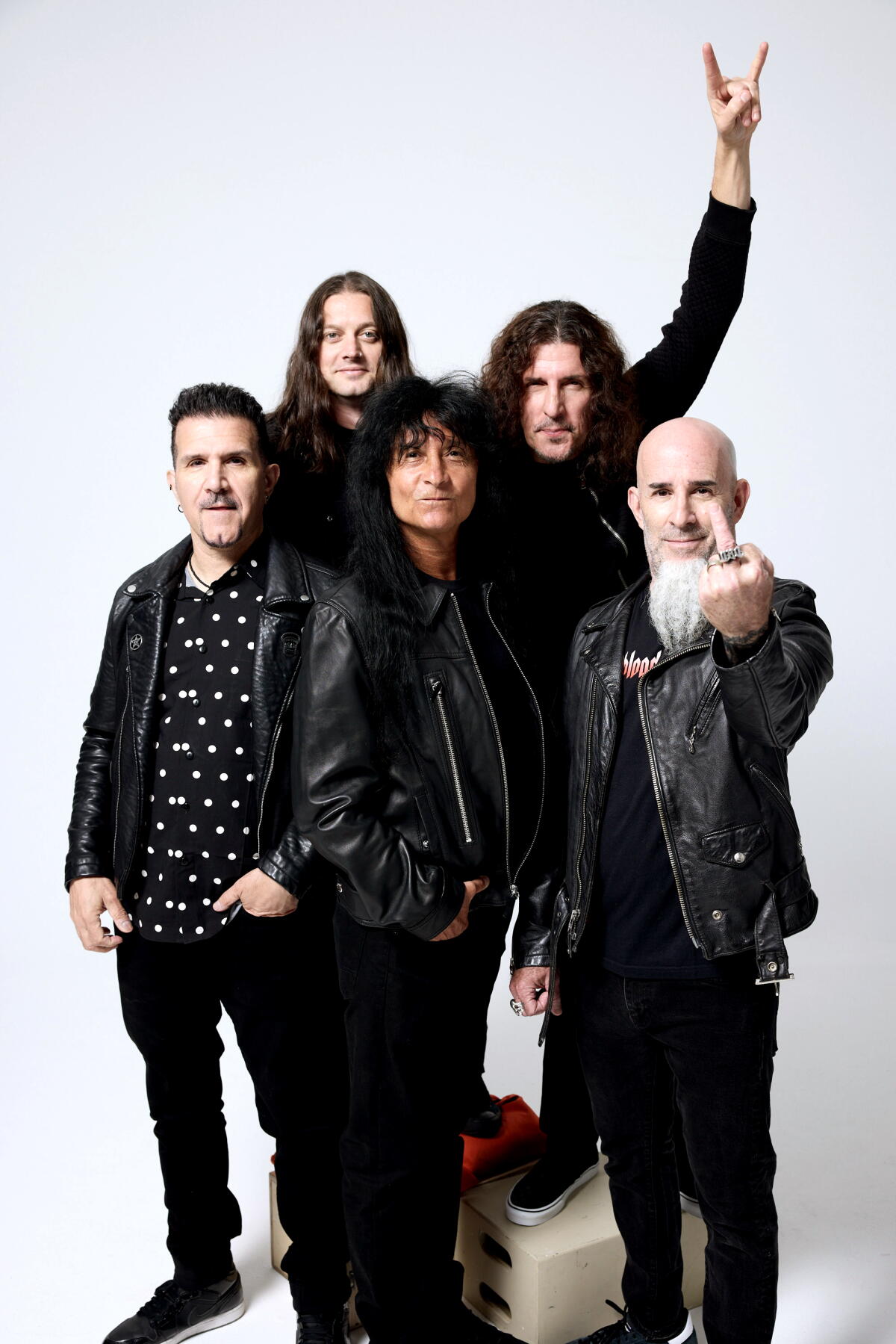
Moments after the final rapid-fire rhythm of Anthrax’s opening number “Caught in a Mosh” fades from the open air of the Sports Illustrated Stadium in Harrison, N.J., shaggy-headed vocalist Joey Belladonna addresses the audience. “I gotta ask everybody out there right now. Who’s never seen Anthrax before?” Around half of the 6,000-or-so crowd members who showed up by 6 p.m. for the three-band bill, headlined by heavy metal legends Iron Maiden, raise their hands. “Ah, yeah! We got a lot of new friends here today. Thank you for being here.”
Some bands with a four-decade career would be disappointed by the turnout, or by the realization that many fans not wearing Maiden shirts are dressed in Megadeth merch. But for Anthrax, preaching to the unconverted is an opportunity to expand their fan base beyond the somewhat insular community of thrash metal, a style of music that took the aggression of bands like Iron Maiden and turbocharged it with the speed and fury of hardcore punk. As much as Anthrax cherish being one of the “Big Four” — Metallica, Megadeth, Slayer and Anthrax — playing a 35-minute set well before dark is a great way to reach new listeners.
“We have a strong base of fans that are deeply into this band, but we know there are also people that have never listened to this type of music before,” says bald-headed, gray-bearded rhythm guitarist and lyricist Scott Ian from his home office outside of L.A. a week before the show. “They’ve heard band names, but maybe they haven’t dipped their toe in the water. So, it would be great to reach them and give them something they didn’t even know they wanted and then they’ll fall in love with it.”
A full 10 years have passed since Anthrax released their last studio album, “For All Kings,” which helps explain why they’re not as well-known as some metal veterans. Instead of rushing out an album after the pandemic, Anthrax took their time writing and fine-tuning new songs before entering Dave Grohl’s Studio 606 in L.A. in 2022. Then, they wrote more songs and massaged those for another two years before finishing the recording and sending the album to be mixed in 2025.
“I nitpicked over every detail of these songs before I even sent the demos to the other guys to put their two cents in,” says drummer and main songwriter Charlie Benante, clad in a black T-shirt and blue jean shorts, and sporting cropped black hair and a slanted mustache. “I wanted them to be as good as they could possibly be. Being good enough wasn’t OK.”
The 11 tracks on “Cursum Perficio” (Latin for “I complete my journey”) encapsulate the finessed brutality, incisive melodies and experimental flourishes from Anthrax’s years with Belladonna (from 1984-1992 and 2005 to the present), during which the band wrote its fastest, most aggressive songs. As much as Anthrax were driven this time by the desire to attract new fans, they were also motivated by many popular new metal albums — and not in a good way.
Anthrax’s meticulously crafted album was recorded at Studio 606, using Iron Maiden support slots to court new listeners beyond the thrash faithful.
(Travis Shinn)
“I hear bands with new records out, and they’re horrible,” Benante says, squinting his eyes and grimacing. “The genre has gotten stagnant to the point where you see a social media post by some band mentioning they have new music coming out, and you can tell exactly how it’s going to sound just by the way they look.”
While “Cursum Perficio” may be a bit heavy for some metal fans, it’s neither dull nor predictable. The album is loaded with Anthrax trademarks — serrated, crunchy riffs, soaring lead vocals, bludgeoning beats, and scorching guitar — but there are also galactic noise effects, angular song structures and atypical chord configurations. The most striking number, “The Edge of Perfection,” starts with chiming ethereal guitars and gently tapped cymbals, then detonates in a conflagration of feral blast beats, minor-key tremolo guitar picking (redolent of black metal), and chanted tribal vocals before climaxing in a slithering riff and ebullient chorus.
“After 30 years as a band, I can honestly say that’s the best song we’ve ever done,” says Ian, the most voluble member. “I feel like it’s genre-defying and can appeal to fans of atmospheric stuff and extreme metal, and anyone who likes aggressive music or even just guitar rock.”
For such a bruising cut, the lyrics of “The Edge of Perfection” are surprisingly optimistic. “It’s about striving for perfection, which, of course, is impossible. But that doesn’t mean you can’t reach for it,” says Ian. “To me, true perfection is happiness and health, and that comes from love, and it isn’t a given. I work hard at being an empathetic person and I only do things out of love and wanting to make everybody around me feel good as well.”
Lest Ian’s Zen-like proclamation color him a romantic, the guitarist stresses that much of the energy and anger of “Cursum Perficio” stems from the political, social and economic turmoil of the last decade. The problems, he stresses, are cutthroat capitalism, rampant partisanship and mankind’s seemingly innate instinct to destroy.
“Humans are really good at one thing and that’s murder, and we’ve excelled at it over the centuries,” Ian says, shattering the good vibes that flowed like a clean mountain spring just a minute ago. “Every year, we get better at treating each other terribly, which I can’t understand. I mean, there are people on this planet who, if they wanted to, could end world hunger. But I guess there’s no money in that. They would rather make the world a s— place by draining the resources. I swear to God, it’s just like [the 1971 Dr. Seuss book] ‘The Lorax.’”
While Ian purposely scrapped any early lyrics he wrote about politics in the age of Trump (“that would have been boring”), on “Everyone’s Got a Plan” he addresses the partisan strategy of “divide and conquer,” and in the first single, “It’s for the Kids,” he writes about the ubiquity of school shootings. Neither song has stopped naysayers from characterizing Anthrax as left-wing.
“I’m not a liberal,” he plainly states. “I’m a centrist. I like skeet shooting and I enjoy going to a range and shooting at targets. But I believe in common sense. And no matter what your political leanings, I think everybody can agree that nobody wants to see an 8-year-old shot in the face, which happens all too often.”
“I love this country,” interjects Benante. “But that doesn’t mean I don’t have some problems with it…. The way we go about things in this country is just wrong, and it makes me frustrated to the point where I’m like, ‘F— it. I’ll just put my head down and write a song.’”
“Cursum Perficio” delivers classic Anthrax crunch with experimental flourishes, anchored by genre-defying centerpiece “The Edge of Perfection.”
(Travis Shinn)
Much of “Cursum Perficio” caters to neither the left nor the right. “NYC 93” is about the celebratory chaos of band life in the early ’90s, “The Long Goodbye” addresses the horrors of dementia, and the title track is about closure, whether positive or problematic. The Latin translation of the phrase, along with Benante’s past comments that he can’t imagine writing another full Anthrax album anytime soon, have led to speculation that the band is nearing the end of the line; the theory is seemingly supported by lines like, “The journey’s over/ The threads that hold it all together.” But while there are no plans now to write any new songs, and four of the members are in their 60s (lead guitarist Jonathan Donais is the baby at 47), growing too old to headbang isn’t even a notion.
“I truly believe that going out and playing shows keeps us young,” concludes Benante. “We get in a zone, and the music takes over and the energy going through our bodies is the same as it was when we were 20. Why would we ever want to give that up?”
Wiederhorn is the co-author of Scott Ian’s 2014 autobiography, “I’m the Man: The Story of That Guy From Anthrax.”
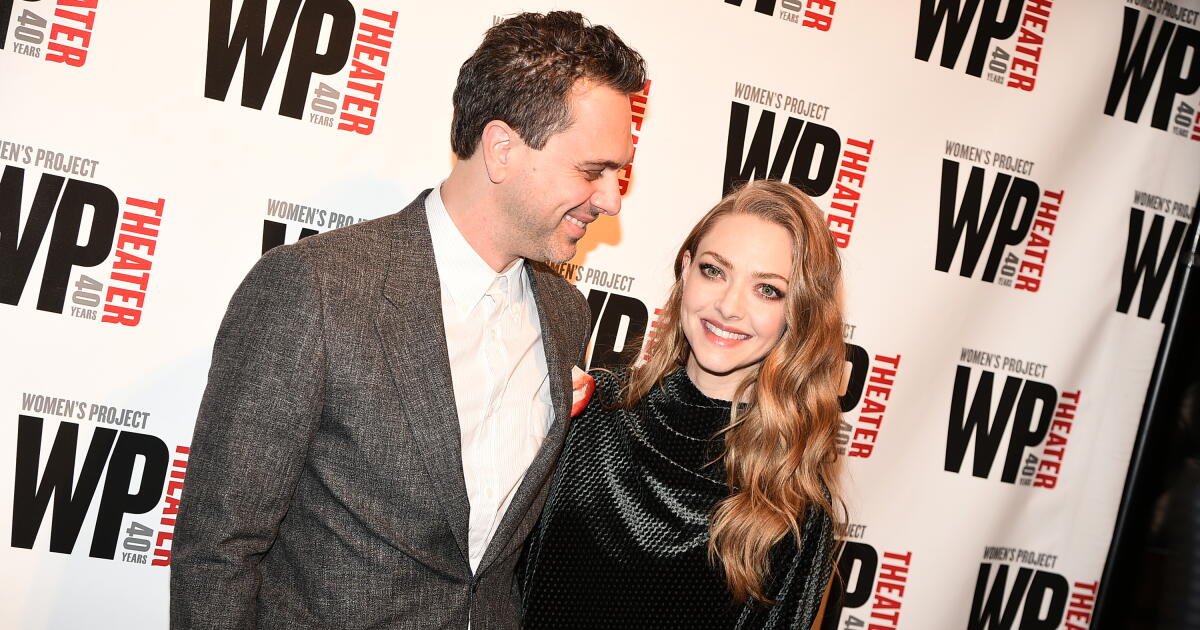
The former couple, who tied the knot in March 2017, told People that they had been separated for some time.
“We have been separated for a while, and it’s proven to be the right move for us and our family unit. We’ve got each other forever — and it’s GOOD,” Seyfried and Sadoski told the outlet.
On Tuesday, Seyfried shared a piece of prose by poet and author Bianca Sparacino on her Instagram stories that read:
“Maybe in another lifetime.”
“No.
“This is all you get. So please, just fight for the things that crack light into your life, fight for the things that soften you. Protect the people you love, leave them better than you found them. Defend your heart, do whatever it takes to keep it open despite what it has been through. Forgive, not just others, but yourself, as well. Slow down. Taste, and touch, and feel and care. Create the things you want to see in this world, stay as curious as possible. Honour your joy, do not shy away from the good that is trying to reach you, do not convince yourself that you are unworthy of it. Be strong enough to be gentle. Be brave enough to break. Be all that you are. Be all that you are.”
The pair met back in 2015 while starring in “The Way We Get By,” a two-person off-Broadway play that explores love and lust and takes place the morning after a drunken hookup. It was Seyfried’s stage debut. “I feel like the luckiest guy in New York right now, to be honest with you,” Sadoski told Backstage on Broadway at the time. “I mean, I get one of the great American playwrights, one of the great American directors, and a perfect scene partner, I’m a pretty happy guy.”
The two teamed up again the same year to play love interests once more in “The Last Word.”
After spending a good portion of the year pretending to be in love with Seyfried on stage and screen, in October 2015, Sadoski split from his wife of eight years, studio casting executive Kimberly “Becky” Hope. By March 2016, the “Newsroom” actor was romantically linked to the “Mamma Mia!” star.
Seyfried, 40, and Sadoski, 50, tied the knot in a private countryside ceremony in 2017. There were no family or friends on the guest list, just their officiant and Seyfried’s dog, Finn. Shortly after the nuptials, the pair welcomed a baby girl, Nina. In 2020, they had a son, Thomas Jr.
The couple have raised their family on a farm in the Catskill Mountains of upstate New York, a property the “Mean Girls” star bought in 2013, while also maintaining properties in Los Angeles and Manhattan. But last month, Seyfried listed her 2,700-square-foot Los Angeles residence for about $3.2 million.
As the fall equinox approached from a week away, the Primetime Emmy Awards made its 78th visit, leaving trophies in some hands, the honor of just being nominated for others and bupkes for the rest of the thousands who make what we call television. Once again I have been called to witness (from afar) and report, so let’s get down to it.
It was the turn of NBC (and Peacock) in the round robin of major networks who broadcast the show, and to keep things literally in-house it was hosted by Mariska Hargitay, “America’s sweetheart sex cop Olivia Benson” from the network’s “Law & Order: Special Victims Unit” and broadcast from the Peacock Theater, formerly the Microsoft Theater, formerly the Nokia in #DTLA, formerly downtown Los Angeles.
When reviewing the Emmys, or any awards show, as television in its own right, the only real questions are what distinguishes it from its many previous appearances on the karmic wheel of life — how it tricks up the basic, immutable form, like different decorations on the same sugar cookie recipe you have been using forever. Anything unexpectedly or especially moving, rousing, funny or strange, things that go against the grain of a production that wants to keep things controlled in order to bring the ship in on time.
This year the critic has been given the gift of Hargitay, primarily a serious actor (and director and producer), following in a long line of comedians and comic actors. There have been other serious actors as host, for example, Raymond Burr in 1959, Tom Selleck in 1984 and Angela Lansbury in 1993. And certainly, if you’re looking for someone to represent the medium rather than merely to comment on, celebrate or joke about it, you could do no better than Hargitay, the longest-serving actor on the longest-running prime-time live-action series on American TV. She’s beautiful, glamorous, self-possessed. She was recently on Broadway in “Every Brilliant Thing,” which involved a degree of what comedians call “crowd work,” so standing up in front of a live audience of people no more famous than she wasn’t going to throw her. Professional comedian Nate Bargatze, who hosted last year, was much more of a dark horse.
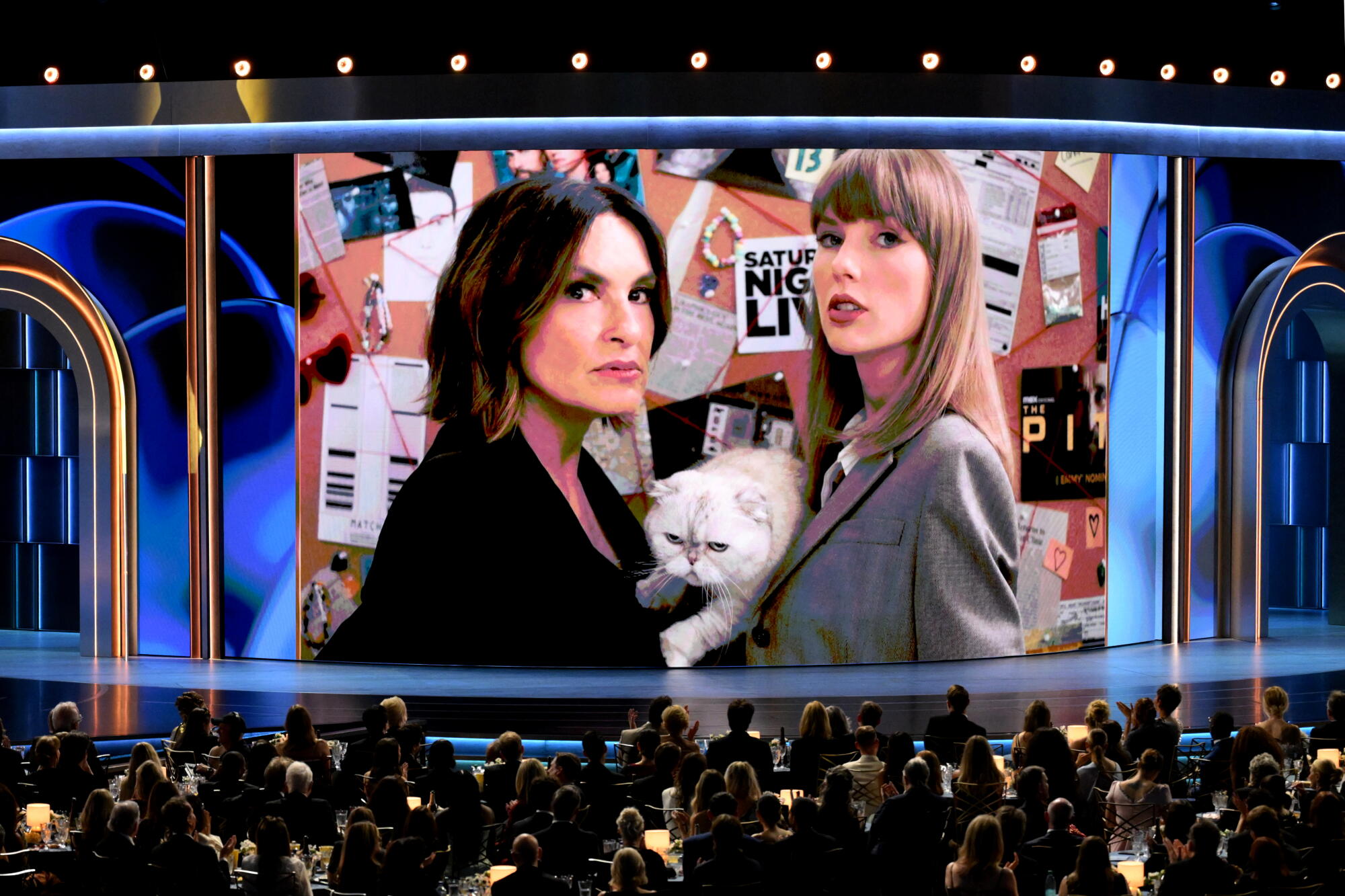
Emmys host Mariska Hargitay with singer Taylor Swift and her cat Olivia Benson on screen during a skit the 78th Primetime Emmy Awards.
(Patrick T. Fallon / AFP via Getty Images)
Although I would have bet on a pre-filmed “Special Victims Unit” routine to open the show, which is why I’m not a gambler, it wasn’t until an hour in that it appeared. (It involved murder-style boards, concerning the Case of Whether Taylor Swift would be making an appearance; she did, in the bit.) The pre-filmed production number that did open the show began with Hargitay and her actual good friend New York Knick Jalen Brunson steaming their clothes when Hargitay suddenly realizes she is due across the country to host the show. This led to Joan Jett’s “I Love Rock ’N Roll” reconceptualized as “I Love TV Screens,” which included the “Widow’s Bay” sea hag revealed to be Jennifer Coolidge, bringing boba tea (rhymes with “TV”); other rhymes matched “eating beef” and “watching ‘Beef’” and “Ed Gein” and “mean.” It moved to the live stage, with Hargitay flanked by dancers with television heads. Both segments felt more effortful than funny, but not unfunny.
On her own, however, Hargitay was above all a woman having a good time, never less than likable and game and enthusiastic, managing the scripted patter as well as anyone might have. Her monologue included several jokes about age, one about “L&O” producer Dick Wolf’s real name (Richard Penis), and another about her inability to pronounce “finale” because she’d never been in one. As is practically an Emmys tradition, some of these were confusing (even to the people performing it), or went on too long (Nick Offerman, cornered at his table, describing his work as an erotic house painter), or just had the effect of having been put on their feet without much, if any, rehearsal. Presenting the final award, for outstanding comedy, Woody Harrelson and Matthew McConaughey, told to stretch — the show was actually running short — described the plot of their upcoming Apple series, “Brothers,” until they were allowed to move on.
As to what the Television Academy calls “creative elements,” everything that isn’t a presentation or a speech, they advertised tributes to the 30th anniversary of “Buffy the Vampire Slayer,” certainly a typo, and the 50th of “Charlie’s Angels,” a logical impossibility, but these were really just themed groupings of presenters — Sarah Michelle Gellar and David Boreanaz in the former, Kate Jackson, Cheryl Ladd and Jaclyn Smith in the latter. (The Angels managed a few words for Farrah Fawcett, but none for Shelley Hack, Tanya Roberts or David Doyle.) But there were full tributes to Dolly Parton (Sally Field enthused, Reba McEntire sang); to James Burrows, with Jamie Lee Curtis pivoting emotionally to talk about old friend Rob Reiner, who won a posthumous guest appearance Emmy this year for “The Bear”; and to Catherine O’Hara, with her “Home Alone” child Macaulay Culkin and “Schitt’s Creek” children Annie Murphy and Dan Levy, who spoke to “helping her build a TV character over the age of 60 that wears leather miniskirts and eight-inch heels and speaks in a strange, sometimes unintelligible transatlantic accent, and know that she will not scare an audience away.”
And there was Julianna Margulies presenting the Bob Hope Humanitarian Award to Michael J. Fox, who, in his usual way, was eloquent and funny, and let the people know about the goodness of Bob Hope, setting up a punchline in the bargain. Like a lot of you, I love Michael J. Fox, and I’m just going to leave that here, with a pile of soaked-through tissues.
John Mulaney stole the show as a presenter at the 78th Emmy Awards ceremony at the Peacock Theater in Los Angeles.
(Robert Gauthier / Los Angeles Times)
But what America will mostly remember from this night was John Mulaney, introducing the award for lead actor in a drama, and burning the house down with a routine that went wherever it wanted. “They can play anything, these nominees. Not just doctors. They can play a cop or an FBI agent or a secret agent. And then that’s it. No other examples.”
“Since the creation of television, men have been historically underrepresented,” Mulaney said, explaining that the medium was all “beauty contests and children talking to hand puppets until the early ’60s. Until a man walked out and said, ‘Enough. My name is Fonzie and the president’s been shot.’” Mulaney is a man who has convulsed crowds in arenas and stadiums, but, as a local, nothing made me laugh harder than the words, “You know, I was shooting down Barham last night at 90 miles an hour.”
Nothing against Hargitay, but it’s clear that Mulaney should host this show, and every awards show, from now on.
Sean McVay and the Rams thought the situation was under control, or at least manageable.
Star edge rusher Myles Garrett first experienced knee discomfort and swelling during training camp, a condition that caused him to sit out the majority of team workouts throughout the weeks leading up to the season opener.
But Garrett failed to record a tackle, and was clearly not himself, in an embarrassing defeat by the San Francisco 49ers on Friday in Australia.
On Monday, Garrett was scheduled to have surgery, and he will sit out at least the next four games on injured reserve.
“Our job is to put our players and our team in positions to have successful outcomes,” McVay said Monday during a videoconference with reporters. “Thought we would take an approach where he’d be feeling good enough to go, contribute positive change and be the player that he’s capable of.
“But that wasn’t the case, and so the next right thing for us is to be able to get this thing fixed.”
Garrett, 30, will miss next Monday’s home game against the New York Giants, road games at Denver and Philadelphia and home game against the Buffalo Bills before he is eligible to return.
McVay did not have a timeline for his return.
“It’s all contingent on how do things go [Monday],” McVay said. “But I think it would be unfair to him, without having the totality of all the information, to put any sort of timeline on it.”
Garrett, a two-time NFL defensive player of the year, played only 40 of 65 snaps against the 49ers. McVay said the decision to pursue surgery was made after consulting with Garrett immediately after the game.
“We thought we were doing the right thing,” McVay said of the Rams’ attempt to manage the situation. “In hindsight, you’ll always be able to learn from it. I’ll never hang onto whether you want to say it was a mistake or just different things to be able to kind of change course.”
With Garrett out, the Rams could use a spark for a defense that gave up three touchdown passes and 174 rushing yards against the 49ers.
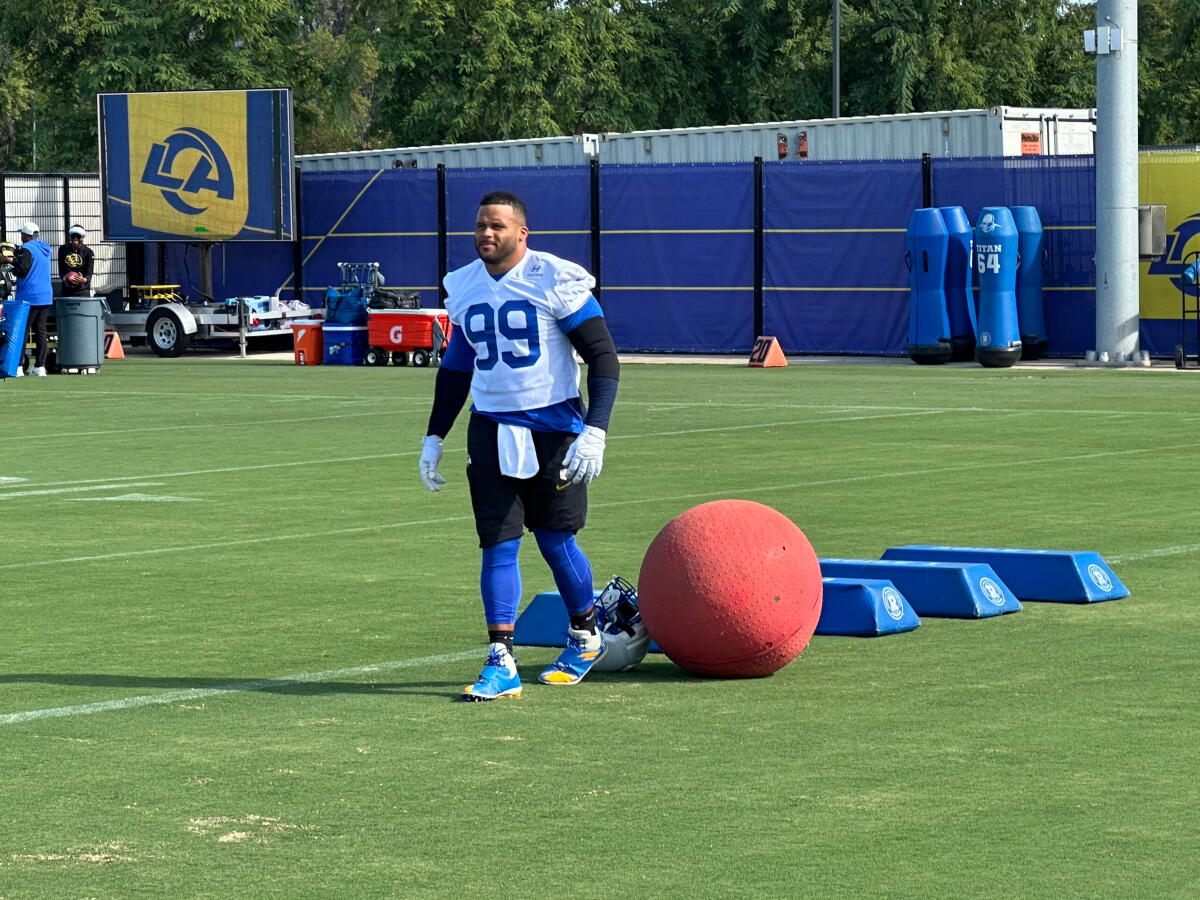
Will lineman Aaron Donald, who has returned from a two-year retirement, make his season debut against the Giants?
Aaron Donald practices for the Rams in August.
(Greg Beacham / Associated Press)
“We haven’t decided that yet,” McVay said. “He’s going to continue to work his process and we’ll see what that looks like.”
McVay said Donald’s situation is “totally separate” and “totally independent” of Garrett’s.
“It’s more about Aaron and how he can contribute to the collective,” McVay said. “What does that feel like with how he’s feeling to be able to resume 11-on-11 and being able to play and do the things that he’s capable of.”
In the meantime, the Rams will look to fill the void of Garrett’s absence with Josaiah Stewart, Desjuan Johnson and rookie Wesley Bailey.
Share via
The Rams lose to the San Francisco 49ers 27-7 in the 2026 season opener at Melbourne Cricket Ground in Australia on Friday.
Stewart, a second-year pro from Michigan, made six tackles and had one of the Rams’ two hits on 49ers quarterback Brock Purdy.
“He’ll be asked to step up,” McVay said, “as will everybody in that group.”
McVay speaks often about how adversity during a season is bound to come.
But for the Super Bowl-favorite Rams, it came early.
“I don’t have a crystal ball,” McVay said of anticipating when adversity will come. “I just know this: that these are the opportunities to really separate yourself with how you handle ‘em.”
The 49ers, the Seattle Seahawks and the Arizona Cardinals all won their openers, putting the Rams in last place in the NFC West.
It’s still early, of course, but the road to a spot in Super Bowl LXI at SoFi Stadium suddenly appears more challenging.
“That is over with,” McVay said of the loss to the 49ers. “That’s in our rearview mirror. We’re all eyes moving forward.”
Etc.
Linebacker Omar Speights suffered a hip pointer against the 49ers, McVay said. “We’ll kind of manage him throughout the week, but he’s feeling better than we anticipated,” McVay said. Linebacker Nate Landman sustained shoulder and thumb injuries, but McVay said he is expected to play against the Giants.
For Orville Peck, the best Sundays are basically all the same. And they are pretty similar to every other day of the week too. The masked country singer (and now actor) got sober three years ago and has figured out a routine that helps him stay clear-minded and present with the people in his life whom he cares about.
In Sunday Funday, L.A. people give us a play-by-play of their ideal Sunday around town. Find ideas and inspiration on where to go, what to eat and how to enjoy life on the weekends.
“If I don’t keep up that routine, especially on a day like a Sunday, it quickly falls into no day feeling fun,” he says. “[The routine], which to some people is like, ‘Oh God, that looks like hell,’ is fun for me because it is fun for me to show up for myself.”
Peck’s latest album, “Mule,” which details his sobriety journey, is out Friday. That same day, he’s headlining the Hollywood Bowl, one of his favorite venues in the city.
Peck currently lives in the Hollywood Hills and has been in Los Angeles, on and off, for 18 years. “It’s definitely home to me,” he says. “I met my partner there. I’ve had some of the most important moments of my life in Los Angeles. I will always love this city.”
It’s also particularly conducive to his new lifestyle. “There’s a ton of other crazy people going to the gym and swimming and going to [12-step] meetings every single day,” Peck says. “So I’m in appropriately obsessive company for sure.”
This interview has been lightly edited and condensed for length and clarity.
5 a.m.: Early to rise
I wake up painfully early. I’ve been doing that since I was a toddler. I used to hold my mother’s eyelids open in the morning to get her to wake up.
When I wake up, the first thing I will do is meditation. I do transcendental meditation. I find every other form of meditation impossible. I’ll do TM for 20 minutes. My partner started doing it and I saw how much he was benefiting from it, so I decided to go and take the course and just loved it.
And then I’m an avid journaler, so I usually journal for probably about half an hour in the morning.
7 a.m.: Caffeination and hydration
I will make a very large iced coffee. I’m not snobbish about coffee, I’ll drink whatever.
I also fill up a massively obnoxious water bottle that has times on it that I carry everywhere. It looks like performative hydration, but it’s literally because if I don’t challenge myself to drink water, I just won’t drink water at all. It’s basically to shame myself into drinking water.
8 a.m.: Pool time, Part 1
I get to a public pool and I do laps. I grew up in South Africa and you’re forced to play every sport known to mankind. I always excelled at swimming, so it’s the one thing I still love to do. I just started up [again] within the last year.
I work out a lot, but when I’m at the gym, I don’t do any cardio. I’m never going to be on a treadmill or anything like that. Swimming feels like a fun way to keep me engaged.
10 a.m.: Meal prep
Then I go meet back up at home with my partner. We’ll go take our dog for a walk or we’ll go to a farmers market to get some produce for the week.
Then we’ll go grocery shopping because I love to cook. I will go to whatever is easiest. I’ll frequent a Gelson’s or a Ralphs or a Whole Foods. If I’m going to Whole Foods, I’m not doing regular grocery shopping. I want brands. I like a Coca-Cola.
I’d say I’m cooking usually about five or six nights a week. I’m very organized — I’m a Capricorn, if you can’t tell. I usually have a whole menu of what I’m going to do for the week, so I’ll get everything I need for that.
I will read a recipe or see a recipe I like, and then I will just freestyle it. I used to work in restaurants, so I feel pretty confident about it. But in terms of the style [of cooking], I’m best at recipes that take a long time, so anything that requires lengthy flavor building, like stews or curries.
Noon: Pool time, Part 2
Back at the house, we’ll have some lunch, something easy by the pool. So more swimming.
2 p.m.: Gym time
I’ll work out either at the house or go out to the gym. I’ve been sticking with a weight training routine for a couple of years now, but I try to evolve the exercises all the time because I get bored really easily.
Sometimes I work with a trainer. I filmed “Street Fighter” last year in Australia, so I did a ton of different training and martial arts training for months. It opened up my horizons to a lot of different forms of working out that I just didn’t know before. I’ve got a pretty big encyclopedia to pull from at this point.
4 p.m.: Recovery
I’ll usually head to a 12-step meeting, I’ll either catch one online or try to find one in person because there’s a lot around L.A.
6 p.m.: Not cooking tonight
On the weekend is where we will typically order in or eat out, maybe with some friends. Some places I love to order in from are the Sisters Cafe, which is Vietnamese, and Jon and Vinny’s.
9 p.m.: Early to bed
Both my partner and I are 80 years old at heart. We always have grand plans about watching a movie or whatever, and then we’re both inevitably snoring by 10 p.m. at the latest.
I used to live my life like a psycho maniac doing everything unhealthy. It definitely didn’t involve going to 12-step meetings and swimming laps at seven in the morning. It was whatever the opposite of that is.
When I went through the first two years of my sobriety, I went through a lot of trial and error in terms of overdoing it with things like therapy and mindfulness, and then also underdoing it as well. It took me a couple of years to really find what are the things that make me feel good about myself, make me feel grounded, make me feel accountable, and still feel like I’m living a happy life and not just white-knuckling 12 hours of, essentially, therapy every day. So I’ve found the things that really work for me.
There’s days where I will totally not do every one of those things. There’s days where I’m too lazy to go swimming and there are days where I’m like, “I don’t want to go to the gym.” I’m not militant about it. The other thing I’ve learned is to be easy with myself.
Alanis Morissette is getting candid about the terror she experienced with what she calls “postpartum activity.”
Although terms like postpartum depression and postpartum psychosis may not have dominated trending topics in the 2010s when the singer-songwriter was having her three babies, Ever Imre, now 15; Onyx Solace, 10; and Winter Mercy, 7, it’s an especially hot-button issue today. And Morissette knows a thing or two about grappling with the condition.
On Wednesday, Morissette appeared on the “Call Her Daddy” podcast and told host Alex Cooper that she experienced postpartum depression after giving birth to each of children, and that the condition worsened each time.
“Basically, I became another person,” she said, adding that her hormones felt out of whack. “There’s some version of menopausal flux combined with … invasive thoughts that are so harrowing — terrible, ceaseless, invasive thoughts, anxiety, depression, rage, off the charts. I felt completely out of control, and yet I was touring … and being a boss and being someone taking care of money and finances and everything, and that is the part where, when I’m quiet and alone, I might weep a little bit.”
In recent months, attitudes around postpartum depression have shifted, and the condition has been discussed more urgently than perhaps ever before. Hayden Panettiere’s death sparked renewed scrutiny of society’s treatment of women suffering from the condition. And the polarizing trial of Lindsay Clancy, a labor-and-delivery nurse who pleaded not guilty by reason of insanity after killing her three children in 2023, has captivated the country since July.
Back in 2019, Morissette discussed her experience with the illness, but the topic hadn’t yet garnered the public’s attention like it has today. Morissette told Cooper that when she first experienced symptoms, she reached out to multiple therapists, who didn’t seem to know how to treat the issue, no matter how well-meaning they were.
The “You Learn” singer said that the “invisible load” that mothers often carry — which the Institute of Child Psychology describes as the mental and emotional weight involved in running a home and tending to children — should no longer be invisible.
“We’re making it visible,” she said. “I’m going to tell you the 37 things that we do an hour … let’s name it. Even us calling it ‘invisible load’ keeps it invisible.”
The Grammy winner told Cooper that she went on tour while suffering from postpartum depression during the pandemic and that it became so severe, she “dipped into psychosis.”
“The depression piece inside PPD, unfortunately, I was familiar with it,” she said. “It was all the other stuff. It was the invasive thoughts and the terror. All I could picture was death and terrible things. … The bummer for me inside PPD was that I was losing people’s trust in my sanity. That’s a bummer. When I have spent my whole life attempting to establish to people I love that I’m safe, and that I’m predictable, and then all of a sudden I wasn’t. That was a loss, because people looked at me differently. They looked at me like I maybe couldn’t be trusted.”
The singer said she’d recovered since the struggle. “I feel so happy that I’m back.”
It’s been five years since “Call My Agent!,” known in its home country as “Dix pour cent” (“10 percent”), ended with the staff of Paris’ bankrupt ASK talent agency moving en masse toward the exit, as in the closing moments of “The Mary Tyler Moore Show.”
The rich workplace comedy mounted four seasons from 2015 to 2020; the fourth was made without its creator, Fanny Herrero (she went on to create the fine but less successful “Standing Up,” about Parisian comics). But she has returned, along with “Standing Up” writer Lison Daniel, for “Call My Agent! The Movie,” premiering Thursday on Netflix, which picks up the scattered ensemble more or less where they imagined they’d be when the series ended, and gets them back in the same frame.
As a movie, it’s its own sort of beast — a complete statement in a single package, with not just A and B stories, but C and D as well, and arcs that might develop over a season of the show compressed into a couple of hours. But its essentials are essentially unchanged: It’s still about the difficulty of making art, and the often unsavory business that lets art get made, with known actors playing fun house versions of themselves and our heroes attempting to wrangle them into order, with whatever works — lies, bribes, real shared feelings. The regular cast, many of whom Americans will first have met here, still feel identical with their characters, rather than just professionals who have been paid to play them, so that even when the action is outlandish the emotions are real.
The focus here is on the fierce Andréa (Camille Cottin), who has left agenting and is about to direct her first movie, a drama set in the woods, and Noémie (Laure Calamy), whom Andrea hires as a replacement producer — she has become the producer of a hit workplace comedy, “Les Colleagues,” the sort of show that produces a lot of branded merch — believing that she can mold Noémie to her will. On the domestic front, Andréa separated from partner Colette (Ophélia Kolb), a co-parent to her daughter Flora — some sticky questions will arrive, doubling the pressure.
Noémie is still with Mathias (Thibault de Montalembert), once the most formidable of agents, who has quieted down somewhat owing to a Season 4 heart attack, and the fact that he’s working in the agency his daughter Camille (Fanny Sidney) announced at the end of the series. He’s feeling old (comparatively, he is, at 64 — though Liliane Rovère as agent emeritus Arlette beats him at 93) and things with Noémie are not great, which sets the stage for some romantic comedy, including a wild boar.
Andréa’s movie brings the old cast together, including sensitive junior agent turned aspiring actor Hervé (Nicolas Maury), and I am glad to see them. (Stéfi Celma’s Sophia, a receptionist turned actor, is sadly missing.) Much goes wrong, before things go right. (It’s a comedy, they will — though there are some moving dramatic moments along the way.) To be sure, there are no backstage comedies — or dramas, or dramedies — in which nothing goes wrong, or things even go mostly right. Disaster is the air they breathe.
On the eve of production, Andrea loses her male lead (Laurent Lafitte as himself) to a Wes Anderson movie; the psychologically delicate actor they get to replace him, Vincent Macaigne as himself, who’s represented by former ASK agent Gabriel (Grégory Montel), now working for their old rival, has a messy history with the other lead, Laetitia Casta, also as herself. They can barely work together. (There will be a bit of romantic comedy wrapped around this thread, as well.)
Then there’s a storm.
The French actors playing themselves are not well known here — Casta may be more familiar as a ’90s supermodel, for those who are familiar with that sort of thing — but Americans have been given the gift of cameos from Eva Longoria and an uncredited George Clooney who takes a comically unproductive lunch meeting with Andrea, crashed, in more than one sense, by Noémie.
Though the series finale made for a satisfying ending, there was already talk then of another season or a film. Still, “The Movie” arrives seemingly out of left field, as sort of a happy surprise. It doesn’t betray its legacy. We know from the supermarket magazines and internet scandal sites that some actors are seemingly as crazy as these actors pretend to be. But somehow movies get made. Most every show business satire is also a show business celebration. There’s no business like it.
Stella Parton has released a public plea as the family continues to mourn her sister Dolly Parton’s death last month at the age of 80.
Late last week in an Instagram statement, Stella Parton thanked fans for the “genuine” support, urging them to use her sister’s life as an “example for tolerance and respect towards others.”
At the same time, she asked them to “show more compassion and wisdom.”
The 77-year-old singer-songwriter says the family has been subjected to “pressure” and “insensitivity” from strangers following the death of Dolly, who died on Aug. 25 after a private battle with cancer.
“There is a tremendous amount of [artificial intelligence] and endless garbage being posted everyday and it’s been challenging to absorb and or ignore,” Stella wrote in her Sept. 4 statement. “As time passes, those who are in the business of exploiting the loss and tragedies of others on a daily basis will move on to the next stampede of endless misinformation.”
While it is not clear what AI content Stella was referring to, AI-generated images of Dolly surged online following her death.
On Aug. 27, President Trump uploaded a fake image on Truth Social of the two walking around the White House . Another online user created an AI song that has amassed over 1.5 million views since its upload on Aug. 25. The song was falsely credited to pop singer Miley Cyrus, Dolly’s goddaughter..
“She loved her fans and the public in general. That is the reason she chose not to express her opinions on a lot of things like politics, religion and individuals in the public eye,” Stella wrote in the Instagram post. “She knew as well as anyone what a negative vortex that could turn into which is nothing but a huge waste of positive energy.”
Last year, Dolly critiqued AI content when clearing rumors surrounding her health, which swirled online after sister Freida Parton asked the public for prayers in a Facebook post on Oct. 7, 2025, in which she stated that the singer “hasn’t been feeling her best lately.”
“Did you see that AI picture of Reba and me? Oh lordy, I mean, they had Reba at my death bed and we both looked like we need to be buried,” Dolly said on Instagram on Oct. 8, 2025.
Toward the end of her Instagram statement, Stella said her plea is less about the “fake AI garbage” or “snarky tweets,” and more about encouraging the community to look within: “How will you feel about yourself? It’s not about what other individuals you will never meet think of you!”
Stella Parton is best known for her 1975 hit “I Want to Hold You in My Dreams Tonight” and a country and gospel discography that spans 21 studio albums. Also known for her acting in “The Dukes of Hazzard” and “The Best Little Whorehouse in Texas,” Stella made the distinction between her and her older sister clear at the end of her statement: “I’ve always embraced my own personality and will continue to be myself and express my opinions as I deem appropriate regardless of what anyone thinks of me.”
“Dolly loved the world and everyone in it,” Stella wrote on Aug. 27 on Instagram in her first statement after her sister’s death. “I would criticize and complain about it and she would laugh and say; ‘shoot Tedda, we’ve got more important things to do than worry about their silly a—.’ She was right, and she proved it every day.”
Will star defensive lineman Aaron Donald be with them?
“Feeling good, feeling really good,” Donald said Monday. “Come up with a game plan and see.”
But could he say for certain he will make the trip?
“I’m feeling really good. Feeling great,” he said. “Come up with a game plan and see what’s going on but I’m telling ya, I feel great.”
Donald, 35, returned from a two-year retirement to join a Rams team that is favored to win Super Bowl LXI. But the three-time NFL defensive player of the year has gone through only one 11-on-11 practice.
2026 NFL season preview
He did that on Sunday, but did not practice Monday. Donald said he did a cardio workout as part of a scheduled day off.
“I’m 35,” he said, chuckling. “You don’t play football in two years, you got to be smart. Even if I feel good, you still gotta be smart.”
Coach Sean McVay has said that Donald’s situation would be evaluated daily.
Rams defensive coordinator Chris Shula, asked if a decision had been made regarding whether Donald would play against the 49ers, said “everything’s” day by day.
“We’re ready for him if he does, ready for him if he doesn’t,” Shula said, “and we’ll have a plan for however many plays he feels like he can go and we’ll go from there.”
Donald said his ramp-up has gone better than he anticipated.
“Thought I’d be a lot more rusty,” he said, adding that things were “clicking.”
Donald said that during his first full practice, he settled in after a few plays. He is not where he wants to be, “but pretty pretty damn good, if you ask me, to not play football in two years to be moving how I’m moving.”
Donald came back, in part, to team with edge rusher Myles Garrett, a two-time NFL defensive player of the year. They have been in meetings and walkthroughs together, and now have practiced.
“It was good to be on the grass with him and do some stuff, and get a feel,” Donald said. “Because the chemistry of playing with each other, kind of learning how each other rush, how each other play, not just Myles just the whole front. … It’s exciting.”
Donald said he was ready for whatever role he fills, and that he was not going to worry about playing 60 or 70 snaps.
“There’s no pressure on me. I can just go out there play free, play ball, let the game come to me,” Donald said. “Play with the guys around me. Help them, they help me.”
Donald, an eight-time All-Pro, has 111 career sacks.
Star receiver Davante Adams is happy that he returned to join the Rams.
“Nobody knows exactly what he’s going to do statistically, if he’s going to be exactly what he was,” Adams said. “But … I know the type of person that he is and I know the way he’s going to work and I know the way he looks right now.
“It looks like it’s going to be a familiar picture for us all out there.”
Puka Nacua ready for opener
Star receiver Puka Nacua said he was happy to be participating in full-team drills after being sidelined for a few weeks because of a psoas injury sustained during a joint practice with the Dallas Cowboys a few days after the end of training camp.
The NFL has been investigating an incident that led to Nacua being the defendant in a civil lawsuit. If the league determines that Nacua violated the NFL’s personal conduct policy, he could be suspended.
But the league has not taken action, and McVay said he expected Nacua to play against the 49ers.
Did the possibility of a suspension before the season weigh heavily on Nacua?
“Definitely feeling emotion of some of the things that, just trying to handle that in the ways that I can and what’s in my control,” he said. “But also having a realistic understanding of the consequences of some of the things that I put myself in this offseason.
“But I feel like I’ve been able to feel grounded and feel present when I step out there on the football field. That’s been one of the positive things, of every time I step on that football field, never taking that moment for granted.”