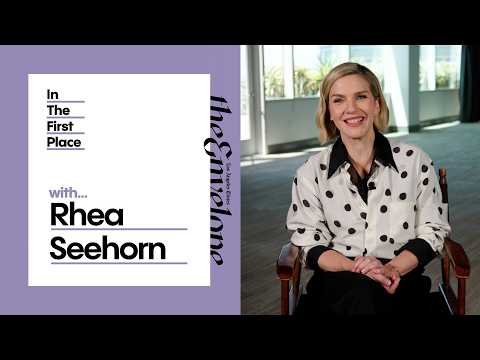
Rhea Seehorn possesses what Vince Gilligan calls “Jumbotron face.” As the creator of “Pluribus” and (with Peter Gould) “Better Call Saul,” Gilligan has relied on Seehorn’s ability to broadcast what her characters are thinking and feeling without saying much of anything. Gilligan loves silences and uses them in long stretches, allowing — or, perhaps more accurately, demanding — his audience to figure out what’s happening on their own.
And in Seehorn he found someone who, with a mere sidelong glance or knitted brow, can let you in on Gilligan’s secrets.
But Seehorn carries this ability wherever she goes, she tells me. People take a look at her and make assumptions. She’s 5 foot 4, lean and seems athletic, though she says she’s “the least athletic person that anybody knows.” That hasn’t stopped her from being cast as a golf instructor in the upcoming second season of the Owen Wilson comedy series “Stick” and a track and field coach in a movie she’s shooting right now called “Running.”
“I do not run,” she told the movie’s director, Gavin O’Connor. “I can tell people to run, but you don’t want to see me running.”

It’s not just work, though, where these deductions are made. Up until a few years ago, when people started recognizing her for playing poker-faced attorney Kim Wexler on “Better Call Saul,” Seehorn would be standing in a store and customers figured she worked there. Shopping at the Gap, she’d be asked if a T-shirt comes in medium. In Target, she’d be queried about where to find the Christmas decorations. Even on set, a background person would approach her, wondering if there’s any more plain bagels at craft service.
Why do you think this happens? I ask her. Because, even with her fame and her Golden Globe win for playing Carol, a sad woman forced to save the world from happiness and the hive mind in “Pluribus,” Seehorn, 54, says this still takes place on a regular basis.
“I’ve asked my friends, and apparently my daydreaming or thinking face looks focused,” she says. “I guess my interior monologue is highly interpretable to people, and if you’re standing in a store and you see somebody really thinking and thinking, they’re like, ‘She must be restocking the shelves.’ When in reality, I’m probably thinking about what I said wrong to somebody at a party in the ’80s.”

Rhea Seehorn as Carol Sturka in “Pluribus.”
(Apple TV)
Seehorn bursts out laughing, which she does often and with great gusto throughout our conversation. We’re at The Times, nine years after her last visit to our offices, which I know because she shows me a photo on her camera roll of her youngest stepson, McLain, taken when we were downtown and he was 9, young enough to still be thrilled about being in a “newspaper building.”
This prompts another take-your-kids-to-work memory.
“I brought him and Gray [the other stepson she shares with her partner of 12 years, real estate agent Graham Larson] to the set of ‘Better Call Saul’ when they were 7 and 9, and the thing they were most excited about was signing an NDA,” Seehorn says. “Everybody in the production office made a huge deal of it, pretending like they were spies, because I knew they’d think that was cool.”
Seehorn played Kim opposite Bob Odenkirk on “Better Call Saul” for six seasons, creating a character that evolved from a minor role to what Gilligan calls the “backbone of the series.” Dazzled by her versatility, Gilligan wrote “Pluribus” for Seehorn. But he didn’t want to tell her about it until he had a script and not just an outline. He asked “Saul” executive producer Melissa Bernstein to act as a spy and tell him if Seehorn was close to taking another job. One day, during the show’s final season, Bernstein told him he’d better pounce.
“I didn’t want to miss my opportunity,” Gilligan says over the phone. “That would have been a bummer. Rhea is the manager that makes the show work.”

(Ian Spanier / For The Times)
Where Kim Wexler was a composed and poised overachiever, suppressing her emotions when things (as they often did) spiraled out of control, “Pluribus’” Carol Sturka lets it all hang out. She’s volatile and angry, drinking heavily to obliterate her regret and rage. The characters share a fierce drive to fight for what they believe is right, which, for Carol, means maintaining her autonomy and resisting the good-vibes group contentment of the Others. A hero has never been more reluctant than this curmudgeon.
Seehorn is the ultimate professional: pleasant, quick to credit her colleagues, a team player. So Carol’s bitter fury feels distinct from her friendly personality as well as anything we’ve ever seen her do onscreen. But it’s not entirely foreign. Talking about the “Pluribus” season finale, she said that while she’s never murdered anyone, she has felt out-of-control rage.
When did this happen?
“I’m not going to tell you that!” she answers, laughing.
I’m just trying to picture it, I tell her.
“I know, because a lot of people are like, ‘I’ve never seen you mad,’” Seehorn says. “I suppress. I suppress too much. That’s something I work on with my therapist. I used to scream and yell as a teenager. That’s how I fought. And I just decided in college one day — I think I had an out-of-body experience — that I don’t want to be this person. And it probably moved the needle too far the other way. Now, when I’m angry, often I withdraw and get very quiet. I say everything is fine and then I’m never speaking to you again.”
That could have made playing a highly reactive character like Carol therapeutic. Instead, it did a number on Seehorn’s body.

(Ian Spanier / For The Times)
“Unlike Carol, I cry often when I’m extremely angry and in the middle of trying to tell someone how upset I am,” Seehorn says. “Like the anger disturbs my body so much that it makes me cry. No matter how much I tried to unplug from Carol, my body didn’t understand that I was pretending.”
We start talking about relationships and unhealthy withdrawal and letting things fester to the point that when the emotions come out, it feels abrupt and the other person has no idea what’s going on. And out of nowhere, Seehorn gives me a taste of Carol, growling the words, “Can you just get it?” with such ferocity that I’m almost physically blown back in my chair.
“God, you scared me with that,” I tell her.
“Thank you,” Seehorn says, beaming.
Because she’s a (generally) well-adjusted human being, Seehorn has developed ways of dealing with the terror and flop sweat that comes with playing the lead on an expensive, highly touted TV series, one that earned 18 Emmy nominations, including one for her lead turn. She converted the garage at her home into what sounds like a veritable wonderland. In one corner, there’s a tiny gym. There’s a place to record voice-over work, not a proper booth, which she’d like someday, but close. There’s a space to be quiet and read scripts. There’s an area where she can paint, sculpt, do jigsaw puzzles, Lego sets, embroider — all the things that ease her anxiety but also help her work through creative blocks.
“If I have too much of a vice grip on a scene and I can’t figure it out, I’ll do a jigsaw puzzle or draw while running the lines,” Seehorn says.
She loves creating things, but she also loves projects that involve following instructions. That soothes her. In the middle of enthusing about a cross-stitch embroidery project, she says, “Don’t roll your eyes at me!” Which I most definitely was not doing. That was my daydreaming, thinking face.

(Ian Spanier / For The Times)
Sometimes these projects make their way inside the house, where Seehorn might turn on the television and watch what she calls “murder TV,” sitting under a big, curved metal dome lamp that feels like an interrogation spotlight. There, her brain still working on what she was doing in her office, she’ll lose herself on multiple fronts as she wrestles with a scene.
Seehorn loves watching shows like “Dateline” because they provide a sense of order in a chaotic world. Bad guy. Bad guy gets caught. Bad guy goes to jail. All is well. But it goes beyond that. As an actor, she loves watching people trying to lie — and failing. She can’t believe how bad people are at not telling the truth.
“Every single time, I’m like, ‘Dude’s lying,’” Seehorn says. “Women too, where I’m watching an interrogation scene and thinking, ‘There’s a zero percent chance you did not know someone was going to break in and shoot your husband.’ It’s funny because as actors, whenever we’re playing criminals that are lying to the police, we’re really good at it.”
Does that mean Seehorn is an adept liar? Yes and no. You’ve seen her act. She can make you believe anything. But when she does lie, she is compelled to confess, even when the fib is innocuous.
“I’ll be in a conversation where there’s a bunch of cool people talking about a movie they saw, and I’ll be like, ‘Oh yeah, that was great!’” Seehorn says. “And then I’ll leave and then I’ll come back and say, ‘I didn’t actually see it. I’m sorry.’ And they’re like, ‘Who’s that weird girl?’ I’m good at lying, but bad at holding the guilt.”
So when you’re telling me you don’t know any details about the second season of “Pluribus,” are you misleading me? I ask.
“I know nothing!” Seehorn says. The atomic bomb in the crate that a helicopter carefully deposits in Carol’s driveway in the last scene? “As soon as they said, ‘Cut,’ I went up to Vince and asked, ‘Now can you tell me what we’re doing?’ And he said, ‘I have no idea.’”
“And all these months later, I know no more than that,” she continues.
But if you did…
“You’d be getting a phone call from me about an hour after we say goodbye, confessing all,” Seehorn answers, smiling.
The phone still hasn’t rung.

(Ian Spanier / For The Times)