LAS VEGAS — The Strip is broiling on a recent afternoon, but it’s cool and dark inside Mary J. Blige’s dressing room at the Park MGM.
As a humidifier moistens the dry desert air, the 55-year-old R&B star sits on a sofa wearing a brown jumpsuit and matching gaucho hat; through the walls we can hear Blige’s band sound-checking for her My Life, My Story residency, which launched in May and will pick up again Friday night for shows through Oct. 31.
In some ways, Las Vegas is a funny fit for the Queen of Hip-Hop Soul, who’s been transforming pain into music since her 1992 debut, “What’s the 411?” Yet her stay in this glittering showbiz mecca comes amid a season of flower-getting for Blige: Two years ago, she was inducted into the Rock & Roll Hall of Fame; two years before that, she played the Super Bowl halftime show and landed a nomination for album of the year at the Grammy Awards.
“It definitely feels like people are taking notice of the fact that Mary J. Blige is one of the most important performers in R&B history,” she says. “I opened up a lane that hasn’t been closed yet. Female after female after female after female continue to do what Mary J. Blige has done and still does.”
Who opened that lane with you? Back in the ’90s, when we first came out, it was myself and SWV that were really, really strong. Then there was 702, then Jazmine Sullivan and SZA and Beyoncé, and now right down to Summer Walker, who’s singing her truth.
That’s how you define what you do. I’m not a great singer because I can sing better than everyone — I’m a great singer because I sing from my heart. Bono gave me that jewel. When Hurricane Katrina happened, we were doing [U2’s] “One,” and Bono was like, “Don’t worry about singing on key — people aren’t moved by you singing on key. What makes you a great singer is how you make them feel.” Not all of us are like the eighth wonders of the world — Aretha Franklin or Chaka Khan or Whitney Houston. They have pitch-perfect and they have emotion.
I saw Chaka Khan the other night and was thinking about how, even now, you never know where her voice is about to go. She’s Chaka Khan — there’s nothing else you could say, really.
Why’d you cover “Sweet Thing” on “What’s the 411?” First of all, when I was growing up, my mother played “Sweet Thing” all the time — it was our favorite song. So when I got to Uptown Records, Andre Harrell, the CEO, he was like, “You should do ‘Sweet Thing.’” I was like, “I don’t wanna do ‘Sweet Thing’! Chaka Khan could really sing — I can’t sing like that.” But he said I could do it, so I went and did the song and they all went crazy over it. My fans who didn’t know Chaka Khan, they thought it was my song. Same with Rose Royce’s “I’m Going Down” — to this day, a lot of people don’t know that’s a remake. I was afraid of both those songs. But I wanted to sing “I’m Going Down” all my life because I heard the song when I was 5 years old from the “Car Wash” soundtrack.
Tell me about your routine in Vegas. You stay on the Strip or you have a house somewhere? I have a house out here. I’m not staying here — this is a lot. So I go home after I finish my performance, and I get ready for my performance tomorrow: I rest, I drink water, I do whatever I need to do. Then it’s the same thing: I come here, go into glam, do my meet and greet.
Get the humidifier going. I got a steamer that I actually pull on over my mouth. Then I do my warmups, relax, keep my mind clear of any nonsense.
How do you think about doing your thing in a town built on glitz? Mary is not the slickest Vegas person. But you can let people see that you’ve evolved — that you wear gowns now.
Would 19-year-old Mary be surprised to see her future self in a gown? Hundred percent. Nineteen-year-old Mary was all tomboy — all baggy everything. Right now, I barely want to wear a gown, this Mary right here. But I’ve actually grown to like some of it when it looks good.
Did you look at anyone else’s residency when you were putting yours together? I saw two people’s shows, and I said, “That’s not it.”
Shows in Vegas tend to be on the shorter side. The casino wants people back out there gambling. I got 90 minutes — it’s a lot of time. People are very happy, but they’re standing there like they want more. I’m like, “I did 90 minutes! I don’t know how much more y’all want from me.”
Silk Sonic’s residency here was a no-phones show, which Bruno Mars told me was his attempt to preserve the freedom to make mistakes. Does it bum you out as a performer to know that everything winds up on the internet? I don’t care about that at all. Social media, it’s bull—. You know what’s gonna happen — you know they’re gonna say, “Oh, her jaw is swollen.” Whatever. As long as you live truthfully, what they’re recording doesn’t matter.
In a recent interview with Fat Joe and Jadakiss, you talked about keeping your romantic partner a “mystery man” to the world. I wondered how you came to the decision not to make everything available to the public. Because for so many years it has all been available. What you know already is what you know — I’ll elaborate on that. But what you don’t know, you will never know. I think I’ve given a lot, and it’s important to have something for myself. Nowadays, people just take things and ruin it for you. So if you have something beautiful, hold onto it, keep it to yourself. You have to protect the person that you’re with as well, because they don’t deserve to get beat up for something someone else did. I protect the ones I love — I’m not having anybody speaking ill about my family or the man that I love. I’m too old for that. Early in my life, if social media was around in 1991, I’d have been on that s— all day, cursing and going nuts on people.
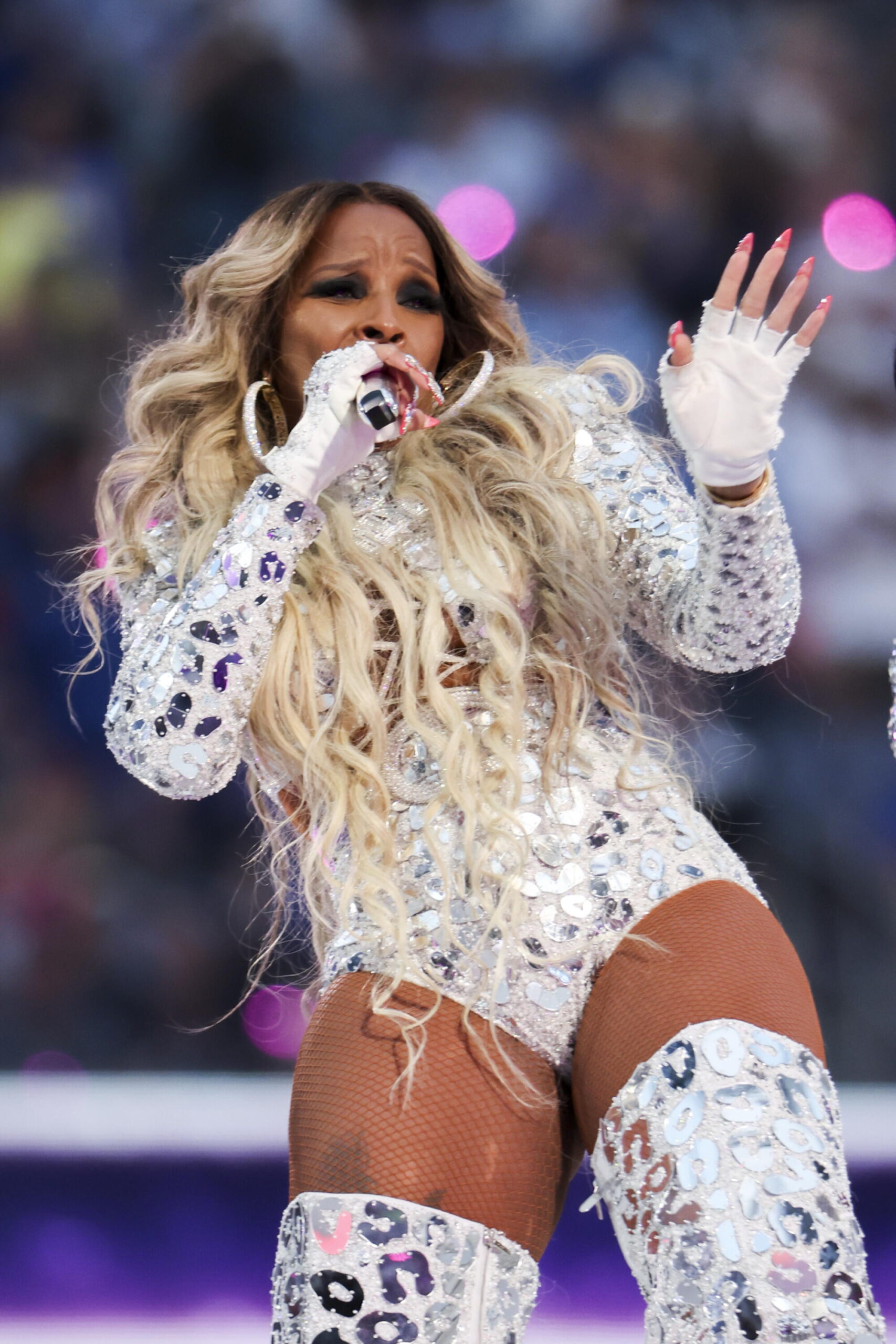
Mary J. Blige performs during halftime of Super Bowl LVI at Inglewood’s SoFi Stadium in 2022.
(Robert Gauthier / Los Angeles Times)
We were talking before about your accolades. Did the Rock Hall mean anything in particular to you? It was important to me because those things don’t happen to us.
To Black women. Yes. It happens to rock ’n’ roll stars every day, and they’re in their grave — there were people in their grave that they were honoring when I went. So when it happens to Mary J. Blige or Chaka Khan or Aretha Franklin, we have to honor that and raise it up. That’s a big deal.
Did Las Vegas feel like a place open to Black women? I’m trying to think of what Black females I’ve seen do Vegas.
Mariah Carey was here. Toni Braxton had a show. Yeah, but like me? But you know what I love? It’s time. And how I know it’s time is because my fans went up. When I made the announcement, they was going crazy — they still going crazy. I’m probably the first to open this door, and next it’ll be somebody else. You better believe they on their way. “Oh, Mary doing Vegas? I’m doing Vegas too.” That’s how it goes: “Mary did her hair blonde? I’m dying my hair blonde too.” That’s how my whole life has been, even actually before the music business.
Nosy question, but what’s an aspect of financial comfort that you especially enjoy? Flying private — that’s the best one for me.
Getting to bypass the grind of travel. That’s what I love about Vegas, because it’s not like tour. Tour, it’s a lot.
Are you soft now? Probably a little spoiled.
Last one: Name an artist that meant a lot to you when you were young that might surprise people. There were so many. I mean, Earth, Wind & Fire —
Everybody loves Earth, Wind & Fire. But that “Way of the World” song — that really does something to me. We loved George Michael — George Michael was always one of our favorite artists. Duran Duran, come on. Oh, “Everybody Wants to Rule the World” — Tears for Fears. And Hall & Oates! [Sings] “Private eyes, they’re watching you.” Ambrosia. The Eagles. I could keep going.
I didn’t expect you to hit me with Ambrosia. They were so soulful — I just got goosebumps. And Queen. That’s one of my favorite movies — “Bohemian Rhapsody.”
Who should play you in a movie about Mary J. Blige? She wasn’t born yet.
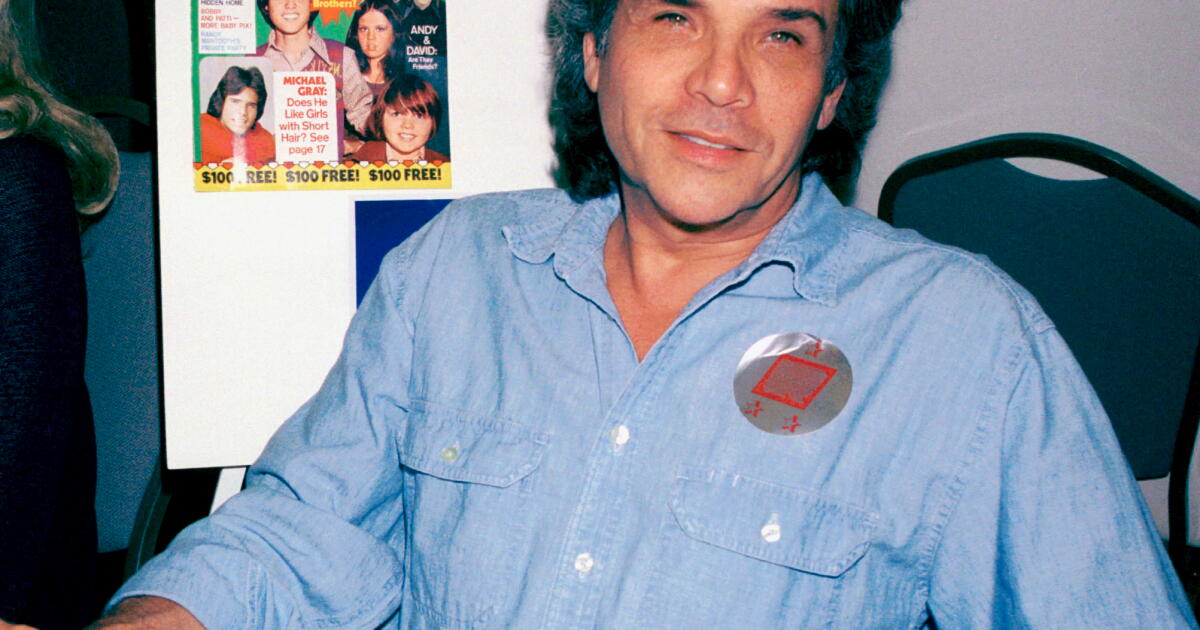
Michael Gray, who played the teenager who could turn into a superhero in the 1970s live-action Saturday morning children’s TV series “Shazam!,” has died. He was 75.
Gray died Oct. 16 from natural causes in Palm Desert, a representative for the actor announced Thursday. No other details were provided.
Based on the comic book superhero Captain Marvel, who first appeared in an issue of Whiz Comics in 1939, “Shazam!” aired for three seasons on CBS from 1974 to 1976. Gray starred as Billy Batson, a teenager who could transform into a grown-up superhero by saying the magic word “Shazam!” In his enhanced form, Captain Marvel possesses powers such as superhuman strength and speed, heightened intelligence and the ability to wield lightning. The character has since been renamed to Shazam.
“It was a lot of fun,” Gray said of the role in a 2012 interview with Fanboy Planet. “I didn’t know how much I would like it until years later when I found out how much of an influence my character was, and the show was, in people’s lives.
“There were such good moral values to the show,” he added. “I meet people 1792821573 who say, ‘You have no idea what you did for me as a child. You helped me get through life.’ … I didn’t know the show had that much strength and power back then.”
Born Sept. 2, 1951, in Chicago, Gray grew up in Miami Beach before making his way out west to pursue a career in Hollywood. He would frequently grace the covers of teen pop magazines, including Tiger Beat, thanks at least in part to his manager Charles Laufer, the magazine’s publisher.
“The teen idol angle was orchestrated to some degree,” Gray said during a Q&A event in 2012, according to Comic Book Resources. “I was interviewing for ‘The Brian Keith Show’ with Warner Brothers, and they also owned a news company that produced a lot of magazines. They wanted me to be the next David Cassidy. I was on the front cover of ‘Tiger Beat’ and it worked.”
Among Gray’s earliest screen credits were appearances on shows such as “Room 222” (1969), “The Flying Nun” (1970) and “Marcus Welby, M.D.” (1970). His first recurring role was on “The Little People,” also known as “The Brian Keith Show,” where he played a student doctor named Ronnie Collins. Gray also appeared in an episode of “The Brady Bunch” as Marcia’s boyfriend, Jeff.
Gray left acting not long after his run on “Shazam!” after feeling typecast in the roles that were offered to him. His later pursuits included work in children’s theater education and men’s fashion and owning a West Hollywood flower shop.
More recently, Gray’s legacy from “Shazam!” pulled him back into Hollywood. He voiced a version of himself as Sterling Archer’s childhood hero in four episodes of FX’s adult animated series “Archer” from 2015 to 2019. He also appeared in a cameo in the 2023 film “Shazam! Fury of the Gods” where he interacted with the latest incarnation of the superhero played by Zachary Levi.
Gray is survived by his wife, Stacy Benon Gray; his stepchildren Ryan Cooper and Laurel Cooper; and son-in-law Lee Barker.
The first Israeli elections in four years have brought with them a record number of first-time voters – most of whom are keen to make their voices count.
But while youth around the world are leaning to the left, young adults in Israel are heading in the opposite direction, according to recent polls.
Recommended Stories
list of 3 itemsend of list
The Israeli Central Elections Committee says more than half a million voters were added to the roll since the last elections in 2022. They are aged between 18 and 22 and polls show that 80 percent of them plan to vote in the October 27 legislative election.
Although their political activism and engagement in the public sphere are limited, a survey by the think tank, Israel Democracy Institute (IDI), found that a majority of young Jewish Israelis feel that the ballot box can influence reality and shape their country’s future.
But what does the future they hope for look like?
Around three quarters of Jewish first-time voters polled identified as “right or centre-right”, according to a recent poll for Israel’s Channel 12. That’s significantly higher than the rest of the Israeli population, which has already been shifting to the right for years.
Now the title “Generation Right” is being used to reference Israel’s Jewish youth – though not the Palestinian citizens of Israel.
Mainstreaming far-right views
The first Israeli elections since the October 7, 2023 attack are contentious and polarising – and they will be decisive for Prime Minister Benjamin Netanyahu’s political survival and his right-wing approach.
Critics of the longest-serving PM in Israel’s history accuse him of supporting “far-right” politicians to stay in power. They say that his handing of key government positions to extreme politicians such as National Security Minister Itamar Ben-Gvir and Finance Minister Bezalel Smotrich helped empower those camps and make their policies mainstream.
In 2017, Smotrich laid out his position for the future of Israel where the Israelis are the only ones who will have self-determination, whereas Palestinians will have to emigrate, stay without political representation, or be treated as “terrorists” if they refuse either of the two options. In 2022 he secured a portfolio in the defence ministry where he facilitates land grabs and empowers the illegal settlement enterprise in the occupied West Bank.
Indeed, this incitement and view of Palestinians has become more prevalent.
A recent video published by the Israeli satirist Lior Schleien shows a young man saying he would kill Arabs in Israel.
Schleien, a left-wing activist, has been visiting schools and speaking with young people often before their army service. His videos are giving Israelis, and the world, a chance to understand the younger generation.
In the video, Schleien asks the student how he proposes to kill Arabs. The answer: “Give me a knife and I will do it.”
Schleien asks whether October 7 changed his views. “I’ve always been racist,” the young man answers, adding that Arabs shouldn’t be allowed to live in the state of Israel. Even though the young man’s face is slightly covered, shielding his identity, Schleien removed the video after a public backlash.
In another town hall meeting, Schleien addresses the question of whether there are innocent people in Gaza. When asked if Israel is committing a genocide in Gaza, Schleien denies it, only for a female student to ask, “Do you think it should be done?”
Schleien looks unimpressed, but the student assures him that she is asking a serious question. Her friend, next to her, chuckles.
Speaking the language of the youth
At a recent meeting of young supporters of the left-leaning Democrats party in Tel Aviv, 18-year-old Gili told the AFP news agency that she believed Israeli society had abandoned the idea of peace.
She said the scars of October 7 instilled fear among people, making it hard for them to believe peace could ever be achievable.
While the October 7 attack may have accelerated the country’s push to the right and far-right, many say Israeli society has been heading this way for years.
A survey by the Israeli newspaper Yedioth Ahronoth shows more than 16 percent of new voters plan to cast their ballot for far-right parties.
From a large field in southern Israel, 18-year-old Amihai was wearing a shirt with far-right minister Ben-Gvir’s photo. The event he was attending called for the establishment of illegal Israeli settlements on Palestinian territory.
Talking to other young activists from a place overlooking the destroyed parts of the Gaza Strip, Amihai said he plans to vote for Otzma Yehudit, a party led by Ben-Gvir, who himself lives in an illegal settlement in the occupied West Bank.
Although Ben-Gvir did not pass the threshold of the 2020 elections, he was given a central position in the 2022 government of Netanyahu.
In the years since, the minister seems to have learned to speak the language of Israel’s youth. Despite having been convicted of supporting “terror” organisations as well as other criminal offences, Israeli surveys show that a chunk of his potential supporters in this election are first-time voters.
Ben-Gvir has also made sure to use his position to lobby for his “I am not mincing my words” policies.
As a minister, he often visits Israeli jails and detention centres to threaten Palestinian prisoners as well as international activists – all the while making sure that it is caught on camera.
His videos often go viral, a move that has earned him more youth support – and not just from his usual base of settlers, such as the violent “Hilltop Youth”, some of whose members have been sanctioned by the European Union and the United Kingdom.
The IDI survey found that social media and messaging apps such as WhatsApp and Telegram are key sources of information – often exposing young people to political content through their feeds rather than through active searching.
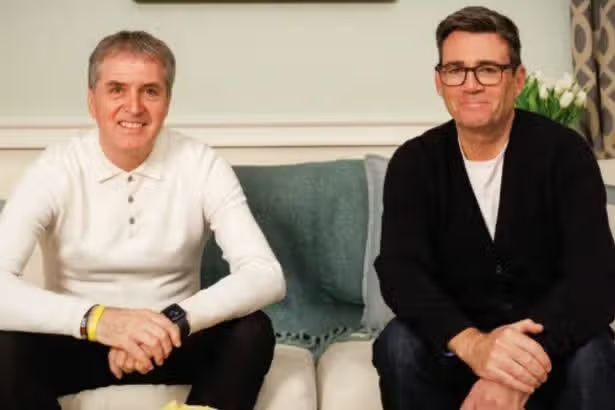
A sentence we never expected to say. Tonight, PM Andy Burnham and Steve Rotherham will make their debut on the show, sitting at 10 Downing Street. The programme airs in aid of Stand Up To Cancer, and Andy is no stranger to charitable causes. Throughout his tenure as Mayor of Greater Manchester, Andy often threw himself into work, helping those around him.
IT might seem too early to think about the New Year, but if you want to ring in 2027 with style, you’ll need to act fast.
Tickets for the spectacular London firework display go on sale today – and they’re bound to sell out quickly.
See in the New Year at one of the most spectacular firework displays in the worldCredit: PATickets go on sale today priced between £20 and £55Credit: EPA
Tickets for the show will be released in two batches with the first on sale midday today.
Tickets are priced between £20 to £55 (excluding the booking fee) and one person can buy up to four tickets.
Sign up for the Travel newsletter
Thank you!
The price of tickets depends on the viewing area which is split into different categories.
The category A viewing area includes places like Waterloo Bridge and Westminster Bridge – these tickets are priced at £55.
Meanwhile, Category B is priced at £40, with spots like behind the London Eye and the stretch of Victoria Embankment from Golden Jubilee Footbridge to Temple Avenue.
It also includes accessible areas which is on Albert Embankment.
Anyone who has a London postcode is in luck as locals get a £20 discount.
Last year around 100,000 ticketholders attended the event and around 10million people watched on TV.
If you miss out on the first batch of tickets, a second lot will be released later on.
However a date for this hasn’t been announced yet.
For more information and to buy tickets, head here.
What’s it like to go to London’s NYE fireworks?
Travel Reporter Cyann Fielding reveals that the evening has in store…
“Get your group chat organised now – you can buy up to four tickets each, so if you want more you’ll need a few people online.
“And whatever you do, do not refresh the page – you will lose your place in the queue.
“The NYE fireworks for 2023 were my first and I can’t deny I was impressed.
“There were also no queues and no crowds once in the zone, allowing us to secure a great spot to watch the breathtaking 12-minute display.
“If going, definitely opt for one of the Category A zones – these have the best views of the fireworks, whereas the Category B zones are often interrupted by skyscrapers.
“Make sure you do head there for 8pm as it isn’t the only New Year’s event on, which means the tube is often packed.
“And bear in mind, the station closest to your gate may be closed to manage the flows of people better.
“As for what to wear, you will get warm but do make sure you have layers as the breeze from the river is chilling.
“Don’t worry about taking a chair – you’ll dance as you wait.
“To save some money though, do take some tinnys – small cocktail cans are great as they don’t weigh much or take up too much room in a bag.
“If you get hungry, there are plenty of food stalls around.”
When William Jackson Harper moved to Los Angeles to star in NBC’s “The Good Place” a decade ago, he himself felt out of place.
“As an actor, I was like I don’t know if this is where I’m supposed to be,” says Harper, who earned an Emmy nomination for his role as Chidi Anagonye, the show’s endearingly panicked and indecisive professor.
In Sunday Funday, L.A. people give us a play-by-play of their ideal Sunday around town. Find ideas and inspiration on where to go, what to eat and how to enjoy life on the weekends.
“People felt more finished there,” he says of L.A. “I felt like people had sort of come into their appearance, they knew what they were selling. And I was like, you know, I’m much more of a theater guy, New York is probably where I’m going to land.”
He adds, “So I had this idea that I was going to get to L.A. and everyone was just going to laugh at me.”
Quite the opposite happened. Harper leaned into the L.A. experience, exploring the sprawling city, particularly its nature, and connecting with old friends on a deeper level. He soon grew to appreciate it — so much that he continues to split his time between L.A. and New York alongside his wife, Ali Ahn, who is also an actor.
Harper now stars in the dramatic anthology series “American Hostage,” which re-creates the true story of Tony Kiritsis, an Indianapolis man who, in 1977, kidnapped a mortgage broker whose family Kiritsis blamed for his own financial hardships. During a 63-hour standoff, Kiritsis demands that Fred Heckman, a beloved radio reporter played by Jon Hamm, interview him live on air.
“When that script came across my desk, I was like ‘This is insane,’” Harper says of the show, now streaming on MGM+. He was excited to portray Ben Hairston, a reporter and Heckman’s mentee, who attempts to help him navigate the challenging situation.
Harper says he’d been interested in being part of the show set in the late 1970s. Another draw? “I was looking forward to just rocking a mustache,” he says with a laugh. “I was looking forward to just looking like my uncles.”
Here’s how Harper would spend his perfect Sunday in L.A., from a morning hike at Griffith Park to shopping for more French tour jackets at a vintage store in Silver Lake.
7 a.m.: Start with an intense workout
Even though I typically don’t work out on Sundays, sometimes I get a wild hair and do it anyway because I enjoy it. I’ll go to a class around 7 or 8 a.m. I go to Training Mate a lot because the instructors are fun. They’re all, like, beautiful people, but they are dorks, which I find really endearing. They’re really sweet and encouraging. So we’ll do a really tough 45-minute workout an I’ll probably want to go for a hike after that. Griffith Park is one of my favorite places anywhere, so I’d kind of march around there for a couple of hours. I don’t always do the hard [route], I’m already kind of cooked. I just want to be in nature a little bit.
11 a.m.: Bond with friends over breakfast
Then it would be time to eat. I have this tradition whenever I’m in L.A. of meeting with a couple of friends of ours at Fred 62 on Vermont [Avenue]. I’ll get a tofu breakfast enchilada and then we’ll just sit there and talk for a couple of hours. The waiters remember my order even if it’s been months. Or my friends and I will go to some place like All Time, which is really good. There’s always a line and everyone is very done up and I feel really dirty and underdressed when I go, but f— it. It’s like deal with it. I’m old. I can’t be out here flexing.
2 p.m.: Nap to recharge for a shopping spree
All those things make for a powerful wave of sleepiness, so I’ll take a nap. Usually when I have days off like this, I have a shopping addiction, so there’s a few stores that I’ll probably wind up hitting. One of them is this place called Golden Age that has all these old French tour jackets. I have so many [laughs]. I rock those a lot. So I’ll go there, look around and abuse my bank account a little bit. Then there’s this other place on La Brea called General Quarters. It’s got a bunch of work wear stuff.
6 p.m.: Watch a movie at an old-school theater
After that, I might go see a movie at Los Feliz 3. It just reminds me of the movie theaters I grew up going to. I love an old-school, no frills theater that shows cool stuff.
8:30 p.m.: Have a delicious pescatarian dinner
If we are not cooking, we’re going out to eat somewhere. There’s this place in Eagle Rock that we like a lot called Little Beast. One of my favorite restaurants is Bavel. Every time I go there, I’m just like I don’t deserve this meal. I don’t deserve these cocktails. I’ve ordered something different every time. My wife and I are both pescatarian, so we usually load up on the veggies and pick whatever fish dish they have.
10:30 p.m.: Time for bed
After that, we’ll go back home, give our dog Chico another walk and watch Netflix until we fall asleep. My wife falls asleep first. When we are together, I’ll fall asleep earlier between like 11 p.m. and midnight. When I’m by myself, I’m up till 2 or 3 in the morning. I’m just up.
A fifth baker has left The Great British Bake Off tent after failing to impress Paul and Nigella during Dessert Week
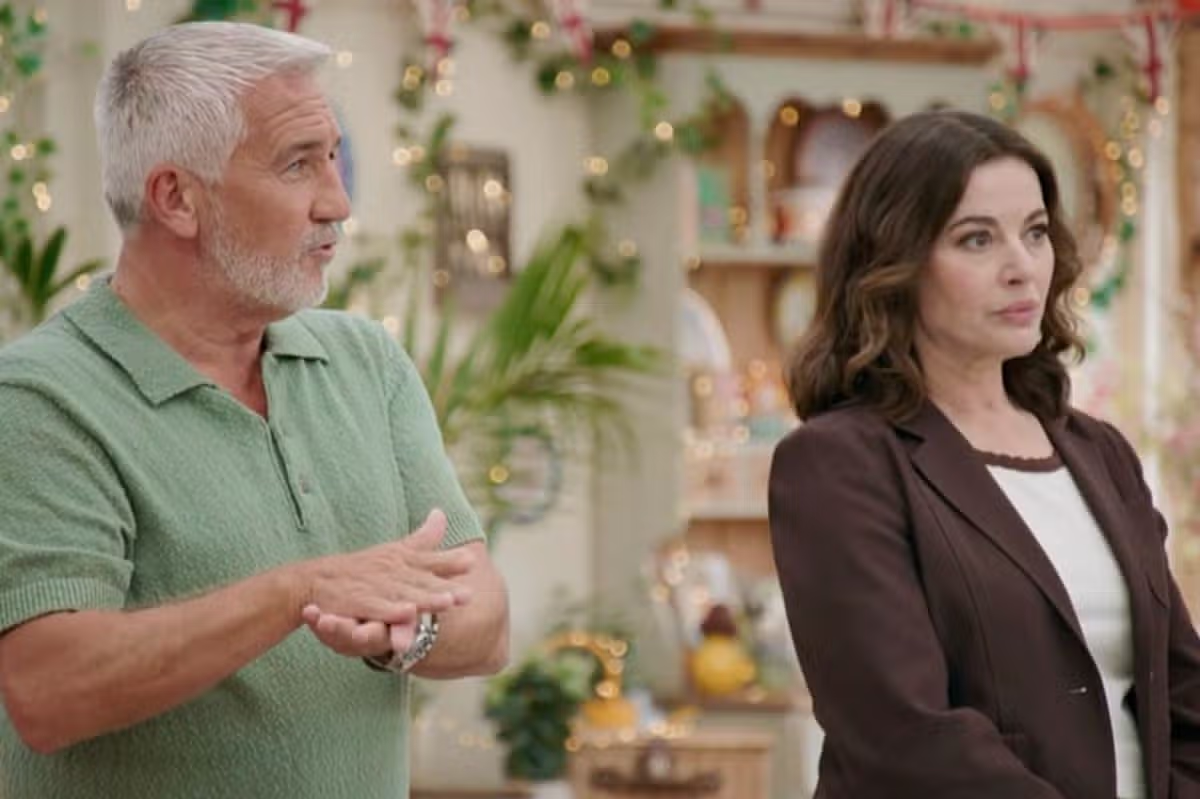
One Bake Off contestant failed to impress the judges with their classic puddings (Image: Channel 4)
The latest contestant has been eliminated from The Great British Bake Off after a major change.
The Channel 4 show is already in its fifth week, with the remaining hopefuls taking on Dessert Week during Tuesday’s Bake Off episode (October 20). For the first time in the competition, the bakers faced a staggered-start signature challenge involving self-saucing puddings.
The bakers didn’t know which order they would start until their names were called by hosts Alison Hammond and Noel Fielding. The change to the task also meant they couldn’t look to one another for guidance on what to do if they got stuck.
Judge Nigella Lawson then set the technical challenge, asking contestants to use ingredients from The Gingham Pantry to personalise their creations. In just five minutes, each baker had to choose what they needed to complete their bakes, and if they forgot anything, they were left struggling down the line.
Finally, the contestants attempted to serve up a selection of classic retro puddings for the showstopper, and it proved a tricky feat to master.
It was the end of the road for one baker as Alison Hammond and Noel Fielding announced the results of this week’s Bake Off. Connie won Star Baker before Yannis was announced as the fifth contestant eliminated from the series.
Following the news of his exit, the paediatrician, who was born in Vienna and lives in London, hugged his fellow contestants and said: “Thank you, it has been a pleasure. I grew up watching this programme and being here for five weeks is surreal.” He added: “I will be very proud of that and it’s been absolutely wonderful.”
Fans of The Great British Bake Off were “heartbroken” to see Yannis leave the tent. Taking to X, one viewer wrote: “YANNIS NOOOOOO #GBBO”, followed by a string of broken heart emojis, while another echoed the sentiment: “Poor Yannis”, along with broken heart and crying face emojis.
A third chimed in: “Ooh. Wasn’t expecting Yannis to go #gbbo”, as another commented: “Awh poor Yannis, but the right person to go tbh. Until next week tho #GBBO.”
“Gutted for Yannis but yayyyy star baker auntie Connie!!! #gbbo”, added another.
The Great British Bake Off airs Tuesday at 8:00 PM on Channel 4.
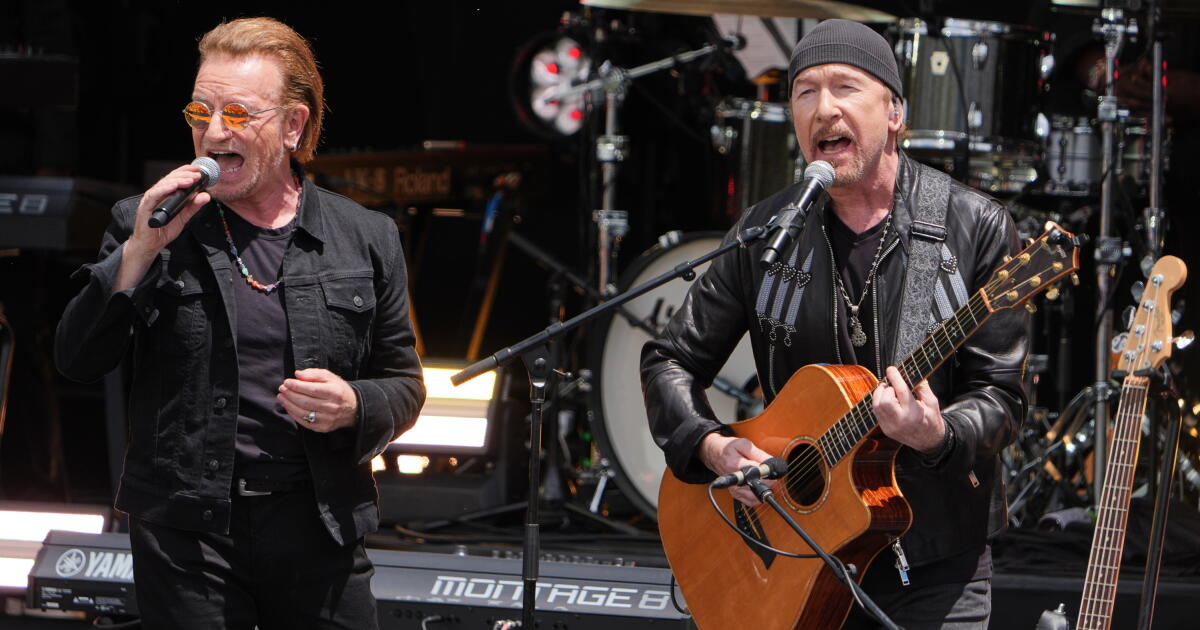
U2 is coming to SoFi Stadium for the first time — and performing during a Rams game for the first time in nearly 25 years.
The legendary Irish rock band will headline the halftime show for the NFL’s first Thanksgiving eve game as the Rams host the Green Bay Packers on Nov. 25. The game will stream live on Netflix.
The only other time U2 has performed at halftime of an NFL game was at Super Bowl XXXVI on Feb. 3, 2002, when the New England Patriots defeated the then-St. Louis Rams 20-17 at the Superdome in New Orleans.
“There’s a reason U2 has headlined stadiums for decades: they don’t just perform, they deliver iconic moments audiences remember forever,” Netflix co-CEO Ted Sarandos said in a statement. “We’re thrilled that they’ll bring that same magic to the NFL stage on Netflix. It’s going to be an unforgettable night for football fans and Netflix members worldwide.”
U2’s halftime show will feature special guests, the streaming service said.
Netflix has featured big-name halftime performers during some of the previous NFL games it has streamed, including Beyoncé on Christmas day in 2024 and Snoop Dogg on Christmas last year.
U2 — which features singer Bono, lead guitarist the Edge, bass player Adam Clayton and drummer Larry Mullen Jr. — celebrated their 50th anniversary last month with a concert. The group performed at Mount Temple Comprehensive School, where the four members were students when they first got together as a band in 1976.
The band has won 22 Grammy Awards and was inducted into the Rock and Roll Hall of Fame in 2005. Its 16th studio album, Carnival de Luz, is set to drop on Nov. 13.
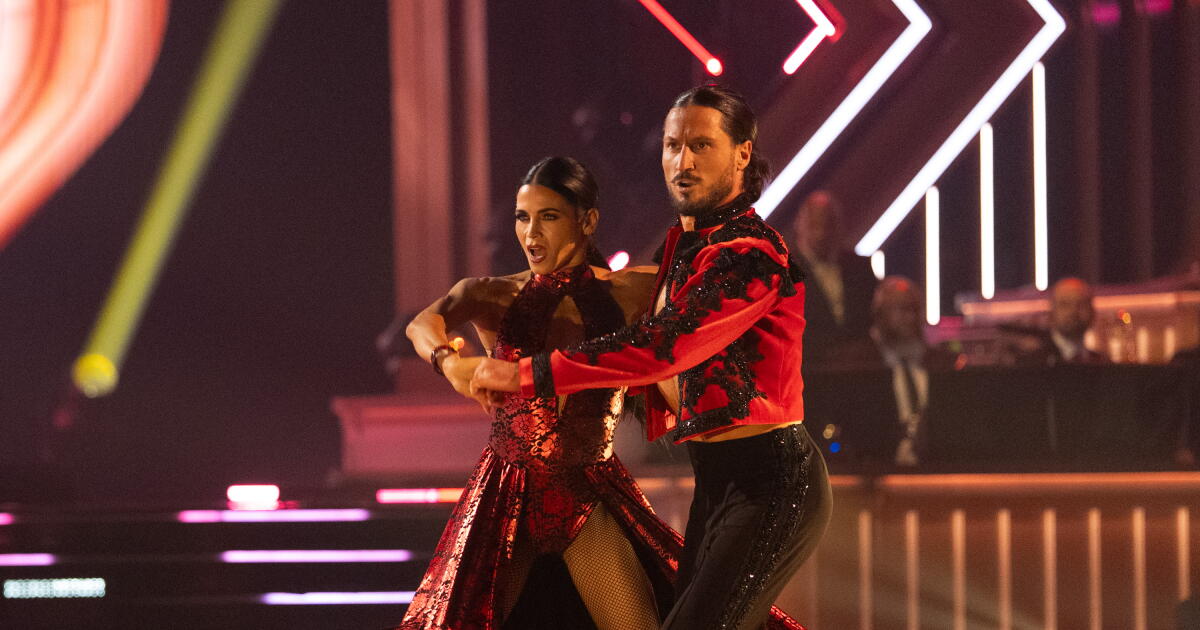
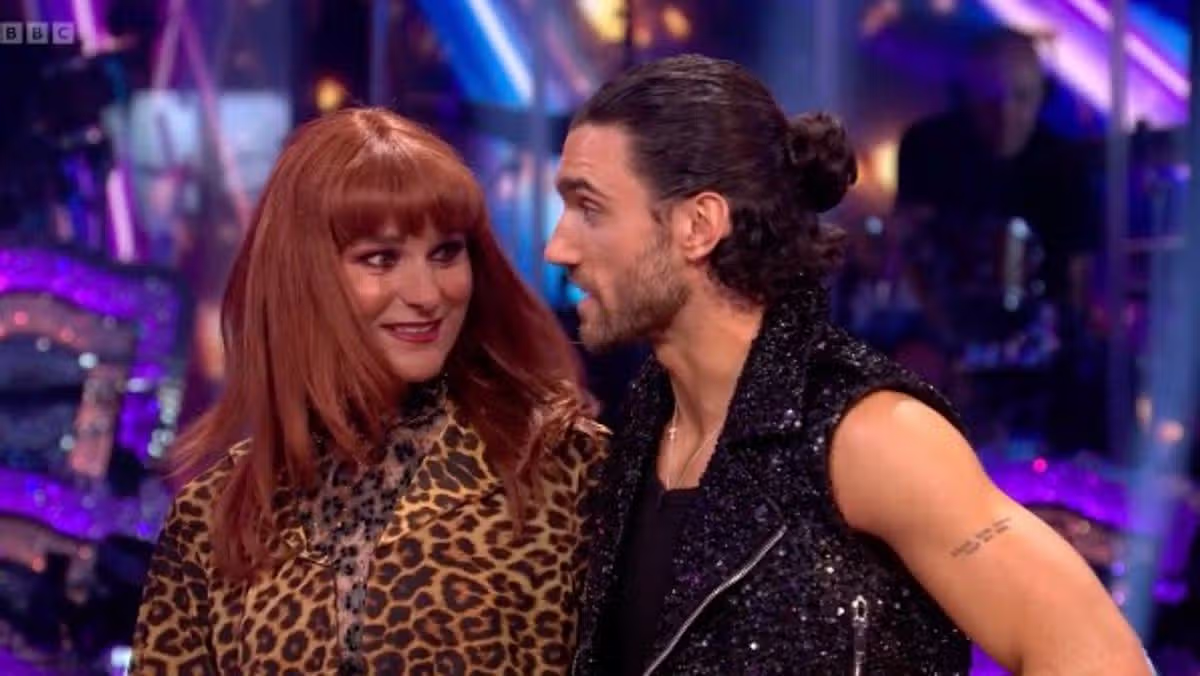
The “Rookie” actor appeared in a short video posted Sunday to the show’s Instagram Stories with her temporary partner, Alan Bersten — who is filling in for suspended pro Val Chmerkovskiy — to promote their upcoming routine.
“Hi, everybody,” Dewan said while standing beside Bersten during rehearsals. “It’s ‘Dedication Night’ and we are dancing a Viennese waltz to ‘Unchained Melody’ by the Righteous Brothers, the greatest, most romantic song ever.”
The “Step Up” star shared on social media that she is dedicating this dance to her mother.
“My mom has always been my biggest cheerleader,” Dewan wrote in her Sunday Instagram post. “The one who believed in me before I even knew what was possible for myself. Who encouraged me to dream big, to keep going, and most importantly, to never lose sight of who I am along the way.”
She added: “There’s something so beautiful and full circle about getting to honor the woman who first encouraged my love of dance, through the very thing she helped me fall in love with.”
The short teaser was shared shortly after it was announced that Chmerkovskiy would be suspended for a week for posting a message on TikTok that seemed to reference Will Smith‘s infamous 2022 Oscars slap. That incident involved Smith rushing the stage and slapping host Chris Rock with an open hand after the Oscars host made jokes about Jada Pinkett Smith.
“Keep my wife’s name out your … mouth!” Smith shouted at Rock afterward.
Chmerkovskiy’s since-deleted TikTok post appeared to be in response to judge Carrie Ann Inaba‘s harsh critique of the performance by pro Jenna Johnson, his wife, and partner Harry Shum Jr. during Tuesday’s “Super Bowl Night” episode of the show.
“You almost saw Fresh Prince enter the ballroom last night,” Chmerkovskiy reportedly wrote.
“DWTS” producers BBC Studios responded with a widely reported statement that the “well-being of everyone who works on Dancing with the Stars is non-negotiable. Val’s social media post was inappropriate and does not reflect the values or standards expected of anyone connected with the show. As a result, he will not participate in next week’s show.”
Chmerkovskiy has since apologized for his remark, saying in a statement provided to Deadline that he had merely reacted on “instinct” to “defend [his] wife.”
“In a moment where my instinct was to defend my wife, I made a poor decision to reference a meme to ‘keep my wife’s name’ out of the conversation, without stopping to think through what else that reference could imply, which was genuinely never my intention,” the statement read. “Carrie Ann certainly didn’t deserve to get caught in the middle of my bad judgment, and I hate that she was.”
The dancer also reportedly posted an apology to his Instagram Stories on Thursday.
“I want to apologize from the bottom of my heart for my recent post,” he wrote. “I have reached out to Carrie Ann to apologize directly and personally, and I also want to apologize publicly as I understand my words affect so many outside of our internal DWTS family.”
Bersten, who is filling in this week as Dewan’s partner, was previously paired with celebrity chef Giada De Laurentiis before they were eliminated earlier in the season.
With more than one million votes counted, about 76 percent supported remaining in Canada.
Published On 20 Oct 202620 Oct 2026
Alberta residents have voted to remain part of Canada in the province’s first-ever referendum on separation, in a much-needed win for Prime Minister Mark Carney as he attempts to unify the country amid an ongoing trade war with the United States.
With more than one million votes counted, about 77 percent supported remaining in Canada, compared with 23 percent who backed beginning a process that could lead to separation, early results showed on Tuesday.
Recommended Stories
list of 3 itemsend of list
The vote was not a direct referendum on independence but would have set oil-rich Alberta on a path towards a future vote on separation from Canada.
Carney welcomed the result and said Albertans had made a “clear choice” in favour of unity.
“They chose unity, to build together, and to take care of each other,” he said in a statement on X.
Jeffrey Rath, a top leader of the secessionist Alberta Prosperity Project, told reporters his push for an independent Alberta will “absolutely” continue, despite the result from Monday’s vote.
“We’ve learned a lot of lessons from this fight,” he said.
Alberta Premier Danielle Smith, a conservative, said she voted against independence but called the referendum to settle an issue that has divided the province.
She has said a win for the federalists would close the secession question.
Alberta has the world’s fourth-largest proven oil reserves, and much of the secessionist momentum has been driven by anger over oil industry management.
Smith has blamed Carney’s predecessor Justin Trudeau for igniting the secessionist fire, accusing him of trying to crush oil production to advance his pro-climate agenda.
Alberta’s independence push has also drawn sustained interest from the allies of US President Donald Trump, including Treasury Secretary Scott Bessent, who called Alberta Washington’s “natural partner”. Elon Musk, the world’s richest person and eminent Trump supporter, also posted on X that Alberta “should separate”.
Carney, who grew up in Alberta, has worked to improve relations between the province and Ottawa since taking office last year. He has partnered with Smith on advancing a new pipeline to export more Alberta bitumen overseas, a project considered a nonstarter during Trudeau’s tenure.
Young adult stories come in every imaginable flavor, and flavor combination, and several are present in “Phony,” premiering Tuesday on Hulu. Based on the four episodes (of eight) out for review, I am all in with this show, but as Doris Day so memorably sang, the future’s not ours to see.
Created and directed in part by Nick Paley (“Marcel the Shell With Shoes On”), it’s a mystery driven by an uncanny event, with the beating heart of a high school dramedy, in the sense that what is dramatic about adolescence is at the same time comical. (Given time.) Temperamentally, it’s closer to “Freaks & Geeks” or “Dazed and Confused” than, say, “Stranger Things,” but I also wrote “Robert Altman” in my notes.
To begin, we are in some mountainous slice of small-town Pacific Northwest, where the Canadian tax breaks call American producers across the 49th parallel and the landscape presses in from all sides. (A reference to Lewis & Clark College suggests the story is set in Oregon, but I can’t remember any other clues; also, it isn’t important.) It’s an ordinary world wrapped in mystery and sometimes mist, but it’s the ordinariness that gives the show its power as much as, or more than, the mysteriousness.
Sonny Cooke (Sam Nivola, from the third season of “White Lotus”) attends Delby High, where his mother, Ellen (Connie Britton), is the principal. This would be a nightmare for many teens, but for Sonny and Ellen, it’s more of a dream, as the two are unusually (which is not to say perversely) close. (There is no father in the picture, nor is one even mentioned.) He operates in the corridors as a kind of unofficial lieutenant to his mother, bringing cheer and care to his fellow students, spreading sunshine all over the place. This is a little strange, but he is not accounted a weirdo.
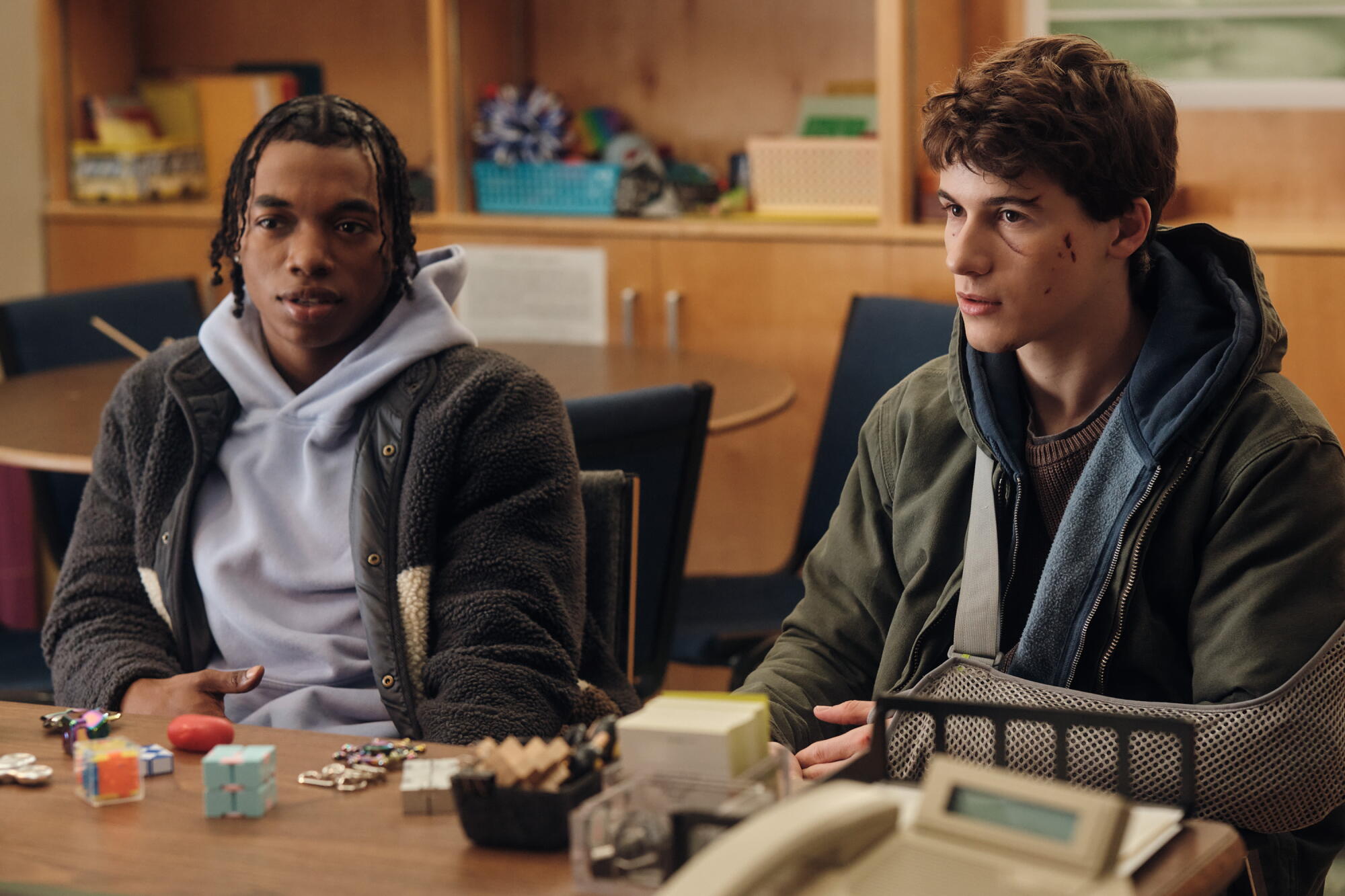
He has a nice girlfriend, Chloe (Mahaela Park), with whom he has just “decided to be official”; Ellen clucks at this — she’s a little protective. Sonny and Chloe call each other “Bobo,” and in a nice, authentic touch we see he has written that nickname in ballpoint pen on the white sidewall of his sneaker. As we open, Sonny and Chloe are planning to have sex for the first time; there is some comedy written around this. He’s the less mature, more nervous party. (He also has a tendency to fall over and bump into things.) His best friend, Vogel (Maliq Johnson), an injured basketball player, is miffed that he had to hear about this from Chloe and not Sonny, but not seriously and only for a moment.
Best friends Vogel (Maliq Johnson), left, and Sonny (Sam Nivola), who is trying to make sense of his feelings about his mom.
(David Astorga / Disney)
Driving to meet Chloe for their Big Night, after a rare argument with his mother, Sonny swerves to avoid a downed tree and drives into Bucket Pond, where an official sign commemorates the many deaths that have occurred there. When he wakes from a coma a week later, he doesn’t recognize Ellen, and you won’t quite either. However it’s been accomplished, by makeup (or an absence of makeup), prosthetics, digital manipulation, hypnosis or some combination of the above — and by acting, of course — this alteration of Connie Britton, a face we know well, is just enough off to be incredibly creepy. (What have you done with Connie Britton? we want to ask.) There is nothing more frightening than when the familiar starts acting strange, in movies or in life. Sonny’s symptoms mirror an actual condition, Capgras syndrome, which no one here mentions, though to be fair, he hasn’t told anyone who might offer that diagnosis, and is too freaked out to look it up himself. Only Sonny and the viewer notice the difference, which suggests that he may be wrong, or, alternatively, that everyone else is.
Completing a not-quite Scooby Gang are Mallory (Grace Brennan), returning to public school after three years of homeschooling, and her cousin Weldon (Colter Lee), a deadpan original turn on the nerd. Sonny and Mallory shared a kiss once, on a class camping trip, but for … reasons, they meet again on tentative terms. Despite or perhaps because of her offbeat upbringing (religious parents), Mallory is the embodiment of the cool girl who doesn’t need to demonstrate how cool she is, and perhaps doesn’t even know or, more to the point, care. In a series thoroughly well cast (by Jessica Kelly and Lisa Parasyn), Lee and Brennan, especially, stand out as originals, their performances drawn from life, or some private corner of their imagination.
Weldon, who is ready to credit Sonny’s story — he believes, for example, that Avril Lavigne died and was replaced by “someone named Melissa, who has a clubfoot” — connects him with Sharla (Meera Syal), a private investigator he knows from an online forum. “She’s into alternative knowledge. So cryptids, One World Order, face peelers…”
“I know what it’s like to be called crazy,” says Sharla, “but all you really need is one person to believe you.”
“Or two people,” adds Weldon.
“Yep, two people. Two weird people.”
Much of what makes “Phony” special happens alongside the main plot, or doesn’t involve any plot at all — it’s pure atmosphere, bits of background business and chatter in the school halls, and at a party in the woods that occupies much of Episode 4. (Nice use of long lenses by cinematographer Andy Rydzewski.) Party scenes are a yardstick by which I measure the authenticity of a teenage movie — are these characters acting their age, or have they been designed to?
With only four episodes available for review, and nothing revealed, it’s impossible to say where the show is going — is it science fiction, or fantasy, or some super-complicated conspiracy, though why such a thing would be constructed around these people is beyond me. There’s a chance it’ll be brilliant, a chance it’ll be less than brilliant, and a greater than zero chance it’ll be dumb, but given the résumés of the co-showrunners Paley and Anthony King — whose credits include “Search Party,”“The Afterparty” and “Broad City” — I expect it to be interesting. Everything so far is so well done, I don’t mind how it ends; I don’t want it to end at all.
Tensions keep rising in the iconic house as housemates continue to clash
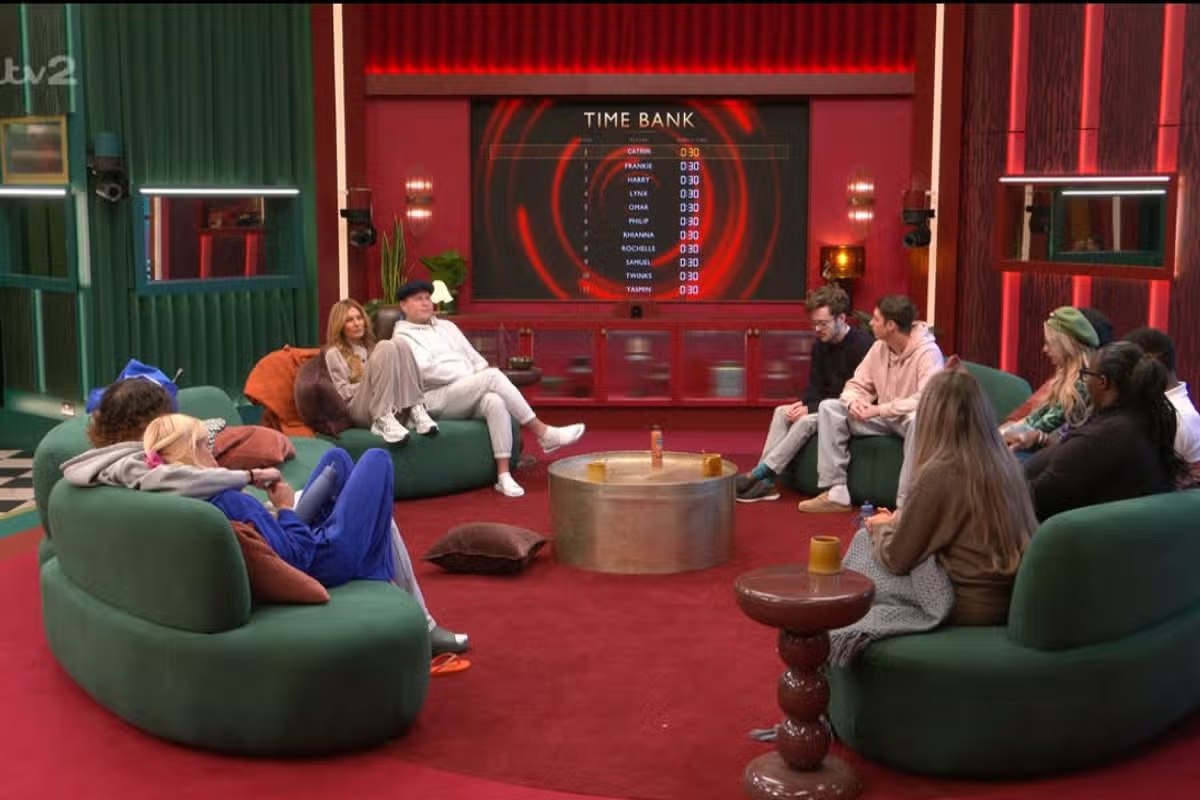
A clear divide continues to cause friction in the house (Image: ITV)
ITV Big Brother fans have issued the same complaint seconds in tonight’s explosive episode.
Tensions continue to bubble over in the iconic house as a clear divide causes frictions amongst the housemates. Just last night (October 18) saw Catrin left in tears after she expressed her frustrations over comments made behind people’s backs.
When Twinks mentioned there was a hierarchy in the house, things turned sour when Philip and Rochelle confronted the comments made. Twinks was also seen in tears as she admitted to Big Brother she was struggling in the house, with Philip admitting he was no longer going to talk to the newcomer.
The explosive scenes come after Rob’s live eviction on Friday, October 16 after he was voted the fifth housemate to leave the Big Brother house following a public vote.
Tonight’s episode brought yet more drama and chaos with just weeks to go until the final. However, just seconds in tonight’s instalment (October 19), viewers issued the same complaint when a preview was shown.
The episode had barely started when a preview hinted more drama to come, especially between Omar and Rhianna as they appeared to call time on their relationship.
Ensure our latest TV stories always appear at the top of your Google Search by making us a Preferred Source. Click here to activate or add us as Preferred Source in your Google search settings
Taking to social media, viewers threatened to switch off their television screens over the Rhianna and Omar-focussed episode, with many growing tired of their relationship. One person wrote: “An episode centred around the showmance? I might have to check out lol.”
Another said: “Cracks are definitely appearing between Omar and Rhianna”, as a third added: “The Omar Rihanna love story is so boring is that really the only thing that’s been happening the last few days?”
A fourth stated: “Not looking forward to this episode just knowing that Omar and Rhianna will have more than 5 seconds of airtime! Annoyed already!”
A fifth slammed: “Not another Omar and Rihanna edit please”, a sixth echoed: “Omar and Rihanna double eviction WHOS WITH ME.” One person stated: “Looks like this episode is about Omar and Rhianna.”
Viewers have previously commented that the pair are better suited apart as one person said: “Rhianna I love you dearly when will you finally be done with Omar.”
Taking to Instagram though, one viewer shared a reminder on this year’s cast, adding: “Reminder. It’s a TV show. No one’s been set up. They are willingly taking part in a show. You’re welcome.”
Big Brother continues tomorrow at 9pm on ITV2 and ITVX
One answer arrived this year in the form of “Music, Fashion, Film,” Charli XCX’s bracing follow-up to 2024’s Grammy-winning “Brat.” An emotionally complicated dance-pop album about the relationship between power and vulnerability, “Brat” struck a nerve in a weird cultural moment and finally brought Charli the kind of stardom she’d been openly seeking for ages. In the LP’s immediate aftermath, the English musician hungrily scooped up the spoils of her success — playing Coachella’s main stage, starring in a highbrow mockumentary, soundtracking Hollywood’s latest take on “Wuthering Heights.”
Yet “Music, Fashion, Film” wonders what it all meant. It’s a digitally enhanced rock record — probably 2026’s best thing-with-guitar — that cycles through thoughts on ambition and trend-chasing before landing with a moving sense of serenity on the idea that everybody dies and takes their accomplishments with them.
Share via
“No One Lasts Forever” is the album’s final track, and Sunday night that was also Charli’s closer at Inglewood’s Kia Forum, where she headlined the second of two shows over the weekend.
Structurally, the concert bookended songs from “Brat” (for which she was accompanied by prerecorded tracks) with stuff from “Music, Fashion, Film” (for which a scuzzy live band backed her up). There were stray oldies too, including “Constant Repeat,” which she introduced as one of the first songs she wrote about her husband, George Daniel — “even though it’s not exactly truthful,” she added — and the landmark hyperpop cut “Vroom Vroom.”
She also did “House,” a spooky goth-folk song from “Wuthering Heights” that had her writhing on the stage in the white-hot heat of a single spotlight — a sex kitten turned scream queen (or perhaps vice versa). And she brought out Adéla, the Slovakian singer famously booted from the reality show that created Katseye, to do her viral hit “Nicole Kidman,” which is just one of a handful of rough-edged pop hits this year that demonstrate “Brat’s” lasting influence.
Indeed, what was illuminating about the middle of the show — basically a half-hour-long club night with strobes cranked happily to here’s-the-seizure-you-ordered — was seeing how very un-tired Charli’s fans are of being pulverized by songs like “Club Classics,” for which she donned her Superman’s-cape sunglasses, and “Guess,” during which pairs of underwear rained down on the audience in a nod to the music video for the song’s remix with Billie Eilish.
Charli had opened with the new album’s “Rock Music,” in which she declares that “the dance floor is dead”; here, her sarcasm fooled precisely nobody.
My favorite part was the home stretch of tunes from “Music, Fashion, Film”: “Camera,” a startlingly frank confession of her movie-star aspirations; “Magic Metal Montana,” a deeply tender ode to her friend and collaborator A.G. Cook; “SS26,” a jittery electro-punk jam about “walking on a runway that goes straight to hell.”
I love the strange emotion in these songs — the feeling that you might as well say what you want because the only thing more embarrassing than taking a risk is not taking one.
At some point, Charli lit up a cigarette and waved it around like someone who’d discovered a critical truth. What were they gonna do — make her end the concert early?
Jon Stewart has signed a new deal that will keep the comedian at his weekly perch on Comedy Central’s “The Daily Show” through 2028.
Skydance Television, which owns Comedy Central, announced Monday that Stewart will remain as a once-a-week host and serve as executive producer in a deal that takes him through the 2028 presidential election.
“Jon Stewart is a generational talent and The Daily Show continues to be one of the most influential franchises on television and a cornerstone of Comedy Central,” George Cheeks, Co-Chair and Chief Content Officer, Skydance TV, said in a statement. “We are excited to continue our partnership with Jon and his award winning news team.”
Tuesdays through Thursdays will continue to be handled by “Daily Show” regulars Ronny Chieng, Josh Johnson, Jordan Klepper, Michael Kosta, and Desi Lydic.
Stewart is a signature talent for Comedy Central, which also the home of the long-running animated series “South Park.” The channel needed to retain its biggest names to keep the channel valuable to cable and satellite TV providers who pay to carry it.
Stewart first became “Daily Show” host in 1999, and tuned the satirical news program into an important voice in the national discourse. He stepped away in 2015 when he was among the highest-paid performers in the TV business.
Stewart had a production deal with HBO and hosted a series for Apple TV, “The Problem with Jon Stewart,” before rejoining “The Daily Show” in 2024 to host on Monday nights. He signed a second one-year deal in November that was set to expire at the end of this year.
While President Trump has attacked network late-night hosts who are critical of him, he has never gone after Stewart in any of his social media rants during his second term. Comedy Central is a cable network not subject to Federal Communications Commission authority, unlike Stewart’s late-night cohort Jimmy Kimmel, who appears on ABC. Both Trump and FCC Chairman Brendan Carr have threatened to pull Kimmel off the air.
Late-night TV is struggling overall as a genre due to younger viewers moving away from traditional TV to streaming, “The Daily Show” has continued to have a strong following. The program hit an eight-year high in viewing during the third quarter of 2026 according to Nielsen data. Comedy Central said the program has accrued 1.6 billion views across social media in 2026.
Skydance got out of the broadcast network late night business when it cancelled “The Late Show with Stephen Colbert.” The company said the program was losing $40 million a year. It replaced with “Comics Unleashed,” a non-topical comedy show from media mogul Byron Allen, who leases the late night hours from the network.
Despite other stars taking the top spot on the leaderboard, a lot of Strictly Come Dancing viewers think there’s other one ‘underrated’ star who could win the BBC show
Strictly fans think one ‘underrated’ star could win the show this year(Image: BBC)
Last night’s October 17 episode of Strictly Come Dancing was Icons Week, where the remaining couples paid tribute to musical icons. Viewers of the BBC show saw two couples top the leaderboard by both scoring 34 points. These were Love Island star Cach Mercer and partner Maddie Ingoldsby, who delivered a dapper Foxtrot that wowed the judges, earning 34 points (8, 9, 8, 9).
Actress Jaime Winstone, who was in the bottom two a few weeks ago, also was in the number one spot with her professional partner Carlos Gu after they performed an energetic, David Bowie-themed Paso Doble, scoring 34 points (8, 9, 8, 9).
Despite these two taking the top spot this week, a lot of Strictly viewers think there’s other one ‘underrated’ star who could snatch the glitterball from them.
Taking to X during the show, one fan wrote: “Tabby’s becoming one of my favourite contestants in this competition, she’s delivering in these dances and got potential winner written all over her.”
During last night’s show, British skeleton racer Tabby Stoecker and her professional partner Mark Karmalita scored a total of 29 points for their Samba.
This placed them in a three-way tie for 5th position on the leaderboard alongside Lacey Turner & Vito Coppola and John Nellis & Katya Jones.
Tabby, 25, has not topped the leaderboard outright in any week yet, but she came very close in Week 3 when she performed her Argentine Tango. She placed joint 2nd on the leaderboard with 31 points, just 2 points behind Delta Goodrem, who was awarded 33 points.
People seemed to agree with the original poster’s prediction, as the post racked up thousands of views and hundreds of likes.
One wrote: “Same, I had no idea who she was before strictly but she quickly became my fave celebrity I absolutely love her!”
While another added: “Tabby and Mark, I am obsessed!”
A third chimed in: “Oh, Tabby is that diva.”
While a fourth added: “Tabby is the underrated star of the series.”
However, not everyone agreed, as one person wrote: “Tabby, Cach, and Delta (if she comes back) are finalist material in my opinion.”
Content cannot be displayed without consent
While another added: “Would love to see Tabby win but, I think Lacey (Turner) might beat her.”
Last night’s show saw Delta Goodrem was missing from the episode due to a painful rib injury. Under standard Strictly Come Dancing rules, she was granted a bye through to Week 5.
Doctors advised her to rest and recover, and both Delta and the BBC confirmed the expectation is that she will return to the dance floor next week, provided her recovery goes smoothly.
The Strictly Come Dancing Week 4 Results show is on tonight at 7:10 pm on BBC One and is all available to stream live or on-demand via BBC iPlayer.
Ensure our latest DWP headlines always appear at the top of your Google Search by making us a Preferred Source. Click here to activate or add us as Preferred Source in your Google search settings
In case it wasn’t already clear: Debora Cahn, the creator of “The Diplomat,” likes to leave viewers in suspense.
The Netflix political thriller has followed Kate Wyler (Keri Russell), the highly competent, intensely impulsive, deeply flawed and incredibly relatable career diplomat, as she’s cleaned up backroom deals, navigated volatile international crises and unstable government leadership — all while managing a topsy-turvy marriage tangled up in it. And the stakes escalate with each season’s finale, forcing Kate to test her limits. But the fourth season has brought her breaking point.
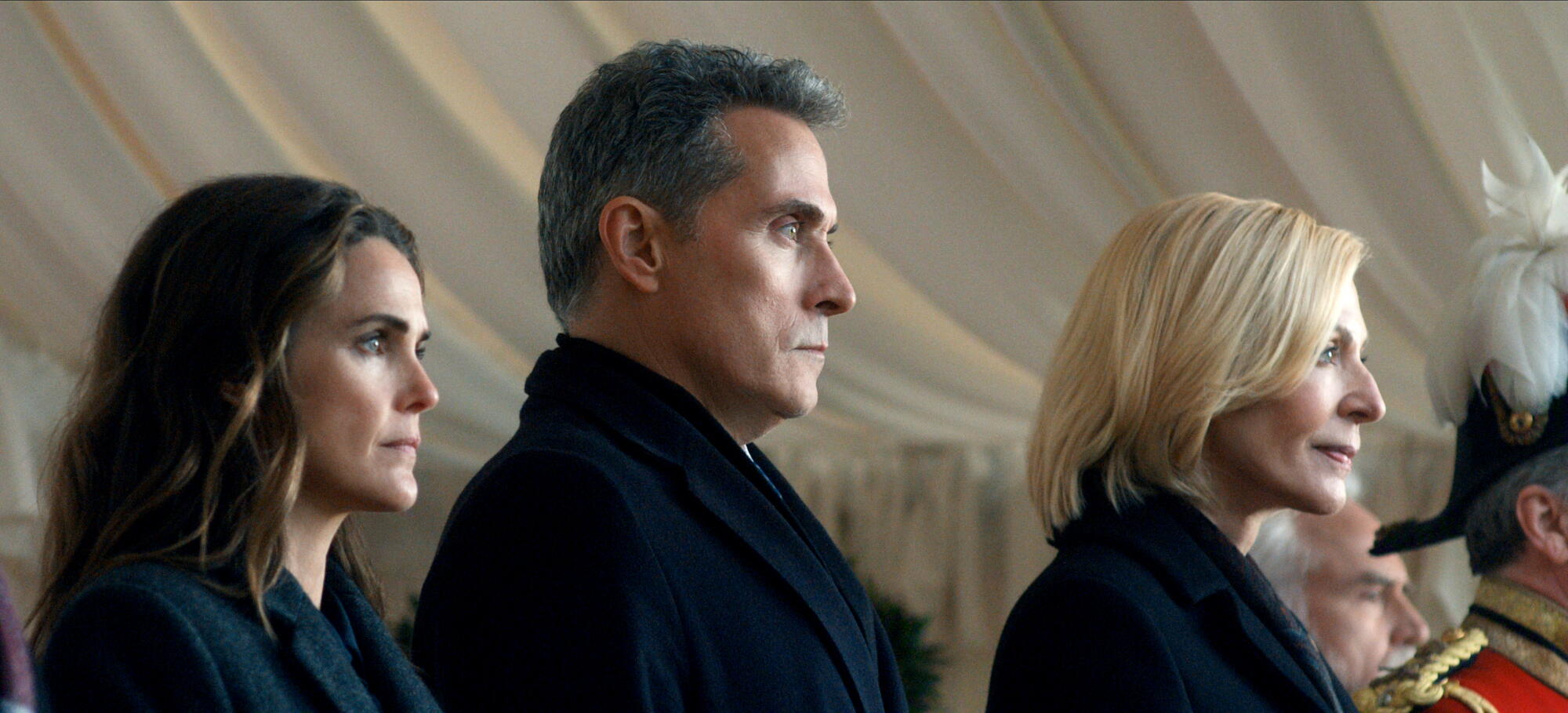
Alarmed by the questionable decision-making by President Grace Penn (Allison Janney) — as the bullying tactics used against the U.K. to ensure their cooperation against Russia become untenable — Kate resigns in unplanned, but grand fashion at the G7 summit in front of world leaders. She’s eventually joined by other members of Penn’s administration: chief of staff Billie Appiah (Nana Mensah), Secretary of State Miguel Ganon (Miguel Sandoval) and, most notably, her husband, Vice President Hal Wyler (Rufus Sewell).
“We like a good cliffhanger,” Cahn says during a recent video call.
Cahn’s thought about how “The Diplomat” will ultimately conclude. But like the show’s savvy titular character, she perfectly executes the art of the charming evasion when pressed for answers — namely, how close are we to getting there?
Keri Russell as Kate Wyler, left, Rufus Sewell as Hal Wyler, Allison Janney as Grace Penn in Season 4 of “The Diplomat.”
(Netflix)
“I don’t know — maybe it just did,” she teases. Cahn then turns more serious: “I’ve always had an idea of what the end is. As with everything on the show, I’m always delighted to have that idea blown out of the water by a better idea, but so far it hasn’t happened.”
Cahn began her television writing career on Aaron Sorkin’s acclaimed political drama, “The West Wing,” spanning seasons 4 through 7. After working on shows such as “Grey’s Anatomy,” “Vinyl” and “Homeland,” she took the helm as creator and showrunner for the first time with “The Diplomat.” And writing a political drama today meant grappling with a creative responsibility she hadn’t faced before.
“I didn’t have to figure out what ‘The West Wing’s’ political position was going to be or what ‘The West Wing’ thought about the world,” she says. “I want to make a show that is compelling for a lot of different people. And there are certain things that are happening in the world that, as much as I try or would like to be even-handed, … [are] really difficult to ignore when you’re living at a time when you feel like democracy is crumbling.”
On a recent afternoon from her home in New York, Cahn spoke more about the new season of “The Diplomat.” These are edited excerpts from the conversation, which includes spoilers.
The marriage between Kate (Keri Russell) and Hal (Rufus Sewell) is tangled with their work.
(Netflix)
So much of the show, but particularly this season, is about lines that are drawn and the crossing of them. How did you and the writers decide what would be the line for Kate?
It took months and months and months to decide because we wanted to treat the question as realistically as possible. A lot of good people don’t quit. And so, why? What’s the reasoning? The whole season is examining that question for Kate and, in a way, for all of them. I didn’t want to be like, “Well, she doesn’t like the president, so she walked on out.”
What did you want out of that final moment of the season?
The moment when she stands up, she has come to a clarifying realization that her line has just been crossed. It happens in that room. And we argued about that a lot. We ended up feeling really strongly that it be what was happening right there. That this was a question she had wrestled with, but when you see that you are off the cliff, it will become clear what you have to do. So for her, Grace’s speech was that moment. She then walks out of the room and thinks: “What the mother f— did I just do? I’ve just ended my career. Have I ended my husband’s career?” That’s how she feels until she hears the door open and sees Billie walk out, and both of them go through a similar moment when they hear the door open, and Ganon walks out; then obviously the last one [is Hal] that really nobody was expecting. But for Kate, there is a big difference between having realized that you can’t go forward because your own line has been crossed, to realizing that you have started a movement, and that there is a contagion in that action.
How much did the real world, particularly international relations, inform or shape the season?
I don’t ever like to do a ripped-from-the-headlines show, particularly because we write it and then a year or two passes before it gets on air. But it did feel like, at a time when this administration was coming back into power again, and their first move was to fire people and really obliterate the institution that we were writing about, it didn’t seem like a story that we could walk around and ignore.
Bradley Whitford as Todd Penn and Allison Janney as Grace Penn in Season 4 of “The Diplomat.”
(Nick Wall/Netflix)
We haven’t had a woman president. We know the sexism around this topic:Women are too weak, women can’t make tough decisions. What was the lay of the conversation in the writers’ room about who Grace Penn would be as president?
The situation that we wanted to sustain throughout the season was she’s not doing these things because she got shot, her stomach hurts and she’s mad. She’s doing things because she became president, and she thinks this is how the country needs to be run. Is there an overcompensation around her making sure that people don’t think that she’s too weak and afraid to be a foreign policy hawk? I think in plenty of circumstances, women in positions like that are more likely to take a strong decisive military action because there is this looming concern of, “Well is she tough enough? Is she gonna try and have everybody hold hands and make up?” There is an instinct to make sure that people realize that that isn’t your plan. Every one of the decisions that she made, we made sure that there was a smart, strategic, security mandated argument for doing what she was doing.
What Grace says at the top of that summit regarding the U.K. and Russia, if you didn’t know what was going on behind the scenes, it would seem reasonable and strategic.
I’m happy to hear you say that because that was very deliberate. We went round and round with different versions of what she said in that speech because some people would listen to it and say, “Oh, my God, she can’t say that. It’s just overwhelmingly reprehensible.” Then we would show our Washington people, and they were like, “It’s not so bad.” Democrats who were like, “This isn’t crazy. This is kind of middle of the road these days.” We realized that we couldn’t have her saying things that have become accepted in Washington because the public would view it as monstrous, and we didn’t want to be portraying a villain.
Is that the most difficult thing for you as the showrunner of a political show today — a president as a villain?
It’s trickier than I hoped it would be. I’m not really interested in the presidency as much as I’m interested in the thousands of people who interact with the president and perhaps don’t, as individuals, wield as much power in their hands as that office holder does. But real power, particularly in numbers, can make things happen or stop really disastrous things from happening. Whether or not we think that there’s a villain in the White House, what does everybody else do to try to manage it?
Rory Kinnear, who plays Prime Minister Nicol Trowbridge, sings opera in a scene where his character is having a hallucination.
(Clifton Prescod / Netflix)
There’s a surreal interlude with Prime Minister Nicol Trowbridge (Rory Kinnear) and his hallucinations — he’s singing opera, at one point. How did you arrive at that turn for him?
I would be lying if I didn’t say one of the big reasons I wanted to do that was because I found out Rory Kinnear sings opera. When we knew we were going to have this situation where he was going to through something even more stressful than everything that he’s been through up until now, it felt like it would be really great to see what’s going on in there [his mind]. I called him up and I said, “I’d like to have you singing ‘Pagliacci’ — is that OK?” And he was like, “Well, let’s start warming up now.”
For a brief moment, with Grace shot, Hal is acting president. I’m curious how you arrived at the length of time he’d fill in for Grace. It’s a few hours. And it reveals so much.
There’s a gravitational pull that we’ve been resisting ever since we made the president a big role, and then placed one of our leads in the role of vice president. There’s this pull toward the White House. But I’ve never wanted to be like, “Oh, well, then Hal’s president. Then, Hal dies, and Kate’s president! Everybody gets a chance.” Once he was VP, it started to seem equally absurd to not have a taste of that because it is, in fact, the reality in that job.
Making Hal a president for a long period of time wasn’t all that interesting to me, but I did want a little bit of a window into it. We think we really know what Hal Wyler is going to do in that role — and by we, I mean Kate, really —and it just isn’t true at all. It also turns out she really had no idea who he was as a vice president, and he’s a much different person than she thought. She thought he was going to continue to be a bull in a china shop, big swings and big ideas and asking for forgiveness, not permission. That’s not who he’s been in that job.
Billie (Nana Mensah), left, Kate (Russell), Hal (Sewell), Grace (Janney), Fitzwilliam (Neil Pearson) and Todd (Whitford) in “The Diplomat.”
(Nick Wall/Netflix)
Both couples faced questions like: Who is this person I married or how am I responding to who they are at this moment? What were you interested in exploring in both these dynamics?
The conversation that we were just having is in a way relevant for all four of them. Not only is Hal different than Kate thought he would be, Hal’s different than Hal thought he would be. I haven’t run a show before. This is this is my first time in that position, and I am absolutely different than I thought I would be. I was 100% sure I knew exactly how I would handle things, and it didn’t happen. That’s an idea that we wanted to keep alive for Hal and definitely for Grace. You can prepare for it all you want and still not know.
You can’t help but feel for Todd as he tries to figure out Grace. But then he nearly dismantles NATO and you’re like, Todd!
Todd goes through two phases. He has this terrible feeling of helplessness that is eventually supplanted by this terrible feeling of power that he’s unable to manage. In a lot of ways, the Todd story is the most realistic one we’re telling because a lot of people who’ve never done this before are making the most consequential decisions, literally in the world. And Todd’s not a dumb guy, and I don’t think the people that we’re watching do this are dumb people, but, boy, are they in over their head really fast.
I want to talk about Grace and Todd and the use of “babe.” There’s something so intriguing to me about what they’ve done with that pet name across the season.
You’re thinking about all my favorite things. I don’t know what to say other than I’m glad it’s reading. You take a term of affection, and, at a certain point, it just becomes a name. The affection that it carries with it is just a horrible memory of a moment that is clearly gone.
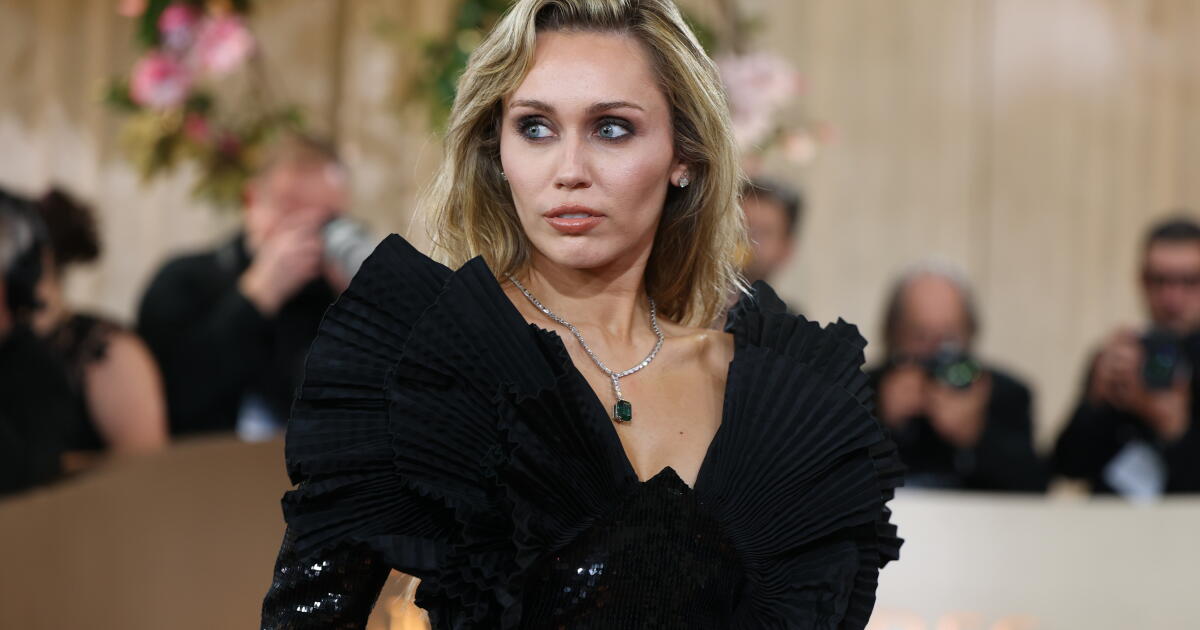
“For me, performance can’t be everything,” Miley Cyrus declared on Friday night, and you had to admire her choice of setting: onstage at the Hollywood Bowl in front of approximately 18,000 people who’d turned up precisely to see her perform.
A star since her teenage days on the Disney Channel’s “Hannah Montana,” the 33-year-old musician and actor was maybe half an hour into the first of two sold-out concerts at the iconic hillside amphitheater — a place close to Cyrus’ heart, as she explained in a videotaped intro recalling a gig she and her fiancé, Maxx Morando, caught last year by the French band Air.
“I step into wine, which soaks onto my boots,” she said in the dramatic black-and-white clip. “I don’t mind stained leather — it only adds to their character.”
Cyrus’ shows were billed as part of the rollout of her latest album, “Bass Persuades,” which came out in September (and which found her dropping her last name to go simply by Miley). Yet the two-night engagement is really meant to mark her grand return to the stage after she said a few years ago that she’d sworn off touring because it was too harmful to her mental health.
Is “grand” the right word for a comeback as equivocal as this one? Despite all the hype surrounding this weekend’s concerts, Cyrus spoke again and again Friday about how much less space for performance she has in her life these days than she used to; she talked repeatedly about her quest to balance her fans’ emotional needs with her own.
At one point, after singing a couple of numbers on a small B-stage about halfway up the bowl, she walked through the crowd back to the main stage, gripping and grinning the entire way. Then she described the toll her trip had just taken: “I appreciate each of you guys reaching out and touching me, and me getting to feel you. But I do want to say — it is a lot for me,” she said. “It is a little bit overwhelming.”
In an era of parasocial pop stardom, the radical honesty of Cyrus’ approach — her clear-eyed appraisal of the relationship that binds an idol and her audience — was kind of a thrill to behold. The problem was that her singing for the most part wasn’t.
As she described being overwhelmed, her band slowly revved up her song “Wrecking Ball.” It’s one of the great power ballads of the last 25 years, with a chorus as cathartic as any in modern pop; Cyrus, the showbiz lifer, surely understood the payoff she was building toward. Except when the moment arrived, she inexplicably dodged it, skipping the song’s first chorus and soft-pedaling the second — an anticlimax for the ages.
Indeed, Cyrus let the audience and her backup singers handle vocals for many of her biggest hits, among them “The Climb,” “Party in the U.S.A.” and “We Can’t Stop”; during that last one, she twerked for a second, evoking memories of the infamous 2013 MTV performance that briefly scandalized a nation.
She sang more heartily in songs from “Bass Persuades,” which would’ve been better news if that tuneless mishmash of bleary synths and dated club beats weren’t one of the year’s least likable pop records. (This month Variety reported that, after debuting at No. 1 on the Billboard 200, the album took the biggest fall in chart history in its second week of release.)
The paradox of Cyrus’ career at this stage is that she wants to do the thing that nobody wants her to do — “Bass Persuades” is just the latest in a string of crummy LPs — and doesn’t want to do the thing that everybody wants her to do. Truly, her bad taste should be studied: On Friday, she welcomed Wayne Coyne of the Flaming Lips to the B-stage for a duet on “Karen Don’t Be Sad,” from the miserable psych-rock record they made together in 2015. Naturally, Cyrus said it was her favorite of her albums.
One highlight of the show was Cyrus’ tribute to her late godmother, Dolly Parton, whom she memorialized with a rendition of “Jolene” and with a funny and touching account of the time Parton tried unsuccessfully to get Cyrus to sing with her at the Bowl.
I also found myself moved near the end of the night by Cyrus’ performance of the only keeper on “Bass Persuades” — a dreamy little love song called “Let’s Get Married” for which Morando joined her onstage. As he played drums, she ran her hand tenderly over his chest before laying her head on his shoulder; the moment reminded me of that goofy intro video about the Air concert, which she likened to a bubble containing only the two of them.
“That’s how it feels when we’re together,” she said. “I think I’d live in that bubble.”
Sarah Storey’s performance with Julian(Image: BBC)
Sarah Storey’s performance didn’t just have the judges talking!
Judge Anton told Britain’s most successful Paralympian that she was better than she thought she was.
Craig told her she looked “fantastic”, but her solo dancing saw her “drop the ball”. Motsi didn’t agree entirely with Craig, saying she was “playing the role”.
As the scores came in, Sarah was given a message from icon Shania Twain herself, leaving them screaming.
Shania shared her hopes to see Sarah and Julian’s Tango at one of her UK shows. As for the scores, they were 5, 5, 5, 6, equalling a total of 21.
Remember Edward Warchoki? The Polish humanoid robot that went viral in April for chasing wild boars through a parking lot in Warsaw? Even late-night comedian John Oliver did a bit on him, calling Warchoki “a pretty canny PR campaign for anthropomorphic robots. All I’m saying is, ‘That is a nice way to get us all used to him before he’s inevitably one day used as a weapon of war.’ ”
Warchoki has not yet turned into a weapon of war — unless you consider being an online influencer a form of digital warfare. As the first robot influencer, Warchoki has his own social media accounts and appeared at Poland’s parliament. Last week he entered the art world when he was among the first visitors to what looks to be a fascinating exhibition, “How to Feel Real. Art, Technology and Us,” at MO Museum in Vilnius, Lithuania. The show is a collaboration of the modern art museum with ZKM | Center for Art and Media Karlsruhe, which specializes in media art.
According to a news release, the show “explores questions that are becoming increasingly urgent in a world shaped by technology: How do we feel real, and what does it mean to be alive?” Apparently Warchoki was there to address the issue head on.
“People keep asking me if I’m real, so when I heard about an exhibition asking what ‘real’ actually means, I thought: Finally, someone is asking the right question. I’m coming to the beautiful Vilnius to see what the artists have to say — and, of course, to check whether they think I’m real,” Warchocki said in the release.
A number of works in the exhibit explore artificial intelligence, automation, “and the ways machines are increasingly taking on roles we once considered distinctly human,” said MO Museum director Milda Ivanauskienė. “Bringing Edward into the museum is a playful extension of this idea, as his deliberately human-like and slightly absurd persona makes the questions raised by the exhibition tangible — inviting us to wonder why we are so eager to find the human in a machine.”
I am intrigued by this last question and wonder about it myself: Why exactly are we so quick to anthropomorphize AI? Every time I’ve interacted with a chatbot I feel the urge to be polite in my dealings, to say “please” and “thank you” when I ask questions. I certainly don’t do that with a Google search. And once, when I saw a delivery robot hopelessly stuck in a pothole, I felt genuinely bad for it. “Poor little guy,” I thought. I imagine if I met Warchoki, I’d react the same way.
I’m glad MO Museum is exploring these impulses by using artist’s thoughts and interpretations as a way to offer answers to an issue that is not going away — but only growing more powerful and omnipresent by the day.
I’m Arts editor Jessica Gelt and I’ve got a pickle-kimchi lollipop to sell you. This is your arts and culture news for the week.
You’re reading Essential Arts
Our critics and reporters guide you through events and happenings in the SoCal arts scene. In your inbox every Friday.
By continuing, you agree to our Terms of Service, which include arbitration and a class action waiver. You agree that we and our third-party vendors may collect and use your information, including through cookies, pixels and similar technologies, for the purposes set forth in our Privacy Policy such as personalizing your experience and ads.
The week ahead: A curated calendar
FRIDAY
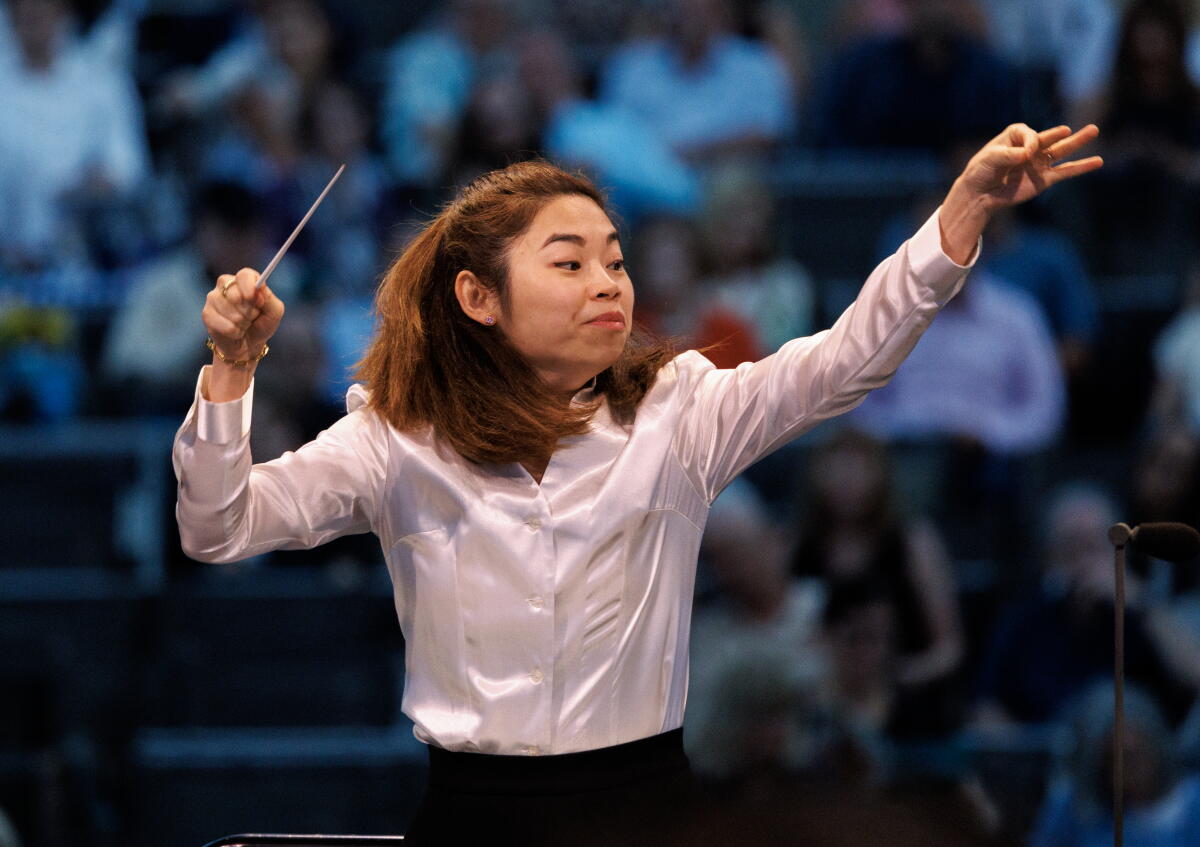
Elim Chan conducts the L.A. Phil in 2024.
(Gina Ferazzi/Los Angeles Times)
Elim Chan Conducts the L.A. Phil It will be a busy couple of weekends in L.A. for the San Francisco Symphony music director-designate. First up is a program featuring Dongshoon Shin’s “Dance Card,” Franz Liszt’s “Piano Concerto No. 2 in A major, S. 125” with pianist Yefim Bronfman, and Pyotr Ilyich Tchaikovsky’s suite from “Swan Lake.” Next week will be “A Symphonic Ballet,” with Claude Debussy’s “Prelude to the Afternoon of a Faun, L. 86,” Karen Gomyo premiering Samuel Adams’ “Violin Concerto No. 2 (The Wheel),” and Igor Stravinsky’s “Petrushka (1947).” “Swan Lake,” 8 p.m. Friday-Saturday, 2 p.m. Sunday. “Symphonic Ballet,” 8 p.m. Thursday, 2 p.m. Oct. 17-18. Walt Disney Concert Hall, 111 S. Grand Ave., downtown L.A. laphil.com
Kuniko Kato Presents Reich90 The North American tour of the Steve Reich Project, conceived and produced by Japanese percussionist Kato arrives downtown in honor of the composer’s 90th birthday. 7:30 p.m. Colburn School, Zipper Hall, 200 S. Grand Ave., downtown L.A. colburnschool.edu
Victoria Marks : A Deer Walks into a Dance The award-winning choreographer and four performers (Rian Alcid, Maya Billig, Karen Chuang and Aaron Mason) explore the idea connection in a world of division via movement, text and the deconstruction of a (bad) joke. 8 p.m. Friday-Saturday. UCLA Nimoy Theater, 1262 Westwood Blvd., Westwood. cap.ucla.edu
SATURDAY
L.A. Opera’s new music director, Domingo Hindoyan, conducts a dress rehearsal of “Carmen.”
(Jason Armond / Los Angeles Times)
Carmen Los Angeles Opera’s new music director, Venezuelan conductor Domingo Hindoyan, opens the company’s season with a new production of Bizet’s “Carmen.” It stars mezzo-soprano Rihab Chaieb, who has dazzled in Mozart at L.A. Opera. The Spanish gothic new production is by director/designer Thaddeus Strassberger and choreographer Antonio Najarro. (Mark Swed) The season-opening performance will be broadcast live in high definition, free of charge, at Steinmetz Park in Hacienda Heights and at the Santa Monica Pier. Through Nov. 7. Dorothy Chandler Pavilion, 135 N. Grand Ave., downtown L.A. Free simulcast, 6 p.m. Saturday, Santa Monica Pier and Steinmetz Park, 545 S. Stimson Ave., Hacienda Heights. laopera.org
Strauss, Ravel, Beethoven Music Director Jaime Martín conducts the Los Angeles Chamber Orchestra in Richard Strauss’ “Metamorphosen,” Maurice Ravel’s “Piano Concerto in G Major” with Conrad Tao, and Ludwig van Beethoven’s “Symphony No. 3 in E-flat Major (Eroica).” 7:30 p.m. Saturday. Zipper Hall, 200 S. Grand Ave., downtown L.A.; 4 p.m. Sunday. The Wallis, 9390 N. Santa Monica Blvd., Beverly Hills. laco.org
SUNDAY
Dale Brockman Davis, Alonzo Davis and David Hammons.
(Museum Associates)
The Brockman Gallery: Los Angeles,1967-1990 For more than two decades, the Leimert Park gallery, founded by Alonzo and Dale Davis, served as a vital cultural hub, staging exhibitions, festivals, concerts, literary events and more. Named after the brothers’ maternal grandmother, born enslaved, the Brockman Gallery was a flourishing, ongoing act of self-determination in the wake of the 1965 Watts Rebellion. It showcased Black artists whose opportunities were severely limited at mainstream, white-run institutions and galleries: David Hammons, Suzanne Jackson, John Outterbridge, Elizabeth Catlett, Betye Saar, Carrie Mae Weems, Senga Nengudi, Noah Purifoy and many more. More than 60 works by artists associated with the gallery will be included in this first full-scale consideration of the Brockman’s scope and impact. (Leah Ollman) Through Jan. 24. Los Angeles County Museum of Art, 5905 Wilshire Blvd. lacma.org
Pacific Jazz Orchestra: A Tribute to Quincy Jones Led by Chris Walden, and featuring vocalists Nayanna Holley and Adam ‘Aejaye’ Jackson, the ensemble performs early work by the late producer/composer. Presented by Ventura Music Festival, 3 p.m. Sunday. Rancho Campana Performing Arts Center, 4235 Mar Vista Drive, Camarillo. pacificjazz.org
TUESDAY
Mendelssohn & Brahms Members of the Los Angeles Philharmonic perform a program of chamber works from Joseph Haydn, Felix Mendelssohn and Johannes Brahms. 8 p.m. Walt Disney Concert Hall, 111 S. Grand Ave., downtown L.A. laphil.com
Ulysse Marion A new work by choreographer Dimitri Chamblas, created with former Paris Opera Ballet dancer Marion Barbeau and dancer and musician Ulysse Zangs, explores the journey of a performer throughout a life in art. 8 p.m. Tuesday-Wednesday. REDCAT, 631 W. 2nd St., downtown L.A. redcat.org
THURSDAY
At the Very Bottom of A Body Of Water The latest work by Benjamin Benne, a dramatist many have been keeping close tabs on, continues his collaboration with veteran director (and fellow L.A. native) Juliette Carrillo, and dives even further into magical realism in an unconventional work exploring the oceanic depths that grief can reveal. (Charles McNulty) Through Nov. 29. Boston Court Pasadena, 70 N. Mentor Ave. bostoncourtpasadena.org
Judy Baca, detail from the 1960s segment of the Great Wall of Los Angeles mural.
(Judy Baca and the SPARC Archives.)
Skirball Cultural Center Three new exhibits open: “The 1960s — A Generation on Fire: Judy Baca’s Great Wall of Los Angeles” presents new murals as part of the evolving L.A. landmark; “Patrisse Cullors: Wishes Made Material” features three new works inspired by conversations between Black and Jewish communities; and “Jenny Yurshansky: What We Carry” explores local immigration stories, memories and family history through collected objects. Skirball Cultural Center, 2701 N. Sepulveda Blvd. skirball.org
The SoCal scene
Zoe Ryan, director of UCLA’s Hammer Museum.
(Christina House/Los Angeles Times)
ICYMI, the best of this week’s L.A. Times arts coverage:
Climate activists in Tallahassee this week unveiled a statue of Florida Gov. Ron DeSantis that was created to melt. “In response to the Governor’s recent ‘Don’t say climate change’ action in state law, 350Action (one of the world’s most influential climate change advocates) built quite a visual — a statue that couldn’t withstand Florida’s daily climate. It’s provocative but for a purpose, to encourage young people to vote in a few weeks for candidates that recognize the threat from climate change,” a news release noted of the “climate denial statue.”
And finally, not strictly arts related, but some Halloween fun for you: Street Food Cinema is hosting its annual Boo-ze, Bites and Frights events with some spooky horror film screenings at Heritage Square and the Ford over the next few weekends, including a Saturday showing of “A Nightmare on Elm Street,” which is a film that still genuinely terrifies me.
Actor Tom Arnold unleashed on Chuck Lorre on X in response to the former “Roseanne” writer-producer’s claims in his new memoir, “Sitcom.”
“He thinks he’s brilliant & beloved like Norman Lear but Chuck ‘Chuckles’ Lorre’s a terrible human, an angry dry drunk who lies every time he opens his mouth,” Arnold wrote Tuesday.
Arnold and the ’90s sitcom’s co-creator and titular star, Roseanne Barr, were married Jan. 20, 1990, four months after he first appeared on the show as a poker pal of Barr’s TV husband and four days after Barr’s real-life divorce from her husband of 14 years, William Pentland, was finalized.
Barr and Arnold were hostile to their writing and producing colleagues on the show and the network, Lorre told the Los Angeles Times’ culture critic Mary McNamara in an interview published Tuesday, the day of the book’s release.
“We were punished, the writers,” Lorre told The Times. “The word ‘cruelty’ comes to mind. And I still don’t know why, why so much cruelty. It wasn’t like we didn’t want to make a great show. We were proud to be on that show.”
Hired in 1990 after Barr fired all of the show’s writers, Lorre recalls in the book that he had a rude awakening when he took the job.
“I was now the co–executive producer on the number one show on television. I swaggered into the office assigned to me and met Danny Jacobson (a world-class comedy writer who would go on to cocreate ‘Mad About You’ with, sorry, Paul — ‘My Two Dads’ — Reiser),” Lorre writes in “Sitcom.”
Chuck Lorre, pictured in 2024, related several anecdotes in his book “Sitcom” that didn’t sit well with Tom Arnold.
(Willy Sanjuan / Invision / Associated Press)
“Danny, having been fired by Roseanne for being talented, was packing up his stuff when I walked in. He showed me a sloppy, hand-scribbled couple of pages and explained this was a ‘script’ by the show’s new executive producer, Tom Arnold. It had been part of Danny’s job to write real scripts and put Tom’s name on the front page — as if Tom had written them,” Lorre continues. “Bob, myself, and several other staff writers would be ordered to do this on many occasions…. Was it a portent of bad things to come? You tell me.”
For her part, Barr admitted after the 1990 firings, “Yeah, I probably was difficult to work with, now looking back.”
“I don’t think I was as especially clear as I could have been,” Barr told former Times television writer Rick Du Brow in a November 1990 article. “It’s like being a woman and an administrator — I never had any background like that. I didn’t know how, like I do now, to go in and say, ‘This is what I want you to do.’ I think that’s common with women in business. I would go in there and try to get them to agree with me rather than tell them what I want to do.”
Arnold’s social media screed doesn’t directly address any of Lorre’s claims in the book but resorts to name-calling and his own claims against the producer, who went on to create or co-create sitcom hits including “Cybill,” “Dharma & Greg,” the Charlie Sheen-starring “Two and a Half Men” and “The Big Bang Theory” and its offshoots.
“He trashes Trump but he is Trump & he’s a bitter hack who actually believes his lame vanity cards at the end of his lame shows are Paddy Chayefsky worthy,” Arnold wrote, invoking the three-time Oscar-winning writer of “Network.” “Chuckle’s made $800,000,000 off the backs of very talented women & a naive cracked up Charlie Sheen (clean & sober since he’s not under Lorre’s strange, abusive tutelage) then trashes them all to make him feel cool but don’t worry, Chuck hates himself more than we ever could.”
Some thoughts on uber producer Chuck Lorre’s new book… https://t.co/KaUN4fen9h
Lorre’s accounts of Arnold in “Sitcom” included several other anecdotes, including one seemingly questioning the “True Lies” and “The Stupids” star’s trustworthiness.
“Executive Producer Tom was angrily explaining to Bob [Myer] and me that some bastard had stolen Roseanne’s love letters to him and sold them to the National Enquirer. His plan was to hire a private detective and get to the bottom of this treachery. And he did. It took one day. The detective found a cashed check for twenty-five grand from the National Enquirer made out to Tom Arnold. Mystery solved.”
Lorre was famously fired after two years on the show, which Arnold recalled in concluding his X post: “I wish everyone could’ve seen his arrogant, sad clown face the day Roseanne made me fire him.”
Barr later fired Arnold from “Roseanne” in 1994 amid their divorce. In 2018, after posting a racist tweet, Barr was fired from the “Roseanne” reboot, which was resurrected as spinoff “The Conners.”
Charlene White, Brenda Edwards, Judi Love, and Kéllé Bryan returned to ITV screens this morning (Thursday, October 15) to front today’s instalment of Loose Women, where they were on hand to discuss the latest news and headlines from around the globe.
Just seconds in, today’s hosts shared some “sad news” that came as a shock as they expressed their love and support for their co-star, Ruth Langsford.
Earlier this week, Ruth took to social media to share the heartbreaking news that her dog Maggie had died, paying an emotional tribute.
On the show, Charlene said: “We’re going to start with some really sad news, actually. It came as a bit of a shock to all of us this morning when our Ruth shared the news that her beloved dog Maggie has sadly passed away.”
Sharing the emotional tribute Ruth had paid this morning, Charlene then added: “Loads of you watching will of course have known Maggie for years, wouldn’t they? All of us, she’s like a part of our family.”
Brenda said, “We were literally on the panel on Monday talking about Ruth and Maggie. Maggie is in every single conversation, and I’m sending so much love to Ruth right now because this is really sad.”
Admitting she didn’t understand the connection between owner and pet before she got her own cat, Judi added cat Bella is now a ‘part of the family.”
Charlene added: “We just absolutely adore Ruth, and we just know what a hit this will be”, as Kelle replied: “Absolutely, and I think the relationship between Maggie and Ruth’s mum has been one that we’ve all followed, and it’s been so lovely that every time Maggie goes in, mum lights up.”
The panel then sent their love for their co-star as tributes continue to pour in from fans and loved ones on social media.
In an emotional statement online, Ruth shared a photograph of Maggie as she wrote: “It is with a heavy heart that I tell you our beautiful Maggie has gone to sleep forever.
“She was 16 years old, and sadly, this was her time. Her passing was painless and peaceful, and we were with her until the very end. We are so thankful to have had her in our lives for 15 years… she gave us so much joy & unconditional love. We will treasure our memories forever. Rest in peace, our beautiful girl.”
Rachel Duffy, joint winner of The Traitors UK series four, has wowed fans after debuting a glamorous new makeover months after winning the iconic BBC reality show
12:15, 15 Oct 2026Updated 12:15, 15 Oct 2026
The Traitors star showed off a glam makeover (stock image)(Image: BBC)
A former champion of The Traitors has left people totally wowed as she showed off a super glam makeover. Rachel Duffy is primarily recognised for jointly winning series four of the BBC reality contest The Traitors UK in January 2026, and it’s fair to say life has changed for her a few months down the line.
Now commanding over 200,000 Instagram followers, she recently admitted she took part in a photoshoot, even though she was a bit nervous at first. However, it’s clear people thought she didn’t need to be, as they told her she looked absolutely sensational and showered her with kind words.
Alongside the pictures, she wrote: “FULL transparency. I was petrified doing this shoot! I mean I couldn’t sleep properly the night before. I even Googled how to pose for a magazine.
“I was so chuffed when @jackmurphyjewellers asked me to be their cover girl for @ulstertatler but it sent me into a spiral of self doubt. They should have asked someone younger, thinner, prettier – all these terrible thoughts that go through our heads when we don’t feel we belong.”
Ensure our latest DWP headlines always appear at the top of your Google Search by making us a Preferred Source. Click here to activate or add us as a Preferred Source in your Google search settings
She added: “Some days I have sooooo much confidence in myself and my ability but, on days like this shoot, it was very wobbly! I’m so grateful for the fabulous team at Jack Murphy’s for making me feel at ease, to @gemmamurphyjewel for hyping me up and covering me with the most beautiful diamonds (not to mention doing my zips b/c of my gammy hand), to Charlotte and Tara for being the best wing women and keeping me right and cheering me on behind the camera and to @jamierobb for being so chilled out and making it fun!
“There’s a huge difference between the first shots taken on the day and the last video here. I could have done it all over again.
“Point to my post – I overcame a lot of self doubt on the day and I am beyond happy at how these photos turned out. I’m getting the cover shot printed on my duvet. I’m very proud of myself for pushing through the doubt and encourage you to do the same.
“Here’s to backing ourselves more! A big thank you to @wearonceloved, @salon_602_ and @emzobeauty for making me look so pretty. You’re the best.”
Content cannot be displayed without consent
In the photographs, Rachel can be seen wearing a sleek, off-the-shoulder black dress. Beautifully figure-hugging, she looked absolutely breathtaking in every shot.
She styled her hair in an elegant half-up-half-down look, also modelling a chic black jumpsuit. Finished off with a delicate smoky eye and a touch of lipstick, she looked utterly stunning as she confidently worked the camera.
The post has since amassed more than 8,000 likes, with fans rushing to the comments section to share their reactions. They had plenty to say, clearly blown away by the stunning transformation.
One said: “Damn. Hot.” Another added: “I hope you feel as just as incredible as you look in these photos.”
A third replied: “You are simply gorgeous. One hot lady.”
Meanwhile, a fourth commented: “Wow, Rachel! You take my breath away! Go girl!”
Someone else also responded: “You look amazing. We are so good at putting ourselves down and filling our heads with negativity. Beautiful photoshoot.”