On Monday, the GMCA released a statement about Burnham’s meetings with Man City in his role as mayor for the region for almost a decade.
The statement said he had a formal meeting with Al Mubarak in October 2021 at the UK Government’s Global Investment Summit, arranged by the Department for International Trade; and that he met the club chairman “informally in the stands” at a testimonial match in 2019 for former player Vincent Kompany.
It also said that “in his capacity as mayor, he was a guest of Manchester City at home matches on a small number of occasions”.
A previous GMCA register of declarations for Burnham, seen by the BBC, detailed a “dinner with [then-Manchester City Council leader] Richard Leese and Chair of Man City” for an Everton match at the Etihad stadium in August 2017, valued at £300 for hospitality.
Below is another entry for “dinner with the Chairman at the Man City/Man Utd derby at the Etihad” in April 2018, valued at approximately £699.
Burnham previously declared those dinners, alongside a £150 pair of tickets to see Ed Sheeran perform at the stadium in May 2018.
But the register of declarations has since been deleted from the GMCA website, as first reported by The Sun. The BBC understands it is the authority’s policy to only publish entries from the current mayoral term.
BBC News has asked GMCA for more details about this policy – given its website has entries dating back to 2022, despite the current mayoral term beginning in 2024.
Downing Street has defended the two dinners with Man City’s chairman, saying this was hospitality received at home games, which had been declared, rather than separate meetings with the club chairman.
But political pressure on Burnham to be clearer about any former discussions with Man City is continuing to mount.
Tory shadow sports minister Louie French said: “Andy Burnham promised the country and House of Commons full transparency on his dealings with Manchester City.
“This was essential after his inappropriate intervention into football.”
And Reform UK’s Robert Jenrick said “this saga stinks” as he accused Burnham of having apparently “concealed his extensive links to Man City’s owners”.
Conservative leader Kemi Badenoch has demanded for several days that No 10 release all details of meetings between the prime minister and senior figures at the club.
Burnham told the Rest Is Politics podcast last week he was “happy” to do this and would “quite clearly put out there everything that I have done working with them in my previous role as Mayor of Greater Manchester”.
“None of it is recent, actually, in terms of the meetings I had. I only had one significant meeting, actually, and that was in 2021.”
Asked at Prime Minister’s Questions on Wednesday whether anyone at the club had raised the charges they were facing with him or his team, Burnham said: “They did not raise those issues with me.”
With the PM continuing to face pressure on the issue, he told MPs he was happy for “everything to be set out in full”, referring to the GMCA’s statement as “a full statement of my key dealings with the owners of Manchester City Football Club”.
When asked by reporters why the statement did not refer to the two dinners, and what the difference is between “everything” and “key dealings”, the PM’s press secretary referred back to the GMCA statement.
The list of meetings, which was published by the GMCA on Monday, did not include detail on what was discussed. The BBC has asked GMCA why the two dinners were not specifically mentioned.
In September Man City – which has dominated the top flight of English football for years – was found guilty by an independent commission of breaching Premier League financial regulations.
The commission found City had broken rules over a nine-year period between 2009 and 2018 by creating “sham” contracts with commercial partners to secretly funnel more than £830m into their football operations.
Sanctions are yet to be announced and City, which denies any wrongdoing, has lodged an appeal against the verdict.
Earlier this month, Sir Richard Leese – who was head of Manchester City Council for 25 years until 2021 – defended a decade-old deal between the council and Man City owners Abu Dhabi United Group (ADUG).
Under the partnership between the authority and the company, which is linked to the United Arab Emirates royal family, land was leased to ADUG at “below comparable rates”, according to a University of Sheffield report.
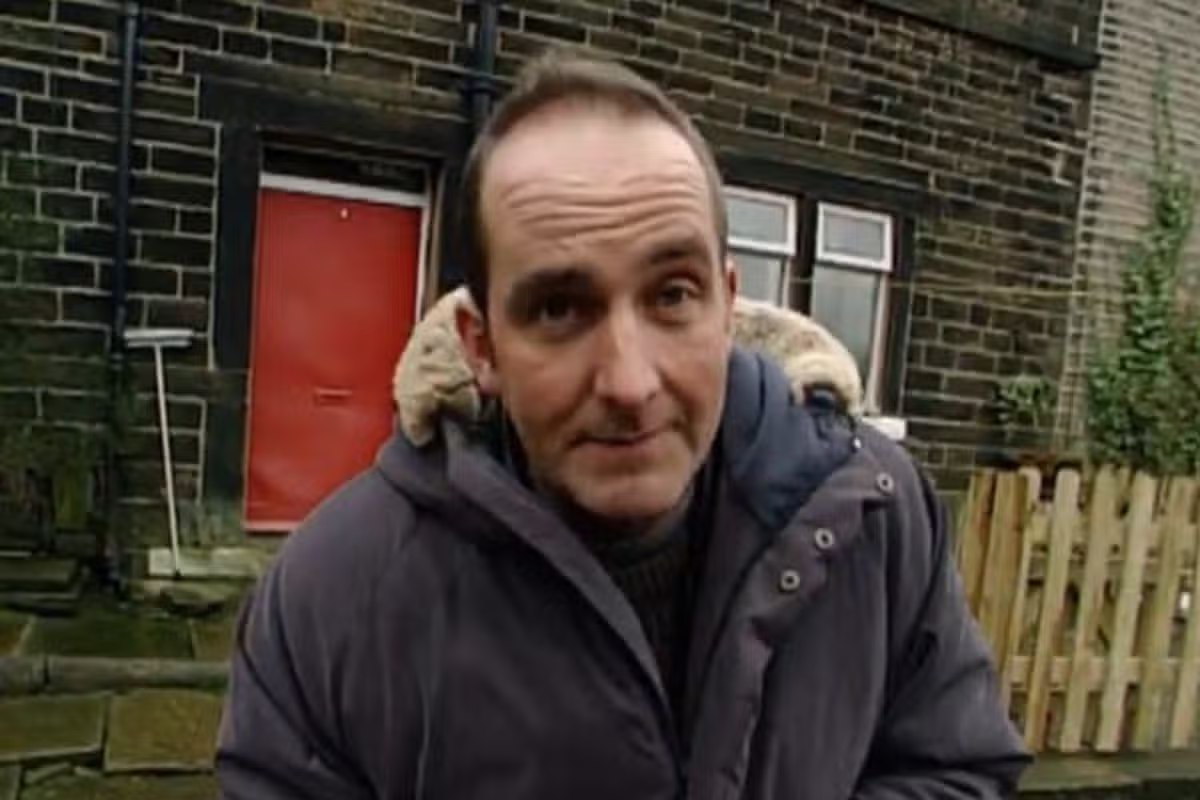
Grand Designs viewers were left disgruntled as Kevin McCloud returned to a build from 25 years ago.
Viewers issued the same complaint (Image: Channel 4)
Grand Designs viewers claimed to “turn off” the Channel 4 programme as they rushed to social media to share their complaints.
Kevin McCloud’s architectural programme has been airing a new series, which has so far seen a ‘pink cloud house’ in London built by an eccentric couple, and a Cornwall family home designed to overlook the sea. On Wednesday, 14 October, the Channel 4 show took viewers back in time 25 years, revisiting a build in Yorkshire.
It looked back on earlier Grand Designs clips, where Chris and Gill designed and built their dream home from a 19th-century Mill. Kevin shared at the start of the episode: “West Yorkshire has always been a place of innovation, manufacturing and mills.”
He spoke about the disrepair of one mill, before it was brought back to life by “gutsy pioneers”. Kevin continued: “25 years ago, Chris and Gill put that same spirit of innovation into the restoration of one of these forgotten buildings.
“They took an abandoned mill and turned it into a high-tech home, and they did it in proper Yorkshire style – no nonsense, with grit.” Gill and Chris had bought the derelict 19th-century mill in 1999, without seeing the site.
“What a dump,” Kevin had declared at the time. But the couple were determined to transform it, and had high ambitions for “a radical hybrid home”. Looking back on the build, Kevin went on: “Amazingly, it’s been a quarter of a century since I last saw Chris and Gill, that is a really long time! So long in fact, that you have to ask, have they changed? Is the building as radical as it looked then, and most importantly, how well has that building over 25 years looked after them?”
As Kevin shared their story from over two decades ago, and reflected on where Gill and Chris were now, viewers were disgruntled at the revisit, rather than a new project on their screens. A number of fans quickly took to social media to share their frustrations.
Content cannot be displayed without consent
“Another pointless edition of #granddesigns,” one person fumed, as another said: “Always disappointing seeing ‘new’ @granddesigns and its the revisited version.” Someone else said: “There obviously hasn’t been many new ‘grand design’ projects in the country over the last few years as it’s a ‘revisited’ episode four shows into the new series.” Someone else replied by saying they’ve “turned it off”, as another added: “Was exactly my point too.”
Someone else wrote: “#granddesigns revisit, in other words, it’s a repeat.” However, other viewers were more excited about the revisit episode, with one sharing: “I can’t wait! This one was amazing at the time.” Someone else declared: “This was one of my favourite GD’s of all time.”
Ahead of the new series airing, Kevin spoke about the success of Grand Designs, and was asked about if the series has changed the way people build houses. He replied: “It is very chicken and egg, what came first?
“I think the great thing about television is that it can reflect society, and I think television is at its best when it is able to do that and hold a mirror up and say, this is us now. Channel 4 are very good at doing this, I think it is one of the most compelling things about the channel.
“Grand Designs has been going forever, and so the question is whether it holds a mirror up and I believe the answer is yes, it does so because we have no real formula. We find projects in the real world and we observe, that is it.
“Grand Designs strengths and its longevity are down to the fact it doesn’t really have a format other than that. It has a beginning and a conclusion, but what happens in the middle is not up to us, it is up to the people who are building. We, of course, go out of our way to find interesting and challenging projects that are more at the margins, that show us where we might be as a society in 5,10, 20 years time, not just where we are now. So, my short answer is possibly, but it is much more important for us to show examples of stuff which show the rest of society how we might be building and living in the future.”
The last time audiences saw Vision, the reconstructed synthezoid was flying off into the distance, and we didn’t know when we’d actually see him again. But he’s finally back.
Premiering Tuesday on Disney+, “VisionQuest” brings Vision (Paul Bettany) back into the spotlight — along with a few of his closest inorganic friends — as he tries to figure out his identity and understanding of humanity. Along the way, he’ll encounter a bounty hunter (Todd Stashwick) and a teenager that just might be his son (Ruaridh Mollica), sort of. It’s a long story.
Created by Terry Matalas, “VisionQuest” is set to wrap up the story set into motion by the 2021 series “WandaVision.” The Marvel Cinematic Universe’s first-ever streaming series saw a grief-stricken Wanda magically manifest a happy life for herself and Vision as newlyweds and, eventually, new parents. But that happiness wasn’t meant to last since the actual Vision was gone.
A lot has changed in the MCU since the conclusion of “WandaVision,” so here’s a quick refresher to get you up to speed for everything you need to know before watching “VisionQuest.”
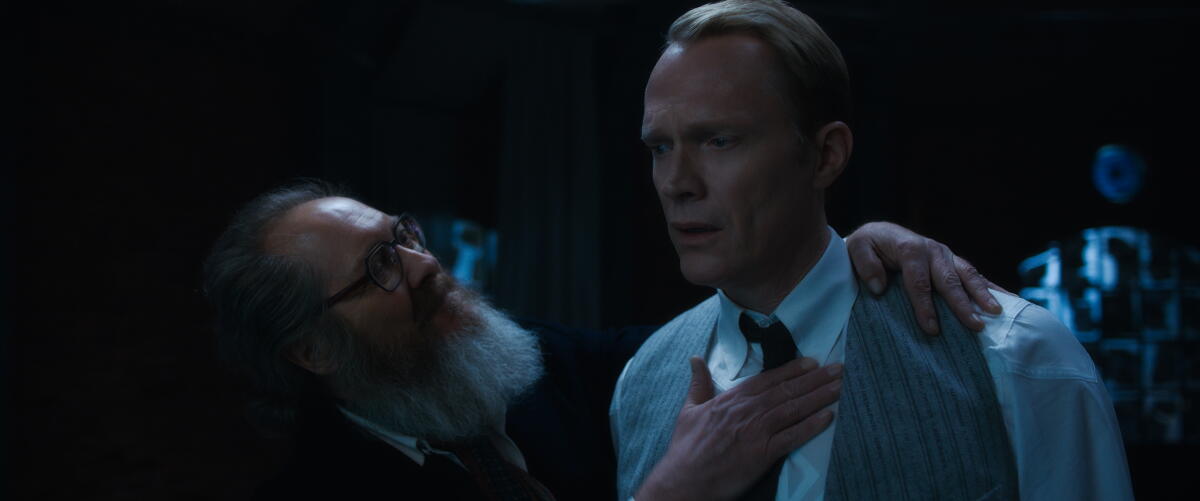
Ultron (James Spader), left, and Vision (Paul Bettany) in “VisionQuest.”
(Marvel)
What is ‘VisionQuest’ about?
Set some time after the events of “WandaVision,” “VisionQuest” will follow Vision as he tries to sort through his understanding of his identity and humanity. The former weapon of mass destruction has been in hiding for some time, but a bounty hunter tracks him down and disrupts his quiet life before also discovering a young man who appears to be Vision’s son.
When was the last time we saw Vision?
Audiences last saw Vision at the end of “WandaVision.” The monochromatic version of the former Avenger had been rebuilt without his memories to be a sentient weapon, but during a showdown with his magically created double, he regained them. He then flew off into the unknown to figure out what having access to these memories means for him.
What happened to Wanda?
After undoing her hex that let her live out a version of a happily ever after with Vision, Wanda had to watch him and their kids — twin boys Tommy and Billy Maximoff — disappear. Her story continues in the 2022 movie, “Doctor Strange in the Multiverse of Madness,” where she taps into some dark magic in order to find a way to reunite with her boys somewhere in the multiverse for another attempt at that happy life. But she’s a bit overzealous and things take a (villainous) turn for the worse before she ultimately sacrifices herself and is crushed by a mountain.
Thomas Shepherd (Ruaridh Mollica) in “VisionQuest.”
(Marvel)
What happened to Wanda and Vision’s kids?
Audiences learned in the 2024 series, “Agatha All Along,” that although Billy and Tommy’s physical forms disappeared when Wanda undid her hex at the end of “WandaVision,” their souls remained. Instead of crossing over into the afterlife, Billy, the magically inclined twin, transferred his soul into the body of William Kaplan, a teenager who had just been involved in a fatal car crash. Billy, now inhabiting the body of and living as William, was then able to use his powers to help Tommy’s soul find a new body to inhabit. At the end of “Agatha,” Billy and his magical mentor, Agatha, headed off to search for Tommy.
Who else is in this show?
Joining Vision in his “VisionQuest” adventures are an array of other AIs created by Tony Stark — all of which essentially now reside inside of Vision’s head. Most of these programs did not have physical forms in their original MCU incarnations, but appear in human form within the world inside Vision’s mind.
J.A.R.V.I.S. (James D’Arcy) is the AI assistant that Stark originally created to help manage his home and office as well as his Iron Man suit. His core programming was used to make Vision during “Avengers: Age of Ultron” (2015). F.R.I.D.A.Y. (Orla Brady) is the AI assistant that was created to take over J.A.R.V.I.S.’ duties afterward.
E.D.I.T.H. (Emily Hampshire) was created by Stark to help manage his company’s security and defense systems and was connected to his glasses. These glasses were passed on to Peter Parker in “Spider-Man: Far From Home,” before they were acquired by the film’s villain for his nefarious plot.
F.R.I.D.A.Y (Orla Brady), J.A.R.V.I.S. (James D’Arcy), U (Johnathan Sayer) and D.U.M.-E. (Henry Lewis) appear human in Vision’s mind in “VisionQuest.”
(Marvel)
D.U.M.-E. (Henry Lewis) and U (Jonathan Sayer) were a pair of arm robots that helped Stark in his workshop. All of these AI have specific roles and responsibilities within Vision’s home in his mind.
Another resident within Vision’s head is Ultron (James Spader), the misanthropic genocidal AI originally created by Stark and Bruce Banner to help save humanity. He tried to delete J.A.R.V.I.S. during the events of “Age of Ultron,” which led to the creation of Vision, so their dynamic is a bit complicated.
Also set to appear on the show is Mollica’s Thomas Shepherd, an older incarnation of one of Wanda and Vision’s magically created sons who had disappeared when the hex enveloping Westview was undone.
What do I need to watch before watching ‘VisionQuest’?
“VisionQuest” has been touted as the conclusion of the “WandaVision” trilogy, which also includes “Agatha All Along.” The events of “WandaVision” appear to be most central to “VisionQuest’s” story, though.
Those who’d like to see Vision and Ultron’s story from the very beginning should add “Avengers: Age of Ultron” to their queue. Fans who want to delve more into Vision and Wanda’s love story can also check out “Captain America: Civil War” (2016) and “Avengers: Infinity War” (2018) — with the latter adding more context to Vision’s current state of being. Those who want to see what happened to Wanda after “WandaVision” should also watch “Doctor Strange in the Multiverse of Madness.”
The A Place in the Sun presenter shared the sad news that the guest had died, months before the episode first aired.
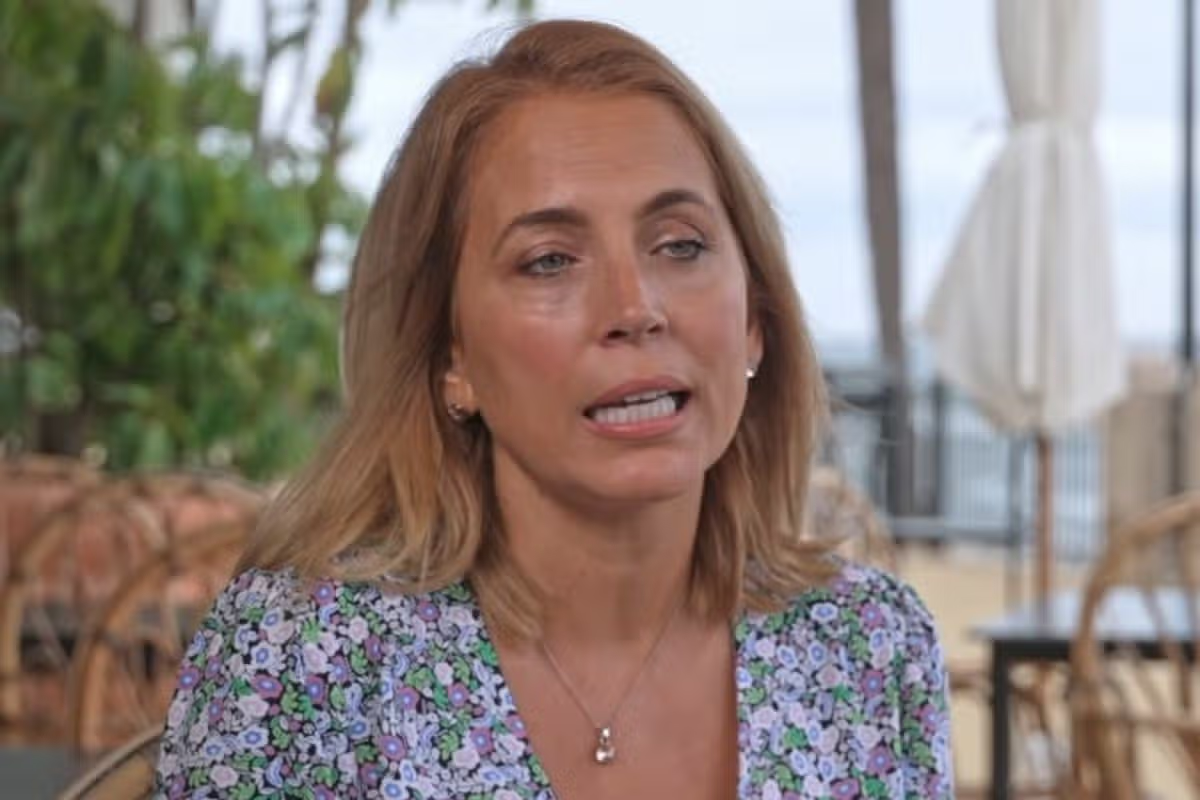
Jasmine Harman shared the tragic news(Image: Channel 4)
A Place in the Sun presenter Jasmine Harman shared the tragic news that a guest on the show had died, just months before the episode aired.
The Channel 4property programme returned with a repeat episode on Tuesday, 13 October, that had originally aired around the same time last year. It saw the presenter take couple Jackie and Delroy around Marbella in Spain, where they were looking for their dream holiday home.
Jackie and Delroy were hoping to buy their first home together, having met two years earlier on a dating site. They wanted to move to Spain permanently to start a whole new life together.
Reflecting on their relationship at the start of the episode, Jackie said: “We met and I think we knew fairly soon that there was something special.” Delroy meanwhile quipped: “Who else would you be with, I’m Prince Charming!” They had a budget of £600,000, telling Jasmine what they wanted to find somewhere with three bedrooms, sea views and their own pool.
At the end of their search, Jackie and Delroy revealed to Jasmine that they’d decided to make an offer on one of the properties they’d seen. “That’s fantastic news,” the presenter celebrated. The property was on the market for under £691,000, though Jackie and Delroy wanted to negotiate a lower price.
They explained: “The house is very tired, it needs a lot of updating. There’s no en-suite in the main bedroom, lots of flooring throughout the house to change, we have a kitchen to change, so we figure, about £605,000.”
Jasmine replied: “That’s over £85,000 off the asking price, which, as cash buyers, for a property of that level, you may stand a chance of getting something for £605,000.”
The presenter rung the vendor’s agent, putting forward the offer, while Delroy told her: “There’s only so much where I will go, with my developer head on, I know what needs to be done, so no way is my heart going to overrule my head.” However, unfortunately their first offer wasn’t accepted, with Delroy and Jackie going up to £625,000 and leaving that price on the table.
After filming, it was revealed that their second offer had been accepted, but Jasmine shared the heartbreaking news with viewers that Delroy had sadly died, just months before the episode originally aired.
After filming with the couple had ended, she said: “A couple of hours later, the agent called me back to say the vendor had decided to accept Jackie and Del’s offer of £625,000. However, sadly Delroy became ill shortly after returning to the UK. And they had to put the move to Spain on hold. Tragically, he passed away in April 2025. We send our deepest sympathies to Jackie and all their family.”
“What a sad ending,” one viewer wrote, as the repeat episode aired on Tuesday, 13 October. Another said: “Not expecting a heartbreaker today on #APlaceInTheSun.” “Well that was an unexpected and sad ending,” another echoed. Someone else commented: “RIP Delroy.”
Viewers also paid tribute on a post Jasmine had shared after Delroy’s death. She’d written on Instagram last year: “Tonight’s episode of A Place in the Sun was in remembrance of a very special person. I was so incredibly sad to hear the tragic news about Del’s passing. My heart goes out to Jacqui and all of Del’s loved ones. Jacqui you are so strong and he would be so proud of you.
“It’s another reminder; we never know what is around the corner. Live life to the full and cherish moments with your loved ones. RIP Del Delroy Alphonso Burke 17/10/1965 – 09/04/2025.”
Having watched the repeat episode, several viewers flooded to the comments. One wrote: “This was the saddest ending ever RIP big fella x.” Another said: “So sorry to hear that Del passed and that you didn’t get to live your lives in the sun. RIP Del.”
Someone else commented: “Just watched this, very sorry to hear this, he looked so well in the show.” Yet another said: “Just watched the episode (a year later) and wasn’t sure I heard it correctly at the end but unfortunately i did! RIP Del!”
A Place in the Sun is available to watch on Channel 4.
A Netflix show has been gripping viewers so much that they admit to watching all 26 episodes over and over again. It’s had many people totally hooked, and it’s been deemed a “masterpiece”
09:53, 13 Oct 2026Updated 09:58, 13 Oct 2026
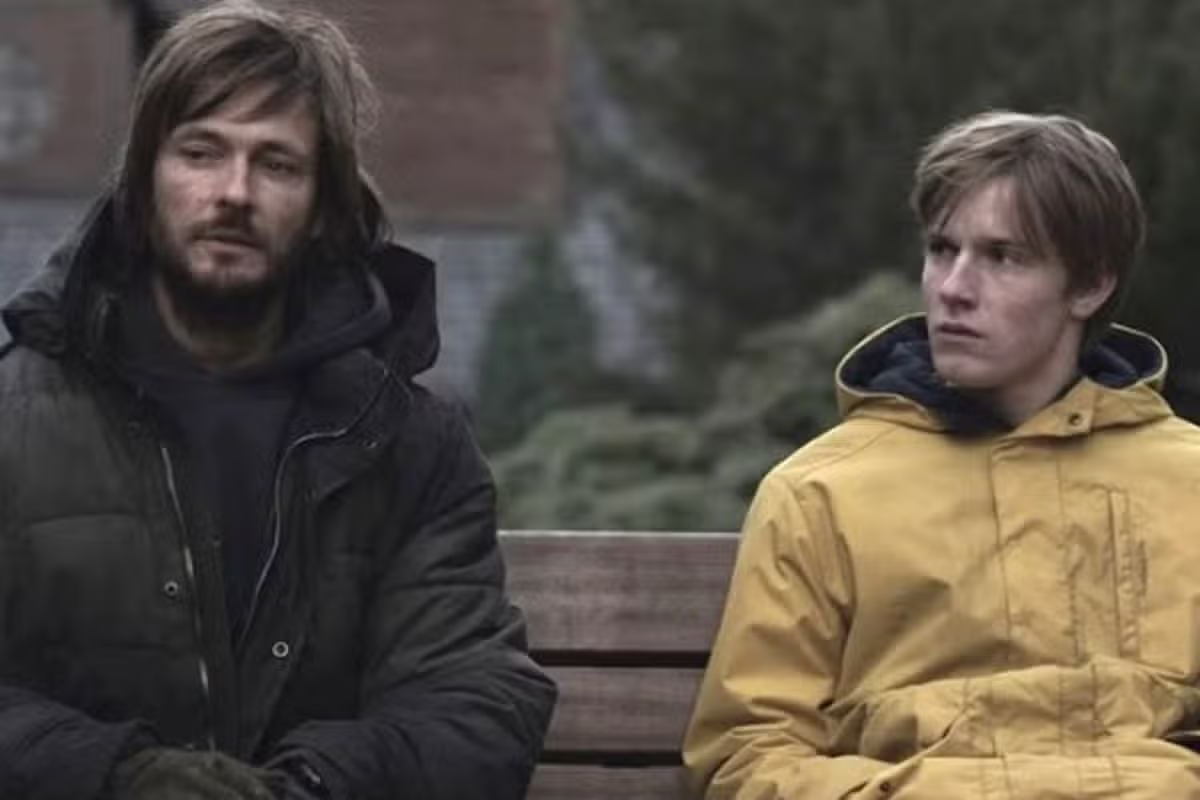
Viewers are watching the Netflix show again and again (stock image)(Image: Dark/Netflix)
The Netflix series recently came to light on Reddit, when a user was searching for a quality show to binge, and it wasn’t long before people brought up a certain series they’ve been gripped to. In fact, many TV lovers have confessed they’ve found it hard to find anything else that matches its quality, which is perhaps why so many have admitted to binging it repeatedly.
The social media user asked: “Any good binge watch shows? Can be Netflix or non-Netflix?” It didn’t take long for one particular title to emerge as the firm favourite, with several viewers declaring it utterly spectacular.
One person simply said: “Dark.” To this, another replied: “The best show ever created.
“I’ve watched it from start to finish four times and realised I missed something every time. I’m probably going to watch it again because I just don’t want it to be over.”
A third noted: “Loved Dark.” Meanwhile, in a separate thread, viewers were equally forthcoming with their glowing praise for the drama.
Someone else wrote: “I’ll say it one million times, but I wish I could experience this masterpiece like the first time I watched it.”
A different social media user offered: “I consider Dark the best series on Netflix. I’ve watched it countless times.”
One more said: “Took a chance with this one. I don’t regret it. Very intricate storytelling.”
What is the plot?
For those unfamiliar with it, Dark is a German science-fiction mystery thriller television series, created by Baran bo Odar and Jantje Friese.
It’s been available on Netflix for some time, having aired across three seasons from 2017 to 2020. Despite this, audiences are still discovering it for the first time.
The narrative primarily tracks four families from the fictional German town of Winden, as they pursue the truth following a child’s disappearance.
Yet, as events unfold, they find themselves uncovering a disturbing time travel conspiracy stretching across multiple generations. Essentially, the series explores the existential consequences of time and its impact on human nature and existence.
With 26 episodes available to watch, many viewers insist it’s thoroughly worth your time, though you’ll likely need subtitles given it’s a German production.
Israel has expanded its military occupation in the Gaza Strip in violation of a United States-brokered ‘ceasefire’, forcing Palestinians into an ever-smaller share of the besieged territory, devastated by Israel’s ongoing genocidal war.
Nearly two-thirds of Gaza is now under Israeli military control or subject to access restrictions.
The original ‘Yellow Line’, established under US President Donald Trump’s 20-point plan to end the war, marked the area to which Israeli forces initially withdrew. They were expected to make further withdrawals gradually, but instead, they have seized more territory.
On Sunday, Israeli forces moved yellow concrete blocks dozens of metres west in Shujayea, a neighbourhood in southeastern Gaza City, forcing Palestinian families to flee and bringing more of the neighbourhood under Israeli military control.
A yellow block demarcating the ‘Yellow Line’, which has separated the Gaza Strip’s Israeli-held and Palestinian zones since a ‘ceasefire’ began a year ago, is seen in Khan Younis in the southern Gaza Strip on January 22, 2026 [Abdel Kareem Hana/AP Photo]
“It’s not simply about where the ‘Yellow Line’ is today but where it can move next,” Al Jazeera’s Ibrahim al-Khalili said, reporting from Gaza City. “For families who have been repeatedly displaced in the past three years, the situation remains dire, and they have to make the impossible decision of where they can go.”
More than 90 percent of Gaza’s 2.1 million population has been forcibly displaced by Israel’s war, launched on October 7, 2023, after Hamas-led attacks on southern Israel.
Using maps, Al Jazeera shows how much of Gaza Israel has grabbed since the ‘ceasefire’.
Gaza before the war
Before the war, Palestinians were spread across the Gaza Strip, a 365sq km (141sq-mile) territory roughly 41km (25 miles) long and from 6km to 12km (4 to 7 miles) wide.
That made it one of the most densely populated places on Earth with about 6,000 people per square kilometre, similar to Nairobi or London. Each person had, on average, about 160sq metres (1,722sq ft) of land.
Even then, not all of Gaza’s land was accessible. Israel enforced a buffer zone along the fence with Israel, and Palestinians who approached it risked being shot. In 2010, the United Nations Office for the Coordination of Humanitarian Affairs (OCHA) estimated that the restricted area covered 17 percent of Gaza’s land and 35 percent of its farmland.
Gaza has been under an Israeli land, air and sea blockade since 2007.
Gaza at the ‘ceasefire’
Under the first phase of the “ceasefire”, Israeli forces were to withdraw to the “Yellow Line” within 24 hours, after which a 72-hour period began for the handover of Israeli captives held in Gaza. Trump first published a map of the line on his Truth Social platform.
The line left Israel in control of 53 percent of the Strip, mostly farmland and border areas in the east, and confined Palestinians to the remaining 47 percent, about 172sq km (66sq miles).
By October 2025, two years of war had killed more than 67,000 Palestinians, and tens of thousands more had left the territory, reducing Gaza’s population to about 2.1 million.
Pushed into less than half of Gaza’s territory under the “ceasefire”, its density doubled to about 12,000 people per square kilometre, comparable to New York City. Each person was left with about 82sq metres (883sq ft).
(Al Jazeera)
Gaza today
Since the “ceasefire”, Israeli forces have repeatedly moved the yellow concrete blocks marking the “Yellow Line” farther west, sometimes overnight, expanding the areas under their control. Satellite imagery has also documented continued demolitions in areas held by Israeli forces.
The research group Forensic Architecture estimated that Israel controlled 58 percent of Gaza by December. In March, the Israeli military sent aid agencies maps of a new “orange line”, a restricted zone beyond the “Yellow Line” where humanitarian movements must be coordinated with the army.
According to OCHA, restrictions now cover 65 percent of Gaza. Israel itself said it controls about 70 percent of the territory, a UN official told the Security Council in June.
(Al Jazeera)
That leaves 2.1 million people in about 35 percent of the Strip, roughly 128sq km (49sq miles). The population density has nearly tripled since before the war to about 16,000 people per square kilometre, close to central Tokyo.
Each person now has about 61sq metres (657sq ft) of land for everything: shelter, roads, schools, hospitals and farmland.
Unlike Tokyo, Gaza has little space left to house its people. The UN Satellite Centre, UNOSAT, found 82 percent of structures in the Strip are damaged or destroyed. The UN Food and Agriculture Organization says only 3 percent of Gaza’s cropland is both undamaged and accessible.
(Al Jazeera)
OCHA says the remaining 35 percent of Gaza is “already overcrowded” and access restrictions are a key obstacle as aid groups try to relocate families before the rainy season. More than 950,000 people live in displacement sites at risk of flooding, according to the UN, most of them in tents and makeshift shelters, as seen in the satellite image below.
Approaching the ‘Yellow Line” can be deadly. Israel treats areas beyond it as a free-fire zone, and Palestinians who come near it have been shot. Nearly 1,500 people have been killed across Gaza since the ceasefire was announced.
FORGET simply being a pop star, Westlife’s Kian Egan can now add stylist to his CV after he helped save the day on the first night of their tour.
As Bizarre’s Jack joined the lads backstage for the first of three sell-out shows at the O2 in London, the Irish singer revealed a wardrobe error meant they were an outfit down in Dublin last month.
Westlife’s Kian Egan can now add stylist to his CV after he helped save the day on the first night of their tourCredit: SplashKian, Shane Filan and Nicky Byrne with The Sun’s Jack HardwickCredit: Supplied
Kian flew into action before the first show in the Irish capital and found himself, Shane Filan and Nicky Byrne leather jackets to wear on stage.
Shane said with a laugh: “We weren’t going to wear these. We only got them sorted the night before. Luckily Kian came to our rescue.”
Sign up for the Showbiz newsletter
Thank you!
The Westlife 25th anniversary tour will see them play 87 dates around the globe during this year and next.
Over the decades, Westlife have clocked up 14 No1 singles and eight No1 albums — an achievement Kian admits they never dreamed of when they formed in 1998.
Reflecting on their first chart-topper Swear It Again, he said: “We had no expectations at all.
“When our first single went No1 in 1999, I kid you not, we cried. The last few years have been really good to us — we even got our own T-shirts in Primark.
“When I was 16, I was begging for a job there, but they wouldn’t give me one. Now they are selling our T-shirts.”
In a sweet moment, he was presented with a cake by his three children, Rocco, Jay, and Gia who came on to huge cheers from the audience.
An overwhelmed Nicky told the crowd: “It’s 25-plus years we have together now.
“It has been absolutely beyond incredible, to be honest with you.” This tour has been planned for some time.
“You might have seen some of our ideas on the screen, our childhood homes coming to life. It’s a real celebration of Westlife.
“The tour has been pretty incredible, we have all grown up with this, from friendships, to heartbreaks, to weddings, babies, some funerals, and we’re all in this together.
“We are having the time of our lives up here.”
He added: “Nobody wanted to predict it when we were 17 and 18 years of age.
“Just some lads going on stage, eventually winning MTV Europe awards, Brit Awards, World Music awards.
“It’s been absolutely insane. And to stand here on my birthday, still doing this at this level . . .
“If this was it for us, this would be enough.”
LOVED-UP BENSON ON SONG
Benson Boone’s new music is pouring out of him after finding loveCredit: Alamy
BENSON BOONE’s new music is pouring out of him after finding love.
The singer split from his influencer girlfriend Maggie Thurmon a year ago.
But he’s set tongues wagging that there is another special someone in his life.
Asked what’s inspiring him, he said: “Love. I feel like that’s the greatest inspiration of all time. But yeah, new love, I think, is a very beautiful feeling.
“When you first open yourself up to someone, it’s like one of the greatest things ever, to feel as a human being and to have that be accepted.
“Those feelings just very easily turn into melodies and words so easily. It comes very quickly”
Benson released his second album American Heart in June 2025, and will finally get a chance to complete a third album when he finishes his world tour next month.
He told Australia’s Kiis radio: “Before this tour, I wrote quite a lot. Then afterwards, I’m planning on continuing that. So we’ll have, next year, a substantial amount of songs.”
LANCE BASS has revealed NSYNC were pretty much “working for free” in their Nineties heyday.
He said in a new interview they got $35 a day, adding: “Our first cheque was $10,000 after years of No1 albums, sell-out tours.
“You’re like, ‘Oh, thanks’. We should be grateful for that – been working for free for two, three years now.”
THE CHASE FOR NO1 STATUS
Little Simz features on Chase & Status’ new album, GenericCredit: Getty
CHASE & STATUS are on course to land their 14th Top 40 song this Friday.
They have the highest new entry thanks to Carnage, featuring Little Simz.
The track comes from the drum and bass duo’s new album, Generic Everything, which they released on Friday.
Taylor Swift is holding tight at the top, with Patient Zero looking likely to have a third consecutive week at No1, holding off Jamie Miller’s Babydoll and Ashe’s Stop The Wedding.
Jeremy Clarkson’s Hawkstone Farmers Choir swapped planting for partying in the video for their new single, AbsolutionCredit: Supplied
The track is the latest single from the Britain’s Got Talent winners’ upcoming album This Is Home, which comes out on November 20.
A source said: “The choir loved letting loose for the video.
“It’s a celebration of downing tools and coming together.”
STEVEN KNIGHT is keen on a follow-up to his film Oasis: Don’t Look Back In Anger.
The documentary, now available to stream on Disney+ followed the band’s reunion tour last year.
In an exclusive chat at a VIP screening, Steven told me: “I believe there is another.
“There’s loads of stuff there that people would love to see. Why not?”
Hear. hear.
TAKE OFF FOR MEL’S PHOENIX
Mel B’s daughter Phoenix is the latest of the Spice Girls offspring to go into music – revealing she is planning to officially release her first tunesCredit: Getty
MEL B’s daughter Phoenix is the latest of the Spice Girls offspring to go into music – revealing she is planning to officially release her first tunes.
The self-taught DJ has been playing gigs for a while and has now announced she’s been working on original tracks.
Phoenix, whose dad is Dutch dancer Jimmy Gulzar, said on TikTok: “Been in the studio all summer working on music and I’m finally ready to start sharing it with you guys.
“So nervous but so excited for you to hear what I’ve been working on.”
Phoenix is expected to drop the first of the dance music tracks in the coming weeks, after fans praised her over a snippet she shared online.
While it will be her first proper single, she did get a taste for fame 25 years ago, appearing in the video to her mum’s solo single Lullaby, which was written about her birth.
Victoria Beckham’s son Cruz has so far been the most successful of the Spice babies, touring across the globe and releasing his Wear & Tear EP in August.
In an exclusive chat, the Blue singer, who came out in 2012, talked about his personal disappointment over the axe, saying: “The BBC has always been about showing inclusivity and showing things for all ages and all genders and all humans.
“I feel we are almost being hidden away again. It’s a huge shame because it was great for the BBC to have something so inclusive.”
Looking to the future, Duncan is preparing to spread some light and laughter as he heads out on the road as part of a new supergroup.
Appearing in All Stars – The Music Of Abba, Duncan will join his bandmate Antony Costa, as well as Samantha Mumba and Una Healy for a UK tour celebrating the Swedish group’s hits.
The tour will kick off at Fairfield Halls in Croydon on February 26 before wrapping up at Southampton’s Mayflower on April 11. Tickets are on sale now.
Duncan said: “I get to dress up in all the sparkles and all the glitz and glamour and just have a fabulous time. The last year with Blue, has been so full on with the 25th anniversary, and we’ve worked so hard.
“It’s been wonderful. But at the same time, it’s always really nice to just have a little break mentally from Blue and go into something else.”
Suki a groover and shaker
Suki Waterhouse continued her love affair with Oasis at the Austin City Limits music festivalCredit: APShe channelled her inner Liam Gallagher after putting on an Adidas vest and waving a tambourine during her set, just like the rockerCredit: Getty
SUKI WATERHOUSE continued her love affair with Oasis at the Austin City Limits music festival.
She channelled her inner Liam Gallagher after putting on an Adidas vest and waving a tambourine during her set, just like the rocker.
Suki is a massive fan of Noel and Liam, and has previously covered Don’t Look Back In Anger during her live music sets.
I’ve no doubt Suki and her fiancé Robert Pattinson will also be on the brothers’ live tour next year, after they were spotted down the front at Wembley Stadium during their reunion shows last summer.
THE WEEK IN BIZNESS
TODAY: Britain’s Got Talent’s Simon Cowell, Amanda Holden, Alesha Dixon and KSI will be back behind the judging desk at Winter Gardens Blackpool as they record the auditions for the 2027 series.
TUESDAY: Barack Obama will be on stage for a trio of An Evening With… events, beginning at The O2 Belfast before Glasgow’s OVO Hydro on Wednesday and Manchester’s Co-op Live on Thursday.
THURSDAY: Tyla brings her A*Pop tour to the UK, kicking off with two nights at London’s O2 Academy Brixton followed by shows in Glasgow and Manchester.
SUNDAY: The Victoria’s Secret Fashion Show returns in Los Angeles with models including Gigi Hadid and performances from Tate McRae, Megan Thee Stallion and Katseye.
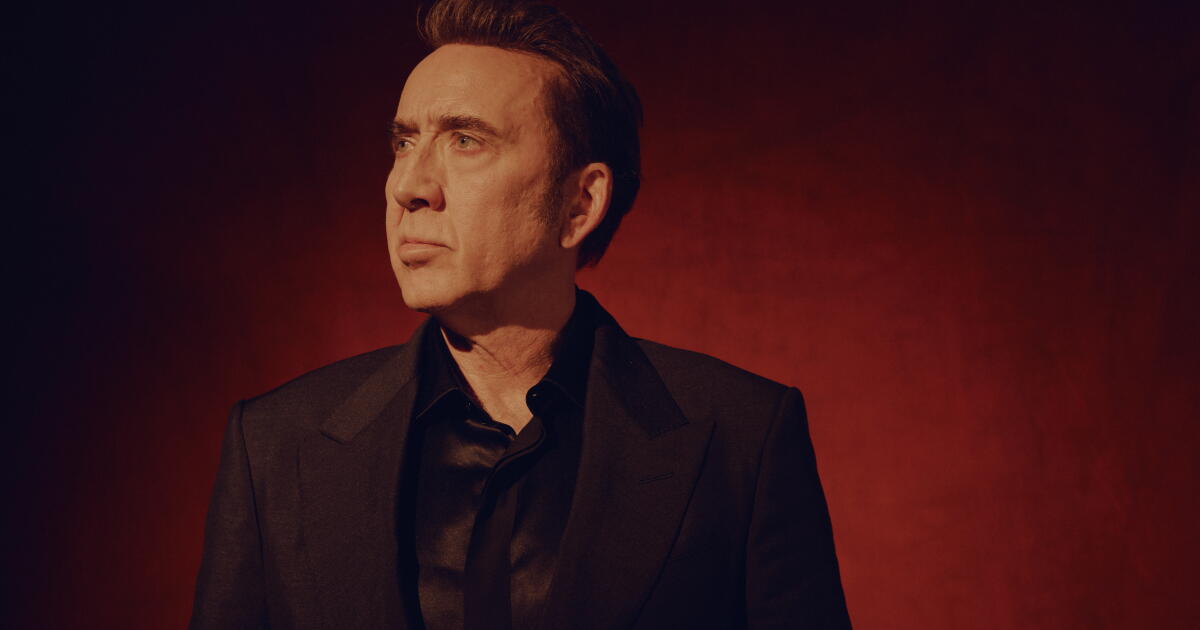
Nicolas Cage is making it clear — he’s not an “AI-friendly actor.”
The 62-year-old actor spoke out against a tech giant during an appearance at New York Comic Con on Saturday. He alleged that he was asked to sign an artificial intelligence waiver for the television series “Spider Noir.”
“Amazon is a very AI-friendly company, to the tune of $50 billion invested in OpenAI,” Cage said on stage.
“I am not an AI-friendly actor, so it’s like, connect those dots! I’m not a member of their club. I didn’t sign the waiver to let him use AI on ‘Spider-Noir.’ I’m probably not going to be working with that studio again, but that’s OK.”
Amazon did not immediately respond to a request for comment.
“Spider-Noir,” which premiered in May, is a “Spider-Man” project that put a 1930s crime-thriller spin on the web-slinging superhero. The show was produced by both Sony Pictures Television and Amazon MGM Studios.
Cage’s part as “The Spider” marked his first leading role in a series. The Oscar-winning actor, whose home in Malibu was recently affected by a sinkhole, is known best for his roles in movies like “National Treasure,” “Moonstruck” and “The Rock.”
Upon its release, “Spider-Noir” received much praise from fans and critics alike. In its first six weeks of streaming, the series earned 2.6 billion minutes watched, according to Nielsen. It was also Amazon’s most-nominated show at this year’s Emmys, with 11 nominations and five wins.
Last month, Amazon announced that the show was canceled after only one season, leaving much of the industry in shock.
During his Comic Con panel, Cage also said he plans to keep working in TV. He announced that he will be joining the HBO series “True Detective.”
“My agent’s out there somewhere listening,” Cage said. “That’s OK that I’m the first to announce that, right?”
MICHELLE Keegan may have gripped the nation with her new ITV drama The Blame, but there’s one surprising TV appearance that has been doing the rounds on social media again.
It’s not the actress fronting a Netflix mini-series or portraying a soldier in Our Girl, but a forgotten stint on The Jeremy Kyle Show.
Michelle Keegan is well known for her gripping TV dramas such as new release The BlameCredit: Not known, clear with picture deskBut fans were shocked when an unearthed clip of her on the Jeremy Kyle Show went viral recentlyCredit: @daytimetvthrowbacks/tiktok
The episode was a crossover with Coronation Street and sees Michelle as her soap character TinaCredit: @daytimetvthrowbacks/tiktokShe’s seen arguing with on-screen boyfriend David Platt, played by Jack P. ShepherdCredit: @daytimetvthrowbacks/tiktokThe clip is hilariously going viral on TikTok againCredit: @daytimetvthrowbacks/tiktokThe clip, which was filmed when Michelle was 23, saw the actress a far cry from her now-glamorous lookCredit: Splash
During the crossover episode, Michelle’s character Tina appears on the show as her boyfriend, David (Jack P. Shepherd) is accusing her of having a relationship with his brother Nick (Ben Price).
In a clip from the episode, which has been unearthed by TikTok users and is now being circulated around the app, the trio are seen at loggerheads.
“Shut up David,” Tina is seen shouting over the stage as the pair go back and forth, with Jeremy getting involved.
Later, Nick and David are seen fighting over Tina as Nick slams: “She doesn’t like him. She doesn’t fancy you, she doesn’t, it’s over!”
“You think you can fly in, Nick, and take a piece of her,” hits back David, as Tina breaks down into tears and he slams her “waterworks”.
A crying Tina then tells Jeremy: “I’m sick of him, he ruins everything. Even the thought of accusing me of sleeping with Nick, it’s not important to me right now.
“And he’s got a cheek to actually question it – you’ve got a cheek David.”
The hilarious crossover, which was to celebrate the 1000th episode of the Jeremy Kyle Show, came in the middle of Michelle’s time on Coronation Street, which she joined in 2008.
As the clip has been circulating around Tiktok, many users on the video streaming app were confused as to whether it was real or for a skit.
One user said: “If I didn’t know this was a special episode with actors, I would’ve thought this was real, it’s well good 👏😂”
“I would not have recognised her…what year is this???,” said a second of Michelle.
A third praised: “Corrie was on another level creating this with JK, it makes it look so more real.”
Michelle was just 23 at the time of filming the scenes.
She eventually left the soap in 2014, as Tina was killed off.
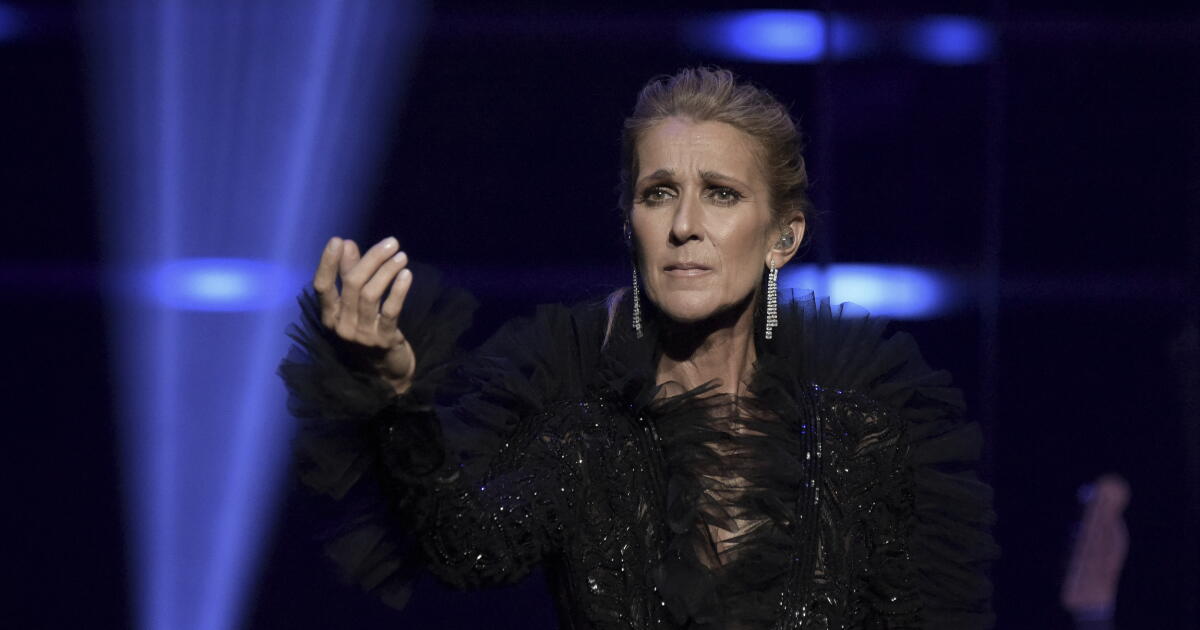
Céline Dion will go on — even after taking a little tumble onstage.
The 58-year-old singer slipped in front of a live audience while performing “Dans un Autre monde” during her Paris residency on Oct. 7. But the French Canadian singer quickly got back up and signaled to fans that she was A-OK by flashing a thumbs-up, in footage obtained by People.
Despite the slight stumble, it has been a triumphant comeback to the live stage after a six-year hiatus for the “All By Myself” singer, who has shows scheduled for this fall and next spring at the Paris Plenitude Arena (formerly Paris La Défense Arena).
In 2022, Dion was diagnosed with stiff-person syndrome (SPS), an autoimmune neurological disorder that affects about one in a million people and has no cure. The illness is characterized by muscle rigidity in the torso, arms and legs. Sensitivity to noise, touch and emotional distress can set off muscle spasms, according to the National Institute of Neurological Disorders and Stroke.
Following the diagnosis, Dion canceled her North American Courage World Tour in May 2023 (which originally began in 2019 but was interrupted by COVID-19 pandemic) as she continued to deal with severe muscle spasms and was having difficulty controlling her voice.
“I’m so sorry to disappoint all of you once again. I’m working really hard to build back my strength, but touring can be very difficult even when you’re 100%,” she said in a public statement on her website in May 2023. “It’s not fair to you to keep postponing the shows, and even though it breaks my heart, it’s best that we cancel everything now until I’m really ready to be back on stage again.”
Her early symptoms began in 2008 during her Taking Chances World Tour, when she experienced difficulty controlling her voice despite doctors saying her vocal cords appeared normal, she shared with Vogue in 2024.
Additional details about her struggles with SPS came to light in a 2024 Prime Video documentary titled “I Am: Celine Dion,” directed by Academy Award nominee Irene Taylor, which follows the singer as she navigates the drastic changes to her health.
The “It’s All Coming Back to Me Now” singer has experienced broken ribs because of the spasms, she told Hoda Kotb on “Today” in 2024 while promoting the documentary. Her journey back to the spotlight has entailed intense physical therapy, vocal rehabilitation and medication, she said.
“I’m going to go back onstage, even if I have to crawl, even if I have to talk with my hands, I will,” Dion shared. “Not just because I have to, or because I need to, but because I want to. And I miss it.”
It was only Adéla’s second headlining show in Los Angeles — and she was only about 20 minutes into it — but the ascendant pop star already had an apology she needed to get off her chest.
“The next song that I’m gonna sing is a little bit awkward,” she said Thursday night at the Fonda Theatre. “So I’m gonna need y’all to bear with me as I explain why I made a song called ‘The Baddest Bitches Ain’t in L.A.,’ OK?”
Added Adéla: “Please don’t boo.”
To be precise, the song in question is titled “Ain’t in L.A.” — a woozy banger from the 22-year-old’s buzzy debut album, “Prima.” But you took her point: Here she was in front of a hyped-up crowd that included Chappell Roan and members of the girl group Katseye, and what she was about to tell us is that true coolness lies elsewhere.
Based on her assertion that the Hollywood dream machine is “all a lie,” “Ain’t in L.A.” looks back with scorn at Adéla’s experience as a first-round flameout on “Dream Academy,” the build-a-band reality series that documented Katseye’s creation under the watchful eye of the K-pop kingpin Bang Si-hyuk. At the Fonda, Adéla recounted moving here from her native Slovakia and working alongside the show’s other contestants to “try to become pop stars together,” she said.
“And guess what? That didn’t work out for me. But it did for them.” She peered up at the venue’s balcony. “Shout out to y’all,” she said.
Except now it’s working out for Adéla too: Thursday’s show was the first of two at the Fonda behind last month’s release of “Prima,” whose title nods to the singer’s background as a ballet dancer; in addition to “Ain’t in L.A.,” which has more than 190 million streams on Spotify, the album has spun off a second hit in “Nicole Kidman,” which reached No. 1 on that platform’s U.S. singles chart thanks in part to the enthusiastic embrace of the Hollywood meme queen herself.
This week, Kidman appeared in a viral TikTok video showing her, Kristen Wiig, Pedro Pascal and Dua Lipa lip syncing to “Nicole Kidman” at a Chanel fashion show in Paris.
Adéla’s breakthrough comes amid a broader surge by a generation of young pop singers — think of Slayyyter and think of Tinashe — finding success with music that plays up rather than sands down its rough edges; each is working in the wake of Charli XCX’s influential “Brat,” which offered new ways to think about how pop balances polish and filth, swagger and confession.
Adéla made “Prima” with the producers Dylan Brady (of the duo 100 gecs) and Blake Slatkin (who’s scored hits with Lizzo and Justin Bieber); together the three get an appealingly scuzzy sound that puts chirpy vocal hooks over serrated club beats à la “Blackout”-era Britney Spears. What I’m saying, basically, is that the indie-sleaze revival is real.
At the Fonda, Adéla brought her songs to life on a stage that was bare except for a ballet barre, which she and a small crew of dancers used to execute choreography that grew raunchier and more elaborate as the show progressed. Both she and a guy danced en pointe; Adéla never went long without whipping her long pink hair, which was one style choice widely replicated throughout the room.
Before she closed with “Nicole Kidman,” the singer sat down at the front of the stage with her journal and told the crowd she wanted to “take a second and manifest a little bit.” She asked the universe to give her a long career, and she asked that her fans, after having gotten home safe, remember this night forever. She also asked — again — that L.A. not be mad at her for writing “Ain’t in L.A.”
“I really do feel bad,” she said, and not a boo could be heard.
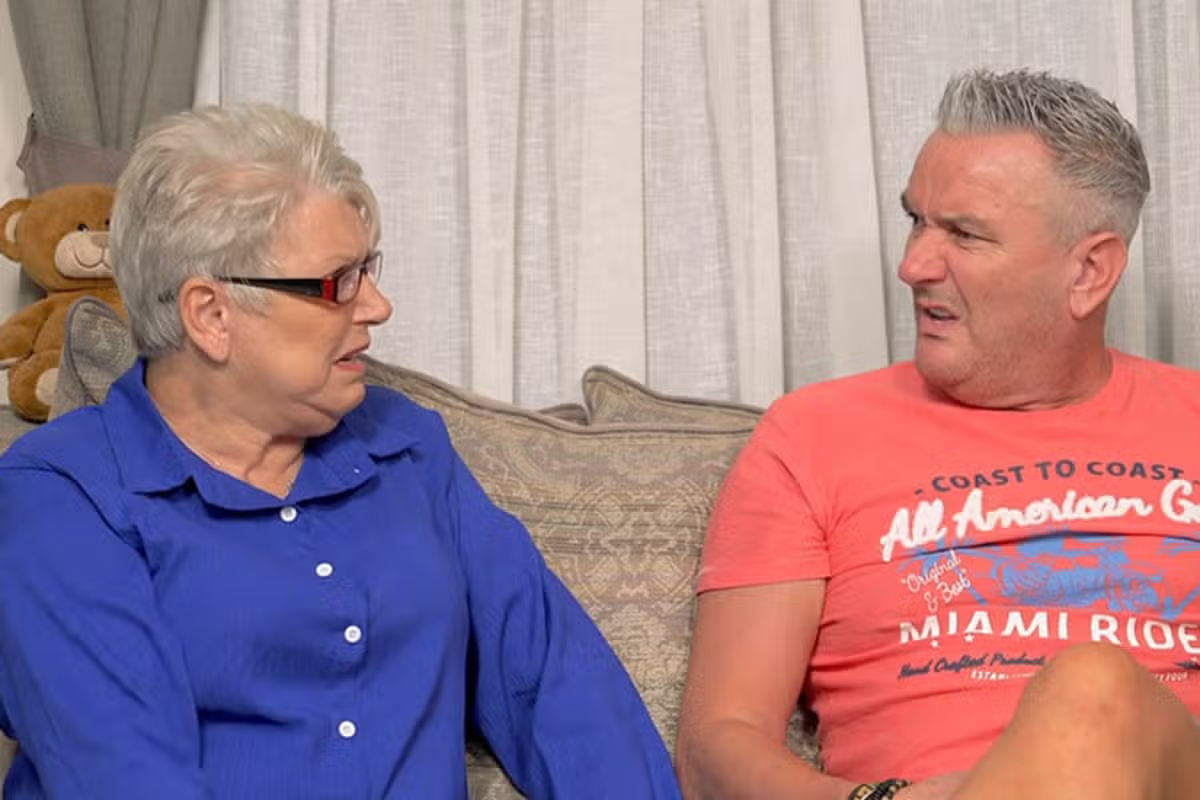
Fan-favourite Gogglebox stars Jenny and Lee have been a staple on the Channel 4 show for 12 years, having joined the show back in 2014.
The Gogglebox star had her friend in hysterics over her divorce remark(Image: CHANNEL 4)
The Gogglebox star was in hysterics over Jenny’s marriage remark.
Channel 4 viewers tuned in to watch the nation’s favourite armchair critics give their thoughts and reactions on the latest TV shows of the week. However, in between giving their verdicts on the programmes of the week, Gogglebox favourites Jenny and Lee spoke briefly about marriage.
It comes ahead of the stars settling in to watch the latest HBO drama, War, which follows a very public divorce of two well-known figures. Lee asked Jenny: “Would you ever get divorced?”
After a brief pause, she replied: “Don’t know. No, I’d just wait.” Lee burst out laughing at her quick remark about divorce.
Jenny often speaks about her husband, Ray, on the programme, although he’s opted to stay out of the limelight. However, he did make a very brief cameo recently when he phoned Jenny and viewers got to hear his voice.
Last year, Lee shared a throwback image of Jenny on her wedding day to Ray as he celebrated their 50th wedding anniversary. He captioned the post: “Wishing my sidekick Jenny and Ray a happy 50th golden wedding anniversary, who gets the medal.”
Content cannot be displayed without consent
It wasn’t long before people commented on the post, with many praising Ray’s ‘epic’ sideburns. One person said, “Ray should get a medal for those sideburns alone. Epic.”
Someone else added, “Jeez, those sideburns have a life of their own.” While another said: “Bl**dy hell, look at those side burns. You could ski down them.”
Although Ray was offered to join Jenny on the Channel 4 show when she was first scouted at Beverley Races Ladies’ Day in 2014, he declined, prompting her best friend Lee to take his place on the couch.
The pair have been friends since 1994 when Lee met Jenny at the pub when she was a landlady. Speaking to Ireland’s Big Issue magazine, Jenny commented: “Lee was a customer at my pub, The Crown Inn in Paull. He became a regular in 1994 and used to come in pretty much every night with his partner and we were friends from the off. We’ve been best friends ever since.”
Lee added: “I wish I’ve never gone in the pub – it cost me a fortune. When I first met her she had a perm and I can remember thinking, ‘She needs a haircut’. We were firm friends immediately. I don’t think we’ve ever had an argument. We’re too placid to argue. She makes me laugh too much for me to ever fall out with her.”
Gogglebox is available to watch Friday’s on Channel 4 from 9pm.
Mexico is investigating a viral video said to show mercenaries chanting drug cartel slogans in Ukraine. President Claudia Sheinbaum announced the inquiry. Mexico previously warned Kyiv cartel members were joining its International Legion to gain drone warfare experience.
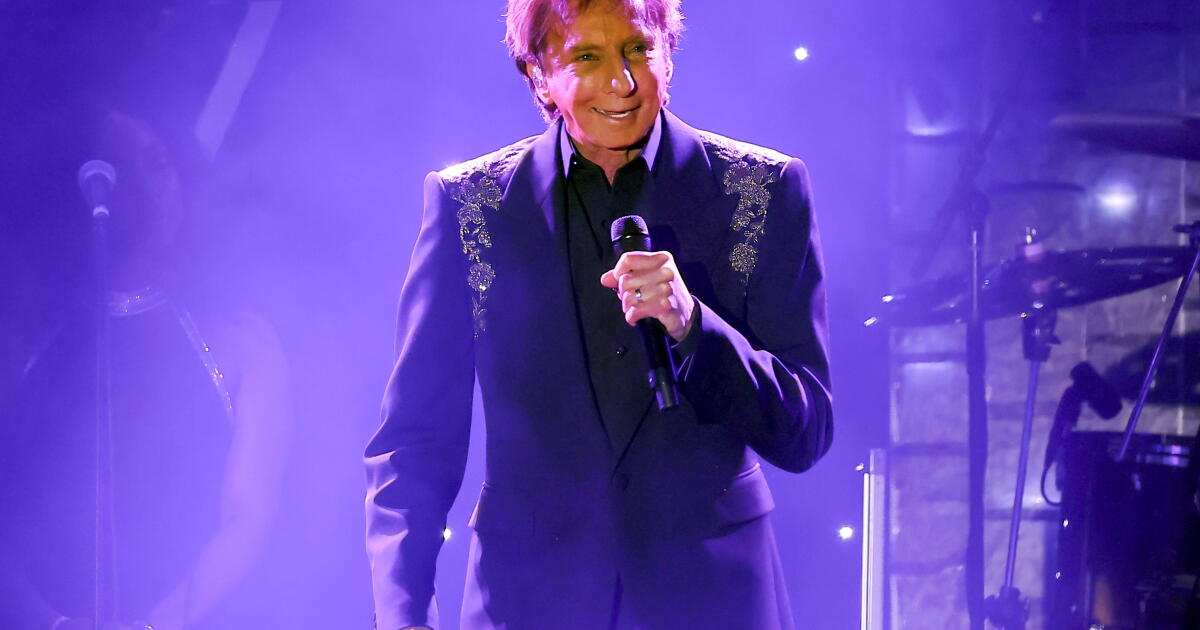
Barry Manilow has returned to the stage after taking a break following his summer tour.
Manilow performed at the International Theater at the Westgate Las Vegas Resort & Casino on Thursday night, telling the audience, “This is the first time back in a long time. I have some medical problems, but I’m back!”
The audience cheered and a couple of crowd members tossed underwear onto the stage. He picked up a pair of full-coverage briefs and asked if they needed to go to the laundry, and then a pink lacy thong and joked, “I’ll keep this pair.”
“God, I feel like I’m a teenage idol again.”
Last year, Manilow revealed that he had been diagnosed with lung cancer and that surgery would require him to postpone several performances. The star returned to the stage in June following a six-month hiatus, in support of his latest album, “What a Time,” his first LP loaded with new material in almost 15 years.
But in August, he canceled shows because of vocal and technical problems before telling fans he needed to pause. “We just finished a fantastic summer tour, 29 shows in 68 days,” the singer said. “The shows were fantastic. The audiences were fantastic. And I sounded fantastic. But it seems that we were pushing a little too hard.
“Now we all need to sit down and shut up,” Manilow said. “So, we’re going to take a break until we return to the Westgate Las Vegas on Oct. 8. When I’ll be singing like a bird. I hope to see you then.”
The “Copacabana” singer is slated to hit the stage again on Friday evening.
We are weathering a truly apocalyptic heat wave in L.A., but that hasn’t stopped Halloween from sneaking up on us. For those who like to give themselves the creeps, the city has its fair share of spook shows, including Griffith Park’s Haunted Hayride and the Queen Mary’s Dark Harbor. These mainstays offer hardworking actors seasonal jobs, but usually don’t allow for any real narrative besides jump scares and chainsaws. Which is why I’m so jazzed about a new entry to the immersive Halloween show scene: “Hospital of Emotions After Dark,” with its specially ticketed basement creep-fest, “Below.”
For readers who haven’t been inundated with a million ads for “Hospital of Emotions” on your Instagram feeds, it’s an immersive art show that unspools in 80 discrete rooms over four floors of the shuttered St. Vincent’s Medical Center near downtown L.A. The 45,000-square-foot exhibition opened in late May and was supposed to close in late July, but has extended its run due to popular demand. This month that run includes an after-dark option, which features the regular show — only after-hours — with ambient lighting and roving actors who show up in the most unexpected places (I won’t spoil it, but I got one of the most serious jump scares of my life in one of the exhibit rooms).
A separate ticket (which can be purchased in a bundle with the main exhibition) gets you a ride in an elevator to the hospital’s long-abandoned basement where you are treated to an immersive theater show with a nun for a tour guide. My nun was played by Penny Wiggins, and I’m not sure I have ever witnessed such true commitment in a spook show. Wiggins sold her character — at one point with genuine tears.
I won’t give away the plot, but it’s harrowing, especially if you are someone familiar with the hospital, which opened in the late 1800s and was the first hospital in the city. I had my daughter there in 2016, so it was extra chilling to know that this basement of horrors was there even then. The show uses the building’s actual abandoned infrastructure as its framework, so guests are led through dank subterranean corridors, old examination rooms and specimen labs, as well as an autopsy room.
“Below” isn’t as viscerally gory as “Dark Harbor” or “Haunted Hayride,” but it’s more artistic. There is dancing and an actual script that features a “gotcha” twist — as well as an upsetting demon who appears out of nowhere. I applaud the commitment by the actors who, I imagine, must find it kind of scary just waiting down there for the next round of guests. Plus, it’s good fun to be in the “Hospital of Emotions” at night when everyone is a little wild and there’s a sense that something out of the ordinary might pop out at you at any minute.
I’m Arts editor Jessica Gelt begrudgingly wearing a tank top and shorts in early October. This is your arts and culture news for the week.
You’re reading Essential Arts
Our critics and reporters guide you through events and happenings in the SoCal arts scene. In your inbox every Friday.
By continuing, you agree to our Terms of Service, which include arbitration and a class action waiver. You agree that we and our third-party vendors may collect and use your information, including through cookies, pixels and similar technologies, for the purposes set forth in our Privacy Policy such as personalizing your experience and ads.
The week ahead: A curated calendar
FRIDAY
Felipe Dulzaides / Bradley Baboc Cuban-born artist Dulzaides uses photography, drawing, video, performance, sculpture and sound to capture the sublime nature of Havana knife sharpeners in the exhibition “Balance in Place.” L.A. painter Boboc drew on the Toy District as inspiration for a new series of paintings, “Shadoobie (Shattered).” Opening, 6-9 p.m. Friday; 10 a.m.-4 p.m. Thursday-Sunday, through Nov. 8. Arcane Space, 324 Sunset Ave., Unit G, Venice. arcanespacela.com
Ludovico Einaudi The popular Italian pianist and composer returns to Disney Hall for the first time since 2019 on this solo tour. 8 p.m. Friday. Walt Disney Concert Hall, 111 S. Grand Ave., downtown L.A. laphil.com
Mälkki Conducts Bartók Susanna Mälkki leads the Los Angeles Philharmonic in Béla Bartók’s “Concerto for Orchestra.” 11 a.m. Friday, 2 p.m. Sunday. Walt Disney Concert Hall, 111 S. Grand Ave., downtown L.A. laphil.com
Takács Quartet with Jeremy Denk The Grammy winning ensemble teams up with the MacArthur Grant-winning pianist for a program of chamber music featuring works by Haydn, Mendelssohn and Franck. 7:30 p.m. Broad Stage at Santa Monica College Performing Arts Center, 1310 11th Street, Santa Monica. broadstage.org
SATURDAY
Laura Andreson, 1979, Forrest L Merrill Collection, Photo by M. Lee Fatherree
(Photo by M. Lee Fatherree)
The Eternal Quality of Aesthetic Joy: Laura Andreson and Her Legacy The artist bristled at “superfluous” decoration, favoring distilled jar, box, bowl and vase forms influenced by her love for Scandinavian and Bauhaus design. She became a wizard with glazes, conjuring lustrous surfaces resonant with elements of the Southern California landscape. This show offers a rare opportunity to savor the gorgeous purity of her work, alongside that of several of her mentors and peers, such as Gertrud and Otto Natzler and Glen Lukens, as well as some of her students, including JB Blunk and Bernard Kester. (Leah Ollman) Noon-6 p.m. Tuesday-Saturday, Oct. 10-Jan. 9, 2027. Craft in America Center, 8415 W 3rd St. craftinamerica.org
Haunted Soiree: True Crime An immersive theater experience inspired by the 1928 Hex Hollow murder with cocktails and curious encounters. Selected nights through Oct. 31. Nocturne Theatre, 324 N. Orange St., Glendale. hauntedsoiree.com
Pacific Jazz Orchestra’s Benefit Concert Songwriter and producer David Foster, singers Katharine McPhee, Joanna “JoJo” Levesque, Veronica Swift, Adam “AeJaye” Jackson, violinist Anne Akiko Meyers and pianist Emmet Cohen are the headliners for a celebration of founding Artistic Director Chris Walden’s 60th birthday, which also includes a buffet reception and dancing under the stars. 7 p.m. Private estate in Toluca Lake, address to be provided upon confirmation of attendance. pacificjazz.org
Saint Megan Playwright Joy Gregory, inspired by the journey of the granddaughter of the founder of the controversial Westboro Baptist Church, examines the long history of American Christian zealotry. Opening, 8 p.m. Saturday, 8 p.m. Fridays, Saturdays and Mondays, 2 p.m. Sundays through Nov. 22 (no performance Oct. 12 or Oct. 31. Rogue Machine at the Matrix Theatre, 7657 Melrose Ave. roguemachinetheatre.org
SUNDAY
Akram Khan Company In the London-based dance troupe’s final touring production, “Thikra: Night of Remembering,” an international cast of women perform contemporary and Bharatanatyam dances. 8 p.m. UCLA, Royce Hall, 340 Royce Drive, Westwood, cap.ucla.edu
Camerata Pacifica The chamber ensemble opens its 37th Season with Rachmaninoff’s “Variations on a Theme of Chopin, Op. 22” and Schubert’s “B-Flat Major Trio.” 5 p.m. Sunday. Bank of America Performing Arts Center, Janet & Ray Scherr Forum Theatre, 2100 Thousand Oaks Blvd., Thousand Oaks; 7:30 p.m. Tuesday. The Huntington, Rothenberg Hall, 1151 Oxford Road, San Marino; 8 p.m. Wednesday. The Colburn School, Zipper Hall, 200 S. Grand Ave., downtown L.A.; and 7 p.m. Thursday. Music Academy of the West, Hahn Hall, 1070 Fairway Road, Santa Barbara. cameratapacifica.org
Heartbreak House The Antaeus Theatre Company launches its 35th season with George Bernard Shaw’s dark comedy. Directed by ATC Artistic Director Nike Doukas. The cast includes Elinor Gunn, Harry Groener, Arye Gross and Bernard Addison, Previews, 2 p.m. Sunday, 8 p.m. Tuesday-Oct. 16; opening, Oct. 17-Nov. 16. Kiki & David Gindler Performing Arts Center, 110 East Broadway, Glendale. antaeus.org
Musical Theater Guild members Valerie Larsen and Gabriel Navarro during a reading of “The Light in the Piazza” in 2024.
(Stan Chandler)
Here’s to Us! The Musical Theatre Guild marks its 30th anniversary with a benefit concert featuring show tunes from “Titanic,” “Fanny, “The Pajama Game” and “Sunday in the Park with George.” 7 p.m. Broad Stage at Santa Monica College Performing Arts Center, 1310 11th Street, Santa Monica. musicaltheatreguild.com
Untitled, n.d. Mavis Pusey
(Neil Lane Collection / Estate of Mavis Pusey)
Mavis Pusey Two exhibitions this fall will help familiarize audiences with this remarkable woman. “Mobile Images” at the Hammer is a full-scale survey co-organized by the Studio Museum in Harlem and the Institute of Contemporary Art at the University of Pennsylvania, and is accompanied by a rich and thorough catalog. “Restless” also adds a Pusey publication to the shelf. The Benton show focuses mostly on Pusey’s prints, drawing exclusively from the collection of Ian White, artist, educator and son of esteemed artist Charles White. (Leah Ollman) “Mobile Images,” through Feb. 28, 2027. UCLA Hammer Museum, 10899 Wilshire Blvd., Westwood. hammer.ucla.edu “Restless,” through Jan. 3, 2027. Benton Museum of Art, Pomona College, 120 W. Bonita Ave., Claremont. pomona.edu
MONDAY
Art Of Elan: In The Desert Inspired by a trip to Bryce Canyon, Olivier Messiaen wrote his percussion-rich chamber music masterpiece “From the Canyons to the Stars” as a 1976 U.S. Bicentennial commission from Alice Tully Hall in New York. Replete with Messiaen’s characteristic bird calls, it’s been done out of doors before, and memorably at the Ojai Music Festival. But the San Diego imaginative new music series Art of Elan is now taking it to the desert for a special performance led by percussionist Steven Schick at an outdoor theater in Borrego Springs. (Mark Swed) 6:30 p.m. Stargazing Theater, La Casa del Zorro Desert Resort & Spa, 3845 Yaqui Pass Road, Borrego Springs. artofelan.org
TUESDAY
Angela Hewitt The pianist performs an all-Mozart recital accompanied by Los Angeles Chamber Orchestra concertmaster and violinist Margaret Batjer for the first installment in LACO’s inaugural recital series. 7:30 p.m. Tuesday. The Colburn School, Zipper Hall, 200 S. Grand Ave., downtown L.A. laco.org
WEDNESDAY
Lisa Batiashvili/Gautier Capuçon/Jean-Yves Thibaudet The superstar violinist, cellist and pianist team up for an evening of Shostakovich, Debussy, and Dvořák. 8 p.m. Walt Disney Concert Hall, 111 S. Grand Ave., downtown L.A. laphil.com
Joey Soloway.
(Loshara Vova)
A 1 They/Them Show The Emmy and Golden Globe-winning creator of “Transparent” steps out from behind the camera to try out their stand-up routine in L.A. before hitting the road with a deeply personal solo comedy performance exploring family, Hollywood, gender, sex, Judaism, ambition and reinvention. A tour is expected to include a November stop in Chicago. 8 p.m. Wednesday and Oct. 28, doors open at 7 p.m.. The Virgil, 4519 Santa Monica Blvd. dice.fm
THURSDAY
Houston Ballet
(Quinn B. Wharton/Segerstrom Center for the Arts)
Houston Ballet The Texas dance troupe brings celebrated young pianist George Li for an ode to Frédéric Chopin. Making its West Coast debut, and created by Stanton Welch AM, artistic director of the Houston Ballet, the piece, “Sons de L’âme” (Sounds of the Soul), merges choreography with a live performance of Chopin’s famed piano pieces, showcasing the talents of the nation’s fourth-largest ballet company and a rising star of classical music. (Eloise Rollins-Fife) 7:30 p.m. Thursday-Friday, 2 and 7:30 p.m. Saturday, 1 p.m. Sunday. Segerstrom Center for the Arts, 600 Town Center Drive, Costa Mesa. scfta.org
Speaking In Tongues The world premiere of a Luis Alfaro play is always a welcome event. And his latest work, commissioned by Latino Theater Co. and developed at the theater’s Circle of Imaginistas playwriting group, resonates thematically with Alfaro’s 2023 play “The Travelers,” which LTC produced in 2023 and made my list of that year’s best theater productions. The new play, infused with Alfaro’s trademark Chicano humor, returns us to the world of California’s Central Valley and the stories of migrant farmworkers and their spiritual quests in a societal landscape transforming faster than anyone can keep up. (Charles McNulty) Previews, 8 p.m. Thursday-Friday; opening night, 8 p.m. Saturday; 8 p.m. Thursdays-Saturdays, 2 p.m. Sundays, through Nov.. 15. Los Angeles Theatre Center, 514 S. Spring Street, downtown L.A. latinotheaterco.org
The SoCal scene
Cuban-born artist Enrique Martinez Celaya paints the new curtain for the L.A. Opera at the Dorothy Chandler Pavilion.
(Carlin Stiehl / For The Times)
ICYMI, the best of this week’s L.A. Times arts coverage:
L.A. artist Enrique Martínez Celaya hand-painted a brand new 70-foot curtain for L.A. Opera’s new season.
A documentary about Asco, the revolutionary arts group founded in the 1970s, is streaming for the first time on PBS.
As 24th Street Theatre prepares to celebrate its 30th anniversary, it has announced that it raised $3 million to officially buy the converted 1928 carriage house it’s called home for the past 29 years. It also purchased properties next door and across the street in order to expand its mission and community programming, including plans for an outdoor garden and a black box theater, which is, according to a news release, “officially named the 24th Street Black Box Theatre in honor of longtime supporter Jack Black, who is also the new venue’s first donor.” Black is set to host the theater’s gala on Oct. 18.
Tesserae — Andrew McIntosh, left, Ian Pritchard and Joshua Rubin — perform “Bowling, Animals and the Ocean” at the Sierra Madre Playhouse.
(Dania Maxwell / Los Angeles Times)
The 99-seat Sierra Madre Playhouse announced it has received $2.5 million from the State of California for a slew of exciting upgrades to its 100-year-old building — marking the largest gift in the organization’s history. The funds were secured by Pasadena Assemblymember John Harabedian, and will be used toward making the historic venue ADA-compliant, as well as to renovate lobbies and other areas open to the public. It will also help with new programming and building infrastructure.
The LA Phil and Orchestre de Paris have announced the launch of a new opportunity: the Salonen International Conducting Fellowship, which is, according to a news release, “designed to nurture and accelerate the careers of the next generation of orchestral conductors … the fellowship will offer early-career conductors unparalleled access to artistic mentorship, practical podium experience, and professional development opportunities at Los Angeles’ Walt Disney Concert Hall and the Philharmonie de Paris.” The first yearlong program will start in the 2027-28 season, and will feature two to four fellows, who will spend about six weeks working with each orchestra.
The Hammer Museum at UCLA announced this week that Eric Esrailian is succeeding Marcy Carsey as the new chair of the museum’s board (after previously serving as vice chair). Karen Hillenburg will now serve as vice chair. The Hammer also named three new members to its board: philanthropist Leslie McMorrow, attorney Alicia Miñana de Lovelace and Joan Weinstein, vice president of program planning at the Getty.
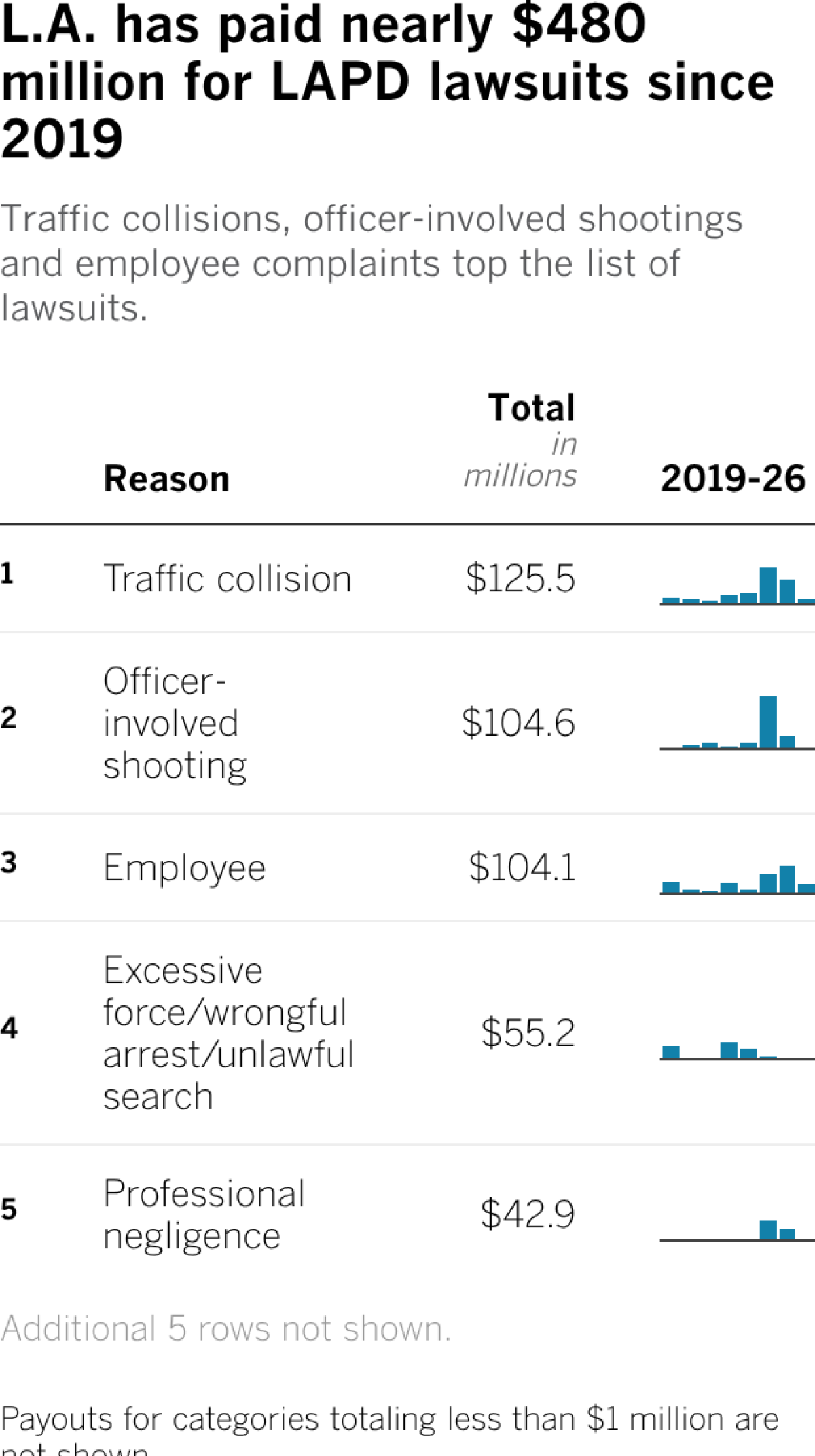
The city of Los Angeles has shelled out nearly $480 million over the last five and a half years to end legal disputes involving the Police Department, including claims of excessive force, litigation over traffic accidents and cases filed by employees who allegedly faced retaliation after reporting misconduct.
The soaring legal costs have come under greater scrutiny in recent years as Los Angeles’ financial problems have gotten worse. The city faced a $1-billion budget shortfall in 2025 but, after various cost-cutting measures, managed to set aside funding for the LAPD to hire more than 500 new officers in the coming year.
The LAPD’s annual lawsuit costs more than doubled from 2019 to 2025. The payouts peaked in 2024, when the city spent $178.6 million to resolve more than 300 police-related lawsuits and civil claims, before dropping to just over $100 million in 2025, according to a Times analysis of city attorney’s data.
The Times reviewed hundreds of pages of court documents and analyzed data from the city attorney’s office released through a public records request showing nearly 2,000 payouts dating to January 2019.
Through the first six months of this year, the city has paid out $20.3 million in legal settlements and court judgments involving LAPD officers. Several recentbig-dollarverdicts aren’t included in that tally because they hadn’t yet been approved by the City Council.
The surging cost of LAPD payouts depriving the cash-strapped city of money for pressing needs such as fixing roads and sidewalks, according to City Controller Kenneth Mejia.
“There’s a reason why your streetlights are out and they’re not fixed for a year, there’s a reason why your sidewalk won’t get fixed or your animal shelters are understaffed or underfunded,” said Mejia, whose office is conducting an audit of the city’s risk management strategies, the results of which will be released this year.
Experts are still untangling the reasons for the explosion of legal payouts involving police — which stretches far beyond L.A.
This year, a legal defense organization found that New York City has paid more than $796 million since 2019 to settle lawsuits involving accusations of police misconduct — including $117 million in 2025. In Chicago, the city is on track to blow past the $252 million spent last year to resolve police lawsuits, mostly involving plaintiffs who went to prison based on faulty evidence, according to local news reports.
In Los Angeles, the surge has come under the watch of City Atty. Hydee Feldstein Soto, who has blamed the rising costs on the way the office handled litigation of all kinds before her administration — as well as a national legal trend of so-called nuclear verdicts.
“The system is getting inflated in a way that is unhealthy and it creates, I think, incentives to sue and to do pie-in-the-sky settlements,” Feldstein Soto said in interview with The Times earlier this year. She said her office evaluates each claim case by case, deciding when it makes more sense to settle rather than go to trial, at which juries can issue decisions based on emotion or differing perceptions of what occurred. Feldstein Soto has lobbied for years to change state law to limit “non-economic” damages.
Feldstein Soto’s critics contend that she has pursued a hard-line approach in recent years, refusing to settle except in cases where it is clear the city is likely to lose in court.
That tough stance has led to mixed results. The city has lost some jury verdicts that could have been avoided if it had been willing to settle. It has also prevailed in several high-profile cases, including this year when a jury ruled that an officer was not liable for the 2021 death of a 14-year-old girl killed by a wayward bullet fired during a hasty confrontation with a suspect at a North Hollywood department store.
The city attorney’s office said in a statement to The Times that while it is proactively working to curb rising litigation costs “by every means possible,” it could not “control the number, timing or claimed damages of lawsuits filed against the City.”
“Nor does the Office have control over the alleged root causes of these liabilities: the City Attorney’s Office is not responsible for LAPD policies or personnel,” said the statement, adding that the number of lawsuits filed against the city has risen by roughly 20% in each of the last four budget years, straining the office’s resources.
Zachary Powell, an associate professor of criminal justice at Cal State San Bernardino, said that although data suggest that use of force by police has decreased since 2020, the public has become “much more aware of police abuses and conduct than they ever were before.”
“I think people also ask a lot more questions in a jury setting,” he said.
Other explanations, he says, are the passage of statewide police accountability measures and the fact that a backlog of cases from the pandemic years are finally coming due.
The Times’ analysis found that hundreds of legal battles involving officer-involved traffic incidents make up nearly a quarter of all payouts. Since 2019, the city has paid $125 million for the thousands of accident claims, just under a third of which stemmed from cases in which officers were found to have failed to stop or yield at crossings before crashing into another vehicle or a pedestrian. Pursuit-related claims and suits stemming from cases in which officers made improper left turns have also cost the city millions.
Other legal costs date back years — and in some cases decades.
The city is still paying $7,410 a month to Clarence Chance, who in the early 1990s was awarded a large payment over a wrongful arrest that led him to spend 17 years in prison for a murder he didn’t commit. Nearly $40 million has gone to people whose homes were damaged after the LAPD bomb squadbotched the detonation of seized fireworks and leveled part of a city block in 2021.
One of the biggest payout categories was $104.6 million spent since 2019 on claims related to police shootings — more than three-fourths of which involved people who were reported to be under the influence of a substance or in the midst of a mental health crisis, according to The Times’ analysis. Roughly $38.4 million was paid out after police shot someone wielding an edged weapon, such as a knife, the analysis found. Shootings involving gang officers cost the city nearly $4 million in that span.
Dozens of lawsuits remain pending, including claims related to the handling of mass pro-immigration protests since last year, likely putting taxpayers on the hook for more large payouts in the future. Police use of hard foam projectiles, house-mounted officers and other tactics against crowds have already cost the city at least $22 million in the last seven and a half years — just over half of which stemmed from the department’s response to the 2020 mass protests over the murder of George Floyd.
Such totals may not always include lawyer fees that are negotiated after a settlement is reached — or if a case is appealed.
Jonathan Evans, a civil rights attorney who has sued the department, thinks the big payouts show that greater public awareness of mental health issues is a factor. Recognizing this, he said, municipalities are agreeing to higher settlements than in years past.
“The decision to use lethal force is being more heavily scrutinized,” he said.
Tens of millions of city dollars have in recent years gone to disgruntled police officers who sued over workplace injustices such as sexual harassment, racial discrimination and retaliation. Since 2019, at least 27 LAPD employees have won million-dollar-plus jury verdicts or settlements from the city; many more have seen five- or six-figure paydays.
To clamp down on future legal costs, the department last year brought back a former senior official, Arif Alikhan — at a monthly salary of $20,000, paid for by a private donation — to study how to reduce the number of costly lawsuits. Alikhan did not respond to a call requesting comment.
The department maintains an early intervention system that flags officers based on risk factors, such as a relatively high volume of civilian complaints, frequent use force, and involvement in preventable traffic collisions or pursuits. The system is used to determine whether they need additional training or should be reassigned or placed on a performance improvement plan.
Within the LAPD, some officers and the Los Angeles Police Protective League, the rank-and-file union, argue that the city should fight back harder against claims with no credibility, instead of settling. They say officers who are most often sued tend to come from specialized units that do the type of proactive policing that the department and most of of the public wants: targeting gangs, drugs and guns.
Attorneys who represent officers that have sued the department over whistleblower retaliation dismiss the claim by Chief Jim McDonnell and others that some cops are exaggerating their claims in pursuit of a big payday. If anything, they contend, the continued large payouts are a product of entrenched racial and gender bias and inconsistent discipline — and the LAPD’s unwillingness to learn its lessons from past lawsuits.
Greg Yacoubian, a labor attorney, said there is little incentive for the current system to change because the costs of lawsuits are passed on to taxpayers — not the officers involved in misconduct and their bosses.
“The person responsible for the error never feels the pinch,” Yacoubian said.
Times staff writer James Queally contributed to this report.
The latest episode of the ITV2 programme featured an error that viewers couldn’t ignore
Big Brother viewers have pointed out a major error made in the latest episode (Image: ITV)
Big Brother viewers have spotted the same error just minutes into the latest episode of the ITV2 programme.
The reality competition returned to screens on Thursday night (October 8), with the housemates still residing in the House of Revelations. The twist is all about exposing secrets in the house, including housemates’ true feelings about each other.
Viewers were ready to tune into the next revealing challenge in tonight’s episode, but they were left distracted by Rochelle’s comment just minutes in. During a conversation with newcomer Twinks, the housewife earnestly asked: “Who was the feminist that ran in the streets, Betty Boop, or something?”
Rochelle went on to add: “She ran on the race course, didn’t she? And got run over.” The other housemates within earshot quickly jumped in to correct her but their replies weren’t especially helpful.
Twinks responded: “Betty Boop’s a cartoon with the big head,” before adding that “Emily Pankhurst” was the feminist who tragically died after being hit by King George V’s horse in 1913.
While Emmeline Pankhurst was the woman who fronted the British suffragette movement, she wasn’t the person who walked onto the race course. That was actually fellow suffragette Emily Davison.
Viewers quickly spotted Twinks’ error and gathered on social media correct her. One X user posted: “for the record, neither Betty Boop nor Emeline Pankhurst ran in front of the horse, it was Emily Davison #bbuk.” A second rightfully questioned: “Wasn’t it Emily Davidson, not Pankhurst who threw herself under the horse? #bbuk.”
Someone else said: “Eye is twitching at Emily Davison being referred to as both Betty Boop and Emmeline Pankhurst. Bless Twinks for incorrectly correcting Rochelle, Pankhurst was closer but they are different people my love #BBUK
While a third eagle-eyed fan chimed in with: “Slight ding for Twinks there. It was Emily Davison who ran in front of the race track horse at the Derby. Emmeline Pankhurst was the leader of the suffragettes. Know your history if you plan to educate! #BBUK”
But this small mishap is unlikely to sway public opinion on Twinks, who is currently the frontrunner to win the show according to recent odds.
Try ITVX Premium free for a week
This article contains affiliate links, we will receive a commission on any sales we generate from it. Learn more
ITVX Premium offers exclusive ad-free content that can be streamed on-demand and on the go, with everything from Hollywood blockbusters to bingeable British box sets.
An annual plan costs £59.99 – equal to £4.99 per month – after a seven-day free trial.
It comes just hours before the house is set to face its next live eviction following brutal face-to-face nominations earlier this week.
Pauline is up for elimination after receiving five nominations from Lynx, Philip, Rhianna, Rochelle and Catrin. And Rob will join her, having received six nominations from Frankie, Lynx, Omar, Philip, Rhianna and Yasmin.
Viewers are being asked to vote for the housemate they wish to evict. Friday night (October 9) will see the next eviction and the evictee’s first live interview with hosts AJ Odudu and Will Best.
Big Brother continues tomorrow at 9pm on ITV2 and ITVX
Dearest gentle “Bridgerton” viewers — rejoice, for a new prequel series about Lady Violet is headed to Netflix.
The streamer and Shondaland announced Thursday that an untitled spinoff about the early life of the future matriarch of the Bridgerton clan is in the works. Shonda Rhimes and Nicholas Nardini will write and serve as showrunners on the limited series, which will tell the story of young Lady Violet’s romance with her future husband, Viscount Edmund Bridgerton.
The show will be the second spinoff set in the expanding world of the popular Regency romance following the 2023 prequel series “Queen Charlotte: A Bridgerton Story,” which explored the early days of the eponymous queen’s marriage to King George III.
Portrayed by Ruth Gemmell in the flagship series, Lady Violet is the mother of the eight Bridgerton siblings whose individual adventures in (and around) the marriage mart are the focus of the show. A younger version of the character, played by Connie Jenkins-Greig, also appeared in the “Queen Charlotte” prequel. The cast of the untitled Lady Violet prequel has not yet been announced.
Based on the popular book series by Julia Quinn, “Bridgerton” has been a hit with audiences since premiering in 2020. The first four seasons have chronicled the steamy happily-ever-afters of the eldest Bridgerton siblings, Daphne, Anthony, Colin and Benedict. The fifth season of the series, which will follow the love story of Francesca Bridgerton (Hannah Dodd) and Michaela Stirling (Masali Baduza), is currently in production in London.
In addition to Rhimes and Nardini, who was also a writer on “Scandal,” “Queen Charlotte” and “Inventing Anna,” frequent Rhimes collaborator Tom Verica will direct and executive produce on the upcoming limited series. Shondaland’s Betsy Beers is also an executive producer.
“Crazy Rich Asians” will officially be back on screen, with some familiar faces joining for the ride.
HBO announced on Thursday that it had ordered an original drama series of the same name based on author Kevin Kwan’s book series eight years after director Jon M. Chu’s “Crazy Rich Asians” film adaptation marked a watershed moment for Asian representation in Hollywood. The series will see stars Constance Wu and Henry Golding reprise their roles as lovebirds Rachel Chu and Nick Young; Ronny Chieng as Nick’s cousin Eddie Cheng and Oscar winner Michelle Yeoh as the hard-to-please Young family matriarch, Eleanor.
Although not exactly the movie sequel some fans were hoping for, the series will pick up after the events of the 2018 film and will be based on Kwan’s books, HBO announced. Adele Lim, who co-wrote Chu’s 2018 film, will serve as showrunner and will executive produce the series alongside Kwan, Chu and “Crazy Rich Asians” movie producers Nina Jacobson and Brad Simpson.
The official series order comes more than a year after Golding shared that he and some of his “Crazy Rich Asians” collaborators had reunited to discuss the future of the franchise, including a meeting with Lim. The Times confirmed last year that the series was in early development.
The “Crazy Rich Asians” series could fill the void left by the onetime promise of a “Crazy Rich Asians” sequel. Prospects of a sequel crumbled in 2019 when the Hollywood Reporter broke news that Lim left the sequel over pay disparity.
As viewers tuned into tonight’s episode of The Celebrity Traitors, the Mirror takes a look at some of the strong ties that bind this year’s batch of stars, which could take them all the way to the end
19:36, 08 Oct 2026Updated 19:56, 08 Oct 2026
There are plenty of friendships on the show already(Image: BBC)
The Celebrity Traitors is well underway and it’s already brimming with wild twists and turns – including a self-confessing traitor and a weird adversion to physical touch.
We’re only two episodes in, but fans will have already spotted that a number of stars seem chummy even before getting themselves settled in the iconic Scottish Highlands castle.
Friendliness isn’t always a superpower on the show – the sneakiest often prevail once it really gets going – but loyalty can go a long, long way.
As we’ve seen in previous seasons (Hello Rachel Duffy and Stephen Libby), forging an alliance can make all the difference when all eyes are on you at the Round Table. And it sometimes takes just one strong ally to sway the opinion of the group.
Here, the Mirror takes a look at some of the strongest bonds in Celebrity Traitors this year, and how they might shake things up…
Rob Beckett and Romesh Ranganathan
Starting off with possibly the best-known connection in the show, comedians Rob Beckett and Romesh Ranganathan already feel like a package deal, with their friendship dating back to their early days on the 2010 comedy circuit.
Rob first learned of Romesh’s comedic talents through a friend and headed out to see his set at his dad’s pub. His initial feeling was that of annoyance, having “wanted to be the only good one at comedy”. But this irritation quickly blossomed into a friendship that would see them right to the top of their profession.
Both feeling like “outsiders” in a middle-class industry, Rob and Romesh secured a solid bond before hitting the big time. Reminiscing in a 2021 address to the Royal Television Society, Rob, now 40, shared: “Coming up through comedy and telly, which is quite a middle-class world, we bonded because we both felt we didn’t belong. We really did get on…Having a mate that you can share the madness with was great.”
Having built impressive careers independently, becoming familiar faces on the likes of A League of Their Own, 8 Out of 10 Cats, Mock the Week, and Taskmaster, it soon became clear that viewers loved the pair’s natural on-screen dynamic.
In 2019, Rob and Romesh were snapped up by Sky Television for Rob and Romesh Vs…, a series which sees the two funnymen plunged into unfamiliar territory together.
One episode saw the pals perform a country song in Nashville after meeting Shania Twain, while another followed them as they performed Hollywood-style stunts for Hollyoaks.
Summing up their relationship as the Traitors’ games began, Rob quipped: “I know Rob very, very well. I mean, I’ve sat next to him as he’s had a colonic.”
It’s clear nothing much fazes the duo, who are able to adapt to pretty much any situation imaginable – from dancing in Swan Lake to training with the NFL. Will their bond and shared chameleon abilities prove to be one of this season’s greatest weapons? We’ll have to wait and see.
Richard E. Grant and Jerry Hall
Another friendship that has also come under the spotlight is that of Richard E. Grant and Jerry Hall. Neighbours over in swanky Richmond and friends for 30 years, Richard was a guest at Jerry’s 2016 wedding to media tycoon Rupert Murdoch, whom she divorced in 2022.
Jerry has spoken fondly of the fun she shared with the Withnail & I thespian on the set of the 2004 kids’ fantasy film, Tooth, which delves into the lives of tooth fairies living in ‘Fairytopia’.
Describing the critically reviled movie as “ridiculous” ahead of their Traitors reunion, Jerry chuckled: “We had such a laugh, and I went on holiday with him earlier this year, just after Christmas, to Africa with some friends. And we danced all night. We had so much fun! Little did we know back then that we’d both be here!”
Richard, 69, had viewers’ jaws firmly on their living room floors after proudly outing himself as a traitor in the very first episode, followed by plenty of backtracking. While many faithfuls were less than convinced by the Academy Award winner’s subsequent performance, supermodel Jerry stood firmly by her pal.
Jerry, 70, insisted: “I just don’t believe Richard’s a Traitor. I know Richard, I’ve known him 30 years and he’s my neighbour. He says and does eccentric things. He’s an amazing guy, but I think he’s acting out because he’s not been chosen.”
While en route to their shipwreck challenge, Jerry was quick to agree with Industry actress Myha’la, who said, “I really, really genuinely do not think he’s a traitor,” declaring, “I don’t either.”
This show of loyalty may prove very useful to Richard when it comes to quashing some very understandable doubts over his faithfulness.
Of course, fans of a more cynical bent could also argue that Richard and Jerry could have discussed tactics beforehand in one of their neighbourly chats, and that a long game could well be afoot to see them both splitting the prize…
Bella Ramsey and Sebastian Croft
Having braved the tangled feudal webs of Westeros together, Bella Ramsey and Sebastian Croft will likely feel prepared for the cloak-and-dagger world of the Traitor’s Castle. And their established friendship could prove to be a powerful alliance.
Bella, now 23, was just 11 years old when they astonished Game of Thrones fans with their portrayal of the pint-sized yet formidable head of House Mormont, Lyanna Mormont.
Sebastatian, known as ‘Bash’ to pals, made his Thrones debut in 2016 – the same year as Bella – giving a brief but memorable performance as a young Ned Stark.
While the pair never got to share a scene, Sebastian, 24, could barely contain his excitement as he pictured the two of them plotting together. The star, who is known to be a huge Traitors buff, enthused: “I love Bella! Imagine us in the turret together. That would be the dream.”
Being well-used to sticky endings in their former shared set, you can guarantee that these two won’t be too horrified by increasingly frequent dispatches of their castlemates. But they also know that sometimes it’s the ones you care for the most who can leave you with a Valyrian steel sword in the back.
In a private castle exchange in episode two, Bella admitted, “I go back and forth on you, Bash”, making their suspicions clear. Bash was quick to refute this, signalling their closeness as he argued, “I genuinely think you’d know if I was.” Bella considered this and noted that they thought Sebastian would know too, if it were the other way around.
Both actors pledged to have each other’s backs, but it was evident that neither one of them left the conversation feeling 100 per cent at ease. During a piece to camera segment, Bella shared: “I know Sebastian, who I know as Bash. We met quite a few years ago, I think at an awards thing we were both at. I mostly trust Bash, but there’s something just a little bit unsettling that I just have to keep in the back of my [mind].” They added, “I can’t trust everybody. This is a game. Nothing is personal”
Sebastian, too, is erring on the side of caution, telling the camera: “I love Bella, and I’ve tried to make myself as little of a threat to them, but as much of an asset, because Bella is a formidable player. That’s someone I’m definitely keeping an eye on.”
Joe Lycett and James Acaster
Joe Lycett and James Acaster are also good pals, with their friendship dating back to their days on the pub circuit nearly 20 years ago. The comedic pair, who have appeared on numerous panel shows together, have a running joke about people frequently getting them mixed up.
Back in 2021, Joe, 38, cheekily riffed on this by putting James’ face on posters for his tour, causing some confusion amongst comedy fans. Clarifying that this wasn’t an awkward error on the part of the printers, Joe issued the following statement via X: “I would like to publicly apologise to Mr Acaster and his team for this.
“The posters were an experiment to see if my face was a deterrent to the British public and if his face would sell more tickets for my show.”
He proceeded to jest: “It is with great disappointment that I have discovered sales have shot up. Mr Acaster’s legal team contacted my representatives, and after talks we have agreed on an out-of-court settlement.”
Will the similarities between the duo prove to be a help or a hindrance this season? We shall certainly see.
Maya Jama and… half the castle
A natural leader, fans were no doubt thrilled to see Maya Jama don that infamous green cloak and make it look like a fashion moment. And it’s likely the presenter’s natural people skills will prove to be a real asset here.
Maya, 32, has crossed paths with a number of fellow Traitors celebs in the course of her work. In 2020, she competed against James Acaster on The Big Fat Quiz of the Year.
Memorably, James dislodged a safety partition screen in an humorously chaotic attempt to stop Maya’s team from seeing his written answer. It’s likely she won’t have forgotten the comedian’s competitive streak.
In March 2021, Maya appeared on Romesh’s podcast Hip Hop Saved My Life, where she discussed developing her early love of hip hop through her mum’s Eminem CDs. She also offered Romesh some tips on his makeup techniques.
Then, in February 2024, Maya was seated in the front row at Italy’s Milan Fashion Week, right next to Little Mix’s Leigh-Anne Pinnock. More recently, Maya co-presented the Artist of the Year award at the BRIT Awards 2026 with none other than You’re Beautiful singer, James Blunt.
While there will be few unfamiliar faces here for Maya, she has played down any significant connections, asserting: “I’ve met a few people in the cast, but nobody really knows me, so we’re all starting from scratch.”
Nevertheless, these various brushes over the years will surely come in useful when it comes to keeping a careful eye out at the round table.
The Celebrity Traitors returns tonight at 8 pm on BBC One.
Do you have a story to share? Email me at julia.banim@reachplc.com.
Israel opened its first national pavilion at Morocco’s Marrakech Air Show, joined by Israel’s top military contractors.
Published On 8 Oct 20268 Oct 2026
Israel’s Ministry of Defence says it is participating for the first time in a defence exhibition in Morocco, as it announced its first-ever national pavilion at the Marrakesh Air Show 2026.
“This marks Israel’s first official participation in the defence exhibition held in Morocco since the signing of the Abraham Accords”, Israel’s Defence Ministry said in a statement on Thursday.
The ministry said eight Israeli defence companies exhibited “advanced, combat-proven technologies at the show” in Marrakesh, which runs until Saturday.
Abdellatif Loudiyi, Morocco’s defence administration minister, speaks at the Marrakech Airshow in Marrakesh, Morocco, October 7, 2026 [Ahmed El Jechtimi/Reuters]
The Marrakech Air Show, taking place from October 7 to October 10 this year at the Marrakech Royal Moroccan Air Force Base, is organised every two years and is meant for civil and military aeronautics and space industries to highlight their latest offerings.
“Israel’s three major defence industries, Elbit Systems, IAI, and Rafael, also exhibited, presenting solutions across the air, land, sea, space, intelligence, cyber, and digital domains,” it said.
Munition exhibited by Israel’s Elbit Systems at the Marrakech Air Show in Marrakesh, Morocco, October 7, 2026 [Ahmed El Jechtimi/Reuters]
The announcement is the latest sign of increasing ties between the Arabic-speaking North African country and Israel, since the two established ties in 2020 as part of the US-backed Abraham Accords.
Last month, Israel and Morocco agreed to upgrade their diplomatic ties, including elevating their respective missions to embassies and appointing ambassadors to both countries.
The move followed a meeting between the two countries’ foreign ministers, hosted by the US ambassador to the United Nations, Mike Waltz, on the sidelines of the United Nations General Assembly in New York.
They also agreed to expand air travel, including by reinstating direct flights operated by carriers from both nations, and confirmed plans for high-level bilateral visits in the coming months.
Morocco is also one of the five countries that have pledged to send troops to Gaza, under the US-backed International Stabilization Force (ISF) as part of US President Donald Trump’s so-called Board of Peace.
Spotify on Thursday said it renewed its deal with Joe Rogan, who leads the audio company’s most popular podcast “The Joe Rogan Experience.”
Rogan’s podcast, which has 18 million followers on Spotify, has been the company’s top podcast since 2020. The terms of the multiyear licensing deal were not disclosed. The Wall Street Journal, citing unnamed sources, reported the deal had an estimated earn out of $250 million.
“The partnership with Spotify has been an amazing fit, and they’re incredible to work with,” Rogan said in a statement. “I’m extremely happy and excited to continue with them for years to come.”
Rogan first entered into an exclusive multiyear podcast deal with Spotify in 2020 in a deal said to be worth $100 million. The partnership was key to driving podcast audiences to Spotify, which at the time was mostly known for as a streaming music service.
In 2024, the company extended its partnership for “The Joe Rogan Experience” to be distributed on other platforms, which has continued in its current deal. Rogan’s show was ranked as the top podcast last year on Spotify, YouTube and Apple Podcasts.
“Joe has built something incredibly enduring, and his show continues to resonate with a massive global audience because there’s simply nothing else like it,” said Jordan Newman, head of content partnerships at Spotify in a statement.
“The Joe Rogan Experience” has run into controversy, spurring a Spotify boycott in 2022 led by Neil Young over concerns that Rogan and his guests were spreading misinformation related to the COVID-19 vaccine. Rogan also received criticism over how he used the N-word on past episodes of his show, which he later apologized for.