Come 2028, the Democratic presidential campaign promises to be a banger, with all sorts of intrigue and subplots layered within a wide-open fight for the nomination.
In the meantime, Democrats have seemingly resolved at least one 2028 fight, a fracas marked by snarking, backbiting and plenty of acrimony — all the things that make our politics such a grand and glorious endeavor.
We speak of the contest to determine which state will hold the first vote of the 2028 nominating process. And the winner is … South Carolina!
This was a blow to Nevada, the runner-up in the calendar sweepstakes, and not a very sporting one at that. The state Democratic Party issued a huffy news release, insisting Nevada will be the candidates’ first true test of 2028 — emphasis added — reprising the argument over which state offers the best starting path to reclaim the White House and, thus, deserves the coveted lead voting slot.
(California, a perennially frustrated onlooker, is not set to vote until March 7, several weeks into the balloting, which is supposed to start Jan. 22.)
Iowa went first, holding its quaint and quirky precinct caucuses — neighbors gathered in church halls, school libraries and the like as they worked through arcane rules involving “realignment” and “viability thresholds” — followed by New Hampshire’s first-in-the-nation primary.
The change set off a free-for-all this time around, as a dozen states bid for the chance to vote first.
(The two major political parties set the rules for choosing their presidential nominees, independent of one another. Republicans are expected to stick to the traditional lineup, starting with the Iowa caucuses and New Hampshire primary, followed by contests in Nevada and South Carolina.)
Last month, after nearly a year of consideration, the Democratic Party’s Rules and Bylaws Committee voted for six states to hold their contests in a window between late January and the end of February. They are, in order, South Carolina, Nevada, New Hampshire, New Mexico, Michigan and Virginia. The lineup will be presented to the full Democratic National Committee to be voted on and finalized later this month.
Doubtless, you — a normal person — have paid little or no attention to any of this. You’ve got more important things to do, like binge-watching “Widow’s Bay,” or not melting.
But party leaders and political insiders take the process extremely seriously. At stake: bragging rights, a modest economic boost and the chance for local analysts and office-holders to make frequent appearances as experts on the cable-TV chat shows.
The jostling grew particularly fierce between South Carolina and Nevada.
More than 50% of the Democratic primary electorate in South Carolina is Black. In Nevada, Latinos are a substantial and increasingly powerful voting bloc. So, naturally, the competition between the two states assumed fraught racial overtones, which is unfortunate but not surprising, given Democrats’ penchant for picking at sore spots and turning on each other at the slightest provocation.
It was also rather pointless. The order of the presidential calendar is consequential, but far from determinative.
Presidential campaigns have changed drastically in the 50 years since a little-known Jimmy Carter quietly burrowed into Iowa, spent months bunking in folks’ extra bedrooms, then burst to national fame by outperforming his more prominent rivals. Today, the race is a 24/7 affair, followed by voters in all 50 states.
Obviously, the voting has to begin somewhere and the competition between states is well and good. But the trash-talking and, especially, antagonism over race and ethnicity is gratuitous and needlessly divisive. Candidates will show they have the stuff to win the nomination, or not, by building their best case and pitching it to voters.
No matter if it’s a Black church in Las Vegas or a Latino neighborhood in North Charleston. Any location will do.
SPRINGFIELD, Ill. — The first day all the members of the Women’s Professional Baseball League were at the same field, it rained.
That didn’t dampen the smiles around Robin Roberts Field the day before the league opens play Saturday, marking the first professional women’s baseball games in 72 years.
“Getting to be together for six whole weeks or around two whole months with them [if we make the playoffs] is honestly going to be a game changer,” said third baseman Ashton Lansdell, who stars for the USA national team. “I think we’re going to build a really unique and exciting culture that is going to last a very long time, especially with the inaugural season at WPBL. Like we’re starting from the ground up, so we get to build all of these things from the very beginning.”
The Los Angeles Queens, managed by former Dodgers second baseman Eric Young, have arguably the most star-studded roster, behind Savannah Bananas third baseman Lansdell, former Little League star Mo’ne Davis and Japanese ace pitcher Ayami Sato.
The Los Angeles Queens’ Ayami Sato pitches during a Women’s Pro Baseball League exhibition game in March 19 in Fort Myers, Fla.
(Rebecca Blackwell/AP Photo/Rebecca Blackwell)
“I pretty much have an idea who I want to lead off and who’s my starter,” Young said. “Those two things I do know. But the rest of the lineup, I’m looking forward to making it. The first one will be very special, just like everything else.”
Women’s baseball has been long fractured with few opportunities for the best to gather in one spot. The only consistent tournament has been the Women’s Baseball World Cup, with the U.S. going undefeated in group play this week in Rockford ahead of the WPBL’s quick week of preseason practices.
The WPBL will be the first women’s baseball league since the All-American Girls Professional Baseball League, which operated from 1943 until 1954 to offset the loss of male baseball players called into action during World War II. The league gained popularity and notoriety when it was dramatized in the 1992 film “A League of Their Own.”
While women’s baseball didn’t boom and girls were mostly limited to playing softball, some women sought a chance to play the sport they loved.
The WPBL, even with a limited six-week season at one location, is helping many players realize seemingly impossible dreams and honoring the first recorded women’s game with a paid crowd and the home of the single-season Springfield Sallies.
Games will span seven innings and the league will use aluminum bats featured in college baseball and softball, while outfield dimensions were altered to be closer to the Women’s World Cup field dimensions. Salaries range from $300-$500 per game for the 15-player rosters.
“It’s just what we’ve all dreamed of our whole lives,” Lansdell said. “The coolest thing out of all of it is that we’re starting this league this year, but in the next five to 10 years, even two years down the road, I’m so excited to see just the growth of women’s baseball and the amount of hope and inspiration that we have.”
Like many women’s baseball players, Lansdell had a history in softball, contributing to the Women’s College World Series season in 2025 at Ole Miss. More recently, she went 11-for-13 with two doubles and two home runs in five games during the U.S. World Cup group stage for a historic .846 batting average.
Players warm up before a game on the fourth day of tryouts for the Women’s Professional Baseball League in August 2025 at Nationals Park in Washington.
(Julia Demaree Nikhinson / Associated Press)
She will be the core of the Queens’ lineup, surrounded by some of the biggest name in the sport. Brittany Apgar grew up playing in all-boys baseball tournaments before playing college softball at Greensboro College.
“I think this is really when the quote that baseball is 90% mental and 10% physical kicks in because that game’s going to be a lot,” Apgar said of the Saturday opener. “Like we have the honor of doing the first game. That will be a lot of pressure on everyone.”
The Queens flaunt one of the best right sides of the infield in the league with Lansdell at third and Curacan 19-year-old shortstop Thaima Maximiliana.
Australian shortstop Caitlin Eynon hit .375 in the World Cup and could contribute to the Queens’ lineup, too.
Davis highlights an outfield that includes Apgar and Japanese center fielder Suzu Narasaki. Amira Hondras, 18, played for the U.S. after spending time with MLB Develops and the Chicago White Sox youth league and is one of the best young women’s baseball prospects in the nation.
Sato leads a staff of pitchers from several backgrounds. Canadian 19-year-old right-hander Michelle Roche plays college baseball in British Columbia while 38-year-old veteran Meggie Meidlinger has been a bullpen stopper for the U.S.
“More than anything, I’m excited for the opportunity to play with talented players from around the world,” Sato said through her translator, Mayo Hiran. “That’s something that I’ve been working for for a long time.”
The Queens face the New York Heights to begin their season and will play 30 games through the start of September before a two-week playoff period.
By this time next year, they may get a chance to play home games in the Los Angeles area. The league hasn’t announced its plans for shifting games outside of Illinois other than to confirm they aspire to do so.
But for a few moments this weekend, in Springfield alone, dreams will come true and a sport will be reborn.
“It’s going to be a lot of people’s first time for a lot of things,” Apgar said. “Some of the people didn’t actually get to make it to tryouts, so there’s some people that are drafted that I haven’t even seen in person before. It’s all exciting.”
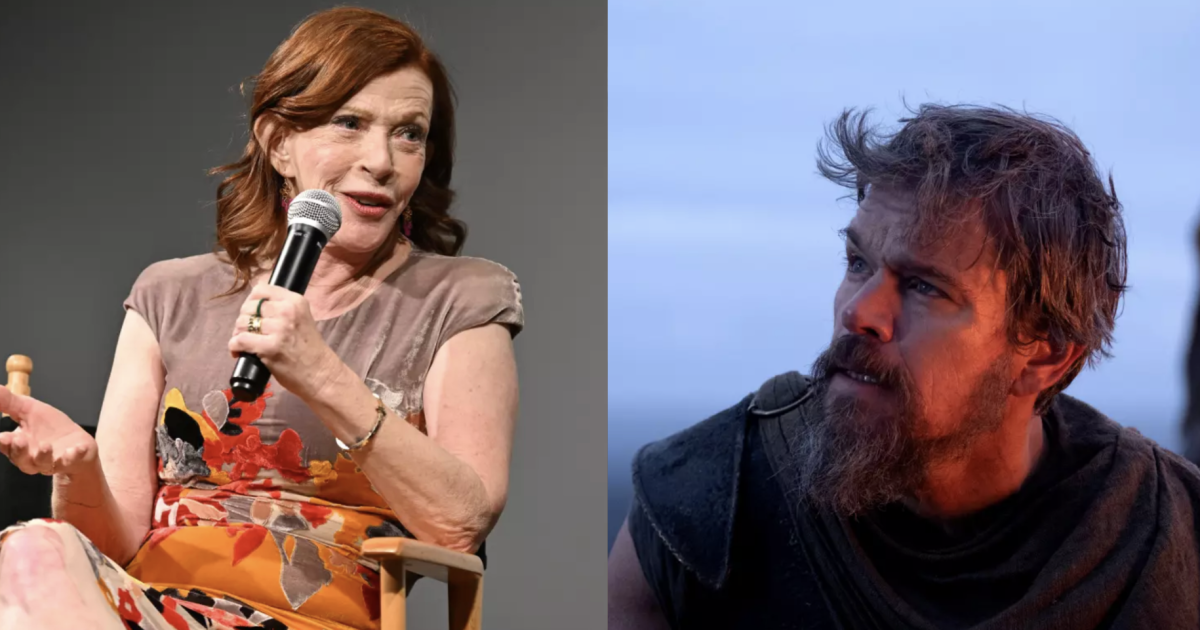
In a book nerd battle that’s become so epic, even The Onion has satirized the saga, acclaimed author Susan Orlean has grabbed the mic, and Emily Wilson is admitting she has one regret in her review of “The Odyssey.”
Earlier this week, Joyce Carol Oates panned Wilson’s critique of Christopher Nolan’s big-screen adaptation, and now acclaimed author and journalist Susan Orlean has entered the chat.
“I loved The Odyssey (saw it twice) and love any piece of art that gets people talking and reading and thinking,” she posted on Threads on Thursday. “Emily Wilson is being a bit of a jerk.”
Choice words from Orlean, but she knows a thing or two about film adaptations: her 1998 book “The Orchid Thief” inspired Spike Jonze’s 2002 film “Adaptation” starring Nicolas Cage and Meryl Streep (who played Orlean), and her 1998 article “Life’s Swell” was brought to screen as “Blue Crush,” also in 2002.
“Why can’t things be the things they are and if they’re different from their source material that’s their new form and their own thing and I SAY THIS FROM EXPERIENCE,” she added in a separate post.
The ire stems from a biting 4,200-word takedown of “The Odyssey” penned by classicist Wilson, who translated Homer’s poem in 2017.
In early interviews discussing the film, Nolan referenced Wilson’s translation, which subsequently skyrocketed in sales. A representative for Audible told The Times on Wednesday that, year over year, purchases of Wilson’s “Odyssey” translation were up by more than 600% across Audible’s U.S., U.K. and Canadian marketplaces.
Wilson’s review, published in the London Review of Books, essentially dubbed Nolan’s film a dud for academics with taste and a blockbuster hit for virgins who like special effects that go “Boom!”
“Nolan’s Odyssey lacks many of the elements that make the poem great. It has nothing convincing to say about time, memory, history, war, or about the relationship between one warrior’s glorious return and the lives of his family, adversaries, comrades, friends and neighbours,” she wrote. “It lacks psychological, emotional, political and ethical depth. Its narrative structure is gimmicky. The writing is abysmal. None of the characters has convincing motivation for their actions or words. There are no sex scenes, and all the food looks horrible.”
Pulitzer Prize finalist Oates, like Orlean, is also team Nolan. “Her tone of dismissal & haughty superiority strike a sour note,” Oates said of Wilson’s review in a post on X. Oates added that rather than Wilson disagreeing with “interpretations of Homer in a collegial manner,” she benefited from Nolan’s film and then attacked it.
Wilson’s review went so viral it crashed the London Review of Books website for a few hours on Monday. On the heels of the missive’s publication, Wilson posted on Bluesky that an earlier draft of the essay was actually more cutting than the version that went live.
“Was I too mean? Or not mean enough? I went through my first draft and tried to take out the snark,” she wrote. “To quote the great poet: ‘Though much is taken, much remains… That which we are, we are.’”
She added in the same thread: “The oddest thing about the response to this essay is people who say it’s ‘personal’. You can disagree about some or all of it! I may well be wrong! But it’s not ‘personal’ to analyze a film or other work of art, even negatively. Criticism is more than ‘Hurray!’ or ‘Hiss!’”
One criticism Wilson admits she regrets in retrospect is her take on Nolan’s race-neutral casting. In the review she wrote that while the casting launched a culture war, it wasn’t actually progressive. She likened the characters portrayed by Zendaya, Lupita Nyong’o, Himesh Patel, Corey Antonio Hawkins and Travis Scott to “versions of the Black best friend, whose only role in the drama is to provide aid to the white protagonist.”
On Bluesky, she wrote, “In this piece, I regret the paragraph about the uses of the POC actors – who are all great, but IMO under-utilized (and why couldn‘t Himesh Patel be Odysseus instead?) I still think the film largely wastes its strong cast, but I framed it badly.”
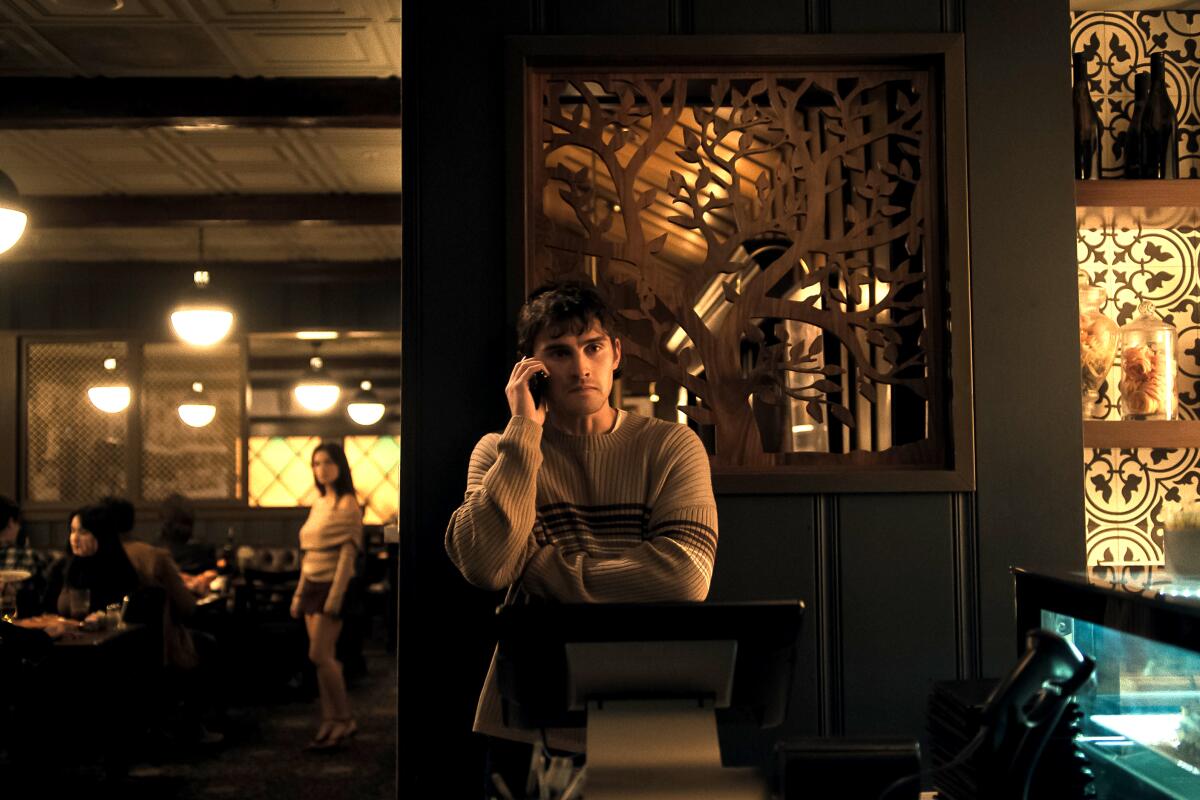
The creator of “New Girl” has a dark, twisty new show about a … female serial killer?
Since the end of her breakout sitcom, Liz Meriwether has imbued her sharp and charming brand of funny in network comedies like “Single Parents” and “Bless This Mess.” But she’s steadily embraced darker tones in her work — first, with the Emmy-winning Elizabeth Holmes biodrama “The Dropout,” then with last year’s FX miniseries “Dying for Sex,” a delicate dance between laughter and sorrow in its exploration of a woman’s commitment to live her best sexual life following a terminal cancer diagnosis. “Furious,” though, may be her darkest project yet.
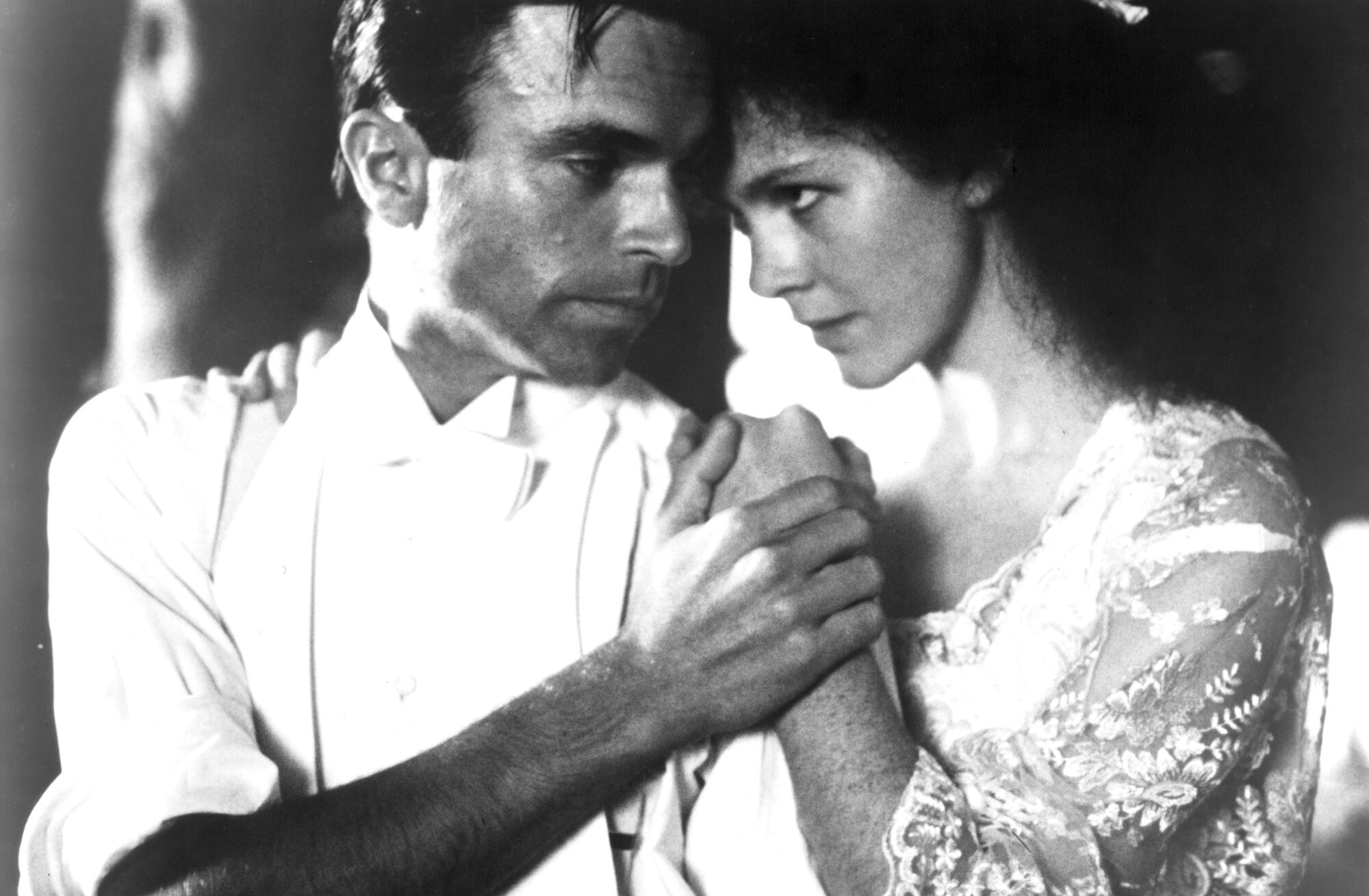
Loosely inspired by the 1987 neo-noir “Black Widow,” which starred Theresa Russell as a serial killer who marries and poisons wealthy men for their inheritances, and Debra Winger as the investigator obsessed with tracking her down, the Hulu crime drama deepens the cat-and-mouse dynamic. It follows an FBI rookie and her search for a female serial killer seeking vengeance against the men who abused her as a teenager. And still, it manages to find moments of levity. The first three episodes are currently streaming, with new episodes released every Monday until the finale Aug. 31.
“I’ve just been loving trying different things with my writing,” Meriwether told me during a recent video call. “When this came up, I was like, ‘Oh, wow, a crime thriller, a serial killer show.’ It was so different than what I’d done before. It’s like the shows that I love, so I was excited to try to write one, somewhat naively. It’s funny because I would always roll my eyes a little bit when drama writers thought they could write comedy and then I found myself in the flip side of that being like, ‘Oh, this is so hard.’”
Check out more of my conversation with Meriwether in Guest Spot. And yes, as a devoted “New Girl” re-watcher forever trying to retain my Youths! status, I asked about about the reboot discourse that’s become its own comedy.
You are reading Screen Gab newsletter
Sign up to get recommendations for the TV shows and streaming movies you can’t miss, plus exclusive interviews with the talent behind your favorite titles, in your inbox every Friday
By continuing, you agree to our Terms of Service, which include arbitration and a class action waiver. You agree that we and our third-party vendors may collect and use your information, including through cookies, pixels and similar technologies, for the purposes set forth in our Privacy Policy such as personalizing your experience and ads.
Also in this week’s Screen Gab, our writers recommend the return of a detective comedy that has its schoolteacher-turned-self-taught P.I. on another wild adventure and a Spanish-language limited series that takes place during the 1986 World Cup. — Yvonne Villarreal
Turn on
Recommendations from the film and TV experts at The Times
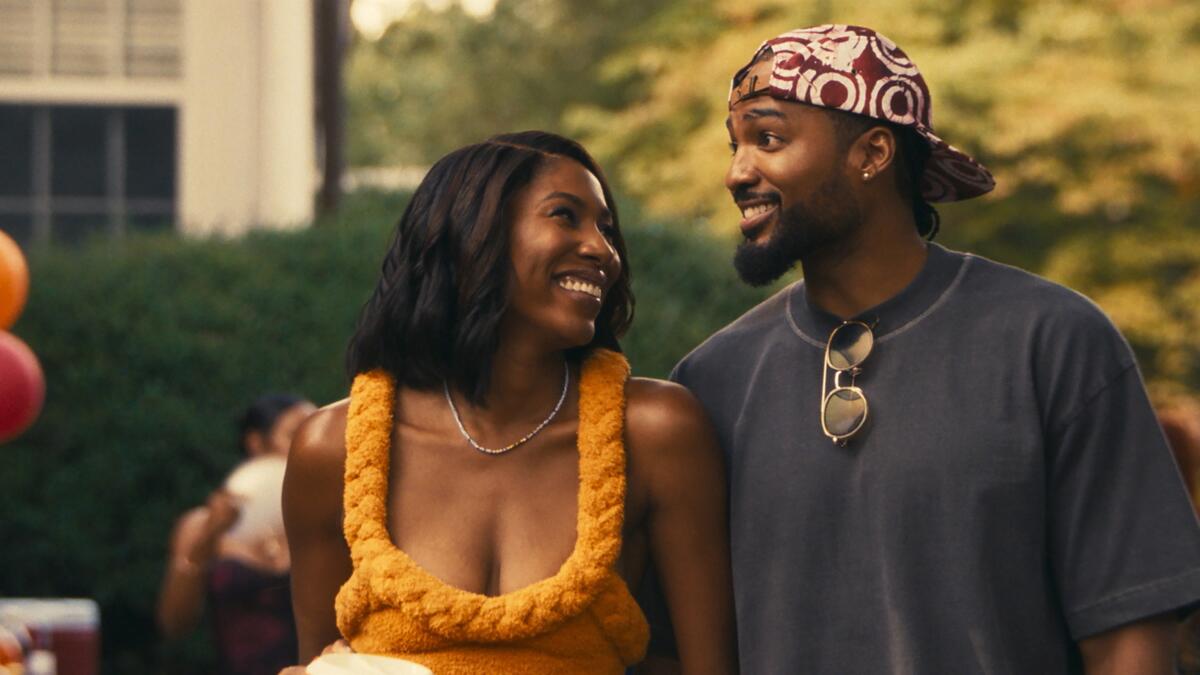
Diarra Kilpatrick as Diarra Brickland and Shannon Wallace as Chris in Season2 of “Diarra From Detroit.”
(BET / Paramount+)
“Diarra from Detroit” (Paramount+)
Diarra Kilpatrick (“Perry Mason”) created and stars in this smart, sparky mystery as a middle school teacher, also named Diarra, who turns self-described Black Nancy Drew when a man she was dating (Shannon Wallace as Chris) disappears. The new season, which sees the series folded into Paramount+ along with other BET+ series, finds them together again (retrospective spoiler alert: she rescues him at the end of Season 1), with issues — he’s got trauma to navigate, she’s sorting out her identity and desires — and mysteries still to solve, including the identity of the Chief, the city’s Mr. Big. The new season, which feels even more self-assured, picks up old themes of friends and family, as the search for a missing antique desk leads Diarra and friends and accomplices Aja (DomiNque Perry) and Tea (Bryan Terrell Clark) into fanciful new territory, including encounters with Black Freemasons and bikers, the history of Prohibition and a treasure hunt. Local food culture (Superman ice cream, coney dogs, Faygo) gets its due. The mix of suspense, romance and comedy is deft; small details keep the characters surprising and lifelike.— Robert Lloyd
Rafaella Lopez as Barbara, Ian Andrade as Salvador, Aldo Emiliano Navarro as Miguel, Damian Vergara as Tono and Regina Arroyo as Maria in “I’m Not Afraid.”
(Julieta Horak / Netflix)
“I’m Not Afraid” (No Tengo Miedo) (Netflix)
The dilapidated La Esmeralda coffee estate in Mexico’s Veracruz mountains is a lush, beautiful and spooky place — the perfect setting for a kidnap mystery. But in “I’m Not Afraid,” it’s also the wonderfully imperfect backdrop for a compelling tale about friendship and family bonds as seen through the eyes of a child. Set in 1986 during FIFA World Cup fever and a blight that’s ruined the region’s coffee crops, 10-year-old Miguel (played with depth and authenticity by Aldo Emiliano Navarro) first discovers boy captive Felipe (Yago Andreu) hidden and chained in and overgrown area that’s said to be haunted. He’s sure it’s the work of a witch spoken about in local folklore until it’s revealed his beloved parents may have something to do with the abduction. Poverty has driven them and the other families on the estate to make desperate choices. Adapted from Niccolò Ammaniti’s acclaimed novel by Ernesto Contreras (“The Secret of the River”), this six-episode series explores what happens when adults do desperate things in the hope of securing a better future for their children, but it’s the kids who end up saving the day. — Lorraine Ali
Guest spot
A weekly chat with actors, writers, directors and more about what they’re working on — and what they’re watching
Emmy Rossum as FBI agent Alice Black in “Furious.”
(Sarah Shatz / Disney)
“Furious” feels like a crime story for the Epstein age. The eight-episode psychological thriller stars Emmy Rossum as Alice Black, a troubled rookie FBI agent who left her job as an NYPD detective to escape a violent and traumatic relationship with a fellow cop. She gets enlisted to help track down a female serial killer, played by Lola Petticrew, whose targets are the wealthy men who exploited and trafficked her for sex. But the series isn’t as concerned with its ripped-from-the-headlines relevance. Over video call, creator Liz Meriwether discussed what she was interested in unpacking in TV’s latest addition to the crime drama genre and contributing to the red flag roles played by Jake Lacy. —Y.V.
The series is loosely based on the “Black Widow” film. But how much did current events, specifically stories surrounding Jeffrey Epstein and the powerful men in his orbit, inform what or how you wanted to explore here?
It really did start as a “Black Widow” adaptation. This female serial killer and this female FBI agent in this cat-and-mouse game that has this very weird third act, where they just end up hanging out together on a beach, being friends. I loved that part of it. In the midst of this very exciting female killer-female FBI agent crime movie, there was this story about two women connecting who don’t have anybody else really in their lives to connect with. I dug into that and quickly saw that if the serial killer was just a black widow like she is in the movie, that it wasn’t going to give me enough story for eight episodes. I did a lot of research about real-life female serial killers, which are pretty rare. Female serial killers are almost all victims of horrible violence at different times in their lives. That really got me going, OK, what does it mean if you’re a victim of violence and you start being perpetrator of violence? What are the things that we can forgive and understand, and what are the things that we can’t?
And yes, when I looked out into the wider world and current events and what I was thinking and feeling, I definitely scooped up a lot of a lot of stories that are out there. But it’s not the story of a specific predator. There’s a lot to choose from right now. It should feel relevant. It should have echoes of what’s going on out there. But I wanted the focus to be on these characters, not the men that did these acts.
The parallels between Alice and Catherine — what they each have survived and the different ways they deal with it — come into focus. What were you interested in exploring about the traumatic and lingering effects of abuse through these two women?
Initially, when we were casting Catherine, the question of age came up because all of my writer instincts were like, “Oh well, we need to have Catherine be very young and closer to when she was actually a victim of this predator.” But as I started thinking about it, I was like, I don’t think we’ve seen as many stories about the long-term effects of this violence. There’s no flashbacks in the show. I’m not interested in showing what was done to either one of them [Catherine and Alice]. I really was interested in the aftereffects.
I spoke to a social worker, a psychologist and a trafficking victim, which was one of the hardest conversations I’ve ever had, and also a beautiful conversation. Her name is Jay Benke, and she has an organization that helps people that have been trafficked. She made a really interesting point that stuck with me, which is that when these FBI agents and law enforcement officials build cases, they’re looking at putting the traffickers in jail; they’re not looking at what the people who have been trafficked need for their lives to heal. There’s also an amazing website that a lawyer pointed me to called thelifestory.org, which is videos from different people who’ve been trafficked telling their story — from their childhood, all the way through having been trafficked and then coming out — and it’s in the shape of a circle. Those two resources for me were incredible. On the Alice side of things, we tend to think of the experience of being a [domestic violence] victim as being much more cut and dry than it is for a lot of people. The victim’s relationship with violence and love is very complicated and violence and intimacy can become linked in their brain. It was something that I started to learn about in my research for “Dying for Sex” and continued on with “Furious.”
Lola Petticrew as Catherine in “Furious.”
(Sarah Shatz / Disney)
We see these very girly things, stickers and gemstones, that Catherine holds onto. It reminds us of her emotional or mental stasis.
I don’t know what Lola would say about this, but my thought about the character of Catherine was she was a bit trapped. The choice to go on the path of vengeance feels like a very active choice, but in some ways it’s really limited. It makes your whole life about what happened to you. I feel like Catherine’s story is about breaking out of that trap a little bit, almost trying to give her character a chance to to grow up in some ways. That was definitely a struggle for me going into this because I was like, how am I going to give a serial killer an emotional arc? Catherine is trapped and needs to put the pieces of her memory and her life together in order to move forward.
The thing I love in Episode 3 is the bag that Catherine puts on the bed. That was a big breakthrough for me for Catherine’s character in that her history is something that she’s had to piece together and hold on to, and there’s big gaps in her memory, so she holds on to these material objects in order to just feel like she’s a person. Then in looking at Alice’s character, we felt like she was the opposite in a lot of ways. She had run out of her life with Marshall and [did] not really bring that much. Her whole life is her job; her apartment is really bare.
I don’t mean to sound glib in regard to the subject matter, but you mentioned Marshall, played by Jake Lacy. Why has Jake cornered the market on playing toxic dudes who seem like nice guys?
I haven’t seen “All Her Fault” yet — it’s something that I really need to see. He’s extraordinary in the show [“Furious”], and I had a long conversation with him before he signed on. It’s a very tricky part to play. It was very important to me throughout the process that none of the characters were easily put into bad or good categories — hopefully, we’re constantly making the audience question their feelings and their judgments about people. There’s an incredible documentary called “A Better Man” that is impossible to find. I had to pay like $50 to rent it. It’s this couple that dated when they were in high school, and he was abusive toward her. She got out of the situation, and they’re coming back in their 30s, meeting again and talking about what happened. It’s an unbelievable documentary. I had Jake watch it because I really wanted him to think about Marshall as a human. He really contributed to that, and you can see it in his performance. He’s [Jake’s] a very nice guy.
You know I can’t let you go without mentioning this “New Girl” reboot — or at least the talk of it. It’s become a bit at this point — Lamorne Morris and Jake Johnson pointing fingers at each other. You posted a video on Instagram confessing to sending explicit messages that have caused some tension.
In some ways, I feel like the videos and the interviews and stuff is maybe better than a reboot. If we can see that as the reboot, maybe that would be good for everybody. [The video] came from me getting this question from journalists during the [“Furious”] junket, It was like Hour Eight of the junket, and my brain just disappeared, and I started talking like a stream of consciousness — like I don’t have any more stories to tell or something. And then I went home that night and texted the cast and I was like, “I really messed up the question.” It had been this running joke on our text threads about how they just constantly blame each other, but a lot of the times they blame me like I’m the one that’s like holding up the reboot. I find it so annoying, but then I like answered this question in a horrible way, and then I was like, “Oh, I am going to be the one who has to answer to this.”
If it does happen, it’s going to be a really dark “New Girl” reboot, given the tone of recent projects.
[Laughs] I don’t even know if fans would want what would come out of me at this point.
Last question: What have you’ve watched recently that you’re recommending to everyone?
I love “Taskmaster” [YouTube, Pluto TV]. It’s the thing that brings me joy when I need it and so I always recommend that to everybody — but with the caveat that you have to love British humor. If you love joy and British humor, I highly recommend “Taskmaster.” And Kumail [Nanjiani] was on this last season, which was like really fun.
I’m very behind. “Widow’s Bay” [Apple TV] is No. 1 on my list. I need to watch it. I love Katie [Dippold, the show’s creator] so much.
If you are over the age of, say, 14, you might not be familiar with daughter-father duo Salish and Jordan Matter. But if you are a parent of a Gen Alpha kid, it can feel like you hear about nothing but Salish and Jordan Matter. Their YouTube videos — a high-octane mix of zany challenges, games and hijinks — are admittedly hard to resist, which may be why they rake in millions of views as soon as they blast into the social media universe.
In Sunday Funday, L.A. people give us a play-by-play of their ideal Sunday around town. Find ideas and inspiration on where to go, what to eat and how to enjoy life on the weekends.
Sixteen-year-old Salish was in elementary school when she started appearing in her father’s YouTube videos and the channel is like a time capsule of her childhood — or, well, the most public, heavily produced version of it. There’s the day Salish turned her house into a waterpark (73 million views) or the night she had a secret sleepover in a mall (31 million views) or the time she survived 100 babysitters in 24 hours (61 million views). “A blessing and a curse for me is that we’ve documented it all,” says Jordan, whose background is in photography. “I have these beautiful videos of her when she was 10. I was just watching them 30 minutes ago and was like, oh wow, it feels like yesterday.”
Now their creator journey is taking a new turn. Salish and Jordan recently signed a deal with Netflix to develop, produce and star in original projects — it’s the largest such creator partnership for the streaming giant. Their show, “Salish & Jordan Matter,” reached Netflix’s Top 10 this month. Beyond the screen, the duo co-founded the popular teen skincare brand Sincerely Yours. (The launch of one glossy lip balm brought 2,000 fans to the Santa Monica Pier earlier this summer.)
It’s been a wild ride for the pair, but despite their snowballing fame, they swear they’re like any other dad and daughter who bicker, joke around and simply enjoy each other’s company.
“I think we’re pretty chill, right?” Jordan says.
“Yeah, we’re pretty chill,” Salish agrees.
Here they share what they’d do together on a Sunday Funday around their South Bay home, noting that a perfect day would involve the whole family, including mom Lauren Matter and Salish’s 20-year-old brother, Hudson Matter.
This interview has been edited for length and clarity.
10 a.m.: Wake up and debate the day’s options
Jordan: Salish, what time would you actually wake up?
Salish: Probably like 10.
Jordan: OK, so we’re sleeping in until 10. Then why don’t we go get breakfast? We’ll go to Ocean Diner in Hermosa Beach. We’ll both get huevos rancheros and fresh orange juice. And then I would love to go get coffee at Boy and the Bear in Redondo Beach.
Jordan: Well, if we go to Two Guns, Salish would get the avocado toast.
Salish: No, the chai! It’s so good!
Jordan: OK, well, if Salish has an opinion, that’s what we’re doing. But later today, one thing I would love is a bike ride on the beach. Are you still down?
Salish: [High-pitched voice] Yeah.
Jordan: Did you hear that voice?! That tone is like, “Yeah, but not for much longer.”
Salish: [Laughs] No, I like doing bike rides with you! It’s just that I don’t know how much of a “biker” I am.
Jordan: You’re not one.
Salish: I’m not.
Jordan: But you have an electric bike! You just have to go like [makes e-bike revving motion] vvrrrrrruurr.
11:15 a.m.: Shopping and soup dumplings
Jordan: The next thing we’re going to do is …
Salish: Go to the mall! I like picking out new outfits for him because every day he just wears a black T-shirt.
Jordan: OK, and if we’re going to go to Del Amo mall, we’ll have lunch at …
Jordan: Which means we’ll have to put our name on the waiting list.
Salish: It’s like a two-hour wait.
Jordan: So we’ll put our name down right after breakfast. And then we’ll shop for clothes before our reservation.
Salish: I’ll go to Aritzia and probably Garage. And then you’ll go to Express and Levi’s. I go to PacSun a lot too but normally I don’t find anything there. I always wear sweats and hoodies — literally just sweats and hoodies.
Jordan: Also tank tops. Salish doesn’t like to repeat outfits on videos, so she does need at least one new outfit a week.
And I’ll just follow her around. I’ll be like, ‘Oh, that looks good.’ And she’ll be like, ‘No, it doesn’t.’ And I’ll be like, ‘No, it looks really good.’ And she’ll be like, ‘You’re just saying that.’ And then she’ll ask, ‘Which color?’ I’ll say the blue, and then she’ll get the pink. And I’m like, ‘I’m glad I could be helpful.’ So that’s how shopping with Salish goes. Then finally, there’s Din Tai Fung.
3 p.m.: An afternoon by the ocean
Jordan: Then we would leave the mall because I’m not gonna be there all day. We’re gonna go paddleboarding in Long Beach, in the Naples Canals area. We love anything with water, right? We love vacationing in Lake Tahoe, swimming and boating.
Then we would probably go for a bike ride along the Strand. I would vote for pulling over and having dinner. There’s a really good taco place right near the Hermosa Beach Pier called Palmilla Cocina Y Tequila.
Salish: [Winces slightly] I’m not gonna lie. I don’t really like tacos.
Jordan: Salish is an absolutely impossible eater. All she eats is Chipotle. She’s a vegetarian but she’s a picky vegetarian, so that combo makes it almost impossible for her to find food anywhere. But she’d get the black beans and rice and tortillas and cheese and mix it all together.
Salish: Yeah.
Jordan: See, I basically know everything about you.
Salish: And you would get the chicken!
Jordan: Yes.
Salish: I knew it. But you have to make sure it’s white meat.
Jordan: White meat chicken, mole, enchiladas — yum!
8 p.m.: Family hang time
Jordan: Now if there’s a good horror or suspense movie out, I might convince Salish to go. But that would be a tough sell. So maybe we’ll go back home. We just got a pool, so that’s exciting. And late nights in the pool has become a thing. We might play ping pong or a board game.
Salish: Then my brother and I would probably just chill and talk in one of our rooms. He doesn’t live here so we try to talk as much as we can while he’s home.
Jordan: Our family isn’t looking for big things to have fun — just time together. We just talk and hang out. With Salish, we talk about work but I’m also super interested in what her everyday life is like. You know, from the time she was young, I feel like I treated her like an adult in a way and we’ve always had real conversations. That’s made it easier as she’s grown up. It feels comfortable having these types of conversations.
Salish: Also, I’m a great kid, so like …
Jordan: Of course, of course. You are such a great kid. But you were a spitfire when you were little, I’ll say!
Salish: [Laughs]
Jordan: It’s a joy. It’s a joy to be with her every day.
They might. Because we all remember how frequently the self-inflicted damages were occurring during that bizarre and jarring stretch starting late last year.
We also had him publicly calling out NFL officials on a stream and in a social media post sent from the locker room, and getting fined $25,000 by the league for that. We had his weird post on X — a laughing emoji and “sam darnold” — after the Seattle Seahawks’ quarterback led his team to the Super Bowl LX championship on Feb. 9, when Nacua also was recorded stumbling and dancing in a San Francisco street after the game.
We had this all within just a couple of months. So we had to replace the image we previously had of Nacua as a jolly, smiling football star with a new one: a picture of teeth marks on a woman’s skin.
Ick.
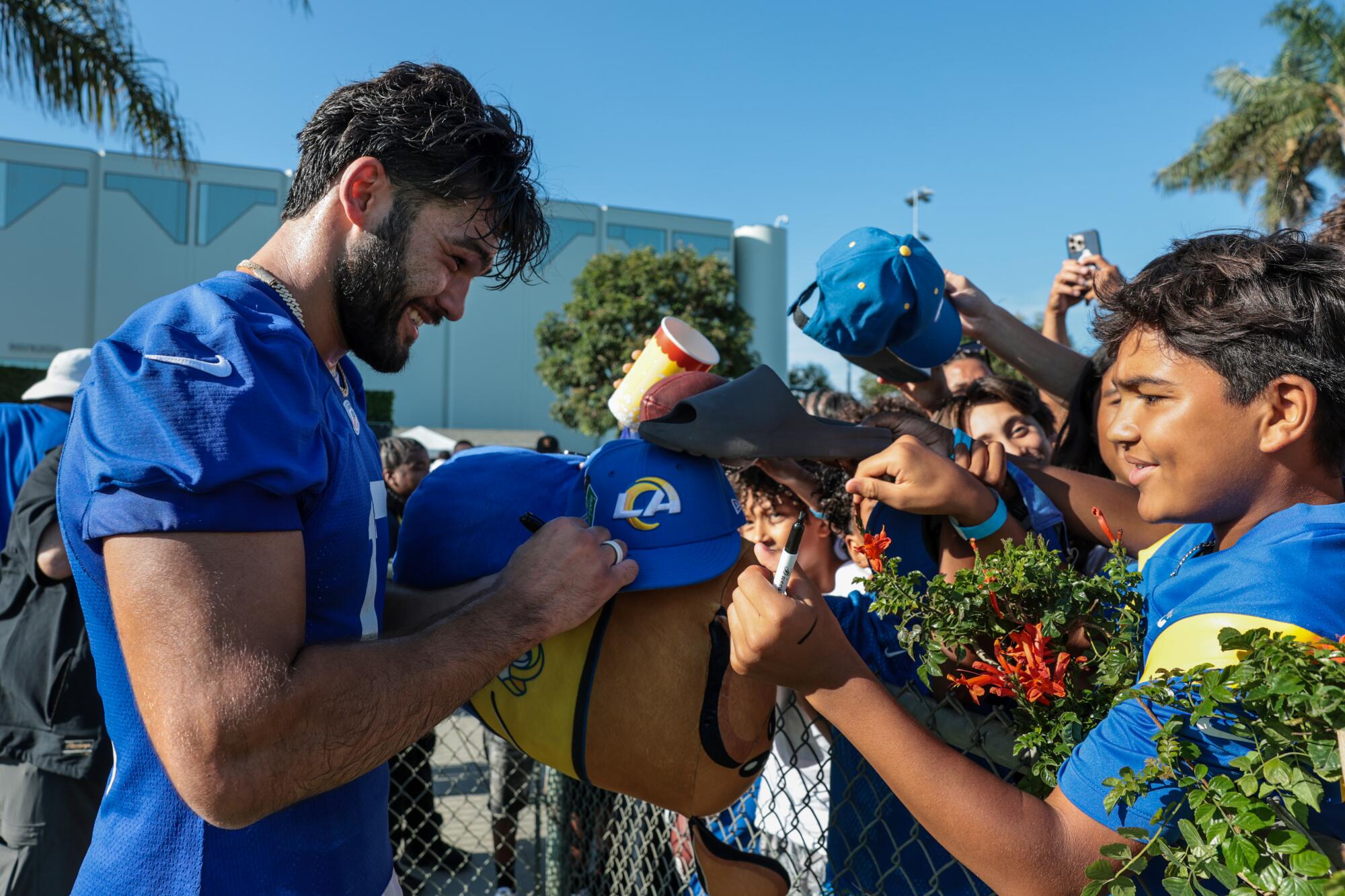
Rams receiver Puka Nacua signs autographs during training camp at Loyola Marymount University on Sunday.
(Robert Gauthier/Los Angeles Times)
Nacua said Wednesday that he’s trying to be better, to do better.
“Definitely trying to take accountability for the things that I know that I can continue to change,” the 25-year-old said at Rams’ training camp at Loyola Marymount.
We should all hope so.
There’s enough at stake, don’t you think?
For Nacua, there’s the proverbial bag to secure. For the Rams, there’s the Super Bowl at SoFi Stadium, which everyone believes should be theirs for the taking. And there’s what winning will mean for the franchise’s stature in L.A., a city that’s impressed by little that’s short of championships.
Don’t mess this up, Puka.
No one wants the distraction of bizarre and disturbing behavior, of internet idiocy or civil lawsuits. (Nacua’s attorney, Levi McCathern, said the alleged bite was the result of “horseplay” and the Los Angeles city attorney’s office indicated last week that the matter was on track to be resolved through a program that allows eligible defendants to avoid criminal prosecution and jail time.)
No one wants to wonder what could have been if it turns out quarterback Matthew Stafford can’t count on Nacua getting open and punishing defenders downfield.
And no one should want to see the Rams’ sure-handed wide receiver let generational wealth slip through his fingers.
Nacua is one of those athletes who you trust on the field to make the play, but all his off-field shenanigans gave the Rams reason to doubt him, to make him skip his turn at the big payday.
He was up for a contract extension that could have paid him as much as $160 million over four years, instead he’ll be earning $5.8 million this season. He’ll have to prove himself to the Rams as a reliable investment.
But that’s OK, Nacua said. He’s happy to be back at work.
Rams receiver Puka Nacua tries to slip past defensive back Trent McDuffie during training camp at Loyola Marymount University on Sunday.
(Robert Gauthier/Los Angeles Times)
“There have been things outside of my control that I think have impacted the way I’ve been able to kind of focus and enjoy this game of football,” he said. “But coming out here and seeing that jersey No. 12 hung up in my locker is something that I don’t take for granted … the level of connection that I feel like I have with all the guys out there, [it] has never crossed my mind that I don’t want to be out here.”
One of the Rams’ primary weapons on offense, a barefooted Nacua went on the charm offensive after practice Wednesday, opening his media scrum by joking with reporters, asking how his hair looked and whether he had any boogers visible in his nose.
He looked fit, like he’s been taking care of himself. He said he was mostly laying off McDonald’s, seeing a therapist and appreciating football as a safe space. The dad of a baby boy, he spoke about that too.
He said he’s closed his “circle of trust” and expressed regret for actions that, he said, “haven’t been the truest reflection of the person I feel like I am, and how my mother raised me.”
“There’s definitely been conversations with her to apologize, but also for her to say that she supports me,” Nacua said of his mom, Penina, who brought up Puka and his five siblings as a single parent after her husband, Lionel, died in 2012.
“And also my brothers are, I think, my biggest critics as well,” Nacua said. “So there were some intense conversations, but loving conversations, in order to see improvement.”
Nacua is one of the Rams’ best players and absolutely their most popular. The loudest roar at Wednesday’s practice was when he showed up on the sideline with fellow receiver Davante Adams. When it was over, the sound of children shrieking “Puka!” reverberated off the bleachers.
The Rams are fans, too. Nacua isn’t tolerated for his talent; he’s adored for his spirit.
Coach Sean McVay loves the guy, a fifth-round draft pick out of BYU who broke a 63-year-old record for the most receiving yards by a rookie in NFL history: “You know how much I love him and the heart that he has,” McVay said Wednesday. “And I’ve been really proud of what he’s been doing and how he’s taking accountability for some of the things that we can learn from.”
Nacua said he was buoyed by messages from teammates during this turbulent offseason, in which he checked himself into a Malibu rehab facility to, as attorney McCathern said, “focus on his health, personal growth and overall development.”
We all know how valuable Nacua is on the field, but now we’re going to find out how much he values this opportunity, getting to take another rep to repair his reputation.
We’re going to find out if this man of many routes can run straight-and-narrow. Whether the slow-moving train wreck can get back on track. Whether he can keep stacking incident-free days.
Nacua says he can. “I feel,” he said, “very confident about that.”
Almost five years ago, “Spider-Man: No Way Home” swung into theaters in the teeth of a COVID-19 surge and did what almost nothing else could that winter: drove cooped-up moviegoers to cinemas and opened to one of the biggest domestic debuts on record, pulling in $260 million.
This weekend, Peter Parker is back — a little older, more world-weary and facing a far less forgiving market.
The genre’s floor has dropped out since then.
Annual box office revenue for superhero movies is down, on average, about $3.5 billion, about half of what it was during the pre-pandemic years of 2017 to 2019, according to data from the FranchiseRe industry newsletter. Sony Pictures is betting that more real-world stunts, a relatable narrative and Spidey’s lasting popularity are enough to put “Spider-Man: Brand New Day” on the other side of that trend.
Whatever the approach, the commercial appetite is there. Pre-sales for the film, which stars Tom Holland and Zendaya, have been robust, and industry tracking estimates an opening weekend haul of at least $195 million in the U.S. and Canada. If that holds, it would be the year’s biggest domestic debut, beating Walt Disney Co. and Pixar’s “Toy Story 5” ($159.7 million). The movie cost about $225 million to produce and is produced by Sony’s Columbia Pictures, Marvel Studios and Pascal Pictures.
“This movie takes a grounded, emotional approach to the story, and I actually believe that’s what audiences are hungry for,” said Tom Rothman, chairman of Sony’s motion picture group. “It’s got all the whiz-bang wow visuals. But at its heart, it’s more a superperson movie, if you will, rather than a superhero movie.”
“Brand New Day” picks up where the last film left off. A spell has erased Peter Parker from the world’s memory — the price of undoing the public exposure of his identity — leaving him a stranger to his best friend, Ned, and to MJ. Without those friendships, he pours himself into his crime-fighting work to stave off his loneliness.
That feeling of being adrift without knowing where to turn is what the filmmakers built the movie around.
“We’re all really isolated from each other,” said Amy Pascal, one of the film’s producers who has overseen the entire franchise. “That kind of longing for connection between people and not knowing how to make it happen and living in a world where we become more and more remote, matched the moment that people are going through.”
The smaller scale was also a reaction to what came before it. “No Way Home” brought back Tobey Maguire and Andrew Garfield in a time-bending multiverse crossover, and there was no topping it.
“That was a movie that was 20 years in the making,” Pascal said. “There was no way to be bigger than that. So we went smaller. We went internal instead of external, and we found the bigness in that.”
Peter Parker’s isolation is what drew director Destin Daniel Cretton, who made 2021’s “Shang-Chi and the Legend of the Ten Rings” and was an executive producer on the Marvel Television series “Wonder Man.” He said he related to the pain and tragedy the character goes through, and to the idea of a superhero story that felt like it was happening in a real place.
The production’s rule of thumb became trying to execute scenes practically, in front of a lens, wherever possible.
That included a tank chase shot largely on a street in Glasgow, Scotland, on the first day of filming, complete with a rig that let an actor swing with explosions going off behind him. Thousands of people showed up to watch, which was “a big adrenaline rush on day one,” Cretton said.
A later set piece — Spider-Man against a group of red-clad ninjas known as the Hand — was shot at a former prison outside London.
Cretton’s insistence on real locations has an argument behind it. At a moment when audiences want to know what goes into moviemaking and are increasingly unsure whether the myriad images they’re looking at were generated by artificial intelligence, the answer is visible labor.
“Right now, more than ever, I think it’s important for audiences to really feel that people made the thing that they’re watching, and people went through an experience to make the thing they’re watching,” said Cretton, who grew up watching behind-the-scenes segments on his favorite DVDs. “All of that, I think, is just as important as the thing that they’re watching.”
Effects alone don’t carry a superhero movie — or any movie, for that matter — anymore, Cretton said.
“The action can be great, the [visual effects] can be fantastic, the explosions can be huge, but if there isn’t some type of emotional spine that connects with people where they are and what they’re going through, it’s just another big, explosive movie,” he said.
The slump itself isn’t in dispute. Many of Marvel’s newer films haven’t come close to the heights its predecessors once cleared, and this year, movies like Amazon MGM Studios’ “Masters of the Universe” and Warner Bros. and DC Studios’ “Supergirl” underperformed in theaters.
What’s driving it is contested.
“I don’t think it’s fatigue of the genre,” Rothman said. “I think it’s the audience wanting new things and less predictability.”
For Marvel, long treated as the genre’s gold standard, part of the problem was volume; a dense web of interconnected films and TV shows that made casual viewers feel like they had too much homework to do before a new premiere.
The likeliest near-term explanation for that estimated $195-million opening, though, may have less to do with tone than with supply and brand. “Brand New Day” is the first Marvel superhero film since last year’s “The Fantastic Four: First Steps,” and Spider-Man remains one of the most commercially durable characters in the genre.
The calendar is also less accommodating than it was. The latest “Spider-Man” installment opens against Christopher Nolan’s “The Odyssey” and holdovers including “Toy Story 5” — a considerably more crowded field than the thin, pandemic-era slate its predecessor benefited from on the way to $1.9 billion.
And the movie has a second job. With Disney and Marvel’s “Avengers: Doomsday” arriving at the end of the year, “Brand New Day” has to leave audiences wanting it.
“It’s got a lot riding on it,” said Steve Granelli, a teaching professor and division head of communication studies at Northeastern University. “Not just in terms of this being yet another ‘Spider-Man’ film, but also this being a huge storytelling device in the larger [Marvel franchise].”
Which is the tension at the center of the pitch. The filmmaking team went internal on purpose, and built a movie about a young man nobody remembers. It also has to set up the largest external event on Marvel’s calendar.
CHICAGO — In the nearly nine months since he was hired as head coach at UCLA, Bob Chesney has won over a lot of hearts and minds with his unwavering sense of belief.
First, he won over his star quarterback, Nico Iamaleava, who opted to stick with the Bruins after a 3-9 season a year ago. He won over 45 new transfers, who came to UCLA as part of the portal’s 11th-ranked class and seems to be winning over recruits, too, with UCLA currently ranked in the top 10 among 2027 classes. He even won over once-dormant Bruin donors, who, according to the school’s athletic department, have now poured over $41 million in private support into UCLA athletics over the past fiscal year, an increase of 80% from the previous year.
“It’s his energy, man,” Iamaleava said. “He brings a different type of energy.”
At this point, the only thing it seems Chesney hasn’t won yet at UCLA is an actual football game.
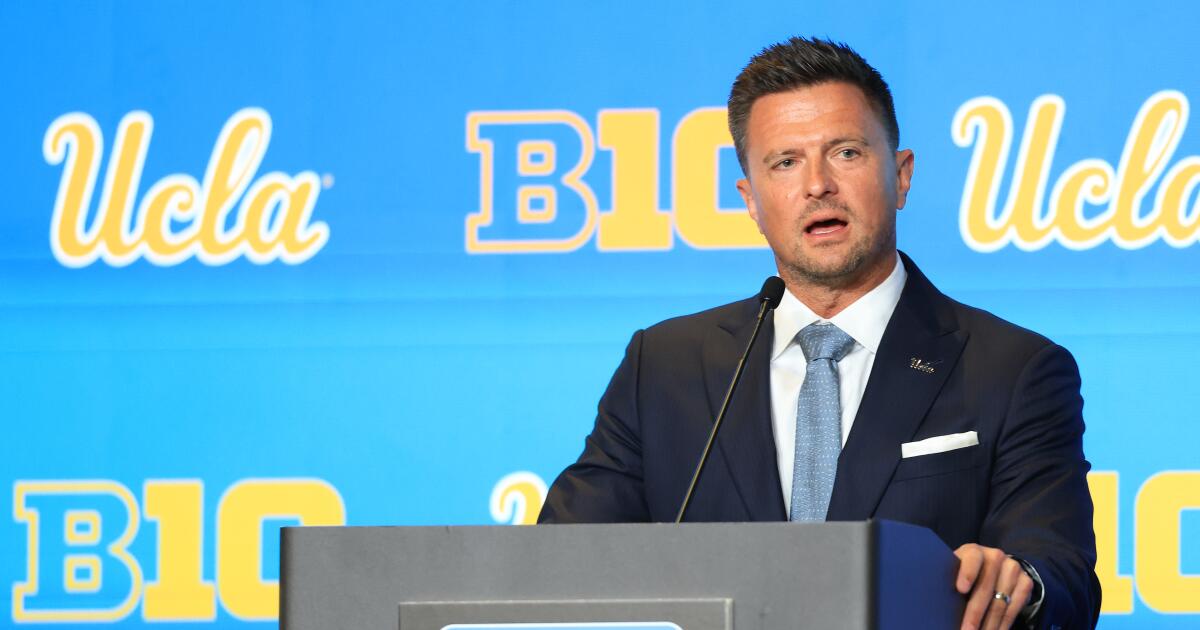
He couldn’t do anything about that Wednesday from the podium at Big Ten media days. Though, as far as first impressions go in this conference, Chesney certainly had a leg up on his predecessor, who stumbled through his own opening address two years ago.
But as the season draws nearer and a new era of Bruin football begins, all the enthusiasm does beg the question: What does a successful debut actually look like for Chesney at UCLA?
Chesney said Wednesday he had no interest in setting those expectations or “in putting artificial limits on ourselves.”
“Outcomes have to be earned,” he said. “And I think in the end, potential is a gift, right? The work is becoming. That’s the work.”
Considering UCLA’s recent history, you can understand why Chesney wouldn’t want to wade too far into setting expectations. Hope, after all, may be his most valuable resource at the moment.
The Bruins are coming off a season in which they won just three games, their fewest in more than 54 years. They’ve reached the nine-win mark once in the past decade. And just two UCLA coaches in a half-century — Jim Mora and Terry Donahue — have clocked a winning campaign in their debut seasons with the Bruins.
“There’s no better place I’d rather be at this moment in time,” Chesney said. “I strongly believe in the power of what UCLA is.”
The collective Big Ten media seems less convinced, having voted the Bruins to finish 13th in their preseason conference poll. That’s exactly where they finished last season.
But there are some things working in Chesney’s favor. For one, a schedule that includes just four opponents picked to finish in the top half of the Big Ten.
It doesn’t hurt, either, that his quarterback got a full spring and summer under his belt as a Bruin. Iamaleava didn’t join the program until late in the process last season after his transfer portal drama dragged out through the spring and summer. Then once he started to find his bearings, UCLA’s coach was fired.
There was no such uncertainty this offseason, as Chesney moved to quickly retain Iamaleava.
“It was a matter of making sure he understood we had a plan,” Chesney said. “That was the most important thing we could do to make sure he stuck around and he did.”
Not only was Iamaleava impressed with his plans to prepare him for the NFL, but he found himself right away swept up in the coach’s personality.
“When you first talk to him,” Iamaleava said, “it kind of sounds like you’re talking to a poet or something, the way the words roll off.”
Chesney is counting on Iamaleava to make things move smoothly for UCLA’s offense this season. But the most marked difference for the Bruins on that side of the ball should be the ground game.
The Bruins boasted one of the least dynamic rushing attacks in the Big Ten a season ago, as Iamaleava led the team with just 505 rushing yards. Their lead running back, Jalen Berger, rushed for a meager 364 yards over the course of the season.
Meanwhile, at James Madison, Chesney had three running backs with as many yards last season. The Dukes rushed for the fifth-most yards (3,381) of any Football Bowl Subdivision team.
Their lead rusher, Wayne Knight, followed Chesney to UCLA and should step in as one of the best backs the Bruins have had in years. Of the 30 backs in college football with over 200 carries, Knight averaged the most yards per carry last season (6.63).
“There’ll be a commitment to playing that style of football,” Chesney said.
The rest is mostly just a projection, a fact that Chesney openly acknowledges.
“Everything here is ultimately conceptual,” he says.
But one change has already taken hold, if you ask Iamaleava. One that might appear unrecognizable from recent history at UCLA.
“He’s definitely changed the mindset in there, just how you feel. I don’t know how to explain it,” Iamaleava said.
“When Ches walks into a room, he just brings that winning mentality.”
One balmy October day in Havana, as the Cuban French sister act Ibeyi plotted the video for “Offerings” — an electro-spiritual ballad from the new album “Offering,” released in June — Lisa-Kaindé Díaz unceremoniously asked her twin Naomi Díaz, to ceremoniously shave her head on camera.
Naomi was accustomed to Lisa-Kaindé’s whims long before they became professional artists. But to take a blade to her sister’s voluminous curls would be a bridge too far.
“I was like, ‘Hell no. I’m not doing that!’” Naomi recalled to The Times, over a Zoom call from Paris.
“As always, when I come with my woo-woo stuff, Naomi is eye rolling like, ‘Girl, what is this s—?’” said Lisa-Kaindé. “But this time around, Naomi was like, ‘OK.’”
The music video ended with Lisa-Kaindé releasing her locks into the sea.
At the core of Ibeyi, which translates to “twins” in the Yoruba language, is the polarity between sisters. Lisa-Kaindé is the bleeding heart who whispers divinity into her lyrics, and Naomi grounds them with the beating pulse of her percussion. They sing in unison, both in tension and harmony. This is the synergy that illuminates their atmospheric approach to the Afro-Cuban jazz tradition.
Born into a musical family in Paris — their mother the French Venezuelan singer Maya Dagnino, their father the Grammy-winning Cuban percussionist Anga Díaz (of Irakere and Buena Vista Social Club) — the 31-year-old sisters jump-started their music careers at 18 when they were discovered by British producer Richard Russell, who also helms the indie powerhouse XL Recordings. After releasing a self-titled debut in 2015, the Díaz sisters appeared in the utopian short film for Beyoncé’s “Lemonade,” then released two more albums under XL: 2017’s “Ash” and 2022’s “Spell31,” which Lisa-Kaindé admitted underperformed expectations.
For “Offering,” they parted with XL and braved the studio as independent artists, inviting new collaborators into the project such as producer Michael Brun (J Balvin, Victoria Monét)and the famed Cuban conguero Pedrito Martinez.
“Things didn’t go the way you wanted them to go, now what does it free?” said Lisa-Kaindé. “It freed a lot of things, in our personal and professional lives,” she added.
The duo returned to their roots in Havana last fall to film the visuals for “Offerings” — as well as other singles “Aset” and “Hurry Hurry,” which were co-directed by Corry Van Rhijn and Roman Pichon Herrera. Family, friends and neighbors filled the frames with dancing and dominoes; their apartments painted in shades of mint, butter yellow and palomino pink, flecked with a patina cultivated by humidity and time.
As Cuba remains a topic of heated debate in the U.S. — or a political football — the Díaz sisters remind listeners that the island nation is still home to over 10 million people, including their relatives, whom they’ve visited regularly since they were little girls.
In 2027, Ibeyi will embark on a North American tour, which kicks off Jan. 27 at the Fillmore in San Francisco and includes a stop at Pacific Electric in Los Angeles on Jan. 29. (“I want everybody to cry, dance and twerk that ass at our shows!” said Naomi.) The Díaz sisters spoke to The Times about their season of upheaval and the recovery that informed their first independent outing yet.
This interview has been edited and condensed for clarity.
What has changed for you the most since you released “Spell31?”
Lisa-Kaindé: A lot has changed, personally and in the world. We needed to stop for a little bit and gather our thoughts, reflect on our career and all that we have done. We went from anger to sadness to acceptance. We left XL Recordings, which was our home for 10 years [and] three albums. We also stopped working with Richard Russell, whom we love. He was one of the first people to hear the album. But we really needed to experience something new.
Naomi: We started when we were 18, and now we’re independent and more in control than ever. We tried to find new producers with whom we felt a deep connection. That was like leaving a marriage and going on Tinder and having lots of bad dates… Our sound is so strong that we’d eat them, so we had to find producers whose sound could stay strong with ours.
I hear a lot of heartbreak in this album, but also making peace with that. How do you personally heal from the pain of such endings?
Lisa-Kaindé: We just go through the s—. There’s no other way. I think we should all be courageous to change. Look into the mirror and be like: “Who am I? What do I want to do?” And just live. L-I-V-E. It could also be L-E-A-V-E.
You have a T-shirt that says, “I used to make spells, now I make offerings.” What does that mean to you?
Lisa-Kaindé: “Spell31” [went] hand-in-hand with my high expectations. I felt like we needed to put a spell on the world, so that the world would love us. When “Spell31” didn’t meet the expectations I had, it was painful. I went into a meditation and came out thinking: “I used to make spells. Now I make offerings.” Suddenly it was so obvious I was trying to feed myself from the wrong source of protein. What if I just gave without expecting anything?
Some of your lyrics name orishas from the Yoruba religion, such as Elegua and Olokun. What does your spiritual practice look like?
Lisa-Kaindé: The older we grow, the more religious I’m becoming … but Naomi lives her spirituality in very different ways. For her, twerking in a sweaty club can be one of the most spiritual things ever. She’s getting more and more gangster.
Naomi: It’s how we grew up. We never use the word “spiritual,” but spirituality can be a lot of things. To me, there’s nothing more spiritual than being in [famed Atlanta strip club] Magic City. Some people are gonna light a candle. Everybody can do whatever the f— they want.
Lisa-Kaindé: It’s about living in a way that is aligned with what makes you vibrate, what makes you feel alive.
What was it like for Naomi to cut Lisa’s hair in the video for ‘Offerings?’
Naomi: I was scared that she would not like her reflection. She came [to me] with, “Can you be the one shaving my head?” And I was like, “Hell no. I’m not doing that!” She was like, “Please, [it’s] really important for me as a twin.”
We didn’t have any mirrors. It was tough, but [as] I was doing it, I was like, “I hope she’s gonna love herself.” At one point I looked at her and I was like, “Oh, you’re so beautiful!” And she was like, “If Naomi tells me I look beautiful, I am.” It was really powerful.
In the closing track, ‘Lucky,’ you sing: ‘We can’t manifest for s—; God will always choose for us.’ Be honest, is this in response to those trending videos on social media about manifestation magic?
Lisa-Kaindé: Funny enough, we’ve never talked about this to the press. … But I went kind of cuckoo with the manifestation while making “Spell31.” I started writing three times a day: “It’s gonna do well.” It was the first time I ever did that. And when it didn’t work, I was like, “What do you mean? I did all of the things y’all told me to do!” And that’s why I’m saying we can’t manifest for s—. What happened was exactly what was supposed to happen.
My own outlook changed after a priestess told me to keep an altar to bring offerings to my ancestors. If you want something … you have to give the universe something to work with!
Lisa-Kaindé: You need to give! That doesn’t need to be a religion or whatever. Just be kind. It’s an exchange. There’s always a price — and that doesn’t have to be a terrible thing. It could be a very beautiful thing. I think it’s better if there’s a price. You’re not just demanding the universe to give you something just because you say it enough times.
I sense more thunder in the sounds of ‘Offering,’ especially in Naomi’s percussion. ‘Mosh Pit’ is a storm of trap and acoustic elements. Can you talk about making this song?
Naomi: This was the first song we made for the album. We met Michael Brun, who is Haitian and lives in New York. We wanted a tough energy, we wanted dragon energy in this song. I listen to a lot of rap and trap, so there’s a little more of myself in this. Ibeyi is like a needle between Lisa and I; for 10 years, the needle moved a little more toward Lisa, but now it’s moving toward me. Life is like that.
You shot multiple music videos in Cuba. What made you decide it was time to make these videos in Havana?
Naomi: We recorded the videos in September and October. We wanted to show Cuba because it’s remembering our dad. Home is Paris, London and Havana for us.
Lisa-Kaindé: After having done the visuals from “Spell31” inside the studios … we needed something more personal. We had never done visuals in Cuba, but I think it’s because we’re very protective of Cuba. We’re protective of what the world sees Cuba as, whether it’s the old ladies smoking cigars, or the American cause. We’d go there in the summers [for] our whole lives. We wanted to show something beyond what tourists see. These are the people who actually live there. It’s important to know how people live.
Naomi: We wanted to be with our people and show the real Yoruba, Cuban way of living. Parties full of elderly people, young people … everybody twerking!
This big house party happens in the video for the song ‘Aset.’ Can you tell me about shooting the party scene?
Lisa-Kaindé: Funnily enough, I think our family was more involved behind the scenes. Naomi’s best friend helped with all of the wardrobe because she’s a fashion girlie. One of the directors we’ve known since we were 15 years old, he’s like a brother to us. We also worked with a conguero, like our dad, his name is Karín. We filmed the “Offerings” video in his house. Then we went to La Playita 26, which is not far from our old house, to look at the sea.
Naomi: What’s beautiful is that it was all real. It was also [full of] people we didn’t f— know. But it was raw.
Lisa-Kaindé: The day we filmed “Aset,” when I saw Naomi dance, I was like: “Here we are. Here is that freedom [we’ve been] missing.”
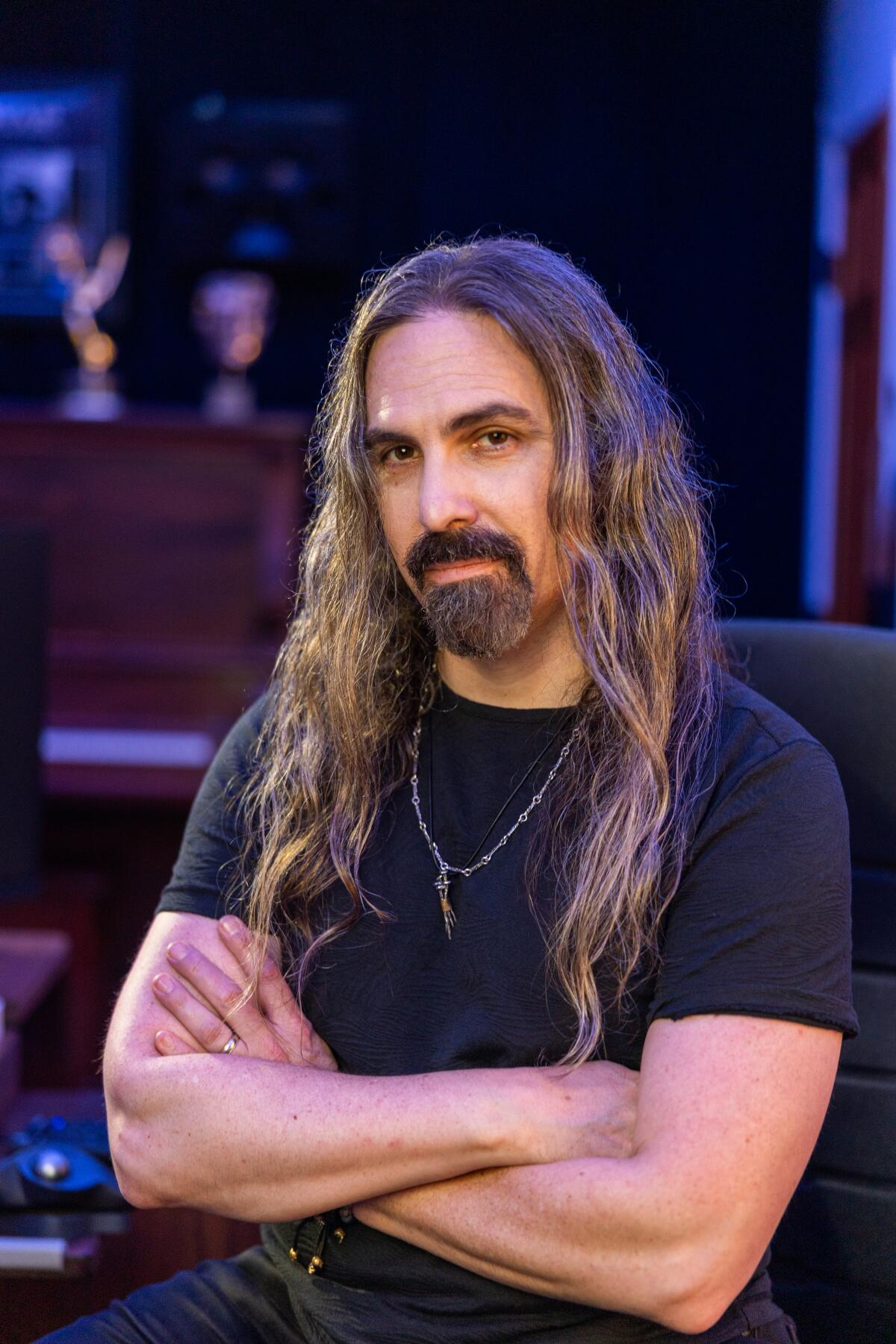
Emmy-nominated composer Bear McCreary has taken a reverse road to symphonic rock. Prog rockers have traditionally integrated symphonic elements; other rock bands have done orchestral versions of their songs. McCreary began creating television and film scores, discovered his inner metalhead, and has since bridged those worlds with his “Singularity” project. It all adds up to a different take on that time-honored formula.
The second of the two albums, “The Singularity: Ekleipsis,” is out Friday and features contributions from guitarist Steve Vai, Coheed and Cambria frontman Claudio Sanchez, Fall Out Boy frontman Patrick Stump and McCreary’s younger brother Brendan, who sings on half the tracks. The multifaceted album feels like “I am Bear, hear me roar.”
“I love that quote,” he says, laughing, during his two-hour interview with The Times. “I want to put that on the posters. I feel like ‘The Singularity’ is a temper tantrum of a record from someone who had been writing music for other people for 20 years, then all these ideas exploded out.” Two years after the release of the first “Singularity” album, “Ekleipsis” feels more focused and personal to him.
From Anthrax dinners to sessions with Slash, Stewart Copeland and Bulgarian choirs, McCreary’s restless curiosity drives genre-bending songs that wrestle with identity, diaspora and the world listeners are trying to survive.
(Allen J. Schaben / Los Angeles Times)
The first “Singularity” double album — which featured guests like Serj Tankian, Corey Taylor, Rufus Wainwright and Joe Satriani — tied into a graphic novel about a man who repeatedly experiences loss and death at the hands of a villainous character in his every life across their multiverse. This leads to a major revelation at the end. Although McCreary says that “Ekleipsis” is not disconnected from that universe, it is not strictly tied to a narrative.
“I wasn’t setting out to write a concept album again,” McCreary admits, “but there’s something immediate in all the lyrics. Half of them are specifically talking about the world that we all find ourselves living in and trying to overcome in some way.”
McCreary’s sonic diversity continues with “Ekleipsis.” Gojira frontman Joe Duplantier collaborated with the McCreary brothers and the Mystery of the Bulgarian Voices choir on “Black Box” to create a work of dissonant majesty. The composer improvised his way through the initial stages of “Pray for a Storm,” his high-energy collaboration with famed drummer Stewart Copeland.
“Let’s all go into your studio with nothing,” McCreary recalls telling the irrepressible percussionist. “I’m not even going to bring an idea. We’ll plug in our instruments, set the mics up and play. I want to capture your ideas and your energy, then shape it into a song based on the pieces that I get.”
McCreary sees new endeavors as a learning experience. He meets his collaborators in the way they like to work. He was awed while writing with Guns N’ Roses bassist Duff McKagan and Red Hot Chili Peppers drummer Chad Smith on the anthemic “Cool Kids.”
“Those guys are true songsmiths,” the composer declares. “I think they’re unrecognized as songwriters. They wrote for Ozzy Osbourne. They’re focused on hammering down a riff until it works. We walked into a studio with a riff that Duff had written and walked out with this song that we brought Slash onto. We got that band experience [with them].”
McCreary is best known for scoring series like “Battlestar Galactica,” “The Walking Dead” and “The Lord of the Rings: The Rings of Power,” along with movies such as “Godzilla: King of the Monsters” and the “God of War” video game franchise. He gained entry into metal through a dinner with Anthrax guitarist and “Battlestar” fan Scott Ian two decades ago.
“‘I know you. You’re a guy who loves Sepultura,’” Ian told him, invoking a musical link for the composer. Intrigued, McCreary listened to Sepultura’s folk-infused Brazilian death metal and loved it. His metal journey began.
Ever since, McCreary has been itching to dive into that arena. He has an important collaborator in that quest.
“My brother’s my secret weapon when it comes to rock,” McCreary says. “His body of [rock] knowledge makes up for mine. Our emphasis is in a different place. He is a fantastic producer because he’s got a really good radar for when things are useless, when a part of a song isn’t pulling its weight. It’s a very good influence to have someone like that. He’s got a great lyrical sense and an incredible voice.”
McCreary says Brendan is often the driving force of their lyrical efforts, and “sometimes we co-write with other people. Claudio Sanchez wrote all the lyrics on ‘Sweet Misery.’ It just depends.”
The younger McCreary was the propelling wordsmith on “One Fine Day.” “It’s about our experience as being in the Armenian diaspora and exploring what that means to us,” McCreary elaborates. “All the songs are very personal, which is another thing that sets this record apart from the last record. Many of them were personal, but I also had a weird song about an automaton that fell in love.”
Mentored at USC by Elmer Bernstein, McCreary now leaps from “God of War” themes to a Higgs boson rock musical and a roaring Singularity tour that hits L.A. on Sept. 17.
(Allen J. Schaben / Los Angeles Times)
Before he jammed with rock icons, McCreary was mentored by the late, iconic Elmer Bernstein for nearly the last decade of his life. The burgeoning young composer organized Bernstein’s music archives, sat in on recording sessions and audited his senior-level classes for three years while studying at the Thornton School of Music at USC. McCreary says that Bernstein “really set me on the path that I am now on, not because I learned how to orchestrate or how to write music from him. But he showed me the life that I could envision myself having when I was 15 or 16, that crucial time when you’re really setting the rudder for where you’re going to go in life.”
That rudder has steered him to many shores. McCreary has been co-writing the musical “Particle Fever” with Zoe Sarnak (“Galileo).” Pulitzer Prize finalist and Tony winner David Henry Hwang (“M. Butterfly)” wrote the book, and Tony nominee Leigh Silverman (“Suffs”) is its director. It is based on the documentary of the same name about the discovery of the Higgs boson — the “God particle” — at the Large Hadron Collider in CERN. It will debut at the La Jolla Playhouse in February 2027.
“It is a really kick-ass, earnest rock musical about a really ambitious discovery,” McCreary says. “My hope is that it actually has some of the swagger and fun that people found in ‘Hamilton,’ which also was a very dry subject that you learned about in eighth grade.”
The 47-year-old composer exudes an infectiously upbeat energy. He loves challenges and says he learned that charisma and charm are valuable assets to get in the door to prove one’s talents.
“I’m wired to be very positive and collaborative,” he concedes. “But I got so oppressively excited in my 20s that I started annoying people. My lesson was walk it back.”
His creative energy continues unabated. He’s even scored shorts for filmmakers he met through Twitter. (“I’m down to work.”) He has been blogging about his musical life for 20 years for a core group of followers. (“In hindsight, if Jerry Goldsmith had done that in the ‘80s, my God, my life would be different.”)
McCreary started as a high school keyboardist, then found the accordion in college, an instrument that gave him greater stage motion and which he later used to great effect in his music for the “Outlander” series. He loves to headbang while playing the hurdy-gurdy, an instrument he picked up in 2010 and later employed in the “Black Sails” show and “God of War: Ragnarok” video game. He learned guitar to play rhythm during his 2025 shows.
Those riffs will be on display at the Wacken Open Air festival on Friday and during McCreary’s eight-date September “Singularity” tour of the West Coast that hits L.A. on Sept. 17. McCreary has performed his symphonic scores in Europe and America with orchestras, but now he also loves to rock out (loud).
A big secret of the ambitious McCreary’s success harks back to lessons of simplicity that Bernstein taught him.
“The giant theme that I wrote for ‘God of War’ can be played with one finger on a piano,” McCreary reveals. “That is the thing that it boils down to, and that is what I listen for in music. Most of the time it means there’s a melody in there that sticks with you, and it doesn’t matter how well it is produced or how epic it is or how loud it is. A good song is a good song is a good song, and it really doesn’t matter how good a band performs. If the song is good, it will connect with people.”
He said the quiet part out loud. As the artistic director of New York’s Public Theater and one of the art form’s most prominent leaders, Oskar Eustis is known to do that. And as always, he got the art world talking.
When Eustis, 67, announced Wednesday that he would step down from his role at the Public in 2028 — after 23 years — he said in a New York Times interview that “the American nonprofit theater movement is over.” This has been whispered about and lamented since the COVID-19 pandemic led to temporary theater closures across the country that have since become permanent, but it is rare to hear it expressed so candidly.
Did Eustis, one of the key players in that vaunted movement — the man who helped foster “Hamilton” — really mean what he said? And if so, how does theater move on in the face of obstacles that at times feel as though they are scattered across an increasingly difficult course? In a wide-ranging follow-up interview with the Los Angeles Times, Eustis addressed the path forward.
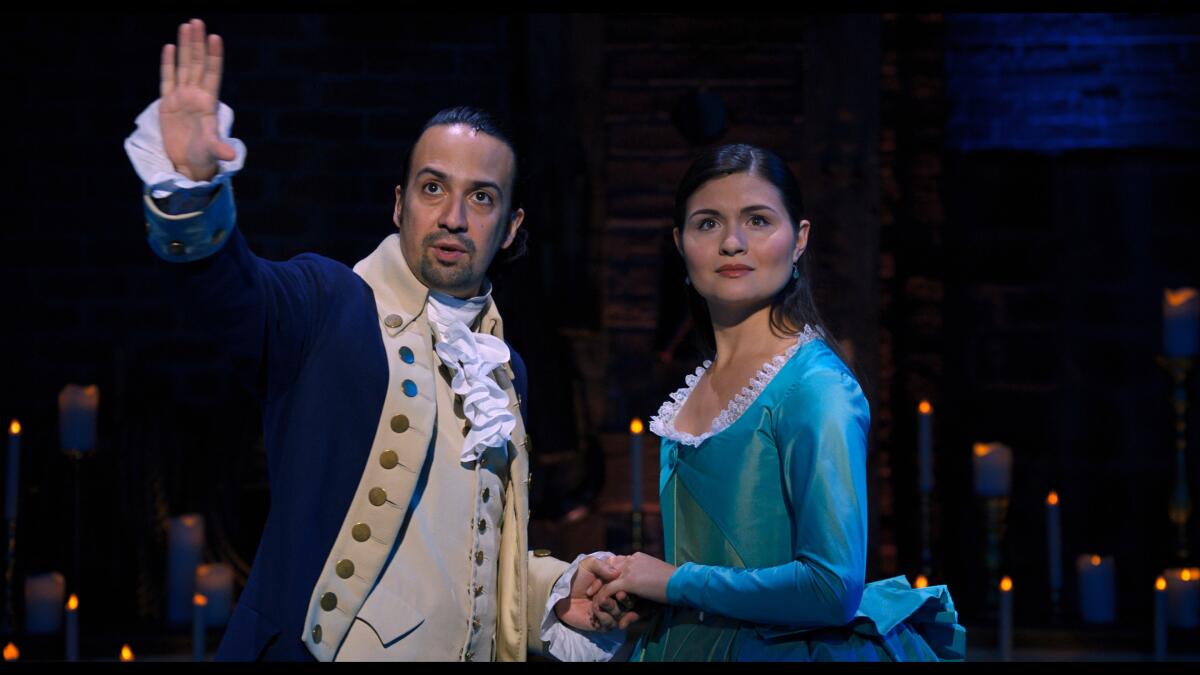
Lin-Manuel Miranda and Phillipa Soo portray Alexander and Eliza Hamilton in “Hamilton.” The megahit premiered off-Broadway at the Public Theater under Oskar Eustis in 2015.
(Disney+)
It’s not an easy one, but Los Angeles theater leaders working in the trenches, including Tarell Alvin McCraney at Geffen Playhouse, Danny Feldman at Pasadena Playhouse and Snehal Desai at Center Theatre Group, already knew that. They talked with the Los Angeles Times about their plans at the crossroads reached by American theater in light of Eustis’ imminent exit.
Eustis traces the rise of the American nonprofit theater movement to the late 1950s when W. McNeil “Mac” Lowry, director of the arts and humanities program at the Ford Foundation in New York, began organizing existing regional theaters into a national movement.
“What happened during that period was that a consensus emerged,” Eustis said, noting that it was expressed in the form of national endowments, state arts agencies, public policy institutes and corporate philanthropic departments. “An idea of the common good was held throughout the country, and there were many stakeholders. And part of that idea of the common good was a broadly held belief that Americans deserved serious, non-market-driven performing arts.”
With no feudal background, America lacked a capital city like London or Paris designed to showcase the arts, so the idea spread across all 50 states. This led to the proliferation of the regional theater movement, said Eustis, as well as that of symphony orchestras and ballet companies.
“The explosion of the regional theater movement is actually, in retrospect, astonishing,” Eustis said. “From a few scattered theaters in the 1950s, by the early ‘70s, there were over 400 professional nonprofit theaters in every state of the union. Tens of thousands of people were employed. Millions and millions of audience members every year. That’s the field that I walked into in the early ‘70s.”
Fifty years later, those stakeholders have “absolutely zero consensus on whether theater should exist as a nonprofit performing arts field or whether we should exist at all,” Eustis said. “It’s gone.”
“We’ve kind of been living, in a way, off inertia of this old idea,” he added.
The great pandemic pause, along with the racial reckoning in the wake of George Floyd’s murder and the continued fracturing of a shared reality under President Trump, served to reveal how fragile that consensus was, Eustis said, and, “It’s not coming back.”
Where does that leave American theater in 2026?
“We’re faced with the need to prove to the people in our individual communities that we matter enough to them that they should support us,” Eustis said. “Now, that’s not a very bad demand to put on an art form.”
Except, as every theater that has lately dared put on a show created by new, experimental or unknown artists knows, it can feel like an insurmountable task.
Danny Feldman, artistic director of Pasadena Playhouse, said that the days of theaters underpaying talent are over.
(Brian van der Brug / Los Angeles Times)
Smaller theaters across the country, including many in L.A., have shuttered with staggering regularity in the last six years, which puts even greater pressure on the city’s most prominent nonprofits to shine a light on a sustainable model moving forward.
Feldman, Pasadena Playhouse’s artistic director, noted that Eustis represents the second generation of leaders of the “first chapter” of the nonprofit regional theater movement. “And that to me is what is now undeniably at the end.”
He said he and Eustis have discussed the subject at length. “We are now in a very different era. And the things that got us to this point are not the things that are going to get us to the next chapter.”
McCraney, Geffen Playhouse’s artistic director, said forging a path forward in nonprofit theater without succumbing to commercial pressure to produce only guaranteed hits requires the delicate balance of surfing.
“And there’s no better place to surf than in L.A.,” McCraney said over the phone from the Public, where he was meeting with Eustis and other theater leaders to share ideas. “I feel very connected to a bunch of folks who recognize that the regional theater model has always had to have radical vision, and that those radical visions need revision, because our most practical job is to make sure that communities have stories.”
Tarell Alvin McCraney, artistic director of Geffen Playhouse, compared the balancing act theater leaders must perform to surfing.
(Jay L. Clendenin / Los Angeles Times)
It’s not just the way theater tells — and funds — stories that must evolve. It’s the entire business model, the leaders note.
The beauty and the founding of the original regional movement, said Feldman, was artists saying, “New York is not just where it’s at. We’re going to go to our communities. We’re going to make things with and for them, and really build these ecosystems that are deeply entrenched in these local communities around the country. … And I think the underbelly of that — that maybe has not been discussed as much — was always an element of subsidized labor involved.”
In L.A. and elsewhere that meant a lot of artists in the front and back of the house working for incredibly low wages. The pandemic effectively put an end to that, and as workers demanded fair compensation, the cost of producing shows skyrocketed. Most theater leaders agree that part is as it should be. Eustis points to the recent unionization of the Public’s production department as a case in point.
“For the first time in history, everybody who’s swinging a hammer on our productions has health insurance,” he said. “They have it through the union. That’s a good thing. And it’s put a shock wave through the whole industry, but you know what? We figured out how to pay development directors. We should figure out how to pay carpenters. That’s part of growing up.”
Center Theatre Group Artistic Director Snehal Desai said Oskar Eustis’ departure from New York’s Public Theater represents a “pass the mantle” moment.
(Etienne Laurent / For The Times)
Desai, CTG’s artistic director, said he views Eustis’ decision to step down as a “pass the mantle moment.”
“Oskar has been a huge mentor to so many of us,” Desai said. “It’s up to us, the next generation of leaders, to figure it out, just as his generation did in the ‘60s, ‘70s and ‘80s when they built these institutions for us.”
At CTG that means exploring a new way of doing things including touring shows, intensive work in various communities and site-specific productions, all of which “can change the financials and the model of how we’re doing business.”
As for Eustis? He plans to leave the Public in the best possible shape for the next generation of artists, and never wavers from its core mission. “This is a theater of democracy that believes that the culture belongs to everybody,” he said.
“Other than going to the White House, there were a lot of people from California, senators from California that are not just people who work for the government, but they’re Dodgers fans as well,” Rojas said Friday before the Dodgers’ series opener against the Mets. “So it’s pretty cool to give people that watch games and support us throughout the year [an opportunity] to get to see us.”
Sen. Alex Padilla (D-Calif.) posted on X, “Think we can do this every year, @Dodgers?” with three photos — one of himself with their back-to-back World Series trophies, another posing with a World Series ring on his finger, and a group shot that included Rojas, Roberts, Klein and Dodgers president Stan Kasten.
Rep. Luz Rivas (D-North Hollywood), whose district includes several San Fernando Valley neighborhoods, posted on social media that she thanked Rojas for hitting his tying home run in Game 7of the World Series.
“Thank you to Miguel and the team for stopping by Capitol Hill,” she posted on X. “We can’t wait to welcome them back again next year (with a THIRD trophy, perhaps?…).”
The Dodgers’ visit to the White House on Thursday frustrated the portion of their fan base that wanted their team to stand up against the president’s anti-immigration policies.
Only two players on the active roster who were part of the 2025 World Series team did not attend: shortstop Mookie Betts, who told reporters he’d rather spend time with his family, and reliever Edgardo Henriquez, who declined to comment via Dodgers PR.
“This is something that I don’t really think about [being] political,” Rojas said of visiting Capitol Hill and the White House. “…I’m representing the Dodgers, and I’m going to these events just because I’m part of the Dodgers, and the Dodgers are deciding to go there. And I feel, as a professional, your job doesn’t just stop when the game is over. You have to do some things outside the field that sometimes are tied to success and to the things that you do on the field. So, for me, it’s a privilege to get the opportunity to go to a place where you will never be if you don’t have success in sports.”
Roberts, who has also talked about separating the visit from politics, kept his review brief.
“It was good,” he said. “It was an honor to be there.”
Ohtani update
Dodgers two-way star Shohei Ohtani is scheduled to throw a bullpen session Saturday, his second since receiving an injection in his left knee at the beginning of the All-Star break.
“That’s the beauty of where we’re at right now,” Roberts said. “We’re not going to push him. There’s constant conversation going on each day. But the main thing is with Shohei and this pitching thing is to remain nimble.”
Even if Ohtani’s bullpen goes well, Roberts said he probably won’t be ready to return to the rotation next week.
“That’s too early,” Roberts said. “I feel good that it won’t be next week.”
R&B singer Nivea publicly revealed her recent leukemia diagnosis on an episode of the Atlanta-based performance and interview series “Cadillac Chronicles.”
In a conversation with host Brian Freeman, the 44-year-old Grammy-nominated artist said she was diagnosed earlier this year and is “grateful to God” for her health as she undergoes treatment.
“I’ve been going through treatment, and everything is going great so far, and I expect it to continue. Amen, amen, amen,” she said on Tuesday’s episode.
“Cadillac Chronicles” features Freeman riding in his 1974 Cadillac Eldorado with a musician, usually a hip-hop or R&B artist. In addition to discussing gratitude, Nivea also performed her hits from the car’s passenger seat, including 2002’s “Don’t Mess With My Man,” which earned her a 2003 Grammy nomination.
It seems the diagnosis hasn’t slowed her down. The singer also revealed she’s working on new music and going to school for audio engineering, which she said she’s “always wanted to learn.”
“I’m doing all the things I want to do,” she said. “Loving on my children, and just being grateful and taking every opportunity that comes my way.”
Nivea — born Nivea B. Hamilton — was married to singer-songwriter and record producer The-Dream from 2004 to 2008, and shares three children with him: daughter Navy Talia, born in 2005, and twin sons London and Christian, born the following year.
She also shares a son, Neal — who performs as Lil Novi — with rapper Lil Wayne.
Leukemia is a cancer of the blood that begins in the bone marrow, which varies based on the type of blood cell affected and the stage of the disease. The “Complicated” singer did not reveal which type she was diagnosed with, but said she maintains a “positive” outlook in all areas of life.
“I’m very grateful for life. It’s so cliche to say, you don’t know the time nor the hour, but it’s true, and it just helped me put a lot of things in perspective,” she said. “I live in gratitude religiously.”
The 2026 FIFA World Cup has wrapped, but some Angelenos who rented their homes to fans are still tallying up profits from a month of soccer frenzy in the city.
Driven by projections of massive tourism and a $750 first-time host incentive from Airbnb, many local property owners expected a sizable payout. While some savvy owners were able to cash in big during the tournament, others experienced only a moderate bump.
But something they all walked away with was some extra cash in their pockets and a blueprint for the LA28 Olympics.
We spoke with three L.A. Airbnb hosts to find out what they earned through their rentals during the World Cup, the luxurious renovations and amenities that helped their properties stand out and what advice they’d give others to prepare for the next global gold rush.
Wellness retreat-inspired house in Inglewood, 3 bedrooms
Lia Pilla turned one of her Airbnb properties into what she calls the Pink Palms Retreat. The Inglewood home features an infrared sauna, a large hot tub and more.
Price during the World Cup: During opening weekend, I got $2,730 for two nights. Of course, I have to pay a cleaning fee, but just in two nights, I’m a few hundred short of paying my mortgage, so that was really cool. For the following games, I maybe got like $400 to $500 a night. Then for the final weekend, I got like $3,400 for four nights, so it went back up.
What updates did you make, if any, to prepare? Last July, I did a full remodel of the house and turned it into what I call Pink Palms Spa Retreat. It’s all pink on the outside. It has an infrared sauna and a huge hot tub that can fit up to like 20 people. It has a large dining table with a firepit on top of the table, lush privacy trees and a custom gym.
Were you surprised with how things played out? I was expecting to make a couple hundred thousand off this World Cup, I’m not gonna lie, but I didn’t so I was like “OK. That kind of sucks.” I think L.A. got a little bit [cheated] with the teams we had. We had Team USA, which was cool, but we didn’t have any of the the big name teams like Argentina or France or Spain, so I think that’s one reason why the prices weren’t as high. I also think the political climate has made a big impact. Some people are scared to come to the U.S. or they aren’t allowed to come. But I’m happy with what I did get.
What’s one thing you’re thinking about doing with the money you made? I always invest back into the business. I want to touch up everything at all of my properties, so it continues to look like the pictures because your reviews are so important. I also have a Europe vacation planned.
Any advice for hosts preparing for the Olympics? Do your research on the market. Think “If I’m traveling to Los Angeles, what would I want?” because it’s also about the experience you create. Know what amenities people like. If you’re starting out or you’re already a host, I highly recommend having software in place for property management, cleaning and pricing.
‘Hillside hideaway’ in Woodland Hills, 2 bedrooms
Matthew Motamedi was surprised to see an influx of bookings on his Woodland Hills hideaway, which is roughly 30 miles away from SoFi Stadium.
Pre-World Cup rate: In late spring, we were charging $250-$280 per night on average.
Price during the World Cup: It was around $300, which is normal during July for us. We undercut the hotels and some of the other listings in our area by $100.
What updates did you make, if any, to prepare? We added a super crazy, comfy couch made of fake fur and people love it. That’s one of the important things about an Airbnb. There needs to be a really good hangout spot, so the couch needs to be super comfortable, and if the couch isn’t comfortable, no one wants to stay there.
Were you surprised with how things played out? Our property was so far away from SoFi Stadium (nearly 30 miles) so I thought it was going to be a non-event for us. It was supposed to be like that, but it definitely affected us because I started getting a lot of European and Spanish-speaking tenants.
What’s one thing you’re thinking about doing with the money you made? We’re definitely putting the extra money back into the property because we’re not there yet. There’s so much we want to do. During the World Cup, I was able to upgrade the AC unit, added a smart thermostat and invested in landscaping, which we want to do more of. We want to invest in the curb appeal and add more outdoor furniture. Maybe a movie room. We also want to get an auto pen so we can write handwritten cards for guests because it’s kind of hard to write perfect handwriting in different languages and in cursive. [Laughs] You can pick a font and it holds a ballpoint pen. To have that would be really cool.
Any advice for hosts preparing for the Olympics? You have to curate the experience and get more involved. If you can’t get involved, you need a co-host. Find a cousin, a sister, a brother, a friend, someone you trust with good taste to help you. Also, don’t just put up random paintings. Make it so that people want to move there. A lot of my guests are like “I wish I could live here.” You need a hotel scent and to provide laundry supplies. Ask your guests about their allergies and snack preferences then put together a snack basket. They freak out when they see that. Have a comfy couch, add plants like the fiddle-leaf fig (it looks bougie and you only have to water it once a week) and get a good cleaner. With that, you’re going to do really well.
Modern suite with luxurious amenities in Westchester, 1 bedroom, 2 guests
How long have you been a host? I started my [rental management] business about 10 years ago, but have been a full-time host for roughly eight years.
Pre-World Cup rate: About $195 a night.
Price during the World Cup: $234, which is about a 15% increase so a little bump. It wasn’t anything crazy.
Were you surprised with how things played out? I probably was expecting a little bit more because it was such a huge event. What I was a little surprised by though was how long the stays were. I was thinking that people were going to come in for a few days, but most of my stays were for a week or longer. We were pretty booked. I think we only had a couple days in between bookings.
What updates did you make, if any, to prepare? We bought the home a year ago and we’ve been getting it ready for the last four months. I added a private hot tub and an Eight Sleep Pod, which is a really fancy mattress topper that heats and cools your mattress. I tried to go all out with my amenities. We’ve got all the fancy soaps, deluxe robes and we added a washer and dryer. I always think about what I’d want when I’m traveling. I always put Q-tips, cotton balls and makeup wipes. For the kitchen, just having all the little stuff you need there. A wine bottle opener is No. 1.
What’s one thing you’re thinking about doing with the money you made? Paying my property taxes and my mortgage. [Laughs] Honestly, we’re putting it toward our living expenses and being able to afford our house. It’s been a huge help because everything is so high.
Any advice for hosts preparing for the Olympics? Really think about what you would want and put yourself in the shoes of the traveler. I always recommend people to try out your space before they rent it out. That will help you realize things like this faucet doesn’t get hot water or I forgot to put an ice cream scoop in the kitchen. You don’t want your guest to be a guinea pig.
If Oxnard to you is just a freeway sign on the way to Santa Barbara or Ojai, you’re missing out on a few things. Like an extensive harbor with none of the traffic or showy affluence of its southern cousins. Miles and miles of white sand where you won’t find another family right next to you as soon as you lay down a towel. A diverse, chilled city with an energetic subculture (Nardcore, anyone?) and some pretty decent tacos.
There are a bunch of ways to spend your time here. Take an architecture tour around Heritage Square, perhaps, or taste your way around September’s Chowderfest at the Maritime Museum. On the water, you can paddleboard ‘til you drop, commune with whales on a boat excursion or skip off to the Channel Islands on a whim.
It’s the only California Cultural District in Ventura County, an honor bestowed by the California Arts Council, which says that “from Guelaguetza and Fiestas Patrias to Juneteenth celebrations, Nardcore punk shows, lowrider cruises, fandangos, and Ballet Folklorico, the district’s cultural life is exuberant and deeply rooted in community.” Rapper/producer and Oxnard native Anderson .Paak named his third album after the city and has hosted the .Paak House music festival in the region.
And Oxnard is a summer home to Netflix darlings the Dallas Cowboys Cheerleaders. For two decades, the Cowboys have held their training camp in the city, and this time around, the cheerleaders will join the scene for Oxnard Fan Night on July 31, the opening ceremony Aug. 1 and toa dance clinic Aug. 2.
Oxnard may not be overly polished, which of course adds to its charm. To get to know the community, you’ll have to veer a few miles off the 101 — but the detour makes for a vibrant SoCal weekend.
LONDON — Ewan Mitchell shares few similarities with Aemond Targaryen, his unhinged character on HBO’s “House of the Dragon.” The British actor, 29, is soft-spoken, thoughtful and quick with a “thank you.” His hair is currently brown rather than Targaryen blond, although he says the color is actually left over from filming Justine Triet’s upcoming psychological thriller “Fonda.” Although he is very different from the power-hungry second son he plays on TV, Mitchell understands him.
“I always empathize with that little kid in Season 1,” he says, speaking from London’s 180 House on a sunny day in July. “He was this neglected, bullied boy. He was never given a dragon egg. So from the beginning he recognized that he was on the back foot, and he was bullied for being different. What’s nice about Season 3 is it’s showing Aemond’s true colors.”
Early in Season 3, Aemond asserted his dominance over his mother Alicent (Olivia Cooke) with a gasp-inducing kiss on the mouth, a moment Mitchell compares to Michael Corleone’s iconic kiss on Fredo in “The Godfather Part II.” The disgraced prince regent left King’s Landing for Harrenhal in search of Daemon (Matt Smith), only to murder Ser Simon Strong and his sons instead. His fray with the Strong family was triumphant, but left Aemond with a wound in his side. He begged the castle’s mysterious inhabitant Alys Rivers (Gayle Rankin) to help him before vanishing for the next two episodes.
In Episode 5, Aemond is back. At first, he appears wounded and broken. But he ably defends Alys from a group of invaders, relying on muscle memory and — perhaps — a sense of honor to pay her back for saving his life.
“I liken Harrenhal to the White Lotus of Westeros,” Mitchell says. “It’s a place you go for a retreat. You have all of your toxins drawn out of you. You have to confront them head on. You discover like the darkest, deepest places of yourself. And the general manager of that place is Alys Rivers.”
In Episode 5, Aemond (Mitchell) fights off invaders, saving Alys’ life.
(Theo Whiteman / HBO)
The upcoming episodes will keep Aemond at Harrenhal with Alys and expand on the events of George R.R. Martin’s 2018 book “Fire & Blood,” on which the series is based. Showrunner Ryan Condal wanted to explore what wasn’t in Martin’s fictional history of Westeros.
“We knew from the book that he goes to Harrenhal and effectively disappears, at least from the interactive narrative,” Condal says, speaking later over video call. “It’s thought that he establishes some relationship with Alys Rivers. We had that as a baseline, but the idea was: ‘Where can we take Aemond from here?’”
He adds that there was “a danger of the character becoming an anime villain,” which the writers wanted to undercut. “He looks a certain way,” Condal says. “He has this eye patch. He rides this Godzilla-sized dragon. And he’s done some pretty reprehensible things.”
But the writers wanted to go beyond Aemond’s surface, to “a different place and excavate that trauma and vulnerability.”
Mitchell says Alys is the key to Aemond finding himself. “We know his dragon Vhagar is missing,” he says. “And if Aemond is nothing without his dragon, then does he really deserve her? We’ve got to challenge what we know of the character already … Vhagar was the wind in his sails.”
He compares Aemond with Spider-Man, an oddly aligned character. “With great power comes great responsibility to wield that power,” Mitchell says. “He’s got to be able to show he can control it effectively. That’s what he wanted to prove throughout Season 1 and 2.”
He laughs: “It’s just like ‘Spider-Man 2.’ I find it really interesting building up this character over two seasons to bring him back down.”
“I find it really interesting building up this character over two seasons to bring him back down,” Mitchell says of Aemond, who is facing turbulent times in Season 3.
(Jennifer McCord / For The Times)
Condal adds, “He’s feeling isolated and alone and he possibly has made an enemy of his family. And then this woman saves him. He feels this sudden magnetic draw to her. In the episodes that follow, we will further excavate that relationship. It’s one of the most surprising and engaging and emotional stories we have this season.”
Mitchell first appeared as Aemond, the son of Viserys and Alicent and the brother of Aegon II, in the eighth episode of Season 1. He was originally played by Leo Ashton, who Mitchell says “really set up the character for me.” Production had already begun when Mitchell auditioned, first with a self-tape and then for the producers. Initially, he didn’t know which character he was up for.
“I knew this character was the younger brother and that was like a theme of the first season and going through further seasons,” Mitchell recalls. “The second son out to prove his worth.”
Mitchell’s audition was memorable. “He came into the room in character and he scared all of us,” Condal says. “I remember the first question that I asked [our casting director] after he left was, ‘Is he always like that?’ Because it felt like he had gone to such a dark place just to do the audition. When I spoke to him later, I loved how different the person was on the phone versus the person I met in the room.”
To play Aemond, Mitchell looked at MMA and cage fighters to hone in on the character’s agile, brutal fighting style. He trained physically to make Aemond lean but also strong and imposing. He took inspiration from paintings, including Alexandre Cabanel’s 1847 work “The Fallen Angel,” which depicts the devil after his fall from heaven.
“There’s this tear in his eye and you don’t know if he’s feeling sorry for himself or he’s looking at things to come,” Mitchell says. “Is he thinking about the harm he’s going to inflict in retaliation? That was something I wanted to do in Season 2. It contrasts his muscular physique. It’s a mixture between vulnerability and sheer muscle.”
Season 2 saw Aemond purposefully incinerating his brother, leaving him badly burned, and decimating the Riverlands while on Vhagar. The character was grappling for power, even if it meant brutalizing his own family. Condal hints that a reckoning with Aegon will come.
“In the great tradition of ‘Game of Thrones,’ I feel like that is a fairly safe bet,” he says. “Characters are scattered all over the map and then slowly find themselves being brought back together, but in different forms. That was always something we were talking about doing with Aemond and Aegon.”
To play Aemond, Mitchell looked at MMA and cage fighters to hone in on the character’s agile, brutal fighting style. He also took inspiration from paintings, including Alexandre Cabanel’s 1847 work “The Fallen Angel.”(Jennifer McCord/For The Times)
Mitchell sees Aemond as a product of his circumstances, rather than just a murdering psychopath. He was bullied as a child and coddled by his mother, but never received the unconditional love he craved. He was taken to brothels from an early age. He lost an eye. And he grew up in the midst of a brutal war between the Greens and the Blacks. Now he has to reckon with what he’s done.
“You might not understand all of the things he does,” Mitchell says. “And you might not feel like you’re supposed to understand all the things he does. But you do feel something for him. In the moment he saves Alys, maybe there is a redeemable Aemond in there somewhere.”
Cooke says she loves working opposite Mitchell thanks to his complex approach to the character.
“He has such intensity and helps me as an actor in playing Alicent to feel like I’m completely on the back foot,” she says in a voice memo. “It’s filled with tension trying to guess what he’s going to do. Yet in reality, he is the most gentle, lovely, quiet, beautiful person. He’s a joy to work with and I think he makes such interesting choices outside of ‘House of the Dragon.’”
Between Seasons 2 and 3, Mitchell filmed Emerald Fennell’s “Wuthering Heights.” He had previously worked with the filmmaker on 2023’s “Saltburn,” for which he auditioned using a Harold Pinter monologue. For “Wuthering Heights,” Fennell simply texted Mitchell asking him to play Joseph, a servant in the Earnshaw house, whose sexual depravity electrifies Cathy.
Aemond (Ewan Mitchell) and Alys (Gayle Rankin) share a tender moment in Episode 5.
(Theo Whiteman / HBO)
“I was like, ‘If you asked me to shine your shoes, Emerald, I would do that,’” Mitchell says. “All of her characters are so vibrant and so nuanced, and there is such a vision you see in her films. She’s a one-of-a-kind, singular visionary. I’ve learned so much working with Emerald that I’ve taken forward in my career.”
One of those things was a more playful, loose approach to acting. During his first two seasons of “House of the Dragon,” Mitchell felt locked into a particular performance. “I learned the scripts verbatim,” he says. “Aemond is such a calculating character and everything he does is premeditated. He’s so in control of himself. I found myself offering up the same take every single take.”
After working with Fennell on “Saltburn” and “Wuthering Heights,” Mitchell felt more freedom. She encouraged him to give a range of performances on set, allowing her to find the character during the editing process. He brought that with him to the third season of “House of the Dragon.”
“With Aemond being so unsure of himself, it happened more naturally,” he says. “He’s learning new things about himself. I was really open to finding the scene organically on the day and not coming in with any preconceived choices. And I found so much more enjoyment in it.”
Condal observed Mitchell’s looser approach. “I don’t think Ewan was ever rigid,” Condal says. “But what I saw happen over the seasons was someone learning from their professional experience. As a massive fan of Emerald Fennell’s work, I can see how being in that very different crucible could help him become his best version. We probably demanded the most out of Ewan in Season 3 than any of the other actors.”
Mitchell says working with Emerald Fennell helped him take a looser approach to acting.
(Jennifer McCord / For The Times)
Since wrapping Season 3 last fall, Mitchell has stayed busy. He filmed “The Way of the Runner” in China with first-time filmmaker Yutong Bai, Gareth Evans’ remake of the 1960s Japanese crime film “A Colt Is My Passport” in Wales, Luna Carmoon’s sophomore feature “To Make Ends Meat” in London and Can Aydin’s directorial debut “The Healer” in Budapest. He then flew to France to work with Triet, an experience he loved because she shot on film. “Knowing you’ve only got a limited amount of time, there’s something beautiful about the imperfections of performances,” he says. “There was such a great energy with everyone in the room.”
Mitchell has been attracted to performing for as long as he can remember. Growing up in Derby, England, he admired films like “Citizen Kane” and “Taxi Driver” because they centered on “characters you don’t completely understand.” He appreciates the scope of projects he’s done so far, from the massive scale of production on “House of the Dragon” to smaller art house films.
“I love working as much as I can and learning,” he says. “I’d love to keep working with debut directors. After the recent films I’ve done and seeing ‘Obsession’ and ‘Backrooms,’ it’s really motivating seeing what they can do.”
Although Mitchell looks nothing like Aemond, he is frequently recognized. Someone stopped him on his way here today to ask for a photo. “I think it’s the chin,” he grins. He knows he’s inextricably linked to the character, for better or worse. He can’t give much away about what’s to come in Season 3, but Aemond is certainly not down for the count.
“What makes him so dangerous is that just when you think he has nothing left in the tank, it’s like, ‘Guess again,’” Mitchell says. “It’s not a question of whether he’s going to do evil. It’s inevitable that he will do it. And it will be brutal and it will be fast.”
He pauses, unsure of what he can reveal. “I don’t want to spoil anything,” he says carefully, “but I can’t wait for people to see what Harrenhal has in store for him.”
It feels like the World Cup started only yesterday, but we’re quickly approaching the final between Spain and Argentina on Sunday. Even if soccer isn’t a sport you typically watch, it was hard not to get sucked into the enthusiasm of the game and cheer for the teams, whether you had a connection to a particular country or not. If you’re among the viewers who are going to feel a little melancholy after it’s all over, you’re not alone. Culture critic Mary McNamara has been enthusiastically following the matches, and if you’re feeling more globally minded as a result, she came up with a list of international TV shows to watch when the the World Cup is over.
My colleagues at De Los, who, like many of us, have been watching the matches on Telemundo (I count myself among them), might be following up their World Cup viewing with some episodes of “El Señor de los Cielos,” the network’s long-running series starring veteran Mexican actor Rafael Amaya. The ads for the show have been a constant between timeouts and matches, and I’m intrigued. And I’ll admit the racy ads for “El Turco” also caught my eye — Telemundo knows exactly what it is doing.
And as the global event winds down, if you’re still hankering to watch something sports related, you’re in luck because Netflix released its latest comedy starring Will Ferrell, “The Hawk,” in which the comedic actor plays Lonnie “The Hawk” Hawkins,” the greatest golfer in the world. The series, which Ferrell created with longtime collaborators Harper Steele and Chris Henchy, reunites him with fellow “Saturday Night Live” alums Molly Shannon and Chris Parnell. However, the person you’ll see him most with onscreen is his co-star Fortune Feimster. The stand-up comedian and actor dropped by Guest Spot to chat about the new series, her experience with golf and what it was like to go toe-to-toe with Ferrell, one of her comedy heroes.
You are reading Screen Gab newsletter
Sign up to get recommendations for the TV shows and streaming movies you can’t miss, plus exclusive interviews with the talent behind your favorite titles, in your inbox every Friday
By continuing, you agree to our Terms of Service, which include arbitration and a class action waiver. You agree that we and our third-party vendors may collect and use your information, including through cookies, pixels and similar technologies, for the purposes set forth in our Privacy Policy such as personalizing your experience and ads.
Also in this week’s Screen Gab, our writers recommend a romance horror film that set the internet ablaze earlier this year and a classic British spy series. — Maira Garcia
Turn on
Recommendations from the film and TV experts at The Times
Inde Navarrette stars as Nikki and Michael Johnston as Bear in “Obsession.”
(Focus Features)
“Obsession” (Peacock)
After earning $428 million worldwide at the box office (on a $750,000 budget) and sending shock waves through Hollywood, the cautionary love story in this romance horror film hits streaming. Directed by YouTuber-turned-horror-auteur Curry Barker, the film follows Bear (Michael Johnston), a shy, hapless guy who, after being unable to summon the courage to confess his feelings for friend and co-worker Nikki (Inde Navarrette), dubiously turns to a one-wish willow toy and hopes for her to “love him more than anyone else in the world.” And, well, the results are chilling — in large part due to Navarrette’s ability to go from completely charming to completely frightening with just her face. If you want to understand some of the online discourse the film has ignited — what it says about consent, its plot holes, whether it’s worthy of the hype or just what the heck was up with that walking backward moment — here’s your chance to see what all the fuss is about. — Yvonne Villarreal
Patrick McGoohan stars in the 1967 TV series “The Prisoner.”
(ITC Entertainent)
“The Prisoner” (Criterion Channel)
The 17 episodes of “The Prisoner,” Patrick McGoohan‘s 1967 existentialist, anti-authoritarian, anti-nationalist, mod-a-go-go avant-garde ode to individualism, have been given a deserved berth in the cinematic pantheon that is the Criterion Channel, looking clean and crisp and immediate. Created in an era rife with screen spies — including the one creator-star McGoohan had previously played in the show aired here as “Secret Agent” — its hero is a British operative who resigns his job in the opening credits, only to find himself imprisoned in a fanciful seaside village — a kind of Baroque hilltown impression of a holiday camp. His unidentified jailers believe there must be a darker reason for his resignation and spend the series attempting it to extract it with elaborate charades, gizmos and gadgets, while our hero spends it trying to bring them down and/or escape. (A giant floating white ball provides creepy security.) Unwilling to bend, impossible to break, McGoohan at once upends the James Bond mythos and provides a dashing hero, clever, witty and terribly attractive. — Robert Lloyd
Guest spot
A weekly chat with actors, writers, directors and more about what they’re working on — and what they’re watching
In “The Hawk,” Fortune Feimster plays Sam, who becomes the caddie for Lonnie (Ferrell).
(Colleen E. Hayes / Netflix)
“The Hawk” gives us a tour of the golf world through the eyes of the titular Lonnie Hawkins (Ferrell), whose better days in the game appear to be behind him. With his trusty caddie Old Henry (Keith David) by his side, he’s feeling like things are looking up — until Old Henry dies suddenly. Lonnie is heartbroken, but he’s not deterred, choosing to continue his ambitious return to the PGA Tour, leading him to be extremely late to Old Henry’s funeral and making a disastrous entrance.
But who will be his new caddie? Enter Sam, played by Feimster, a drifter Lonnie meets in a Walmart parking lot when he pulls over his tour bus. Sam’s late-model Cadillac is broken down in the parking lot, but that doesn’t get her down. Lonnie and Sam strike up a fast friendship, and before you know it, she’s driving his bus and working as his caddie on the course, encouraging him as he goes up against foes like Golden Fisk (Luke Wilson), Anton (Parnell) and even his own son, Lance (Jimmy Tatro), with whom he has a difficult relationship. Her methods are unusual — Sam doesn’t know much about golf, but their mutual love of fast-casual dining and pickles (a running gag in the show) gets them through.
“I’m excited for people to see another big broad comedy,” she says about “The Hawk.” “You know, we need to laugh. That’s what’s been missing, I think, from our current times is we need some more laughter, some more levity.”
The actor spoke about hers and Ferrell’s onscreen friendship, which has become a real-life friendship thanks to their mutual love of sports, how a silly musical moment in the finale came together and why you might see her and interior designer Jeff Lewis together again soon. — M.G.
I feel like a lot of your comedy has some sensibility of who you are as a person and where you come from — the South. How did you relate to Sam in this series?
The heart of Sam was something I really responded to. I love that this was a really silly, wacky character where I got to show off the broad comedy that I often enjoy doing. But I appreciated the trajectory of the character, that they allowed me to have this range where I got to show emotion and be disappointed and angry and just go through a mix of emotions as an actor. That was a really cool road to get to go down. But I love the heart that she had. And I think that’s something that I try to incorporate in my own life, positivity and cheering people on and that belief in people that they can do it.
How much did you know about golf before taking role?
Not much, honestly, other than a few rounds at Top Golf. [Laughs] I’m a sports gal. I love sports. I played sports my whole life, but for whatever reason, golf was the one sport I did not partake in … I even played college sports. This was the one I didn’t have much knowledge of, but luckily my character did not need any knowledge of golf. It almost was beneficial that I did not know what I was talking about. So when Will’s character needed a club, and I had no clue which one it was, that was all very real.
Do you think the show helps make golf more relatable? Golf is presented as a highbrow sport, but Sam and Lonnie, they’re grounded. He found Sam in a Walmart parking lot.
I definitely think it makes it more palatable for people that aren’t familiar with that world. I think that’s why you start rooting for this character, because he’s the outsider that doesn’t necessarily fit in that world. You kind of like that chaos that he brings to this very posh, very put-together sport. That’s why I think you find a lot of comedy in the juxtaposition of that. Comedy’s all about tension and release, and you have a lot of tension with that stuffy golf world and that competition, and then the release is this fun comedy, ridiculous people, crazy outfits — it’s fun to watch the two worlds collide.
I’m so glad you mentioned crazy outfits because there’s this scene where Sam gets herself a leather suit as a reward. Was it hot to wear?
As a comedian, the suit was incredible because it was so ridiculous. And of course, my character would waste her money on something like that right away instead of being responsible with it and saving it. As an actor, that suit was so, so hot. We were filming in the hottest parts of the Valley of L.A. and they did everything they could to make it not just like … my body sweated every two seconds. It sure was rough at times. But for the look of it all and the comedy of it all, it was worth it.
There’s another great moment, in the finale, where you’re trying to motivate Lonnie and you start singing the Chili’s “Baby Back Ribs” song. Was that in the script?
That was in the script, mainly just because anything song related had to have clearance. But there was a lot of riffing between him and I about fast food restaurants and about restaurants in general, and a lot of that was off the cuff, he and I just talking as people about all the fast food restaurants we love. The Chili’s song is that iconic jingle that everybody knows. We took it very seriously getting to sing it with each other … and we were practicing like, “OK, you take this part,” and he’d be like, “OK, no, you keep going, and then I’ll come in.” It felt like a real musical situation that we were prepping for.
Oh, my God, I need to see that outtake. I would be dying.
Luke [Wilson, who plays Golden Fisk] said he had passed by us practicing, and he said it was such a surreal moment seeing how serious Will and I were taking this song.
Fortune Feimster as Sam and Will Ferrell as Lonnie in “The Hawk.”
(Colleen E. Hayes / Netflix)
Speaking of Will, I went through our archives and you told one of our writers in 2023 that you hoped to one day have a career like Will Ferrell’s. Now you’re starring in a show with him. What was it like working with him, and do you feel like you’re getting closer to that goal?
The experience of working with him was definitely a dream come true — he and Molly Shannon, the fact that I’m with both of them on the show is pretty crazy. I feel like everyone growing up has their “SNL” cast that they are like, “That’s my cast, that’s who I watched every Saturday,” and they were definitely my cast. My early knowledge of comedy comes from them, and I’m sure there’s a big influence of them in my comedy now, having watched them religiously. To now be on a show with the two of them does not feel real at times.
What’s nice is I’d done two movies with Will, like very small parts, and had hoped that that would lead to something more in the future and was so lucky that it did. But we really got to know each other a lot better on this show, obviously, because I was basically his right-hand person the entire show. I would say 85% of what I filmed was with him. We just hit it off right away. Our energies are very similar. We’re very similar in our outlook. Our sensibilities of comedy are very similar.
We became genuine friends. He’ll pick me up and take me to a Lakers game. We just went to the World Cup game together. We definitely have a bond of sports. It’s so cool to not only get to be working with someone I admire so much and a comedy hero, but to now be genuine friends, it’s pretty incredible. I’m so lucky that I’m in that position.
What World Cup game did you guys go to?
We went to USA vs. Turkey here in L.A. He wore his visor that says “Hawk” on it. We kept trying to get the camera guy’s attention because we weren’t sitting in a box. We wanted to be in the mix … with the fans, and so no one expected to see Will sitting there amongst the fans.
After halftime, they go around and show different [celebrities] like, “Leonardo DiCaprio is here.” I said, “Will, the camera guy’s looking at us.” Everyone in our section got really pumped about it. We show up on the Jumbotron, and our whole section starts going nuts. And I’m pointing at Will’s hat, he’s dancing, and we didn’t know that it was also on TV. My phone blew up for like the next 30 minutes because everyone and their mother was watching this soccer game. We ended up inadvertently promoting “The Hawk” on this really big world stage.
What’s a TV series or film that you’ve watched recently that you’re recommending to everyone?
I feel like it’s not something that I have to recommend, so many people know of it, but I really loved “Hacks” [HBO Max], and especially this last season of it, I felt like they wrapped it up so beautifully. Sometimes these shows have this good run, and then they sort of fumble it at the end, and I just thought the way they ended that show really serviced all of their characters in such a great way and highlighted this really beautiful friendship from people of different generations.
What’s your comfort watch, a TV show or film that you love to return to and watch over and over again?
A movie that I could watch no matter what … is “Bridesmaids” [Peacock, Hulu]. That movie never gets old. I just think it’s one of the best comedies. Of course, as a female comedian, I love a group of women doing funny things together. And those particular women are just so incredible. I’ve gotten lucky enough to work with Kristen [Wiig] and Annie [Mumolo] — I did “Barb and Star [Go to Vista Del Mar]” with Kristen and Annie. Even though I was a tiny part of that movie, I can watch that movie over and over again. I just love their sensibilities as writers as well.
I promised my colleague I would ask you one more question, about getting your house renovated by Jeff Lewis on “Flipping Out” and what that was like.
That always cracks me up how many people saw that show. I’m working with him right now. I have a new house that he is helping with at the moment.
I mean, listen, he’s a big personality. There’s a reason why they gave him “Flipping Out” for so many years that he has a radio show now [“Jeff Lewis Live” on SiriusXM], and they’re actually bringing his “Flipping Out” show back [“Still Flipping Out” on Bravo], which I did a little bit of that show as well. But as an interior designer, he definitely has this — he kind of walks into a space and you see him calculate things, like “A Beautiful Mind,” where he’s seeing everything in front of him, and he’s very decisive. I’m very indecisive with interior design. Even though he has this … over-the-top personality, as a designer, he’s so gifted. And when you see his work, you’re like, “Oh, my God, this is incredible.”
Obviously he and I have a funny rapport with each other, but now also doing this house, I feel like I’ve learned even more to the point where I know when to give it back to him a little bit. He likes that little ribbing of each other.
London — It’s a scorching day and the city feels blanketed by the heat. Even the unusually strong air conditioning in a suite at the Raffles hotel is no match for the temperature. Octavia Spencer immediately peels off her jacket after entering the room and realizing there are no cameras present for our interview. Hannah Waddingham, her co-star in “Ride or Die,” kicks off her heels as they settle onto a plush sofa.
“You’ve seen that we look nice,” Spencer says. “So now we can do this.”
There’s a relaxed, familiar vibe between the actors. They didn’t know each other prior to filming the series, now streaming on Prime Video, but they did develop a real-life friendship during production in Prague last year. It was perhaps inevitable considering that “Ride or Die,” created by Tessa Coates, is about two best friends whose relationship is upended when one of them is revealed to be a professional assassin.
Spencer, 56, plays Debbie Claybourne, a lawyer whose career has been put on hold due to her British husband David’s political aspirations. The actor was approached by Skydance, now part of Paramount, as part of a development deal with the studio. She said yes almost immediately, and by happenstance both she and the producers imagined Waddingham, 51, in the role of Judith Burton, a skilled assassin who works for a shady organization run by the Director (Bill Nighy).
“It was always just the two of us for these roles,” says Spencer, who won an Oscar in 2012 for “The Help.” “We did a Zoom and I was sitting there thinking, ‘I hope she says yes.’”
In “Ride or Die,” Spencer plays Debbie, a lawyer and wife of a British politician, who is best friends with secret assassin Judith, played by Waddingham.(Dusan Martincek / Prime)
“It’s Octavia Spencer and I’m thinking, ‘Be cool, be cool,’” Waddingham chimes in. “Octavia and Tessa start telling me the plot and at the end I said, ‘Who the hell are you going to get to play Judith?’ Octavia’s face filled the whole screen and she said, ‘We want to make you Judith, dummy.’”
Each professes to be a fan of the other, but Spencer is particularly effusive. She admits to initially having to remind herself that Waddingham is, in fact, an actual person and not Rebecca Welton, her character on “Ted Lasso.” She turns to her co-star. “We know you’re a brilliant comedian, but you also showed us in ‘Game of Thrones’ this depth,” Spencer tells Waddingham, adding, “With her beauty and that statuesque presence she has, this role was literally written with a woman of her caliber in mind.”
Waddingham turns red. “I’m not good when she does this,” she admits.
“Well, it’s very true,” Spencer responds. “I think it was kismet. I knew it was meant to be when we were at the upfronts for Amazon and we were in the wings with Will Ferrell and Reese Witherspoon, just chatting it up. I’ve always had severe stage fright. They walked out and I got really quiet, centered myself, and then I felt these arms around me. She wrapped me up from behind, and it was like, ‘OK, I’m good.’ That’s what it has felt like this entire process.”
Waddingham’s memory of that day, her second time meeting Spencer after their first call, is slightly different. “Octavia is so established in Hollywood,” she says. “I’m still a newcomer in this town. So I was having the worst impostor syndrome that day. I was thinking, ‘I look like a competition winner.’”
Nerves settled by the time the production started in January 2025. Before joining forces in Prague, Waddingham flew to Ischgl, an Austrian ski town known for its party vibe, to shoot the show’s opening sequence. The James Bond-style scene introduces Judith as talented, serious and a bit of a loner. That perception is quickly upended when the character arrives at Debbie’s home in London for their book club meeting and the duo begin singing along to Salt-N-Pepa’s “Shoop.”
“Octavia is so established in Hollywood,” Waddingham says of meeting her co-star. “I’m still a newcomer in this town.”
(Bexx Francois / For The Times)
“That was our first scene together and we didn’t plan anything or talk about it,” Waddingham says. “But we had an unspoken, organic process.”
“We had a lot of trust,” Spencer adds. “I knew she was going to come in with 1000% and that I was going to too. Some of those things you figure out when you’re on the set and some of those things just happen in the moment.”
Showrunner Matt Miller points to the scene as evidence of the actors’ “instant chemistry.”
“It really feels like this is a friendship that has endured 25 years from the moment they get on screen,” Miller says, speaking with Coates over video call later. “From the second you see them dancing around, you’re like, ‘Oh yeah, these two are best friends.’”
Coates and Miller wanted to ensure that the characters’ history was baked into the scripts. They’ve been friends for decades, so there had to be a shorthand between them that was immediately apparent and they had to be on equal footing. The duo are forced on the run across Europe, dogged by their past, and successfully get themselves out of danger.
“These characters came from a great desire to see women like this on screen,” Coates says. “So many stories suggest aging is the worst thing that could possibly happen to you. But what if getting older seemed really cool and you got wiser and better at your job and gave less of a s— about things?”
Coates adds they wanted both characters to be competent and clever women who happen to be thrown into difficult circumstances.
“Women in their 50s are just as capable, just as beautiful, just as sexy,” Spencer says. “We’re just aging.”
Spencer and Waddingham, both executive producers on the series, never sought top billing over the other. Although the show is ostensibly an action comedy, they wanted to ground it in real emotions. Everything is tethered to this friendship.
“Women in their 50s are just as capable, just as beautiful, just as sexy,” Octavia Spencer says. “We’re just aging.”
(Bexx Francois / For The Times)
“There couldn’t be one more important than the other,” Waddingham says. “The thing they say about relationships is that when one is at 90 and the other is at 10, or one is at 80 and the other is at 20. That’s what this had to be straight away. If you have that pendulum back and forth, you can create magic.”
Although both characters find small romances throughout the story, men are sidelined for the far more important relationship: their own. And it’s not always an easy partnership between them.
“There is a love story at the center of this,” Spencer says. “It’s not a romantic love story, but it is a familial relationship. It’s contentious, and the relationship is fractious at points.”
Waddingham adds, “You have to be able to call each other out, and then get through that storm and let the water settle.”
Still, there is a lot of action in “Ride or Die.” Judith frequently kicks ass, often taking on groups of imposing men. It’s deeply satisfying to watch Waddingham, who did most of her own stunt work, take these men down.
“In theater, I never had an alternate,” she explains. “I’m not usually Method, but with this I thought my exhaustion from fighting and the stunt training would lend itself to Judith’s exhaustion and her frailty. It wasn’t particularly healthy, if I’m honest, but that fractured tiredness really helped play the role.”
She adds, “It’s a real art form. The first stunt work I did was on ‘The Fall Guy’ and learning to stop before you punch someone in the face is hard.”
“That’s why I was terrified for you,” Spencer interjects. “Because I did punch somebody in the face. The only other time that I actually had to do stunts was on ‘Snowpiercer.’ It was so exciting watching you, but then I was like, ‘Somebody could hit her for real.’”
Waddingham felt added pressure knowing Judith’s background. “She’s not just an assassin, she’s a notorious assassin of 30 years,” she says. “If you see her punching someone, like when we’re running out of the gala, that punch can’t be some girly thing. You have to believe she can do it perfectly and effortlessly.”
Waddingham did much of her own stunt work in “Ride or Die.” “It’s a real art form. The first stunt work I did was on ‘The Fall Guy’ and learning to stop before you punch someone in the face is hard.”
(Bexx Francois / For The Times)
Both actors approached the show with complete dedication. Waddingham and Spencer appear in almost every scene, which vacillate between action, comedy and drama. Debbie, named after Coates’ mother, feels betrayed by Judith and her husband, who is involved in shady dealings with an Albanian gang. “There were the rigors of it physically, but there was also the emotional rigor of it,” Waddingham says.
“It might have been the most challenging job that I’ve ever done,” Spencer agrees. “The most challenging, but also the most gratifying. I knew I would not be called upon to do any stunt sequences, but I did have physical stuff I needed to do. And then dealing with the emotional weight of Debbie discovering that two very important relationships are not at all what she thought they were was a lot.”
She pauses. “But you know what, why not?” she continues. “We don’t want to be in a comfortable place all the time. You want to know you completed something that was very difficult to do. I feel very proud now, looking back.”
“We couldn’t have left our hearts and our bodies and our brains on it any more than we did,” Waddingham agrees. “It is splattered with us. I’ve been very privileged to go from ‘Ted Lasso’ to this, because ‘Ted’ is a very hard act to follow in terms of that constant and emotional push and pull. This has that as well.”
While filming “Ride or Die,” Waddingham found out Apple TV had greenlit a fourth season of “Ted Lasso,” which premieres Aug. 5. She wasn’t expecting to be pulled back to her Emmy-winning role of Rebecca after the series ostensibly concluded in 2023. “I didn’t know anything about it,” she says. “No clue.”
“We found that out together,” Spencer says.
Waddingham had only two weeks off after wrapping “Ride or Die” before flying to Kansas to film the first episode of Season 4, which sees Rebecca attempting to lure Jason Sudeikis’ Ted back to London to coach Richmond’s women’s soccer team. The rest of the series then shot in England. The new episodes keep Rebecca as one of the emotional cores of the show.
“I haven’t really stopped since then,” Waddingham says. “When I’m older, I’m going to have a little sleep. But this is what you wait for in your life.”
For Spencer, “Ride or Die” has raised the bar on what type of project she wants to do as a producer and as an actor.
“It is hard to get things made,” Spencer says. “I don’t have time to do things just for a paycheck. It has to resonate with me because your time and health are your most valuable commodities, and time is something that you have no control over. As an artist, I want to be fulfilled and when you get a project like this now everything has to compare. I’ve learned to be very discerning.”
She gestures to Waddingham. “Don’t you want to be excited about things?” she asks.
“Yes,” Waddingham agrees. “And it just doesn’t happen very often. But this was remarkable from the beginning. To be able to spend a couple of days together right now and regroup, it’s almost like a therapy session. We’ve had distance to reflect on all the good and all the exhausting, and on what we have created together. I know that neither of us will ever forget this.”
Spencer nods. “It is a dream. I feel very fortunate that we get to look for projects like this for ourselves and have an active voice in procuring those things for ourselves and for other people. But you dream it, and then you get something like this, and it surpasses everything you ever thought you could want.”
Rarely would Sam Neill, who died Monday, carry a film on his own, but what he did in several of them, modestly and dependably, was equally as important. His nuanced supporting work allowed some of the greatest actresses of their moment attain their first fireworks. And even though he starred in one of Hollywood’s hugest blockbusters, it takes a certain kind of confidence to share the spotlight with a dinosaur. Here are Neill’s highlights, all worth rewatching for the sake of better appreciating a sophisticated presence often on the sidelines.
‘My Brilliant Career’ (1979)
Sam Neill and Judy Davis in the movie “My Brilliant Career.”
(Michael Ochs Archives / Getty Images)
Gillian Armstrong’s first feature is a landmark of the Australian New Wave and feminist cinema, signaling the arrival of the great Judy Davis and containing the most erotically charged (and quite possibly the longest) pillow fight in movie history. It works splendidly for countless reasons, not the least of which is Neill’s presence as the charming suitor of Davis’ headstrong heroine. Set in 1897 in rural Australia, the film follows Davis’ Sybylla, who dreams of becoming a writer, an unconventional aspiration given her family’s poverty and societal norms. Then she meets a wealthy charmer, played by Neill, and he proposes. It should be an easy decision, particularly since Sybylla loves him and Neill makes him so irresistible. That Sybylla does, in fact, resist, choosing independence over love and the possibility of perennial pillow fights, makes “My Brilliant Career” so daring and thrilling. — Glenn Whipp
‘Possession’ (1981)
Isabelle Adjani and Sam Neill in the movie “Possession.”
(Metrograph Pictures)
It’s being remade with Margaret Qualley and the main reason for the movie’s notoriety remains Isabelle Adjani’s unhinged, incantatory performance, a collection of freak-outs that’s still unmatched. But one can argue that Adjani couldn’t have gotten there without the slightly milquetoast banality of her character’s husband, played by Neill as one of the least exciting on-screen spies of the 1980s. (She’s already cheating on him when the movie begins.) He doesn’t seem cut out to be a family man either, but Neill’s cuckolded complaining, hard to pull off this confidently, may be what’s driving her to self-harm in the first place. — Joshua Rothkopf
‘The Final Conflict’ (1981)
More than a decade before his “Jurassic Park” role, Neill delivered a chilling turn as the Antichrist in “The Final Conflict,” better known as the third film in “The Omen” franchise, about a couple that unwittingly adopts the son of Satan. In this second sequel, Neill plays an adult Damien Thorn, now a U.S ambassador to the United Kingdom who is determined to stop the second coming of Christ. With sinister smiles and steely glares, Neill makes Damien his own, waging a murderous campaign against a group of priests, his voice dripping with contempt as he vows to slay “the Nazarene” when he is born. — Greg Braxton
‘Dead Calm’ (1989)
Sam Neill and Nicole Kidman on the set of the movie “Dead Calm.”
(Michael Ochs Archives / Getty Images)
We remember Philip Noyce’s claustrophobic cat-and-mouse thriller primarily as Nicole Kidman’s big-screen breakthrough. But, and you may be noticing a theme here, the movie would not work without Neill, who had a gift for playing opposite strong-minded women. Kidman and Neill are a married couple embarking on an ocean adventure to work through the loss of their child. They happen upon a crazy-eyed stranger (Billy Zane) on a sinking schooner, take him aboard and things go south from there. Part Cary Grant, part MacGyver, Neill gives a great physical performance, which he parlayed into well-paying Hollywood action roles for the rest of his career. None came close, though, to his flare-gun theatrics here. — Glenn Whipp
‘Jurassic Park’ (1993)
You go for the dinosaurs and there’s no shame in that. But credit Neill for both understanding the assignment and not quite settling for those awed stares of Spielbergian wonder. His Alan Grant is distinct enough to register as prickly and a little inside himself. He absolutely hates children, even as the whole plot, somewhat obviously, steers him in the opposite direction. He’s not Jeff Goldblum-level rascally, but he’s confident enough to go his own way and make a killer joke at a high-voltage fence. Acting-wise, Neill has already held his own opposite several forces of nature (see above). Raptors were nothing. — Joshua Rothkopf
‘The Piano’ (1993)
Sam Neill in the move “The Piano.”
(The Criterion Collection)
So many of Neill’s most memorable movies feature him supporting the singular vision of great directors, as is the case with Jane Campion’s 1993 landmark. Neill plays the awkward, ignorant Scottish farmer who arranges for a mail-order marriage with Holly Hunter’s mute pianist and then becomes possessive and driven to jealous despair. We hate him. Which was fine by Neill, as he wrote in his 2023 memoir: “There is honour to be found in the second fiddle. Or fourth. No one notices you much, you don’t get nominated for things. But you served. I was there in an important feminist film. It’s a work of art. And look, that tiny little figure in the fabric — see down there on the right — that’s me. It’s a film that will always have a place in cinema history. And I served in it.” — Glenn Whipp
‘In the Mouth of Madness’ (1994)
Finally, a leading role. Granted it’s one in which Neill, strapped in a straitjacket, screams things like “I’m not insane!” But if you’re a fan of his brand of slightly unconvinced heroism, John Carpenter’s horror movie — about an insurance investigator on the hunt for a missing Stephen King-like author — is an enjoyable watch. Carpenter was never one to overexplain things to his actors (it’s why you find so many rich, self-directed performances in his movies) and Neill’s snoop definitely goes through the looking glass, from disbelieving cynic to true believer. Genre movies thrive on his kind of total commitment. — Joshua Rothkopf
And if you didn’t hear your name called, well, you’re feeling like you’re out there on the street behind the police barricade, hot and sweaty, wondering what happened to your dragons and how in this underwhelming Emmy season things could go so wrong.
Share via
With Emmy submissions still down this year, there aren’t as many slots available to salute all the worthy work, leading to some sad omissions — which, for the sake of alliteration and search engine optimization, we’ll call “snubs.” There were also some surprises, some worthy, some about as welcome as the aftermath of a hot dog-eating contest on the Fourth of July.
Now that I’ve whetted your appetite, grab a donut (or a footlong) while I run down the morning’s notables.
SURPRISE: “The Bear” (comedy series)
OK, not that huge a surprise when a series nominated for its first three seasons, and winning for its first, snags another nod. But given the number of people complaining about the show’s pokey plotting, it was fair to wonder if “The Bear” would again make the cut for Season 4. The show dropped its final season three days after nominations voting ended and because things actually happened during this crowd-pleasing conclusion, it’s possible we might be seeing it again here next year too.
SNUB: Jeremy Allen White, “The Bear” (comedy lead actor)
While “The Bear” made the cut for series, the only cast member to join the party was Ayo Edebiri. Past winners White, Liza Colon-Zayas and Ebon Moss-Bacharach were left out, though all will have a shot at returning next year. Whether they will is open to question. Voters seem to have had their fill of the show.
Jeremy Allen White and Ayo Edebiri in “The Bear.”
(FX)
SURPRISE: “Your Friends and Neighbors” (drama series)
The Jon Hamm-led Apple crime drama failed to land any nominations for its first season outside a nod for main title music. Now moved from limited series to drama, it inexplicably landed a single nomination for its enjoyable-enough follow-up season — for the big prize, drama series. No other noms. Nothing for Emmy favorite Hamm. It’s almost as confusing as some of the plotting in the show.
SNUB: “Half Man” (limited series)
Richard Gadd’s limited series was provocative with its brutally violent look at male rage and unresolved trauma. But some voters I talked with found it so off-putting that they never made it past the first episode. Could be we’ve had our fill of toxic male behavior in the news without having to endure it on our down time too.
SURPRISE: Riz Ahmed, “Bait” (limited series / TV movie lead actor)
Ahmed created, wrote and produced this limited series about a struggling actor whose life is upended when rumors circulate he might be the next James Bond. His sharp comic timing and affecting vulnerability landed with voters.
SNUB: Cailee Spaeny, “Beef” (limited series / TV movie supporting actress)
OK, you didn’t like her character and you’re still afraid to drink orange juice after watching the show. But to nominate everyone else from the series and omit Spaeny? That feels like a case of Millennials and Boomers taking out their grievances on Gen Z.
Cailee Spaeny, left, with Carey Mulligan and Charles Melton in “Beef.”
(Netflix)
SURPRISE: Richard Jenkins and Joy Sunday (limited series / TV movie supporting actor and actress)
The weird and unpredictable “DTF St. Louis” had one last surprise for us, as voters indicated their enthusiasm for it by nominating not just David Harbour, Jason Bateman and Linda Cardellini, but also Richard Jenkins and Joy Sunday, who were terrific as the mismatched law enforcement partners. “DTF,” not “Beef,” might now be the limited series to beat at the Emmys.
SNUB: “Stranger Things” (drama series)
Nostalgia, it would seem, has its limits.
SURPRISE: Rufus Sewell, “The Diplomat” (drama lead actor)
He’s overly involved on the show, so why not at the Emmys, too?
SNUB: Kathy Bates, “Matlock” (drama lead actress)
Dirty birdies.
Chase Infiniti in “The Testaments.”
(Disney)
SURPRISE: Chase Infiniti, “The Testaments” (drama lead actress)
Infiniti was overlooked at the Oscars for her lead turn in “One Battle After Another,” but Emmy voters did right by her, nominating her formidable work in the sequel to “The Handmaid’s Tale.”
SNUB: Adam Brody and Kristen Bell, “Nobody Wants This” (comedy lead actor and actress)
Though Netflix’s rom-com nabbed a comedy series nomination, voters took the title to heart regarding its two leads, both of whom were nominated for its first season.
SURPRISE: Yahya Abdul-Mateen II, “Wonder Man” (comedy lead actor)
A show about a struggling actor navigating the indignities of auditions? No doubt voters found it relatable and Abdul-Mateen II made his anxieties and aspirations vivid.
SNUB: Jenna Ortega, “Wednesday” (comedy lead actress)
Wednesday’s child is full of woe.
Megan Stalter, left, with Robby Hoffman and Paul W. Downs in “Hacks.”
Stalter’s loud, boundary-pushing nepo baby Kayla on “Hacks” was divisive, but she coasted to her first nomination on the wave of goodwill surrounding the show’s final season. Cringe comedy enthusiasts are celebrating. Now we await a reprise of her jeans and white T-shirt red carpet look from last year.
SNUB: “Saturday Night Live” cast members (comedy supporting actor and actress)
Admittedly it’s a low bar, but “Saturday Night Live” was better this year, not that voters seem to have noticed. Bowen Yang failed to earn a nomination for his farewell season, ending a four-year streak. And breakout cast member Ashley Padilla was overlooked too, her comic timing apparently too absurd for voters’ tastes.
Hopes were high for “Widow’s Bay,” television’s best new comedy, which arrived late in the Emmy season — so late that its last three episodes weren’t eligible for consideration. But that didn’t stop voters from embracing it, giving the show 19 nominations, including one for Dickey’s turn as the gruff town hall worker who is the Spielberg of overhead projector presentations.
SURPRISE: Connor Storrie (comedy series guest actor)
HBO Max’s hockey romance drama “Heated Rivalry” wasn’t eligible for the Emmys because it’s a production of the Canadian TV network Crave, and the television academy requires the U.S.A. be part of a show’s funding to make the ballot. But star Storrie still received an Emmy invite thanks to his impressive comic turn hosting “Saturday Night Live” in February. The guest actor trophies are handed out during the Creative Arts Emmys, a week before the primetime show, but we’ll likely see Storrie and “Heated Rivalry” co-star Hudson Williams show up to present something during the main telecast. They do want people to watch, right?
It was never actually in doubt. Dearica Hamby was going to stay a member of the Sparks. That was just how she worked.
Even when Nneka Ogwumike came into the fold and the frontcourt became crowded, Hamby didn’t doubt her decision to return to the organization that traded for her four years ago.
Loyalty mattered more than anything else.
“That’s who I am,” she said. “I don’t run away from things. I wanted to stay here and help L.A. get back to where it was and is capable of being.”
In a loaded frontcourt, the 32-year-old Hamby has still found ways to shine. Hamby has led the Sparks in scoring four times and led or tied for rebounding 16 times this season after signing a three-year, $3.5-million contract.
She ranks in the top 20 in the league in rebounds and field-goal percentage (plus 25th in scoring) and is eighth in offensive rebounds in establishing herself as an essential piece to the Sparks’ “win now” attempt.
“I think it’s the challenge, because we are so good and we have so much talent,” said Hamby, who is averaging 14.8 points, 7.7 rebounds and 2.3 assists while shooting 52.8% from the field. “You’re forced to produce, but it’s also a blessing. I know it’s probably hard for coach to manage the three’s playing time and stuff like that, but it’s a beautiful problem.”
Hamby was in the headlines when the Aces traded her after she was pregnant. In September of that year, she filed a federal discrimination complaint against the team and league, claiming she was traded because she was pregnant. The two sides resolved matters before trial.
The new CBA this year created a new rule that requires a pregnant player’s consent to be traded.
“I feel like she’s such an anomaly,” said forward Rae Burrell. “I remember when she had her son, and it was crazy because everybody was saying she was coming back so early, I thought that was insane, but now being her teammate, I see it, she’s just kind of a freak of nature, like she’s so athletic, she can do all types of things on the court that you think looks unorthodox, but she makes it happen, but also just love being her teammate. She’s just good people.”
Since that trade, she has been a regular in the Sparks’ starting lineup while averaging double-digit scoring and around eight rebounds per game. She’s one of the most efficient scorers in the league, too.
But Hamby’s games have been all over the board. Against the Aces, she missed all seven of her shots. Against Dallas and Indiana, she made six of eight shots. She’s had eight games with a shooting percentage above 60% and four games under 40%.
Sparks forward Dearica Hamby, left, tries to steal the ball from Mercury forward DeWanna Bonner during a game in Phoenix.
(Christian Petersen / Getty Images)
Having the three frontcourt players has been an adjustment for coach Lynne Roberts to find how to implement them all in the offense.
“I’m trying to implement the new offense, we’re plugging pieces into play, and things that I may have been able to do last year as freely I’m not as able to do this year,” Hamby said. “So just adjusting for sure, but I think that’s across the board for everybody.”
Before the season, Roberts said that Cameron Brink would come off the bench and Hamby would start. Brink, the only natural center on the team, averages just 17.5 minutes per game primarily because of her 3.7 fouls.
“She’s my vet,” Brink said of Hamby. “I think she’s just such a grounding force for us, and she’s someone that does everything, so I just really feel like I learn from her every day, and I’m just very thankful to be in her presence.”
Hamby averages 3.2 fouls per game and has expressed frustration about the new officiating norms this season, but has avoided true foul trouble. She and Ogwumike work as two fours instead of a team with a traditional five.
“She has a lot of energy,” Ogwumike said. “I think she does a really good job of just having a high motor and going out there and kind of like doing the dirty work. I feel like it’s beneficial to have a loaded frontcourt, to be able to have so many different types of players and a depth where anytime one of us is in, there’s no letdown.”
The Sparks have been the worst defensive team in the league this season and struggled to score when point guard Kelsey Plum was out of the lineup with an ankle injury. Ogwumike might be the other veteran leader, but Hamby has stayed with this Sparks team the past two seasons while Ogwumike was in Seattle.
Now her role has changed, even with that loyalty. She’s playing just over a minute less and they’re asking for better defense and efficiency.
Hamby chose to come back. Now she’s choosing to help build the Sparks up.
“I know my usage is a lot lower,” Hamby said. “A goal of mine the last two seasons was to have those numbers, so to have the same numbers just at a more efficient rate, and so I mean offensively, but with like two fewer shots a game, that’s pretty impressive.”
Some of us are booked and busy six days a week traveling to the Mamanuca Islands of Fiji by way of the current season of “Love Island USA.” But sometimes an escape needs an escape. Peacock has a new beachy series that adapts Elin Hilderbrand’s bestselling 2023 novel, “The Five-Star Weekend.”
Now streaming, the series stars Jennifer Garner as Hollis, a lifestyle influencer grieving the death of her husband who decides to host a getaway to Nantucket with old and new friends — played by Regina Hall, Chloë Sevigny, D’Arcy Carden and Gemma Chan — to try to heal. It’s primarily a story of grief, resilience and female camaraderie. But there are glimmers of romance, too, courtesy of Hollis’ childhood boyfriend Jack, played by Timothy Olyphant. It reunites Olyphant and Garner two decades after they starred in the 2006 romantic comedy “Catch & Release.” And it’s not the only series that features Olyphant this month. He’ll also appear in Apple TV’s “Lucky,” which premieres Wednesday with two episodes, as a con artist father to the titular character (Anya Taylor-Joy). Olyphant stopped by Guest Spot to discuss both series.
You are reading Screen Gab newsletter
Sign up to get recommendations for the TV shows and streaming movies you can’t miss, plus exclusive interviews with the talent behind your favorite titles, in your inbox every Friday
By continuing, you agree to our Terms of Service, which include arbitration and a class action waiver. You agree that we and our third-party vendors may collect and use your information, including through cookies, pixels and similar technologies, for the purposes set forth in our Privacy Policy such as personalizing your experience and ads.
But this week didn’t just bring new summer launches. A look back at some of the standout series and performances from the recent season of television arrived Wednesday when 2026 Emmy nominations were announced. HBO Max’s “The Pitt” and “Hacks” led the pack — you can check out the full list of nominees here. But you may have more fun reading what our awards czar Glenn Whipp considered a snub or a surprise — come for his pitch-perfect Taylor Swift-Travis Kelce wedding comparison, stay for his astute observations. We also checked in with some of this year’s nominees: Rhea Seehorn (“Pluribus”), Sepideh Moafi (“The Pitt”) and Matthew Rhys (“Widow’s Bay”). (And, hey, if you’re a fan of “Widow’s Bay,” be sure to check out TV critic Robert Lloyd’s brilliant spotlight on K Callan, who has received well-earned praise for her turn as Ruth, the town’s forgetful secretary with a secret.)
Elsewhere in Screen Gab, our writers recommend two animated series that expand two beloved franchises. One focuses on the early days of your favorite “Adventure Time” duo, Finn the Human and Jake the Dog, the other revisits Marvel’s band of heroic mutants.
Meanwhile, I’ve been on my own nostalgia kick, revisiting episodes of “Tales From the Crypt” on Shudder. That decaying Crypt Keeper’s maniacal laugh, I fear, makes me feel like a kid again. Let’s see how long that lasts. See you next week!
— Yvonne Villarreal
Turn on
Recommendations from the film and TV experts at The Times
Finn and Jake in “Adventure Time: Side Quests.”
(Cartoon Network Studios)
“Adventure Time: Side Quests” (Disney+, Hulu)
We return to the Land of Ooo in the days when Finn the Human (now voiced by Sasha Knight, Jeremy Shada being almost 30) had not yet turned 13, and the order of the day was to go out and fight things. You’d think reviving a cartoon was easy — just draw the characters, make some similar voices — but we are talking about one of the greatest epics of this century, and I approached this revival with some trepidation. First, I looked to see whether longtime showrunner Adam Muto was still in charge, and he isn’t. But new captain Nate Cash is a veteran of the “Adventure Time” art department, wrote more than 40 episodes of “SpongeBob SquarePants” and was the supervising director on Patrick McHale’s great “Over the Garden Wall,” whose art director Nick Cross is the art director here. The new visual style, which dispenses with the usual outlines and detailing in favor of a sort of painterly Little Golden Book look, is jarring at first, but it grows on you — I mean, I’d buy an “Adventure Time” Little Golden Book — and keeps “Side Quests” from reading like a retread. The stories are good, the new monsters inventive. It’s got spunk. Most importantly, John DiMaggio is back as Jake the Dog, along with Tom Kenny as the Ice King, Olivia Olson as Marceline and Hynden Walch as Princess Bubblegum. Even series creator Pendleton Ward popped in to voice Lumpy Space Princess and write an episode — a seal of approval. — Robert Lloyd
A scene from Season 2 of Marvel’s “X-Men ’97.”
(Marvel)
“X-Men ‘97” (Disney+)
Regardless of whether you attribute it to “fatigue,” it’s no secret that comic book superhero stories have struggled to draw audiences to theaters these last few years. But some of the best offerings of the genre have been on TV. “X-Men ‘97” is a revival of one of my formative media experiences — “X-Men: The Animated Series.” Boasting some returning talent among the cast and creatives, “X-Men ‘97” continues the story of the iconic mutant team as they navigate being superheroes in a world that doesn’t always accept them for who they are. The first season leaned into some signature X-Men themes around tolerance, xenophobia and extremist violence while trying to thwart a superpowered genocidal human-android hybrid that wields an army of killer robots. The second season, which premiered earlier this month, picks up after the cliffhanger that saw members of the X-Men team scattered across time to cross paths with different versions of the powerful supervillain Apocalypse. Expect plenty of action, interpersonal tensions and philosophical dilemmas around destiny and morality. — Tracy Brown
Guest spot
A weekly chat with actors, writers, directors and more about what they’re working on — and what they’re watching
Timothy Olyphant in “Lucky.”
(Jessica Brooks / Apple TV)
Is it even July if Timothy Olyphant isn’t on your screen? Whether you prefer a breezy watch or a grifter thriller, the veteran actor has it covered. In Peacock’s “The Five-Star Weekend,” he plays the cool and charming high school sweetheart who softly orbits the show’s grief-stricken protagonist (Jennifer Garner) as she tries to heal from the death of her husband. The green flags are less obvious with his turn in Apple TV’s crime thriller “Lucky” as John Armstrong, an imprisoned father whose daughter (Anya Taylor-Joy) is on the run after the multimillion-dollar heist he got her caught up in collapses. It has the pair caught between a determined FBI agent (Aunjanue Ellis-Taylor) and the ruthless mob boss (Annette Bening).
And there’s more Olyphant in the pipeline. Production on Season 2 of FX’s “Alien: Earth” is underway. And later this year, he can be seen reprising his “Once Upon a Time in … Hollywood” character James Stacy — the true-life star of late-1960s western show “Lancer” — in David Fincher’s “The Adventures of Cliff Booth.” When does he sleep? When we caught him by phone in mid-June, he assured us he had just completed a lengthy nap. He discussed what it was like sharing screen time with Bening, reuniting with Garner and the small-time sports event that had his attention. — Y.V.
In “Lucky,” you’re playing a con artist who has brought his daughter into a criminal underworld. What did their father-daughter dynamic reveal to you?
There is something compelling about exploring a relationship in which a man has done a lot of damage to his kid without even seemingly knowing it. The idea of hurting your kids is like just the worst nightmare possible. The idea of doing it without even being aware of it makes it even worse. I knew [creator Jonathan] Tropper was behind it all, and he’s an extremely good writer, so I knew it was in good hands with exploring that material in a really elegant way.
You’re known for playing lawmen, but you have also played antagonists — both types of characters are often willing to cross lines or bend rules or sacrifice things to achieve what they see as the greater good. How do you think about those two types of figures?
I do find it compelling exploring the conflict between of feeling like you have to break rules in order to enforce rules and this idea of the original sin. Any interesting character has to be aware they’re capable of sin, except for maybe on “Law & Order,” but for the most part, life is complicated.
In the first two episodes of “Lucky,” your interactions are strictly with Anya and with Annette — both are dynamic performers at different stages in their careers. What stands out to you about sharing scenes with them?
Anya is really impressive because she has a composure and a strength to her that just seems beyond her years. I certainly didn’t have it when I was her age, and I just have a tremendous amount of respect for her and how she handled things on the other side of the camera,. And Annette is just a wonderfully unpredictable actor, take to take. You never see the same thing twice, and you never feel like you’re not playing in the right sandbox. It’s just a honor and a pleasure to work with her.
There’s a moment where Annette put her hand on your cheek — it terrified me.
Can I tell you? Only one take. And I’m smart enough to know, when that she did that, I thought to myself, “This is going to be on TV.”
Let’s also talk about “Five–Star Weekend.” Its focus is not necessarily on romance, but of friendship between women, but you do factor in as a flirtation of sorts for Jennifer Garner’s character. You’ve worked together before in 2006’s “Catch and Release.” How was it to reunite with her for this?
A pleasure. She’s a pro and gave just a wonderful performance in that show. It was easy-peasy working with her. I show up. They gave you a lot of cool things to say, and somebody hands you really cool wardrobe, the acting partner is really good, and so it makes the job pretty simple.
Timothy Olyphant as Jack and Jennifer Garner as Hollis in Peacock’s “The Five-Star Weekend.”
(Greg Gayne / Peacock)
You’re also reprising your “Once Upon a Time in … Hollywood” character James Stacy in David Fincher’s “The Adventures of Cliff Booth.” What’s it like being directed by him? How does he deliver a directing note?
That’s just that experience is really high up on the bucket list, and I just thank my lucky stars I had that opportunity. It was a very special experience.
He gives them [notes] out quite generously, is what he does. He gives you many and often, it’s really unlike anything I’ve experienced. I really enjoyed. It felt like a workout; it was this intense exploration of of the work. I hope I get another opportunity [to work with him]. I’d be thrilled.
You’re beginning production on Season 2 of “Alien: Earth.” What has it been like playing this android with bleached hair and eyebrows in this fictional world? The level of artistry of that set is quite something; I can’t imagine what it’s like being on that set.
It’s essentially child’s play, but sometimes it feels like you’re saying that with capital letters — this falls under that category. So many of the effects are practical, so many of the creatures are practical, so it’s a kick to be around that stuff. It’s a lot of oohing and aahing when you’re working with practical effects. And it’s about something. It’s got something to say. That’s pretty special when those two things come together.
Being on a set with those monsters that I watched as a kid, that I was thrilled watching those movies — to now wake up one day, and you’re part of that, you pinch yourself a little bit.
What can you tease about the new season?
It’s gonna get weird. There’s a lot going on on the surface and under the surface on this one.
Before I let you go, what show has your attention? I know you’ve been busy, so if you can’t tell me what you’ve watched recently, is there something you plan to watch on your long plane ride?
Does the World Cup count? I’ve got the World Cup fever. It’s just one of the greatest sporting events in the world.
Are you primarily rooting for us? Who are you going for?
What do you mean, am I rooting for us?
I mean, when we’re not playing, who are you rooting for?
I root for Brazil. My wife grew up in Brazil, so there’s a lot of Brazilian enthusiasm here in this house. I root too for our people to the north; I’m a fan of the Canadians. I just love that event. I love that it’s all these countries and everything evens out on that grass. It’s pretty great.