Hello! I’m Mark Olsen. Welcome to another edition of your regular field guide to a world of Only Good Movies.
I have been writing this newsletter, most weeks, for more than 10 years now. I wouldn’t even want to do the math on how many of them that would be, or just how many movies I have written about. That count is about to come to a close as this is the last one.
Don’t worry: I will still be covering the world-class scene of moviegoing in Los Angeles as well as writing about a broad swath of films and filmmakers, just finding new ways to go about it.
When this newsletter began, it was a catch-all for movie coverage and related events from The Times and eventually settled into a curated survey of the best new releases each week. We helped figure out what you should go see. As theaters reopened following the closures forced by the pandemic, the repertory scene in Los Angeles exploded, with new audiences turning out for old movies in astonishing numbers.
We followed their lead, flipping the focus of the newsletter to the rep scene while still keeping an eye on new releases. Venues around the city had a newly revived energy to match audiences’ enthusiasm. The Academy Museum opened with two gold-standard theaters, while the American Cinematheque expanded the number of screens it programs. (Just recently, it added the historic Village Theater in Westwood.) The Vista began bringing first-run films in 35mm and 70mm, along with classic movies. Vidiots opened in Eagle Rock, helping to redraw the map of L.A.’s movie-loving community.

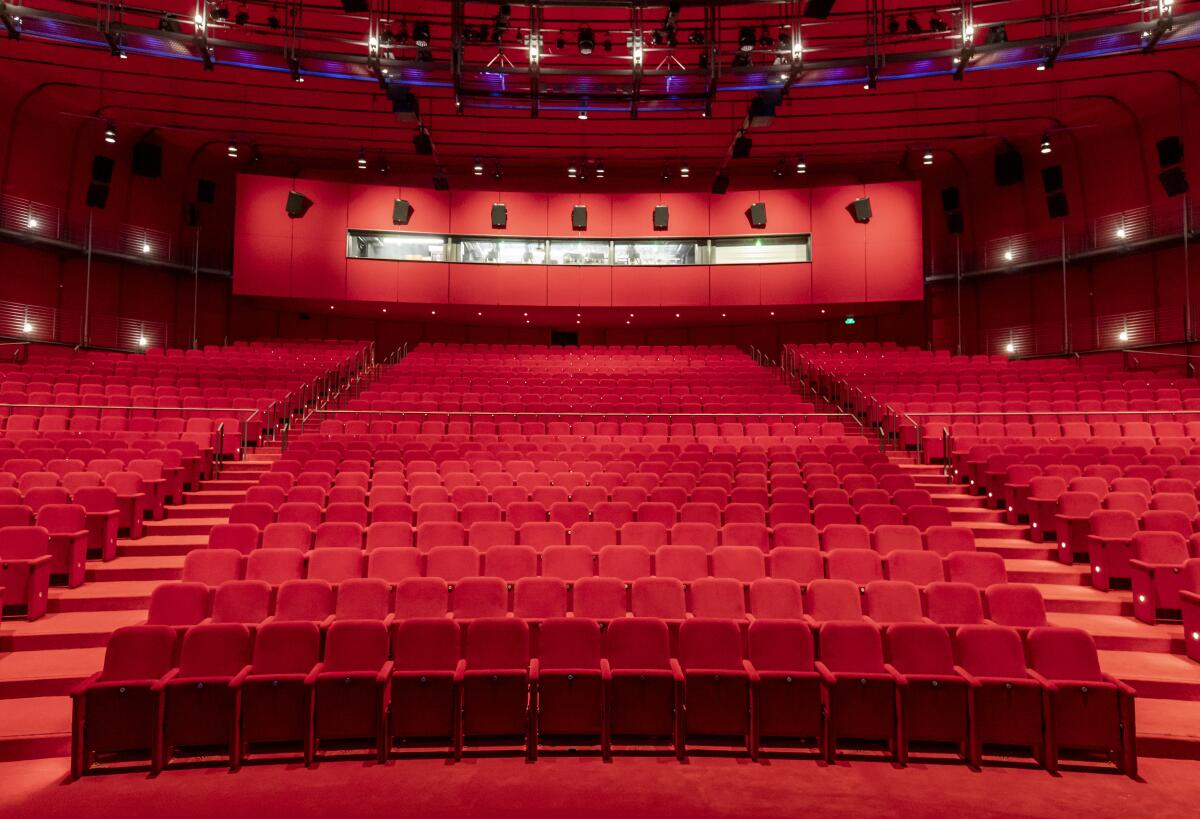
The David Geffen Theater at the Academy Museum seats a thousand and is often fully attended.
(Ricardo DeAratanha / Los Angeles Times)
The city has also seen the rise of itinerant pop-up series such as Mezzanine, Acropolis Cinema and Hollywood Entertainment pulling off must-see events. Smaller venues such as Now Instant Image Hall, 2220 Arts + Archives, Eastwood Performing Arts Center, Brain Dead Studios and the Philosophical Research Society have made a home to all kinds of movies. The Laemmle and Landmark chains have continue to play traditional arthouse releases and international films, while the Frida and Gardena theaters bring great movies to the South Bay.
Entities such as Revival Hub and MovieTown do a vital job of collating extensive listings info. (We will also continue to give monthly overviews of the best movies to see.) This is simply an incredible time for going to the movies in Los Angeles, arguably the best ever.
My main takeaway from the experience of working on this newsletter is confirmation of my belief in the movies themselves and the community of people around them. I was recently at a sold-out screening of Akira Kurosawa’s “Ran” and the idea of sitting with nearly a thousand other people watching a Japanese movie from the 1980s, each connecting to the events on screen in their own way, was deeply inspiring.
Among my favorite recent developments is how many venues now name the show’s projectionists as part of a screening’s introduction, which is always met with an enthusiastic round of applause. It is a reminder that what this is really about is people, dedicated to something we love.
And since this isn’t really a goodbye, it seems fitting to turn to the movies once again, as another week demonstrates why the scene here in Los Angeles is so truly special.
A tribute to Sam Neill

Sam Neill and Nicole Kidman on the set of 1989’s “Dead Calm.”
(Michael Ochs Archives / Getty Images)
Anyone looking for an example of just how intimate the screening scene in Los Angeles can be should make their way to the New Beverly Cinema on July 24. The theater already had a three-night double-bill of Rob Reiner’s “Misery” and Phillip Noyce’s 1989 thriller “Dead Calm” booked when news broke last weekend that actor Sam Neill had died at age 78.
The New Bev quickly announced that it would make one of those screenings into a tribute to Neill, who co-stars in “Dead Calm.” Director Noyce, along with co-star Billy Zane and filmmaker Roger Donaldson (who worked with Neill on 1977’s “Sleeping Dogs”) will all be there to celebrate their friend and colleague.
“Dead Calm” is a tight thriller set within the confines of a small sailing boat. Reviewing the movie when it was first released in 1989, Sheila Benson wrote, “Neill is probably one of the screen’s most underrated actors … ‘Dead Calm’ was probably far and away his nastiest assignment physically, yet his presence, sexuality and all, is absolutely vital to the balance of the story.”
Remembering the actor as part of a rundown of his greatest performances, Glen Whipp described Neill in “Dead Calm” as “part Cary Grant, part MacGyver.”
Two by Ross McElwee

Documentary filmmaker Ross McElwee in his 1986 movie “Sherman’s March.”
(Music Box Films)
Documentary filmmaker Ross McElwee helped to reinvent the form with his 1986 film “Sherman’s March,” which comes with the explanatory subtitle of “A Meditation on the Possibility of Romantic Love in the South During an Era of Nuclear Weapons Proliferation.”
Ostensibly a film about Union General William Tecumsah Sherman’s campaign of destruction during the Civil War, the movie actually ends up being about McElwee revisiting old girlfriends and forging a few new ones along the way, reflecting on his own campaign of romantic misadventure. As charming as it is revelatory, the movie is being rereleased in a new 4K restoration.
McElwee’s latest film, “Remake,” reflects on the death of his son Adrian and whether the director himself had a detrimental effect on the boy’s life. Reviewing “Remake,” Tim Grierson calls it “especially revealing — both in terms of the glimpses we get of this father-son relationship and of unsolved mysteries that linger just outside the frame.”
A weekend with Robert Rodriguez

Quentin Tarantino, George Clooney and Salma Hayek in the horror movie “From Dusk Till Dawn.”
(Academy Museum)
The Academy Museum will present “A Weekend with Robert Rodriguez” to celebrate the 30th anniversary of “From Dusk Till Dawn” and the 25th anniversary of “Spy Kids.” It speaks to Rodriguez’s undersung range as a filmmaker that one movie is a bawdy, gory comedy about a criminals on the run who encounter an ancient den of vampires, while the other is a family-friendly tale of two siblings who discover their parents are secret agents and must rescue them from a supervillain.
Rodriguez will not only be present to talk about both movies, he will be performing music each day with a different band.
Reviewing “From Dusk Till Dawn,” which was scripted by Quentin Tarantino, Jack Matthews said it was “a film nerd’s fever dream, a Frankenstein’s monster of used movie parts, deliberately mismatched styles, and deliriously implausible characters.”
Elaine May’s secret success

Dustin Hoffman and Jessica Lange in the movie “Tootsie.”
(Everett Collection / Columbia Pictures)
One of the most exciting things about the ongoing revival of L.A.’s repertory scene is the upheaval of the notion of the “canon.” What are the most lauded movies of all time and who gets to do the lauding? Case in point is the now widely accepted coronation of Elaine May as a towering creative figure, no longer relegated to being merely a fringe character unfairly saddled with the commercial failure of “Ishtar.”
May is credited as director on only four feature films, though she’s an uncredited writer on a number of other projects, perhaps most notably 1982’s comedy “Tootsie,” starring Dustin Hoffman as a struggling New York City actor who finds success when he lands a part by secretly posing as a woman. Directed by Sydney Pollack, who also makes a tremendous turn as Hoffman’s agent, the movie will be playing at Vidiots on Saturday.
Finding new moves

Wiley Wiggins and Patrick Riester in the movie “Computer Chess.”
(Kino Lorber)
The very first thing I ever wrote under the banner of Indie Focus was about how independent filmmakers such as Andrew Bujalski and Alex Ross Perry were working on 35mm at a time when mainstream Hollywood was very much forcing the idea of shooting on digital. So it only seems appropriate that this final edition of the newsletter should include something on Bujalksi, who has long been one of my favorite contemporary American filmmakers.
“Computer Chess,” Bujalski’s oddball experiment in using antiquated video equipment to tell a heady, offbeat story about a weekend chess tournament in the early ’80s, will screen in a 35mm print at Brain Dead Studios on July 24, presented by Mezzanine. Bujalski will be present, along with Blair Barnes, a filmmaker who will be showing the L.A. premiere of his short “sitrep,” also shot on an analog-era tube camera.
New this week

Matt Damon and Zendaya in the movie “The Odyssey.”
(Melinda Sue Gordon / Universal Pictures)
Sure to be one of the biggest movies of the year, Christopher Nolan’s adaptation of “The Odyssey” opens today. Los Angeles audiences have multiple venues to choose from that are showing the film in Nolan’s preferred Imax 70mm format — these theaters are among only a small number across the world that are doing this. Presenting a movie in Imax 70mm isn’t the easiest endeavor. Eloise Rollins-Fife has a report on how that’s actually done. Get your epic on.
Reviewing the movie, Amy Nicholson wrote, “Nolan refuses to tremble before the canon. Grabbing mighty scissors, he cuts and rejiggers Homer and a bit of Virgil to transform these classical texts into his type of tale: one fixated on memory, self-identity, destructive genius and the slippage of time. As ever, it’s light on sex, heavy on wine-dark angst.”
Kenneth Turan spoke to Nolan about the movie’s origins, saying, “I’ve been telling this story in all my films for years. It’s a family story, a love story, a revenge story, a war story, a coming-of-age story. It’s a very strong foundational text for me.”