short film

Spend Father’s Day with an Indiana Jones trilogy, plus the week’s best films

Hello! I’m Mark Olsen. Welcome to another edition of your regular field guide to a world of Only Good Movies.

Recently, I don’t exactly know why, I was overtaken by a concern that because of the impending merger of Paramount and Warner Bros., Olivier Assayas’ 2022 series adaption of his own film “Irma Vep” would be removed from the HBO Max streaming platform. With no official physical release, the series — starring Alicia Vikander as a Hollywood movie star making a project in Paris — could be effectively vanished from existence.

This is sadly inevitable, though some superfans have gone to extra-legal measures to ensure otherwise (not that we would ever endorse this). Most famously it’s happened with the original “Star Wars” trilogy. Billed as the “Grindhouse Edition,” these are discs of the first three “Star Wars” films sourced from scans of original film prints before the digital fixes and polish of the more recent official releases. Reengaging with these works in this way, scratches and all, is (I’m told) a strong reminder of why they hit so hard in the first place, similar to how it might be to reread a text in the original language instead of a more recent translation.

‘Indiana Jones’ marathon

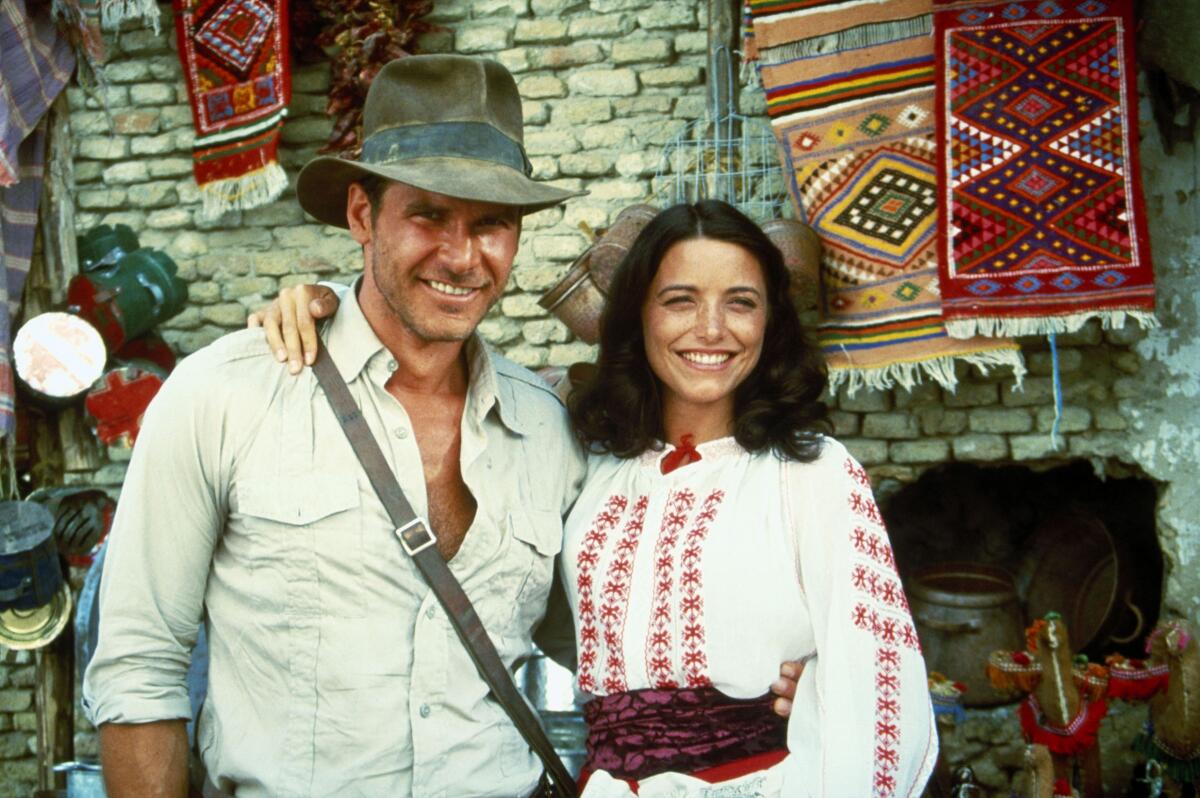
A man in a fedora smiles with a woman in a white dress.

Harrison Ford and Karen Allen on the set of 1981’s “Raiders of the Lost Ark.”

(Lucasfilm Ltd.)

The same deep understanding of genre filmmaking that went into the original “Star Wars” also went into “Raiders of the Lost Ark,” the first adventure of the character of Indiana Jones. Directed by Steven Spielberg from a script by Lawrence Kasdan and story by George Lucas and Philip Kaufman, the film is playful, thrilling and self-aware. It is made with such care, attention to detail and sense of fun that I remember how disappointed I was to discover not all movies would be like this.

There have of course been diminishing returns with the more recent run of Indiana Jones sequels, but the first three installments all have a real spark. And so the Secret Movie Club will present “Raiders,” 1984’s “Indiana Jones and the Temple of Doom” and 1989’s “Indiana Jones and the Last Crusade,” all on 35mm at the Million Dollar Theater in DTLA on Sunday in celebration of Father’s Day.

In her original review of the first film, Sheila Benson described that while watching it, she felt “a rush of gratitude which almost brought tears of contagious joy and — not to be corny about this — the strength of the film’s positive vision. If this is an era in which the heroic is lacking and the mediocre threatens us from every side, then ‘Raiders,’ which has no pretensions to importance, which is unabashedly wide-eyed and exaggerated and true blue but somehow cherishes the best in life and filmmaking — is a high-water mark.”

Plenty of jokes could be made about the movies having settled into what might be thought of as part of the dadcore canon: action-adventure movies that play well on TV and maybe you can take a short nap and not miss anything. So be it.

From one master to another

A man in shades walks down a hallway with a blond woman.

Cary Grant and Eva Marie Saint in Alfred Hitchcock’s 1959 thriller “North by Northwest.”

(Sunset Boulevard / Corbis via Getty Images)

Filmmaker Guillermo del Toro has been making waves of late for his strong public stance against the use of AI in feature filmmaking. But it is worth remembering that he is also a deep and incisive thinker about older movies, a true fan, which makes his upcoming appearances at the Academy Museum a special occasion.

Del Toro will present five films by Alfred Hitchcock — 1946’s “Notorious,” 1943’s ‘Shadow of a Doubt,” 1959’s “North by Northwest,” 1953’s “I Confess” and 1972’s “Frenzy” — along with delivering a lecture on each of them. To see one great filmmaker reflect with such depth into the work of another is just remarkable. This is some genuine only-in-L.A. type stuff.

Comedy + politics = good fun

A man in a white suit stands outside a car wash.

A scene from the 1976 movie “Car Wash.”

(Margaret Herrick Library / Academy of Motion Picture Arts and Sciences)

A raucous comedy set around the location of the title, “Car Wash” is also a sharp, politically minded satire about labor and money. Directed by Michael Schultz from a screenplay by Joel Schumacher, the film has an extended ensemble cast that includes Richard Pryor, Franklyn Ajaye, George Carlin and many others.

In his original review Charles Champlin compared “Car Wash” to films such as “American Graffiti” and “Nashville” and called it “light but not foolish. … The experience is exhilarating.”

A 50th anniversary screening at the Academy Museum on Saturday of a new 4K restoration will include a panel with Schultz and actors Bill Duke, Antonio Fargas, Melanie Mayron, Garrett Morris and Pepe Serna.

Collision report

A man looks out the window of his car while two people embrace in the back seat.

James Spader in the 1996 movie “Crash,” directed by David Cronenberg.

(Jonathan Wenk / Fine Line Features)

The controversy that surrounded David Cronenberg’s “Crash” when it premiered at Cannes in 1996 and received a U.S. release in 1997 tended to overwhelm the actual movie. Shockingly explicit, the film is about a secret underground world of people who create a sexual fetish out of car crashes. An adaptation of the novel by J.G. Ballard, Cronenberg’s movie explores the cinematic obsession with sex and violence.

Over time, “Crash” has been evolving from a seemingly cursed object dogged by scandal into something that audiences can come to appreciate and admire — even if it is not a movie you can ever exactly fully understand. Part of Cronenberg’s brilliance is how enigmatic and unknowable his work can be: strange, inviting and enveloping while refusing easy or direct analysis.

The movie is playing twice locally this week, on Saturday at Vidiots in partnership with the Cinegogue, with special giveaways and exclusive merch, and again on Monday at the Academy Museum in 4K. Who will be brave (or perverse) enough to go twice?

A different view of Rio

People dressed in drag assemble for a party.

Milton Gonçalves, center, in the 1974 movie “The Devil Queen.”

(Kino Lorber)

A drag queen (Milton Gonçalves) rules the criminal underworld of Rio de Janeiro in Antonio Carlos da Fontoura’s 1974 gangster drama “The Devil Queen,” an unlikely mix of camp aesthetics and gritty violence. Among the film’s many fans is Kleber Mendonça Filho, the filmmaker behind the recent Brazilian hit “The Secret Agent,” who referred to “The Devil Queen” as “bloody, nasty and full of personality.”

The movie is playing in a new 4K restoration at the Lumiere Cinema in Beverly Hills.

A musical melodrama returns

A man plays piano while a woman in red stands close.

Raul Julia, left, and Teri Garr in Francis Ford Coppola’s 1981 movie “One From the Heart.”

(Rialto Pictures / American Zoetrope)

We have talked before about Francis Ford Coppola’s “One From the Heart,” a movie of such delirious audacity that it nearly ruined the filmmaker‘s career. A throwback musical about two lovers who break up in search of more excitement, the film stars Teri Garr, Frederic Forrest, Nastassja Kinski and Raul Julia.

On Saturday the film will screen at the American Cinematheque’s Aero Theater in a 70mm print for the first time in L.A. since 1990. The event is being dedicated to Dean Tavoularis, Coppola’s longtime production designer, who died in April. For “One From the Heart,” Tavoularis re-created the Las Vegas Strip on a studio back lot.

New this week

  • Amy Nicholson is not a fan of the new “Toy Story 5,” writing in her review, “Pixar has continued adding shades to the same plot outline like a child with a box of 128 crayons (or a company clinging to its billion-dollar idea).”
  • Glenn Whipp cast back into the “Toy Story” universe for a highly personal ranking of his 10 favorite “Toy Story” toys.
  • Two gay teenage boys attempt to survive a supernatural entity and conversion therapy in Adrian Chiarella’s debut feature “Leviticus.” Jen Yamato spoke to the filmmaking team.
  • I spoke to writer-director Michael Sarnoski about his new “The Death of Robin Hood,” starring Hugh Jackman in a subversively revisionist telling of the last days of the medieval bandit.

Source link

‘Trainspotting’ is still peak ’90s, plus the week’s best films

Hello! I’m Mark Olsen. Welcome to another edition of your regular field guide to a world of Only Good Movies.

It seems odd that the biggest news of the week was the fact that tickets for a movie went on sale, but apparently Christopher Nolan’s upcoming “The Odyssey” is no typical movie. Having already made tickets available for some shows a full year in advance, Universal put more of them on sale for the July 17 opening weekend of the Oscar-winning filmmaker’s ancient epic. There were reports of long online wait times, crashing ticketing systems and the kind of problems more often associated with pop stars than movie nerds.

“The Odyssey” will be playing in a variety of formats, with the Imax 70mm screenings among the most coveted. More venues than usual have also been announced as playing the film in 70mm, including the Village Theatre in Westwood. (A handy visual guide to the different fomats is on the film’s website.) While there is a hint of the ridiculous to some of this mania — popcorn buckets in the shape of Imax cameras and movie tickets going on the resale market for hundreds of dollars — there is no denying how exciting it is to see this kind of anticipation building around any movie.

Back to a ’90s phenomenon

Four friends stand around waiting for life to happen.

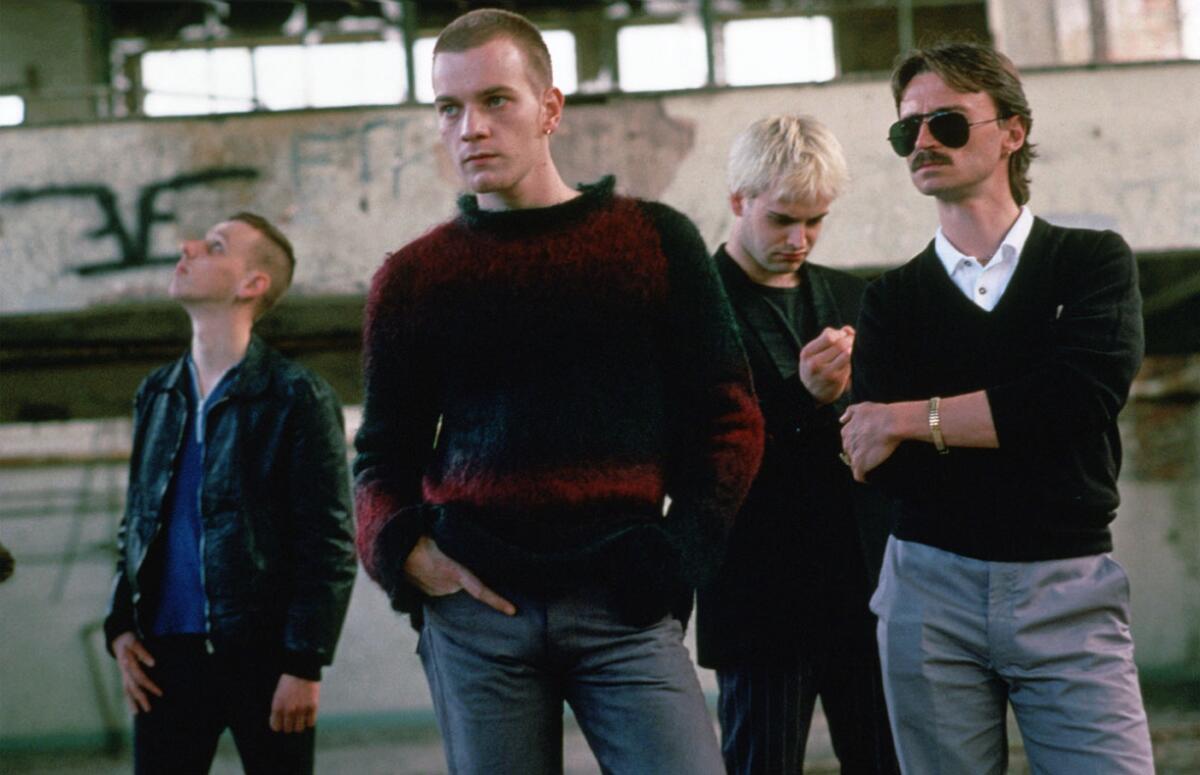
Ewen Bremner, left, Ewan McGregor, Johnny Lee Miller and Robert Carlyle in the movie “Trainspotting.”

(Liam Longman / Sony Pictures Classics)

When it first came out in 1996, “Trainspotting” was an instant cultural phenomenon, capturing the vibes of the “Cool Britannia” moment with its sparkling soundtrack, inventive, high-energy style and cast that included up-and-coming talents such as Ewan McGregor and Kelly Macdonald. It was only the second feature directed by Danny Boyle, who would go on to be an Oscar winner, mount an Olympics opening ceremony and remain a reliably exciting filmmaker all the way to his recent “28 Years Later.”

“Trainspotting” is now back in theaters in a 4K restoration for its 30th anniversary, having lost none of its brash vigor. In his original review, Kenneth Turan said of the film, “Exuberant and pitiless, profane yet eloquent, flush with the ability to create laughter out of unspeakable situations, ‘Trainspotting’ is a drop-dead look at a dead-end lifestyle that has all the strength of its considerable contradictions.”

Appearing like magic

A trio of witches makes goofy expressions.

Kathy Najimy, left, Bette Midler and Sarah Jessica Parker in the 1993 comedy “Hocus Pocus.”

(Disney)

Directed by Kenny Ortega, “Hocus Pocus” is one of those movies that has seen its fanbase grow steadily over the years — it is now much more beloved than it ever was on initial release. (It even inspired a 2022 sequel.) Bette Midler, Sarah Jessica Parker and Kathy Najimi play the Sanderson sisters, 17th century witches who find themselves inadvertently brought to modern day by a group of teenagers messing around with casting spells.

The film will play Saturday at the Gardena Cinema, featuring a live commentary from cast members Omri Katz, Thora Birch, Larry Bagby, Tobias Jelinek and Vinessa Shaw followed by a Q&A. This is a rare appearance by Katz in particular, who has retired from acting. Fans of the movie should make the effort to attend.

The Gardena, the last family-owned single-screen theater in Los Angeles, suffered a blow last weekend when a burst pipe flooded the venue. Though they are operational, a campaign has been started to help them recoup repair costs.

Examining the life of the mind

An intense man in a suit and eye glasses sits on a beach.

John Turturro in the 1991 movie “Barton Fink.”

(20th Century Fox)

Ranking the films of Joel and Ethan Coen has become a cottage industry of its own. Personally, I go back-and-forth on where to place 1991’s “Barton Fink,” which won the Palme d’Or at Cannes, as well as prizes for director and actor. The movie is by turns funny, disturbing and inscrutable (all good things), with John Turturro in the title role as an intellectual New York playwright who goes to Hollywood to write screenplays — and slowly goes insane.

The movie will play Friday in 35mm at Vidiots with an introduction from Noah Segan, who directed Turturro in one of the breakout titles from this year’s Sundance, “The Only Living Pickpocket in New York.” Hopefully, this will turn into a year in which Turturro gets some long-deserved accolades.

Christmas in June

A man in a suit tenses for bad news.

Elliott Gould on the set of 1978’s “The Silent Partner.”

(Anwar Hussein / Getty Images)

There is something particularly charged about watching a Christmas movie at other times of year — an odd sense of dislocation and maybe even something a little naughty, a circuit-scrambling frisson. So it is particularly notable that as part of their salute to the independent studio Carolco Pictures (behind such films as “Basic Instinct,” “Terminator 2: Judgment Day” and “Reservoir Dogs”), the Vista will be showing 1978’s “The Silent Partner.”

Just the kind of tight and gripping thriller that people pine for all year round, “The Silent Partner” has a screenplay by Curtis Hanson, who would go on to make “L.A. Confidential.” Elliott Gould plays a Toronto bank teller who tries to rip off the thief (Christopher Plummer) who robs his branch wearing a Santa costume as a disguise. Soon they are both scheming against each other.

In his original review of the film, Kevin Thomas called it “tense and ingenious.” In a reconsideration of the film some months later, Charles Champlin called it “a stylish crime-suspense story, a cat-and-mouse game between Christopher Plummer as a clever, sadistic bank robber and Elliott Gould as a bored bank teller who sees a way out of his boredom and into riches.”

So much beauty

A woman approaches a farmhouse during twilight.

Brooke Adams and Sam Shepard in the 1978 movie “Days of Heaven.”

(Criterion Collection)

Terrence Malick’s 1978 “Days of Heaven” is still strikingly singular: a love story told with a stirring visual style. The film’s beauty — aside from its impossibly good-looking lead actors, Richard Gere and Brooke Adams — in part comes from gifted Spanish cinematographer Néstor Almendros, who made his American debut after a career in Europe that saw him working with filmmakers such as Eric Rohmer and François Truffaut. Almendros would win an Academy Award for the film.

The New Beverly will show “Days of Heaven” in 35mm Tuesday through Thursday as a double bill with Truffaut’s 1970 “The Wild Child,” shot by Almendros in black-and-white. Writing about “Days” in 1978, The Times’ Charles Champlin called it “an extraordinary and original visual experience and a movie which is thrilling in its uncompromised purity.”

Perverse fun

Two people speak in a drawing room.

Ha Jung-woo, left, and Kim Min-hee in the 2016 movie “The Handmaiden.”

(TIFF)

Korean filmmaker Park Chan-wook was just president of the Cannes jury and has become a much-beloved figure on the international circuit for his wicked sense of humor and sharp sense of style. Nowhere is that on better display than his 2016 film “The Handmaiden,” which is somehow at once a period drama, a con-man thriller and an erotic lesbian romance. Vidiots will be showing the movie Sunday.

As Justin Chang wrote when the film was released, “Without sacrificing his taste for psychosexual perversity or his flair for violent grace notes, Park has given us a teasingly witty and elegant puzzle-box of a thriller whose pleasures are rooted not in visceral shock but in narrative surprise, and which wisely opts to seduce rather than pulverize its audience.”

In an interview at the time, Park said the film’s unpredictability was part of the project’s appeal. “That’s the exact kind of fun to be had with this film and the reason why I chose to make this film. Everything becomes a game of perception. Rather than to say it’s a difficult thing to navigate, it is fun to deal with. Not only for me as a filmmaker but for the audience to see that and engage in that game.”

New this week

  • Amy Nicholson reviews the latest attempt to make a movie out of a popular Mattel toy with the lightly-tongue-in-cheek “Masters of the Universe.”
  • Amy also reviewed the revival of the satirical “Scary Movie” franchise, with original stars Anna Faris and Regina Hall returning to make fun of such recent hits as “Sinners,” “Weapons” and “The Substance.”
  • The documentary “Time and Water” looks at climate change through the life and work of Icelandic writer Andri Snaer Magnason as directed by Sara Dosa, who had a hit with her last film “Fire of Love.” Robert Abele reviews.

One last thing…

This week, our colleagues at De Los launched a podcast hosted by Fidel Martínez and Suzy Exposito. The interview-style video podcast will feature conversations with the people shaping Latino culture in the United States.

The first episode features singer and actor Leslie Grace, who talks about her experiences working on the film “In the Heights” as well as being the star of the canceled “Batgirl.”


Source link

Why Marilyn Monroe still matters at 100, plus the week’s best films

Hello! I’m Mark Olsen. Welcome to another edition of your regular field guide to a world of Only Good Movies.

Both made by 20-something directors who emerged from the world of YouTube, the horror movies “Obsession” and “Backrooms” are dominating the conversation. They could come to represent a pivotal moment for how Hollywood engages with young talent and audiences alike.

I saw Curry Barker’s “Obsession” this week at a packed holiday matinee and Kane Parsons’ “Backrooms” is on track for a huge opening weekend — maybe the largest in A24’s history. The fact that audiences are responding to these films is exciting and one has to hope that Hollywood takes the right message from their successes: to give young filmmakers the space to create the projects they want to make, rather than shoehorn them into preconceived notions of what people want. Audiences right now seem to be proving themselves to be adventuresome when given the opportunity to try something new.

Marilyn at 100

A woman in a pink dress sings about diamonds.

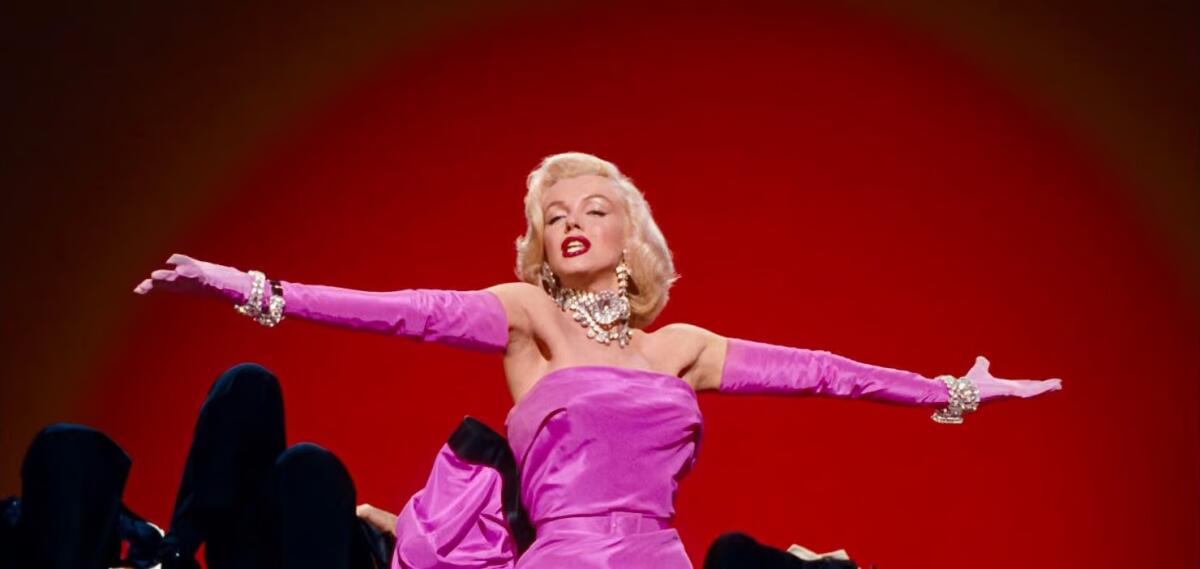
Marilyn Monroe in the 1953 classic “Gentlemen Prefer Blondes.”

(Academy Museum)

When Marilyn Monroe’s death was first reported in The Times on Aug. 6, 1962, the news read, “Marilyn Monroe, a troubled beauty who failed to find happiness as Hollywood’s brightest star, was discovered dead in her Brentwood home of an apparent overdose of sleeping pills.”

That intertwining of the glamour and sex appeal of her public persona with an air of doomed tragedy would permanently attach itself to her image, making her one of the most unforgettable stars Hollywood has ever created.

Monday marks the 100th anniversary of Monroe’s birth in L.A.’s Boyle Heights, where she was born Norma Jeane Mortenson. In celebration of Monroe’s centennial, the Academy Museum will open a new exhibition on Sunday, “Marilyn Monroe: Hollywood Icon,” featuring hundreds of objects including personal materials never before displayed and a number of her most memorable costumes.

The museum will also launch a 17-film series spotlighting Monroe’s remarkable career, including her versatile talent as both a comedian and a more dramatic performer. Highlights include the 1953 thriller “Niagara,” 1950’s backstage drama “All About Eve” in a new 35mm print with an introduction from journalist Lorraine Nicholson and 1955’s “The Seven Year Itch” with writer Kim Morgan introducing. Elsewhere, “Some Like It Hot” from 1959 and Monroe’s final completed film, “The Misfits,” will both show in 4K.

On Sunday, “Gentlemen Prefer Blondes” will play in the Academy’s David Geffen Theater in 4K. There are also other Monroe screenings and events around the city, including multiple shows of “Gentlemen” at the Gardena Cinema on Saturday.

A woman in a low-cut dress stands with a photographer.

Marilyn Monroe and photographer Bruno Bernard backstage at the Hollywood Bowl in 1953.

(Bernard of Hollywood Foundation Archive)

Authors Mark A. Fortin and Joshua John Miller have collaborated on a new book, “The Marilyn Monroe Century: From Norma Jeane to Icon — A Story in Photographs.” The culmination of a seven-year-long research process, the book unearths original negatives of pictures of Monroe taken by Miller’s grandfather, acclaimed photographer Bruno Bernard. Bernard, who died in 1987, shot with her before she had even adopted the name Marilyn Monroe and took the best-known images of her, standing on a subway grate with her white dress billowing up while in production on “The Seven Year Itch.”

“One of the stories I’m trying to tell with a lot of these pictures is to counter the narrative that Marilyn didn’t have agency in the creation of her persona,” says Miller in a recent Zoom call from a room at the Chateau Marmont. “The truth is she was very much instrumental in constructing her image. And Bruno was a big part of that. Photographers at that time were not only the photographer — they were the best friend, the therapist, the agent, the stylist. I think it’s really important to have context for these pictures because this kind of history gets lost.”

The book does a remarkable job of providing additional atmosphere around images that might already be familiar, giving a fuller sense of what was going on both inside and outside of the frame. The notorious subway-grate scene was actually shot twice, first in New York and again in Los Angeles.

“I think what I’ve been trying to do is not rewrite the narrative, but thread [Bruno] correctly back into the stitching of Marilyn’s mythology,” Miller says. “He is one of the only photographers who deeply knew both Norma Jeane and Marilyn. I know everyone says they know the ‘real Marilyn,’ but he was part of the construction with her to create that.”

The joy of sadness with ‘Bleak Week’

Two young men sit on a couch together.

Joseph Gordon-Levitt and Brady Corbet in the movie “Mysterious Skin.”

(Tartan Films)

“Bleak Week: Cinema of Despair” has become the signature program of the American Cinematheque, expanding beyond its L.A. footprint for editions at other theaters not just around the country but around the world. Turning sadness, depression and defeat into group activities to be enjoyed together has been an ingenious masterstroke of programming.

Now in its fifth edition, this year’s highlight will be a series with Isabelle Huppert, who will be present for screenings of such downbeat fare as “The Piano Teacher,” “Le Cérémonie,” Violètte Noziere,” “Elle,” “Time of the Wolf” and “Heaven’s Gate.”

Filmmaker Ari Aster will also be present for a complete retrospective of his four features. Other guests include Denis Villeneuve with “Incendies,” Allen Hughes with “Dead Presidents,” Al Pacino with “The Godfather Part II,” Gregg Araki with “Mysterious Skin,” Robert Englund with “Buster and Billie,” Werner Herzog with “Heart of Glass” and Theresa Russell with “Bad Timing.”

I will be introducing the U.S. theatrical premiere of a 4K restoration of Carlos Saura’s 1966 “The Hunt” and moderating Q&As with filmmaker Richard Kelly for the 20th anniversary of the Cannes cut of “Southland Tales” and actor Haley Joel Osment for a 25th anniversary 35mm screening of “A.I. Artificial Intelligence.” And The Times’ Joshua Rothkopf will moderate a Q&A with Aster for “Eddington,” while Amy Nicholson will talk to Aster for “Midsommar.

UCLA’s Festival of Preservation

A woman with an Afro deplanes.

Leslie Uggams in 1972’s “Black Girl.”

(UCLA Film & Television Archive)

The UCLA Festival of Preservation is one of the city’s most-longstanding and venerated events for film lovers, celebrating revered classics and rediscovered obscurities alike. This year’s edition, the 22nd, opens with the West Coast premiere of a new restoration of Ossie Davis’ 1972 “Black Girl,” an adaptation of J.E. Franklin’s successful play about thee generations of Black women.

Jose Luis Ruiz’s groundbreaking 1975 documentary on Latino immigrants, “The Unwanted,” will have a restoration world premiere. The restoration of Budd Boetticher’s 1955 melodrama “The Magnificent Matador,” starring Anthony Quinn and Maureen O’Hara, brings back the film’s stunning look in Cinemascope and Eastmancolor.

Andre de Toth’s 1948 thriller “Pitfall,” starring Dick Powell and Lisbeth Scott, will have a world premiere restoration. The series concludes with De Toth’s stylish romantic drama “The Other Love” from 1947 starring Barbara Stanwyck. The restoration reinstitutes the original ending of the film unseen by audiences since the 1940s.

Former Times critic Keneth Turan has made his own picks for what not to miss.

A tender coming-of-age romance

Two people flirt.

Vincent Spano and Rosanna Arquette in the movie “Baby, It’s You.”

(Paramount Pictures)

Produced by Amy Robinson and Griffin Dunne between their work on Joan Micklin Silver’s “Chilly Scenes of Winter” and Martin Scorsese’s “After Hours,” the 1983 movie “Baby It’s You” captures a number of rising talents at just the right moment. Only the third feature written and directed by John Sayles (and still his only movie made at a Hollywood studio), the film is a particularly smart take on the coming-of-age romance, with a sharp sense of time and place. It’s even shot by cinematographer Michael Ballhaus, fresh off his collaborations with Rainer Werner Fassbinder but before his long collaboration with Scorsese.

Set in late-1960s New Jersey, the story involves a good-girl high schooler preparing for college (Rosanna Arquette, who lights up the screen) who falls for a bad boy with few future prospects (Vincent Spano). The film will show on Wednesday in a 4K restoration at the Academy Museum with Arquette and Spano both scheduled to attend.

In a 1983 Times review, Shelia Benson said the film “explores questions of class and unequal opportunity with humor and tender insight,” adding that Spano and Arquette “together conjure up every improbable, love-struck couple who ever dazzled us ordinary mortals in the halls or at the senior prom.”

New this week

  • Kane Parson’s horror film “Backrooms” stars Renate Reinsve and Chiwetel Ejiofor in an adaptation of Parson’s own popular YouTube videos. As Amy Nicholson wrote, “Given that backdrop, ‘Backrooms’ would be one of the year’s most significant releases even if the movie itself was merely fine. But it’s better than fine — it’s a work of honest-to-goodness art.”
  • Katie Walsh reviews the crime thriller “Tuner,” starring Leo Woodall as a piano tuner who gets in over his head with the wrong people. The film is the fiction feature debut from Oscar-winning documentary filmmaker Daniel Roher.
  • The latest music-themed film from Irish writer-director John Carney, “Power Ballad” is about a failed-to-launch songwriter (Paul Rudd) trying to get credit for the tune he co-wrote with a boy band star (Nick Jonas). Amy Nicholson reviews.

Source link

Is ‘Terminator 2’ the best summer movie ever? Plus the week’s best films

Hello! I’m Mark Olsen. Welcome to another edition of your regular field guide to a world of Only Good Movies.

There are, it goes without saying, a lot of movies out there. And so even for someone like myself, whose job is just to stay on top of them, sometime a title slips by. I had not taken much notice of “Is God Is” before it opened last week without playing any festivals in advance, but the reviews and conversation around it grabbed my interest. Once I realized that Tessa Thompson and Janicza Bravo were involved as producers, I made sure to carve out time to see the movie this week. And am I ever glad I did.

The debut as writer-director for Aleshea Harris (adapting her own play), “Is God Is” is among the most exciting movies released so far this year. Kara Young and Mallori Johnson are absolutely electric as twin sisters who set out to find the estranged, abusive father who abandoned them after leaving them and their mother horribly scarred in a fire. There is a volatile unpredictability to the storytelling that gives it a fresh energy. I saw it at a more-or-less empty matinee, but I’m glad I did. Catch this in theaters while you can.

35 years of ‘T2’

A woman points a gun.

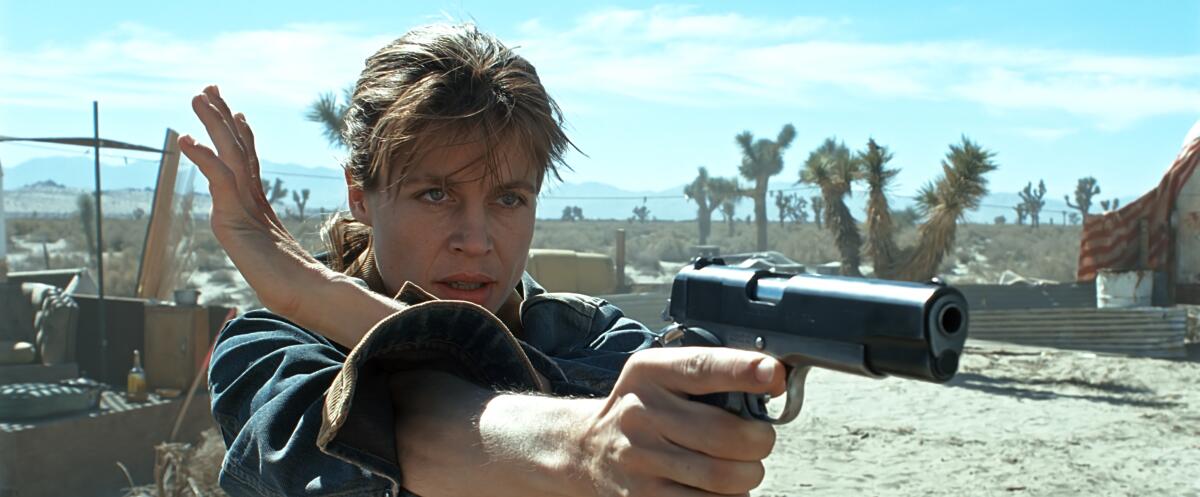
Linda Hamilton in the movie “Terminator 2: Judgment Day.”

(Rialto Pictures)

As far as I’m concerned, James Cameron’s 1991 “Terminator 2: Judgment Day” is the quintessential summer movie. You can pay close attention or not, the special effects and action are amazing, the villains are sentient machines (shades of our AI-addled present) and it has a song by freaking Guns N’ Roses.

The main cast of Arnold Schwarzenegger, Linda Hamilton, Robert Patrick, Edward Furlong and Joe Morton are all perfectly tuned into the movie they are making, full of chaos, mayhem and just the right amount of thoughtfulness. (Morton and Hamilton in particular give the film an unexpected soulfulness.)

To celebrate the film’s 35th anniversary, the American Cinematheque is screening the film in 70mm, 35mm, 3D and DCP at different venues on different days. (Check carefully, as there have already been some schedule changes.) The Academy Museum will show the film on Wednesday in 4K with visual effects supervisor Dennis Muren and special effects creator Shane Mahan present. The film is also playing the Vista in 70mm June 6 and 7.

In his original 1991 review, Kenneth Turan wrote, “Most of all, what makes ‘Terminator 2’ come alive in a major way is Cameron’s intuitive understanding of the mechanics and psychology of action films. Unlike many of the wanna-bes who find themselves in charge of pictures these days, this is one director who really knows how to direct. … Cameron flamboyantly underlines, for those who may have forgotten, why the pure adrenaline rush of motion is something motion pictures can’t live for very long without.”

Lena Dunham before ‘Girls’

Two people hang out in a pipe at night.

David Call and Lena Dunham in the movie “Tiny Furniture.”

(Joe Anderson / IFC Films)

Lena Dunham recently published her second memoir, “Famesick,” a portrait of her rise to cultural prominence and media ubiquity and subsequent retreat from it, which makes this a perfect moment to revisit a key component of her initial ascent, the micro-budget 2010 feature “Tiny Furniture.” Made when Dunham was in her early 20s, the film is a deadly accurate portrait of post-collegiate ennui, shot partly in her parents’ NYC apartment, and remains fresh and startlingly insightful.

The Eastwood Performing Arts Center will be screening the film Friday and Saturday. The film is showing along with the “Welcome to Bushwick a.k.a The Crackcident” episode of Dunham’s series “Girls.”

I profiled Dunham at the time, having first encountered her at SXSW the year before when she was there with her film “Creative Nonfiction.”

“That movie is so personal,” Dunham said of “Tiny Furniture” during an interview from the New York production office of the pilot for what would become “Girls.” “It’s like I wrote it, I directed it, I star in it — if you don’t like the movie you don’t like me.”

With the lacerating self-awareness that made her a star, she added, “And I also understand there is something essentially unappealing about ‘girl makes movies about being a loser and then gets un-loserly things to happen to her.’ It’s a little absurd.”

More onscreen Bob Dylan

Three actors pose for the camera.

Rupert Everett, Fiona Flanagan and Bob Dylan in a production still for 1987’s “Hearts of Fire.”

(Skinner / Mirrorpix / Getty Images)

It was just a few weeks ago that we wrote about a program of Bob Dylan live concert footage. In honor of his 85th birthday, the American Cinematheque will be putting on another program of two oddball rarities from his long career.

Rarely screened in theaters, the 2021 film “Shadow Kingdom,” directed by Alma Har’el, was originally released to a pay-per-view streaming site. Though it purports to be a performance at the Bon Bon Club in Marseille, France, the film was actually shot on a soundstage in Santa Monica. The musicians on screen are not playing live and are not even the same musicians who played on the prerecorded tracks.

The whole thing is very confusing in a very Bob Dylan way, but also kind of incredible. With its Dust Bowl “Twin Peaks,” last-nightclub-on-Earth vibes and spare, haunting arrangements of many Dylan classics that he rarely plays at his own concerts anymore, it is a truly one-of-a-kind document.

The same could be said of the 1987 film “Hearts of Fire,” directed by Richard Marquand (who also helmed “Return of the Jedi!”) and screening in 35mm. In a rare acting turn, Dylan plays a reclusive musician who takes a young singer (Fiona) under his wing, only to have her fall for a pop star played by Rupert Everett. Let’s charitably call Dylan’s performance singular as he delivers every line as if he isn’t sure why he is in the movie. It’s still fascinating.

Kurosawa’s late masterpiece

A woman lifts a dagger.

Mieko Harada in Akira Kurosawa’s 1985 epic “Ran.”

(Rialto Pictures)

One of the highlights of the Academy Museum’s ongoing series on Japanese filmmaker Akira Kurosawa will be this weekend’s 35mm showing of 1985’s “Ran,” a retelling of Shakespeare’s “King Lear” shifted to 16th century Japan. Playing in 35mm in the big David Geffen Theater, it’s a chance to see a truly epic-scaled film under ideal conditions.
Reviewing the movie on its initial release, Kevin Thomas wrote, “‘Ran’ is a heroic saga of human destiny, a war movie with some of the greatest battle scenes in the history of the cinema, a costume drama of the utmost magnificence — and a crackling good samurai movie chock full of swordplay and palace intrigue.”

David Fincher’s secret soft heart

Two people have a conversation in front of a tree.

Gary Oldman and Amanda Seyfried in the movie “Mank.”

(Netflix)

The last couple months have been a real feast for Fincher-heads out there, with high-profile screenings of “Seven,” “Fight Club” and “Zodiac.” Now, David Fincher’s 2020 film “Mank” will be playing this weekend at the Vista. Because it came out during the pandemic (and was launched by Netflix), the film has only ever played a limited number of theaters, let alone in 35mm, which should do wonders for its black-and-white photography.

From a screenplay by Fincher’s father Jack, the film stars Gary Oldman as writer Herman J. Mankiewicz, working on the script for “Citizen Kane” with Orson Welles. Amanda Seyfried gives a vibrant performance as actor Marion Davies, who attempts to save Mankiewicz from his own worst instincts when it comes to her own paramour, mogul William Randolph Hearst.

In his review Justin Chang called the movie “very much a story about class divides and clashing egos, outsiders and insiders, striving and ambition, creation and authorship, and the thrill and loneliness of being the smartest guy in the room. … The off-kilter rhythms feel both immersive and agitated, as if Fincher were trying to both hypnotize you and jolt you awake with his lustrous Old Hollywood homage.”

New this week

A man in a purple hat makes arm gestures.

Director Boots Riley, photographed in Los Angeles in May.

(Ian Spanier / For The Times)

  • Amy Nicholson and Joshua Rothkopf finished out their time at this year’s Cannes Film Festival. (The awards will be announced over the weekend.) Amy took a look at what many have felt to be a weak program this year, while Josh spoke to Korean filmmaker Na Hong-jin, whose sci-fi action film “Hope” has a cast that includes Michael Fassbender and Alicia Vikander as space aliens.
  • I spoke to Boots Riley, a musician and political activist turned filmmaker whose new movie is “I Love Boosters.” Riley maintains a deep sense of political commitment in his work, one which he does not feel he has to betray by also making things that are entertaining and enjoyable.
  • The first new “Star Wars” movie in theaters since 2019, Jon Favreau’s “The Mandalorian and Grogu” is now playing. As Robert Abele put it in his review, “The brand is back together for ‘The Mandalorian and Grogu,’ which is a movie, a hoped-for franchise revival, a fourth season of sorts and an affable throwback. But it’s never quite riveting enough as canon or fodder to supplant anyone’s memories of [insert favorite “Star Wars” film here].”

Source link

The weird allure of Altman’s ‘Popeye,’ plus the best films in L.A.

Hello! I’m Mark Olsen. Welcome to another edition of your regular field guide to a world of Only Good Movies.

This newsletter is about going to the movies, of course, but it’s about writing and reading about movies, too. And so it was exciting news this week that Film Comment, the venerable but shuttered publication that helped foster cinephilia in America, would return as a quarterly online publication.

A complete archive is now available online, going all the way back to the earliest issues in 1962. Looking for landmark writings by Manny Farber, Paul Schrader, Richard Corliss, Amy Taubin, Jonathan Rosenbaum, Kent Jones or countless others? It’s all there and well worth digging into. I began my career as an intern at Film Comment, publishing some of my own earliest pieces, and still consider it a North Star for writing about movies. Its return is most welcome.

Agnès Varda’s bruising brilliance

A woman stands outdoors.

Sandrine Bonnaire in the 1985 movie “Vagabond.”

(Criterion Collection)

Though she became better known for her free-spirited, pixie-ish persona later in life, French filmmaker Agnès Varda was also capable of the bruising emotions of 1985’s “Vagabond,” arguably her greatest fiction feature and winner of the Golden Lion at Venice and the César for best actress for star Sandrine Bonnaire. Opening with the lead character found dead in a ditch, the film flashes backward to piece together her life from the memories of others, creating a fragmented portrait of an enigmatic young woman’s life.

Mezzanine will screen the film on Saturday at 2220 Arts + Archives, followed by a conversation between art critic Megan O’Grady and former Times staffer Carolina Miranda. Writing about the film in 1986, Sheila Benson said, “Just how Agnes Varda has kept ‘Vagabond’ from being a monumental downer is interesting, but she has. It is haunting. It is melancholy … but ultimately, beyond its central tragedy, it is an exhilarating film, the sort you leave burning to talk about with friends.”

A cartoon comes to life

A man with a corncob pipe speaks to a very thin woman.

Robin Williams and Shelley Duvall in the 1980 movie “Popeye.”

(Paramount Pictures / Getty Images)

It is one of the most deranged credit blocks imaginable: an adaptation of “Popeye” directed by Robert Altman, produced by Robert Evans, with a screenplay by Jules Feiffer, music by Harry Nilsson and starring Robin Williams and Shelley Duvall. When it was first released in December 1980, it was seen as too weird for kids and too naive for adults, but it has since been reconsidered as a unique snapshot of intersecting talents — a strange, wonderful, one-of-a-kind movie.

Vidiots will screen the film on Saturday afternoon with actors Paul Dooley and Donovan Scott, who played J. Wellington Wimpy and Castor Oyl. In our original 1980 review that is more positive than one might expect, Charles Champlin wrote, “Its difficulties arise not from a lack of ambition and innovation but from excesses of them.”

Neil Young + Devo = gloriously weird

A man in a striped shirt smiles next to a statue of a Native American.

Neil Young in the 1982 movie “Human Highway.”

(Shakey Pictures)

Neil Young’s place as a singer-songwriter and musician is unassailable — he’s an irascible, restless troubadour. But his sidebar work as a filmmaker, typically under the name Bernard Shakey, has had more sporadic and unpredictable output.

Young’s 1982 film “Human Highway” is probably the pinnacle of his work as a director, starring Young himself in an offbeat story of a small community in the shadow of a nuclear power plant. Dennis Hopper, Dean Stockwell, Devo and even former Times music critic Robert Hilburn all appear. Now Instant Image Hall will be screening the film on Saturday and Sunday along with a selection of Devo music videos in celebration of an exhibition at the MutMuz gallery.

After Young premiered a new cut of “Human Highway” a decade or so ago, I somehow found myself sitting across from him at a diner on a rainy midnight in downtown Toronto. (This job does have its moments.)

“My films are not super commercial, but they mean something to me,” Young said.

An Oscar-winning debut

Three people stand in front of a suburban house.

Shirley MacLaine, Debra Winger and Jack Nicholson in the 1983 movie “Terms of Endearment.”

(Paramount Pictures)

Part tearjerker, part family drama and part comedy, 1983’s “Terms of Endearment” trademarks a certain bittersweet tone that is still just pure magic. The story of a mother (Shirley MacLaine) and daughter (Debra Winger) across many years of ups and downs in their relationship, the film was the feature debut for James L. Brooks as writer-director and won five Oscars, including three for Brooks. The Academy Museum will play the film in a new 35mm print on Sunday afternoon.

When the movie came out on 4K disc in 2023, I spoke to Brooks about it. He talked about how even though it does have moments of great emotional weight, it was intended to play with a lighter tone overall.

“The whole thing was to make it as a comedy,” Brooks said. “The whole thing was to clock laughs. You had to, in order to do it right. And of course, once the audience leaves and it has its afterlife, it’s a drama because people are watching it alone. But I swear to you, in the theaters it was a comedy.”

A ’90s noir ripe for rediscovery

Three people sit tensely around a table.

Jason Patric, left, Bruce Dern and Rachel Ward in the 1990 movie “After Dark, My Sweet.”

(Kino Lorber)

Set in the Coachella Valley with the woozy feel of a day drunk and a sense of uneasy menace, 1990’s “After Dark, My Sweet” is an adaptation of the novel by pulp icon Jim Thompson, directed by James Foley.

Jason Patric, then only 23, stars as Kevin Collins, known as Collie, a former boxer who escapes from a mental institution and is now just drifting. He falls in with Fay (Rachel Ward), an enigmatic, lonely alcoholic widow, who in turn introduces Collie to a shady man known as Uncle Bud (a delightfully sleazy Bruce Dern). Soon Collie is ensnared in a plot to kidnap a sickly rich boy that immediately goes off the rails.

On Tuesday at Vidiots, there will be a screening of Patric’s personal 35mm print of the film — a gift he received some 20 years ago and has never watched before. (It is said to be in pristine shape.) Along with a video introduction from actor and filmmaker Alex Winter, there will be a Q&A afterward with Patric moderated by critic and scholar Travis Woods, who contributed a commentary track to a recent Australian Blu-ray release of the film.

Patric organized the screening as a tribute to director Foley, who died in May 2025 at age 71. “After Dark” landed in between Foley making “Who’s That Girl” with Madonna and the David Mamet adaptation “Glengarry Glen Ross.” Among his other credits are “At Close Range,” “Fear” and the last two “Fifty Shades” movies.

“He was a good friend of mine at the time,” says Patric on a recent phone call from Santa Monica. “I know this was his favorite movie and it was closest to him. It’s the only movie that he had actually written that he directed. And I thought the best way to do that is just to show the movie.”

Patric, who says Collie is his favorite character in a career that also includes “The Lost Boys,” “Rush” and “Your Friends & Neighbors,” was first given the script and in turn gave it to Foley; developed it further together, trying to retain the language of Thompson’s novel. (The screenplay is credited to Foley and Robert Redlin.)

“It’s really a subjective piece of filmmaking,” says Patric. “So as Collie’s figuring things out, the audience is figuring things out.”

In her original review of the film, Sheila Benson wrote that “Collie is one of those roles actors lust after, the damaged dreamer, maybe dumb, maybe dangerous, and Patric demolishes the conventions of the role with breathtaking skill.”

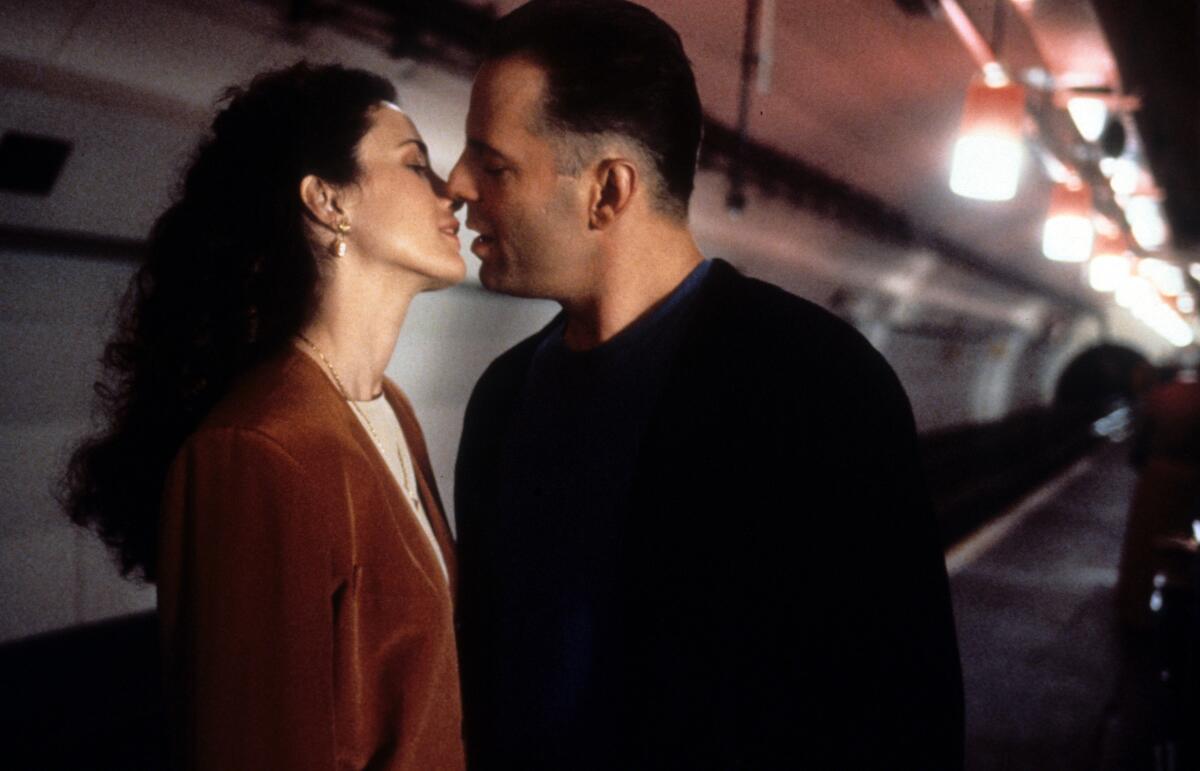
“After Dark, My Sweet” landed just ahead of the Tarantino-inspired crime movie boom of the mid-’90s, alongside such noir-influenced precursors as Dennis Hopper’s “The Hot Spot,” John Dahl’s “Kill Me Again” and Stephen Frears’ Thompson adaptation “The Grifters.”

“This is just such an exciting film to want to reintroduce to audiences,” said Woods in a call. “And to get the opportunity to see this film on the big screen, which most people haven’t had that opportunity for 36 years, it’s just one of those really cool, really only in Los Angeles cinematic moments.”

New this week

A woman stands in front of a leafy backdrop.

Argentinian director Lucrecia Martel, photographed at the Sunset Marquis in April.

(Jason Armond / Los Angeles Times)

  • The unlikely duo of James Cameron and Billie Eilish co-directed a 3D concert film drawn from Eilish’s 2025 tour, “Billie Eilish — Hit Me Hard and Soft: The Tour (Live in 3D).” Film critic Amy Nicholson and pop music critic Mikael Wood traded their thoughts on the movie.
  • Argentinian director Lucrecia Martel is among the world’s most accomplished filmmakers and the true crime tale “Our Land (Nuestra Tierra)” is her first documentary. Carlos Aguilar spoke to Martel about it.
  • “Mad Bills to Pay” expands to multiple Laemmle venues after a weekend run in the Vidiots microcinema. Carlos Aguilar spoke to director Joel Alfonso Vargas about portraying the Dominican American community in the Bronx.

Source link