good work

Is ‘Terminator 2’ the best summer movie ever? Plus the week’s best films

Hello! I’m Mark Olsen. Welcome to another edition of your regular field guide to a world of Only Good Movies.

There are, it goes without saying, a lot of movies out there. And so even for someone like myself, whose job is just to stay on top of them, sometime a title slips by. I had not taken much notice of “Is God Is” before it opened last week without playing any festivals in advance, but the reviews and conversation around it grabbed my interest. Once I realized that Tessa Thompson and Janicza Bravo were involved as producers, I made sure to carve out time to see the movie this week. And am I ever glad I did.

The debut as writer-director for Aleshea Harris (adapting her own play), “Is God Is” is among the most exciting movies released so far this year. Kara Young and Mallori Johnson are absolutely electric as twin sisters who set out to find the estranged, abusive father who abandoned them after leaving them and their mother horribly scarred in a fire. There is a volatile unpredictability to the storytelling that gives it a fresh energy. I saw it at a more-or-less empty matinee, but I’m glad I did. Catch this in theaters while you can.

35 years of ‘T2’

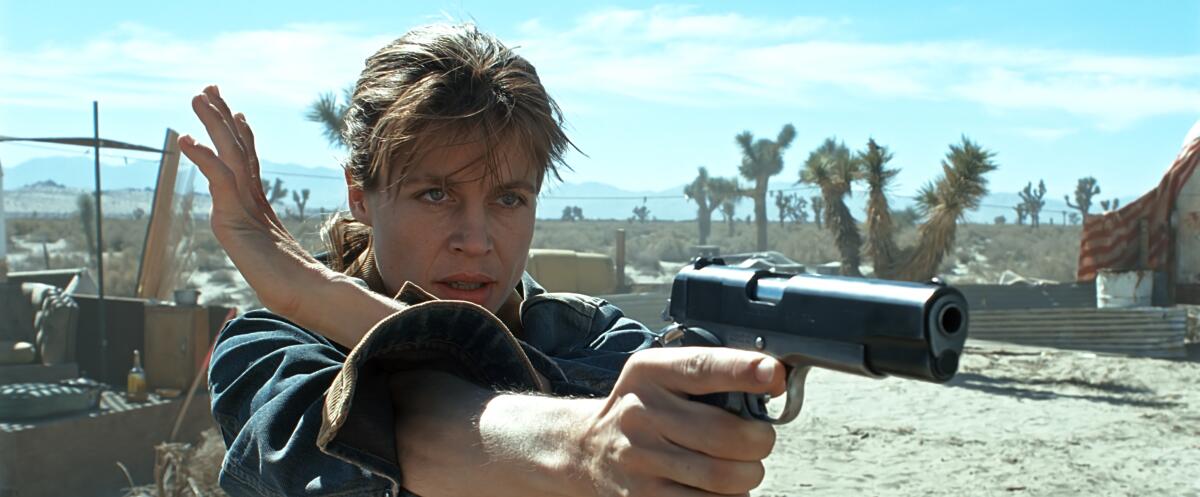
A woman points a gun.

Linda Hamilton in the movie “Terminator 2: Judgment Day.”

(Rialto Pictures)

As far as I’m concerned, James Cameron’s 1991 “Terminator 2: Judgment Day” is the quintessential summer movie. You can pay close attention or not, the special effects and action are amazing, the villains are sentient machines (shades of our AI-addled present) and it has a song by freaking Guns N’ Roses.

The main cast of Arnold Schwarzenegger, Linda Hamilton, Robert Patrick, Edward Furlong and Joe Morton are all perfectly tuned into the movie they are making, full of chaos, mayhem and just the right amount of thoughtfulness. (Morton and Hamilton in particular give the film an unexpected soulfulness.)

To celebrate the film’s 35th anniversary, the American Cinematheque is screening the film in 70mm, 35mm, 3D and DCP at different venues on different days. (Check carefully, as there have already been some schedule changes.) The Academy Museum will show the film on Wednesday in 4K with visual effects supervisor Dennis Muren and special effects creator Shane Mahan present. The film is also playing the Vista in 70mm June 6 and 7.

In his original 1991 review, Kenneth Turan wrote, “Most of all, what makes ‘Terminator 2’ come alive in a major way is Cameron’s intuitive understanding of the mechanics and psychology of action films. Unlike many of the wanna-bes who find themselves in charge of pictures these days, this is one director who really knows how to direct. … Cameron flamboyantly underlines, for those who may have forgotten, why the pure adrenaline rush of motion is something motion pictures can’t live for very long without.”

Lena Dunham before ‘Girls’

Two people hang out in a pipe at night.

David Call and Lena Dunham in the movie “Tiny Furniture.”

(Joe Anderson / IFC Films)

Lena Dunham recently published her second memoir, “Famesick,” a portrait of her rise to cultural prominence and media ubiquity and subsequent retreat from it, which makes this a perfect moment to revisit a key component of her initial ascent, the micro-budget 2010 feature “Tiny Furniture.” Made when Dunham was in her early 20s, the film is a deadly accurate portrait of post-collegiate ennui, shot partly in her parents’ NYC apartment, and remains fresh and startlingly insightful.

The Eastwood Performing Arts Center will be screening the film Friday and Saturday. The film is showing along with the “Welcome to Bushwick a.k.a The Crackcident” episode of Dunham’s series “Girls.”

I profiled Dunham at the time, having first encountered her at SXSW the year before when she was there with her film “Creative Nonfiction.”

“That movie is so personal,” Dunham said of “Tiny Furniture” during an interview from the New York production office of the pilot for what would become “Girls.” “It’s like I wrote it, I directed it, I star in it — if you don’t like the movie you don’t like me.”

With the lacerating self-awareness that made her a star, she added, “And I also understand there is something essentially unappealing about ‘girl makes movies about being a loser and then gets un-loserly things to happen to her.’ It’s a little absurd.”

More onscreen Bob Dylan

Three actors pose for the camera.

Rupert Everett, Fiona Flanagan and Bob Dylan in a production still for 1987’s “Hearts of Fire.”

(Skinner / Mirrorpix / Getty Images)

It was just a few weeks ago that we wrote about a program of Bob Dylan live concert footage. In honor of his 85th birthday, the American Cinematheque will be putting on another program of two oddball rarities from his long career.

Rarely screened in theaters, the 2021 film “Shadow Kingdom,” directed by Alma Har’el, was originally released to a pay-per-view streaming site. Though it purports to be a performance at the Bon Bon Club in Marseille, France, the film was actually shot on a soundstage in Santa Monica. The musicians on screen are not playing live and are not even the same musicians who played on the prerecorded tracks.

The whole thing is very confusing in a very Bob Dylan way, but also kind of incredible. With its Dust Bowl “Twin Peaks,” last-nightclub-on-Earth vibes and spare, haunting arrangements of many Dylan classics that he rarely plays at his own concerts anymore, it is a truly one-of-a-kind document.

The same could be said of the 1987 film “Hearts of Fire,” directed by Richard Marquand (who also helmed “Return of the Jedi!”) and screening in 35mm. In a rare acting turn, Dylan plays a reclusive musician who takes a young singer (Fiona) under his wing, only to have her fall for a pop star played by Rupert Everett. Let’s charitably call Dylan’s performance singular as he delivers every line as if he isn’t sure why he is in the movie. It’s still fascinating.

Kurosawa’s late masterpiece

A woman lifts a dagger.

Mieko Harada in Akira Kurosawa’s 1985 epic “Ran.”

(Rialto Pictures)

One of the highlights of the Academy Museum’s ongoing series on Japanese filmmaker Akira Kurosawa will be this weekend’s 35mm showing of 1985’s “Ran,” a retelling of Shakespeare’s “King Lear” shifted to 16th century Japan. Playing in 35mm in the big David Geffen Theater, it’s a chance to see a truly epic-scaled film under ideal conditions.

Reviewing the movie on its initial release, Kevin Thomas wrote, “‘Ran’ is a heroic saga of human destiny, a war movie with some of the greatest battle scenes in the history of the cinema, a costume drama of the utmost magnificence — and a crackling good samurai movie chock full of swordplay and palace intrigue.”

David Fincher’s secret soft heart

Two people have a conversation in front of a tree.

Gary Oldman and Amanda Seyfried in the movie “Mank.”

(Netflix)

The last couple months have been a real feast for Fincher-heads out there, with high-profile screenings of “Seven,” “Fight Club” and “Zodiac.” Now, David Fincher’s 2020 film “Mank” will be playing this weekend at the Vista. Because it came out during the pandemic (and was launched by Netflix), the film has only ever played a limited number of theaters, let alone in 35mm, which should do wonders for its black-and-white photography.

From a screenplay by Fincher’s father Jack, the film stars Gary Oldman as writer Herman J. Mankiewicz, working on the script for “Citizen Kane” with Orson Welles. Amanda Seyfried gives a vibrant performance as actor Marion Davies, who attempts to save Mankiewicz from his own worst instincts when it comes to her own paramour, mogul William Randolph Hearst.

In his review Justin Chang called the movie “very much a story about class divides and clashing egos, outsiders and insiders, striving and ambition, creation and authorship, and the thrill and loneliness of being the smartest guy in the room. … The off-kilter rhythms feel both immersive and agitated, as if Fincher were trying to both hypnotize you and jolt you awake with his lustrous Old Hollywood homage.”

New this week

A man in a purple hat makes arm gestures.

Director Boots Riley, photographed in Los Angeles in May.

(Ian Spanier / For The Times)

  • Amy Nicholson and Joshua Rothkopf finished out their time at this year’s Cannes Film Festival. (The awards will be announced over the weekend.) Amy took a look at what many have felt to be a weak program this year, while Josh spoke to Korean filmmaker Na Hong-jin, whose sci-fi action film “Hope” has a cast that includes Michael Fassbender and Alicia Vikander as space aliens.
  • I spoke to Boots Riley, a musician and political activist turned filmmaker whose new movie is “I Love Boosters.” Riley maintains a deep sense of political commitment in his work, one which he does not feel he has to betray by also making things that are entertaining and enjoyable.
  • The first new “Star Wars” movie in theaters since 2019, Jon Favreau’s “The Mandalorian and Grogu” is now playing. As Robert Abele put it in his review, “The brand is back together for ‘The Mandalorian and Grogu,’ which is a movie, a hoped-for franchise revival, a fourth season of sorts and an affable throwback. But it’s never quite riveting enough as canon or fodder to supplant anyone’s memories of [insert favorite “Star Wars” film here].”

Source link

Musical reviews: ‘Brigadoon’ soars, ‘Flower Drum Song’ falters

Few would contend that Lerner and Loewe’s “Brigadoon” and Rodgers and Hammerstein’s “Flower Drum Song” represent the best work of these legendary duos.

Unlike Lerner and Loewe’s eternally popular “My Fair Lady,” “Brigadoon” hasn’t had a Broadway revival since 1980. “Flower Drum Song,” relegated to the shadows of Rodgers and Hammerstein’s “Oklahoma!” and “South Pacific,” didn’t last long when it received its first and only Broadway revival in 2002.

I assumed nostalgia was fueling the desire to give these Golden Age musicals a makeover. But when I sat in the audience for these shows and fell immediately under the spell of their scores, I had a different answer.

The music makes a case for why “Brigadoon,” now in a soaring revival at Pasadena Playhouse, and “Flower Drum Song,” making a less assured reemergence at the Aratani Theatre in Little Tokyo, should live again. I was particularly skeptical of “Brigadoon,” with its airy-fairy book and heavy dose of romantic hokum, but the Broadway-level production at Pasadena Playhouse may be the best local staging of a musical I’ve seen in my 20 years covering the scene for The Times.

Kylie Victoria Edwards and Daniel Yearwood in "Brigadoon" at Pasadena Playhouse.

Kylie Victoria Edwards and Daniel Yearwood in “Brigadoon” at Pasadena Playhouse.

(Jeff Lorch)

I knew both musicals principally from their film adaptations. I missed David Henry Hwang‘s original rewrite of “Flower Drum Song,” which was a storied success at the Mark Taper Forum in 2001 but fared less favorably when it moved to New York the following year. I suppose I first saw “Brigadoon” as a kid at my grandmother’s house, amused at the way she goofily sang along. When I recently watched both movies again, it was like falling into a musical comedy time warp.

The enduring love for these Broadway shows isn’t just about the standards they have bequeathed to the American songbook. It’s also about the yearning for a more optimistic era of musical storytelling, when goodness could be counted on to prevail and a happy ending might be delayed but only rarely denied.

“Brigadoon,” a romantic fantasy about two Americans who stumble upon a mystical Scottish village that magically comes to life for a single day once every 100 years, might seem to be irredeemably old-fashioned. The show, which premiered on Broadway in 1947, was Lerner and Loewe’s first hit after a string of flops and fizzles. Without the success of “Brigadoon,” “My Fair Lady,” “Camelot” and the movie musical “Gigi” might never have happened.

Betsy Morgan and Max von Essen in "Brigadoon" at Pasadena Playhouse.

Betsy Morgan and Max von Essen in “Brigadoon” at Pasadena Playhouse.

(Jeff Lorch)

But how do you solve a problem like Alan Jay Lerner’s book, written for a sensibility markedly more wholesome than our own? Enter playwright Alexandra Silber, whose fresh adaptation works for the most part remarkably well. There are a few lumpy patches, moments when the revision over-explains itself or belabors a point. But the way Tommy Albright (Max Von Essen) and Jeff Douglas (Happy Anderson), the accidental American intruders, have been modernized is a fizzy delight.

Imagine if Vincente Minnelli’s screen version of “Brigadoon,” starring Gene Kelly and Van Johnson, was remade with Paul Rudd and John Goodman, and you’ll have some idea of the comic chemistry here. But I should preface this thought exercise by first extolling the musical theater prowess of Von Essen, who received a Tony nomination for his work in “An American in Paris” and has a voice that could make the angels swoon. Less is required of Anderson’s jaded, booze-sodden Jeff, but this smart-alecky sidekick is re-imagined with crackling comic vitality.

The production, directed and choreographed by Katie Spelman, saves its most assertive interventions for its female characters. Fiona MacLaren (Betsy Morgan), the unmarried heroine who catches Tommy’s amorous eye, still falls heedlessly in love but not before correcting some of her American suitor’s chauvinistic assumptions. Morgan might overdo Fiona’s fiery streak when she sings “Waitin’ For My Dearie,” but the driving impulse is to bring the musical’s out-of-time female characters into the 21st century.

"Brigadoon" ensemble at Pasadena Playhouse.

“Brigadoon” ensemble at Pasadena Playhouse.

(Jeff Lorch)

Meg Brockie (Donna Vivino), no longer the town floozie single-mindedly out to bed Jeff, is now the proprietor of Brockie’s Pub and the keeper of Brigadoon’s traditional language and culture. She’s still a sensual wrecking ball, but she’s too formidable to be treated as comic relief.

Silber has transformed Mr. Lundie, Brigadoon’s schoolmaster and moral guide, into Widow Lundie. The casting of the great Tyne Daly in the role is reason enough to make the gender switch, but it’s all part of a recalibration of the values of this theatrical world.

The dynamism of the singing and dancing smooths out some of the adaptation’s rough edges. Spelman puts her own stamp on Agnes DeMille’s original choreography, which was as integral to the storytelling as the book, lyrics and music.

When Charlie (a phenomenal Daniel Yearwood), a genial groom readying himself for the big wedding day, performs with his buddies “I’ll Go Home With Bonnie Jean,” Pasadena Playhouse erupts in a stomping frenzy of Celtic ecstasy. And Yearwood’s gorgeous rendition of “Come to Me, Bend to Me” is so seductive, it’s no wonder that Jean (Kylie Victoria Edwards), Fiona’s sister, has chosen to marry him.

"Brigadoon" ensemble at Pasadena Playhouse.

“Brigadoon” ensemble at Pasadena Playhouse.

(Jeff Lorch)

All, however, is not idyllic in time-forgotten Brigadoon. Casting a pall over the nuptials, Harry Beaton (Spencer Davis Milford), hopelessly in love with Jean, threatens to destroy Brigadoon’s miracle by leaving the town for good.

Silber deepens Harry’s character and gives his story more emotional weight. (Milford manages to be both convincingly menacing and pitiably heartbroken.) The movie tweaked Harry’s fatal ending, but the adaptation does something even more striking with his desperation. The change is absorbed naturally by the musical, even if the funeral dance that Maggie (Jessica Lee Keller) elaborately performs might be more moving on a reduced scale.

The adaptation doesn’t always get the dramatic proportions right. When Jeff bares his soul to Tommy after the two are back on barstools in New York, the revelation that he is a heartsick widower complicates our understanding of a character originally conceived as a cynical bachelor. But Silber tries to extract too much sympathy from the exchange and stops the action when it should be moving rapidly toward its big finish.

"Flower Drum Song"

Marc Oka, foreground, and Esther Lee, from left, Gemma Pedersen, Ai Toyoshima, Sally Hong, Hillary Tang and Emma Park in Rodgers and Hammerstein’s “Flower Drum Song,” produced by East West Players and the Japanese American Cultural and Community Center.

(Mike Palma)

But nothing can derail the success of this extraordinary production, the high watermark so far of Pasadena Playhouse producing artistic director Danny Feldman’s ongoing reexamination of the American musical canon. Jason Sherwood’s ravishing scenic design, full of eye-catching texture and lush density, makes it impossible not to dream along with the characters. Even the stage curtain, graced with Brigadoon’s floral insignia, is a work of art.

A 22-piece orchestra, under the music supervision of Darryl Archibald, draws out the all the sublime color of Frederick Loewe’s music. Most spectacularly, the blend of Von Essen’s lyric baritone and Morgan’s assertive soprano gives eternal life to Tommy and Fiona’s numbers. Hearing “The Heather on the Hill,” “Almost Like Being in Love” and “From This Day On” in the majestic intimacy of Pasadena Playhouse is a memory that will last at least a lifetime.

It’s a bit harder to judge this update of “Flower Drum Song,” which is Hwang’s second crack at revising the book, originally written by Oscar Hammerstein II and Joseph Fields. A co-production between East West Players and the Japanese American Cultural and Community Center, the revival doesn’t have the resources of Pasadena Playhouse’s “Brigadoon” and likely doesn’t have the same goals.

"Flower Drum Song"

Ai Toyoshima, from left, Brian Shimasaki Liebson, Grace Yoo and Scott Keiji Takeda in Rodgers and Hammerstein’s “Flower Drum Song,” produced by East West Players and the Japanese American Cultural and Community Center.

(Mike Palma)

The musical, which premiered on Broadway in 1958, was groundbreaking for the way it provided a showcase for Asian American performers. Henry Koster’s 1961 studio film adaptation followed suit with an even greater reach. The intention was to create musical theater entertainment built around generational conflict — a longstanding device of romantic comedy. But here the clash involves immigrants in San Francisco trying to reconcile traditional Chinese culture and modern American life.

Stereotypes, however, prevailed, leaving a community at once grateful for representation and uncomfortable with the reinforcement of old tropes. Hwang (author of the Tony Award-winning “M. Butterfly”) set out to re-imagine the characters from the perspective of a contemporary Asian American dramatist nearly 25 years ago. But times continue to change along with cultural sensitivities, and he wanted to revisit his work for East West Players’ 60th anniversary season.

Directed by EWP artistic director Lily Tung Crystal, who is of Chinese heritage, the production is on a quest for a deeper authenticity. This mission is to provide a more genuine reflection of Asian American experience — community members speaking directly to fellow community members.

"Flower Drum Song"

Grace Yoo, left, and Scott Keiji Takeda in Rodgers and Hammerstein’s “Flower Drum Song,” produced by East West Players and the Japanese American Cultural and Community Center.

(Mike Palma)

The production is most effective when the actors are singing, especially Grace Yoo, who plays Mei-Li and had me entranced the moment she started singing “A Hundred Million Miracles.” Don’t let the traditional flower drum she totes around fool you. She’s no longer the quietly obedient daughter of authority. Having fled communism, she has arrived in the U.S. without papers and (unlike the original) her father, and isn’t too keen on anyone dictating to her what she can and cannot do.

Scott Keiji Takeda, who plays Ta, Mei-Li’s reluctant inamorato, has a sumptuous voice that captures the hues of Richard Rodgers’ music. But unfortunately his wooden characterization raises questions about what exactly Mei-Li sees in him.

There’s a tension between the update’s good intentions and the tendency of musical comedy to traffic in amusing caricatures. (Exaggeration and simplification are par for the course.) In trying to root out offensive Asian American stereotypes, Hwang imports swishing stereotypes for laughs in his creation of a new character, Harvard (Kenton Chen), who works at the theater owned by Ta’s father and seems a throwback to the campy, wisecracking gay characters that were a staple of 1980s big-budget movie comedies. Harvard may get a more empowering storyline than his florist-hairdresser-retail-clerk predecessors, but the humor is redolent of the same punishing cliches.

"Flower Drum Song"

Krista Marie Yu in Rodgers and Hammerstein’s “Flower Drum Song,” produced by East West Players and the Japanese American Cultural and Community Center.

(Mike Palma)

Emily Kuroda as take-charge producer Madame Liang and Marc Oka as Wang, Ta’s old-school father, throw themselves into the revival with full farcical force. Crystal’s fluid staging, full of agile and vibrant design choices, smoothly maneuvers the action. But earnestness is the enemy of hilarity. Hwang can be very witty, but how can the production let itself go when it’s so often being called upon to make an important point?

Linda Low (Krista Marie Yu), no longer Mei-Li’s rival for Ta’s hand in marriage, is now her ally. When she sings a middling version of “I Enjoy Being a Girl,” the joke isn’t on her but a society that leaves women so few options. The problem is that for Hwang to rebuild Mei-Li and Linda into characters of credible modern-day complexity, he would have to start from scratch, not just retooling the book but commissioning a new score to flesh out his more complicated vision. In other words, leaving Rodgers and Hammerstein’s musical behind.

“Brigadoon” manages to transcend time, but this take on “Flower Drum Song” falters between eras.

‘Brigadoon’

Where: Pasadena Playhouse, 39 S. El Molino Ave.

When: 8 p.m. Tuesdays (5/26), Wednesdays and Fridays; 7 p.m. Thursdays; 2 and 8 p.m. Saturdays; 2 p.m. Sundays and 7:30 p.m. June 14 (closing night).

Tickets: Start at $44.

Contact: (626) 356-7529 or PasadenaPlayhouse.org

Running time: 2 hours, 30 minutes (including intermission).

Rodgers & Hammerstein’s ‘Flower Drum Song’

Where: The Aratani Theatre, 244 S. San Pedro St., Little Tokyo.

When: 7:30 p.m. Thursdays-Fridays; 2 and 8 p.m. Saturdays; 1 and 7 p.m. Sundays. Ends May 31

Tickets: Start at $10

Contact: (213) 625-7000 or eastwestplayers.org

Running time: 2 hours, 35 minutes (including one 20-minute intermission)

Source link

The weird allure of Altman’s ‘Popeye,’ plus the best films in L.A.

Hello! I’m Mark Olsen. Welcome to another edition of your regular field guide to a world of Only Good Movies.

This newsletter is about going to the movies, of course, but it’s about writing and reading about movies, too. And so it was exciting news this week that Film Comment, the venerable but shuttered publication that helped foster cinephilia in America, would return as a quarterly online publication.

A complete archive is now available online, going all the way back to the earliest issues in 1962. Looking for landmark writings by Manny Farber, Paul Schrader, Richard Corliss, Amy Taubin, Jonathan Rosenbaum, Kent Jones or countless others? It’s all there and well worth digging into. I began my career as an intern at Film Comment, publishing some of my own earliest pieces, and still consider it a North Star for writing about movies. Its return is most welcome.

Agnès Varda’s bruising brilliance

A woman stands outdoors.

Sandrine Bonnaire in the 1985 movie “Vagabond.”

(Criterion Collection)

Though she became better known for her free-spirited, pixie-ish persona later in life, French filmmaker Agnès Varda was also capable of the bruising emotions of 1985’s “Vagabond,” arguably her greatest fiction feature and winner of the Golden Lion at Venice and the César for best actress for star Sandrine Bonnaire. Opening with the lead character found dead in a ditch, the film flashes backward to piece together her life from the memories of others, creating a fragmented portrait of an enigmatic young woman’s life.

Mezzanine will screen the film on Saturday at 2220 Arts + Archives, followed by a conversation between art critic Megan O’Grady and former Times staffer Carolina Miranda. Writing about the film in 1986, Sheila Benson said, “Just how Agnes Varda has kept ‘Vagabond’ from being a monumental downer is interesting, but she has. It is haunting. It is melancholy … but ultimately, beyond its central tragedy, it is an exhilarating film, the sort you leave burning to talk about with friends.”

A cartoon comes to life

A man with a corncob pipe speaks to a very thin woman.

Robin Williams and Shelley Duvall in the 1980 movie “Popeye.”

(Paramount Pictures / Getty Images)

It is one of the most deranged credit blocks imaginable: an adaptation of “Popeye” directed by Robert Altman, produced by Robert Evans, with a screenplay by Jules Feiffer, music by Harry Nilsson and starring Robin Williams and Shelley Duvall. When it was first released in December 1980, it was seen as too weird for kids and too naive for adults, but it has since been reconsidered as a unique snapshot of intersecting talents — a strange, wonderful, one-of-a-kind movie.

Vidiots will screen the film on Saturday afternoon with actors Paul Dooley and Donovan Scott, who played J. Wellington Wimpy and Castor Oyl. In our original 1980 review that is more positive than one might expect, Charles Champlin wrote, “Its difficulties arise not from a lack of ambition and innovation but from excesses of them.”

Neil Young + Devo = gloriously weird

A man in a striped shirt smiles next to a statue of a Native American.

Neil Young in the 1982 movie “Human Highway.”

(Shakey Pictures)

Neil Young’s place as a singer-songwriter and musician is unassailable — he’s an irascible, restless troubadour. But his sidebar work as a filmmaker, typically under the name Bernard Shakey, has had more sporadic and unpredictable output.

Young’s 1982 film “Human Highway” is probably the pinnacle of his work as a director, starring Young himself in an offbeat story of a small community in the shadow of a nuclear power plant. Dennis Hopper, Dean Stockwell, Devo and even former Times music critic Robert Hilburn all appear. Now Instant Image Hall will be screening the film on Saturday and Sunday along with a selection of Devo music videos in celebration of an exhibition at the MutMuz gallery.

After Young premiered a new cut of “Human Highway” a decade or so ago, I somehow found myself sitting across from him at a diner on a rainy midnight in downtown Toronto. (This job does have its moments.)

“My films are not super commercial, but they mean something to me,” Young said.

An Oscar-winning debut

Three people stand in front of a suburban house.

Shirley MacLaine, Debra Winger and Jack Nicholson in the 1983 movie “Terms of Endearment.”

(Paramount Pictures)

Part tearjerker, part family drama and part comedy, 1983’s “Terms of Endearment” trademarks a certain bittersweet tone that is still just pure magic. The story of a mother (Shirley MacLaine) and daughter (Debra Winger) across many years of ups and downs in their relationship, the film was the feature debut for James L. Brooks as writer-director and won five Oscars, including three for Brooks. The Academy Museum will play the film in a new 35mm print on Sunday afternoon.

When the movie came out on 4K disc in 2023, I spoke to Brooks about it. He talked about how even though it does have moments of great emotional weight, it was intended to play with a lighter tone overall.

“The whole thing was to make it as a comedy,” Brooks said. “The whole thing was to clock laughs. You had to, in order to do it right. And of course, once the audience leaves and it has its afterlife, it’s a drama because people are watching it alone. But I swear to you, in the theaters it was a comedy.”

A ’90s noir ripe for rediscovery

Three people sit tensely around a table.

Jason Patric, left, Bruce Dern and Rachel Ward in the 1990 movie “After Dark, My Sweet.”

(Kino Lorber)

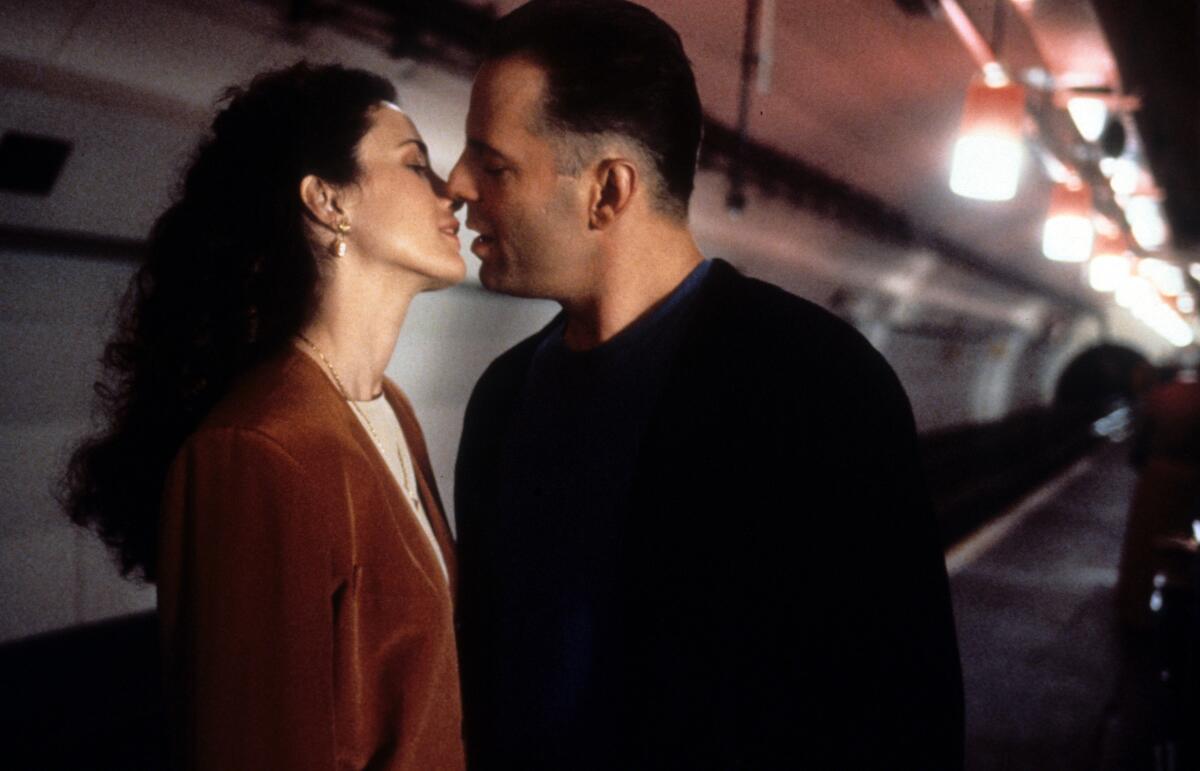
Set in the Coachella Valley with the woozy feel of a day drunk and a sense of uneasy menace, 1990’s “After Dark, My Sweet” is an adaptation of the novel by pulp icon Jim Thompson, directed by James Foley.

Jason Patric, then only 23, stars as Kevin Collins, known as Collie, a former boxer who escapes from a mental institution and is now just drifting. He falls in with Fay (Rachel Ward), an enigmatic, lonely alcoholic widow, who in turn introduces Collie to a shady man known as Uncle Bud (a delightfully sleazy Bruce Dern). Soon Collie is ensnared in a plot to kidnap a sickly rich boy that immediately goes off the rails.

On Tuesday at Vidiots, there will be a screening of Patric’s personal 35mm print of the film — a gift he received some 20 years ago and has never watched before. (It is said to be in pristine shape.) Along with a video introduction from actor and filmmaker Alex Winter, there will be a Q&A afterward with Patric moderated by critic and scholar Travis Woods, who contributed a commentary track to a recent Australian Blu-ray release of the film.

Patric organized the screening as a tribute to director Foley, who died in May 2025 at age 71. “After Dark” landed in between Foley making “Who’s That Girl” with Madonna and the David Mamet adaptation “Glengarry Glen Ross.” Among his other credits are “At Close Range,” “Fear” and the last two “Fifty Shades” movies.

“He was a good friend of mine at the time,” says Patric on a recent phone call from Santa Monica. “I know this was his favorite movie and it was closest to him. It’s the only movie that he had actually written that he directed. And I thought the best way to do that is just to show the movie.”

Patric, who says Collie is his favorite character in a career that also includes “The Lost Boys,” “Rush” and “Your Friends & Neighbors,” was first given the script and in turn gave it to Foley; developed it further together, trying to retain the language of Thompson’s novel. (The screenplay is credited to Foley and Robert Redlin.)

“It’s really a subjective piece of filmmaking,” says Patric. “So as Collie’s figuring things out, the audience is figuring things out.”

In her original review of the film, Sheila Benson wrote that “Collie is one of those roles actors lust after, the damaged dreamer, maybe dumb, maybe dangerous, and Patric demolishes the conventions of the role with breathtaking skill.”

“After Dark, My Sweet” landed just ahead of the Tarantino-inspired crime movie boom of the mid-’90s, alongside such noir-influenced precursors as Dennis Hopper’s “The Hot Spot,” John Dahl’s “Kill Me Again” and Stephen Frears’ Thompson adaptation “The Grifters.”

“This is just such an exciting film to want to reintroduce to audiences,” said Woods in a call. “And to get the opportunity to see this film on the big screen, which most people haven’t had that opportunity for 36 years, it’s just one of those really cool, really only in Los Angeles cinematic moments.”

New this week

A woman stands in front of a leafy backdrop.

Argentinian director Lucrecia Martel, photographed at the Sunset Marquis in April.

(Jason Armond / Los Angeles Times)

  • The unlikely duo of James Cameron and Billie Eilish co-directed a 3D concert film drawn from Eilish’s 2025 tour, “Billie Eilish — Hit Me Hard and Soft: The Tour (Live in 3D).” Film critic Amy Nicholson and pop music critic Mikael Wood traded their thoughts on the movie.
  • Argentinian director Lucrecia Martel is among the world’s most accomplished filmmakers and the true crime tale “Our Land (Nuestra Tierra)” is her first documentary. Carlos Aguilar spoke to Martel about it.
  • “Mad Bills to Pay” expands to multiple Laemmle venues after a weekend run in the Vidiots microcinema. Carlos Aguilar spoke to director Joel Alfonso Vargas about portraying the Dominican American community in the Bronx.

Source link