Hello! I’m Mark Olsen. Welcome to another edition of your regular field guide to a world of Only Good Movies.
Recently, I don’t exactly know why, I was overtaken by a concern that because of the impending merger of Paramount and Warner Bros., Olivier Assayas’ 2022 series adaption of his own film “Irma Vep” would be removed from the HBO Max streaming platform. With no official physical release, the series — starring Alicia Vikander as a Hollywood movie star making a project in Paris — could be effectively vanished from existence.
This is sadly inevitable, though some superfans have gone to extra-legal measures to ensure otherwise (not that we would ever endorse this). Most famously it’s happened with the original “Star Wars” trilogy. Billed as the “Grindhouse Edition,” these are discs of the first three “Star Wars” films sourced from scans of original film prints before the digital fixes and polish of the more recent official releases. Reengaging with these works in this way, scratches and all, is (I’m told) a strong reminder of why they hit so hard in the first place, similar to how it might be to reread a text in the original language instead of a more recent translation.
‘Indiana Jones’ marathon

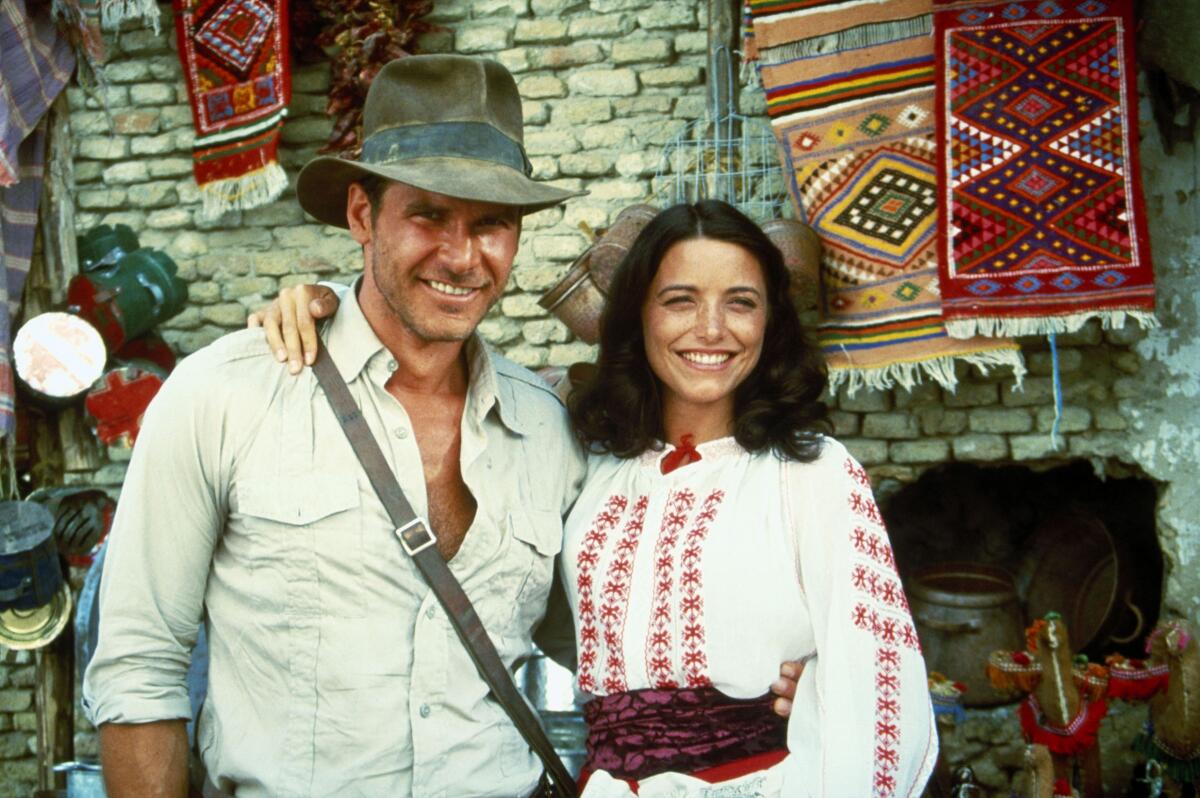
Harrison Ford and Karen Allen on the set of 1981’s “Raiders of the Lost Ark.”
(Lucasfilm Ltd.)
The same deep understanding of genre filmmaking that went into the original “Star Wars” also went into “Raiders of the Lost Ark,” the first adventure of the character of Indiana Jones. Directed by Steven Spielberg from a script by Lawrence Kasdan and story by George Lucas and Philip Kaufman, the film is playful, thrilling and self-aware. It is made with such care, attention to detail and sense of fun that I remember how disappointed I was to discover not all movies would be like this.
There have of course been diminishing returns with the more recent run of Indiana Jones sequels, but the first three installments all have a real spark. And so the Secret Movie Club will present “Raiders,” 1984’s “Indiana Jones and the Temple of Doom” and 1989’s “Indiana Jones and the Last Crusade,” all on 35mm at the Million Dollar Theater in DTLA on Sunday in celebration of Father’s Day.
In her original review of the first film, Sheila Benson described that while watching it, she felt “a rush of gratitude which almost brought tears of contagious joy and — not to be corny about this — the strength of the film’s positive vision. If this is an era in which the heroic is lacking and the mediocre threatens us from every side, then ‘Raiders,’ which has no pretensions to importance, which is unabashedly wide-eyed and exaggerated and true blue but somehow cherishes the best in life and filmmaking — is a high-water mark.”
Plenty of jokes could be made about the movies having settled into what might be thought of as part of the dadcore canon: action-adventure movies that play well on TV and maybe you can take a short nap and not miss anything. So be it.
From one master to another

Cary Grant and Eva Marie Saint in Alfred Hitchcock’s 1959 thriller “North by Northwest.”
(Sunset Boulevard / Corbis via Getty Images)
Filmmaker Guillermo del Toro has been making waves of late for his strong public stance against the use of AI in feature filmmaking. But it is worth remembering that he is also a deep and incisive thinker about older movies, a true fan, which makes his upcoming appearances at the Academy Museum a special occasion.
Del Toro will present five films by Alfred Hitchcock — 1946’s “Notorious,” 1943’s ‘Shadow of a Doubt,” 1959’s “North by Northwest,” 1953’s “I Confess” and 1972’s “Frenzy” — along with delivering a lecture on each of them. To see one great filmmaker reflect with such depth into the work of another is just remarkable. This is some genuine only-in-L.A. type stuff.
Comedy + politics = good fun

A scene from the 1976 movie “Car Wash.”
(Margaret Herrick Library / Academy of Motion Picture Arts and Sciences)
A raucous comedy set around the location of the title, “Car Wash” is also a sharp, politically minded satire about labor and money. Directed by Michael Schultz from a screenplay by Joel Schumacher, the film has an extended ensemble cast that includes Richard Pryor, Franklyn Ajaye, George Carlin and many others.
In his original review Charles Champlin compared “Car Wash” to films such as “American Graffiti” and “Nashville” and called it “light but not foolish. … The experience is exhilarating.”
A 50th anniversary screening at the Academy Museum on Saturday of a new 4K restoration will include a panel with Schultz and actors Bill Duke, Antonio Fargas, Melanie Mayron, Garrett Morris and Pepe Serna.
Collision report

James Spader in the 1996 movie “Crash,” directed by David Cronenberg.
(Jonathan Wenk / Fine Line Features)
The controversy that surrounded David Cronenberg’s “Crash” when it premiered at Cannes in 1996 and received a U.S. release in 1997 tended to overwhelm the actual movie. Shockingly explicit, the film is about a secret underground world of people who create a sexual fetish out of car crashes. An adaptation of the novel by J.G. Ballard, Cronenberg’s movie explores the cinematic obsession with sex and violence.
Over time, “Crash” has been evolving from a seemingly cursed object dogged by scandal into something that audiences can come to appreciate and admire — even if it is not a movie you can ever exactly fully understand. Part of Cronenberg’s brilliance is how enigmatic and unknowable his work can be: strange, inviting and enveloping while refusing easy or direct analysis.
The movie is playing twice locally this week, on Saturday at Vidiots in partnership with the Cinegogue, with special giveaways and exclusive merch, and again on Monday at the Academy Museum in 4K. Who will be brave (or perverse) enough to go twice?
A different view of Rio

Milton Gonçalves, center, in the 1974 movie “The Devil Queen.”
(Kino Lorber)
A drag queen (Milton Gonçalves) rules the criminal underworld of Rio de Janeiro in Antonio Carlos da Fontoura’s 1974 gangster drama “The Devil Queen,” an unlikely mix of camp aesthetics and gritty violence. Among the film’s many fans is Kleber Mendonça Filho, the filmmaker behind the recent Brazilian hit “The Secret Agent,” who referred to “The Devil Queen” as “bloody, nasty and full of personality.”
The movie is playing in a new 4K restoration at the Lumiere Cinema in Beverly Hills.
A musical melodrama returns

Raul Julia, left, and Teri Garr in Francis Ford Coppola’s 1981 movie “One From the Heart.”
(Rialto Pictures / American Zoetrope)
We have talked before about Francis Ford Coppola’s “One From the Heart,” a movie of such delirious audacity that it nearly ruined the filmmaker‘s career. A throwback musical about two lovers who break up in search of more excitement, the film stars Teri Garr, Frederic Forrest, Nastassja Kinski and Raul Julia.
On Saturday the film will screen at the American Cinematheque’s Aero Theater in a 70mm print for the first time in L.A. since 1990. The event is being dedicated to Dean Tavoularis, Coppola’s longtime production designer, who died in April. For “One From the Heart,” Tavoularis re-created the Las Vegas Strip on a studio back lot.
New this week
- Amy Nicholson is not a fan of the new “Toy Story 5,” writing in her review, “Pixar has continued adding shades to the same plot outline like a child with a box of 128 crayons (or a company clinging to its billion-dollar idea).”
- Glenn Whipp cast back into the “Toy Story” universe for a highly personal ranking of his 10 favorite “Toy Story” toys.
- Two gay teenage boys attempt to survive a supernatural entity and conversion therapy in Adrian Chiarella’s debut feature “Leviticus.” Jen Yamato spoke to the filmmaking team.
- I spoke to writer-director Michael Sarnoski about his new “The Death of Robin Hood,” starring Hugh Jackman in a subversively revisionist telling of the last days of the medieval bandit.