
spend

Ramaswamy takes responsibility for ad with Amy Acton’s mother and will spend millions to promote it

Republican Vivek Ramaswamy ’s team confirmed late Tuesday that it produced a controversial advertisement featuring the estranged mother of Amy Acton, and the campaign said it will spend $4 million to promote it despite facing bipartisan rebuke for dredging up the painful childhood of his Democratic opponent in Ohio’s governor’s race.

The decision exacerbates a deeply personal element in one of the country’s most closely watched and expensive campaigns for state office. Questions about the video will likely shadow Ramaswamy, a biotech billionaire who previously ran for president but has never before held public office, in the final two weeks of the contest. Democrats said he was growing desperate at a moment when more than 676,000 people have already cast ballots in Ohio.

The advertisement features Acton’s birth mother, Donna Arthur, calling her “a liar” and insinuating she has mental health issues. Acton, Ohio’s former public health director, has made no secret of facing homelessness and abuse as a child. Arthur lost custody of her children after their stepfather was indicted for raping Acton.

The video’s origins were initially murky when it started circulating online. It first surfaced in a post by an Ohio political blogger, then spread across social media. It did not include the “paid for” tag that is legally required to air on television so viewers can know who produced and paid for it. D.J. Brynes, who blogs as “The Rooster,” told CNN he got the video from a voter who viewed it as part of a poll and recorded it.

Connie Luck, a spokesperson for Ramaswamy’s campaign, said Acton’s mother was not paid for the one-minute video, which she said will stream online and air on television.

Acton spent Tuesday condemning Ramaswamy for the ad even before his campaign confirmed its provenance.

“I won’t normalize somebody who has said that my childhood is just something I’m complaining about, who today just released an ad using my birth mother, who I was removed from at the age of 12 for severe abuse and neglect, and sexual abuse,” she told Spectrum News, a cable news outlet in Ohio.

She said Ramaswamy made similar personal attacks during his run for the Republican presidential nomination two years ago, calling it “a lifelong pattern.”

Ramaswamy’s campaign initially issued a statement that did not address whether he was responsible for the ad or knew who produced it. In the earlier statement, Luck said Acton “has some serious problems with the truth that the public needs to be aware of.”

Democrats and Republicans condemn the ad

Casey Putsch, a car designer and YouTube provocateur who competed against Ramaswamy for the Republican nomination for governor, said on social media that he would be voting for Acton in the wake of the ad’s release. He called the video “pretty damn low.”

Acton’s campaign released a statement from her brother, Philip Stearns, who said the two were removed from their mother Donna Arthur’s custody as children after their stepfather, Arthur’s husband, was indicted for raping Acton as a child. Acton has not seen Arthur, whose last known address was in Pennsylvania, since they were in a courtroom together in 1978.

Later Tuesday, the Acton campaign released a video featuring Stearns, who recalls his older sister taking “the worst” of the abuse they faced as children in order to protect him and disparages Ramaswamy and his allies for exploiting the situation.

According to police and court documents obtained by the Associated Press, Cledith Arthur was arrested and charged with the rape of his stepdaughter, then 12, in July 1978, after Acton’s biological father reported him to authorities. The abuse allegedly happened from December 1976 to April 1978.

Cledith Arthur pleaded not guilty. He was indicted by a grand jury that September, but failed to show at a court hearing and remained a fugitive until at least 1981. He has since died.

High-profile Republicans who back Ramaswamy — including Donald Trump Jr. and influencer Laura Loomer — elevated the video in online posts.

But others joined Democrats in condemning the ad. Meghan McCain called it “dastardly” and Dan Hauser, a strategist for Republican Sen. Mike Lee of Utah, said he deleted his post sharing the video once he realized “the very serious accusations that caused their issues.”

The Democrat running for U.S. Senate in Ohio, Sherrod Brown, described the spot as “disgusting” and said everyone — including his opponent, Sen. Jon Husted — should be willing to condemn it. Husted’s campaign didn’t respond to a request for comment.

Smyth writes for the Associated Press. AP writer Ali Swenson in New York contributed to this report.

Source link

How much does France spend on education compared with the rest of Europe? | Education News

French high school students have been protesting for more than two weeks over conditions in schools, including overcrowded classrooms and staff shortages, and they show no sign of stopping.

The unrest began on September 21 when pupils blockaded a school in the Paris suburb of Creteil, and within a week, their protest had spread across the country with students and police clashing violently.

On September 29, the demonstrations coincided with a nationwide public sector strike, in which teachers joined other state workers against a proposed pay freeze. More than 6,100 people have since been arrested.

With the government under pressure to rein in spending as its debt rises, Al Jazeera looks at how much France invests in education, how it compares with the rest of Europe and how it measures up against what the country spends on healthcare and defence.

How much does France spend on schooling?

According to the latest data from Eurostat, the European Union’s statistics agency, France’s public spending on education amounts to 5.1 percent of its gross domestic product (GDP). That figure does not include private spending, such as school fees paid by families.

The French Ministry of National Education uses a broader measure, known as domestic expenditure on education, which counts all the money that goes into education, whether from the state, local authorities, businesses or households. As well as teaching, it covers adult and continuing training and related costs such as school meals, boarding and transport.

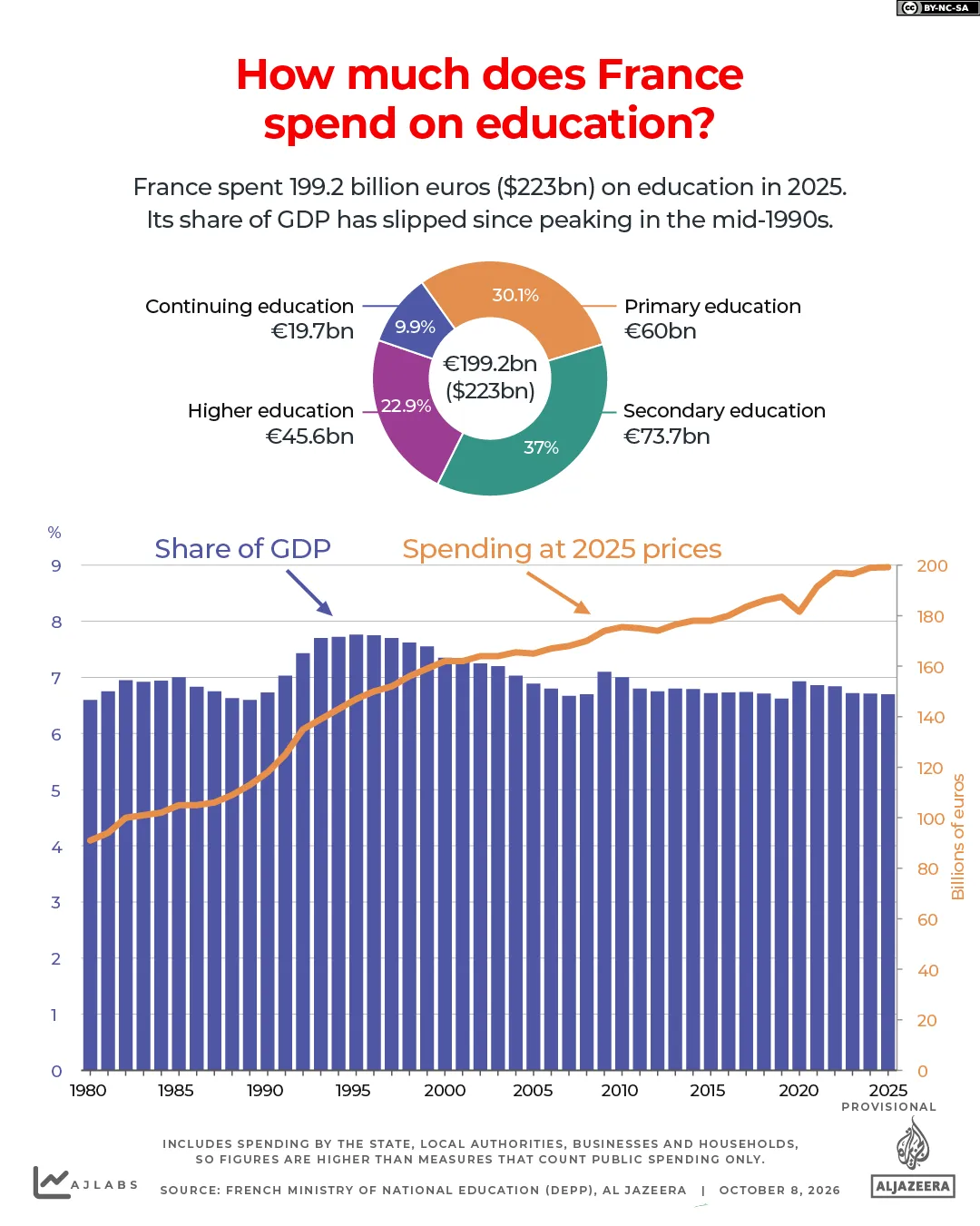
By this measure, France spent 199.2 billion euros ($223bn) on education in 2025, equivalent to 6.7 percent of its GDP and 2.4 billion euros more than in 2024, according to provisional ministry figures.

INTERACTIVE - How much does France spend on education-1791443863
(Al Jazeera)

Spending has more than doubled since 1980, even after accounting for inflation. But the economy has grown too, so education spending’s share of GDP is lower today than it was in the mid-1990s.

Secondary education accounted for the largest share of spending at 73.7 billion euros (37 percent), followed by primary education at 60 billion euros (30 percent), higher education at 45.6 billion euros (23 percent) and adult and continuing education at 19.7 billion euros (10 percent), according to the National Education Ministry.

How much do other European countries spend on education?

Among European countries, Sweden spends the largest share of its GDP on education at 7.3 percent in 2024, followed by Iceland (7 percent) and Belgium, Estonia and Finland (6.3 percent each), according to Eurostat.

The lowest spenders are Ireland (2.7 percent), Greece (3.9 percent), Romania and Italy (4 percent each), and the United Kingdom and Spain (4.1 percent each).

At 5.1 percent, France is joint 13th, level with the Netherlands and Slovakia, and above the EU average of 4.8 percent.

But above-average spending has not shielded France from a problem affecting much of the developed world. Teacher shortages are growing across countries in the Organisation for Economic Co-operation and Development, according to the OECD’s latest Education at a Glance report.

Rather than leaving posts empty, many countries are filling them with teachers who lack full qualifications. In the 2024-2025 school year, 9 percent of primary and secondary teachers across the OECD were not fully qualified.

In France, the strain is most visible in secondary schools. About 11 percent of secondary teachers are not fully qualified, compared with less than 3 percent in primary schools. Furthermore, lower secondary classes average 26 pupils, compared with 23 across the OECD.

That echoes what pupils have been saying during the latest protests: Classes are large, and absent teachers are not being replaced. Some also described dilapidated buildings, a shortage of tables and chairs and, in some schools, rodent infestations. The intense heatwaves that hit France this year exacerbated existing problems in neglected buildings, many of which have no air conditioning, students said.

Teachers also feel undervalued. Only 4 percent said their profession is valued in society, the lowest share of any country surveyed and far below the OECD average of 22 percent.

How much has spending changed?

Historical UNESCO data showed France’s education spending slipped from 5.5 percent of GDP in 2017 to 5.3 percent in 2022 although it remained the ninth-highest among 29 European countries with data. A brief rise to 5.7 percent in 2020 reflected the pandemic shrinking the economy, not extra spending.

France was one of 14 countries where the share fell. Norway and Denmark saw the steepest drops while Slovakia, Slovenia, Lithuania and the Czech Republic recorded the biggest rises.

What else are these nations spending on?

The protests have coincided with nationwide public sector strikes over the government’s proposed 2027 budget, which seeks 54 billion euros ($61.3bn) in savings as French President Emmanuel Macron’s government tries to rein in a large public deficit.

Unions and public sector workers object in particular to a plan to freeze state employees’ salaries, which is expected to save about 2 billion euros ($2.27bn).

Across Europe, most governments spend more on education than on defence, but healthcare takes the largest share of national income of the three, according to 2022 data from the World Bank and UNESCO.

France spent 11.9 percent of its GDP on healthcare in 2022, one of the highest shares in Europe.

Source link

US senator says AIPAC plans to spend $233M to defeat candidates critical of Netanyahu gov’t – Middle East Monitor

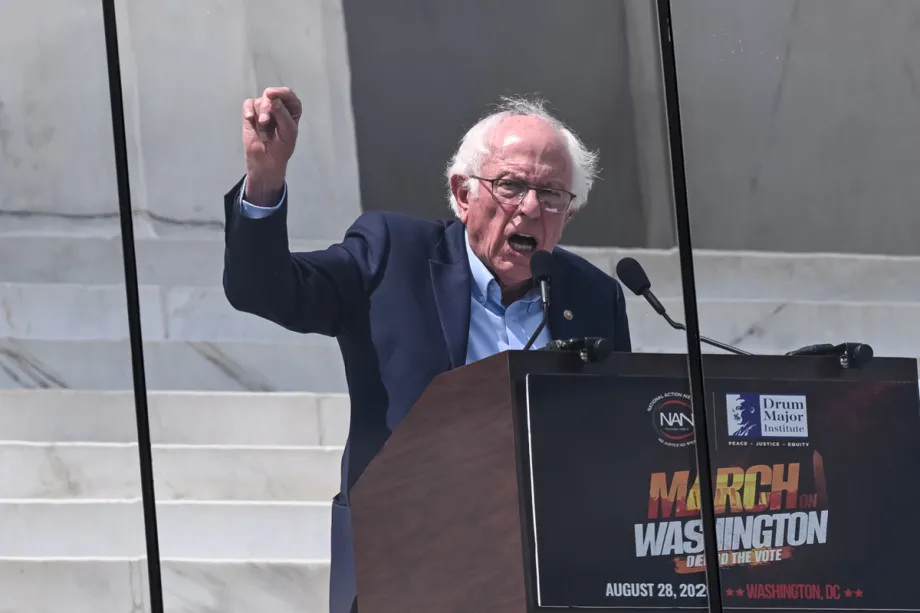
The American Israel Public Affairs Committee (AIPAC) is set to spend $233 million to defeat candidates in this fall’s congressional midterm elections who speak out against the government of Israeli Prime Minister Benjamin Netanyahu, warned US Senator Bernie Sanders, Anadolu reports.

The top pro-Israel lobbying firm in the US “plans to spend $233 million to defeat candidates who dare to speak out against Netanyahu’s extremist government,” Sanders said on US social media platform X on Friday.

“They spent $33 million to defeat Abdul El-Sayed in the Michigan primary. They lost. They are going to keep losing,” he said.

El-Sayed, the Democratic candidate in this year’s senatorial race in the state of Michigan, strongly opposes unconditional US military aid for Israel and has criticized the Netanyahu government’s policies in both Gaza and the occupied West Bank.

READ: Former Israeli premier accuses Netanyahu of preparing ground for war that could delay elections

Sanders added: “NO MORE U.S. MILITARY AID FOR ISRAEL.”

In the Nov. 3 US congressional midterms, polls show Democrats broadly favored to win the House of Representatives and possibly the Senate.

As the US electorate’s view of Israel has soured, especially in light of the genocide in Gaza, many Democrats running for office this year have taken a harder line against the policies of the Netanyahu government and what many see as its efforts to displace Palestinians and frustrate any hope for peace in the Middle East.

READ: US senator urges Congress to cut off funding for Iran war

Source link

Friends spend a day in France for under £75 and have ‘one big tip’

They flew to France for lunch, spent seven hours exploring the town then headed home

A pair of best friends nipped to France for lunch and came home the same night, spending less than £75 on the whole trip. Mel Evans travelled to Beauvais with her friend and work colleague, Joanne Howard.

Mel managed to snap up return flights from Birmingham for just £48. The retail workers took an 8.45am Ryanair flight and landed at Beauvais Airport at 10.55am local time before taking an 85p bus into the town centre.

“We had seven hours to explore before we needed to get the bus back to the airport,” said Mel, from Chesterfield, Derbyshire. “The itinerary was to visit the cathedral and wander around the pretty streets and shops, look around the local markets and have some lunch and a drink.

“I love architecture and got lost looking at the cathedral, chateau and old houses. I was in my element. When we got there, we headed straight to the market and had a walk around. They had fish, meat, clothing, bags, purses and all sorts.

“We then headed to the cathedral. There was a lovely street nearby where I took pictures. We walked around the cathedral, then went inside and watched the astronomical clock.

“There was a craft fair, so we bought a few souvenirs for £5. We then headed to the Oise museum, which looked like a château from the outside. It had beautiful grounds.

“We then headed for lunch in the main square. After lunch, we walked around the town some more, stopping in shops and churches. We had a £2.50 ice cream, and found a street with old buildings. Then we looked around a second market and headed back to the main square for a £2.15 coffee until it was time to head for the bus.”

Their two main meals and two drinks cost £38 before they caught the bus back to the airport and boarded their 10:50 pm flight home. They landed back in the UK at 11 pm and, after travelling home, Mel was finally in bed by 12:30 am.

Mel and Joanne have been friends for 12 years and have already been on four day trips abroad together to Milan, Bergamo, Alicante and Oslo. Mel says everything went according to plan – and she would happily do it all over again.

Mel said: “I’m the planner, and Jo turns up; she’s very happy to go with the flow and my itinerary. It works well. There were no hiccups at all.”

Mel and Joanne’s trip began on 19 Sept with a £9.50 parking fee at Birmingham International train station, where they left their car for 24 hours before taking the free shuttle to departures. Their flight took around one hour and 10 minutes. After paying 85p each for the bus into Beauvais, they began exploring the town.

Mel then enjoyed a burger while Joanne had an omelette in the main square alongside two Coke Zeros. With no delays or other problems, the pair had plenty of time to enjoy their whistle-stop visit before catching the 85p bus back to Beauvais Airport.

The whole trip cost less than £75 each. Mel said: “At the end of the day, before flopping into bed, I felt very grateful I’d been able to travel. The next day is when I feel tired. I like that you can explore other countries in a day without having to book annual leave. You can explore the world one day at a time.”

Mel and Joanne have more day trips planned for the rest of the year, with France, Italy and Spain all on their travel radar.

Mel added: “We love day trips. It gives us something to look forward to, and we have a few more booked for this year. Friends and family think it’s great how we nip to France, Italy or Spain just for a day.

“My family call me Judith Chalmers because I’m always away. Day trips aren’t for everyone, as they are long days, but for how nice it feels to sit in a local cafe or park in another country makes it all worthwhile.

“I definitely recommend it to anyone. My biggest tip is to use a site such as Skyscanner to search for flights. Midweek tends to be cheaper than the weekend, and it’s best to book around 12 weeks in advance.”

Source link