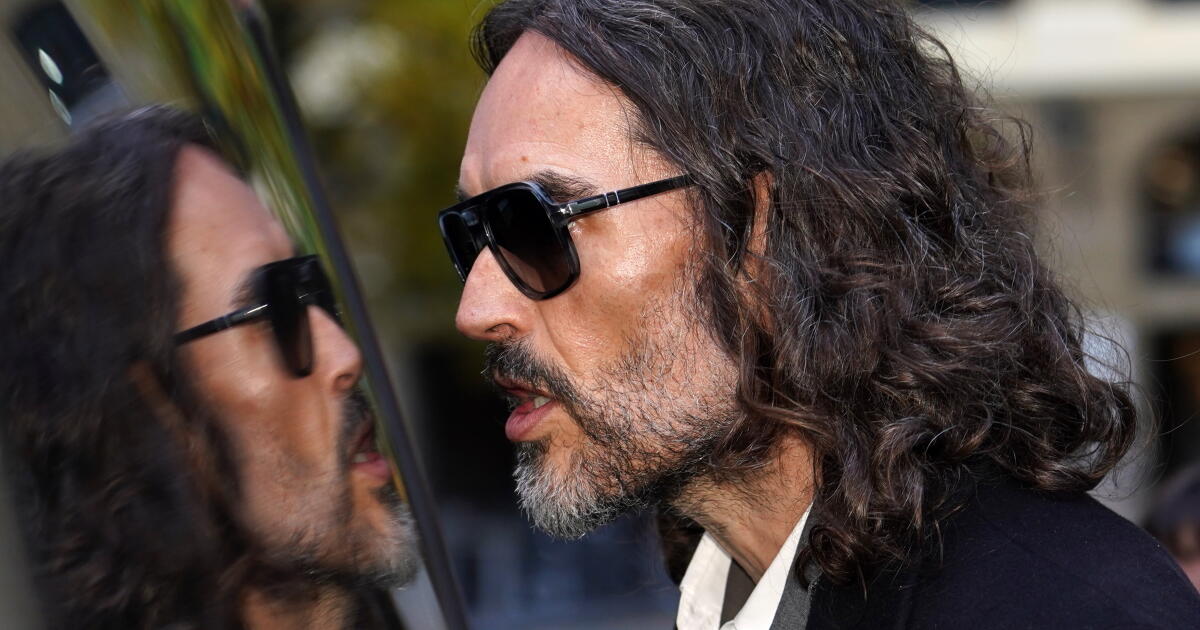
Yet another shape-shifting convicted felon is starring in a new documentary, but unlike Elizabeth Holmes in “You Can See Everything,” Russell Brand did not invite director Olivia Isaacs into his home to engage in a cinematic staring contest.
Not that he wouldn’t have done it if given the opportunity (and a very different filmmaker). As Isaacs’ traditional and deeply layered documentary “Russell Brand: Open Secret” makes clear, Brand is, in addition to being a sexual predator, a canny media manipulator who openly reinvented himself to exploit an ever-evolving zeitgeist and provide cover for his crimes. A navel-gazing doc would be right up his alley.
Brand, however, refused to respond to requests to participate in “Open Secret,” and he is, of course, now in prison. The documentary began production after a damning investigation by London Times and Sunday Times reporters Rosamund Urwin and Charlotte Wace in 2023. It premiered Friday on Netflix, a mere eight days after Brand was found guilty of one count of rape and three counts of sexual assault, and four days after he was sentenced to 10 and a half years in prison. (There is an ongoing investigation into additional rape allegations.)
Urwin and Wace (who joined the four-year reporting process about midway through), provide the narrative spine of “Open Secret,” chronicling the decades of rumors (which, as with Bill Cosby, gained attention when stand-ups began directly calling Brand a rapist) and the difficulty of finding women who would speak of their experiences on the record.
Several did and do here. None of them were part of the recent trial, though at least one is part of the new investigation, and all women were, at various times, in a relationship with Brand. Only two do not describe being sexually assaulted, including Amanda Alguero Alejos, who recounts meeting Brand when he was her English teacher in a foreign language school and watching as he changed dramatically when his career took off, abusing drugs and becoming so openly sexual with other women that she left him.
But this is not a story of how success, complete with rock-star-type female adoration, somehow corrupted an ordinary guy who finds himself in extraordinary circumstances. Neither, aside from a brief segment scanning his troubled relationship with his father, is it much interested in why Brand did what he did.
Instead, both the reporters and the filmmakers examine how Brand has brazenly leveraged cultural trends, beginning with the sexually free and outrageous mood of the late 1990s and early 2000s (or “noughties”) that celebrated his “bad boy” persona, to provide cover for his predatory habits.
Deftly using clips from Brand’s stage shows and interviews as well as passages from his books, “Open Secret” proves its titular point over and over again. On multiple occasions, Brand admitted to terrible behavior and even called himself a rapist, before brushing it off as a satirical joke aimed at those too prudish to understand unbridled sexuality.
It worked spectacularly well, earning him TV jobs, film roles and A-list status (including a friendship with fellow convicted felon Sean “Diddy” Combs) and the inevitable phalanx of managers, lawyers and powerful allies.
This combination of celebrity and power is one reason many of the women Urwin and Wace interviewed over the course of four years were reluctant to speak publicly; two of those who allege rape in “Open Secret” did so anonymously.
Even so, rumors of Brand’s behavior began early and continued to grow. Particularly after 2011, when he moved to U.S. during the apex of his film career and his brief marriage to Katy Perry. (Perry is mentioned briefly in the film, which highlights a portion of her 2013 interview with Vogue in which she discussed their divorce, saying: “Then I found out the real truth, which I can’t necessarily disclose because I keep it locked in my safe for a rainy day.”)
After Brand returned to the U.K., the film implies, he realized that his grinning-satyr reputation wasn’t playing so well anymore. In 2014, he made a huge career adjustment, leaping from unapologetic sexual player to politically progressive firebrand. Energetic and superficially erudite, his “working-class,” antiestablishment stance was immediately embraced by the progressive left. “Brand was wild,” journalist and political activist George Monbiot says in the film. “Exactly what left-wing politics was lacking at the time.”
That too worked, for a while. But during and after the #MeToo movement, many people were attempting to “out” Brand and his career began to suffer. Soon he reinvented himself again. Modeling himself on Tucker Carlson, he became a right-wing conspiracy theorist, railing against the usual suspects of science, liberals and legacy media.
By 2023, Urwin and Wace had found multiple women willing to speak on the record. When, in the final phase of reporting, they reached out to Brand, his lawyer responded that his client believed the piece to be “a concerted campaign” with “a deeply concerning agenda to all this, namely the fact that he is an alternative media broadcaster competing with mainstream media.” Brand then took to YouTube to denounce the article, claiming that “all of his relationships were consensual” and that the Sunday Times had a political agenda.
That did not work. Additional allegations poured into the journalists and Scotland Yard, and an investigation was opened. Brand once again shape-shifted, publicly embracing Christianity (down to being baptized in the River Thames in 2024 by Bear Grylls) and proselytizing about the powerful love of Christ.
Whether or not his newly found religious beliefs were sincere, they did not prevent him from being arrested, charged and convicted.
The film ends on an earnest rather than victorious note, with various participants voicing their hope that women will be more empowered to speak up about rape and sexual assault, and that the culture will stop celebrating and shielding the men who perpetrate it.
These sentiments have, regrettably, become a bit boilerplate, words many people say even as attempts to shame and silence sexual assault victims continue. The unsettling power of “Russell Brand: Open Secret” has little to do with Brand himself. Instead, this painstaking chronicle of how two dogged reporters and a few very brave women finally helped bring him to justice is an indictment of us. The people who heard the rumors and continued to support him, through ticket sales, clicks, likes and applause. The people who continued to find him audacious, funny and “authentic,” even as he was telling us exactly who he was and what he was doing.
An open secret is not a secret; it is a fact we have chosen not to confront. Brand got away with smirking about his life as a sexual predator under a thin disguise of mischievous comedy because we let him. And that’s what needs to stop.