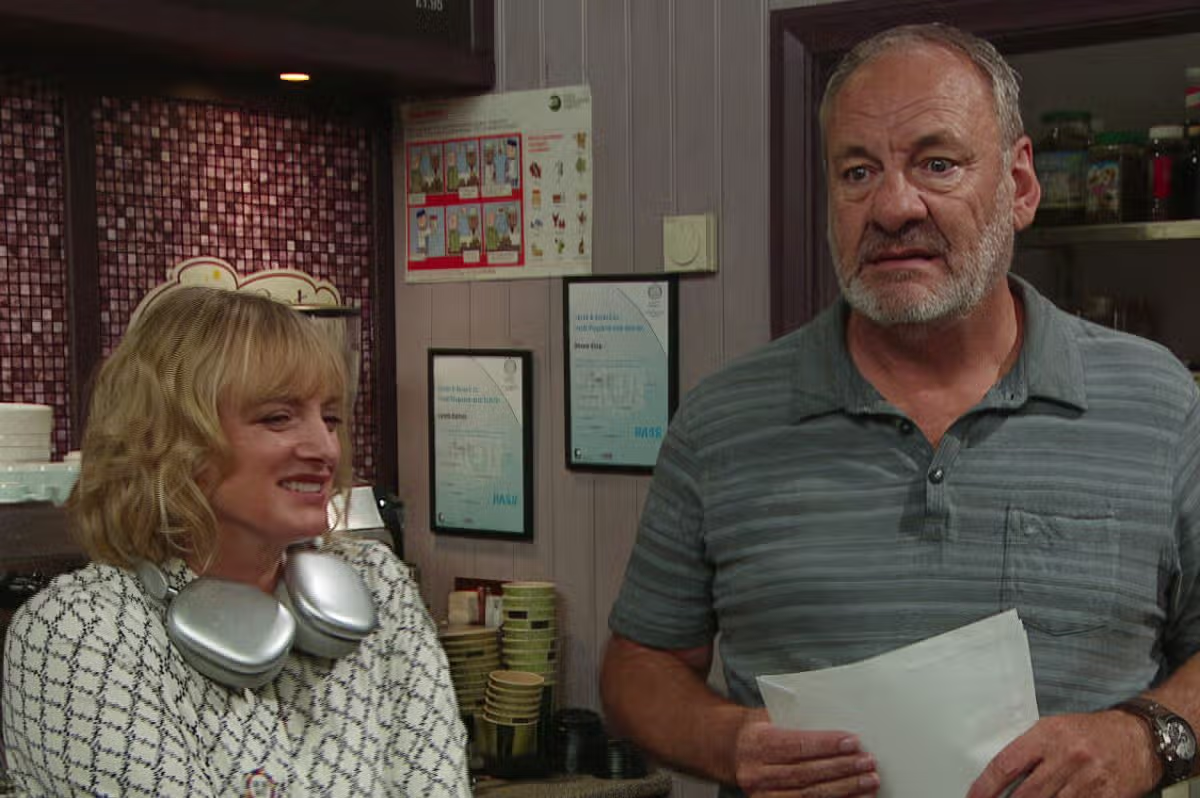


Pete Wicks and Olivia Attwood were spotted holding hands on a date night in LOndonCredit: Not known, clear with picture deskThe pair were spotted in posh Mayfair – seen here at the back of the bar towards the rightCredit: SuppliedEarlier in the day the pair were spotted looking smitten outside a London officeCredit: GoffRomance rumours between the pair started at this year’s Brit AwardsCredit: Alamy
Olivia, who was wearing a £2k leather jacket from Magda Butrym, and Pete were snapped by a fan at the Broadwick Hotel in London’s Soho on Friday evening.
The fan said: “Everyone knows they’re dating now even though they’ve not confirmed it, but it was still surprising to see the PDA.
“It goes beyond the hand on arm and hugging we’ve seen from them in public since the pics of them kissing first emerged.
“They just looked like a normal couple on date night, holding hands.
Earlier in the day, Olivia and Pete looked equally loved up as they smoked a cigarette outside a London office.
The pair only had eyes for each other as they chatted happily together.
Olivia was dressed casually in a white tracksuit, as she enjoyed her new man’s company.
It comes after the new couple have just returned from a secret getaway to the South of France.
The pair, who were also spotted on a romantic dog walk, were seen collecting their luggage from the baggage carousel at Nice Côte d’Azur Airport in the South of France on Sunday.
The pair seemed in deep conversationCredit: GoffOlivia seemed smitten with her new manCredit: GoffPete put his arm around his new girlfriendCredit: Goff
Former Love Island star Olivia, and podcast co-host Pete flew Business Class on British Airways from London’s Heathrow to Nice.
An onlooker said: “They were seen at the gate and they were very loved-up and cuddling each other.
“They were trying to keep a low profile by wearing baseball caps.
“They were kissing at the gate and couldn’t keep their hands off each other.
The new couple have been spending a lot of time togetherCredit: Goff
“They were sitting in Business Class together.
“At the luggage carousel they were cuddling and kissing and headed off together.”
Olivia and Pete usually host their own Kiss FM radio show together on Sundays but were absent from the programme this week as they jetted off on their secret holiday.
The Sun revealed how the pair enjoyed a three-night break at the luxury Lily of the Valley hotel in St Tropez – costing £1,000 a night.
Eagle-eyed fans mused how they had spotted Pete’s trademark glasses on the table in one of Olivia’s social media pics from the trip
It led one fan to remark to The Sun: “It seems they tried to keep it all under wraps but seeing Pete’s glasses in the background of Olivia’s snaps appeared to give the game away.”
The Sun has contacted reps for Olivia and Pete for comment.
Production on Season 5 of “The Secret Lives of Mormon Wives” will resume after filming was halted weeks ago amid a domestic violence investigation involving star Taylor Frankie Paul, The Times has learned.
Filming on the Hulu reality series paused in mid-March after the Draper City Police Department in Utah launched an investigation that involved Paul and her ex-boyfriend Dakota Mortensen and stemmed from an alleged incident in February. It was later revealed that Paul was under investigation for an alleged third domestic violence incident involving her and Mortensen in 2024, which was being led by police in West Jordan, Utah. The Salt Lake County district attorney’s office announced last week it would not be filing charges against Paul.
It has not been disclosed when cameras will pick back up or whether Paul or Mortensen will return to the series. In addition to Paul, the main cast includes Whitney Leavitt, Mayci Neeley. Jessie Draper, Jen Affleck, Mayci Neeley and Miranda McWhorter.
Paul was previously arrested in 2023 for another incident with Mortensen, which was partially documented on Season 1 of “Mormon Wives.”
“Here come the ugly parts of what healing actually looks like,” Paul wrote in a lengthy post Sunday on Instagram. “If you know me you know I’ll admit my parts, flaws, and faults. I’m well aware thats apart of it. We’ll get there. This public atrocity that I not only lived through once but twice now, on even a bigger scale was ultimately the cost to my freedom. I wouldn’t wish this upon my worst enemy or even the ones who publicized it. I cried on my knees in pain while also saying THANK YOU 🙏🏼”
When the investigation tied to the alleged February incident was made public, a video from the events involving the 2023 incident — showing Paul throwing barstools at Mortensen while her young daughter was present — was leaked to TMZ. It quickly led to ABC pulling Paul’s season-headlining “The Bachelorette” just three days before its March 22 premiere.
SUPERSTAR Cher was left “speechless” when she found out she had a secret granddaughter aged 15.
In an exclusive interview with The Sun on Sunday, the girl’s mum Kayti Edwards says she told the chart legend the bombshell news in an emotional phone call last year.
Sign up for the Showbiz newsletter
Thank you!
Superstar Cher was ‘speechless’ when she found out she had a secret granddaughterCredit: GettyKayti with daughter Ever, 15Credit: Jeff Rayner/Coleman-Rayner
Ex-model Kayti had a brief romance with 79-year-old Cher’s second son Elijah Allman in 2010 which led to the birth of their daughter, Ever.
Kayti, who lives on a ranch in Joshua Tree, California, explained: “Cher got in touch with me last June and asked if it was true, so I had to confess.
“She said she had heard something about it from Elijah back in 2021, but didn’t know if it was just crazy talk.
She claimed he was “substantially unable to manage his own financial resources due to severe mental health issues”.
The pair later resolved the matter privately.
But in June last year, Elijah — who is Cher’s son from her second marriage to the late musician Gregg Allman — was hospitalised for several days after a second overdose.
Kayti explained: “He came back into my life just recently.
“I didn’t know anything about his state.
“But he asked me if he could come to Joshua Tree as he needed to get out of Hollywood.
“As soon as he stepped out of the car, I knew he wasn’t well.
“A few weeks later, he overdosed and was hospitalised, and this was when Cher got in touch.
“She wanted to know what had happened and then she asked me if it was true regarding Ever.
“That’s when I had to tell her the situation.”
Kayti, who owns a horse rescue centre, told how Cher invited her and Ever to her Malibu home last September.
“We went to the house and stayed the night,” she said.
“She was lovely and kind and we had dinner.
“Cher asked Ever if she wanted to see her closet and showed her a pair of jeans she had worn in concert.
“It was a cool experience for her.
“Cher was very childlike.
“They played in the pool and she spoke to Ever about school and asked her about boys.
Cher was wed to Gregg Allman from 1975-1979Credit: GettyElijah last summer, a few weeks after he went into hospitalCredit: London Entertainment for The U.S. Sun
“She was like a kid herself.”
The Believe hitmaker, who played a glamorous gran in Mamma Mia! Here We Go Again, has previously told how she longed to be a grandma.
On the 2018 press tour for Mamma Mia!, the singer said: “I don’t have any grandchildren.
“I wish I did, I really do.”
Kayti said Cher is still “processing the news” after the shock reveal, but she and Ever — who is a straight-A student — are building a relationship.
She went on: “Cher sent her a Christmas card and present.
“It was a Chrome Hearts hoodie.
“And then for her birthday, she sent her some money and Chrome Hearts sweats.
“She called her and they spoke on the phone.
“Cher is really trying.
“It’s an adjustment and I’m not pushing any relationship.
“It has to come naturally.
“Elijah and his wife always said Cher didn’t want to be a grandma and to keep Ever away, so I was nervous to introduce her, but it’s been nothing but a good experience.”
Kayti said Elijah wanted to be a part of Ever’s life, which is why he went to Joshua Tree.
She said: “He wanted to see her and have a relationship with her, but he wasn’t in any fit state.
“She thought he was just a family friend at that point.
“I had to shelter her from him and, when he gets better, he will appreciate that.
“Cher is also very protective of Ever and the family dynamic and she knows Elijah’s state and wants to protect that from her, too.
“He needs to get back to being the guy I once knew, and Cher agrees.
Elijah reportedly told cops he was a “prospective father”, which caused mass speculation online.
Days later, he was arrested again for allegedly breaking into a house.
He is currently in jail awaiting trial in New Hampshire.
Kayti and ex Elijah pose for a snap in a photo boothCredit: Jeff Rayner/Coleman-RaynerKayti Edwards with The Sun’s US editor Scarlet HowesCredit: Jeff Rayner/Coleman-Rayner
With her voice cracking, Kayti said: “Elijah did this.
“I’m only speaking about this now because I want this to be my story.
“I would have kept it under wraps.
“I have to say, Cher loves her son.
“He needs help and, regardless of what anyone says, she goes to any lengths to help him.”
Kayti, who is the step-granddaughter of Mary Poppins star Julie Andrews, said: “I know what it’s like to have a famous grandma and it’s not all it’s cracked up to be.
“I craved the ideal of grandma baking cookies in the kitchen with me, but it wasn’t like that.
“We had cooks and were raised by nannies.
“To talk to my grandma, I had to call her assistant.
As BBC marks what would have been Queen Elizabeth II’s 100th birthday, Peter Phillips says that his grandmother stunned them all in 2012
Queen Elizabeth II had a great sense of fun when it came to marking big events(Image: CREDIT LINE:BBC Studios/Camera Press/ROTA)
As the nation remembers Queen Elizabeth II on what would have been her 100th birthday next week, one grandson has given fresh insight into the subterfuge that went into her astonishing James Bond moment from the 2012 Olympics.
Peter Phillips was gripped by the scenes, along with the rest of the nation, in which the monarch comes face to face with Daniel Craig’s 007, before they seemingly parachute into the stadium from a helicopter.
But speaking in a new BBC documentary, Peter says even the family were kept totally in the dark about the extraordinary stunt. “When the clip first started we were like, ‘I wonder who they’ve got playing the Queen?’ And then she turned around. And we were like ‘wow’. It was sheer amazement. That was one of the best-kept secrets, because literally nobody knew.”
The tribute film, which airs tomorrow, takes viewers through all the key moments of her reign, with insights provided by leaders, celebrities, experts and loved ones.
Queen Camilla speaks of her deep admiration for her late mother-in-law. Looking back at how she came the first female member of the royal family to join the army full time, when she joined the Auxiliary Territorial Service during the war, Camilla says: “I think duty has over-ridden everything. I don’t think I’ve ever seen anybody have a sense of duty like she had.”
Ex-US president Barack Obama agreed, commending the late Queen’s “combination of a sense of duty, with a very human quality of kindness and consideration and a sense of humour”. He adds: “I think that’s what made her so beloved, not just in Great Britain but around the world.”
Former Labour Prime Minister Tony Blair also had deep respect for Elizabeth II. “She was not a queen, but the queen,” he says. “I don’t think we’ll see her like again.”
Camilla recalls that celebrating the Queen’s platinum jubilee in February 2022, just as the Covid pandemic finally came to a close, was particularly joyous coming, as it would turn out, just a few months before the Queen’s death.
“I remember there were thousands and thousands of people lining the streets and lining The Mall – we were all looking for something to cheer us all up,” she says. “People hadn’t been out, they’d been stuck in their houses so it was an incredible jubilee. She was very much centre stage, I’ve never seen anything like it. Everybody was in a good mood.”
Helen Mirren, who put in as Oscar-winning performance as Elizabeth II in The Queen, agrees that the monarch’s profound sense of duty came naturally to her and says her death in 2022 left many feeling bereft. “She’d become such an intrinsic part of the tapestry of our life, it was as if you were going to pull a thread and the whole thing was going to fall apart.”
To research the role for the 2006 movie, Helen studied hours of footage, including plenty of when the monarch was a child. She laughs when shown an archive reel of a three-year-old Elizabeth. “I’ve never seen this before, so young! And her hair is almost the same as when she died. That’s incredible.”
Another clip shows Elizabeth aged around 10. “When I played the Queen I watched a particular piece of film over and over again of her getting out of a big black car,” the actress explains. “You see how she steps forwards and does what she knows she’s supposed to do, which is shake hands. She naturally had a sense of self control and duty.”
That innate sense of how to behave was again in evidence when Elizabeth’s father, George VI, died suddenly while she and her new husband Prince Philip were just six days in to a tour of the Commonwealth in 1951. Returning swiftly to Britain, she was filmed smiling and shaking hands with the many top-hatted, male politicians who were on the tarmac to greet her.
“She’s only just been told that her beloved, beloved father has died without her being there,” Helen 80, says. “I think that would have been so devastating to her, that she never had the chance to say goodbye.What you see happening is the duty stepping in, she does exactly what she’s supposed to do.”
Camilla is also astonished to see how calm and composed the young queen looks in this challenging moment, when she is dealing with her own grief. “It must have been so difficult being surrounded by much older men. There weren’t women prime ministers or women presidents, she was the only one. So I think she carved her own role.”
Over the course of her life Elizabeth faced plenty of difficult times, including the marriages of three of her children ending in the same year and the loss of many loved ones.
When her husband of 73 years, the Duke of Edinburgh, died during the pandemic, the Queen refused to break the rules governing the nation and instead broke hearts as she sat at his funeral all alone. Watching the sad clip of his isolated grandmother, Peter Phillips says all he wanted to do at the time was “give her a hug”.
But there were also times when the Queen came in for criticism rather than sympathy, never moreso than after the death of Princess Diana in 1997, when she opted to remain at Balmoral for more than a week rather than return to London.
BBC royal presenter Kirsty Young remembers: “There was tangible anger. Whether it was the flag being brought down to half mast or the Queen making a statement, these things were not happening. There was radio silence. There was a sense in which people might almost storm the gates of the palace.”
But the Queen then turned public opinion around with her heartfelt TV broadcast to the nation. Describing the former monarch as “quietly radical”, Kirsty adds: “I think the address by the Queen after the death of Diana illustrated beautifully that she had an ear to the public and that she was willing to do things that had never been done before.”
Blair agrees it was one of the Queen’s most challenging moments. “We had a series of really intense conversations where the Queen was having to balance the impact on her family, on her grandchildren, with the need to respond to what was a national mood at the time. Her genius was, in a way, to steer the monarchy through all of that whilst not really changing much herself.”
For her part, actress Helen believes the Queen was absolutely right to stay with her grandsons after the devastating loss of their mother. “I think she was right to stay in Balmoral with the children and then when she came out and did the very difficult walk with the flowers and everything, that was the right thing to do.”
Born just a couple of weeks after the Queen, Sir David Attenborough was running the BBC at one point in the late 1960s when it was decided the royals needed to become more relatable. This led to the BBC documentary Royal Family, an early example of reality TV, where they let the cameras in. “There was a feeling that the royal family was getting a bit remote and I remember the discussions we had in the BBC, that the image of the family should be softened in some way,” Sir David explains. It was huge hit with more than 30million UK viewers tuning in – but afterwards the Queen regretted her decision to display their private lives. The series has not been shown since the 1970s, with Elizabeth ordering it was locked away in the royal archives.
But tonight viewers can see rare clips from the series, showing a relaxed Philip cooking sausages and the queen laughing and joking with her children.
– Queen Elizabeth II: Her Story, Our Century, BBC1, 9pm, Sunday
GEMMA Arterton has revealed she secretly welcomed a second child.
The actress – who is set to headline the new big budget ITV drama Secret Service later this month – has revealed she kept her entire pregnancy a secret last year.
Sign up for the Showbiz newsletter
Thank you!
Gemma Arterton has revealed she secretly welcomed her second child last yearCredit: GettyThe new mum looked incredible as she sported some bright red trousers earlier this week in the London sunshineCredit: BackGridGemma stepped out with her co-star Rafe Spall while promoting their new thriller Secret ServiceCredit: BackGrid
As reported by the Mirror, speaking on the Dish podcast with hosts Nick Grimshaw and Angela Hartnett, Gemma casually revealed she is now a mother of two.
Asked how she is on the latest podcast, she told the hosts: “I’m happy to be let out for the day.
SPAIN’S popularity might often leave you feeling like there isn’t a part of the country that is untouched and unexplored.
But just over an hour’s drive from Seville, you’ll find the much quieter coastal town of Mazagón.
Sign up for the Travel newsletter
Thank you!
The Spanish town of Mazagon is about an hour from SevilleCredit: AlamyThe small town features a long beach, backed by sandstone cliffsCredit: Alamy
The town of Mazagon dates back to the 14th century, when it used to be a fishing village.
It was initially a popular holiday destination for rich Spanish families from the nearby cities, and even now just a few thousand people live there.
According to The Telegraph, it is still more popular with Spaniards than Brits.
They said: “The low-key town is popular with Huelva locals, but it’s still relatively undiscovered by holidaymakers from the rest of Spain, let alone Britain.”
It largely remains untouched for two reasons – one being strict planning rules that ban anything from being built higher than three-storeys high.
Not only that, but the area is protected due to sitting near the Donana National Park.
The largest nature reserve in Europe, it is home to a number of endangered species including the Spanish imperial eagle and the Iberian lynx.
One of the main attractions of the town itself is the 3.4mile beach, backed by rocky, sandstone cliffs.
At the western end of the town, close to the marina, Playa de Mazagón is built up enough to have things like showers, sunloungers and parking facilities.
One tourist said it “offers a peaceful escape from crowded tourist spots,” while others said the calm waters made it ideal for families with young kids.
Along the beach you might also spot ‘chiringuitos’ – small, wooden hut beach bars – usually serving tapas and drinks.
Moving westwards from the town, the Playa de Mazagón leads into Playa de las Dunas – a quieter spot, with a number of villas littered at its edge.
Head even further west and you will reach Playa de Alcor which is a more rural beach that is backed by pine woods and sand dunes.
Don’t expect the beaches to have a promenade, instead you can explore then via wooden boardwalks.
The town centre itself is relatively small, but there are a number of sites worth visiting such as Ermita del Carmen chapel, which was restored in 2014, or the more modern Sagrados Corazones.
There’s also the Mazagón Lighthouse, dating back to 1861 and is still in use – and is bizarrely built 600metres inland.
Historically, the town was a fishing villageCredit: AlamyAnd key sites to visit include a lighthouse 600metres inlandCredit: Alamy
When it comes to grabbing a bite to eat, the town has many tapas bars where each dish can cost as little as €4 (£3.49), such as cheese croquettes and calamari.
At most bars and restaurants you can expect to pay a couple of euros for a beer.
If you are looking for a place to stay, you can’t get much closer to the beach than Playa de Mazagon Camping which is right on the sand.
There are a range of different accommodation options at the site including bell tents for between two and six people, a two-person cabin and camping pitches.
The campsite also boasts an outdoor swimming pool with a pirate ship, a restaurant and bar, sports courts and a playground.
A bell tent for two people costs as little as €50 (£43.63) per night and the two-person cabin costs from €60 (£52.35) per night.
Donana National Park is nearby too and is home to over 300 bird speciesCredit: AlamyIf you are looking for somewhere to stay, you could opt for Playa de Mazagon Camping, which is right on the beachCredit: Google Maps
Our favourite Spain holidays
*If you click on a link in this box, we will earn affiliate revenue.
Hotel Best Punta Dorada, Salou
The Spanish resort is a popular destination near PortAventura World, a theme park with over 40 attractions and huge rollercoasters. It’s also close to sandy beaches like Platja de Llevant, and the scenic Camí de Ronda coastal walk.The hotel itself has an outdoor swimming pool to enjoy, as well as two bars along with evening entertainment and shows.
With its palm tree-lined pool and Mediterranean backdrop, it’s a miracle this Majorca resort is so affordable. Expect a classic family holiday feel – where days revolve around soaking up the Spanish sunshine, chilling by the spacious pool and sipping on frozen cocktails. Set away from the busier resorts, it’s a good option if you’re after a more out-of-the-way escape.
The Magic Aqua Rock Gardens Hotel is African-themed and less than a mile from the beach. It has two outdoor pools, including a children’s freshwater pool with a waterfall and a tipping water bucket for the little ones. There’s also an aquapark with slides, and a kids club for both younger children and teens.
For a calmer side of Ibiza, this hillside resort has two pools, a kids’ splash zone, and an all-inclusive buffet with a poolside bar. It’s a 10-minute walk from Cala Llonga’s shallow turquoise bay, offering a scenic, family-friendly base away from the island’s main party zone.
If you fancy exploring further afield then you could head to the port city of Huelva, just a 20-minute drive away.
The city is famous for being the departure point for Christopher Columbus‘s first voyage to the Americas.
The easiest way to get from the UK to Mazagon is by flying to either Seville or Faro in Portugal – both taking just under three hours.
Flights from the UK to Faro cost as little as £13 one-way in April and May.
Once in Faro, you can either drive or hop on a bus for an hour-and-a-half, costing £16 per way.
Alternatively, if you head to Seville, flights from the UK cost from £15 in May and from the airport it is then an hour-and-20-minute drive or bus journey, which would cost around £6 per way.
The easiest way to get to Mazagon from the UK is by flying to Faro or SevilleCredit: AlamyFrom there, the town is about an hour-and-a-half drive awayCredit: Alamy
WITH two singles in the top 20, a sold-out world tour, a recent album and a string of festival headline slots, Zara Larsson will be the soundtrack of the summer. And as teen girls clamour for tickets to the Swedish star’s upcoming gigs, she is determined to overthrow Taylor Swift as the ultimate pop princess….
MADONNA has called in the big guns for her new album – reaching out to Britney Spears for a potential collaboration.
I can reveal the Queen of Pop tried to connect with the Circus singer in December and January with hopes of a joint writing or studio session.
Sign up for the Showbiz newsletter
Thank you!
Madonna has called in the big guns for her new albumCredit: UnknownShe has reached out to Britney Spears for a potential collaborationCredit: WireImage
Madge has been busy working on the follow-up to 2019 album Madame X, which is expected to be released this year.
However, Britney has so far refused to engage with the Like A Virgin singer, who was one of the few guests at her wedding to model Sam Asghari in 2022.
A collaboration between the two superstars would be huge for the pop universe — 23 years after they scored a No2 hit with Me Against The Music.
That year, 2003, they also made global headlines when they kissed on stage at the MTV VMAs.
A source close to the younger star said: “Madonna believes Britney is not just a brilliant artist, but a lovely person.
“They had a great time in the past working together and had touched on working together again.
“Madonna felt that Britney could bring something to her new album or perhaps join for a writing idea.
“She feels a connection to Britney and has been a vocal supporter of her, despite all the concern about her welfare in the last couple of years.
“Madonna is one of the few people on the planet to understand the stresses and troubles of being one of the most famous people in the world.”
Britney has said she is unsure if she will ever return to music, although she did have a No3 hit in 2022, duetting with Elton John on Hold Me Closer, following the end of her 13-year conservatorship.
Meanwhile, Madonna has also been busy with acting.
Last month she shot a cameo in Venice for the Apple TV series The Studio, in which she will play herself in a storyline inspired by the making of her scrapped biopic.
It will show Julia Garner — who was cast as Madonna in the real film before it was binned — winning a gruelling audition, then heading to the Venice Film Festival for its debut.
It sounds like quite the farce, but I’m glad Madonna can still laugh at herself after all these years.
KAROL COMES OUT TO PLAY
Karol G poses without a bra in a revealing crop topCredit: Gray SorrentiColombian beauty Karol G poses for PlayboyCredit: Gray SorrentiThe singer is set to headline Coachella festival in CaliforniaCredit: Gray Sorrenti
COLOMBIAN beauty Karol G has Playboy covered . . . even if she isn’t.
The singer went topless on the cover of the mag and posed without a bra in a revealing crop top in another shot, as she gears up to headline Coachella festival in California this weekend.
And although she is used to massive crowds, she was unsure about stripping off for Playboy, asking her Modern Family actress pal Sofia Vergara for advice.
When Karol told her she wouldn’t do it if Sofia didn’t think it was a good idea, she says the TV star replied: “With that body? When you get to this age, you tell yourself, ‘F***, why didn’t I pose that one time?“
Karol, take it from me – you look amazing.
Karol G on the cover of PlayboyCredit: Gray Sorrenti
ROB COMES UP ROSES FOR BLUE
ONE was in the biggest British boy band of the Nineties, and the other followed suit among the pop heart-throbs of the Noughties.
Now Take That’s Robbie Williams has thrown his support behind Blue by writing their new single. They will drop the track, called Flowers, tomorrow following the release of their No2 album Reflections in January.
Antony Costa, who is in the group with Simon Webbe, Duncan James and Lee Ryan, said: “Having an icon like Robbie write a track for Blue was an honour.
“Robbie reached out to me a while back and said, ‘I’ve got a song for Blue’. We only got to record it recently and thought it would be perfect to release for our 25th anniversary tour.
“It’s already sounding amazing in rehearsals with the live band – we can’t wait for you all to hear Flowers.”
Blue have already kicked off their massive tour and will spend the rest of April playing shows UK-wide, with more gigs across the country as well as Europe throughout the summer.
Robbie has plenty of shows lined up this summer, too, but I won’t be surprised if he pops up at one of Antony and the boys’ concerts.
ARIANA GRANDE has confirmed she is back in the studio – a month after I revealed she was secretly working on new music.
She previously insisted she had no plans to release her eighth album this year, saying she is far too busy with her Eternal Sunshine tour kicking off in June.
However, last night she posted images on Instagram of her clearly making music, tagging her long-time co-writer and co-producer Ilya Salmanzadeh. She released her seventh album, Eternal Sunshine, in 2024.
BLOW FOR CREDIT CARDI
Cardi B dazzles in this violet outfit and shows off her colourful hairCredit: Getty
NOTHING could get Cardi B down as she arrived for an after-party in Philadelphia in this revealing dress.
The rapper has had a tough week, as her ex-husband Offset was shot and she became the victim of credit card fraud.
But she still had a smile on her face with this violet outfit and her colourful hair, despite saying on Instagram that she wanted to have the person responsible for nicking her money “beat the f*** up”.
Cardi claimed almost £45k was spent on her AmEx card in an Apple shop and fancy American department store Saks. Whoever did that messed with the wrong woman.
A SUPER SHOT FOR MARISA
Marisa Abela is hoping to land a key role in the Superman sequel Man Of TomorrowCredit: Getty
BRIT stars Marisa Abela and Ella Purnell are battling against US actress Adria Arjona to land a key role in the Superman sequel Man Of Tomorrow.
US website Deadline reported last night that the actresses have been testing for the role of Maxima – the warrior queen from the planet Almerac.
The character lands on Earth and swiftly sets her sights on Superman, who is once again being played by David Corenswet.
It will be a coveted role and landing it would be a coup for any of the leading ladies.
THE STROKES are celebrating 25 years since their debut by returning with their seventh album, Reality Awaits.
It will be out on June 26 and they have already released the first taste with new track Going Shopping.
Their album was recorded in Costa Rica and is their first music since 2020’s The New Abnormal.
JACKO KO ON ABUSE MENTION
The Michael Jackson biopic has been forced to erase scenes featuring allegations of child abuseCredit: Getty
THE upcoming Michael Jackson biopic has been forced to erase scenes featuring allegations of child abuse.
The film will finally hit cinemas a fortnight tomorrow – a full year after its original release date.
And now the cause of the long delay has been revealed.
According to a clause in a settlement with one of his accusers, Jordan Chandler – the boy whose accusations were at the centre of Jackson’s first sex probe in the Nineties – any depiction or mention of him in an official Jackson film is banned, so producers had to go back to the drawing board.
According to Variety mag, the final third of the film needed to be reshot, resulting in 22 days of extra work last June.
This is estimated to have cost the late singer’s estate around $10-15million.
Jackson’s nephew Jaafar will play him on screen, but the Billie Jean star’s sister Janet is not in the film. I’m sure it’ll still be a box office smash.
SABRINA CARPENTER says she can separate her feelings from her songs when she’s performing – handy, given she has so many hits about failed relationships.
She told Perfect mag: “When I’m on stage, there’s a button. I think it’s been this way ever since I was young.
“I started touring when I was 16, and I’ve always felt there’s a button that turns on when you’re performing. And when you’re singing these songs, in that moment, it really becomes a show.
“I am a human being. I’m a 26-year- old girl. I’m hormonal. I’m emotional. I’m dealing with a lot of stuff.
“For me, it really just has been compartmentalising the moments where I feel like the show must go on and moments where I allow myself to be a little all over the place.”
MORE than a quarter of a century after they burst on to our screens as one of America’s most dysfunctional and chaotic families, the Malcolm In The Middle clan are back.
Malcom In The Middle stars Christopher Masterson, Justin Berfield, Jane Kaczmarek, Bryan Cranston and Frankie MunizCredit: GettyThe Malcolm In The Middle cast back in 2001Credit: Fox TV
FRANKIE MUNIZ, who starred as Malcolm, posed alongside his on-screen parents, played by Bryan Cranston and Jane Kaczmarek, for the premiere of the four-episode sequel Malcolm In The Middle: Life’s Still Unfair, which debuts on Disney+ tomorrow.
Also back as Malcolm’s older brothers Francis and Reese are Christopher Masterson and Justin Berfield.
But Erik Per Sullivan, who played their younger sibling Dewey, decided not to return as he is busy studying Victorian literature at Harvard University.
JENNIFER ANISTON could be destined to marry her hypnotherapist boyfriend – as she is convinced they are soulmates who met in a past life, it is claimed.
Jennifer Aniston could be destined to marry hypnotherapist boyfriend and wellness guru Jim CurtisCredit: Instagram/Jennifer AnistonJen is convinced they are soulmates who met in a past lifeCredit: Getty
Sources claim the smitten couple have also had regression therapy, designed to open up old memories, and firmly believe they knew one another in a previous incarnation.
Now, they are keen to “complete their journey” by marrying in front of loved ones at a lowkey ceremony — possibly in Europe.
An insider said: “Jen is glowing. She feels like she has waited a lifetime to find a love this easy and in a way, she believes she has.
“They’ve done intensive regression therapy together, and Jen and Jim believe they met in a past life.
“They feel their souls were destined to find each other again in this timeline to complete their journey.
“It’s all very woo-woo and spiritual, but it absolutely works for them.”
“They’ve been discussing a small wedding away from the Hollywood circus, and Europe is top of the list.
“Jen does not like big crowds and would prefer an intimate ceremony with just a handful of their closest confidantes.”
The couple regularly split their time between Jen’s £15million Bel Air mansion in Los Angeles and her £12million Montecito retreat. But it appears they may be ready to move in together.
Jim has listed his £1.2million pad in Manhattan, and the pair are said to have been hunting for a luxury New York apartment.
They have been spotted looking at a block where prices start at £5million.
Jen is glowing. She feels like she has waited a lifetime to find a love this easy and in a way, she believes she has.
Insider
A source said: “They have been viewing apartments on the Upper East Side. This will be their first joint home.”
Jen and Jim have grown close amid their shared passion for spiritual healing.
But I am told they also bonded over their shared love of dogs.
The Friends star and Curtis are said to be so in love they have begun scouting locations for their weddingCredit: InstagramThe couple are said to have also bonded over their shared love of dogsCredit: InstagramOne of the wellness coach’s social media postsCredit: instagram/jimcurtis1
Jen’s fans will be delighted to see her so happy after previous devastating break-ups.
But they announced their split in 2018. Since then, the Morning Show star has kept her romantic life fiercely guarded, focusing on her career, rescue dogs and tight-knit circle of friends — until Jim walked into her life.
The master hypnotherapist, transformational coach and best-selling author built a career guiding clients through trauma and emotional recovery.
He has more than a million Instagram fans and posts daily affirmations. The pair were introduced through mutual friends in 2024. Jen was already a fan of his self-help literature and they clicked instantly, leading to clandestine dinner dates at their homes.
They have since been spotted on a romantic getaway at the exclusive Ventana Big Sur resort in Northern California and on a yacht in Majorca.
Written in stars
Instagram photos shared by Jen on Easter Sunday showed the couple embracing, and there was a snap of her with Friends co-star and pal Courteney Cox.
Jim has had a turbulent love life, too. In his book, The Stimulati Experience, he told of past struggles to “keep” a girlfriend and his divorce from his ex-wife.
According to one source, Jim was “Jen’s rock” as she was plagued by an alleged stalker who began bombarding her with messages and voicemails in 2023.
In 2025, the man crashed into the gates of her home while she was inside. He was later charged but was deemed mentally incompetent to stand trial.
“Jim kept her grounded throughout what was a very traumatic and stressful time,” said one source.
They have been viewing apartments on the Upper East Side. This will be their first joint home
Source
Meanwhile, Jen has been uncharacteristically open about her deep admiration for Jim. Last November, on his 50th birthday, she shared a black and white photo of them on Instagram. On her wedding finger was a diamond ring, prompting speculation she was engaged. But her team refused to comment.
Shortly after, Jen told Elle magazine Jim was “quite extraordinary”, and “very special”.
Now, it seems that with a spiritual connection written in the stars — or perhaps a past life — Jen’s search for The One is finally over.
Jennifer’s reps were asked to comment.
Jim built a career guiding clients through trauma and emotional recoveryCredit: instagram/jimcurtis1He has over a million Instagram fans and posts daily affirmationsCredit: instagram/jimcurtis1A snap of Jennifer with Friends co-star and pal Courteney Cox on Easter SundayCredit: Instagram
To laugh or to cry? It’s a question that feels a little too familiar of late — one confronted often while watching “Maddie’s Secret,” the debut as writer-director from comedian and performer John Early.
Playing the title role with an unnerving sincerity and startling sense of vulnerability, Early stars as Maddie Ralph, a young woman climbing the ranks as a Los Angeles food influencer while secretly hiding her struggle with bulimia.
Early’s performance is a truly remarkable highwire act, all the more so for the wig, padding and prosthetics he wears to play the character. Made in the earnest style of a disease-of-the-week television movie without ever tipping over into winking irony, the film is both funny and tender.
“That, to me, is Maddie’s true secret,” says Early, 38, on a recent video interview from the apartment he is renting in New York City while appearing onstage in Wallace Shawn’s new off-Broadway play “What We Did Before Our Moth Days.”
“The secret of the movie — the real twist of the movie — is not any kind of trope-y reveal,” Early says. “The twist is actually a tonal twist. What I hope is then that becomes funny: the sheer commitment to the stakes of it.
“At any given moment, you can experience it as totally sincere, you can absorb it genuinely and be moved by it,” Early continues, “or you can take a little break and step out of it and find it uproariously funny that we’re even doing this to begin with.”
John Early, front, and Eric Rahill in the movie “Maddie’s Secret.”
(Magnolia Pictures)
Early’s skillfully wrought psychodrama, which had its world premiere at last fall’s Toronto International Film Festival, is now the opening-night selection for this year’s Los Angeles Festival of Movies, playing Thursday at Eagle Rock’s Vidiots with members of the cast present for a Q&A, and then again on Friday at 2220 Arts + Archives in Historic Filipinotown.
“Maddie’s Secret,” which opens in theaters June 12, makes for a fitting kickoff for this year’s event. Though the programming includes movies from all over the world, organizers ended up leaning heavily into films made in Los Angeles.
“This year it really does feel like a homegrown festival,” said Sarah Winshall, LAFM’s co-founder and festival director. “What it ended up doing is making us think about L.A. as a small town as a result.”
“I think the movie is an incredible accomplishment,” said Micah Gottlieb, LAFM co-founder and artistic director. “It’s made by somebody who’s not just a great comedian but also is a cinephile, knows the history of cinema, is trying to make something that fits within that lineage, while also just making an all-out entertaining movie.”
“Maddie’s Secret” was shot in the same workaday, creative-class neighborhoods where LAFM unspools. (Maddie’s house in the movie is Early’s own home.) The actor and filmmaker describes it as a “very Echo Park, Silver Lake, Eagle Rock, Frogtown, Glassell Park, Highland Park, Los Feliz movie.”
The story is also rooted in Early’s own complicated feelings about the L.A. food scene.
“It’s completely born out of my time in L.A. and my initial shock when I was confronted with a burgeoning restaurant scene,” says Early, who grew up in Nashville and moved to L.A. from New York in 2016.
“Not to always be talking about millennials, but it seemed very much of my generation,” he says, “specifically these kinds of restaurants where the food is really expensive but you’re sitting on a milk crate, eating lots of Middle Eastern food made by white people. There was just something very funny about all of it to me, even though I completely also sincerely loved it and still do.”
The film’s supporting cast is drawn largely from Early’s own circle of friends, including his most frequent collaborator, the comedian and writer Kate Berlant, along with Conner O’Malley, Claudia O’Doherty, Eric Rahill and Vanessa Bayer. The film’s production designer Gordon Landenberger is his ex-boyfriend and Early is excited that a number of other key collaborators, including costume designers Kimme Aaberg and Izzy Heller and cinematographer Max Lakner, are working on a feature for the first time, just as he is as writer-director.
“I think I wanted to force myself at gunpoint into a place of innocence and naivete,” says Early. “I think this movie is a strange mutation of the camp tradition.”
(Justin Jun Lee / For The Times)
Berlant plays Maddie’s best friend in the film. She and Early have worked together on shorts, live performances and their 2022 Peacock special “Would It Kill You to Laugh?” The two always share what they are developing and so Berlant first heard about “Maddie’s Secret” when it was just percolating as an idea.
“It was a very wild proposition,” she recalls with a laugh while driving down L.A.’s Beverly Boulevard. “He’s like, ‘I’m going to play a woman who’s struggling with bulimia.’ I was like, ‘Good luck.’ I was astonished that he totally pulled it off and he’s such a true filmmaker. It was kind of miraculous.”
Berlant describes their shared sensibility, the ability to simultaneously play comedy and pathos, as a kind of freedom. “Just the underlying absurdity or joke really gives you the ability to go to these really intense emotional places,” she says. “It gives you the permission to go to places that otherwise would be too unbearably saccharin.”
For Early it was also a chance to fulfill his longtime desire to play an old-school ingénue.
“I think I wanted to force myself at gunpoint into a place of innocence and naivete,” says Early. “I think this movie is a strange mutation of the camp tradition.”
“I was astonished that he totally pulled it off and he’s such a true filmmaker,” says Kate Berlant, Early’s longtime collaborator. “It was kind of miraculous.”
(Justin Jun Lee / For The Times)
He references Susan Sontag’s famous essay “Notes on Camp” to say there are two kinds of camp humor, one that is unknowing and another that is knowing. It is near impossible now to genuinely create the first kind, but the process of making “Maddie’s Secret” was in a sense about being the second and striving for the first.
“In the age of the internet and in the kind of crumbling, depressing world we live in, it’s almost impossible to be the first kind of camp,” says Early, “to feel innocent and naive and to twirl. But obviously there is a part of me, there’s a part of all of us, that is very childlike and innocent and has hope. So I think this movie, it knows itself to be camp but it’s aching to be more like the first kind of camp. It’s aching to be pure and naive.”
Though it may be easy to place what Early is doing in the tradition of drag performers such as Divine’s work with filmmaker John Waters, to Early his performance in “Maddie’s Secret” sits outside of it.
“Drag is often obviously about a certain kind of extravagance and fabulousness and Maddie is very humble,” he says. “And so I don’t really see it as drag. It didn’t feel like drag doing it, whatever that means. It honestly just felt like acting to me.”
In dealing with the serious topic of bulimia, Early was careful never to make the eating disorder the joke. He points to a trio of TV movies — 1986’s “Kate’s Secret,” starring Meredith Baxter Birney; 1997’s “Perfect Body,” starring Amy Jo Johnson; and 1981’s “The Best Little Girl in the World,” starring Jennifer Jason Leigh — along with Lauren Greenfield’s 2006 documentary “Thin” as key influences on how he approached the film’s depiction of the illness. (Other non-bulimia influences include Alfred Hitchcock’s “Marnie,” Paul Verhoeven’s trashy “Showgirls” and Adrian Lyne’s “Flashdance.”)
“I don’t find bulimia itself funny,” says Early. “The genre of these movies — that’s what’s funny. It’s the emotional pitch of those movies and the way that they’re made and the acting style and the kind of moralistic quality while being totally pervy. All that was funny to me. And then also putting contemporary life — young, gentrified L.A. food-content influencer culture — putting all that through a melodrama-style filter, that was funny to me.”
While writing the screenplay, Early says he often found himself weeping, overtaken by the emotions of what he was creating. “I guess I’m not above the genre at all,” he admits.
But playing the part was another matter, having sold everyone involved in the production on a very specific tone and conception of what they would do together.
“I was like, ‘I am so stupid, I can’t believe I have put myself in this position,’” Early says, laughing at the memory. “I had set myself up to do the thing that I really had no proof that I could do, which is to play an almost Juliet kind of character who’s going through these extreme things. And I was the one that promised everyone that we would take it seriously. And then suddenly I was like ‘OK, well you have to do it. You actually have to do it.’”
Even if Early was uncertain in the moment, the result is undeniable: a dizzying, disarming blend of humor and emotion — and one of the year’s boldest performances.
Weekly insights and analysis on the latest developments in military technology, strategy, and foreign policy.
Last month, images hit the internet showing a very stealthy, extremely long-endurance, very high-altitude intelligence, surveillance, and reconnaissance drone commonly (and unofficially) referred to as the RQ-180, or an evolution thereof, landing at a base in Greece. Many questions remain about the uncrewed aircraft and why it might be operating from Larissa Air Base.
However, as we noted in our initial reporting, the current conflict with Iran would be a very relevant fit for what the RQ-180 was likely designed to do. Furthermore, a secretive late Cold War-era drone program known as Quartz, intended to persistently monitor mobile nuclear-tipped ballistic missiles deep within the Soviet Union, offers a window into exactly why the RQ-180 could be in high demand in the Middle East now. There is no higher-priority standing mission for Operation Epic Fury at this time than finding and destroying Iranian launchers.
In many ways, the shadowy Quartz program from decades ago was a progenitor for what became a very large flying wing uncrewed aircraft that shares the planform of the B-21 (and the original B-2 design) and is likely at least part of the RQ-180’s origin story.
Strange arrival over Greece
To recap quickly, on March 18, local Greek news website onlarissa.gr first published pictures of what it misidentified as a B-2 bomber landing at Larissa Air Base, also known as Larissa National Airport. The base, which belongs to the Hellenic Air Force, but is also known to host U.S. Air Force MQ-9 Reaper drones, is situated in the city of the same name.
This aircraft seen over Larissa, Greece is not a B-2 like the local Greek news reported or an RQ-170, but is in fact best imagery ever published of the RQ-180, an undisclosed low observable drone used by the USAF. Location suggests use in the Iran conflict https://t.co/Pa9whNlQSVpic.twitter.com/UsDxy9Tc4n
Onlarissa.gr outlet followed up its initial reporting by posting a video of the drone, seen below. Additional and increasingly more detailed imagery has subsequently emerged.
Το αμερικανικό βομβαρδιστικό Β-2 πάνω από τον ουρανό της Λάρισας
Per onlarissa.gr, the highly exotic aircraft had landed at Larissa after experiencing some kind of technical issue, citing unnamed sources. This remains unconfirmed, but it would explain why the drone touched down in broad daylight, rather than coming in under the cover of darkness. It could also have diverted there with an emergency, while operating out of another location, even one in the continental United States. It is worth noting that Larissa Air Base appears to have unique facilities built in recent years that seem to be very well suited for housing an aircraft like this.
TWZ previously reached out to U.S. Air Forces in Europe (USAFE) and the Pentagon for comment, but has not received any responses as of the time of writing. In a story published on March 24, Air & Space Forces Magazine said U.S. Central Command (CENTCOM) also declined to comment.
Attention was also subsequently called to U.S. Air Force cargo planes having been tracked making unusual flights from Edwards Air Force Base in California to Larissa recently. One of those flights came on February 25, while another one occurred on March 9. A C-5M also flew to Larissa from Tinker Air Force Base in Oklahoma on February 25, according to Aviation Week. Whether there is any connection between these flights and the drone spotted at the base has not been confirmed at this time. Edwards is the Air Force’s main hub for aviation test and evaluation efforts, and flight testing of the RQ-180 was reportedly at least managed from there in the 2010s. The Air Force could also have moved other assets to Larissa via Edwards.
These photos are really interesting as they explain the two C-17s which flew from Edwards Air Force Base to Larissa Air Base in Greece in early March and late February.
The current state of the RQ-180, or any designs that have evolved from it, on a programmatic level, is very murky. In addition to testing at Edwards, past reports have said that a unit at Beale Air Force Base in California began flying the drones operationally, at least on a limited level, by 2019. There has been talk of a large flying wing aircraft similar in configuration to the B-21 Raider bomber flying out of Plant 42 in Palmdale, also in California, under the cover of darkness for years.
There are very strong indications that a photograph that appeared on Instagram in October 2020 of an unmanned aircraft flying in the skies over California’s Mojave Desert near Edwards Air Force Base was the first sighting of an RQ-180. That picture also notably showed a drone with an overall white paint scheme. That aligned with a report from Aviation Week that the design had gained the nicknames “Great White Bat” and “Shikaka.” The latter of these is the name of a fictional sacred white bat that is at the center of the plot of the 1995 Jim Carrey comedy Ace Ventura 2. The drone seen recently flying over Larissa has an overall black or otherwise dark-colored paint job. TWZ has noted previously that an overall white/cream/light pastel color scheme could help the drone to hide better at high altitudes during the day, but that a dark scheme would be more relevant at night. It is very possible, if not probable, that multiple schemes have been tested for a drone expected to fly sorties lasting multiple days.
A notional rendering of the Northrop Grumman drone commonly referred to as the RQ-180. Hangar B Productions
There certainly has been no clear evidence, at Beale or anywhere else, of the establishment of the kind of infrastructure that one would associate with the RQ-180 reaching a more advanced operational state and serial production. It is possible that the drone could share facilities with the B-21 under the larger umbrella of the Long Range Strike (LRS) family of systems. The RQ-180 is very likely intended, in part, to work in concert with the Raider, and there may even be some commonality between the two aircraft. The RQ-180 and/or related designs very likely played a direct role in risk reduction efforts that helped sell the Long Range Strike-Bomber (LRS-B) concept, and possibly the win by Northrop Grumman of that contract.
B-21 Takeoff and Landing
So, where the RQ-180 stands in terms of its overall capacity and its future remains unclear, but they are clearly being used on operational sorties, at least in a limited manner.
Iranian missile threats persist
After more than five weeks of fighting, the conflict with Iran is still grinding on. Despite the United States and Israel having substantially degraded the ability of Iranian forces to launch retaliatory missile and drone strikes, they have not stopped entirely. Iran has been digging out underground missile bases struck by American and Israeli forces and getting them back into operation, sometimes within hours, The New York Times reported just last Friday, citing U.S. intelligence reports. That followed other reports stating that Iran still retains a vast arsenal of missiles and drones, as well as a significant number of launchers to fire them.
U.S. forces drop precision munitions on underground military targets deep inside Iran to further degrade the Iranian regime’s ability to project power in meaningful ways beyond its borders. pic.twitter.com/ciQRbE0KFM
In recent weeks, publicly available data from multiple sources has, at times, shown relatively small, but noticeable upticks in Iran’s launches. There are also signs that more of those threats are evading interception, though whether this has translated to more damage and/or casualties from impacts is unclear.
Iran’s missile and drone arsenal has taken a hit, but what remains is being used more efficiently. Tehran continues fire an average of 21 missiles per week — with an uptick in its hit rate and ability to impose costs.
The talking point of “launches are down 90% since day 1” is true but so is “launches are up since last week”. The latter is the more important indicator at the moment. https://t.co/Oa4sZPOgWx
When it comes to launchers, Iran has invested heavily over the years in road mobile designs for firing ballistic and cruise missiles, as well as drones. This includes types that can be hard to distinguish from normal civilian trucks, especially those used for launching short-range ballistic missiles.
✈️🎯60+ strike flights: The IAF completed additional waves of strikes in western Iran targeting the Iranian regime’s missile launchers, defense systems, and live-fire arrays. pic.twitter.com/I1rRLBJlUR
Iran also has extensive underground ‘missile cities’ and other hardened sites that launchers can sprint to and from, and even fire from within in some cases. Beyond the main missile storage and launch sites, Iranian authorities have clearly had plans to disperse these weapons across the country. Reports have said that more authority to employ them has been delegated to lower echelons of command to minimize the impacts of separate U.S. and Israeli strikes on command and control nodes, as well.
On top of all this, Iran still has longer-ranged ballistic missiles that it can fire from areas further to the east, where the volume of U.S. and Israeli strikes has only more recently begun to grow. What’s left of Iran’s air defenses, which presents a real threat, is therefore likely to be more intact in those regions. In general, many of Iran’s air defense systems are also road mobile and can pop-up suddenly. All of this creates challenges for finding and fixing Iran’s remaining launch capacity, let alone neutralizing it.
Three weeks of Operation Epic Fury.
The Joint Force owns the skies, but Tehran holds the Strait. Additional U.S. fighter aircraft and naval assets arrived in both theaters, and Marine expeditionary forces are en route.
The Israeli Air Force has dropped over 16,000 bombs in Iran since the start of the war, in over 800 waves of strikes, the military says.
According to the IDF, over 10,000 separate strikes have been carried out on 4,000 targets. pic.twitter.com/gkU4rW4s8T
— Emanuel (Mannie) Fabian (@manniefabian) April 1, 2026
In this context, there is a clear need to be able to readily detect launchers, which can pop out suddenly and unexpectedly from cover, across vast areas. Known missile storage sites and launch areas around them also need to be persistently surveilled. The ability to find launchers faster opens up new options for striking them. Just tracking and recording their typical movements would also help further refine interdiction and intelligence-gathering strategies going forward.
As TWZ has previously explored in great depth, the RQ-180 is best understood as a very high-flying, very long-endurance, and very stealthy intelligence, surveillance, reconnaissance platform that is capable of penetrating and persisting deep into enemy airspace. Its primary means of achieving that mission would be a radar with ground moving target indicator (GMTI) and synthetic aperture radar (SAR) capabilities, but radar would be just the primary component of a larger sensor package, which would likely include powerful electro-optical sensors and passive radiofrequency ones.
At its most basic, GMTI allows battle managers to see the enemy’s ground movements in real-time and then quickly adapt their game plan to counter those enemy forces before they can ever attack, or even pose a threat to friendly forces. GMTI is also a critical capability for detecting changes in force posture, establishing patterns of enemy movements over time, and identifying new targets of interest. Modern GMTI products can also be looped into a ‘kill web’ for rapid targeting purposes.
Some of this is also achieved through the aforementioned SAR mode, which basically provides a satellite-like image of a target area using radar. It also has the ability to see some things optical systems cannot, and, like GMTI, it can work under nearly all atmospheric conditions, day or night. When paired with GMTI, SAR can be used to help positively identify targets, as well as gain better situational awareness about the targets being tracked.
A generic example of GMTI tracks overlaid on top of a SAR image. Public Domain
Passive electronic intelligence collection that allows for radiofrequency-emitters to be quickly detected and geolocated via onboard antennas and interferometry-based computing is another part of the equation. Long-range optical sensors can also provide higher-fidelity intelligence and spot movements of infrared signatures over large areas. You can imagine how fuzing all these capabilities together, combined with advanced networking, on a single platform could be incredibly potent. Basically, detecting a target or target group of interest, and then training advanced sensors on it to rapidly build up a high-quality understanding of what is going on and even to provide real-time targeting data to ‘shooters’ would be this aircraft’s bread and butter.
All of these are capabilities that would be ideally suited to the very high-priority task at hand of searching for Iranian launchers across the country’s vast terrain.
This all brings us back to Quartz and the very specific mission set that drove that program. Quartz is the best-known codename for a drone conceived as part of what was officially dubbed the Advanced Airborne Reconnaissance System, or AARS program.
The lead-up to Quartz
AARS/Quartz was itself born out of a succession of earlier developments. Proving that using a stealth platform to penetrate enemy air defenses and to stay over contested territory for hours on end while transmitting data collected without being detected is one of the biggest revolutions in warfare of the 20th Century. This capability was demonstrated on the tactical side at the dawn of stealth technology by Northrop’s Tacit Blue. That aircraft was developed as part of the Defense Advanced Research Projects Agency’s (DARPA) highly classified Battlefield Surveillance Aircraft-Experimental (BSAX) program, which began in the late 1970s.
The Tacit Blue demonstrator. Northrop Grumman
Tacit Blue notably served as a periphery risk reduction effort for the Advanced Technology Bomber (ATB) program that would result in the B-2. However, its reason for being was to show that a stealthy aircraft carrying a huge radar can penetrate enemy air defenses and loiter for prolonged periods of time, collecting GMTI radar data and other intelligence information.
The radar for BSAX was a low probability of intercept design that had come from Pave Mover, another DARPA effort. Pave Mover ultimately led to the non-stealthy and now-retired E-8 Joint Surveillance Target Attack Radar System (JSTARS) aircraft, but offshoots of that radar technology did end up elsewhere, including on the B-2. Low probability of intercept/low probability of detection (LPI/LPD) radars and communications suites are now key tenets of stealth aircraft design, in general. Keeping signal emissions, which an enemy can use to spot and track threats, to a minimum is critical for low-observable (stealthy) aircraft designs. Pave Mover was also tied into DARPA’s Assault Breaker program, which focused on proving out various technologies to enable standoff targeting of enemy forces, especially large Soviet armored formations on the move, deep behind the front lines.
An E-8C JSTARS aircraft. USAF/Senior Airman Jared Lovett
The famously ugly Tacit Blue, also nicknamed the “Whale,” produced results that were revolutionary, as you can read more about here. Even the most capable existing penetrating intelligence, surveillance, and reconnaissance (ISR) aircraft available at the time, like the SR-71 Blackbird, could only take a snapshot in time of the enemy and its posture. Satellites were far more predictable and could only provide the same ‘moment in time’ intelligence, and in a much less flexible manner. Tacit Blue could watch for hours with the enemy not even knowing it was there.
An SR-71 Blackbird. Courtesy photo via USAF
This meant the quality of intelligence Tacit Blue was capable of collecting was of far greater value. Metaphorically speaking, the SR-71 was like documenting a wedding by loudly running through a crowd and snapping a few photos. Tacit Blue was like rolling hours of videotape at the same wedding by an invisible cameraman. It was an absolute game-changer. The information was also transmitted securely using a LPI data link in near-real-time so that it could be rapidly exploited, not once the aircraft returned to base.
A drone to hunt Soviet mobile ballistic missiles
AARS/Quartz can be seen as something of a strategic parallel to the more tactically-minded BSAX effort and the Tacit Blue demonstrator. It was conceived as a cooperative effort between the U.S. Air Force, the National Reconnaissance Office (NRO), and the Central Intelligence Agency (CIA). NRO, the very existence of which was only declassified in 1992, is and has historically been responsible primarily for intelligence-gathering via satellite. However, it was also involved in ISR drone operations in the 1960s and 1970s.
The supersonic D-21 drone, seen here atop an M-21 mothership aircraft during a test, is one of the uncrewed aircraft programs NRO was involved in during the 1960s and 1970s. USAF
In the 1980s, the Reagan Administration grew concerned about a gap in reconnaissance assets, in the air and in space, to persistently track and monitor Soviet mobile nuclear-armed intermediate-range and intercontinental ballistic missiles.
“As spy satellite systems came on line in the 1960s, they shared the same fundamental operational scheme as the SR-71. Both conducted reconnaissance with relative impunity but were so fast that they only provided episodic coverage. The Soviet system of fixed air bases, missile silos, and command centers of the Cold War’s first 30 years favored ‘fast pass’ reconnaissance, however, so its weaknesses were not evident until the strategic equation shifted in the late 1970s,” Thomas Ehrhard wrote in a monograph, titled Air Force UAVs: The Secret History, which the Mitchell Institute for Airpower Studies published in 2010. “Soviet mobile missiles (both nuclear and air-to-air) and the advance of aviation technology opened the door for a true loitering surveillance UAV called AARS.”
Ehrhard pointed to three missiles as particular drivers behind the AARS program. The first of these was the road-mobile RSD-10 Pioneer, known in the West as the SS-20 Saber, a nuclear-armed intermediate-range ballistic missile (IRBM) with three warheads in a multiple independently targetable reentry vehicle (MIRV) configuration. The SS-20 had an immensely destabilizing impact on the security environment in Europe. Its appearance was a central factor in the United States and the Soviet Union ultimately signing the Intermediate-Range Nuclear Forces (INF) Treaty in 1987.
A Soviet RSD-10 Pioneer/SS-20 Saber IRBM, at left, alongside a U.S. Pershing II medium-range ballistic missile (MRBM), at right, on display at the National Air and Space Museum. The INF treaty allowed for the preservation of a small number of demilitarized RSD-10/SS-20s and Pershing IIs, but the rest were destroyed. National Air and Space Museum
The other Soviet missiles that helped make the case for AARS/Quartz were two ICBMs, the rail-mobile RT-23 Molodets (SS-24 Scalpel) and the road-mobile RT-2PM/RS-12M Topol (SS-25 Sickle).
RT-23/SS-24 SCALPEL MOD 1 ICBM
RT-2PM/SS-25 SICKLE ICBM
In his 2010 monograph, Ehrhard describes the Reagan-era view of the resulting problem set as follows:
“The technological problem of holding these mobile missiles at risk, one that NATO had never solved with the SS-20, now became vastly more complex [with the inclusion of the SS-24 and SS-25]. U.S. forces had to constantly monitor their movement and electronic emissions, something neither fast-pass satellites, U-2s, nor the SR-71 could accomplish. The mission also entailed breaking the over two decade-long declaratory policy of not overflying the Soviet Union, a prospect the Reagan Administration apparently felt was worth the gain. To complicate matters further, they needed a platform that could track those missiles in a nuclear detonation environment while flying from remote bases in the continental US. Operating and receiving imagery from such a craft beyond line-of-sight using space relays would prove daunting. The political and design challenges loomed large, but in the end the Air Force/NRO/CIA consortium opted for a leap-ahead system.”
With all this in mind, AARS/Quartz was seen as a national imperative. The very long-endurance drone, penetrating deep into Soviet airspace, would be able to locate many of these threats, allowing them to be targeted during the opening throes of a potential apocalypse – something we will come back to later on.
By the mid-1980s, contracts were doled out to Lockheed and Boeing to develop what at the time could be seen as the most ambitious ‘silver bullet’ aerospace program of its time, albeit one that had very few eyes on it as it was deeply buried in the classified realm. Ehrhard writes:
“To accomplish the loitering surveillance mission, this UAV needed autonomous (i.e., not remote controlled), highly reliable flight controls, and a design capable of intercontinental ranges from bases in the US zone of the interior with extreme high altitude capability (long wingspan with sailplane-type lift and multi-engine propulsion to reach altitudes more than 70,000 feet). Moreover, it had to carry an array of high-resolution sensors, high-capacity satellite communications capabilities, and various antennas—all in a package that was stealthy to the point of being covert. The cost of developing each technology piece alone would be staggering, but integrating them presented an even greater challenge – thus the project became a magnet for the best and most starry-eyed technologists in the black world. As one CIA engineer said in an anonymous interview, this project was ‘the cat’s pajamas,’ and ‘the single most fun project I ever worked on’ because it stretched every conceivable technology area.”
Ehrhard does not elaborate on the expected sensor package, but an LPI/LPD radar with GMTI and SAR modes, as well as other sensors, would have been needed for a stealthy platform tasked with this mission set. As noted earlier, electronic emissions, which can be detected passively, were also seen at this time as a key way to spot and track mobile missile launchers.
A highly ambitious undertaking
By all indications, AARS/Quartz was seen as a very ambitious effort from the start, but one that could yield impressive capabilities needed to address a mission requirement critical to national security. It should be noted that the U.S. military was pursuing a host of advanced stealth aviation technology programs at around the same time. Many of the efforts would go on to produce real results, if they hadn’t already by the mid-1980s, and this is just based on what is known publicly. Northrop’s stealthy Tacit Blue demonstrator flew for the first time in 1982. Lockheed’s F-117 Nighthawk reached an initial operational capability the following year. The Advanced Technology Bomber (ATB) program that would lead to the B-2 was well underway by this time, too.
Another look at the Tacit Blue demonstrator, as viewed from below. Northrop Grumman
In the end, AARS/Quartz did not fare as well as many of its contemporaries, at least from what we know. The program ran through the end of the Reagan years and into the 1990s under the administration of President George H.W. Bush. It morphed and changed hands considerably from a smaller ‘bleeding-edge’ NRO-led program into one that was integrated into a new national unmanned aircraft strategy. This, in turn, caused its mission set to balloon as a maelstrom of stakeholders demanded many capabilities out of a single platform that was already beyond the available technology of the era.
Ehrhard’s 2010 monograph sums up just how bloated AARS became by the 1990s:
“[David A.] Kier[, NRO’s Deputy Director from 1997 to 2001] said the large version of AARS, which according to some reports had a wingspan of 250 feet, cost less than a B-2, but more than $1 billion a copy. Reportedly, the production plan called for only eight vehicles at a cost of $10 billion, each of the vehicles capable of an amazing 40 hours on station after flying to the area of interest.”
“Air Force officials were so leery of the UAV’s autonomous flight concept (no pilot had moment-to-moment control) that they reportedly insisted the flying prototype carry a pilot to handle in-flight anomalies and that the final design include a modular, two-place cockpit insert to make it optionally piloted. ‘By the time everyone got their wishes included,’ Kier said, ‘it [AARS] had to do everything but milk the cow and communicate with the world while doing it.’”
“With all of AARS’s leading-edge sensors and communications links, each of which posed substantial technical challenges in its own right, flight reliability quickly became the biggest design hurdle, according to Kier. The technologies were so secret, and the value of the payload and the air vehicle was so great that its loss over unfriendly territory was unthinkable. One defense official remarked, ‘If one had crashed, it would have been so classified we would have had to bomb it to ensure it was destroyed.’”
“Sailing along on the glut of black money in the late 1980s, AARS kept moving forward despite its continually expanding, problematic requirements list. As happened with [the] D-21 and Compass Arrow [drone programs] in the early 1970s, however, AARS was about to have its most vital mission curtailed.”
A D-21 reconnaissance drone, also known by the codename Tagboard. USAF
“The end of the Cold War brought the expensive program to a halt. An Air Force general familiar with the project said: ‘When AARS was invented, there was more money than they [the NRO] could spend. After the Cold War, the money went away and projects like that could not possibly survive.’ Like predators stalking a wounded animal, manned alternatives to AARS emerged. One proposal would put a sophisticated target acquisition system on the B-2 stealth bomber –the so-called RB-2 configuration. The proposal had value as a terminal tracking system, but the RB-2 lacked a method of off-board cueing to direct it to a search area.”
…
“As it turned out, none of the alternative programs made the cut, for not only was the Cold War officially over with the dissolution of the Soviet Union, but the venerable Strategic Air Command was disbanded in June 1992. With that move, AARS lost its primary military constituent and the AARS alliance began to crumble.”
“…The Air Force pulled funding on AARS, and it was terminated in December 1992 by the intelligence community hierarchy just as it was to enter full scale development. AARS was, in the final analysis, a misfit. It was a major aircraft program backed by a satellite organization (the NRO), and a risky unmanned surveillance platform slated for a combat pilot-led Air Force—hardly an edifice solid enough to survive the removal of its strategic underpinnings. No one organization provided focus or advocacy for the program. As a result, the “perfect” surveillance UAV faded away even as the ultimate Cold War satellite system, Milstar, and the equally exotic B-2 stealth bomber managed to survive, backed as they were by one service, and powerful sub-groups within that service, who were culturally and operationally attuned to those configurations.”
A view of the official rollout ceremony for the B-2 bomber in 1988. USAF
Kier, who Ehrhard also identifies as the last AARS program manager, says the drone’s design ultimately evolved into something that “resembled a substantially scaled-up version of DARPA’s DarkStar.” Lockheed’s DarkStar, which eventually received the designation RQ-3, was a stealthy tailless design with an ovoid central fuselage and with very long, slender, and straight main wings. Boeing was also a major subcontractor for the RQ-3.
The RQ-3 DarkStar. USAF
DarkStar was also referred to as “Tier III-minus,” a moniker that reflected the requirements for the drone, which were truncated compared to a planned Tier III type. Tier III was a more direct follow-on to AARS, but was already envisioned as a smaller and less capable, and one would imagine less expensive, uncrewed aircraft. There were also additional lower capability tiers, one of which ultimately led to the RQ-4 Global Hawk. Ehrhard says some members of Congress and of industry did attempt to drum up support for a true successor to AARS/Quartz, unofficially referred to as Tier IV, but without success.
With regard to the RQ-3, at least two flying examples were built, the first of which crashed in 1996 after suffering a control system malfunction. DarkStar had vanished completely from the public eye by 1999, but it has since emerged that a direct line can be traced between it and the stealthy RQ-170 Sentinel via another secretive drone called the X-44A, which TWZ was first to report on back in 2019.
An RQ-170 Sentinel at Andersen Air Force Base on Guam. USAF via FOIA
When it comes to AARS/Quartz, the full scale and scope of what exactly came out of the hundreds of millions, and possibly billions, spent on the program over at least a decade, remains unclear. Clearly, major leaps were made in the critical communications, command and control, structural, and sensor technologies needed to make the system a reality. There are rumors that sub-scale risk-reduction test articles were flown, but details surrounding the program remain highly secretive.
A mission requirement that rhymes
As we noted earlier, many questions remain about the RQ-180, as well as the overall status of that program. At the same time, fast forward some three decades or so from the end of AARS (and its immediate successors), and there are now echoes of the Cold War mission requirements that prompted that program, including in the current conflict with Iran.
The Iranian arsenal of conventionally-armed missiles is not anywhere near the same kind of threat as Soviet nuclear-tipped IRBMs and ICBMs. Still, they do present very real threats, especially for strikes on large critical infrastructure targets and as terror weapons when loaded with cluster munition payloads. The current conflict has demonstrated that strategy also puts immense strain on Israeli missile defenses, which could have broader ramifications, as you can read more about here. Iran’s short-range ballistic missiles offer additional flexibility against targets on land or at sea. In addition, it has been clear for years now that Iran is very willing to launch conventional ballistic missile attacks.
As already noted, the launchers for these missiles are mobile, and some are configured to look like typical civilian-style trucks at a casual glance. Some operate from hardened and underground bases. A number of those facilities were even built with ports that allow missiles to be fired from within, though it is unclear how extensively Iran has made use of that capability in the current conflict. These apertures have likely been repeatedly struck by the U.S. and Israel.
The underlying challenge of finding Iran’s ballistic missiles, and doing so with enough time to attempt to strike them before they launch, has clear similarities to the mission that drove AARS/Quartz. The Iranian case is perhaps more complex in certain respects, given the larger number of smaller missiles, many of which could be dispersed over a broad area. Still, the long-range weapons that threaten Israel are clearly the top priority and would be the easiest to spot for an asset like the RQ-180.
CENTCOM:
The Iranian regime is using mobile launchers to indiscriminately fire missiles in an attempt to inflict maximum harm across the region.
U.S. forces are hunting these threats down and without apology or hesitation, we are taking them out.pic.twitter.com/l4lxbTlAf4
🚨 WATCH: CENTCOM releases footage of strikes on fortified missile bases in southern Iran. The first footage includes hits on tunnel entrances and on mobile and stationary launchers at the missile base in Hajjiabad, Iran. pic.twitter.com/wuoi5GEhqp
— Major Sammer Pal Toorr (Infantry Combat Veteran) (@samartoor3086) March 22, 2026
Iran is responding to external threats by releasing a new video showcasing one of its underground missile tunnel systems, packed with missile engines, mobile launchers, and a range of advanced weaponry. The footage prominently features the Paveh cruise missile, the Ghadr-380… pic.twitter.com/ILsdlrPtQy
Furthermore, Iran’s air defenses have been significantly degraded after some five weeks of U.S. and Israeli strikes, on top of the losses during the 12 Day War last year, but threats remain. As noted, the northeastern end of the country has seen fewer strikes compared to other areas, overall. Total air supremacy over Iran has yet to be achieved.
This is not a hypothetical assessment either, as underscored by the recent loss of a U.S. Air Force F-15E Strike Eagle. In the ensuing efforts to recover the F-15E’s crew, an A-10 Warthog crashed after being hit by hostile fire and two rescue helicopters were also damaged. American forces deliberately destroyed additional aircraft – reportedly two MC-130J special operations tanker transports and four Little Bird helicopters – inside Iran to prevent the capture of sensitive material. This came after the MC-130Js had become disabled after touching down at an austere operating location during the final mission to retrieve the downed Strike Eagle’s Weapon System Officer.
A picture showing a destroyed Little Bird, on the right, and the hulk of a C-130, to the left. via X
This is exactly the environment where a very high-flying, extremely long-endurance, and very stealthy drone, like the RQ-180, would be valuable, if not critical, to perform the aforementioned mission. The drone would simply fly outside the range of Iranian defenses if need be and likely fly nearly directly over most of them without fear of being shot down. From that perch, which could be far above where normal jet aircraft fly (60,000-70,000+ feet is possible) it would be able to monitor massive swathes of Iranian territory for movement of launchers and indications of launches, especially around known launch areas and storage sites.
AARS/Quartz was never intended to exist in a vacuum. It was explicitly seen as a part of an ecosystem that also included the B-2 bomber (to strike the targets the drone found) and the Milstar communications satellite constellation (to help transmit relevant data). The B-2 and Milstar did enter service, although the former did so on a very truncated level due to post-Cold War drawdowns. The U.S. military has made further investments since then in advanced networking capabilities as part of integrated kill web architectures. The B-2 and other relevant capabilities that could directly tie in with the RQ-180 are being employed publicly in the current conflict with Iran. It is possible, if not highly plausible, that this integration has already existed for years, in part as a result of the development of the LRS family of systems.
Another rendering of a notional ‘RQ-180’ design. Hangar B Productions
There is a degree of precedent here already, with regard to Iran specifically, with the RQ-170 Sentinel. RQ-170s are understood to have conducted extensive flights over Iran in the 2000s and into the very early 2010s, particularly to provide persistent monitoring of nuclear sites. Those missions were thrust into the public eye in 2011, when an RQ-170 went down in Iran and was captured largely intact.
The fact that the Sentinel has been flying operationally for nearly two decades, at least, also just underscores the degree to which stealthy, persistent drone surveillance capabilities had already advanced decades ago. That being said, the RQ-170 is a medium-altitude platform that was developed as a more tactical-level asset for surveillance of smaller areas. It does not fulfill the continued requirements for something like the RQ-180, able to fly at much higher altitudes over far greater distances for much longer periods of time, while carrying huge sensors, and was never intended to do so.
It’s also worth noting here that any decision to employ a highly secretive and sensitive asset like the RQ-180 over Iran would still carry major risks. Stealth aircraft aren’t invisible or completely immune to threats, and accidents do happen. As noted earlier, a technical issue of some kind may well be the only reason why we got a clear look at the drone during the day at Larissa in Greece, to begin with. At the same time, there is something of a precedent for taking these kinds of risks with regard to Iran, specifically, even outside of the demands of open conflict. After the RQ-170 went down in Iran, it is very likely that Russia and China had opportunities to analyze the drone in detail. But the technologies in the RQ-170, and its very design, are understood to be far less exquisite than what would be found in the RQ-180.
But even as an RQ-180 would have an even more pressing use case against a peer competitor like China, which is drastically expanding its nuclear arsenal and has thousands of road-mobile ballistic missiles, risking such a sensitive asset over Iran is paired with the high stakes involved with this operation, especially in regard to Israel. Iran’s massive and rapidly growing number of long-range missiles were a stated reason Trump decided he had to act now. The administration has said that soon Iran would be able to oversaturate any defenses if action wasn’t taken. It is this same threat that would be a major factor in using such a prized asset for Epic Fury, to do whatever possible to limit the damage to Israel, and to America’s Arab allies as well.
When the secretive drone first emerged at Larissa, comparisons were also drawn to an Israeli design referred to as the RA-01. That uncrewed stealth aircraft has a roughly similar planform, but is a smaller overall design that likely falls between the RQ-170 and the RQ-180. It has been very active during the conflict, being seen in videos. It would be of no surprise if it were tasked with hunting Iranian missile launchers, as well.
It should be stressed that we still do not know for sure why the secretive drone is at Larissa and what operations it might have been conducting, or still is, from the Greek base. As mentioned at the start of this piece, U.S. authorities have, so far, declined to comment on the uncrewed aircraft’s presence there at all.
At the same time, its emergence does come at a time when the capabilities of the RQ-180, or an evolution thereof, would be in extremely high demand to support current operations over Iran, and specifically to address the urgent need to counter Iran’s long-range weapons, just as the progenitor of the concept was meant to do nearly four decades ago.
WASHINGTON — The U.S. Secret Service said Sunday it was investigating reports of overnight gunfire near Lafayette Park, which is across the street from the White House.
No injuries were reported and no suspect was found after a search of the park and the surrounding area after midnight, the agency said in an online post.
President Trump was spending the weekend at the White House, which had no immediate comment on the incident. White House operations remained as normal but security in the area was increased, according to the Secret Service.
The park has been fenced off for weeks of renovations.
The Secret Service said it was working with the D.C. Metropolitan Police Department and U.S. Park Police.
The island is said to have more pubs per capita than anywhere in Ireland, and perhaps the British Isles. It also has a nightclub run by two OAPs that opens on demand
Every June, hundreds of teenagers descend on Pub Island.
The youth of Donegal leave their hilltop farms, hop on a ferry and head to this mythical land of pints and pork scratchings.
On the busiest days, when Coláiste Árainn Mhóir’s summer Irish course is in full, céilí-practising swing, hundreds of teenagers fill the island’s youth hostels, B&Bs and campsites. In the evenings, once lessons end, they head for the pubs.
The island, actually called Arranmore, is said to have more pubs per capita than anywhere in Ireland, and perhaps the British Isles.
Alongside the hordes of youngsters, the island’s 480 permanent residents, mostly sheep farmers and fishermen, sustain six pubs and an iconic nightclub that opens at midnight if the boozers close.
Smugglers is an institution on Arranmore, introducing generations of islanders and visitors to disco at its late-night parties. Opening hours are irregular.
Partygoers either check Facebook for a “disco this Friday” post or knock on the door at the witching hour and hope. The OAP pals who run it have been known to give in and open up.
An unusual quirk of the island is its lack of police. That leaves plenty of scope for debauchery and no need to call last orders until everyone is done.
“The morning after is like D-Day,” one mainland resident told me, recalling teenage nights on the island before her group caught the ferry home, trying to hide seasick hangovers from parents waiting at the other end.
In the UK, the miserable state of the pub industry is well known. Rising costs and falling demand mean hundreds close each year. The Republic is faring little better. More than 2,100 pubs have shut since 2005, about a quarter of the total. An average of 112 close annually, rising to 128 a year between 2019 and 2024, leaving 6,498 licensed pubs.
Against this backdrop, I travelled to Arranmore to see why this Atlantic community is bucking the trend.
Before arriving, the ferry weaved through an archipelago of islands that narrowed the channel to a handful of meters, providing a view of the derelict Rutland. The once-booming island of over 1,000 was deserted when the herring fisheries collapsed, leaving a crumbly but intact high street. Although officially population-less, it is possible to rent a holiday home on the abandoned island.
Aaranmore hoved into view a minute later, a patchwork of fields dotted with sheep rising up on the hill above Leadgarrow port. The island’s main attraction is the lighthouse, which stands on the western cliffs above sea whipped into a deadly froth. It’s a striking scene, but one that requires a fair tolerance for cold and wind.
Unlike the main strip over in the east, which is protected from the worst of the weather. Here you will find the pubs.
My crawl began up the hill at the charming pods at Aaranmore Glamping, my home for the weekend, which came complete with an incredible sea view and a hot tub. From there, a short walk took me to Neilys.
The only inland pub, it has two sides. In winter, it serves locals dropping in for a quick drink after work. In summer, it caters to tourists with cocktails, craft beer and a pizza van.
Next was Early’s, closest to the ferry and opening onto the beach. A three-generation family business spanning 60 years, it is now run by sisters Kayla and Aisling, who recently took over from Jerry. It is the place for generous plates of food and a chat with the owners, whatever the weather. On quiet evenings, the refurbished band and darts hall sits empty while punters gather around the fire.
At 9.30pm, I made my way to Phil Bans, roughly 10m down the road. It was packed to the rafters with well over 100 people of all ages, many of them wearing football jerseys in support of the national team. Even Ireland’s eventual penalty heartbreak wasn’t enough to kill the good vibes in the cheery room.
Sadly, that was all the pubs I was getting for the night. Smugglers wasn’t opening, and the other pubs have given way to Phil Ban’s superior big-screen setup.
So how does a place support so many pubs?
Being a beautiful island with a lot of weather means many visitors come and are then pushed inside for a warming tipple.
But more than that, Aaranmore is just a very friendly place. In 2017, the community council wrote an open letter to the world, urging people to move there to stop the dwindling population from falling even further. Many, from across Ireland’s 80 million diaspora and beyond, answered the call.
It’s a place that’s used to people from all over coming and staying for more than a quick drink.
A TV insider has shared what they claim is the real reason behind a ‘blunder’ on ITV’s Britain’s Got Talent
BGT fans spotted a blunder during a magician’s act last week(Image: ITV)
A TV insider has revealed what he claims is a behind-the-scenes Britain’s Got Talent secret ploy following a ‘blunder’ during a recent episode of the ITV programme.
The hit talent competition recently made a triumphant return to our screens as judges Simon Cowell, Amanda Holden, Alesha Dixon and KSI reunited with presenters Ant and Dec in the hunt for Britain’s next talented superstar.
Contestants have pulled out all the stops in an attempt to impress the panel and secure a life-changing £250,000 cash prize and a coveted slot at the Royal Variety Performance.
Amongst the numerous performers who have graced the stage so far is magician Fabian Fox and BGT fans know full well that magic acts are amongst the most-loved performances on the programme.
Last weekend the young magician introduced himself to judges Amanda Holden, KSI, Alesha Dixon and guest judge Stacey Solomon, while two large platforms with curtains attached stood behind him on the stage, reports Belfast Live.
However, his trick sparked conversation amongst fans as he ‘transported’ a woman and man from one of the platforms to the other using his own powers.
The way viewers were going to be able to tell that it was the same woman transported onto the platform was that she was going to be holding one white sports trainer at the point of teleportation.
Yet viewers watching at home were swift to notice an editing blunder as initially the lady was holding a trainer with the laces undone, then, when she “teleported” to the other platform, the laces were mysteriously tied up.
According to TikTok user @adamjamesonTV, who works in television, it was no accident and programme producers did that deliberately to attract more audiences.
Mirror has approached ITV for comment.
In footage shared to his account, he displayed an image of the ‘error’ and stated: “So everybody thinks this was an editing blunder on Britain’s Got Talent but they’re wrong.
“First of all, this edit is seen by so many people before it actually gets broadcast. There’s no way on earth they missed it.”
He went on: “Second of all, the fact that they kept this blunder in means that he’s definitely not going to win the show. Their argument will be that they’re showing the act as it was and therefore they’re doing nothing to manipulate the performance.
“However, their real reason is the fact that you guys will all stick it on social media and talk about the show. If you’re talking about the show, the show gets more viewers and the traction gets bigger. Essentially, he’s just become another pawn in Britain’s Got Talent’s machine.”
He concluded: “If they wanted him to win, they would have cut this bit out, gone to a wide shot and nobody would have known. But whether you like it or not, Britain’s Got Talent is not about having a fair talent competition. It’s about viewers and viewers equals money.”
Britain’s Got Talent airs Saturday nights on ITV and ITVX.
DEVON is one of the most popular counties in the UK to visit for a staycation – so when looking at where to explore it can be hard to find somewhere that only locals know about.
Nestled within the coastline, between Dawlish and Torquay, you’ll find Babbacombe.
Sign up for the Travel newsletter
Thank you!
Babbacombe Downs in Devon is a hidden gem on the coastCredit: AlamyThere are two beaches you can head to, below the sandstone cliffsCredit: Getty
While it is often skipped for its larger neighbours on the English Riviera, Babbacombe deserves a spotlight of its own.
What used to be just a humble fishing village in the 16th century, has turned into a much-loved local gem.
In records, the area was previously known as ‘Babbecumbe’ meaning ‘Babba’s Valley’ and by 1775 there were only a few cottages littered across the area.
In the late 19th century, John ‘Babbacombe’ Lee survived three attempts to hang him at ExeterPrison for a murder he had committed in Babbacombe.
He became known as ‘the man they could not hang’ and has become a story told by locals.
In the Victorian era, the region grew in popularity for tourists as it was recognised for its dramatic cliff scenery.
The small town is home to Babbacombe Beach, which is made up of shingle and sits below the towering red cliffs that form Babbacombe Downs.
One recent visitor said: “Babbacombe Beach is a very peaceful, attractive place; the views from the top of the cliff are stunning.”
At Babbacombe Downs, you’ll find a promenade which is thought to be the highest in England, boasting amazing views across the bay.
And from there you can head to Oddicombe Beach, by walking down a picturesque lane – but be warned it is rather steep.
Alternatively, you can catch the funicular down to the beach.
One recent visitor said: “Oddicombe beach is a wonderful suntrap with a micro climate of its own.”
If with little kids, I would recommend taking the Babbacombe Cliff Railway, which has been operating for 100 years, this year.
The funicular runs from Babbacombe Downs to Oddicombe Beach, which neighbours Babbacombe Beach.
Babbacombe is also home to a funicular which is 100 years old, this yearCredit: Alamy
The Babbacombe Cliff Railway was built in 1926 and over that time has shuttled hundreds of holidaymakers to and from Oddicombe Beach.
The funicular did have to close for some time though between 1941 and 1951 due to wartime restrictions.
The carriages were later replaced in the early 2000s and painted in the original maroon and cream colours, with Torbay’s coat of arms on either side.
I remember as a child using the 200-metre cliff railway, with it feeling like stepping back in time, as if I was entering a part of history that I had been learning in school.
Nothing quite compares to the views either, the steepness of the track nestled between red sandstone and grey Devonian limestone 73metre-high cliffs means you can see the beach below with nothing disturbing the picture.
Because the railway and beaches below are hidden in the cliffside, not many tourists know about it.
It’s also away from the main hubbub of the main towns on the coastline.
If you’re wanting somewhere special to eat, head to Babbacombe Bay Cafe.
They serve freshly made toasties with salad and warming cups of tea that are ideal after being buffeted by the coastal winds.
You can also take a walk to the high street, which is about three minutes from the Downs.
Also in Babbacombe, you can head to Bygones which has a full-scale replica of a Victorian high streetCredit: Alamy
One place to visit here is Bygones, a museum with a full-scale replica Victorian street.
The museum has over 2,000 artefacts to discover and your four-legged friend can even join you on a visit.
Tickets cost from £13.95 per adult and £9.75 per child.
Spread across four acres, visitors can feel like a giant as they explore hundreds of scenes depicting British life, including iconic landmarks.
I used to visit once or twice a year growing up and particularly remember going at Christmas when all of the park’s models become covered in ‘snow‘.
The attraction has a sense of humour too, great for keeping parents entertained.
For example, there’s an ‘unaffordable housing development’ and a celebrity mansion with the Mutant Ninja Turtles and The Incredibles family playing in the garden.
Also nearby is Babbacombe Model Village, which features models of iconic London landmarksCredit: Alamy
Included in your admission ticket, you also get the chance to watch a film in the attraction’s 4D cinema.
It was always a laugh being jolted around in your seat as puffs of air and water were sprayed at you.
Every Friday evening from April to October, the whole park is illuminated with multi-coloured lights as well.
Tickets cost £21.95 per adult and £17.95 per child.
If you are looking for somewhere to stay, there are several options.
For example, you could stay at the Babbacombe Palms Guest House from £65 per night.
Fancy something a little more luxury? Then opt for the Cary Arms Hotel and Spa costing from £195 per night.
Former first lady Jill Biden delivers remarks in the East Room of the White House in Washington, D.C., on December 2, 2024. A Secret Service agent on her detail mistakenly shot himself in the leg at an airport Friday. File Photo by Annabelle Gordon/UPI.. | License Photo
March 27 (UPI) — A U.S. Secret Service agent on former first lady Jill Biden‘s detail shot himself in the leg by mistake Friday in Philadelphia, the agency announced.
Around 8:30 a.m., the agent sustained “a non-life-threatening injury following a negligent discharge while handling a service weapon at the Philadelphia International Airport during a protective assignment,” a Secret Service statement issued to ABC News said.
“There were no reported injuries to any other individuals and the special agent is being evaluated at an area hospital in stable condition.”
Doctors at Penn Presbyterian Medical Center were evaluating the agent, who was listed in stable condition.
The Secret Service’s Office of Professional Responsibility expects to investigate the incident, CNN reported.
Secret Service spokesman Anthony Guglielmi said Biden was at the airport when the shooting happened, but wasn’t in the agent’s presence.
President Dwight D. Eisenhower and first lady Mamie Eisenhower (R) pose for photographers with Queen Elizabeth (C) after welcoming her to the White House on November 4, 1954. She was first lady from 1953 to 1961 and focused on supporting military families, veterans and women’s volunteer efforts. UPI File Photo | License Photo
ZENDAYA fuelled speculation she’s tied the knot with Tom Holland again tonight as she wore a gold wedding band to the Paris premiere of her new film The Drama.
She’s certainly lived up to the film’s name in recent weeks as the world clamours to know if she and fellow A-lister Tom, 29, are in fact man and wife.
Sign up for the Showbiz newsletter
Thank you!
Zendaya looked incredible at the Paris premiere of The DramaCredit: GettyA gold band was visible on her ring finger fuelling marriage rumoursCredit: GettyTom Holland and Zendaya have been together for five yearsCredit: Getty
White was once more her colour of choice tonight in the French capital as she posed with co-star Robert Pattinson, 39.
The pair recreated their goofy on-screen chemistry as they high-fived and smiled in front of the cameras and were suitably dressed for the occasion; the new film is about a couple unravelling on their wedding week.
Stunning Zendaya, 29, looked a Hollywood siren through and through with her short curls and glamorous jewellery. Robert was groom-like in his stylish black suit.
Her golden band was previously on showat the 19th annual Essence Black Women inHollywood earlier this month.
And Zendaya addressed speculation during a recent appearance onJimmy KimmelLive.
The host asked the star if she was aware of AI photos circulating of her and Tom’s so-called ‘wedding’.
Zendaya replied: “Many people have been fooled by them.
“While I’ve been out and about in real life and people are like ‘oh my god your wedding photos are gorgeous’ and I was like ‘babe they’re AI’.
“They’re not real! They’re not real!”
Zendaya admitted that some loved ones had been fooled by them and also supposedly unhappy they were not invited.
Robert Pattinson and Zendaya are the lead roles in The DramaCredit: Getty
The US actress wore a bridal-style gown at the Los Angeles premiere. In fact it was the same frock she wore to the Oscars in 2015.
She claimed that she only chose the strapless Vivienne Westwood number to promote the movie — and to relive her first appearance at the Academy Awards as a teenager.
Zendaya told interviewer Maura Higgins, 35, on the red carpet: “We just happened to be wearing white a lot.
“But I didn’t want that to be the only theme.
“And I know that the phrase is, ‘Something old, something new, something borrowed, something blue.’ So I started with something old.
“This is a dress that I wore when I was 18 years old to the Oscars actually — my very first Oscars.
“It was a very important moment for me in my life and my career but also for my family, for my folks.
“So that moment meant a lot for me so this felt like the right time to bring this one out of the archive.
“And also, it happened to be a wedding dress, so that worked out too.”
Zendaya has been dating her Spider-Man co-star Tom since 2021.
HAVE you ever wanted to live out your favourite movie? Well, there actually is an attraction in the UK that lets you do this.
Secret Cinema is known for hosting immersive movie experiences in the UK’s capital.
Sign up for the Travel newsletter
Thank you!
Secret Cinema is planning to launch its first permanent venueCredit: Studio DJL & Dale Croft
Previous venues have included Battersea Park, Alexandra Palace and London Fields with shows including Grease, Stranger Things, Casino Royale, Guardians of the Galaxy, Dirty Dancing and even Bridgerton.
And now, Secret Cinema plans to create a permanent venue in Greenwich.
The purpose-built venue in North Greenwich, if approved, would open by the end of the year.
And the venue would be close to other popular destinations in Greenwich such as The O2 and the Troubadour Theatre, due to open in late 2026.
Merritt Baer, Artistic Director & Producer of Secret Cinema said: “Greenwich Peninsula is the perfect location for Secret Cinema’s long-term flagship home.
“We are committed to bringing world-class immersive experiences to London audiences and are thrilled to work with local businesses and partners to make this happen…
“We are looking forward to breaking ground on this venue and continuing to bring entertainment’s most loved stories to life.”
Secret Cinema hopes that Greenwich will become its permanent home “for up to 10 years”.
In addition to the potential permanent site, Secret Cinema has also announced that it is bringing back last year’s hit, Grease: The Immersive Movie Musical.
The experience will return to Battersea Park from July 22 to September 13.
Travel reporter Cyann Fielding visited last year’s Grease experience and said: “Secret Cinema’s Grease: The Immersive Movie Musical had immediately transported me out of London in 2025 and landed me in the world of Sandy and Danny in the 1950s.
“It felt like a time machine had dropped me into the world of Sandy and Danny, more than 65 years in the past.
“Guests can purchase carnival tokens, just like at a real fair, to enjoy the attractions at the experience.
The brand is known for creating immersive experiences based off of moviesCredit: Luke Dyson
“There was a Ferris wheel, flying chairs, hook-a-duck and even the iconic fun house from Sandy’s unforgettable transformation scene.
“Inside, the school’s gymnasium dominated the room, serving as the central stage for the night’s performance.
“Around the edges, themed bars and seating areas were scattered – each also playing a role in the experience.
“Rows of vintage cars had been converted into tables, the auto shop was slick with oil and the bleachers were ready for Patty Simcox to screech about school spirit.
“The experience kicks off with the film itself, but as key scenes played out, actors took to the stage to bring them to life, all before cutting back to the movie.
Secret Cinema also recently announced that it will be bringing Grease: The Immersive Movie Musical back for 2026Credit: Cyann Fielding
“My only criticism would be that at times it felt a little overwhelming to the senses – I found myself on occasions unsure where to look or what to listen to as the sound from the film, orchestra and actors sometimes battle against each other.
“Yet, the entire time my feet tapped and I couldn’t help but sing along.
“Both the dancing and singing throughout the experience was breathtakingly flawless.”
Unlike the usual West End shows in London, the Secret Cinema experience allows guests to stand and move around freely.
As you move around, so do the actors and they interact with you too, chatting while in full character.
Cyann added: “One student dropped by our table to rant about being ‘left out of Frenchy’s sleepover’ – dragging us directly into the drama.
Visitors get to walk around Rydell High, going on carnival rides, before heading into the gymnasium for the showCredit: Cyann Fielding
“For the finale, the audience was led back outside to the carnival.
“Sandy’s final transformation scene with song ‘You’re the One That I Want’ really did bring the house down complete with leather trousers and Shake Shack.”
A woman who found a secret compartment in a plane toilet was left gobsmacked by what she found inside – as some said other public toilets should do the same
The woman found something amazing in the plane bathroom (stock photo)(Image: kool99 via Getty Images)
Your next flight might be concealing some vital items in a “secret compartment” within the toilet. We’re all aware that air travel can be an uncomfortable affair. You’re squeezed onto an aircraft alongside a host of strangers and informed you can only bring a small bag containing all your essentials – and you’re likely to overlook something important.
While nothing will truly enhance the experience unless you splash out thousands of pounds for first class, one woman on social media has revealed that a hidden door in the bathroom could hold something which at least makes the journey tolerable for some passengers.
Rhonda Abdalla, from Florida, US, was travelling on a Southwest Airlines service from Tampa to Houston, Texas, en route to Las Vegas, when she unexpectedly started her period. She consulted a flight attendant who pointed her towards a small compartment in the aircraft toilet, which was stocked with tampons and sanitary towels.
The woman admitted she had no clue the compartment existed, and suspected other women would be equally unaware, so she turned to Threads to share the discovery and spread awareness.
She posted: “I’m a girls’ girl, so I have to share. Ladies! Did you know there’s a secret compartment in the airplane bathroom that has tampons and pads if you need them?! Because nobody wants to be caught off guard at 35,000 feet.”
Speaking to Newsweek, Rhonda revealed the flight attendant instructed her to take as many tampons as required, and even thoughtfully disclosed she had additional supplies if the stock in the lavatory proved insufficient.
Rhonda detailed that whilst the compartment does feature a sign indicating it can be opened, it “isn’t very noticeable”, so she believes she never would have considered looking there had the flight attendant not informed her about it.
Southwest Airlines has confirmed that sanitary products are something they ensure are stocked on all aircraft for any passenger who might require one urgently.
They told Newsweek: “Sanitary products are available on all Southwest aeroplanes in all lavatories. These items are supplied in case a customer needs one. Whilst we do supply them, they are not a relatively high-use item.”
Both flight attendants and passengers have reacted to Rhonda’s social media post, with numerous people expressing gratitude for her sharing the information, whilst others mentioned they always carry spare tampons for circumstances like hers.
One flight attendant commented: “The amount of times someone has come up to me in tears because on top of a stressful travel day, they started their period and all their products are in their checked bag. Baby, I got you. Tampons, chocolate and a glass of wine will be brought to your tray table immediately.”
Another contributed: “And if you don’t find them in the lavatory, ask a flight attendant. We always have some on board!” One grateful passenger responded: “That’s actually a really useful travel tip! Appreciate you sharing that with everyone.”
Rhonda later expressed her satisfaction at the positive feedback to her post, as she believes it’s important for everyone to be aware of the resources available to them when needed.
She stated: “The response has been really positive, and I’m glad it’s helping spread awareness. Getting your period mid‐flight is already stressful, so knowing there are resources available makes a big difference.”
However, it’s worth noting that some airlines may not stock sanitary products in their lavatories. You can always enquire with a flight attendant who may be able to assist, but it’s advisable to always carry a few emergency tampons or pads – either for your own use or to help someone else in need.
Nick Endacott-Gibb, 57, said he was conceived long before Lulu began dating his dad Maurice GibbCredit: MirrorpixLulu discussed her marriage to Bee Gees star Maurice on The Louis Theroux PodcastCredit: The Louis Theroux Podcast
But Nick Endacott-Gibb, 57, insists he was conceived around two years before Lulu and Maurice’s romance began.
He told the Mirror: “I was born in April 1968, conceived in August 1967. Lulu and Maurice weren’t married until 1969, after what has been described for decades as a ‘whirlwind’ romance.
“Were you together with him, Lulu? Two years does not a whirlwind make. I’m as curious as she is about whether Maurice was with her at the time I was conceived. It was the summer of love, after all!”
Hove-based Nick was adopted from a children’s home at 18 months old by secretary Peggy and her chartered quantity surveyor husband David.
Nick’s biological mum is former music studio manager Patti Nolder, who he met for the first time in 2003 after uploading his details onto the Missing You database — a long-running message board style online community that helps reunite families.
Initially, she told him his dad was Chris Andrews, guitarist and vocalist of 60s psych-pop band The Fleur de Lys, but a DNA test confirmed this was not the case.
It was Patti’s sister who threw Maurice’s name into the mix and, after uploading his DNA to an ancestry website, he matched 100 per cent with Maurice’s other son Adam, who had uploaded his own DNA.
Further matches with cousins of the Gibb brothers followed and Nick struck up a close relationship with their older sister Lesley and her daughter Debbie, who live in New South Wales,Australia.
Nick never got the chance to meet Maurice before his death from a heart attack in 2003, but he said: “I’m sad he died before I got the chance to meet him, but his memory lives on in the songs.”
Lulu was married to Maurice for six years, with their relationship officially ending in 1975. They never had children together.
She admitted the news of Nick’s existence came as a complete surprise decades after their relationship ended.
Louis said: “You know, we’re not always our best selves and that Maurice, I think it’s openly acknowledged now, had a fling with Barbara Windsor while he was with you.”
Maurice died in 2003 from a cardiac arrest, aged 53Credit: GettyThe Bee Gees are one of the most successful groups everCredit: AP:Associated Press
Lulu admitted: “I think he’s got a son. It might have happened when we were married.”
She continued: “I just found out someone showed me something with a guy, and I can’t remember the year he impregnated this girl after a one-night stand, and she has a son who has had his genes taken.
“It’s proven he’s 100 per cent Maurice.”
A shocked Louis asked: “While he was with you?”
Lulu answered: “I didn’t do the math because it wasn’t that important.”
Louis replied: “Why isn’t it important?”
Lulu responded: “Today, c’est la vie.”
The Bee Gees are one of the most successful bands of all time, dominating the charts with a string of global hits.
From disco anthems like Stayin’ Alive and Night Fever to timeless ballads, the group sold over 200 million records worldwide and helped define an entire era of music.
He had two children — daughter Samantha and son Adam — with his second wife, Yvonne Spenceley.
Following her divorce, Lulu went on to date celebrity stylist John Frieda but the romance was rocked by a short-lived affair with David Bowie.
She continues to perform live, with shows lined up in the UK, including a major concert at London’s Royal Albert Hall in 2026.
As well as music, she’s been opening up about her life in recent years, releasing her memoir, If Only You Knew, and speaking candidly about her past struggles, including her battle with alcoholism and journey to sobriety.
Lulu rose to fame in the 1960s with her breakout hit ShoutCredit: AlamyLulu got engaged to Maurice Gibb when she was just 18 years oldCredit: Times Newspapers LtdTheir marriage lasted six years, from 1969 until their split in 1975Credit: GettyThe singer has toured the UK, including a major concert at London’s Royal Albert Hall in 2026Credit: Splash
Like the mythical city of Brigadoon, Lisa Kudrow’s “The Comeback” has returned to television after many years away, with the difference that time has not stood still for its inhabitants, older in a changing world that values them less and which they navigate with less assurance.
Kudrow, who created and writes the series with Michael Patrick King, was in her youth a player in the twilight of network-dominated television, cast in a smart, influential show with wide, multigenerational appeal; in a quantitative sense, at least, everything would be downhill from there, as the medium transformed and transformed again. “The Comeback” premiered in 2005, just a year after the end of “Friends”; the first season addressed the rise of reality TV, and the next season, in 2014, riffed on dark, streaming “prestige” television.
The new (and final) season, which is both timely and speculative, addresses the impact of artificial intelligence on the medium and the industry, hinting at a dystopian future; this gives it a moral, even political component, not to say a sense of urgency. Not surprisingly, “The Comeback,” as a thing made by humans, comes down firmly on their side — it’s a manifesto at times — even as it acknowledges, uncomfortably, that computer-produced content might be “good enough.”
Once again, Kudrow plays Valerie Cherish, who, at 60 — the phrase “of a certain age” repeats throughout the series — still qualifies as a working actor. But she’s been pushed into the further reaches of the profession: Her two-season cozy mystery series, “Mrs. Hatt” (“part-time gardener, solves crime, husband is an ex-police chief”), is on no one’s radar but her own, having shown on Epix. A day’s work on a “no-budget” film is even less rewarding than she had imagined; she lasted all of two episodes on “The Traitors.” Paddling hard to stay current, to improve her brand, she bumbles through a podcast, “Cherish the Time,” without any idea what to do with that time; employs a social media person, Patience (Ella Stiller), with no discernible impact; and posts pictures of herself holding products in hopes of “future collabs.”
Still, she is not poor. Valerie and husband Mark (Damian Young), have moved from Brentwood to a condominium with a view in the (real life) Sierra Towers, overlooking the Sunset Strip, opening the latest “new chapter” in their lives, though just what that chapter for them is hard to say. Mark has lost his job in finance — “You told a joke at work at a time when jokes were illegal,” Valerie says, trying to cheer him, “no one cares now” — but left on a golden parachute; now he builds his day around pickleball. A potential role in a reality show, “Finance Dudes,” isn’t working out to anyone’s satisfaction. He’s on the verge of a three-quarter-life crisis.
When her self-promoting manager/publicist Billy (Dan Bucatinsky) comes to her waving an offer for a new series, for a new network, in which she’ll star, Valerie is more than intrigued, if taken aback when he tells her that it’s being written by AI. (He isn’t supposed to know.) Network head Brandon (Andrew Scott, as blandly discomfiting as his Moriarty on “Sherlock”) assures her that it is “within the Writers Guild agreement,” but that it is also a secret — which will account for a lot of comedy going forward, secrets and lies being the very stuff of the form. “AI is really extraordinary,” he tells Valerie. “After all, it picked you.”
It’s also created a wholly generic multicamera sitcom, “How’s That?,” in which Valerie’s character, Beth, as she describes it, “runs a cute, charming old New England B&B with the help of her hunk nephew, Bo — so Beth and Bo, B&B.” (“Viewers want a break from the complicated confusing storylines of all these dark streaming shows,” says a network exec.) Her eager supporting cast has no idea that the series is being written by anything other than its human faces, unhappily married couple Josh (John Early) and Mary (Abbi Jacobson). Josh, who thinks of himself as “the voice of women of a certain age,” is precious about the jokes he manages to get into the script; Mary couldn’t care less. Untalented writing assistant Marco (Tony Macht) only wants “to get, like, a really nice house.” The AI, meanwhile, is personified to the cast and crew, who know nothing about it, as someone named “Al,” who “works remotely.”
One by one, the old company is introduced into the new season, Valerie finds Jane (Laura Silverman), her former documentarian, working as a cashier at Trader Joe’s, having tired of scuffling as a filmmaker, “begging people to care about the things that I cared about.” When Valerie lets it slip that her new series is AI-generated — “but don’t tell anyone ‘cause that’s a secret” — Jane is inspired to pick up her camera again. Lance Barber will eventually rejoin as screenwriter Paulie G., Valerie’s old nemesis. Robert Michael Morris, who played Mickey, Valerie’s hairdresser and best friend, in earlier seasons, passed away in 2017; Jack O’Brien, as Tommy, occupies a version of that space here.
Valerie may be only moderately successful, but she isn’t a hack. She has an Emmy for “Seeing Red,” the drama at the center of Season 2. She pushes back against the costumer (Benito Skinner) who wants to put her in a caftan. She knows her craft and is nominally proud of belonging to a union. She’s not a diva, but she has her pride. And that she is loyal, even when it does her no good, makes her easy to like. Thrust half-wittingly onto this cutting edge — being the first in an AI comedy, Mark tells her, “is like saying, ‘I was the first one to eat an arm in the Donner Party’” — she is wholly sympathetic, and, eventually, as things bend toward horror in a last-act revelation, a hero.
Though the subject is serious, the approach this time is light and farcical. Partially abandoning the documentary aesthetic of its predecessors — the first season had the look of amateur video, and the second of guerrilla filmmaking — much of this season is shot as a conventional, non-meta television show, allowing us access to private conversations and meetings without having to account for Jane and her crew, or requiring the players to act as if they’re being watched. Paradoxically, without pretending to reality, it makes some things more real.
Playing himself, director James Burrows, whom Valerie convinces to helm her pilot, notes that the jokes AI writes might come fast but are never better than obvious. “Surprising only comes from a group of writers huddled in a corner beating themselves up to beat out a better show,” he says. And just as Valerie is not a character an algorithm could produce, Kudrow is not an actor a machine could ever imagine. She’s no Tilly Norwood, or Tilly Norwood at 60, or Tilly Norwood with quirks applied. There’s no one like her— other than her — for the learning machines to scrape.
You should never settle for “good enough” when better, or best, is available. But that choice is on you.