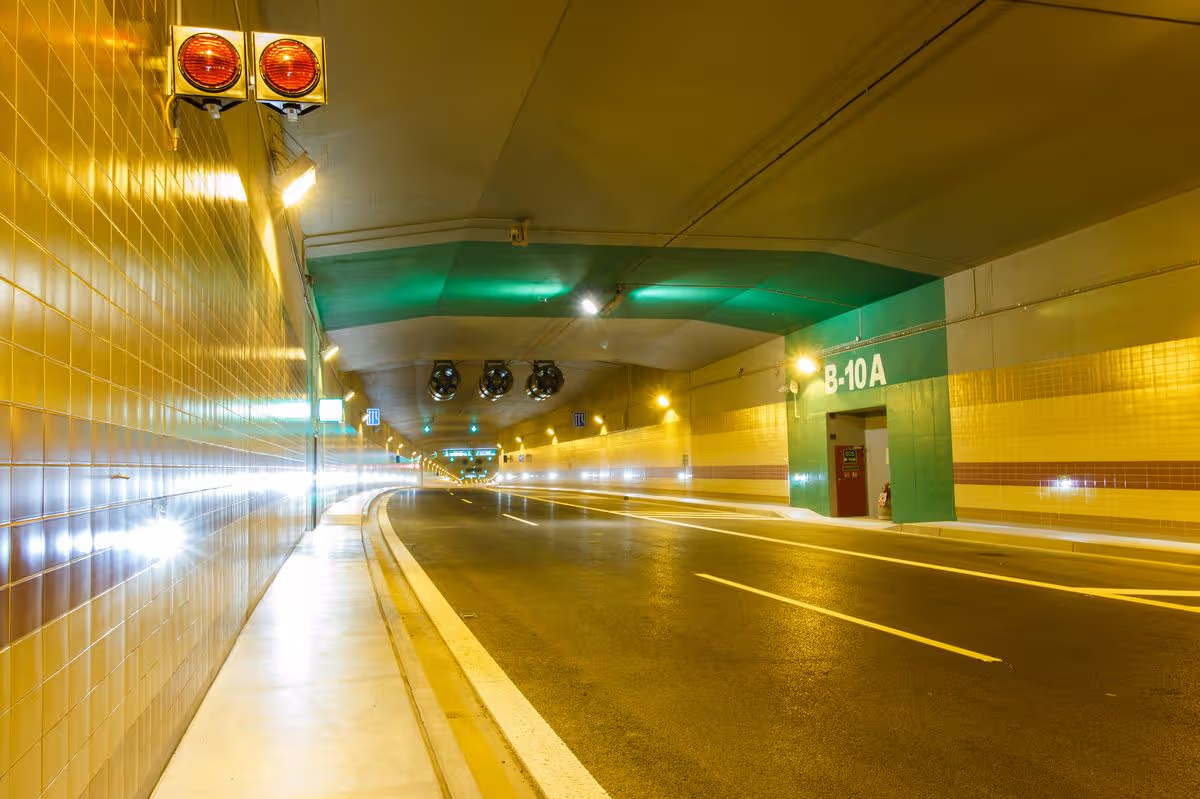
Three tunnels form part of the complex under the city

The tunnel runs right under a European city.
A European city has an extensive network of tunnels beneath it. The Blanka Tunnel Complex is the longest city tunnel in Europe and runs for a total length of 5,502 meters.
The tunnel sits under Prague and is the longest road tunnel in the Czech Republic. It connects the area west of Prague Castle with the Trója district in the North-east of the city.
Three tunnels, consisting of the Bubenečský, Dejvický, and Brusnický, make up the complex, which was designed to relieve heavy traffic from the history city centre. In its first 49 months since opening, it was used by 139 million cars.
Today, it is estimated that 88,000 vehicles use the tunnel every day. The Blanka Tunnel Complex opened on September 19, 2015, but it was a long time coming.
Construction launched in 2006, but it was planned since 1993. The tunnel was due to open in 2011, but the biggest and most expensive project in Prague was delayed by four years.
It cost 43 billion crowns, which is £1.5 billion today and doesn’t include all construction costs. During the construction of the tunnel complex, there were three landfalls.
The incident occurred twice in the Stromovka park, creating a hole measuring 15 to 25 meters. Another landfall happened in the garden area of the Ministry of Culture in Hradčany.
Since opening, the Blanka Tunnel Complex has undergone continuous maintenance. There is 24/7 monitoring by a dedicated control centre that works night shifts to service lights, ventilation systems, cabling and drainage.
Last year, the tunnel marked its 10th anniversary. Prague Daily News said: “It relieved congestion in the city centre, reduced journey times, and took vehicle traffic underground.
“Since its opening, around 780 million vehicles have passed through the tunnel.
“The Dejvický Tunnel has borne the greatest load with more than 271 million vehicles, followed by the Brusnický Tunnel with almost 266 million and the Bubenečský Tunnel with 236 million vehicles.
“Although Blanka has been in regular operation for years, the approval process for part of the project is still not fully concluded.
“A formal decision by the Administrative Court has meant that the relevant section continues to operate only under provisional use.
“Observers, however, expect a final acceptance soon.”