Flooding left vehicles piled up and people stranded inside Sao Paulo’s Anhangabau tunnel. People had to wait for the floodwaters to recede before rescue teams could reach them.
The U.S. government set off conventional explosives inside a tunnel deep in the Nevada desert this week in a test designed to replicate a so-called “decoupled” nuclear detonation. Data collected is now being used to help improve methods for detecting this kind of nuclear testing. Just earlier this year, American authorities accused China of using decoupling to conceal new nuclear tests despite the country’s stated moratorium on such activities.
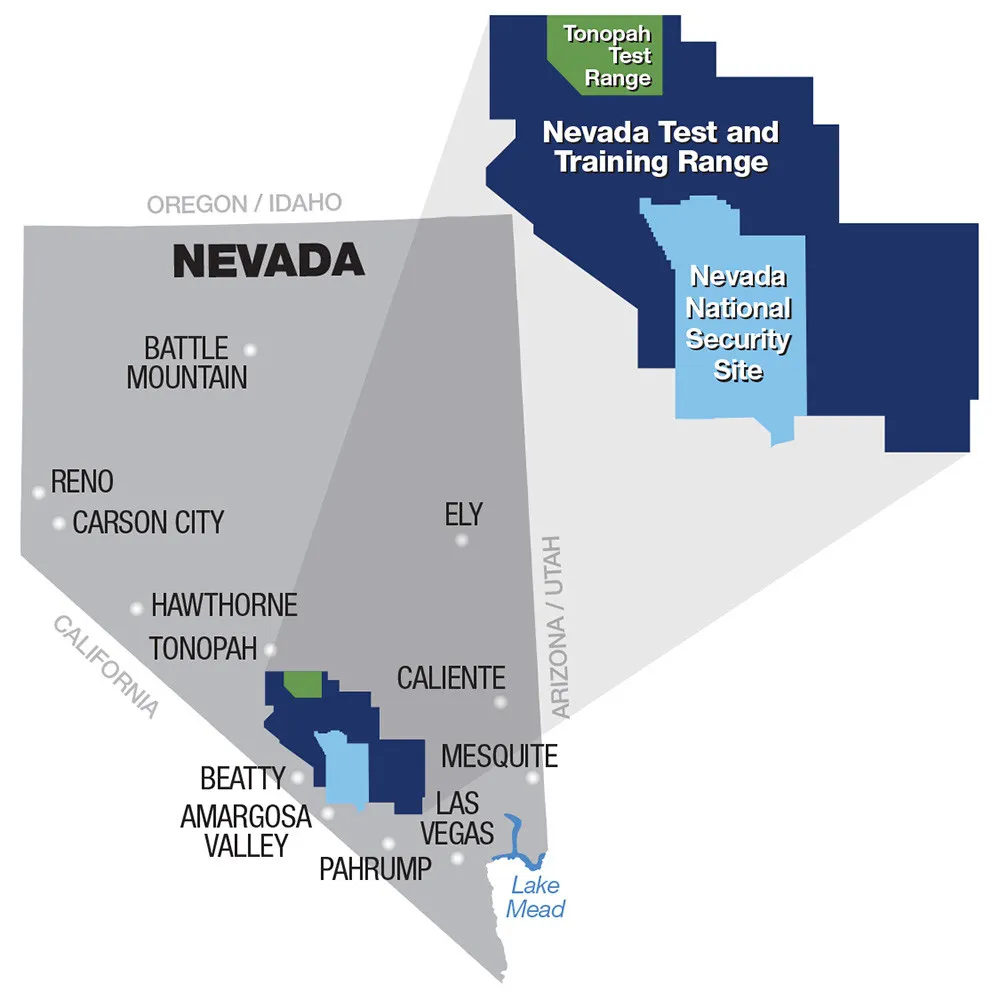
The test, which involved the use of chemical high-explosives and radiotracers, was conducted yesterday inside P Tunnel in Area 12 of the Nevada National Security Site (NNSA), according to a press release from the National Nuclear Security Administration (NNSA). The NNSS, which is situated within the boundaries of the U.S. Air Force’s Nevada Test and Training Range (NTTR), is used for a wide variety of testing purposes today. An agency under the Department of Energy, NNSA’s main jobs are to oversee the development and production of nuclear weapons, as well as manage America’s nuclear deterrent stockpile.
A map giving the general sense of the location of the NNSS with the NTTR. Center for Radiological Nuclear TrainingAnother map showing the specific testing areas within the NNSS. Area 12 is at the northern end of the complex. United States Geological Survey
“This experiment is especially focused on further enhancing the U.S. capabilities to detect a ‘decoupled’ explosion,” per NNSA’s release. “Data collected from the experiment will be used to validate scientific models and refine algorithms that are critical to U.S. nuclear explosion detection efforts.”
“Just as a stealth aircraft looks smaller on radar, decoupling can greatly muffle the signals detected by nuclear detection sensors, making a large explosion appear smaller,” the release explains. “In a conventional, or ‘coupled,’ underground nuclear test, a device is placed deep in a hole in close contact with the rock, allowing much of the explosion’s shockwave to reach sensors. In a decoupled test, by contrast, the device is detonated inside a large underground chamber, substantially reducing the explosion’s seismic signature.”
“In this experiment, researchers gathered measurements using a broad suite of advanced sensors, including accelerometers, seismometers, infrasound sensors, electromagnetic sensors, chemical and radiotracer samplers, and meteorological sensors,” it adds. ”Together, these measurements will improve scientists’ understanding of the signatures produced by underground explosions and strengthen the United States’ ability to detect and characterize nuclear explosive events.”
Overview of the NNSS
The U.S. already maintains a U.S. Atomic Energy Detection Systems (USAEDS) network, which is overseen by the U.S. Air Force Technical Applications Center (AFTAC). USAEDS is made up of more than 3,600 sensors positioned around the world. USAEDS is also tied in with the International Monitoring System (IMS), which is managed by the organization responsible for overseeing the Comprehensive Nuclear-Test-Ban Treaty (CTBT). AFTAC also supports the mission to monitor for potential nuclear testing globally using a fleet of specially configured WC-135R Constant Phoenix aircraft. In addition, those planes are used to help keep watch for unusual spikes in atmospheric radiation that could point to nuclear or radiological accidents or other incidents leading to the spread of potentially dangerous radioactive material.
Video 1: How CTBTO’s International Monitoring System works (subtitles)
With regard to the USAEDS network specifically, “once a disturbance is detected underground, underwater, in the atmosphere or in space, the event is analyzed for nuclear identification, and the findings are reported to command authorities,” according to AFTAC’s website.
As mentioned, the U.S. government has accused its Chinese counterparts of using decoupling to conceal new nuclear testing, and NNSA’s press release draws explicit attention to these allegations. At the annual Conference on Disarmament in Geneva, Switzerland, in February, Thomas DiNanno, Under Secretary of State for Arms Control and International Security, said that China had conducted at least one such test at Lop Nur on June 22, 2020. The Comprehensive Nuclear-Test-Ban Treaty Organization (CTBTO) subsequently said the IMS had not detected an event matching that description at that location on that date. For its part, the Chinese government has denied the accusation.
The social media posts below include satellite imagery showing activity at Lop Nur that could point to new nuclear testing activities in recent years.
参考 Satellite Imagery Analysis of China’s Alleged 2020 Nuclear Test at Lop Nurhttps://t.co/aafvU5Szh7 CSIS 20260213 ROLES SAT ANALYSIS No.7 中国に核実験実施の動き ー Lop Nur核実験場の画像分析 ーhttps://t.co/n66yYk0hLg ROLES 20250522
While China is a signatory to the CTBT, the country has never ratified it. The Chinese government last acknowledged a critical-level nuclear test in 1996, after which a self-imposed moratorium was put in place, at least publicly. As an aside, the United States has also signed, but never ratified, the CTBT, and has a similar self-imposed moratorium on nuclear testing since 1992. It is worth noting that the treaty does not ban so-called sub-critical testing, which involves fissile material, but does not result in a full-fledged nuclear reaction.
Last week, The Wall Street Journal reported that the Trump administration has been holding new talks with the Chinese government regarding various aspects of the country’s massively and rapidly expanding nuclear arsenal, including the testing allegations. That story immediately preceded a state visit by China’s President Xi Jinping to Washington, D.C., to meet with Trump.
President Donald Trump (at left) and President Xi Jinping (at right) walk together at the White House last week. White House/Joyce N. Boghosian
“The discussions between American and Chinese officials have centered on measures to reduce nuclear risks and haven’t been aimed at negotiating a formal arms-control pact, an effort Beijing has sharply rebuffed in the past,” according to that report. “The Trump administration has begun to highlight the possibility of implementing new verification measures.”
“Independent experts say seismic instruments might be placed on or near test sites,” The Journal‘s story also noted. “Another possibility, which was floated during the Biden administration, is to install radiation-detection equipment at test sites.”
NNSA’s announcement about the test at the Nevada National Security Site is certainly an example of the development underway already of new means of verification that could be deployed at sites around the world.
The Russian government has said it is ready to conduct new nuclear tests if the United States pursues this course of action. The last official nuclear test in Russia came in 1990 right before the fall of the Soviet Union.
“It takes nuclear expertise to detect nuclear activities and experiments like these [to] ensure America remains unmatched in detection,” NNSA Administrator Brandon Williams said in a statement yesterday in light of the test in Nevada. “The Trump Administration has made it clear that the United States will lead from a position of strength. You cannot evade American innovation. With this experiment, we are sending a clear message: under this administration, America will never be outmatched.”