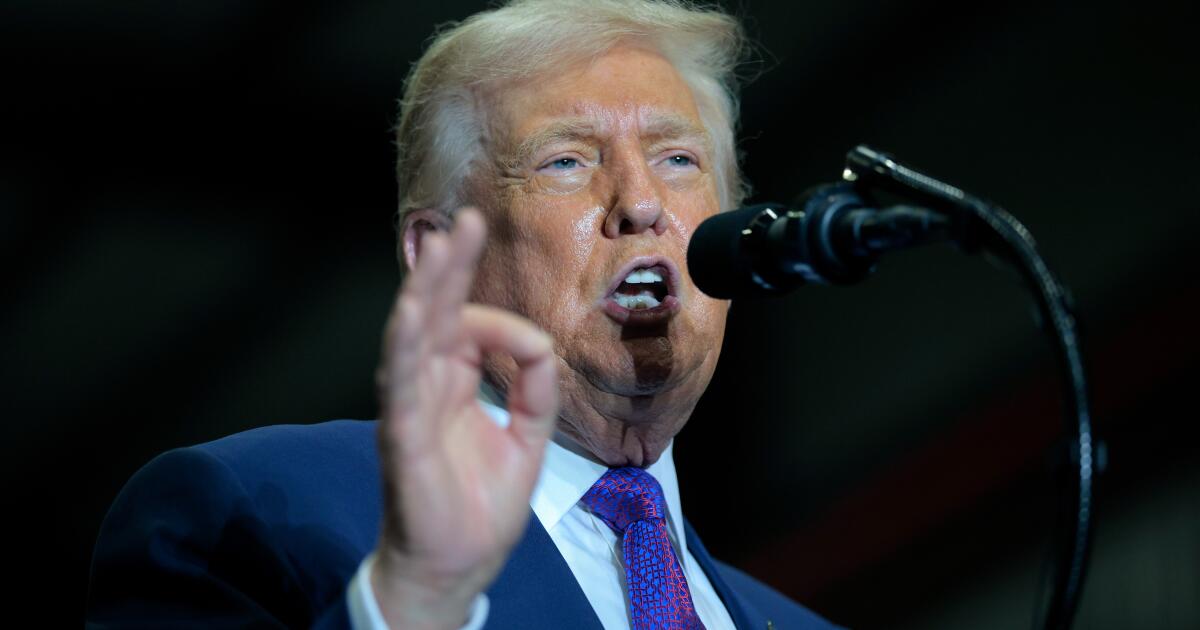
The most prestigious board ever put together.
That is how the president of the United States, a man convicted of fraud, described his new team focused on international relations. A team that does not include representatives from our closest neighbors — Mexico and Canada — but did save room for leaders accused of war crimes by the International Criminal Court.
Now, we do not know whether President Trump created his “Board of Peace,” which this week held its first meeting, specifically to undermine the authority of the United Nations. But we do know that the president has pledged $10 billion in tax dollars to the board’s mission while still owing the U.N. half that amount in back payments. We do not know whether Trump, who is indefinitely the leader of this peace board, intends to relinquish that power after he leaves the White House. But we do know he is still trying to overturn the results of the 2020 election. Whether the “Board of Peace” is the most prestigious panel ever assembled is debatable. What is not debatable is that it was conceived by an adjudicated sexual abuser who is referenced in the released Epstein files some 38,000 times.
That is not my take.
That is simply what is happening.
Which is why the president encourages his supporters to ban books and reject journalism. He doesn’t want voters to pay attention. He doesn’t want voters to understand his actions.
Ten years ago this month — after his Nevada caucus victory speech — Trump said, “I love the poorly educated.” And his reliance on this base is why, over the past decade, he and other conservatives have purposely misconstrued the term “woke” as a catch-all slur toward progressive and far-left policies. It used to mean “aware” and “informed.” The term was not born out of modern politics but rather the need to understand the history of the social economic systems we all are living in. The alternative is to be blindly led by an unscrupulous leader most concerned with his own well being.
Being “woke” is why the Boston Tea Party happened in 1773; it is why Thomas Paine published “Common Sense” in 1776; it is why Republicans formed the Wide Awakes to help get Abraham Lincoln elected in 1860. When voters understand the context in which decisions are made, we are better equipped to address shortcomings at the ballot box and in our daily lives.
Trump’s self-proclaimed love for the poorly educated has nothing to do with progressive policies or college degrees and everything to do with whom he can convince to believe him. And by making “woke” an insult, Trump and other conservatives have politicized the very tool necessary to help the country fulfill its promise: information.
This threat is the reason his administration attacks, and even arrests, journalists; the reason he refers to reports he doesn’t like as “fake news”; the reason he fired the labor statistics chief after an unflattering jobs report last year. He’s waging a war on information.
The reason 2025 marked the worst nonrecession year for job growth since 2003 isn’t that the country was “woke.” It’s because of shortcomings in leadership.
When Trump returned to the White House, he made lowering the U.S. trade deficit a key component to his economic policy. In 2024, the deficit was $903.5 billion. In 2025, it was $901.5 billion — and America’s families paid $230 billion more for goods because of his yo-yo tariff policies.
He told his supporters that other nations would be paying for the tariffs he enacted — obvious nonsense to anyone who attended a day of Econ 101. And we know that as a result of his reckless and ignorant policies, farmers in particular suffered. It’s not clear whether that financial burden was a consideration when the Supreme Court on Friday declared the president’s sweeping tariffs to be illegal. What we do know is before Trump entered politics, his businesses filed for bankruptcy six times — so perhaps he was never the economic savant he claimed to be.
Just as the saga of the Epstein files reveals he is not the protector of women and young girls that he claimed to be.
Just as his recent attacks on the 1st, 2nd, 4th and 14th Amendments show he was never the defender of the Constitution he took an oath to be.
Acknowledging the laundry list of untruths tied to his promises and presidency is not political or a symptom of “Trump Derangement Syndrome.” It’s simply having information: the one thing that helps voters understand why things are the way they are. The one thing the president hopes his supporters never wake up to see for themselves.
YouTube: @LZGrandersonShow
Insights
L.A. Times Insights delivers AI-generated analysis on Voices content to offer all points of view. Insights does not appear on any news articles.
Viewpoint
Perspectives
The following AI-generated content is powered by Perplexity. The Los Angeles Times editorial staff does not create or edit the content.
Ideas expressed in the piece
-
The Board of Peace, while described by the president as the most prestigious ever assembled, excludes the country’s closest neighbors in Mexico and Canada while creating space for leaders accused of war crimes by the International Court[2][3].
-
The administration is pledging $10 billion in tax dollars to the board’s mission while the United States still owes the United Nations $5 billion in back payments, raising questions about priorities and institutional commitment.
-
The board represents a potential threat to the UN’s authority and the multilateral international order, with the president positioned to lead indefinitely without a clear succession mechanism independent of his personal tenure.
-
The use of the term “woke” as a political slur by the president and conservatives serves to discourage informed and critically aware voters from engaging with factual information and journalism, undermining democratic participation.
-
The administration’s economic policies have demonstrably failed, including tariff strategies that burdened American families with $230 billion in additional costs while the trade deficit marginally decreased from $903.5 billion to $901.5 billion, a result inconsistent with promised outcomes.
-
The president’s record of attacks on the press, dismissal of unfavorable reporting as “fake news,” and removal of officials for releasing unflattering data represents a broader assault on the free flow of information essential to accountability.
Different views on the topic
-
The Board of Peace represents a vital step in implementing the president’s 20-point plan for Gaza, which was endorsed by United Nations Security Council Resolution 2803 and initially received broad international support from Western democracies[1][3].
-
More than two dozen nations have signed on as founding members of the board, with member countries pledging $5 billion toward Gaza’s reconstruction, demonstrating substantial international engagement with the initiative[2].
-
The Executive Board comprises leaders with expertise across diplomacy, development, infrastructure, and economic strategy, positioning the mechanism to provide strategic oversight and mobilize international resources for Gaza’s stabilization[1].
-
The board functions as an overarching body designed to implement demilitarization and reconstruction efforts through subsidiary mechanisms including the Gaza Executive Board and the National Committee for the Administration of Gaza, with operational structures intended to deliver governance and development outcomes[1][3].
-
The initiative was conceived as a focused mechanism to support stabilization and reconstruction in Gaza within the framework of the UN-endorsed 20-point plan, anchoring its original purpose in internationally recognized diplomatic processes[3].