information

FBI probes cases of missing or dead scientists, including four from the L.A. area

Amid growing national security concerns, the FBI said Tuesday that it has launched a broad investigation in the deaths or disappearances of at least 10 scientists and staff connected to highly sensitive research, including four from the Los Angeles area.

“The FBI is spearheading the effort to look for connections into the missing and deceased scientists. We are working with the Department of Energy, Department of War, and with our state and state and local law enforcement partners to find answers,” the agency said in a statement.

The FBI’s announcement comes after the House Oversight Committee announced that it would investigate reports of the disappearance and deaths of the scientists, sending letters seeking information from the agencies involved in the federal inquiry as well as NASA, which owns the Jet Propulsion Laboratory in La Cañada Flintridge, where three of the missing or dead scientists worked.

“If the reports are accurate, these deaths and disappearances may represent a grave threat to U.S. national security and to U.S. personnel with access to scientific secrets,” Reps. James Comer (R-Ky.), chairman of the committee, and Eric Burlison (R-Mo.) wrote in the letters.

President Trump told reporters last week that he had been briefed on the missing and dead scientists, which he described as “pretty serious stuff.” He said at the time that he expected answers on whether the deaths were connected “in the next week and a half.”

Michael David Hicks, who studied comets and asteroids at JPL, was the first of the scientists who disappeared or died. He died on July 30, 2023, at the age of 59. No cause of death was disclosed.

A year later, JPL physicist Frank Maiwald died at 61, with no cause of death disclosed.

Two other Los Angeles scientists are part of the string of deaths and disappearances.

On June 22, 2025, Monica Jacinto Reza, a materials scientist at JPL, disappeared while on a hike near Mt. Waterman in the San Gabriel Mountains.

On Feb. 16, Caltech astrophysicist Carl Grillmair was fatally shot on the porch of his Llano home. The Los Angeles County Sheriff’s department arrested Freddy Snyder, 29, in connection with the shooting. Snyder had been arrested in December on suspicion of trespassing on Grillmair’s property.

Snyder has been charged with murder.

There is no evidence at this point that the deaths and disappearances, which occurred over a span of four years, are connected.

A spokesperson for NASA, which owns JPL, said in a statement on X that the agency is “coordinating and cooperating with the relevant agencies in relation to the missing scientists.

“At this time, nothing related to NASA indicates a national security threat,” agency spokesperson Bethany Stevens wrote. “The agency is committed to transparency and will provide more information as able.”

Representatives from Caltech did not immediately respond to a request for comment.

Source link

Minnesota investigates the arrest by ICE of a Hmong American man as a possible kidnapping

A Minnesota county is investigating the arrest of a Hmong American man by federal officers that was captured on video as a potential case of kidnapping, burglary and false imprisonment, officials announced Monday.

Ramsey County Atty. John Choi and Sheriff Bob Fletcher said at a news conference they will pursue information from the Department of Homeland Security that they need for their investigation into the arrest of ChongLy “Scott” Thao in January. Ramsey County includes the state capital of St. Paul.

Immigration and Customs Enforcement officers bashed open the front door of Thao’s St. Paul home at gunpoint without a warrant, then led him outside in just his underwear and a blanket in freezing conditions.

“There are many facts we don’t know yet, but there’s one that we do know. And that is that Mr. Thao is and has been an American citizen. There’s not a dispute over that,” Fletcher said. “There’s no dispute that he was taken out of his house, forcibly taken out of his home and driven around.”

He continued: “Is that good law enforcement, to take an American citizen out of their home and drive them around aimlessly, trying to determine what they can tell them?’”

Homeland Security, which oversees ICE, has refused so far to cooperate with other state and local investigations into the killings by federal officers of two U.S. citizens in Minneapolis during the Trump administration’s immigration crackdown.

Choi said they’re trying to determine whether any crimes were committed that they could prosecute under state or federal law.

“This is not about, any type of predetermined agenda other than to seek the truth and to investigate the facts,” he said.

Agents eventually realized Thao was a longtime U.S. citizen with no criminal record, Thao said in an interview with the Associated Press in January. They returned him to his home after a couple of hours.

Homeland Security later said ICE officers had been seeking two convicted sex offenders. Thao told the AP he had never seen the two men before and that they did not live with him.

Videos captured the scene, which included people blowing whistles and horns, and neighbors screaming at more than a dozen gun-toting agents to leave Thao’s family alone.

The state and the chief prosecutor in Hennepin County, which includes Minneapolis, sued the Trump administration last month to gain access to evidence they say they need to independently investigate three shootings by federal officers in Minneapolis, including the killings of Renee Good and Alex Pretti.

The lawsuit accuses the federal government of reneging on its promise to cooperate with state investigations after the surge of around 3,000 federal law enforcement officers into Minnesota.

Minnesota and Hennepin County have also appealed to the public to share information about federal officers’ potentially illegal activities, given the refusal by federal authorities to provide evidence.

The Trump administration has suggested Minnesota officials don’t have jurisdiction to investigate those cases. State and county prosecutors say they need to conduct their own inquiries because they don’t trust the federal government.

The Justice Department in January said it was opening a federal civil rights investigation into Pretti’s killing, and two officers have been placed on leave, but the agency said a similar federal probe was not warranted in Good’s death.

Vancleave and Karnowski write for the Associated Press. Karnowski reported from Minneapolis.

Source link

How sensitive LAPD files got leaked online — and what happens next

The disciplinary files of Los Angeles police officers are closely guarded secrets, protected by some of the nation’s strictest confidentiality laws.

But now, many of those secret files have been splashed across the internet, along with tens of thousands of other sensitive records from the L.A. city attorney’s office.

The extent of the data breach is still unclear, and city officials have said they are investigating to find out what was taken, who was responsible and how the city’s cybersecurity was compromised.

A ransomware hacking collective called WorldLeaks, which has gained a reputation for extorting private and public entities by threatening to disclose confidential files on the internet, has claimed responsibility.

The group first announced the breach on March 20. City and LAPD officials did not comment on whether the hackers requested a ransom in return for not releasing the information — or whether the city paid one. Some reports suggest that the group was behind a hack of L.A. Metro last month that forced it to shut down part of its transit network.

The Times spoke with several sources familiar with the investigation into the data breach who requested anonymity because they were not authorized to discuss the case publicly, and reviewed a partial inventory of the leaked files, including screenshots of some materials.

Here’s what we know so far.

How did hackers get the LAPD files?

The hacking group appears to have exploited vulnerabilities in a system used by the Los Angeles city attorney’s office, enabling the group to make off with nearly 340,000 files, according to the sources familiar with the case.

In the wake of the George Floyd protests, the sources said, the city was flooded with dozens of lawsuits from protesters who had been injured by LAPD officers. To handle the deluge of new cases, the city created a file-sharing system so that attorneys on both sides could access discovery materials, including some considered private under court orders.

It was akin to Dropbox or Google Drive, the sources said, and access was supposed to be restricted to just authorized users.

But the system, according to two sources familiar with the investigation, was not password-protected because city officials believed that it needed to be accessible to other parties, including outside attorneys hired to assist with civil litigation.

The sources said the system expanded far beyond its initial scope and came to include records from hundreds of lawsuits involving the LAPD.

In a statement issued to The Times on Wednesday, Ivor Pine, a spokesperson for the city attorney’s office, described the hack as “unauthorized access to a third-party tool used by the City Attorney’s Office to transfer discovery to opposing counsel and litigants.”

How did the LAPD and city officials find out?

Few inside the LAPD knew about the extent of the leak until The Times published a story Tuesday revealing files that appeared online.

After the news broke on Tuesday, the department released a brief public statement acknowledging the disclosure of “discovery documents from previously adjudicated or settled LAPD civil litigation cases.” The department noted that the “breach does not involve any LAPD systems or networks.”

Pine said that once the city attorney’s office realized its file-sharing system was compromised, it “took immediate steps to secure the tool and investigate what information was accessed.”

“No other City applications or systems were involved in this incident,” Pine said. “The information was self contained in this application without any links or access to any department records or systems.”

What are the consequences of the massive leak?

The data breach could have political ramifications for embattled City Atty. Hydee Feldstein Soto, who is up for reelection.

Last week, she earned the endorsement of the powerful Los Angeles Police Protective League, which represents rank-and-file LAPD officers. But union officials contend that Feldstein Soto failed to mention the leaked documents to them until they learned of the hack Tuesday evening.

On Wednesday, the union issued a scathing statement.

“To say we are disappointed by the lack of urgency and forthrightness from the City Attorney’s office is an understatement,” the union’s statement said. “We will keep asking the tough questions and once we receive answers we will take appropriate action.”

Feldstein Soto’s challenger in the city attorney’s race, John McKinney, said the public deserves immediate answers.

“The lack of transparency isn’t just concerning, it’s unacceptable,” said McKinney, who currently leads the major crimes bureau at the L.A. County district attorney’s office. “By keeping the public in the dark, witnesses and Los Angeles Police Department families may have been put at risk.”

Lawyers for police officers reported numerous calls from clients worried their personnel and medical records were exposed, raising the prospect of more costly litigation. About 900 officers are currently suing the department over the 2023 release of mugshot-style images and other materials in response to a public records request.

How much information was snatched and what’s in it?

In all, according to posts about the data breach, 7.7 terabytes of information was available for download.

The LAPD statement described the files in the recent hack as coming from closed cases, but at least one of the files reviewed by The Times involved a lawsuit over an alleged sexual assault by a police officer that was set for trial next week.

Also disclosed were personnel files from dozens of current and former officers. Every officer’s personnel records are contained within a system called TEAMS II.

It is a detailed history that includes records on arrests they have made, training sessions they have attended, citizen complaints received against them and lawsuits they have been involved in, along with any history of traffic collisions, shootings or other uses of force, commendations, assignments, workers’ compensation claims and more.

Such records can be turned over as discovery in civil cases, but almost always under a protective order that restricts them from being shared publicly.

An untold number of internet users have downloaded the terabytes of data in the weeks since its release. What surfaces next remains to be seen.

Source link

Sensitive LAPD records leaked in hack of L.A. city attorney’s office

A trove of sensitive Los Angeles police records, including officer personnel files and documents from Internal Affairs investigations, are among the materials seized by hackers in a breach last month involving the L.A. city attorney’s office.

The leak involves 337,000 files, including some of the LAPD’s most closely guarded records. The documents posted online include the disciplinary histories of officers and investigations into complaints against them, materials that are typically sealed from public view under state law.

The massive hack sent shudders through the department. Officials have sought to downplay the extent of the disclosure, but activists who have long pushed for more transparency around acts of officer misconduct quickly put a spotlight on sensitive files they were able to access.

After The Times published a story Tuesday about the hack, the Los Angeles Police Department issued a statement that said “unauthorized individuals had gained access to a digital storage system,” enabling them to obtain “discovery documents from previously adjudicated or settled LAPD civil litigation cases.”

The department noted that it was a compromise of the Los Angeles city attorney’s office computers and that the “breach does not involve any LAPD systems or networks.”

“We take this incident very seriously and are working with the L.A. City Attorney’s Office to gain access to the impacted files to understand the full scope of the data breach,” the department’s statement said.

Ivor Pine, a spokesperson for the city attorney’s office, said in a statement that the office first became aware March 20 of “unauthorized access to a third-party tool used by the City Attorney’s Office to transfer discovery to opposing counsel and litigants.”

Pine said the office “took immediate steps to secure the tool and investigate what information was accessed,” including contacting law enforcement.

“The City Attorney’s Office has confirmed that no other City applications or systems were involved in this incident,” Pine said. “The information was self contained in this application without any links or access to any department records or systems. Our investigation is continuing to determine what information was present in the tool and we will take appropriate action to notify any affected parties based on the results of this review.”

The Los Angeles Police Protective League — the union that represents the department’s rank-and-file officers — issued a statement Wednesday afternoon that criticized the city attorney’s office for its handling of the breach.

The union’s board of directors said City Atty. Hydee Feldstein Soto “should have picked up the phone and informed us about this egregious data breach when she claims she learned of it several weeks ago.”

“We first learned of the breach by reading the Times and the City Attorney has still not provided the union with an honest assessment of the breach’s magnitude, who was impacted, what was disclosed and how this could have happened,” the union’s statement said. “To say we are disappointed by the lack of urgency and forthrightness from the City Attorney’s office is an understatement. We will keep asking the tough questions and once we receive answers we will take appropriate action.”

Within the Police Department, there has been virtually no acknowledgment from senior leaders about the breach or its implications, according to LAPD sources who requested anonymity in order to discuss the confidential matter.

According to one of the department sources, there was a vague reference to LAPD employees needing to change their passwords more frequently at a regular meeting Monday of command staff — but no mention of the breach itself or what files had become public.

The data were obtained by a well-known hacking group known for conducting ransomware attacks on large entities and demanding payment, threatening to make the confidential data public on the web. City and LAPD officials did not comment on whether the hackers requested a ransom in return for not releasing the information and whether the city paid one.

A spokesperson for the FBI’s office in Los Angeles said the agency “is aware of the incident, is actively assisting the City’s Attorney’s Office, and is coordinating with partners.”

At least one hacking group on March 20 claimed to have access to the city of Los Angeles files. Cybercrime investigators from both the federal government and the LAPD have been pursuing the hack since last month, according to police sources who requested anonymity because they were not authorized to discuss the open case.

Some of the records have surfaced on social media platforms, including X. Among the first to share a file from the hack was the account @WhosThatCop, which regularly posts about information related to police accountability.

The account’s administrator said a security researcher first disclosed the breach. A link to the files apparently had been taken down by Tuesday afternoon.

The disclosure represents a stunning breach of police data. Some files circulating from the hack included personal health information of officers, witness interviews from criminal investigations and internal probes conducted by the department. Only rarely do Internal Affairs documents surface in civil lawsuits and criminal cases, and even then they are often heavily redacted.

In all, according to posts about the data breach, 7.7 terabytes of information was available for download.

The disclosure of confidential LAPD records could unleash a new round of costly lawsuits by officers. About 900 officers are currently suing the department related to a 2023 release of mugshot-style images — along with names, races and other demographic details of police officers — in response to a public records request.

The LAPD statement described the files in the recent hack as coming from closed cases. But the X account @WhosThatCop published a redacted internal affairs report from an apparently ongoing case. The case involves a lawsuit by a woman who alleges that she was sexually assaulted by an LAPD officer days after the officer took her into custody in 2022.

In a statement to The Times, the account’s anonymous operator applauded the hack.

“Sadly, having the public resort to transparency by relying on 340,000 City Attorney files being published at the hands of criminals is emblematic of the stonewalling and incompetence by City Attorney Hydee Feldstein Soto, Mayor Bass, and LAPD Chief McDonnell,” the operator said.

According to court filings, the city reached a conditional settlement with the woman on March 20 — the same day the data theft was revealed by hackers. The matter had been set to go to trial next week.

The lawsuit alleged that the officer, Gabriel Anthony Espadas, detained the woman on a mental health hold after responding to a call for service in the San Fernando Valley. The woman’s lawsuit contends that the officer “engaged in nonconsensual sexual activity” with her after her release.

The city defended itself in the lawsuit, saying the “two sexual encounters” involved an “off-duty, probationary officer” who was “not acting within the course and scope of his employment.”

The disclosure is the latest of several cybersecurity incursions targeting public agencies in Los Angeles. Last month, the city’s metro system shut down parts of its network after its security team detected hacking activity. Law enforcement and cybersecurity specialists are continuing to investigate who was behind the attack, authorities said.

The Los Angeles County Superior Court was hit by a ransomware attack in 2024 that infected its computer system with damaging software, forcing it to shut down for two days.

Times staff writers Clara Harter and Gavin J. Quinton contributed to this report.

Source link

Inside Bob Chesney’s quest to remake UCLA one practice at a time

UCLA football practices simulate as many aspects of a game as possible, including TV timeouts. In a Bob Chesney practice, those simulated breaks become a chance for coaches to share information with the players.

“Instead of just taking a break … the coaches get together and then they break up and disseminate that information to the players, and then they come back together again and then we go out and play,” Chesney said.

Chesney wants his entire team to adapt, overcome and perform. These goals are often utilized in rest periods. They’re spread throughout practice to break the monotonous nature of it.

“I want the coaches to talk about the new plays they’re seeing from the offense and the new things they’re seeing from the defense,” he said. “I want them to practice coaching in-game, and they themselves want to practice coaching in-game.”

The coaching staff tries to slow things down for players. They don’t want players to rush through learning the playbook, and there’s no concrete deadline for installing plays into practice, offensive coordinator Dean Kennedy said.

“It’s fluid,” he told reporters last week.

In previous seasons at James Madison, Kennedy and Chesney noticed there were times when they would focus on learning plays too early in spring practice, leading to execution mistakes during games. This convinced them to put a hold on finalizing certain plays so players had more time to process details and make necessary adjustments.

“There’s a million football plays, but if you just install stuff and you don’t actually get a rep of it, what’s the point, right? You can’t assess it on film,” Kennedy said. “You can’t teach it to them the proper way because realistically, just like us, there’s only so much they can learn, right?”

Competition is at the heart of Chesney’s efforts to revitalize the Bruins. From the weight room to sitting in meetings, to the way the lockers are kept — everything is a competition, Chesney said.

“Every single thing is going to be graded and judged and held to a high standard, and accountability will follow it,” he said. “That has got to be it, we have to be able to compete. We play a game where you keep score and everybody’s in a one-on-one matchup and [compete] as hard as possible for 80, 90, however many plays it might be in a game.”

For UCLA, it’s important to set a level of competition that mimics game-time energy during practice.

“I want Saturdays to feel as much like a Tuesday and Wednesday as humanly possible,” Chesney said.

That includes the pressure of trying to filter out thousands of screaming fans. In punt return drills involving receiver Mikey Mathews, UCLA players rushed him, screamed at him and sprayed him with water in an attempt to prevent him from catching the ball.

Chesney doesn’t want to wait until the season starts to see if his players crack under pressure.

“I’d rather find out right now in practice three and just continue to elevate it week in and week out,” he said. “I think that’s probably the focal point of this entire program is that you pay attention to no virtue that has not been tested in fire, and I want to make sure that we test everything that we can out here in fire.”

Injury update: Linebacker Ryan McCulloch, who transferred from Cal, could see some practice time near the “very end” of the spring practice period, Chesney said. McCulloch missed most of the 2025 season because of injury.

Source link

Judge blocks Trump administration from gathering for college applicant information

April 4 (UPI) — A federal judge has blocked the Trump administration’s attempt to collect data on students on public universities in their attempt to stop them from considering race as part of the admissions process.

Seventeen states had sued to stop the administration from forcing several universities from submitting seven years of data on applicants and admitted students to prove that they have not factored race into admission decisions, Politico and The Los Angeles Times reported.

U.S. District Court Judge Dennis Saylor on Friday night issued a preliminary injunction that will allow universities in California, Colorado, Connecticut, Delaware, Hawaii, Illinois, Maryland, Massachusetts, Nevada, New Jersey, New York, Oregon, Rhode Island, Vermont, Virginia, Washington and Wisconsin to retain their records until the trial is over.

The injunction said that the administration’s efforts to gather the information are “rushed” and “chaotic,” and moves to shut down the federal Department of Education would not only make collecting and analyzing the data difficult, but it may also become illegal.

“This is not a merely technical issue,” Saylor said in the ruling, explaining that if the department no longer exists, the work “cannot be turned over to States and local communities; they have no authority … to conduct such surveys.”

He added that that only federal agency with that authority is the DOE and its National Center for Education Services, meaning that if the department is shut down, the federal government’s authority to collect and analyze university data “vanishes.”

The Supreme Court in 2023 ruled against using affirmative action — the consideration of race to increase the diversity of university populations — in the admissions process.

The Trump administration has worked to enforce the ruling as part of its antagonistic view of diversity, equity and inclusion (DEI) programs. Gathering and analyzing public university data, as well as lawsuits, are among the ways they are doing so.

The federal DOE was created by Congress under President Jimmy Carter in 1979 with the aim of improving coordination and management of federal education programs, but Trump ordered the department to be dismantled in a March 2025 executive order.

Twenty states have sued the administration to prevent that effort, as well.

President Donald Trump delivers a prime-time address to the nation from the Cross Hall in the White House on Wednesday. President Trump used the address to update the public on the month-long war in Iran. Pool photo by Alex Brandon/UPI | License Photo

Source link

Environmental groups accuse Mexico of lying about source of oil spill in the Gulf

Environmentalist groups accused Mexico’s government of lying about the source of a massive oil spill in the Gulf of Mexico, something authorities promptly denied.

The spill of off the coast of the southern state of Veracruz has spread more than 373 miles and into seven nature reserves. Turtles and other marine life have been found on sea shores coated in oil, and fishermen have been unable to work in waters they have fished for decades.

Mexico’s government reported that 800 tons of hydrocarbon-laden waste have spilled into the ocean. The government said the spill started in March and the sources were a ship anchored off the coastal state of Veracruz and two sites from which oil naturally flows.

On Monday, a group of 17 organizations — including Greenpeace Mexico, the Mexican Alliance Against Fracking and the Mexican Center for Environmental Rights, or CEMDA — contradicted that claim and said that satellite images they captured show the root of the spill was actually a pipeline from Mexico’s state-run oil company, Pemex, and that a large oil slick appeared in early February.

“All this lack of information is causing massive economic and environmental damage. So far no one has been held accountable,” Margarita Campuzano, spokesperson for CEMDA, said Tuesday.

Images from February circulated by the activists match images obtained by The Associated Press on Tuesday through Copernicus, the European climate agency. The photos show a boat floating over a sea clouded with what the groups say is oil, which appears to be streaming out of a platform.

The groups said that the boat in the images is Árbol Grande, which specializes in pipeline repair — implying that the government knew about the spill before it had reported it and “hid it.”

Pemex called the information and images circulated by the groups “inaccurate” and said the Árbol Grande boat traverses the Gulf of Mexico continually, “carrying out preventive inspections of platforms and specialized spill response operations.”

Campuzano called for greater transparency and more aggressive investigations by authorities.

“They’re trying to dilute their responsibility when technology makes it very easy to know where this occurred and who is responsible,” she said.

Mexican President Claudia Sheinbaum on Tuesday denied the accusations during her morning press briefing and said that up until now, “no leak has been reported” in state oil infrastructure and that such natural seeps in the Gulf have happened in the past.

She said the government was investigating with scientists whether the spill was “due to these natural seeps in the area, which have been reported on many occasions and are well-documented in scientific literature, or a leak from one of the facilities.”

Sheinbaum said that it was more probable that the spill came from the natural seeps, and added that teams were hard at work cleaning up the spill and mitigating the effects.

While government officials recognized the impacts on turtles, birds and fish, and the spread to protected ecosystems, they also insisted that it had not caused “severe environmental damage.”

The accusations come as environmental groups in the United States have also raised alarm after the Trump administration exempted oil and gas drilling in the Gulf of Mexico from the Endangered Species Act, saying environmentalists’ lawsuits threatened to hobble domestic energy supplies during the U.S.-Israeli war with Iran.

Critics said the move could harm marine life and also doom a rare whale species.

Janetsky writes for the Associated Press. Associated Press writer Teresa de Miguel in Mexico City contributed to this report.

Source link

Tiger Woods arrested for DUI following rollover crash in Florida

Tiger Woods was arrested on suspicion of driving under the influence and causing property damage following a rollover car crash Friday afternoon in Florida, authorities said.

The Martin County Sheriff’s Office said that Woods, 50, had tried to overtake another vehicle when his Land Rover clipped it. Woods climbed out of the passenger side of the car. He showed signs of impairment at the scene and was arrested, authorities said. Woods was driving alone, and neither he nor the driver of the other car were injured in the crash.

Tiger Woods mugshot photo after arrest

The Martin County Sheriff’s Office released Tiger Woods’ booking photo on Friday night following the golfer’s arrest.

(Martin County Sheriff’s Office via Associated Press)

Woods was released on bail Friday night, the Associated Press reported.

Woods’ talent agency, Excel Sports Management, did not respond to a request for comment.

A breathalyzer test showed he had no alcohol in his system, but he refused to do a urine test, Martin County Sheriff John M. Budensiek said at a news conference around 5 p.m. local time.

The crash occurred around 1 p.m. local time, the department said in a Facebook post. The Jupiter Island Police Dept. was first to respond to the scene and found a pickup truck that had been pulling a pressure cleaner trailer and Woods’ Land Rover rolled over on the driver’s side door, Budensiek said. Officers talked to Woods and then asked the sheriff’s office for help.

The sheriff’s office determined that the pickup truck was slowing down to make a turn into a driveway off of a two-lane road with no shoulder when the driver looked in his mirror and saw the Land Rover approaching quickly from behind. The pickup driver tried to get out of the way of the approaching car. The Land Rover swerved at the last moment to avoid a crash, clipped the back end of the trailer, listed to the side and rolled onto the driver’s side door.

At the scene, Woods appeared lethargic, the sheriff’s office said, and was arrested following “in depth” roadside tests. The sheriff said he does not know exactly what Woods was intoxicated with, but concluded it was likely due to “some type of medication or drug.”

Because Woods refused to submit to a urinalysis, “we will never get definitive results as to what he was impaired on at the time of the crash,” the sheriff said. No drugs or medications were found in Woods’ car.

In addition to DUI and property damage, Woods also was charged with refusal to submit to a lawful test, Budensiek said. All three charges are misdemeanors.

Under Florida law, Woods had to remain in Martin County jail for at least eight hours following the arrest.

Asked if Woods would get preferential treatment, Budensiek said the celebrity would not be with other inmates who could take advantage of his position. Otherwise, it would be just another case.

“We know we arrested a high-profile figure,” Budensiek said. “I’m not trying to dramatize, but it doesn’t matter who you are. If you break the law, we’re going to follow the law. That’s a really easy path to take.”

Woods recently competed at the TGL indoor golf finals but has not confirmed whether he intends to play at the Masters starting April 9 in Augusta, Ga.

Woods was seriously injured in a rollover crash near Rancho Palos Verdes in 2021.

Around Thanksgiving 2009, a report that Woods had been in a car accident near his home erupted into a major scandal involving allegations of affairs with multiple women. It resulted in Woods’ divorce from Elin Nordegren, the mother of his children.

Assistant Editor Christie D’Zurilla contributed to this story.

Source link

Family appeals to Arizona community for clues to find Nancy Guthrie

Savannah Guthrie is renewing pleas to neighbors, friends and residents of Tucson to jog their memories in hopes of sparking new leads in the disappearance of her mother, Nancy.

The “Today” show co-host posted a new family statement on her personal Instagram account Sunday morning, hours after the show’s Instagram account shared it.

After expressing gratitude to the community, the family said in its statement that it believes someone in Tucson or in southern Arizona may “hold the key to finding the resolution in this case.”

“Someone knows something. It’s possible a member of this community has information that they do not even realize is significant.”

The family urged people to go over their memories of Jan. 31 — when Nancy Guthrie was last seen — and Feb. 1 as well as the evening of Jan. 11.

“Please consult camera footage, journal notes, text messages, observations, or conversations that in retrospect may hold significance,” the statement said. “No detail is too small.”

They also acknowledged in the statement that their family’s matriarch may no longer be alive.

“We cannot grieve; we can only ache and wonder.”

Nancy Guthrie was reported missing Feb. 1. Authorities believe the 84-year-old was abducted or otherwise taken against her will. The FBI released surveillance videos of a masked man who was outside Guthrie’s front door on the night she vanished.

The Guthrie family has offered a $1-million reward for information leading to the recovery of their mother.

On March 5, Savannah Guthrie visited the NBC “Today” show studio in New York City for the first time since her mother’s disappearance. The show said she plans to return to the air at some point but “remains focused right now supporting her family and working to help bring Nancy home.”

Tucson is a little more than 100 miles south of Phoenix and 70 miles north of the Mexico border. The Catalina Foothills, the neighborhood where Nancy Guthrie lives, is known as an affluent area with popular hiking trails.

Savannah Guthrie has been a co-anchor of the longtime NBC morning show since 2012. One of her former colleagues, Hoda Kotb, has returned to “Today” to fill in during Guthrie’s absence.

Source link

Justice Department subpoenas Comey in Trump conspiracy probe

The Justice Department sent a subpoena to former FBI Director James Comey as part of an investigation into whether former law enforcement and intelligence officials waged a years-long conspiracy against President Trump, according to people familiar with the matter.

The grand jury subpoena was issued last week by the U.S. attorney’s office for the Southern District of Florida, according to the people, who asked not to be identified speaking about an ongoing investigation.

The subpoena seeks information about Comey’s role in putting together an intelligence assessment about Russia’s interference in the 2016 presidential election, according to the people.

The U.S. attorney’s office has previously sent subpoenas to other former U.S. officials. The office is conducting a sweeping investigation into whether former U.S. officials allegedly took actions to sabotage Trump starting in 2016 through his indictment over the handling of classified documents in 2023.

The new subpoena, reported earlier by Axios, marks an escalation of Justice Department efforts targeting Comey in particular, who Trump has repeatedly said should be investigated.

Comey was previously indicted by a grand jury at the request of the U.S. attorney for the Eastern District of Virginia for allegedly lying to senators during a congressional hearing — a claim that Comey has denied. The indictment was dismissed after a federal judge ruled that the U.S. attorney was unlawfully appointed. The Justice Department is appealing the ruling.

A lawyer for Comey declined to comment Thursday. The U.S. attorney’s office in Miami didn’t immediately respond to a request for comment.

Trump and Comey have had a contentious relationship. Trump fired Comey as FBI director in 2017 during his first term as president. Since then, Comey and Trump have publicly criticized each other.

Strohm writes for Bloomberg News.

Source link

Schools left wondering how to proceed after ruling on transitioning students

The Supreme Court broke new ground this month when it ruled the Constitution forbids school policies in California that prevent parents from being told about their child’s gender transition at school.

But the reach of this new parental right remains unclear.

Does it mean all parents have a right to be informed if their child is using a new name and pronouns at school?

Or is the right limited to parents who inquire and object to being “shut out of participation in decisions involving their children’s mental health,” as the high court said in Mirabelli vs. Bonta.

Both sides in this legal battle accuse the other of creating confusion and uncertainty. And that dispute has not subsided.

UC Davis law professor Aaron Tang says understanding the Supreme Court’s order calls for a close reading of the statewide injunction handed down by U.S. District Judge Roger Benitez in San Diego.

That order prohibits school employees from “misleading” or “lying” to parents. It did not say school officials and teachers had a duty to contact parents whenever they saw that a student changed their appearance or used a new name, he said.

By clearing this order to take effect, the Supreme Court’s decision “means that schools must tell parents the truth about their child’s gender presentation at school if the parents request that information,” Tang said.

“But the initial burden is on the parents. This is not a rule that schools have an affirmative obligation to inform any and all parents if their child is presenting as a different gender,” he said.

The high court’s 6-3 order also indicated the reach of the judge’s injunction was limited.

It “does not provide relief for all the parents of California public school students, but only those parents who object to the challenged policies or seek religious injunctions.”

Religious conservatives who sued say they seek to end “secret transition” policies that encourage students to adopt a new gender identity without their parents knowing about the change.

The lawsuit challenging California’s “parental exclusion” policies was first filed by two teachers in Escondido.

Peter Breen, an attorney for the Thomas More Society, said many of the parents in Escondido “had no clue” their children were undergoing a gender transition at school.

“We need to activate parents,” he said.

Ruling for them, Benitez said the state’s “parental exclusion policies are designed to create a zone of secrecy around a school student who expresses gender incongruity.”

His injunction also said schools must notify their employees that “parents and guardians have a federal constitutional right to be informed if their public school child expresses gender incongruence.”

The Supreme Court’s order cited a dramatic example of nondisclosure.

Two parents who joined the suit had gone to parent-teacher meetings and learned only after their eighth-grade daughter attempted suicide that she had been presenting as a boy at school and suffered from gender dysphoria.

John Bursch, an attorney for Alliance Defending Freedom, argues the Supreme Court’s opinion goes further to empower parents.

“Fairly read, the Mirabelli opinion creates an affirmative obligation on school officials to disclose,” he said. “It’s consistent with the way [the court] describes the parental right: ‘the right not to be shut out of participation in decisions regarding their children’s mental health.’ School officials’ silence (rather than lying) is not notice to and is shutting out parents.”

“All that said, the California attorney general is obviously not getting that message,” Bursch said.

He said the Supreme Court needs to go beyond an emergency order and fully decide a case that squarely presents the issue of parents rights.

“School officials should not be socially transitioning children without parental notice and consent. Period,” he said.

He filed an appeal petition with the Supreme Court in a case from Massachusetts that dissenting Justice Elena Kagan described as a “carbon copy” of the California dispute.

It takes only four votes to grant review of a case, but since November, the justices have repeatedly considered the case of Foote vs. Ludlow and taken no action.

The case is set to be considered again on Friday in the court’s private conference.

Meanwhile, California Atty. Gen. Rob Bonta went back to the 9th Circuit Court of Appeals seeking a clarification to limit the potential sweep of Benitez’s order.

He objected to the part of the judge’s order that said schools must post a notice that “parents and guardians have a federal constitutional right to be informed if their public school student child expresses gender incongruence.”

Bonta said that goes beyond what the Supreme Court approved.

This “could be understood to suggest that public school officials have an affirmative constitutional duty to inform parents whenever they observe a student’s expression of ‘gender incongruence,’ effectively imposing a mandatory ‘see something, say something’ obligation in all circumstances,” he said.

But the 9th Circuit said it would not act until he first presented this request to Benitez.

Meanwhile, transgender rights advocates say the voices and the views of students have been ignored.

“This case has been about states’ and parents’ rights but students have been left out of the conversation. Their voices have not been heard at all,” said Andrew Ortiz, an attorney for the Transgender Law Center. “School should be a place where young people can feel safe and confident they can confide in a teacher.”

“We’re hearing about fear and anxiety,” said Jorge Reyes Salinas, communications director for Equality California, the nation’s largest statewide LGBTQ+ civil rights organization.

“There are students who are unable to speak with their parents. Teachers can encourage them to have a conversation with their parents. But this will weaken the trust they have in their teachers,” he said.

In the past, the court had been wary of reaching into the public schools to decide on education policies and the curriculum, but it took a significant step in that direction last year.

In a Maryland case, the court said religious parents had a right to “opt out” their young children from classes that read “LGBTQ+-inclusive” storybooks.

The 1st Amendment protects the “free exercise of religion” and “government schools … may not place unconstitutional burdens on religious exercise,” wrote Justice Samuel A. Alito, the lone conservative who attended public schools.

The same 6-3 majority cited that precedent to block California school policies that protect the privacy of students and “conceal” information from inquiring parents if the student does not consent.

But the California case went beyond the religious-rights issue in the Maryland “opt out” case because it included a “subclass of parents” who objected without citing religion as the reason.

The justices ruled for them as a matter of parents’ rights.

“Parents — not the state — have primary authority with respect to the upbringing and education of children,” the court said.

That simple assertion touches on a sensitive issue for both the conservative and liberal wings of the court. It rests on the 14th Amendment’s clause that says no state may “deprive any person of life, liberty or property without due process of law.”

In the past, a liberal majority held that the protection for “liberty” included rights to contraceptives, abortion and same-sex marriages.

Conservatives fiercely objected to what was dubbed “substantive due process.”

In the California case, Kagan, speaking for the liberals in dissent, tweaked the conservatives for recognizing a new constitutional right without saying where it came from.

“Anyone remotely familiar with recent debates in constitutional law will understand why: Substantive due process has not been of late in the good graces of this Court — and especially of the Members of today’s majority,” she wrote.

She noted that when the court struck down the right to abortion in the Dobbs case, Justice Clarence Thomas said he would go further and strike down all the rights that rest on “substantive due process.”

In response to Kagan, Justice Amy Coney Barrett filed a concurring opinion that staked out a moderate conservative position.

Since 1997, the court has said it would stand behind rights that were “deeply rooted in the nation’s history and tradition,” she wrote. That includes “a parent’s right to raise her child … and the right to participate in significant decisions about her child’s mental health.”

She said California’s “non-disclosure policy” is unconstitutional and violates the rights of parent because it applies “even if parents expressly ask for information about their child’s gender identification,” she wrote.

Chief Justice John G. Roberts and Justice Brett M. Kavanaugh signed on to her opinion.

While Kagan dissented on procedural grounds, she did not disagree with bottom-line outcome.

“California’s policy, in depriving all parents of information critical to their children’s health and well-being, could have crossed the constitutional line,” she said. “And that would entitle the parents, at the end of the day, to relief.”

Source link

As Trump pushes deportations, immigration data becomes harder to find

The Trump administration likes to promote its immigration enforcement agenda through numbers, with ambitious goals to deport 1 million people, report zero releases at the U.S.-Mexico border and arrest thousands of alleged gang members.

For all the boasting, the administration has been releasing less reliable, carefully vetted data than its predecessors on a signature policy that has become one of the most contentious of Trump’s second term.

The gap in information and a loss of figures from an office that has tracked immigration data back to the 1800s have left researchers, advocates, lawyers and journalists without important statistics to hold the Republican administration to account.

“They aren’t publishing the data,” said Mike Howell, who heads the conservative Oversight Project, an advocacy group pushing for more deportations. Instead, Howell said, the Department of Homeland Security has put out numbers in news releases “that purport to be statistics with no statistical backup and the numbers have jumped all over the place.”

With mass deportations a priority, new restrictions and increased enforcement have led to a surge in immigration arrests, detentions and deportations.

But finding the metrics that once measured those changes can be hard. It is an extension of earlier administration moves to limit the flow of government information by scrubbing or removing federal datasets or by the firing last year of the top official overseeing jobs data.

Important data is no longer publicly available

The Office of Homeland Security Statistics is responsible for publishing figures from Homeland Security agencies, including removals and the nationalities of those deported, to provide a comprehensive picture of immigration trends at the border and inside the United States.

Originally known as the Office of Immigration Statistics, it tracked such data since 1872. In its current form, created under the Biden administration, it also started publishing monthly reports that allowed researchers to track developments almost in real time.

But key enforcement metrics on its website have not been updated since early last year. A note on the page where the monthly reports were says it “is delayed while it is under review.”

“It’s the most timely data. It’s the most reliable data,” Austin Kocher, research professor at Syracuse University who closely follows immigration data trends, said about the monthly reports. “It has the most omniscient view of immigration enforcement across the entire agency.”

An interactive dashboard launched by U.S. Immigration and Customs Enforcement in December 2023 once let users examine whom the agency was arresting, their nationalities, criminal histories and removal numbers. ICE called it a “new era in transparency.”

Though intended for quarterly updates, the latest data is from January 2025. The agency’s annual report, typically released in December, had not been published as of mid-March.

Other agencies also publish data that touches on immigration, and parts of it do continue to roll out, such as U.S. Customs and Border Protection statistics detailing border encounters or data from the Department of Justice’s immigration courts.

But experts say other data has slowed.

The State Department’s most recent visa issuance data is from August. Key statistics from U.S. Citizenship and Immigration Services have not been updated since October.

The now-missing data had helped researchers study the effects of different policies. Lawyers could cite the figures to support their litigation. Journalists saw in them a powerful tool to hold the government to account on public claims or to report on important trends.

“We’re all a little bit in the dark about exactly how immigration enforcement is operating at a time when it’s taking new and unprecedented forms,” said Julia Gelatt, associate director of the U.S. Immigration Policy Program at the Migration Policy Institute.

DHS did not respond to detailed questions about why it was no longer releasing specific data.

“This is the most transparent Administration in history, we release new data multiple times a week and upon reporter request,” the department said in a statement.

Researchers contend with a patchwork of numbers

Figures the administration has released are inconsistent and unverifiable.

In a Jan. 20 news release, DHS said it had deported more than 675,000 people since Trump returned to the White House. A day later, in a second release, the department put the figure at 622,000. In congressional testimony March 4, Homeland Security Secretary Kristi Noem said the figure was 700,000.

But ICE, an agency within DHS, also releases figures on how many people it has removed from the country, part of a large data release mandated by Congress. An Associated Press analysis of the figures put that number at roughly 400,000 over Trump’s first year.

DHS has said 2.2 million people who were in the U.S. illegally have gone home on their own, but the department has given no explanation for the count. Experts have questioned the source of that figure, saying this was not something that DHS historically has tracked.

The department did not respond to questions about where that data came from.

With key sources of data halted, researchers, advocates and others have had to rely on information the administration is obliged to report or that has come to light through legal action.

The publication of ICE detention figures — how many people are detained, for how long and whether they have committed a crime — is required by Congress and is generally released every two weeks. But the figures’ release has faced some delays and its data gets overwritten with every new publication, complicating the work of people who need access to it.

The University of California, Berkeley’s Deportation Data Project, a research initiative, successfully sued through the Freedom of Information Act to access data about ICE arrests including nationalities, conviction status and whether arrests occurred at jails or in the community.

Graeme Blair, co-director of the project, said every administration has struggled with transparency in immigration enforcement, and given the Trump administration’s ambitious enforcement goals, the team wanted to secure and verify information that the government might not publicly release.

“Given the scale of what they were talking about doing, it seemed really important to be able to understand, to be able to double check those numbers,” he said.

But there are limitations, he said. The data obtained through the lawsuit only runs through Oct. 15. It does not cover recent operations such as the Minneapolis enforcement surge, when federal immigration officers fatally shot two protesters, leading to widespread demonstrations and scrutiny of enforcement tactics.

The absence of data is one of the few issues that has drawn bipartisan criticism.

“We deserve to know the numbers, just like we deserve to know who’s in our country and who needs to leave,” Howell said.

Santana writes for the Associated Press.

Source link

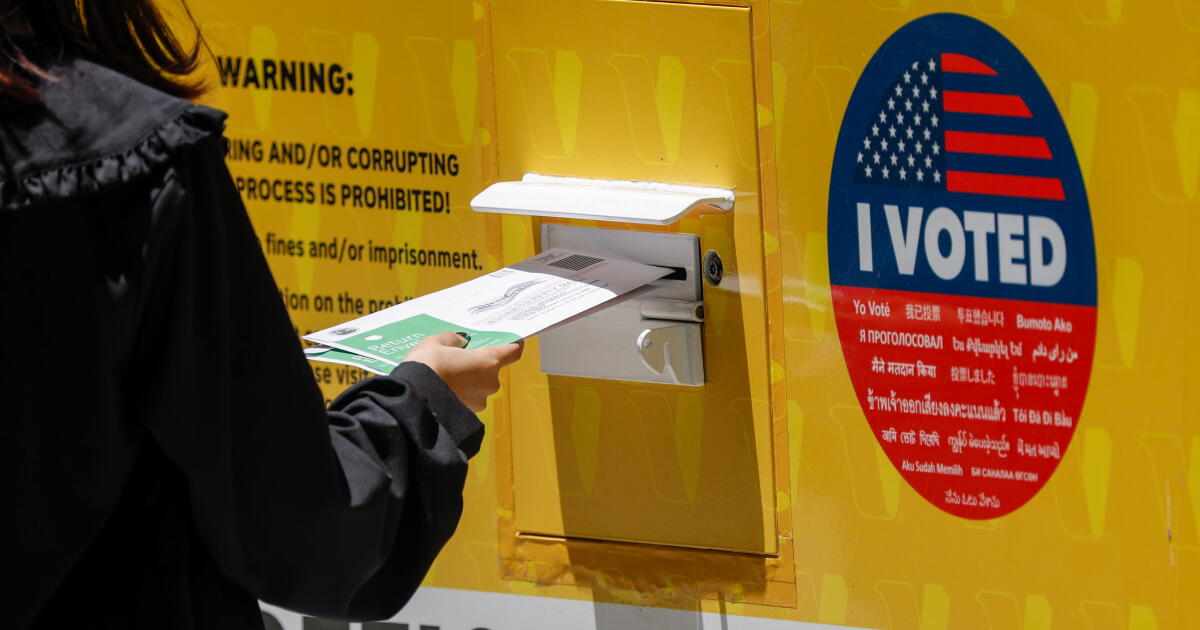
Video: $5 to sign a ballot petition with someone else’s name? California launches probe

A video circulating online appears to show signature collectors paying people to sign initiative petitions under other people’s names, according to officials, and now the state has opened an investigation.

The video, filmed by videographer JJ Smith, shows a long queue leading to a table set up at 6th and Mission streets in San Francisco. A man in line says they are being offered $5 to sign petitions. At the table, where there are lists with the information of apparent registered voters, a woman confirms the payment and — using a highlighter — instructs a person on the name and address that she is supposed to use.

“I get $5 too?” the videographer asks.

“Yeah,” says the woman.

“And what is it?”

“Just sign it,” she says.

  • Share via

Petitions connected to at least three ballot campaigns — including the billionaire-backed effort to thwart California’s proposed billionaire tax — appear in the video.

“I approached some people and asked them what they were there for,” Smith told The Times. “They told me they didn’t know what they were signing for, that they just wanted the $5.”

Smith said he watched the scene for hours and estimated that a few hundred people cycled through the line over roughly two hours.

Those running the table did not ask for anyone’s identification and gave no explanation of what was actually being signed, he said.

The video showed voter data from San Luis Obispo County that was both visible and, as details were spoken aloud, audible in the footage.

The county acted immediately after becoming aware of the video and initiated an investigation through the fraud unit of the California secretary of state’s office, said Erin Clausen, public information officer for the San Luis Obispo county clerk’s office.

Clausen noted that, although voter registration data can be legally requested from county election offices, the data in this case may have been used inappropriately. The county is also planning on reaching out directly to voters who were specifically mentioned or identified in the video, according to Clausen.

“The activity shown in the video, if verified, would violate California election law,” County Clerk-Recorder Elaina Cano said in a formal statement released Wednesday morning.

The secretary of state’s office confirmed it had opened a formal investigation.

“Under California law, it is illegal to give money or other valuable consideration to another in exchange for their signature on an initiative petition,” a spokesperson said in a statement. “ Those who abuse our system will be held accountable.”

The office is working with local officials and encouraged anyone with information to file a complaint.

One political committee, Californians for a More Transparent and Effective Government, confirmed its petitions were among those whose signature gatherers were allegedly paying people to sign and moved quickly to distance itself from the activity.

“Under no circumstance do we tolerate this type of activity in the signature gathering process,” said spokesperson Molly Weedn. “We’ve taken immediate action and have demanded that the signature gathering firm identify these circulators and reject their petitions.” Weedn said the collectors were subcontractors, not campaign employees, and that attorneys were contacting authorities.

That committee is funded by another group, Building a Better California, which was also among campaigns that appeared in the video. The other was for a proposed initiative called the Retirement and Personal Savings Protection Act of 2026. Representatives for the latter two have not responded to requests for comment.

Smith said this was not the first time he had witnessed this type of activity in the area.

“I saw something similar with ballots three days ago,” he said.

The investigation is ongoing. Anyone with information can submit a complaint to the Office of the California Secretary of State or contact their local county elections office.

Times staff writer Seema Mehta contributed to this report.

Source link