The two leading candidates condemn recent deadly Black Sea drone strikes but differ on the Ukraine war more broadly.
Published On 25 Oct 202625 Oct 2026
Bulgarians are voting in a presidential election amid the spread of Russia’s war on Ukraine to the waters off Bulgaria’s Black Sea coast.
Ahead of Sunday’s vote, President Iliana Iotova, 61, and ex-caretaker Prime Minister Andrey Gyurov, 50, were leading a field of 27 candidates in the polls.
Recommended Stories
list of 3 itemsend of list
The presidency is a largely ceremonial post in Bulgaria. While major policies must be approved by Parliament, direct election gives the president greater political authority. The president leads the armed forces and can veto legislation, sign international treaties and appoint ambassadors.
The election has also gained attention after a series of drone attacks on merchant ships off Bulgaria’s coast that likely killed some two dozen international seafarers.
The drone strikes sparked international condemnation and concerns about the growing reach of the war in Ukraine, prompting Bulgaria to seek allied assistance to bolster its maritime security.
The Bulgarian government has stopped short of explicitly blaming Russia for the attacks, but Prime Minister Rumen Radev said the outcome of the strikes “benefits the Russian Federation”.
Relations with Russia, West at stake
The two leading candidates for president have both condemned the strikes, but they differ on the broader war in Ukraine.
Gyurov, who served as caretaker prime minister this year, is backed by pro-Western, reformist parties and has long expressed support for Ukraine. He signed a security cooperation agreement with Kyiv during his time as premier.
“I want Bulgaria to have a voice of its own in Europe, a reliable NATO ally that defends its interests through preparedness, strong diplomacy and a clear position,” he said at a rally on Thursday.
This photo, released by the Bulgarian Interior Ministry, shows the ship Chelsea 3 during a rescue operation near Byala, Bulgaria, on October 13, 2026, after it was hit by drones [Bulgarian Interior Ministry via AP]
Iotova, a former vice president, became acting president in January after Radev resigned to enter the parliamentary race, which he won on what many political analysts considered a Kremlin-friendly ticket.
Radev supports Iotova, and they both call for a diplomatic end to the war.
“My opponents argue that there must be a war of attrition,” Iotova told a rally on Thursday. “The truth is, we are all the ones who are most exhausted.”
While there is a broad consensus among the parties in Parliament on the country’s pro-Western path, widespread pro-Russian sentiments based on traditional historical and cultural ties with Russia have divided society, particularly since the start of Moscow’s full-scale invasion of Ukraine.
Dobromir Zhivkov, managing director of the Market Links polling agency, said Iotova is among those who advocate that Bulgaria take a more neutral position.
“They call for an end to aid for Ukraine and a halt to arms deliveries to Ukraine; we often hear them use Kremlin rhetoric and terminology borrowed directly from Kremlin propaganda,” he told The Associated Press news agency earlier this week.
Run-off vote expected
Candidates are also addressing public fears about the steep rise in energy prices and surging inflation, with many Bulgarians in rural areas struggling to make ends meet.
Polls by Alpha Research give Iotova 41 percent of the vote and Gyurov 28 percent.
Voting starts at 7am (05:00 GMT), and polls close at 8pm (18:00 GMT).
Analysts expect none of the 27 candidates to secure the outright majority needed to win in the first round, however.
Turnout must also be above 50 percent of the 6.6 million registered voters, and Sunday’s turnout is expected to be less than 40 percent, which means a likely run-off on November 1.
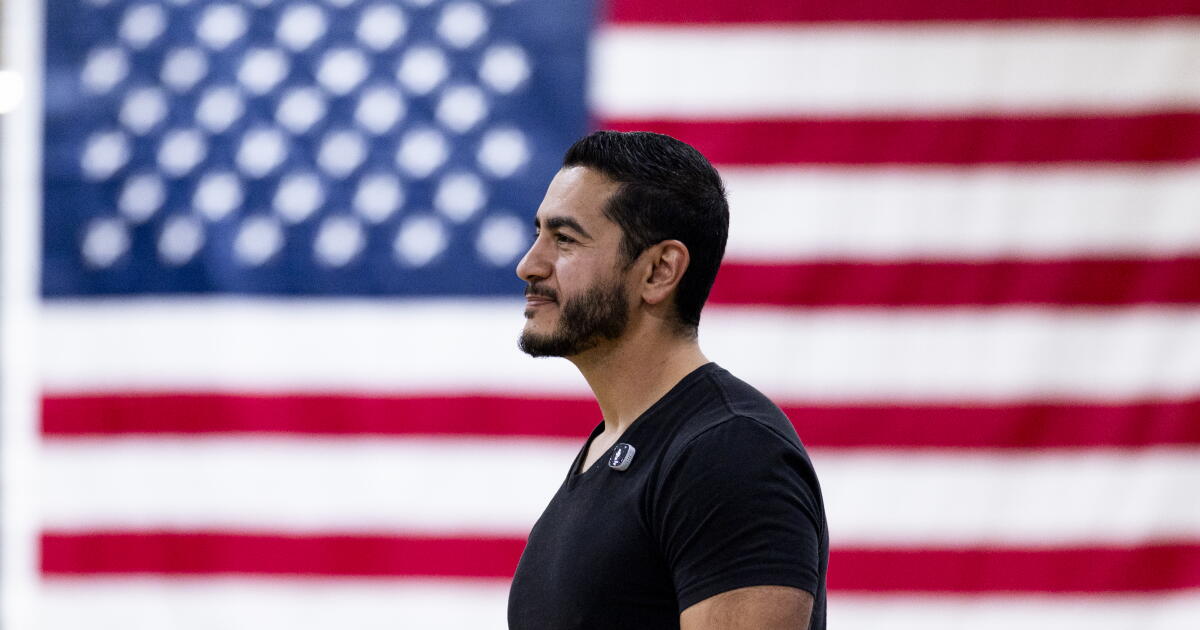
Michigan’s Democratic candidate for the U.S. Senate, Abdul El-Sayed, is many things to many people.
He represents change, part of a new generation of outspoken leaders who aren’t afraid to challenge the status quo.
He represents possibility: As the son of Egyptian immigrants, his trajectory is the American dream realized.
And he represents a threat to those who fear that his Muslim faith means he can’t possibly love America. El-Sayed is a handy bogeyman for Republican politicians who seek to scare their constituents into voting for them instead of the foreboding Arab name on the ballot.
But for people like me — American Muslims, or anyone with roots in the Middle East, North Africa, South Asia or other Muslim-majority regions — El-Sayed embodies the exhausting experience of having to explain yourself over, and over, and over …
We know what’s truly going on when someone discovers our lineage, then apropos of nothing asks, “How do you feel about the Oct. 7 Hamas attack?” In previous eras it was, “What are your thoughts about 9/11? The Iranian hostage crisis? The PLO?”
Regardless of the decade, the underlying question was the same: How American are you, really?
For generations, the insinuation has been that your loyalty lies somewhere else and that you have a predisposed soft spot for groups such as ISIS or Al Qaeda. Beneath that Taylor Swift-loving exterior, there must be a Bin Laden fighting to get out.
It was disappointing but hardly surprising when El-Sayed was asked at a recent town hall in Caro, Mich., if he would “disavow the Muslim Brotherhood.”
The questioner, who identified himself only as Tommy, was referring to a century-old Islamist movement with branches that have been designated as terrorist organizations by various countries and U.S. administrations.
It’s worth noting that El-Sayed was born and raised in Detroit, not Egypt or Jordan. He attended the University of Michigan medical school, not a radical madrassa, and received a Rhodes Scholarship to Oriel College, Oxford, where he completed a doctor of philosophy in public health (not bomb making).
El-Sayed answered the question without hesitation. “Sure, yeah, absolutely,” he said, then swiftly turned the tables and began interrogating the motives of his interrogator.
“You’re asking the question because implicitly, you assume that I’ll have dual loyalties, right?” El-Sayed said. “You assume that I wouldn’t disavow, or that I’ll have some higher order allegiance than to the Constitution, correct? Tommy, is that what you imply?”
The candidate spent four to five minutes laying bare the political motives behind what was clearly designed to be a “gotcha” moment.
His opponent in next month’s election, former Rep. Mike Rogers, has claimed without evidence that the Muslim Brotherhood funds El-Sayed’s campaign and that his family members have terrorist links. The attacks are on brand with a wider Republican strategy around sinking El-Sayed. Fearing a blue tsunami might flip the crucial swing state, Rogers and his allies have leaned heavily into Islamophobic attacks against the progressive Democrat.
It’s a campaign tactic endorsed at the highest levels. President Trump has referred to El-Sayed as a “radical jihadist” and claimed he is associated with the Muslim Brotherhood, mispronounced his name, infused it with nonsensical babble and called him “Muhammad Al-Fayad.” Trump has defended his racism by stating: “I’m the president. I can call him whatever the hell I want.”
El-Sayed preferred to talk about another president while addressing Tommy’s question at the town hall. He recalled that John F. Kennedy faced similar scrutiny during his 1960 presidential campaign when asked whether his Catholic faith would make him loyal to the pope and Vatican rather than the U.S.
“His answer, famously, was that he was not running to be a Catholic president,” El-Sayed said. “He was running to be president that happened to be Catholic. I’m not running to be a Muslim senator. I’m running for the U.S. Senate and happen to be Muslim.”
The standoff between El-Sayed and Tommy (who has since been outed as Thomas Teepell, the son of a Republican strategist and a former staffer to Republican Sen. Josh Hawley) has gone viral and is now being referred to as a 2026 election Rorschach test because both the right and left believe they prevailed.
It’s unclear to me how anyone might see El-Sayed’s evisceration of Teepell’s means-to-an-end question as a victory for the right. Perhaps it comes from eight years of watching Barack Obama weather insidious and overt racist attacks with the patience of a Shaolin monk. El-Sayed reacted, therefore they won?
On the left, El-Sayed’s articulate defense was widely applauded, but there were still criticisms that he may have come off as condescending. Liberal podcasters and influencers opined that El-Sayed should have just let it slide — for the 1,000th time.
Such an easy solution when it comes from those outside the sphere of suspicion.
But the reason we’re even having this conversation is because El-Sayed is challenging the norm. His rise to a formidable candidate who is willing to publicly dismantle loaded questions like Tommy’s represents progress wrought by successive generations of immigrants who’ve had to explain themselves ad nauseam.
Our parents and grandparents went out of their way to avoid those kinds of questions by taming their accents, changing their hard-to-pronounce names or eating their “ethnic” lunches outside the break room. The hope was that they’d melt into the proverbial pot with as little friction as possible.
My father, who emigrated from Iraq, did what all his Arab friends did here in L.A. — fit in. They used Brylcreem to tame their thick hair, listened to Johnny Cash and used terms like “guys and gals” as if they’d just stepped out of an Elvis movie.
As the next generation, I made it a point to openly embrace what my dad often downplayed — that we are Arab and Muslim. But given the post-9/11 climate, it came buffered with calming disclaimers: We are not a threat. Al Qaeda does not speak for Islam. And dolma is delicious, dammit.
El-Sayed’s refusal to brush off questions aligning him with terrorists may or may not cost him the election, but it’s a victory for all of us who’ve been defusing suspicion since we were kids.
The clip from the town hall ends with El-Sayed asking Thomas if he’s a Christian who has tried to live by Christian doctrine. Thomas affirmed. Then El-Sayed asked, “Do you disavow any attempt to read any religious doctrine into the laws of our country?” Thomas responded, “I do not.”
El-Sayed replied, “I think it’s you who needs to understand the Constitution, not me.”
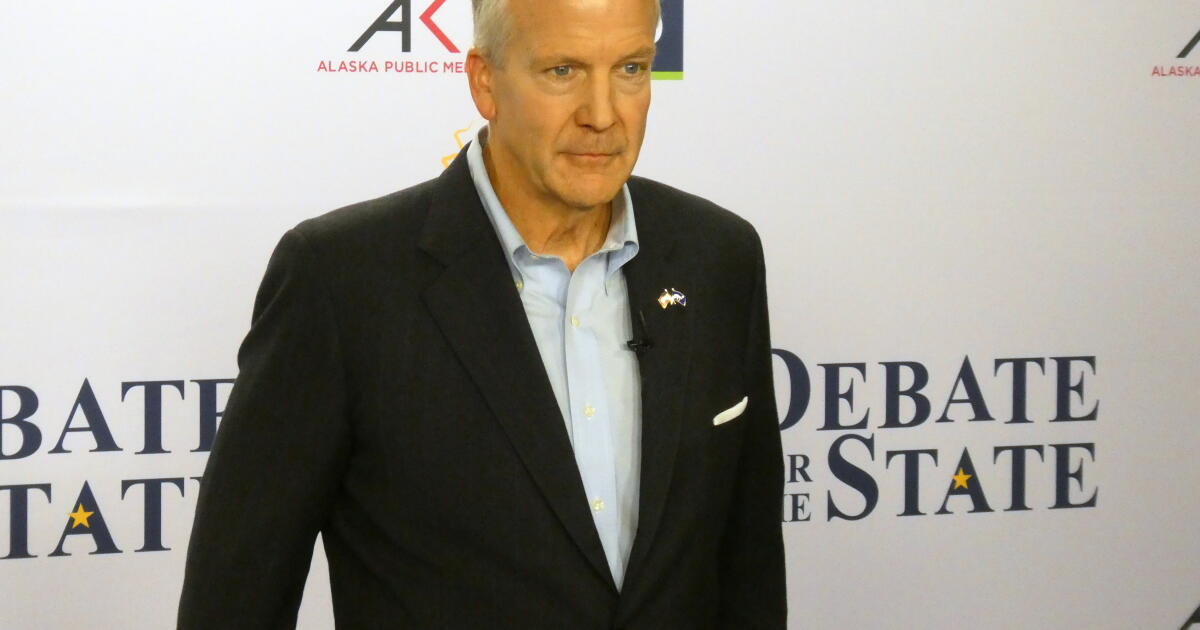
WASHINGTON — The Trump administration has filed a lawsuit to block certification of the Senate race in Alaska if Republican Sen. Dan Sullivan loses the contest while another candidate with the same name is on the ballot, kicking off what many have feared could become a lengthy battle between the U.S. government and states over certifying an election where the president’s party is struggling.
Many in both parties believe the fight could come down to Alaska, where Sullivan faces Democrat Mary Peltola. Also on the Alaska ballot is a Daniel J. Sullivan from the tiny fishing community of Petersburg. He has said he decided to run on his own, but Republicans have contended he’s a Democratic plant to siphon votes away from their candidate.
On Thursday, the Department of Justice filed a lawsuit in federal court in Alaska demanding that the state be blocked from certifying a Peltola win if the other Sullivan remains on the ballot. “The United States accordingly brings this lawsuit to protect the integrity of the 2026 Senate election in Alaska,” the lawsuit alleges, contending that federal law requires states to protect the integrity of federal elections.
The Alaska Supreme Court rejected previous Republican efforts to remove the other Sullivan from the ballot, and the state’s Republican officials made the decisions about how to list him on the ballot. The other Sullivan will appear without a party designation next to his name, while the senator will be listed as the Republican incumbent. Alaska’s ranked choice voting system also will allow voters to select both of the men if confused.
The Trump Department of Justice has increasingly been used to bolster the president’s political operation, targeting his enemies and filing lawsuits against Democratic-controlled states in the run up to the election. Democrats and many voting rights advocates have long feared the Trump administration will try to block certification of elections the president’s party loses much as Trump unsuccessfully tried to do when he lost the 2020 presidential election.
Earlier Thursday, U.S. Atty. Gen. Todd Blanche told reporters that was unlikely outside of extreme circumstances. “It is not DOJ’s intention to and it’s never our intention to improperly interfere with elections or the state certification process,” the attorney general told reporters in Virginia.
Derek Muller, a law professor at Notre Dame University, said the lawsuit will likely only kick in if Republicans narrowly lose the Alaska Senate race and that it does not seem to have legal merit. “The statute simply doesn’t let the Department of Justice enjoin certification,” he said.
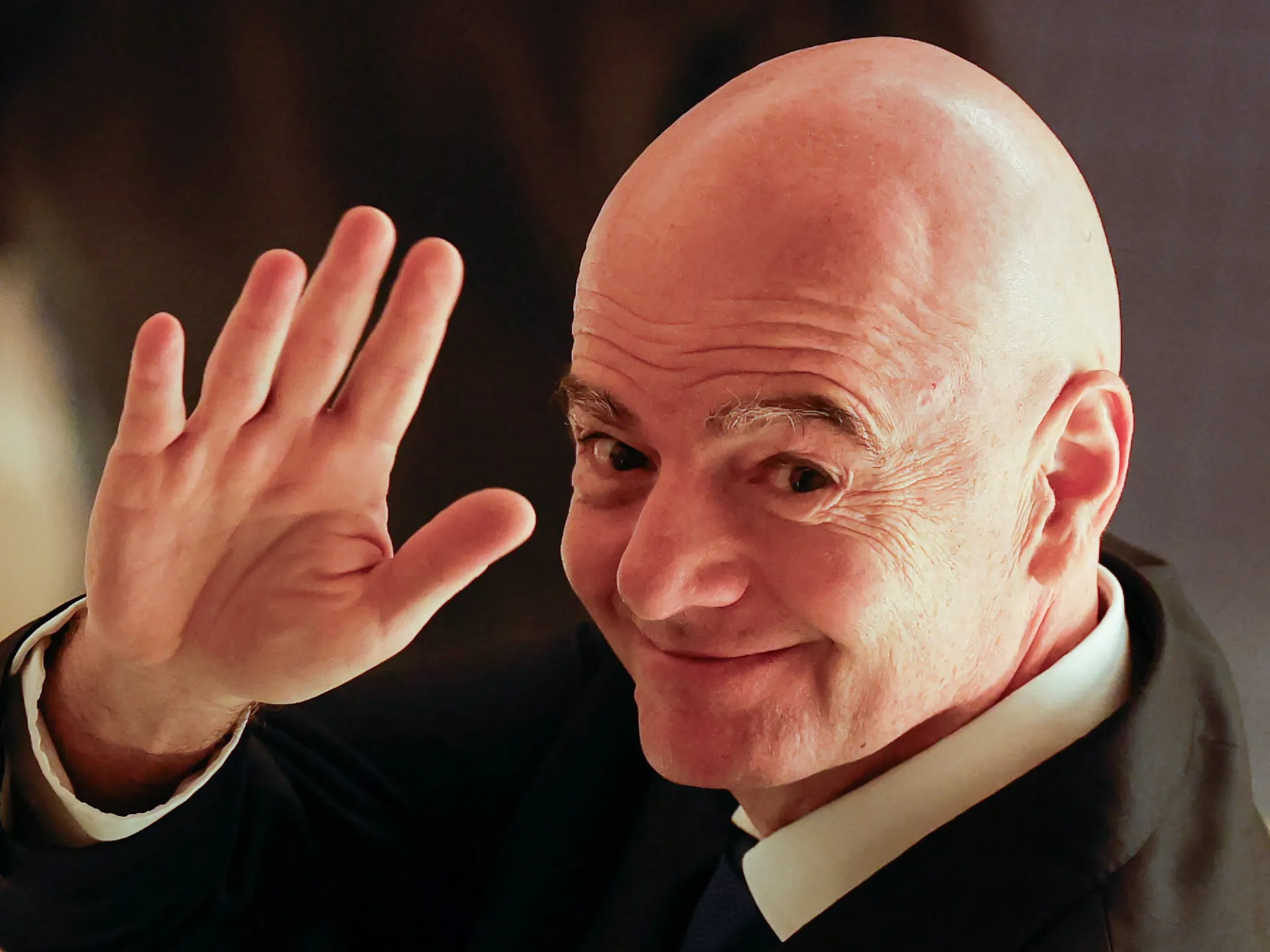
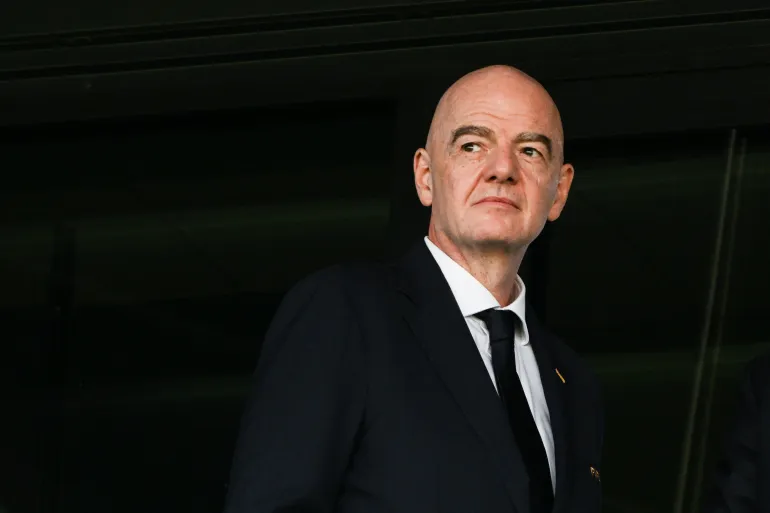
The head of the Asian Football Confederation (AFC) says the body is endorsing Gianni Infantino for another term as FIFA president.
The AFC has 47 member confederations. Even if all the members do not follow Friday’s direction from Sheikh Salman bin Ibrahim Al Khalifa, those that do could be key to guaranteeing another mandate for Infantino, who leads the governing body of world football and is seeking a fourth term.
Recommended Stories
list of 4 itemsend of list
The FIFA election is in March. The deadline for candidates to file against Infantino is November 18, and so far, none has filed.
Sheikh Salman, speaking at the AFC’s extraordinary congress in Tokyo on Friday, embraced Infantino with a large hug in front of the membership as he delivered his endorsement.
“We affirm our full commitment to supporting you and your leadership as you seek a new mandate as the FIFA president.” Sheikh Salman said.
“You’ve visited a lot of countries in Asia. I’ve spoken to a lot of members within this continent. I know your feeling, and I think your commitment is clear as well.”
Addressing his remarks to Infantino, Sheikh Salman indicated not every AFC member would go along with the endorsement but most will.
“My feeling is, I’m sure, the feeling of most of my members,” the AFC president said. “And I’ve said that to you.”
A sudden about-face by AFC
This is an abrupt turnaround for Sheikh Salman. Just over two months ago, the AFC joined the football governing bodies of Europe and that of North and Central America in saying Infantino had committed a “fundamental breach of trust”.
Infantino apologised last week in Zurich to FIFA’s 37-member ruling council, which he chairs, for “mistakes” he made in assembling a now-scrapped $4.2bn plan to sell a stake in FIFA events, including the World Cup, to private investors.
Sheikh Salman referenced the differences with Infantino in his speech but glossed over any details.
“Gianni, I want to make it clear: Yes, we had some issues we spoke about in the past,” Sheikh Salman said. “But let’s not relate the two things together. I think the last few days we met in Zurich, you made it clear that there’s a true understanding between us.”
“The past I’m sure is part of our history,” he added, “We’ve all, I’m sure, learned important lessons from it. What matters now is how we move forward together. I think everyone has questions, and I’m sure the answers will be available, whether to us in Asia or the rest of the world. ”
Infantino’s electioneering around the globe
FIFA’s media office has been promoting Infantino’s travels around the world, seeking votes in exchange for millions of more dollars in financial support for small and large football countries.
“Thank you for being here,” Sheikh Salman said to Infantino. “I know you have been everywhere. I don’t know how you can do it. But I’m sure that you set a record for being in almost every country.”
Sheikh Salman then joked that, perhaps, Infantino had a “clone”.
That drew a laugh. But the largest applause came at the end of his brief address when he again repeated his support for Infantino.
“As one Asian family, we are ready to move forward, united in your support, Gianni,” Sheikh Salman added. “I want to make that clear today.”
Infantino accepts AFC’s support
Infantino took the podium after Sheikh Salman and kept his remarks light. But he did acknowledge some errors.
“When you do many things, you do – hopefully, as we did, many good things – you do some mistakes as well,” Infantino said. “The important, however, is, as you said, to learn, to learn always from the experience, from the mistakes, to apologise, to move ahead, to come together, to unite, to build for our future, for your future.”
The largest applause came as he mentioned how, under his leadership, millions more are flowing to FIFA’s patronage network.
“Before I started as FIFA president, each of you – some of you are still [here] and still remember that time – each of you was receiving $1m every four years” Infantino said. “As of the first of January of next year, it will be $25m.”
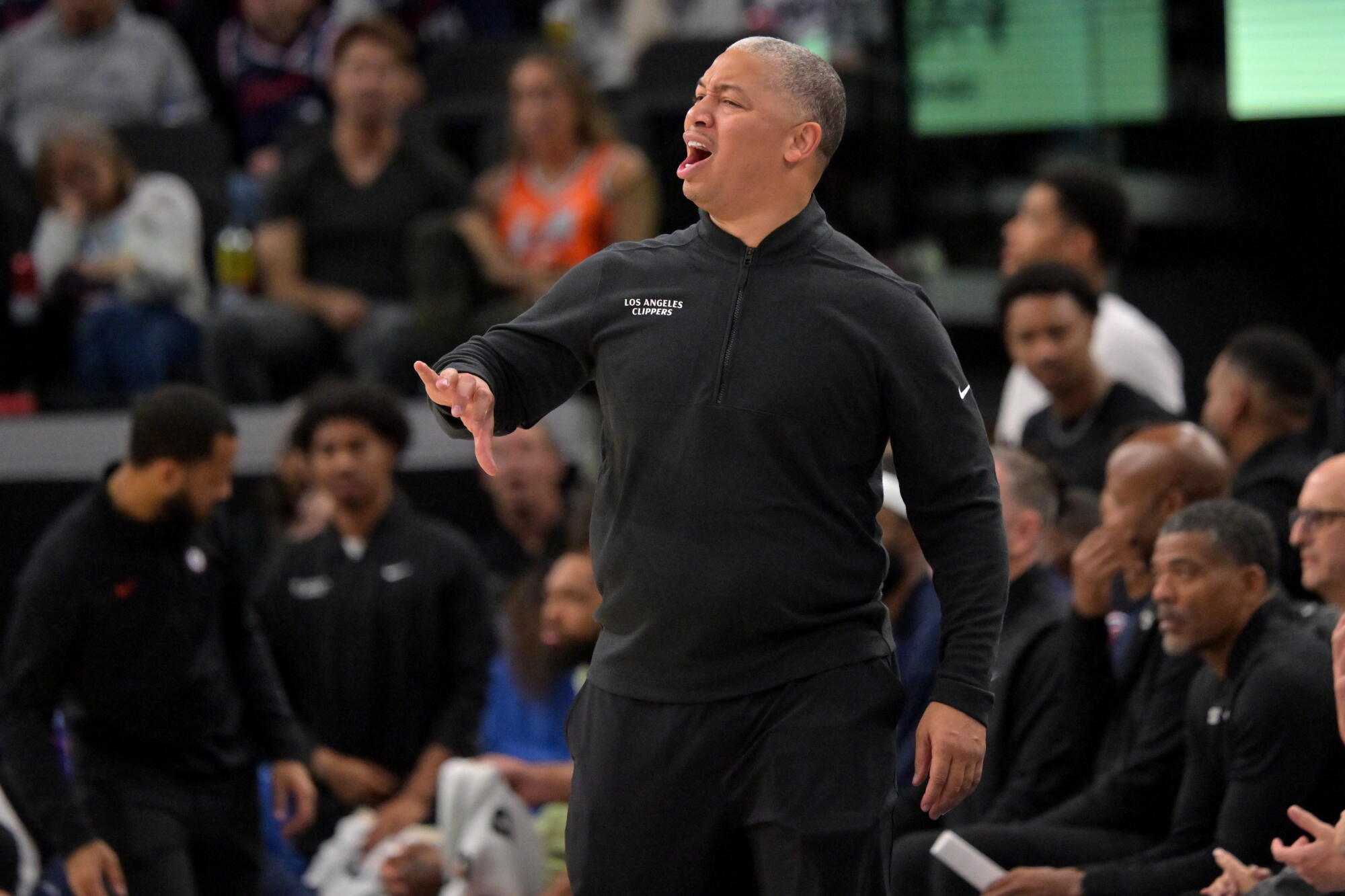
Not with superstars or championship aspirations. But with the promise of free parking, a jersey trade-in and a basketball team that is, at least, better than the Sacramento Kings, who they beat 121-96 in both teams’ season opener. Coach Tyronn Lue dedicated the win to suspended team owner Steve Ballmer: “Just want to say thank you for everything. We’re still fighting for him.”
Clippers coach Tyronn Lue directs his players during a win over the Sacramento Kings Wednesday at Intuit Dome.
(Jayne Kamin-Oncea / Associated Press)
Wednesday’s fan appreciation stuff was a swell gesture, as a start. But it wasn’t nearly far-reaching enough.
Not for embattled Clippers supporters who have stuck with the team through thick and thin, sickness and health, in spite of Donald Sterling, the former cheap, racist owner and now Ballmer, the wealthy, over-invested one whose salary cap circumvention cost his team its first-round picks in the 2029, 2030, 2031, 2032, and 2033 NBA drafts.
To fans, that was the most consequential part of the historic punishment dealt by the NBA, which commissioned a year-long investigation that determined the Clippers committed audacious levels of salary cap circumvention.
The league also fined the team $30 million, suspended team owner Ballmer and president of business operations Gillian Zucker for a year and president of basketball operations Lawrence Frank for six months.
And Leonard? He got a $700,000 slap on the wrist and got traded back to Toronto, where he signed a two-year, $115 million contract extension and on Wednesday, had Raptors coach Darko Rajaković saying he was “super excited for the chance to bring a Hall of Famer back home.”
“That’s one of the most insulting parts of it all, the way [Leonard] was able to walk away scot-free and the fans are left sort of holding the bag,” said Torrance’s Justin Ratterree, while he tried to dodge raindrops as he waited in line, four hours before tipoff, to trade in his No. 2 Leonard jersey.
Young Clippers fans watch the team play the the Sacramento Kings Wednesday at the Intuit Dome.
(Jayne Kamin-Oncea / Associated Press)
“It’s rough right now. Defending the team this past couple months has been really rough … and I’ve kind of just given up defending. How can you defend it?”
Even Ballmer stopped doing that, releasing a statement on Sept. 13 that read, in part: “This has been a very difficult time for everybody associated with the Clippers, and for that, I have sincere regrets.
“I want to apologize to our fans, employees, and my fellow NBA team owners for the distraction and distress this matter has caused, for which I accept responsibility as principal owner.
“We are,” he added, “committing to put this chapter behind us.”
Yes, let them try to scrub the memory of Leonard, the intensely skilled and private player who demanded so much of the Clippers when he signed with them as a free agent in 2019. Who made no efforts to popularize the team, missed almost as much time as he worked, and who failed to lead the Clippers to their first championship or anywhere close to it in his seven seasons.
After his trade to Toronto went through on Sept. 23, the Clippers resisted posting the “Thank You, Kawhi” graphic that pro sports teams do when they part ways with a player.
Let them also forget to play a tribute video when Leonard’s Raptors visit Intuit Dome for the only time this season on Nov. 2.
And let the Clippers expand the jersey swap beyond the first 4,000 paying customers at Game 1; there was no official figure available Wednesday night for exactly how many jerseys were traded and how many of them belonged to he-who-must-not-be-named.
The Clippers should keep it going, offer the option all season. Set it up at the Intuit Dome’s Lost and Found — invite fans to exchange the No. 2 jersey of the player whom they lost all respect for a guy they’ve found themselves newly enamored with, likely rookie Keaton Wagler if Wednesday’s exchange was any indication.
Clippers fans also deserve more than having their parking picked up until an hour before gametime, on one rainy workday, on late notice.
They should have their parking at games covered all season — or at least substantially reduced from the typical $70 price that’s already too steep. (The Dodgers didn’t start charging $65 until the National League Division Series!)
They should do more if they want to continue to draw a crowd to watch a team whose best player is now Darius Garland, whose future is compromised, whose current best-cast scenario — the play-in! — only Clippers fans could love.
Clippers forward Rui Hachimura drives past Kings guard De’andre Hunter and center Domantas Sabonis Wednesday at the Intuit Dome.
(Jayne Kamin-Oncea / Associated Press)
Several fans Wednesday also said they would appreciate improved transparency, including in terms of player injury and availability news.
It’s the least the team can do for these patient people, who will have the type of team that they usually fall hard for, actually — a group of gamers, devoid of divas, punching above their weight.
“All this stuff that’s going on,” Lue said, “you can’t take that out on our players … that’s not their fault, you know?”
It’s not fans’ fault, either. Let’s see the Clippers go above and beyond for them.
Far-right President Abelardo de la Espriella says he will wage a ‘counterrevolution’ against cultural institutions.
Published On 22 Oct 202622 Oct 2026
Colombian President Abelardo de la Espriella has announced he is spearheading a cultural “counterrevolution” that includes removing dozens of exhibits from the National Museum, drawing protests and comparisons to United States President Donald Trump.
De la Espriella, a conservative Trump ally, said last week that he wants to prevent cultural institutions from being taken over by what he calls “atheist social communism”.
Recommended Stories
list of 3 itemsend of list
Since then, exhibits have been taken down that once addressed the history of social movements, including feminist and LGBTQ+ activism, and Colombia’s political violence.
The changes have sparked protests by civil rights groups, artists and students who have accused the government of censorship and warn that important parts of the country’s history could be erased.
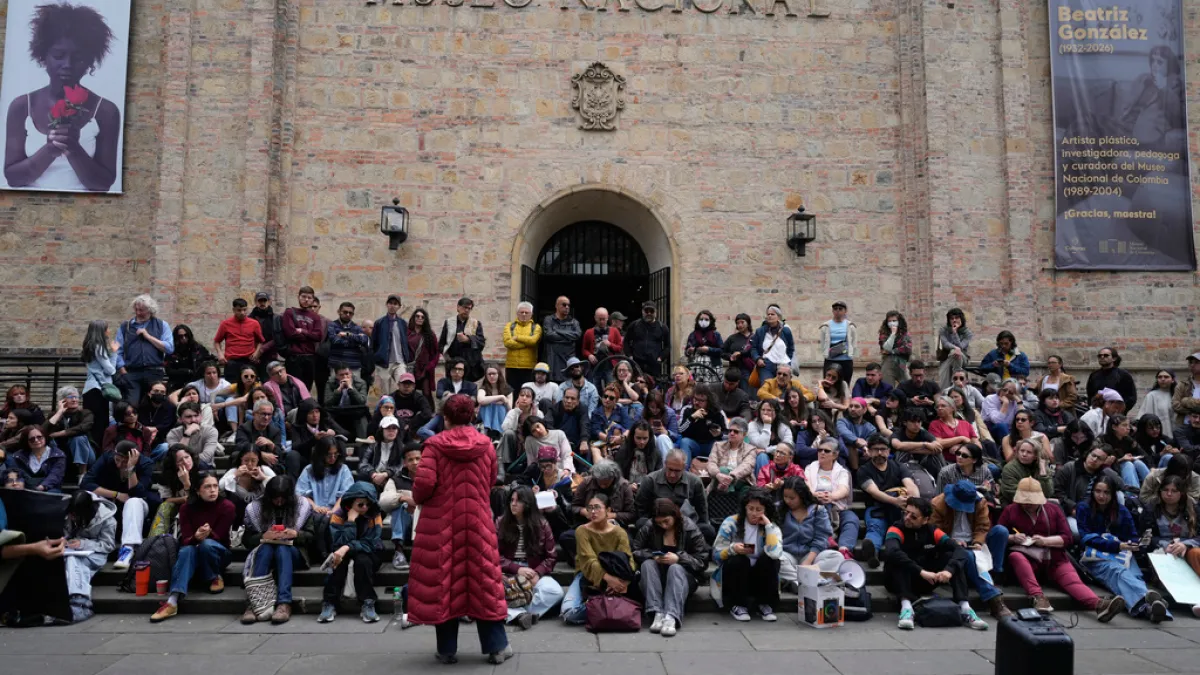
Dozens of demonstrators gathered on Wednesday outside the National Museum in downtown Bogota as riot police guarded its entrance.
“I find it outrageous that they want to erase part of our history,” said Azul Riascos, a history student.
He said the government was promoting a vision of Colombia as exclusively white, Catholic and Spanish-speaking. That image, he explained, excluded Black, Indigenous and LGBTQ+ communities.
Gimena Sanchez-Garzoli, director for the Andes at the Washington Office on Latin America, a research and advocacy organisation, said the Colombian government’s approach reflects a broader trend among Trump allies who are copying US political narratives and strategies.
Trump has been fiercely critical of museums in Washington, particularly those tied to the Smithsonian Institution.
The White House released a report in July branding leaders of the Smithsonian’s National Museum of American History as radical activists and has ordered signs to be installed outside the museum telling visitors that some of the exhibits are inaccurate.
Nearly three months after that order, such signs haven’t been installed. The museum’s director, Anthea Hartig, told Congress that the White House report “does not fairly or accurately characterise the full body of work at the museum”.
Sanchez-Garzoli said Trump’s cooperation with allied Latin American governments on security and counternarcotics efforts also has an ideological dimension.
“These are imported narratives about terrorism and about being ‘woke,’” anthropologist Arturo Sanabria said during Wednesday’s protest, describing the Colombian government’s approach as a form of neocolonial intervention.
Colombia’s Culture Minister Paola Holguin said the government was reviewing and redesigning exhibitions and curatorial practices at other museums overseen by her ministry.
The Foreign Ministry also renamed a courtyard previously honouring an Indigenous leader, describing the change as part of the president’s campaign against “woke” ideology.
“The government is making serious efforts in a cultural battle that probably doesn’t exist,” political scientist Estefania Cardozo said outside the museum. “It is inventing one to erase identities that cannot be erased because they already exist.”
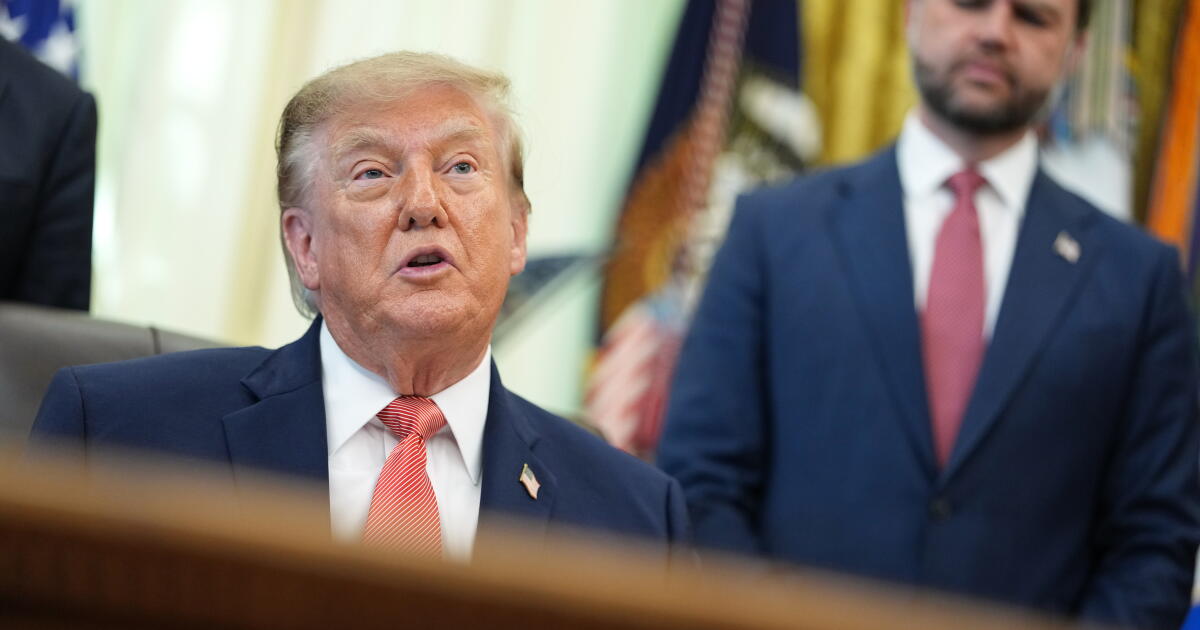
WASHINGTON — President Clinton famously said he could feel voters’ pain over the economy. But these days, when it comes to questions about high prices, President Trump insists that the pain is his.
“They hit me with affordability, and that’s the first time I ever heard the word used,” he complained in Nebraska earlier this month.
The White House leaves Vice President JD Vance to use a softer touch. Last month in Texas, he admitted “there are people out there who are frustrated by the pace of progress.” And during a CBS News town hall on Saturday, Vance said, “I recognize that gas prices are too high right now” and “we’re working on it.”
Depending on which Republican is speaking, Americans are getting a different perspective on how bad things are with the economy. Trump says “the golden age of America is upon us.” Vance walks a tightrope to show that he knows voters are feeling an economic pinch while still selling them on Trump’s agenda.
The disconnect comes as Americans’ confidence in the economy sank to the lowest level in more than a decade this month, the average long-term U.S. mortgage rate jumped this month to its highest level in nearly three years and the unemployment rate ticked up last month.
Recent economic data released this month shows that high gasoline prices are intensifying inflation and more expensive oil and gas have begun to push prices up in other parts of the economy.
While most of Trump’s supporters don’t hold him at fault, some acknowledge that the president’s penchant for salesmanship may not hit the mark.
“I think he talks it up,” said Conda Little, a 76-year-old retiree who went to see Trump in Dalton, Ga., on Friday. “I think Vance is more real.”
Little takes the president at his word that he will achieve a victory over Iran in a way that benefits U.S. consumers back home. But she said it’s impossible to deny the fallout from the conflict.
“Everybody’s real upset about the gas” and “groceries are out of sight,” she said. “It’s hard. It’s really hard,” she said, adding that, “I think that people need to hear the truth.”
‘We need to do more’
Trump is loath to acknowledge concerns. He told reporters earlier this month that he gives himself “an A+ on the government, on economics, on everything.” He has dismissed concerns about high costs, arguing that concerns about affordability are a “hoax.”
“We’re in the golden age of America. So our nation is doing better now than ever before,” he told a crowd in Kentucky on Saturday while campaigning for Republican candidates.
Trump has occasionally acknowledged that gas prices are high, but has called it “a small price to pay” for keeping the country and the world safe with the Iran war.
Trump’s discordant message with one of the top concerns voters are voicing ahead of the midterm elections has seemed heightened by his fixation on beautifying Washington and building a large ballroom at the White House.
During a visit this month to an economically struggling corner of Arizona, he regaled the crowd with the story about how he ended up with a luxury jet gifted by Qatar to use as Air Force One.
Vance, as he crisscrosses the country, is quick to say that the administration has more work to do.
To cast blame, the vice president often says that his administration’s Democratic predecessors put the country in such a deep hole that they need more time to climb out.
To show empathy, he often references his own experience growing up in a working-class family in a Rust Belt town. That’s far different from Trump, who comes from a wealthy family, is a billionaire and even joked during his speeches on Friday and Saturday that if people have lunch at his Mar-a-Lago club, “for $5,000, you’ll get one hamburger and a small dessert.”
Vance, during a CBS News town hall that aired on Saturday, said: “I grew up in a working-class family. When gas prices were high, I know that it made my grandmother suffer, and I’m sure that you’re struggling with it in a variety of ways.”
When asked by the moderator about the mixed message he and Trump are giving on the economy, Vance said Trump was speaking about new investments coming into the country, but said the changes take time.
“We need to do more, and we can certainly do better,” he acknowledged.
Many Trump supporters trust his pitch
Some voters said Trump’s rosy view on the economy turns them away, like Santiago Rodriguez, a 19-year-old Texas college student who will be voting for the first time this year.
Rodriguez, who attended a campaign rally last week for Democratic Senate candidate James Talarico, said he would consider voting for a Republican but not while Trump is in charge because he doesn’t grasp the high cost of living for Americans.
“I think he’s out of touch, I think he’s never seen what a true day as a Texan or anybody in general who is in the working class,” Rodriguez said.
Trump’s most loyal supporters aren’t interested in blaming high prices on anything the president has done.
Cindy Massengill, a 67-year-old who came to see Trump in Dalton, Ga., said she felt he’s doing the best he can.
“I’m positive that he’s got done more than any other president after the mess we were left with Obama and Biden,” she said.
Mary Bunker, a 67-year-old Republican who attended Trump’s Monday rally near Wichita, Kan., said she works multiple jobs, including as a waitress and DoorDash driver.
She feels the pressure of high gas prices, but she likes the tax breaks that Trump signed into law last year and she doesn’t fault the way he speaks about economic concerns.
“I think he’s a very good businessman,” Bunker said. “He’s been in business a long time, so I think he knows what he’s talking about.”
Price writes for the Associated Press. AP writers Bill Barrow in Dalton, Ga., Jesse Bedayn in San Marcos, Texas, and Nicholas Ingram in Park City, Kan., contributed to this report.
LEWISTON, Maine — Maine Republican Susan Collins has promoted her reputation as one of the most independent U.S. senators and she is using the waning days of the election season to sell that message to voters by campaigning with a former colleague who has endorsed her.
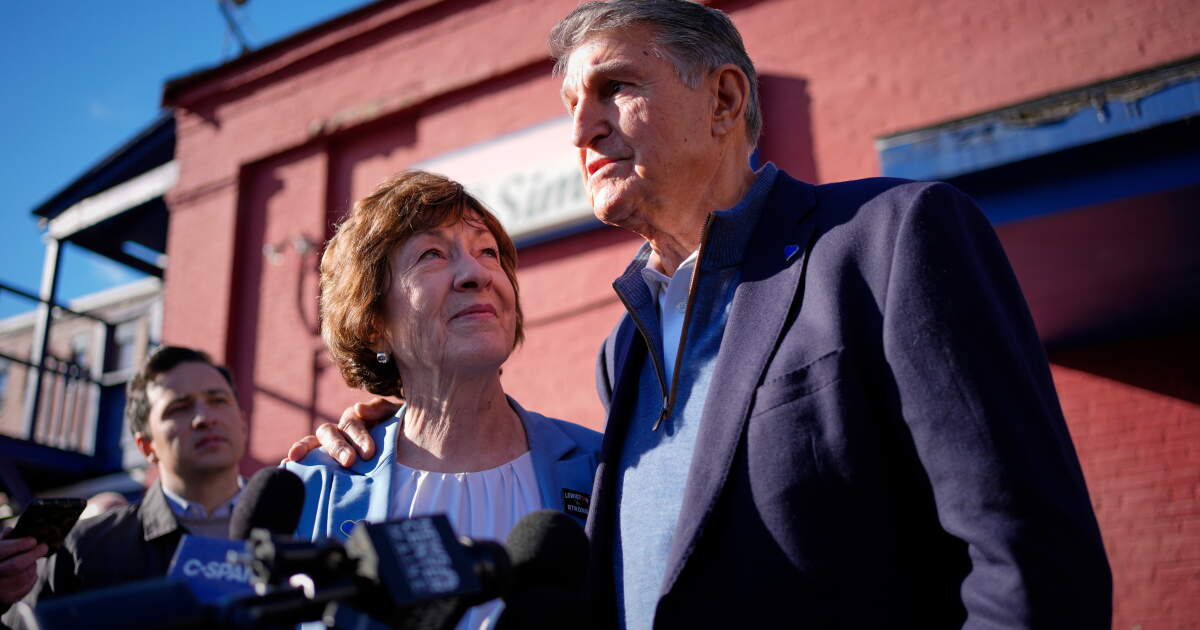
Collins is trying to fend off a challenge from Democrat Troy Jackson, a onetime state Senate president, and on Wednesday she made appearances with Joe Manchin III, a West Virginian who was a Democrat then became an independent late in his career before retiring.
After stopping for breakfast at Simones’ Hot Dog Stand in Lewiston, Collins spoke of how she and Manchin were “part of every piece of bipartisan legislation that passed and became law” during their time together in office.
Manchin said to lose Collins would be “to lose the soul of the Senate.” He praised her independent streak, her willingness to buck Republican President Trump and her record of fighting for Maine’s interests.
“This is a true blue-blooded Maine person who knows exactly where she came from,” Manchin said.
They planned a stop later at a New Balance shoe facility in Norway. Jackson, 58, is scheduled to campaign Thursday in Portland with Alexandria Ocasio-Cortez, the progressive congresswoman from New York.
Collins, 73, is in what may be her toughest reelection fight as she seeks her sixth term.
It’s only the second time that she has sought reelection in a midterm with a sitting Republican president, and the national trends are much less favorable to the GOP than they were the last time she did so, in 2002. Trump’s approval has fallen well below where it was when he took office last year, and a recent poll from the Associated Press-NORC Center for Public Affairs Research found that a strong majority of voters want change in Washington.
Collins has been working to persuade voters that she is independent of Trump and willing to break with him. In Manchin, she enlisted a politician who was one of the most moderate voices in the Senate. Manchin said in 2023 that Trump would “ destroy democracy in America” if he was elected to a second term.
Among the few dozen Collins supporters at the Lewiston event was Mike Marcotte.
“I may not have always been a fan of her complete package of votes, but when I look at the vitriol that’s in the U.S. Senate right now, we need more people like Susan Collins,” he said.
Jackson got a late start on campaigning after the party’s initial nominee exited the race but trails Collins in the money race by less than $3 million after an aggressive quarter in which he raised more than $20 million. Jackson has campaigned relentlessly and his events have drawn hundreds. Collins has largely stuck to smaller appearances.
Some of Jackson’s backers demonstrated across the street from the hot dog stand. A few held signs bearing the face of Brett M. Kavanaugh, the U.S. Supreme Court justice whom Collins voted to confirm and whose vote eventually helped overturn the constitutional right to abortion.
“Someone needs to stand up and be a check on Donald Trump and his harmful policies,” said David Sysko.
Collins has broken with Trump and Republicans over the years. She voted to convict him at his impeachment trial in 2021. Increasingly during the campaign, she has worked to distance herself from the president as Democrats argue that she is too close to him.
Collins said in early October that she is “not exactly his favorite senator,” and that she did not expect Trump to campaign in Maine. He has steered clear of the state with the Nov. 3 election nearing.
Pinning Collins to Trump is central to the Democrats’ strategy. In one ad, a nurse says the state is in a healthcare crisis “because of Susan Collins and Donald Trump,” citing Collins’ vote for Trump’s push for Medicaid cuts. Collins did vote to advance the bill but ultimately voted against it.
Trump also was a major focus of four contentious debates between the candidates this month, where Collins sought to distance herself from the president and Jackson repeatedly accused her of doing Trump’s bidding.
Asked at the final debate to name a time in which she bucked her own party and succeeded, Collins gave the example of rallying support against Trump’s nomination of Pete Hegseth, who was confirmed as Defense secretary.
Democrats seized on the moment and released a statement that said the exchange “underscores a central question in the Maine Senate race: Does Collins, a Republican in a state that disapproves of President Donald Trump and has grown bluer in recent years, stand up to her party enough to earn the independent streak she has staked her career on?”
Jackson has characterized Collins as out of touch with the struggles of working-class people in Maine. He has described Collins as a “rubber stamp” for the president and criticized her votes on Kavanaugh and Robert F. Kennedy Jr., Trump’s second-term Health secretary. Collins has said she does not regret either vote.
Republican ads against Jackson, a logger from northern Maine, have focused more on accusations of his having a volatile personality and behaving like a bully with female colleagues. Jackson has denied those accusations.
Collins distanced herself on Wednesday from a Republican super PAC attack ad that she said “should be taken down.”
The senator was a top target of Democrats in 2020 when she defeated challenger Sara Gideon by nearly 9 percentage points. Collins is the only Republican senator from New England, a distinction she has had since January 2013.
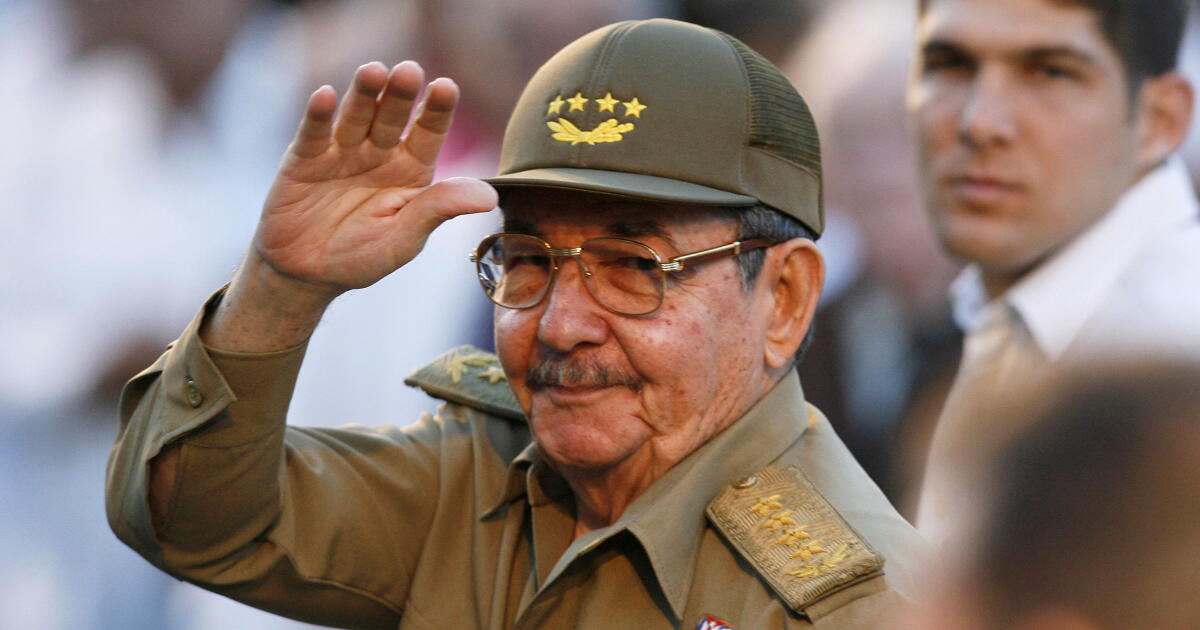
MIAMI — Former Cuban President Raúl Castro is facing more charges in Florida related to the 1996 downing of civilian planes flown by Miami-based exiles after the U.S. government indicted the former leader earlier this year.
Florida Atty. Gen. James Uthmeier on Monday accused Castro, 95, of directing spies to infiltrate the exile group Brothers to the Rescue and ordering the attack on their planes. The state charge of conspiracy to commit first-degree murder is based largely on a federal indictment announced in May that included charges of murder and destruction of an airplane.
It remains unclear whether Castro will ever step foot in a U.S. courtroom. Uthmeier said the arrest warrant will restrict Castro’s ability leave the island nation and prevent him from traveling to any place with an extradition agreement with the U.S.
“I’m not ignorant of the fact that Raúl Castro is an older man who’s probably not looking to march himself into Miami,” Uthmeier said. “I think others would get him before the court of law would, but at the end of the day, we stand ready to prosecute the case.”
According to the state complaint, Castro was the Minister of the Revolutionary Armed Forces and First Vice President of Cuba when he gave the final authorization to shoot down the planes. Cuban Directorate of Intelligence agents operating as part of the Wasp Network in the Miami area and the Florida Keys infiltrated Brothers to the Rescue and reported flight plans, investigator said.
On Feb. 24, 1996, three unarmed Cessna aircraft departed Opa-Locka Airport in Miami-Dade County. Well outside Cuba’s territorial waters, Cuban MiGs destroyed two of the civilian planes with air-to-air missiles, killing the four occupants, the complaint said. Both aircraft were traveling away from Cuba and received no warning despite contact with Havana air traffic control, U.S. officials said.
Cuban President Miguel Díaz-Canel called the federal indictment earlier this year a political stunt that sought only to “justify the folly of a military aggression against Cuba.” He accused the U.S. of lying and manipulating events surrounding the shootdown.
“Our historic federal indictment laid the groundwork, and James and his team have now taken the important step of bringing charges under Florida law,” U.S. Attorney for the Southern District of Florida Jason Reding Quiñones said at a news conference.
Castro took over as president from his ailing older brother Fidel Castro in 2006 before handing power to a trusted loyalist, Díaz-Canel, in 2018.
While he retired in 2021 as head of the Cuban Communist Party, he is widely believed to wield power behind the scenes, underscored by the prominence of his grandson, Raúl Guillermo Rodríguez Castro.
Meanwhile, President Trump has been threatening military action in Cuba ever since U.S. forces captured former Venezuelan President Nicolás Maduro, the Cuban government’s longtime patron.
After ousting the Venezuelan leader earlier this year, the White House ordered a blockade that choked off fuel shipments to Cuba, leading to severe blackouts, food shortages and an economic collapse across the island.
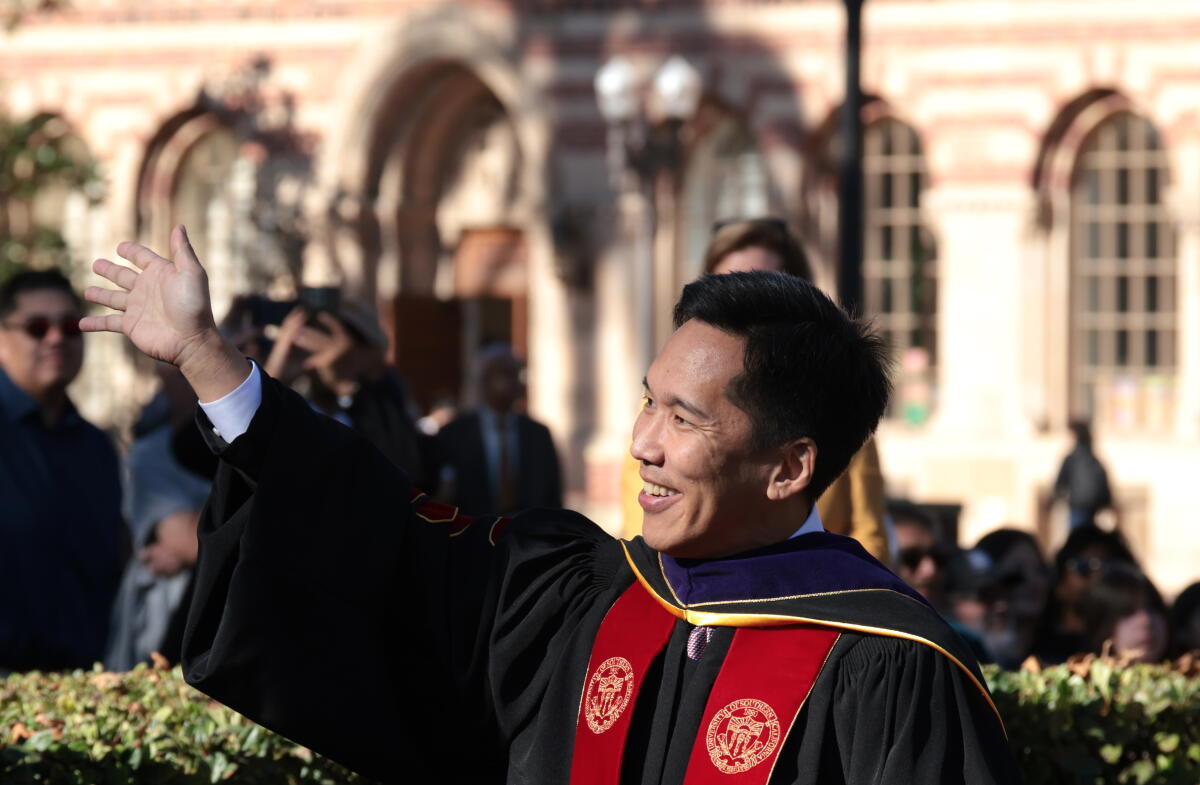
Eyo-Dae Kim and Susan Kim attended the University of Southern California decades ago, two international students with little money and no family in the U.S. On Friday, their son, Beong-Soo Kim, stood before an Alumni Park crowd and was formally installed as the 13th president of their alma mater.
“It is wonderful to have you here, Dad, facing the same library where you and Mom studied together at USC,” Kim, 53, said to his father, who took doctoral courses in economics. Kim’s late mother fled during the Korean War and earned a USC master’s degree.
“They certainly would never have imagined, as international students, that this day could possibly come,” Kim had said earlier.
In a wide-ranging interview before the event, Kim — who was appointed in February after holding an interim presidential role — said he leads USC at a time of promise and deep challenges:
The Los Angeles Memorial Coliseum, leased and operated by USC, will be a showcase site for the 2028 Olympics. A recent $200-million gift is fueling a university-wide push into artificial intelligence. USC admitted 12.6% of first-year applicants this fall for sought-after slots.
Beong-Soo Kim was formally installed as USC’s 13th president during an investiture ceremony Friday.
(Myung J. Chun / Los Angeles Times)
Yet he faces steep hurdles. The former federal prosecutor who spent five years as USC’s general counsel inherited a deficit of more than $200 million. Among his first actions, Kim approved the layoffs of more than 900 workers and ordered deep cost-saving measures. USC is still recovering from years of scandal and controversy that scarred its national reputation, including a $1.1-billion payout to settle sexual abuse allegations against a campus gynecologist, its involvement in the “Varsity Blues” admissions bribery scheme and its handling of pro-Palestinian protests.
Then there is Trojan football.
Fans chanted this month for the firing of football coach Lincoln Riley — after years of underachieving — though the Trojans have defeated Washington and Penn State after an Oregon loss.
Although fans and analysts have soured at times on Riley — whose pay exceeds $11 million and whose reported buyout is about $70 million — Kim declined to say whether USC could afford a coaching change, saying, “We’re not thinking about that.”
Share via
Amid fan chants to fire Trojan football coach Lincoln Riley, USC President Beong-Soo Kim declined to say whether USC could afford a coaching change, saying “we are laser-focused on the next game.”
“We are laser-focused on the next game, and then the game after that, and really having the best possible season that we can have in football,” he said.
After the stinging rounds of layoffs, Kim said, the university expects to “significantly exceed” the roughly $30-million surplus he forecast for USC earlier this year during his state-of-the-university speech, though final numbers are pending.
In his speech, Kim said that public trust in universities has declined and “we must regain trust by earning it.” USC is among the elite universities targeted last year by the Trump administration over alleged campus antisemitism, though it has not faced major federal funding freezes or lawsuits as the UC system has.
On Friday, deans and faculty in academic regalia processed into Alumni Park, where the Trojan Marching Band accompanied the national anthem as temperatures climbed toward the 90s during the nearly two-hour ceremony.
USC religious life dean Varun Soni opened an invocation by describing the cello’s sound post — a small wooden piece called its “soul” in Italian and French — and comparing it to the soul of a university. Kim, a cellist, later joined USC Thornton School of Music students to play “Prelude,” the first movement of Grieg’s “Holberg Suite,” Op. 40, as Kaufman School of Dance students performed.
Morton Schapiro, Northwestern’s president emeritus and a former USC dean, represented visiting academic delegates and praised Kim’s “creativity, character and commitment to community” before Suzanne Nora Johnson, chair of the Board of Trustees, formally installed Kim. Jewish, Christian, Muslim, Hindu, Buddhist and humanist blessings closed the ceremony. In the afternoon, a “Trojan Family celebration” in McCarthy Quad was scheduled to feature food stalls and performances by singer-songwriters Aloe Blacc, a USC alumnus, and Allen Stone.
Money, medicine and priorities
When he took over as interim president in 2025, upon the departure of Carol Folt, Kim immediately confronted the university’s financial crisis. The campus had long spent more than it brought in, an imbalance driven by rising athletics costs, pandemic expenses and major legal settlements. A weak year for USC’s health system deepened the shortfall. Kim maintained a hiring pause, stopped merit raises and took “a hard look at a lot of our administrative expenses and our operations,” he told The Times.
Keck Medicine of USC took a significant hit in the layoffs after running a deficit in the tens of millions in recent years. Last month, dozens of layoffs took place at the Viterbi School of Engineering.
Kim said Keck’s performance “has been good, but it can get better.” The health system is “making very positive progress” to cut expenses while focusing on “patient care, patient quality.”
Across campus, he credited staff and faculty with “stepping up, asking how can we do more with less.”
USC is also challenging a faculty union before the National Labor Relations Board. Non-tenure-track faculty voted in June to join United Faculty-UAW, with about 70% in favor. USC has asked the labor board to review the decision that allowed the vote, arguing the union is too broad. Faculty leafleted Friday during Kim’s event.
Kim said he wants USC to build strong partnerships with Los Angeles industries, including entertainment, biotechnology, sports and “the new space economy.”
He cautioned in his speech that “great universities do not become greater by trying to do everything.”
During the interview, he did not say which university programs need to shrink but said such decisions will come through a strategic plan that will “engage the whole community.”
“One of the things that I frankly pride myself on as a university president is that I readily admit that I don’t have all the answers, and certainly not the best answers,” he said.
Beong-Soo Kim speaks at USC’s commencement in May.
(Jason Armond / Los Angeles Times)
Admissions
A pressing debate — particularly within the University of California system — is whether standardized tests should be required for admissions. Many of the nation’s most elite institutions have recently turned away from test-blind or test-optional admission policies. UC, which does not consider SAT scores in admissions, is reviewing whether to resume SAT and ACT requirements.
Kim said USC, which is test-optional, is studying the issue too. USC considers SAT and ACT scores if applicants submit them but does not require them.
Share via
As the University of California evaluates whether to reintroduce SAT and standardized testing requirements for admission, USC President Beong-Soo Kim said USC is also looking at the question. He said USC, which is test-optional, has not made a final decision.
“It’s absolutely something that has been under discussion, particularly with respect to STEM students,” he said, referring to science, technology, engineering and math majors. He cautioned that no final decision has been made and that the new provost, David Madigan, will be looking at the issue.
Kim said UC’s test-blind policy is “one of the contextual factors that we have to consider.” Many California students who plan to apply to UC skip the tests, and many of them also apply to USC, he said.
USC said last year it would keep weighing applicants’ family ties to the university despite a state ban on legacy and donor preferences. In 2024, while the ban was pending, USC said it would “comply with state law” if it were signed. Schools that keep the preferences are listed publicly as out of compliance and must report more admissions data to the state.
Kim said USC chose to keep “considering whether someone is a member of the Trojan family” as one of many factors. He said he is “actually quite proud” that USC maintained its “holistic admissions practices” in a way that “provides more transparency about our admissions.”
Image and trust
Legacy preferences have fed a stereotype of USC as a college for the wealthy and well connected. Kim disputed that image.
He pointed to USC’s transfer students, Pell Grant recipients and first-generation students. USC opens its doors to “so many people in California, throughout the country, and throughout the world,” he said.
Still, Kim acknowledged that trust in education has fallen, though he said that trust in American institutions “across the board has been declining.”
Share via
USC violates state law by considering legacy and donor ties in admissions, a practice President Beong-Soo Kim defended as part of a holistic review while touting the university’s transparency in reporting admissions data to the state.
“Some might have to do with events from several years ago,” he said.
He did not say which events, though USC has had its share. As general counsel, Kim helped steer it through the aftermath of the national Varsity Blues admissions bribery scandal and the sex abuse payout to former patients of campus gynecologist George Tyndall, the largest in higher education history.
His answer to falling trust has been the Open Dialogue Project, which he launched in October 2025 to bring clashing views to campus. Guests have included National Institutes of Health Director Jay Bhattacharya, former ACLU President Nadine Strossen and legal scholar Jonathan Turley.
In September, the Foundation for Individual Rights and Expression gave USC its top “green light” rating for several speech policies. After the group recalculated its college free speech rankings, USC rose from 198th to 37th out of 261 schools.
White House pressure
Last fall, the Trump administration invited USC and eight other universities to sign a higher education compact offering favorable access to federal research grants. Signers would cap international undergraduates at 15%, require the SAT or ACT and freeze tuition for five years.
USC rejected the compact last October — about two weeks after the administration offered it.
Some faculty viewed USC’s initial reluctance to reject the overture as a sign it was unwilling to openly challenge Trump’s education demands. They also point to USC’s closure of its university-wide Office of Inclusion and Diversity last year amid a federal anti-DEI push and its removal of pages for cultural heritage months from its “Culture Journey” website earlier this year.
Kim disagreed that USC bends quickly to the White House.
“It would have been highly presumptuous for me just to make a rash decision about what we were going to do without listening,” he said of the compact.
International students have also faced pressures, as the government restricts some visa programs and significantly increases costs for others.
About 26% of USC students are international, with 15% of the undergraduate population coming from other nations. Kim said international students “have been part of USC for decades” and called their presence “a win-win.”
AI risks
USC is also leaning into artificial intelligence, with a $200-million gift from Nvidia board member Mark Stevens and his wife, Mary Stevens, meant to infuse AI across the campus and recruit AI researchers.
But leaders of OpenAI and Anthropic have warned that the technology’s fast development poses serious risks to jobs and human existence.
“We have to take those warnings very seriously,” Kim said. Universities, he said, can help clarify what it means for AI to be “aligned” and “safe.”
Kim said USC wants to make sure its students “are leading in terms of how to use it ethically, how to use it morally.”
The future
On July 14, 2028, the Coliseum — USC’s campus-adjacent home stadium — will share the Olympics’ opening ceremony with SoFi Stadium in Inglewood.
Kim said he hopes Olympic visitors will see “a university that has an incredible Olympic tradition,” but also one whose reach goes well beyond sports.
The Games will also bring alumni and students “from across the globe,” he said. “I think that’s going to make for a very magical moment.”
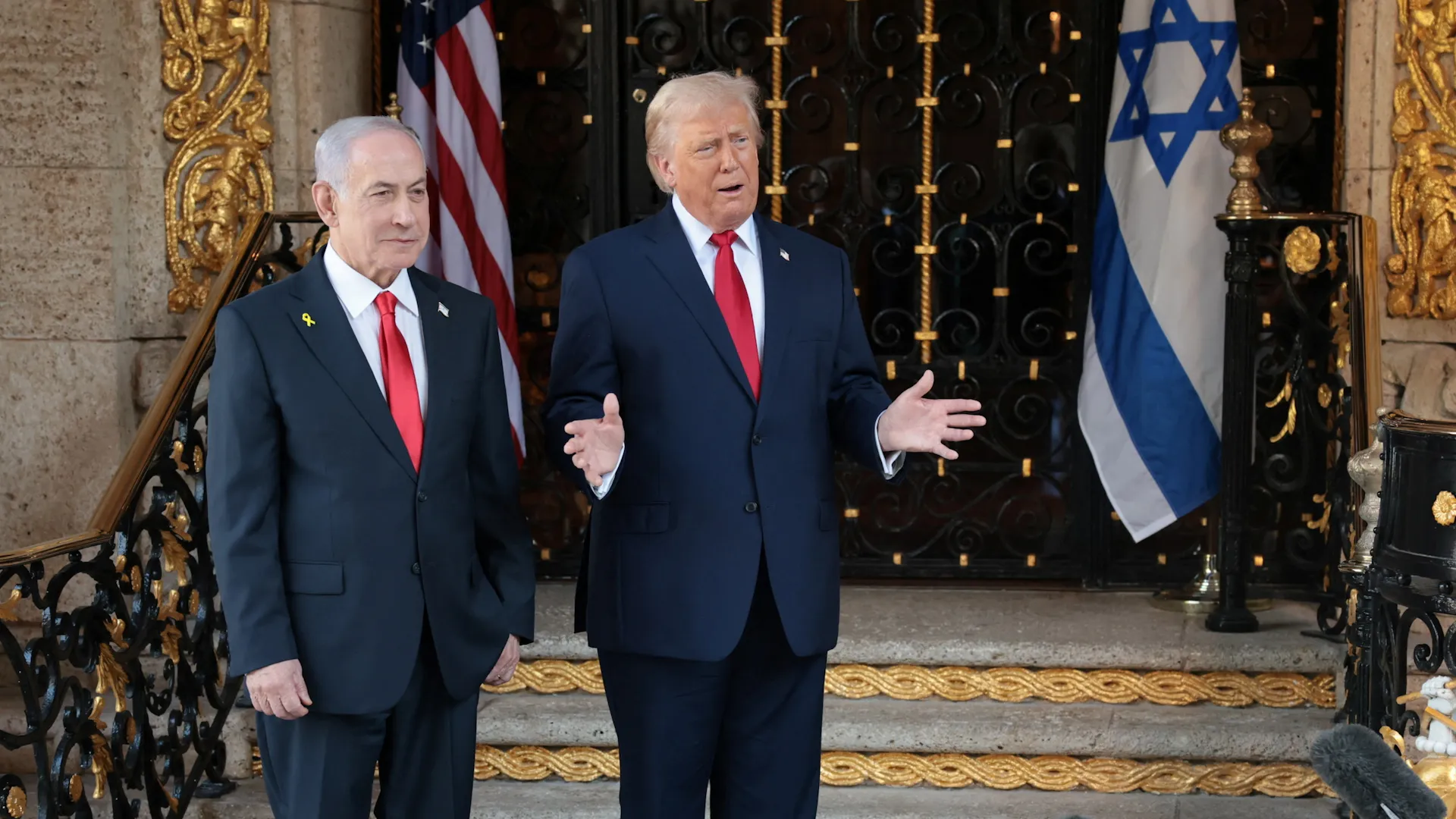
US President Donald Trump has issued an official endorsement of Israel’s Prime Minister Benjamin Netanyahu for the upcoming Israeli election. Al Jazeera’s Patty Culhane reports from Washington DC.
BANGOR, Maine — Ever the optimist, Speaker Mike Johnson said he believes Republicans will hold on to their U.S. House majority, defying a surge of Democratic momentum in the final stretch of the midterm elections that will determine control of Congress.
It’s the crowds he says he’s seeing as he crosses the country campaigning for GOP candidates. The caliber of recruits and incumbents he calls workhorses, not show horses. And the nearly half a billion he has raised for House Republicans.
He also has faith.
“We run to win, and that’s biblical: You run to win,” he told the Associated Press during a campaign stop in Maine.
“And I believe that we will.”
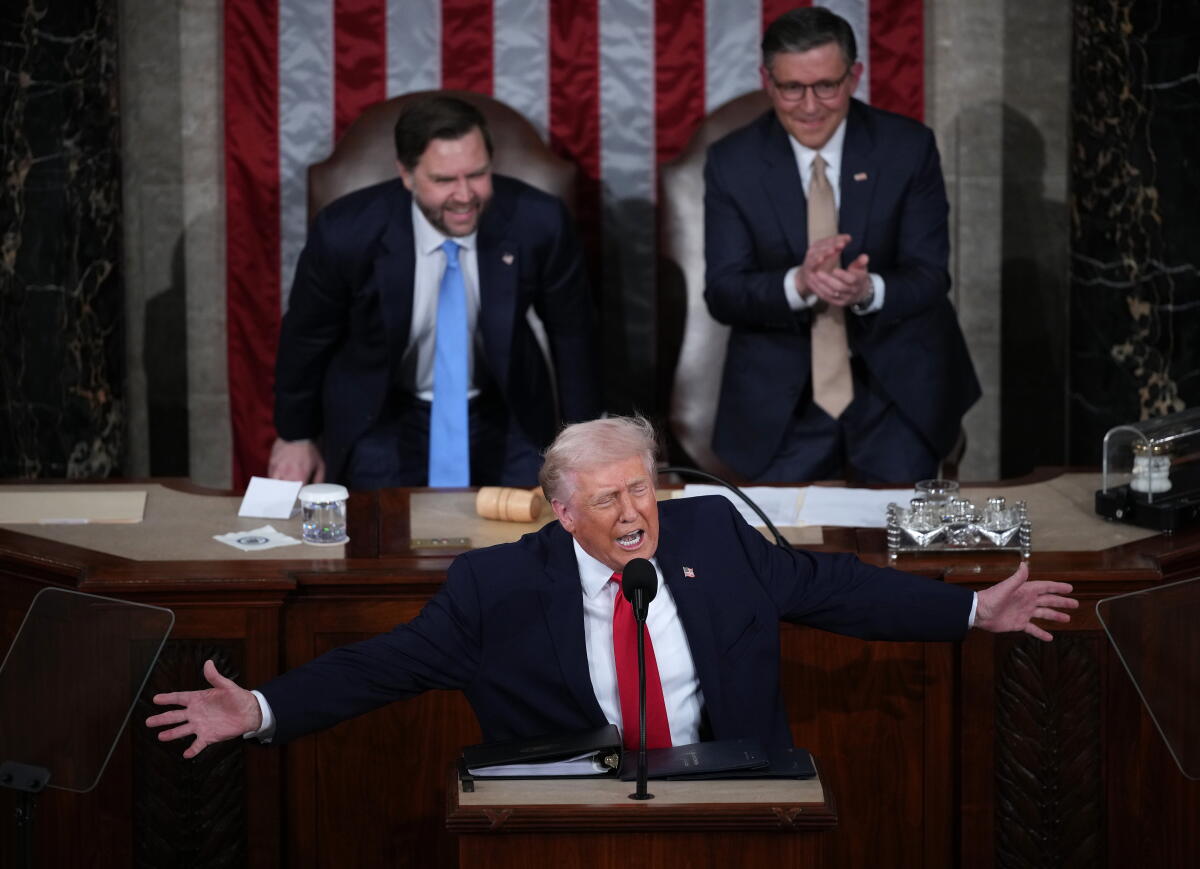
House Speaker Mike Johnson, right, applauds along with President JD Vance as President Trump delivers his State of the Union address during a joint session of Congress in February in Washington.
(Andrew Harnik / Getty Images)
The speaker of the House is one of the most consequential elected officials in the United States, second in line of succession to the president. While Johnson quipped to Fox News recently that he may return to his hometown of Shreveport, La., to start a lawn care business if Republicans lose power on Nov. 3, he fully expects to buck an American midterm tradition that often sees the president’s party dumped in Congress.
It can be said that Johnson, who has drawn so close to President Trump that he routinely fields 1 a.m. calls — they spoke the night before as Trump rallied in Alaska — walks on the sunny side of the street. That’s despite voter frustration over high prices and the Iran war, and his own challenge of leading one of narrowest House majorities in modern times.
In his three years as speaker, Johnson has pushed past the doubters and naysayers, holding his thread-thin GOP majority together to deliver Trump’s agenda. He notably led passage of the big tax breaks and social service cuts bill. Most days he does not have a single vote to spare.
“So many times everybody had written off, there was no way he was going to be able to pull off a particular vote,” said Republican Rep. Mark Harris of North Carolina, who joined the speaker on the campaign swing. “Yet he always seems to pull out the win in the end.”
In the interview, Johnson did not speak brashly about expanding the House majority on election day, as he has in the past. But on track to visit more than 20 states and 40 congressional districts though November, he said the political mood reminds him of the 2024 election that swept Republicans to control of Congress and the White House.
“It’s not going to be a giant majority,” he said. “But I genuinely believe that we will have a working majority.”
Emboldened by Trump
Johnson first fell into the speaker’s job almost by accident, a desperate choice by his GOP colleagues after a contingent of renegade Republicans ousted his predecessor, then-Rep. Kevin McCarthy of California in 2023.
Johnson had been a lower-level member of House leadership, but distinguished himself before the Jan. 6, 2021, attack on the Capitol by organizing support for Trump’s false claims of widespread fraud in the election that he lost to Democrat Joe Biden.
In the time since, Johnson has secured proximity to Trump’s power. He joined Trump at a UFC fight in New York and once gifted the president a speaker’s gavel as Trump signed the “One Big Beautiful Bill” into law. It was a symbolic act, but one that critics saw as giving away the authority of a coequal branch of government.
More recently, Johnson abruptly sent lawmakers home early rather than face a vote forced by Republican Rep. Thomas Massie of Kentucky to impeach Defense Secretary Pete Hegseth as lawmakers tried to halt the Iran war, which has not been authorized by Congress.
Over coffee in Bangor, after rallying for House candidate Paul LePage, a former governor, Johnson brushed back criticism that Congress has eroded under his watch as Trump works to amass executive power.
“Absolute nonsense,” Johnson said.
“We did not yield Article 1 authority to the president,” he said, referring to the powers spelled out in the Constitution. “We used our own,” he said, to muscle GOP priorities past Democratic opposition.
Trump agenda at risk
Johnson has focused the election on Democrats he portrays as “communists.” A handful of far-left liberals, backed by the Democratic Socialists of America, are on the ballot.
Rep. Hakeem Jeffries of New York, the House Democratic leader who is in line for the speaker’s gavel if his party sweeps to power, is preparing a first-100 days agenda for when the new Congress convenes in January, if there is a change in control.
What the Republicans will do if they retain power is less defined.
“Lots of plans,” Johnson said, “along the same course of what we’ve been doing — less taxes, less regulation.”
Trump “wants to go big for his legacy,” he said. “We have big things on the horizon that we can do.”
The president has essentially purged the House GOP ranks of those perceived to be disloyal. Among them are Massie, who lost his primary, and Marjorie Taylor Greene of Georgia, who retired early after breaking with Trump over release of the Jeffrey Epstein files.
Pressed how he would keep Republicans in line, Johnson said he is preparing to change the House rules if he returns as speaker.
“There’s going to be some changes that are going to make the machinery work smoother,” he said.
Praying for the speaker, and the country
Faith has often been strong among House leaders. Two former speakers, Nancy Pelosi and Newt Gingrich are Catholics, as is John Boehner, who invited Pope Francis to address Congress.
Johnson, a former constitutional lawyer who was first elected alongside Trump in 2016, is expected to win his own reelection next month.
“My faith is a huge component of how I think and how I act and what I do,” said Johnson, who led a public prayer on the National Mall as part of the nation’s 250th anniversary.
He is drinking lots of coffee these days, he said, cutting back on the Celsius, and still has 1,413 unread text messages, a slight dip from the frightful number reported a few months ago by the Wall Street Journal.
One text is from someone praying for him.
Johnson said he is grateful for the outpouring of prayers he receives, for him and the country.
“I pray for God’s will. And I believe God’s will is for us — and not the communists — to be in charge of America,” Johnson said.
“And it does say in the New Testament, you run the race to win,” he said, citing 1 Corinthians 9:24. “This is a biblical admonition. So we will.”
Remember the FIFA Peace Prize awarded to United States President Donald Trump six months before the World Cup? Well, it is now close to being scrapped, which would make the US president its first and only winner.
Less than a year after FIFA President Gianni Infantino extolled Trump in the US capital while presenting the award at the World Cup 2026 draw, several members of the FIFA Council are questioning its merit and have demanded changes, including scrapping the award.
Recommended Stories
list of 3 itemsend of list
The calls for scrutiny come at a time when Infantino faces ongoing criticism for his World Cup sell-off plan, which also led to calls for his removal from office.
So what was the prize about, and why might it be scrapped? Here’s a look:
What is the FIFA Peace Prize?
On November 5, football’s global governing body announced a new annual award called the “FIFA Peace Prize – Football Unites the World”.
FIFA said the award was created to “reward individuals who have taken exceptional and extraordinary actions for peace”.
Trump thanked FIFA and called the award “one of the great honours of my life”.
He and Infantino are close allies, and the FIFA chief had made it clear that he thought Trump should have won the Nobel Peace Prize for his efforts to broker a ceasefire in Israel’s genocidal war on Gaza.
“This is your prize. This is your peace prize,” Infantino said at the glitzy, celebrity-studded ceremony at Washington, DC’s Kennedy Center.
Infantino has repeatedly spoken about football as a unifier for the world, but the prize is a departure from the federation’s traditional focus on sport.
Critics pointed out that the recognition came less than 24 hours after the Trump administration carried out a deadly air strike in the Caribbean.
Two months later, the US and Israel launched their war on Iran, assassinating Supreme Leader Ali Khamenei in Tehran and hitting nuclear and military sites around the country.
The US-Israel war on Iran has gone on for months with Trump saying this week that he will not attack Iran again before the November 3 midterm elections in the US.
Why might FIFA scrap the award?
Several FIFA member nations demanded the discontinuation of the award during Thursday’s FIFA Council meeting in Zurich, Switzerland, according to reports in British media.
Others called for the prize to no longer be handed out to politicians.
As a result, FIFA’s 22-member Football Social Responsibility Committee was tasked with assessing the merits of the award. It is expected to make a recommendation before the next council meeting in Doha, Qatar, on December 16.
Debbie Hewitt, a FIFA vice president and president of the English Football Association, told the media at the council briefing that the committee “will consider, first of all, how the peace prize came about, whether it should have come about, whether it should have been awarded in the way that it was, who made that decision and whether or not it should be taken out or whether it should be reformed”.
What has FIFA said?
Al Jazeera has reached out to FIFA for comment and was referred to Infantino’s statement on it: “For the FIFA Peace Prize, it was decided that the Football Social Responsibility Committee will be tasked to analyse it, provide a proposal, and also, there, a decision will be taken at the next FIFA Council meeting.”
Has the FIFA Peace Prize faced opposition?
Yes.
In October, the Norwegian Football Association (NFF) made parallel filings with FIFA committees in relation to three recent issues, one of which was related to the awarding of the FIFA Peace Prize.
“The purpose is to raise these issues formally with the appropriate bodies, to have them examined, relevant evidence obtained and accountability for the conclusions reached,” the NFF said in a statement.
The NFF has repeatedly raised questions about the award, and in April, its president, Lise Klaveness, said FIFA should scrap its peace prize to avoid getting drawn into politics.
“We want to see it abolished. We don’t think it’s part of FIFA’s mandate to give such a prize. We think we have a Nobel institute that does that job independently already,” Klaveness said.
Earlier, human rights group FairSquare filed a complaint with the FIFA Ethics Committee, accusing Infantino of breaching his duty of neutrality by supporting Trump.
Infantino has been under severe pressure since he announced a plan in July to open premium FIFA competitions, such as the World Cup, to private investors [Omar Marques/Getty Images]
‘Mockery’ of FIFA human rights policy
The criticism of the award isn’t limited to football associations.
In late April, Australia midfielder Jackson Irvine said football’s credibility as a force for good has been undermined by FIFA, and he accused FIFA of making a mockery of its human rights policy.
“As an organisation, you would have to say decisions like the one that we saw awarding this peace prize makes a mockery of what they’re trying to do with the human rights charter and trying to use football as a global driving force for good and positive change in the world,” Irvine told the Reuters news agency in an interview.
“Decisions like that feel like they just set us back in the perceived market of what football currently is, especially at the top level, where it’s becoming so disconnected from society and the grassroots of what the game actually is and means in our communities and in the world.”
Craig Mokhiber, a former United Nations official who has campaigned to suspend Israel from world football over its genocidal war in Gaza, called the award to Trump a “truly shameful development”.
Infantino has refused to take action against Israel, arguing that football “cannot solve geopolitical” issues.
“Not satisfied with two years of FIFA complicity in genocide in Palestine, Infantino and his cronies have now invented a new ‘peace prize’ in order to curry favour with Donald Trump,” Mokhiber told Al Jazeera.
He added that the award also aims to “obscure” Trump’s “disgraceful record” of support for Israel, his deadly strikes on vessels in the Caribbean Sea and “gross violations of human rights” inside the US.
Growing pressure on Infantino
The scrutiny around the FIFA Peace Prize follows the recent backlash Infantino has faced.
Infantino has been under fire since his announcement in late July that he wanted to open FIFA’s premium competitions, such as the World Cup, to private investors.
That plan was ultimately abandoned in the face of widespread criticism with a rebellion led by the European governing body UEFA, the Asian Football Confederation and CONCACAF, which runs the sport in North and Central America and the Caribbean.
Infantino has headed FIFA since 2016 and is running for re-election in March despite calls for him to stand down in the wake of the $4.2bn plan to sell a 20 per cent commercial stake in the World Cup.
In case it wasn’t already clear: Debora Cahn, the creator of “The Diplomat,” likes to leave viewers in suspense.
The Netflix political thriller has followed Kate Wyler (Keri Russell), the highly competent, intensely impulsive, deeply flawed and incredibly relatable career diplomat, as she’s cleaned up backroom deals, navigated volatile international crises and unstable government leadership — all while managing a topsy-turvy marriage tangled up in it. And the stakes escalate with each season’s finale, forcing Kate to test her limits. But the fourth season has brought her breaking point.
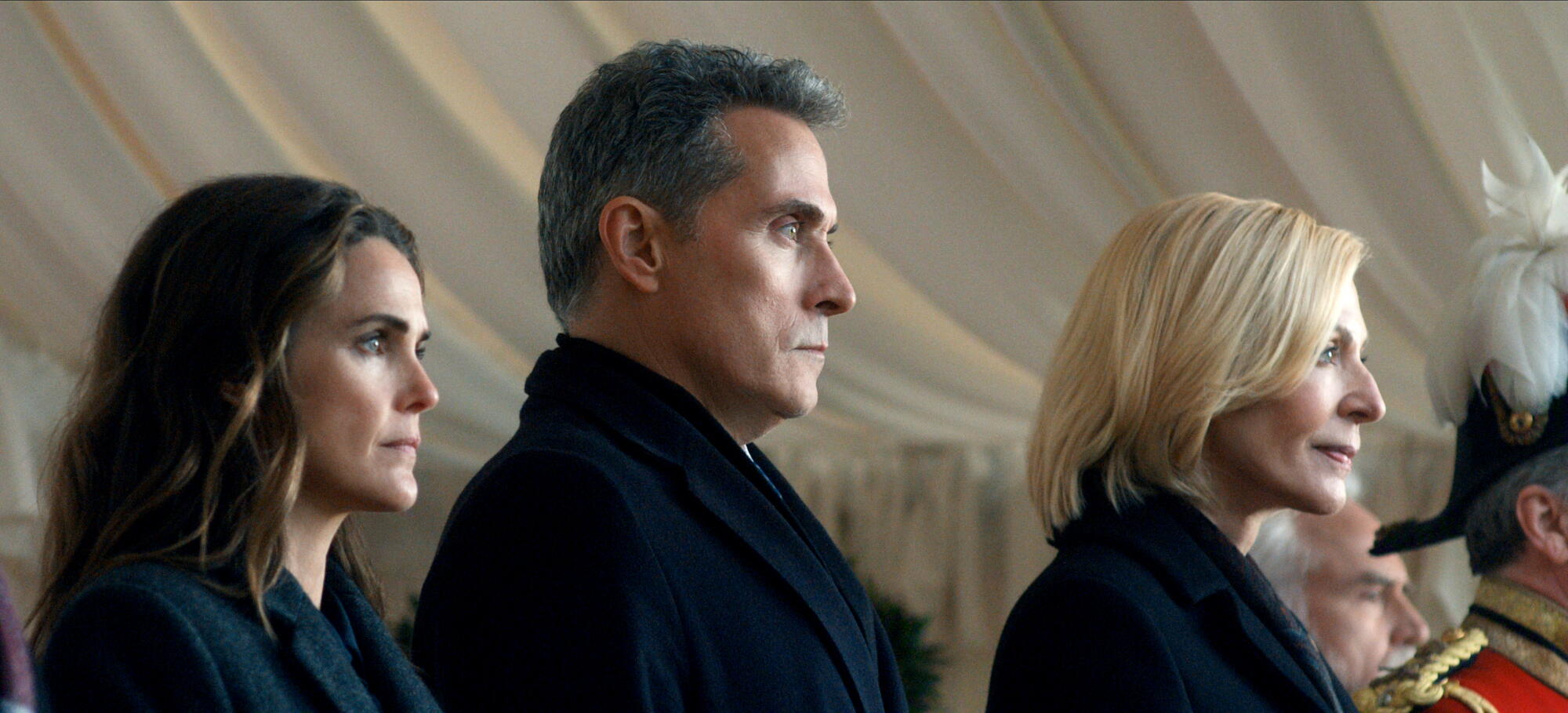
Alarmed by the questionable decision-making by President Grace Penn (Allison Janney) — as the bullying tactics used against the U.K. to ensure their cooperation against Russia become untenable — Kate resigns in unplanned, but grand fashion at the G7 summit in front of world leaders. She’s eventually joined by other members of Penn’s administration: chief of staff Billie Appiah (Nana Mensah), Secretary of State Miguel Ganon (Miguel Sandoval) and, most notably, her husband, Vice President Hal Wyler (Rufus Sewell).
“We like a good cliffhanger,” Cahn says during a recent video call.
Cahn’s thought about how “The Diplomat” will ultimately conclude. But like the show’s savvy titular character, she perfectly executes the art of the charming evasion when pressed for answers — namely, how close are we to getting there?
Keri Russell as Kate Wyler, left, Rufus Sewell as Hal Wyler, Allison Janney as Grace Penn in Season 4 of “The Diplomat.”
(Netflix)
“I don’t know — maybe it just did,” she teases. Cahn then turns more serious: “I’ve always had an idea of what the end is. As with everything on the show, I’m always delighted to have that idea blown out of the water by a better idea, but so far it hasn’t happened.”
Cahn began her television writing career on Aaron Sorkin’s acclaimed political drama, “The West Wing,” spanning seasons 4 through 7. After working on shows such as “Grey’s Anatomy,” “Vinyl” and “Homeland,” she took the helm as creator and showrunner for the first time with “The Diplomat.” And writing a political drama today meant grappling with a creative responsibility she hadn’t faced before.
“I didn’t have to figure out what ‘The West Wing’s’ political position was going to be or what ‘The West Wing’ thought about the world,” she says. “I want to make a show that is compelling for a lot of different people. And there are certain things that are happening in the world that, as much as I try or would like to be even-handed, … [are] really difficult to ignore when you’re living at a time when you feel like democracy is crumbling.”
On a recent afternoon from her home in New York, Cahn spoke more about the new season of “The Diplomat.” These are edited excerpts from the conversation, which includes spoilers.
The marriage between Kate (Keri Russell) and Hal (Rufus Sewell) is tangled with their work.
(Netflix)
So much of the show, but particularly this season, is about lines that are drawn and the crossing of them. How did you and the writers decide what would be the line for Kate?
It took months and months and months to decide because we wanted to treat the question as realistically as possible. A lot of good people don’t quit. And so, why? What’s the reasoning? The whole season is examining that question for Kate and, in a way, for all of them. I didn’t want to be like, “Well, she doesn’t like the president, so she walked on out.”
What did you want out of that final moment of the season?
The moment when she stands up, she has come to a clarifying realization that her line has just been crossed. It happens in that room. And we argued about that a lot. We ended up feeling really strongly that it be what was happening right there. That this was a question she had wrestled with, but when you see that you are off the cliff, it will become clear what you have to do. So for her, Grace’s speech was that moment. She then walks out of the room and thinks: “What the mother f— did I just do? I’ve just ended my career. Have I ended my husband’s career?” That’s how she feels until she hears the door open and sees Billie walk out, and both of them go through a similar moment when they hear the door open, and Ganon walks out; then obviously the last one [is Hal] that really nobody was expecting. But for Kate, there is a big difference between having realized that you can’t go forward because your own line has been crossed, to realizing that you have started a movement, and that there is a contagion in that action.
How much did the real world, particularly international relations, inform or shape the season?
I don’t ever like to do a ripped-from-the-headlines show, particularly because we write it and then a year or two passes before it gets on air. But it did feel like, at a time when this administration was coming back into power again, and their first move was to fire people and really obliterate the institution that we were writing about, it didn’t seem like a story that we could walk around and ignore.
Bradley Whitford as Todd Penn and Allison Janney as Grace Penn in Season 4 of “The Diplomat.”
(Nick Wall/Netflix)
We haven’t had a woman president. We know the sexism around this topic:Women are too weak, women can’t make tough decisions. What was the lay of the conversation in the writers’ room about who Grace Penn would be as president?
The situation that we wanted to sustain throughout the season was she’s not doing these things because she got shot, her stomach hurts and she’s mad. She’s doing things because she became president, and she thinks this is how the country needs to be run. Is there an overcompensation around her making sure that people don’t think that she’s too weak and afraid to be a foreign policy hawk? I think in plenty of circumstances, women in positions like that are more likely to take a strong decisive military action because there is this looming concern of, “Well is she tough enough? Is she gonna try and have everybody hold hands and make up?” There is an instinct to make sure that people realize that that isn’t your plan. Every one of the decisions that she made, we made sure that there was a smart, strategic, security mandated argument for doing what she was doing.
What Grace says at the top of that summit regarding the U.K. and Russia, if you didn’t know what was going on behind the scenes, it would seem reasonable and strategic.
I’m happy to hear you say that because that was very deliberate. We went round and round with different versions of what she said in that speech because some people would listen to it and say, “Oh, my God, she can’t say that. It’s just overwhelmingly reprehensible.” Then we would show our Washington people, and they were like, “It’s not so bad.” Democrats who were like, “This isn’t crazy. This is kind of middle of the road these days.” We realized that we couldn’t have her saying things that have become accepted in Washington because the public would view it as monstrous, and we didn’t want to be portraying a villain.
Is that the most difficult thing for you as the showrunner of a political show today — a president as a villain?
It’s trickier than I hoped it would be. I’m not really interested in the presidency as much as I’m interested in the thousands of people who interact with the president and perhaps don’t, as individuals, wield as much power in their hands as that office holder does. But real power, particularly in numbers, can make things happen or stop really disastrous things from happening. Whether or not we think that there’s a villain in the White House, what does everybody else do to try to manage it?
Rory Kinnear, who plays Prime Minister Nicol Trowbridge, sings opera in a scene where his character is having a hallucination.
(Clifton Prescod / Netflix)
There’s a surreal interlude with Prime Minister Nicol Trowbridge (Rory Kinnear) and his hallucinations — he’s singing opera, at one point. How did you arrive at that turn for him?
I would be lying if I didn’t say one of the big reasons I wanted to do that was because I found out Rory Kinnear sings opera. When we knew we were going to have this situation where he was going to through something even more stressful than everything that he’s been through up until now, it felt like it would be really great to see what’s going on in there [his mind]. I called him up and I said, “I’d like to have you singing ‘Pagliacci’ — is that OK?” And he was like, “Well, let’s start warming up now.”
For a brief moment, with Grace shot, Hal is acting president. I’m curious how you arrived at the length of time he’d fill in for Grace. It’s a few hours. And it reveals so much.
There’s a gravitational pull that we’ve been resisting ever since we made the president a big role, and then placed one of our leads in the role of vice president. There’s this pull toward the White House. But I’ve never wanted to be like, “Oh, well, then Hal’s president. Then, Hal dies, and Kate’s president! Everybody gets a chance.” Once he was VP, it started to seem equally absurd to not have a taste of that because it is, in fact, the reality in that job.
Making Hal a president for a long period of time wasn’t all that interesting to me, but I did want a little bit of a window into it. We think we really know what Hal Wyler is going to do in that role — and by we, I mean Kate, really —and it just isn’t true at all. It also turns out she really had no idea who he was as a vice president, and he’s a much different person than she thought. She thought he was going to continue to be a bull in a china shop, big swings and big ideas and asking for forgiveness, not permission. That’s not who he’s been in that job.
Billie (Nana Mensah), left, Kate (Russell), Hal (Sewell), Grace (Janney), Fitzwilliam (Neil Pearson) and Todd (Whitford) in “The Diplomat.”
(Nick Wall/Netflix)
Both couples faced questions like: Who is this person I married or how am I responding to who they are at this moment? What were you interested in exploring in both these dynamics?
The conversation that we were just having is in a way relevant for all four of them. Not only is Hal different than Kate thought he would be, Hal’s different than Hal thought he would be. I haven’t run a show before. This is this is my first time in that position, and I am absolutely different than I thought I would be. I was 100% sure I knew exactly how I would handle things, and it didn’t happen. That’s an idea that we wanted to keep alive for Hal and definitely for Grace. You can prepare for it all you want and still not know.
You can’t help but feel for Todd as he tries to figure out Grace. But then he nearly dismantles NATO and you’re like, Todd!
Todd goes through two phases. He has this terrible feeling of helplessness that is eventually supplanted by this terrible feeling of power that he’s unable to manage. In a lot of ways, the Todd story is the most realistic one we’re telling because a lot of people who’ve never done this before are making the most consequential decisions, literally in the world. And Todd’s not a dumb guy, and I don’t think the people that we’re watching do this are dumb people, but, boy, are they in over their head really fast.
I want to talk about Grace and Todd and the use of “babe.” There’s something so intriguing to me about what they’ve done with that pet name across the season.
You’re thinking about all my favorite things. I don’t know what to say other than I’m glad it’s reading. You take a term of affection, and, at a certain point, it just becomes a name. The affection that it carries with it is just a horrible memory of a moment that is clearly gone.
Five days. That’s how long President Trump’s latest press secretary, Katie Zacharia, lasted before she was fired Friday.
Her stint, which was about as long as the recommended shelf life for an open can of beans (if refrigerated), broke the previous record set by Anthony Scaramucci.
During Trump’s first term, Scaramucci lasted 11 days as White House communications director — the suggested length of time before a sealed pack of hot dogs expires.
Their minuscule tenures represent an impressive race to the bottom in a once-prestigious role that was created just under a century ago, during the Great Depression.
The press secretary typically stuck in the job for years or entire terms, rather than days or weeks. For reference, Scaramucci’s dizzying 2017 arrival and departure broke a 72-year-old record.
Jonathan Daniels served just 19 days (recommended expiration time for a tub of sour cream) in 1945. He at least had a valid excuse for his short run: President Franklin D. Roosevelt died.
Trump told reporters Friday that Zacharia might continue to work for him “in some form, but maybe a more pleasant form.”
He sowed further confusion when he recounted his conversation with Zacharia, claiming that he told her, “Honestly, if I were you, I’d reconsider” and asked her, “Katie, do you need this? I don’t think you need this.”
With verbal chops like those, who needs an articulate press secretary? Apparently not Trump, judging by his appointment of someone whose debut was anything but professional.
Let’s take a trip down memory lane and recall her first day on the job. It was Monday.
Zacharia appeared wholly unprepared when she took the lectern to address the press corps. She looked down and read nervously from a script, took just three questions and embarrassingly mixed up references to “her husband” and “her president.” She abruptly exited the briefing after just 11 minutes.
Zacharia previously worked as a conservative commentator and senior communications advisor for Trump Media & Technology Group (Truth Social). She monitored the president’s social media posts to discern what was of importance to him, then would go on air to talk about those topics. In essence, she was a press secretary, just not in the White House.
She told the conservative outlet Human Events on Thursday that she had been aiming for a job within the administration, frequently appearing as an expert voice on conservative platforms such as Fox News.
“My philosophy is, I’m on TV enough where if he sees me and he likes me, then I will be recruited for the job,” she said. “I do not believe that lobbying for that job would have been successful, and I wanted to work for it. I wanted to audition for it.”
She succeeded Karoline Leavitt, who served quite a long time — 19 months — before leaving to “spend more time with my family,” then immediately signed on with Fox News as an on-air contributor.
The revolving door of Trump administration press secretaries has at least been entertaining. Most stayed on significantly longer than Zacharia (the bar is low, after all), and at least a few managed to leave a lasting impression.
Sean Spicer kicked off the parade in 2017, scolding journalists his first day on the job when defending the size of Trump’s inauguration crowd. It was record-breaking, he claimed. It was not.
Spicer became the inspiration for one of the best recurring “SNL” sketches ever when Melissa McCarthy transformed into him, embodying the new administration’s disdain toward the press: “I’m not here to be your buddy!” she screamed at befuddled reporters.
McCarthy’s “Spicy” is hard to beat, but a Zacharia parody could come in a close second should it end up as the premise for “SNL’s” cold open this weekend.
When Trump announced her appointment last week in a social media post, he referred to her as “an attorney.” She referred to herself as a lawyer.
But when a reporter asked Trump on Monday where she had passed her bar exam, the president threw the question to Zacharia, who was standing behind him on the South Lawn. She stepped up to the mic and answered, “When I moved to China.”
By Wednesday, reporting surfaced that Zacharia sat for the California bar exam after graduating from Pepperdine University’s law school in 2011, but did not pass. In China, she worked in international transaction law, which didn’t require admission to a state bar.
If history is any indicator, whoever replaces Zacharia as Trump’s press secretary should have a go bag packed and stashed directly behind the lectern.
The once-respected position has been degraded by six years of poor decisions and a volatile president who prefers to communicate with the electorate at 3 a.m. in ALL CAPS via his own social media platform.
Here’s to the next White House press secretary. May you outlast the shelf life of a carton of milk.
WASHINGTON — President Trump bypassed his White House chief of staff last week in selecting Katie Zacharia as his press secretary and chief messenger, triggering days of scathing headlines about her credentials and abilities before her ignominious resignation on Friday.
Susie Wiles, that senior-most aide ostensibly in charge of the president’s team, is facing his scrutiny over a different set of problems: widespread public anxiety over corruption in government under the Trump administration. The issue has surpassed the economy as the top concern of voters entering next month’s election, according a Fox News poll released this week.
Marco Rubio, the president’s secretary of State and national security advisor, has been silent on Trump’s decision to cut a deal with Moscow on diesel sales that could fuel Russia’s war against Ukraine. The president’s poll numbers have been below water across the board, but especially so on foreign policy, where over two-thirds of Americans disapprove of his job performance and support Kyiv’s fight for freedom.
Trump aides walk to board Air Force One on Tuesday: Natalie Harp, Trump’s executive assistant, left; Walt Nauta, director of Oval Office operations (in sunglasses); Chief of Staff Susie Wiles; and then-Press Secretary Katie Zacharia.
(Alex Wong / Getty Images)
And on Thursday, the president was forced to reverse a course set out by Defense Secretary Pete Hegseth and the Pentagon to live-stream the execution of a convicted mass shooter by firing squad.
In the final stretch of the 2026 midterms, nearly two weeks out from election day, a White House that has enjoyed relative stability over the past two years has returned to the state of disarray that characterized much of Trump’s early political career, anticipating sweeping losses to Democrats in the House and Senate.
Staff upheaval is expected as officials brace for a blame game over Republican performance, with some distancing themselves from what they see as a fading political movement.
Polls suggest that Republicans are likely to lose control of the House, setting up two years of relentless congressional probes through the twilight of the Trump era, and that Democrats could even flip the Senate, winning in ruby red states from Ohio to Alaska.
It is historically a time for closing arguments, when politicians deliver their final pitches to voters in neat, disciplined packages.
Yet Trump’s campaign blitz across the country in recent weeks has generated a muddled message, dismissing the importance of the election itself at the risk of depressing Republican votes, overshadowing local candidates seeking distance from his record and touting an economy unrecognizable to most Americans.
President Trump walks ahead of Katie Zacharia at the White House.
(Win McNamee / Getty Images)
The president’s selection of Zacharia, who lasted just five days on the job, raised fresh questions about his message discipline in the final stretch.
And infighting within the White House has reinforced a narrative among political pundits that Democratic gains are a fait accompli, despite Zacharia, in her first and only press briefing, foretelling of Republican energy and excitement “never seen before in the history of midterms thanks to President Trump.”
Election officials across the country fear that, anticipating inevitable losses, Trump may be laying the ground to challenge the authenticity of the election results themselves.
“You know, this is the only guy that — it’s ‘promises made, promises kept,’ but he did more things than he promised,” Trump said Thursday, referring to himself in the third person. “I think we did. We did much more than we promised.”
The extent of the coming West Wing shakeup could be extensive, reaching into a Cabinet that has had far less turnover than Trump experienced in his first term.
Zacharia is the second senior official forced out by Trump in just three days, after Kimberly Guilfoyle, the former fiancée of one of Trump’s sons who served as U.S. ambassador to Greece, was revealed by the Wall Street Journal to have asked a Trump donor to pay off her $100,000 credit card bill.
Now, the president has begun asking political allies and donors about Wiles’ job performance, according to a recent Politico report, and several top administration officials are vying for her role, anticipating her resignation after the elections next month.
The conclusion of the midterms will also kick off the start of the 2028 presidential election season, when Republican hopefuls — including many from Trump’s Cabinet — are expected to launch exploratory committees.
British Defense Secretary Wes Streeting and U.S. Defense Secretary Pete Hegseth stand for anthems at the Pentagon on Thursday.
(Finn Gomez / Getty Images)
“We have to get through the midterms first,” Trump said at the end of August, asked about Hegseth reportedly considering a run. “I bet there’s a lot of people considering it that you don’t know about. You have a lot of people.”
The party of incumbent presidents regularly loses seats in midterm elections, and it is common for presidents to shake up their staffs halfway through a term.
But the last time a term-limited Republican president faced voters in midterm elections, in 2006, Democrats swept into power in both houses of Congress — and President George W. Bush’s political capital never recovered.
That year, 37% of voters said they approved of Bush’s job performance. Polls published this month by AP and Reuters have found Trump already below that threshold.
In the GOP presidential primaries that followed, candidates jockeying to replace Bush distanced themselves from his legacy. He ultimately left office with an approval rating of 25%.
Ukrainian President Volodymyr Zelenskyy warned Russia’s ambitions extend beyond eastern Ukraine, saying its drone attacks threaten NATO. Speaking after an EU summit in Belgium, he also took a jibe at US President Donald Trump for saying he is harder to deal with than Putin.
WASHINGTON — New White House press secretary Katie Zacharia defended her legal background and justified her truncated inaugural briefing as she navigates a rocky first week as the president’s chief spokeswoman.
Zacharia sat down for an interview Thursday with the conservative Human Events outlet. In it, she said she did not have time to get fully prepared ahead of her first briefing on Tuesday and that it was always the plan to keep it short because President Trump would field questions from journalists later that morning.
“It was absolutely my goal to keep it short, considering he is his own best spokesperson, and he would love — and does love — gaggling with the media as he goes to Marine One,” Zacharia said. “So I wanted to give ample deference and not barge into his time.”
The initial briefing materials were given to Zacharia on Monday evening, then completed on Tuesday at 8 a.m., less than two hours before she would appear before the White House press corps. She had been up since 3 a.m. preparing, Zacharia said.
“I never had a full briefing beforehand, and I went out and I effectuated the briefing,” she said.
As for her legal background, Zacharia said she was preparing to take the bar exam in California at a time that she had just gotten married and was readying a move to China to join her new husband, who had been working in private equity in Beijing.
“I was obviously incredibly distracted and overwhelmed and excited for finally being married to someone who I’d been long distance from for at least a year,” Zacharia said.
She said the results of the bar exam, which she did not pass, were “somewhat inconsequential” because she would not need to be a barred attorney while living in China.
Zacharia, who has been under scrutiny for calling herself a “lawyer,” said she consulted several legal experts to ensure that title was accurate when offering legal analysis.
“It’s unfortunate that people dub this as some kind of conspiracy or want to put me in a camp. The truth is, I was very careful how I executed this, and I never came across as someone who was an attorney-at-law.”
She will not weigh in on legal matters in her White House capacity, Zacharia said.
She also divulged details of how she went about securing the White House press secretary job. Zacharia stressed that she did not want to be seen as lobbying for the position, left vacant when Karoline Leavitt announced she would depart the administration to spend more time with her family.
Zacharia, who was a communications advisor for the company that runs Truth Social, said she closely monitored the president’s social media posts to determine what was top of mind for him, then would go on air to talk about those topics.
“My philosophy is, I’m on TV enough where if he sees me and he likes me, then I will be recruited for the job. I do not believe that lobbying for that job would have been successful, and I wanted to work for it. I wanted to audition for it.”
Then on Oct. 7, as Zacharia was preparing to take one of her children to a pumpkin patch, she received a phone call from Trump about the press secretary position.
She promptly flew out the next day from her home in California to Washington, met with the president about the job on Friday and formally accepted the position later that day.
A protester wearing a ‘Release the Epstein files’ shirt was punched by Trump supporters at a Republican rally in Youngstown, Ohio. The US president mocked the protester as law enforcement officers took them away.
The Mexican community of Cabo Corrientes faces the risk of a direct hit as the Category 4 storm churns off Jalisco.
By Reuters and The Associated Press
Published On 11 Oct 202611 Oct 2026
Mexican President Claudia Sheinbaum has urged residents along the Pacific Ocean to stay indoors as Hurricane Simon’s powerful winds and heavy rains pound coastal communities.
As of Sunday, the hurricane’s eye was moving offshore of Mexico’s Jalisco state, with winds of at least 240km/h (150mph).
Recommended Stories
list of 4 itemsend of list
Torrential rain has already battered residents living between the Sierra Madre mountain range and the ocean. Communities in hilly and mountainous areas have been warned to brace for mudslides.
Simon reached Category 4 strength, on a scale of five, on Saturday, as part of an unusually active Pacific hurricane season.
“With the approaching impact of Category 4 Hurricane Simon, we urge residents of coastal municipalities in Jalisco, Colima, Nayarit and Michoacan to remain sheltered until authorities officially declare that the danger has passed,” Sheinbaum wrote in a post on the social media platform X on Sunday.
In a midday advisory, the United States’ National Hurricane Center (NHC) warned that Simon could produce “additional rainfall totals of 8 to 16 inches (20 to 41 cm) over portions of southwestern Mexico”.
Precipitation totals as high as 76 cm (30 inches) were possible in areas of Michoacan, Colima, and Jalisco until Monday.
It’s not clear whether the storm will make landfall. But the greatest risk of a direct hit lies at the moment with Cabo Corrientes, a town that sits on a cape in Jalisco, jutting into the Pacific Ocean.
A man boards up a shop as Hurricane Simon approaches Puerto Vallarta, Mexico, on October 10 [Fernando Llano/AP]
Mexico’s National Civil Protection Coordination (CNPC) placed 28 municipalities in Jalisco and Colima under its highest cyclone alert level, while another 93 municipalities were under a high alert level, according to civil protection bulletins.
Classes were suspended in the affected areas, and efforts to evacuate residents were under way.
Businesses in popular tourist destinations like Puerto Vallarta boarded up windows and placed sandbags at entrances as the storm approached.
Jalisco’s Governor Pablo Navarro warned that the high-powered hurricane was creating “high-risk marine conditions” along the coast of his state, with waves reaching as high as eight metres (26 feet).
On Sunday, he also shared video on social media of the storm surge crashing onto sidewalks and flooding waterways.
“Here is the current state of Jalisco’s beaches this morning — from Barra de Navidad to Puerto Vallarta — as Hurricane Simon passes through,” he wrote in the video’s caption.
“I ask everyone to heed official instructions, take precautions and avoid putting themselves at risk. The safety of Jalisco’s families is the top priority.”
‘I think it’s time for Ukraine to get a new president’.
US President Trump criticised Ukraine’s Volodymyr Zelenskyy as he called for new leadership in Ukraine and pressed Zelenskyy to stop hitting Russian oil Refineries.
President Lai emphasises peace and freedom, vows not to tolerate aggression in Taiwan Strait.
Published On 10 Oct 202610 Oct 2026
Taiwan’s President Lai Ching-te has said the island “cherishes peace” and will “not give up our freedom” in a National Day speech outside the Presidential Office in Taipei.
Lai made the remarks on Saturday before thousands of people, including foreign diplomats.
Recommended Stories
list of 3 itemsend of list
“We are open to exchanges, but will not accept subordination,” he said. “Our aim by increasing investment in national defence is not to provoke; rather, it is to deter war.”
Taiwanese fighter jets and two Chinook helicopters carrying giant Taiwan flags flew over the capital ahead of the speech.
The holiday marks the 115th anniversary of a 1911 uprising that toppled China’s last imperial dynasty and led to the founding of the Republic of China.
Pressure from China
Taiwan’s 23 million people live under the constant threat of an attack by China, which insists the island is part of its territory, has never renounced the use of force to take it, and calls Lai a “separatist”.
Beijing has rebuffed his offers of talks.
Lai said China continued to “apply pressure through military and grey-zone activities in an attempt to alter the status quo across the Taiwan Strait”.
Grey-zone tactics are actions that stop short of open war. “Peace cannot rely solely on wishes, and tolerance cannot become a pretext for aggressors to encroach ever further,” he added.
Lai’s government has set aside a record 1.1 trillion New Taiwan dollars ($34.5bn) for defence in 2027, more than 3 percent of gross domestic product.
China held war games around the island shortly after Lai’s first National Day speech in 2024, but not last year. Its last drills near Taiwan were in late December, after news of an $11bn arms deal with Washington, the largest ever US weapons package for the island.
Lai said he welcomed talks between the United States and China, but insisted “there must be respect for the right of the people of Taiwan to exist”.
He urged democracies in the Indo-Pacific to join forces to preserve peace and stability in the region.
The US switched official diplomatic relations from Taipei to Beijing nearly 50 years ago but remains Taiwan’s most important security backer.
Officials in Washington and Taipei have repeatedly said US policy on Taiwan has not changed under President Donald Trump.
In May, after meeting Chinese President Xi Jinping in Beijing, Trump suggested arms sales to Taiwan could be a bargaining chip with China, which set off alarm across the world.
Taiwan is now waiting for Trump to sign off on $14bn worth of weapons, including the US-made Patriot air defence system.
The dispute dates back to China’s civil war, when the nationalist forces of Chiang Kai-shek retreated to Taiwan in 1949 after defeat by Mao Zedong’s communists.
The Republic of China remains the island’s formal name.

![This photo, released by the Bulgarian Interior Ministry, shows the ship Chelsea 3 during a rescue operation near Byala, Bulgaria, on October 13, 2026, after it was hit by drones [Bulgarian Interior Ministry via AP]](https://i0.wp.com/occasionaldigest.com/wp-content/uploads/2026/10/AP26286454273950-1792891430.jpg?w=640&ssl=1)