The stunning victory by the New York Knickerbockers over the San Antonio Spurs on Wednesday gave ABC the most-watched NBA Finals Game 4 since 1998, the year of Michael Jordan’s last championship with the Chicago Bulls.
Nielsen data showed an average of 20.9 million viewers watched the Knicks overcome a 29-point halftime deficit to top Victor Wembanyama and the Spurs 107-106 at Madison Square Garden, the greatest comeback in NBA Finals history. The Knicks have a 3-1 lead in the series and will play Game 5 on Saturday in San Antonio, attempting to win their first NBA championship in 53 years.
Through the first four games, the NBA Finals are averaging 19.6 million viewers, also the highest since the Bulls-Utah Jazz faced off on NBC in 1998. The series is on track to become the most-watched since the NBA Finals moved to ABC and ESPN in 2002.
“The match-up is ideal from a media business standpoint, featuring the nation’s largest media market with New York, teams with robust followings and multiple all-stars, especially Wemby, the compelling new face of the NBA,” said Lee Berke, president of LHB Sports Entertainment & Media, Inc.
The Knicks-Spurs series is up 116% over the first four games of last year’s match-up between the Oklahoma City Thunder and the Indiana Pacers. But the most encouraging numbers for ABC and ESPN is the growth among younger viewers, who have become harder to reach in the age of social media and streaming. Ratings among teens aged 12 to 17 are up 138% while the 18 to 24 age group is up 147%.
ABC is also seeing spikes in viewing among women, up 121%, and the Latino audience due to its large populations in the markets of New York and San Antonio, according to Flora Kelly, ESPN’s senior vice president for audience research.
Viewing in the New York market alone is accounting for 18% of the national audience.
Este Haim, Taylor Swift, and Mariska Hargitay react during the 2026 NBA Finals at Madison Square Garden on June 10, 2026.
(Al Bello / Getty Images)
In addition to delivering highly competitive games, the NBA Finals also had President Trump and pop superstar Taylor Swift in attendance at Madison Square Garden. Both are capable of turning a live TV event into a full-blown spectacle.
“What we’re seeing is that this Spurs-Knicks series is a tremendous cultural moment,” Kelly said.
Trump attended Game 3, making him the first sitting president to attend an NBA Finals. While Trump was a fixture at Knicks games before he entered the national political scene, some commentators, such as ESPN’s Stephen A. Smith, believed the president’s insistence on attending Monday’s contest became a distraction that disrupted the home team’s momentum. (The Knicks lost the game 115-111, ending the team’s streak of 13 consecutive wins).
Swift showed up for Game 4, joining “Law & Order: SVU” star Mariska Hargitay and the other celebrities that regularly show up court side at Madison Square Garden.
WASHINGTON — Independents have grown increasingly unhappy with President Trump during his second term, a new AP-NORC polling analysis finds, particularly those without a college degree.
The analysis from researchers at The Associated Press-NORC Center for Public Affairs Research shows that while about half of independents without a college education had a positive view of Trump around the 2024 election, his approval with that group fell to about one-quarter this spring. That shift has erased the large education gap that existed among independents in the months before Trump took office for his second term, with independents now holding similarly negative views of the president regardless of their level of education.
The analysis was conducted by aggregating nearly two dozen AP-NORC polls conducted between July 2024 and April 2026, allowing for a deeper look at how support for Trump changed during several distinct periods, including the last six months of 2024, the first 100 days of Trump’s presidency, the summer of 2025 when the One Big Beautiful Bill passed, last fall’s government shutdown and the beginning of the Iran war.
The compiled polling shows a steady decline among independents throughout Trump’s second term. His standing has also dropped among several small but important groups that moved toward him in the 2024 presidential election, including Black and Hispanic independents.
More Americans than ever consider themselves independents, and they are among the groups that shifted toward Trump in the 2024 presidential election. Any erosion in that support could signal trouble for Trump and Republicans headed into the midterm elections, which are often seen as reflection of how voters feel about their governing party.
Tafari Torres, a senior research associate at NORC who co-authored the analysis, noted that while Democrats’ and Republicans’ views of Trump have held largely steady in his second term, independents’ opinions are still moving.
“Independents are, broadly, the people who are reacting to the events and dropping in their support,” he said.
Dramatic declines during Trump’s first 100 days
Trump’s return to the White House was in part fueled by independent voters who saw him as the stronger candidate on key issues like the economy. The new analysis, which looks at Trump’s favorability and presidential approval ratings, shows that once he took the helm, their views quickly soured.
Independents without a college degree had a much more positive view of Trump than college-educated independents did during and shortly after the 2024 election, but that shifted in the first few months of his term. Positive views of Trump among independents without a college degree fell from 48% in the months before he returned to office to 31% in polling conducted during Trump’s first 100 days back in office. Those warm views declined even further, to about one-quarter, during the government shutdown and the early months of 2026.
Only about 3 in 10 college-educated independents, by contrast, had a positive view of Trump before he returned to office, making their drop to about one-quarter much less dramatic.
“The decline among no-college independents was steeper and it was greater than the slight decline in college independents,” said Sean Collins, a research associate at NORC who co-authored the analysis. “That was surprising, especially given, when you think of Trump’s coalitions, those without college degrees is usually one of the ones that that stands out.”
Hispanic, younger independents grow disenchanted
Americans without a college degree have long been a key part of Trump’s coalition. But Trump also won in 2024 by making gains among groups that tend to support Democrats, including Hispanic adults.
About 4 in 10 independent voters — 42% — voted for Trump in 2024, up from 37% in the 2020 presidential election. Independent voters without a college degree were a little more likely to back Trump over former Vice President Kamala Harris in the last election, according to AP VoteCast, and Hispanic independents were about evenly split between the two.
The picture looks much bleaker for the president now.
Nearly half of Hispanic independents — 46% — saw Trump favorably in the polling conducted around the presidential election. His approval among these adults dropped quickly in his second term, falling as low as 15% during last fall’s government shutdown before landing around one-quarter in the spring.
Younger independents also became less supportive of the president, while independents age 60 and older remained mostly stable. Other AP-NORC polling has pointed to Trump losing ground among younger Republicans over inflation concerns and Hispanic Americans growing increasingly discontented.
“The gains Trump appeared to make during the election, I don’t know if they’re sticking around. He’s experienced some significant shifts among those people,” Torres said. “From our research, they don’t appear to be permanent gains.”
The economy is frustrating many independents
Polling suggests that the economy is at the root of many Americans’ frustrations with Trump, including independents.
About half of independents who supported Trump in 2024 said inflation was the single most important factor for their vote, AP VoteCast found, and most expressed high levels of concern about the cost of food and gas.
More than a year into Trump’s second term, inflation remains high, fueled by gas prices that remain elevated as the Iran war continues. An AP-NORC poll conducted in April found that about 3 in 10 independents were “extremely” or “very” concerned about being able to afford groceries in the last few months, and a similar share were worried about being able to afford gas.
The analysis found that Americans’ views of the U.S. economy tend to align with their view of the president. Those with negative views of the country’s economy tended to have negative views of Trump, and about 8 in 10 independents described the U.S. economy this spring as poor.
The latest AP-NORC polling from May found that only about 3 in 10 independents approve of how Trump is handling the economy, in line with the roughly 3 in 10 who said that at the beginning of his second term. The April poll found only about 1 in 10 independents — 12% — approved of how Trump was handling the cost of living.
This AP-NORC analysis of 4,836 independents was conducted over 21 AP-NORC surveys, blocked into five time periods before and during President Donald Trump’s second term. Independents are classified as panelists who do not select that they identify with or lean toward either the Democratic or Republican Party.
At a motion for a vote of no confidence against Arwa Elrayess, the first Palestinian president of the University of Oxford’s debating society, Oxford Union, she was accused by a 20-year-old student of contributing to “an atmosphere of hostility and harassment”.
In a video of the forum last week at the prestigious university, which was shared with Al Jazeera, Elrayess is seen replying to Ben Ashworth, “Not just in my career within the union but in my existence as a Palestinian, there seems to always be this post-mortem vilification of Palestinians.”
Recommended Stories
list of 4 itemsend of list
The room was full of onlookers as Elrayess, who became the head of the Oxford Union late last year, stood tall in a green sequinned dress.
“Palestinians, when they talk, are for some reason a danger. Our very existence is something that is scary,” she added.
The motion was filed after screenshots of text messages from Elrayess were quoted in outlets including The Telegraph and the BBC as saying that the Hamas-led incursion into southern Israel on October 7, 2023 was “proportional”.
The text also said groups branded as terrorists were often later “lauded as heroes”.
Ashworth cited the Sunday Telegraph directly in his accusation. The newspaper’s political editor, Camila Turner, whose father serves as chief executive of UK Lawyers for Israel, had carried the claim that Elrayess said Hamas would be “lauded as heroes”.
But Elrayess did not make any statement of support for Hamas.
Nine months ago – before Elrayess was president – she was in a group chat of students meant to discuss politics.
In the group chat, October 7 and Palestine – and broader conversations on resistance groups – were discussed.
“Analysing something is not giving it moral legitimacy,” she told Al Jazeera. “Even though I described explicitly in all the messages that I’m not describing this as legitimate or morally justified, I’m just providing analysis; all of this was stripped away when it was reported in The Telegraph or the Daily News.”
The full quote in question on the group chat read: “Any resistance group will inevitably be deemed a terrorist organisation by the West until they achieve their liberation, by which time they’ll be lauded as heroes as history has historically proven.”
‘Entirely misquoted’
The messages were not meant as commentary on Hamas specifically, she argued.
“It was entirely misquoted; I believe it was entirely intentional to frame as having said something that I simply did not say,” she told Al Jazeera.
To the Jewish Chronicle, though, Elrayess reiterated her position by saying, “I condemn Hamas’ targeting of innocent civilians, just as I condemn the targeting of innocent civilians by the [Israeli army] or any other actor.”
After refuting the allegation and misquotations, Ashworth is seen in the video yelling at Elrayess, asking whether she condemns Hamas again.
Ashworth, who is not Jewish, has faced criticism for recently visiting Israel with the Pinsker Centre, a think tank formerly known as the Pinsker Centre for Zionist Education.
The motion for a vote of no confidence overwhelmingly failed, receiving 126 votes, 116 of which were online signatures, far below the 150 needed to proceed to a poll.
This is not the first misinformation campaign against Elrayess.
In October 2025, just before her election as president of the debating society, falsified minutes were ratified by an unnamed member of the union, alleging that Elrayess “argues that alumni members shouldn’t be allowed to vote, reiterating her claims that they are incapable of making a rational judgement”.
Elrayess believes that the minutes were made up and spread to “paint me as someone who hates alumni of this institution”.
After an internal disciplinary process, the person who falsified the minutes was suspended from office and the minutes were de-ratified.
Shortly after her win, opposition within the Union brought forward a number of charges against Elrayess, ranging from misuse of social media to antisemitism. In January, it was found that the charges were un-evidenced. By this point, however, Elrayess had lost two months of her presidency.
Alongside this, an article was published in the Oxford Standard alleging that she was related to a leader of Hamas who happened to share the same surname as her, and that she had created and shared a cartoon of herself stepping on a lizard and a hook-nosed anti-Semitic caricature to celebrate her victory.
The claims, again, were false. The cartoon linked to an anonymous meme page that Elrayess had nothing to do with, and she had no family ties to Hamas. The article had no author attributed to it, and the Oxford Standard did not contact Elrayess or reply to her emails, fact-checking the article.
Within days, Elrayess had emails from journalists at The Jerusalem Post, Jewish Chronicle and The Telegraph, asking her to clarify her family affiliation with Hamas and her views of Jewish people, stemming from the stark untruths shared in the nameless Oxford Standard article.
Arwa Elrayess said she is the victim of a smear campaign after media outlets selectively quoted and misinterpreted some of her text messages [Courtesy of Arwa Elrayess]
The only cause for the allegations, some have observed, appeared to be Elrayess’s Palestinian identity.
A colleague and friend of Elrayess, who wished to remain unnamed, described to Al Jazeera a sense of distress among Elrayess and her friends.
“The level of attacks that Arwa and her friends received was astounding,” he said.
The Oxford Standard, which no longer exists, deleted both the article and their website altogether. But the rumours they began, with no facts to back them up, have snowballed into national news headlines of Oxford Union’s first Palestinian president being a supporter of Hamas and a proud anti-Semite.
Tweets by prominent Zionist influencers like Eylon Levy, former spokesperson for Israel, sharing the lie that Elrayess is a Hamas heiress, with now-broken Oxford Standard links and no factual corrections.
‘I’m a very proud Palestinian’
Elrayess’s dedication to debate and free speech has brought controversy to her tenure. She invited prominent Israel supporter Tommy Robinson to a debate, triggering widespread protest in Oxford, and has engaged with conservatives and Zionists in her union and her own appointed committee.
Oliver Jones-Lyons, director of finance of the Oxford Union, works alongside Elrayess and describes himself as a “pretty public Zionist”.
Still, despite their diametric positions, Lyons-Jones does not endorse the growing smear campaign against Elrayess.
“I have never felt oppressed, abused or discouraged from sharing my views openly, quite the opposite in fact,” said Jones-Lyons in a statement to Al Jazeera. “Me and Arwa obviously vehemently disagree on a lot of issues; however, our conversations about issues that are deeply personal to both of us have never once been aggressive and have always been productive, in fact I can certainly say Arwa has changed my mind on issues I never thought I would.”
Oxford Union member Oliver Goldstein said, “Personally, I like Arwa. I don’t agree with many of her comments, but do I feel unsafe as a Jewish student at the Oxford Union? No … I don’t think she’s an anti-Semite.”
Despite the inundation of misinformation, Elrayess remains determined.
“My father is from Gaza,” she said. “He would always tell me, ‘It doesn’t really matter what you say or do not say; people will always find a way to spin it in such a way that you become a target, because you’re already a target.”
She said she lives by her father’s words.
“I’m not resigning from my position. They can throw 1,000 different letters in 1,000 different articles. I’m very vocal, and I’m a very proud Palestinian.”
PORTLAND, Maine — This election year is déjà vu for Sen. Susan Collins — the Maine Republican is running for reelection as Democrats pin their hopes on a new candidate to defeat her. Last time, it was state lawmaker Sara Gideon. This time, it’s combat veteran and oyster farmer Graham Platner.
But Collins has proved to be a hard target for Democrats over the years — even for candidates without the baggage of Platner, who has faced criticism for his relationships with women, inflammatory online posts and a previous tattoo recognized as a Nazi symbol. Collins is seeking her sixth term with sky-high name recognition, a record-breaking run of consecutive Senate votes and a history of bringing back federal funding for her state for years.
She is also the rare Republican who sometimes can boost her own popularity back home by keeping her distance from President Trump, and she has perfected that delicate dance even as his tightening grip on the party has cost two of her Senate Republican colleagues their reelection.
Sens. John Cornyn of Texas and Bill Cassidy of Louisiana lost their primaries when facing Trump-endorsed opponents. But despite the president’s complaints about Collins, he did not campaign against her. Years of practice have made her adept at staying close — but not too close — to the president when it is politically advantageous, and moving away when showing an independent streak is helpful.
“She’s shown time and time again where her state’s electorate is. She understands what’s too far, she understands where she needs to be,” said political consultant Matt Mackowiak, who worked for Cornyn’s failed reelection campaign. Trump endorsed Cornyn’s opponent, Texas Atty. Gen. Ken Paxton.
The road to Senate control goes through Maine
The Democrats need to flip four seats to take control of the Senate in November and hope that Trump’s falling approval ratings and the war in Iran — as well as its subsequent effect on oil prices and the economy — could buoy their chances. Maine is among the top targets, along with Alaska, Ohio and North Carolina.
Platner wants to make the case that Collins isn’t as independent of Trump as her reputation suggests — repeatedly noting that she allowed his Supreme Court nominations to go through, which in 2022 led to the overturning of Roe vs. Wade, a landmark 1973 decision that legalized abortion, among other major issues.
“Susan Collins may have started her career decades ago in Washington with good intentions, but she has become just as spineless and corrupt as the establishment she now serves,” Platner said at a victory party on Tuesday.
Platner supporters are ready for change, said John Keenan, of Sullivan, Maine.
“I think Maine has grown tired of the same old system,” he said. “And putting youth into the campaign, with new instead of a rubber stamp, is very refreshing.”
Republicans have already launched their campaign in support of Collins. The National Republican Senatorial Committee posted a pro-Collins video on the social media channel X on Tuesday that resembled a 1980s video game. It stated that Collins “has brought more than $1.5 billion back to Maine” and that Platner “spent time as a kid at a $70,000 a year prep school in Connecticut.”
Trump has often criticized Collins — but not lately
Even as she faces Platner in November, Collins may have to stay wary of Trump. The president has spent years singling her out for daring to occasionally defy him on some issues.
However, he’s refrained from doing so more recently — especially as Collins failed to draw a credible challenger and cruised to a Republican primary victory.
The White House declined to comment. Political advisors close to Trump, however, said the president understands how critical it is that Republicans maintain control of Congress after November, which requires accommodating Collins. Trump understands the need to avoid a Republican wipeout like 2018’s “blue wave” midterms that saw Democrats flip the House and derail much of the last two years of his first-term plans.
“Senator Susan Collins represents the people of Maine first and foremost and has proven herself to be a dedicated public servant,” said Republican National Committee spokesperson Kristen Cianci in a statement.
Collins spokesperson Blake Kernen said the senator “has worked with five different Presidents throughout her Senate tenure, and has never agreed with any of them on every issue.”
“When she agrees with an effort, she will support it; when she disagrees, she does not hesitate to speak up for what she believes is the right outcome for Maine and for America,” Kernen said in a statement.
Other Republicans ran into trouble with Trump
That didn’t work out for some Republican senators.
Cornyn was among his party’s top voices, rising through the ranks after joining the Senate in 2002. Paxton trounced him in a runoff race days after Trump endorsed the attorney general.
In office since 2015, Cassidy voted to convict Trump during his impeachment trial after the U.S. Capitol siege on Jan. 6, 2021. He lost his primary to Trump-endorsed state Rep. Julia Letlow.
Maine figures to be a more competitive race in November — as evidenced by Trump recently refraining from singling out Collins. That’s despite her voting last week with Democrats to block the nearly $1.8-billion fund the president wanted to create to benefit allies that he claims were unfairly targeted by law enforcement.
“She’s always down in the polls and she survives,” Trump conceded when asked about Collins in an interview with the New York Post last week.
Collins defeated Gideon, the Maine House speaker, by almost 9 points in 2020, the same year that Biden beat Trump by a similar margin in the state.
Mackowiak said that “there’s just no pathway to a MAGA senator from Maine.”
“It does appear that the Trump political operation is soberly analyzing the electoral environment in Maine and really kind of follows her lead as it relates to that state and that race, particularly this cycle,” he said.
Maine Republicans are ‘a bit more pragmatic’
Chuck Ellis, a Republican from Westbrook who runs a digital marketing company, said Collins’ reluctance to move in lockstep with Trump can be a plus.
Although there are some “hard-line” voters who may disapprove, Ellis said, “ultimately a lot of your conservatives, your Republicans, are people who are a bit more pragmatic.”
After Collins opposed the White House’s signature tax cut and spending package last year, and voted against a proposal to claw back $9 billion in foreign aid and public media funding, the president complained about her on social media.
“Republicans, when in doubt, vote the exact opposite of Senator Susan Collins,” he wrote.
Then, in January, Trump lashed out at the “stupidity” of Collins and four other Senate Republicans who joined Democrats to start a debate over restricting the president’s use of force in Venezuela.
She later received a profanity-laced call from Trump.
White House may keep a further distance from Collins’ race
As chair of the powerful Senate Appropriations Committee, Collins last week cast her 10,000th Senate vote in a row, setting a record.
“She has been able to do and show that ‘I am bringing money and resources from the federal government to Maine to help Maine,’ ” Ellis said.
The president is unlikely to travel to Maine ahead of November despite visiting other states with key Senate races, like Iowa and Michigan. He could even campaign personally for Paxton.
Vice President JD Vance has been to Maine, where he promoted his anti-fraud task force. Collins didn’t attend Vance’s speech in Bangor last month in which he acknowledged the senator’s distance from the Trump administration.
“If she was as partisan as I sometimes wish that she was,” Vance said, “she would not be a good fit for the people of Maine.”
Whittle and Weissert write for the Associated Press. Weissert reported from Washington.
A month away from its closure, onetime gambling oasis Primm, Nev., located along the state border with Southern California, has a new lease on life.
The Primm family, owners of the land that includes three casino resorts and other businesses along the 15 Freeway, announced Tuesday a partnership intended to save the struggling state-line strip and hundreds of jobs.
“What we saw with them is the same energy that we had in rebuilding Primm,” said Cory Clemetson, describing the new deal with Terrible’s in an interview with The Times. Clemetson is president of Primm South Real Estate Co. and a grandson of Primm founder Ernie Primm, who made a name for himself in Southern California in the 1930s and ’40s with his Gardena card rooms.
In the summer of 2025, signage blocks an entrance at Primm Mall, a once-popular site along with the trio of casinos at the California-Nevada state line.
(Bridget Bennett / For The Times)
“Primm has long been one of Nevada’s most recognizable destinations,” said Tim Herbst, president of Terrible’s, in a statement. “This partnership reflects our commitment to preserving that legacy while creating new opportunities for growth, investment, and tourism for decades to come.”
Terrible’s takes over for Affinity Gaming, owned by private equity company Z Capital Partners, in the full-circle world of southern Nevada gaming. In 2010, Herbst Gaming declared bankruptcy and saw Primm taken over by Z Capital Partners.
An email to representatives for Affinity Gaming was not immediately returned.
The process for the return of Terrible’s to Primm kick-started May 5, when Affinity confirmed the closure of Primm Valley Casino Resorts.
Affinity’s subsidiary, Primadonna Co. LLC, sent termination notices to more than 300 employees effective July 4.
The closure was devastating, Clemetson said.
“It felt like a gut punch,” he said. “I mean, you’ve got to be kidding me that they would announce something like that for the Fourth of July. Laying off in excess of 300 Nevadans who are mostly paycheck to paycheck with nowhere to go didn’t sit well with my family.”
Primm Valley was the last of three resorts built between 1977 and 1994 at the site that remained in full operation.
Buffalo Bill’s, the largest of the three resorts, closed 24-7 operations in July 2025, after Whiskey Pete’s, the original casino, shuttered in December 2024.
Affinity Gaming declined multiple requests from The Times to speak about Primm’s struggles.
In a letter presented at a Clark County Board of Commissioners meeting, Erin Barnett, Affinity’s vice president and general counsel, wrote in October 2024 that “traffic at the state line has proved to be heavily weighted towards weekend activity and is insufficient to support three full-time casino properties.”
“As a tenant with a difficult lease and an expensive property and increased competition every day in California … it just became a very difficult thing,” he said, “and we’ve been losing money for years there.”
Clemetson said that Affinity asked for help over the years, such as potential rent reductions, but that the Primm family was unaware of Affinity’s finances.
As for the future, Clemetson said Terrible’s was in the process of reacquiring a gaming license for Primm, which he hoped would happen in the next three weeks.
He also said it was the goal of the Herbst and Primm families to try to keep all workers who received a termination notice employed.
Clemetson said he was excited about Primm’s future under Terrible’s and chalked up its bankruptcy in 2010 to the Great Recession.
“They suffered a similar fate of many big brands like MGM and Caesar’s,” Clemetson said.
“They’re very well thought of in Nevada and they’re a very successful family who’s done well,” he added.
Speaking of Primm’s chances of regaining its former glory, Clemetson reached back into his own past as a young sports agent for players on the L.A. Galaxy soccer team.
“I can’t tell you how many people told me I was dumb to get involved representing soccer players because soccer would never make it here,” he said. “Now, Major League Soccer has a few franchises over a billion dollars.”
As for Tim Herbst and his family, “we believe Primm’s best days are still ahead.”
NEW YORK — Donald Trump is set to be the first sitting U.S. president to attend an NBA Finals game, bringing strict security measures that will require New York Knicks fans to navigate an extensive safety perimeter around Madison Square Garden and an expected lengthy wait to get inside the building.
The security for Game 3 between the Knicks and San Antonio Spurs and the scene around the arena more closely resembled New Year’s Eve in Times Square, and for fans, it might seem more akin to a trip to the airport. They were asked to get to the game two hours early and will be required to provide a ticket to get past various checkpoints along with passing through a TSA-style magnetometer.
Trump’s appearance led the New York Police Department and Secret Service to establish a multi-block security perimeter around the arena, cancel a watch party outside and institute a no-bag policy for ticket-holders. Fans had gathered around the Garden to watch games during this playoff run, during which the Knicks have won 13 games in a row to reach the final for the first time since 1999 and move two victories from their first NBA title since 1973.
“The NYPD in coordination with the Secret Service made the decision for Game 3, where we have a presidential visit, that we could not support watch parties right outside of the Garden,” Police Commissioner Jessica Tisch said at a news conference Monday. “We are looking forward to bringing back watch parties for Game 4. But I think New Yorkers are used to presidents coming to town, and they understand that that generally means lockdowns of areas and that’s what you’re going to see tonight at the Garden.”
Trump has attended several major sporting events in his time as president, and the security measures have created major hassles for fans.
Thousands of fans missed the start of last year’s U.S. Open men’s singles final between Carlos Alcaraz and Jannik Sinner because of lengthy security lines. Even though the U.S. Tennis Association pushed back the start of the match by a half-hour, many fans still couldn’t get in because added measures meant that they had to go through screening not only when they arrived at the Billie Jean King National Tennis Center but again in front of the steps into Arthur Ashe Stadium, where Trump watched from a suite.
Asked his thoughts on Trump attending, Knicks center Mitchell Robinson said: “Cool, I guess. We can still get out there and play (no matter) who’s here and who’s not.”
Mayor Zohran Mamdani and other dignitaries are also expected to be at the game Monday night.
It was already hard enough for Knicks fans to get inside Madison Square Garden because of astronomical ticket prices. The get-in price for a ticket is higher than the average cost of monthly rent in New York, surging over $6,000. The best seats are tens of thousands of dollars. Mamdani said he bought his ticket for about $1,000 directly from Madison Square Garden.
The difficulty of seeing the game in-person has prompted fans to crowd bars, streets and watch parties all over the city. The watch party near the Garden has become a major event all through the playoffs, but with Trump attending, that event will be moved a few blocks away outside the security perimeter, at Bryant Park.
“We improvise,” said Knicks guard Jose Alvarado, who is a New York native. “We’re New Yorkers. We’re going to find a way to watch a game, and that’s what we’re doing.”
Whyno writes for the Associated Press. AP writer Brian Mahoney contributed to this report.
US President Donald Trump was loudly booed when he was shown on screens during the national anthem before Game 3 of the NBA Finals between the San Antonio Spurs and New York Knicks.
NEW YORK — Donald Trump was booed loudly by fans inside Madison Square Garden when he was shown on video screens during the national anthem prior to Game 3 of the NBA Finals on Monday night.
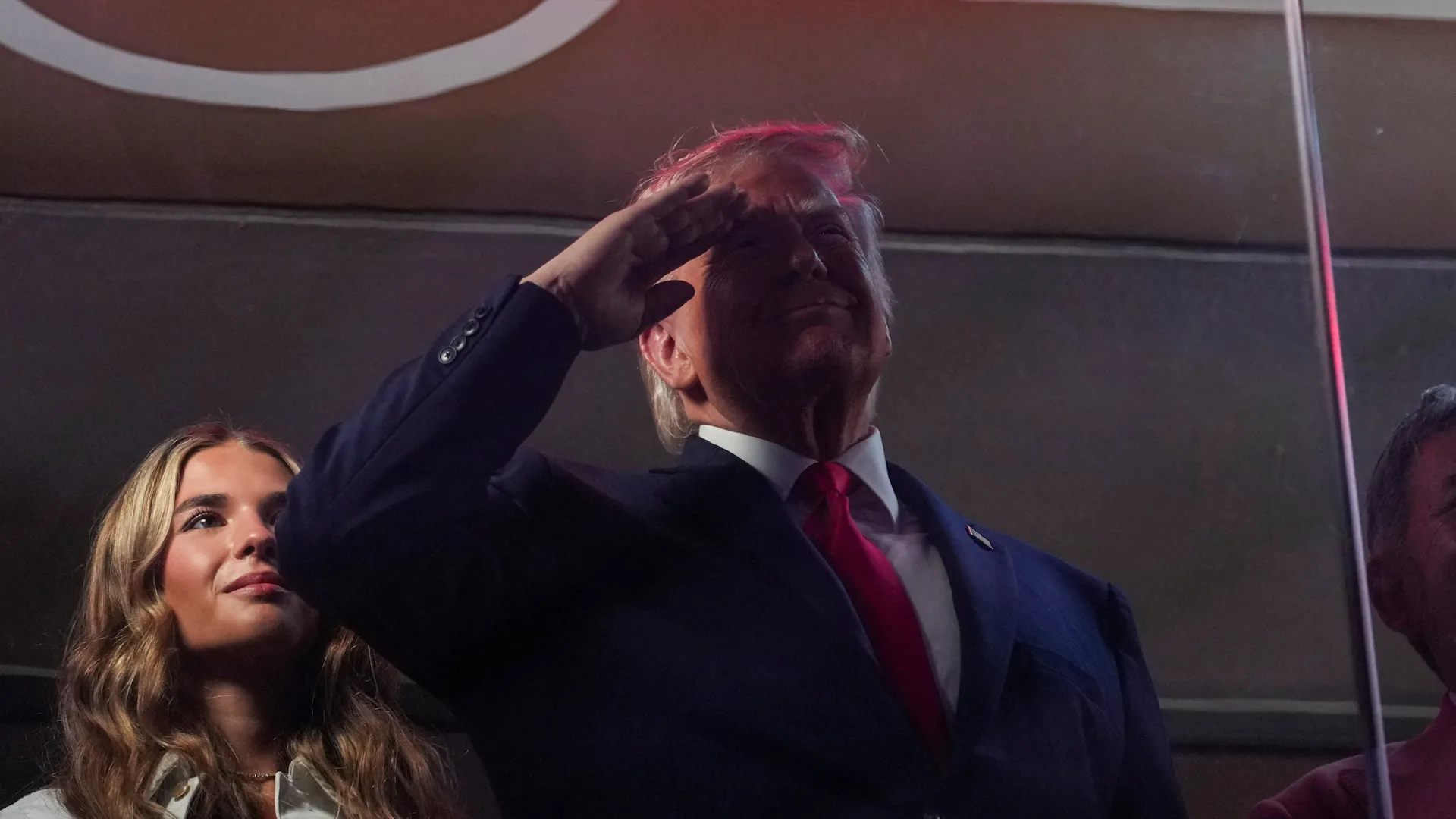
Trump was shown for several seconds giving a military salute. The boos ended when the U.S. flag followed him on the screens, and fans cheered when New York Knicks players were shown. Mentions of the San Antonio Spurs also elicited loud boos.
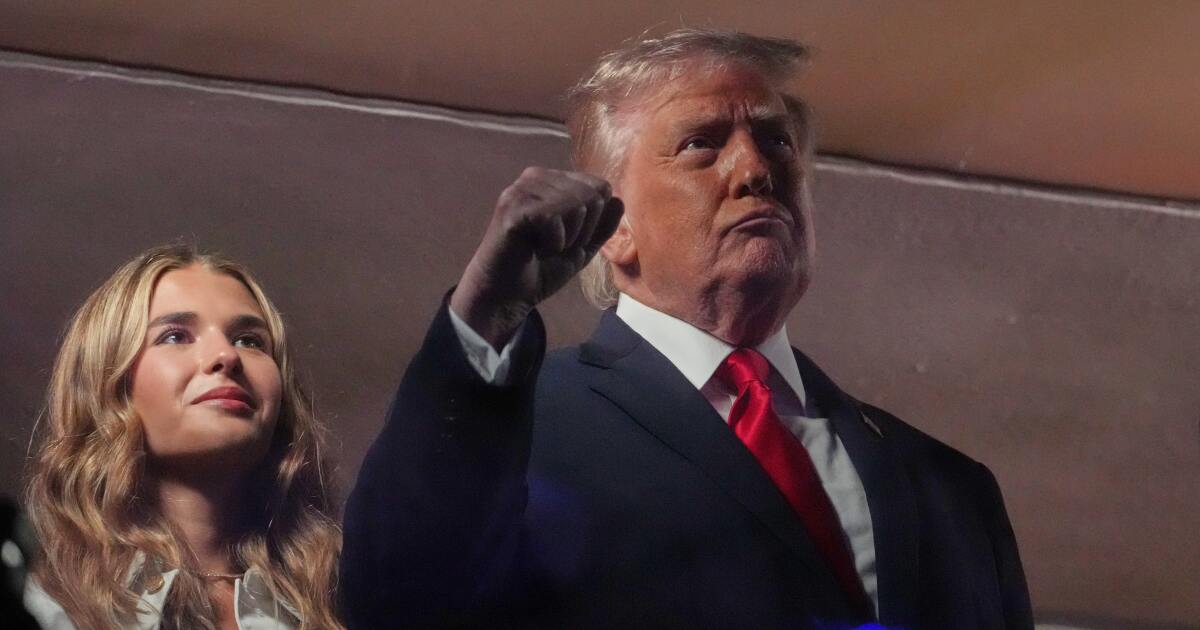
Trump is watching from Knicks owner James Dolan’s suite, along with granddaughter Kai, personal adviser Boris Epshteyn and Cabinet secretaries Lee Zeldin, Sean Duffy and Doug Burgum. He is the first sitting president to attend an NBA Finals game.
Trump’s Marine One helicopter flew from his home in New Jersey and landed near Wall Street before his motorcade made its way up through Manhattan and to the arena roughly an hour before tipoff. He encountered a handful of people making rude gestures, and outside the area, one group held signs saying “Trump must go.”
He settled into Dolan’s suite shortly afterward.
During the afternoon before Trump’s arrival, the New York Police Department and the U.S. Secret Service set up a large perimeter surrounding Madison Square Garden. Fans lined up to get inside the arena more than four hours before tip-off, in a scene more closely resembling New Year’s Eve in Times Square than the usual leadup to a basketball game.
They were required to provide a ticket or pass to get past various checkpoints, along with going through a Transportation Security Administration-style magnetometer. Secret Service personnel and police were positioned at every corner and in large numbers. Daily commuters, tourists and fans were all confounded at various times as they tried to maneuver the security.
New Yorkers forced to adjust
After traveling from his new home in Florida for the game, Knicks fan Greg Weldon said the main inconvenience he’s faced so far has been the lack of information.
“We’ve asked so many cops, Secret Service, guys with machine guns, what to do, where should we go,” he said. “Nobody knows.”
Knicks coach Mike Brown and Spurs counterpart Mitch Johnson downplayed any concept of being inconvenienced by the closures and enhanced security because of Trump.
“There’s a lot going on, and I’d much rather be a part of it than not,” Johnson said.
With security stepped up, a watch party outside was canceled, and ticket holders were not allowed to bring bags inside the Garden. Fans had gathered near the arena to watch games during this playoff run, during which the Knicks have won 13 games in a row to reach the Final for the first time since 1999 and move two victories from their first NBA title since 1973.
“We are looking forward to bringing back watch parties for Game 4,” Police Commissioner Jessica Tisch said at a news conference Monday. “But I think New Yorkers are used to presidents coming to town, and they understand that that generally means lockdowns of areas and that’s what you’re going to see tonight at the Garden.”
Incidents heighten attention to Trump’s security
This is the latest major sporting event Trump has attended during his time as president, and the security measures have created major hassles for fans.
Thousands of fans missed the start of last year’s U.S. Open men’s singles final between Carlos Alcaraz and Jannik Sinner because of lengthy security lines. Even though the U.S. Tennis Assn. pushed back the start of the match by a half hour, many fans still couldn’t get in because added measures meant that they had to go through screening not only when they arrived at the Billie Jean King National Tennis Center, but again in front of the steps into Arthur Ashe Stadium, where Trump watched from a suite.
Federal law enforcement officials have been reexamining Trump’s security in light of three incidents in the past two years: a shooting at a 2024 rally in Butler, Penn.; the discovery of a man armed with a rifle as Trump played golf in West Palm Beach, Fla., later that year; and the recent shooting at the White House Correspondents’ Assn. dinner.
Asked Sunday his thoughts on Trump attending, Knicks center Mitchell Robinson said: “Cool, I guess. We can still get out there and play [no matter] who’s here and who’s not.”
New York City Mayor Zohran Mamdani and other dignitaries were also at the game.
It was already hard enough for Knicks fans to get inside Madison Square Garden because of astronomical ticket prices. The get-in price for a ticket is higher than the average cost of monthly rent in New York, surging over $5,000. The best seats are tens of thousands of dollars. Mamdani said he bought his ticket, which he said was standing room only, for about $1,000 directly from Madison Square Garden.
The difficulty of seeing the game in person has prompted fans to crowd bars, streets and watch parties all over the city. The watch party near the Garden has become a major event all through the playoffs, but with Trump attending, that event was moved a few blocks away outside the security perimeter, at Bryant Park.
“We improvise,” said Knicks guard Jose Alvarado, who is a New York native. “We’re New Yorkers. We’re going to find a way to watch a game, and that’s what we’re doing.”
BOSTON — A federal judge on Monday struck down the Trump administration’s $100,000 fee on new H-1B visas, contradicting an earlier federal court ruling upholding the fee hike.
The administration announced the much-higher fee as a way of preventing foreign workers from taking American jobs.
But U.S. District Judge Leo Sorokin in Boston sided with 20 states and struck down the visa policy, concluding that the executive branch exceeded its authority and violated the Administrative Procedure Act, which governs how federal agencies develop and issue regulations.
“The Court finds that the Policy imposes a tax on H-1B petitions without the requisite delegation by Congress,” Sorokin wrote.
H-1B visas are meant for high-skill jobs that are difficult to find American workers to fill. Deep-pocketed technology companies are the biggest users, with nearly three-quarters of approvals going to workers from India. The states argued that using the H-1B program to fill vacancies for much-needed doctors and teachers was already difficult before the higher fee.
Most H-1B visa applications cost several thousand dollars before the announced increase set off a wave of panic among confused employers, students and workers in the United States and abroad and led to several lawsuits, including in Boston.
The U.S. Chamber of Commerce also sued, in federal court in Washington, D.C., and has appealed a denial of a summary judgment against the fee hike. That left the higher fee in effect, at least until September, when it is scheduled to expire. Monday’s ruling is also a summary judgment, to the opposite effect. Still another lawsuit was filed in federal court in San Francisco, by religious groups and labor organizations, setting up the possibility of divided rulings in three appellate court circuits.
The states argued that the policy impedes their ability to hire primary and secondary school educators and to staff public colleges and universities, will stymie academic research and will lead to a decline in medical workers.
“The Proclamation makes various overtures to domestic economic policy goals to justify the unprecedented $100,000 fee,” plaintiffs wrote in their complaint. “But the Proclamation gives no indication that the President gave any consideration to how the fee would affect Plaintiff States and their ability to provide their residents access to education, healthcare, and other basic human needs.”
A Department of Homeland Security statement said the agency disagrees with “this blatant judicial activism dismantling President Trump’s historic efforts for immigration reform.”
“Under President Trump and Secretary [Markwayne] Mullin, our immigration system is being reformed to serve American citizens, American workers, and American families and to preserve our national identity — not to rapidly import foreigners who take American jobs, commit crimes, burden our welfare system, and erode our cultural and social fabric.”
WASHINGTON — A relentless push by President Trump to reshape Washington‘s cityscape is facing mounting resistance, threatening a slate of transformative monuments intended to cement his legacy in the nation’s capital.
Eager to see his projects completed before leaving office, Trump has responded to growing legal and political obstacles by pushing ahead, attempting to force approvals through faster than opponents can challenge them. But the scramble to fast-track construction has inflated their costs for taxpayers, imperiling his plans and amplifying his political risks as the midterm elections approach.
Urban design has become a preoccupation for Trump since the start of his second term. Cranes dot the skyline of the city, and construction fences block access to many of its most cherished parks and venues less than a month before the nation celebrates 250 years since its founding on July 4.
Cranes from the White House East Wing ballroom construction project rise from behind the U.S. Treasury Department building on Thursday in Washington, D.C.
(Kevin Carter/Getty Images)
Government lawyers are defending the president’s use of the wrecking ball, arguing in court that he has unfettered power to build and destroy. Should he ever choose to tear down the Statue of Liberty, the Justice Department told a judge Friday, no one could stop him.
Yet a recent series of legal setbacks, as well as increasing Republican opposition on Capitol Hill, have cast doubt on the fate of his most lavish designs, including the construction of an imposing ballroom at the White House and the erection of a massive triumphal arch on the sightline of the National Mall.
It’s become a race against time for the president, who could soon confront a Democratic-controlled Congress armed with renewed oversight authority and subpoena power, further gumming the works of elaborate construction projects, which could stymie their completion before he leaves office.
“This is very much on the committee’s radar,” said one Democratic source with the House Oversight Committee, citing “serious concerns surrounding corruption.”
Visitors at the Mall gather in front of the Lincoln Memorial and near the Reflecting Pool, which is under renovation on Friday in Washington, D.C. President Trump dismissed criticism of the recent Lincoln Memorial Reflecting Pool renovations, rejecting claims the project amounted to merely a “paint job.”
(Roberto Schmidt / Getty Images)
Trump as ‘builder-in-chief’
Several of Trump’s more modest initiatives, referred to by the administration as beautification projects, are complete or well underway.
At the White House, a historic rose garden conceived by Jacqueline Kennedy was paved over, and its adjoining colonnade refurbished with black granite and gilded presidential portraits. The Palm Room foyer was decked in marble and chandeliers. New flagpoles fly supersized American flags on the North and South lawns.
The en suite bath of the Lincoln Bedroom in the residence has been gutted and renovated. And the Oval Office now practically drips in gold, while an adjoining study, once used by Franklin Roosevelt to scrutinize war maps and Lyndon Johnson to monitor the space race, was converted into the president’s personal swag shop.
A temporary Ultimate Fighting Championship arena constructed on the White House South Lawn is another example of how Trump is leaving a visual mark on the presidential residence. The structure, which towers over the White House, was paid for by the UFC, which is scheduled to host a series of fights on the premises.
Outside the White House complex, fountains across the city are coming back to life after decades of neglect, from DuPont Circle to Freedom Plaza and Union Station. The idyllic Logan Circle, surrounded by historic mansions, is being revitalized by the National Park Service, as is Lafayette Square, the site of an infamous clash between Trump and protesters shortly after George Floyd’s murder in 2020.
1
2
1.National Park Service Conservator for the National Mall and Memorial Parks Ali Cavicchio puts a clear coat over the recently repainted “I Have a Dream” marker at the Lincoln Memorial on June 05, 2026 in Washington, DC. The marker’s letters are carved into stairs of the Lincoln Memorial where Dr. Martin Luther King Jr. stood and delivered his “I Have A Dream” speech in 1963.(Chip Somodevilla / Getty Images)2.Members of the West Branch Area School District in Morrisdale, Pennsylvania, student marching band perform at the Lincoln Memorial on the National Mall on June 05, 2026 in Washington, DC.(Chip Somodevilla / Getty Images)
In some parks, even the turf is getting a makeover.
“People are all thanking me because Washington is beautiful again,” Trump told reporters last week. “The parks are open, we changed the grass. You know, grass has a life, also. Like people, grass has a life, and that grass hasn’t changed in 70 or 80 years.”
On Friday morning, several people sat by the restored cascading fountain at Meridian Hill Park. They walked their dogs, read books and exercised by the water.
Jean Luc, 33, was one of them. As he took a stroll with his 2-month-old daughter, Juno, he said it had been nice to see the government fix up the park, which he says he tries to enjoy with his daughter daily.
“It’s been nice to see the whole process,” he said. “I love it.”
President Trump displays a chart titled “Our Pool is Bigger than Skyscrapers” while discussing his renovations to the Lincoln Memorial Reflecting Pool on Wednesday in the Oval Office.
(Kevin Dietsch / Getty Images)
The Lincoln Memorial Reflecting Pool has been painted over in “American Flag Blue” by a firm that Trump said had worked on the swimming pool at his golf club in Virginia. Millions will be spent to regild the hulking Art Deco statues that buttress Arlington Memorial Bridge. And Trump has plans to connect the Lincoln Memorial to the Potomac River by building a promenade, one of many projects he has said may be named after himself.
Federal contracting data show that the Virginia firm Terra Site Constructors has been awarded roughly $60 million in contracts from the National Park Service to complete work on the various fountain rehabilitation projects across the city.
Another Virginia firm, Atlantic Industrial Coatings, holds a contract for $14.2 million to paint the reflecting pool.
The funding for both contracts comes from the entrance fees paid by national park visitors.
“How fortunate are we to have the builder in chief?” Interior Secretary Doug Burgum said Thursday in the Oval Office. “Someone who both has the vision and the understanding of how to get projects done that would make our city safe and beautiful.”
Construction continues on the White House East Wing ballroom on May 29, 2026.
(Kevin Carter / Getty Images)
‘The finest ballroom anywhere in the world’
Yet other, more controversial projects, exacting irreversible change to capital institutions, are facing greater opposition.
On Thursday, the Kennedy Center for the Performing Arts directed its staff to begin removing Trump’s name from its facade after a judge ruled that the attempted name change, and his effort to close the venue for two years of dramatic renovations, were illegal.
Angered by the court’s decision, Trump directed the Commerce Department to make arrangements to transfer control of the Kennedy Center to Congress. The move would give lawmakers power over the center’s operations, maintenance and management. It was originally an act of Congress that gave the Kennedy Center its name and mandate.
In other areas of the city, preservationists have successfully delayed the president’s bid to paint over the natural gray granite of the Eisenhower Executive Office Building. And Republican lawmakers have refused to vote to fund the construction of a ballroom at the White House that has already laid waste to the East Wing and, if completed, would dwarf the landmark residence.
Construction crews began tearing down the East Wing in October to make way for the 90,000-square-foot facility. Trump, who built a career as a real estate developer, has frequently touted the project, gushing over the sounds of jackhammers and excavation trucks.
Construction continues on the White House South Lawn on June 1, 2026, for an upcoming UFC match. President Trump is hosting a UFC match on the White House grounds to mark the nation’s 250th birthday.
(Kevin Carter / Getty Images)
“Oh, that’s music to my ears. I love that sound,” Trump told Republican senators at a White House event last fall. “A lot of people don’t like it. When I hear that sound, it reminds me of money.”
The ballroom project was initially expected to cost $200 million, a price that has since doubled. It is being financed by private donors and Trump, who has called it a “gift to the United States.”
“We are building what will be the finest ballroom anywhere in the world,” the president said last month.
More than half of the publicly identified donors of the ballroom projects — 14 of the 27 known corporate contributors — have won new or bigger federal contracts worth more than $50 billion in the six months since construction began, according to a report released by Public Citizen, a watchdog group.
“These giant corporations aren’t funding the Trump ballroom fiasco out of the goodness of their hearts,” said Jon Golinger, a public policy advocate at Public Citizen and author of the report. “They have massive interests before the federal government and they hope to curry favor with, and receive favorable treatment, from the Trump administration.”
White House military aides stand next to the giant mirror that hangs along the Rose Garden Colonnade at the White House on May 21, 2026.
(Chip Somodevilla / Getty Images)
The White House has challenged the report’s assertions, saying critics of how the project is being funded are “only people who suffer from a severe and incurable disease known as Trump Derangement Syndrome.”
“President Trump is making the White House beautiful and giving it the glory it deserves at no cost to taxpayers — something everyone should celebrate,” White House spokesman Davis Ingle said in a statement.
The report came out as the ballroom project has faced persistent hurdles in court and Congress.
The National Trust for Historic Preservation sued to stop construction, arguing the administration had not followed the legally required review process and had not secured congressional approval. In March, a federal judge halted aboveground construction, but an appeals court quickly allowed work to resume through June while the case proceeds.
On Friday, the panel heard the case and expressed skepticism about Trump’s push to build the ballroom without congressional approval.
On Capitol Hill, Senate Republicans dropped a proposal to set aside $1 billion in security funding for the ballroom after several GOP senators said it lacked the votes to pass.
Trump has insisted the funding is not necessary to complete the project, though he said it would help secure the complex. Without it, he told reporters last month, “the White House won’t be a very secure place.”
(Los Angeles Times photo illustration; Photo by Kevin Dietsch / Getty Images)
Arc de Trump
The president is also seeking to build a 250-foot-tall “triumphal arch” near Arlington National Cemetery, across the Potomac River at the foot of Memorial Bridge.
Renderings show the arch would be twice the height of the Lincoln Memorial, crowned by a golden statue of Lady Liberty sporting outstretched wings. An observation deck on its roof would offer sweeping views of the city.
Preservationists have criticized the plan as disrupting a sacred sightline between the memorials to Abraham Lincoln and Robert E. Lee, designed as a statement of unity after the Civil War. Even advocates of adding an arch in Washington have criticized the size of Trump’s proposed structure as overbearing. And a group of Vietnam War veterans has sued to try to stop its construction, arguing the project lacks congressional approval and would “dishonor their military and foreign service” because it would block the view of the cemetery.
Commission of Fine Arts member Pamela Hughes Patenaude, left, hands colleague Matthew Taylor a model of President Trump’s proposed triumphal arch to commemorate the country’s 250th anniversary during the commission’s public meeting at the National Building Museum in Washington on April 16, 2026.
(Andrew Harnik / Getty Images)
Despite public opposition, the National Capital Planning Commission last week advanced the project in its review process.
Trump praised the planning commission’s support, saying that “when completed, it will be, without question, the Greatest Arch of them all!”
The president has yet more plans to leave his mark — in some cases with his name, in others with his face.
Transportation Secretary Sean Duffy has proposed a $22-billion overhaul of Dulles International Airport outside the capital that would include a new terminal brandishing Trump’s name. Limited-edition U.S. passports will feature his portrait. And the Treasury has plans to mint a $250 bill featuring Trump’s mugshot from his 2023 Fulton County arrest, pending congressional approval — an unlikely prospect.
A walkway with the numbers “45” and “47” leading to construction on the new ballroom extension of the White House in Washington, D.C., on May 19. President Trump said a military hospital and research facilities will be built on the site of his planned White House ballroom, offering more details about the scope of the sprawling, controversial project.
(Samuel Corum/Bloomberg via Getty Images)
In a moment that went viral on social media, Sen. Jon Ossoff (D-Ga.), who is generating buzz over a potential run for the Democratic presidential nomination in 2028, offered a theory on what’s driving the president.
“He’s trying to put his face on the money. He’s building a monument to himself,” Ossoff told a crowd of supporters.
“But see, Atlanta, he’s doing these things now because no one will honor him when he’s gone,” he added, “because he’s a failed president and a national disgrace.”
Wilner reported from Los Angeles and Ceballos from Washington. Times staff writer Ben Wieder contributed to this report.
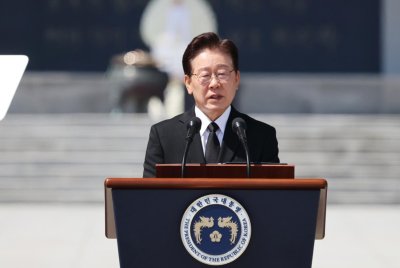
South Korean President Lee Jae-myung delivers his speech during a ceremony marking the country’s 71st Memorial Day to commemorate veterans and independence activists at the National Cemetery in Seoul, South Korea, 06 June 2026. Photo by KIM HONG-JI / EPA
June 7 (Asia Today) — President Lee Jae-myung sharply criticized the National Election Commission on Sunday over allegations that voting rights were violated during South Korea’s June 3 local elections.
Lee called on the National Assembly to conduct a parliamentary inquiry and ordered the administration to create a joint investigation team involving prosecutors and police.
“The National Election Commission caused serious disruption to the people’s exercise of voting rights during the June 3 local elections,” Lee wrote on Facebook. “The incident itself is difficult to understand, but its response afterward and explanation to the public were also insufficient.”
Lee said the right to vote is a constitutional right that must not be restricted or infringed upon for any reason.
“This is a grave matter that damaged the foundation of popular sovereignty,” he said. “As one citizen and as the president responsible for the government, I express deep regret.”
Lee asked lawmakers to quickly pursue a parliamentary inquiry to determine the facts and prepare measures to prevent a recurrence.
He also called for discussions on fundamental institutional reforms of the election commission.
“The government will also consider every possible measure at the administrative level, given the seriousness of the matter,” Lee said. “I have instructed the creation of a joint investigation team involving prosecutors and police to clarify responsibility and thoroughly determine the full circumstances of the case.”
Lee noted that the commission is an independent institution and said its independence comes with major responsibilities.
“The chairperson of the National Election Commission is regarded as one of the five highest constitutional officeholders because the commission is an independent institution with corresponding authority, duties and responsibility, just like the executive, legislative and judicial branches,” Lee said.
“The more independent an institution is, the more important public trust becomes,” he said. “An independent institution that has lost public trust has no reason to exist.”
Lee urged the commission to conduct a fundamental review of its organization and election management system. He said the commission should take the incident seriously and show a strong commitment to reform at a level the public can trust.
PORTLAND, Ore. — Former Sen. Bob Packwood, a moderate Oregon Republican whose reputation as a champion of women’s rights was tainted late in his career by a sexual harassment scandal, has died. He was 93.
Packwood’s death Saturday was announced in an obituary sent to media outlets by his family. The release didn’t include additional details.
As the scandal unfolded, Packwood initially refused to quit the chamber in which he had served for 27 years, saying he didn’t want to be remembered only for that.
Before the #MeToo era, Packwood stood out as an example of private behavior undermining a man’s public image. He previously had been praised by Planned Parenthood and others.
The great-grandson of a member of the 1857 Oregon Constitutional Convention, Packwood established himself as a social moderate and fiscal conservative who often voted across party lines. He considered running for president in 1980.
Elected to the Senate in 1968, Packwood was best known as the leading Republican advocate of abortion rights — at a time when the position had bipartisan support — and was widely admired by women’s groups throughout the country until the Senate Ethics Committee launched an investigation into the allegations of sexual and official misconduct in 1993.
More than two dozen women, former employees and acquaintances, accused him of making unwanted or uninvited sexual advances.
The allegations remained the target of an ethics inquiry that widened to include other alleged acts of official misconduct. He resigned in September 1995, and went on to start a lucrative lobbying business in Washington.
Democratic Sen. Ron Wyden, who replaced Packwood in 1996, said that although he should be praised for his record on abortion rights and tax reform, how Packwood treated women overshadows it all.
“His horrible history as documented in his own diaries will forever overshadow that public record. Simply put, historians’ first line about Bob Packwood must include those women who he abused and assaulted for years and years,” Wyden said in a statement.
As chair and then ranking Republican on the Senate Finance Committee, Packwood was a master of cutting deals and forging compromises needed to pass tax legislation through Congress. He was most proud of the lead role he played in a sweeping tax reform of 1986 that lowered the top income tax bracket and eliminated many itemized deductions.
Over his career, he was described as a blunt, independent, outspoken politician who was a boat-rocker, loose cannon, skilled partisan, and — for most of his career — political survivor.
“I think they probably all ring true,” Packwood told the Associated Press in December 1992.
“I would like to think that I am nobody’s lackey. I try to reach conclusions independently and then I’m willing to fight for those conclusions; if necessary, having to fight against my party or my party’s president,” he said.
Packwood won his first Senate election at age 36, narrowly defeating Democratic Sen. Wayne L. Morse, an Oregon legend who had held the seat for 23 years. He quickly grabbed attention as a rising star in the GOP. By 1980, he was elected chairman of the National Republican Senatorial Committee.
But he lost the seat when the White House backed a competitor after Packwood publicly accused President Reagan of alienating women, African Americans and Jews.
Just two weeks after Packwood’s reelection in 1992, the Washington Post printed allegations from former female employees and acquaintances that the senator had subjected them to uninvited sexual advances.
The Senate Ethics Committee also investigated allegations that Packwood solicited jobs from lobbyists for his ex-wife, used his staff to try to threaten the female accusers into keeping quiet and obstructed the investigation by altering his personal diaries.
The Senate held two days of extraordinary debate in 1993 over whether Packwood should have to comply with an Ethics Committee subpoena for his diaries, in which he reportedly made entries relevant to the investigation. The Senate voted 94 to 6 to enforce the subpoena.
Packwood took the case to federal court and lost, ending when Supreme Court Chief Justice William Rehnquist refused the senator’s request for the high court to intercede.
Packwood launched his lobbying business, Sunrise Research Corp., in 1997. By 1999, the firm was grossing $1.5 million a year. His business slowed in later years, but he told a City Club of Portland audience in 2010 that he was still spending about half his time in Washington lobbying for a number of clients.
It was interesting work, Packwood told the audience, according to the Oregonian, but “it is not as much fun as being in the Senate.”
As Congress became increasingly partisan after his departure, Packwood continued to advocate a centrist tack and in his 2010 City Club speech called for Oregon to create nonpartisan elections.
Attorneys for musician Chuck Redd say a D.C. Superior Court judge dismissed a breach of contract lawsuit filed against the artist after he canceled a Christmas Eve performance at the Kennedy Center in protest of President Trump’s influence over the venue.
The dismissal was granted Friday under Washington’s Anti-SLAPP laws, which are designed to prevent meritless lawsuits intended to silence opposing points of view on matters of public interest.
Redd, a drummer and vibraphone player who has toured with Dizzy Gillespie, Ray Brown and others, had presided over holiday “Jazz Jams” at the Kennedy Center since 2006. He called off last year’s performance shortly after Trump’s handpicked board for the Kennedy Center voted to add the president’s name to the venue, which Congress named for President Kennedy after his assassination.
“The Center sued Mr. Redd because he publicly and rightly objected to adding Donald Trump’s name to the Kennedy Center, a living memorial to former President John F. Kennedy,” Lisa J. Banks, one of Redd’s lawyers, said in a statement. “The lawsuit against Mr. Redd was political retribution, pure and simple, by the Trump Kennedy Center, and the Court correctly saw it as such in dismissing the case with prejudice.”
Redd told the Associated Press in an email Saturday that he is “very pleased with the judge’s ruling.”
The motion to dismiss, filed in March, argued that Redd wasn’t contractually obligated to perform. It included the contract provided by the Kennedy Center, which the artist never signed.
Representatives for the Kennedy Center did not immediately respond to a request for comment on the suit’s dismissal.
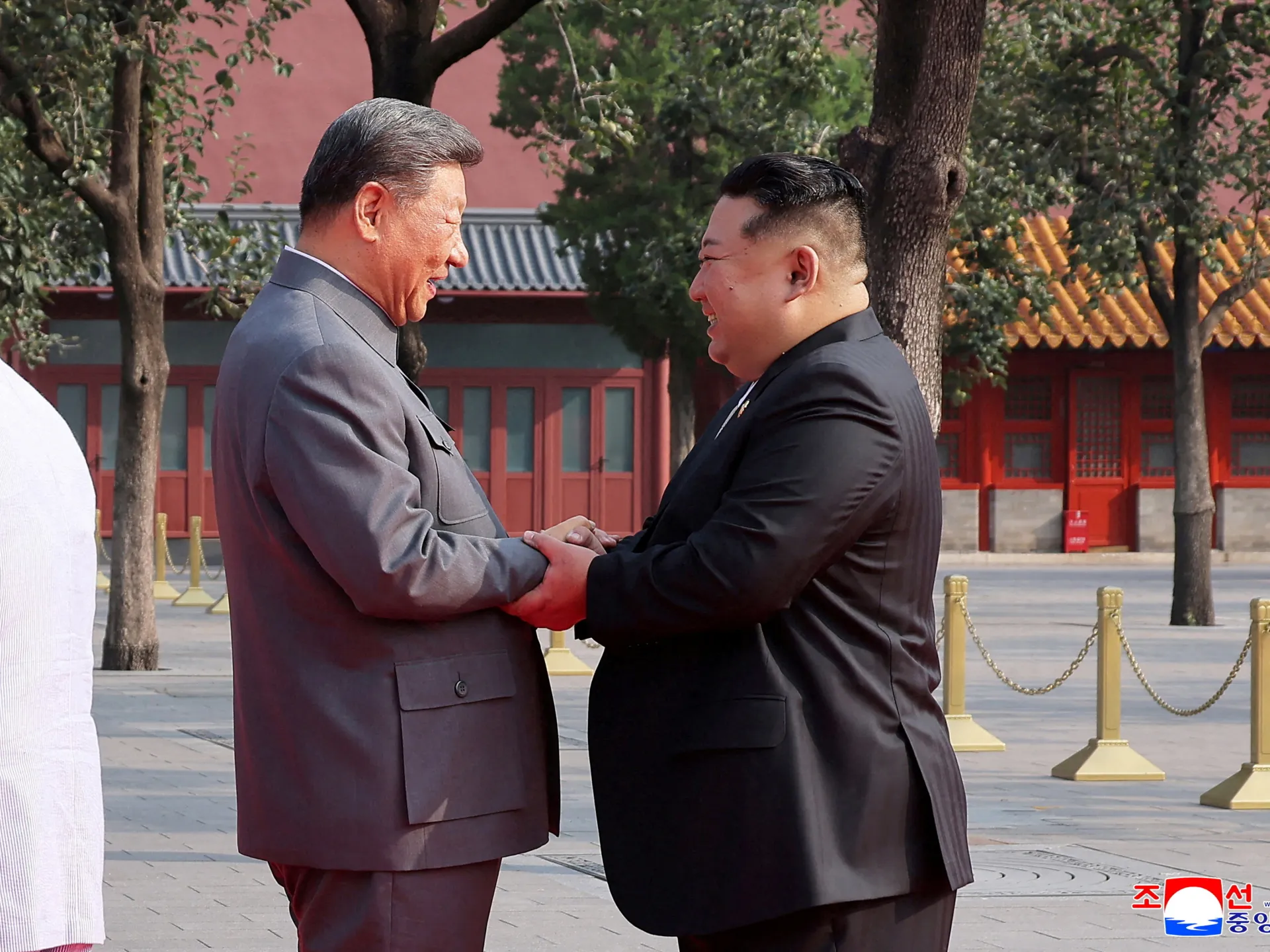
Chinese President Xi Jinping’s meeting with North Korea’s Kim Jong Un in Pyongyang on Sunday is significant for one reason.
It’s not that they are meeting: The two men met in Beijing just a year ago when China held a massive military parade to mark 80 years since Japan surrendered unconditionally to Allied forces, bringing an end to the second world war.
Recommended Stories
list of 4 itemsend of list
What’s surprising is that Xi is travelling at all.
The Chinese leader has not travelled to Pyongyang since 2019, having steadily cut down his travel in recent years, and world leaders like US President Donald Trump and Russian leader Vladimir Putin generally come to him these days.
“We need to remember that Xi Jinping has not really travelled abroad that much,” William Yang, Crisis Group’s senior analyst for Northeast Asia, told Al Jazeera. “The growing trend is foreign leaders heading to Beijing to meet with him.
“For Xi Jinping to be the one who decides to travel to Pyongyang, it shows the level of significance that China attaches to this trip.”
Xi averaged about 14 trips a year between 2013 and 2019, but dropped to approximately six a year between 2022 and 2025, according to the Asia Society. In 2020, he made just one overseas trip, and in 2021, he made none, as China grappled with the COVID-19 pandemic.
He may be travelling now, though, amid concerns about North Korea’s relationship with Russia, Yang said.
Senior partner no more?
Traditionally, Beijing played the role of senior partner in the China-North Korea relationship, with North Korea heavily dependent on China for as much as 95 percent of its trade, according to one 2022 estimate from the National Committee on North Korea, a US-based nonprofit.
That dynamic has been changing since Russia’s 2022 invasion of Ukraine, however. North Korea has provided Russia with critical weapons, artillery and manpower and is credited by observers with helping to keep Moscow’s war machine going.
South Korea’s Institute for National Security Strategy, a government-funded research institute, estimates that since 2023, Moscow has paid North Korea as much as $14.4bn for troop deployments and the export of “artillery, shells, and guided and ballistic missiles”.
The report said that North Korea may only have received between $580m and $1.5bn of that in the form of “goods”, which means there is a “significant possibility that the majority of the payment from Moscow was in the form of ‘sensitive military technology or related precision parts and materials that are difficult to observe via satellite’,” according to a translation.
Although China shares a mutual defence treaty with North Korea, it is still wary of North Korea acquiring new military technology, Yang said.
“Beijing has always been very careful about providing military assistance to North Korea because they do not see a militarily stronger North Korea as necessarily in its favour,” he said. “A North Korea that is militarily emboldened through its relationship with Russia could be a potential source of disruption to the balance of power and status quo on the Korean Peninsula.”
North Korea has already carried out eight missile launches since the start of the year, and in May unveiled a new AI-guided tactical cruise missile, according to North Korean media and the US Naval Institute.
Earlier this week, North Korean state media also released photos of Kim touring a new “weapons-grade nuclear materials” factory, which would be used to expand Pyongyang’s nuclear capability at an “exponential rate”.
Fluctuating tensions
North Korea has technically been at war with South Korea since 1950, with the conflict suspended by a 1953 armistice agreement. The two countries are divided by a 250-kilometre-long (155-mile-long) Demilitarized Zone, splitting the Korean Peninsula.
Tensions have fluctuated dramatically over the years, reaching a recent low point in 2024 when Kim abandoned the long-term goal of Korean unification.
He has largely cut off communications ever since, according to observers. On Friday, South Korea’s Ministry of Foreign Affairs said that it hopes that Xi’s trip will “play a constructive role in addressing issues related to the Korean Peninsula” – suggesting that Seoul may have lobbied the Chinese leader to try to smooth over relations.
South Korean Minister of Unification Chung Dong-young separately told reporters last month that he expects the two leaders to discuss a possible meeting between Kim and Trump later in the year.
Xi may also be alarmed by other security developments in East Asia, including news of a possible military-logistics support pact between South Korea and Japan, which was raised at the Shangri-La Dialogue of regional defence officials in Singapore last weekend.
While China and South Korea’s relationship fluctuates, its ties with Japan are acrimonious due to longstanding grievances dating back to Imperial Japan’s occupation of China in the 1930s and 1940s. Beijing has also objected to recent moves by Tokyo to expand its de facto military.
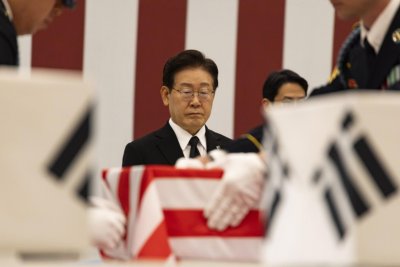
South Korea President Lee Jae Myung attends the ROK and the U.S. repatriation ceremony for Korean remains at Seoul Military Air Base in Seongnam, South Korea, 05 June 2026. The remains of ten South Koreans and the three U.S. soldiers killed in the Korean War were sent back to their homeland. Photo by JEON HEON-KYUN / EPA
June 5 (Asia Today) — South Korean President Lee Jae-myung said Friday that the mutual repatriation of Korean War remains by South Korea and the United States is “the most compelling evidence” of an alliance forged in blood.
Lee made the remarks at Seoul Air Base in Seongnam, where South Korea and the United States held a mutual repatriation ceremony for Korean War remains. It was the first time the ceremony was held in South Korea. Previous mutual repatriation ceremonies had been held in Hawaii.
“Today’s repatriation is a meaningful milestone that deepens and strengthens the South Korea-U.S. alliance, which was built on the blood and dedication of veterans,” Lee said.
“The effort to find not only one’s own warriors but also those of an ally and return them to their families is the most compelling evidence of an alliance forged in blood,” he said.
The ceremony returned the remains of 10 South Korean service members from Hawaii to South Korea. The remains of three U.S. service members were returned to the United States.
Lee said the repatriation was a promise by both countries to remember the heroes who devoted themselves to freedom and peace, calling it “the most noble tribute to their sacrifice.”
“More than 70 years ago, we were able to defend freedom and peace because of the noble sacrifice of heroes who gave their most precious lives to protect the freedom and peace of the Republic of Korea,” Lee said.
“But there are heroes who, long after the war ended, have still not returned to their hometowns,” he said. “Returning them fully is the historical duty of those of us who survived.”
Lee said trust built through battlefield promises has sustained the U.S.-South Korea alliance for decades.
“The trust that keeps promises made on the battlefield, even after decades have passed, is the strong root that has supported the South Korea-U.S. alliance,” Lee said. “With the firm South Korea-U.S. alliance as nourishment, the Republic of Korea is writing a new history of prosperity that amazes the world.”
Lee said the two allies should continue working together for peace and mutual prosperity.
“If South Korea and the United States join hands and move unwaveringly toward the future, complete peace will take root on this land and the flower of mutual prosperity will bloom,” Lee said. “We will continue to carry forward, with future generations, the noble history of solidarity for freedom and peace.”
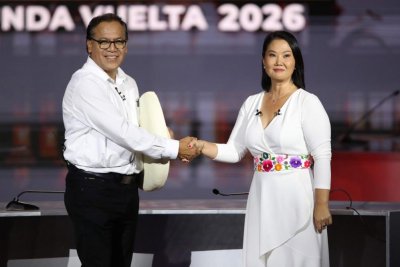
Lleft-wing candidate Roberto Sanchez and right-wing candidate Keiko Fujimori pose during a presidential debate in Lima, Peru, last weekend. This was the only debate between Fujimori and Sanchez before the decisive election scheduled for Sunday. Photo by Paolo Aguilar/EPA
June 6 (UPI) — Peru will choose its next president Sunday in a runoff election between Keiko Fujimori, leader of the right-wing Popular Force party, and Roberto Sánchez, candidate of the leftist coalition Together for Peru.
Nearly 28 million Peruvians are eligible to vote for what will be the country’s ninth president in just 10 years, a figure that reflects Peru’s deep institutional crisis and political fragmentation.
Recent polls show Sánchez and Fujimori in a statistical tie, meaning the final outcome could depend on undecided voters and the share of blank ballots.
For many observers, the central question is not only who will win the presidency, but whether Peru can break the cycle of political instability that has defined the past decade.
Fujimori’s candidacy once again places Fujimorismo at the center of Peruvian politics. The daughter of former President Alberto Fujimori remains one of the country’s most influential and polarizing political figures. Sunday’s vote marks her fourth consecutive attempt to win the presidency in a runoff election.
Sánchez, meanwhile, is a far less familiar figure outside Peru. His campaign has evolved throughout the race and has sought to appeal to supporters of former President Pedro Castillo, who was removed from office in 2022 after attempting to dissolve Congress.
Fujimori maintains a strong advantage in Lima, while Sánchez dominates much of the country’s interior, particularly in the Andean regions.
The election is taking place amid growing public frustration with Peru’s political system.
Beyond the traditional divide between Fujimorismo and anti-Fujimorismo that has shaped much of Peru’s politics over the past two decades, several analysts argue that the country’s deeper problem is a broader crisis of political representation.
Luis Lira, a researcher at the International Affairs Observatory at Finis Terrae University in Chile, said Peru has become one of the clearest examples of a “democracy without parties,” where political organizations have lost their ability to channel voter demands and have been replaced by highly personalized leadership.
“The presence of two candidates viewed as strongmen demonstrates the deterioration of political parties,” Lira told UPI.
Raúl La Torre, a Peruvian academic and professor at the University of the Andes in Chile, offered a similar assessment.
According to La Torre, Peru enters the runoff burdened by a representation crisis that has deepened over the past decade. Political parties remain weak, Congress continues to suffer from low public trust and the gap between citizens and political elites continues to widen.
Carlos Escaffi, founder of consulting firm Relaxiona Internacional, said the Fujimorismo versus anti-Fujimorismo divide remains relevant, but is no longer sufficient to explain voting behavior.
Issues such as public security, informal employment, economic opportunity and growing rejection of the traditional political class now play a larger role in shaping voter preferences, he said.
“The demand for order, security and concrete solutions to everyday problems appears to be playing an increasingly important role in voters’ decisions,” Escaffi told UPI.
Analysts also point to Peru’s political structure as a factor behind its persistent instability.
Juan Jiménez, a former prime minister under President Ollanta Humala, said the country has long experienced a contentious relationship between the executive branch and Congress, marked by frequent confrontations and repeated efforts to remove presidents from office.
“In the last 10 years we have had eight presidents. On Sunday we will have the ninth,” Jiménez told UPI.
He attributed part of the crisis to the repeated use of constitutional mechanisms that allow Congress to remove presidents from office, as well as to the country’s fragmented political landscape.
Questions over whether the eventual winner will be widely accepted have become another source of concern.
Polls released in recent days suggest an extremely close race, increasing the likelihood of legal challenges or accusations from the losing side.
Jiménez said the country’s first challenge after Sunday’s vote will be ensuring that all political actors accept the result.
“It is highly foreseeable that there will be a conflict over the outcome,” he said, noting that narrow margins in previous elections have repeatedly fueled allegations of fraud.
The former prime minister also argued that problems during the first round undermined confidence in electoral authorities and could contribute to renewed disputes once the final results are announced.
Escaffi, however, urged caution regarding claims of fraud. He said there is no evidence to support allegations of a systematic effort to alter the popular vote.
“What we have seen is that the fraud narrative has become a political tool used by different sectors to mobilize their supporters or preemptively challenge the results,” he said.
Political analyst and commentator Jorge “Coco” Salazar expressed a similar view, saying either candidate could challenge the outcome if the margin is extremely narrow.
Salazar told UPI that the climate of mistrust generated during the first round has created conditions for electoral disputes to once again dominate the political debate.
Regardless of who wins, analysts agree the next president will face structural challenges that extend far beyond the campaign.
The most pressing task will be restoring governability in a country where political confrontation has become routine.
According to La Torre, that will require building minimum agreements with a fragmented Congress, strengthening weakened institutions and rebuilding public confidence.
Corruption and public security also rank among voters’ top concerns.
Lira said Peruvians increasingly demand greater transparency and accountability from the political class, while rising crime has become one of the country’s most pressing social issues.
Escaffi warned that Peru’s ability to maintain economic stability despite years of political turmoil should not be taken for granted.
Institutions such as the Central Reserve Bank of Peru and the country’s fiscal discipline have helped cushion the effects of repeated political crises, he said, but prolonged uncertainty could eventually affect investment, economic growth and job creation.
Several analysts also believe the restoration of a bicameral legislature could help counter the institutional drift behind the recent instability.
Jiménez said the return of the Senate may make it more difficult to carry out rapid presidential removals and could create greater opportunities for political deliberation.
Even so, few experts are optimistic about a quick resolution to Peru’s political troubles.
“The election offers an opportunity to begin a more stable period, but by itself it does not guarantee that outcome,” La Torre said.
For many observers, the question that will remain after Sunday’s vote is not simply who wins the presidency but whether Peru’s political system can regain the legitimacy and stability it has steadily lost over the past decade.
Washington has extracted major concessions from Caracas since the Jan.3 strikes and kidnapping of President Maduro. (Archive)
Between the mid-1980s and the early 1990s, amid the terminal crisis and collapse of the so-called European socialist bloc, the era of struggle that had begun following the triumph of the Cuban Revolution came to a close in Latin America. A new phase began, during which the leftist and progressive social and political organizations and movements of the subcontinent went through phases of accumulation and de-accumulation of forces.
Phases of accumulation
From 1985 to 1998, these movements accumulated enough social power to topple neoliberal governments and enough political power to secure seats in local governments and national legislatures, but not enough to take control of the national government.
From 1998 to 2009, they accumulated enough social and political power to elect—and in some countries, to re-elect several times—leftist or progressive governments.
Phases of de-accumulation
From 2009 to 2012, there were no electoral defeats for leftist or progressive governments, but there were coups d’état of a “new type” in the “weakest links in the chain”: Honduras and Paraguay.
In 2013 and 2014, there were no electoral defeats, but the margin by which the left retained power in Venezuela and El Salvador was reduced to a bare minimum.
From 2015 to 2019, electoral defeats in Argentina, El Salvador, and Uruguay, coups of a “new type” in Brazil and Bolivia, along with Lenín Moreno’s betrayal in Ecuador, broke six of the “strongest links in the chain,” and the siege against Venezuela, Nicaragua, and Cuba intensified.
Phase of partial recovery and subsequent acute loss of strength
Following the election of Andrés Manuel López Obrador as President of Mexico in 2018 and Alberto Fernández in Argentina in 2019 at the end of the phase of decline, between 2020 and 2024, the left and/or progressive movements regained power in Bolivia, Honduras, Brazil, and Uruguay, held power in Chile, Colombia, and Guatemala, and lost it again in Chile and Honduras in November and December 2025, respectively. In January 2026, President Nicolás Maduro and his wife Cilia Flores were kidnapped by the US military and are currently being held illegally in that country.
Predominant factors in the phases of accumulation (1985–1998 and 1998–2009)
The legacy of the historical accumulation of popular struggles, particularly during the period ushered in by the Cuban Revolution in which other revolutionary or reformist processes did not succeed or survive, contributed to opening up spaces for legal struggle.
The rejection of the genocidal repression traditionally employed against the peoples of the region forced the United States and its Latin American allies to seek less brutal forms of domination.
The momentum of popular movements in full swing brings into the political and electoral struggle social sectors that previously lacked the consciousness, motivation, or conditions to participate in it.
The protest vote against neoliberal governments by broad sectors of the population that were not politically conscious could nonetheless be turned against leftist and progressive forces if they failed to meet their expectations, whether fair or unfair, rational or irrational.
Predominant factors in the de-accumulation phases from 2009 onward
Historical accumulation depreciates. As time passes, with the superseding of recent realities, the emergence of new social expectations and demands – in some cases due to the fulfillment and in others due to the unfulfillment of previous ones – and the shortcomings and errors of the left and progressivism, there is a relativization or devaluation of the historical legacy.
The brutal repression of the past was replaced by “full-spectrum destabilization” against progressive and left-wing governments.
Due to their dissatisfaction with left-wing or progressive governments over the failure to fulfill their economic and social promises – due to the “constraints” of the system, pressure from the powers that be, and shifts toward the “center” to broaden their electoral base – a large part of the popular social movements that had provided decisive support in earlier phases began to exercise punitive abstention against them.
Social sectors without political ties or preferences, which in an earlier phase cast their protest votes against neoliberal parties, began to cast them against the left and progressivism.
With the exception of Uruguay, the overthrow, defeat, or betrayal of left governments was followed by the criminalization, prosecution, and, in many cases, imprisonment of their leaders, most notably Lula in Brazil.
The transformative processes with the greatest capacity to remain in power have been those in Venezuela and Nicaragua, which set out to and succeeded in establishing control over all the institutions of state. It is this concentration of power that has guaranteed the survival of the Cuban Revolution over six and a half decades. However, in Venezuela and Nicaragua there is a contradiction between the formally prevailing liberal/bourgeois system and the actually prevailing institutional system, with characteristics of state socialism, in which a political party – not the only one, but certainly the dominant one – monopolizes control of the four branches of government, the armed forces, and the security services.
The incompatibility between the formally existing institutional system and the institutional system actually in place in Venezuela and Nicaragua remained latent as long as the leaders of their respective transformative processes enjoyed widespread popularity and maintained high levels of approval, or raised expectations regarding the fulfillment of social needs and interests. However, this concentration of power has both a positive and a negative aspect:
The positive aspect is that it has been decisive in resisting the policy of encroachment, economic blockade, and political isolation that has affected Cuba since the triumph of its Revolution (1959), Nicaragua during the two periods of FSLN rule (1979–1990) and (2006 to the present), and Venezuela since the first term of Hugo Chávez’s government (beginning in 1999).
The negative aspect is that it distorts the relationship between the end and the means. The end was to develop a national project that would satisfy society’s material and spiritual needs and aspirations, and the means was to establish a power capable of guaranteeing that national project. The distortion consists in continuing to exercise power when one no longer has the capacity to satisfy society’s needs and aspirations, either because one failed to develop that capacity or because it was lost.
Given that external and/or internal forces are attempting to undermine or overthrow the established institutional systems in these countries, and given that neither of them has managed to make progress in building a new society – with this project becoming unattainable in the form and substance originally envisioned – the defense of power becomes an end in itself.
When evaluating any process of progressive social reform or revolutionary social transformation, it is necessary to consider the extent to which it has met or failed to meet its historical goals. In cases of failure to meet these goals, one must take into account the adverse and external factors that have influenced this outcome. However, it cannot be ignored that, even if resulting from such factors, the failure to meet historical goals erodes these processes. In essence, every transformative process is compelled to achieve its historical goals within a timeframe no longer than the moment society perceives it as an “eternal uphill battle.”
The Venezuela Case: Between Reality and Utopia
The kidnapping of President Nicolás Maduro and his wife Cilia Flores by the US military – along with the questions of how such an operation could have been carried out (no less than inside the headquarters of the Bolivarian National Armed Forces!), how the kidnappers knew where they would be sleeping that night, and that they were indeed there, why there was no response, which had been assured would occur in the event of any aggression against Venezuela, and, on top of all that, that the outcome is a “normalization of relations” with the aggressor power agreed upon by the very government that Maduro headed – reveals the fragility of revolutionary processes that claim to have a solid base of popular power, but events like this reveal that, in reality, they lack it.
Twenty-seven years and five months after the start of the Bolivarian Revolution – the first link in a chain of elections and re-elections of leftist and progressive governments that has become increasingly fragmented since 2009–2019 and is now practically extinct – it is time to face reality and assess to what extent the parties, movements, fronts, or coalitions that have held and/or currently hold power in their respective countries are aware of the true relationship between their rhetorical utopias and their political realities.
Between every emancipatory utopia and its corresponding reality lies a “missing link.” The “missing link” between utopia and reality creates a “gap” between the project of revolutionary social transformation or progressive social reform and the transformative or reformist process intended to bring it about. The danger lies in failing to recognize the cumulative widening of the “gap” between utopia and reality and clinging to a utopia as the foundation of a process of revolutionary social transformation or progressive social reform that is increasingly deviating from and becoming disconnected from it.
The disconnect between utopia and reality has consequences, including most notably: the conversion of utopia into dogma; the social alienation that every reformist or revolutionary process is meant to eradicate; the divergence of interests and direction between “leaders” and “followers”; the drift of the process toward disillusionment and failure; and, in well-known historical experiences, such as that of the USSR (to mention only the most prominent), the absolute empowerment of a caste that creates and defends its own political and economic interests, leading to the negation of utopia: from the very pinnacle of “power” itself!
Utopia must be systematically grounded in reality through the active, genuine, and effective participation of society, and never reaffirmed or reformed from “above.” This reevaluation and renewal led by society is the only way to ensure that utopia not only serves as a guide, as Galeano says, but also serves to walk the path that turns it into a political, economic, and social reality that is as close as possible to the vision itself.
Based on experiences and studies conducted in previous decades, since the beginning of the chain of elections and re-elections of leftist and progressive governments in Latin America, attention has focused on denouncing media warfare, cognitive warfare, cultural warfare, and fourth- and fifth-generation warfare. In recent years, Caracas has been the main venue for events and the most active platform for denouncing this form of counterrevolutionary action. These analyses and denunciations must continue “at full speed,” but we must also recognize and accept that this is not the only threat facing leftist and progressive governments and political forces.
All forms of external and internal counterrevolutionary activity must be analyzed and combated, but with the knowledge and understanding that this is not the only battlefront. Another front, just as important or even more so, is the recognition and eradication of our own weaknesses and errors, which make transformative and/or revolutionary processes vulnerable to enemy strategies and tactics. What has happened in Venezuela is proof of this omission: plenty of denunciation of the enemy and little to no self-reflection.
The moral of the story is that yes, we must denounce and unmask the enemy. But no, we cannot focus attention on denouncing the enemy at the expense of recognizing and eradicating our own weaknesses and mistakes.
Roberto Regalado is a Cuban political scientist and PhD in Philosophy. He is a professor at the Center for Hemispheric and U.S. Studies at the University of Havana (CEHSEU) and a member of the Historical and Social Literature Section of the National Union of Cuban Writers and Artists.
He is the author of, among other essays, Latin America Between Centuries: Domination, Crisis, Social Struggle, and Political Alternatives of the Left (2006), Encounters and Disagreements of the Latin American Left: A View from the São Paulo Forum (2008), The Latin American Left in Government: Alternative or Recycling? (2012), and numerous articles in specialized journals.
The views expressed in this article are the author’s own and do not necessarily reflect those of the Venezuelanalysis editorial staff.
Real Madrid is owned entirely by members who decide its president. Each pay an annual fee of around £130 and nearly 100,000 of them will vote on Sunday.
Following his first election in 2000, Perez pursued a ‘Galacticos’ policy of signing expensive world-class players including Luis Figo, David Beckham and Zinedine Zidane.
Real Madrid won two La Liga titles and a Champions League before Perez resigned in 2006 amid disappointing results.
In 2009, he successfully stood for the presidency again unopposed and has done so a further four times in his 17-year second term.
Trailing La Liga champions Barcelona by eight points, Real Madrid ended the 2025-26 season with no major trophies for the second season in a row.
As the season drew to a close, Perez called a news conference in which he railed against the club’s enemies and urged those unhappy with his leadership to run against him for president.
Renewable energy magnate Riquelme stepped forward, leaving Perez to compete with another candidate to retain his role for the first time in 20 years.
On Wednesday, Perez promised voters he would initiate a Galacticos-style transfer bid days after he hopes to be re-elected.
“I have some news for you,” he told Spanish TV show Horizonte.
“On Tuesday or so, I’m going to make an offer to a major Champions League club for a great player. It would be the largest transfer fee Real Madrid has ever paid in its history.”
Perez was asked the identity of his target and the scale of the fee.
“Olise is a great player but it’s not Olise,” Perez said. “It’s not Doku either.
“We’re going to make a significant offer, at least around 150m.
“He needs to be a player from midfield who can go forward. And it’s not Haaland.
“The player is not from the Premier League. And the first thing we’ll do is talk to the club.
“It’s a signing meant to generate excitement because that’s what it’s all about, generating excitement.”
He also reminded voters his re-election would activate already-agreed deals for manager Jose Mourinho, Inter Milan defender Denzel Dumfries and Ibrahima Konate, whose contract at Liverpool won’t be renewed.
WASHINGTON — President Trump announced Wednesday night at a White House dinner that he wanted to make acting Atty. Gen. Todd Blanche’s leadership of the Department of Justice permanent.
The president said he thought the confirmation of his onetime personal defense attorney would go “very quickly,” according to a video posted from the dinner.
But early indications suggest that the process could be anything but.
Blanche, who assumed his current role after Trump fired former Atty. Gen. Pam Bondi in April, has been the face of some of the administration’s most unpopular actions, including the $1.8-billion “anti-weaponization fund,” the Justice Department’s release of the so-called Epstein files and a spate of prosecutions that critics have seen as politically motivated.
“He was nominated because he’ll do whatever the President demands. Todd Blanche should be under investigation — not under consideration for a promotion,” Sen. Cory Booker (D-N.J.), who sits on the committee, said in a statement.
Blanche was confirmed as deputy attorney general last year in a vote along party lines but now faces a changed political climate, in which Senate Republicans have felt more emboldened to question the administration’s actions.
Already, two Republicans who sit on the Senate Judiciary Committee, which will decide Blanche’s fate, have expressed reservations about his nomination.
Republicans hold a 12-to-10 majority in the committee, so losing two votes probably would torpedo Blanche’s confirmation.
Texas Republican Sen. John Cornyn told CNN reporter Manu Raju Thursday that he was concerned about the independence of Blanche, who served as Trump’s personal attorney in a New York case about his alleged hush money payments to porn star Stormy Daniels.
“Being attorney general is probably one of the hardest jobs in the Cabinet, because you’re working for the president but you’re also supposed to be able to tell the president ‘no,’ ” Cornyn said. “So we need to talk about that.”
Cornyn recently lost his primary bid for reelection after Trump endorsed his opponent, Texas Atty. Gen. Ken Paxton.
In recent weeks, Blanche has faced withering criticism for the anti-weaponization fund, which was created last month to settle a lawsuit brought by Trump, two of his sons and their business against the Internal Revenue Service.
Blanche publicly walked back the fund at a congressional hearing this week, after critics had described it as a slush fund for allies of the president who believed they had been prosecuted for political purposes, including those who participated in the Jan. 6, 2021, storming of the Capitol.
Republican Sen. Thom Tillis of North Carolina, who sits on the Senate Judiciary Committee, told reporters that the fund, and any support for participants in the Jan. 6 insurrection, would be a sticking point for him in Blanche’s nomination.
“The key for Todd or anyone going through the Judiciary Committee is being pretty tight on January the 6th,” Tillis said.
Tillis, who is not seeking reelection, previously held up the confirmation of another Trump appointee — Federal Reserve Chair Kevin Warsh — over the senator’s concern about the prosecution of outgoing Federal Reserve Chair Jerome H. Powell in connection with statements Powell had made about a renovation of the Federal Reserve headquarters.
And Blanche will probably face questions during the confirmation process about the department’s prosecution of other perceived political enemies of the president, including former FBI Director James Comey, who is facing charges in North Carolina over a picture he posted on social media of seashells spelling out the numbers “86 47,” a reference to removing the president that prosecutors described as a death threat.
During Blanche’s first nomination hearing to be deputy attorney general, Tillis specifically asked Blanche to promise not to pursue any politically motivated prosecutions.
“I’ve got your commitment there will not even be a whiff of an investigation that appears to have a political motivation to it?” Tillis asked.
“I commit to that,” Blanche responded.
Even if he were to advance out of the Senate Judiciary Committee, Blanche could face a tough confirmation vote in the full Senate, where Republicans hold 53 seats. Two Republican senators facing tough reelection matchups, Sen. Lisa Murkowski of Alaska and Sen. Susan Collins of Maine, along with lame duck Republican Sen. Bill Cassidy of Louisiana, could prove to be hard votes to win.
Blanche has also been criticized for his handling of the release of millions of pages of records from the Justice Department’s investigation into deceased sex offender Jeffrey Epstein, as well as his interview with Epstein accomplice Ghislaine Maxwell.
Last week, Blanche’s predecessor, former Atty. Gen. Pam Bondi, placed the blame for the delayed release of files and improper redactions on Blanche’s shoulders.
He has also faced criticism for his decision to interview Maxwell in her Florida prison in July 2025, and for her transfer to a more comfortable prison in Texas soon after the interview was conducted. The former British socialite’s attorneys have made clear that she is seeking a pardon for her 2021 conviction and 20-year prison sentence.
Kenyan President William Ruto said allowing the US to build an Ebola quarantine facility in Kenya was the “right thing”. At least two people were killed this week in protests against the facility, which is being built on a US air force base for Americans exposed to the virus.
Members of the Bolivian police in riot gear deploy tear gas during an operation to regain control of the seized Humberto Suarez Roca plant and oil field, in the municipality of Santa Rosa del Sara, Bolivia, on Wednesday. Hundreds of demonstrators stormed the plant a day earlier, forcing operations to halt and blockading the facility to demand President Rodrigo Paz’s resignation. Photo by Juan Carlos/EPA
June 3 (UPI) — Bolivian President Rodrigo Paz sent a bill to Parliament on Wednesday to regulate states of emergency, while two ministers resigned amid a crisis that has entered its fifth week of road blockades.
The crisis, which began in early May with protests over fuel shortages, rising living costs and opposition to economic measures promoted by the government, has left at least five people dead and caused economic losses that exceed $1.6 billion.
Since the inception, more than 100 roadblocks have disrupted the transportation of goods, food and medical supplies, and fuel distribution in different parts of the country.
“This law regulating states of emergency in the nation has already been sent to Parliament, and I hope it will be resolved soon,” Paz said during a public statement.
Paz envía al Parlamento una ley para reglamentar los estados de excepción en medio de la crisis
El presidente @Rodrigo_PazP anunció este miércoles el envío a la Asamblea Legislativa de un proyecto de ley para reglamentar los estados de excepción en Bolivia, en un contexto de… pic.twitter.com/5rXgfBZl1O— REDDTVOFICIAL (@reddtvoficial) June 3, 2026
Paz said the initiative would provide a legal framework for actions the government plans to implement to ensure assistance to the population and distribution of essential supplies.
Bolivia’s Constitution provides for a state of emergency in extraordinary situations that affect the country’s security or normal functioning. However, the newspaper La Razón reported the government considers it necessary to have a specific law establishing procedures, scope and implementation mechanisms for that constitutional tool.
Paz added that any action taken by the police, armed forces and government would be guided by a “logic of humanitarian action” and defended dialogue as the path to resolving the crisis.
“We come from the real, democratic and constitutional culture of dialogue,” he said.
The announcement came the same day defense and education ministers submitted resignations, becoming the most significant cabinet departures since the protests began, according to reports from Bolivian media outlets.
Their departures follow the resignation of Labor Minister Edgar Morales less than two weeks ago.
The resignations represent a new political blow to Paz, who took office six months ago and is facing a growing humanitarian crisis.
The protests, led by labor unions, Indigenous organizations, teachers and groups aligned with former President Evo Morales, have expanded their demands, and some groups have begun to call for the president’s resignation.
According to reports by El País and Infobae based on data from Bolivian authorities and business organizations, the Federation of Private Business Entities of Bolivia warned that the road blockades continue to affect productive sectors, exporters and transport operators, while agricultural producers have warned of growing difficulties in moving goods and guaranteeing domestic supply.
The Legislative Assembly must now debate the proposal on states of emergency as protests continue and pressure mounts on the executive branch to solve the crisis.
The government maintains that road blockades are intended to destabilize the constitutional order, while protesters say the demonstrations are a response to deteriorating economic conditions and shortages that affect much of the country.
WASHINGTON — Acting Atty. Gen. Todd Blanche said Tuesday that the Trump administration was scrapping plans to create a $1.8 billion fund meant to compensate allies of the Republican president after widespread political backlash and setbacks in the courts.
“We are not moving forward with the fund, period,” Blanche said in response to questions at a House hearing on the Justice Department budget.
““Not moving forward, ever?” asked Rep. Grace Meng, a New York Democrat.
The blunt declaration marked an extraordinary turnabout for a Trump Justice Department that just two weeks ago had pronounced the fund as essential to make up for what officials insist was weaponized law enforcement during President Biden’s Democratic administration. Since then, though, the idea has faced mounting pressure from Republicans who demanded reassurances that plans for the fund were off the table before they would move forward with legislation funding President Trump’s immigration enforcement agencies.
Blanche said the Justice Department was not abandoning an element of a settlement with the IRS that gave Trump and his family immunity from tax audits.
The hearing before a House Appropriations subcommittee was scheduled for discussion of the Justice Department’s budget, but lawmakers quickly focused their questioning on the creation of a fund that has provoked outrage over the mere possibility that violent pro-Trump rioters who stormed the U.S. Capitol on Jan. 6, 2021, could be eligible for payouts.
Signs for the retreat surfaced Monday when a person familiar with the matter said the Republican president was now reconsidering whether to move forward with the fund established to resolve his lawsuit against the Internal Revenue Service over the leak of his tax returns. The Justice Department also said Monday it would comply with a Virginia court temporarily blocking the administration’s “Anti-Weaponization Fund,” effectively agreeing to pause the plan for at least two weeks.
Another judge in Florida raised the prospect of reopening the IRS lawsuit because of “grievous allegations” of improper dealing made against the administration by settlement critics.
The Trump administration has defended the fund as an appropriate measure to make up for what officials insist was a weaponized Justice Department during President Joe Biden’s Democratic administration, a claim the Biden administration strongly denied. Though some Trump supporters, including participants in the Capitol riot, have celebrated the announcement, the reaction among Republicans in Congress has been decidedly more hostile, forcing Blanche to try to assuage a GOP constituency that generally operates in close alignment with the administration.
The furor has especially complicated matters in the Senate, where Republicans defiantly left town 10 days ago without passing legislation to fund Trump’s immigration enforcement agencies. Republicans who returned to Washington on Monday said they won’t have the votes to pass the Homeland Security spending bill until the White House works with them to place parameters on the fund. Many have pushed the administration to impose limits or scrap the idea altogether.
At a Senate budget hearing last month, Blanche refused to rule out the possibility that those who carried out violence on Jan. 6 could be eligible for payouts and has repeatedly said in interviews that anyone who feels persecuted by the criminal justice system is free to apply. Payouts will be decided by a five-member commission appointed by Blanche.
But he has apparently struck a more conciliatory tone in private when confronted by Republican anger.
Blanche encountered a groundswell of opposition last month at a tense private meeting with GOP senators, with more than half raising concerns, including by shouting at the Justice Department’s top official, Republican Sen. Ted Cruz of Texas said in a recent episode of his podcast.
“There were fireworks at an epic level — and I’ve got to say, it’s one of the roughest meetings I’ve seen in my entire time in the Senate,” Cruz said.
Behind closed doors, Blanche was “adamant” that no one who assaulted police at the Capitol would receive compensation, according to Cruz.
“He said not just ‘no,’ but ‘hell no,’” the senator recalled.
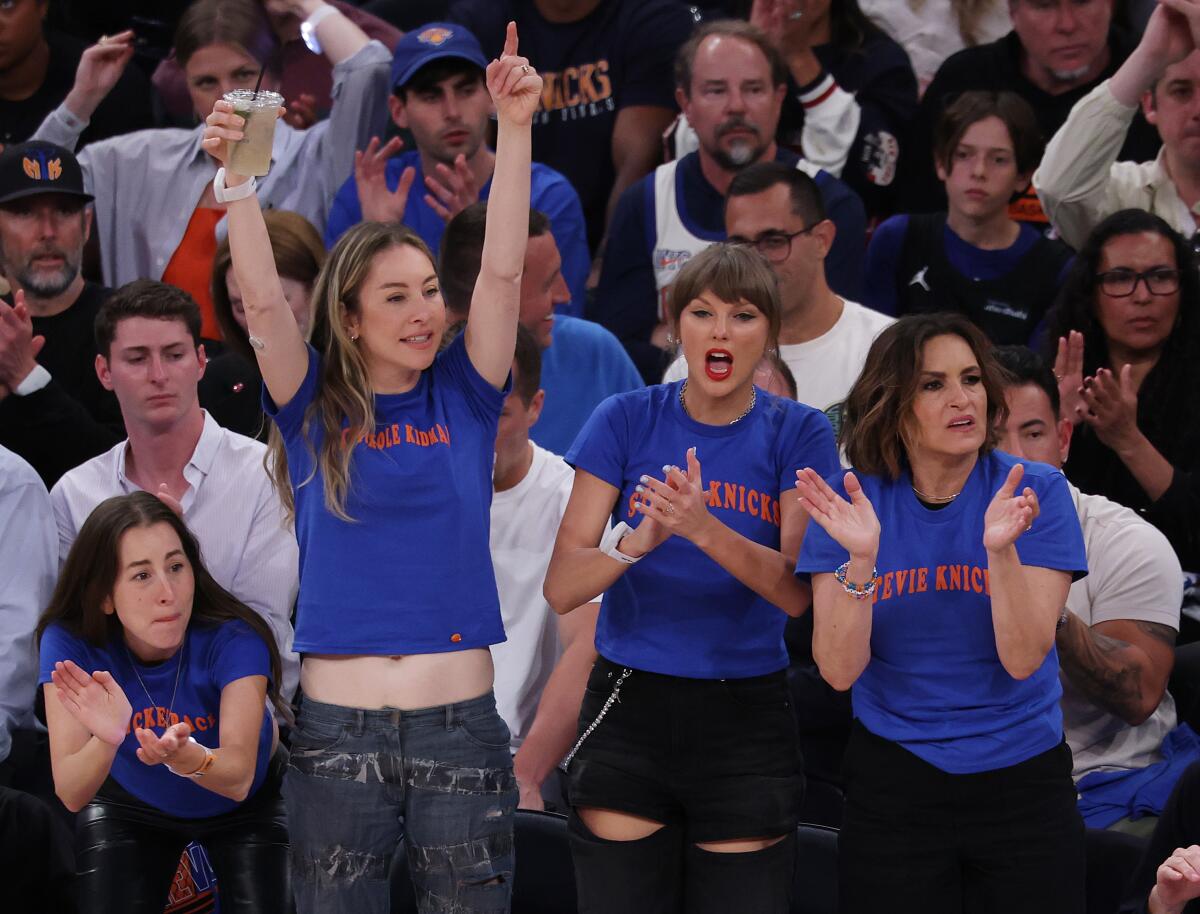

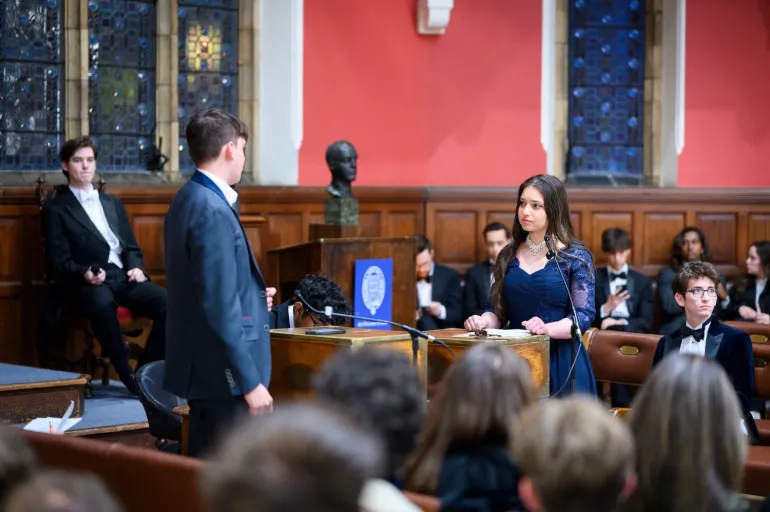
![Arwa Elrayess [Courtesy of Arwa Elrayess]](https://i0.wp.com/occasionaldigest.com/wp-content/uploads/2026/06/original-1C35F445-DBD0-445D-9835-200DAAC9C332-1781175489.jpeg?w=640&ssl=1)