Column

COLUMN ONE : Seymour’s Overdrive for Success : Pete Wilson’s appointed successor settles into his U.S. Senate job with aggressive deal-making. He defends his earlier switches on issues such as abortion and offshore drilling.

In the hush of his office, John Francis Seymour is working what he calls “the levers of power” like a 53-year-old kid running an imaginary earthmover.

His fists grip invisible levers, pushing them back and forth. He bounds forward in his leather chair. His voice rises until it cracks. All that is missing is the grind of an engine.

California’s appointed senator is explaining the thrill of maneuvering a bureaucracy, which excites this self-described real estate millionaire as much as buying and selling the California Dream.

“That is a fantastic challenge!” he crows. “I mean, you gotta be good to succeed in the private sector. But if you’re gonna succeed in getting things done in the public sector, you gotta be better than that! That’s the challenge!”

There is no doubt in Seymour’s mind that he is up to the challenge. Four months after he was wrenched from a Sierra vacation to assume the U.S. Senate seat vacated by Pete Wilson, the diminutive Republican is plying the elegant marble halls of the Capitol with an effusiveness unfettered by humility.

If most of Washington’s power is dispensed in cool and bloodless strokes, Seymour is playing the opposite game. His approach is a blend of gee-whiz and “let’s make a deal”–an assertive, bartering politics that spares no time on the notion that freshmen senators should be seen more than heard.

His is the ambition of a man who has chased success since childhood, sure enough of himself to have set his sights on high statewide office the night in 1978 that he was elected mayor of Anaheim.

His rapid rise in the Legislature in Sacramento left Seymour with the image of a politician who cut deals with relish–helping his supporters in the process–and switches alliances as the need arises. Now that the job of his dreams has been dropped into his lap, Seymour faces the grueling prospect of a contentious and costly campaign in 1992 to win it outright.

In the struggle, Seymour will be almost clinically dissected.

His friends say that he embraces challenges and is unafraid to admit when he is wrong. His foes call him self-serving and accuse him of selling out on principles. His friends say that he is stubborn and tenacious. His foes add that he is relentless and shrill.

Despite an admittedly stumbling start that has inspired his critics to doubt his chances next year, Seymour is brimming with confidence.

He dismisses his critics as jealous, scorning particularly those of his own party who disapprove of the deals he has spent a lifetime cutting. He says that he is a political pragmatist, a born optimist who believes that anybody, anywhere in California, can make it good, just like he did–that anyone can grasp the levers of power.

To most California voters, this man sitting in the U.S. Senate is unknown. Rarely, in his eight years in the California Senate, did Seymour surface amid the state’s telegenic political stars.

He came closest to the spotlight last year, when he fought unsuccessfully for the lieutenant governorship. That campaign broke into the news only occasionally and left Seymour with an image that dogs him to this day–that of a man who changed his tune on two defining issues, abortion rights and offshore oil drilling.

On both, he abandoned long-held conservative views, adopting positions that favored abortion rights and opposed offshore drilling. Because the changes came before an election year and put him in the mainstream of California voters, they inspired charges, which Seymour denies, that the moves were politically motivated.

Suspicion of his motives is a sore spot for the senator and those close to him. When asked what his father stands for, Seymour’s son Jeff, 24, launched into a defense of his integrity.

“People misunderstand who John Seymour is,” he said. They think indecisive, flip-flop. . . . Which just isn’t true. He’s been misunderstood.”

It is tough to see, on some levels, how Seymour could be misunderstood by anyone, for he can be unnervingly blunt.

If the subject is the influence of money on politics, he tells an audience that he qualifies “in that nasty group of millionaires.” Discussing negotiating techniques, he offers that he has angrily stomped out of rooms in attempts to intimidate opponents. His gestures are theatrical, his words expressed in exclamations.

But his statements and actions at times distort reality in a way that serves to protect the image of success Seymour has so carefully created.

Long after he was unceremoniously stripped of a party leadership position in 1987, he insisted that he had intended all along to quit. In a recent interview, he gruffly acknowledged that the job had been taken from him “before I was ready to go.”

He is, acquaintances say, sensitive to public knowledge that he smokes, a habit that he practices in private and has long tried to quit.

His campaign literature notes that Seymour has six children and that “he and his wife, Judy, have lived in Anaheim for more than 25 years.” They have–but not together. Until their divorce 19 years ago, Seymour lived there with his first wife, Fran, the mother of three of his children.

On occasion, Seymour’s directness appears to be an outgrowth of his political ambitions. In the throes of the 1990 lieutenant governor’s primary, he publicly asked to be allowed to watch the state’s planned execution of double murderer Robert Alton Harris. According to him, it had nothing to do with the publicity he would garner; rather, he argued that supporters of capital punishment should be prepared to see it. The request was turned down.

His open quest for success has sometimes put him in conflict with fellow politicians, particularly more conservative Republicans who see him as willing to sacrifice them to his upward climb. It has also earned him the friendship of Democrats, who appreciate his willingness to work with them on major issues.

“I would characterize John Seymour as a deal maker in both the good and bad sense of the word,” said state Sen. Bill Leonard (R-Big Bear), a conservative now second-in-command among GOP members in the upper house. “He wants to be productive. He thinks that people can sit and talk long enough about their cares and concerns that consensus can be built. . . . The bad sense is there’s a time to compromise and a time to hold fast.”

The art of the deal is bred into Seymour’s bones. From his youth, every job he has held has been in sales, following the steps of his father, his uncles and his grandfather. To politics, he brought tactics honed in real estate, selling legislation as he once sold homes and keeping in mind a real estate dictum: Make the sale, or there’s no commission.

“Never have been one to go around dying on my philosophical sword. That is not productive,” he said during a conversation in his office. “I have seen too many in politics go back home and beat their chests over how they fought the battle but they lost the war. And that’s not my idea of why people elected me.”

Seymour sells and compromises with a rare intensity, instilled by a family that valued tenacity.

“An ethic of work, an ethic of discipline, an ethic of positive thinking,” Seymour describes his youth. His father, Jack, and mother, Helen, who live in Garden Grove, moved from Seymour’s birthplace of Chicago to Toledo, Ohio, and then to Mt. Lebanon, Pa., by the time Seymour was in high school.

From the time he was a boy, he had set a goal–to make $1 million. It was his first definition of success.

Seymour recalls his father demanding, when he was merely 10 years old: “What are you going to do when you grow up? What are you going to do when you grow up? What are you going to be? What are you going to do?”

It left an impression.

“You can’t expect a kid to decide what their lifetime career is going to be,” Seymour said. “But I did know I wanted to go into business and I did know that I wanted to make a million. . . . So it was sort of in my head, you know, way back. It never left.”

Seymour says that he did become a millionaire–a claim that has not been independently verified–through his Anaheim-based business, which he started with his parents after a tour in the Marines and a business degree from UCLA. The Marines, he says, turned him around, transforming a poor student into a good one, proving to him that he could make it in the toughest of climates.

His four-year hitch began after his parents suggested that he was not ready for college, and his father, using some home-grown psychology, announced that the military would undoubtedly reject him. Seymour, 17, promptly signed for the maximum enlistment.

Asserting himself in the face of challenge is a Seymour theme, in part a defiant response to his 5-foot, 6-inch stature, those around him suggest.

“Short people fight harder,” his father said. “If you notice on TV . . . it’s usually the big, tall guy that’s successful. You’re always competing with someone tall. Which makes you fight harder.”

Seymour denied being teased because of his height, but sensitivity about it clearly left its mark. In the ninth grade, he was head and shoulders shorter than his teammates–”That was the end of my basketball career,” he said wryly. His football career had ended a year earlier.

“To be a Marine,” he said, his voice sarcastically deepening to mimic a military recruitment commercial, “You’ve got to be six feet tall and able to lift 450 pounds or whatever. And I knew I couldn’t do that.

“But what does that mean? In sports, I remember in high school, in order to compete I had to try harder. In college, in order to get good grades I had to study longer. It just took more hours for me. In order to succeed in business I had to work longer hours–and so it’s just sort of a natural habit. Anything I do, whether it’s recreational or work, it’s never at 80%. It’s always at 110.”

And 110% to win–or Seymour is tempted not to compete at all. “He doesn’t arm-wrestle me now, because he knows I’ll beat him,” said his son Jeff.

“He does not like to be defeated,” said Seymour’s mother, Helen. “He always loves to win.”

Politics did not present itself as a natural extension of Seymour’s drive for success. The way he explains it, he began volunteering for city commissions much in the same way he served on the boards of the Chamber of Commerce and YMCA. In 1974, he was elected to the City Council.

“At that particular point, I don’t believe I had ever contributed to somebody’s campaign, never worked in a campaign, was not active in the Republican Party,” he said.

That would soon change. In 1978, he spent more than $55,000 in an unopposed campaign for mayor, according to reports at the time. The same year, he helped negotiate the deal that brought the Los Angeles Rams to Anaheim. He also backed Wilson’s unsuccessful run for governor, which would both whet Seymour’s appetite for statewide politics and tighten links between the two that would pay off handsomely 13 years later.

By 1982, aided by strong name identification in central Orange County and by his fund raising–he outspent all competitors combined by a 40-1 margin–Seymour was elected to the state Senate. From the outset in Sacramento, it was clear that Seymour was not wasting time.

“He never went through the usual freshman period of being seen and not heard. And not everybody liked that,” said Robert Naylor, a Seymour supporter who was GOP Assembly leader when Seymour came to Sacramento. “He had the reputation of being a little abrasive because he was not willing to sit back.”

What ranks in many minds as a defining moment came little more than a year after Seymour joined the Senate, when conservatives led by state SenL. Richardson labored to oust Republican leader William Campbell.

“He was perceived as part of the Campbell group, but I needed the votes to put together the overthrow,” said Richardson, now a consultant to U.S. Rep. William E. Dannemeyer of Fullerton, who is opposing Seymour in his bid for a first elected term. “The only way to do it was to promise him the caucus chairmanship.”

The caucus chair is the second-ranking party leadership position and a heady role for a freshman. The political plum dangled before him, Seymour switched his vote and moved with the majority to strip Campbell of his power.

Shrugging off fellow legislators’ anger, Seymour said that he was simply doing business the way it is done in Sacramento. Whatever his motives, the move made it easier years later for Seymour to be accused of expediency when he switched to popular positions on abortion rights and offshore oil drilling.

Seymour said he decided to favor abortion rights and oppose coastal drilling only after the circumstances surrounding both issues had changed. His abortion switch followed the U.S. Supreme Court’s 1989 decision allowing states to regulate the practice. His decision that same year on drilling came after oil spills despoiled Alaska’s Prince William Sound and Huntington Beach.

His positions changed, Seymour said, after deliberative discussions with representatives from both sides–a contention supported by friends who consulted with him.

“Times change, people change, conditions change. And thank God they do,” Seymour said. “Changing the mind in a changing environment–I don’t know that there’s anything wrong with that.”

Whatever its repercussions among Republicans, Seymour’s flexibility made him a player in Sacramento. Early on, he was part of the team that framed SB 813, the landmark education reform bill of 1983. Democrat Gary K. Hart of Santa Barbara, a Senate powerhouse on education matters, said he found Seymour “easy to work with–and more than anything else, a good negotiator.”

Seymour’s support for increased money for teachers and his interest in special education and vocational education were not common among Republicans at the time. He also took on, early in his tenure, other issues that won notice on both sides of the aisle.

As early as 1983, he pressed for new programs in child care, ranging from cash payments to poor parents who could not take advantage of child-care tax credits to placing pressure on the insurance industry to offer liability policies to providers of child care.

“It’s not the kind of legislation that you would normally expect from a Republican male,” said Rep. Maxine Waters (D-Los Angeles), a former assemblywoman who engaged in some heated battles with Seymour on other issues.

“That stands out in my mind–and maybe one or two other issues–that seemed nonpartisan, almost like he was just truly interested in the issue. . . . He worked on them and he seemed sincere about them.”

But as often, Seymour aimed his attention at traditional Republican constituencies. Seymour, whose campaigns have been heavily financed by the real estate industry, pressed bills that would benefit developers and brokers, and was a particularly fierce opponent of rent control.

That Seymour trait–helping industries that helped finance his campaigns–recurred throughout his career. Seymour, in an interview, said he would only support a bill out of genuine personal belief, not because it could help his benefactors.

For eight years in Sacramento, Seymour rolled up reelection victories and built an impressive statewide fund-raising network. Still, few saw him as U.S. Senate material.

“Look, John’s where he is today because of one individual’s ability to put him there,” said Steven A. Merksamer, former chief of staff to Gov. George Deukmejian and a Seymour friend. “It could have just as easily been someone else. Politics is so much of a crapshoot.”

For months, Wilson pondered whom to appoint to the U.S. Senate. He interviewed several contenders and watched as others took themselves out of consideration. He and Seymour never discussed the Senate seat, Wilson said, not even in a 90-minute conversation held 10 days before Wilson offered Seymour the job.

Wilson said he based his decision on their similar views on issues, and on Seymour’s personal characteristics.

“He is honest, he is smart, he is tough-minded and he is tenacious,” Wilson said.

But none of those qualities fully prepared Seymour for his early days in office, he conceded recently as he strode through the Capitol.

“I felt like I was standing in the surf of a tidal wave, one wave after the other just crashing over my head and hardly being able to keep up, keep from drowning in all of it,” he said.

Sometimes it showed. More than a month after he was appointed, Seymour met with former President Ronald Reagan. Publicized by Seymour’s staff, the meeting was an opportunity for the senator to court, by extension, the conservatives who idolize Reagan and disdain Seymour.

After the meeting, Seymour bounded out of the elevator at Reagan’s Century City offices. Reagan, he said, deserved the credit for the military buildup that propelled the Persian Gulf effort–and in return, he suggested, the Strategic Defense Initiative that Reagan championed should be approved by Congress.

But the Bush Administration had significantly scaled back this so-called “Star Wars” initiative. Which version did he support–Bush’s or Reagan’s, Seymour was asked?

“Well, to be honest . . . I haven’t had the opportunity to review the details of it,” he said.

Occasionally, he still stumbles. Seymour’s bill to help the state deal with the drought would allow the secretary of the Interior to defer payments incurred by users of the federal water system. No interest would be charged to agricultural users, but others would have to pay interest at current rates.

Asked why he would hold farmers and urban areas to different standards, Seymour said he was “not aware” that that distinction was in the bill.

“It doesn’t sound logical to me,” he said. “Maybe I ought to check on that.”

As he has acclimated, Seymour has displayed increasing ease.

At a recent Capitol luncheon with other senators and reporters, he analyzed a host of measures, including the Endangered Species Act and the Social Security payroll tax. Often, he said, he had not come to a decision on particular issues, but he did grasp the arguments on both sides.

Seymour’s friends and political allies say that there can be no underestimating the overwhelming transition he has had to make into federal office, without benefit of a lengthy campaign to hone his positions and reflexes.

“Most people, when they arrive in the Senate, do so after seeking the post. He did not seek it. It was thrust upon him, without warning, and suddenly he was literally within a matter of days cast into an arena without having had any preparation,” Wilson said.

“He’d never dealt with SDI, never dealt in defense or foreign policy matters. These are new and they are complex, and John is not a hip-shooter,” the governor said.

Seymour is a product of the California where all seemed possible, where a young Marine could come West, set down roots and get rich. His view of the state virtually glows with possibilities. It is not a place of traffic jams and smog and urban chaos. Asked his vision of California, he cited “California Gold,” a John Jakes novel about the post-Gold Rush frontier.

“My dream, my vision for California, is the California Dream,” he said. “It is an environment in which the individual has the opportunity to become everything they’ve ever dreamed of–if they’re willing to try hard and if society is willing to give them half a chance. That’s the California Dream–it’s the epitome of the American Dream.”

His friends and political allies say that Seymour has consciously tried to broaden himself beyond the stereotype of Orange County Republicans, a mostly white, mostly male, mostly wealthy class. Seymour said he feels “very close” to the state’s poor and its minority populations. He points to his support of child care, vocational education and drug treatment.

Republican state Sen. Becky Morgan of Los Altos Hills, who served with Seymour on the substance abuse committee Seymour headed, said its hearings helped the senator understand poverty.

“While he does not live the life of the poor,” she said, “he has empathy.”

But Seymour has not always reinforced that image. He has long targeted welfare as a way to cut back government spending–most notably at February’s state GOP convention in Sacramento, where he came under criticism for appearing to equate welfare with a luxury item.

“Sometimes you lose your job,” he said. “Maybe you’ve got to sell your boat to keep your family going.”

Today, Seymour argues that he was unfairly criticized, and draws a distinction between yachts and mere boats.

“I wasn’t speaking of yacht owners,” he added. “ Boat owners! There’s hundreds of thousands, perhaps millions (of boats) in California.”

But Seymour’s son Jeff hints at a more personal reason for Seymour’s attitude toward welfare–and by extension, the poor.

“I think what he has said is–there are enough jobs out there. People just don’t want to take the jobs that are out there,” he said. “He can feel for the little man and the nobody–he was at one time a nobody. . . . He feels that anyone can do it.”

In 13 months, Seymour faces his first race for the U.S. Senate in the Republican primary. If he survives that, the general election will follow five months later.

At this early date, Seymour is feeling pressure from two quarters. On his right, Dannemeyer has already christened Seymour with a pejorative–”Senator Flip-Flop”–because of Seymour’s changed positions. From his left, Seymour is being challenged by Democrat Dianne Feinstein, who closely trailed Wilson in 1990’s tight race for governor. More combatants may follow.

What Seymour can accomplish before Election Day will be minimal, officials in Washington suggest, but he should be able to begin sketching his image for Californians.

Already, he has pushed for compromise on long-fought legislation to preserve millions of acres of California desert, which was ditched last year in a dispute between its sponsor, Sen. Alan Cranston (D-Calif.), and then-Sen. Wilson.

“I think he looks on this as a chance to show that he can accomplish,” Cranston said.

Moderate moves on some social issues, along with conservative positions on crime and foreign policy, seem likely to achieve the same sort of image for Seymour that Wilson enjoyed through two Senate elections.

“I have to say, I think he will be more formidable than some have estimated he might be,” said U.S. Rep. Vic Fazio (D-Sacramento). “He is not going to be, however, at any time, unbeatable. He is not a guy with a great deal of visibility even now.”

Seymour is trying to change that, traveling to California virtually every weekend, visiting a military base here, a schoolyard there, talking to farmers about the drought, and to business leaders about the recession.

Sometimes, in the subtle sweetness of a spring afternoon in the capital, the sun glinting off the Washington Monument down the Mall, he floats on the “constant high” the Senate has provided him.

“I tell you, I love it!” he said. “Love every minute of it! All of it!”

Source link

Column: After Swalwell scandal, a ‘safe choice’ for Democrats emerges

Xavier Becerra seems like the type of steady, trustworthy fellow you’d like your daughter to marry. But she’s attracted to a charming party animal.

Then the flashy dude does something really stupid and repulsive. Daughter is jarred into her senses and decides to size up the unexciting but reliable guy.

That’s how I’m seeing the suddenly captivating contest to succeed termed-out Gov. Gavin Newsom.

OK, it’s not a perfect analogy. Becerra is 68, been happily married for 37 years and the couple have three grown children. But the principle’s the same: He’s the safe choice. The hot other character merely fooled lots of people for a while.

You’re reading the L.A. Times Politics newsletter

George Skelton and Michael Wilner cover the insights, legislation, players and politics you need to know. In your inbox Monday and Thursday mornings.

Becerra is suddenly getting a hard look because the fast-stepping, front-running Democrat Eric Swalwell revealed himself to be totally unworthy of public office.

Five women accused the married Bay Area congressman of sexual misconduct, including rape. He denied the allegations but apologized to his wife for past “mistakes in judgment.” Donors, endorsers, staffers and voters immediately fled his campaign. And he quickly slunk away.

And Becerra surged.

Why?

“People are looking for something stable,” Becerra answered when I asked. “Everybody likes pizzazz and glitter. Then all of a sudden their hero falls from grace. And they look for who they can trust.”

Dan Schnur, who teaches political communications at USC, UC Berkeley and Pepperdine, says: “Democrats had a near-death experience with Swalwell. They don’t seem to be in the mood to take more risks.”

Schnur calls Becerra “this year’s version of Joe Biden’s 2020 campaign.” He’s the safe choice. “Sometimes being ‘none of the above’ is good enough.”

Since Swalwell’s collapse, the once-floundering Becerra has had a meteoric rise in the polls.

A survey conducted for the state Democratic Party showed Becerra rising by 10 points from single digits to tying Tom Steyer, a billionaire hedge fund founder turned climate warrior. Close behind was former Orange County Rep. Katie Porter.

Those three are now the leading Democratic competitors for a slot on the November ballot. The top two vote-getters in the June 2 primary, regardless of party, will advance to the general election.

Republican former Fox News host Steve Hilton was leading the entire field in the poll, followed closely by Riverside County Sheriff Chad Bianco.

Steyer and Porter are both liberals in their ideology and personalities. Neither are flamethrowers, but they‘re fiery. In contrast, Becerra also is an ideological liberal, but with a low-key demeanor that might cause one to mistake him for a political moderate.

San José Mayor Matt Mahan is clearly a Democratic centrist. But in this era of intense polarization, moderation may be a hard sale. At least, it has been so far for Mahan.

Among those six Democratic and Republican candidates, Becerra boasts by far the most outstanding political resume.

He was U.S. secretary of Health and Human Services under President Biden. Before that as state attorney general, California’s mild-mannered “top cop” showed his aggressiveness by suing the first Trump administration 123 times and winning the vast majority of cases. He also served 12 terms in Congress from Los Angeles and became part of the Democratic leadership. And he served one term in the state Assembly.

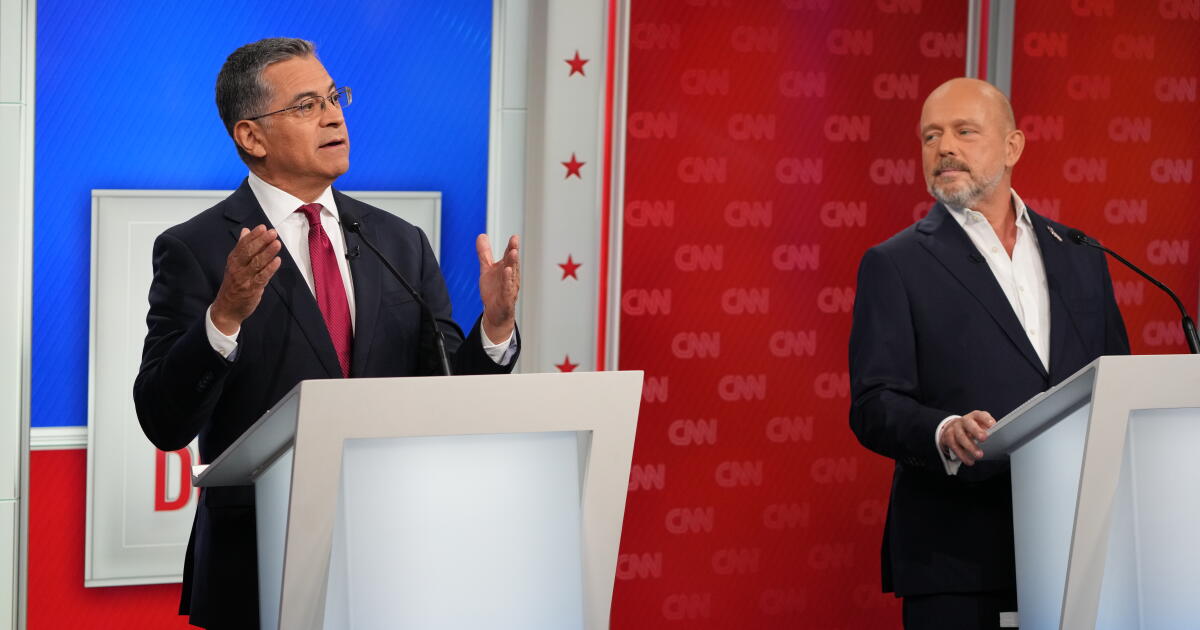
That’s an impressive list. But Schnur says Becerra was “the least impressive” candidate in a 90-minute televised debate last week.

“He talked in very vague generalities,” the former political operative says, but adds: “In the middle of the other candidates’ drama and emotional outbursts, he seemed very calm and safe.”

Some pundits and pols have been calling on Becerra to show more fire. But that’s not him. He’s guarded and understated. It’s how he’s wired. If he attempted a personality change, it probably wouldn’t work. There’s a risk of it seeming contrived and phony.

But Becerra should be more specific on issues. Exactly how would he make life better for Californians?

His basic answer when asked how he’d solve a given problem pestering California is essentially: Trust me. I’ll meet with all sides and figure it out.

That’s not just a cop-out. It’s his pragmatic modus operandi.

That reserved style prompted this shot during the debate from Porter, who tends toward specificity:

“Mr. Becerra, you have all these lovely plans. But there are never any numbers, any revenue plan, any details. … The how, the why and how much, it’s all missing.”

Becerra responded with some rare emotion: “That’s very rich to hear from someone who’s never had to actually run a government.” The former Cabinet secretary said he’d balanced four federal HHS budgets that were larger than the California state budget.

I asked Becerra about some issues last week. Here’s partly what he said:

Housing costs: Expedite building by streamlining more regulations. “We’ll continue to have rules, but let’s make them smart rules.”

Gas prices: Keep more refineries from closing. “Let them know they can operate and produce and not lose money. That’s an easy one.”

High-speed rail: ”We’re going to build the bullet train, but not this bullet train. It’s too expensive. Sit everybody down and come out with a position.”

Banning new gas cars by 2035: Is Newsom’s goal realistic? “Seeing what I see, no. We can’t make it by ‘35, but we can make it.”

But let’s be honest. Elections usually turn more on likability than policy positions.

“Decency may be a quality that goes a long way” in the governor’s race, says longtime Democratic strategist Darry Sragow. “In part that’s because of the Swalwell revelations and also because of Trump, who’s not decent. Decency may be what people are looking for.”

But Democrats are riled up by Trump and they’re also demanding backbone and fight.

Many are eyeing Becerra as someone perhaps worth partnering up with. A bit more passion from him could help sustain their interest.

What else you should be reading

The must-read: The congressional landmine stirring fears about the midterm election — and a Trump power grab
Brace yourself: Voter ID controversy headed for California with initiative on November ballot
The L.A. Times Special: How a Trump-endorsed Republican could become California’s next governor

Until next week,
George Skelton


Was this newsletter forwarded to you? Sign up here to get it in your inbox.

Source link

Column: Tucker Carlson’s reversal on Trump is a familiar script

This week Tucker Carlson apologized for unintentionally “misleading” voters into supporting President Trump’s return to the White House. The apology came days after the president called Carlson dumb and overrated on social media. We’ve seen this plot before: It’s a different name but the same story.

Recall the president’s first term was closely shadowed by high-profile breakups from loyalists who disagreed with him on matters of substance. For example, the split with his first Defense secretary, James Mattis, began in 2017 when Mattis, a man who spent more than four decades in uniform, defended the importance of NATO. His successor, Mark Esper, found himself at odds with the president for refusing to use the military on citizens. On his way out the door, Esper told the country that if his replacement was “a real ‘yes man’ … then God help us.”

Some of the highlights from Trump’s second term include squabbles with his biggest donor, Elon Musk, who was upset the president wasn’t lowering the national debt enough; with former congresswoman Marjorie Taylor Greene because millions of Americans faced losing health insurance; and with Rep. Thomas Massie for having the audacity to seek justice for the victims of Jeffrey Epstein’s child sex-trafficking operation.

Now it appears it’s Carlson’s turn. He, like Pope Leo XIV and many of our allies and nearly 70% of Americans, disapproves of the president’s handling of the war in Iran. On a recent episode of the Carlson podcast, the former Fox News host invited his brother Buckley, himself a former Trump speechwriter, on the show to discuss their buyer’s remorse.

Everyone has that line they won’t cross for the president.

Omarosa Manigault Newman left reality TV to advise Trump. She followed him to the White House, found out there was a lot of racism over in MAGA land, and ended up back on reality TV. For Mattis, it was abandoning our allies. For Esper, it was shooting protesters.

For Carlson, it’s Iran. Candidate Trump campaigned on ending endless wars. This week, Trump said there’s no timeline for when the war he started with Iran will end.

“I do think it’s like a moment to wrestle with our own consciences,” Carlson told his brother. “We’ll be tormented by it for a long time. I will be. And I want to say I’m sorry for misleading people.”

Now before Tucker’s apology, Buckley defended his initial support of Trump’s candidacy in 2015 — despite “all of his obvious foibles and his disgusting elements of his personality” — in part because “he built things.” Buckley also said that after the election of President Obama, white Americans in Washington were subjugated by a version of Jim Crow in education and society, and that progressives “would look blank or angry” whenever he asked what Obama was doing to strengthen the nation.

In other words, being red in the face over Trump did not turn the Tucker boys blue. In fact, the episode ended with the two calling the left a bunch of “lunatics,” even after listing the ways the Trump administration was holding back release of the Epstein files and hurting the country.

“Demonic influences concentrate on those who have power. Beware of power,” Tucker warned listeners halfway through the show before his brother chimed in: “And those who seek power.”

Of course, Trump’s ascension to the White House wasn’t solely based on the contributions of media folks. The president entered 2015 having been a public figure for more than 30 years. He’s had the luxury of criticizing elected officials and legislation on camera without the burden of governing for much of that time. When he entered the political arena, he didn’t have a record to defend. He likes being quotable, not being held accountable. That’s why it’s doubtful he would have been elected a second time if not for the support from unscrupulous podcasters masquerading as political journalists such as Joe Rogan, Theo Von and Andrew Schulz, who less than a year ago said everything Trump “campaigned on, I believed he wanted to do. And now he’s doing the exact opposite thing.… I voted for none of this.”

As if “this” had not been clearly spelled out in the pages of Project 2025 for all to see before deciding whether to vote for Trump and that agenda.

Schulz, the comedian and podcaster, might not have read that outline, but Tucker Carlson probably did. That’s why his apology to listeners — like the mea culpas from the discarded loyalists of the past — ultimately won’t mean anything to mainstream Republicans or MAGA. Those who identify with the latter listen only to Trump. As for the former — they have always known that people like Carlson don’t regret supporting Trump. They regret falling out of favor.

YouTube: @LZGrandersonShow

Source link

Column: Swalwell scandal exposed flaws in top-two primary

California Democrats caught a huge break with Eric Swalwell’s sexual assault scandal. It surfaced in early spring rather than midsummer.

Just think of the Democratic debacle that could have occurred.

What if the accusations of sexual misconduct, including alleged rape, had come to light after the gubernatorial candidate had triumphed in the June 2 primary and qualified for the November ballot?

Under California law, it would have been impossible to remove him from the ballot and insert a Democratic replacement.

“It would have been pretty devastating,” notes Assemblywoman Gail Pellerin (D-Santa Cruz), who heads the Assembly Elections Committee.

“It has given us a lot to think about.”

There’s a glaring flaw in California’s election system that should be fixed for the future. But exactly how is trickier than it might seem.

Here’s what I’m talking about:

Prior to April 10 — doomsday for Swalwell — the then-congressman from the East San Francisco Bay was leading the large field of Democratic candidates for governor. Just barely. But he was starting to pull away, based on polling and endorsements.

A survey conducted by the independent Public Policy Institute of California just before Swalwell’s accusers went public showed him leading all candidates — Democrats and Republicans — with 18% support among likely voters.

He was closely trailed by Republican Steve Hilton, a former Fox News host, with 17%. Another Republican and a Democrat — Riverside County Sheriff Chad Bianco and billionaire climate activist Tom Steyer respectively — were tied for third at 14% each. Democratic former Orange County Rep. Katie Porter followed at 10%.

You can now toss all those numbers in the trash. But the point is that Swalwell was headed for victory in the primary. His next stop was the governor’s mansion because no Republican has won a statewide race in California in two decades.

The Democratic front-runner was raking in endorsements from interest groups and democratic politicians. He was considered the safest bet in a generally unimpressive field, a regular middle-class guy — and a white male, the only ethnicity and gender that has ever been elected governor in California.

Former state Controller Betty Yee, a Democratic darkhorse candidate for governor, was pretty much on target when she observed after Swalwell’s campaign collapsed:

“The obsession with who looks the part [of governor] almost got us an alleged sexual predator in Sacramento — ignoring the reality we need to actually fix our fraught state.”

But what if the victims of Swalwell’s alleged sexual improprieties — five women at last count — had waited a few more months to go public? And that’s conceivable. After all, they had remained silent for years. Apparently the nightmare of their alleged assailant becoming governor inspired them to talk now.

Although Swalwell quickly dropped out of the race, there’s no way to erase his name from the primary ballot. But at least voters can choose among seven other “major” Democratic contenders.

If he had already won in the top-two primary, however, and a Republican had also qualified for the November ballot, Democratic voters would have been left high and dry.

Presumably no sane person, no matter how partisan, would vote to elect an alleged rapist as governor. But the only other choice would have been a Republican lackey of President Trump. He’d undoubtedly win by default in a landslide.

“If Democrats had been stupid enough to nominate Swalwell, they’d have been stuck with him,” says Tony Quinn, a Republican elections analyst.

“Even dying doesn’t get you off the ballot. You don’t want to be the party nominee? So what, you are.”

No write-in candidacies are allowed in California’s general elections, although they are in the primary. That’s an inexplicable flaw.

“I’ve thought for years there should be a write-in option to deal with such a problem,” says UCLA law professor Rick Hasen, an expert on elections law.

Also, he points out, California’s top-two primary system — which advances only the top two vote-getters regardless of party — “cuts out minor parties from being relevant. You ought to be able to write in a minor party candidate.”

One reason a candidate can’t be removed from the ballot, election officials claim, is that tens of millions ballots have to be printed early enough to mail to every registered voter one month before election day.

Nonsense. In this era of rapidly expanding technology, you’d think that dilemma could be resolved even within snail-paced government bureaucracies. If nothing else, mail out a supplemental ballot just for the governor’s race.

But a bigger question is exactly who would choose the replacement for a departed candidate.

In a presidential election, the party hierarchy — a convention or national committee — would choose another nominee.

But there are no party nominees in California’s top-two open primary system. Parties don’t choose candidates for the November election. Voters regardless of their party do. So, in Swalwell’s case, the Democratic Party alone wouldn’t be entitled to select his substitute — unless the law were changed.

Or, perhaps the No. 3 vote-getter in the primary could automatically be elevated to the general election. We then could wind up with two candidates from the same party. But at least there’d be a better choice than an alleged sexual predator.

“I kind of miss those days” when parties nominated, says Pellerin, who was Santa Cruz County’s chief elections official for 27 years. “It’s something I’ve been thinking about — whether this is the best primary system.”

As I recently wrote, my vote would be to junk the top-two system and return to pre-”reform” party-nominating primaries.

Advocates of the top two primary — including myself — thought it would produce more centrist officeholders. It really hasn’t. It has just caused additional problems — like occasionally sending two candidates of the same party to the November runoff.

Meanwhile, all California voters should be grateful that Swalwell’s accusers courageously went public in April, not August.

You’re reading the L.A. Times Politics newsletter

George Skelton and Michael Wilner cover the insights, legislation, players and politics you need to know. In your inbox Monday and Thursday mornings.

What else you should be reading

The must-read: Swalwell supporters scramble after he drops out of governor’s race. Who will benefit?
California love: Californians are pouring money into Democrats’ Senate races in other states
The L.A. Times Special: There’s a wide gap between rumor and fact. That’s where Eric Swalwell lurked

Until next week,
George Skelton


Was this newsletter forwarded to you? Sign up here to get it in your inbox.
Source link

Column: How COVID is helping Biden advance broader agenda

When Joe Biden launched his campaign for the presidency in 2019, his economic proposals were relatively modest updates of the middle-class-oriented agenda he championed as vice president under Barack Obama. “It doesn’t require some fundamental shift,” he said, pushing against the sweeping proposals of rivals like Bernie Sanders and Elizabeth Warren.

Then came the pandemic.

Today, Biden’s economic message, retooled to address current needs, has real urgency.

“We can’t wait,” he said last week. “There’s a lot of people who are in real, real trouble — a lot of people going to bed at night, staring at the ceiling wondering … if they’re going to be evicted.”

And Americans seem ready to spend to make things better. The huge $1.9-trillion pandemic relief bill Biden has proposed is wildly popular. A CBS News poll last week found that 79% of Americans want Congress to pass a bill as big as the one Biden proposed, including 61% of Republicans.

Biden isn’t stopping at pandemic relief. He’s also using the emergency to build support for the far broader program of economic reform he adopted midway through his campaign last year, including massive investments in manufacturing, technology, education and child care.

“We’re in a position to think big and move big,” he said.

He’s following the advice that Rahm Emanuel, then a member of Congress, offered during the financial crash of 2008: “You never want a serious crisis to go to waste.”

For Biden, that begins with the pandemic relief plan, a package that includes a $1,400 check for most adults, increased unemployment insurance, a child tax credit of up to $3,600 a year, $440 billion for state and local governments and $130 billion to help reopen schools.

And once that proposal is enacted, White House officials say, the president will turn to the broader, long-term economic proposals of his campaign, including a $400-billion “Buy American” plan to support manufacturing, $300 billion for research and development, more spending on clean energy and — if it doesn’t pass as part of the pandemic package — a $15 minimum wage.

It’s an ambitious agenda: a dramatic expansion of federal government spending to create jobs, especially in manufacturing and strategic technologies.

Biden’s economic populism is aimed, in part, at the same voters Donald Trump appealed to when he called for revitalizing American manufacturing and bringing jobs back home — but only in the sense that Biden, too, has promised to repair some of the damage wrought by the long decline in manufacturing jobs.

“A lot of white working-class voters thought we forgot them,” he said last year during a campaign tour of faded industrial towns in Pennsylvania. “I get them. I get their sense of being left behind.”

He’s kept a few of Trump’s policies, most notably the tough stance on trade with China. But the difference in the two populisms is illustrated by the predecessor each president chose as a model.

In Trump’s Oval Office, he hung a portrait of Andrew Jackson, the 19th century nationalist who warred with bankers on behalf of working-class white Americans but also supported slavery and pushed tens of thousands of Native Americans off their ancestral lands.

Biden replaced Jackson’s portrait with one of Franklin D. Roosevelt, the Depression-era Democrat who enacted Social Security, vastly expanded the federal government and was reelected three times.

If Biden’s economic agenda were being proposed by full-throated progressives like Sanders or Warren, it might sound extreme to many voters. But his long record as a relatively centrist Democrat could insulate him from that hazard, much as FDR’s aristocratic background allowed him to tack left.

“Voters view him not as a radical, but as a get-things-done moderate,” Biden’s campaign pollster, John Anzalone, told me. “Voters are incredibly transactional right now. They want help and they want it quick.”

Republican opposition to both parts of Biden’s agenda — the short-term relief plan and the longer-term reforms — has been muted so far, mostly because GOP leaders have been too busy with family quarrels over Trump’s legacy to offer much of an alternative to the president’s plans.

That’s unlikely to last. There will be plenty for conservatives to oppose soon enough, beginning with the $15 minimum wage and those new big-government economic programs — not to mention the increase in corporate taxes Biden has proposed to help finance it all.

But as the president nears the end of his first month in office, it’s possible to imagine that by the end of 2021 he could be claiming credit for a rebounding economy and pressing ahead with his broader proposals. If he succeeds, the Biden presidency could be transformative in a way even his supporters didn’t expect.

Source link

Column: Pay attention to the deficit, even if Trump won’t

Americans could be forgiven if they’re unaware that President Trump recently performed one of his most essential tasks and sent his annual budget request to Congress, though months late and stunningly incomplete.

After all, so much else has been dominating the news lately: the Mideast war that Trump promised not to start. Price rises he’d vowed to end. His repeated insults of Pope Leo XIV. His portraying himself as Jesus Christ, then lying about having done so. An incompetent attorney general to fire. And the president’s actual priorities — plans for a $400-million White House ballroom and a massive “Triumphal Arch” nearby!

It’s a lot.

Once again, as in Trump’s first term, the public and press are inattentive to the nation’s fiscal health relative to past years. But that reflects the president’s own disengagement with reconciling spending and revenue — this from a president many Americans voted for based on his purported prowess as a businessman. For decades back to Ronald Reagan’s time, so-called deficit wars in Washington were a big story. Now, even Republicans in Congress complain of Trump’s absence from the fiscal fray as they struggle to belatedly finish this year’s budget work that was due last fall, and to end a weeks-old partial government shutdown, before turning to the budget for the fiscal year starting Oct. 1.

Yet it’s worth paying attention to U.S. budgets even if Trump won’t, for the sake of our children and grandchildren who’ll inherit the bills. In one document, a federal budget reflects the nation’s priorities. And these days, in the perennial guns-versus-butter debate, Trump has made his feelings all too plain.

“We’re fighting wars,” he told a group at the White House on April Fools’ Day. “We can’t take care of day care … Medicaid, Medicare, all these individual things.”

Forget that Trump swore to end wars. Or that last year, long before he went to war against Iran, he cut $1 trillion over 10 years from Medicaid and other healthcare programs in his misnamed “One Big Beautiful Bill.”

Yes, budgets can be boring, especially to a president with a famously short attention span. Trump and many of us Americans are distracted constantly by all the shiny objects he throws at the national consciousness by his words, acts and social media postings at all hours.

Yet the budgetary trend is clear to anyone bothering to look: As president, Trump is once again exacerbating the nation’s unsustainable course of piling up debt. According to the nonpartisan Congressional Budget Office, among other credible sources, debt is now approaching the highest level in U.S. history, which was reached during World War II. It already surpasses the size of the entire economy and threatens higher borrowing costs and reduced investments.

For all the achievements Trump likes to claim — ending eight wars in a year! — here’s one that’s real: He is on a path to break his own record for the most debt in a single presidential term, $8.4 trillion in Trump 1.0, which was nearly double the increase under President Biden.

Need further proof of Trump’s brazen mendacity? Of course you don’t, but here it is: In the face of the well-documented budget record, Trump declared both this year and last year to a joint session of Congress, on national television, that he would balance the federal budget —“overnight,” he said in February.

The inequitable tax cuts and big spending increases for the military and immigration crackdowns that Trump and the Republican-controlled Congress enacted last year are significantly greater than in his first term, and are driving up the debt despite Republicans’ deep healthcare cuts. Just months after Trump took office, the ratings firm Moody’s downgraded the nation’s sterling credit rating for the first time in more than a century.

And now, in his new budget request, Trump seeks to inflate military spending from under $1 trillion when he regained office to $1.5 trillion, for the biggest year-to-year increase in military budgets since World War II.

This fiscal irresponsibility is happening at the worst possible time. For the last quarter of the 20th century, presidents and Congresses of both parties annually debated how to reduce deficits and several times reached consequential multi-year deals, culminating during the second Clinton term in four straight years of surpluses. (Those surpluses ended — wait for it — with Republicans’ tax cuts and war spending during the George W. Bush administration.)

Politicians back then were moved not just by the deficits of their time — deficits that, as a share of the economy, were less than half what they are now. They also were responding to experts’ warnings of a demographic tsunami by the 2020s: With the aging of the huge baby-boomer population, spending for Social Security, Medicare and Medicaid would greatly increase even as the workforce whose payroll taxes support those programs shrank. Today the number of people 65 or older is almost three times what it was 50 years ago, and rising.

This reckoning is upon us, though you wouldn’t know it as Trump keeps calling for cutting revenue and spending more for lawless wars, immigration raids and monuments to himself. Barring bipartisan action, in 2033 Social Security’s retirement fund and Medicare’s hospital fund will no longer be able to cover beneficiaries’ full claims, according to their trustees’ annual report, necessitating reduced benefits or shifts of money from other worthy programs.

Trump did put Vice President JD Vance in charge of a “war on fraud.” But that holds about as much promise as Elon Musk’s fiscal fiasco — remember DOGE? — that cost money instead of cutting $2 trillion as promised.

Like other problems, Trump likely will leave the fiscal follies to his successor, who, should he or she win two terms, would preside as Social Security and Medicare become insolvent. I’ve yet to hear any of the early 2028 presidential aspirants — or Trump — address or be asked about that.

Let the debate, belatedly, begin.

Bluesky: @jackiecalmes
Threads: @jkcalmes
X: @jackiekcalmes

Source link

Column: Bye, bye Eric. Swalwell needs to go

There has never been a California governor’s race like this one. And that was even before the leading Democrat was shoved aside by shocking accusations of sexual assault.

For months, the contest has been uninspiring, unexciting and unwatchable. It really shouldn’t have been called a “race.” It was more like a slow trot. No candidate has drawn even 20% of voters’ support in independent polling. Half the 10 main candidates have been stuck in single digits.

And in less than a month, voters will start casting mail-in ballots.

But suddenly eyes and ears have opened.

Democratic frontrunner Eric Swalwell, a congressman from the East San Francisco Bay, was accused by a former young female staffer of twice sexually assaulting her when she was too intoxicated to consent.

The San Francisco Chronicle reported that Friday and CNN soon followed with a similar report, adding accusations of sexual misconduct from three other women.

“I was pushing him off of me saying no,” the anonymous former staffer told CNN. “He didn’t stop.”

Swalwell, who is married and has three children, strongly denied the accusations.

The incidents “never happened,” he said. “I will fight them with everything I have….

“I have certainly made mistakes in judgment in my past, but these mistakes are between me and my wife. And to her I apologize deeply for putting her in this position.”

Sorry, congressman, but if someone is running for governor of the nation’s largest state, the mistakes aren’t just between him and his wife.

Former House Speaker Nancy Pelosi of San Francisco told Swalwell, in essence, that it’s his right to fight the accusations, but he should do it on his own time, not the Democratic Party’s. She was among the first of party leaders to call on him to abandon the race.

Bye, bye Eric. Might as well depart the House, too.

A leading candidate for California governor has never crumbled so fast. It was like a dam bursting.

Powerful interests and major politicians had been coalescing behind the 45-year-old congressman because he charmed them or they were loyal colleagues or — most important — he seemed like a potential winner.

Political players, including campaign donors, seek to invest their capital in anticipated victors. Their expected return is access and favors. And Swalwell had been racking up lots of endorsements.

But almost immediately after the sex scandal broke, supporters began fleeing the reeking corpse.

Marital infidelity is one thing, but alleged sexual assault — rape — cannot be tolerated, especially by a party dominated by female voters.

Labor unions, other interests and influential politicians began backing off their endorsements. Many urged Swalwell to fold his campaign. And with his support collapsing, he really was left ultimately with no other choice.

So, now the most pertinent question is which candidate will replace Swalwell as the Democrat with the best chance of surviving the June 2 top-two primary and winning a spot on the November ballot.

If it’s a Democrat against a Republican in November–the most likely matchup–the Democrat is a virtual cinch to succeed the termed out Gov. Gavin Newsom. No Republican has won a statewide race in California in 20 years.

State Democratic Chairman Rusty Hicks — as part of his effort to pressure lagging candidates to exit the race and make more room for faster runners — released a nonpartisan, party-paid poll last week. It was conducted before Swalwell’s collapse.

It showed two Republicans tied for the lead with 14% each: Riverside County Sheriff Chad Bianco and conservative commentator Steve Hilton.

Among Democrats, Swalwell led with 12%, slightly ahead of billionaire hedge fund founder Tom Steyer at 11%. Former Orange County Rep. Katie Porter had 7%. Then came former U.S. Health Secretary Xavier Becerra, San José Mayor Matt Mahan and former Los Angeles Mayor Antonio Villaraigosa, each with 4%.

Former state controller Betty Yee and state schools chief Tony Thurmond barely registered at 1% each.

For weeks, it has been deemed conceivable that both Republican candidates would finish ahead of all Democrats in the June 2 primary. Democratic voters would splinter their support among the party’s crowded field. That would lock out Democrats from the November ballot and guarantee the election of a Republican.

But President Trump seemed to botch that for the GOP last week by endorsing Hilton. Trump presumably will help the former British politico draw votes from Bianco and indirectly assist a Democrat in finishing second.

There’s a new twist, however. Where will Swalwell’s votes go? If enough go to the Democratic laggers rather than the party frontrunners, both Republicans could still wind up one-two.

No gubernatorial contest in modern times has been this wide open.

These candidates’ failure to make waves isn’t all their fault. Some were slow diving into the water. But even those who tried to make a splash were inundated by Trump.

Practically all the public’s attention has been on the president and his oddball or vengeful or unprincipled actions.

Now the Democratic race is more wide open than ever.

Steyer — a liberal climate fighter — has run an energetic campaign, spending more than $100 million of his own money on TV ads. But will Californians elect a mega-rich governor? They never have.

Porter has been running better in polls than the latest Democratic survey showed. She’s straight forward on all the issues, but a bit too liberal and feisty for some establishment Democrats. Swalwell’s fall is her opportunity to rise.

Becerra — a former state attorney general and congressman — has an impressive resume, but was too slow out of the starting gate. This is his chance to sprint, if he can.

No candidate is more qualified to be governor than centrist Villaraigosa, a former state Assembly speaker. But voters apparently are looking for someone younger. He’s 73.

Mayhan is a moderate who started too late and has fallen far short of expectations. He now has a second chance.

It soon will all be in the hands of voters, whether they’re interested or not.

You’re reading the L.A. Times Politics newsletter

George Skelton and Michael Wilner cover the insights, legislation, players and politics you need to know. In your inbox Monday and Thursday mornings.

What else you should be reading

The must-read: Eric Swalwell’s bid for California governor is over. Let the political scrambling begin
Knives out: GOP’s best shot at California governor’s office in decades mired in angry internal debate
The L.A. Times Special: Newsom reluctant to endorse a successor, break gridlock in governor’s race

Until next week,
George Skelton


Was this newsletter forwarded to you? Sign up here to get it in your inbox.

Source link

Column: Broken Lakers need to shut down the season

Barely a week ago, a charmed Lakers season screamed three words.

Deep playoff run.

Today, a jinxed Lakers season soberly whispers three very different words.

Shut it down.

With less than a month of games remaining, the Lakers season is done, finished, kaput.

Twisted and torn by the sudden same-day injuries to their two best players, the Lakers are broken beyond repair.

They can’t win without Luka Doncic and Austin Reaves, and neither is coming back at full strength in time to save them.

They were wholly embarrassed in their first two shorthanded games and will wind up falling to a fourth or fifth seed with a first-round matchup looming against Kevin Durant and the Houston Rockets.

They can’t beat the Rockets, they won’t beat the Rockets, and the season will officially and quickly and sadly end. It might end in something more palatable than a sweep — maybe they win a game? — but it’s going to end, and soon, and the Lakers need to reinforce their priorities before it does.

Shut it down.

Tell Doncic to stay in Spain for as long as it takes for that magic medicine to cure his strained hamstring. Tell Doncic his MVP-worthy season is DOA. Tell Doncic to begin getting ready for September.

The Lakers don’t need him showing up in three weeks trying to save this season on a limp and a prayer. They don’t need him risking a reinjuring of the hamstring that could affect his summer workouts and bleed into next season.

Lakers star Luka Doncic holds his head in his hands while reacting to a play against the Thunder.

Lakers star Luka Doncic reacts to a play during a blowout loss to the Thunder in Oklahoma City last week.

(Cooper Neill / Getty Images)

Most experts agree it would be a miracle if Doncic would return at 100% in time to carry them through the first round of the playoffs, which start April 18. The Lakers don’t need him to be a miracle. They need him to be the cornerstone of a franchise that is being rebuilt in his image.

They don’t need him now, when he’s not going to save them anyway. They need him six months from now, to be healthy and in shape to lead them into their next era.

Shut it down.

The Lakers need to say the same thing to Reaves, who they’re going to give a boatload of money this summer to be their No. 2 star for the indefinite future.

They don’t need him to try to play with an injured oblique and make things worse. They don’t need him to gut it out. They need him to sit it out.

The fans aren’t going to like reading this. And the players aren’t going to like hearing it.

Just listen to Giannis Antetokounmpo, the Milwaukee Bucks star who has been shut down since March 15 because the Bucks didn’t want his nagging injuries to worsen and affect either his trade value or his 2026-27 season.

“Like a slap in my face,” he told reporters recently. “I’m available to play today. Right now. I’m available. Do I look like I’m not available? … I don’t know what game is being played right here, I just don’t wanna be a part of it.”

There is no game with the Lakers. Their new Dodger ownership group doesn’t play games. Their goal is to build a franchise that has sustainable success. Pushing all their chips into the middle for a team that doesn’t have a chance in hell is not building sustainable success.

You’ve seen how the Dodgers rest their players for six months to prepare themselves for the postseason, right. Shutting down the Lakers now is sort of this, in reverse. They’re punting in the playoffs to prepare themselves for next season.

Certainly, Doncic would take the news of a shutdown about as well as Antetokounmpo.

“I think he’s, in my conversations with him, he’s motivated to do everything possible,” said coach JJ Redick to reporters. “And I know for him, it’s hard for him not to be on a basketball court. That’s his happy place. And he’s one of the handful of guys that really plays year round. And it’s not just international competition. But he likes to be in the gym. He likes to be working on his craft. And I think it’s hard for him. He wants to get back on the court.”

Lakers forward LeBron James tilts his back as he reacts to a play against the Kings.

Lakers forward LeBron James reacts to a play during a win over the Kings last month at Crypto.com Arena.

(Eric Thayer / Los Angeles Times)

And no, LeBron James is not going to be happy either, trying to carry a team that seemingly isn’t trying. So what? Do you really believe he is going to take remarkably less money to stay on the Lakers next season? Do you really believe the Lakers want him back when they will have the cap space to trade for a player like, um, Antetokounmpo?

To leave James alone on a first-round island might be unfair, but the Lakers have kowtowed to him plenty in his eight years here. He’s just going to have to take one for the team, however briefly that team may be playing.

“It was a shot to the heart and the chest and the mainframe with Luka,” James told reporters. “I woke up from my nap and saw that [Reaves] news and was like, ‘S—.’”

You know who else wouldn’t easily accept the news of a shutdown? That would be Redick, who, barely one week after being lauded as the first Laker coach since Phil Jackson to manage consecutive 50-win seasons, now finds himself again fighting for credibility.

Remember last year when Redick took heat for playing his starters the entire second half of a playoff loss to Minnesota?

He’s taking heat again this spring for playing both Doncic and Reaves in the second half of a blowout loss to Oklahoma City that sent both players to the injured list.

Lakers coach JJ Redick directs players during a blowout loss to the Thunder on Tuesday.

Lakers coach JJ Redick directs players during a blowout loss to the Thunder on Tuesday.

(Robert Gauthier / Los Angeles Times)

When Doncic was hurt the Lakers trailed by 32 and he had already looked injured after grabbing his leg in the second quarter. Reaves, meanwhile, spent much of the first quarter grabbing at his back.

Redick said both players were medically cleared and that they both insisted on challenging the league-leading Thunder in the second half.

“The group wanted to go for it in the second half,” Redick told reporters. “There was nothing leading into that game that would suggest either those guys were ‘running hot.’’’

This was just the beginning of Redick’s bad week.

Jarred Vanderbilt was certainly running hot Tuesday night in a rematch against Oklahoma City after he was benched in the first moments of the second quarter. Vanderbilt accosted Redick on the court and had to be restrained. Redick ultimately responded by benching Vanderbilt the rest of the game and then not-so-subtly ripping him afterward.

“I think for all of us, you know, being undermanned, we’ve got to scrap and claw, we’ve got to all be on the same page, we got to be great teammates, we got to all play hard,” Redick told reporters. “Called a timeout to get him out of the game. And he reacted.”

One has to wonder about Redick’s connectivity with his players if one of them is unafraid to confront him on the court during the middle of a game.

One has to also wonder, again, about Redick’s big-game management style if he would allow his two best players to risk their health during a blowout.

Redick, who signed an extension in September that will keep him under contract until 2030, is not on the hot seat, not yet. But another spring meltdown will not endear himself to new owners who expect their coaches to be the calm face of the organization.

Then again, for everyone involved, there must be some grace granted in the wake of the incredible tension surrounding a team whose dream season just became a nightmare.

End the nightmare now. For the sake of the future of the franchise, shut it down.

Source link

Column: We’re stuck with an unchecked mad king until January

Amid all the alarming and unhinged comments of the president of the United States in recent days threatening Iran with genocide — remarks beyond even the usual cray-cray blather from Donald Trump — it was a statement from his spokesperson on Tuesday that really put the madness in the White House in perspective.

“Only the President knows where things stand and what he will do,” Karoline Leavitt said.

She issued those words just hours before Trump’s 8 p.m. Tuesday deadline for Iran to either reopen the Strait of Hormuz to international shipping or face Armageddon — that is, war crimes by the United States. The statement from the White House press secretary was as clear a description as Americans could get of governance under Trump these days: A mad king reigns, virtually unchecked.

And as a practical matter, there is nothing under the Constitution, neither impeachment nor removal under the 25th Amendment, that can be done about him. There’s only voters’ opportunity to eject the complicit Republican majorities in the House and Senate in November’s midterm elections, to install a Democratic — and democratic — check on Trump for the remaining two years of his term.

By now we know that, just before Trump’s deadline to Iran warning “a whole civilization will die tonight,” he announced a fragile two-week ceasefire for negotiations. The commander in chief declared victory, natch. But so did Iran. And it had the better of the argument: Iran continued to control and monetize passage through the strait, unlike before Trump’s war began Feb. 28, and already on Wednesday it flexed that power by closing the route in retaliation for Israeli strikes. The ceasefire also lets Iran retain possession of its enriched, nearly bomb-grade uranium, and the nation won Trump’s offer of possible tariff and sanctions relief.

So much for the “UNCONDITIONAL SURRENDER!” he demanded in a post a month ago.

I’m writing these words on Wednesday. Who knows where things will stand by the time you’re reading this? “Only the president knows.”

Trump has fluctuated, reversed and contradicted himself repeatedly — even within a single social-media screed or chest-thumping performance for the press — since he ordered war against Iran nearly six weeks ago, without notice to Congress, let alone its authorization. Since Sunday, he’s variously called Iran’s leaders “crazy bastards” and “animals” and taken credit for “Total Regime Change, where different, smarter, and less radicalized minds prevail.”

Presidential rule by fiat and whim would be wrong in any case under the Constitution’s checks and balances of power, and specifically of war power. But in Trump’s case, America has a president who lately has piled on the evidence that he is mentally unstable, unfit for the office.

And spare us the cheerleaders’ claims on Fox News about how he’s playing multidimensional chess. When even Alex Jones likens Trump to “crazy King Lear” and calls for invoking the 25th Amendment to remove him from power — echoing former Trump promoters including Marjorie Taylor Greene and Candace Owens, among others — you know he’s crossed a line by his unilateral war-making and profane threats (on Easter Sunday!) of genocidal apocalypse.

The evidence of Trump’s dangerous instability has been there from his political genesis. In his first term, he warned he’d unleash “fire and fury like the world has never seen” against nuclear-armed North Korea then declared that he “fell in love” with dictator Kim Jong-un (without achieving any diminution in Kim’s arsenal). He celebrates the deaths of political enemies and prosecutes those still living. He repeatedly interrupts himself on some policy question to bloviate about his ballroom plans.

He’s ordered armed agents into American neighborhoods on immigration raids, then expressed neither responsibility nor remorse when citizens died and legal residents got deported. The national security leaders of his first term let it be known that they’d prevented him from acting on his worst impulses, but there’s no chance of that from Defense Secretary Pete Hegseth. Retired Gen. Mark Milley, former chair of the Joint Chiefs of Staff, in 2021 described first-term Trump as being in mental decline and “fascist to the core.”

You’d be hard-pressed to find anyone who thinks Trump has gotten better in the intervening five years.

The country “can’t be a therapy session for … a troubled man like this,” Trump’s first-term attorney general, William P. Barr, told CBS in 2023 as Trump campaigned to return to office.

If only the presidency were therapy for Trump. Instead he’s like a power addict in the world’s most powerful job, mainlining its intoxicants, and no one will stop him. Only people with extraordinary egos seek the White House in the first place, but when an actual egomaniac inhabits that warping bubble of butter-uppers, there’s danger. I remain haunted by the words of retired Gen. John F. Kelly, Trump’s first-term Homeland Security secretary and then White House chief of staff, who in 2023 said of Trump’s potential reelection: “God help us.”

Having failed twice to convict and remove Trump in his first term, Democrats have shied from a third attempt, until now. Scores in Congress have called for impeachment or invocation of the 25th Amendment to oust him. There’s some value in sending a message. But Democrats are offering supporters false hope. A Republican-led Congress and a Cabinet of clownish sycophants will not exercise the powers they have, even against a mad king.

The authors of the Constitution, having thrown off a king, debated at length how to guard against a power-crazed president. But they didn’t anticipate political parties that put tribal loyalty over the country. That partisanship has rendered the high bars to a president’s removal — a vote of two-thirds of the Senate for conviction after impeachment, or, under the 25th Amendment, action by the vice president and a Cabinet majority — all but insurmountable.

That leaves the voters, who in special and off-year elections as recently as Tuesday have shown their zeal to punish Trump’s party. We can hope that a new Congress will check him come January.

And we can pray.

Bluesky: @jackiecalmes
Threads: @jkcalmes
X: @jackiekcalmes

Source link

Column: Trump’s cries of cheating on mail-in ballots defy logic

Why would an immigrant living here illegally risk jail and deportation by trying to vote? That has always puzzled me.

And why would a political pro waste time and money soliciting votes from noncitizens when there are millions of legal voters available to persuade?

The answer is that undocumented immigrants don’t. And neither do campaign consultants.

President Trump and MAGA Republicans who echo his diatribe are hallucinating or outright lying when they claim without evidence that there’s widespread fraud in American elections — specifically in blue states like California that vote for Democrats.

Trump reiterated the fabrication last week when he signed an executive order seeking to place tight federal controls on increasingly popular mail-in voting.

“Mail-in voting means mail-in cheating,” Trump reiterated. “Cheating on mail-in voting is legendary. It’s horrible what’s going on.”

“See you in court,” California Gov. Gavin Newsom replied.

California and several states partnered in filing a lawsuit accusing the president of an illegal power grab. They pointed out that states have a constitutional right to administer elections pretty much as they see fit.

Trump hypocritically voted by mail himself in a recent Florida special election.

“You know what, because I’m president of the United States,” he told reporters when asked about the vote. “I had a lot of different things” to do. For him, voting by mail was convenient.

As for the rest of us, apparently in Trump’s mind we don’t do anything important enough to warrant handy mail voting.

The reality is that egotistical Trump still can’t admit to himself that he lost the 2020 presidential election to Joe Biden fair and square. Democrats must have cheated, he thinks — or says he does.

The main way Democrats cheat, Trump and his followers assert, is to round up noncitizens and register them to vote — especially immigrants from Latin America.

It’s nonsensical. As if some undocumented immigrant struggling to survive and dodge ICE agents really gives a rat who’s elected governor or senator. Voting fraudulently is a crime — a misdemeanor or a felony, punishable by a steep fine and/or jail time.

And a campaign pro is going to break the law by offering cash or groceries to a noncitizen for her vote? That would be felony stupid.

“We can’t get Latinos who have been here legally for three generations to vote. If you’re going to spend money getting votes, that’s where you’re going to spend it,” says Republican consultant Mike Madrid, who has written a book about Latino political influence.

“The notion that Democratic operatives are going after undocumented immigrants is absurd.”

People who migrated here illegally, Madrid adds, “don’t want to touch the government in any shape or form. They just want to put in a hard day’s work and retreat to the shadows. They couldn’t care less about politics and voting in the United States.”

No hard evidence of significant election fraud in America in recent years has been produced by Trump or anyone else.

Riverside County Sheriff Chad Bianco, a leading Republican candidate for governor, apparently was trying to impress Trump and win his endorsement by seizing more than 650,000 ballots cast in November’s Proposition 50 election.

The sheriff said he was investigating claims — unsubstantiated — of election fraud. But the project is now on hold. A good place for it.

It was a waste of the sheriff’s resources to collect the ballots and would be an even bigger misuse of personnel and money to sift through all of those documents in a fruitless search for fraud.

I called Assemblywoman Gail Pellerin, a Democrat who was Santa Cruz County’s chief elections official for 27 years. She chairs the Assembly Elections Committee.

In all of those years supervising elections, Pellerin told me, she encountered only one clear case of fraud. A landlord snatched a ballot that had been mailed to a tenant and illegally cast it.

But a voter must sign the envelope containing a mailed ballot and the landlord’s signature didn’t match the intended voter’s as given when she originally registered. Election officials contacted the intended voter, who said she hadn’t received her ballot yet. The landlord was prosecuted and convicted.

Signatures are checked with the use of technology in California. That’s the main method of verifying a mailed ballot’s legality.

Pellerin says her own signature didn’t match up once. “I got sloppy and my signature had changed since I registered 20 years earlier.” She was contacted by an elections official and her ballot ultimately was counted.

In every election, she says, there are cases of a mother signing the ballot for a daughter who’s away at college, or someone signing for an aging parent. The signatures invariably don’t match and the voters are contacted.

But that’s about the extent of so-called cheating, Pellerin says.

“Immigrants are here to make their lives better,” she says. “They’re not going to risk any path to citizenship by trying to participate in an election.”

When voters register, they must answer under penalty of perjury whether they’re a citizen.

Trump’s convoluted intervention in state-operated voting would, among other things, direct the United States Postal Service to design new envelopes with bar codes that verify voter legality. The feds would refuse to send ballots to people deemed ineligible to cast them.

Gosh, what could possibly go wrong under the Trump administration?

Californians have embraced mail-in voting. In the gubernatorial election 40 years ago, only 9% of ballots were cast by mail; 20 years ago, 42% were. In November, it was up to 89%.

But baseless claims by Trump and his grovelers of “cheating” will persist. It fires up the conservative base and raises political money.

It also maligns noncitizens and dedicated elections officials who keep voting fraud-free.

You’re reading the L.A. Times Politics newsletter

George Skelton and Michael Wilner cover the insights, legislation, players and politics you need to know. In your inbox Monday and Thursday mornings.

What else you should be reading

The must-read: California election experts sound alarm as rate of rejected ballots quadruples
What the … : Californians may need to mail ballots early as Supreme Court signals support for new election day deadline
The L.A. Times Special: The loophole that keeps a Trump loyalist serving as L.A.’s top federal prosecutor

Until next week,
George Skelton


Was this newsletter forwarded to you? Sign up here to get it in your inbox.
Source link

Tony Pulis column: What Roberto de Zerbi needs to do to turn Tottenham around

Around 40% of clubs in England’s top four divisions of men’s football have changed their manager this season, and one in four of those teams have made more than one change.

With those stats still so high, I am sure people outside the game must be wondering about the process of appointing a manager.

In my day, I never once put on a presentation in front of a chairman or board of directors as part of any interview process.

Usually it was your management record, and your relative success with the respective budgets you’d been given, that would seal the deal.

Today, that has all changed. Many managers and coaches, I’m told, pay to have these presentations professionally prepared for them.

Before you get to that stage, however, club owners and chairmen will rely on their sporting director and chief executive to compile a list of names.

As I’ve mentioned in previous columns about the lack of opportunities now for British managers, with so many foreign owners in our game, there are lots of foreign sporting directors too, so it is not surprising they appoint managers and coaches they know.

Also, the agents who have assisted the owners when they purchased the club, will often have a big say on who the sporting director is too.

Players will also flow into some clubs in a similar fashion, I’m sure, and I’m afraid all of this impinges on managers and coaches from this country, who are not part of that network.

Academy coaches from the top clubs are finding a way through the system, as I am sure their contacts with clubs’ young players is part of their appeal.

It is definitely a route into management that is worth following but I am sure any ex-professionals who have followed it will have quickly been exposed to the key difference between managing at academy level and being in charge of a club’s first team.

Unlike academy football, which is about development, first-team football is about winning.

Every week you will be judged on your result and, no matter what philosophy you employ, the fanbase and the people above you will react accordingly.

Source link

Column: The time has come to discard California’s top-two open primary

It’s probably time for California to reform the outdated “reform” that could be leading us into an absurd November election with no Democratic candidate for governor allowed on the ballot.

The absurdity is that Democratic voters outnumber Republicans in California by nearly 2 to 1. But the voters’ choices for governor could be restricted to just two Republicans — both disciples of President Trump, who is despised in this state.

We’d be electing our first GOP governor in 20 years.

The odds against this scenario are high. But it’s an increasing possibility.

It’s conceivable because of a crowded Democratic field of candidates and a 2010 reform placed on the ballot after a late-night deal demanded by a Republican state senator — Abel Maldonado of Santa Maria — in exchange for his vote to pass a stalled budget and tax increase.

The compromise led to voter approval of California’s unique top-two open primary. The top two vote-getters advance to the November runoff, regardless of party. It’s called an open primary because voters can choose any candidate, no matter their party.

So two Democrats or two Republicans might be the only choices in November — in statewide, congressional and legislative races. That doesn’t happen often, but it has a few times.

It doesn’t reflect the current reality of American politics, with voters sharply polarized between Democrats and Republicans. They want to vote for someone from their own party and are not interested in choosing among two perceived evils.

We should consider returning to a primary system that produces party nominees — one Democrat and one Republican — to give voters a more varied selection in November. Maybe even allow a third or fourth candidate to emerge from minority parties.

It’s too late to change for this year, but we could for future elections. It would require voter approval.

For the present, we’re saddled with the unwieldy dilemma of there being eight major Democratic candidates and just two Republicans. If the combined Democratic vote is splintered among the eight Democrats in the June 2 primary, the two Republicans could end up finishing first and second.

Political data guru Paul Mitchell, who has been running primary election simulations, pegs the chances of a Democratic lockout at 20%.

“There’s only a one-in-five chance, but you don’t want to see a one-in-five chance with something this important,” says the statistician, who works mostly for Democrats.

“To be safe, the Democratic Party needs to have a candidate polling at 20% or more. And none of the Democratic candidates are half way there. It’s scary.”

Mitchell bases his assessment on a poll released last week by state Democratic chairman Rusty Hicks, part of an effort to pressure low-polling Democratic candidates to step out of the race.

The survey showed both Republicans leading the field — former Fox News host Steve Hilton with 16% and Riverside County Sheriff Chad Bianco at 14%. At 10% each were three Democrats: Rep. Eric Swalwell of the San Francisco Bay Area, former Orange County Rep. Katie Porter and wealthy climate activist Tom Steyer. No other Democrat registered above 3%. There were 24% undecided.

The straggling candidates need to ask themselves, Hicks says: “if you’re polling 1% to 2%, do you have a path to get to 20?

“All of these candidates are experienced. They know in their gut when they’re viable or not.”

Mitchell says, “A lot of folks are now looking at why we have a wacky system that causes [a party chair] to tell candidates they should drop out of a race.”

Yes, it does smack of being undemocratic even if it’s practical politics.

Mitchell says the top-two system should be scrapped.

Hicks agrees.

“Things that were promised [by top-two promoters] have not been delivered,” the state party chairman told me. “It’s time to consider going back to the kind of system voters like.”

Appealing to the middle

I called around and got different views from veteran Democratic strategists.

“It was sold as reform, but it’s not reform. It’s a distortion of the process,” one former political consultant told me, asking for anonymity because of his current employment. “Everybody thought it would yield more moderate, consensus candidates, but that’s not what’s happening.”

Consultant Steve Maviglito, who ran the 2010 campaign against the top-two system, says it’s undemocratic because it risks not giving voters “a chance to cast a ballot for a candidate they have some belief in. That’s what our system is built on.”

The grand theory, he notes, was that candidates would be forced to appeal to the middle.

“Just the opposite,” Maviglio argues. “Democrats want a strong Democrat and Republicans want a strong Republican. The only thing in the middle of the road is a dead armadillo.”

Moreover, he points out, the top-two system has been manipulated by Democrats — including Sen. Adam Schiff and Gov. Gavin Newsom — to boost a Republican in the primary to guarantee a non-competitive, easy election in November.

That’s a bit sleazy.

“The top-two has actually been hugely good to Democrats,” says Democratic strategist Garry South. “They need to think this through. Since the top-two primary was implemented, there have only been three same-party runoffs for state office out of 26 races — all three of them Democrats.

“The current specter of two Republicans [in November] is not the fault of the top-two primary system. It’s due to every Democrat and their brother — or sister — taking a flier and filing for governor.”

“Never,” replies consultant David Townsend when asked whether the top-two primary should be junked. He ran the ballot campaign authorizing it. Townsend insists today’s Legislature contains more moderate Democrats because of the top-two and that they provide a check on the liberal majority.

That’s true to some degree.

OK, we could leave the top-two system for the Legislature and scuttle it for statewide offices.

The thought of being limited to a choice between two Republicans — or two Democrats — for governor is unacceptable and un-American.

You’re reading the L.A. Times Politics newsletter

George Skelton and Michael Wilner cover the insights, legislation, players and politics you need to know. In your inbox Monday and Thursday mornings.

What else you should be reading

The must-read: USC cancels gubernatorial debate amid uproar over candidates of color being excluded

The L.A. Times Special: It’s been decades since California had a governor’s race like this one. That was a shocker

Until next week,
George Skelton


Was this newsletter forwarded to you? Sign up here to get it in your inbox.

Source link

Letters to Sports: Bill Plaschke’s Dodgers prediction is a winner

p]:text-cms-story-body-color-text clearfix”>

Congratulations to all the young athletes and their teams on The Times All-Area high school basketball teams. I do wonder about the choices the seniors are making in their commitments to colleges and I look to The Times to explain why UCLA is seemingly not on the radar for these young players.

It used to be known that the Bruins’ academic requirements were a significant barrier to many high school players. Is that still true? Are the local graduates not the cream of the crop that Southern California was known for in past years? Are NIL deals affecting the choices of these future freshmen? Is UCLA not making a strong outreach effort for the top local talent? Is L.A. so awful for these kids that it isn’t even on their radar to stay close to home?

I am sure I am not alone in seeking clarity around the issue of the exodus of local talent to Missouri, Oregon State, Texas, North Carolina, Nevada, and even more confounding, USC.

David Gerne Echt
Torrance


The Los Angeles Times welcomes expressions of all views. Letters should be brief and become the property of The Times. They may be edited and republished in any format. Each must include a valid mailing address and telephone number. Pseudonyms will not be used.

Email: sports@latimes.com

Source link

Column: Trump’s recklessness endangers the nation

President Trump was uncommonly lucky in his first term, neither inheriting nor provoking a crisis of the sort that tests U.S. presidents, until COVID struck in his final 10 months. (He failed that test, contributing to his 2020 reelection defeat.) Trump 1.0 was bequeathed a growing economy from President Obama, and the incoming president assembled a roster of capable advisors who often acted to prevent him from doing nutty things at home and abroad.

Trump 2.0 made sure that no such human guardrails populated his second Cabinet, only genuflecting enablers. Unrestrained, he has presided over one crisis on top of another, all of his own making. Tariff mayhem and high prices. Armed agents and troops in American cities. Repeated violations of court orders. Demolition at federal agencies and the White House.

And now Trump has taken the nation to war against Iran in league with Israel’s Benjamin Netanyahu. Depending on the moment and the audience, a contradictory Trump is either claiming the war is “very complete” or that much remains to be done to “decimate” Iran. On Wednesday he blithely told Axios, “Any time I want it to end, it will end,” even as U.S. officials planned further actions.

In any case, Trump’s war of choice and the killing of the supreme leader of Iran’s terroristic theocracy now has spawned another potential crisis, counterterrorism experts warn: the risks of retaliatory terrorist threats at home. And that is a threat, whether from homegrown extremists or sleeper cells of the sort that came alive for 9/11, that is likely greater because of the initial self-induced crisis of Trump’s second term: his whacking of the federal government.

Trump authorized Elon Musk’s destruction of the bureaucracy in the name of “government efficiency” and continues to exact retribution against any federal employee who had anything to do with investigating and prosecuting him during his interregnum. Longtime agents and operatives have been eliminated at the FBI, Justice Department, Department of Homeland Security, CIA and elsewhere. Especially at the FBI, counterterrorism experts with centuries of collective experience are gone and many who remain have been diverted to Trump’s top priority: mass deportations.

Consequently, the president who promised to “Make America Safe Again” has arguably made Americans less safe.

I raised this scary prospect just over a year ago as Trump’s teardown of the purported Deep State was underway. And now a Mideast war that Trump promised never to start has further incentivized Iran and its jihadi proxies to hit back, just as he’s diminished the nation’s early-warning systems.

Enough intelligence remains, however, that even in the days before Trump ordered the first strikes against Tehran, government analysts were picking up “worrisome signs” of Iranian plotting against U.S. targets, the New York Times reported. After the U.S.-Israel onslaught and death of Ayatollah Ali Khamenei on Feb. 28, the government intercepted a possible Iranian “operational trigger” to “sleeper assets” outside Iran, according to ABC News.

Counterterrorism expert Colin P. Clarke, executive director of the Soufan Center, which focuses on global security and transnational terrorism, wrote this week in the Atlantic that U.S. agencies’ record of disrupting Iranian-backed plots in America was in jeopardy given the recent changes in funding, personnel and priorities. “Because of this,” he concluded, “the U.S. homeland is arguably more vulnerable than it has been in a long time.”

In a follow-up exchange of emails, Clarke told me, “Many of this administration’s moves have been myopic — shifting counterterrorism resources to immigration, firing FBI agents working counterintelligence, etc. A week before the U.S. went to war with Iran, the FBI Director Kash Patel was off gallivanting in Milan at the Olympics [where he struggled to chug a Michelob Ultra, a firing offense in its own right] when he should have been preparing for the potential for an Iranian response on U.S. soil.”

Patel’s preposterous partying with the U.S. men’s hockey team while war-planning was underway in Washington was widely, justifiably mocked. But it stands as a metaphor for the entire Trump administration’s cavalier attitude toward homeland security. Its abusive focus on both migrants and citizens protesting on the migrants’ behalf is a distraction from actual threats to the country.

Patel, like his boss at the Justice Department, Atty. Gen. Pam Bondi, has made plain in words and actions that the president’s political enemies are the real public enemies No. 1. One of Bondi’s first acts was creation of a “weaponization working group” to identify, fire or prosecute those in her department who’d investigated and prosecuted Trump, many of whom also had experience in domestic and transnational terrorism. The association representing FBI agents called her purges “dangerous distractions” from the work “to make America safe again.”

Days after starting the Iran war, when homeland security should have been on red alert, Trump fired his secretary of Homeland Security, Kristi Noem. Her costly cosplaying as the homeland’s heroine on horseback in anti-migrant videos, along with her penchant for luxury jets allegedly to transport deportees, was too much even for him.

Yet all three “national security” officials — Noem, Bondi and Patel — simply reflect Trump’s own warped approach and blasé attitude toward the homefront.

When Time magazine last week asked the commander in chief whether Americans should be worried about potential terrorist strikes at home, he replied, “I guess.”

“We plan for it,” he added. “But yeah, you know, we expect some things. Like I said, some people will die. When you go to war, some people will die.”

The administration is planning for it all right. An extraordinary number of senior Trump officials have taken up residence in houses on military bases, including Bondi, Noem, the secretaries of State and Defense, Marco Rubio and Pete Hegseth, and White House consigliere Stephen Miller.

The rest of us just have to keep our fingers crossed. I guess.

Bluesky: @jackiecalmes
Threads: @jkcalmes
X: @jackiekcalmes

Source link