Good morning, and welcome to L.A. on the Record — our City Hall newsletter. It’s Noah Goldberg, David Zahniser and Melissa Gomez, giving you the latest on city and county government.
Los Angeles voters won’t get a chance to increase the size of the City Council. They won’t take up a plan to give noncitizens the right to vote, either.
These and other proposed ballot measures got put on the back burner, delayed for a future year as the council scrambled to finish its work before its summer break.
One proposal did survive the sometimes blunt vetting process: decreasing the number of council meetings.
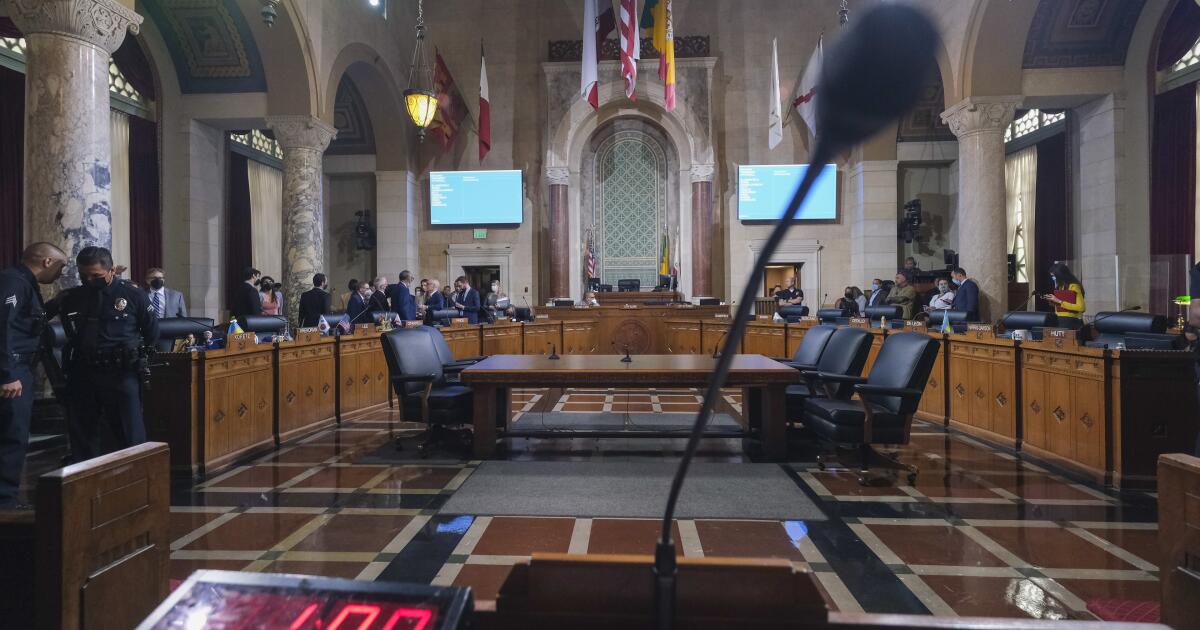
On Tuesday, council members sent voters a measure for the Nov. 3 ballot that would only require a single council meeting per week. The City Charter currently mandates a minimum of three.
Councilmember Tim McOsker was among those pushing for the change, saying it will make the council more efficient and effective.
“It will also allow council members to take care of more business in their districts,” said McOsker, who represents neighborhoods stretching from Watts to the Port of Los Angeles.
The council, which voted 12-0 to place the measure on the ballot, has been thinking about cutting back on the number of meetings for a few years.
In 2024, McOsker and Councilmember Katy Yaroslavsky tried to place a measure before voters that would have made the same change. But other council members were not prepared to put it on the ballot.
Yaroslavsky said at the time that much of the city’s public comment period was occupied by “15 people screaming racist, misogynistic, antisemitic epithets.”
Any change to the City Charter would not preclude the council from scheduling additional special meetings.
The proposal drew sharp criticism from Rob Quan, an organizer with Unrig LA, who spent much of the past year tracking the effort to rewrite the charter. He fears that a reduction in meetings will also lead to a decrease in opportunities for Angelenos to address their council representatives.
One of the reasons council members, who each make $244,727 a year, don’t get as much business done is that they frequently use their Friday meetings for ceremonial activities — honoring civic leaders, community groups, youth sports teams, Dodgers superstar Shohei Ohtani and beloved bands from the 80s.
“Do we really need that? Not necessarily,” Quan said.
Quan said the proposal to cut the number of meetings received zero vetting from the council. The 13-member Charter Reform Commission, which spent nearly a year examining various changes to city government, took up the idea and rejected it.
If voters approve the change, council meetings could end up resembling those of the Los Angeles County Board of Supervisors, which meets most Tuesdays at 9:30 a.m. The supervisors frequently don’t finish their business until well after 5 p.m.
Former prosecutor will stay away from Lee case
We told you last week that Councilmember John Lee is suing the city Ethics Commission over a $138,000 fine he received for allegedly violating city gift laws — a case that stems largely from a notorious 2017 trip to Las Vegas. The council responded to that lawsuit by voting to retain the law firm Hecker Fink to defend the Ethics Commission, at a cost of $120,000.
As it turns out, at least one Hecker Fink lawyer knows plenty about that Vegas trip.
Mack Jenkins, who heads the firm’s L.A. office, was one of the federal prosecutors who brought the criminal case against Lee’s onetime boss, Councilmember Mitchell Englander, in 2020. That case stems from the duo’s trip to Sin City in 2017.
Federal prosecutors said Englander and Lee, listed in court filings as Staffer B, were plied with fancy meals, expensive alcohol and other freebies by people seeking to do business with the city. Englander went a step further, walking into a casino bathroom and picking up $10,000 cash in an envelope from a Los Angeles-area businessman. He later pleaded guilty to providing false information to investigators.
The city’s lawyers say they cannot represent the Ethics Commission because Lee is one of their clients. But does Jenkins’ history with the case create any type of conflict for Hecker Fink?
Nancy Jackson, a spokesperson for the Ethics Commission, says no. In an email, she said Jenkins will be walled off from Hecker Fink’s work on the matter.
“That former prosecutor is recused from the case and will have no involvement in the case,” she said.
What went wrong with the lighting assessment?
Property owners resoundingly rejected a recent request to pay more to fund streetlight repairs. One of the reasons might have been the wording on their ballot.
The city mailed letters asking if they would like to increase the yearly assessment, using language that didn’t offer a lot of explanation.
In the section where property owners had the option to vote yes, the ballot read: “Yes I am in favor of the proposed maximum assessment for Fiscal Year 2026/2017 and the proposed annual cost of living increases as described in the attached notice beginning Fiscal Year 2026/2027.”
Councilmember Eunisses Hernandez, who chairs the council’s Public Works Committee, said the phrasing could have been a lot more persuasive — and better explained the need for additional money.
“Some of the language that was put out was not written in a way for us to be clear about what we were doing, and instead used language that really turned people off,” she said.
The assessment, which has not changed since 1996, currently generates about $45 million a year. For the average single-family home, the current payment is $58 annually.
The increase would have brought the average annual bill to $117, generating an additional $80 million a year as the city faces a backlog of broken streetlights due to stagnant funding and a rise in vandalism and theft.
After the vote failed to pass, the council approved a motion directing city staff to identify $6.6 million for the Bureau of Street Lighting. Without that money, the city will face “an immediate threat to public safety and our infrastructure at large,” the motion said.
“There will be a 15% cut in field workforces by the end of July 2026, making the timeline for streetlight repair to reach 2 years when the City had previously been able to do this work within 7 days,” said the motion authored by Hernandez and Yaroslavsky.
Hernandez voiced frustration over the defeat of the assessment. She took aim at Proposition 218, the state law that restricts how local governments can raise money, saying it disenfranchises renters who have to “live with the conditions that property owners choose for them.”
She added that the ballot measure’s wording, which she said was crafted by the City Attorney’s Office, failed to capture the reason for the increase.
“People really think that the main reason our lights are out is copper wire theft,” she said. “But the fact is that over 60% of our street lights are out because of lack of maintenance, because we just do not have the money to do that work.”
Hernandez said that next time, she would push for more community engagement so voters understand why the increased funding is needed. She also raised the possibility of reforming Proposition 218.
“No matter what, I’m going to get these streetlights on, and if that’s figuring different things out until we can get a significant effort to do another assessment, then we will do that,” she said.
State of play
— COLD FEET: The L.A. City Council decided against putting two major measures on the Nov. 3 ballot. One measure would have provided a pathway for noncitizens to vote in local elections, while the other would have given the council more authority over the LAPD.
— COSTLY COLLISION: The city of Los Angeles will pay $20 million to settle a lawsuit brought on behalf of a teen who lost his leg in a 2023 hit-and-run in Boyle Heights. The lawsuit blamed the city for an intersection lacking signage, lighting and other traffic controls.
— LAHSuit: The Los Angeles Homeless Services Authority, also known as LAHSA, sued the Trump administration Monday to stop it from suspending the agency from receiving hundreds of millions of dollars in funding. LAHSA argued that the decision would put thousands of people at risk of losing their government funded housing.
— FORWARDING ADDRESS: The only post office in Skid Row abruptly closed in January due to repeated break-ins and damage to employee property, according to the U.S. Postal Service. The closure has frustrated residents and business owners.
— BUILDING BLITZ: Senate Bill 79, the historic housing bill, took effect across the state on Wednesday. The law could bring townhomes, row houses and other developments to 57 neighborhoods across the city.
— AIRBORNE TOXIC EVENT: A preliminary analysis showed that the recent inferno at a Boyle Heights warehouse contaminated the air with high levels of smoke and soot, rivaling the pollution that filled the region during the 2025 wildfires.
— MORE MEGA PROJECTS: Two large scale developments grabbed the attention of downtown Los Angeles this week. One, approved by the council, is slated to add 1,500 residences to Skid Row. The second, proposed this week, would transform the World Trade Center building into a 512-unit affordable housing complex.
QUICK HITS
- Where is Inside Safe? The mayor’s signature program to combat homelesssness went to the area near Olympic Boulevard and Menlo Avenue in Pico Union on Friday in Hernandez’s district, bringing 24 people indoors.
- On the docket next week: The City Council will be on summer recess until Aug. 4.
Stay in touch
That’s it for this week! Send your questions, comments and gossip to LAontheRecord@latimes.com. Did a friend forward you this email? Sign up here to get it in your inbox every Saturday morning.