decide

Senate hopeful Haley Stevens knows how to win in Michigan. Democrats must decide if that’s enough

U.S. Rep. Haley Stevens is spending the closing weeks of Michigan’s Democratic Senate primary making a simple case: she’s the candidate who wins.

Stevens flipped a Republican-held House seat in suburban Detroit in 2018 and hasn’t lost since, including surviving a bruising primary against a fellow Democratic incumbent after redistricting in 2022. She says it’s what sets her apart from her opponent in the Aug. 4 primary, progressive Abdul El-Sayed.

“It is not a hypothetical that I beat Republicans,” Stevens told The Associated Press after a campaign stop in West Michigan this week. “I win tough races. I have had Republicans throw everything at me and still managed to win.”

Holding Michigan’s Senate seat is essential to any Democratic path back to the Senate majority this fall. That imperative only grew this week after Democrats’ nominee in Maine, Graham Platner, said he planned to drop out after he was accused of sexual assault, threatening another seat the party had hoped to keep competitive. While no Republican has won a U.S. Senate seat in Michigan since 1994, former U.S. Rep. Mike Rogers came within 20,000 votes of doing so in 2024.

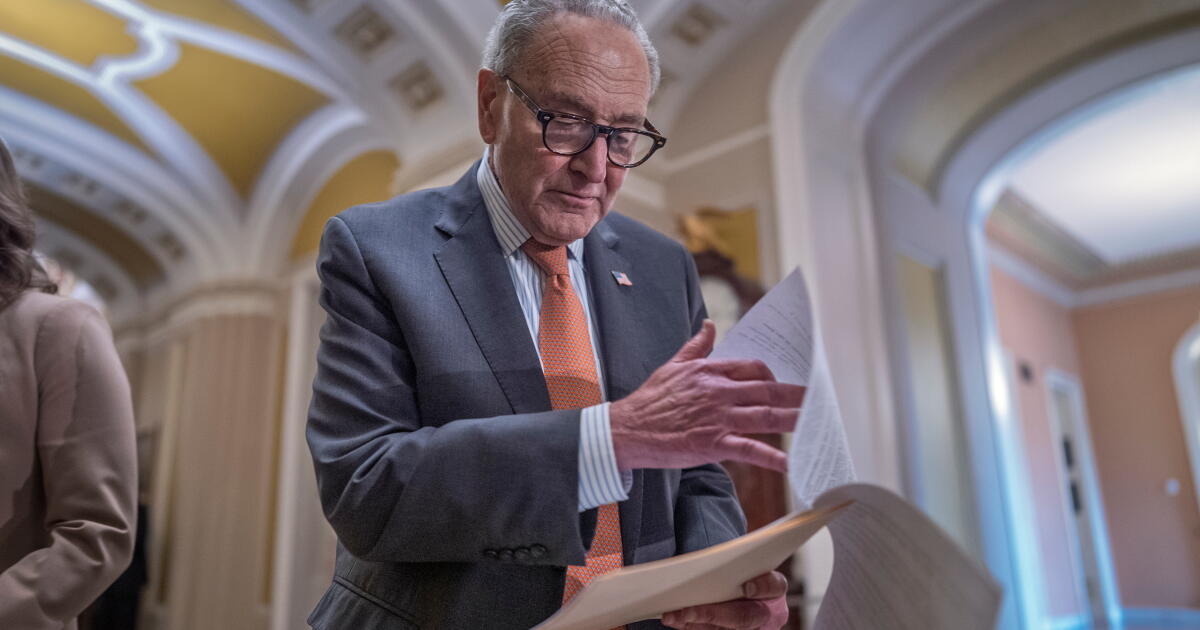
That calculation has led Senate Democratic leader Chuck Schumer and influential Michigan Democrats, including former Sen. Debbie Stabenow, to rally behind Stevens, arguing she gives Democrats their strongest chance in November against Rogers, who is running again.

But if electability is the party establishment’s top priority, it’s an open question whether Democratic primary voters agree.

“Democratic leadership should think more in terms of what we want to accomplish, and less about, ‘We’ve got to make it appeal to everybody,’” said Dave Burdick, 71, of Douglas, Michigan. He’s backing El-Sayed, who has surged by arguing that Democrats don’t have to run to the middle to win.

El-Sayed has built his campaign around bold policy proposals, rejecting corporate PAC money and casting himself as an alternative to the status quo of the Democratic Party.

“People don’t want a moderate. They want somebody who’s going to come in and effect change,” Burdick added.

Stevens makes the case for retail politics

On a summer afternoon in South Haven, a community along Lake Michigan, Stevens walks into a pet supply store with the ease of a seasoned campaigner. Within minutes, she’s chatting with the owner about the area, greeting reporters by first name and striking up conversations with customers. She slips easily between small talk and campaign mode, asking about customers’ lives before mentioning legislation she’s championed and asking for their vote.

“I thought she was great fun,” said owner Roxanne Leder. “She was energetic and had a positive outlook.”

It’s the kind of campaigning Stevens’ allies say has defined her political career. They acknowledge she lacks the viral progressive moments that have fueled El-Sayed’s rise, but say she’s at her best in small rooms, union halls and local businesses — which they say is where elections are won.

Stevens has leaned into that contrast herself.

“Unlike my opponent, I’m not running at the first mic or camera I see,” Stevens said during a debate Tuesday. “We do not need a celebrity senator. We need a workhorse.”

It’s also a style familiar to Michigan Democrats. From former Gov. Jennifer Granholm to current-Gov. Gretchen Whitmer, successful statewide candidates have often paired an upbeat, personable campaign style with a pragmatic message centered on economic issues.

But unlike Granholm or Whitmer, Stevens has yet to generate the kind of broad grassroots enthusiasm that defined their statewide campaigns. El-Sayed, meanwhile, has packed rallies with progressive supporters and high-profile endorsers.

Stevens has leaned more heavily on tens of millions of dollars in outside spending, which could become one of Stevens’ biggest liabilities in the primary. Outside groups have spent more than $30 million to boost her candidacy, dwarfing the spending behind El-Sayed. The largest spender, United Democracy Project, the super PAC affiliated with the American Israel Public Affairs Committee, or AIPAC, has spent more than $13 million on Stevens’ behalf and reserved another $7 million before the primary.

For Burdick, the 71-year-old El-Sayed supporter, that spending is disqualifying. He said he would not vote for Stevens in the general election because of her support from AIPAC.

Leder, by contrast, said she expects to vote for Stevens in August because she’s far more familiar with the congresswoman than with El-Sayed. She said she still plans to do more research before making a final decision.

“I’m just a Democrat,” said Leder. “Please, please no Mike Rogers.”

Michigan has a populist streak

El-Sayed is running on Medicare for All, campaign finance reform, abolishing the U.S. Immigration and Customs Enforcement agency and ending all U.S. weapons sales to Israel. He’s also a Muslim who has never held elected office.

To many Democratic leaders in Washington, that makes him a risky nominee in a battleground state often viewed as moderate and centered on manufacturing.

But Michigan has repeatedly rewarded candidates who cast themselves as outsiders challenging the political establishment. In 2016, Sen. Bernie Sanders defeated Hillary Clinton in the state’s Democratic presidential primary by running against party leaders. Donald Trump later built his own anti-establishment coalition, carrying Michigan in 2016 and again in 2024.

Burdick, a self-described “old white guy living in rural Michigan” who is a democratic socialist, said Trump and Sanders resonated with voters because they were upset.

“Well, you know what? They’re still mad,” he said. “They portray people like Abdul as unrealistic, but I think it’s unrealistic to think that we can continue the way that we’re heading.”

A two-person race changes the calculus

On Sunday, state Sen. Mallory McMorrow suspended her campaign. It prompted establishment Democrats to jump off the sidelines and back Stevens, including Democratic group EMILY’s List and Attorney General Dana Nessel.

“Haley is wicked smart, has won multiple highly competitive races, and she connects with people on a level so sincere and genuine that everyone who meets her feels truly seen and heard,” Nessel said in a statement.

El-Sayed has also built support among labor groups that have played an influential role in Democratic politics, including an endorsement from the United Auto Workers.

Fems for Dems, an influential Democratic grassroots group in the state, is not endorsing in the primary. But its founder, Lori Goldman, told AP in an interview that she planned to vote for El-Sayed.

“I personally am not going to have business as usual when I go to the ballot box. I want to vote for people, candidates that are going to go there and fight on our behalf,” she said.

Goldman, who founded the group 10 years ago in the politically important Oakland County, acknowledges the changing dynamics of Democratic primaries.

“Who would the natural choice be 10 years ago? Haley Stevens, right? Because we just followed the party line,” she said.

“People are breaking away from the party line. People want change.”

Cappelletti writes for the Associated Press.

Source link

Are three City Council meetings a week too much? L.A. voters will decide

Good morning, and welcome to L.A. on the Record — our City Hall newsletter. It’s Noah Goldberg, David Zahniser and Melissa Gomez, giving you the latest on city and county government.

Los Angeles voters won’t get a chance to increase the size of the City Council. They won’t take up a plan to give noncitizens the right to vote, either.

These and other proposed ballot measures got put on the back burner, delayed for a future year as the council scrambled to finish its work before its summer break.

One proposal did survive the sometimes blunt vetting process: decreasing the number of council meetings.

On Tuesday, council members sent voters a measure for the Nov. 3 ballot that would only require a single council meeting per week. The City Charter currently mandates a minimum of three.

Councilmember Tim McOsker was among those pushing for the change, saying it will make the council more efficient and effective.

“It will also allow council members to take care of more business in their districts,” said McOsker, who represents neighborhoods stretching from Watts to the Port of Los Angeles.

The council, which voted 12-0 to place the measure on the ballot, has been thinking about cutting back on the number of meetings for a few years.

In 2024, McOsker and Councilmember Katy Yaroslavsky tried to place a measure before voters that would have made the same change. But other council members were not prepared to put it on the ballot.

Yaroslavsky said at the time that much of the city’s public comment period was occupied by “15 people screaming racist, misogynistic, antisemitic epithets.”

Any change to the City Charter would not preclude the council from scheduling additional special meetings.

The proposal drew sharp criticism from Rob Quan, an organizer with Unrig LA, who spent much of the past year tracking the effort to rewrite the charter. He fears that a reduction in meetings will also lead to a decrease in opportunities for Angelenos to address their council representatives.

One of the reasons council members, who each make $244,727 a year, don’t get as much business done is that they frequently use their Friday meetings for ceremonial activities — honoring civic leaders, community groups, youth sports teams, Dodgers superstar Shohei Ohtani and beloved bands from the 80s.

“Do we really need that? Not necessarily,” Quan said.

Quan said the proposal to cut the number of meetings received zero vetting from the council. The 13-member Charter Reform Commission, which spent nearly a year examining various changes to city government, took up the idea and rejected it.

If voters approve the change, council meetings could end up resembling those of the Los Angeles County Board of Supervisors, which meets most Tuesdays at 9:30 a.m. The supervisors frequently don’t finish their business until well after 5 p.m.

Former prosecutor will stay away from Lee case

We told you last week that Councilmember John Lee is suing the city Ethics Commission over a $138,000 fine he received for allegedly violating city gift laws — a case that stems largely from a notorious 2017 trip to Las Vegas. The council responded to that lawsuit by voting to retain the law firm Hecker Fink to defend the Ethics Commission, at a cost of $120,000.

As it turns out, at least one Hecker Fink lawyer knows plenty about that Vegas trip.

Mack Jenkins, who heads the firm’s L.A. office, was one of the federal prosecutors who brought the criminal case against Lee’s onetime boss, Councilmember Mitchell Englander, in 2020. That case stems from the duo’s trip to Sin City in 2017.

Federal prosecutors said Englander and Lee, listed in court filings as Staffer B, were plied with fancy meals, expensive alcohol and other freebies by people seeking to do business with the city. Englander went a step further, walking into a casino bathroom and picking up $10,000 cash in an envelope from a Los Angeles-area businessman. He later pleaded guilty to providing false information to investigators.

The city’s lawyers say they cannot represent the Ethics Commission because Lee is one of their clients. But does Jenkins’ history with the case create any type of conflict for Hecker Fink?

Nancy Jackson, a spokesperson for the Ethics Commission, says no. In an email, she said Jenkins will be walled off from Hecker Fink’s work on the matter.

“That former prosecutor is recused from the case and will have no involvement in the case,” she said.

What went wrong with the lighting assessment?

Property owners resoundingly rejected a recent request to pay more to fund streetlight repairs. One of the reasons might have been the wording on their ballot.

The city mailed letters asking if they would like to increase the yearly assessment, using language that didn’t offer a lot of explanation.

In the section where property owners had the option to vote yes, the ballot read: “Yes I am in favor of the proposed maximum assessment for Fiscal Year 2026/2017 and the proposed annual cost of living increases as described in the attached notice beginning Fiscal Year 2026/2027.”

Councilmember Eunisses Hernandez, who chairs the council’s Public Works Committee, said the phrasing could have been a lot more persuasive — and better explained the need for additional money.

“Some of the language that was put out was not written in a way for us to be clear about what we were doing, and instead used language that really turned people off,” she said.

The assessment, which has not changed since 1996, currently generates about $45 million a year. For the average single-family home, the current payment is $58 annually.

The increase would have brought the average annual bill to $117, generating an additional $80 million a year as the city faces a backlog of broken streetlights due to stagnant funding and a rise in vandalism and theft.

After the vote failed to pass, the council approved a motion directing city staff to identify $6.6 million for the Bureau of Street Lighting. Without that money, the city will face “an immediate threat to public safety and our infrastructure at large,” the motion said.

“There will be a 15% cut in field workforces by the end of July 2026, making the timeline for streetlight repair to reach 2 years when the City had previously been able to do this work within 7 days,” said the motion authored by Hernandez and Yaroslavsky.

Hernandez voiced frustration over the defeat of the assessment. She took aim at Proposition 218, the state law that restricts how local governments can raise money, saying it disenfranchises renters who have to “live with the conditions that property owners choose for them.”

She added that the ballot measure’s wording, which she said was crafted by the City Attorney’s Office, failed to capture the reason for the increase.

“People really think that the main reason our lights are out is copper wire theft,” she said. “But the fact is that over 60% of our street lights are out because of lack of maintenance, because we just do not have the money to do that work.”

Hernandez said that next time, she would push for more community engagement so voters understand why the increased funding is needed. She also raised the possibility of reforming Proposition 218.

“No matter what, I’m going to get these streetlights on, and if that’s figuring different things out until we can get a significant effort to do another assessment, then we will do that,” she said.

You’re reading the L.A. on the Record newsletter

Sign up to make sense of the often unexplained world of L.A. politics.

State of play

— COLD FEET: The L.A. City Council decided against putting two major measures on the Nov. 3 ballot. One measure would have provided a pathway for noncitizens to vote in local elections, while the other would have given the council more authority over the LAPD.

— COSTLY COLLISION: The city of Los Angeles will pay $20 million to settle a lawsuit brought on behalf of a teen who lost his leg in a 2023 hit-and-run in Boyle Heights. The lawsuit blamed the city for an intersection lacking signage, lighting and other traffic controls.

— LAHSuit: The Los Angeles Homeless Services Authority, also known as LAHSA, sued the Trump administration Monday to stop it from suspending the agency from receiving hundreds of millions of dollars in funding. LAHSA argued that the decision would put thousands of people at risk of losing their government funded housing.

— FORWARDING ADDRESS: The only post office in Skid Row abruptly closed in January due to repeated break-ins and damage to employee property, according to the U.S. Postal Service. The closure has frustrated residents and business owners.

— BUILDING BLITZ: Senate Bill 79, the historic housing bill, took effect across the state on Wednesday. The law could bring townhomes, row houses and other developments to 57 neighborhoods across the city.

— AIRBORNE TOXIC EVENT: A preliminary analysis showed that the recent inferno at a Boyle Heights warehouse contaminated the air with high levels of smoke and soot, rivaling the pollution that filled the region during the 2025 wildfires.

— MORE MEGA PROJECTS: Two large scale developments grabbed the attention of downtown Los Angeles this week. One, approved by the council, is slated to add 1,500 residences to Skid Row. The second, proposed this week, would transform the World Trade Center building into a 512-unit affordable housing complex.

QUICK HITS

  • Where is Inside Safe? The mayor’s signature program to combat homelesssness went to the area near Olympic Boulevard and Menlo Avenue in Pico Union on Friday in Hernandez’s district, bringing 24 people indoors.
  • On the docket next week: The City Council will be on summer recess until Aug. 4.

Stay in touch

That’s it for this week! Send your questions, comments and gossip to LAontheRecord@latimes.com. Did a friend forward you this email? Sign up here to get it in your inbox every Saturday morning.

Source link

Supreme Court will decide a gun-rights challenge to blue-state bans on assault weapons

The Supreme Court announced Tuesday that it will hear a 2nd Amendment challenge to the gun laws in Connecticut and Cook County, Ill., that ban most semiautomatic assault weapons.

Before leaving for the summer recess, the justices issued orders on new cases that will be heard in the fall. The new 2nd Amendment case figures to be a major test of what kinds of firearms and ammunition are off-limits to state or federal regulation.

The outcome will affect California and all the states led by Democrats that strictly regulate or prohibit semiautomatic rifles, such as the AR-15.

Gun-rights advocates say these are among the most common and popular weapons in the country, and they should not banned in some states.

In response, Connecticut state attorneys said only about 2% of Americans own assault weapons, and they rarely use them for self-defense.

Since 1989, California has prohibited the sale and possession of most semiautomatic rifles and pistols that can fire more than 10 shots before reloading. Nine other states led by Democrats have similar laws.

State lawmakers said these rapid-fire guns are not needed for self-defense but can be a weapon of mass murder. All of the blue-state bans could be struck down next year if the court’s conservatives rule in favor of the 2nd Amendment claim.

Gun-rights advocates say firearms in “common use” by law-abiding owners cannot be prohibited by the government.

Four of the court’s conservatives have said in past dissents they believe the state bans on assault weapons run afoul of the 2nd Amendment. They are Justices Clarence Thomas, Samuel A. Alito, Neil M. Gorsuch and Brett M. Kavanaugh.

That suggests the fate of those state laws depends on Chief Justice John G. Roberts and Justice Amy Coney Barrett.

Joining in support of the gun-rights challenge were the state attorneys for Montana, Idaho and 25 other Republican-led states.

They urged the court to prevent liberal judges and states led by Democrats from “rewriting the 2nd Amendment … to allow hostile jurisdictions to continue infringing on their citizens’ core constitutional right to keep and bear arms.”

In 2016, California’s voters approved a ballot measure that makes possession of large-capacity magazines illegal. At least 10 states have similar laws, but they apply only to the manufacture and sale of large-capacity magazines.

Gun-rights advocates sued in San Diego, leading to nearly a decade of back-and-forth litigation. A federal judge struck down these restrictions under the 2nd Amendment, but the state appealed. They were eventually upheld by the 9th Circuit Court in an en banc ruling.

Meanwhile, the 7th Circuit Court in Chicago has upheld an Illinois law and the Cook County ordinance prohibiting semiautomatic rifles and pistols. Its opinion said rapid-fire guns do not differ significantly “from machine guns and military-grade weaponry,” which can be banned under the 2nd Amendment.

Before Tuesday, the justices had repeatedly refused to weigh in on whether the 2nd Amendment’s right to “keep and bear arms” includes the right to semiautomatic “assault weapons” and large-capacity magazines.

Since 2015, the court has turned down gun-rights appeals from blue states like Illinois and Maryland over their bans on “assault weapons,” despite dissents from Justices Thomas, Alito and Gorsuch.

As an appeals court judge in Washington, D.C., Kavanaugh voted to strike down the city’s ban on assault weapons.

Three years after John Roberts became chief justice, the court ruled for the first time in 2008 that the 2nd Amendment protected individual gun rights, not just state militias. But the 5-4 decision simply struck down a city’s ban on having a hand gun at home for self-defense.

Justice Antonin Scalia’s opinion in District of Columbia vs. Heller said the Constitution gives law-abiding persons a right to have weapons in “common use” for self-defense, but not “dangerous and unusual weapons.”

Ever since, advocates for gun rights and gun control have been arguing over whether semiautomatic guns with large-capacity magazines can be regulated because they are uniquely dangerous or are protected because they are very common.

In the past two years, the Supreme Court has a mixed record on gun regulation.

Last year, the justices in a 6-3 decision struck down a federal regulation that banned “bump stocks,” which allow rapid-fire shooting with a semiautomatic rifle.

That regulation was adopted in the first Trump administration in response to the mass shooting at an outdoor concert in Las Vegas where a lone gunman fired as many as 1,000 shots from a hotel window.

The conservative majority ruled the bump stock devices did not fit the definition of a prohibited machine gun.

Earlier this year, however, the court in a 7-2 decision upheld a regulation prohibiting unregistered “ghost guns” that were made by parts kits.

Source link

Supreme Court will decide if ‘criminal aliens’ can be held indefinitely while they fight deportation

The Supreme Court agreed Monday to hear a Trump administration appeal and decide if “criminal aliens” may be held indefinitely while they fight deportation.

The case to be heard in the fall could give the administration more power to arrest and hold immigrants, including green card holders, who have criminal records.

The government’s lawyers say immigration laws call for deporting non-citizens with “aggravated felonies” on their records. And in such cases, they say these people may be held for months or even years while their claims are before the immigration courts.

Judges have been split on whether non-citizens fighting deportation have a right to a bond hearing and a chance to go free if they pose no risk to public safety.

The 2nd Circuit Court of Appeals in New York ruled for a pair of green card holders who faced deportation to the Dominican Republic and Jamaica. Both had been convicted of assaults that were characterized as aggravated felonies under the immigration laws.

However, the appeals court said their “prolonged detention” was unconstitutional if they were given no bond hearing and no chance to go free.

They were represented by the American Civil Liberties Union, whose lawyers urged the court to turn down the appeal.

“For the first time in this litigation, the government argues that civil detention ‘does not implicate any fundamental rights’ and so the Due Process Clause affords the detained men no protections—substantive or procedural,” they wrote.

In the past, they said the Supreme Court had accepted the “bedrock principle” that detained persons may have a right to seek their release on bond.

One of the two men had left this country and returned to Jamaica, the ACLU lawyers said. But Solicitor Gen. D. John Sauer urged the court to rule on the issue.

The detained men “have no procedural due-process right to a bond hearing on whether they are a flight risk or danger to the community,” he told the court. “Individualized findings about flight risk and danger are irrelevant” under the immigration laws which called for “mandatory detention based on their aggravated-felony convictions alone.”

Source link

Here are the big cases the Supreme Court will decide in June

The Supreme Court heads into the final month of its yearly term facing decisions on birthright citizenship, gun rights, transgender athletes and President Trump’s power over independent agencies.

Unlike in years past, the term’s most significant rulings were not left for the last week in June.

The court dealt Trump a major defeat in February by striking down his sweeping worldwide tariffs. The president is likely to suffer a second defeat when the justices reject his plan to revise the citizenship laws via an executive order.

Republicans won when the court struck down a Louisiana congressional district that favored a Black Democrat.

That decision has already shifted several congressional districts toward the GOP, but its greatest impact will be seen in 2028 and 2030.

Republicans are likely to prevail in two other pending cases.

One would free party committees to raise and spend more money to support their candidates. A second would change state laws to bar counting of mail ballots that arrive after election day.

The justices have 26 cases waiting to be decided before they go on a summer recess. Here are the major cases due for decision:

Trump and birthright citizenship

Does the 14th Amendment of 1868 mean what it says about who is a citizen?

It declares: “All persons born or naturalized in the United States and subject to the jurisdiction thereof are citizens of the United States.”

The Supreme Court upheld that understanding in 1898, ruling that Wong Kim Ark, who was born to Chinese parents in San Francisco, was a U.S. citizen at birth. Congress adopted birthright citizenship in the Immigration and Nationality Acts of 1940 and 1952.

But on his first day back in the White House, Trump issued an executive order to deny citizenship to the newborns of parents who in the country unlawfully or temporarily on a student, work or tourist visa.

Judges blocked the order from taking effect, and in April, the justices gave a skeptical hearing to Trump’s lawyers as the president sat in the gallery.

The best outcome for Trump would be a ruling that rejects his executive order based on U.S. immigration law alone. Although a defeat, that could in theory permit Congress to revise the law and deny citizenship to the newborns of so-called “birth tourists.” (Trump vs. Barbara)

Guns and drugs

Can the government make it a crime for “habitual users of unlawful drugs” to have a gun, or does that violate 2nd Amendment rights?

Since 1968, federal law has prohibited gun possession by anyone who is an “unlawful user of or addicted to any controlled substance.”

The 5th Circuit Court of Appeals in a Texas case struck down this provision as unconstitutional, except for someone who is “under an impairing influence” of drugs at the time of his arrest.

The Trump administration appealed and urged the Supreme Court to uphold the law against “habitual users of unlawful drugs,” including regular users of marijuana. (U.S. vs. Hemani)

In a second gun rights case, the court will decide whether Hawaii, California and three other states led by Democrats may forbid licensed gun owners from carrying a firearm into stores or private businesses open to the public unless they have the “express authorization” of the owners. (Wolford vs. Lopez)

Transgender athletes and school sports

Can states maintain separate sports teams for boys and girls “based on biological sex determined at birth” or does excluding transgender girls violate the Title IX law or the Constitution’s guarantee of equal protection?

The justices heard appeals from West Virginia and Idaho after lower courts ruled they had discriminated against transgender girls, and most of them sounded ready to rule for the states.

The only question was whether the court will rule narrowly to uphold laws in the red states or go further to decide how Title IX applies nationwide. (West Virginia vs. B.P.J. and Little vs. Hecox)

Trump and independent agencies

Can the president fire the leaders of special agencies who were given a fixed term by Congress?

For most of American history, Congress created new boards or commissions with a specific mission, such as regulating railroad rates in the 1880s or nuclear power in the 1970s. By law, these agencies are led by a bipartisan board of experts who had a fixed term and could be fired only for cause.

But Trump and the court’s conservatives believe the president has the executive authority to control the government and to fire agency officials — but with one exception. The majority wants to preserve the independence of the Federal Reserve Board. (Trump vs. Slaughter)

Separately, the court will rule on whether Trump had the power to fire Fed Governor Lisa Cook for cause. He alleged she engaged in mortgage fraud and dismissed her in a social media post. The justices blocked her removal and sounded ready to rule she deserved due process of law and a full hearing to contest the allegations. (Trump vs. Cook)

Temporary Protected Status

Can the Trump administration cancel legal protection for more than 300,000 Haitians and Syrians who are living and working in this country?

In 1990, Congress created this protected status for foreign nationals who could not return home safely because of armed conflicts or natural disasters.

The Obama administration extended protection to Haitians and Syrians. Last year, Trump’s then-Homeland Security Secretary Kristi Noem sought to terminate it, but judges blocked her orders because it was still dangerous and unsafe in those countries.

Before the Supreme Court, Trump’s lawyers argued the law forbids “judicial review” of these executive decisions. (Mullin vs. Doe)

Campaign funds and political parties

Do the 50-year-old limits on how much political party committees can raise and spend to directly support their candidates violate the 1st Amendment?

During the Watergate era, Congress adopted limits on money in political campaigns, but the court has struck down the spending limits on free speech grounds. Left standing were the limits on direct contributions to candidates, including from political parties.

Republicans led by then-Sen. JD Vance sued, arguing the party limits were outdated and unwise in an era when super PACs are free to spend huge sums on campaigns. (National Republican Senatorial Committee vs. FEC)

The court also will rule on the GOP’s bid to strike down laws in California and most states that allow for counting mail ballots that were postmarked by election day but arrive a few days later. (Watson vs. Republican National Committee)

Source link

Trump holds Situation Room meeting to decide on Iran deal

A framework agreement to end the U.S. war with Iran is all but settled, pending sign-off from the presidents of the two warring sides, President Trump said Friday, projecting optimism that a deal could finally be at hand.

Yet doubt cast a shadow over the diplomatic process entering the weekend as Trump faced a politically fraught decision to enter an agreement that would invariably require significant concessions to Tehran.

The negotiations have faced severe headwinds in recent days, with both sides accusing the other of violating a fragile ceasefire that has largely stopped the fighting since April.

On his Truth Social site, Trump said he had summoned his top aides to the White House Situation Room to decide on the deal.

The agreement would see an end to the U.S. naval blockade on Iranian ports and the removal of Iranian mines from the Strait of Hormuz, an international waterway through which 20% of the world’s energy supply passes each day. The strait, Trump wrote, will reopen with “no tolls” for “unrestricted shipping traffic, in both directions.”

And “Iran must agree that they will never have a Nuclear Weapon or Bomb,” Trump wrote, noting that Iran’s stockpile of highly enriched uranium, the key ingredient for nuclear weapons, “will be unearthed by the United States (which, it is agreed, is the only Country, along with China, with the mechanical capability of doing so!), in close coordination and conjunction with the Islamic Republic of Iran, plus the International Atomic Energy Agency, and DESTROYED.”

“No money will be exchanged, until further notice,” he added.

Treasury Secretary Scott Bessent also said the deal would require Iran to disavow the continuation of its domestic nuclear program — a diplomatic feat never before achieved throughout a quarter century of international negotiations over Iran’s nuclear work.

It is unclear whether Tehran would go that far. And Iran’s negotiators expressed defiance on Friday, stating that there was “no trust in guarantees or words” from the American side.

“No step will be taken before the other side acts first,” said Mohammad Bagher Ghalibaf, the speaker of Iran’s Parliament. “We do not gain concessions through dialogue, but through missiles.”

It remains unclear when the Trump administration would ease sanctions on Iran, how extensive that relief would be, or what form it would take — questions that fueled Republican criticism of the Obama-era nuclear deal more than a decade ago.

The working diplomatic document would formally extend the existing ceasefire for 60 days, allowing for a more detailed negotiation to take place over Iran’s nuclear program. But the truce as it currently stands is on perilous ground. Iran launched a ballistic missile on Thursday at Kuwait, a close U.S. ally, after American forces took “defensive” actions against Iranian missile launchers and mine laying boats it had launched in the strait.

The war has proven historically unpopular with the American public, and has seen oil prices soar since the U.S. military, in partnership with Israel, launched its first strikes against Iran in February.

Bessent said he is hopeful that oil prices would drop quickly once an agreement is signed. But industry analysts say the effects of the war on the oil market could last for months, if not years, with the stability of traffic through the Strait of Hormuz now in question for commercial shippers.

While oil has dropped to under $100 a barrel, markets appeared skittish on Friday over the prospects for a deal, with mixed messages appearing to emerge out of the region.

It is also unclear whether a U.S. agreement with Iran would in any way bind Israel’s hands in its military operations, either in Iran or in Lebanon, where an Iranian proxy militia, Hezbollah, has vowed to keep up the fight.

Israel has ramped up strikes against Hezbollah targets in recent days, jeopardizing a delicate ceasefire negotiated with the Lebanese government, a deal encouraged by the Trump administration in order to grease the wheels for its talks with Tehran.

Trump has been uncharacteristically silent on the prospects of an agreement in recent days, expressing cautious optimism in limited exchanges with reporters.

“It’s hard to say exactly when or if the president’s going to sign,” Vice President JD Vance, who has led the U.S. diplomatic team, told reporters, noting that “the nuclear stuff” is still subject to negotiation. “We’re going back and forth on a couple of language points.”

“I do think that we’ve made a lot of progress here,” Vance added. “Hopefully we’ll continue to make progress, and the president will be in a position where he can endorse the agreement. But obviously, that’s still TBD.”

Source link

Granada Hills, Carson advance to a fourth straight final meeting to decide City Section softball title

The Granada Hills and Carson softball programs know each other so well they might as well put on their MaxPreps schedule before the season a date for their annual game to decide the City Section Open Division championship.

It’s happening for a fourth consecutive season Friday at 6:30 p.m. at Legacy High in South Gate. Last season, Granada Hills ended a three-game losing streak to the Colts.

On Wednesday, both teams won their semifinal games. Granada Hills’ No. 1 and No. 2 batters in the lineup, Elysse Diaz and Zoe Justman, had big games in a 12-9 win over San Pedro. They combined to go five for eight with five RBIs. Justman had a home run. Gina Evangelista hit an inside-the-park grand slam.

San Pedro scored five runs in the seventh to give the Highlanders a little scare.

At Carson, the Colts came away with a 12-2 semifinal win over Birmingham. Sophomore Anaiyah Popoalii had a home run, double and three RBIs. Olivia Lomeli went three for four with three RBIs. Pitcher Isabella Campos threw a complete game.

Source link

Champions League semi-finals: Ranking top 10 players who could decide ties

3. Julian Alvarez (Atletico Madrid)

Atletico Madrid’s trip to Arsenal in the league phase feels a long time ago, but it will stick in their mind not just for the four goals they shipped, but for their struggles in attack.

Atletico produced only 0.32 xG from open play in that defeat and managed only one shot on target, so, if they are to take anything against Arsenal this time around, getting Julian Alvarez in the game will be key.

The Argentina forward has scored nine goals in the competition this season, more than any Atletico player had managed in a Champions League campaign.

He’s also a menace defending from the front, with a mammoth 853 high-intensity pressures – more than anyone else this season. That’s 70 per game on average.

That work ethic, ruthlessness in front of goal and the wizardry to bend a free-kick into the top corner, as Barcelona found out, make the 26-year-old vital to Atletico’s chances of progressing.

Source link

Virginia redistricting vote: What polls suggest and what voters will decide | US Midterm Elections 2026 News

Voters in Virginia head to the polls on Tuesday to decide on a measure that could redraw the state’s congressional map and potentially shift the balance of power in Washington.

Major political figures, including former President Barack Obama and House of Representatives Speaker Mike Johnson, have weighed in on the high-stakes vote, with nearly $100m spent on campaigning around it.

Part of a broader redistricting battle that began in Texas and spread nationwide, the vote may be the Democrats’ last chance this year to gain seats by changing district maps. The vote comes about six months before the 2026 midterm elections.

Here is what we know:

What is Virginia voting on?

Virginia currently sends 11 members to the House. At the moment, six of them are Democrats, and five are Republicans, reflecting the state’s balance.

Democrats now want to redraw the map to favour them in a way that could help them win up to 10 of the 11 seats. Under the proposal, most districts would be safely Democratic or lean towards the party, with only one strongly Republican.

A breakdown would be:

  • Eight districts would be safely Democratic
  • Two would be competitive but lean Democratic
  • Only one would be safely Republican

If approved, this could give the Democrats several extra seats in Congress, helping them win back or strengthen control of the House in Washington, where majorities are often decided by just a few seats.

That would be a big political shift for the state, which was once closely contested but has become more Democratic-leaning in recent years.

Supporters depart a campaign rally against Virginia Democrats' proposed state redistricting constitutional amendment
Supporters depart a campaign rally against Virginia Democrats’ proposed state redistricting constitutional amendment [FILE: Ken Cedeno/Reuters]

How would the vote work?

Voters in Virginia can cast their ballots either early or on Election Day.

Polling stations will be open across the state on Tuesday:

  • Polls open at 10:00 GMT
  • Polls close at 23:00 GMT

Votes will be counted after polls close, with early results expected later that evening and fuller results overnight or the next day.

What are voters being asked to decide?

The proposed constitutional amendment is the only statewide contest on the ballot.

It reads:

“Should the Constitution of Virginia be amended to allow the General Assembly to temporarily adopt new congressional districts to restore fairness in the upcoming elections, while ensuring Virginia’s standard redistricting process resumes for all future redistricting after the 2030 census?”

A “yes” vote would support allowing the General Assembly to redraw congressional districts before the midterms.

A “no” vote would leave current boundaries unchanged until the next round of regularly scheduled redistricting after the 2030 census.

What do the latest polls suggest?

The result is expected to be close.

A recent poll by State Navigate, a nonpartisan research group, suggests a small lead for supporters, with about 53 percent in favour and 47 percent against.

Why do district lines matter so much?

District lines decide how voters are grouped, which can shape who wins elections.

Moving the lines can make a district more favourable to a Democratic or Republican win, by adding or removing neighbourhoods and communities that lean one way or the other.

It can turn a close race into a safe seat, or the other way around. It affects which communities are kept together and who represents them.

This process, often called gerrymandering, allows parties to draw maps that benefit them.

In a closely divided state like Virginia, even small changes to the map can shift several seats and influence who holds power in Congress.

A 2023 study by Harvard University researchers found that gerrymandering often creates “safe” seats for politicians, meaning their races are less competitive.

In turn, those politicians become less responsive to the needs of their constituents, who become discouraged about voting as a result.

Supporters pray during a campaign rally against Virginia Democrats' proposed state redistricting constitutional amendment
Supporters pray during a campaign rally against Virginia Democrats’ proposed state redistricting constitutional amendment [Ken Cedeno/Reuters]

When could new maps take effect?

If approved, the new map could be used as early as the next election cycle, including the upcoming midterms, depending on legal approval.

However, the plan could face legal challenges. Critics have questioned the ballot wording and the process used by lawmakers.

The Virginia Supreme Court has allowed the vote to go ahead while reviewing those concerns.

If it later finds that rules were broken, the results could be overturned, and the current maps would remain.

Why this vote could shape power in Washington?

A handful of seats could decide control of the US House.

Republicans currently hold a narrow 218–213 majority, but Democrats are seen as competitive heading into the midterms.

Political leaders have underscored the stakes.

Hakeem Jeffries, the Democratic Party’s leader in the House, has pointed to Virginia as a crucial battleground, while Mike Johnson has said the result will be closely watched across the country.

U.S. House Speaker Mike Johnson (R-LA) speaks during a campaign rally
US House Speaker Mike Johnson (R-LA) speaks during a campaign rally [Reuters]

What it means to control the US House

The party with the majority (more seats) in Congress can:

  • Set the agenda, deciding which bills are brought up for debate
  • Control committees, including investigations and hearings
  • Pass legislation more easily (if they stay united)
  • Block bills from the minority party.

The majority party also chooses the speaker of the House, who has major influence over what reaches the floor.

Where else has this happened?

Virginia’s redistricting vote is part of a larger political battle playing out in the US. Republicans in Texas, encouraged by Donald Trump, have redrawn district maps to strengthen their advantage, prompting similar efforts in other states.

In rare cases, voters have been asked to decide directly, including in California last year and now in Virginia.

In California, voters backed the changes despite concerns about fairness. Now it’s Virginia’s turn to decide.

What Democrats are saying, and why?

Democrats argue the plan is a response to Republican actions in other states, not just a power grab.

Leaders like Obama had long opposed gerrymandering in principle, but have now backed the Virginia move, even releasing a video asking voters to go out and vote for the constitutional amendment.

Source link