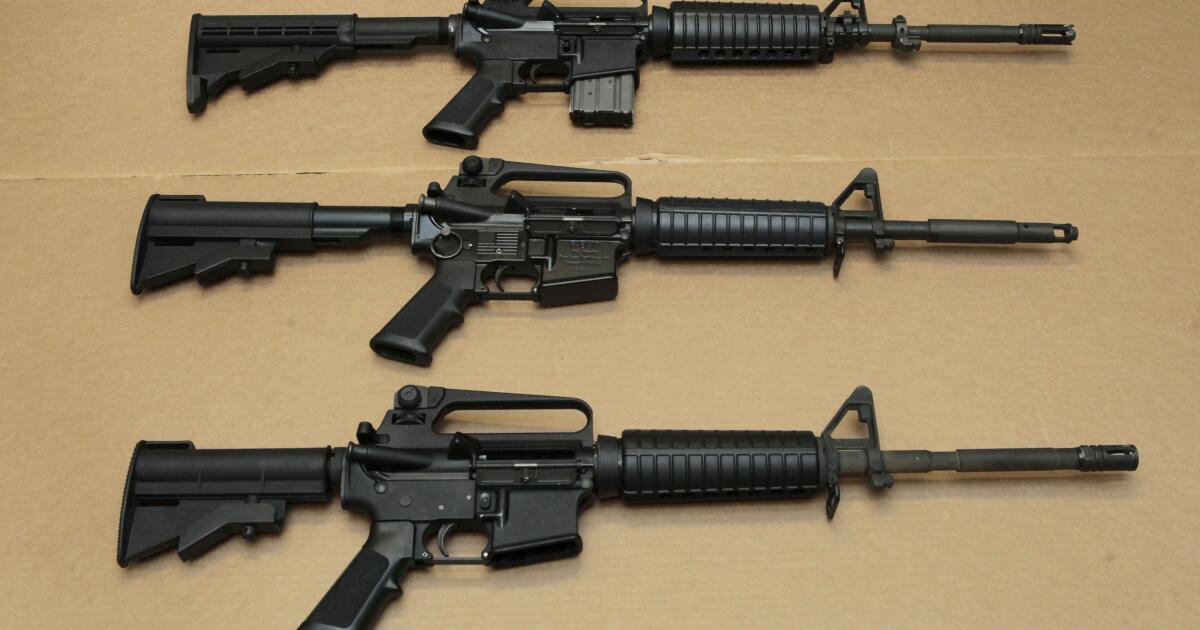
WASHINGTON — The Supreme Court announced Tuesday that it will hear a 2nd Amendment challenge to the gun laws in Connecticut and Cook County, Ill., that ban most semiautomatic assault weapons.
Before leaving for the summer recess, the justices issued orders on new cases that will be heard in the fall. The new 2nd Amendment case figures to be a major test of what kinds of firearms and ammunition are off-limits to state or federal regulation.
The outcome will affect California and all the states led by Democrats that strictly regulate or prohibit semiautomatic rifles, such as the AR-15.
Gun-rights advocates say these are among the most common and popular weapons in the country, and they should not banned in some states.
In response, Connecticut state attorneys said only about 2% of Americans own assault weapons, and they rarely use them for self-defense.
Since 1989, California has prohibited the sale and possession of most semiautomatic rifles and pistols that can fire more than 10 shots before reloading. Nine other states led by Democrats have similar laws.
State lawmakers said these rapid-fire guns are not needed for self-defense but can be a weapon of mass murder. All of the blue-state bans could be struck down next year if the court’s conservatives rule in favor of the 2nd Amendment claim.
Gun-rights advocates say firearms in “common use” by law-abiding owners cannot be prohibited by the government.
Four of the court’s conservatives have said in past dissents they believe the state bans on assault weapons run afoul of the 2nd Amendment. They are Justices Clarence Thomas, Samuel A. Alito, Neil M. Gorsuch and Brett M. Kavanaugh.
That suggests the fate of those state laws depends on Chief Justice John G. Roberts and Justice Amy Coney Barrett.
Joining in support of the gun-rights challenge were the state attorneys for Montana, Idaho and 25 other Republican-led states.
They urged the court to prevent liberal judges and states led by Democrats from “rewriting the 2nd Amendment … to allow hostile jurisdictions to continue infringing on their citizens’ core constitutional right to keep and bear arms.”
In 2016, California’s voters approved a ballot measure that makes possession of large-capacity magazines illegal. At least 10 states have similar laws, but they apply only to the manufacture and sale of large-capacity magazines.
Gun-rights advocates sued in San Diego, leading to nearly a decade of back-and-forth litigation. A federal judge struck down these restrictions under the 2nd Amendment, but the state appealed. They were eventually upheld by the 9th Circuit Court in an en banc ruling.
Meanwhile, the 7th Circuit Court in Chicago has upheld an Illinois law and the Cook County ordinance prohibiting semiautomatic rifles and pistols. Its opinion said rapid-fire guns do not differ significantly “from machine guns and military-grade weaponry,” which can be banned under the 2nd Amendment.
Before Tuesday, the justices had repeatedly refused to weigh in on whether the 2nd Amendment’s right to “keep and bear arms” includes the right to semiautomatic “assault weapons” and large-capacity magazines.
Since 2015, the court has turned down gun-rights appeals from blue states like Illinois and Maryland over their bans on “assault weapons,” despite dissents from Justices Thomas, Alito and Gorsuch.
As an appeals court judge in Washington, D.C., Kavanaugh voted to strike down the city’s ban on assault weapons.
Three years after John Roberts became chief justice, the court ruled for the first time in 2008 that the 2nd Amendment protected individual gun rights, not just state militias. But the 5-4 decision simply struck down a city’s ban on having a hand gun at home for self-defense.
Justice Antonin Scalia’s opinion in District of Columbia vs. Heller said the Constitution gives law-abiding persons a right to have weapons in “common use” for self-defense, but not “dangerous and unusual weapons.”
Ever since, advocates for gun rights and gun control have been arguing over whether semiautomatic guns with large-capacity magazines can be regulated because they are uniquely dangerous or are protected because they are very common.
In the past two years, the Supreme Court has a mixed record on gun regulation.
Last year, the justices in a 6-3 decision struck down a federal regulation that banned “bump stocks,” which allow rapid-fire shooting with a semiautomatic rifle.
That regulation was adopted in the first Trump administration in response to the mass shooting at an outdoor concert in Las Vegas where a lone gunman fired as many as 1,000 shots from a hotel window.
The conservative majority ruled the bump stock devices did not fit the definition of a prohibited machine gun.
Earlier this year, however, the court in a 7-2 decision upheld a regulation prohibiting unregistered “ghost guns” that were made by parts kits.