council

Why your food scraps travel more than 100 miles — and how an L.A. council member wants to stop it

Bob Blumenfield would like to see Angelenos’ old banana peels and moldy bread stay local.

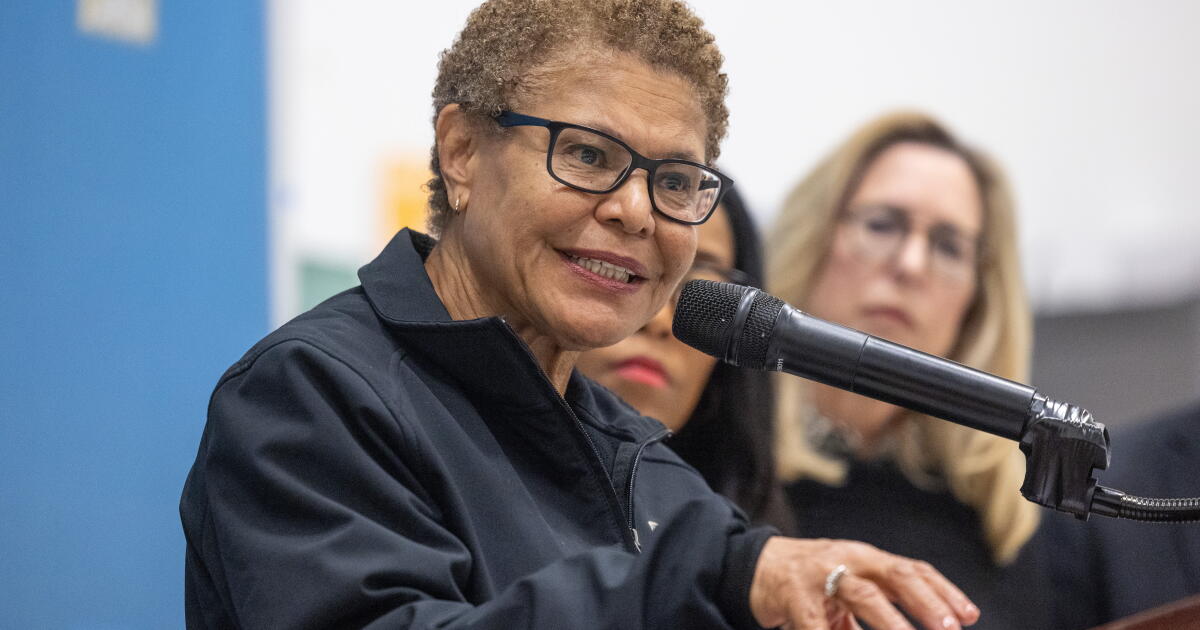
On Tuesday morning, the City Council member told a small crowd of waste advocates in front of city hall that he was introducing a motion to reduce the city’s greenhouse gas emissions by strengthening local composting infrastructure and decreasing reliance on distant facilities.

Currently, when city residents separate their food waste and yard clippings, chances are it’s being trucked to faraway processing facilities in Bakersfield or Lancaster.

The motion would help the city meet targets set by California’s Short-Lived Climate Pollutant Reduction Strategy, or Senate Bill 1383, which phases out sending green waste to the landfill, because it is a major source of the powerful climate pollutant methane.

It also would help meet Mayor Bass’ Climate Action Plan, which aims to use at least 50% of locally produced compost and mulch within Los Angeles by 2030. Currently, only 25% to 30% of the city’s material is applied to land locally.

The city produces approximately 350,000 tons of organic material a year, Blumenfield told the crowd, which he said equates to roughly 1.2 to 1.5 million metric tons of carbon dioxide.

“That’s a big number, and when you do the math,” he said, that’s roughly the same amount of carbon dioxide released by the entire country of Belize, the entirety of Humboldt County or the equivalent of burning 1.6 billion pounds of coal per year.

As the announcement was underway, in the background a fire burned for a sixth day in a Boyle Heights warehouse, where 85 million pounds of frozen food was thawing and beginning to rot.

Signed into law in 2016, the state’s composting bill mandated a gradual increase in the amount of organic waste that must be diverted away from landfills. It required 50% of all green and food waste be diverted by 2020; by 2025, that number was supposed to hit 75%.

But it hasn’t. Although Los Angeles has pushed to get a residential curbside bin program in place — recall the “Great Green Bin Apocalypse of 2025” — it has struggled to get people to comply.

According to reports for the recycLA program, a commercial and multifamily waste collection franchise program, only about half of households and business are separating their compostable waste.

Alex Helou, assistant general manager of L.A. Sanitation & Environment, provided a much brighter picture of the city’s food waste situation. L.A. is the first major city to provide green bins to 750,000 residential customers, he said. The city has “exceeded expectations” in food recovery, he said, saving 80 million meals that would have been thrown out and redirecting them to people in need.

Helou said Blumenfield’s motion completes the loop by keeping food waste close to home, creating more local composting and reducing greenhouse gas emissions from transporting waste outside of the city. It doesn’t directly affect the city’s compliance with SB 1383, but that isn’t necessary, he said. “We’re meeting that and exceeding that at multiple fronts.”

Blumenfield’s initiative directs the Bureau of Sanitation to develop a plan for expanding local composting across the city. It would also increase the use of locally produced compost and mulch.

For instance, the motion would encourage using the compost on urban farms and at community gardens and city parks. It also would be used to replace artificial grass and turf.

It will support a “citywide transition away from artificial turf and towards nature-based solutions, such as California native plants and natural grass plant fields, and ensure everyone has access to safer, cooler, and sustainable parks, schools, and communities,” said Terry Saucier, a Tarzana resident and member of the Neighborhood Council Sustainability Alliance and the Tarzana Neighborhood Council.

The state’s composting law has proved challenging on several fronts.

The Antelope Valley has become a dumping site for many of the city’s haulers looking to cut transport and facility costs — causing concern among environmentalists and others who say the material is destroying fragile ecosystems.

Complying has been particularly difficult for Los Angeles and much of coastal Southern California, where there are few large composters and low demand for compost. Unlike areas to the north, there is little agricultural demand for compost and mulch.

Experts say dumping in the desert has always been a problem, but the law made it worse by making it more expensive and difficult to deal with.

In addition, composters are struggling with the amount of plastic and other debris that people and businesses put in the food waste bins.

According to a report by Closed Loop Partners, which partners with companies such as Pepsico and McDonald’s, nearly 4% of food waste is contaminated with other materials — most of it plastic. State law requires that finished compost contains no more than 0.5% by dry weight of physical contaminants.

Source link

How the plan to expand the L.A. City Council got shelved once again

Good morning, and welcome to L.A. on the Record — our City Hall newsletter. It’s David Zahniser, with an assist from Noah Goldberg and Melissa Gomez, giving you the latest on city and county government.

It’s long been the Holy Grail for the reform crowd that tracks L.A. city government: expanding the size of the City Council.

The idea of giving L.A. more council members was endorsed by the city’s redistricting commission in 2021. Two years later, the concept was debated at length by a council committee focused on reform. After that panel failed to reach a decision, the idea was assigned to the city’s Charter Reform Commission, which endorsed the change, saying the council should have 25 members, up from 15.

Yet even after that five-year journey, the council voted Wednesday to push a proposed ballot measure on that topic off to the future, sending the idea to a new reform committee for more deliberations.

So what happened this time around?

You’re reading the L.A. on the Record newsletter

Sign up to make sense of the often unexplained world of L.A. politics.

For one thing, the 13-member citizens commission that recommended the idea didn’t offer a lot of specifics on how the change would work.

The commission recommended 10 additional council members, a move that would cause each district to shed more than 100,000 residents, leaving each member with about 159,000 constituents.

But it never explained whether that decrease should be accompanied by a similar reduction in a council member’s salary, now nearly $245,000 a year.

“That’s one of the reasons why [council expansion] is slated for further study,” Councilmember Bob Blumenfield said in an interview. “While the commission might have had a nice discussion and a negotiation among themselves, what we need to have in front of us to vote responsibly is context and information.”

A councilmember’s pay could be a major sticking point for voters during a campaign over council expansion — especially if an opposition campaign arose to defeat it.

Blumenfield said the commission failed to vet other issues, including the number of council aides needed for each district if a district is smaller.

Councilmember Tim McOsker expressed a similar view.

“I think there were gaps in what the commission proposed — substantive gaps,” he said.

Backers of council expansion have argued that an increase in the number of districts would make the council more responsive and more diverse. Opponents said bigger does not necessarily mean better representation.

Raymond Meza, who chaired the Charter Reform Commission, acknowledged that pay, staffing and the cost of each council office didn’t come up during his panel’s deliberations. Those questions should have fallen to the council, which reviews and approves the city budget each year, he said.

“They would need to figure this out through the budget process, like they figure out most other things in the city,” he said.

Meza said he believes that, in the end, council members didn’t want to dilute their own power. Former City Councilmember Mike Bonin offered a similar take, saying elected officials generally don’t want to risk changing the system that got them into office.

“They are in power because of the way the system is structured,” said Bonin, who now runs the Pat Brown Institute for Public Affairs at Cal State LA.

Before sidelining the expansion proposal, Council President Marqueece Harris-Dawson said a larger council would shift the balance of power at City Hall, giving the mayor greater authority and the council less of it.

In the end, none of these delays may end up mattering. No one at City Hall expected council expansion to happen until 2032 anyway, since the change would require a new round of redistricting — the process of drawing new boundaries for each council district. Redistricting won’t happen until after the release of results from the 2030 U.S. Census.

In other words, there’s still time for voters to act.

What happened to the City Hall misconduct measure?

Here’s another proposal that got shunted to the sidelines during the council’s eight-hour marathon meeting: what to do about city elected officials who are charged with serious crimes.

Charter reform was, in part, a reaction to a string of corruption scandals. Among them: three sitting council members who were charged with felonies between 2020 and 2023.

In each case, council members had to decide whether to use their power, spelled out in the City Charter, to suspend colleagues accused of wrongdoing — stripping away their duties until their criminal cases were resolved.

The council moved swiftly to suspend then-Councilmember Jose Huizar in 2020, taking action the day he was arrested, before he even pleaded “not guilty” to racketeering and other charges. The council suspended then-Councilmember Mark Ridley-Thomas in 2021 after a lengthy floor debate, with some saying he was being denied his due process rights. (Ridley-Thomas, who was found guilty of seven felonies, is fighting his conviction.)

A few years later, the council decided not to suspend Councilmember Curren Price, allowing him to step off of his council committees but preserving his other council duties as he contests charges of embezzlement, perjury and conflict-of-interest violations.

Although the case is still ongoing, Price is back on various city committees.

Each of those cases put the council in a bind. Voting in favor of suspension can mean depriving a council member’s constituents of representation. It also runs counter to the idea that a colleague is innocent until proven guilty.

Voting against suspension has its own set of dangers, such as undermining trust in city government. It could also allow an elected official accused of wrongdoing to continue taking part in decisions about contracts, real estate development and other matters where the potential for corruption exists.

Under the current system, a council member can be suspended with just eight votes. Harris-Dawson, who supported the suspension of Huizar but opposed it for Ridley-Thomas, said early on that he wanted the Charter Reform Commission to look at the process for disciplining elected officials accused of wrongdoing.

The Charter Reform Commission offered its answer two months ago, recommending that the council retain the power to suspend, but only with a three-fourths vote — 12 out of 15. That safeguard was meant to guard against potential abuses of power, said Meza, the former commission chair.

The council declined to put that idea on the ballot, saying it needs more study.

Asked about that decision, Harris-Dawson said he has long had serious problems with the idea that “one set of elected officials could suspend another set of elected officials.” He suggested that a third party in another branch of government — not the council — determine whether a member merits suspension.

Under that arrangement, the council could initiate the process but leave it to a judge or other party to make the final call, he said.

“I personally think that we have checks and balances in government that should be respected,” Harris-Dawson said.

A last-minute union threat

One ballot proposal that did survive this week’s gauntlet of votes was a plan to increase, not decrease, the council’s power. That proposal, backed by Councilmember Hugo SotoMartínez, would give the council the authority to set policy at the Los Angeles Police Department.

But even that proposal may be in danger, thanks to a dispute that has erupted between the city’s labor negotiators and the Los Angeles Police Protective League, the union representing rank-and-file officers.

Union leadership said this week that the league was not formally asked by management to meet and confer over various charter proposals dealing with the LAPD, including the one focused on policy. That step is legally required before such measures can be sent to voters, the union said.

City Administrative Officer Matt Szabo, the city’s chief labor negotiator, told council members on Monday that his office sent three emails to various employee units asking if they wanted to confer over the charter changes. He said his office received no response from the police union.

A day later, after learning of Szabo’s remarks, the league fired back.

In a letter to council members, the union said it only received emails about charter reform that had nothing to do with policing. Those emails did not constitute a formal invitation to meet and confer about potential changes at the LAPD, the union said.

The city “did not follow the law and did not formally contact us,” union President Ricky Mendoza said in a statement.

The council voted to draft the change in LAPD policy making, pending a confidential report from the city attorney on whether the city first has to bargain with the police union. Council members cast that vote even after the union demanded that they suspend any further consideration of the proposal for the Nov. 3 ballot.

If the city attorney concludes that the LAPD ballot proposal does not require further talks, the Police Protective League will file a lawsuit to protect its members’ legal rights, union officials said.

On Wednesday, Szabo said the proposal to give the council power over LAPD policy decisions doesn’t require collective bargaining.

The proposal to give council say over policy at the LAPD wasn’t the only one focused on that department. Another measure discussed by the council would have given the police chief power to terminate alleged problem officers.

The council sent it to a committee for more study. The union said that proposal also would have required a meet and confer process.

State of play

— CITY CHARTER GRAB BAG: As noted earlier, the council voted to draft an assortment of charter amendments for the Nov. 3 ballot, including one to allow the council to give noncitizen residents the right to vote in local elections. The council also ordered up a measure doubling the amount of money allocated for the Department of Recreation and Parks, discarding an alternative plan that would have increased it by 50%. Other measures would switch the city to a two-year budget process and require a five-year plan for maintaining and upgrading city infrastructure.

— KNOWING ME, KNOWING ULA: Looking to boost apartment construction, the council backed a surprise plan to rewrite Measure ULA, the tax on high-end property sales passed by voters in 2022 and sometimes called the mansion tax. The council voted 9-5 to instruct the city’s lawyers to draft a measure exempting apartment buildings sold within 10 years of construction from having to pay the tax. Another vote will be needed to get it on the ballot.

— ZOO STORY: Membership at the Los Angeles Zoo has fallen by 23% over the past year, dropping from 36,914 in April 2025 to 28,440 in February, according to a report issued by the Los Angeles County civil grand jury. That report urged the city to create a new public-private partnership to run the facility, saying such a move will be critical for the zoo’s long-term survival.

— SHERIFF SUBPOENAS: L.A. County’s Civilian Oversight Commission is suing the Sheriff’s Department, asking a judge to order the release of records on three use-of-force incidents involving its deputies. The commission issued three subpoenas to the agency in February 2025, but according to the suit, the department has declined to fully comply.

— UNION DUES AND DON’TS: A former high-level officer with L.A.’s firefighter union has been accused of stealing more than $82,000 from a charity for injured firefighters to pay for his online gambling, his mortgage and other personal expenses. Adam Walker, former secretary of United Firefighters of Los Angeles City Local 112, was charged with one count each of grand theft and forgery, prosecutors announced Wednesday.

— DOG DISASTER: The Los Angeles Police Department is facing a public outcry after its officers shot and killed the dog of a woman celebrating the New York Knicks’ NBA championship in Canoga Park. Video on social media showed the dog’s owner sobbing and hugging her dog, who was wearing a Knicks T-shirt, as several LAPD officers stood nearby.

— BASS WEIGHS IN: The Canoga Park incident prompted Mayor Karen Bass to issue a statement promising a thorough and transparent investigation into the death of Jameson, the dog killed by the LAPD. “Every life lost to violence is a tragedy, and we know that the devastating loss of Jameson will be felt by his family forever,” she said. “I have spoken directly to the Chief to ensure a full investigation and accountability for any wrongdoing.”

— OFFICE FIRE: A fire broke out at a building in Pacific Palisades where former mayoral candidate Spencer Pratt maintained an office for his crystals company. Pratt, whose home burned in the 2025 Palisades fire, called the latest blaze “very suspicious.” The fire department said it’s investigating.

QUICK HITS

  • Where is Inside Safe? The mayor’s signature program to address homelessness went to a stretch of Silver Lake Boulevard that passes under the 101 Freeway. That area is represented by Soto-Martínez.
  • On the docket next week: The council meets Wednesday to take up the massive 4th & Central project, which calls for offices, retail space and nearly 1,600 units of housing on a 7.6-acre site in downtown.

Stay in touch

That’s it for this week! Send your questions, comments and gossip to LAontheRecord@latimes.com. Did a friend forward you this email? Sign up here to get it in your inbox every Saturday morning.

Source link

Who loved Bass, Raman and Pratt the most? A district-by-district breakdown

Good morning, and welcome to L.A. on the Record — our City Hall newsletter. It’s David Zahniser and Noah Goldberg, giving you the latest on city and county government.

Los Angeles voters have finally gotten some closure on the outstanding contests in the June 2 primary election, with City Councilmember Nithya Raman qualifying for the runoff against Mayor Karen Bass, and Measure ER, the countywide sales tax hike, prevailing after a week of ballot counting.

With nearly all the votes counted, Angelenos are now getting a more granular understanding of the strongholds built up by each of the top three mayoral candidates.

Districts that went big for Bass, Raman and Pratt

Early on in the vote-counting process, it looked like Raman might not win her Hollywood Hills-based district, which stretches from Silver Lake to Reseda. In the end, she pulled out a first-place finish, securing nearly 34% of the vote compared to Bass’ 31%, according to Paul Mitchell, vice president of the voter data firm Political Data Inc, who aggregated county precinct data into council districts. Spencer Pratt, the former reality TV personality, trailed at 27%.

Still, Raman’s strongest support came from three districts on the eastern end of the city.

Mitchell’s analysis showed Raman with 45% of the vote in Council District 13, which includes all or parts of Echo Park, Hollywood and Atwater Village. She got nearly 40% in Council District 1, which takes in parts of Highland Park, Mt. Washington and Angeleno Heights. And she scored nearly 38% of the vote in Council District 14, which includes downtown, Boyle Heights and El Sereno.

Those districts are represented by Hugo SotoMartínez, Eunisses Hernandez and Ysabel Jurado, respectively — all members of Democratic Socialists of America, who all endorsed Bass instead of Raman, a DSA member herself. Raman placed first in all three.

Bass found her greatest strength in the three districts that cover South L.A., coming in first in all three. Her best performance was in District 8, represented by Council President Marqueece Harris-Dawson, where she led with nearly 62% of the vote.

You’re reading the L.A. on the Record newsletter

Sign up to make sense of the often unexplained world of L.A. politics.

The mayor received 45% of the vote in Council District 10, which stretches from Koreatown to the Crenshaw Corridor, and 42% in Council District 9, which stretches from the southern edge of downtown south to 95th Street.

Pratt performed the strongest in the west San Fernando Valley. He was the top vote-getter in District 12, which is represented by Councilmember John Lee and includes Chatsworth, Granada Hills and Porter Ranch. In that district, he received 39% of the vote, Mitchell’s assessment showed.

Pratt got nearly 37% of the vote in District 3, which is represented by Councilmember Bob Blumenfield and includes Woodland Hills, Warner Center and Canoga Park.

Pratt also led the pack in the 5th District, which takes up much of the Westside and is represented by Councilmember Katy Yaroslavsky. He had 30.7% of the vote, compared to Raman’s 30.6%, according to Mitchell’s analysis.

Nithya Raman attacks the L.A. ‘political machine’

It was one of tougher attacks of the mayoral primary: Raman accused Bass of engaging in “pay to play” — making decisions that benefited certain interest groups, who then spent big on her reeelection.

At her first post-election press conference Wednesday, Raman revisited that line of attack, criticizing Bass over her push to upgrade the city’s Convention Center. That $2.6 billion project was approved in the middle of the city’s financial crisis, when the council was contemplating major job cuts, Raman said.

“Downtown business groups then spent over a million dollars supporting her in her reelection. Meanwhile, the city went back to voters asking them to pay more to fix their streetlights. That is the political machine at work,” she said.

Pay to play was a potent issue in the 2005 election, when Mayor James Hahn was defeated by Councilmember Antonio Villaraigosa. At the time, federal agencies had opened corruption investigations into decisions at the city’s harbor and airports, as well as the Department of Water and Power. That year, the phrase “pay to play” was synonymous with criminal wrongdoing.

In a video acknowledging his primary defeat, Pratt said he got into the mayor’s race to “expose this corrupt machine.”

Raman stopped short of such a framing.

“It’s not corruption,” Raman told reporters at Vista Hermosa Park. “But it is evidence that the system, and how it works, particularly the influence of money in politics, has led to some very broken priorities here in the city.”

Last year, policy analysts warned the Convention Center project would be a financial drag from the moment it opens, consuming more than $100 million per year throughout the 2030s. Business groups and labor organizations pushed back, saying the project would help revitalize downtown while creating much needed construction jobs.

The Central City Assn., a downtown-based business group that supported the Convention Center upgrade, spent about $1.6 million on efforts to reelect Bass.

“Nithya Raman doesn’t think we need more jobs or visitors to our hotels and restaurants that produce the tax revenues downtown generates for the entire city, so it’s hard to support her,” said Central City Assn. President and Chief Executive Officer Nella McOsker in a statement.

Bass spokesperson Alex Stack also pushed back on Raman’s criticism, saying the mayor has been with “every group and industry to deliver results for Angelenos.”

“Nithya Raman can’t get anything done and then attacks the same groups she sought to endorse her campaign,” he said.

Pratt trailed Trump among L.A. voters

As a mayoral candidate, Pratt was dogged by questions about whether he was MAGA — shorthand for the movement that first powered President Trump into office in 2016. The Republican had received fulsome praise from Trump-aligned figures, including podcast host Joe Rogan and Greg Gutfield of Fox News.

Pratt downplayed his GOP ties. Still, there’s one area where he definitely had some similarity with Trump: His performance with L.A. voters.

Trump and Pratt both picked up roughly one out of every four votes in L.A. during their respective campaigns.

Pratt, former star of MTV’s “The Hills,” had 25.5% of the vote in L.A., according to results posted Friday. In November 2024, Trump did a little better, receiving 26.5%, county election results show.

Trump had 369,319 votes in L.A. two years ago, compared to 976,781 for then-Vice President Kamala Harris. By Friday, Pratt had 217,638 votes, compared to 247,242 for Raman and 292,115 for Bass.

It might not be fair to compare Pratt and Trump, given that there were key differences between the elections. Pratt was competing in a primary campaign, while Trump was in a general election. The candidate pool was different as well.

Trump was running in a six-way contest where Harris was his main rival. Pratt, on the other hand, was in a race featuring 13 other candidates.

Although two-thirds of those candidates were complete unknowns, four of Pratt’s rivals ran serious campaigns, amassing endorsements and spending significant amounts of money.

State of play

— TRUMP VS. LAHSA: The Trump Administration moved Thursday to block the embattled Los Angeles Homeless Services Authority from receiving federal funds, saying the agency was badly managed and engaged in fraud. Elected officials across the city denounced the move, while nonprofit groups also voiced alarm. “This is intended to create chaos,” said Jerry Jones, the head of the Greater LA Coalition on Homelessness, which represents groups that serve the region’s unhoused.

— PAYOUT PROBE: Dist. Atty. Nathan Hochman said Wednesday that he believes four out of every five claims in the largest sex abuse settlement in U.S. history — one that resulted in a $4 billion payout by Los Angeles County— may be fake. Hochman has asked a judge to pause the sex abuse payments while he continues his criminal investigation into the plaintiffs, lawyers and therapists involved in filing the claims.

— GET READY TO RUMBLE: The showdown between Bass and Raman is going to get ugly, political experts said this week, in part because they agree on a number of big-picture political issues. Both will need to court at least some of the disaffected voters who picked Pratt in the primary.

— A SCATHING SENDOFF: As we mentioned higher up, Pratt released a video Friday that was both an acknowledgment of his primary election defeat and a vitriolic screed against Bass and Raman, his former rivals. Pratt called them “morons,” “commie animals” and “corrupt communists,” and made clear he intends to ramp up his attacks in the coming months. “I don’t have campaign laws hamstringing me now. It’s war,” he said.

— WOOING LATINOS: Bass carried far more Latino-majority neighborhoods than her rivals in last week’s primary, a Times analysis found. She carried 35 Latino-majority neighborhoods, including Boyle Heights, Pacoima and Historic South-Central. That was a 46% increase from 2022, when she won 24 Latino-majority neighborhoods in her primary against Rick Caruso and Kevin de León, the analysis found.

— EKING OUT A WIN: The countywide sales tax hike known as Measure ER prevailed this week, with late-arriving ballots pushing the number of ‘yes’ votes just above 50%. “It’s a lifesaver to carry us through the storm we’re all in,” said County Supervisor Holly Mitchell, who led the push among her colleagues to get the measure on the ballot.

— AN EXPENSIVE FEE-FA: Bass was set to attend the U.S. opening game of the World Cup Friday at SoFi Stadium in Inglewood after being invited by FIFA, her office said. Still, Bass wasn’t exempt from the high ticket prices she criticized earlier this year. She paid $2,735 out of pocket for her ticket, a spokesperson said. On a related note, the mayor announced more than 100 “Kick it in the Park” events where Angelenos can watch World Cup games for free.

— MORE OF THE SAME: In a break with recent history, every council member who ran for reelection this year won their race. “People see what we’re doing, and they want us to keep fighting for them,” said Councilmember Tim McOsker, who won nearly three out of every four votes in his San Pedro-to-Watts district.

QUICK HITS

  • Where is Inside Safe? The mayor’s signature program to address homelessness went to the area around 54th Street and Western Avenue, in the South L.A. district represented by Harris-Dawson.
  • On the docket next week: The City Council meets Wednesday to take up a sprawling package of charter reform proposals, including a move to ranked-choice voting and a larger number of council members. Will the council send those ideas to voters or punt them for another two years? Stay tuned!

Stay in touch

That’s it for this week! Send your questions, comments and gossip to LAontheRecord@latimes.com. Did a friend forward you this email? Sign up here to get it in your inbox every Saturday morning.

Source link

Ed Sheeran slapped with raft of eco-friendly rules by council in bid to build rehearsal space near ‘Sheeranville’ estate

An image collage containing 2 images, Image 1 shows Aerial view of a rural village surrounded by fields, Image 2 shows Ed Sheeran looking at the camera and smiling, wearing a pink shirt

ED Sheeran has been dealt another blow in his ongoing struggle to build a rehearsal space near his mega estate “Sheeranville”.

The Shape of You singer faces painfully slow construction on his new rehearsal studio due to eco-rules.

Ed’s new rehearsal space is being held back by protected newts living nearby Credit: Deadline via Getty Images
The rehearsal space is set to be near his 16-acre ‘Sheeranville’ estate (pictured) Credit: SplashNews.com

Builders having to begin construction by hand because of the prescence of endangered newts.

And they will be given special “toolbox talks” on what to do if they come across the tiny 15cm critters.

Planning bosses say the tiny 15cm critters could be disturbed by his plans to knock down a historic but dilapidated barn and turn it into a personal rehearsal space.

Council chiefs said the measures were normal for any countryside development – and not “unreasonable”.

SHE’S BACK!

Coronation Street star to make shock comeback months after leaving soap


HEALTH SCARE

Disney legend, 78, rushed to hospital after suffering stroke

Ed’s builders will have to use hand tools instead of machinery, remove all debris by hand.

The popstar’s problems with amphibians date back as far as 2018 0 when protected great crested newts were found near his Suffolk estate.

Planning permission for the project was granted, but with a string of conditions to protect the species.

Sheeran bought the £1million farm in 20245 – which included a 19th century dilapidated piggery.

Mid-Suffolk Council have forced the pop-star to put a range of measures in place to protect the newts Credit: sandra standbridge
Each builder will be given a “tool box talk” explaining how to protect the newts Credit: Laszlo Bokor

The brick and wood debris will also be entirely removed by hand to stop the newts from accessing it.

The ‘Great Crested Newt Method Statement’ filed with Mid-Suffolk District Council states: “The removal of any debris e.g. rubble, wood, will be undertaken by hand as far as possible, and with care, checking beneath all removed items for newts.

“Careful use of machinery will be necessary to lift large debris and to remove the existing concrete building base, with the area beneath checked for the presence of GCN as each section is lifted.”

The method statement also gives a time limit restricting project work to March, April and May when most newts will be in ponds away from construction.

Other eco measures Ed’s having to put in place include creating a “species rich, flowering lawn” with 19 different species of flowers.

Plus he’s got to plant 12 fruit trees, two bat boxes and a triple-house sparrow tower.

A spokesperson for Mid-Suffolk District Council told The Sun: “This is certainly NOT a case of any unreasonable ‘eco-friendly measures’ being demanded by our council – simply normal requirements that would be expected of any countryside developers.”

They explained there had been no conflict between Ed Sheeran and the council at any stage and that he had not complained about the restrictions.


Source link

Proud Boy booted from Spencer Pratt election night party

Proud boy expelled from Pratt’s party

Spencer Pratt’s election night party at Don Antonio’s Mexican restaurant in West Los Angeles included a few uninvited guests, and it wasn’t just members of the news media.

As Pratt spoke to reporters relegated to the sidewalk, a Virginia man convicted of joining in the Jan. 6, 2021 assault on the U.S. Capitol hovered behind him, trying to horn his way into the candidate’s frame as Pratt spoke to the news cameras.

A member of Pratt’s security team grabbed the man, Jon Mellis, by the shoulders, dragged him past the TV cameras and pushed him down onto the pavement of Pico Boulevard as cars whizzed by.

Mellis — a member of the far-right Proud Boys who was pardoned by President Trump along with the other Jan. 6 rioters — wasn’t thrilled. He attempted to interrupt multiple news broadcasts to air his grievances.

“They can’t assault me like that,” Mellis said.

“They hate MAGA,” someone else in his group chimed in.

Earlier Tuesday evening, Mellis had happily mugged for one news camera after another, expressing his fealty for Pratt.

Mellis described himself as “ultra-MAGA” to The Times and, pre-shove, said he didn’t mind that Pratt was distancing himself from the MAGA movement as he campaigns for votes in the Democratic stronghold of Los Angeles.

Recent polling showed most Democrats were less likely to vote for Pratt when perceiving the candidate as tied to MAGA and Trump. Given that, it’s hardly surprising that Pratt’s security team gave Mellis and his friends the bum’s rush.

“Those guys are paid ops,” a member of Pratt’s campaign wrote on X. “They crash every single event.”

Airbnb’s election night sweep

It was a good election night for short-term rental giant Airbnb, which infused numerous city races with cash and didn’t take a single loss.

The company teamed up with the Central City Assn., a group representing downtown Los Angeles businesses, to fund ads in support of Karen Bass, city attorney candidate John McKinney and five City Council candidates.

The business group said its PAC, which received funding from Airbnb and the Los Angeles Police Protective League, spent nearly $5 million during the primary election cycle, up from $1 million during the 2024 primary and general elections.

“We have been intentional about supporting candidates and causes focused on building more housing; investing in public safety, transportation, and infrastructure; and supporting the diverse businesses that provide jobs and put paychecks in Angelenos’ pockets,” said Nella McOsker, president of the Central City Assn.

“The results speak for themselves,” said Justin Wesson, Airbnb senior manager of public policy in California. “Airbnb has arrived in L.A. politics — not as a guest, but as a permanent resident.”

In council, CCA and Airbnb supported Traci Park, who declared victory and had a big lead over her opponent; Jose Ugarte, who will probably advance to a November runoff; and Timothy Gaspar, who was leading in his primary as well, though votes are still being tallied and it wasn’t clear if he would make the majority threshold needed for an outright victory. CCA also supported Monica Rodriguez, who ran unopposed and Tim McOsker (Nella McOsker’s father), who coasted to a big lead in the primary.

Betting on whims and vibes

This is Los Angeles’ first mayoral election in the age of prediction markets, and two giants of the field, Kalshi and Polymarket, have been actively promoting betting on who will be the next mayor — and even sub-bets within the election, such as which candidate will come in second place in the primary or which two candidates will advance to the runoff.

On election night, as Spencer Pratt led Nithya Raman for second place by about 9 percentage points, both Kalshi and Polymarket had Pratt favored to move on to the runoff.

But overnight, the market shifted, with a Bass versus Raman runoff now considered more likely by bettors, probably due to a widely held belief that the remaining votes to be counted will lean more Democratic as the county tallies late-arriving vote-by-mail ballots.

Although Kalshi promotes its markets as the “odds” that a certain candidate will win, experts warn it merely represents the beliefs of bettors, who are not always the best-informed.

“This is people’s whims and vibes. You might have better luck in Vegas; at least when you bet in Vegas there’s math involved,” said Democratic consultant Mike Trujillo.

A spokesperson for Kalshi said “sharp traders on Kalshi are experts at pricing likelihoods in real time.”

Eric Zitzewitz, a professor of economics and expert on prediction markets at Dartmouth College, said that sites such as Kalshi and Polymarket are pretty accurate, and that smart money usually corrects the market.

“Historically that movement in Pratt’s price would reflect a movement in his odds,” Zitzewitz said.

As of Friday, Polymarket had a Bass-Raman runoff at 80%, and a Bass-Pratt runoff around 22%. Kalshi gave Bass and Raman a 78% chance of advancing and Bass and Pratt 22%.

Pratt currently leads Raman, but Los Angeles County is still tallying ballots and Raman has gained some ground following initial results Tuesday.

You’re reading the L.A. on the Record newsletter

Sign up to make sense of the often unexplained world of L.A. politics.

State of play

— BASS VERSUS?: Mayor Bass will advance to a runoff against either Pratt or Raman after a bruising primary campaign during which the incumbent was attacked from the left and the right.

— COALITION KAREN: A broad coalition of supporters assembled by the mayor helped her secure a spot in the Nov. 3 runoff. On her side was organized labor, including the powerful police officers’ union; business leaders, working closely with Airbnb; the Los Angeles County Democratic Party, including key elected officials; and immigrant rights groups that applauded Bass for her condemnation of federal ICE raids.

— COMEBACK COUNCILMEMBER?: Raman is still running behind Pratt, but experts say the remaining ballots to be counted should favor Democrats. “Don’t count [Councilmember] Nithya Raman out yet,” said Zev Yaroslavsky, director of the Los Angeles Initiative at UCLA Luskin.

— INCUMBENTS IN CONTROL: The mood was celebratory in Los Angeles City Council chambers Wednesday, as incumbents up for reelection held wide leads over their challengers as vote counting from Tuesday’s primary continued.

— FELDSTEIN SOTO OUT, MEJIA IN: Los Angeles City Atty. Hydee Feldstein Soto all but conceded that her reelection bid had failed Wednesday morning, as she lagged far behind her two well-funded challengers based on early returns. Her incumbent colleague, City Controller Kenneth Mejia, appeared to be faring better in his bid to stay in office, holding a double-digit lead over finance executive Zach Sokoloff.

QUICK HITS

  • Where is Inside Safe? The mayor’s signature program moved 20 people inside from Skid Row in Council District 14.
  • On the docket next week: Proposals from the Charter Reform Commission are still being reviewed by the Rules, Elections, and Intergovernmental Relations Committee, with the next meeting scheduled for June 12.

Stay in touch

That’s it for this week! Send your questions, comments and gossip to LAontheRecord@latimes.com. Did a friend forward you this email? Sign up here to get it in your inbox every Saturday morning.

Source link

Park leads Malik in battle for District 11 L.A. City Council seat

Los Angeles City Councilmember Traci Park opened up a commanding lead over public interest attorney Faizah Malik in the race to represent the city’s coastal neighborhoods, according to early election returns Tuesday night.

Park has been a close ally of the police and fire unions in the city, calling for more cops and firefighters. Malik has been endorsed by the Democratic Socialists of America and also is backed by the Los Angeles County Federation of Labor and Unite Here Local 11, which represents hotel and airport workers.

Faizah Malik and Traci Park.

L.A. City Council candidate Faizah Malik, left, and incumbent Traci Park.

(Eric Thayer and Francine Orr / Los Angeles Times)

Park reported raising $1.3 million in campaign contributions, according to the latest campaign finance reports filed with the city, compared with about $540,000 for Malik.

Park said she felt good about the early returns.

“It confirms that we have been right on the priorities and the results have spoken for themselves,” she said. “I have been writing a comeback story for the Westside for the last three years, and I’m super excited to finish it.”

In a speech to supporters at the Lincoln, a bar on the Westside, Malik remained upbeat.

“This campaign has demonstrated that we can chart a new course for a sustainable future and we can lead the way here on the Westside,” Malik said.

Los Angeles voters cast ballots for eight of the 15 City Council seats in Tuesday’s election, including races in two districts where the incumbents are leaving because of term limits.

In races with more than two candidates, the top two vote-getters will compete in a Nov. 3 runoff unless a candidate gets a majority vote in the primary.

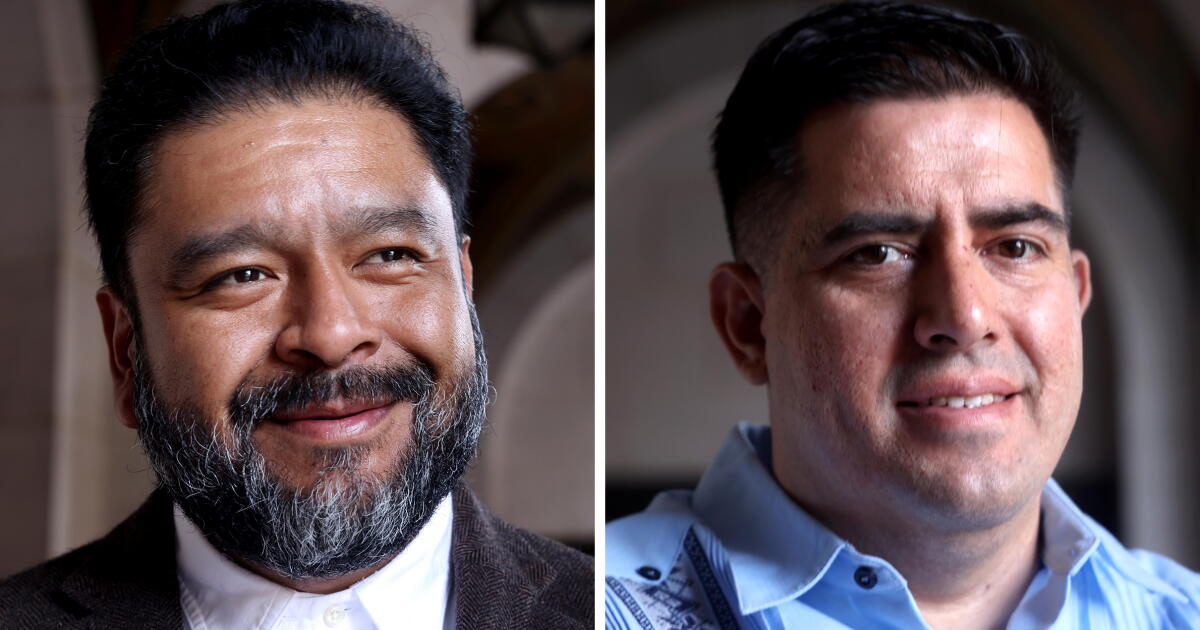
Jose Ugarte was leading Estuardo Mazariegos in the field of six candidates in the District 9 race held by termed-out Councilmember Curren Price.

Jose Ugarte and Estuardo Mazariegos, both running for Los Angeles City Council District 9.

District 9 candidates Jose Ugarte, left and Estuardo Mazariegos.

(Genaro Molina / Los Angeles Times)

Ugarte is a former deputy chief of staff for Price, and Mazariegos is co-director of the Alliance of Californians for Community Empowerment Los Angeles and is backed by the Democratic Socialists of America.

Mazariegos said he felt confident he would make it into the Nov. 3 runoff against Ugarte.

“I feel a sense of relief and accomplishment,” he said.

The other candidates in the race were trailing Ugarte and Mazariegos in early returns. They are Elmer Roldan, executive director of Communities in Schools of Los Angeles; Martha Sánchez, a therapist; Jorge Nuño, an entrepreneur; and Jorge Hernandez Rosas, an educator.

The district includes the Convention Center, USC and communities along the Harbor Freeway.

In the San Fernando Valley’s District 3, Tim Gaspar and Barri Worth Girvan were leading the field of three candidates vying for the seat being vacated by Bob Blumenfield.

A smiling woman with dark hair, in a magenta jacket, is flanked by portraits of two men, also smiling

Christopher “C.R.” Celona, left, Barri Worth Girvan, center, and Tim Gaspar are running for L.A. City Council District 3.

(Stephanie Lorens, Yauma Olstead and Tim Sullens)

Gaspar is the founder of an insurance company, and Worth Girvan is a district director for Los Angeles County Supervisor Lindsey Horvath.

Worth Girvan said she was confident she would face Gaspar in a runoff in November.

“[The campaign] has been about ensuring the West Valley gets its fair share of resources,” Worth Girvan said.

In a statement, Gaspar said he was feeling “incredibly optimistic” about the coalition of business owners and community leaders he built during his campaign.

“They are showing they want a fresh perspective in City Hall,” he said.

The third candidate, tech entrepreneur Christopher Robert “C.R.” Celona, trailed behind.

In District 13, Councilmember Hugo Soto-Martínez was leading three challengers — Dylan Kendall, who runs Grow Hollywood, an economic development corporation; Rich Sarian, vice president of strategic initiatives for downtown’s South Park Social District; and Colter Carlisle, vice president of the East Hollywood Neighborhood Council.

Clockwise from top left; Hugo Soto-Martinez; Colter Carlisle, Rich Sarian, and Dylan Kendall.

City Council District 13 candidates, clockwise from top left: Councilmember Hugo Soto-Martinez; Colter Carlisle; Rich Sarian; and Dylan Kendall.

(Los Angeles Times)

Soto-Martínez also was backed by the Los Angeles chapter of the Democratic Socialists of America for the district that includes Atwater Village, Glassell Park, Elysian Valley, Echo Park, Silver Lake and Hollywood and East Hollywood.

Soto-Martínez said in a statement he was feeling optimistic about the early returns.

In District 1, which covers Highland Park in the northeast to University Park in the southwest, Councilmember Eunisses Hernandez was leading a pack of four challengers in the race, according to early returns.

Maria Lou Calanche, executive director of the nonprofit Expanded Learning Alliance, trailed Hernandez, according to early returns. They were followed by Raul Claros, chief executive of UNO Partners; Nelson Grande, president of Grande Enterprises; and Sylvia Robledo, who worked as an aide to several elected L.A. officials and who has fallen into last place.

Hernandez was grateful for the support that put her far ahead on the first night of results.

“I just feel reassured that all these fights we’ve been taking on for the last 3½ years have been worth it and people have been watching,” Hernandez said.

In other races, Councilmember Tim McOsker had a wide lead over Green Party member Jordan Rivers for the 15th District seat, which includes Harbor City, San Pedro, Watts and Wilmington. But the incumbent said while the early returns were encouraging, it was too early to declare victory before 9:30 p.m.

“I’ll be back in City Hall early tomorrow morning to get back to work,” McOsker said from his campaign party at the Dalmatian-American Club in San Pedro.

His campaign, he said, was focused on moving forward projects “past the point of no return” to make real change in the district that encompasses Watts, Wilmington, Harbor Gateway, Harbor City and San Pedro.

In the 5th District, which includes Bel-Air, Westwood, Cheviot Hills and Hancock Park, Councilmember Katy Yaroslavsky declared victory in her race around 9 p.m. after early ballots pushed her far ahead of the two challengers.

“Across the spectrum, people are looking for lights to be fixed and sidewalks to be usable,” she said.

In the north San Fernando Valley’s 7th District, Monica Rodriguez was running unopposed.

Source link

Live Election 2026 primary results, updates: who won Los Angeles mayor, city council, LAUSD

Elections in the city of Los Angeles include mayor, City Council, three ballot measures and Los Angeles Unified School District board seats and, if you live in the city, you’ve maybe seen an ad about them.

The high-profile competition between incumbent Mayor Karen Bass, City Councilmember Nithya Raman and conservative reality star Spencer Pratt has been tumultuous. And that is to say nothing of Rae Huang, Adam Miller and the nine others contenders.

With leaked files, millions in campaign fundraising donated by a candidate’s mother, and a multi-campaign effort by L.A.’s chapter of Democratic Socialists of America, the race for mayor isn’t the only one making headlines this primary.

A candidate can win by getting a majority of the vote. If no one receives 50% + 1 vote, the top two advance to the November election.

Mayor

The Associated Press, which surveys the numbers posted by local election officials and projects the winner using vote returns and other data, will call a winner (or a runoff) for L.A. mayor.

City Council

Back to top

Officers

Back to top

Ballot measures

Back to top

Los Angeles Unified School District

Back to top

Source link

Your last-minute guide to L.A. City Council elections

The most important California stories and recommendations in your inbox every morning.

Source link

How Monica Rodriguez went from being a thorn in Bass’ side to campaign ally

Good morning, and welcome to L.A. on the Record — our City Hall newsletter. It’s David Zahniser, with an assist from Noah Goldberg, Melissa Gomez and Sandra McDonald, giving you the latest on city and county government.

Los Angeles City Councilmember Monica Rodriguez has had some pretty tough words over the years for Mayor Karen Bass and her administration.

Rodriguez, who is running unopposed in Tuesday’s election, repeatedly criticized Bass’ Inside Safe program, which moves homeless people indoors, saying it lacked financial oversight. She voted against the mayor’s budget last year, saying too much was going to Inside Safe. She was especially harsh in the wake of the Palisades fire, saying that Bass’ team botched the first few months of the recovery.

That might make her an ideal person to endorse Councilmember Nithya Raman, who is running to unseat Bass in Tuesday’s primary and has leveled similar critiques. Instead, Rodriguez has emerged as an unexpected ally of the incumbent.

During the campaign, Rodriguez has appeared with Bass at events in Eagle Rock, Pacoima and even Sherman Oaks, located in Raman’s district. She popped up in a campaign flier from Latinos Por Karen Bass. And she’s been dinging Raman over everything from economic development to policies around outdoor barbecues.

Rodriguez explained her decision to support Bass in an interview, saying she views the incumbent as being far more willing to entertain opposing views than Raman — and understands that “not everyone thinks the same way.” Bass also is more consistent on the issues, Rodriguez said.

You’re reading the L.A. on the Record newsletter

Sign up to make sense of the often unexplained world of L.A. politics.

Raman, by contrast, has shifted her positions on police spending, the tax hike known as Measure ULA and even who should be the next mayor, jumping into the race after she endorsed Bass, Rodriguez said.

“I don’t know what she stands for,” she said.

Raman’s campaign declined to comment on Rodriguez’s remarks. But former former Deputy Mayor Rick Cole, a Raman supporter, said he is surprised to see Rodriguez line up behind Bass, given how critical she has been over the years.

“Monica is a self-described maverick, so it’s ironic that she’s thrown in with the establishment on this. But sometimes personalities play a role,” he said.

Rodriguez had been talked up at one point as a possible opponent of Bass in this year’s election. If Bass wins a second and final term, the mayor’s race would be wide open in 2030.

Pratt accuses Bass of electioneering

It was a small yet upbeat event staged by Bass’ reelection campaign: The mayor, accompanied by supporters chanting “four more years,” walking up to an official drop box and putting in her ballot.

That miniature rally, staged last weekend near the city’s Memorial Branch Library, was captured on video and circulated by Bass’ campaign. But it has drawn a complaint from mayoral candidate Spencer Pratt, who accused the mayor of violating a state law prohibiting electioneering near a polling place or voter drop box.

In a complaint filed with the city clerk, Pratt attorney Peter McNulty said Bass and her supporters improperly solicited votes, waved campaigns signs and “engaged in blatant electioneering” near a voting location.

“Such clear violations of electioneering restrictions show a reckless disregard for the rule of law and an apparent belief that she need not comply with relevant restrictions that apply to all other candidates,” he wrote.

The Bass campaign pushed back on those allegations, saying the video features footage from two locations near the drop box. The portion that featured the Bass campaign signs was filmed 200 feet away — twice the distance required by law, said Alex Stack, a Bass spokesperson.

“Spencer is just mad that his supporters are AI cartoons and we have real Angelenos,” he said. “We follow the rules.”

Pratt’s lawyer said in his letter that he wants the city to investigate. He also filed a complaint with the state, citing the state election law that prohibits the dissemination of “visible or audible electioneering information” near a polling place or drop box.

Feldstein Soto flames Airbnb

City Atty. Hydee Feldstein Soto has been getting hit from both directions over the last few weeks.

On one side, a committee with at least $450,000 in funding from the Consumer Attorneys of California has been pumping out campaign ads promoting her opponent, Deputy Atty. Gen. Marissa Roy. On the other, a campaign committee heavily bankrolled by Airbnb is running ads for Deputy Dist. Atty. John McKinney, another opponent in the race.

Feldstein Soto has countered with a television ad that highlights her office’s lawsuit against Airbnb, which accuses the company of engaging in price gouging after the Palisades fire. Staring into the camera, Feldstein Soto said Airbnb and other special interests “are spending millions to try and get rid of me.”

“They think L.A. belongs to them,” she says. “I know it belongs to you.”

Feldstein Soto had raised about $860,000 for her campaign through May 16, compared with about $680,000 for Roy and about $122,000 for McKinney. But those fundraising efforts, which face strict limits under the city’s ethics laws, have been overshadowed by the unlimited spending from Airbnb and the others.

Angelenos for Progress, a pro-McKinney committee sponsored by the Central City Assn., received at least $2.1 million from Airbnb over the last month, pouring that money into campaign videos and television ads.

Justin Wesson, senior public policy manager for Airbnb in California, said in a statement that McKinney’s campaign platform is “focused on keeping Los Angeles communities safe and vibrant, including for Angelenos who share their home and their guests that contribute to the local economy.”

In recent weeks, Airbnb has been pushing the city’s elected officials to loosen L.A.’s home-sharing regulations, by allowing owners of second homes to lease their properties on short-term rental platforms.

Airbnb has put big money into other committees, including those that support Tim Gaspar, who is running to replace Councilmember Bob Blumenfield, and Jose Ugarte, who is running to replace Councilmember Curren Price.

Team Raman woos Huang, without success

We mentioned a few weeks back that Raman supporters have been noisily demanding that mayoral candidate Rae Huang drop out of the race, saying she was siphoning left-of-center votes away Raman. Turns out Raman’s campaign was trying to persuade her to pull the plug as well.

Raman campaign strategist Jeff Millman reached out to Huang advisor Bill Przylucki earlier this month about getting the community organizer to drop her mayoral bid, according to Huang spokesperson Emel Shaikh.

The overture from the Raman camp, first reported by LA Material, took place after the May 6 NBC LA debate but before a Fox debate planned for the next week, Shaikh said.

“She never really entertained the idea,” Shaikh said.

Raman, speaking with reporters on Friday, said she knew that people from both campaigns were conferring.

“I’m sure [Huang] was aware of it as well,” she said. “And I think we were really talking about how to achieve a bold, progressive vision for Los Angeles. Both of us got into this race because we felt a deep sense of dissatisfaction with the status quo.”

Millman, a veteran of L.A. politics, worked for former Mayor Eric Garcetti and was a spokesperson for Austin Beutner’s mayoral bid before his campaign ended in January. After Beutner dropped out, he moved to the Raman campaign. Przylucki is the former executive director of the progressive nonprofit Ground Game LA.

Supporters of Raman contend that Huang doesn’t have a path to victory — and could deprive Raman of a chance to compete in the Nov. 3 runoff. Asked whether she feels the same way, Raman said she is focused on getting her voters to the polls.

At this point, Raman is neck and neck with Bass and slightly ahead of Pratt, according to a poll from the UC Berkeley Institute of Governmental Studies, which was co-sponsored by The Times.

State of play

— A THREE-WAY RACE: Bass, Raman and Pratt are locked in a tight three-way contest, with the mayor holding a statistically insignificant lead in the run-up to Tuesday, the latest UC Berkeley-L.A. Times poll found. Bass had 26% support from likely voters, followed by Raman with 25% support and Pratt at 22%.

Bass, appearing at City Hall Thursday, said she’s not worried about failing to make the top two, telling an audience there are many polls that show different results. “I feel confident about Tuesday,” she said.

— AN EMBATTLED MAYOR: The Times took a look at Bass’ first term and the events that have put her political future in peril. Although some point to the city’s handling of the massively destructive Palisades fire, others say her troubles go much deeper.

— READING THE ROOM: While Bass has had difficulty managing the city, Raman faces a different issue: her struggle to forge working relationships with colleagues and allies. No one on the council, including those backed by the DSA, have endorsed her. Raman allies downplayed the issue, saying her strength is her independence.

— CUTTING CRIME: Even with L.A. experiencing fewer murders than at any point in 60 years, crime remains a potent issue in the mayor’s race. Pratt has been portraying the city as a lethal hellscape. Meanwhile, even some of Bass’ supporters have been shocked by how “aggressively pro-police she has been,” said former Councilmember Mike Bonin, who heads the Pat Brown Institute at Cal State, LA.

— DOWNTOWN IN THE DUMPS: Meanwhile, downtown business owners say they are struggling with crime, homelessness and aging infrastructure — all issues that have become central to the mayor’s race.

— LOVE, MOM: The mother of city controller candidate Zach Sokoloff has pumped at least $7.5 million into an independent expenditure campaign supporting him as he seeks to unseat City Controller Kenneth Mejia. The incumbent has accused the Sokoloff family of trying to buy the seat. Sheryl Sokoloff has declined to comment.

— SHERIFF SHOWDOWN: Los Angeles County Sheriff Robert Luna is in a rematch against former Sheriff Alex Villanueva, while also facing six other opponents. (Villanueva was unseated by Luna in 2022.) The top two vote getters will head to the Nov. 3 runoff.

— WAITING FOR THE WAGE: The council finalized its plan to delay a series of minimum wage hikes for hotel and airport workers this week, ensuring that the wage won’t reach $30 until January 2030 instead of July 2028.

— D&D AND DSA: Democratic Socialists of America, whose L.A. chapter is campaigning for five candidates in the city election, took in $30,000 at a Dungeons & Dragons-themed fundraiser. The candidates took part in the action, playing fantasy characters who still keep one foot in the political world.

— CALLING THE COPS: Looking to prevent copper wire theft, the Department of Water and Power is seeking to create its own police force.

— OUT OF THE FRYING PAN: The council on Wednesday confirmed Gabrielle Amster as the latest general manager for the animal services department, which oversees the city’s network of animal shelters. Amster had been serving as vice president of shelter engagement for DocuPet, a national pet registration business, according to her resume.

QUICK HITS

  • Where is Inside Safe? Bass’ signature initiative to tackle homelessness did not launch any new encampment operations this week.
  • On the docket next week: The election, obviously! If you haven’t cast a ballot by mail, make sure you show up at a voting center!

Stay in touch

That’s it for this week! Send your questions, comments and gossip to LAontheRecord@latimes.com. Did a friend forward you this email? Sign up here to get it in your inbox every Saturday morning.

Source link

L.A. voters will cast ballots in eight City Council districts, two with open seats

Los Angeles voters will cast ballots in eight City Council district elections next week, including for two open seats where incumbents are leaving because of term limits.

The contests for the seats being vacated by Councilmembers Bob Blumenfield and Curren Price have drawn large fields of candidates, but the biggest spending has been in the Westside’s District 11, where incumbent Traci Park is facing challenger Faizah Malik, a public interest attorney and one of four council candidates backed by the local chapter of Democratic Socialists of America.

Park has raised $1.3 million, according to the latest campaign finance reports filed Friday, while challenger Faizah Malik reported about $520,000 in contributions. In addition, more than $3 million has been spent in the race by so-called independent expenditure committees that spend money to elect or defeat candidates but which are barred from coordinating their activities with the campaigns.

The district includes Venice, Mar Vista, Brentwood and Pacific Palisades, which was devastated by wildfire in January 2025.

Malik said Friday she is confident heading into the primary election, saying most of her donations are under $100 each, and that she hasn’t taken money from corporations.

Los Angeles City Council candidate for CD11 Faizah Malik attends a canvassing event.

Los Angeles City Council candidate Faizah Malik attends a canvassing event March 15 in Westchester.

(Eric Thayer / Los Angeles Times)

“This is what it means to be a grassroots candidate, and it is just more evidence that the people of CD11 believe in our vision for a Westside that is affordable for everyday people,” Malik said.

A Park campaign aide said Park’s haul is indicative of the councilmember’s record of getting results.

“But no one is taking anything for granted,” the aide said in a statement. “We’re working until the final vote is cast because this election will determine whether the Westside keeps moving forward or gets pulled backward into the same failed ideological politics Angelenos are exhausted by.”

Los Angeles City Councilmember Traci Park gives a pep talk to members of United Firefighters of Los Angeles City.

Los Angeles City Councilmember Traci Park, center, with members of United Firefighters of Los Angeles City on May 12.

(Genaro Molina / Los Angeles Times)

Park has emphasized her advocacy for fire recovery efforts, including pushing for permit fee waivers for residents wanting to rebuild. Malik has said Park has been too focused on single-family homeowners and said she would focus more energy on renters.

They have contrasting views on policing: Malik said she opposes expanding the size of the Los Angeles Police Department and instead supports shifting more resources to the city’s unarmed crisis response program. Park said the Police Department should have about 10,000 sworn officers, up from about 8,700 currently. She voted in favor of a 2023 LAPD contract that gave raises to officers and increased salaries to new hires.

They stand in contrast of each other on the Venice Dell housing development project, which would turn a city lot into 120 housing units for low-income and homeless people. Park opposed the completion and instead wants to turn it into a “mobility hub” and move the housing project to an adjacent lot. Malik, who represented the developer that filed a suit against the city claiming Park and others sought to kill the project, said the project was a motivating factor for her campaign.

District 9

Six candidates are vying to replace Councilman Curren Price, who hit the 12-year limit, in District 9. The district includes the Convention Center, USC and communities along the Harbor Freeway.

The candidates vary on key issues, including policing and housing. Estuardo Mazariegos, co-director of the Alliance of Californians for Community Empowerment Los Angeles, is backed by the Democratic Socialists of America. He has called for reducing the LAPD budget and redirecting funds to other city departments.

Two other candidates — Jorge Hernandez Rosas, an educator, and Jose Ugarte, who previously worked for Price — said they support hiring more police officers. Another hopeful, Elmer Roldan, executive director of Communities in Schools of Los Angeles, said he believes in keeping the LAPD at its current size.

Ugarte, Roldan, Rosas and Martha Sánchez, a therapist, all support enforcing Municipal Code 41.18, which bars homeless encampments near schools and daycare centers. Mazariegos and Jorge Nuño, an entrepreneur, say the code doesn’t solve homelessness and instead just moves people around.

Ugarte has raised the most in contributions of any candidate and has been endorsed by the Los Angeles County Democratic Party in the nonpartisan race.

District 3

Three candidates are competing for an open seat in District 3, where Councilmember Bob Blumenfield has termed out of office. The district encompasses Woodland Hills, Canoga Park, Reseda, Winnetka and Tarzana.

The candidates are Tim Gaspar, who founded an insurance company, Barri Worth Girvan, district director for Los Angeles County Supervisor Lindsey Horvath, and Christopher Robert “C.R.” Celona, a tech entrepreneur.

The three candidates are similarly positioned on public safety, backing Mayor Karen Bass’ long-term goal to increase the LAPD ranks to at least 9,500 officers. All three also support enforcing Municipal Code section 41.18.

Gaspar and Worth Girvan have both scored key endorsements. Gaspar is backed by Blumenfield, billionaire developer Rick Caruso and Councilmembers Monica Rodriguez, Tim McOsker and John Lee and billionaire developer Rick Caruso. Worth Girvan has endorsements from a long list of state Democratic lawmakers, the county Democratic Party, the Sierra Club and labor unions.

Gaspar leads in campaign contributions, followed by Worth Girvan. Celona, who has promised to resuscitate the city’s entertainment industry by fast-tracking film permits and cutting red tape, trails far behind.

District 1

Councilmember Eunisses Hernandez faces four challengers in District 1, which stretches from Highland Park on the northeast to University Park on the southwest. She is backed by the local Democratic Socialists of America, and her challengers claim the district has suffered under under her leadership, pointing to MacArthur Park as emblematic of the homelessness and drug addiction crisis plaguing the city.

Hernandez counters with a list of accomplishments, including helping secure a $6.3-million state grant to house homeless individuals near the Arroyo Seco riverbed and advocating for a citywide network of unarmed crisis response teams.

She faces challenges from Maria Lou Calanche, a former Los Angeles police commissioner and founder of the nonprofit Legacy LA; Nelson Grande, an executive consultant and former president of Avenida Entertainment Group; Raul Claros, founder of California Rising; and Sylvia Robledo, a small-business owner and former council aide.

Hernandez’s campaign has also faced an onslaught of accusations of “dark money” spending. A group called Neighbors First has sent mail pieces critical of Hernandez and other leftist City Council candidates.

District 5

Incumbent Katy Yaroslavsky faces two challengers for her District 5 seat, both of whom oppose her stance on housing and public safety spending. The district includes some of the city’s wealthiest neighborhoods, including Bel-Air, Westwood, Cheviot Hills and Hancock Park.

Challengers Henry Mantel, a tenants’ rights lawyer, and Morgan Oyler, an accountant, say Yaroslavsky hasn’t done enough to increase the district’s housing supply. Yaroslavsky, who holds a wide lead in fundraising, has said she supports increasing housing density near transit centers but cautioned against building more than the city can sustain.

District 13

Councilmember Hugo Soto-Martínez, who is also backed by the Democratic Socialists of America’s L.A. chapter, faces three challengers in District 13, which includes Atwater Village, Glassell Park, Elysian Valley, Echo Park, Silver Lake and East Hollywood.

The list of challengers includes Colter Carlisle, vice president of the East Hollywood Neighborhood Council, Dylan Kendall, who runs Grow Hollywood, and Rich Sarian, vice president of strategic initiatives for downtown’s South Park Social District.

While Soto-Martínez supports expanding the city’s unarmed personnel program, Carlisle and Kendall would like to expand the police force. Sarian has said he supports the unarmed personnel program and wants to examine the LAPD’s current size and resources.

District 15

Incumbent Tim McOsker is facing off against community organizer Jordan River in District 15, which covers Harbor City, Harbor Gateway, San Pedro, Watts and Wilmington. McOsker has decades of experience in the political world, having worked in the mayor’s office, and the city attorney’s office before joining the City Council in 2022. Rivers, who is unemployed, is a member of the Green Party.

District 7

Monica Rodriguez is running unopposed for the District 7 seat in the northeast San Fernando Valley.

Times staff writers David Zahniser, Noah Goldberg and Sandra McDonald contributed to this report.


Source link

Trump likes Pratt. Will that help, or hurt?

We’re really almost there.

There is just over one week remaining before the June 2 primary for Los Angeles mayor, city attorney, city controller and eight of the 15 City Council seats.

As of Friday morning, 333,000 mail-in ballots had been cast in the race, up from 321,000 at the same time in 2022, according to the L.A. County Registrar/Recorder.

The Trump card

Spencer Pratt’s foes in the Los Angeles mayor’s race like to say that the former reality television star lacks the experience needed to run a big city.

But Pratt might have an even bigger liability — any sense that he may be aligned with President Trump.

Cygnal, a national polling group that has worked for Republican candidates, found that tying Pratt to Trump and the MAGA movement is a bigger turnoff to Democrats than his reality television past.

According to its poll of 500 likely Los Angeles voters, Pratt’s reality TV resume made 59% of overall Democrats less likely to vote for him. By comparison, tying Pratt to MAGA and Trump made 65% of Democrats less likely to vote for him, Cygnal said.

Pratt is a registered Republican and on Wednesday, Trump signaled support for Pratt in the mayoral race. On Thursday, former Trump advisor Steve Bannon said the president didn’t formally endorse Pratt out of fears it would hurt Pratt’s chances in Democrat-dominant Los Angeles.

L.A. mayoral candidate Spencer Pratt hosts a campaign "block party" event.

Spencer Pratt at a recent campaign block party in South Los Angeles.

(Robert Gauthier / Los Angeles Times)

Overall, including Democrats and Republicans, 24% of voters said tying Pratt to Trump made them more likely to vote for him while 50% of voters were less likely to vote for him because of it.

“Karen Bass is a fairly reserved individual, but you have to believe that backstage she was doing a happy dance after she heard Donald Trump’s comments,” said Dan Schnur, a professor of politics at USC, UC Berkeley and Pepperdine University.

The strongest pro-Pratt argument is a public safety argument that Pratt will reject “defund the police” policies and hold repeat offenders accountable.

The poll showed Bass at 25% support, Pratt at 22% and Councilmember Nithya Raman at 18%.

You’re reading the L.A. on the Record newsletter

Sign up to make sense of the often unexplained world of L.A. politics.

Big money for Blumenfield seat

It hasn’t had the same sizzle as the mayor’s race, or been as pricey as the acrimonious campaign for city controller. But the battle to replace City Councilmember Bob Blumenfield in the west San Fernando Valley is turning into yet another high-stakes, big-money contest.

In that three-way race, a handful of special interests have now put more than $1 million into various efforts to elect businessman Tim Gaspar.

The Central City Assn., a downtown-based business group, has spent the most so far, pouring more than $400,000 into mail pieces, web videos and other campaign expenses, according to Ethics Commission filings. Most of its money has been coming from Airbnb, which is looking to loosen the city’s rules on homesharing platforms, by allowing second homes to be used as short-term rentals in the run-up to the 2028 Olympic Games.

Political aide Barri Worth Girvan, who is running to replace Blumenfield, criticized Gaspar over the influx of money, saying the “West Valley is not for sale.”

“Airbnb has destroyed countless neighborhoods around Los Angeles, and they clearly believe that my opponent will allow them to do that in the San Fernando Valley,” said Worth Girvan, who works for county Supervisor Lindsey Horvath. “Let me be clear — I will not allow that in our neighborhoods.”

Gaspar, in a statement, said he’s proud of the coalition supporting him.

“Like so many Angelenos, they are ready for change and new ideas that will actually get something done. Barri is offering nothing but the same tired excuses, empty promises, and failed ideas,” he said.

Under the city’s campaign finance rules, donors cannot give more than $1,000 to the campaign of a council candidate. However, independent expenditure groups can spend unlimited amounts, as long as they do not coordinate with the campaigns of their favored candidate.

Some of the other Gaspar backers who are spending large sums include the California Alliance of Family Owned Businesses, which represents McDonald’s franchisees, the California Apartment Assn. and Working Californians, a committee sponsored by International Brotherhood of Electrical Workers Local Union 18, which represents employees of the Department of Water and Power.

That committee is also partly funded by Airbnb, according to the Ethics Commission website.

Ethical supes

The Los Angeles County Board of Supervisors voted this week to establish its first ethics commission.

The creation of the new body aimed at preventing and eliminating corruption in county government was mandated by Measure G, which voters approved about 18 months ago.

That measure overhauled the county charter to create an elected county executive position and increase the number of supervisors from five to nine.

It also stipulated the establishment of an ethics commission and an office of ethics compliance, helmed by an ethics compliance officer.

Polling shows the effort has broad public support, according to Sara Sadhwani, a political science professor at Pomona College who served on a task force that made recommendations to the supervisors.

But there was still controversy before the Board of Supervisors voted 5-0 Tuesday to support to approve the plan.

Supervisor Janice Hahn said the ethics commission was intended to be an independent body whose members were not directly selected and appointed by elected officials.

She proposed an amendment that would have made it so commissioners were chosen from a list of qualified and interested people via a lottery system.

Hahn lost that battle and the county approved the plan without the change. The county assessor, the chair of the Board of Supervisors and starting in 2028, the newly minted county executive, will each appoint one ethics commissioner.

Those three commissioners will then select the other four members of the commission, who are subject to the approval of the supervisors.

State of play

— “THE HILLS” ARE ALIVE: The Times dived deep on Spencer Pratt’s history as well as his campaign, showing how he rose from reality television villain on “The Hills” to become a leading contender for L.A. mayor.

— TRUMP BUMP?: President Trump signaled support for Los Angeles mayoral candidate Spencer Pratt on Wednesday, wading into the local election less than two weeks before the primary.

— FRESH PRINCE: Spencer Pratt’s campaign for Los Angeles mayor has paid the Hotel Bel-Air more than $15,000 since April 7, according to Pratt’s latest campaign finance filings.

— PROGRESSIVE BLOCK: Three members of the L.A. City Council’s progressive bloc endorsed Mayor Bass for reelection, snubbing fellow progressive Nithya Raman in the June 2 primary. The endorsements from Eunisses Hernandez, Ysabel Jurado and Hugo Soto-Martínez underscore fractures on L.A.’s left. All three are members of the Democratic Socialists of America, as is Raman.

— HOLLYWOOD HOPEFULS: In campaign ads, interviews and the recent televised debate, the top three contenders: incumbent Mayor Bass, former reality TV villain Spencer Pratt and Raman, have made the ongoing production slump a pivotal topic, highlighting their plans to revitalize the industry while deploying the issue to undercut one another.

— WHITHER LATINOS?: Latinos make up nearly 37% of the L.A. electorate, making their votes crucial for anyone with mayoral ambitions. That has campaigns putting out ads and social media posts in Spanish, hitting the ground in Latino majority neighborhoods and rallying for key endorsements.

— HUNGRY FOR MORE: It’s the biggest slate of democratic socialists Los Angeles has ever seen. The L.A. chapter of Democratic Socialists of America is looking to push City Hall further left by backing candidates for city attorney and four City Council seats in the June 2 primary.

— OH, AND A BUDGET: The Los Angeles City Council signed off on a $15-billion budget for 2026-27 on Thursday, preserving Mayor Karen Bass’ police hiring plan while socking away more money for potential emergencies.

— AIRPORT DELAYS?: A $30 minimum wage for hotel and airport workers will be delayed after Los Angeles elected officials persuaded a group of business leaders to drop a ballot measure that would have devastated the city budget.

QUICK HITS

  • Where is Inside Safe? The mayor’s signature program moved 69 people indoors near Chinatown this week in Jurado and Hernandez’s council districts.
  • On the docket next week: The City Council will vote to approve a formal letter to remove the gross tax repeal from the November ballot.

Stay in touch

That’s it for this week! Send your questions, comments and gossip to LAontheRecord@latimes.com. Did a friend forward you this email? Sign up here to get it in your inbox every Saturday morning.

Source link

L.A. police union targets leftist mayoral candidate Rae Huang, who’s running in fifth

Good morning, and welcome to L.A. on the Record — our City Hall newsletter. It’s David Zahniser, with an assist from Connor Sheets and Sandra McDonald, giving you the latest on city and county government.

We’ve reached the point in L.A.’s city election season where a juicy piece of news is popping off every day.

With a little over two weeks until the June 2 election, the campaigns’ remarks are getting more scathing, the spending more expensive and the scramble by supporters to get their chosen candidates into the top two more intense.

Like everyone else, we’re struggling to keep track of it all. In the meantime, here are a few of the more unusual moments from the past week:

The police union targets fifth-place candidate Rae Huang

You’ve probably heard about the digital attack ads put out by the Los Angeles County Federation of Labor warning voters that reality TV personality Spencer Pratt is “the LAST thing Los Angeles needs.”

Savvy political players said it wasn’t an attack ad at all, but rather a thinly veiled bid by the County Fed, a group that supports Mayor Karen Bass, to boost Pratt’s chances of making the Nov. 3 runoff election. Those observers say the mayor and her allies would rather run against Pratt, a Republican in a heavily Democratic city, than Raman during the campaign’s second round.

Now, another ad is up. But this time it’s from the Los Angeles Police Protective League, another union that is backing Bass’ reelection.

The league reported Wednesday that it’s spending about $100,000 on digital ads against mayoral candiate Rae Huang, who has been polling in the single digits.

Like the County Fed ad focused on Pratt, it’s not so much a lacerating attack as it is a list of the candidate’s beliefs.

“She supports the anti-business Green New Deal to increase taxes on corporations to provide free public transportation,” the digital ad says.

Once again, political sophisticates see a ruse, saying the police union is trying to lift Huang’s profile among voters, helping her pull support away from one of Bass’ top rivals, Councilmember Nithya Raman. Such a scheme, if successful, would ensure that Pratt ends up in the top two.

Asked about its new ad, league spokesperson Tom Saggau said the union is alerting voters that Huang “hates cops, corporations and real estate developers and voters should be aware.”

“It’s extremely important for voters to know about Rae Huang’s reckless plans to dismantle the police department and blow the city budget with free public transportation and other giveaways,” he said.

Huang said on social media that the police union is going after her because “they know change is possible.” At the same time, she acknowledged the ads were somewhat flattering.

“I think LAPD’s a little scared of me because they just spent over $100,000 in attack ads against me,” she said in a campaign video. “But they’re making me look good, so … thank you!”

Rob Quan, who is part of the advocacy group Unrig LA, replied to Huang at one point on X.

“They aren’t trying to stop you they are trying to boost you,” he wrote.

Raman backers really want Huang to drop out

With the primary campaign nearly over, impatient Raman supporters have been taking matters into their own hands, calling on Huang to drop out and ensure that Bass faces an opponent to her left.

Evan Goodrich, a Raman voter who lives in Echo Park, said he wants Raman in the top two. Voters shouldn’t squander their chance at getting a progressive mayor and creating change at City Hall, he told The Times.

Goodrich, 31, was more blunt on social media.

“Your campaign is broke, you have a snowball’s chance in hell of winning, and you’re costing us the most progressive viable candidate we have. It’s time to drop out!!!” he wrote, in a response to a Huang post.

Huang, a member of the Democratic Socialists of America, said she’s not going anywhere.

During a Q-and-A posted on Reddit, she pushed back at the idea that her campaign is splintering the progressive vote, arguing that she views Raman as “neoliberal,” not progressive.

Raman has shifted her positions on police hiring, anti-encampment laws and Measure ULA, the tax on high-end real estate sales, Huang’s campaign said.

“I would not consider Nithya to be a progressive candidate, full stop. I do see her as being continuing to be a part of the establishment,” Huang said.

Huang did acknowledge that she sees Raman as being to the left of Bass.

Raman accuses Bass of ‘pay-to-play’ politics

As she battles to get into the top two, Raman launched a broadside against Bass this week, accusing her of engaging in multiple “pay-to-play” deals.

In a burst of social media posts, she accused Bass of negotiating “a sweetheart LAPD Union contract that bankrupted the city and a convention center expansion that will cost us over $4 billion after debt payments.” Special interests that supported those deals are now reciprocating, Raman said, by campaigning for the mayor.

Raman offered what she said is a fresh example of pay-to-play politics: the mayor’s push to allow owners of second homes to rent those places out on Airbnb or other short-term platforms, a practice currently prohibited by city law.

The Central City Assn., which supports the move, announced plans this week to spend $1 million on a campaign supporting Bass. A large part of its funding is coming from Airbnb, which also favors the idea. The downtown-based business group also supported Bass on the Convention Center.

“This is what pay-to-play politics looks like,” Raman said.

Bass has been defending her policy moves, saying the police raises were needed to keep officers from taking more lucrative jobs in other cities. The Convention Center expansion will boost tourism and a struggling downtown, Bass said.

The mayor also reiterated her support for the vacation rental policy, saying it would only be temporary, generating additional taxes for the city while ensuring more beds are available for the 2028 Olympic Games.

You’re reading the L.A. on the Record newsletter

Sign up to make sense of the often unexplained world of L.A. politics.

Bass campaign spokesperson Alex Stack called the allegations “another conspiracy theory from a failing candidate who is grasping at straws after her debate disasters and polling showing she won’t make the runoff.”

“The City should absolutely be exploring every way to maximize the economic benefit from the Olympics and to generate revenues paid by visitors, not Angelenos,” he said in a statement.

Nella McOsker, who heads the CCA, struck a similar note, praising Bass for supporting pro-business policies and calling Raman’s assertions “ridiculous.”

Wait, there’s a sheriff’s race?

If the mayor’s race has been blowing up, the contest for Los Angeles County Sheriff has been downright sleepy.

Sheriff Robert Luna, now seeking a second 4-year term, holds a substantial financial edge over the rest of the field, according to the most recent batch of fundraising reports.

In mid-April, Luna had more than $738,000 cash on hand, compared to about $114,000 for former Sheriff Alex Villanueva, who is attempting a comeback. Each of the other challengers had less than $50,000, spending reports show.

Sheriff’s Capt. Mike Bornman, one of the eight candidates running to unseat Luna, said the campaign had a single candidate forum in Compton, and that neither Luna nor Villanueva took part.

State of play

— BERN NOTICE: U.S. Sen. Bernie Sanders announced Friday he is endorsing a handful of council candidates: Eunisses Hernandez on the Eastside, Hugo SotoMartínez in Hollywood, Faizah Malik on the Westside and Estuardo Mazariegos in South L.A. Sanders is also backing Deputy Atty. Gen. Marissa Roy in her bid for city attorney.

— HITTING THE MOTHERLODE: You can’t put a price on a mother’s love. Or can you? The independent expenditure committee working to elect city controller candidate Zach Sokoloff, bankrolled by his mother Sheryl Sokoloff, continued its campaign spending spree this week, reporting it had paid out nearly $4.8 million by Thursday. The latest tranche of money went toward attack ads against City Controller Kenneth Mejia.

— WAGE WARS: The City Council took the first step Wednesday toward scaling back a planned $30 hourly minimum wage for hotel and airport workers, in the hope of persuading business leaders to drop a planned ballot measure to repeal the city’s business tax. Under the plan, the hourly wage would reach $30 in 2030, instead of summer 2028. The move is not final and more deliberations are planned next week.

— OLYMPIC ANGST: State lawmakers pressed organizers of the 2028 Olympic Games about the effort to secure federal funding, pointing to Trump’s animosity toward California. Joey Freeman, vice president of state affairs for the LA28 Organizing Committee, assured legislators that his committee has a “wonderful working relationship” with the Trump administration. L.A. is on the hook for hundreds of millions of dollars if the games lose serious money.

— POLL POSITION: A new voter survey showed Bass continuing to lead the pack of candidates in the mayor’s race, with Pratt in second and Raman third. Paul Mitchell, vice president of voter data firm Political Data Inc., questioned the poll’s accuracy, saying it oversampled Latinos and undersampled people over 50.

— DUMPING THE DEBATE: The FOX11 mayoral debate that had been planned for this week was canceled after Bass and Raman pulled out. Pratt had already declined to attend the event.

— TARGETING TAXES: L.A. County voters historically have been generous about sales tax hikes, signing off on increases to pay for public transit and homeless servcies. But with the public reeling from soaring gas prices and other rising costs, some are wondering if they will get behind Measure ER, a half-cent sales tax hike to pay for healthcare programs.

— DIGITAL FIRST: TV ads used to dominate in L.A. mayoral campaigns. But this year, candidates have been relying heavily on social media, posting snappy, off-the-cuff videos in the hope of going viral.

— REALITY, STARS: Songwriter/producer David Foster and his wife Katharine McPhee held a star-studded fundraiser for Pratt at their home, one that featured McPhee singing a parodied version of Tina Turner’s “The Best,” according to a video posted on X. Pratt has been scooping up donations from a number of Hollywood players, including Universal Music Group chief executive Lucian Grainge and Sandra Rebish, also known as TLC’s Dr. Pimple Popper.

QUICK HITS

  • Where is Inside Safe? The mayor’s signature program to combat homelessness went to Boyle Heights this week, tackling encampments at Hollenbeck Park and at the entry to the Sixth Street Bridge. The area is represented by Councilmember Ysabel Jurado.
  • On the docket next week: The council meets Tuesday to take another stab at renegotiating the terms of the $30-per-hour wage hike for airport and hotel workers.

Stay in touch

That’s it for this week! Send your questions, comments and gossip to LAontheRecord@latimes.com. Did a friend forward you this email? Sign up here to get it in your inbox every Saturday morning.

Source link

L.A. mayoral debates serve up a few surprises

Good morning, and welcome to L.A. on the Record — our City Hall newsletter. It’s David Zahniser, with an assist from Noah Goldberg, offering up the latest on city and county government.

L.A. voters finally got a chance this week to see how the leading candidates for mayor behave onstage with each other, and they didn’t disappoint.

The back-to-back debates offered plenty of cutting moments as Mayor Karen Bass, Councilmember Nithya Raman and reality television star Spencer Pratt faced off against each other.

But the two showdowns also served up a few surprises. Here are three that were noteworthy:

Raman and a campaign pledge

Bass went mano-a-mano with Raman on Tuesday for 90 minutes in the drab settings of the Sherman Oaks Adult Center.

Technically it was Raman’s home turf, since the facility is located in her Hollywood Hills district. But the Sherman Oaks Homeowners Assn., the event’s host, wasn’t an especially friendly audience — in part because of their diverging views on real estate development.

You’re reading the L.A. on the Record newsletter

Sign up to make sense of the often unexplained world of L.A. politics.

Raman soldiered on, telling the audience about her big promise of the day: If elected, she would cut the number of homeless encampments across the city in half by the 2028 Olympic Games.

Then she went further, saying she would remove every encampment by the end of 2030, the conclusion of her hoped-for first term as mayor.

Raman has spent much of the campaign talking up her record on homelessness in her district, which stretches from Silver Lake to Reseda, pointing to a 54% reduction in the number of tents and encampments over three years. She’s been contrasting that work with Bass’ Inside Safe program, which secured a 17.5% reduction over two years citywide.

“I don’t think anybody in Los Angeles right now can say that we are satisfied with spending extraordinary amounts of money and getting only incremental progress,” Raman said the following night, at a debate sponsored by NBC4 and Telemundo 52 at the Skirball Cultural Center.

As part of her pitch, Raman unveiled a four-part strategy to get the city’s nearly 27,000 “unsheltered” homeless residents indoors.

Still, her pledge drew criticism from Councilmember Monica Rodriguez, who has emerged as a Bass supporter in recent days. Rodriguez said Raman has been in office since 2020, spending half that time in charge of the committee that oversees homelessness, and is only offering a comprehensive encampment strategy weeks before the election.

“What’s stopped her for the last six years?” Rodriguez asked in a text message.

Bass and needle exchange

On Wednesday, Bass and Raman joined Pratt for the one-hour televised debate at Skirball. Pratt spent much of the night promising to rid the streets of drug addicts, whom he regularly refers to as “zombies” on social media.

“When you get rid of all the drug addicts on the street, the police won’t be responding to the drug addicts all day long,” he said.

Echoing that theme, NBC4’s Colleen Williams told the three candidates that Norm Langer of Langer’s Delicatessen wants the city to end its needle “giveaway program.”

Williams asked the three candidates if they would do as Langer requested. Raman said no. Pratt said yes.

Bass, after a brief pause, also said yes. That was something of a surprise, since the city’s Department on Disability delivers those types of services as part of its HIV/AIDS prevention services, collecting dirty syringes and offering clean ones to drug users.

The mayor’s budget calls for nearly $1.2 million in the coming fiscal year for overdose prevention and syringe exchange services, City Administrative Officer Matt Szabo said in an email.

Bass spokesperson Paige Sterling said the mayor’s office is now “actively reviewing these programs.”

“Needle exchange programs like this are not designed to end people’s addictions, and we should be doing everything we can to end drug use in our parks — especially given the increased use of deadly drugs like Fentanyl,” she said in a text message.

Langer said needle giveaways should not be in or near “sensitive sites” like parks and schools, including MacArthur Park.

Officials in Los Angeles County’s Department of Public Health said so-called harm reduction programs, including the distribution of Narcan and syringes, help save lives and improve public health, reducing the number of overdose deaths and the transmission of HIV and viral hepatitis.

Pratt was in fact kinda chummy with Bass

He calls Bass trash on social media — at least in Spanish. He reposted an AI video that portrays her as the Joker. He blasted her as “an incredible liar” during Wednesday’s debate.

Yet the evidence is clear: Pratt, the former star of MTV’s “The Hills,” did get friendly with Bass for a few moments during his hour onstage with her.

At one point, Pratt praised Bass for working to fund the Los Angeles Police Department, saying her efforts were “important, actually.” At another point, he flagged for the moderators that Bass was trying to rebut some of Raman’s remarks.

“Mayor Bass would like to respond,” Pratt nudged them.

“Thank you,” Bass replied.

Team Raman has been trying to make the case that Bass has been going easy on Pratt, as part of a larger strategy to ensure that she faces him in the top-two Nov. 3 runoff. During the debate, Raman accused the two of teaming up to attack her, saying they were afraid of facing her in Round 2.

Pratt pushed back on the idea, saying he considers Bass to be the more formidable opponent. “You think it’s easier to run against the incumbent mayor with all the unions [endorsing her], or a random council member who’s been a failure for six years?” he said.

Halfway through the debate, Bass tried to reply to another Raman remark, and Pratt stepped in again to assist.

“See how nice they are being to each other?” Raman said.

State of play

— DOUBLE NO-SHOW: Bass won’t be returning to the debate stage next week, skipping a candidate forum scheduled for Wednesday on Fox11. Pratt also is not attending, according to organizers. That leaves City Councilmember Nithya Raman, tech entrepreneur Adam Miller and community organizer Rae Huang. Bass spokesperson Alex Stack said the mayor will be in Sacramento that day lobbying for state funding.

The main organizers of the event — the Pat Brown Institute for Public Affairs and the League of Women Voters of Greater Los Angeles — issued a statement calling Bass’ withdrawal from the debate “disappointing.” “Public forums such as this are a cornerstone of democratic accountability,” the groups said.

— TICKING TIMEBOMB: Szabo, the city administrative officer, issued a grim warning this week about the proposal heading to the November ballot that would repeal the city’s business tax, depriving the city of about $860 million per year. Szabo said the measure, backed by a coalition of business leaders, would lead to “an immediate and lasting contraction of public services” and “fundamentally undermine” the city’s ability to host the 2028 Olympic Games.

— THREE MORE STOPS: Metro’s D Line subway extension finally opened Friday, offering three additional stations along Wilshire Boulevard. The line’s westernmost point is now the La Cienega Boulevard station.

— MAD FOR MCKINNEY: L.A. County Dist. Atty. Nathan Hochman and the union that represents rank-and-file police officers endorsed prosecutor John McKinney, dealing a fresh setback to the reelection campaign of City Atty. Hydee Feldstein Soto. The police union withdrew its endorsement of Feldstein Soto last month, citing her handling of a data breach dealing in part with police lawsuits.

— AIRBNB’S BIG BUCKS: Meanwhile, a campaign committee sponsored by Airbnb just put $1.5 million in an independent expenditure committee backing McKinney, according to a new filing with the secretary of state. Michael Trujillo, political strategist for Feldstein Soto, responded on X:
“Hydee Feldstein Soto SUED AIRBNB for GOUGING LA FIRE SURVIVORS and now they are crying with this IE in support of their hand picked puppet.”

— ROOTING FOR RAMAN: She didn’t get Democratic Socialists of America to reopen its endorsement process for the mayoral primary election. But Raman got something else: a recommendation in DSA’s newly released voter guide.

The group’s L.A. chapter said a vote for Raman would ensure that “a left candidate with a proven track record of delivering for working class Angelenos” makes it into the top two against Bass. The DSA also issued a caveat, saying in boldface that its “recommendation” is “not an endorsement” — and therefore will not cause the group to expend any resources on her behalf.

— THEN THERE’S THIS: The centrist 501(c)4 nonprofit group Thrive LA took a sharply different approach, issuing a voter guide that — wait for it — endorses both Bass and Pratt in the primary. Why? The group doesn’t want Raman, arguing she would bring “higher taxes, more regulation, less housing production, and an ideological approach to governance.”

— STOPPING TRAFFIC STOPS: The City Council took a step toward imposing new restrictions on “pretextual” traffic stops this week, asking the Los Angeles Police Commission to adopt new guidelines similar to San Francisco, which bars officers from pulling drivers over for broken taillights and other minor equipment violations, unless there is a safety threat.

— NOHO TRAGEDY: A jury found Thursday that an LAPD officer was not liable for the death of a 14-year-old girl who was killed by a bullet fired by the officer as he pursued a suspect in a Burlington department store. The family of Valentina Orellana-Peralta filed a lawsuit contending that the officer should have slowed down and deferred to other officers at the scene who had already determined that the suspect wasn’t armed with a gun.

— MEA CULPA: We made a mistake in last week’s newsletter, incorrectly reporting that Councilmember Traci Park voted against L.A.’s “sanctuary city” ordinance. Although Park was highly critical of the ordinance after it passed, she was absent from the council’s vote.

— THEY’RE HERE: Our voters guides have arrived, giving you the rundown on who’s running for what in a whole bunch of races. Take a look!

QUICK HITS

  • Where is Inside Safe? The mayor’s signature program to address homelessness revisted a long list of spots that have been targeted by the program previously.
  • On the docket next week: As we mentioned earlier, the next televised forum is set for Wednesday, with the Pat Brown Institute for Public Affairs, the League of Women Voters of Greater Los Angeles and Fox11 hosting.

Stay in touch

That’s it for this week! Send your questions, comments and gossip to LAontheRecord@latimes.com. Did a friend forward you this email? Sign up here to get it in your inbox every Saturday morning.

Source link

Trump’s FEMA review council recommends widespread changes

May 7 (UPI) — A group appointed by President Donald Trump made its final recommendations Thursday on changes to the Federal Emergency Management Agency, suggesting moves that would put more responsibility back on states and other authorities.

The changes also include reviews of agency staffing and privatizing flood insurance, The Hill reported.

“We need to refocus FEMA to get it back on what its mission originally was,” Homeland Security Secretary Markwayne Mullin said. FEMA is part of Homeland Security.

Panel members said FEMA has become too involved in politics, specifically mentioning state assistance during the coronavirus epidemic, The New York Times reported. Recommendations included changes in how FEMA helps state and local governments with financial recovery.

“Disaster response is complicated and increasingly expensive,” the final report said. “With taxpayers bearing the burden of funding emergency management in the United States, it is the responsibility of every American to embrace their individual responsibility to lessen this burden by being prepared for disasters. … As our nation returns ownership of emergency management back to local communities and their states, tribes and territories, we encourage every American to review their insurance policies and personal disaster plans as well as engaging with their local community leaders to be better prepared when disaster strikes.”

Trump has said that FEMA’s work is too expensive and that state governors should be able to manage more on their own, the Times reported. He has also suggested in the past that the agency should “go away” entirely.

The changes recommended by the report would require congressional approval. They include tweaks meant to make the reimbursement process, once approved, quicker and more direct, and changes meaning the FEMA plays less of a role in helping disaster survivors find housing.

“These recommendations are all about accelerating federal dollars, streamlining the process, making it less bureaucratic, so that Americans can get the help they need on the worst day of their lives,” said former Virginia Gov. Glenn Youngkin, a member of the council. “And this is not a moment for bureaucracy, it is a moment for action, it is a moment for clarity.”

The Environmental Defense Fund said in a statement that Americans are facing increasingly severe weather and the council’s recommendations “don’t meet this reality.”

“The proposed changes would leave communities without the necessary funding, information and access to insurance to stay prepared and safe when disasters strike,” said Will McDow, the fund’s associate vice president for coasts and watersheds.

The group said the proposed changes would “shift enormous burdens onto states and communities and reduce government efficiency.”

Source link

City Council moves to limit traffic stops; LAPD policy not changing

The Los Angeles City Council on Wednesday voted in favor of new restrictions on so-called “pretextual” traffic stops, signaling a growing impatience with the Police Commission’s failure to rein in a controversial LAPD tactic that critics say enables racial discrimination.

The vote requests that the department’s all-civilian watchdog adopt new guidelines similar to San Francisco, which bars police officers from pulling people over for broken taillights and other minor equipment violations unless there is a safety threat.

“Board of Police Commissioners: Get this done; we’re watching, no excuses,” said Councilmember Imelda Padilla, who shared stories of her late father being stopped by police with no explanation. “This is what this generation wants.”

If the new policy were adopted, LAPD officers would be prohibited from stopping motorists, bicyclists or pedestrians for minor violations “except in cases where the violation poses a significant and imminent safety risk.”

The unanimous vote followed sometimes emotional testimony at a City Council meeting from Angelenos about how their lives had been shaken by discriminatory traffic stops and searches.

Several speakers pointed to a growing body of research showing that minor stops disproportionately affect Black and brown motorists and do little to combat violent crime while eroding public trust. In recent years, there have been several high-profile traffic stops that resulted in officers or drivers being killed.

The current LAPD policy, in place since 2022, requires officers to record themselves on their body-worn cameras stating the reasons for suspecting a more serious crime had occurred when making a stop for a minor infraction.

The measure passed Wednesday stops short of a categorical ban that some have sought, but was still met with cautious optimism by traffic safety reformers.

“It helps place the city of Los Angeles on a path of ending racial profiling by LAPD,” said Chauncee Smith, of Catalyst California, a group that advocates for racial justice.

Smith’s group recently released a report that said such stops have continued to disproportionately affect Black and Latino drivers.

Smith said the new policy advanced by the City Council represents “a more formal, explicit prohibition,” adding that he hopes the Police Commission will ultimately give officers even less discretion in deciding when to make stops.

In a brief statement after the vote, Mayor Karen Bass thanked Harris-Dawson for his “leadership and dedication in moving this updated policy forward.”

“I will work closely with the Police Commission and Chief [Jim] McDonnell to implement it and to provide officers with appropriate training,” Bass said.

Any changes to the policy will probably draw strong challenges from within the LAPD and the Los Angeles Police Protective League, the powerful union that represents the city’s rank-and-file officers.

McDonnell has publicly defended the stops as an essential law enforcement tool in the department’s fight against guns, gangs and drugs. He and some transportation safety advocates have argued that persistent traffic deaths — road fatalities have in recent years outpaced the number of homicides — indicate the city needs to crack down harder on reckless driving.

The proposed change comes against the backdrop of a broader effort by city leaders to wrest greater oversight of the LAPD from the Police Commission. A spokesperson for the civilian body said it would evaluate how to proceed.

“The Board intends to place this item on a forthcoming agenda to enable a full and transparent discussion of the Department’s pretextual stop policy, which will include the recommendations from the City Council,” the statement said.

McDonnell did not respond to a request for comment.

The vote was the latest move in a broader push to remove police officers from traffic enforcement. Some advocates have argued that more punitive approaches that prioritize arrests and traffic citations do little to keep city streets safe; instead, they argue the city should invest in unarmed civilian workers and speed bumps, roundabouts and other street modifications that could help curb unsafe driving.

Adrienna Wong, a senior attorney with the American Civil Liberties Union, said Wednesday’s vote showed city leaders taking action on an issue that was personal to them.

“I think what you saw today in council was the council members have lived experiences and are hearing from their constituents and are voting to represent their constituents in a way that the Police Commission has not,” she said.

Source link

In L.A.’s local elections, the big campaign money is pouring in

Good morning, and welcome to L.A. on the Record — our City Hall newsletter. It’s David Zahniser, giving you the latest on city and county government.

We’ve got a month left before the June 2 primary election, with mail-in ballots already heading to voters’ mailboxes.

As if on cue, the big campaign money is pouring in from an array of well-funded interests: business groups, labor unions, hotels, taxicab companies and even one candidate’s mother.

To get around the city’s strict fundraising limits, those donors are putting much larger sums into “independent expenditure” campaigns that operate separately from their favored candidates.

Let’s take a look at some of the outsized spending to emerge in recent weeks.

Police union targets Raman

Things had been pretty sleepy in the L.A. mayor’s race, even with Mayor Karen Bass facing challenges from Councilmember Nithya Raman, reality TV personality Spencer Pratt and 11 other opponents.

That all changed after the Los Angeles Police Protective League, the union representing rank-and-file officers, dropped more than $400,000 on ads targeting Raman, who was elected to the council twice with support from Democratic Socialists of America, which isn’t endorsing in the mayoral primary.

You’re reading the L.A. on the Record newsletter

Sign up to make sense of the often unexplained world of L.A. politics.

Bass has been aligned with the union on a number of issues, supporting the hiring of more cops, signing off on higher police salaries and vetoing a ballot proposal to let Police Chief Jim McDonnell fire officers.

Raman, on the other hand, has been campaigning on her opposition to a package of police pay increases, saying the decision by Bass and the council to approve them was “politically motivated.”

Bass and others said the increases were needed to keep police from leaving a department that has lost 14% of its officers since 2020.

The league tried and failed to unseat Raman two years ago. This time around, the union is texting voters a campaign video highlighting her opposition to a city law barring homeless people from setting up encampments within 500 feet of a school.

The ad, which appears on YouTube, Hulu and other platforms, cites Raman’s recent vote against a new “no-camping” zone in Venice, in an area plagued by assaults and other crimes.

“Raman has voted over 75 times to allow homeless camps next to schools, daycares, parks and other sensitive locations, undermining public safety,” the ad’s narrator says.

Raman responded with her own campaign video saying Bass gave the union “more money than the city could even afford,” forcing city leaders to cut other services “to the bone.”

“This is what happens when a city governs for powerful interests rather than working people,” she said.

The league is planning to spend more than $1 million opposing Raman, and it’s already gotten some help. For example, office building owner Kilroy Realty Group has given $100,000 to the anti-Raman campaign.

A mother of a campaign

Real estate executive Zach Sokoloff has a not-so-secret weapon as he seeks to unseat City Controller Kenneth Mejia: his mom.

Sheryl Sokoloff is the spouse of Jonathan Sokoloff, managing partner of the Los Angeles-based private equity investment firm Leonard Green & Partners. She recently dropped $2.5 million into a committee promoting her son, which has produced digital ads accusing Mejia of performing too few audits.

“Zach Sokoloff will actually do the job as controller,” the ad’s narrator says in one 30-second spot.

Mejia, in an email, called the attacks “baseless” and accused Sokoloff’s family of “using their extraordinary wealth to try to buy the Controller’s position.”

“Unlike my opponent, I do not have any millionaire family members who can bankroll my campaign,” he said. “Just like last time we ran, we’re relying on small dollar donations from LA residents who are inspired by our record of providing unprecedented transparency and accountability on their tax dollars.”

Spending surge in the 11th

We already knew the race for the 11th District, which covers L.A.’s coastal neighborhoods, had gotten outrageously expensive.

Last week, Councilmember Traci Park reported raising nearly $1.3 million. Human rights attorney Faizah Malik, Park’s lone challenger, took in her own impressive haul of $454,000.

Turns out the independent expenditure campaigns in the race are nearly as costly.

Two city employee unions — the Police Protective League and United Firefighters of Los Angeles City Local 112 — have spent nearly $900,000 on efforts to get Park reelected. And they’re getting help.

The firefighters, a Park ally since her 2022 campaign, collected $150,000 for their pro-Park effort from Western States Regional Council of Carpenters, a construction trade union. The police union picked up $150,000 from restaurateur Jerry Greenberg and $200,000 from real estate company Douglas Emmett Properties, which gained notoriety for its push to evict tenants from West L.A.’s Barrington Plaza.

Malik, backed by Democratic Socialists of America, accused Park of doing the bidding of her donors at the expense of “everyday working Angelenos,” by supporting police raises and fighting stronger renter protections.

Hotel workers take aim at Park

Meanwhile, a different union is doing its own sizable spend.

Unite Here Local 11, which represents hotel workers, has put nearly $340,000 so far on efforts to promote Malik and tear down Park. The union’s leadership has been furious with Park, who voted against a hike in the minimum wage for tourism workers to $30 per hour.

Park said the wage hike would harm the city’s hospitality industry, costing hotel workers their jobs.

Like the police and the firefighters, Unite Here is not going it alone. The union picked up $50,000 from United Teachers Los Angeles and another $50,000 from Smart Justice California, a group focused on less punitive public safety strategies.

Unite Here has attempted to portray Park, a Democrat, as a Trump sympathizer, highlighting remarks she made to the president when he visited Pacific Palisades in the wake of the Palisades fire. The union also pointed out that she voted against making L.A. a sanctuary city for undocumented immigrants.

Park told news radio station KNX in 2024 that the state already has a sanctuary law, and that she considered the ordinance to be an act of “symbolic resistance” — one that would jeopardize federal funding.

On Thursday, Park accused Unite Here of using a picture of her with personnel from the Army Corps of Engineers to falsely imply that she was standing alongside ICE. The Army Corps removed debris from thousands of burned-out properties in the Palisades.

Park, in a statement, called the mail pieces “dishonest and disgusting.”

Unite Here didn’t directly address Park’s allegation, but told The Times that “Local 11 believes that our local elected officials should not collaborate with the Trump administration in any way.”

Speaking of the hotel wage

Unite Here isn’t the only player in the hotel wage fight to leap into this year’s council races.

Two L.A.-based hotels, working with the California Hotel and Lodging Assn., have put a combined $300,000 into a political action committee supporting Maria Lou Calanche, who is seeking to unseat Councilmember Eunisses Hernandez; political aide Jose Ugarte, who is running to replace Councilmember Curren Price; and Park in the 11th.

The group, which goes by the name Fix Los Angles PAC, doesn’t seem to be sweating all the details. Its phone script to voters, which was filed recently with the Ethics Commission, got Calanche’s name wrong, referring to her as Mary instead of Maria.

State of play

— EXPANDING THE VOTE: L.A. voters could be asked in November to take the first step toward giving noncitizens the right to vote in city and school board elections. City Councilmember Hugo Soto-Martínez, now running for reelection, wants voters to give the council the authority to let noncitizens vote in elections for mayor, council and other city offices, as well as the school board.

— HOME SHARING HOLDOUTS: Bass is looking to relax the city’s rules on home-sharing, by letting residents rent their second homes on a short-term basis through Airbnb and other platforms. Some council members were cool to the idea, saying this week that they fear such a move would shrink the city’s housing supply.

— EYE IN THE SKY: The LAPD deployed drones more than 3,000 times last year, using them mostly for emergency calls or officers’ requests for help, according to a report submitted to the Police Commission. The 3-foot-wide surveillance devices are being used by a department already known for its sizable fleet of helicopters.

— SEIZING CONTROL: Bass and Councilmembers Tim McOsker and Ysabel Jurado want the city of L.A. to obtain majority control over the embattled Los Angeles Homeless Services Authority, a city-county agency that delivers services to the region’s unhoused population. That proposal comes a year after the county’s Board of Supervisors voted to pull more than $300 million out of LAHSA.

— A GLOOMY OUTLOOK: L.A. voters lack confidence in the ability of city, county and state officials to make housing more affordable, according to a survey conducted by the Los Angeles Business Council.

— READY FOR OUR CLOSE-UP: L.A. plans to install 125 speed cameras by the end of July, in the hope of catching misbehaving drivers. But there are already some takeaways from San Francisco, where the technology is being credited with getting drivers to slow down.

QUICK HITS

  • Where is Inside Safe? The mayor’s signature program to combat homelessness returned to South Los Angeles, sending outreach workers to areas around 23rd and Broadway, Adams Boulevard at Main Street, and Washington Boulevard at Main Street.
  • On the docket next week: The major candidates for mayor are set to square off Wednesday at a forum sponsored by NBC4 and Telemundo 52, in partnership with Loyola Marymount University and the Skirball Cultural Center.

Stay in touch

That’s it for this week! Send your questions, comments and gossip to LAontheRecord@latimes.com. Did a friend forward you this email? Sign up here to get it in your inbox every Saturday morning.

Source link

L.A. City Council District 3 voter guide: Gaspar vs. Girvan vs. Celona

p]:text-cms-story-body-color-text clearfix”>

The candidates are largely in sync on big-picture public safety issues. All three support Mayor Karen Bass’ long-term goal of restoring the Los Angeles Police Department to 9,500 officers. (Last month, it had 8,640.)

Gaspar, 44, thinks that goal doesn’t go far enough. He wants the department to have 10,000 officers, which it last had in 2020. He points to his own experience from a few years ago when his family’s home was burglarized.

“When I called 911, this is no exaggeration, I was on hold for 30 minutes before I got a person. Thirty full minutes,” he said. “That is something that points to the city being broken.”

Worth Girvan, 42, said she too wants the LAPD to return to 10,000 officers, a goal first accomplished in 2013 by former Mayor Antonio Villaraigosa, who was her boss for several years.

Celona, 46, was less specific about the number of officers needed but voiced general support for the mayor’s hiring goal.

All three also spoke in favor of the pay increases Bass negotiated with the city’s police union, which critics have derided as too expensive. Supporters say the pay hikes will keep officers, particularly new hires, from being lured away by other law enforcement agencies.

“I have met with many LAPD officers, and what they they tell me consistently is that they train here, but then we lose them,” Worth Girvan said.

Source link

L.A. City Council District 1 election voter guide: Five run in an Eastside district

p]:text-cms-story-body-color-text clearfix”>

The challengers say Hernandez has failed to making meaningful headway on homeless encampments in Chinatown, Lincoln Heights and other parts of the district.

“People feel they do not have safe and walkable streets,” Robledo said. “People are disappointed, and I am too.”

Robledo, 67, wants to shut down the Los Angeles Homeless Services Authority, the city-county agency that oversees social services at the city’s hotels, motels and other interim housing.

Hernandez touts a $6.3-million state grant she helped secure to house homeless people living in or near the Arroyo Seco riverbed. She’s bringing a new 65-bed interim housing facility to Cypress Park and has worked to beef up services near MacArthur Park.

“I’m not focused on what folks are saying about us not delivering the services,” Hernandez said. “I know in my district we’re doing the work.”

Hernandez supports Mayor Karen Bass’ Inside Safe program, which has cleared encampments across the city, but wants greater transparency on how its money is spent.

Grande and Robledo also favor Inside Safe but say it is too expensive and needs to be reworked. Claros is the only candidate in the race who outright opposes the program, saying he would vote against any additional funds to keep it going.

“When we look at it now and we just do the numbers, it’s been a failure,” Claros said. “We’ve got to completely course correct and get away from that.”

Calanche, 57, supports Inside Safe but believes it isn’t addressing the root causes of homelessness, particularly mental health and drug addiction. Those issues are the responsibility of county government, which has its own public health and mental health agencies, she said.

To make real progress on those issues, the city should create its own public health department, similar to those found in Long Beach and Pasadena, Calanche said.

“There needs to be a different vision to address this issue,” she said.

Calanche, Claros, Grande and Robledo support Municipal Code 41.18, which prohibits homeless encampments within 500 feet of schools and daycare centers. That law allows the council to create 41.18 zones around “sensitive use” locations, such as public libraries and freeway overpasses.

Hernandez is a longtime opponent of 41.18, calling it ineffective and inhumane. She has voted against dozens of 41.18 zones that were created by her colleagues in the San Fernando Valley, the Westside and South Los Angeles.

Source link

L.A. City Council District 15 election guide: Tim McOsker vs. Jordan Rivers

p]:text-cms-story-body-color-text clearfix”>

McOsker said Mayor Karen Bass’ Inside Safe program has been effective in clearing homeless encampments and moving the residents inside. He supports reducing costs by doubling people up in rooms and cutting underutilized contracts.

“It’s unsustainable as it is to spend this much, and I think everyone recognizes that,” he said.

McOsker said he supports “no encampment” zones, per Municipal Code 41.18, around places like schools, day care centers, libraries and homeless shelters.

It’s especially important to keep encampments away from shelters, he said, so people can get help without distractions nearby.

“We really need to make that break and give folks an opportunity to put their lives together,” he said.

Rivers equated the no-encampment zones to federal immigration operations in the city, arguing that they enable law enforcement to snatch people off the street without giving them a place to go.

“Just moving homelessness doesn’t all of a sudden solve it,” he said.

Instead, Rivers wants to establish “safe shelter” zones where people can get their needs met instead of being chased out.

Rivers believes that Inside Safe contractors should be audited and that there should be “full transparency” in the amount of money spent to house each person.

“We need to actually have a track record of where these funds are going to,” so it’s clear the money actually is helping to resolve homelessness, he said.

Source link

L.A. City Council District 5 election guide: challenge for Yaroslavsky

p]:text-cms-story-body-color-text clearfix”>

Katy Young Yaroslavsky

Katy Young Yaroslavsky is running for L.A. City Council District 5.

(Campaign of Katy Young Yaroslavsky for City Council)

Yaroslavsky, 45, was named the council’s budget committee chair at the beginning of last year, a job that carries immense influence over city spending and that requires her to balance lofty political expectations with fiscal reality.

Yaroslavsky began her career as a land use attorney and lobbyist and later worked as a top aide to former Los Angeles County Supervisor Sheila Kuehl for more than six years. She is the daughter-in-law of former Fifth District City Councilmember Zev Yaroslavsky, who later served on the county board of supervisors.

“We need people in office who are interested in problem solving, not focused on gotcha politics. Who are not super ideological but are just really there to solve problems. And that’s what I’m there for,” Yaroslavsky said.

Henry Mantel, candidate for City Council, stands in front of a lush background in a blue suit jacket and white shirt.

Henry Mantel is running for L.A. City Council District 5.

(Handout from Matt Mantel)

Mantel, 33, has worked on a handful of political campaigns, according to his campaign website, including Carolyn Ramsay’s unsuccessful campaign for the 4th District council seat in 2015. Mantel graduated from the McGeorge School of Law in Sacramento in 2020. As a lawyer, he says he has represented tenants in disputes with landlords, including contesting evictions.

“The extent of the crisis really weighed on me, and watching the City Council continue to refuse to do nothing was just unbearable,” Mantel said.

Morgan Oyler, a City Council candidate, in front of a blue background wearing black suit jacket, light blue button-up shirt.

Morgan Oyler is running for L.A. City Council District 5.

( Cory Aycock)

Oyler, 42, is a longtime accountant for Haus of Portraiture, a fine art portrait studio in Santa Monica. He was born and raised in L.A., attending high school in Santa Monica, and returned to live in Westwood about a decade ago. He sought election to the Washington statehouse in 2010 and 2012, running as a Republican and losing both times. He says he became a Democrat a decade ago, after becoming uneasy with President Trump’s influence on the GOP.

Oyler felt compelled to run because he sees Yaroslavsky’s policies as a barrier to sustainable housing growth.

Source link

Iconic rocker Brian May blocked from growing daffodils on his village green after council said flowers posed safety risk

BRIAN May has been banned from planting daffodils on his village green after the local council said they could pose a safety risk.

The former Queen rocker planned to donate bulbs for his village green in Elstead, Surrey, but the local council have blocked him.

Bloomin¿ cheek! Queen legend Brian May frustrated as ¿killjoy¿ councillors block plan to plant thousands of daffodils
Brian May frustrated as councillors block his plan to plant thousands of daffodils Credit: Jam Press/Brian May
Bloomin¿ cheek! Queen legend Brian May frustrated as ¿killjoy¿ councillors block plan to plant thousands of daffodils
Brian May previously planted 3,000 bulbs at the church green Credit: Jam Press/Brian May

Elstead parish council said the yellow flowers would obstruct the line of sight of nearby traffic.

The authority added that the daffodils would prevent locals crossing the green and disrupt accessibility.

The 78-year-old’s request was therefore rejected as the council said it had “a responsibility to balance community initiatives with safety”.

Speaking to the Farnham Herald, Sir Brian said: “We’re struggling to imagine how 18-inch stalks could [obstruct] anyone’s view, especially when the green is normally surrounded by parked vehicles including a 7ft-high ice cream van.”

NEW MISSION

Celeb Masterchef winner and stunning Sky Sports presenter sign up for Celeb SAS


final feelings

Ant and Dec break silence on ‘weird night’ after dramatic I’m a Celeb final

The guitarist hoped the village green would be another success after he previously planted 3,000 bulbs on the green outside St James’s Church.

Jeremy Hunt, the Conservative MP for Godalming and Ash praised “Elstead’s most famous resident Sir Brian May and his brilliant team of planters for supplying and planting the stunning daffodils for Elstead green”.

The council countered that the village green and the church green were “two very different areas”.

It added that the church green was “more amenable to daffodil planting”.

Jenny Littledale, a local resident, said: “How sad that something so lovely has been turned down for such a ridiculous reason.”

Jenny Else, another Elstead resident and former Waverley borough councillor, said the locals wishes hadn’t been considered.

She continued: “Perhaps a vote should have been taken. There has been so much interest in the proposal.”

Ms Else said that when she had seen a sketch of the proposed area for the flowers, she didn’t think sight lines were under threat.

“There is a large area for any community gatherings during the daffodil season and good pedestrian access,” she added.

Sir Brian shared the news on a blog post, he wrote: “I’ve been quite thrilled to get so many happy comments from the village about this year’s display.

“Probably the best part of it all has been the friends I’ve made here in Elstead.

“And of course thanks to our parish council for giving me the permission to donate spring beauty to our community!

“We were all hoping to adorn the main village green for next spring… But sadly the parish council last night rejected my plan.”

A council spokesperson said: “Elstead parish council welcomes and proactively supports community planting and is extremely grateful to the volunteers who put time and care into projects like this.

“The parish council has a duty to balance the practical usage of our green along with the views of our residents.

“The main village green is used in several ways throughout the year. It hosts key community events, is crossed regularly on foot and is valued by some as an open space.

“As a council, we have said that we very much welcome further discussion about these options and thank everyone involved for their enthusiasm and ideas.”

The spokesman told The Telegraph that the issue had been “portrayed in one way when it’s not actually that at all”. The negative response to the ruling got “out of hand” they added.

Source link

These mayoral candidates aren’t up for debate

A much-anticipated debate featuring leading candidates in the Los Angeles mayor’s race is set for Cinco de Mayo before the Sherman Oaks Homeowners Assn. But it won’t include all the leading candidates.

The influential homeowners group has invited just incumbent Karen Bass and City Councilmember Nithya Raman, and not the three other top contenders Spencer Pratt, Adam Miller and Rae Huang.

The group explained its decision by saying that big, crowded debates can often feel chaotic.

“Rather than hosting a stage filled with a long list of candidates, we have chosen to invite these two leaders specifically because they represent Sherman Oaks on two critical — and complementary — levels of government. This format allows for a deeper, more meaningful discussion about the issues that directly impact our neighborhood and our city,” the group wrote in its description of the debate.

Some of the other top candidates took issue with being excluded.

“If the SOHA wanted a real debate on topics like public housing, a public bank, free and fast transit, and the things that matter to Angelenos all over the city, they should call off their gate-keeping process that keeps the system and the establishment protected,” Huang spokesman Emel Shaikh said in a statement.

From the Miller camp, spokesperson Jaime Sarachit called it “a missed opportunity for these voters not to hear directly from a candidate offering a different approach to solving L.A.’s biggest issues, especially on housing, homelessness and public safety.”

Pratt didn’t respond to a request for comment.

Angelenos could have a chance to see more of the major candidates the next day, May 6, for a televised debate featuring Colleen Williams and Conan Nolan of NBC4 and Enrique Chiabra of Telemundo 52. KNBC hasn’t yet confirmed the lineup, but the station said to participate candidates must have received at least 5% support in two reliable 2026 polls.

You’re reading the L.A. on the Record newsletter

Sign up to make sense of the often unexplained world of L.A. politics.

Homeless camp skirmish

Raman scouted out a Harbor Freeway overpass in South L.A. last month after parents at nearby 61st Street Elementary voiced concerns about a homeless camp that students had to pass on their way to school. Raman documented her visit with a post on Instagram, saying “these parents have tried again and again to get someone to listen to their needs — and again and again their concerns have fallen on deaf ears.”

But when City Councilmember Curren Price on Tuesday proposed making the area an anti-encampment zone under the city’s municipal code 41.18, Raman voted against the motion, which passed anyway.

Raman routinely votes against 41.18 zones, saying that reducing homelessness requires connecting people to housing.

“This provision at best shifts encampments around a neighborhood.” Raman said in a statement. “Our working protocols are dependent on that. However, enforcement alone does not drive reductions in homelessness. What works is connecting people to shelter and housing.”

That explanation didn’t stop Bass and Curren, who represents the area in question, from throwing shade Raman’s way.

“It is frustrating when efforts to move forward are met with opposition from those who are not fielding these calls, not hearing from parents, and not seeing these conditions firsthand,” said Price spokesperson Angelina Valencia-Dumarot.

Bass campaign spokesman Alex Stack chimed in: “Raman went to this very school to make an Instagram post about how nobody was helping them, and then turned around three weeks later and voted to allow the encampments to return.”

It’s Miller Time!

Adam Miller has scooped up a couple of names from Bass’ past.

Bill Burton, Miller’s senior advisor, who was a deputy press secretary under then-President Barack Obama — also moonlighted for Bass’ 2022 mayoral campaign as a stand-in for Rick Caruso during Bass’ debate prep, though he didn’t work for the campaign in a formal role.

Burton said during that campaign that the race between Bass and Caruso was “essentially a Democrat versus a Republican.”

Now, Burton is running the campaign for Miller, who voted for Caruso in 2022, though he describes himself as a lifelong Democrat.

Separately, Sarah Sheehan, who worked as Bass’ communications director on her 2022 campaign, is working as a consultant for the Miller campaign.

Sheehan said in a statement that the city needs an outsider.

“That is why I decided to work with Adam Miller,” she said.

Lauren Perez-Rangel, who also worked on Bass’ 2022 campaign as a spokesperson, is also working for Miller.

State of play

— BUDGET: Mayor Bass released her $14.9-billion spending plan Monday, which included a proposal to hire 510 police officers — roughly enough to cover retirements and resignations. The budget must be approved by the City Council, and will be the subject of weeks of hearings.

— COVER UP: The Department of Water & Power has drained the Santa Ynez Reservoir in Pacific Palisades to replace the damaged floating cover, frustrating residents who fear there won’t be water to fight potential wildfires.

— EYE OF THE STORMWATER: Los Angeles officials announced a $40-million project at MacArthur Park this week that’s aimed at turning rainstorm runoff into lake water — and maybe improving the park’s tarnished reputation as well. The project will also include new landscaping, walking paths and other features to enhance the location’s appeal as a park.

— LAHSA LAYOFFS: The Los Angeles Homeless Services Authority announced Monday it plans to lay off nearly 300 employees, citing the county’s decision to withdraw funding and set up its own homeless services department.

— INTO THE BREACH: After the massive leak of LAPD files due to a data breach in the L.A. city attorney’s office, officials are seeking explanations from the city’s top lawyer. City Councilmember Ysabel Jurado said she expected City Atty. Hydee Feldstein Soto to appear before a council committee this week about the data leak. “When did the city attorney’s office become aware, what actions were taken, and why were city officials not notified promptly?” Jurado said. “Right now, we’re still left to question and trying to assemble the information.”

— CULTURE OF FEAR: In the LAFD, firefighters rarely question orders because doing so could invite retribution from bosses. That culture was evident in firefighters’ testimony about the Lachman fire, which reignited into the Palisades fire days later.

QUICK HITS

  • Where is Inside Safe? The mayor’s signature program was in Echo Park and Venice this week, bringing inside more than 40 Angelenos and clearing eight RVs and trailers off the streets.
  • On the docket next week: The City Council will continue to meet to speak about Bass’ proposed budget.

Stay in touch

That’s it for this week! Send your questions, comments and gossip to LAontheRecord@latimes.com. Did a friend forward you this email? Sign up here to get it in your inbox every Saturday morning.


Source link