Good morning, and welcome to L.A. on the Record — our City Hall newsletter. It’s David Zahniser, with an assist from Noah Goldberg, Melissa Gomez and Sandra McDonald, giving you the latest on city and county government.
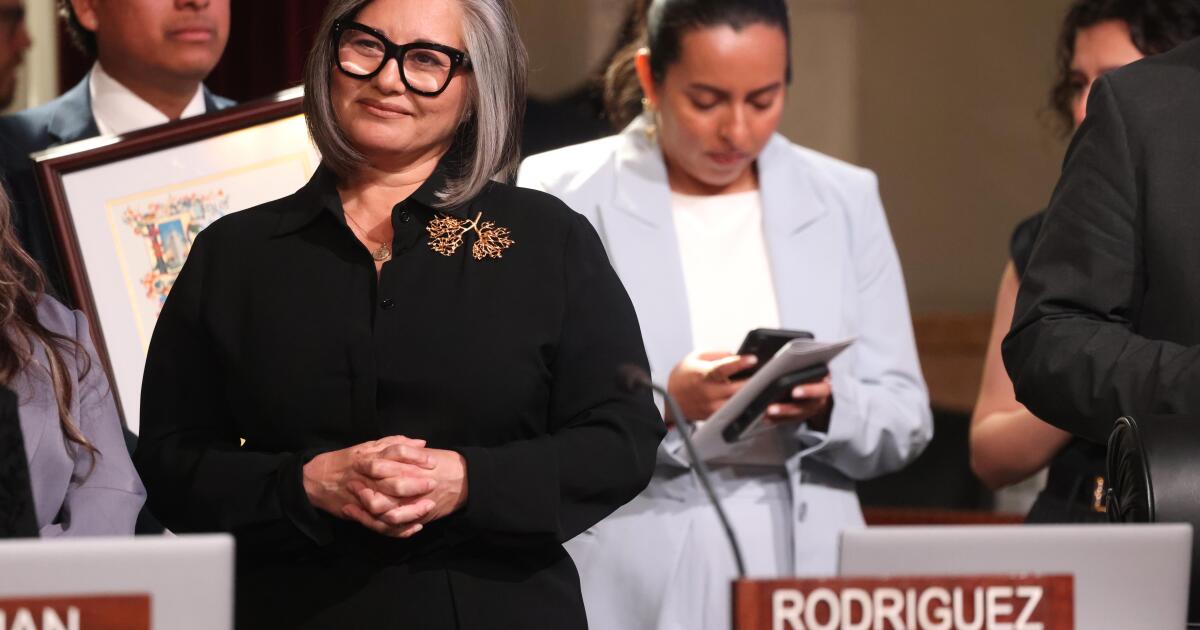
Los Angeles City Councilmember Monica Rodriguez has had some pretty tough words over the years for Mayor Karen Bass and her administration.
Rodriguez, who is running unopposed in Tuesday’s election, repeatedly criticized Bass’ Inside Safe program, which moves homeless people indoors, saying it lacked financial oversight. She voted against the mayor’s budget last year, saying too much was going to Inside Safe. She was especially harsh in the wake of the Palisades fire, saying that Bass’ team botched the first few months of the recovery.
That might make her an ideal person to endorse Councilmember Nithya Raman, who is running to unseat Bass in Tuesday’s primary and has leveled similar critiques. Instead, Rodriguez has emerged as an unexpected ally of the incumbent.
During the campaign, Rodriguez has appeared with Bass at events in Eagle Rock, Pacoima and even Sherman Oaks, located in Raman’s district. She popped up in a campaign flier from Latinos Por Karen Bass. And she’s been dinging Raman over everything from economic development to policies around outdoor barbecues.
Rodriguez explained her decision to support Bass in an interview, saying she views the incumbent as being far more willing to entertain opposing views than Raman — and understands that “not everyone thinks the same way.” Bass also is more consistent on the issues, Rodriguez said.
You’re reading the L.A. on the Record newsletter
Sign up to make sense of the often unexplained world of L.A. politics.
By continuing, you agree to our Terms of Service, which include arbitration and a class action waiver. You agree that we and our third-party vendors may collect and use your information, including through cookies, pixels and similar technologies, for the purposes set forth in our Privacy Policy such as personalizing your experience and ads.
Raman, by contrast, has shifted her positions on police spending, the tax hike known as Measure ULA and even who should be the next mayor, jumping into the race after she endorsed Bass, Rodriguez said.
“I don’t know what she stands for,” she said.
Raman’s campaign declined to comment on Rodriguez’s remarks. But former former Deputy Mayor Rick Cole, a Raman supporter, said he is surprised to see Rodriguez line up behind Bass, given how critical she has been over the years.
“Monica is a self-described maverick, so it’s ironic that she’s thrown in with the establishment on this. But sometimes personalities play a role,” he said.
Rodriguez had been talked up at one point as a possible opponent of Bass in this year’s election. If Bass wins a second and final term, the mayor’s race would be wide open in 2030.
Pratt accuses Bass of electioneering
It was a small yet upbeat event staged by Bass’ reelection campaign: The mayor, accompanied by supporters chanting “four more years,” walking up to an official drop box and putting in her ballot.
That miniature rally, staged last weekend near the city’s Memorial Branch Library, was captured on video and circulated by Bass’ campaign. But it has drawn a complaint from mayoral candidate Spencer Pratt, who accused the mayor of violating a state law prohibiting electioneering near a polling place or voter drop box.
In a complaint filed with the city clerk, Pratt attorney Peter McNulty said Bass and her supporters improperly solicited votes, waved campaigns signs and “engaged in blatant electioneering” near a voting location.
“Such clear violations of electioneering restrictions show a reckless disregard for the rule of law and an apparent belief that she need not comply with relevant restrictions that apply to all other candidates,” he wrote.
The Bass campaign pushed back on those allegations, saying the video features footage from two locations near the drop box. The portion that featured the Bass campaign signs was filmed 200 feet away — twice the distance required by law, said Alex Stack, a Bass spokesperson.
“Spencer is just mad that his supporters are AI cartoons and we have real Angelenos,” he said. “We follow the rules.”
Pratt’s lawyer said in his letter that he wants the city to investigate. He also filed a complaint with the state, citing the state election law that prohibits the dissemination of “visible or audible electioneering information” near a polling place or drop box.
Feldstein Soto flames Airbnb
City Atty. Hydee Feldstein Soto has been getting hit from both directions over the last few weeks.
On one side, a committee with at least $450,000 in funding from the Consumer Attorneys of California has been pumping out campaign ads promoting her opponent, Deputy Atty. Gen. Marissa Roy. On the other, a campaign committee heavily bankrolled by Airbnb is running ads for Deputy Dist. Atty. John McKinney, another opponent in the race.
Feldstein Soto has countered with a television ad that highlights her office’s lawsuit against Airbnb, which accuses the company of engaging in price gouging after the Palisades fire. Staring into the camera, Feldstein Soto said Airbnb and other special interests “are spending millions to try and get rid of me.”
“They think L.A. belongs to them,” she says. “I know it belongs to you.”
Feldstein Soto had raised about $860,000 for her campaign through May 16, compared with about $680,000 for Roy and about $122,000 for McKinney. But those fundraising efforts, which face strict limits under the city’s ethics laws, have been overshadowed by the unlimited spending from Airbnb and the others.
Angelenos for Progress, a pro-McKinney committee sponsored by the Central City Assn., received at least $2.1 million from Airbnb over the last month, pouring that money into campaign videos and television ads.
Justin Wesson, senior public policy manager for Airbnb in California, said in a statement that McKinney’s campaign platform is “focused on keeping Los Angeles communities safe and vibrant, including for Angelenos who share their home and their guests that contribute to the local economy.”
In recent weeks, Airbnb has been pushing the city’s elected officials to loosen L.A.’s home-sharing regulations, by allowing owners of second homes to lease their properties on short-term rental platforms.
Airbnb has put big money into other committees, including those that support Tim Gaspar, who is running to replace Councilmember Bob Blumenfield, and Jose Ugarte, who is running to replace Councilmember Curren Price.
Team Raman woos Huang, without success
We mentioned a few weeks back that Raman supporters have been noisily demanding that mayoral candidate Rae Huang drop out of the race, saying she was siphoning left-of-center votes away Raman. Turns out Raman’s campaign was trying to persuade her to pull the plug as well.
Raman campaign strategist Jeff Millman reached out to Huang advisor Bill Przylucki earlier this month about getting the community organizer to drop her mayoral bid, according to Huang spokesperson Emel Shaikh.
The overture from the Raman camp, first reported by LA Material, took place after the May 6 NBC LA debate but before a Fox debate planned for the next week, Shaikh said.
“She never really entertained the idea,” Shaikh said.
Raman, speaking with reporters on Friday, said she knew that people from both campaigns were conferring.
“I’m sure [Huang] was aware of it as well,” she said. “And I think we were really talking about how to achieve a bold, progressive vision for Los Angeles. Both of us got into this race because we felt a deep sense of dissatisfaction with the status quo.”
Millman, a veteran of L.A. politics, worked for former Mayor Eric Garcetti and was a spokesperson for Austin Beutner’s mayoral bid before his campaign ended in January. After Beutner dropped out, he moved to the Raman campaign. Przylucki is the former executive director of the progressive nonprofit Ground Game LA.
Supporters of Raman contend that Huang doesn’t have a path to victory — and could deprive Raman of a chance to compete in the Nov. 3 runoff. Asked whether she feels the same way, Raman said she is focused on getting her voters to the polls.
At this point, Raman is neck and neck with Bass and slightly ahead of Pratt, according to a poll from the UC Berkeley Institute of Governmental Studies, which was co-sponsored by The Times.
State of play
— A THREE-WAY RACE: Bass, Raman and Pratt are locked in a tight three-way contest, with the mayor holding a statistically insignificant lead in the run-up to Tuesday, the latest UC Berkeley-L.A. Times poll found. Bass had 26% support from likely voters, followed by Raman with 25% support and Pratt at 22%.
Bass, appearing at City Hall Thursday, said she’s not worried about failing to make the top two, telling an audience there are many polls that show different results. “I feel confident about Tuesday,” she said.
— AN EMBATTLED MAYOR: The Times took a look at Bass’ first term and the events that have put her political future in peril. Although some point to the city’s handling of the massively destructive Palisades fire, others say her troubles go much deeper.
— READING THE ROOM: While Bass has had difficulty managing the city, Raman faces a different issue: her struggle to forge working relationships with colleagues and allies. No one on the council, including those backed by the DSA, have endorsed her. Raman allies downplayed the issue, saying her strength is her independence.
— CUTTING CRIME: Even with L.A. experiencing fewer murders than at any point in 60 years, crime remains a potent issue in the mayor’s race. Pratt has been portraying the city as a lethal hellscape. Meanwhile, even some of Bass’ supporters have been shocked by how “aggressively pro-police she has been,” said former Councilmember Mike Bonin, who heads the Pat Brown Institute at Cal State, LA.
— DOWNTOWN IN THE DUMPS: Meanwhile, downtown business owners say they are struggling with crime, homelessness and aging infrastructure — all issues that have become central to the mayor’s race.
— LOVE, MOM: The mother of city controller candidate Zach Sokoloff has pumped at least $7.5 million into an independent expenditure campaign supporting him as he seeks to unseat City Controller Kenneth Mejia. The incumbent has accused the Sokoloff family of trying to buy the seat. Sheryl Sokoloff has declined to comment.
— SHERIFF SHOWDOWN: Los Angeles County Sheriff Robert Luna is in a rematch against former Sheriff Alex Villanueva, while also facing six other opponents. (Villanueva was unseated by Luna in 2022.) The top two vote getters will head to the Nov. 3 runoff.
— WAITING FOR THE WAGE: The council finalized its plan to delay a series of minimum wage hikes for hotel and airport workers this week, ensuring that the wage won’t reach $30 until January 2030 instead of July 2028.
— D&D AND DSA: Democratic Socialists of America, whose L.A. chapter is campaigning for five candidates in the city election, took in $30,000 at a Dungeons & Dragons-themed fundraiser. The candidates took part in the action, playing fantasy characters who still keep one foot in the political world.
— CALLING THE COPS: Looking to prevent copper wire theft, the Department of Water and Power is seeking to create its own police force.
— OUT OF THE FRYING PAN: The council on Wednesday confirmed Gabrielle Amster as the latest general manager for the animal services department, which oversees the city’s network of animal shelters. Amster had been serving as vice president of shelter engagement for DocuPet, a national pet registration business, according to her resume.
QUICK HITS
- Where is Inside Safe? Bass’ signature initiative to tackle homelessness did not launch any new encampment operations this week.
- On the docket next week: The election, obviously! If you haven’t cast a ballot by mail, make sure you show up at a voting center!
Stay in touch
That’s it for this week! Send your questions, comments and gossip to LAontheRecord@latimes.com. Did a friend forward you this email? Sign up here to get it in your inbox every Saturday morning.