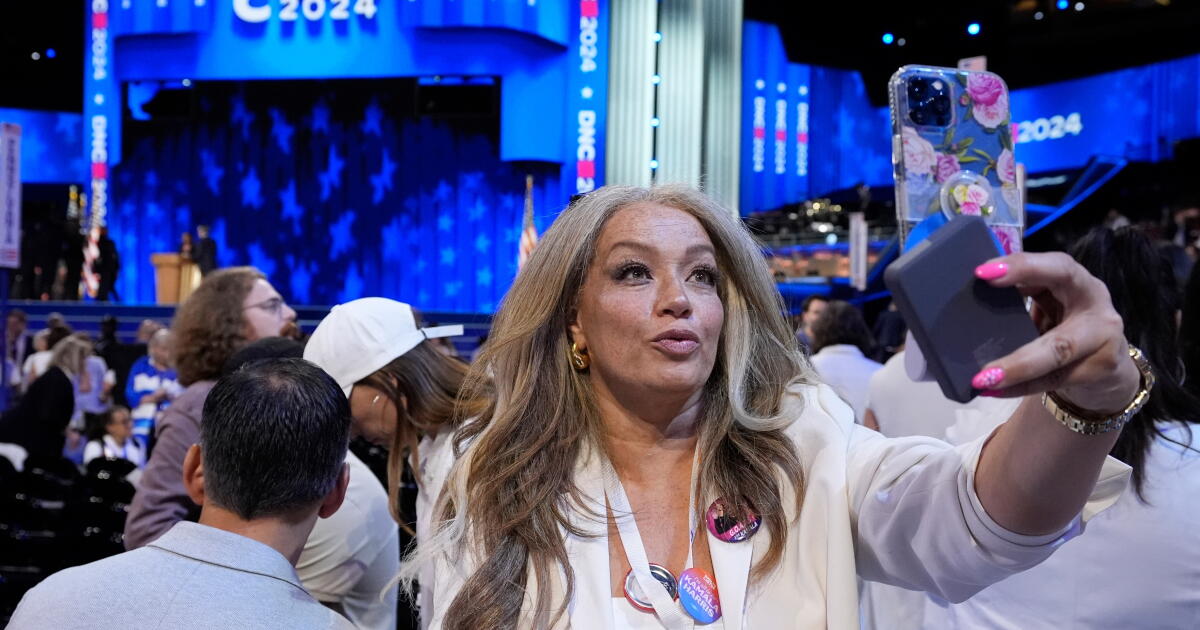
NEW YORK — As Democrats reeled from massive defeats in 2024, one of the few things they could agree on was that Republicans had drowned them out online.
So left-wing strategists built a new digital infrastructure to change that, elevating feisty social media personalities who capitalized on public frustration with President Trump. By 2026, these influencers were amassing billions of views across social media and boosting Democratic candidates by telling a story about affordability and corruption that contributed to historic midterm wins for the party.
“I’ve been doing digital political media for about a decade now, and it’s always been, you know, the left is on defense, swatting back disinformation,” said Brian Tyler Cohen, a progressive podcast host. “For the first time, the left was able to own the narrative in this cycle.”
Now left-leaning influencers and the groups that work with them are at a crossroads as Democrats take control of Congress and get ready for the 2028 presidential election. Some are preparing to serve as party cheerleaders, while others will be pressuring lawmakers to take more aggressive action — even mounting pressure campaigns to stop New York Sen. Chuck Schumer’s reelection as the Democratic leader.
Aidan Kohn-Murphy, the founder of the advocacy group Gen Z for Change, said many political creators like him are feeling empowered about their ability to shape the discourse around the Democratic Party’s future, even if that means criticizing it sometimes.
“Assuming that creators are going to be your little mouthpieces, that’s not going to work,” Kohn-Murphy said.
How this unfolds could be impactful, contentious and opaque. Unlike influencers promoting brands, those advocating political views are generally not required to disclose financial interests or share whether they are being paid to post. But at a moment of declining legacy media, this is a crucial battleground.
Democrats’ revamped social media strategy
Republicans and Democrats have increasingly tapped political influencers to promote their work or disseminate opposition research, either for free, for money or in exchange for perks such as access or training.
Trump was especially successful in mobilizing podcasters, comedians and other digital creators to spread his message in 2024. Democratic strategists took notice, and they spent the next two years trying to catch up.
The first high-profile effort to emerge on the left, just after the 2024 election, was Chorus, an organization started by Cohen that runs an incubator program for pro-democracy content creators.
Cohen said the group pays participants a flat rate for the time they spend in the program and does not require them to post anything, instead focusing on sharing resources such as self-employment crash courses, legal primers and messaging training.
“We’ve likened it to a grad school for content creators,” he said. “We’re just teaching them how to be more effective communicators online.”
Also new since the 2024 election is Project Bullhorn, political strategist Jason Berkenfeld’s effort to boost the volume of left-leaning content on social media. The group’s programs for the 2026 election included paying influencers for posts, according to its public solicitations on an online influencer marketplace called SideShift.
The Democratic National Committee forged new relationships with influencers before the Nov. 3 elections, too, scaling a group chat on the encrypted messaging app Signal from about 20 creators in summer 2025 to nearly 700 a year later, said Matt Rein, the party’s influencer and creative partnerships director.
Rein said for the midterms, his team sent video clips and campaign talking points in the app for creators to use, although there was no requirement to post. It also served as a conduit between the creators and specific campaigns, helping some of them nab opportunities to attend rallies or connect with the candidates.
Meanwhile, a constellation of other, smaller advocacy groups and left-leaning creator networks popped up in the background, some of them heading in person to closely contested states to promote specific candidates.
Kohn-Murphy said Gen Z for Change was successful at gathering small groups of creators to travel and make social media content around specific political targets, like the Democratic primary for U.S. Senate in Michigan, where they promoted Abdul El-Sayed, who went on to win the general election.
“For this Michigan trip, the content for these seven creators for this four-day period got like 25 million views,” he said.
Promoting Democratic wins, demanding results
Left-leaning content creators largely paddled in the same direction in the midterms, advocating for change as they railed against the Trump administration for high costs and the Iran war. But now that the Democratic Party is preparing to lead Congress and is facing a presidential primary that will kick into high gear next year, rifts could emerge between public figures aiming to boost all Democrats and those who want to steer the party in a specific direction.
The Democratic National Committee does not plan to choose sides. Rein said his aim for the coming years is to boost Democratic elected officials’ banner initiatives and develop more relationships with creators so that any 2028 candidate can “step into our creative program right away.”
On the other end of the spectrum, Kohn-Murphy said his group will not be shy about pressing for specific actions such as getting Democrats to ditch Schumer as their caucus leader and pick a fresh face instead. Schumer is being challenged by Sen. Chris Van Hollen of Maryland, who is supported by progressives and many newly elected Democrats.
“The Democratic Party wants new leadership — they demanded it,” Kohn-Murphy said. “To the folks that are going to be trying to pay creators to boost Chuck Schumer, I’ll say good luck.”
Democratic content creator Cheyenne Hunt, who in May founded the anti-misogyny advocacy group Reckoning Action after using her platform to expose sexual misconduct allegations against Democrats Eric Swalwell and Graham Platner, also said she is ready to go after members of her own party as needed.
That includes encouraging Democrats to advance investigations she deems important, including an inquiry into the administration’s handling of files from the Jeffrey Epstein case.
It also includes speaking out if any 2028 Democratic presidential candidates are accused of misconduct. Her group has a creator network that is poised to hold candidates accountable as well.
“If someone is a predator, and there’s any verifiable evidence to go on, we will be making noise about it,” Hunt said. “I’m also really interested in how we can shape the debate in 2028 and force them to take a strong position on an anti-misogyny agenda.”
Kyle Tharp, a political media analyst and writer of the newsletter Chaotic Era, said he expects more public conflicts as the Democratic influencer landscape grows.
He said a similar phenomenon has played out on the right in recent years as some Republican influencers who had championed Trump in 2024, like Tucker Carlson and Megyn Kelly, have taken a more independent tack and voiced criticism of the administration on occasion.
“You’re going to have some folks switching sides and going rogue or being independent or more critical. You’re going to have some that are going to be much more like cheerleaders,” Tharp said. “I think that’s just the sign of a large, fast-growing, healthy political media ecosystem.”
Swenson writes for the Associated Press.