candidate

How Honduras helped vice presidential candidate Tim Kaine find his mission in life

Not long after Jesuit priest Jack Warner met a bearded, 22-year-old Midwesterner in 1980, the two Americans bonded, drawn together by the goals and questions that led them both to El Progreso, a small city not far from vast banana fields — the campos bananeros.

Warner was 35 and had arrived a year earlier to form the Teatro La Fragua, a theater company for Hondurans. As the young priest looked to forge a relationship with the campesinos, his friendship blossomed with Tim Kaine, who had taken a year off from Harvard Law School to join the Jesuit mission.

“He was 22 years old,” Warner said, “and it was the typical thing that a 22-year-old would do: What do I do with my life?”

Kaine, now a 58-year-old U.S. senator from Virginia and the Democratic vice presidential nominee, has often said that his time in Honduras helped him answer that question, giving him “a North Star” to guide his life toward public service. It’s central to his biography and likely to arise Tuesday night when he debates his Republican opponent, Mike Pence.

Election 2016 | Live coverage on Trail Guide | Sign up for the newsletter

When Kaine traveled to Honduras, the nation was in the throes of turmoil, flanked by countries torn by civil war and ruled by the heavy hand of a U.S-backed military bent on stamping out what it perceived to be communism spreading in the region.

“I got a firsthand look at a system — a dictatorship — where a few people at the top had all the power and everyone else got left out,” Kaine said in July at the Democratic National Convention.

He also witnessed extreme poverty. His experiences, coupled with the Jesuit goal of being “men for others,” led him to become a civil-rights lawyer for 17 years, specializing in housing-discrimination cases. Honduras convinced him, he said, “that we’ve got to advance opportunity for everyone.”

Kaine now serves on the Senate Committee on Foreign Relations and this year co-sponsored a bill that would increase aid to Central America’s “Northern Triangle” — Guatemala, El Salvador and Honduras.

Key to his experiences in Honduras was the friendship and example of Warner and a handful of other Jesuits. And a Christmastime visit to a poor man’s house taught him a lesson that resonates decades later.

During his time in El Progreso, Kaine lived in a barracks, along with Warner and other Jesuits. After their work days wrapped up about 5 p.m., he and Warner frequently commiserated over office duties, students, the teatro and the poetry Kaine was writing. Warner, a former English teacher, worked with Kaine on his verse. Over time, they became confidants.

Father Jack Warner admires a painting created by an actor who performs in the Teatro la Fragua in El Progreso, Honduras.

Father Jack Warner admires a painting created by an actor who performs in the Teatro la Fragua in El Progreso, Honduras.

(Veronica Rocha / Los Angeles Times )

Both men grew up in the Midwest — Kaine in the Kansas City, Kan., suburb of Overland Park; Warner in St. Louis — and had been drawn to the Jesuit mission of social justice from an early age.

Kaine attended Rockhurst High School for boys, run by Jesuit priests who ran a demanding schedule of daily Masses, theology classes and community service activities with retreats.

Kaine, who earned a bachelor’s degree in economics at the University of Missouri, was at Harvard Law when he began to question his faith and the path he should take in life, he says. Because he had made a brief trip to Honduras in 1974 to deliver donations to the Jesuits, he decided to write them and see whether they could use some help. They said yes.

“He took a rather strong decision to seek out an answer — not everyone comes to Progreso,” Warner said.

Kaine had to tell his law school dean, and his parents, of this new direction. “The dean, not to mention my parents and friends, were confused about what I was doing and even questioned whether I would come back,” Kaine once recalled in a Virginia Tech speech.

By September 1980, Kaine was rumbling along in a bus into northern Nicaragua, where he visited another American Jesuit, Father James Carney. In Honduras months earlier, Carney had encouraged peasants to fight for their land, and he was expelled by the Honduran military, which saw him as one of the leftist priests who embraced liberation theology and the Sandinista revolution in Nicaragua.

Activists, some of them priests or the peasants they worked with, would be banished or killed by authorities. Carney would later disappear in what was believed to be a clandestine Honduran military operation backed by the CIA.

“It was a time when anytime the police stopped you, you got really nervous. You never knew what was going to happen,” Warner recalled. “We were under a military dictatorship at the time and very heavy military control. It was scary, and one had to live very carefully.”

We were under a military dictatorship at the time and very heavy military control. It was scary, and one had to live very carefully.

— Father Jack Warner, on Honduras in the 1980s

In El Progreso that September, Kaine soon met another Jesuit, Brother James O’Leary, a missionary also from Missouri.

O’Leary, who died in 2002, was often described as an outspoken, occasionally cranky but also skilled carpenter, painter and electrician who built houses and chapels for the poor. Kaine worked with him at his Loyola Technical Vocational Center, helping to boost the school’s enrollment and teaching carpentry and welding. As a youngster, Kaine had picked up skills working in his father’s ironworking shop in the Kansas City area.

Kaine declined to be interviewed for this story, but in a speech at the 2008 Democratic National Convention, he recalled what O’Leary taught him.

“I learned from a great mentor there, Brother Jim O’Leary, that faith is about more than words or doctrine — it’s about action,” he said. “And that led me to spend my life in public service.”

One of Kaine’s former students at the vocational center, Alex Hernandez Monroy, recalled the daily lessons in carpentry and welding from the shaggy-haired young American.

“His Spanish wasn’t very good, but despite all that he interacted with us,” said Hernandez Monroy, then 13 and now 48. Although Kaine couldn’t pronounce certain words, the students appreciated his efforts.

“Something very important that he did was that he visited the families of the students,” he said. “We were not used to interacting with Americans, so it had an impression on us to see someone like him educating us.”

Their debate might not matter much, but Mike Pence and Tim Kaine would be key White House players »

Using some of the skills he learned from Kaine and O’Leary, Hernandez Monroy teaches carpentry to a group of 15 students at the school. “They taught us that we could help our kids,” he said. “The majority of our youth are at risk, so that left an impression on us.”

::

About 35,000 people lived in El Progreso in 1980, when it was dominated by the presence of the United Fruit Co., the world’s largest — and often exploitative — banana company. Today it has a population of about 200,000, and the winding roads leading to the city are lined by brightly colored, one-story concrete homes.

During Kaine’s time there, however, it was a collection of dusty, rural villages and banana camps, with mountaintop towns accessible only by foot or mule. As a center for union activity, it became a target of the communism-fearing Reagan administration.

While war raged in neighboring El Salvador and Nicaragua, Honduras remained calm — but was gripped in fear. It was the staging ground for many of the United States’ clandestine operations aimed at toppling other governments.

People dared not speak about activism or union organizing lest they risk being among those who “disappeared.” More than a dozen priests were killed in the 1970s and 1980s after being associated with liberation theology, considered a Marxist-tinged doctrine that preached to the poor.

While Catholic priests in Central America were attacked for advocating on behalf of the poor, Kaine maintained a low profile and didn’t attract notice from the military.

Warner, a slender man with gray shoulder-length hair, recalled Kaine’s time in Honduras during a recent interview at the theater in El Progreso.

“His interest was in the students and what he was doing in his work, which is what we were all doing,” Warner said. “Trying to figure how we can do the work without being kicked out of the country for exploring it.”

Kaine also saw poverty and expressed his feelings about it through writing, as did Warner.

The priest maintained a daily newsletter with accounts of poverty and life in El Progreso. “We all have our defenses to shut out the existence of human misery, most of which consist of closing our eyes and pretending it doesn’t exist,” Warner wrote in a December 1980 newsletter. “Hopelessness then becomes a way of life for both parties.”

Warner published one of Kaine’s poems, titled “Still Life,” in which he described the “thick misery” of the town of San Pedro Sula. “In the saddest slum of San Pedro, lives are played out in the shade of a highway where buses glide like lost thoughts overhead.”

He likened the challenges, or “questions marks” facing the town to fingers testing the wind. “Each predicts change that just won’t come.”

Kaine spent nine months in El Progreso before returning to Harvard. He has kept in occasional touch with Warner and has returned to Honduras several times, most recently last year. This year, he and 25 senators called for an end to immigration raids in the U.S. targeting women and children who were fleeing violence in Honduras, Guatemala and El Salvador.

When he accepted the nomination for vice president, Kaine said that the three basic values he absorbed in Honduras hold true today: “Fe, familia y trabajo.” Faith, family and work.

Students take a break before heading to class to learn carpentry at Loyola Technical Vocational Center, where Tim Kaine volunteered, in El Progreso, Honduras.

Students take a break before heading to class to learn carpentry at Loyola Technical Vocational Center, where Tim Kaine volunteered, in El Progreso, Honduras.

(Veronica Rocha / Los Angeles Times )

“I came to understand the power of faith and communal worship,” Kaine said at Virginia Tech in 2006. “I learned how to speak Spanish and began to understand how the things which can seem to divide us — like language and skin color — were so much smaller than the dreams and fears that unite us.

Kaine also has repeatedly recalled what became one of his most indelible memories of Honduras.

He and Father Jarrell Wade, a Jesuit known as Father Patricio, had traveled by mule to visit a dirt-poor family around Christmas. As they prepared to leave, the husband handed Wade a bag. “Merry Christmas, padre,” he said.

Inside the worn bag were fruits and vegetables he had saved for the priest. Wade took the bag and thanked him.

Kaine was appalled and angered that the priest would take food from such a poor family — “I was fuming” — until Wade imparted the lesson: “You must be really humble to accept a gift of food from a poor person, and the most important thing in life is the ability to give.”

veronica.rocha@latimes.com

Twitter: @VeronicaRochaLA

Times staff writer Tracy Wilkinson in Washington contributed to this report.

ALSO

Tax troubles threaten Trump as election day nears, and so does his own approach to campaigning

These donors gave to Trump’s GOP rivals. Now 95% are sitting out the general election

Trump wanted to fire women who weren’t pretty enough, say employees at his California golf club


Source link

Here’s the final list of candidates for L.A. city elections

The list of candidates running for Los Angeles city and school board offices is set, with a number of incumbents facing what could be competitive primary elections on June 2.

Fourteen Angelenos have qualified to run for mayor, including incumbent Karen Bass, City Councilmember Nithya Raman and former reality TV star Spencer Pratt.

Seven City Council incumbents face at least one challenger, while Councilmember Monica Rodriguez is running unopposed to represent her northeast San Fernando Valley district.

City Atty. Hydee Feldstein Soto is running against three opponents — deputy attorney general Marissa Roy, human rights attorney Aida Ashouri and Deputy Dist. Atty. John McKinney.

In the race for city controller, incumbent Kenneth Mejia will battle it out against Zach Sokoloff, who is on sabbatical from his job as senior vice president of asset management at Hackman Capital Partners.

For the last week and a half, workers at the City Clerk’s Office have been verifying the legitimacy of voter signatures submitted by the candidates, finishing the last batch on Friday.

Gathering the required 500 signatures is relatively easy in citywide races but harder in council and school board districts. Some candidates who submitted petitions by the March 4 deadline failed to qualify because some of their signatures were deemed invalid.

In each race, if no candidate gets more than 50% of the vote in June, the top two finishers will compete in a November runoff.

The field of 14 for mayor narrowed significantly from the roughly 40 who filed initial paperwork on Feb. 7. The qualifiers include a game streamer, a singer-songwriter and a tech entrepreneur, as well as government veterans like Asaad Alnajjar, a longtime engineer for the city. Rae Huang, a pastor and housing advocate, will also appear on the ballot.

Raman, a former Bass ally, shook up the race with her surprise entry, hours before the filing deadline.

A recent poll found that about 51% of Los Angeles voters are undecided on who they want for mayor. Bass led at 20%, followed by Pratt at just over 10% and Raman at slightly more than 9%, according to the Emerson College Polling/Inside California Politics poll.

Tech entrepreneur Adam Miller was supported by just over 4% of those polled, with Huang at about 3%.

In District 1, which stretches from Glassell Park and Highland Park to Chinatown and Pico Union, four challengers are looking to unseat City Councilmember Eunisses Hernandez. They are Maria Lou Calanche, a former Los Angeles Police Commissioner and founder of the nonprofit Legacy LA; Nelson Grande, an executive consultant and former president of Avenida Entertainment Group; Raul Claros, founder of CD1 Coalition, which organizes cleanup days; and Sylvia Robledo, a small-business owner and former council aide.

Councilmember Bob Blumenfield is terming out in District 3, leaving the race to represent the southwestern San Fernando Valley open to a newcomer. The three candidates are Timothy K. Gaspar, who founded a private insurance company; Barri Worth Girvan, a director of community affairs for an L.A. County supervisor; and Christopher Robert “C.R.” Celona, a tech entrepreneur.

In District 5, which includes Bel-Air, Westwood, Hancock Park and other West L.A. communities, Councilmember Katy Yaroslavsky faces two challengers: tenants rights attorney Henry Mantel and accountant Morgan Oyler.

With Councilmember Curren Price terming out in District 9, six candidates are vying to represent parts of downtown and South L.A. They are Jose Ugarte, who was formerly Price’s deputy chief of staff; Estuardo Mazariegos, a lead organizer at the Alliance of Californians for Community Empowerment; nonprofit director Elmer Roldan; entrepreneur Jorge Nuño; professor and therapist Martha Sánchez; and educator Jorge Hernandez Rosas.

Councilmember Traci Park, who represents the Westside communities of District 11, including Brentwood, Pacific Palisades and Venice, will face off against civil rights attorney Faizah Malik.

In District 13, which includes Hollywood and East Hollywood as well as parts of Silver Lake, Echo Park and Westlake, Councilmember Hugo Soto-Martínez is defending his seat against three challengers. They are Colter Carlisle, vice president of the East Hollywood Neighborhood Council; Dylan Kendall, an entrepreneur and founder of Grow Hollywood; and Rich Sarian, vice president of strategic initiatives for the Social District.

And in District 15, which includes San Pedro and other harbor-area communities as well as Watts, Councilmember Tim McOsker is running against community organizer Jordan Rivers, who is continuing his campaign after reports that he stabbed a neighbor when he was 12. Rivers said it was an “accident” that happened a decade ago.

Three seats are open on the Los Angeles Unified School District board.

In District 2, incumbent Rocío Rivas is being challenged by Raquel Zamora, an LAUSD teacher and attendance counselor.

In District 4, incumbent Nick Melvoin is facing off against Ankur Patel, director of outreach at the Hindu University of America.

District 5 school board member Kelly Gonez is running unopposed for her third term.

Source link

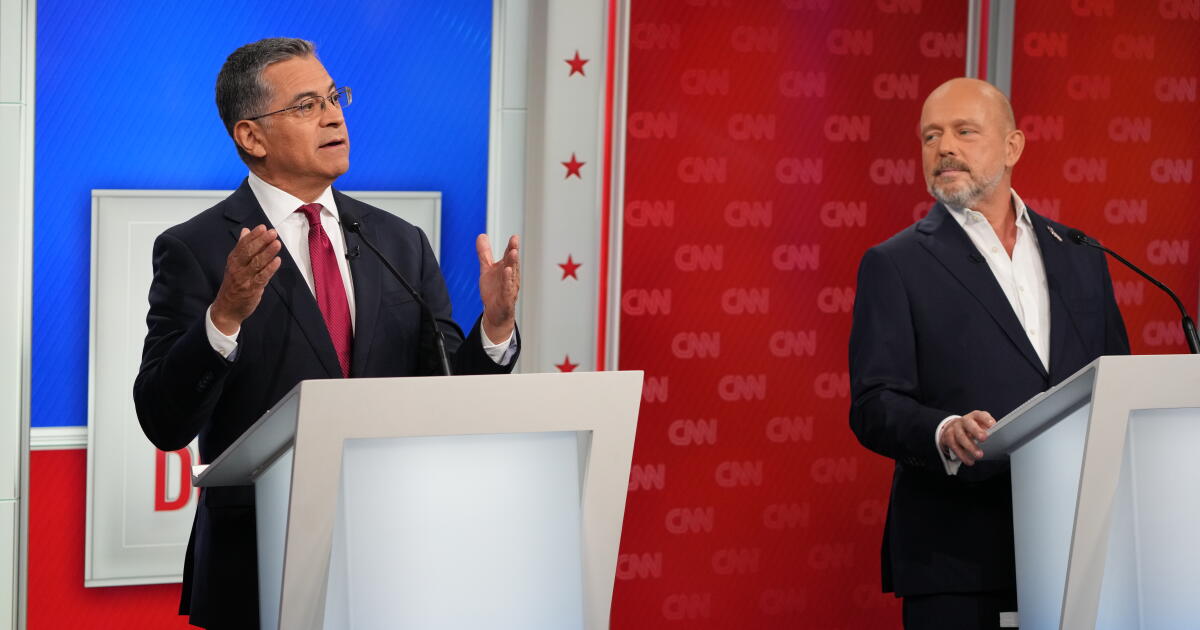
Becerra blasts USC and ABC for excluding candidates of color from gubernatorial debate

Former U.S. Health and Human Services Secretary Xavier Becerra, one of the top Democrats running for California governor, on Friday blasted USC and the ABC affiliate in Los Angeles for hosting a debate that he argues purposely excludes all candidates of color.

Becerra said he and the other candidates were excluded from the televised debate unfairly, a decision that he said “smells of election rigging” in a hotly contested race less than three months before the June primary.

“My father used to tell me of the days when he would encounter signs posted outside establishments that read ‘No Dogs, Negroes or Mexicans Allowed,’” Becerra wrote in a public letter to USC President Beong-Soo Kim. “USC’s actions may not seem so transparent. But, you have deliberately chosen to selectively filter the voters’ view of the field of gubernatorial candidates in what all observers characterize as a wide-open race.”

The university said in a statement that it authorized a political expert to create the formula to determine who would be included in the debate.

“At the request of the Center for the Political Future, Dr. Christian Grose, Professor of Political Science and International Relations, independently established the methodology that determined eligibility for the debate,” according to a statement from the center. “No one in the USC administration had any role in developing, reviewing or approving those criteria.”

The center later said in a statement on Friday that it reiterated the criteria that determined which candidates were invited to participate in the debate, and that nothing had changed since the forum was first planned.

The criteria for gubernatorial candidates to participate considered opinion polling and campaign fund raising. Six candidates were asked to participate in the March 24 debate, which is cosponsored by ABC7 Los Angeles and Univision.

There was conflicting information about USC’s stated criteria, however. The methodology says that the fundraising totals considered were based on semi-annual reports campaigns filed with the California Secretary of State’s office. However, the document later says that the fundraising figures also includes large donations that campaigns are required to immediately report.

This is a critical difference, because San José Mayor Matt Mahan did not enter the race until late January, and thus far has not been required to file any semi-annual fundraising disclosures with the state. However, he has received significant donations since he entered the race.

Mahan agreed with Becerra, saying that he ought to be part of public forums about who will lead the state.

“The former Secretary is absolutely correct, he should be included in the debate,” Mahan said in a statement. “His long record of service to California has earned him a place on every debate stage in this campaign for Governor.”

USC officials said they are clarifying how they selected candidates to participate in the race.

“We are reissuing the criteria to make clear that they include current fundraising totals, including semi-annual and late reports, which were always part of the formula,” the Center for the Political Future said in a statement. “We are not changing the criteria. We have updated even as of today and the rank order includes the same top 6 candidates.”

Grose said that the selection of candidates was based upon polling and fundraising numbers, and that the sentence about semi-annual fundraising reports was inaccurate.

“It was just a wording issue. It’s not a methodology issue,” he said.

Six candidates are scheduled to appear at the debate: Republicans Riverside County Sheriff Chad Bianco and conservative commentator Steve Hilton; and Democrats Northern California Rep. Eric Swalwell, former Orange County Rep. Katie Porter, billionaire hedge-fund founder Tom Steyer and Mahan.

The kerfuffle occurs after Democratic candidates of color accused state party leaders of trying to oust them from the race in favor of white candidates, who have more support in opinion polls.

In addition to Becerra, other prominent Democratic candidates excluded from the debate include former state Controller Betty Yee, state Supt. of Public Instruction Tony Thurmond and former Los Angeles Mayor Antonio Villaraigosa, who also condemned the candidate-selection formula.

“Californians deserve a fair process, and voters deserve to hear from all qualified voices,” Villaraigosa, who taught public policy at USC for three years after leaving office, said in a statement. “But this biased and bigoted action by USC to manipulate the data to exclude every qualified Black, Latino, and API candidate in favor of a less qualified white candidate is shameful.”

Becerra said USC went to great lengths to justify the candidates that were excluded, but the bias was clear.

“You can’t escape the detestable outcome: you disqualified all of the candidates of color from participating while you invited a white candidate who has NEVER polled higher than some of the candidates of color, including me,” he said.

Becerra was clearly referring to Mahan, who recently entered the race and has received millions of dollars of support from Silicon Valley leaders. Becerra noted that veteran GOP strategist Mike Murphy, co-director of the USC Center for the Political Future, which is a sponsor of the debate, is assisting an independent expenditure committee backing Mahan.

Murphy said he had recused himself from anything involved in the debate, and that he was a volunteer for the outside group backing Mahan. If he becomes a paid advisor to the independent expenditure committee, he said he has requested unpaid leave from the university through the June 2 primary.

“I’ve been transparent that I’m personally a Mahan supporter,” Murphy said. “I’ve had zero to do with the debate.”

Source link

Sacked Reform candidate finally apologises for racism after being chained to black youth worker

It’s taken 18 months, but Bob Lomas has been shown the error of his ways and has said sorry to all those he offended

Sacked Reform candidate Bob Lomas has apologised for the racist comment that saw him disowned by party leader Nigel Farage 18 months ago, after being chained to a Black youth worker on Channel 4’s Handcuffed.

The former soldier, 70, has posted his apology on Instagram, after he was persuaded by Chris Preddie that his views were offensive and racist. In the video post the ex-Reform member, from Yorkshire, said: “My name is Bob Lomas and 18 months ago I said that Black people should get off their lazy arses, go and get a job and stop acting like savages.

“I can’t change what I said, I can only apologise for saying it. I vehemently apologise for using those words. I made a bloody big mistake and I am bloody sorry that I did and I want to apologise to anybody that is affected.”

Content cannot be displayed without consent

Handcuffed, hosted by Jonathan Ross, sees people with opposing viewers shackled together for a shot at the £100,000 prize. In Monday’s episode viewers will see Chris Googling Bob to find out who he is actually chained to.

Bob admits having made the shocking comment that ended his political career, on Facebook, but starts off defending himself, arguing: “Everything’s racist if you want it to be. I witnessed a riot in London and was appalled by what was happening in my capital city. I could have worded it better but it gets to the point where you can’t say anything about anything.”

But Londoner Chris, who was awarded the OBE 13 years ago at the age of 25 for his inspirational youth work, said that the terminology had left him feeling “quite disgusted”. And once he has explained his own background, Bob backs down and admits that his views were wrong.

In the programme, Chris tells him that his father had died after being caught up in gangs and he was quickly groomed for a life of crime. himself. “I didn’t have a role model,” he explains. “I didn’t want to sell drugs but, if I didn’t, then I’m not eating. Not surviving.”

He credits the youth worker who helped him to break out with having “saved my life” because Chris feels certain he’d be “dead or in prison” without that support. Getting the OBE from the late Queen Elizabeth had been a huge honour. “I was so proud,” he confesses. “People started to see me as a normal citizen – I was told my whole life that I’d amount to nothing.”

Looking moved by what he’s learned, Bob admits that Chris’s story is “very, very shocking” and tells the camera that he’s impressed by how he not only got out, but went on to help others do the same. “He used that experience to help bring other young men and women out of that mindset. What he does for his community is unbelievable. I salute him.”

Bob was standing as the Reform candidate for Barnsley North when he was dropped by party leader Farage, along with two others, in June 2024 over remarks made by all three on social media. Speaking on Question Time afterwards, Farage claimed: “I wouldn’t want anything to do with them”. The racism within Reform was widely condemned by other political leaders, with Farage told to “get a grip” on his party.

– Handcuffed – Last Pair Standing continues on Monday, Channel 4, 9pm

Like this story? For more of the latest showbiz news and gossip, follow Mirror Celebs on TikTok , Snapchat , Instagram , Twitter , Facebook , YouTube and Threads .


Source link

The Apprentice’s Lord Sugar calls out ‘nasty move’ as candidate admits ‘regret’

Tensions rose in The Apprentice as a candidate shared a decision he would “regret for the rest of my life”.

BBC The Apprentice said goodbye to yet another candidate this week but not before Lord Sugar addressed someone’s “slimey” actions.

In week seven of the hit BBC business show, the remaining candidates took on virtual reality fitness where they were tasked with building demos and brands before chasing investment.

Unfortunately, when it came to the boardroom, it was game over for Team Eclipse, headed up by project manager Lawrence Rosenberg who scored an investment four times lower than Team Alpha.

The drama really began in the boardroom when it came to Lawrence choosing who he would be bringing back with him.

He first decided to pick Rajan Gill for his “lack of contributions” before sharing the controversial reason for his second choice of Levi Hague.

Lawrence said: “With respect Lord Sugar, I think you have made it quite clear about your mind on Levi so I will need to bring back Levi as well.”

Prior to his decision, Lord Sugar had questioned Levi what he had achieved in the past seven weeks of the process but despite his own reservations, The Apprentice legend wasn’t happy with this “naughty”, tactic.

“This is not how this process is supposed to work, you’re supposed to bring people back in who you think did not contribute to this task.”

Lord Sugar described it as a “nasty move” with Lawrence apologetically saying that “I’ll regret it for the rest of my life”.

The Apprentice legend said he was going to be “fair” to Levi though and keep him for another week, putting him forward as next week’s project manager with the candidate laughing “happy days”.

Despite this business between Lawrence and Levi, it was actually Rajan’s turn to be fired for his lack of contributions to the task.

This didn’t stop Lord Sugar from giving Lawrence one last telling off though as he warned: “You were this close to getting out of here.”

The drama wasn’t quite over yet though as when the saved pair went back to the house, Lawrence admitted to the rest of the group that he was “beyond embarassed”, having made a “weak decision”.

Levi wasn’t going to let him off the hook just yet though as he simply stated to the remaining candidates: “Don’t ever use me as a scapegoat in there, don’t ever do that to me.”

The Apprentice continues every Thursday at 9pm on BBC One.

For the latest showbiz, TV, movie and streaming news, go to the new **Everything Gossip** website.

Source link

Most L.A. voters undecided about mayor’s race, with support for Bass at 20%, poll finds

A majority of Los Angeles voters are undecided about the race for mayor, with support for incumbent Karen Bass at 20%, according to a new poll.

The poll by Emerson College Polling/Inside California Politics found that about 51% of Angelenos have not made up their minds about who should lead the city for the next four years.

Spencer Pratt, a conservative reality TV star, came in second to Bass, at just over 10%. City Councilmember Nithya Raman, a former Bass ally who shook up the field with her last-minute entry, polled at slightly more than 9%. Tech entrepreneur Adam Miller was supported by just over 4% of those polled, with leftist candidate Rae Huang at about 3%.

Although Bass had the most support among the candidates in the June 2 primary election, the poll showed that nearly half of Angelenos are unhappy with her performance. She was weakened politically by her handling of the devastating Palisades fire but has touted reductions in homicides and homelessness.

About 25% of those polled said they approve of the job Bass is doing as mayor, while about 47% disapprove. About 28% said they have no opinion or felt neutral.

The poll, based on interviews with 350 likely voters March 7-9, revealed just how up for grabs the mayoral election is, with less than three months before the primary.

“This is a wide open race,” said Zev Yaroslavsky, a former city council member and L.A. County supervisor who runs the Los Angeles Initiative at the UCLA Luskin School of Public Affairs. “The general narrative [of the poll] is that the mayor is not popular for somebody going into reelection, but the majority of people have not made up their mind whether they’ll come back to her or go to someone else.”

Los Angeles Councilmember Nithya Raman meets with reporters after filing paperwork to run for mayor.

City Councilmember Nithya Raman meets with reporters after filing paperwork to run for mayor of Los Angeles.

(Christina House / Los Angeles Times)

Bass campaign spokesperson Doug Herman did not respond directly to the poll. But he said in a statement that the mayor “took on the challenge to change Los Angeles after decades of decline from long ignored issues; resulting in first ever back to back drops in homelessness, 60 year lows in homicides and an unprecedented 40,000 affordable housing units accelerated.”

Pratt said through a campaign spokesperson, “The Emerson poll confirms what we’ve been seeing on the ground — this is a two-person race for Mayor of Los Angeles between me and Karen Bass. Angelenos are frustrated with the direction of the city and it’s reflected in her low approval numbers. Our campaign is gaining real momentum as more voters look for new leadership focused on results and accountability. This race is just getting started.”

Raman’s campaign, however, said she’s the one gaining momentum.

“It’s clear that voters want change, and we’re gaining momentum for our campaign to make L.A. more affordable and to govern with urgency and accountability,” the campaign said in a statement.

The field of candidates did not take shape until the week of the February filing deadline. Billionaire developer Rick Caruso and L.A. County Supervisor Lindsey Horvath both flirted with a run before deciding against it, and former L.A. schoolsSupt. Austin Beutner dropped out after the death of his 22-year-old daughter. With no other major candidate opposing Bass, Raman filed her paperwork with hours to spare.

With petitions still being verified, 13 mayoral candidates have qualified for the June ballot. If no one gets 50% of the vote in the primary, the top two finishers will head to a runoff in November.

“This race could shift dramatically come June,” Spencer Kimball, executive director of Emerson College Polling, said in a statement.

Kimball cited the large percentage of undecided voters of all stripes — 67% of independents, 49% of Democrats and 37% of Republicans are undecided. Pratt is a Republican, and the other major candidates are Democrats in a heavily blue city.

Pacific Palisades resident Spencer Pratt, who lost his home in the Palisades fire, stands with supporters.

Pacific Palisades resident Spencer Pratt, who lost his home in the Palisades fire, stands with supporters after announcing his run for Los Angeles mayor on the one-year anniversary of the Palisades fire in the Palisades Village on Jan. 7, 2026.

(Genaro Molina / Los Angeles Times)

The poll is not the first to show negative views of Bass.

Last year, after the Palisades fire, a poll of L.A. County residents by the UCLA Luskin School of Public Affairs found that 37% held favorable views of the mayor, while 49% held unfavorable views.

The Emerson poll also featured questions on issues such as public safety and homelessness.

More than 82% of Angelenos in the poll said they feel very safe or somewhat safe in their communities, while about 17% said they feel not too safe or not safe at all.

On homelessness, the view was grimmer. Only 15% of Angelenos polled said that homelessness is getting better, while more than 55% said it is getting worse. Almost 30% feel it is staying the same.

Los Angeles has seen significant reductions in street homelessness for the last two years, after years of steady increases.

Bass has attributed the declines to her signature Inside Safe program, which clears encampments and places homeless people in short term housing.

“There is no doubt that Inside Safe, by bringing thousands of people inside and reducing street homelessness by 17.5 percent, has saved lives and helped drive this decline,” Bass said in a statement Tuesday.

The Emerson poll also asked California residents about the governor’s race. Rep. Eric Swalwell (D-Dublin) had the most support at slightly more than 17%, followed by Republicans Steve Hilton at just over 13% and Chad Bianco at more than 11%. Billionaire Tom Steyer came in at about 11%.

Nearly a quarter of California voters were undecided, according to the poll.

Paul Mitchell, a political data expert, called the Emerson poll flawed. Not enough Angelenos were polled, and the sample skewed too heavily toward young people, when older residents are more likely to vote, he said.

Mitchell called the poll an “amuse-bouche.”

“This tells all of the candidates [they] should be doing a poll,” he said.

Source link

California Dems launch polling effort to winnow gubernatorial field

As anxiety mounts among California Democrats about the potential of a Republican being elected governor, the state party will spend hundreds of thousands of dollars on polling to assess the viability of the sprawling field of candidates hoping to replace termed-out Gov. Gavin Newsom, according to plans released Tuesday.

The move comes after nearly every Democratic candidate refused party leaders’ call last week to withdraw from the race to avoid splitting the vote in the June primary — an outcome that could lead to a Republican being elected to statewide office for the first time in two decades.

“Candidates have filed, and now they’ve got the opportunity to showcase their viability, their path to win. I want to simply ensure that everybody has information to fully understand the current state of the race,” said Rusty Hicks, the leader of the California Democratic Party.

As campaign season ramps up, the series of six polls will allow “candidates, supporters, the media, voters, anyone and everyone to have a clear understanding of what is or is not happening in this particular race,” he said.

The filing deadline to appear on the June 2 ballot was Friday. Three days earlier, Hicks released an open letter urging candidates who did not have a path to victory to withdraw from the race. Of the nine prominent Democrats who had announced runs for governor, only one heeded his call: former state Assembly Majority Leader Ian Calderon.

That means the eight other candidates’ names will appear on the ballot, regardless of whether they decide to later drop out. And that creates the possibility of a Republican winning the race because of how California elections are decided.

The state has a voter-approved top-two primary system, under which the two candidates who receive the most votes in the June primary advance to the November general election, regardless of party.

Two prominent Republicans will appear on the ballot: former conservative commentator Steve Hilton and Riverside County Sheriff Chad Bianco. Even though Democratic voters outnumber Republicans nearly 2 to 1, and the state’s electorate last elevated Republicans to statewide office in 2006, it is mathematically possible for Democrats to splinter the vote, allowing the two GOP candidates to advance.

Under such a scenario, not only would Republicans be guaranteed the leadership of the nation’s most-populous state, but Democratic voter turnout also would probably be depressed in November, potentially affecting down-ballot races such as those that could determine control of Congress.

Hicks’ call last week prompted concerns among candidates of color, including former U.S. Health and Human Services Secretary Xavier Becerra and state Supt. of Public Instruction Tony Thurmond, that the effort was aimed at every nonwhite candidate in the race.

The state party chairman responded that his letter was not aimed at any specific candidate.

“It’s not something I lose sleep over,” Hicks said when asked about the racial claims. But he added that the voter surveys will be conducted by Los Angeles-based Evitarus, the state’s only Black- and Latino-led full-service polling firm, and will oversample historically underrepresented communities: Latino, Black and Asian American voters.

Hicks said the polling will cost “multiple six figures” but did not specify the exact amount.

The first poll will be released on March 24, and then five additional surveys will come out every seven to 10 days until voters start receiving mail ballots in early May.

“We’re putting this forward to ensure everyone is armed with the information they need to clearly have an eyes-wide-open assessment of where the state of the race currently is between now and when ballots land in the mailboxes of voters,” Hicks said.

Source link

L.A. City Council candidate stays in race after report that he stabbed a boy at age 12

Jordan Rivers, who is running to represent a harbor-area district on the Los Angeles City Council, said he will continue his campaign after a report surfaced that he stabbed a neighbor when he was 12.

Rivers, 22, is the sole challenger to incumbent Tim McOsker in the June 2 primary election.

In a lawsuit, Nicholas Parszik and his parents alleged that Rivers stabbed Nicholas, then 8, while the two boys were playing video games in the garage of Nicholas’ San Pedro home on July 30, 2016.

Rivers “stabbed Nicholas repeatedly around the neck and shoulder areas,” inflicting “severe and life threatening physical and emotional injuries,” the lawsuit said.

On Monday, Rivers said it was an “accident” that happened a decade ago.

“I do not believe that past situations or indeed past mistakes define or determine who a person is or what they are,” he said in a statement.

Rivers, who is Black, said that an initial media report about the lawsuit had “a racial undertone” and seemed meant to damage his reputation ahead of the election.

The California Post first reported the lawsuit on Monday, which was also the last day for candidates to withdraw paperwork to run for office.

McOsker is seeking a second term representing District 15, which includes Harbor City, Harbor Gateway, San Pedro, Watts and Wilmington.

“I am saddened and troubled that this happened here in our community, and my heart breaks for the victim and his family. I hope they have gotten the care needed. My office will be here to provide advocacy and support for anybody who has been traumatized by this incident,” McOsker said in a statement.

Asked whether Rivers should withdraw, McOsker campaign consultant Dave Jacobson said, “Only Mr. Rivers could decide whether to run, and only he can decide whether he should stay in the race.”

Rivers, who listed his occupation as “community organizer” on campaign filings, has not reported any campaign donations. By Dec. 31, McOsker’s campaign had raised over $190,000, according to the city’s Ethics Commission.

Juvenile criminal records are sealed. Rivers said that law enforcement “got involved” but that he did not serve time in juvenile hall.

Paul Parszik, Nicholas’ father, said he was doing dishes when he heard screaming from the garage and Nicholas ran into the house with stab wounds on his neck and shoulders.

Paul Parszik recalled shoving his fingers into the wounds to staunch the bleeding.

Nicholas fully recovered and is about to turn 18, his father said, but still has physical scars.

In an interview with The Times, Rivers denied attacking Nicholas. He said he had been cooking and accidentally brought a cooking knife to the younger boy’s home.

He forgot that he had put the knife under a video game controller, and the two began “play fighting,” he said.

Rivers said he didn’t notice anything was wrong until Nicholas was already injured.

Rivers’ mother, Eunice Rivers, wrote in a 2016 filing in the lawsuit that her son “was eating an apple and had a small peeler in his hand to cut his apple when the Plaintiff started wrestling with the Defendant. While wrestling Plaintiff Nicholas was injured.”

Eunice Rivers settled the case, which was filed in Los Angeles County Superior Court, for $10,000 in 2018. The settlement did not include an admission of fault.

In an October court filing, Paul Parszik claimed that Eunice Rivers never paid the settlement and owes $7,941.71 in interest.

Parszik said the lawsuit was primarily intended to pressure the Rivers family to move away, which they did not do.

He plans to attend Rivers’ campaign rallies.

“I can’t wait to go home and go to his first rally and say, ‘Hey, you stabbed my kid and you have no remorse,’” he said.

Source link

Contributor: The stars align for Democrats in Texas. Trump is helping them

If Democrats expect to flip a U.S. Senate seat in Texas, they’ll need all the stars to align. This almost never happens, because politics has a way of scrambling the constellations. But on Tuesday, the first star blinked on.

I’m referring to state Rep. James Talarico’s victory over Rep. Jasmine Crockett in the Democratic primary. Most political prognosticators agree that Talarico, an eloquent young Democrat who speaks openly about his Christian faith, is their best hope in a red state that Donald Trump won by 14 points.

The second star was Crockett’s conciliatory concession — far from a foregone conclusion after a nasty primary — in which she pledged to “do my part,” adding that “Texas is primed to turn blue, and we must remain united because this is bigger than any one person.”

The third star — a vulnerable Republican opponent — has not yet appeared over the Texas sky, although forecasters say it might.

Most observers agree that scandal-plagued Atty. Gen. Ken Paxton would be beatable in the general election, while incumbent Sen. John Cornyn would present a much tougher challenge. Cornyn is the kind of steady, conventional politician who tends to win elections, and so, of course, modern voters are extremely suspicious of him.

In the GOP primary on Tuesday, Cornyn’s 42% share of the vote edged out Paxton by about a point. Unfortunately for Republicans, neither candidate garnered enough votes to avoid a May 26 runoff election.

Conventional wisdom suggests that when a majority of Republican voters choose someone other than the incumbent in the first round of voting, an even greater majority will inevitably break toward the challenger in the runoff. If that happens, Paxton would become the nominee, and Democrats would get their third star to align.

Even better for Democrats — a fourth star, so to speak — would be for this protracted runoff to become a “knife fight,” as one Texas Republican predicted, in which Paxton staggers out of the fight as the battered GOP nominee.

The only problem is that Republicans can see these stars aligning, too.

And while the Texas Senate seat matters a lot on its own, it matters even more in the context of nationwide midterm elections, in which a Texas win would help Democrats take back the Senate.

Enter the cavalry — or, more accurately, President Trump, who is now entering a second war in the span of a week, this one a civil war in the Lone Star State.

The day after the primary, Trump announced that he would be “making my Endorsement soon, and will be asking the candidate that I don’t Endorse to immediately DROP OUT OF THE RACE!”

Reports suggest Trump may endorse Cornyn in order to save the seat for Republicans. But who knows? Trump is famously unpredictable. And it’s likely he admires Paxton’s ability to survive scandals that would have caused most normal politicians to curl up in the fetal position. As they say, “game recognizes game.”

Whomever he backs, conventional wisdom also says Trump should make his endorsement “soon,” as he promised. That would save Republicans a lot of time and money. But Trump currently has enormous leverage. Right now, people are coming to him, pleading for his support.

Do you think he wants to resolve that situation quickly?

Me neither.

With Trump, you never know what you’re going to get. In 2021, he helped torpedo Republican Senate candidates David Perdue and Kelly Loeffler in Georgia, handing Democrats control of the Senate. The following year he backed football legend Herschel Walker in another Georgia Senate race, which did not exactly work out great. Democrat Raphael Warnock won and holds that seat, though Walker is now ambassador to the Bahamas so that’s something.

This is to say: Trump’s political assistance does not always assist.

It’s unclear whether Trump’s endorsement would be dispositive — and whether he could muscle the other Republican out of the primary race.

Paxton, for example, initially vowed to stay in the race, no matter what. (He later suggested he would “consider” dropping out if the Senate passes the SAVE America Act, a bill to require proof of citizenship to vote.)

There’s also this: Trump’s endorsements tend to either be made out of vengeance or to pad the totals of an already inevitable winner, so his track record is probably overrated.

Case in point: While most of his endorsed candidates won their Texas elections, his endorsed candidate for agriculture commissioner lost reelection. And according to the Texas Tribune, “at least three Trump-endorsed candidates for Congress were headed to runoffs, one of them in a distant second place.”

Another issue is that Cornyn needs more than a perfunctory endorsement: He needs a clear, full-throated endorsement.

In a 2022 Missouri Senate race, Trump endorsed “ERIC,” which was awkward because two candidates named Eric were running.

More recently, he endorsed two rival candidates in the same 2026 Arizona gubernatorial race — like betting on both teams in the Super Bowl.

This is all to say that the only thing standing between Texas Democrats and a rare celestial alignment may be the whims of the Republican Party’s one and only star.

Sure, establishment Republicans can beg Trump to quickly step in and settle the race, and maybe he will. But it’s entirely possible the president will find a way to blow up his party’s chances for holding the U.S. Senate — and there’s nothing they can do to stop him.

When you’re a star, they let you do it.

Matt K. Lewis is the author of “Filthy Rich Politicians” and “Too Dumb to Fail.”

Source link

California Democratic leader urges weak gubernatorial hopefuls to bow out

Fearing the prospect of a Republican winning California’s gubernatorial race, state Democratic Party Chair Rusty Hicks on Tuesday urged his party’s candidates who lack a viable path to victory to drop out.

“It is imperative that every candidate honestly assess the viability of their candidacy and campaign,” Hicks wrote in an open letter to the politicians vying to replace termed-out Gov. Gavin Newsom. “I recognize my suggestions are hard for many to contemplate and may be even viewed as overly harsh by some.”

Hicks did not name the Democrats he wants out of the race.

But, even though the odds are relatively low, California cannot risk having a Republican elected as the next governor at a time when President Trump is in the White House, he said.

“[S]o much is at stake in our Nation and so many are counting on the leadership of California Democrats to stand up and speak out at this historic moment,” Hicks wrote. “California’s leadership on the world stage is significantly harder if a Democrat is not elected as our next Governor.”

Hicks urged Democrats languishing at the bottom of the field of candidates to drop out before the Friday deadline to officially file to run for governor — to ensure their names do not appear on the June primary ballot.

Under California’s top-two primary system, the two candidates who receive the most votes in the June primary advance to the November general election, regardless of party.

With nine top Democrats running, the fear is that the candidates will splinter their party’s vote and allow the top two Republicans in the race to finish in first and second place. This is despite Democratic registered voters outnumbering Republicans in the state by almost 2 to 1, and no GOP candidate winning a statewide election since 2006.

Having two Republicans competing in the November election would be devastating to Democratic voter turnout and could hurt party candidates in pivotal down-ballot races.

“The result would present a real risk to winning the congressional seats required and imperil Democrats’ chances to retake the House, cut Donald Trump’s term in half, and spare our Nation from the pain many have endured since January 2025,” Hicks said in his letter. “We simply can’t let that happen.”

A recent poll by the Public Policy Institute of California found that five candidates lead the contest — former Rep. Katie Porter, Rep. Eric Swalwell and hedge fund founder Tom Steyer among Democrats and conservative commentator Steve Hilton and Riverside County Sheriff Chad Bianco, both Republicans. Hilton and Bianco have led all candidates in other polls over the last few months.

Discussions about the need for some Democrats to exit the race took place at last weekend’s California Democratic Party convention as well as when the powerful California Federation of Labor Unions began its endorsement process last week.

But a politically thorny issue is that nearly all of the Democrats lagging in the polls are people of color, as former U.S. Health and Human Services Secretary Xavier Becerra noted at a candidate forum Monday evening.

“By the way, there are people who are calling for candidates to get out of the race,” he said at a gathering hosted by Equality California and the Los Angeles LGBT Center at the Renberg Theatre in Hollywood. “Isn’t it interesting that the candidates they are asking get out of the race are the candidates of color? So don’t take me there.”

Hicks, asked about the effect on candidates of color, lauded the field’s accomplishments.

“We have a number of strong candidates. They have incredible stories, and they are reflective of the diversity of our party. That being said, there are some political realities of where we are at at this particular moment,” he said in an interview. “I’m not calling on any specific candidates to move in one direction or the other. I’m just calling on them to assess their campaign and determine if they have a viable [path] and if they don’t, to not file.”

During Monday evening’s gubernatorial forum, Porter said she is concerned about the prospect of two Republicans making the top two.

“I hear people say to me, it could never happen, but everybody said that about Trump too,” she said at the forum. “And I look at how much harm we’re suffering, and I think about all the political risks that people are facing every day, the risk of an immigrant to leave their home and walk on our streets, the risk of a kid who’s trans to try to play sports even in this state. And I just don’t think we can take any more political risks.”

Times staff writer Phil Willon contributed to this report.

Source link

Trump heads to Texas, where 3 supporters are battling it out in the Senate Republican primary

President Trump just can’t seem to choose among friends in the Texas Senate Republican primary.

So when he travels to the state on Friday for his first post-State of the Union trip, where he plans to promote his energy and economic policies, Trump will have all three candidates in the competitive race join him — just days before his party casts ballots in the primary race.

Sen. John Cornyn is battling for his fifth term and is being challenged by state Atty. Gen. Ken Paxton and Rep. Wesley Hunt in a primary fight that has become viciously personal. And all three men, missing the coveted endorsement from Trump, have been trying to highlight their ties to him as they ramp up their campaigning ahead of Tuesday’s vote.

For his part, Trump will be seeking to ride the message of his State of the Union address from Tuesday, where he declared a return to economic prosperity and a more secure America — two centerpiece arguments for Republicans as they campaign to keep their congressional majorities this fall.

Trump’s hesitation to endorse in the Texas Senate primary speaks to the tricky dynamics of the race.

Cornyn is unpopular with a segment of Texas’ GOP base, in part for his early dismissiveness of Trump’s 2024 comeback campaign and for his role in authoring tougher restrictions on guns after the 2022 school shooting in Uvalde, Texas. But Senate GOP leadership and allied groups see Cornyn as the stronger general election candidate, in light of a series of troubles that have shadowed Paxton.

Paxtonbeat impeachment on fraud charges in 2023, and has faced allegations of marital infidelity by his wife, state Sen. Angela Paxton.

Senate Majority Leader John Thune and South Carolina Sen. Tim Scott, chairman of the National Republican Senatorial Committee, have urged Trump to endorse Cornyn. They and allied campaign groups argue that the seat would cost the party hundreds of millions more to defend with Paxton as the candidate.

“It is a strong possibility we cannot hold Texas if John Cornyn is not our nominee,” Scott told Fox News on Wednesday.

Hunt, a second-term Houston-area representative, was a later entry to the race, but claims a kinship with Trump, having endorsed him early in the 2024 race. Hunt campaigned regularly for Trump and earned a prime-time speaking slot at the Republican National Convention in Milwaukee.

If no candidate reaches 50% in Tuesday’s primary, the top two finishers will advance to a May 26 runoff.

Cornyn’s campaign and a half-dozen allied groups have poured more than $63 million into the race since last fall, chiefly trying to slow Paxton but recently attacking Hunt in an effort to keep him from making it to the runoff.

Earlier this month, Trump feinted toward weighing in on the race when he said he was taking “a serious look” at endorsing in the Texas primary. He has since reaffirmed his neutrality.

Still, you wouldn’t know it from watching TV in Texas. Cornyn has been airing ads since last year touting his support for Trump’s agenda, even though his relationship with the president has been cool at times. Paxton and Hunt both have ads airing now featuring them standing with Trump.

“I like all three of them, actually. Those are the toughest races. They’ve all supported me. They’re all good. You’re supposed to pick one, so we’ll see what happens. But I support all three,” Trump said earlier this month.

The GOP battle comes as Democrats have a contested primary of their own in Texas between state Rep. James Talarico, a self-described policy wonk who regularly quotes the Bible, and progressive favorite U.S. Rep. Jasmine Crockett.

Trump hasn’t been shy about wading into other contested Republican primaries in the state. Parts of Corpus Christi fall within Texas’ 34th congressional district, where former Rep. Mayra Flores is fighting to reclaim her seat against the Trump-endorsed Eric Flores. (The two are not related.) The winner of the primary will face off against Democratic Rep. Vicente Gonzalez, long a target of the GOP, whose district was redrawn to make it easier for a Republican to win.

Eric Flores will be at the Trump event at the Port of Corpus Christi, which technically is located in a neighboring district.

Elsewhere in the state, the president has also endorsed Rep. Tony Gonzales, who is fighting calls from his own party to resign from Congress after reports of an alleged affair with a former staffer who later died after she set herself on fire. Gonzales is refusing to step down and has said that there will be “opportunities for all of the details and facts to come out” and that the stories about the situation do not represent “all the facts.”

Gonzales is facing a primary challenge from Brandon Herrera, a gun manufacturer and gun rights influencer who Gonzales defeated by fewer than 400 votes in their 2024 runoff. The White House did not return a request for comment on Thursday on whether Trump stands by his endorsement of Gonzales.

Kim and Beaumont write for the Associated Press. Beaumont reported from Des Moines, Ia. AP writer Jonathan J. Cooper in Phoenix contributed to this report.

Source link

California governor candidates pitch Democrats at convention

It was speed dating: Eight suitors with less than four minutes each, pitching the woo to thousands of Democratic Party faithful.

The race for California governor has been a low-boil, late-developing affair, noteworthy mostly for its lack of a whole lot that has been noteworthy.

That changed a bit on a sunny Saturday in San Francisco, the contest assuming a smidgen of campaign heat — chanting crowds, sign-waving supporters, call-and-response from the audience — as the state party held its annual convention in this bluest of cities.

Delegates had the chance to officially endorse a party favorite, providing a major lift in a contest with the distinct lack of any obvious front-runner. But with an overstuffed field of nine major Democratic contenders — San José Mayor Matt Mahan was said to have entered the contest too late for consideration — the vote proved to be a mere formality.

No candidate came remotely close to winning the required 60% support.

That left the contestants, sans Mahan, to offer their best distillation of the whys and wherefore of their campaigns, before one of the most important and influential audiences they will face between now and the June 2 primary.

There was, unsurprisingly, a great deal of Trump-bashing and much talk of affordability, or rather, the excruciating lack of it in this priciest of states.

The candidates vied to establish their relatability, that most valuable of campaign currencies, by describing their own hardscrabble experiences.

Former Los Angeles Mayor Antonio Villaraigosa — the first speaker, as drawn by lot — spoke of his upbringing in a home riven by alcoholism and domestic violence. State Supt. of Public Instruction Tony Thurmond described his childhood subsistence on food stamps, free school lunches and surplus government cheese.

Former state Controller Betty Yee told how she shared a bedroom with four siblings. Katie Porter, the single mom of three kids, said she knows what it’s like to push a grocery cart and fuel her minivan and watch helplessly as prices “go up and up” while dollars don’t stretch far enough.

A woman enthusiastically cheers at state Democratic Party convention

Michele Reed of Los Angeles cheers at the state Democratic Party convention.

(Christina House/Los Angeles Times)

When it came to lambasting Trump, the competition was equally fierce.

“His attacks on our schools, our healthcare and his politics of fear and bullying has to stop now,” Villaraigosa said.

Rep. Eric Swalwell (D-Dublin) called him “the worst president ever” and boasted of the anti-Trump battles he’s fought in Congress and the courts. Xavier Becerra, a former California attorney general, spoke of his success suing the Trump administration.

Porter may have outdone them all, at least in the use of profanity and props, by holding up one of her famous whiteboards and urging the crowd to join her in a chant of its inscription: “F—- Trump.”

“Together,” the former Orange County congresswoman declared, “we’re going to kick Trump’s ass in November.”

Porter was also the most extravagant in her promises, pledging to deliver universal healthcare to California — a years-old Democratic ambition — free childcare, zero tuition at the state’s public universities and elimination of the state income tax for those earning less than $100,000.

Unstated was how, precisely, the cash-strapped state would pay for such a bounty.

Former Assemblyman Ian Calderon offered a more modest promise to provide free child care to families earning less than $100,000 annually and to break up PG&E, California’s largest utility, “and literally take California’s power back.” (Another improbability.)

Becerra, in short order, said he was “not running on inflated promises” but rather his record as a congressman, former attorney general and health secretary in President Biden’s cabinet.

Two women wear pins supporting Democratic causes

Rachel Pickering, right, vice chair of the San Luis Obispo County Democratic Party, stands with others wearing pins supporting Democratic causes at the party’s state convention.

(Christina House/Los Angeles Times)

It was one of several jabs that could be heard if one listened closely enough. (No candidate called out any other by name.) “You’re not going to vote for a Democrat who voted for the border wall, are you?” Thurmond demanded, a jab at Porter who supported a major funding bill that included money for Trump’s pet project.

“You’re not going to vote for a Democrat who praises ICE, are you?” Thurmond asked, a poke at Swalwell, who thanked the department for its work last year in a case of domestic terrorism.

“You’re not going to vote for a Democrat who made money off ICE detention centers,” Thurmond went on, targeting Tom Steyer and his former investment firm, which had holdings in the private prison industry.

Yee seemed to take aim at Mahan and his rich Silicon Valley backers, suggesting grassroots Democrats “will not be pushed aside by the billionaire boys club that wants to rule California.”

The barb was part of a full-on assault on the state’s monied class, which includes Steyer, who made his fortune as a hedge fund manager.

In a bit of billionaire jujitsu, he sought to turn the attack around by saying his vast wealth — which has allowed him to richly fund his political endeavors — made him immune to the blandishments of plutocrats and corporate interests.

“Here’s the thing about big donors,” Steyer said. “If you take their money, you have to take their calls. And I don’t owe them a thing. In a world where politicians serve special interests, I can’t be bought.”

There were no breakout moments Saturday. Nothing was said or done in the roughly 35 minutes the candidates devoted to themselves that seemed likely to change the dynamic or trajectory of a race that remains stubbornly ill-defined and, to an unprecedented degree in modern times, wide open.

And there was certainly no sign any of the gubernatorial candidates plan to give up, bowing to concerns their large number could divide the Democratic vote and allow a pair of Republicans to slip through and emerge from California’s top-two primary.

But for at least a little while, within the confines of San Francisco’s Moscone Center, there was a glimmer of a life in a contest that has seemed largely inert. That seemed a portent of more to come as the June primary inches ever closer.

Source link

Here’s who is running in the heated race for insurance commissioner

In a typical election year, the interest in the down-ballot race for California insurance commissioner musters modest interest at best.

That all changed on Jan. 7, 2025, when wildfires swept through L.A. County, damaging or destroying more than 18,000 homes and killing at least 31 people.

The resulting anger directed at the insurance industry over how it has handled claims has helped draw four Democrats into the race, who will be vying this weekend for a critical endorsement at the party’s annual convention in San Francisco ahead of the June 2 primary election.

“We haven’t seen this level of competition and, frankly, choice on the Democratic side since it first became an elected office in 1990,” said Jamie Court, president of Consumer Watchdog, a Los Angeles insurance advocacy group. “They represent wide-ranging views and a broad diversity of candidates.”

Up for endorsement are state Sen. Benjamin Allen (D-Santa Monica), whose district includes the Palisades fire zone; former San Francisco Supervisor Jane Kim; former state Sen. Steven Bradford; and San Francisco businessman Patrick Wolff, who has not held elective office.

Three Republicans have declared their candidacies, but that party’s convention isn’t until April. The filing deadline to file for the race is March 6.

The GOP field includes businessman Robert Howell, who lost by 20 points in the 2022 general election to current Insurance Commissioner Ricardo Lara. Also running are insurance agent Stacy Korsgaden from Grover Beach, and attorney Merritt Farren, whose Pacific Palisades home burned down.

Peace and Freedom Party candidate Eduardo Vargas, a Los Angeles school teacher, is on the ballot too.

The race also follows Lara’s two troubled terms in office, during which he has been accused of cozying up to and receiving money from the insurance industry for his first campaign and conferences abroad.

Lara has denied any wrongdoing, and all the Democratic candidates have vowed not to accept insurance industry donations.

“For me and maybe for many survivors, it’s not a position that we ever thought much about, but now with many of our lives devastated by our dealings with insurers I think many survivors will be watching much more closely this time around,” said Joy Chen, executive director of the Eaton Fire Survivors Network, a community group that has accused Lara of being soft on insurers and has called for his resignation.

Allen was perceived by some as the leading candidate for the party’s nomination when he announced his candidacy in September. He has held his seat for more than a decade and is the only sitting legislator in the race. He said he would not be running if not for the wildfire that struck his district.

“The fire certainly was a searing experience, helping hundreds of people get their claims paid right, but it kind of begs the question of why should you have to call your state senator to get treated right,” he said.

Allen’s platform includes a number of ideas to ensure policyholders are treated better, including requiring insurers to clearly explain claim denials. But also key to his campaign is stabilizing an insurance market that over the last several years has seen insurers drop policyholders by the hundreds of thousands, especially in fire-prone neighborhoods.

That forced them onto the California FAIR Plan, the insurer of last resort. It’s rolls grew even more since the January fires and the insurer has been sued by fire victims over its claims practices. Allen wants to build insurer confidence in the market by having insurer requests for rate hikes reviewed in months, rather than the year or more they can drag out now.

He also points to his legislative record, especially his authorship of Proposition 4, which was approved by voters in 2024 and set aside $10 billion in general obligation bonds to fund climate resiliency and environmental protection projects — an important part, he said, of lowering insurance risks.

Allen has drawn a key endorsement from California Sen. Adam Schiff and as of Dec. 31 had about $1 million in the bank, more than any other candidate. But the race was shook up last month when progressive politician Kim declared her candidacy. She boasted an endorsement from U.S. Sen. Bernie Sanders (I-Vt.), for whom she worked as his California political director during the 2020 presidential campaign.

She also has drawn attention for a plan to create a state-run disaster insurance policy for Californians.

Residents would continue to buy regular home insurance from the commercial market but would buy coverage for wildfires and other disasters from the state, similar to plans in some other countries.

The idea has come under sharp criticism from Court, who said it will shift the risk of costly disasters to taxpayers while allowing insurers to make profits from more predictable perils such as water and roof damage.

“We have to explore some different models, because the current system is not working. It’s too expensive and a market failure,” said Kim, adding that the plan could evolve.

Bradford, who represented communities in south L.A County and the South Bay in the Legislature, has been endorsed by L.A. Mayor Karen Bass. He said he’s running as a pragmatist and unifier.

“What we’ve been doing for far too long has been a whole lot of finger pointing and doing the blame game,” he said.

Bradford wants insurers to open their pricing books and give homeowners “real, guaranteed” premium discounts for upgrading their property.

He also is proposing a public–private partnership that shares the risk for insurers who write policies in fire-prone neighborhoods.

Wolff, a political newcomer, is a Chartered Financial Analyst, real estate investor and former hedge manager who cites his experience building a home and auto insurance brokerage for financial services firm Capital One.

“I spent the first half of 2025 really deeply studying the commissioner’s role and the history, and the race — the politics of everything. And after really doing that deep dive, I decided to step forward,” said Wolff, who wrote his campaign a $500,000 check and loaned it another $100,000.

He also thinks rate hikes sought by insurers need to be reviewed more quickly but wants the insurance department to publish annual reports on how specific companies handled claims.

“The insurance industry has basically lobbied to keep that data anonymous at the company level, and I think it’s really important to make that information public,” Wolff said.

Under California’s open primary system, the top two candidates will move on to the Nov. 3 general election, which means two Democrats could run up against each other if a Republican isn’t able to consolidate the GOP vote.

Steve Maviglio, a longtime political consultant currently working for State Treasure Fiona Ma, who is seeking the office of lieutenant governor, said that the race is wide open.

“This is a statewide election with millions of people with candidates they’ve never heard of,” he said.

With multiple candidates seeking the endorsement, it may be hard for any single one to reach the 60% threshold of delegate votes needed.

“If no one is endorsed, somebody is going to have to be the breakout candidate, and the way you do that is with money or organization,” Maviglio said. “Until I see that happen, it’s totally up in the air.”

Source link

Democrats’ fear rising that too many candidates in governor’s race could lead to a Republican victory

Leaders of the California Democratic Party, along with liberal activists and loyal power brokers, are openly expressing fear that their crowded field of candidates running for governor may splinter the vote and open the door to a surprise Republican victory in November.

Because of those concerns, the Democrats lagging at the bottom of the pack are being urged to drop out of the race to ensure the party’s political dominance in statewide elections survives the 2026 election.

“California Democrats are prepared to do what’s required,” state party chairman Rusty Hicks told reporters at the California Democratic Party’s annual convention on Friday. “We are ready and willing and able to do what’s required … to ensure we have a strong candidate coming out of the primary to do what’s required in November.”

Nine prominent Democrats are running to replace termed-out Gov. Gavin Newsom, compared to two top GOP candidates, and could divide the Democratic electorate enough that the two Republicans could receive the most votes in the June primary and advance to the November election. Under California’s “jungle primary” system, the top two vote-getters advance to the general election, regardless of their party affiliation.

Hicks was deferential to the Democratic candidates who have long-served in public office, and have compelling personal tales and the experience to take the helm of the state. But he said there is the harsh political reality that a viable candidate needs to raise an enormous amount of money to have a winning campaign in a state of 23.1 million registered voters and some of the most expensive media markets in the nation.

The party, its allies and the candidates themselves have a “collective commitment to ensuring we do not see a Republican elected [for governor],” Hicks said.

While Hicks and other party leaders did not publicly name the candidates who ought to leave the race, among the candidates lagging in the polls are state Supt. of Public Instruction Tony Thurmond, former state Controller Betty Yee, former Los Angeles Mayor Antonio Villaraigosa and former Assembly Majority Leader Ian Calderon.

Democratic voters vastly outnumber the number of registered Republicans in the state, and no Republican has been elected to statewide office since 2006.

But given the sprawling field of gubernatorial candidates, the lack of a clear front-runner and the state’s unique primary system, the race appears up for grabs. According to an average of the most recent opinion polls, conservative commentator Steve Hilton and Riverside County Sheriff Chad Bianco — both Republicans — are tied for first place, according to Real Clear Politics. Each received the support of 15.5% of voters. The top Democrat, Rep. Eric Swalwell of Dublin, Calif., was backed by 12.5%.

In 2012, Republicans finished in first and second place in the race for a San Bernardino County congressional district — despite Democrats having a solid edge in voter registration. The four Democrats running for the seat split the vote, opening the door for a victory by GOP Rep. Gary Miller. Pete Aguilar, one of the Democrats who lost in the primary, went on to win that seat in 2014 and has served in Congress ever since.

Former House Speaker Nancy Pelosi (D-San Francisco) on Friday pushed back at the fears that two Republicans will win the top two gubernatorial spots in June.

“That’s not going to happen,” she said in an interview after speaking at a young Democrats’ reception. “And everything that you should know about the Democrats this year is we are unified. As I say, our diversity is our strength, our unity is our power. And everybody knows that there’s too much at stake.”

However, the scenario has prompted a cross section of the typically fractious party to unite behind the belief the field must shrink, whether by candidates’ choice or through pressure.

Jodi Hicks, the leader of Planned Parenthood’s California operations, said that the organization is laser-focused on congressional races, but having two Republican gubernatorial candidates “would be nothing short of devastating.”

“We have not weighed in on the governor’s race but we are paying close attention to whether this comes to play, and whether or not we do decide to weigh in and make sure that doesn’t happen,” she said.

Newsom and legislative Democrats have tried to buffer the massive federal funding cuts to reproductive care. A November election with two Republicans on the gubernatorial ballot would eliminate a key partner in Sacramento, and could impact turnout in down-ballot congressional and legislative races.

“A top-two Republican [race] would certainly have dire consequences for the midterm battle and to the governor’s office,” Jodi Hicks said.

Lorena Gonzalez, the leader of California Federation of Labor Unions, noted that her organization’s endorsement process begins on Tuesday.

“I think we are going to have some pretty honest discussions with candidates about their individual paths and where they are,” she said. “They’re all great candidates, so many of them are really good folks. But it’s starting to get to be that time.”

She expects the field to begin to thin in the coming days and weeks.

The conversation went beyond party leaders, taking place among delegates such as Gregory Hutchins, an academic labor researcher from Riverside.

“My goal at the convention, it’s not necessarily that the party coalesces around one particular candidate, but more, this is a test to see what candidates have a level of support that they can mount a successful campaign,” said the 29-year-old, who said he hopes to see some candidates drop out after the weekend.

“Am I concerned long term that [a top-two Republican runoff] could be a thing? Yes and no,” he said “I’m not concerned that we’re not going to solve this problem before the primary, but I do think we need to start getting serious about, ‘We need to solve this problem soon.’”

Not everyone agreed.

Tim Paulson, a San Francisco Democrat who supports Yee, called efforts to push people out of the race “preemptive disqualification.”

“This is nothing but scare tactics to get people out of the race,” he said. “This is still a vibrant primary. Nobody knows who the front-runner is yet.”

Bob Galemmo, 71, countered that many people did not believe Donald Trump would be elected president in 2016 and fears two Republicans could advance to the general election.

“You should never say never,” he said. “If we could get down to like four or five [candidates], that would be helpful.”

The efforts had already began.

RL Miller, the chair of the state Democratic Party’s environmental caucus, said Yee ought to drop out.

Yee, “who is at the bottom of the polls, needs to be taking a good long look at whether she is serving the party or being selfish by staying in the race,” Miller said.

Yee, a former state party vice chair, pushed back forcefully, saying pressure to drop out of the race “would just be undemocratic.”

“First of all, I’ve served this party for a long time. I don’t do it out of selfishness, by any means,” she said at a Saturday gathering where she provided breakfast burritos to delegates. “But I’ll just say this — the race is wide open.”

Yee‘s campaign manager noted that 40% of voters are undecided, and the candidate said no one has asked her directly to exit the race, but that someone started a rumor a month or two ago that she was going to drop out and run for insurance commissioner instead.

“I’m not dropping out, and I don’t think any candidate should go out,” Yee said.

Calderon said Swalwell had urged him to get out of the race.

Calderon noted the largest group of voters is still undecided and defended staying in the race to try to reach those voters after speaking at a gubernatorial forum at the Commonwealth Club on Friday

“I stay very consistent in that 1 to 3% range,” he joked. “But my challenge is access to resources and visibility, which is something that could change within a day with the right backing and support.”

Swalwell and his campaign did not respond to a request for comment.

Source link

Stephen Colbert, Trump and the clash over the FCC equal time rule

It was an extraordinary media moment: CBS late-night host Stephen Colbert on Tuesday publicly blasted his own employer over its handling of his interview with Democratic U.S. Senate candidate James Talarico of Texas.

Colbert contended that his own network prevented him from airing the interview in an effort to appease the Trump administration, which CBS has denied. He chose instead to put the sit-down with the Texas state legislator on YouTube, which is not regulated by the FCC.

The standoff not only highlighted the simmering tensions inside CBS with the late-night host, it also marked the latest flash point in the ongoing clash between the Trump administration and leading media and entertainment figures — including other late-night hosts Seth Meyers and Jimmy Kimmel — who have been openly critical of the president’s policies.

Federal Communications Commission Chairman Brendan Carr has been leading the charge, aggressively attempting to wield the long dormant equal time rules forcing broadcast TV stations to offer equal time to opposing candidates as a means of influencing the legacy media companies who President Trump believes treats him unfairly.

Carr contends the effort is a long overdue corrective to combat what he and Trump believe is liberal bias in broadcast network news coverage. He has even threatened to pull TV station licenses if programmers don’t get in line.

Last fall, he warned ABC that it could lose its TV station licenses after Kimmel made remarks on his program about slain right-wing activist Charlie Kirk that upset conservatives. Two major TV station groups pulled the program and the network suspended Kimmel‘s program for a week.

But experts say the efforts — along with the recent arrest of former CNN journalist Don Lemon over civil rights charges — pose a threat to constitutionally protected freedom of speech and would likely face court challenges.

“We don’t want the government trying to make decisions as to what counts as political speech and what doesn’t and what counts as fairness and what doesn’t,” media consultant Michael Harrison told The Times last month.

Some experts are also skeptical that Carr will ever make good on those threats through greater enforcement of the equal time provision.

Andrew Jay Schwartzman, a public interest communications attorney, said Carr is using his bully pulpit at the FCC to intimidate “a timorous broadcasting industry.”

"The Late Show with Stephen Colbert " on July 23, 2024.

“The Late Show with Stephen Colbert “ on July 23, 2024.

(Scott Kowalchyk / CBS)

“It’s just all bluster,” said Schwartzman. “Broadcasters are more interested in short-term regulatory relief from the FCC, and in the case of [CBS parent] Paramount, getting approval of a possible Warner Bros. Discovery deal.”

CBS cited financial losses as the reason for the cancellation of Colbert’s show, which ends in May, just two months before CBS parent Paramount Global closed its merger deal with Skydance Media, which required regulatory approval from the Trump administration. Paramount also has been attempting a hostile bid for Warner Bros. Discovery.

Paramount also drew scrutiny over its controversial decision to pay $16 million to settle Trump’s legal salvo against “60 Minutes” over the editing of an interview with his 2024 opponent, then-Vice President Kamala Harris. Most legal analysts viewed the case as frivolous.

Jeffrey McCall, a communications professor at DePauw University, said he understands why CBS did not want to invite FCC scrutiny.

“CBS could have other matters in front of the FCC,” McCall said. “So, I don’t blame CBS for trying to tell Colbert like, ‘hey, back off.’”

But McCall added that he sees no reason for the FCC to end or curtail the exemption daytime and late-night television talk shows have from laws requiring stations to offer equal broadcast opportunities to political candidates.

“They have a lot to do otherwise and I’m just not sure this is worth their trouble,” he said.

The equal time rules were devised at a time when consumers had a limited number of media options. Broadcast TV is no longer dominant in the era of streaming as evidenced by how the Talarico interview drew 8 million views on YouTube — more than three times the typical TV audience for Colbert’s “Late Show.”

Schwartzman noted that equal time provision cases are typically resolved quickly, as the rule only applies during an election campaign.

If Talarico’s interview had aired on TV and his opponents requested time, CBS would have to accommodate them ahead of the Texas primary election on March 3. (The network would not have been required to give time to Republican candidates).

CBS could have fulfilled the request by providing time on its affiliated stations in Texas. The opposing candidates did not have to appear on Colbert’s show.

“The remedy is you have to give them airtime,” Schwartzman said. “That’s all.”

CBS wanted Colbert to steer clear of Talarico because the FCC previously announced it is “investigating” ABC over the candidate’s appearance on “The View,” according to a network executive not authorized to discuss the matter publicly. Talarico was on the daytime talk show Feb. 2, which has led to the FCC launching an “enforcement action” on the matter.

Representatives from CBS and ABC declined comment.

Appearing Wednesday on Fox News Channel’s “The Ingraham Angle,” Carr brushed off accusations by Democrats that he was using the rule to silence their candidates.

“What we’re doing now is simply applying the law on the books,” Carr said.

When host Laura Ingraham noted that if CBS had aired the Talarico interview, it would have meant free airtime for Tarico’s primary opponent and high-profile Trump critic Rep. Jasmine Crockett (D-Texas), Carr replied, “Ironically, yes.”

But Schwartzman noted that if the FCC punished a network for ignoring the rule, the move would likely be challenged in court and take years to resolve. Even if the policy were violated, that would not be enough to get a station license pulled.

“A single violation or even a couple of violations of FCC policy are meaningless,” Schwartzman said. “You have to demonstrate a pattern of violations.”

Carr has also publicly supported Nexstar Media Group’s proposed $6.2-billion merger with Tegna, which would require the government to lift the ownership cap that limits TV station owners to coverage of 39% of the U.S. with their outlets.

Not surprisingly, the merger has the support of Trump, who is pals with top Nexstar executive Sean Compton, who oversees its cable channel NewsNation.

“We need more competition against THE ENEMY, the Fake News National TV Networks,” Trump wrote Feb. 7 on Truth Social. “Letting Good Deals get done like Nexstar — Tegna will help knock out the Fake News because there will be more competition, and at a higher and more sophisticated level.”

How Nexstar could take on the broadcast networks is a mystery. Nexstar is highly dependent on its affiliations with ABC, CBS, NBC and Fox due to their contracts with the NFL, which provide the stations with their highest-rated programming. Those network affiliations also give Nexstar leverage in its negotiations to get carriage on cable and satellite providers.

Source link

Stephen Colbert escalates dispute with CBS over Talarico interview ban

CBS late-night host Stephen Colbert shot back at his network Tuesday over its handling of his interview with Democratic U.S. Senate candidate James Talarico of Texas.

Colbert told viewers Monday he was instructed by CBS “in no uncertain terms” that Talarico could not appear on his “Late Show” program because it would require offering equal time to the candidate’s opponents in the Democratic senate primary. The host also said he was told by CBS not to discuss the matter on the air, a demand he ignored.

CBS contradicted Colbert’s account in a Tuesday statement, saying “‘The Late Show’ was not prohibited by CBS from broadcasting the interview with Rep. James Talarico,” and that Colbert was only advised the program would have to make the time available to Talarico’s opponents.

In his Tuesday “Late Show” monologue, Colbert described the CBS denial as “crap.” He said the CBS legal department cleared his Monday comments and even advised him on his language on the matter.

“They know damn well that every word of my script last night was approved by CBS’ lawyers, who for the record approve every script that goes on the air whether it’s about equal time or this image of frogs having sex,” he said.

Colbert took a paper copy with the CBS statement, crumpled it, and put it in a plastic bag typically used to collect dog feces.

The showdown centers on the Federal Communications Commission’s equal-time rule — which applies only to broadcast TV and radio. The rarely enforced regulation requires broadcasters who interview qualified candidates for office to offer equal time to other contenders on the ballot. Exceptions are typically given to interviews on news programs and talk shows.

FCC Chairman Brendan Carr has called to end the exception for talk shows. Experts say such a change would be difficult to enforce and even chill free speech by limiting which guests programs can book.

Carr’s move is largely seen as an accommodation to President Trump, whose animus toward late-night programs that frequently lampoon him is well-known.

Colbert conducted the interview with Talarico and posted it on YouTube, which is not under the FCC’s jurisdiction, where it attracted several million views.

On Tuesday, Colbert claimed CBS management is kowtowing to Carr and showing a lack of corporate courage. He noted that the talk show exemption in the equal time rule is still in place

“I’m just so surprised that this giant global corporation would not stand up to these bullies,” he said.

A CBS representative did not respond to a request for comment.

Colbert has little to risk by publicly taking on CBS management as his program is ending in May. The company cited financial losses as the reason for the cancellation, but the timing of the decision in July came before CBS parent Paramount Global closed its merger deal with Skydance Media, which required regulatory approval from the Trump administration.

Trump celebrated the announcement that Colbert’s program is ending and has called for the firing of late-night hosts Jimmy Kimmel of ABC and Seth Meyers of NBC.

Colbert is under contract through May and has been kept on the air since the cancellation announcement last year. But if CBS execs lose their patience, it’s conceivable that the network can pull him off the air and use guest hosts until the end of the program’s run.

CBS has yet to decide on a replacement for “The Late Show,” which was launched in 1993 when David Letterman joined the network.

Source link

Texas Republicans turn Muslims into new political scapegoat

Imagine if a candidate for, say, the California Assembly appeared at a political event and delivered the following remarks:

“No to kosher meat. No to yarmulkes. No to celebrating Easter. No, no, no.”

He, or she, would be roundly — and rightly — criticized for their bigotry and raw prejudice.

Recently, at a candidates forum outside Dallas, Larry Brock expressed the following sentiments as part of a lengthy disquisition on the Muslim faith.

“We should ban the burqa, the hijab, the abaya, the niqab,” said the candidate for state representative, referring to the coverings worn by some Muslim women. “No to halal meat. No to celebrating Ramadan. No, no, no.”

Brock, whose comments were reported by the New York Times, is plainly a bigot. (He’s also a convicted felon, sentenced to two years in prison for invading the U.S. Capitol on Jan. 6. No to hand-slaughtered lamb. Yes to despoiling our seat of government.)

Brock is no outlier.

For many Texas Republicans running in the March 3 primary, Islamophobia has become a central portion of their election plank, as a longtime political lance — illegal immigration — has grown dull around its edges.

Aaron Reitz, a candidate for attorney general, aired an ad accusing politicians of importing “millions of Muslims into our country.”

“The result?” he says, with a tough-guy glower. “More terrorism, more crime. And they even want their own illegal cities in Texas to impose sharia law.” (More on that in a moment.)

One of his opponents, Republican Rep. Chip Roy — co-founder of the “Sharia-Free America Caucus” — has called for amending the Texas Constitution to protect the state’s tender soil from Islamification by “radical Marxists.”

In the fierce GOP race for U.S. Senate, incumbent John Cornyn — facing a potentially career-ending challenge from state Atty. Gen. Ken Paxton — has aired one TV spot accusing his fellow Republican of being “soft on radical Islam” and another describing radical Islam “as a bloodthirsty ideology.”

Paxton countered by calling Cornyn’s assertions a desperate attack “that can’t erase the fact that he helped radical Islamic Afghans invade Texas,” a reference to a visa program that allowed people who helped U.S. forces — in other words friends and allies — to come to America after being carefully screened.

There hasn’t been such a concentrated, sulfurous political assault on Muslims since the angst-ridden days following the Sept. 11 attacks.

In just the latest instance, Democrats are calling for the censure of Florida Republican Rep. Randy Fine after he wrote Sunday on X: “If they force us to choose, the choice between dogs and Muslims is not a difficult one.” He’s since doubled down by posting several images of dogs with the words “Don’t tread on me.”

In Texas, the venom starts at the top with Republican Gov. Greg Abbott, who’s waltzing toward reelection to an unprecedented fourth term.

In November, Abbott issued an executive order designating the Muslim Brotherhood and the Council on American-Islamic Relations — the latter a prominent civil rights group — as terrorist organizations.

Not to be out-demagogued, Bo French, a candidate for Texas Railroad Commission, called on President Trump to round up and deport every Muslim in America. (French, the former Tarrant County GOP chair, gained notoriety last year for posting an online poll asking, “Who is a bigger threat to America?” The choice: Jews or Muslims.)

Much of the Republican hysteria has focused on a proposed real estate development in a corn- and hayfield 40 miles east of Dallas.

The master-planned community of about 1,000 homes, known as EPIC City, was initiated by the East Plano Islamic Center to serve as a Muslim-centered community for the region’s growing number of worshipers. (Of course, anyone could choose to live there, regardless of their religious faith.)

Paxton said he would investigate the proposed development as a “potentially illegal ‘Sharia City.’ ” The U.S. Department of Housing and Urban Development last week jumped in with its own investigation — a move Abbott hailed — after the Justice Department quietly closed a probe into the project, saying developers agreed to abide by federal fair housing laws. That investigation came at the behest of Cornyn.

The rampant resurgence of anti-Muslim sentiment hardly seems coincidental.

For years, Republicans capitalized on the issues of illegal immigration and lax enforcement along the U.S. -Mexico border. With illegal crossings slowed to a trickle under Trump, “Republicans can’t run on the border issue the way [they] have in the past,” said Jim Henson, director of the Texas Politics Project at the University of Texas at Austin.

What’s more, cracking down on immigration no longer brings together Republicans the way it once did.

General support for Trump’s get-tough policies surpasses 80% among Texas Republicans, said Henson, who’s spent nearly two decades sampling public opinion in the state. But support falls dramatically, into roughly the high-40s to mid-50s, when it comes to specifics such as arresting people at church, or seizing them when they make required court appearances.

“Republicans need to find something else that taps into those cultural-identity issues” and unifies and animates the GOP base, said Henson.

In short, the fearmongers need a new scapegoat.

Muslims are about 2% of the adult population in Texas, according to the Pew Research Center’s Religious Landscape Study, completed in 2024. That works out to estimates ranging from 300,000 to 500,000 residents in a state of nearly 32 million residents.

Not a huge number.

But enough for heedless politicians hell-bent on getting themselves elected, even if it means tearing down a whole group of people in the process.

Source link

Stephen Colbert calls out CBS for barring interview with Democratic candidate

The Federal Communications Commission‘s stronger enforcement of its “equal time” rules is already affecting late-night TV.

During Stephen Colbert’s Monday night monologue on “The Late Show With Stephen Colbert,” he carried on per usual, introducing the Late Show Band and his guest Jennifer Garner. He then posed the question, “You know who is not one of my guests tonight?”

The late-night host was meant to have Texas state representative James Talarico on the show. But he said on air that he was “told in no uncertain terms by our network’s lawyers, who called us directly, that we could not have him on the broadcast.”

He continued on to explain the FCC’s new guidance for equal time rules under its Chairman Brendan Carr. The rules require broadcasters who feature political candidates to provide the same time to their rivals, if requested. Typically, news content, daytime and late-night talk shows have been excluded from these regulations, as it’s been an informal tradition for presidential candidates to make their rounds on various late-night shows.

But the FCC under Carr, who has made no secret of his intention to carry out an agenda that is aligned with President Trump’s wishes, has questioned whether late-night and daytime talk shows deserve an exemption from the equal-time rules for broadcast stations using the public airwaves. Many legal and media experts have said a stricter application of the rule would be hard to enforce and could stifle free speech

“Let’s just call this what it is. Donald Trump’s administration wants to silence anyone who says anything bad about Trump on TV, because all Trump does is watch TV,” said Colbert Monday night.

Earlier this year, ABC’s “The View” featured Talarico, as well as his main rival and fellow Democrat Jasmine Crockett. Talarico is currently facing off with Crockett and Ahmad Hassan in the Democratic primary for one of Texas’ two seats in the U.S. Senate. The FCC is also reportedly investigating his appearance on “The View.”

Experts consider the equal time rule to be antiquated, designed for a time when consumers were limited to a handful of TV channels and a dozen radio stations if they lived in a big city. The emergence of cable, podcasts and streaming audio and video platforms — none of which are subject to FCC restrictions in terms of content — have greatly diminished traditional broadcast media’s dominance in the marketplace. Carr has previously suggested that if TV hosts want to include political candidates in their programming, they can do it — just not on broadcast TV.

Colbert said he was taking Carr’s “advice” and revealed that his entire interview with Talarico was instead uploaded on YouTube. During the interview, Talarico calls out the Republican Party for initially running against “cancel culture.”

“Now they are trying to control what we watch, what we say, what we read. And this is the most dangerous kind of cancel culture, the kind that comes from the top,” said Talarico. “They went after ‘The View’ because I went on there. They went after Jimmy Kimmel for telling a joke they didn’t like. They went after you for telling the truth about Paramount’s bribe to Donald Trump.”

“The Late Show with Stephen Colbert” is leaving the air come May, signaling the end of CBS’s longstanding relationship with the late-night talk show. Its cancellation was a “purely financial decision,” according to CBS. But it also came at a time when Paramount Global, which owns CBS, was seeking regulatory approval from the Trump administration to sell itself to Skydance Media. The merger was finalized in August.

L.A. Times staff writer Stephen Battaglio contributed to this report.

Source link

Gubernatorial candidate Gavin Newsom shared his tax returns — here’s what we learned

In his first five years as California’s lieutenant governor, Gavin Newsom made more than $4 million from his wineries, restaurants, hotels and other hospitality businesses.

And that’s on top of his government salary, which is $142,577 a year.

The former mayor of San Francisco is the first candidate in the 2018 race for governor to release his state and federal tax returns. He filed jointly with his wife, the actress and filmmaker Jennifer Siebel Newsom. On Monday, Newsom allowed reporters to review — but not photocopy — six years of the couple’s returns, from 2010 to 2015, at the San Francisco offices of his campaign consultants, SCN Strategies.

Newsom, the early front-runner in the June 2018 primary, cites his business expertise as a key credential in his campaign for governor. With the help of the wealthy Getty family, he opened a San Francisco wine store in 1992, expanding it over the last 25 years into a network of nearly two dozen businesses known as PlumpJack Group. They include Napa Valley wineries, hotels in Lake Tahoe and Palm Springs, and bars and restaurants in San Francisco.

Here’s what you should know about the tax documents:

The Newsoms reported an average of $1.4 million in income from 2010 to 2015

The Newsoms’ tax returns provided a window into a complex web of the family’s financial interests throughout California. The couple’s lowest adjusted gross income since 2011 was $1.37 million in 2013.

The Newsoms’ average income and tax bills in the years 2010-2015 were:

  • Adjusted gross income: $1.4 million.
  • Federal tax rate: 26.4%.
  • Rate of charitable giving compared to income: 6.8%.
  • Federal taxes paid: $384,687.
  • State taxes paid: $139,146.
PlumpJack Group was founded by Lt. Gov. Gavin Newsom as PlumpJack Wine in 1992. Newsom is still a partner in the company, which has expanded to include restaurants, bars and resorts in addition to three wineries and two wine shops, including this store in San Francisco. (Phil Willon/Los Angeles Times)

PlumpJack Group was founded by Lt. Gov. Gavin Newsom as PlumpJack Wine in 1992. Newsom is still a partner in the company, which has expanded to include restaurants, bars and resorts in addition to three wineries and two wine shops, including this store in San Francisco. (Phil Willon/Los Angeles Times)

(Phil Willon/Los Angeles Times)

2015 was a good year for the Newsoms

The couple, who now live in Marin County, reported an adjusted gross income of $1,720,383 in 2015, the highest amount they earned in the past six years. The Newsoms’ total tax bill came to $753,866, with $568,333 going to the Internal Revenue Service and $185,533 to the California treasury. They donated $62,973 to charity, including a $1,000 contribution to the Bay Area Discovery Museum.

The Newsoms’ biggest income source came from Airelle Wines Inc., which runs Napa wineries, at roughly $790,000.

They made hundreds of thousands of dollars selling silver bars — and donated more than $100,000 to charities each year

  • The tax returns show the Newsoms made hundreds of thousands of dollars trading silver bars during Newsom’s tenure as lieutenant governor. In 2011 alone, they turned a profit of $499,452 on the sale of silver bars.

  • Newsom’s 2013 book, “Citizenville,” appeared to be a moderate money-maker. From 2011 to 2015, Newsom reported a total of $370,325 in income as an author and by working in media. A spokesman for the lieutenant governor said he was unsure if some of that total included money Newsom was paid for his former talk show on Current TV, “The Gavin Newsom Show,” which aired in 2012 and 2013.

  • The Newsoms reported an average of $102,212 in charitable donations each year — nearly 7 percent of their income. But apart from clothing and toy donations to the Salvation Army and Goodwill, it was unclear which charities received money from the couple. Because the Newsoms hold interests in a wide network of partnerships, corporations and trusts, and most of their charitable donations were channeled through them, it is unclear which organizations received the money. A spokesman for Newsom’s political campaign said some of the charities the couple donated money to included the Law Center to Prevent Gun Violence, Best Buddies and Planned Parenthood LA.

Newsom owns a Tesla, and received tax credit for it

Over the years, the Newsoms have received a few tax breaks for their rapidly growing, environmentally conscious family.

  • Newsom received a $7,500 “Alternative Motor Vehicle Credit” on his 2012 taxes after buying a Tesla Model S.
  • He received a $500 tax credit in 2012 for installing energy-efficient doors, windows and insulation.
  • In 2010, the Newsoms’ daughter Montana was their only dependent. Then came their son Hunter in 2011. Daughter Brooklynn arrived in 2013. The Newsoms’ fourth child, Dutch, will make his grand entrance on the 2016 return.

Releasing his taxes ratchets up the pressure on his rivals to do the same

Newsom’s release of his tax returns puts pressure on his rivals to make theirs public too. The move could be a sign that the lieutenant governor is banking on revelations that he thinks could be useful to his campaign, such as information detailing Antonio Villaraigosa’s income sources in the years since he left office as mayor of Los Angeles.

Villaraigosa and Newsom’s other chief rival, state Treasurer John Chiang, have agreed to make public their tax returns, but have not yet specified when they will do so. Another candidate, Delaine Eastin, a former superintendent of public instruction, has also vowed to release her tax returns.

A spokesman for the leading Republican in the race, venture capitalist John Cox, said it was too early to say whether he would make his tax returns public.

phil.willon@latimes.com

Twitter: @philwillon

michael.finnegan@latimes.com

Twitter: @finneganLAT

ALSO

This is how much money the candidates running to be California’s next governor have raised

Rivalry in the air as Newsom and Villaraigosa march with Armenians in Los Angeles

Who will be California’s next governor? New poll shows Newsom leads with 1 in 3 voters undecided


Source link