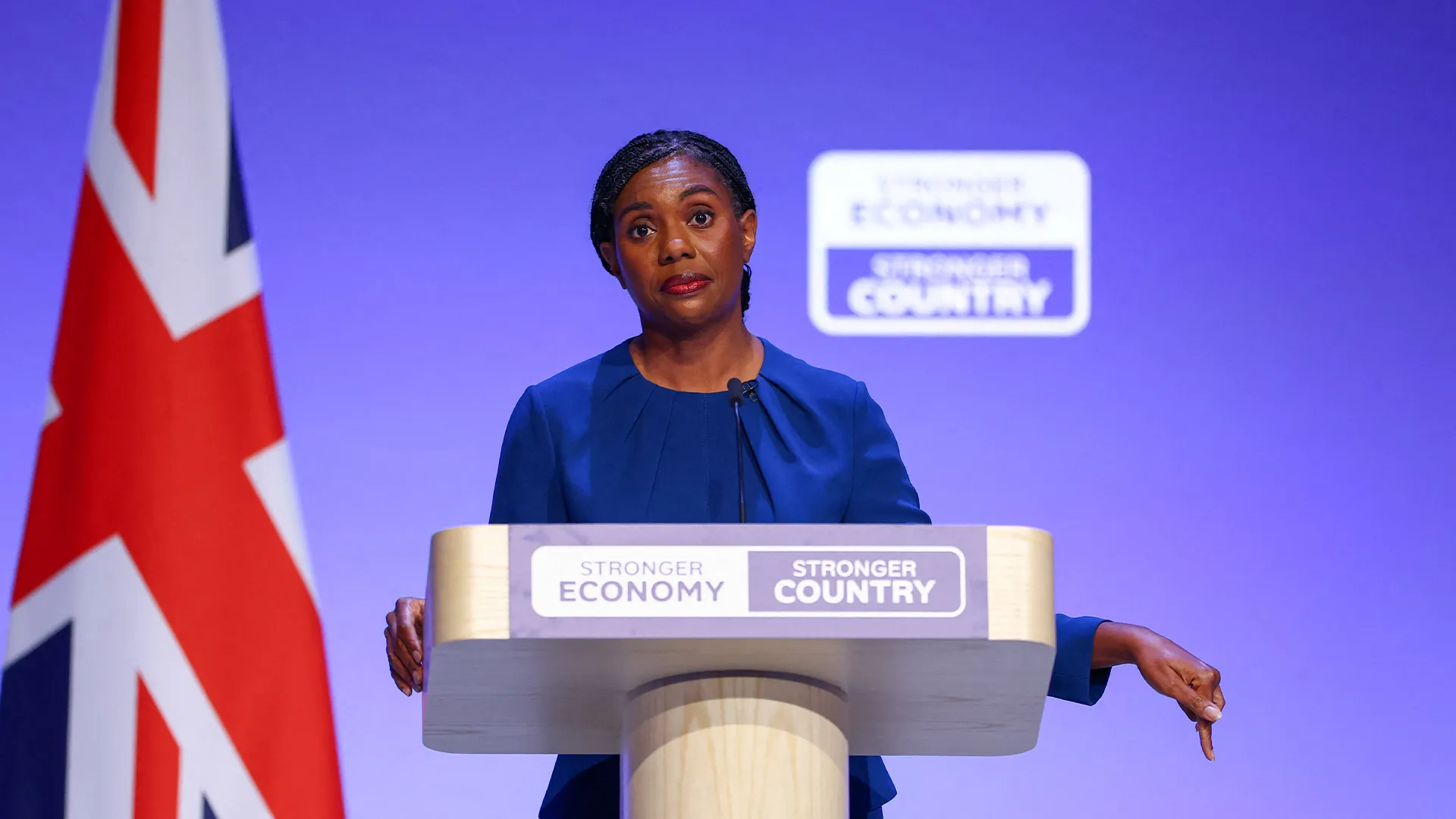
UK Conservative Party leader Kemi Badenoch says the party does not condone former member, and candidate, Jack Ross’s conduct, which was revealed in an Al Jazeera investigation. It showed Ross discussing contract killers and offering to broker the services of a far-right activist.
LEWISTON, Maine — Maine Republican Susan Collins has promoted her reputation as one of the most independent U.S. senators and she is using the waning days of the election season to sell that message to voters by campaigning with a former colleague who has endorsed her.
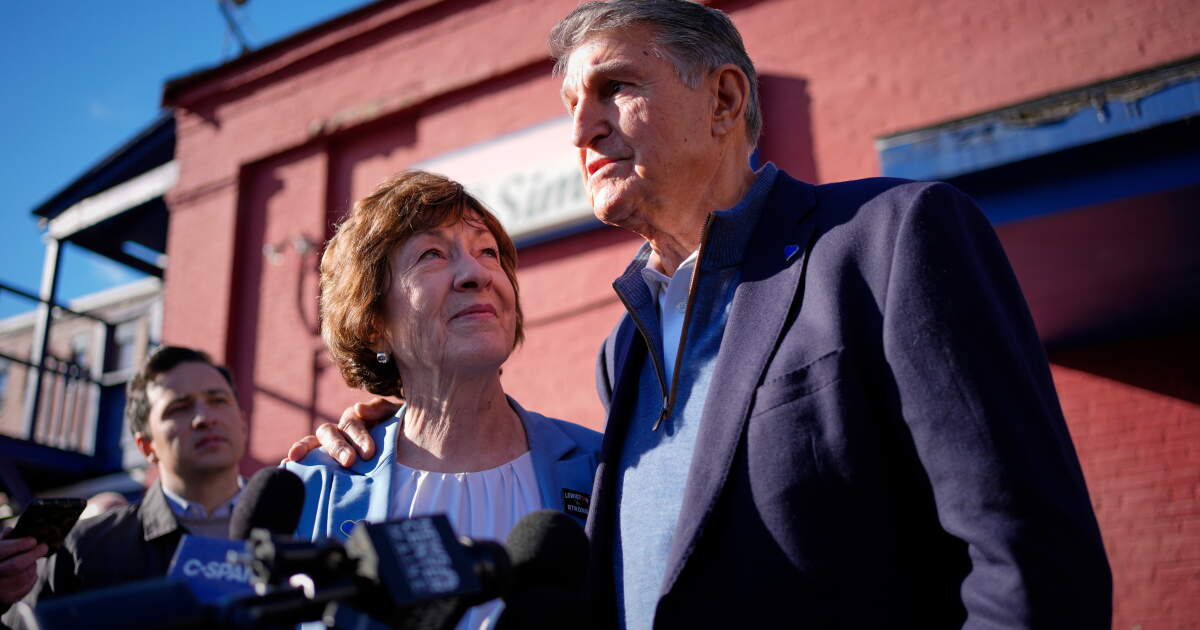
Collins is trying to fend off a challenge from Democrat Troy Jackson, a onetime state Senate president, and on Wednesday she made appearances with Joe Manchin III, a West Virginian who was a Democrat then became an independent late in his career before retiring.
After stopping for breakfast at Simones’ Hot Dog Stand in Lewiston, Collins spoke of how she and Manchin were “part of every piece of bipartisan legislation that passed and became law” during their time together in office.
Manchin said to lose Collins would be “to lose the soul of the Senate.” He praised her independent streak, her willingness to buck Republican President Trump and her record of fighting for Maine’s interests.
“This is a true blue-blooded Maine person who knows exactly where she came from,” Manchin said.
They planned a stop later at a New Balance shoe facility in Norway. Jackson, 58, is scheduled to campaign Thursday in Portland with Alexandria Ocasio-Cortez, the progressive congresswoman from New York.
Collins, 73, is in what may be her toughest reelection fight as she seeks her sixth term.
It’s only the second time that she has sought reelection in a midterm with a sitting Republican president, and the national trends are much less favorable to the GOP than they were the last time she did so, in 2002. Trump’s approval has fallen well below where it was when he took office last year, and a recent poll from the Associated Press-NORC Center for Public Affairs Research found that a strong majority of voters want change in Washington.
Collins has been working to persuade voters that she is independent of Trump and willing to break with him. In Manchin, she enlisted a politician who was one of the most moderate voices in the Senate. Manchin said in 2023 that Trump would “ destroy democracy in America” if he was elected to a second term.
Among the few dozen Collins supporters at the Lewiston event was Mike Marcotte.
“I may not have always been a fan of her complete package of votes, but when I look at the vitriol that’s in the U.S. Senate right now, we need more people like Susan Collins,” he said.
Jackson got a late start on campaigning after the party’s initial nominee exited the race but trails Collins in the money race by less than $3 million after an aggressive quarter in which he raised more than $20 million. Jackson has campaigned relentlessly and his events have drawn hundreds. Collins has largely stuck to smaller appearances.
Some of Jackson’s backers demonstrated across the street from the hot dog stand. A few held signs bearing the face of Brett M. Kavanaugh, the U.S. Supreme Court justice whom Collins voted to confirm and whose vote eventually helped overturn the constitutional right to abortion.
“Someone needs to stand up and be a check on Donald Trump and his harmful policies,” said David Sysko.
Collins has broken with Trump and Republicans over the years. She voted to convict him at his impeachment trial in 2021. Increasingly during the campaign, she has worked to distance herself from the president as Democrats argue that she is too close to him.
Collins said in early October that she is “not exactly his favorite senator,” and that she did not expect Trump to campaign in Maine. He has steered clear of the state with the Nov. 3 election nearing.
Pinning Collins to Trump is central to the Democrats’ strategy. In one ad, a nurse says the state is in a healthcare crisis “because of Susan Collins and Donald Trump,” citing Collins’ vote for Trump’s push for Medicaid cuts. Collins did vote to advance the bill but ultimately voted against it.
Trump also was a major focus of four contentious debates between the candidates this month, where Collins sought to distance herself from the president and Jackson repeatedly accused her of doing Trump’s bidding.
Asked at the final debate to name a time in which she bucked her own party and succeeded, Collins gave the example of rallying support against Trump’s nomination of Pete Hegseth, who was confirmed as Defense secretary.
Democrats seized on the moment and released a statement that said the exchange “underscores a central question in the Maine Senate race: Does Collins, a Republican in a state that disapproves of President Donald Trump and has grown bluer in recent years, stand up to her party enough to earn the independent streak she has staked her career on?”
Jackson has characterized Collins as out of touch with the struggles of working-class people in Maine. He has described Collins as a “rubber stamp” for the president and criticized her votes on Kavanaugh and Robert F. Kennedy Jr., Trump’s second-term Health secretary. Collins has said she does not regret either vote.
Republican ads against Jackson, a logger from northern Maine, have focused more on accusations of his having a volatile personality and behaving like a bully with female colleagues. Jackson has denied those accusations.
Collins distanced herself on Wednesday from a Republican super PAC attack ad that she said “should be taken down.”
The senator was a top target of Democrats in 2020 when she defeated challenger Sara Gideon by nearly 9 percentage points. Collins is the only Republican senator from New England, a distinction she has had since January 2013.
It stopped me mid-scroll. In an Instagram reel, one DJ was mixing an upbeat track in a dark, packed room while another danced on a stage behind her, twerking perfectly on beat. Above them, a message flashed on a massive screen: “Love. Dance. And F— Ice.”
The crowd went wild, matching the energy of the two Los Angeles-based DJs who go by Mango and Ginger. The night looked so electric that I could feel the FOMO traveling through my body.
When I tapped the location tag, I assumed I was looking at an underground warehouse party in downtown L.A. or a venue in Hollywood. Instead, the party — known as If You See Me You See Me — was happening 120 miles south in San Diego. As a DJ and music lover, I knew I needed to get down there ASAP.
For many Angelenos, San Diego is the place to go for a peaceful weekend getaway — think scenic cliffs, serene beaches, fresh fish tacos and visits to Balboa Park and the San Diego Zoo. But it’s easy to sleep on its vibrant nightlife scene — and I don’t just mean the bars crowding the Gaslamp Quarter. The city is home to some of the most exciting late-night spaces, from hi-fi listening lounges to a cinematic Middle Eastern restaurant that feels straight out of Disneyland.
“People just aren’t aware,” says San Diego native Mo Perez, who as DJ Dopemo regularly packs out parties at North Park’s Bluefoot Bar and Lounge. “Then they come here and they’re like, ‘Wow, San Diego is really fun.’”
This is part of the reason why Sasha Marie, a longtime DJ and former member of the Soulection music collective, decided to continue hosting her event If You See Me You See Me, in partnership with Future Is Color, in her hometown of San Diego, even amid invitations to bring it to other cities. She invites DJs from around the globe, many of whom wouldn’t typically play in San Diego, to spin at the party.
“I feel like it’s important to show that something can be successful here,” she says.
Consider this your wake-up call to tap into San Diego’s nightlife scene, whether you want to go dancing or vibe to diverse sounds or have a cocktail in a one-of-a-kind atmosphere. These nine great spots are a sampling of how the city comes alive after dark.
Ekin-Su Cülcüloğlu looked like she had been enjoying herself at the Pride of Britain Awards boozy after partyCredit: Smart PicturresEastEnders star Lacey Turner was ready for bed after the partyCredit: James Curley
But fast forward to the end of the night, and the stars leaving the after party at JW Marriott Grosvenor House looked like they had been enjoying the free bar.
Sign up for the Showbiz newsletter
Thank you!
Love Island icon Ekin-Su Culculogiu was in great spirits as she left the after party in her stunning gown.
The former Islander giggled, as she strutted out of the star-studded bash in London.
The EastEnders actress was seen heading to a waiting cab with sleepy eyes.
Christine McGuinness was spotted resting against a wall after the partyCredit: SplashBut the star was later seen beaming as she headed homeCredit: Smart Picturres
Fellow Strictly star Dani Dyer appeared to have been enjoying herself at the boozy bash.
The former Love Island champ left the party with a huge beam on her face as she waved out of her cab.
The siblings are often spotted partying together, and it appeared they had enjoyed themselves last night.
Strictly and Love Island star Dani Dyer looked like she was ready for bedCredit: James CurleyHelen Flanagan still looked glam, although she appeared a little sleepy after her evening outCredit: Smart Picturres
Christine McGuinness was seen resting against a wall in her striking pink floral ball gown after enjoying the party.
But she later was seen beaming as she got into her taxi to head home to bed.
Despite looking a little sleepy, actress Helen Flanagan still looked glam in her shoulderless gown and long black gloves.
Strictly head judge Shirley Ballaswas also spotted leaving the boozy bash and waved to onlookers as she headed home.
Prince and Junior Andre had enjoyed themselves at the VIP partyCredit: SplashShirley Ballas waved out of cab as she left the boozy bashCredit: Smart Picturres
Hosted by Carol Vorderman and Ashley Banjo, Pride of Britain brings together royalty, world leaders, and hundreds of famous faces including music legends, sporting icons, Hollywood stars and TV favourites to celebrate the winners.
The Pride of Britain Awards 2026 will air on TV on Thursday at 8pm on ITV
The ITV psychological thriller drama boasts a star-studded cast and concluded on Monday evening
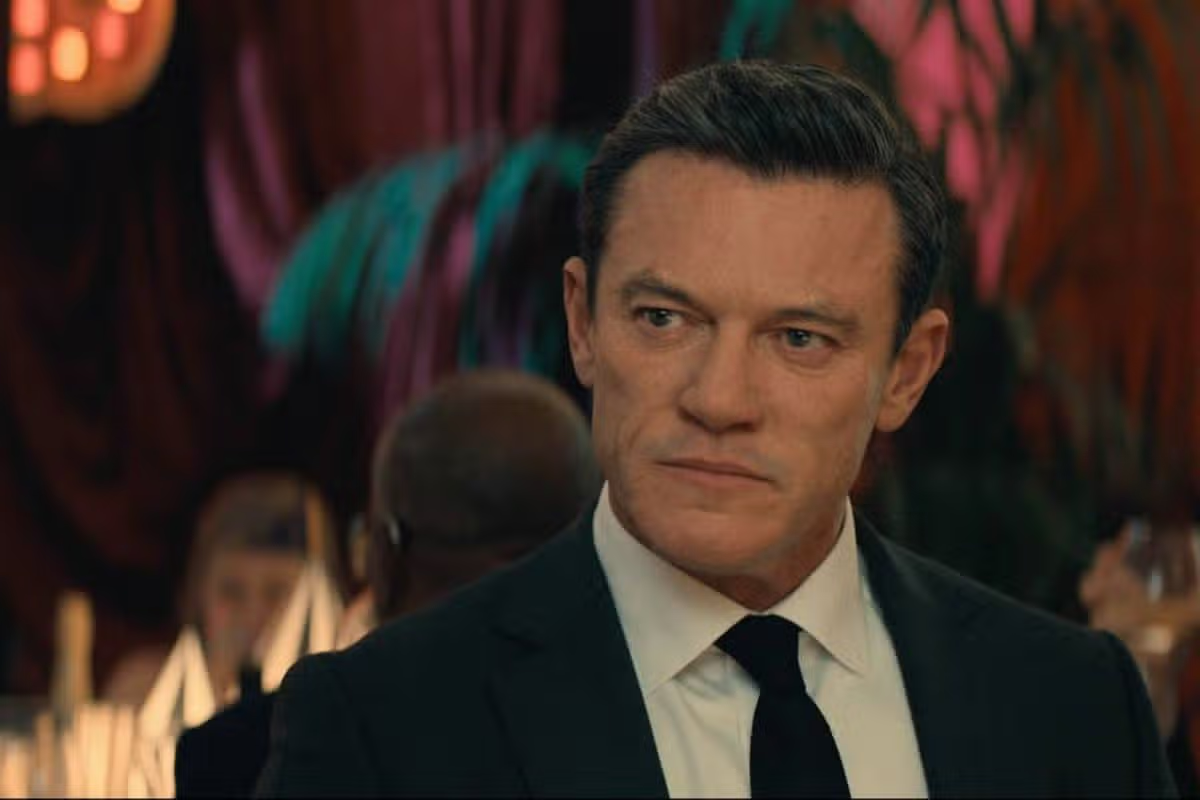
Luke Evans heads up the cast of ITV’s The Party. (Image: ITV)
Tensions were high as The Party concluded on Monday evening.
The ITV political thriller is adapted from Elizabeth Day’s bestselling novel and written for the screen by Sarah Solemani, who also stars. Made up of five episodes, The Party also stars Luke Evans as Martin Gilmour, a working-class boy who wins a scholarship to an elite boarding school and forges a lifelong bond with the wealthy, charismatic Ben Fitzmaurice, played by Tom Cullen.
Years on, and married, Martin attends Ben’s lavish birthday party as Ben weighs a run for the Conservative leadership, and fears the attendant publicity could expose secrets from their past, with tragic consequences.
The twisty story moves between the party itself, a police investigation and flashbacks to the pair’s earlier lives. It was revealed that the pair had been involved in a car crash when they were teenagers, which killed Ben’s twin sister.
While Ben was behind the wheel, three times over the limit, Martin took the fall after being coerced by Ben’s father, Lord George Fitzmaurice (Douglas Hodge), resulting in a huge payoff each year. Although this happened decades ago, the tragic event was the catalyst for the shooting, as a journalist revealed she knew the truth and was about to expose Ben after he had shared his plans to run as the next conservative leader.
In the final episode, Martin pulled a gun on Ben as he accused him of ruining his childhood and leaving him broken as an adult. In the end, Ben talked his friend down and took the gun off of him, although after admitting he always loved him, he shot himself in the head.
Ben’s wife, Serena (Lydia Leonard), heard the gunshot and saw Martin holding the gun, which he took from Ben when he fell to the floor. She believed Martin had shot her husband and told the police.
Ben didn’t die, and Martin was arrested before being later released by the police. However, a police detective was adamant that they wanted to investigate the historical car crash further. Martin realised that the time had come to walk away and put some distance between himself and the Fitzmaurice family. After visiting Ben at the hospital, he left and began facing the world with fresh purpose.
As he walked through the park, he saw a male couple with a newborn baby in the park, a smile played around his lips, as though he’d had a glimpse of the happiness that could be his at some point in the future.
Despite the gripping final episode being full of twists and turns, The Party viewers were left questioning the “abrupt” ending and accused the drama of leaving the plot “incomplete”.
Taking to X, one viewer fumed: “Is that it? What a waste of my time… #TheParty”, while a second agreed: “What a waste of 5 nights #theparty.”
A third asked: “#theparty is that it?”, while another chimed in: “What a **** ending. So many unanswered questions and loose ends #TheParty.”
“#TheParty the night went on for weeks and now it’s getting wrapped up quicker than Poirot says no no mon ami !”, joked another
While Republican Steve Hilton has spent months jackrabbiting around California during his long-shot bid for governor, Democratic front runner Xavier Becerra just recently emerged from quasi hibernation and stepped into political daylight.
Hilton has blasted Becerra as taking the state’s voters for granted, failing to hold public campaign events to explain his detailed plans to address California’s many ills. Despite pledging to participate in multiple debates, Becerra brushed aside several invitations, agreeing to just a solitary one-hour face-off against Hilton on CNN in late September.
That month, Hilton held 14 public events, a dozen more than Becerra, but the Democrat’s spokesperson said he appeared at multiple functions sponsored by other groups. Hilton wasn’t buying it.
“He is a useless nothing, a totally unaccomplished pipsqueak who is so smug, so arrogant, so entitled, that he somehow thinks he’s owed this job just because he was picked as a useful puppet by the Sacramento machine,” Hilton, a former Fox News commentator and British political strategist, said last week in West Sacramento.
“Uh, hello?” Becerra said sarcastically to reporters in Sacramento after being asked about his absence from the campaign trail.
“That Steve Hilton doesn’t see me on Fox News is his problem, not mine. I am gonna talk to voters,” Becerra said, rattling off a list of his recent campaign events. “I will talk to them until November the 3rd, and then I’ll be ready to talk to voters and taxpayers and the people of California when I’m the next governor.”
On Thursday, Becerra held a news conference in downtown Los Angeles with Latino leaders and famed Mexican actor Eugenio Derbez urging voters to turn out despite alleged intimidation efforts by the Trump administration.
On Monday, he held get-out-the-vote events in Santa Clarita and Glendale, shortly after he campaigned for former state Sen. Richard Pan, a congressional candidate, in Sacramento, and urged voters to cast their ballots early at an event in Santa Rosa. In September, Becerra promoted Proposition 1, a proposal on the November ballot that would allow the state to sell nearly $11.3 billion in bonds to fund affordable housing.
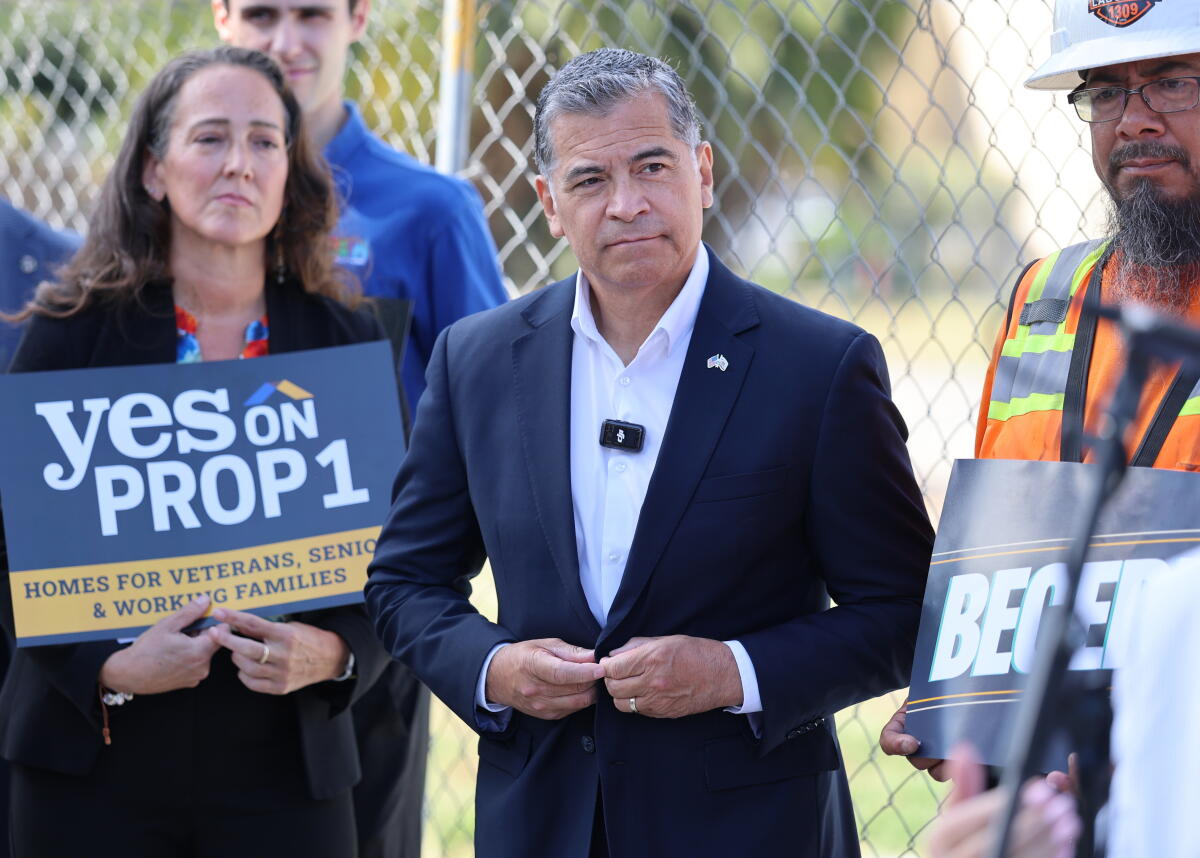
“We know we can get these men and women who are wearing these orange vests to work and keep them working, so they can afford to buy a house if we pass Proposition 1,” Becerra said, standing alongside union members in front of a chain-link fence encircling a vacant lot in North Long Beach.
Gubernatorial candidate Xavier Becerra held a news conference in Long Beach on Sept. 4 to highlight his housing agenda.
(Allen J. Schaben / Los Angeles Times)
Long Beach Mayor Rex Richardson, who endorsed Becerra in April and appeared at the housing event, pushed back on the notion that Becerra is taking the election for granted after winning a top spot in the primary, positioning him to be the first Mexican American elected governor of California.
“I’ve seen firsthand the work that has taken place under the radar that may not be explicitly, openly political or openly be seen as campaigning, but it is the kind of thing you want to see,” Richardson said in an interview on Thursday, adding that he saw Becerra meeting with elected officials of both parties, the mayors of the state’s largest cities and labor leaders. “I’ve seen a very active candidate that has been making sure that real time was put into building relationships that will ultimately translate to a successful governorship, because that’s the goal. I mean, ultimately, what we want is a leader who has the relationships to lead our state.”
Becerra’s campaign said that the candidate has frequently met with voters since the primary without press coverage to hear from Californians, and that he would be a frequent public presence in the weeks before the election, when “voters really get engaged, when ballots land in their mailbox,” said spokesman Jonathan Underland.
“People have incredibly busy lives. They are worried about affording their healthcare, putting food on the table, paying for gas to fill their tank,” Underland said. “What is at the forefront of Secretary Becerra’s mind is the very real problems that Californians are facing every day.”
In contrast, Hilton has been publicly barnstorming California since the June primary.
Becerra’s schedule is not surprising given Democratic dominance in California, where the party’s registered voters outnumber Republicans nearly 2 to 1. While appearing at parades, pancake breakfasts and in voters’ living rooms can be effective for candidates running in local campaigns, the most effective way for candidates to reach voters in a state as vast as California is through sustained advertising buys, which can cost tens of millions of dollars.
“If you’re the Democrat running in California, the operating theme of your campaign is do no harm and measure the drapes and figure out how you’re going to put an administration together and what is the tone that you’re going to set for that administration,” said Tim Rosales, a veteran GOP consultant who led businessman John Cox’s unsuccessful 2018 gubernatorial campaign and previously worked on Arnold Schwarzenegger’s successful effort to replace Gov. Gray Davis in the 2003 recall campaign.
Newsom was more active in the 2018 general election campaign against Cox than Becerra has been this year, but Rosales argued that could be because Becerra views it as the final chapter of his political career, which also may have been the case with former Gov. Jerry Brown in his 2014 reelection campaign. Newsom, however, is pondering a 2028 run for the White House.
“This is potentially more of a swan song for Xavier Becerra, the icing on the cake for a long and distinguished political career, and for Gavin Newsom, it was a stepping stone,” Rosales said.
Becerra has raised $40.5 million, as of Friday, while Hilton has raised $29 million, according to the fundraising disclosure reports filed with the state. Those figures do not include the exponential advantage that Becerra had in independent expenditure committees’ spending over Hilton in the primary.
Veteran Republican strategist Rob Stutzman, an advisor to Schwarzenegger, said that while Becerra will almost certainly be the state’s next governor, he should be cautious about his approach weeks before the November election.
“What he needs to be careful of is a big Democratic night across the United States that looks muted in California, and if that happens, the analysis will be that it’s his fault,” Stutzman said. “He should want to optimize his political capital as the clear leader of his party now in California. So he has to be a little careful of leaving some political capital on the table by not creating a stronger brand over the next three weeks.”
The last gubernatorial race that was viewed as competitive took place in 2010 between Brown and former eBay chief Meg Whitman, then a Republican who spent $144 million of her personal wealth on her campaign.
That contest drew national attention, but Brown beat Whitman by nearly 13 percentage points. Every gubernatorial election since that race has been sleepy and ignored in national politics, with Democratic candidates coasting to victory. The state has seen contentious gubernatorial primaries, notably in 2018, and this year, when the Democratic field was so crowded that party leaders urged low-polling candidates, including Becerra, to drop out.
He won the top spot in the primary after then-Rep. Eric Swalwell (D-Dublin) dropped out amid rape and sexual assault allegations.
Mason Harrison, who worked for Republicans Carly Fiorina in a 2010 Senate bid and Neel Kashkari in a 2014 gubernatorial campaign, and worked with Hilton on business ventures but is not affiliated with his campaign, noted that while Brown was well-known by Californians because of decades in the public eye, Becerra is not. However, given Democrats’ edge in the state’s voter registration, as well as current headwinds against the GOP in California and across the nation, it’s unsurprising that Becerra has been less visible than Hilton. Harrison compared Becerra’s campaign to Biden’s in 2024 before the then-president bowed out of the race.
“The calculus seems to be, the more he gets out on the campaign trail, the greater the potential of him having a misstep in an interview or getting some tough question that he’s going to have to answer, and what’s the advantage of that in a year when you’re running against a party that, by historical standards, stands to lose significantly,” Harrison said. “Why make it more competitive by making yourself more vulnerable?”
Indeed, Becerra previously committed to multiple debates, but has participated in one so far and appears unlikely to agree to another. Still, he has repeatedly disputed the notion that he is taking the race for granted.
“If I were trying to coast, I’d be out on the coast right now instead of here with you all,” he told reporters one sweltering August afternoon in Little Tokyo in downtown Los Angeles, an area he represented in Congress.
Xavier Becerra, center, walks with Helen Ota, left, president of the 2026 Nisei Week Foundation, while touring businesses and meeting with business community leaders at Japanese Village Plaza in Little Tokyo in Los Angeles on Aug. 18.
(Genaro Molina / Los Angeles Times)
While there, he met with local business and community leaders. And he bought merchandise and delicacies, including a sweet mango mochi wrapped in a thin, fluffy pancake at a 123-year-old Japanese confectionery.
Times staff writer Nicole Nixon contributed to this report from Sacramento.
Luke Evans and Tom Cullen’s ITV drama The Party is set to be replaced in the televisions schedule with a new “scandalous” and “provocative” drama starring Dominic Cooper and Romola Garai
ITV’s gripping drama starring Luke Evans and Tom Cullen ends this evening.
The Party is a five-part series based on the acclaimed novel by Elizabeth Day, starring Evans as Martin Gilmour, a journalist shaped by his lifelong friendship with the wealthy and charismatic politician Ben Fitzmaurice, played by Cullen.
Raised alone by his working-class mum, Sylvia Gilmour, played by BAFTA award-winning Joanna Scanlan, Martin wins a scholarship to an elite boarding school, where he first meets Ben. They forge an unbreakable bond, as Ben and the Fitzmaurice’s give Martin the sense of belonging he has always craved.
In turn, Martin remains unflinchingly loyal to Ben through even the greatest crises. Three decades on, Martin is invited to Ben’s lavish birthday party at the Fitzmaurice’s country pile. The news of the Conservative leader’s resignation threatens to derail Ben’s party as he considers announcing his intention to stand.
Martin fears the publicity that Ben’s bid would bring, dredging up the secrets of their past with tragic consequences. The drama moves between the shocking events of the party and the police investigation that follows, with flashbacks to Martin and Ben’s lives at school, university and London party days.
What unfolds is a gripping exploration of identity, privilege and devotion, combined with a tender ode to anyone who has fought to live authentically.
The synopsis for the fifth and final episode which airs tonight (Monday, October 19) reads: “Martin confronts Ben with a gun in his hand. Years of pain andanger spill out. But Ben grabs the gun and reveals the depths of his own despair. A gunshot rings out.
Serena discovers Martin covered in Ben’s blood and tells the police she saw Martin with the gun. Martin once again finds himself in custody. With the evidence mounting against Martin,Ben fights for his life in hospital.
In the chaos of the party aftermath at Denby Hall, Jarvis’s stash of cocaine is found by the police and he is arrested. Only Ben can save Martin, but will he recover? And will he tell the truth?”
It yet to be confirmed f The Party will return for a second series but cast member Lydia Leonard, who plays Serena Fitzmaurice, has hinted that it could be on the cards.
When asked how viewers will react to watching the series, she previously told ITV: “I hope it will have people saying to their friends, ‘Have you seen this amazing drama?’.
**Ensure our latest TV stories always appear at the top of your Google Search by making us a Preferred Source. Click here to activateor add us as Preferred Source in your Google search settings**
“I think it’s gripping and suspenseful and surprising. I hope it will leave audiences wanting to know what happens to these characters next. I mean, Elizabeth has written a sequel that is just waiting to be adapted for television.”
The Party will be replaced in the schedule with a new “scandalous” and “provocative” drama titled Adultery starring Dominic Cooper and Romola Garai as Tom Kirkman and Beth Brookes, who meet after a chance encounter and get involved in a heady affair that risks tearing apart both of their families.
Episode one will air this Sunday (October 25) at 9pm and the second instalment with follow on Monday (October 26) at 9pm.
The full series of The Party is available to watch on ITVX
McALLEN, Texas — On a quiet corner of downtown McAllen, past shops selling quinceañera gowns and perfumes, about 30 people trickled into a small brewery on Wednesday evening to watch James Talarico, the Democratic Senate nominee in Texas, take questions from voters in a CNN town hall.
With beers and tacos, they gathered in front of a large projector screen. Karyme Segura, 18, sat at the front, listening closely as Talarico said federal immigration agents should be going after violent criminals, not “terrorizing our communities” and breaking up families.
Segura clapped. The message was personal to her. A day earlier, her stepfather had been deported to Mexico. Since his detention, her mother has been afraid to leave the house, she said. Now Segura has turned to politics, hoping to change the conditions that have left her family fractured and rattled.
“I just have to do something,” Segura said. “I am hoping that after the election my mom will feel more secure. That if Texas turns blue, Trump will feel threatened.”
Segura is the kind of voter Democrats are counting on as Talarico, a state representative from Austin, tries to defeat Ken Paxton, the state’s Republican attorney general, to become the first Democrat to win a statewide race in Texas since 1994. The race could decide control of the Senate, and has become one of the most high-profile and bitterly fought contests this year.
Talarico, a former teacher and Presbyterian seminarian, has courted voters with a populist economic pitch blended with an overlay of Christian messaging to “love thy neighbor.” Paxton, an ally of President Trump, has focused on rallying his party’s base by portraying Talarico as too progressive for Texas, including his past opposition to transgender sports restrictions.
Since late June, Talarico has led narrowly in most polls, alarming Republicans who have poured hundreds of millions of dollars into ads meant to boost Paxton. Elon Musk, the world’s richest person with significant operations in Texas, has helped buoy that GOP political rescue mission by dropping nearly $190 million into the race, according to federal campaign finance records filed Thursday.
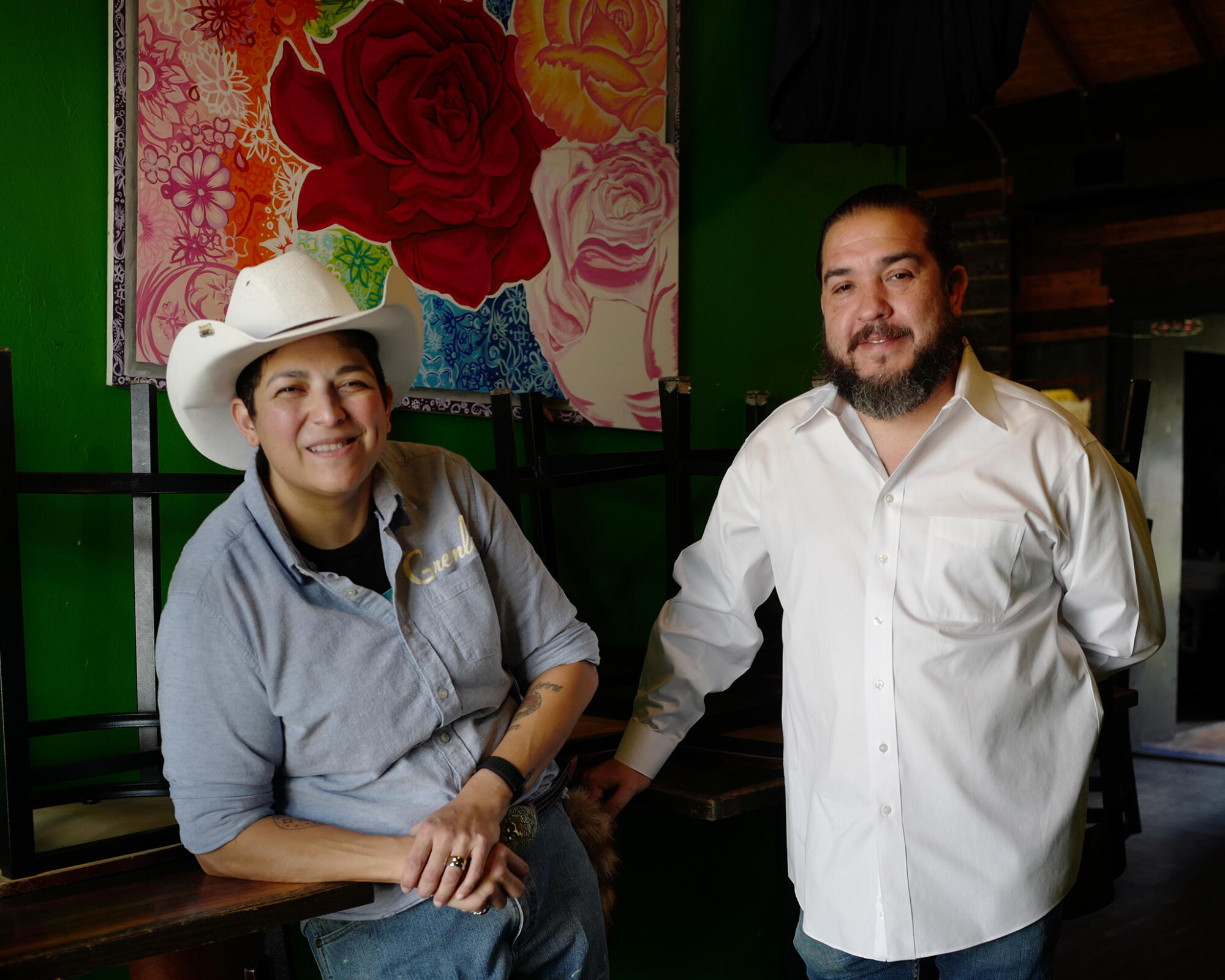
Alyssa Cantu and Antonio Reyna, owners of the Gremlin Bar at their club Thursday in McAllen, Texas.
(Delcia Lopez / For The Times)
Democrats have spent heavily, too. In total, ad spending in the race has surpassed $500 million, according AdImpact, an ad-tracking firm, making it one of the most expensive non-presidential contests in U.S. history.
The Wednesday town hall amounted to free national airtime for Talarico too, who showed up on stage alone despite Paxton —who had so far refused to commit to any debate — being invited. In McAllen, the owners of the brewery, Tony Reyna and Alyssa Cantu, said they bought a projector screen just for the event.
“Any information we can bring out to the community, we try to make it happen,” Reyna said. “And if there is not going to be a debate, we are showing the town hall.”
In recent weeks, conspiracy theories, leaks and attacks have been constant in the lead-up to the election.
Both campaigns are courting independents and right-leaning voters, including Latinos who swung sharply toward Trump in 2024. But Trump’s unpopularity has complicated Paxton’s task. The latest polls show Trump’s approval rating at 32%, the lowest of his political career, as voters struggle with rising prices tied to tariffs and the war in Iran.
In Texas, about half of likely voters in a recent Fox News poll said they worried Paxton was too close to the president; nearly as many were concerned Talarico was too liberal.
Mario Guerrero, a 33-year-old home builder and executive director of the South Texas Builders Assn.
(Delcia Lopez / For The Times)
Along the border in the Rio Grande Valley, an overwhelmingly Latino region, there are signs that voters who backed Trump two years ago are now open to voting for Talarico — and Democrats as a whole. In interviews with more than a dozen voters across the region, many described the Trump administration’s approach to immigration enforcement as inhumane and morally wrong, as well as detrimental to the local economy.
“I didn’t think he was going to do what he is doing now. I don’t think anybody thought it would be like this,” said Mario Guerrero, chief executive of the South Texas Builders Assn. “I think they have gone too far.”
Guerrero voted for Trump all three times. Now he is voting for Democrats, he said.
Residents talked about how in July, a local nun from Nigeria was detained by federal immigration agents after walking from her home on her way to Mass. They talk about their small businesses hurting because people are afraid to be out in public shopping. Others say it is impossible to find workers in the region.
A candidate’s campaign sign marked with graffiti in McAllen, Texas.
(Delcia Lopez / For The Times)
Ariel Salinas, 50, a longtime builder in McAllen, said he has voted for Trump all three times he has been on the ballot. Now, he is voting for Democrats because he is furious at this administration’s approach to immigration, which he says has hurt the entire region’s economy.
“Everyone is hurting right now. Builders, the subcontractors, their families and their friends,” he said. “It’s a trickle effect down. If there are no homes being built, nobody gets paid and in turn no one goes to spend money at local groceries, at mom-and-pop shops, and so forth.”
On Thursday morning, at a housing development on the north edge of McAllen, about 10 homes stood unfinished, and there were no workers in sight. A house that once took four and a half months to build now takes a year, Salinas said. Laborers, whether undocumented or with work permits, have stopped showing up, afraid of being questioned by immigration agents.
“This shouldn’t be reality,” Salinas said. “It is a nightmare.”
Salinas still does not consider himself a Democrat, but said he plans to cast his ballot for them this year because he is so angered by how Republicans and Trump have handled immigration and mistreated hard-working people, many of whom are his neighbors.
“That doesn’t mean that in two years, we are going to vote Democrat again,” he noted. “We are going to vote for them and watch if they keep their promises to us.”
President Trump listens as Texas Atty. Gen. Ken Paxton, the Republican candidate for Senate, speaks at a campaign rally in San Antonio this month.
(Eric Gay / Associated Press)
Opinions on the race are “pretty baked in” by now, so the heavy spending in the final stretch may be hitting diminishing returns, said Brendan Steinhauser, a longtime Texas GOP strategist who previously worked for Sen. John Cornyn, whom Paxton defeated in the GOP primary.
“There are a few undecideds, but not many,” Steinhauser said. “And if they are undecided, the longer they go, I am guessing they are going to break away from the GOP.”
Most Texans appear to have made up their minds.
A University of Texas/Texas Politics Project poll released Wednesday showed 83% of Talarico’s supporters and 69% of Paxton’s said they were unlikely to change their minds. The poll also showed 72% of Democrats were extremely or very enthusiastic about voting, 10 points more than Republicans. In that poll, Talarico led among Latinos, women, suburban and urban voters, while Paxton had the edge with men and rural voters.
Fernando Salinas, 54, the owner of eight dress shops in McAllen, has always voted for Democrats, and after seeing how immigration raids have affected the local community, he believes this year will bring what many in the Valley call a “voto de castigo,” a punishment vote for the party in power.
“I think Texas is going to turn blue,” he said. “People are that upset.”
Republicans are already bracing for a possible loss. In a social media post Thursday, Trump blamed fellow Republicans for the struggles Paxton is facing in the race. He said Cornyn and GOP strategist Karl Rove were doing “everything possible to make it hard” for Paxton to win.
“They are hurting Texas and, more importantly, hurting the United States of America!” Trump wrote. “If Ken Paxton loses, it will be because of WEAK and INEFFECTIVE Political Hacks like John Cornyn and Karl Rove, who have ineffectively opposed me for my entire political career.”
In a September discussion during the Texas Tribune Festival, Rove said the contest “would be over” if Cornyn had defeated Paxton in the primary. Trump, who endorsed Paxton, has campaigned in Texas in recent weeks to rally the Republican base and urge them to vote. Vice President JD Vance has also stumped in the red state.
Texas state Rep. James Talarico, the Democratic candidate for U.S. Senate, speaks Thursday at a campaign event in San Marcos.
(Eric Gay / Associated Press)
In those campaign rallies, Trump has attacked Talarico — whom he calls “Talafreako” — for being a vegan, which Talarico say he is not. Vance has also jokingly questioned Talarico’s sexuality, a comment the campaign has dismissed as irrelevant to the issues that matter to Texans.
But in the Rio Grande Valley, some voters say they feel forgotten by Republicans.
Aaron Garza, 56, a business associate of Salinas, has watched immigration raids hurt business and the community. He has voted for Trump every time he has been on the ballot. But with early voting set to begin Monday, he has not decided whom to support yet.
Garza said he feels no loyalty to either party and wishes there were a third party that showed it actually cared about Latinos and their interests. Still, one thing has him leaning toward Democrats this year: They have shown up.
“The Republicans haven’t been here,” Garza said. “How come you are not here talking to us?”
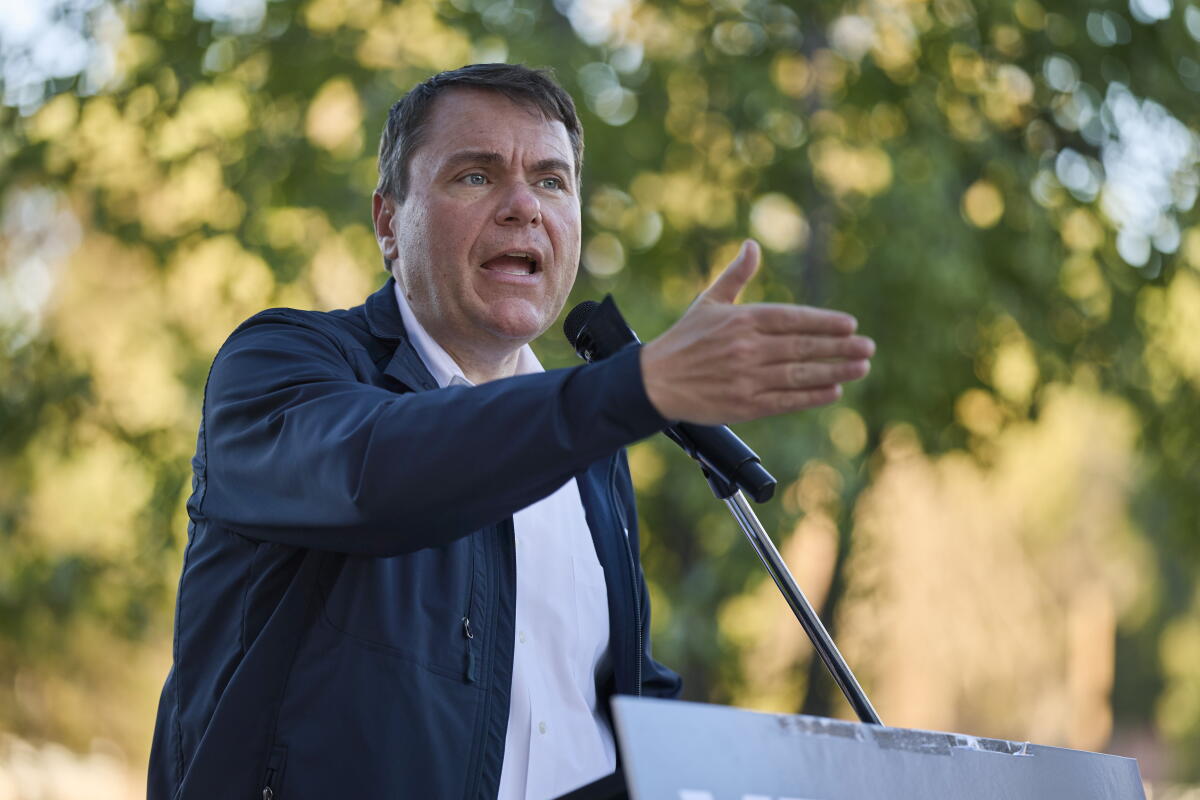
ROSEVILLE, Calif. — San Diego County Republican Carl DeMaio had a warning for conservatives at a get-out-the-vote rally this month in Placer County.
“You are doomed,” DeMaio said, crooning the phrase like a foghorn. The audience chuckled.
“Doomed” is DeMaio’s description for races that lack a conservative candidate. Skip voting in those, he told the crowd, briskly walking them through the Nov. 3 ballot.
Rep. Carl DeMaio speaks to attendees during a “Beer, BBQ & Ballots” event for Proposition 39 at the Nevada County Fairgrounds.
(Fred Greaves / For The Times)
Microphone in hand, the freshman state legislator paced the floor, threw up his hands and scowled as he declared California a “communist state,” the progressive Bay Area “the gates of hell” and Hillary Clinton “the wicked witch.”
Urging volunteers to door-knock at Republican households, he instructed them to ignore Democratic homes entirely.
“I don’t need to remind them there’s an election going on,” he said, prompting more laughs.
DeMaio, 52, is emerging as a prominent voice for California Republicans, promising a path back to power and delighting audiences with his sharp takedowns of Democrats. His vehicle this election is Proposition 39 — he is coauthor of the ballot measure — which would require Californians to provide ID when voting, an initiative backed by millions of dollars from conservatives and condemned by the state’s Democratic leaders and voting rights experts.
A woman grabs a “Yes on 39” lawn sign at the Nevada County Fairgrounds.
(Fred Greaves / For The Times)
On his YouTube channel, he regularly skewers Gov. Gavin Newsom, the Sacramento “swamp” and the media with shows titled, “Thinking of California? 3 Reasons Not to!” and “Socialism on the CA Ballot in 2026!”
His advocacy group, Reform California, supports conservative candidates and helps raise money. Backed by volunteers, the group is usurping the California Republican Party’s influence, according to both his critics and allies.
“Republicans are tired of what’s going on in the state of California, and they’re looking for somebody to lead them out of the minority,” said Corey Gustafson, former chair of the San Diego County Republican Party. “Many people think Carl is the answer to that.”
An alternative GOP machine
In an interview at Reform California’s Escondido office, DeMaio said his goal is to restore political balance in the state by electing more Republicans.
“I’m trying to get my party to pull its head out of its ass, be more effective at campaigning, and get its ideas across,” DeMaio said, ticking off values he believes the Republican Party should champion: socially moderate positions, environmental stewardship and challenging big corporations.
Though the GOP has a poor track record on those issues, DeMaio says: “I’m just simply tapping into something that already exists, that just needs leadership.”
Fairgoers listen to Rep. Carl DeMaio in Nevada County.
(Fred Greaves / For The Times)
Nearby, scores of volunteers sat at long tables, stuffing voter guides — approved and printed by DeMaio’s team — into envelopes. It is an immense undertaking, with every guide tailored to the voter’s local election. Volunteers hand-write the voter’s name and address on the envelope to give it a personal touch.
Matt Rexroad, a political consultant who ran an independent expenditure against DeMaio in his 2024 Assembly race, said that he doesn’t like DeMaio’s “combative side” but praised his effectiveness.
“He’s hardworking and he’s everywhere,” Rexroad said. “What the California Republican Party and the various central committees should be doing? He is basically running and setting up a system that’s totally outside of that which answers to him.”
Ahead of the June primary, the state Republican Party sent a cease-and-desist letter to DeMaio challenging his use of its trademarked elephant emblem and the phrase “Official Republican Voter Guide” on Reform California campaign materials.
Republican candidates endorsed by DeMaio ultimately beat out the party establishment-backed candidates in two significant races in the primary.
Matt Shupe, a spokesperson for the state Republican Party, said that Reform California is benefiting from the strong “foundation” that the party built. “We’re stronger when we work together, and we look forward to doing just that,” Shupe said.
Clashes with business and labor
DeMaio grew up in Orange County, attended a Jesuit school in Maryland and graduated from Georgetown University.
His mother died of breast cancer when he was a teenager, essentially leaving him an orphan because his father was not in the picture, according to DeMaio.
He frequently speaks about his childhood adversity. He recalled visiting his mother in the hospital during her illness, describing how she hid her leg under a blanket and joked that doctors had mistakenly amputated it. “She had a great sense of humor,” he said. “I try to also, no matter what, to keep a sense of humor.”
After college, he founded a think tank dedicated to reforming government. He co-wrote a 2003 report with suggestions for closing California’s massive budget deficit after the dot-com bubble left the state reeling.
Former state Sen. Jim Brulte said the Senate Republican Caucus spent several days reading through DeMaio’s recommendations and ultimately adopted several. DeMaio is “wicked smart,” said Brulte, also the former state GOP party leader.
Former San Diego mayoral candidate Carl DeMaio announces a recall effort against San Diego Mayor Bob Filner in 2013 in San Diego.
(Denis Poroy / Associated Press)
Elected to the San Diego City Council in 2008, he cast himself as a fiscal watchdog, challenging labor unions and businesses’ influence.
He lost a bid for San Diego mayor in 2012, and two tries for Congress, and also twice pursued a voter ID ballot measure before aborting the efforts.
In 2018, he led the successful recall effort against state Sen. Josh Newman over the Fullerton politician’s support of a gas tax, part of what DeMaio called a “gazelle strategy” to target seemingly vulnerable Democrats.
In DeMaio’s winning 2024 state Assembly race, he heavily featured former Gov. Pete Wilson and his signature push for border control. “Gov. Pete Wilson was right,” DeMaio’s ad proclaimed, before blaming both major parties for “doing nothing” on illegal immigration for decades.
The first openly gay Republican Assembly member, he represents a suburban and rural district in northern and eastern San Diego County that covers Santee, Poway and the unincorporated communities of Julian, Ramona and Borrego Springs.
He is running for reelection on Nov. 3 against Democrat Gerald Boursiquot, an IT contractor.
Friction in Sacramento
On his first day in office, DeMaio introduced bills to require voter ID at the polls, repeal California’s “sanctuary state” law, and bar elected officials from trading stocks, among others. All died in the Democratic-controlled Legislature.
DeMaio dubbed it the “Stop Nick Shirley Act,” in reference to the conservative influencer, and said it would prevent activists from doing their jobs. MAGA loyalists flocked to Sacramento in solidarity.
The Democrats “can’t stand him,” said Roger Niello, a Republican state senator from Fair Oaks. “And I think he takes wonderful pleasure in that.”
Assemblymember Josh Lowenthal, a Democrat from Long Beach, called DeMaio’s views and tactics “repugnant” but said he has a friendship with the politician.
“When the camera is on, he’s antagonistic, bombastic and has the capacity to start a nuclear war,” Lowenthal said. “In private, he’s affable, thoughtful and willing to exchange ideas with anyone.”
Campaign Chair Carl DeMaio speaks during a rally at the Santa Clarita Activities Center in 2021 for Gov. Gavin Newsom’s ouster.
(Francine Orr / Los Angeles Times)
Now wrapping up his first term in Sacramento, DeMaio said he dislikes living part time in the state capital and avoids its political culture of nightly fundraisers. Instead, he said, he goes to bed early so he can wake up and record his daily show.
“I’m actually an introvert,” he said. “People don’t believe that. When I am not doing politics, I just want to be home with my cats, my partner and just try to disconnect from the world.”
The voter ID push
DeMaio’s Proposition 39 campaign bus pulled up to Folsom last week, part of a 71-stop tour ahead of the election.
“A lot of people, especially in the Trump era, really like someone who’s loud and fighting for them,” said Sadie Foster, a 34-year-old from Sacramento who volunteered serving potato salad at the event. “Even on the Democrat side, you see that.”
DeMaio, speaking to a large crowd, called his voter ID initiative the “most exciting thing on the ballot to get our base to turn out.”
If passed, Proposition 39 would require voters to present identification at the polls or write a government-approved PIN on the back of mail-in ballot envelopes. It would also require county officials to update voter rolls by removing individuals who have moved or passed away.
Opponents, including prominent Democrats and many voting experts, argue that the measure would make voting harder and disproportionately disenfranchise low-income citizens, rural residents and communities of color. They also point to data consistently indicating that voter fraud, including by noncitizens, is exceedingly rare.
President Trump, who remains widely unpopular in California, also supports stricter voter ID laws. Unlike Trump, DeMaio actively encourages mail-in voting.
A spot for the initiative features a woman asking rhetorically, “Can you dislike Donald Trump and still vote YES on Prop. 39 for voter ID? Yes, you can!”
In an interview, DeMaio linked the proposition to what he described as his longtime interest in election integrity. At the same time, no voter wants to see “an ineligible person casting a vote,” he said.
At an online strategy meeting with volunteers last month, DeMaio instructed them to target “low-propensity, lazy Republicans.”
One volunteer suggested tying their campaign to Trump’s offer to pay voters a $5,000 dividend if Republicans keep control of the U.S. Senate and House of Representatives.
“Please,” said DeMaio, sounding frustrated. “Stay on message. Do not get distracted by shiny objects. Because those shiny objects, according to the data, won’t help us win.”
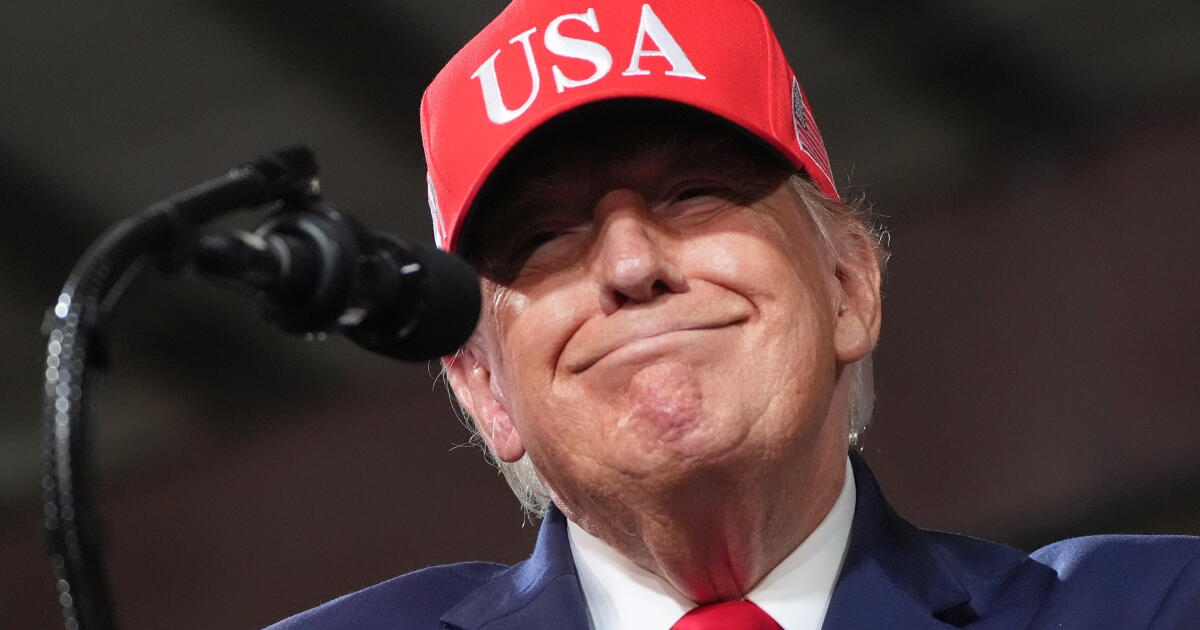
NEW YORK — President Trump says he wants voters to pretend that he’s on the ballot in this year’s midterm elections.
His rivals are doing their best to help his case.
Democratic candidates and their allies have spent more than $163 million since Sept. 1 on television advertising that mentions the Republican president, according to an Associated Press analysis of data from AdImpact, which charts media spending.
That includes airing ads that reference Trump on broadcast, cable and streaming nearly 180,000 times, the data shows. Republicans, meanwhile, have run ads that talk about the president just 16,000 times, at an estimated cost of $11 million, over the same period.
It’s a noticeable silence about the party’s dominant yet unpopular leader.
Many of the Democrats’ ads accuse Republican opponents of siding with the president over voters, particularly on issues like tariffs and the Iran war, which they blame for jacking up costs.
The ads include one from the campaign of Georgia Sen. Jon Ossoff, who is running for reelection and has spent nearly $3 million on a Trump-focused ad attacking his rival, Rep. Mike Collins, for his close relationship with the president.
“Mike Collins voted for Trump’s war in Iran, sending gas prices through the roof. He voted for Trump’s tariffs, sending grocery prices soaring. And Mike Collins voted with Trump to double health insurance premiums for more than a million Georgians,” it says. “Mike Collins sides with Donald Trump and makes you pay more.”
Republican National Committee spokesperson Natalie Baldassarre said Democratic messaging reflected the party’s hollowness instead of its strength.
“Democrats are lighting money on fire talking about President Trump because they have no agenda other than investigation, obstruction and impeachment,” she said. “Trump Derangement Syndrome isn’t a policy platform, it’s a $160 million way of saying you have nothing to offer to the American people.”
Democrats link Trump and his allies to economic woes
Another ad from the House Majority PAC, a super PAC dedicated to electing Democrats to the House, opens with a middle-aged woman standing over her kitchen stove and talking about how her family is “barely getting by” before she expresses her disappointment in Pennsylvania Rep. Brian Fitzpatrick, who is one of Republicans’ vulnerable incumbents.
“He used to be independent. But now it seems like he’s in lockstep with Donald Trump. It really bothers me,” she says, adding, “Congressman Fitzpatrick is not for us anymore.”
Indeed, all the Democratic ads that have aired in Pennsylvania’s tightly contested 1st Congressional District since Sept. 1 have mentioned Trump, even though Fitzpatrick voted against Trump’s tariffs and his power to wage war against Iran without congressional approval.
All four of the ads talking about Trump have aired a combined 2,000 times in that period, the AdImpact data shows. Fitzpatrick is being challenged by Democrat Bob Harvie, a county commissioner who is a former social studies teacher.
Democratic strategists say the messaging reflects the sentiment of voters.
“Every single poll and every single focus group shows affordability to be voters’ number one issue, and they specifically point to corrupt politicians as being responsible for driving up prices,” said House Majority PAC spokesperson Katarina Flicker.
Republican ads back away from the president
Out of dozens of issue categories tracked by AdImpact, the analysis found that Trump was the fourth most common issue mentioned by Democrats in House and Senate races’ final stretch. It was topped only by healthcare, taxes and accusations about opponents being beholden to special interests.
For Republicans in the same races, Trump-themed ads clocked in at number 33, by comparison. The top issues in their ads were taxes and crime.
Idaho Republican Senator Jim Risch tells viewers he “fought alongside President Trump to pass the biggest tax cuts for working families in American history.”
Overall in the race’s final stretch since Sept. 1, Democrats have spent or plan to spend $1.8 billion in ads across all federal, state and local elections. Republicans have spent or reserved $2.2 billion nationwide.
Republican strategist Alex Conant said Democrats are banking on Trump motivating their base to vote, an approach they’ve routinely used over the last decade.
“Democrats want this election to be a referendum on Trump. They want to equate a vote for a Republican candidate to a vote for Trump,” he said.
For Conant’s party, it’s a different calculus.
“We have a ton of money and we’re throwing every kind of message on the wall to see what sticks,” he said. “There’s not a cookie-cutter Republican ad this year. Whereas the Democratic ads are pretty obvious.”
Colvin and Kessler write for the Associated Press.
Cuban American poet Kyle Carrero Lopez first learned what sanctions were as a child — not as a political measure, but as a gendered one. In his poem “Sanctions,” he describes how his father, a surly Cuban refugee who worked as a DJ, laid out the terms of acceptable masculinity.
“No dance class/no “girl toys”/don’t walk like that,” writes Carrero. “His anthem, his law, hammered, hammered, into me.”
The poem features in his debut book of poetry, “Party Line,” released in July by indie publisher Graywolf Press. As a gay, Black Cuban American, Carrero uses social etiquette as a springboard to critically examine how marginalized people learn to negotiate space — whether at a nightclub; in the stratified gay mecca of Fire Island; at a socialist magazine party; or in line for customs at the U.S. border. He cites Black cultural figures like the queen of salsa Celia Cruz, American fashion journalist André Leon Talley, the late French singer and dancer Josephine Baker and political activist Assata Shakur as guiding lights.
“There are two sides of me,” he told De Los. “Between the party girl and the politico is Kyle Carrero Lopez.”
Born in 1995 to Cuban parents in New Jersey, Carrero is now based in New York City, where he earned a master of fine arts in poetry at NYU and published his award-winning 2022 chapbook, “Muscle Memory.” He answered my phone call in South Carolina, while overlooking the Atlantic Ocean; his mother was on the precipice of getting married a second time. Carrero, already a poet, scholar, political organizer and nightlife host, would flaunt yet another title that weekend as wedding officiant. “My work is naturally in conversation,” he explained.
Many of the poems in “Party Line” came to Carrero after visiting Cuba for the first time in 2017, through the CubaOne Foundation. Inspired by the Birthright Israel program for Jewish youth, the nonprofit sponsored trips for Cuban Americans to connect with Cubans on the island. Yet for Carrero, this strengthened his political dissonance with many Cubans in the U.S., who’ve supported economic sanctions on the communist nation. In order to force regime change, in January the Trump administration levied an oil blockade on Cuba, triggering a humanitarian crisis.
Written with an unmistakably Caribbean verve and snappy, conversational meter, Carrero defines his stance on Cuba in no uncertain terms.
“This book really is for Cuban Americans,” he said. “Those of us who are not trying to destroy Cuba, that is.”
Carrero spoke to De Los about party politics, Black Cubanidad and how visiting the island changed his writing for the better. The following interview has been lightly edited for clarity and length.
A lot of people fall back on these ideas about immigrant communities being all hard work and drudgery — but we come from a festive, dance-fueled culture. How did you get the idea to combine poems about parties with poems about politics?
I’ve always been involved in politics. I’ve done a lot of canvassing. In high school, I was in a learning community called the Civics and Government Institute. We did a “social reformers” panel, where you had to play somebody from a social movement. They had me up there dressed up as Elijah Muhammad in the 10th grade, asking me what I’d think of Obama. I had to drag Obama! These Nation of Islam people were not feeling the moderate Democrats.
But that informed my political engagement to this day. I was concerned with the language surrounding the embargo and U.S. aggression against Cuba. In my poem “Torricelli,” I talk about how [former New Jersey congressman and senator] Bob Torricelli wrote the Cuban Democracy Act, which he designed to, quote, “wreak havoc on that island.”
And I write a lot about nightlife. It is a family industry for me on both sides. My maternal grandfather ran a social club in New Jersey, a games parlor. My mom was a club kid. She was out all the time. Parenthood changed some things, but my father still had DJ gigs. Our basement was his studio. He’d leave the house at 9, 10 o’clock to go to the gigs. You know that new Jordan Firstman movie, “Club Kid”? I’m the original club kid.
How do you write for those who may not be ready to receive the club kid and the politico at once?
I like challenging assumptions that political people are drab and unglamorous — and that party people are brain-dead, escapist and have nothing to say. One of the problems I have with the ’90s club kid scene, as it existed, is they were extremely apolitical. And not only were they apolitical, but I would go so far as to say the club kids in the ’90s were a white supremacist entity. We don’t talk enough about how their whole thing was like whiteness and white privilege. All we’re here to do is have fun — and we see what that mentality leads to, right?
[The movie] “Party Monster”!
Yes, “Party Monster”! Michael Alig literally killed a man of color. That is not the party world that I live in. We don’t take off who we are just because there’s low lighting and fog and loud music. I’m going to respond the same way to harassment and perceived injustice as I would any other space.
To this day, there are white club kids in New York who are in the club talking in black-ccents and wearing imitations of black people’s hairstyles. And then if you call them out, they’re like, “Why? It’s a party!” And I’m like, “OK, but it’s a party where all of the music comes from Black people … you are a guest in this space.” Before I’m going to serve you a history lesson, let’s at least start with decency.
And though you may not think you’re doing politics … politics will still do you. Your club kid parents experienced politics by coming to the U.S. from Cuba. Can you tell me about their journey?
My father emigrated from Havana as a child. My mother was born to parents who emigrated in the 1950s during Batista’s regime. Cubans have a privileged relationship to immigration — the pipeline available to us [political asylum] was not the same for most people of Latin American descent.
My family came here not only as Cuban immigrants, but as Black immigrants. Politics happened to them. My father came to the U.S. in the late ’60s, getting called the N-word walking home from school with his two sisters…. They got hit so hard with belts that they would go home having soiled themselves. They were not only Black, but they didn’t even know what language or culture they were trying to assimilate to. There were layers of hatred…. When people talk about Cuban Americans, they think of white, rich Miami Cubans. It’s irresponsible to think in such a flat and one-dimensional way.
In the poem “Usefulness,” which was originally published in the Yale Review, you speak of how Black Cubans exist at the nexus of two different political agendas: the pro- and anti-Revolution contingents. Can you talk about that?
My opinion is very useful to many agendas. I joke that I would make a great Republican talking head. If I decided tomorrow that I wanted to get the GOP bag and be like, “Democrats are liars! I hate immigrants! I hate welfare! There’s two genders! We don’t need gay marriage!” — I would be a millionaire in under six months.
There’s a tokenism that happens when you exist at this nexus of identities. It’s true of the left as well sometimes. You could ask five different people in Cuba what they think about the government and they will give you five different answers. And that is OK! We need to allow that to be the case.
I don’t want what Trump and the Marco Rubios of the world want for Cuba — which is to seize it, to subjugate it and turn it into the next Puerto Rico. If people who are progressive and committed to Cuba’s autonomy don’t want that, I think part of [the work] is talking to Cuban people and hearing them out. I don’t think it’s acceptable to seek out only the opinions that match your own.
You bring up a historical moment that not a lot of Cuban Americans know about, which was the 1976 bombing of Cubana Flight 455, by an anti-Castro Cuban exile group. You said they planned on bombing a flight to Havana the week before, which your mom and her sister were on. How did they manage to avoid that?
[My grandfather] was an influential man. He knew the right people. So he heard something was going down and said, “I’m not putting my kids on that flight.” The flight went on as planned, but these men knew my grandfather and heard that his daughters were getting on the plane. To me that’s like getting on the list … sometimes you get into the party, or the plane [isn’t] bombed. It’s the same negotiation. Or just a moment of alignment.
What was it like visiting Cuba for the first time after the Obama administration eased travel and trade restrictions?
I don’t give Obama much, but he did try to normalize relations there. Unfortunately, Biden didn’t follow through with that, but for a second, we did care about Cuba.
The first time I went was in 2017, when I was 22. It was an incredible experience. My mother traveled to Cuba as a teenager; my father never went back. But they never discouraged me from going. I know that’s the case for a lot of Cuban Americans; there’s so much baggage. But once there was an easy path to go, it changed my life.
I write about Amiri Baraka’s time in Cuba, when he was earlier in his poetry journey — and his writing changed from being there. He wrote a poem called “Betancourt,” named after a young radical there. It made me more politically serious. I feel closer to my heritage, having done that.
What made you close the book with “I Saw Assata In Havana”? Did you really see Assata Shakur?
That was an imagined encounter. But it was the vision of what I imagine was her new life in Cuba — her second chance. I thought that it was a good ending note to land on, pushing against prevailing narratives.
I think the ways that we talk about our radicals — the Huey Newtons of the world, people like Kwame Ture or Angela Davis — we think of them as mythical beings, or, depending on who you ask, terrorists. But that disconnects them from their humanity. I wanted to create a portrait of [Shakur] as a normal lady who needed to pick up groceries sometimes. These were regular people who saw what was going on in the world and decided that they needed to do something about it. Each of us has that ability to enact change.
There are so many ways to make societal shifts, whether that’s writing to your officials or protesting or creating art that is challenging. What Shakur did was to say, “I don’t like this for my people. I don’t like this for the world I’m living in.” The same boot that’s on the necks of Black American people is on the necks of people in the Congo, people in Palestine, people of the global majority. We all have to share the planet. If we work together, we can have a world that can actually sustain itself.
My last question for you is: What would you like to see happen for Cuba?
I’m not a politician; I’m an artist. My duty is not toward any specific government; it is toward truth. My Cuba position, as a Cuban American, is focused first and foremost on my home country’s contribution to the conflict. If Cuba is truly no more than a failed state, why not lift all of the restrictions? Let’s see what happens when Cuba is unimpeded by hostile U.S. policy. That’s how you can best prove your point, right? Unless, of course, you’re afraid of what Cuba could be.
Two men charged Wednesday in connection with the shooting of San Francisco 49ers defensive lineman Keion White at a Super Bowl party in the early hours of February 9 were among four arrested as a result of a sweeping investigation.
Alleged gunman Gregory Walker, 36, of Mountain House was arrested by the Los Angeles Police Department and charged with assault with a firearm. San Francisco District Attorney Brooke Jenkins said Walker is alleged to have personally discharged the weapon that wounded White. Walker is also charged with causing great bodily injury, possession of a firearm by a felon, possession of a concealed firearm by a felon, and possession of a loaded firearm by a felon.
Curtis Green, 35, of Irvine was charged with brandishing a firearm at the party held in the VIP area of the Dahlia Lounge in San Francisco’s Mission District. Green was booked in San Francisco on misdemeanor weapons charges. Charges for the other two suspects, Marquis Davis, 38, and Antoine Washington, 36, have not been announced because they are not in custody in San Francisco, police said.
Davis was arrested in Atlanta and police said they found 979 grams of cocaine, 820 grams of MDMA, 1,026 grams of methamphetamine and 3,842 grams of fentanyl at his home. Washington was arrested in Stockton and police said they found loaded gun and oxycodone pills.
The investigation was dubbed “Operation D-Line” by San Francisco police and involved more than 50 search warrants and the assistance of more than 250 law enforcement personnel nationwide, officials said Wednesday.
“This kind of violence is unacceptable in San Francisco, and we devoted significant resources to holding the perpetrators of this incident accountable,” San Francisco Police Chief Derrick Lew said in a statement.
White was struck in the ankle with a bullet at 4 a.m. According to reports, the shooting occurred after an argument between White, Atlanta rapper Lil Baby, and the rapper’s entourage, who attempted to enter White’s event, according to a police report.
“For those who know me, y’all know this won’t stope [sic] me from spreading peace and joy to the world,” White wrote on Instagram a day after the shooting. “Full steam ahead. I’m in great spirits and ready to make the most of this off-season.”
White, a second-round draft pick of the New England Patriots in 2023, has played in all five games this season for the unbeaten 49ers, registering three sacks and nine tackles. He had a rooting interest in Super Bowl LX because he was traded to the 49ers from the Patriots, who lost the game to the Seattle Seahawks at Levi’s Stadium in Santa Clara.
Lil Baby, a 2022 Grammy winner whose given name is Dominique Jones, performed the night of the game at The Grand nightclub San Francisco before heading to the Dahlia Lounge, where strippers entertained on the main floor. White’s private party was downstairs.
An unidentified witness from White’s group told police that when he went upstairs to ask for help breaking up the conflict, he heard two gunshots. He returned downstairs and found that White had been shot in the left leg. According to the police report, topless women were scooping up money from the floor when police entered the club.
“As I entered, I saw numerous scantily clad females picking up dollar bills that were strewn all over the floor,” the police report said. “Some of the females were topless and appeared to have been adult entertainers.”
White posted a photograph on his Instagram story showing him smiling from his hospital room. He wrote, “I’ve undergone successful surgery. Thank you to everyone who has reached out with their prayers and concerns on my behalf.”
The shooting was the second involving a 49ers player in San Francisco in the last two years. Rookie wide receiver Ricky Pearsall was shot in Union Square when a teenager allegedly attempted to rob him in 2004.
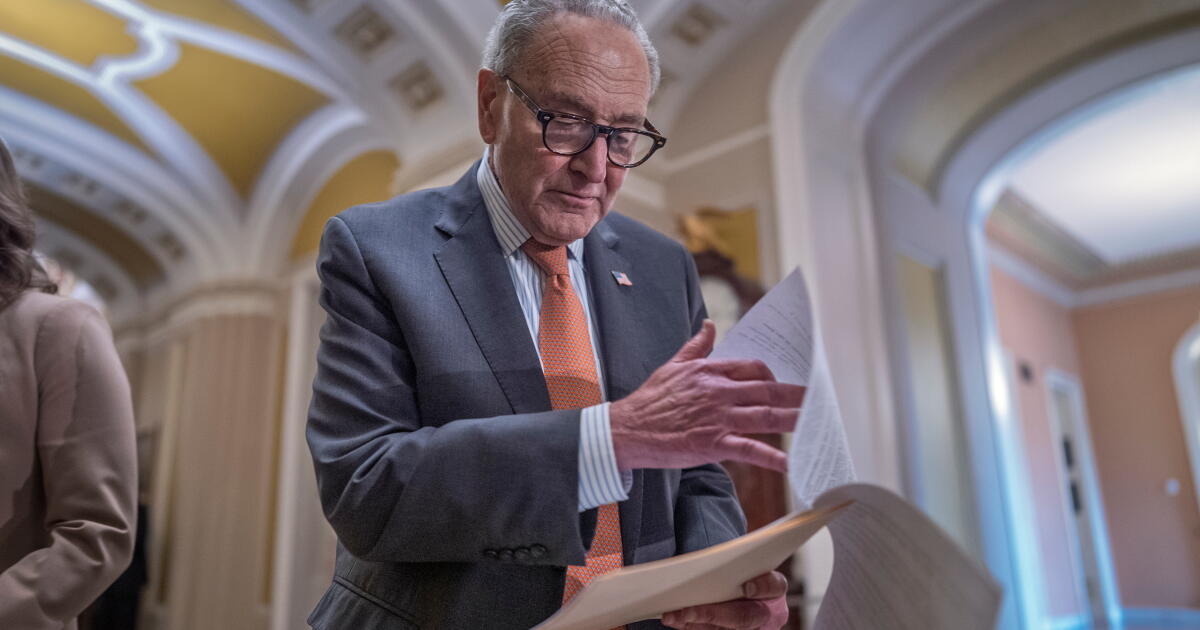
WASHINGTON — Chuck Schumer has won and lost Senate majorities since becoming Democratic leader a decade ago. But this year’s midterm elections could be his most important yet, with some in the party having said he needs to step down and make way for a new generation.
Schumer, who has directly or indirectly overseen his party’s Senate campaign arm in almost every election cycle over the last 20 years, has regained trust within his caucus, for now, as Democrats are hopeful of making gains in the midterm elections despite a difficult map that favors Republicans.
Allies of the New York Democrat say it’s a significant turnaround from last year, when the party was still reeling from major election losses. A low point came in the spring of 2025, when the party’s base erupted at Schumer for voting to keep President Trump’s government open.
Interviews with more than a dozen Democratic senators in recent weeks indicate that Schumer has recovered his political standing with many in his caucus. If Democrats gain seats in the election, colleagues expect him to easily win enough support in the closed-door leadership election, likely the week after Election Day.
Should they win a majority, a feat once seen as improbable, another term as leader would be nearly assured, many said. Both parties pick their Senate leaders by secret ballot, so no senator has to reveal their vote.
Still, nothing is guaranteed. While no Democrat has stepped up to challenge Schumer, that could quickly change if his party suffers an unexpected level of losses. And several Democratic candidates around the country have said publicly that they won’t vote for Schumer or have remained noncommittal.
Interviewed by The Associated Press earlier this month, Schumer stated unequivocally that he’s running for another term as leader. He said he believes Democrats have won more favor with voters over the last year and have a shot at winning the majority after fighting Trump’s tariffs, forcing more than a dozen votes to end the war in Iran and focusing on affordability, corruption and healthcare.
“I think our caucus is strong, it’s united,” Schumer said. “A year ago, everyone said it was out of reach. Today, we have a broader map, strong candidates, a clear contrast.”
Sen. Sheldon Whitehouse, D-R.I., said that “Senate seats in some ruby red states seem to be in play” because of candidates Schumer recruited.
Oregon Sen. Ron Wyden, a Democrat who has served with Schumer for almost 30 years, said that “if you had told us in 2025 that we’d be in the home stretch with a really good shot of taking the majority, it would have been like, ‘You’ve got to be kidding me.’ You can’t argue with results.”
And if Democrats don’t win additional seats? “I’m not thinking about that,” Wyden said.
Some senators won’t commit to supporting Schumer
While Schumer appears to be in a good position at the moment, many Democratic senators won’t say publicly whether they will support him — particularly those in the most progressive wing of the party.
“It’s a little bit too early to speculate on that right now,” said Sen. Bernie Sanders, a Vermont independent who caucuses with Democrats.
Massachusetts Sen. Elizabeth Warren said she is focused on November’s elections. “We’ll know a lot more after the midterms,” she said.
Freshman Sen. Elissa Slotkin of Michigan has called for a “new generation” of leaders across the party.
“It’s not a secret that Democrats still haven’t totally found their footing after Trump,” Slotkin said in a recent interview, adding that “we have to see what the results of the election are.”
It’s unclear if anyone else wants the job
Even if there are losses in Senate races, it’s unclear if any other Democrat wants the burden of being leader. Many are instead eyeing runs for the White House in 2028.
Speculation about a challenge to Schumer has centered on Sens. Chris Van Hollen of Maryland, Chris Murphy of Connecticut and Brian Schatz of Hawaii, who has already said he’s running for the No. 2 leadership spot to replace retiring Illinois Sen. Dick Durbin.
Asked about Schumer, Van Hollen said he doesn’t want to discuss it yet.
“Look, I think everybody wants to get through this election, and then we’ll go from there,” Van Hollen said in an interview before the Senate left Washington to campaign.
Several Senate candidates around the country have either said they won’t vote for Schumer if they are elected or remained noncommittal, including Troy Jackson in Maine, Adam Hamilton in Kansas and Abdul El-Sayed in Michigan.
At the same time, the Senate Majority PAC, which is closely aligned with Schumer, has put millions of dollars into those campaigns and others. Schumer backed El-Sayed’s primary opponent, but the two met in Washington last month.
El-Sayed said after the meeting that the party is united and “we’re having really productive conversations about what it takes to win.”
Schumer has kept his caucus close
Several of the Democratic senators who insisted on anonymity to share their views agreed that Schumer is likely to win another term as leader. There have been very few discussions about a change, said one, partially because Schumer has stayed close to almost everyone in his caucus, keeping them on speed dial in his famous flip phone. Another senator said that they aren’t aware of Schumer asking for any commitments just yet.
At the same time, some said they would like to see Schumer, who is up for reelection in 2028, announce that this is his last term as leader and commit to helping transition to a successor. A commitment like that could end the conversation, one senator said.
Another senator said that a commitment from Schumer about the future isn’t as important — what will matter is if they win in November.
All of the senators agreed that there are no obvious contenders right now to challenge him, but that could change quickly if Democrats lose Senate seats in November.
Schumer has turned the tables since 2025
Attitudes within the Democratic caucus have improved since last year, when the base revolted against Schumer for the March vote to keep the Republican president’s government open. Progressive groups like MoveOn called for him to step down, arguing that Democrats needed to fight harder against Trump and Republicans.
Schumer regained some favor with Democrats inside and outside the Capitol during a prolonged government shutdown a year ago and as he has repeatedly blocked Trump’s nominees and Republican legislation.
But while the calls to resign or step aside have waned, many are still agitating for change.
“Our priority right now is organizing and making sure we elect a new generation laser-focused on affordability and fighting corruption,” said Joel Payne, a national spokesman for MoveOn.
Referring to the 2025 calls for Schumer to step aside, Payne said the group’s members have “already rendered a judgment on Schumer’s tenure and made clear they’re eager for new leadership that energizes the party base.”
It’s unclear, though, whether calls from the progressive wing of the party will influence the secret ballot vote, in which Schumer needs only a majority to win.
Sen. Ben Ray Lujan, D-N.M., dismissed the talk about Schumer’s future.
“It’s hard to lose if no one else is challenging you,” he said.
Jalonick writes for the Associated Press. AP writers Steven Sloan, Seung Min Kim and Joey Cappelletti contributed to this report.
The barrage of spending comes as Republicans fight to overcome Trump’s declining popularity and cost of living concerns.
By Reuters and The Associated Press
Published On 12 Oct 202612 Oct 2026
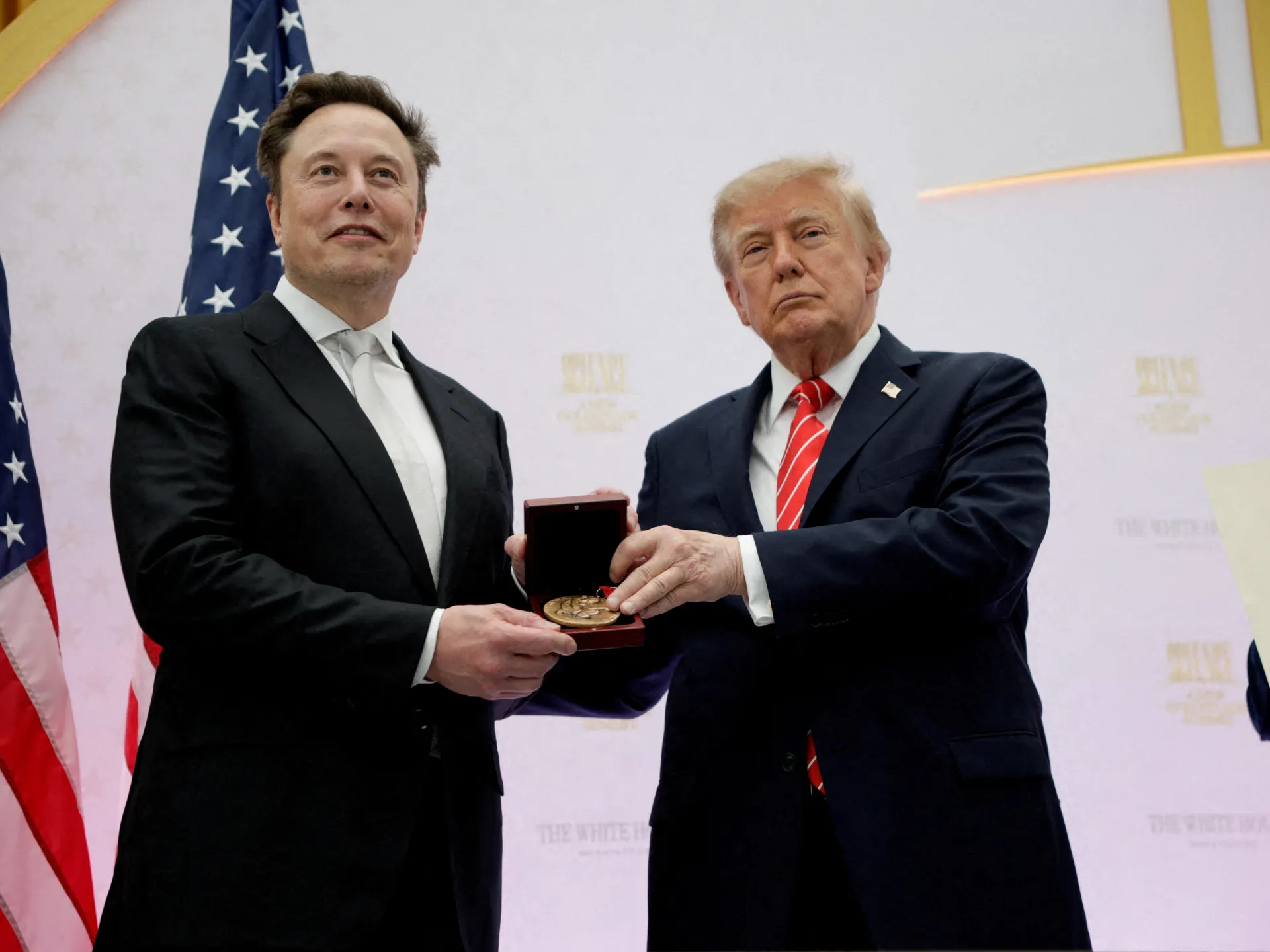
Elon Musk, the trillionaire tech mogul and backer of far-right causes, has reportedly spent $366m since last year to buoy the Republican Party in the United States midterm elections.
The New York Times first reported on Monday that Musk has spent $276m since July alone, including $158m for a super PAC focused on Republican Senate candidates, making him the largest single donor this year.
Recommended Stories
list of 3 itemsend of list
Musk is considered a close ally of President Donald Trump, the leader of the Republican Party, and was a special government adviser to the White House last year.
Musk’s political action committee, America PAC, has confirmed the spending totals. In a statement to The New York Times, a spokesperson framed the record amount as necessary to defend Congress from a Democratic takeover during the midterm races.
“These robust investments have allowed the GOP apparatus to get its message out so Republicans can have a fighting chance to defy history,” America PAC spokesman Andrew Romeo told the Times.
The barrage of spending by Musk comes as Republican candidates are fighting to overcome Trump’s low popularity and rising concerns about the cost of living among US voters.
Democrats are hoping to capitalise on voter dissatisfaction with Trump’s tenure to seize control of Congress, where Republicans currently hold majorities in both the House of Representatives and the Senate.
The influence of wealthy donors and PACs has long been the subject of criticism. Opponents argue that such spending distorts US politics in favour of powerful interests.
Musk became the world’s first trillionaire in June, when his aerospace company SpaceX made its initial public offering (IPO) on the Nasdaq stock exchange.
The tech entrepreneur had previously said that he planned to step back from his involvement in US politics, stating in May that he had “done enough” and did not have plans for large spending efforts.
Still, Musk has leveraged his tech holdings and wealth to support right-wing groups around the world.
Last year, for instance, politicians in Germany accused Musk of trying to meddle in the national election. Musk has been a vocal backer of the Alternative for Germany (AfD) party, which has been accused of adopting a discriminatory stance on immigration and other issues.
Voters in the US will head to the polls on November 3 to cast their ballots in the midterms, which will decide key state and local races, as well as congressional majorities.
The Republican Party is considered to have a sizeable financial advantage over the Democrats ahead of the race, with heavy spending from groups such as MAGA Inc, a pro-Trump super PAC named for the president’s “Make America Great Again” movement.
As of August, MAGA Inc reportedly had $416m in its coffers. The tracking site AdImpact found that it had spent $22m over the past month alone on the tight race unfolding for the open Senate seat in Texas.
Trump has also increased his campaign activities, hosting a string of rallies in the final weeks before the election to help Republicans push their message.
But Democrats appear confident that the Republicans’ spending advantage will not be enough to counter the effects of growing dissatisfaction with Trump.
“Republicans are hoping to buy these elections, injecting tens of millions into races to try and outrun their unpopular candidates, unpopular president and unpopular economy,” said Lauren French, a spokesperson for Democrats’ Senate Majority PAC.
Zack Polanski calls for internal rule reforms to give party leaders greater control over policy after Zionism vote.
Published On 11 Oct 202611 Oct 2026
Zack Polanski, the leader of the United Kingdom’s Green Party, has proposed a potential overhaul of his party’s democratic mechanisms, calling for the leader to have larger control over strategic direction.
The appeal came in an article published in The Guardian on Sunday after party members passed a motion declaring that Zionism is racism at their annual conference on October 4 in a divisive vote.
Recommended Stories
list of 4 itemsend of list
Polanski also failed to grab a parliamentary seat in the wake of the row with Israel in a by-election.
The Labour Party won the election for the parliamentary seat vacated by former leader Keir Starmer in Holborn and St Pancras on Friday, fending off a strong challenge from the left-wing Green Party in a boost for British Prime Minister Andy Burnham.
“Our party democracy must now evolve to meet that – creating wider engagement for members, giving leaders more responsibility to set the party’s strategic direction, and making our processes as robust and accessible as possible,” he wrote.
“Above all, that unity must be deployed in the service of changing this country for the better,” the Green Party leader added.
Criticism over vote on motion
Polanski also replied to the criticisms of him for not participating in the vote on the motion on Zionism.
“I have been asked why I was not present for the vote. The answer is that my priority was fighting a hugely consequential by-election for our party,” he said, adding that he put all his “energy into the race in Holborn and St Pancras”.
He admitted that some members feel “let down” by his decision not to make an appearance there.
The Green Party’s motion, which called for “Palestinian liberation, the right of return, Boycott, Divestment and Sanctions (BDS), and a full arms embargo against Israel” was criticised by Jewish groups, other parties and most Green Party MPs.
After conceding defeat in the fiercely contested by-election, Polanski answered his critics, saying he would stay on as leader.
He was barred from entering Israel after his party backed a motion to define Zionism as racism.
Helen Flanagan looked stunning in a thigh-skimming shirt and corsetCredit: Instagram/@hjgflanaganShe rocked her racy look at The Soho House party.Credit: Instagram/@hjgflanagan
In one snap, Helen fixed her gaze on the camera as she showed off her striking corset look.
Wearing glam makeup, she later posed in a cap on the dance floor, while another shot captured her sitting in a bathroom washed in red light.
Sign up for the Showbiz newsletter
Thank you!
Another showed her perched on a car, giggling and laughing, while a further shot captured her tucking into a meal during her night out.
Helen was captured sitting in a bathroom washed in red lightCredit: Instagram/@hjgflanaganHelen draped a jacket over her racy outfit as she went outsideCredit: Instagram/@hjgflanaganHelen tucked into a meal during her night outCredit: Instagram/@hjgflanaganWearing glam makeup, she later posed in a cap on the dance floorCredit: Instagram/@hjgflanagan
In an Instagram post, Helen shared a cheeky video where she quipped that she was going to flog her underwear for cash.
The short clip showed Helen, who is known for her sexy lingerie pictures, shimmying out of her knickers from underneath a long dress, before swinging them in the air.
In the next shot, the actress headed into the Post Office where she purchased an envelope.
The saucy star was then seen leaving the shop empty handed, implying she had posted her knickers to a fan.
India’s Cockroach Janta Party says its members have been subjected to mass arrests across India ahead of Saturday’s protest in New Delhi. Protesters are demanding the election panel chief’s resignation over alleged irregularities in voter-list revisions that critics say benefited Modi’s BJP.
WASHINGTON — Republicans are entering the final month of the midterm campaign increasingly anxious that the $1 billion at their disposal may not be enough to fend off sweeping losses as the party reckons with President Trump’s unpopularity, persistent cost concerns and the fallout from the war in Iran.
The cash advantage, spread out across a half-dozen groups, is driven largely by the Trump-aligned MAGA Inc., which had nearly $416 million in cash on hand at the end of August and began stepping up its spending on critical races in September.
But that money may have come too late, forcing the president’s group to pay much higher rates because of the shrinking availability of air time. Four Republican Senate campaign officials said groups that reserved advertising time last spring paid much lower rates than MAGA Inc. and its affiliated groups.
Instead, by waiting until September, Trump-connected organizations are sometimes paying more than five times what they would have spent if they acted earlier.
A representative of MAGA Inc. familiar with the group’s strategy said its spending has allowed Republicans to keep races more competitive than they would have been otherwise. In some cases, the group has been the only one on the air criticizing Democratic candidates.
The MAGA Inc. representative and the Republican Senate campaign officials spoke on condition of anonymity to discuss internal strategy.
The challenge is acute in places like Texas, where Trump will travel on Wednesday for the second time in a week to stump for Republican Ken Paxton’s Senate campaign. The state hasn’t elected a Democratic senator since 1988, yet MAGA Inc. has spent more than $22 million in the past month, according to the ad tracking firm AdImpact.
Another group, Texas PAC, which is aligned with Senate Majority Leader John Thune, has spent more than $83 million on advertising in the past month, an extraordinary amount to protect what’s normally a safe Republican seat.
One of those advertisements, which featured Paxton’s estranged wife saying she’s supporting the full Republican ticket, aired across the United States last weekend during a football game between the Dallas Cowboys and the Houston Texans.
Candidates are charged a lower advertising rate than outside groups, so the late infusion of super PAC cash has come at a steep price.
MAGA Inc., which is running ads primarily on streaming services, has been charged roughly $894 per airing, according to AdImpact, while Texas PAC has been charged roughly $809 for a mix of broadcast and streaming. That compares with about $290 for Democratic nominee James Talarico’s campaign, also on broadcast and streaming.
Those averages mask some of the more glaring disparities. For example, during a football game last month, Texas PAC was charged $450,000 to air a single spot in the Austin market. Talarico’s campaign paid $50,000 for a spot during the same game in the same market, according to AdImpact.
Elections are a referendum on the power of money
The 2026 campaign is shaping up as a referendum on the power of money in American politics. Democrats freely acknowledge their disadvantage, relying instead on anti-Trump sentiment among voters and targeted messaging on issues like corruption. Some Republicans, meanwhile, are open about the challenge of trying to spend their way out of a tough campaign at this late stage.
Neil Newhouse, a longtime Republican pollster, echoed concerns that his party was deploying its cash too late.
“After the votes are counted, I think we’re going to find the most effective advertising in terms of communicating message and moving voters and poll numbers, the most effective time was advertising that happened well before Labor Day, not after it,” he said. “A million dollars of advertising in October is a drop in the bucket.”
Thune’s group began pulling back in North Carolina last week, a sign of the party’s challenge in the Senate race there. The state’s outgoing Sen. Thom Tillis has been increasingly vocal about his party’s vulnerabilities and recently said that, even with a strong cash advantage, “in the last month, you pretty much have to place your bets.”
“If we have endless resources, then we should spend endlessly in every state,” he said. “Absent endless resources, you’ve got to make data-driven decisions about where you can win.”
The midterms mark the first national election since the Supreme Court in June erased limits on how much political parties can spend in coordination with candidates for Congress and president, injecting even more money into a political system already awash in cash.
Money alone doesn’t translate into victory
There’s plenty of evidence that money alone doesn’t translate into victory.
Democrat Kamala Harris entered the final stretch of the 2024 campaign with significantly more money than Trump but went on to lose every critical swing state and the White House. Elon Musk’s $25 million didn’t lift his preferred candidate to a Wisconsin Supreme Court seat last year. And Tom Steyer didn’t advance to the general election in the California governor’s race despite pumping $216 million of his own money into the campaign.
The $1 billion that Republicans have amassed compares with roughly $579 million held by a comparable collection of major Democratic groups.
Senate Democratic leader Chuck Schumer said his party is facing an “obscene” amount of spending that could swamp them in the midterms.
“We’re never going to have as much money as them,” he said in an interview. “I sum up the election in this sentence: Can a massive Republican advantage in money beat a massive Democratic advantage in better candidates and political climate? I bet it can’t.”
In addition to Texas, Democrats have mounted competitive Senate campaigns in states like Ohio, Maine, Iowa and Michigan. A similar dynamic has emerged in governors’ races from Florida and Georgia to Wisconsin, Ohio and Nevada.
Former President Barack Obama is stepping up his involvement in the midterms and will headline a fundraiser for Senate candidates on Wednesday.
In the House, Democrats are growing so confident they can retake the majority that they’re expanding their targets deeper into traditionally Republican districts in Arkansas and Tennessee. But a lack of money could limit their gains.
“We absolutely need to spend enough to get our message out,” said Rep. Suzan DelBene of Washington, who chairs the Democratic Congressional Campaign Committee. “And district by district, we are.”
Trump turns to his bond with supporters
From his earliest days as an unlikely political figure, Trump has consistently overcome expectations. Facing daunting prospects heading into the final weeks of his last midterm, he’s betting he can again outwit political gravity, relying in large part on the deep bond he’s built with supporters.
He has stepped up his campaign rallies in recent weeks, traveling to deep red territory to galvanize the party faithful. At events like the one this past weekend in Vandalia, Ohio, the crowd was enthusiastic and cheered at the lines that have become Trump staples over the years, particularly when he dips into profanity. The high school gymnasium that held the event was packed, though crowds began emptying out about halfway through the 90-minute rally.
In the closing minutes of a speech Monday in Grand Island, Nebraska, the president revived his plea that supporters who have stood so fervently by him pretend as if he is on the ballot one more time.
“In a true way, I am running,” he said. “We have to keep it going.”
Sloan and Beaumont write for the Associated Press. Beaumont reported from Des Moines, Iowa. AP writers Seung Min Kim in Vandalia, Ohio, and Mary Clare Jalonick in Washington contributed to this report.
WASHINGTON — Political advertising warns about Democratic plots to defund the police. Campaign events feature law enforcement unions and tough talk about law and order. Stump speeches boast about record low levels of violent crime.
From coast to coast, Republicans are focusing on public disorder, illegal immigration and violent crime in midterm campaigns as voters sour on their party’s handling of the cost of living and the war with Iran.
Democrats have tried to counter the attacks by recruiting candidates with law enforcement backgrounds and emphasizing their own anti-crime plans, but Republicans believe it’s a rare opportunity to go on the offensive in an otherwise challenging year.
“Do you know that right now we have the lowest violent crime rate in 126 years in America right now? Because we emphasize the rule of law,” House Speaker Mike Johnson recently told an audience at Louisiana State University. Crime rates have generally trended down since the 1990s with a brief spike during the COVID pandemic. “We have the most secure border we have had in the past half century.”
President Trump returned to the topic Monday night in Nebraska, warning about how the country used to be before he returned to the White House.
“We had a border with people pouring in, crime like nobody’s ever seen,” he said.
Republicans say Democrats will ‘defund the police’
In Georgia, Michigan, Nevada, Texas and Wisconsin, Republican candidates for governor have attacked their Democratic rivals as weak on crime or warned they could cut police funding. Texas Gov. Greg Abbott, for instance, has lambasted Democratic nominee and state Rep. Gina Hinojosa for not supporting legislation that would require judges to deny bail to illegal immigrants charged with a violent crime.
Hinojosa has campaigned on her tenure as a civil rights lawyer and criticized Abbott’s crime policies as violating civil liberties.
Rick Jackson, a billionaire healthcare executive running in Georgia, has repeatedly attacked Democratic opponent Keisha Lance Bottoms over her tenure as Atlanta mayor.
“I grew up in the type of neighborhood Keisha Lance Bottoms abandoned,” Jackson said at a summer campaign rally. “I know who gets hurt when politicians defund the police.”
In an interview with Atlanta station 11Alive, Bottoms emphasized that her administration gave pay raises to police and firefighters, and said she called for increased federal funding for public safety during her time as mayor.
Crime warnings pervade congressional races
It’s a similar story in U.S. House races.
In Virginia’s first congressional district, Rep. Rob Wittman has attacked his Democratic opponent, prosecutor Shannon Taylor, over her allegedly “soft on crime” record in office. In Michigan’s 10th district, Republican Michael Bouchard is running on his service as a Bronze Star Army captain and son of a longtime local sheriff. He’s claimed his Democratic opponent, former prosecutor Christina Hines, supports “woke, soft on crime, socialist policies.”
In Colorado’s eighth district, Rep. Gabe Evans touts his time as a police officer against Democratic challenger Manny Rutinel. And in Wisconsin’s third district, Rep. Derrick Van Orden hopes to win a third race against Democratic nominee Rebecca Cooke by painting her as a communist who wants to defund the police.
Republicans hope that by reprising warnings of crime and disorder the party can reenergize their disillusioned base and win back skeptical moderate voters who have drifted over concerns like affordability.
Democratic rivals have responded in kind. Taylor aired an ad featuring 13 local sheriffs who endorsed her campaign. Rutinel aired ads with local police and rolled out a safety plan that called for greater police funding and drug prevention programs. Hines said she’ll continue to prioritize public safety and prosecute corruption in Washington. Cooke has vowed to fully fund police departments in Congress.
Not all Republicans see crime as a winning issue
It’s yet to be seen if the strategy will prove effective.
“We’ve got to talk about it. I think that in many ways, we are the victim of our own success because it’s off the headlines a little bit more,” said Sen. Eric Schmitt, a Missouri Republican and former state attorney general. “Having a completely secure border now, no one even talks about it. But that’s a huge accomplishment from where we were at before.”
An AP-NORC poll conducted in September found that border security — which Trump and Republicans often link to crime — was a relative strength for the Republican president, with 48% of U.S. adults saying they approved of his performance on the issue. But that was still a decline from a year ago, when his approval on border security was at 55%.
Not everyone in the party is sold on Republicans rehashing the crime message.
“I don’t see that bubbling up as a major issue for the voters,” said Sen. Thom Tillis, a North Carolina Republican who chose not to seek reelection this year. Aiming to make the race to succeed Tillis a referendum on crime, Republicans have run ads claiming that Democratic nominee Roy Cooper went easy on convicts during his two terms in the governor’s mansion.
Black political leaders have criticized the ads as racist and reminiscent of past Republican campaigns that used dog whistles to appeal to suburban white voters. Trump made the message explicit when he invoked the infamous 1988 “Willie Horton” ad and displayed dozens of mugshots of men of color on a jumbotron during a rally stumping for Michael Whatley, Cooper’s Republican rival.
In contrast to his party’s messaging, Tillis noted his state’s safety in recent years.
“Frankly, when I hear somebody talking about crime in Charlotte, I live 25 minutes from downtown. I’m not worried about walking through Charlotte at night,” said Tillis.
Democrats accuse Trump of corruption
National Democrats contend that Republicans’ message on violent crime is undercut by the Trump administration’s hardline immigration enforcement actions, which resulted in the killing of two American protesters in January and the fatal shootings of multiple undocumented people. They accuse Trump of corruption and have hammered Republicans for alleged complicity in the president’s self-dealing.
“This is the biggest criminal organization that we’ve ever seen,” said Sen. Ruben Gallego, an Arizona Democrat, of the current White House.
He added that, “Democrats should be pushing back with the fact that, if not for the fact that he was president, this guy would be leading some type of mafia right now.”
Lauren Bis, a White House spokeswoman, said “extreme Democrats are trying to deflect from their radical soft on crime agenda.”
Parti Quebecois returns to power, promising a third referendum on Quebec’s independence from Canada.
Published On 6 Oct 20266 Oct 2026
The secessionist Parti Quebecois has won the most seats in Quebec’s election and will form the next government in the predominantly French-speaking Canadian province, according to media reports.
The result on Monday revives the question of whether the province should leave Canada, testing Prime Minister Mark Carney’s message of national unity.
Recommended Stories
list of 2 itemsend of list
Paul St-Pierre Plamondon, the party’s leader, is set to become premier.
During the campaign, he promised a third referendum on leaving Canada during his first term, although he said he would wait until US President Donald Trump leaves office in January 2029.
It was not yet clear whether the party had reached the 64 seats needed for a majority in the 127-seat National Assembly.
If it falls short, it would lead a minority government and need support from opposition lawmakers to pass major legislation and survive confidence votes.
The Parti Quebecois, or PQ, last governed the province from 2012 to 2014.
Monday’s victory marks a sharp recovery for the PQ, which won just three seats in the 2022 provincial election.
Its return also ends eight years in power for the Coalition Avenir Quebec, or CAQ, a centre-right Quebec nationalist party that does not support independence.
Daniel Beland, a political science professor at McGill University in Montreal, told The Associated Press news agency that the victory reflects Quebec’s multiparty system, where support is divided among several parties, rather than a surge in secessionist sentiment.
Support for independence remains at about 30 percent, low by historical standards, he said.
Still, Beland said a secessionist government in Quebec represents a new national-unity challenge for Carney, particularly with another independence-related vote approaching in Alberta.
“Seeing that a pro-independence party won in Quebec barely two weeks before an independence-related referendum takes place in Alberta might suggest to the Trump administration that national unity remains a major issue in Canada despite the popularity of Mark Carney,” Beland said.
Quebec held two previous referendums on independence, in 1980 and 1995, and voters rejected secession both times.
The second vote was decided by a narrow margin, but there has been no further referendum in the three decades since.
Bosnian Serb nationalist Milorad Dodik claimed victory for his party as Bosnia’s presidential elections reinforced its deep political and ethnic divisions. The presidency is made up of three members who rotate the leadership every eight months.
JESSICA Alba blew fans away with her ageless looks as she danced the night away with celebrity pals at a party thrown by Paris Hilton.
The Fantastic Four star, 45, shared a video of her dancing with Keke Palmer and Kelly Sawyer in a purple lit room.
Jessica Alba looked incredible as she posed in her Y2K outfitCredit: jessicaalba/instagramThe star embraced the look in a tiny miniskirt and suede bootsCredit: jessicaalba/instagram
Pictures from the same post showed Jessica embracing her Y2K style in a star-printed cut-off tank top, mini skirt and brown suede boots.
Completing her look with a half-up hairstyle, Jessica looked like she had stepped straight out of 2001 for a night of partying.
Sign up for the Showbiz newsletter
Thank you!
She captioned the video: “A @parishilton y2k end of summer party w my girls @keke@kellysawyer … that’s hot”
Keke clearly had a lot of fun as well, commenting on the post: “I found love when I found you two 😍”
Jenna Dewan posted: “I’m so sad to have missed this!! You look amaze”, while boyfriend Danny Ramirez simply posted a string of heart-eyed emojis.
But fans were blown away by the ageless star, with one writing: “wow she looks almost the same she did 20 years ago, real y2k legend 😍🔥”
Fans said she ‘hadn’t aged in 20 years’ as she posed in her outfitCredit: jessicaalba/instagramThe star shot to fame in the early 2000s thanks to Dark AngelCredit: jessicaalba/instagram
“Natural beauty! You make it look easy,” wrote another.
“Baddest baddie in the history of baddies” said a third.
Most read in Entertainment
While a fourth wrote: “That woman who never grows old, always shines like a new coin.😍”
Jessica Alba shot to fame in the early 2000s, appearing in cult-smash movie, Dark Angel.
She later appeared in a string of blockbusters including Sin City and Honey, before becoming Sue Storm in the Fantastic Four movies in 2005.
She’s currently working on a new TV series, Confessions on the 7:45, starring as Selena Murphy, a woman whose life is turned upside down when she meets a stranger.