democrats

Here’s how the GOP could scheme to keep control of the House

For Democrats or, for that matter, anyone who believes in checks and balances, things are starting to look up.

President Trump’s days of untrammeled war-making, law-breaking and generally doing whatever he damn well pleases may finally be drawing to a close. Public opinion, history and, especially, the surging price of gasoline and groceries, all point to a Democratic takeover of the House in November’s midterm election.

There’s a direct correlation between a president’s approval rating and the way his party performs at the midpoint of his term. Anything below 50% favorability portends political trouble; right now Trump’s positive standing in polls hovers around a dismal 40%.

Then there’s the history part. Since World War II, the party out of the White House has gained an average of more than two dozen House seats in midterm elections. Democrats need to pick up just three to take control beginning in January.

(While the Republican grip on the Senate seems weaker than just a few months ago, the GOP is still favored to hang onto the chamber in November.)

There is, however, a looming threat causing nervousness among Democrats and their allies as they contemplate a celebratory fall, a landmine of sorts buried deep in the congressional election process.

Let’s acquaint ourselves with Article 1, Section 5 of the Constitution.

The pertinent language written by the Framers states, “Each House shall be the Judge of the Elections, Returns and Qualifications of its own Members.” In other words, it’s up to the House and Senate to acknowledge and abide by the will of voters as expressed in the election returns.

What could possibly go wrong?

Well, if you let your paranoia run wild, quite a lot. If the election outcome is close — and probably it would have to be very close — Republican lawmakers could theoretically seize on phony claims of fraud and effectively nullify the results of enough contests to deny Democrats control of the House.

There’s plenty of skepticism that would or could ever take place. But if it were to happen, hello, national crisis!

Normally, we could count on the occupant of the White House to humbly submit to the election returns, even if it’s a “shellacking” as President Obama called his walloping in the 2010 midterm election, or a “thumpin’ ” as President George W. Bush described his electoral spanking in 2006.

Not Trump.

This president has amply demonstrated the lengths to which he’ll go to overturn an honest election, siccing a violent mob on lawmakers certifying his 2020 defeat, telling endless lies and using the Justice Department to confiscate ballots and intimidate innocent election officials and others Trump deems his enemies.

He strong-armed Texas into a highly unusual, highly partisan redrawing of its congressional boundaries, an effort to net five seats and lengthen the odds against a Democratic takeover.

The move appears to have backfired, spurring voters in California and, last week, Virginia to redraw their state’s political maps to more than offset Texas and boost Democrats in November. (The Virginia results are being contested in court.)

A gathering of Virginia voters in front of television screens

Voters attend an Arlington Democrats redistricting vote watch party during a special election Tuesday in Virginia. A measure to redraw the state’s congressional map was narrowly approved.

(Valerie Plesch/Bloomberg via Getty Images)

That failure doesn’t take away Trump’s malign intent. And in the supine Speaker Mike Johnson, he has the perfect handmaiden to undermine the midterm vote.

In 2020, Johnson was the lead author of a Supreme Court brief seeking to overturn the results in four states that Joe Biden had indisputably won. That speaks to Johnson’s probity and integrity.

How would subversion of November’s election take place?

One theory goes like this: When the balloting is over, Johnson could appoint a House committee packed with Trump’s acolytes to investigate alleged voting irregularities. (And if you think Trump won’t be bellowing the words “rigged” and “fraud” in the face of defeat, you’ve either been in a coma or living on another planet for the last decade.)

Those hearings and the “evidence” they turn up could then be cited by election officials in key states — collaborators, if you will — as a reason to delay the certification of election results and block the seating of majority-making Democrats in the next Congress. In their place, the theory goes, Republicans could vote to fill those seats with GOP candidates who lost at the polls, keeping themselves in control.

Derek Muller, an election law expert, suggests that scenario is little more than a fever dream of doomsday devotees and overly nervous Nellies.

He said he’d be very surprised if all the election results weren’t certified by Jan. 3, when the new Congress convenes, given the legal remedies available to prevent stalling and undue delay. And, Muller said, there is no assurance Republicans would march in lockstep behind a plan to prevent the seating of Democrats.

Thwarting a duly elected Democratic majority “involves extraordinary coordination and precedents that have never occurred, with a unique convergence of factors,” said Muller, who teaches law at Notre Dame — though, he added, if control of the House came down to, say, a single seat “all bets are off.”

Far-fetched? Perhaps. Some of the spun-up theories surrounding November’s election do sound a bit like a product of political science fiction.

But what kind of president picks a fight with the pope? Plunges the world into crisis by unilaterally going to war with Iran with no exit plan? Demolishes the East Wing of the White House on an egotistical whim?

If Trump, an inveterate norm-buster, sees a way to keep his grip on unchecked power, don’t put anything past him.

Source link

Democrats win in Virginia but it won’t be the final say in a national redistricting competition

Democrats on Wednesday celebrated an election win in Virginia that could put them slightly ahead in the national redistricting competition that President Trump triggered in an attempt to preserve his party’s House majority in this year’s midterms, but it will not be the final round.

Now that it’s been approved by voters, the new Virginia map will have to clear additional legal hurdles. On Wednesday, the state attorney general’s office said it would immediately appeal a ruling earlier in the day from a judge in rural southern Virginia who ordered that the results of Tuesday’s vote not be certified.

Ultimately, the Virginia Supreme Court will decide whether Democratic lawmakers violated procedural rules when they referred a constitutional amendment to the ballot authorizing the new U.S. House districts that could help Democrats win as many as four additional seats in the state. If so, that could invalidate the map voters narrowly approved Tuesday.

What happens next in Florida also will matter.

The state’s Republican-controlled Legislature is to meet in a special session next week that GOP Gov. Ron DeSantis called in part to draw a new map to expand the party’s congressional majority there. The U.S. Supreme Court is scheduled to issue an opinion by the end of June in a Louisiana case that could overturn a key provision of the Voting Rights Act and lead to redrawn political maps across the South, though almost all of those could not happen until 2028.

After voters passed the Virginia amendment, Democrats could tentatively claim that they netted 10 seats nationally from the mid-decade redistricting, compared with the nine that Republicans claim. Even if things swing again in the GOP’s favor, the net result of Trump’s campaign would be at best an incremental increase in the number of GOP-leaning House seats at a time when his approval rating is dropping and Republican anxiety over losing control of Congress in November is rising.

“We have successfully blunted Trump’s attempt to completely hijack the midterms,” said John Bisognano, president of the National Democratic Redistricting Committee.

Many Republicans agreed.

“The GOP will now lose net seats across the country. If you’re going to pick a fight, at least win it,” Ari Fleischer, who was a spokesman for President George W. Bush, posted on the social media site X after the Virginia vote. “All this was foreseeable and avoidable. We should not have started this fight.”

Adam Kincaid, executive director of the National Republican Redistricting Trust, argued that it is too soon to declare one party a victor.

“It’s an ongoing process with many legal challenges pending, and it’s far too early for sweeping statements on the final outcome,” he said.

Trump on Wednesday tried to undermine the Virginia result by leveling groundless accusations of fraud similar to ones he made after losing the 2020 presidential election. He called the Virginia vote “RIGGED” and “Crooked” in a post on his social media site and added, “Let’s see if the Courts will fix this travesty of ‘Justice.’”

Redistricting spread from Texas to other states

Redistricting is typically done every 10 years after each census, unless ordered by a court. But last summer, Trump pushed a redrawing in Texas, prodding the state’s Republican-controlled Legislature to add up to five winnable House seats for his party. Trump then began pressuring other Republican-run states to follow. Missouri, North Carolina and Ohio have since created more GOP-leaning seats in addition to Texas.

Democrats began to fight back, even though they were more constrained because several Democratic-controlled states had maps drawn by independent commissions rather than lawmakers and governors.

To counter Texas, California’s Democratic governor, Gavin Newsom, pushed the Democratic-controlled Legislature to place a redistricting initiative on last fall’s ballot. After voters overwhelmingly approved it, the measure will replace a commission-approved map with one that could gain Democrats five seats.

Democrats reclaimed the Legislature and governor’s office in November in Virginia and swiftly moved to replicate California’s move with an even more aggressive redistricting plan. It replaces a congressional map imposed by a court after the last census that had resulted in a 6-5 edge for Democrats with one that could allow Democrats to win as many as 10 seats.

“We are not going to let anyone tilt the system without a response,” state Senate President L. Louise Lucas said at a news conference Wednesday.

Courts could still have a say on redistricting

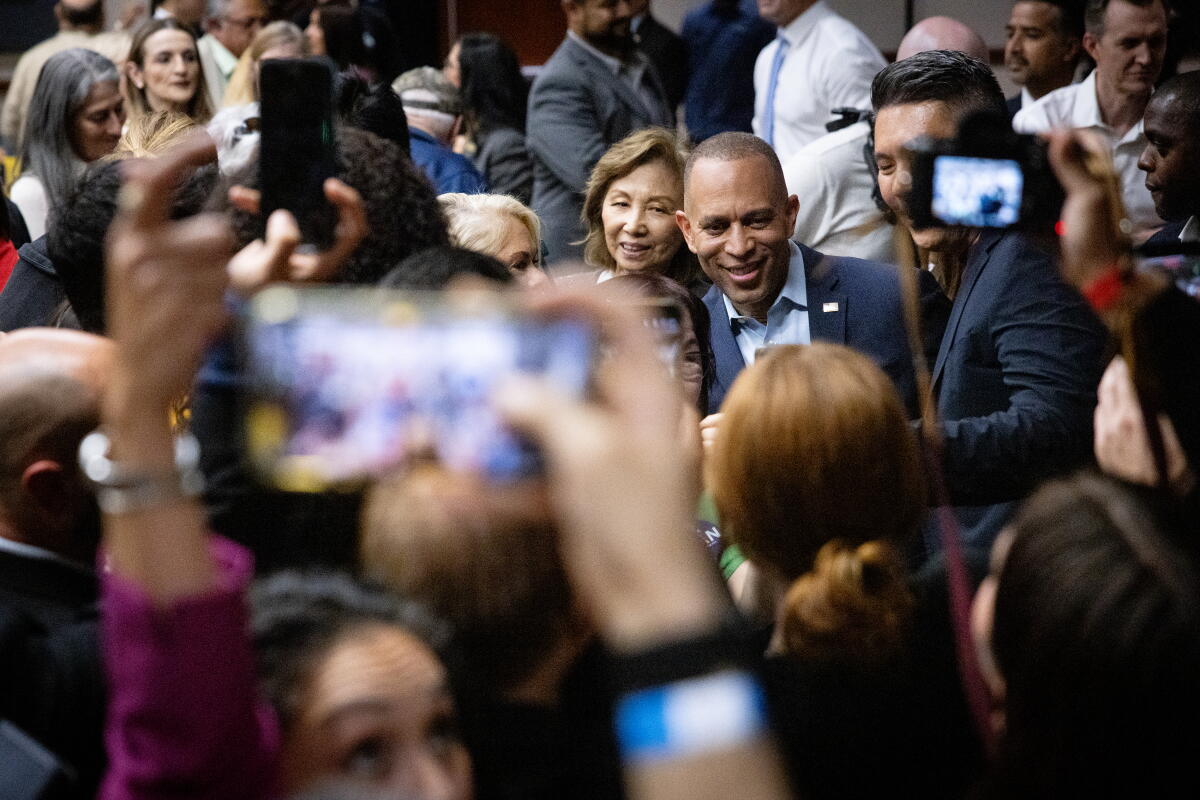
In Washington, U.S. House Democratic leader Hakeem Jeffries of New York warned Florida Republicans, who have been openly nervous about redrawing their district boundaries and potentially spreading their core voters too thin before an election that appears to be trending against them.

“Our message to Florida Republicans right now is, ‘F around and find out,’” Jeffries said.

House Majority Forward, the nonprofit arm of the super political action committee aligned with House Democrats, has spent nearly $60 million to push back against Republicans’ redistricting efforts. Some $40 million of that was on the Virginia campaign.

Another obstacle in Florida is an anti-gerrymandering constitutional amendment that was approved by state voters in 2010. It is likely that any new Florida map would trigger significant litigation, although six of the state Supreme Court’s seven justices were appointed by Republicans.

Nicholas Stephanopolous, a Harvard law professor, said a challenge for DeSantis is that the Florida amendment forbids drawing lines for purely partisan purposes, so he has to find some other excuse for revising the map. “Even with that sort of acquiescent state supreme court, I don’t think it’s a done deal,” Stephanopolous said.

The Virginia move comes with its own legal issues. Republicans have challenged the process that Democrats used to place the measure on the ballot and the state Supreme Court opted to wait for the vote before even scheduling arguments in the case. It is unclear when a ruling could come.

Wednesday’s ruling stopping certification came from a separate case that Republicans filed with the same lower court judge, whose initial ruling against the initiative was put on hold by the state supreme court.

“The ballot box was never the final word here,” Terry Kilgore, the Virginia House Republican leader, said in a statement after Tuesday’s vote. “Serious legal questions remain about both the wording of this referendum and the process used to put it before voters.”

The biggest legal wild card is held by the U.S. Supreme Court. Its conservative majority could throw out a requirement under the Voting Rights Act that in areas with a large minority population, mapmakers draw districts that are more favorable to the election of minority candidates.

That provision has led to the creation of several majority-minority congressional seats, especially in the South. Without it, Republicans in conservative states could shrink the number of U.S. House seats winnable by Democrats even further.

But it’s unlikely that any state other than Louisiana, which brought the lawsuit the high court will rule on, would be able to adjust its congressional lines in time for November even if the court eliminates that provision, known as Section Two. That’s because the November election is already officially underway in most states and candidate filing deadlines — and, in some cases, primary elections — have already passed.

Riccardi and Lieb write for the Associated Press. AP writers Lisa Mascaro and Leah Askarinam in Washington contributed to this report.

Source link

Senate Republicans again block Democrats’ bid to limit war powers

April 23 (UPI) — Senate Republicans have again blocked the Democrats from curbing President Donald Trump‘s ability to wage war with Iran, as negotiators try to find a diplomatic end to the conflict during the fragile cease-fire.

The Senate voted 51-46 on Wednesday afternoon against Sen. Tammy Baldwin‘s War Powers Resolution, the fifth time since March 4 that the Senate has voted against directing the removal of U.S. Armed Forces from hostilities with Iran until authorized by Congress.

As with previous votes, Wednesday’s was mostly along party lines with Republican Sen. Rand Paul of Kentucky again voting with his Democratic colleagues, and Democratic Sen. John Fetterman of Pennsylvania again voting with the Republicans.

“This entire war has been unnecessary, illegal and unwise. And we need to put a check on this president before it gets even worse,” Baldwin said from the Senate floor on Wednesday.

“Unfortunately, the president has shown us that he did not have a plan after day one. The president said the war would be over in a matter of days; we are coming up on the two-month mark with no real end in sight. And over the course of 50-plus days we have seen nothing short of a disaster.”

Sen. Tammy Duckworth, D-Ill., a veteran, vowed in a statement that the Democrats will continue to do all in their power to end the war.

“It’s infuriating that Senate Republicans keep shirking their oaths and giving Donald Trump the green light to plunge our nation even deeper into his war of choice, further endangering our troops abroad and surging prices at home,” she said.

“This wanna-be dictator keeps breaking every single promise he’s made to the American people who are sick and tired of watching Republicans duck their responsibility to stop this chaos.”

The war began Feb. 28 with the United States and Israel attacking Iran.

Since then, 13 Americans have been killed. At least 3,646 people have been killed in Iran, according to HRANA.

Gas prices have surged as Iran has restricted access to the important Strait of Hormuz energy transportation route, and the United States is enforcing a blockade of Iran’s ports, cutting it off from sea-based trade.

The vote was held as a two-week cease-fire was to end before President Donald Trump announced an indefinite extension amid negotiations. On Wednesday, Iran’s military claimed to have seized two cargo ships in the conflict over the waterway.

Since the war began, Democrats have been seeking to rein in Trump’s war powers, arguing the ongoing war with Iran violates the Constitution, which mandates that only Congress has the power to declare war.

Democrats in the Senate have pledged to use their powers to force weekly debates on the war as well as weekly votes, forcing Republicans to repeatedly and publicly state their position on the conflict.

The vote was held less than a week before the 60-day limit of the war passes. On April 28, the War Powers Act will compel Trump to seek congressional authorization for the war.

Sen. Lisa Murkowski, R-Alaska, has said that Trump should have sought Congress’ authorization, and appears to be leading Republican efforts to draft legislation for the continuation of the use of military force as that deadline comes.

“My focus is on the safety of America’s armed forces and the American civilians who are on the ground in the Middle East,” she said in a statement in early March, just days after the war began.

“At this point, we have little choice but to continue the military operation to degrade and destroy Iran’s capability for nuclear weapons.”

Source link

Democrats up in Virginia, but US voters may pay price for redistricting war | US Midterm Elections 2026 News

Washington, DC – The latest battle in United States congressional redistricting has been decided, with voters in Virginia approving redrawing the state’s electoral map.

The result of Tuesday’s referendum on Virginia redistricting is widely expected to benefit Democrats in their fight to retake control of the slimly Republican-controlled US House of Representatives in the midterm vote in November.

Recommended Stories

list of 4 itemsend of list

While redistricting is typically conducted every 10 years, following the US Census count of the country’s population, the election season has seen an unprecedented flurry of states moving to redraw their legislative maps early, initially spurred by pressure on US President Donald Trump to urge his fellow Republicans in Texas to do the same.

Democrats may be up at the moment, but several scenarios – including a redistricting push in Florida – could soon spoil those gains.

Experts, meanwhile, warn of the long-term implications of the election season’s norm-busting political manoeuvres, which they say could transform how and when electoral maps are drawn for years to come.

“Virginia’s unorthodox redistricting isn’t just a map redraw, it’s a mid-decade power play in a national arms race,” Rina Shah, a political adviser and strategist, told Al Jazeera.

“In a cycle defined by retaliation over reform, this sets a precedent: when one side bends the rules, the other follows, until courts or voters draw the final line.”

Democrats gain – for now

Trump has not been timid about his desire to redraw state congressional maps to benefit his Republican Party.

In July 2025, he confirmed the plan to reporters: “Texas would be the biggest one,” he said. “Just a very simple redrawing, we pick up five seats.”

By August, Texas’s Republican-controlled State House had passed a new map favouring Republicans, setting the party on course to secure five more seats in the US House of Representatives compared to the earlier map.

The move was soon followed by changes in Missouri, whose new maps are expected to net Republicans one additional seat, while redistricting in North Carolina and Ohio is expected to give the party two to three new Republican-dominated districts.

Democrats in several states responded in kind, pushing for redistricting in California and Utah that resulted in about six new Democrat-dominated districts. Virginia’s victory largely neutralised Republican gains, adding between two and four seats for Democrats.

“This could shift Virginia from a 6-5 split to something like 10-1 Democratic,” political adviser Shah said, referring to Virginia’s 11 congressional districts and noting this would result in “delivering up to four net seats and dramatically tightening the fight for House control in the 2026 midterms”.

This comes as Republicans are already expected to face a punishing election season, with wariness over the US-Israeli war in Iran and the stubbornly high cost of living in the US.

Democratic control of either chamber of Congress – or of both – would give the party the ability to largely curtail Trump’s agenda in the final two years of his presidency.

As of Wednesday, Sabato’s Crystal Ball, a midterm predictor published by the University of Virginia’s Center for Politics, rated 217 Congressional districts across the country as leaning towards Democrats, with 205 leaning towards Republicans and 13 rated toss-ups.

Good for Democrats, ‘terrible’ for democracy

In the short term, Democrats are “winning” from the redistricting battle, according to Samuel Wang, a professor of neuroscience at Princeton University who runs the Princeton Gerrymandering Project.

“But from a non-partisan good government standpoint, it’s just a terrible event,” Wang told Al Jazeera.

He explained the “incredible” flurry of redistricting in recent months opens the possibility of a new age of heightened gerrymandering, the process by which congressional boundaries are drawn to benefit one political group.

Prior to this election cycle, there had been just three instances of mid-decade redistricting over the last five decades. Wang described the recent spurt as a “complete busting of norms”.

“It’s bad in the sense of reducing competition. Gerrymandering on both sides, basically, removes voters from the equation everywhere it happens,” he said.

Top Democrats have largely argued their hands were forced in mirroring the Republican strategy, rather than yield to the opposing party ahead of a consequential election.

“We fought back,” Hakeem Jeffries, the top Democrat in the House, told the Associated Press after Virginia’s vote. “When they go low, we hit back hard.”

But some Democrats have echoed concerns over the new precedent being set.

John Fetterman, a Democrat from Pennsylvania who has regularly sided with Republicans, told Newsmax on Wednesday, “Whether it’s a red state or whether it’s a blue state, our democracy is degraded.”

Attention turns to Florida

To be sure, while opportunities for further redistricting are diminishing following the vote in Virginia, the final congressional maps ahead of the midterms may not yet be set.

The Virginia vote now shifts pressure on Republicans in Florida, where Governor Ron DeSantis is set to hold a special legislative session on April 28 to discuss possible redistricting.

A new map could add up to five Republican-dominated congressional districts in the state, but could be scuttled by strict language in Florida’s constitution related to the process.

Democrat Jeffries, in a statement on Wednesday, vowed to surge resources to the state to take down Republican incumbents if the map is redrawn. “Maximum warfare, everywhere, all the time,” he pledged.

Several challenges to Virginia’s redistricting ballot measure are also currently being heard before the state’s Supreme Court, which could hinder the implementation of the new map.

Trump on Wednesday decried the Virginia vote as “rigged”, without providing any evidence to back up the claim.

Meanwhile, a case pending before the US Supreme Court could beckon in another slate of redistricting in the US South.

In Louisiana v Callais, the justices will determine whether the creation of two Black-majority congressional districts is in line with the Voting Rights Act, which seeks to assure minority representation in states with a history of racist election policies.

A ruling could open the door to redrawing maps in several states that would have previously been banned due to so-called “racial gerrymandering”, a process of drawing congressional lines based on racial makeup to dilute the electoral power of a minority group.

A pathway to reform?

A handful of states have created independent commissions to oversee redistricting, in an effort to assure the process remains non-partisan.

But the vast majority rely on their state legislatures to draw the maps, which can lead to outsized influence over the party in control, barring legal challenges. That largely remains true whether redistricting is conducted every decade or, as the current election season could portend, more frequently.

But amid the current cavalcade of congressional map changes, Princeton’s Wang, who is himself running in the Democratic primary for Congress in New Jersey’s 12th district, sees a rare opportunity for federal reform.

That could take the form of Congress creating independent commissions to oversee redistricting.

“Now that mid-decade redistricting is backfiring on Republicans, it creates the possibility that both parties can see clearly that gerrymandering is a zero-sum game,” Wang said.

“It opens a path for possible bipartisan action.”

Source link

As primary election nears, top candidates for California governor debate tonight

With the California governor’s race quickly approaching, six candidates will face off Wednesday evening in the first debate since former Rep. Eric Swalwell dropped out of the race in the aftermath of sexual assault and misconduct allegations.

The debate takes place at a critical moment in the turbulent contest to replace termed-out Gov. Gavin Newsom. Ballots will start landing in Californians’ mailboxes in less than two weeks, and voters are split by a crowded field of eight prominent candidates. The debate also takes place after former state Controller Betty Yee ended her campaign because of a lack of resources and support in the polls.

Two Republicans — Riverside County Sheriff Chad Bianco and conservative commentator Steve Hilton — and four Democrats — billionaire Tom Steyer, former Biden administration Secretary Xavier Becerra, former Orange County Rep. Katie Porter and San Jose Mayor Matt Mahan — will take the stage at Nexstar’s KRON4 studios in San Francisco. Former Los Angeles Mayor Antonio Villaraigosa and state Supt. of Public Instruction Tony Thurmond, both Democrats, were not invited to participate because of their low polling numbers.

As the candidates strive to distinguish themselves in a crowded field, the debate could include fiery exchanges about the role of money in politics and potential heightened attacks on Becerra, who has surged in the polls since Swalwell dropped out. With the debate taking place on Earth Day, environmental issues are also likely to be raised.

The Wednesday night gathering is the first televised debate in the gubernatorial contest since early February. Last month, USC canceled a debate hours before it was set to begin over mounting criticism that its criteria excluded all major candidates of color.

The 7 p.m. debate is hosted by Nexstar and will be moderated by KTXL FOX40 anchor Nikki Laurenzo and KTLA anchor Frank Buckley. It can be viewed on KRON4 (San Francisco), KTLA5 (Los Angeles), KSWB/KUSI (San Diego), KTXL (Sacramento), KGET (Bakersfield) and KSEE (Fresno). NewsNation will also air the debate.

Source link

Rep. David Scott, a Georgia Democrat seeking his 13th term in Congress, dies at age 80

U.S. Rep. David Scott, a Georgia Democrat and the first Black chairman of the House Agriculture Committee, has died. He was 80.

Scott, who was seeking his 13th term in Congress despite challenges from within his party, was once a leading voice for Democrats on issues related to farm aid policy and food aid for consumers and a prominent Black member of the party’s moderate Blue Dog caucus. But he faced criticism and concerns in recent years because of declining health, enduring a primary challenge in 2024 and facing another one at the time of his death.

Democrats on Capitol Hill praised the longtime lawmaker.

“The news of Congressman Scott’s passing is deeply sad,” House Minority Leader Hakeem Jeffries told reporters on Wednesday.

“David Scott was a trailblazer who served district that he represented admirably, rose up from humble beginnings to become the first African American ever to chair the House Ag Committee,” Jeffries said. “He cared about the people that he represented. He was fiercely committed to getting things done for the people of the great state of Georgia, and he’ll be deeply missed.”

News of Scott’s death came during the Congressional Black Caucus’ weekly luncheon on Capitol Hill. The Black Caucus’ chair, Rep. Yvette Clarke, told lawmakers at the outset of the meeting, according to a person who insisted on anonymity to discuss a private conversation. Many lawmakers in the room, some of whom had served with Scott for decades, were shocked and saddened by the news.

Scott’s death slightly widens Republicans’ narrow House majority going into the thick of this midterm election year.

The congressman was not especially active on the campaign trail in 2026. But he had been dismissive of pressure to retire.

“Thank God I’m in good health, moving and doing the people’s work,” Scott said in 2024.

David Albert Scott was born in rural Aynor, South Carolina, on June 27, 1945, in the era of Jim Crow segregation. He graduated from Florida A&M University, one of the nation’s largest historically Black college campuses — and in office he was an outspoken advocate for federal support of HBCUs. Scott also earned an MBA from the University of Pennsylvania’s Wharton School.

He was already a veteran state lawmaker in Georgia before being elected to Congress in 2002.

Barrow, Brown and Amy write for the Associated Press. Brown reported from Washington.

Source link

Virginia redistricting election results: Key takeaways from Democrats’ win | US Midterm Elections 2026 News

Virginia voters have narrowly approved a referendum to redraw the state’s congressional map, with about 51.5 percent voting yes and 48.6 percent voting no, and 97 percent of ballots counted, according to The Associated Press news agency.

The map redraws the boundaries of Virginia’s congressional districts, changes that can directly shape which party wins seats in the United States House of Representatives.

With most votes counted, the result remained close, but Democratic-leaning areas helped push it through.

The vote is part of a broader national fight over district lines – a battle that could decide who controls Congress.

Republicans in Florida, for instance, are planning a special session of the state legislature next Tuesday where they are expected to seek to redraw their state’s political map – a move that could help them gain as many as five seats, potentially wiping out any Democratic gain in Virginia.

Here are five key takeaways:

Democrats gain a major advantage in the House race

Currently, Virginia sends 11 members to the US House. At the moment, they comprise six Democrats and five Republicans.

The new map changes how those seats are drawn. By reshaping district boundaries, it makes most areas more favourable to Democrats by clumping together voters who lean towards the party strategically, while splintering communities that typically vote Republican.

  • Eight districts would be safely Democratic
  • Two would be competitive but lean Democratic
  • Only one would be safely Republican.

Because of this, Democrats could realistically win at least eight and possibly up to 10 of the 11 seats in the US house, instead of just six.

This shift follows a high-stakes political battle, with total spending estimated at $100m.

Democratic leaders, including Virginia Governor Abigail Spanberger, framed the new map as a direct response to efforts by US President Donald Trump and Republicans to redraw districts in their favour in other states.

However, even with this win, “there’s no guarantee they’ll send a delegation dominated by Democrats to Washington,” Al Jazeera’s Rosiland Jordan said, reporting from Virginia.

There are still six months until the midterm elections, and voter behaviour can shift. Even favourable maps can produce unexpected outcomes.

Virginia is one part of a bigger battle

Virginia is just one part of a bigger fight over who controls the US House.

After the 2024 election, Trump pushed Republican-led states to redraw congressional maps before the usual timeline to improve their chances in the 2026 midterms.

Republicans moved first in states like Texas, where new maps could give them up to five more seats.

Democrats responded with their own moves. In California, voters approved a plan backed by Governor Gavin Newsom that allowed lawmakers to draw a new, more partisan map. This is expected to give Democrats up to five extra seats.

The Virginia result fits into this bigger picture. If Democrats gain up to four seats there, it could help cancel out Republican gains in other states.

But the fight is not over. More changes could still happen, including in Florida, where Governor Ron DeSantis is looking at redrawing the map.

“Virginia just changed the trajectory of the 2026 midterms,” Democratic state House Speaker Don Scott said in a celebratory statement.

“At a moment when Trump and his allies are trying to lock in power before voters have a say, Virginians stepped up and levelled the playing field for the entire country.”

The measure has been approved by voters, but its future is still uncertain.

The Supreme Court of Virginia is expected to review ongoing legal challenges that could affect whether the new map takes effect. While the court allowed the vote to go ahead, it said it would examine the case in full if the measure passed.

The challenges focus on two key issues: Whether Democratic lawmakers followed the correct legal process when putting the proposal forward, and whether the wording on the ballot may have been misleading to voters.

A narrow win

Both parties were watching the vote closely.

Democrats were happy to win, even if it was close. Republicans, meanwhile, were relieved it wasn’t a big loss.

“Virginia Democrats can’t redraw reality,” said Republican Congressman Richard Hudson. “This close margin reinforces that Virginia is a purple state that shouldn’t be represented by a severe partisan gerrymander.”

Gerrymandering is the process of redrawing electoral maps in ways that can benefit one party over another.

Democrats said the tight result was partly down to voter confusion, which they blamed on Republican messaging. Democrats framed the effort as a response to Trump, promoting the plan with advertisements featuring former US President Barack Obama.

Opponents pushed back by pointing to past comments from Obama and Spanberger, both of whom have previously criticised gerrymandering, using that to question the Democrats’ position.

Gerrymandering is at the centre of the fight

The vote highlights the growing importance of partisan map-drawing in US politics.

Democrats say this balances Republican advantages elsewhere. Republicans call it a power grab in a competitive state.

Either way, redistricting is now a key tool shaping election outcomes, not just reflecting them.

Source link

Virginia voters deciding on redistricting plan that could boost Democrats’ seats in Congress

Virginia voters on Tuesday are deciding whether to ratify an unusual mid-decade redrawing of U.S. House districts that could boost Democrats’ chances of flipping control of the closely divided chamber, as the state becomes the latest front in a national redistricting battle.

A proposed constitutional amendment backed by Democratic officials would bypass the state’s bipartisan redistricting commission to allow use of new congressional districts approved by state lawmakers in this year’s midterm elections.

The referendum, which needs a simple majority to pass, tests Democrats’ ability to push back against President Trump, who started the gerrymandering competition between states after successfully urging Texas Republicans to redraw congressional districts in their favor last year. Virginia is the second state, after California last fall, to put the question to voters.

It also tests voters’ willingness to accept districts gerrymandered for political advantage — coming just six years after Virginia voters approved an amendment meant to diminish such partisan gamesmanship by shifting redistricting away from the legislature.

Even if Democrats are successful Tuesday, the public vote may not be the final word. The state Supreme Court is considering whether the redistricting plan is illegal in a case that could make the referendum results meaningless.

Virginia Democrats are following California’s lead

Congressional redistricting typically is done once a decade after each U.S. census. But Trump urged Texas Republicans to redistrict ahead of the November elections in hopes of winning several additional seats and maintaining the GOP’s narrow House majority in the face of political headwinds that typically favor the party that is out of power during midterms.

The Texas gambit led to a burst of redistricting nationwide. So far, Republicans believe they can win up to nine more House seats in newly redrawn districts in Texas, Missouri, North Carolina and Ohio.

Democrats think they can win up to five more seats in California, where voters approved a mid-decade redistricting effort last November, and one more seat under new court-imposed districts in Utah. Democrats hope to offset the rest of that gap in Virginia, where they decisively flipped 13 seats in the state House and won back the governor’s office last year.

Voters focus on fairness, with different perspectives

The stream of voters was steady Tuesday at a recreation center in the Old Town area of Alexandria, Virginia.

Matt Wallace, 31, said he votes regularly but this election has additional emphasis.

“I think the redistricting issue across the country is unfortunate, that we’ve had to resort to temporary redistricting in order to sort of alter our elections across the country,” Wallace said. He said he voted for the Democratic redistricting amendment “to help balance the scales a bit until things get back to normal.”

Joanna Miller, 29, said she voted against the redistricting measure, “because I want my vote to count in a fair way.” Miller said she was more concerned about representation in Virginia than trying to offset actions in other states.

“I want my vote and my representation to matter this fall,” she said.

Political parties made a big push in Virginia

Leaders of both major parties see Tuesday’s vote as crucial to their chances to win a House majority in the fall. Trump weighed in via social media Tuesday morning, telling Virginians to “vote ‘no’ to save your country!”

Former Virginia Gov. Glenn Youngkin, a Republican, rallied with opponents of the measure Monday night, calling the redistricting plan “dishonest” and “brazenly deceptive.” House Minority Leader Hakeem Jeffries told reporters at the Capitol earlier in the day that a vote to approve the redraw “will serve as a check and balance on this out-of-control Trump administration.”

A committee supporting the Democratic redistricting effort had raised more than $64 million — three times as much as the roughly $20 million raised by opponents, according to finance reports filed less than two weeks before the election.

The back-and-forth battle over congressional districts is expected to continue in Florida, where the Republican-led legislature is scheduled to convene April 28 for a special session that could result in a more favorable map for Republicans.

A lobster-like district could aid Democratic efforts

In Virginia, Democrats currently hold six of the 11 U.S. House seats under districts that were imposed by the state Supreme Court in 2021 after a bipartisan commission failed to agree on a map based on the latest census data.

The new plan could help Democrats win as many as 10 seats. Five are anchored in Democratic-heavy northern Virginia, including one shaped like a lobster that stretches into Republican-leaning rural areas.

Revisions to four other districts across Richmond, southern Virginia and Hampton Roads dilute the voting power of conservative blocs in those areas. And a reshaped district in parts of western Virginia lumps together three Democratic-leaning college towns to offset other Republican voters.

The Virginia redistricting plan is “pushing back against what other states have done in trying to stack the deck for Donald Trump in those congressional elections,” Democratic Gov. Abigail Spanberger said during an online rally last week.

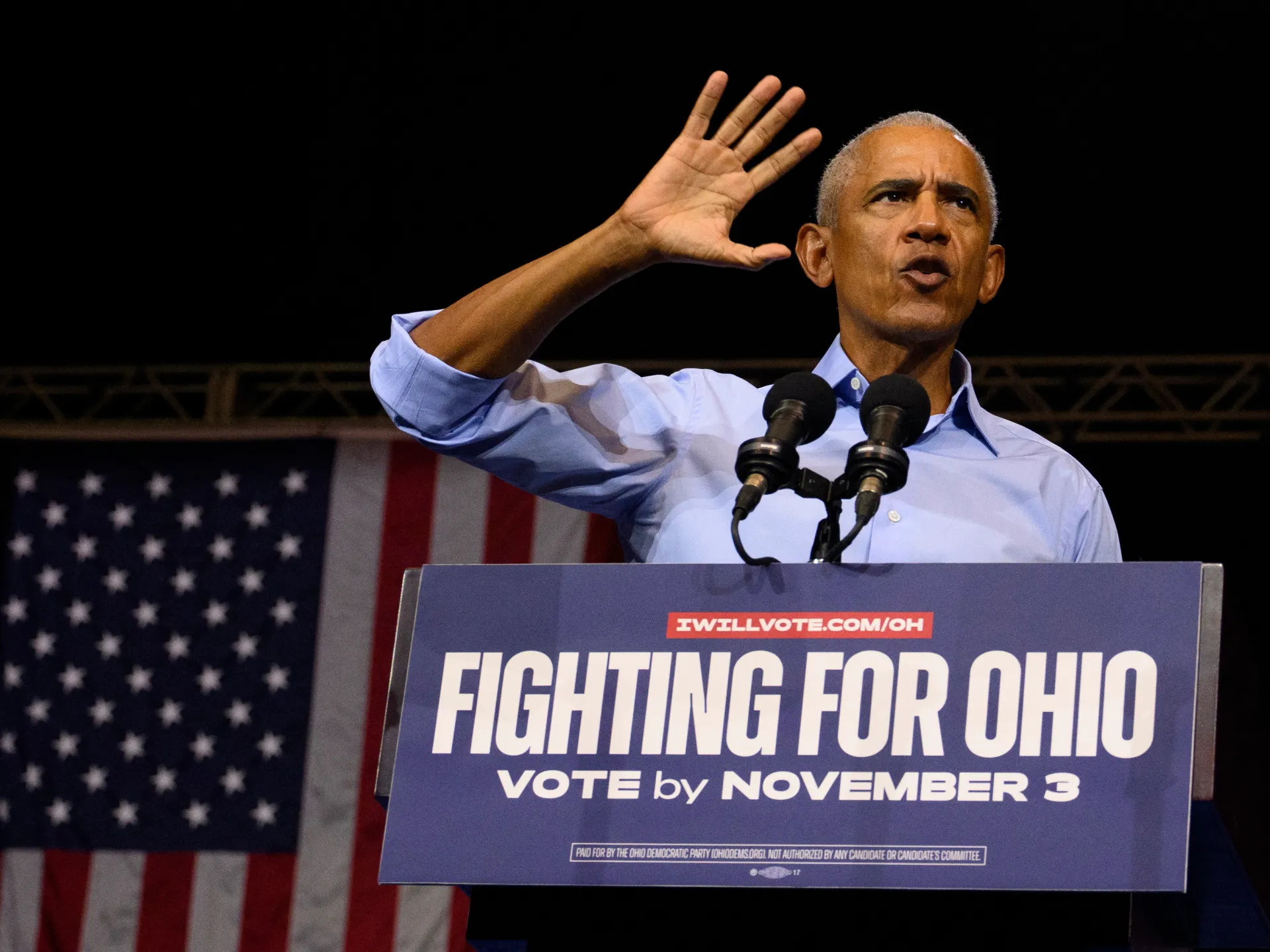
Ads for the “yes to redistricting” campaign featuring former President Barack Obama have flooded the airwaves.

Opponents have distributed campaign materials citing past statements from Obama and Spanberger criticizing gerrymandering, but those were before Trump pushed Republican states to redraw their congressional maps in advance of this year’s midterms.

Democrats “were all against gerrymandering before they were for it,” Virginia Republican Party Chairman Jeff Ryer said.

Virginia court weighs whether lawmakers acted illegally

Virginia lawmakers endorsed a constitutional amendment allowing their mid-decade redistricting last fall, then passed it again in January as part of a two-step process that requires an intervening election for an amendment to be placed on the ballot. The measure allows lawmakers to redistrict until returning the task to a bipartisan commission after the 2030 census.

In February, they passed a new U.S. House map to take effect pending the outcome of the redistricting referendum. Republicans have filed multiple legal challenges against the effort.

A Tazewell County judge ruled that the redistricting push was illegal for several reasons. Circuit Court Judge Jack Hurley Jr. said lawmakers failed to follow their own rules for adding the redistricting amendment to a special session.

He ruled that their initial vote failed to occur before the public began casting ballots in last year’s general election and thus didn’t count toward the two-step process. He also ruled that the state failed to publish the amendment three months before that election, as required by law.

If the state Supreme Court agrees with the lower court, the results from Tuesday’s vote could be rendered moot.

Lieb writes for the Associated Press. AP writers Gary Fields in Virginia and Lisa Mascaro in Washington contributed to this report.

Source link

Virginia voting on new congressional map drawn by Democrats

April 21 (UPI) — Voters are heading to the polls in Virginia on Tuesday to vote on a new congressional map drawn by state lawmakers.

Polls are open until 7 p.m. EST., with nearly 1.4 million early ballots already cast on a constitutional amendment to change the congressional map. The result of Tuesday’s vote could have significant implications for the midterm elections in November.

If the map, drawn by Democratic lawmakers, is approved by voters, Democrats would be favored to win 10 of the state’s 11 congressional districts. Democrats currently hold six of the state’s 11 congressional seats and Republicans hold five.

Virginia is just the latest state to weigh redrawing its congressional map mid-decade after Texas approved a map that will favor Republicans last year. Four Republican-led states have approved new congressional maps.

Democrats and Republicans outside of the state have lent their voices to campaigns for and against Virginia’s redistricting plan. President Donald Trump and House Speaker Mike Johnson, R-La., voiced their opposition to the plan, with Trump calling it “unfair.”

House Minority Leader Hakeem Jeffries, D-N.Y., has joined Virginia lawmakers Sen. Mark Warner and Sen. Tim Kaine at rallies to support redistricting. Former President Barack Obama has also been involved, appearing in ad campaigns calling on voters to vote “yes.”

“We’re giving Virginians a chance to vote — which Republican states have not done — about whether they want to have a congressional delegation that will stand up against Donald Trump’s tyranny if he tries to interfere with our elections,” Kaine said in an appearance on Fox News on Sunday.

The Virginia Supreme Court allowed Tuesday’s election to move forward but may still weigh in on whether the new congressional map is legal or not.

Secretary of Health and Human Services Robert F. Kennedy, Jr. speaks during a House Appropriations Subcommittee on Labor, Health and Human Services, Education, and Related Agencies hearing on the budget for the Department of Health and Human Services in the Rayburn House Office Building near the U.S. Capitol on Thursday. Photo by Bonnie Cash/UPI | License Photo

Source link

Governor’s race wildly unpredictable two weeks before Californians receive ballots

The most unpredictable California governor’s race in recent history took another set of dizzying turns on Monday, with former Health and Human Services Secretary Xavier Becerra surging after former Rep. Eric Swalwell dropped out in the face of sexual assault and misconduct allegations, and former state Controller Betty Yee ending her bid.

The race to replace termed-out Gov. Gavin Newsom is the first in a quarter of a century with no clear front-runner and a sprawling field of candidates who have been jockeying for the attention of Californians, who are just beginning to pay attention to the campaign two weeks before ballots arrive in their mailboxes.

“I certainly could not have imagined the twists and the disturbing turns that this race has taken,” Yee said as she announced she was dropping out. “But through it all, my values and my vision for California has never wavered.”

A poll released Monday by the state Democratic Party — its first since Swalwell (D-Dublin) dropped out — showed Becerra’s support jumped nine points to 13%, placing him in a tie with Tom Steyer, the billionaire hedge fund founder turned environmental warrior. Former Rep. Katie Porter of Orange County saw a slight bump to 10% from 7%, while the remaining Democrats in the contest were mired in the low single digits.

The party began the surveys out of concern that Democrats could be shut out of the governor’s race because of California’s unique primary system, where the top two vote-getters in the June 2 primary move on to the November general election regardless of political party.

“I continue to believe there are too many Democrats in the field,” California Democratic Party Chairman Rusty Hicks told reporters Monday. “My call for candidates to honestly assess the viability of their candidacy and campaigns still stands, especially if you are stalled in the single digits, seeing financial resources dry up and/or are failing to pick up additional support.”

Hicks and other party leaders and allies had unsuccessfully urged low-polling candidates to reconsider their candidacies before the filing deadline in an attempt to cull the field and avoid splintering the Democratic vote. Though most did not name candidates who they thought should think about their viability, Yee was widely believed to be among them.

Yee became emotional as she said on Monday that she decided to withdraw from the race because she wasn’t able to raise the resources necessary to compete in the state. She also said her message of competency and experience wasn’t resonating among voters who were seeking a fiery foil to President Trump, not “Boring Betty,” as she dubbed herself. Yee said she would assess the field before making an announcement on whether she would endorse one of her fellow Democrats.

Becerra was another candidate believed to be a target of party leaders’ efforts to shrink the field. But he held on and apparently benefited from Swalwell’s downfall.

“I’m not the richest candidate, I’m not the slickest candidate, but I am the guy that’s got you,” Becerra said, rallying supporters in Los Angeles on Saturday.

The audience was filled with members of labor groups backing the longtime politician, and Becerra told them he’d serve as a “union man” in the governor’s office.

Pro- and anti-Becerra forces tussled outside the town hall after two people, who declined to identify whom they were working for, passed out fliers highlighting critical media investigations of the U.S. Department of Health and Human Services during the migrant crisis when the agency was led by Becerra.

Pro-Becerra attendees grabbed the fliers and told the men to go away, prompting a security guard to intervene.

The question is whether Becerra, who also served as state attorney general, a member of Congress and a state Assembly member, can raise the funds necessary to compete in a state with some of the nation’s most expensive media markets. And he was tied in the state party poll with a billionaire who dumped an additional $12.1 million of his own money into his campaign last week.

Steyer’s total investment in his bid reached $133 million, according to the California secretary of state’s office. He also received the endorsement of Our Revolution, a progressive political organization founded by U.S. Sen. Bernie Sanders (I-Vt.).

“We’ve never endorsed a billionaire — but Tom Steyer is using his position to upset the system,” the group posted on X on Monday. “As Our Revolution executive director Joseph Geevarghese told @theintercept, ‘He’s been a partner in the movement. Most billionaires have used their wealth and privilege to lock in the status quo. Tom is doing the opposite.’”

San Jose Mayor Matt Mahan, who is also running for governor, accused Steyer of hypocrisy for the hedge fund he founded profiting from investments in private prisons being used to house ICE detainees, and Steyer calling for the abolishment of ICE.

Steyer got “rich investing off the ICE infrastructure he now wants to abolish,” Mahan posted on Instagram.

Steyer, who sold his stake in the hedge fund in 2012, has said he ordered the company to divest from the private prison company and has repeatedly expressed remorse about his former firm’s ties with the detention company.

Mahan also appeared Monday at a Hollywood production lot to announce his proposal for a special fund to lure sporting events, concerts and other productions to California as part of his plan to help the struggling film and television industry.

An independent effort supporting Mahan has also raised roughly $11 million since Swalwell left the race.

Mehta reported from Los Angeles and Nixon from Sacramento. Times staff writer Dakota Smith contributed to this report.

Source link

Former state Controller Betty Yee drops out of the governor’s race

Former state Controller Betty Yee dropped out of the 2026 governor’s race on Monday, citing low levels of support from voters and donors.

Yee, a Democrat, was part of a sprawling field of politicians vying to replace termed-out Gov. Gavin Newsom. But despite the bevy of prominent candidates running to lead the nation’s most populous state and the world’s fourth-largest economy, this year’s governor’s race has long lacked a clear front-runner well known by the electorate.

“The whole notion that voters are looking for experience and competence is not a top priority, and that’s been really my wheelhouse in terms of how we grounded this campaign was based on my experience,” she said in a virtual press conference Monday morning. “The donors have felt the chill of the polling … and it really just came down to where I’m not going to have sufficient resources to get us to the finish line.”

The former two-term state controller did not immediately endorse another candidate and said she would take a few days to assess the field before making an announcement.

The race was upended earlier this month when then-Rep. Eric Swalwell, among the leading Democrats in the race, was accused of sexual assault and other misconduct. The East Bay Democrat, who is facing multiple criminal investigations, promptly ended his gubernatorial bid and resigned from Congress.

Yee, 68, was well regarded by Democrats during her tenure in Sacramento. And she highlighted her no-drama persona on Thursday.

“California — had enough chaos, fear and horrendous political scandals? Ready for calm, cool, collected change? Some may consider that boring. But that’s the point. We need Boring Betty,” Yee posted on the social media site X. “No crisis. No circus. Just competent, drama-free leadership you can trust. #BoringisBetter”

But she never had the financial resources to aggressively compete in a state with many of the most expensive media markets in the nation.

Yee reported raising nearly $583,000 for her gubernatorial bid in 2025, according to campaign fundraising reports filed with the California secretary of state’s office. Yee’s announcement that she is dropping out of the race came days before the latest financial disclosures will be publicly reported.

Despite being elected to the state Board of Equalization twice and as state controller twice, Yee was not widely known by most Californians. She never cracked double digits in gubernatorial polls.

Her name will still appear on the ballot. She was among the candidates who rebuffed state Democratic Party leaders’ request earlier this year to reconsider their viability amid fears that the party could be shut out of the November general election because of the state’s unique primary system. The top two vote-getters in the June primary will move on to to the November general election, regardless of party affiliation.

Though California’s electorate is overwhelmingly Democratic, the makeup of the gubernatorial field makes it statistically possible for Republicans to win the top two spots if Democratic voters splinter among their party’s candidates. Yee said fear of that scenario playing out “kind of took over” the gubernatorial race.

“Was it possible? Yes. Was it plausible? No, we’re in California. That was not going to happen,” she said, adding that the top-two primary system should be done away with.

Still, Yee was beloved by Democratic Party activists, and previously served as the party’s vice chair.

No Democratic candidate reached the necessary threshold to win the party’s official endorsement at its February convention, but Yee came in second with support from 17% of delegates despite calls for her to drop out of the race.

“Every poll shows that this race is wide open, and I know this party,” she said in an interview at the convention. “Frankly, I’ve been in positions where it’s been a crowded field, and we work hard and candidates emerge.”

The gubernatorial primary will take place June 2, though voters will start receiving mail ballots in about two weeks.

Source link

Democratic Senate hopefuls put California cash in the bank

Democrats who once saw retaking the U.S. Senate as a long shot in 2026 have newfound hope thanks to an unpopular president and a California donor machine that has snapped into action.

Californians provided the most out-of-state cash to Democrats in nearly every hotly contested race, and in several cases gave more than in-state donors, according to a Times analysis of campaign finance filings covering the first three months of 2026.

Sen. Jon Ossoff of Georgia, who took in more than $14 million overall, received nearly as much from California backers as from supporters in his home state among donors who contributed at least $200 and whose identities were disclosed.

James Talarico, a Democratic Senate candidate in Texas, has raised a staggering $27 million so far this year, with California donors contributing just under $1.2 million to back his campaign — second only to Texas supporters among those donors whose names were disclosed.

Donors who give less than $200 are not required to be identified in campaign finance reports and made up a significant share of the donors to Ossoff’s and Talarico’s campaigns.

Republicans currently have control of the Senate with 53 of the chamber’s 100 seats. This year 35 seats are at play, including special elections in Florida and Ohio.

GOP still winning a key cash race

While more of the seats up for grabs are in Republican hands, polling showing the potential for tight races in several of them has given Democrats hope that they might be able to shrink or reverse their deficit in November.

Top Democratic candidates have out-raised their GOP rivals in the most competitive Senate races, but Republicans are winning the cash race among big-money committees that can accept checks far larger than the $7,000 cap on donations to candidate committees.

Those Democratic candidates have continued a tradition of relying on donors in the country’s most populous state to bankroll their campaigns.

“California has been a rich gold mine for many a candidate and continues to be that,” said Michael Beckel, director of money in politics reform at Issue One, a bipartisan advocacy group.

Democratic Senate candidates in a few races raised more from California donors than from donors in their home states, according to campaign finance reports filed Wednesday.

Democratic former Rep. Mary Peltola of Alaska, who is challenging incumbent Republican Sen. Dan Sullivan, brought in nearly $900,000 from California donors who had contributed at least $200. Alaska donors contributed just over $520,000 to Peltola in the same time period.

Two of the three leading Democratic hopefuls in Michigan’s open Senate race, Rep. Haley Stevens and physician Abdul El-Sayed, reported taking in more from California donors than from donors in Michigan. California was the second biggest bank of support for the other top Democratic contender, state Sen. Mallory McMorrow.

And in Nebraska, independent Dan Osborn, who is challenging incumbent Republican Sen. Pete Ricketts, took in $80,000 more from disclosed California donors than from Nebraskans.

Dozens of California donors gave to at least five Senate candidates across the country, according to The Times’ analysis of the filing data.

Burbank playwright and screenwriter Winnie Holzman has donated to Democratic candidates in nine key races and said she has been inspired to give to them — and other candidates and political groups — because of concerns about the policies of President Trump’s administration and what she sees as its violation of the law.

“This isn’t just about who is in the Senate,” said Holzman, who wrote the script for the play “Wicked” and co-wrote its movie adaptations. “But if enough Democrats were in the Senate right now, there would be a lot more ability to push back on this.”

The impressive fundraising hauls by Democrats come with a significant caveat.

The two most prominent political committees that support Republican Senate candidates — the party-affiliated National Republican Senatorial Committee and the Senate Leadership Fund super PAC, have both outraised rival Democratic groups by a significant margin this cycle.

For the NRSC, an $11.5-million fundraising advantage since the start of 2025 has translated to a modest $2-million advantage in cash in the bank through the end of February compared with the Democratic Senatorial Campaign Committee.

But the Senate Leadership Fund, which can accept unlimited amounts of cash from donors, had $91.6 million more to spend at the end of March than the Democratic rival Senate Majority PAC.

And the pro-Trump super PAC MAGA Inc. had a stunning $312 million in the bank at the end of February.

Money raised by candidate campaign committees does, however, bring some advantages over money raised by other committees. Most significantly, candidates are able to buy advertising at cheaper rates than other political committees.

That is an important distinction in a year when advertising spending in Senate races is expected to top $2.8 billion.

The Senate map

While political analysts expect that Democrats will likely perform well in congressional races — with early signs pointing to a strong possibility that the party regains control of the House — winning control of the Senate would be a much taller order.

“The Senate is going to be won or lost in red states,” said Kyle Kondik, managing editor of Sabato’s Crystal Ball at the University of Virginia’s Center for Politics.

Even in the best-case scenario for Democrats, to retake control of the chamber they would probably need to win in at least two states such as Iowa, Alaska, Ohio or Texas, all of which went to Trump in the 2024 presidential election by double-digit margins.

With the vast sums likely to be raised — and spent — by both sides, Kondik said that fundraising can reach a point of diminishing returns.

“You’d rather have more than less, obviously, but the actual effect is pretty debatable,” he said.

And history shows that fundraising prowess doesn’t necessarily translate to electoral success in November.

Take the example of Texas Democrat Beto O’Rourke.

In his 2018 challenge of incumbent Republican Ted Cruz, O’Rourke brought in more than $80 million, more than double Cruz’s fundraising haul of $35 million.

But it wasn’t enough to put the then-congressman from El Paso over the top.

O’Rourke lost the race by about 2.5 percentage points.

Source link

Democrats clash with US Energy Secretary over Iran war and gas prices | US-Israel war on Iran News

Watch the moment a Democratic congresswoman tells the US Energy Secretary he is ‘living in a different world’ after his response to whether he’d adequately warned the White House that a war on Iran would have global consequences.

Source link

Democrats file impeachment articles against Defense Secretary Pete Hegseth

April 15 (UPI) — Democrats in the U.S. House of Representatives on Wednesday filed articles of impeachment against Defense Secretary Pete Hegseth, leveling serious criticisms of his handling of the Pentagon and the U.S. attacks on Iran.

As Republicans control the House, this move is unlikely to have an effect in 2026. Rep. Yassamin Ansari, D-Ariz., introduced the resolution, which says Hegseth has “demonstrated a willful disregard for the Constitution, abused the powers of his office and acted in a manner grossly incompatible with the rule of law,” CBS News reported.

The six articles of impeachment cite offenses including waging unauthorized war in Iran and reckless endangerment of U.S. service members, as well as breaking the laws of armed conflict and targeting civilians. Civilian casualties in Iran have included more than 160 people killed in an attack on a girls school in February.

They further accuse Hegseth of mishandling sensitive military information, which refers to his use of a Signal group chat on his personal phone to share information on a military operation in Yemen last year.

The resolution also says Hegseth obstructed congressional oversight by withholding information on military operations and abused his power by using it for political retribution.

Pentagon press secretary Kingsley Wilson dismissed the resolution and its claims as “just another Democrat trying to make headlines,” The Hill reported.

“Secretary Hegseth will continue to protect the homeland and project peace through strength,” Wilson said in a statement. “This is just another charade in an attempt to distract the American people from the major successes we have had here at the Department of War.”

Multiple Democrats are cosponsoring the resolution. These include Reps. Dave Min of California, Brittany Petterson of Colorado, Sarah McBride of Delaware, Nikema Williams of Georgia, Shri Thanedar of Michigan, Dina Titus of Nevada, Steve Cohen of Tennessee and Jasmine Crockett of Texas.

Speaker of the House Mike Johnson, R-La., speaks during a press conference on Tax Day and the Working Families Tax Cut outside the U.S. Capitol on Wednesday. Photo by Bonnie Cash/UPI | License Photo

Source link

Trump promised tax relief, but polling shows most Americans still think they’re overpaying

Most Americans still think their taxes are too high, according to recent polls, even after last year’s tax law fulfilled several of President Trump’s tax-related campaign promises.

In fact, a new Fox News poll indicates people are more upset about taxes than they were last year. The findings from the survey, which was conducted in late March, are another sign that Americans are on edge about their personal finances as the U.S. experiences a spike in inflation and sluggish economic growth. Other polling finds that frustration goes beyond personal tax obligations, with many believing that wealthy people and corporations are not paying their fair share, while others worry about government waste.

The surveys come after Trump and Republicans passed a massive tax and spending cut bill last year. The legislation enacted a range of tax breaks, including a boosted child tax credit and new tax deductions for tips and overtime. Tax refunds are up this season, and many households are expected to see more income from the Republicans’ tax legislation, but the Congressional Budget Office estimated it will ultimately give the largest benefits to the richest Americans.

Republicans have touted the law as evidence that they are making life more affordable for working families. But polling shows that many Americans may not be feeling the benefits, especially as their tax refunds get eaten up by higher prices.

Most say taxes are too high

About 7 in 10 registered voters say the taxes they pay are “too high,” according to the Fox News poll. That’s up from about 6 in 10 last year. The poll shows heightened concern among very liberal voters and Democratic men, but there has also been a sizable increase among groups that Republicans want to court ahead of the midterm elections, such as moderates, rural voters and white voters without a college degree.

Discontent about taxes has been rising for the past few years. Recent polling from Gallup, conducted in March, found about 6 in 10 U.S. adults say the amount of federal income tax they have to pay is “too high,” a finding that’s been largely consistent in the annual poll since 2023. That’s approaching the level of unhappiness found in Gallup’s polling from the 1980s through the 1990s, before President George W. Bush’s 2001 and 2003 tax cuts.

Now, about half of Democrats and about 6 in 10 Republicans say their federal income taxes are too high. Republicans tend to view their tax bill more negatively than Democrats, but Gallup’s polling shows that this gap often shrinks when a Republican is president.

Many believe the rich aren’t paying enough in taxes

Most Americans are troubled by the belief that some wealthy people and corporations don’t pay their fair share of taxes, according to a Pew Research Center poll conducted in January. About 6 in 10 Americans said each of those notions bothers them “a lot,” a measure that is largely unchanged in recent years.

By contrast, only about 4 in 10 U.S. adults in that poll said the amount they personally pay in taxes bothers them a lot.

About 8 in 10 Democrats are bothered “a lot” by the feeling that some corporations and rich people aren’t paying their fair share, the Pew survey found, compared to about 4 in 10 Republicans. Government spending is a bigger issue for Republicans, according to the Fox News poll, which found that 75% of registered voters — and a similar share of Republican voters — say “almost all” or “a great deal” of government funding is wasteful and inefficient.

That points to a perception problem for many Americans. Even if their own tax bill is manageable, the idea that the wealthy are underpaying — or that the government is wasting their dollars — bothers many. About half of Americans, 49%, in the Gallup poll say the income tax they will pay this year is “not fair,” which is in line with the record high from 2023.

Broad unhappiness with Trump’s tax approach

Americans’ tax frustration was rising before Trump re-entered the White House, but it’s still a problem for the president’s party — especially if Americans are not feeling the relief that he promised.

The Fox News poll found that about 6 in 10 registered voters, 64%, say they disapprove of how Trump is handling taxes, up from 53% last April. Disapproval has risen most sharply among independents, but also among Democrats and Republicans.

This aligns with a broader feeling that Trump isn’t doing enough to address inflation. Most Americans said Trump had hurt the cost of living “a lot” or “a little” in his second term, according to an AP-NORC poll conducted in January. Roughly 9 in 10 Democrats and about 6 in 10 independents said Trump has had a negative impact on the cost of living.

Less than half of Republicans, 43%, said Trump had helped the cost of living, while 33% said he hadn’t made a difference and only 23% said he’d helped.

Sanders writes for the Associated Press. The Fox News poll was conducted among 1,001 registered voters from March 20-23. The Gallup poll was conducted among 1,000 U.S. adults from March 2-18. The Pew Research Center poll was conducted among 8,512 U.S. adults from Jan. 20-26. The AP-NORC Poll was conducted among 1,203 U.S. adults from Jan 8-11.

Source link

Kamala Harris says she ‘might’ run for president in 2028

Former Vice President Kamala Harris said Friday she was considering running for president in 2028, offering the clearest signal yet that she could seek to lead Democrats back to the White House.

“I might, I might,” she told an audience in New York. “I’m thinking about it.”

Harris was asked about her plans by the Rev. Al Sharpton during a conversation at a convening of his civil rights organization National Action Network, where several other likely Democratic hopefuls also were appearing this week. Some in Harris’ audience chanted “Run again!” before Sharpton asked whether she might do so.

“I served for four years being a heartbeat away from the presidency of the United States,” Harris said. “I know what the job is and I know what it requires.”

Harris’ loss to President Trump in 2024 was gutting for Democrats, who have faced persistent questions about the party’s direction and what type of candidate would be best positioned to retake the presidency.

Democrats have notched some wins against Republicans in recent state-level races as Trump’s popularity has declined and have set their sights on gains in this year’s midterm elections. Even if the party’s popularity rises, however, the 2028 race likely will be a tooth-and-nail fight as the country determines who will succeed Trump.

“Democrats can win in the midterm through protest votes against [Trump’s] direction of the country, but they’ll clearly need a vision for 2028 and beyond to win the presidency,” said Thad Kousser, a political science professor at UC San Diego.

The number of Democrats vying to put forth that vision is set to be high. Other potential 2028 candidates, including Gov. JB Pritzker of Illinois, Gov. Josh Shapiro of Pennsylvania, Sen. Mark Kelly of Arizona and former Transportation Secretary Pete Buttigieg, also spoke or were scheduled to speak with Sharpton before the conference ends Saturday.

California Gov. Gavin Newsom, who is considering a presidential run, was not on the convention schedule. A recent poll found that Newsom would have a wide lead over Harris among Democratic voters in California for the party’s next nominee.

Whether Harris would seek the nation’s highest office again after a fast, truncated 2024 campaign following former President Biden’s withdrawal from the race has been the subject of speculation for months.

She announced in July that she would not run for California governor — leaving the door open for a presidential run or something else — then published a book in September rehashing her campaign.

Voters’ familiarity with Harris gives her both a strength and a liability — her name recognition and experience have helped put her at the top of recent national polls, Kousser said, but voters often turn to fresher faces by the time primary elections come around. Her loss to Trump also could cause voters to balk ahead of an election that will be largely a referendum on his leadership.

At a time when Democrats are in particular need of a bold vision, that ultimately could give Harris a challenge, Democratic strategist Joe Caiazzo said.

“Elections are about the future, and I think it’s really tough for people who are part of our past to make that case. There’s a yearning for something fresh, new, exciting,” he said.

On Friday, Harris said she was considering who could do the best job for the American people.

“I’ll keep you posted,” she said.

Source link

Democrats tackle outside groups flooding their primaries with campaign cash

Democrats are struggling to come up for air after outside groups flooded their first round of midterm primaries with campaign cash.

As the Democratic Party fights to regain control of Congress, organizations affiliated with the American Israel Public Affairs Committee, cryptocurrency and artificial intelligence have dominated the airwaves, sometimes leaving candidates on the sidelines of their own campaigns.

Democratic pollster Zac McCrary said the primaries have “become proxy wars, and the candidates are almost afterthoughts in larger skirmishes.”

Now the Democratic National Committee is advancing a resolution at its New Orleans spring meeting to condemn the surge of spending that has scrambled its primaries and exacerbated tensions within the party.

Candidates who lost have pointed their fingers at special interests, blaming them for derailing their campaigns. Others who are still in the running are courting voters by denouncing deep-pocketed outside groups. Even those who have benefited from the spending have expressed concern.

“It’s definitely a brave new world,” McCrary said.

“We’re not talking about doubling of campaign expenditures,” he added. “We’re talking about 10 times or 20 times more.”

Dan Sena, a former executive director at the Democratic Congressional Campaign Committee, said party organizations are no longer the ones with the clout to push favored candidates.

“All that’s been completely smashed now,” Sena said. Even if Democrats regain control of the U.S. House, he warned that outside spending could damage the party in the long run.

Referring to House Minority Leader Hakeem Jeffries, he said, “You’re going to hand Jeffries a caucus that is divided.”

Democrats bear the brunt of big spending

So far this cycle, outside money in U.S. House races has largely targeted districts particularly friendly to Democrats, meaning the primaries will likely determine who will win the general election in November. After a record number of House members retired this year, many of those seats opened up for the first time in years, drawing dozens of Democratic hopefuls.

In Illinois, for example, there was more than $125 million in outside spending across five open Democratic primaries. In all but one of those congressional races, the outside spending exceeded candidate spending.

While it’s still early in the calendar, there are indicators that many more races could see big spending. Almost 40 seats have already seen more than $1 million in outside spending, according to Federal Election Commission filings.

In Illinois, the top three spenders in U.S. House races were groups affiliated with American Israel Public Affairs Committee, or AIPAC, according to AdImpact, which tracks ad buys in political races, followed by the cryptocurrency-affiliated Fairshake.

AIPAC was founded to support strong ties between the U.S. and Israel, a particularly controversial issue as Democratic hostility toward Israel rises over the war in Gaza. Some Democratic National Committee, or DNC, members wanted to call out AIPAC’s role in primaries, but the final resolution did not.

“We had various resolutions that focused on different industries and groups, and instead of going one-by-one, we passed a blanket repudiation,” DNC Chair Ken Martin said in a statement.

Campaign spending has divided Democrats

The latest DNC meeting marks another chapter in longstanding disputes between progressives and the party establishment.

Progressives want the party to adopt official language that all Democratic presidential contenders oppose money from dark-money groups, or super PACs that aren’t required to disclose their donors.

“It’s necessary that we actually have the party do something on this issue, not just say something,” said Larry Cohen, co-chair of Our Revolution, a progressive group founded by independent Sen. Bernie Sanders of Vermont, who caucuses with Democrats.

The resolution being advanced at the DNC meeting in New Orleans is viewed by progressives as a step toward that goal. However, some Democrats warn against weakening their candidates when facing a Republican Party that’s flush with cash.

“Provided that we don’t handcuff ourselves in the general elections — because if the Republicans are going to use dark money in general elections, we should be using our money in general elections, too — if you provide an even playing field, I think then that’s fine,” said Sen. Ruben Gallego, an Arizona Democrat. “But we just can’t be handcuffing ourselves in the general to lose races.”

Any DNC resolutions would not stop outside groups from surging funds into primary contests or general elections. But some Democrats believe the issue is core to the party’s values.

“We should eliminate any super PAC in a Democratic primary. And I think every presidential candidate in 2028 should pledge that they will not have any super PAC spending in a Democratic primary,” said Rep. Ro Khanna, a progressive and possible Democratic presidential contender who co-chaired Sanders’ 2020 presidential campaign.

“That should be a litmus test,” Khanna argued. “If you’re not willing to take that pledge, then you’re part of the problem.”

Askarinam, Brown and Sweedler write for the Associated Press. Brown reported from New York.

Source link

Newsom reluctant to endorse a successor, break gridlock in governor’s race

Gov. Gavin Newsom has dismissed questions about the race to succeed him in California for much of the last year.

“You know my position,” he said to reporters last month. “I don’t talk about this governor’s race.”

But as his party runs the risk of losing the most powerful office in the state, Newsom recognizes that he may need to step in and endorse one of the Democratic candidates whether he wants to or not.

California Democrats have put themselves in an unnecessary pickle in the 2026 gubernatorial election: Too many candidates, with few policy distinctions between them, are running to replace Newsom. Opinion polls show no clear favorite and Democrats largely splitting votes.

The tepid support raises the possibility that two Republicans in the race could place first and second in the June primary and advance to the general election. By their own strategic blunder, Democrats could be knocked out of the contest in a state where they outnumber Republicans nearly 2 to 1.

It’s a disaster everyone saw coming and no Democrat, except perhaps Newsom, has the power to stop, said Thad Kousser, a professor of political science at UC San Diego.

“Gavin Newsom’s megaphone is loud enough to echo across this race, leading other prominent members of the party to endorse whomever he chooses and vaulting someone, finally, out of the crowded pack,” Kousser said. “This could be the last remaining chance for the party to avoid splitting its vote in June and being locked out of November.”

Endorsing a successor before the primary carries inherent risk and perhaps more so for Newsom, who is positioning himself as a potential leading candidate in the 2028 presidential contest. Publicly backing a candidate for governor ties Newsom to the outcome of the race and the candidate.

“If it doesn’t work, his endorsement would broadcast his political vulnerabilities and attach him to his party’s weakness just at the time when he needs to project his personal strength,” Kousser said. “But if his intervention rescues the party and elevates his chosen successor into being an overwhelming favorite in the general, it would further elevate his national profile while winning him a close friend in Sacramento.”

Newsom is taking a wait-and-see approach for now, tracking polls to determine whether his intervention is necessary.

President Trump’s decision to endorse conservative commentator Steve Hilton over the weekend could relieve some pressure on Newsom to weigh in.

Hilton and Riverside County Sheriff Chad Bianco, the top two Republicans in the race, were leading the field of candidates before the president got involved, according to a recent poll by UC Berkeley’s Institute of Governmental Studies.

If Trump’s support causes support for Hilton to rise and Bianco to drop, it’s more likely that one Democrat and one Republican will place in the top two in the primary.

Trump’s endorsement left Kousser and other California political observers scratching their heads. If a candidate from each party advances to November, the Democrat is expected to easily win the race because of the voter registration advantage.

Until this week, Newsom had held back from responding to Bianco’s controversial investigation into voter fraud, in which the Sheriff’s Department seized thousands of ballots in Riverside County. State Atty. Gen. Rob Bonta led the court challenges. Bianco said he paused his inquiry in late March, citing “politically motivated lawsuits and court filings.”

But the governor publicly celebrated a California Supreme Court ruling this week that Bianco halt the investigation.

“This rogue sheriff chased conspiracy theories, tried to undermine our elections, and got the ruling he deserved,” Newsom posted on X, the social media platform owned by Elon Musk. “Trump and MAGA’s election denialism is a cancer, a danger to our democracy, and it must be stopped.”

Rob Stutzman, a Republican political consultant in California, compared Newsom’s posts about Bianco to “trying to return a gift.” The Democratic governor’s attack could boost Bianco’s profile and support among Newsom-hating voters.

“Trump has probably bailed the Democrats out of their dilemma by elevating Hilton and for Newsom’s response to be to elevate and draw attention to Bianco, just doesn’t make any sense, and it’s everything Bianco wanted out of this whole ballot seizure gambit to start with,” Stutzman said.

Newsom’s reluctance to endorse a Democrat in the race is, in part, a reflection of his feelings about leaving a position he’s held for eight years and a recognition of his own “sell-by date” in the post. His answers to questions about the contest vary from declining to comment to pointing out that voters don’t appear interested in the race, either.

The focus on national politics, attention Trump draws “24 hours a day” and earlier speculation over whether former Vice President Kamala Harris or U.S. Sen. Alex Padilla would run for governor distracted from the candidates in the field, he said.

“But when I’m out in the community, people aren’t talking to me about it, which is interesting this late, just weeks and weeks before early voting,” Newsom said in March. “And so, as a consequence, I’m not directly as engaged as perhaps I might need to be.”

His comments suggesting that he isn’t paying attention to the race haven’t sat well with some of the candidates. Some Democrats, including San Jose Mayor Matt Mahan, were already running against Newsom’s record.

For Newsom, inaction is more risky than picking a losing candidate, Kousser said. Though California’s top-two system and poor leadership from the state party would mostly be to blame if Democrats lose, giving control of California to the GOP would bolster criticism of Newsom’s leadership.

“A Republican victory in the state Newsom leads would be read, on the national stage, as a rejection of his legacy,” Kousser said.

Source link

Democrats grow bolder on talk about removing Trump from office after his Iran threats

President Trump’s threats to wipe out Iran, “a whole civilization,” ended the restraint that Democrats have mostly practiced when it comes to questions of removing him from office in his second term.

By the dozens, Democrats came out to say that Trump should no longer serve in the White House, either through the impeachment process or the 25th Amendment, which allows the vice president and the Cabinet to declare that a president is no longer able to perform the job.

While Trump eventually pulled back on his threat and agreed to a two-week ceasefire with Iran, the episode highlighted the growing demands for Democrats to oppose the Republican president in the strongest possible terms. Calls about Iran flooded into congressional offices, lawmakers said.

The breadth of the Democratic pushback underscored the gravity of Trump’s apocalyptic threat to a country of more than 91 million people. It also served to raise the domestic political stakes for a conflict that is far from over. The Trump administration faces mounting calls to testify about the war and justify its demands for hundreds of billions of dollars in new military spending.

“We cannot excuse what the president said as a negotiating tactic,” Rep. Sara Jacobs, a California Democrat, told reporters at the Capitol Thursday.

“It is important that even though we were able to get this ceasefire, which I pray holds, that we hold this president accountable for what he threatened because threatening genocide is not just against international law, it’s against our federal law, too,” she added.

Still, Democratic leaders and many moderates in the party have steered clear of endorsing impeachment, and any attempt to remove Trump from office is seemingly doomed to fail so long as Republicans control Congress.

In the near term, Democratic leaders in the House and Senate are instead pushing Republicans to join them and pass legislation that would force Trump to get congressional approval before carrying out any more attacks on Iran.

A few Democrats attempted during a brief session of the House on Thursday to pass what’s known as a war powers resolution on Iran, but Republicans, who control the chamber, did not acknowledge their request.

“We need Speaker Johnson to call us into session,” said Democratic Rep. Emily Randall of Washington. “The American people deserve that.”

At the White House, Press Secretary Karoline Leavitt has defended Trump’s rhetoric as effective.

“I think it was a very, very strong threat from the president of the United States that led the Iranian regime to cave to their knees and ask for a ceasefire and agree to reopening the Strait of Hormuz,” she said at a Wednesday White House press briefing.

Callers jam congressional phone lines

As they press their case against Trump, Democrats are responding to the worries of their own base and constituents. Congressional offices were bombarded with phone calls and emails this week, largely from people alarmed by the president’s rhetoric.

In the House, the office of Rep. Suzan DelBene (D-Wash.) received a “ton” of calls and emails Monday and Tuesday, mostly about Iran but also about impeaching Trump or removing him by deploying the 25th Amendment, said one aide who was not authorized to discuss the internal office situation and requested anonymity.

When her district staffers in the state office took a break Tuesday, they returned to 75 voicemails on Iran an hour later, the aide said.

“My office phones have not stopped ringing,” said Rep. Maxine Dexter (D-Ore.) at a press conference in Portland, urging House colleagues to immediately return to Washington.

Dexter’s office received more calls on Tuesday, 257, more than it has ever received in a 24-hour period since the first-term lawmaker’s team began keeping track.

The groundswell appeared to be organic, rather than an orchestrated campaign to pressure lawmakers to act.

While outside groups have been circulating some discussion points, including the legal details around invoking the 25th Amendment, there has not been an organized effort to flood the congressional offices with a strategic message, said one Democratic strategist familiar with the situation who requested anonymity to discuss the private conversations.

It was simply the “horror” of what Trump was saying, the strategist said, and the scale of the president’s threats, that appeared to have sparked the mobilization.

On the political right, several prominent figures including former Rep. Marjorie Taylor Greene of Georgia, also suggested Trump should be removed from office through the 25th Amendment.

Will Democrats make an impeachment push?

Democrats twice impeached Trump for actions taken during his first term, but he was acquitted each time. They have tried to avoid such debates for the last 16 months as they tried to center their midterm message on kitchen table issues rather than opposing a president who narrowly won the popular vote.

Republicans also have the majority in the House and have easily fended off two previous efforts to impeach Trump in his second term. A significant number of Democrats have either joined with Republicans or voted “present” as the House blocked impeachment resolutions sponsored by Rep. Al Green (D-Texas).

Then came Trump’s threat on Tuesday morning to wipe out “an entire civilization.”

“Temporary ceasefire or not, Trump already committed an impeachable offense. Congress needs to get back to work and remove him from office before he does more damage to our country and the world,” said Massachusetts Rep. Seth Moulton, a veteran of the war in Iraq.

It’s unclear how House Democratic leader Hakeem Jeffries will handle the demands for another impeachment push. But Democratic leaders are holding a call on Friday with members of the House Judiciary Committee that is focused on “Trump administration accountability and the 25th Amendment.”

Standing on the Capitol steps Thursday, Rep. Madeleine Dean (D-Pa.) said she supports impeachment, but nevertheless hit the brakes on it for now, as the Democrats are in the minority. Instead, she called on Republicans to stand up to Trump’s threats, including by invoking the 25th Amendment.

She predicted the imperative to remove Trump from office could only grow as negotiators navigate a fragile framework for a peace deal. Dean and other Democrats criticized the plan as “chaotic” and unworkable.

Yet Dean said Trump’s threat to destroy Iranian civilization should have already been enough. “The president brought the entire globe to watch his madness,” she said.

Groves, Mascaro and Freking write for the Associated Press.

Source link

‘We got our butts kicked’: Republicans reckon with Democratic success ahead of the midterms

The bluntest assessment of Republican failures during this week’s elections in Wisconsin came from one of their own.

“We got our butts kicked,” said U.S. Rep. Tom Tiffany, who is running for governor.

He was referring to Democratic victories in campaigns for the Wisconsin Supreme Court and the mayor’s office in Waukesha, a conservative suburb outside Milwaukee. But some Republicans were also rattled by a special election in Georgia, where their candidate to replace Marjorie Taylor Greene in Congress won by a much slimmer margin than the party enjoyed in the past.

Taken together, the swings from red to blue added more data points to an increasingly clear picture of Democratic momentum heading into the November midterms, when control of the U.S. House, the U.S. Senate and state governments around the country are up for grabs.

“In rural, urban, red, blue, Democrats have overperformed everywhere,” said Jared Leopold, a Democratic consultant whose clients include Keisha Lance Bottoms, a candidate for Georgia governor. “That is a significant canary in the coal mine about what November of ’26 is going to look like.”

Some Republicans insisted there was no need to panic, and their fundraising remains stronger than Democrats’. Stephen Lawson, a Georgia strategist, said “the sky is not falling.”

But he also said his party is running behind where it has been in the past, and Republicans need to be “looking at these results carefully.”

‘A red alarm for Republicans’

Special elections can be notoriously unreliable as political benchmarks, but Democrats have consistently demonstrated surprising strength. They flipped a Texas state Senate district. They won a Florida state House seat in a district that includes President Trump’s Mar-a-Lago resort in Palm Beach.

Then they gained ground on Tuesday in the race to replace Greene, who resigned from Congress in January after a falling out with Trump.

Clay Fuller, the Republican candidate, prevailed by 12 percentage points. Two years ago, Greene won by 29 percentage points and Trump carried the district by almost 37 percentage points.

“That’s a red alarm for Republicans,” said Democratic strategist Meredith Brasher.

Fuller defeated Shawn Harris, who plans to challenge him again in November.

Jackie Harling, the district’s Republican chairwoman, said she believed that Greene’s resignation energized Democrats while her party is suffering from “election fatigue.”

“Marjorie Taylor Greene was like a freight train that you couldn’t stop, and when she pulled out, it gave Democrats hope and it gave them a shot at winning something they believed was unwinnable,” Harling said.

‘Slightly bluer side of purple’

Georgia has key races this year, including an open contest for the governor’s office. Sen. Jon Ossoff, a Democrat, is trying to defend his seat as well.

There’s reason to think that simmering discontent could boomerang on Republicans just two years after Trump harnessed voters’ anger with his comeback presidential campaign.

In November, Democrats defeated two Republican incumbents in statewide races for seats on the Public Service Commission, which regulates utilities. Rising electricity rates have been a fault line in recent campaigns, especially as enormous data centers are built to power artificial intelligence.

But Georgia Democratic Party Chair Charlie Bailey is trying to maintain modest expectations.

“We could cement ourselves, put ourselves, on the slightly bluer side of purple,” he said. ”We’re not going to overnight turn into Colorado.”

‘A very clear sign of momentum’

Wisconsin holds statewide elections for Supreme Court seats, and liberals expanded their majority with a 20-percentage-point blowout victory on Tuesday.

Democrats saw gains in red, blue and purple counties when compared with another judicial race last year, which was also won by the liberal candidate.

“This to me was a very clear sign of momentum and enthusiasm for Democrats in the fall,” said Wisconsin Democratic Party Chairman Devin Remiker.

The state has its own open race for governor this year, and Democrats are hoping to take control of the state Legislature and oust Republican U.S. Rep. Derrick Van Orden.

“It’s time for us to put this thing in overdrive,” said Mandela Barnes, a Democratic former lieutenant governor who is running for governor.

Milwaukee County Executive David Crowley, another Democratic candidate for governor, said it’s clear that “people are really upset with the Republican Party and their brand right now.”

“But that doesn’t mean that they’re automatically going to come over to the Democrats,” Crowley said. “And that’s why we have to continue to focus on the issues and speak to the values of all the voters here in the state of Wisconsin.”

‘A lot of anxiety’

Tiffany, the Republican candidate for governor in Wisconsin, cautioned against reading too much into Tuesday’s results.

He said “every election is unique,” and he wasn’t making any changes to his campaign. He said the key to winning will be to “paint that clear contrast of how we are going to help everyday Wisconsinites.”

But Democrats seemed to be making inroads, including in Waukesha. The city is located outside of Milwaukee in the Republican stronghold of Waukesha County.

Democrat Alicia Halvensleben, president of the city’s Common Council, defeated Republican Scott Allen, one of the most conservative members of the state Assembly.

She said Trump came up “a lot” when she was campaigning, although she thinks her victory came down to local issues and how the state legislature wasn’t addressing them.

“There’s so much uncertainty at the national level,” Halvensleben said. “I think that level of uncertainty is causing people a lot of anxiety, all the way down to the local level.”

Bauer, Amy and Cooper write for the Associated Press. Amy reported from Atlanta, and Cooper from Phoenix.

Source link

‘Revolution’ or ‘chaos’: The massive stakes if a Republican becomes California governor

If conservative commentator Steve Hilton is elected California’s next governor, as President Trump wants, it would mark a “political revolution” for the liberal state, the candidate said.

The state’s Democrat-controlled Legislature, “after all their years of lecturing us about democracy,” would be forced to work with him “to enact the changes that Californians just voted for,” and he would be willing to work with them too, the Silicon Valley entrepreneur and former Fox News host said.

If firebrand Riverside County Sheriff Chad Bianco is elected governor, he will take a decidedly different approach, he said.

“You want to know how I’m gonna work with a Democrat Legislature? I’m not. I’m gonna get every single one of them unelected,” Bianco said. “Every single day, I’m gonna stand on the steps of the Capitol, and I’m gonna tell the California voting public about the idiots in Sacramento that are ruining their lives.”

For the first time in years, the state GOP is riding into its convention this weekend on a wave of optimism about the upcoming gubernatorial race.

According to recent polling, Hilton and Bianco both stand a chance of winning more votes in the June 2 primary than any of the many Democratic candidates, who have spread thin their party’s nearly 2-1 advantage in voter rolls. If the GOP candidates do that, they would advance to a head-to-head contest in November’s general election, and one would become the state’s first Republican governor since Arnold Schwarzenegger.

Much could change to prevent that scenario. More Democrats could drop out. Voters could coalesce around one or two of those left. Hilton, with Trump’s endorsement, could consolidate Republican support and push Bianco out of contention.

Still, the prospect of a Republican governing California, a stronghold of the anti-MAGA movement, has captivated political experts and spectators alike.

A person, seen from behind, walks with hands behind his back in front of another person next to rows of prison cells

Gov. Gavin Newsom imposed a moratorium on the death penalty shortly after taking office, a policy the next governor could reverse. At San Quentin, an inmate is moved from his cell on death row.

(Robert Gauthier / Los Angeles Times)

Trump, in his recent endorsement, said he has “known and respected” Hilton for many years and would help him “turn it around” in California after an “absolutely horrendous job” by Gov. Gavin Newsom and other state Democrats.

“With Federal help, and a Great Governor, like Steve Hilton, California can be better than ever before!” Trump wrote.

Many Democrats predict the opposite: grandstanding and gridlock as either Hilton or Bianco’s MAGA-aligned agenda meets stiff resistance from powerful state Democrats repulsed by the president’s movement.

“If the new governor decided to go hard MAGA, they would face enormous pushback,” said state Sen. Ben Allen (D-Santa Monica), who considers it unlikely for both Republicans to advance.

“I don’t think there’s any question that the state would descend into chaos,” said Phil Angelides, a Democrat and former state treasurer who lost to Schwarzenegger in the 2006 gubernatorial race.

The limits of power

California governors hold substantial power.

They direct and appoint leaders to the state’s many executive agencies, boards and commissions, which oversee vast portfolios in vital areas, such as the environment, California’s university systems and the state parole board. They craft the state budget and have a line-item veto to eliminate legislative appropriations. They can make major unilateral decisions — such as welcoming federal troops into California cities — and command a bully pulpit to drive public opinion and policy, including through statewide ballot measures.

People holding signs face a row of uniformed guards in helmets, holding shields with the words California National Guard

Demonstrators confront California National Guard troops and police outside a federal building during protests in Los Angeles in 2025 after the Trump administration sent in the National Guard. The Republican candidates for California governor said they would welcome similar orders by the Trump administration.

(David McNew / Getty Images)

California’s next governor would have the power to end Newsom’s moratorium on the death penalty, appoint state judges and grant state pardons. During emergencies the governor would be able to reshape state regulations, suspend laws and redirect funding, as Newsom did during the COVID-19 pandemic by banning price gouging, halting evictions and postponing the 2020 tax deadline.

But their power also has limits.

Many of the governor’s appointees are subject to state Senate confirmation. The Legislature can change and amend the governor’s proposed budget and pass a budget bill distinctly different from his proposal. Democrats, with their supermajority, can also override the governor’s vetoes.

The independently elected state attorney general can sue to defend state laws, regulations and residents, a power current officeholder Rob Bonta, a Democrat, has exercised more than 60 times to challenge the Trump administration. The California Supreme Court, which leans liberal, can rein in the executive branch if it determines it has violated the state Constitution or other statutes.

Trump has repeatedly pushed the limits of executive authority and benefited from having a Republican-controlled Congress and a conservative U.S. Supreme Court majority that holds an expansive view of executive power. Hilton or Bianco would face the opposite in California, where many legislators would refuse to acquiesce to a Republican governor, especially one almost certain to face a swift recall, political experts said.

Hilton or Bianco could “potentially build alliances” with Democrats on issues such as housing and affordability and drive change that way, said Kim Nalder, a political science professor and director of the Project for an Informed Electorate at Sacramento State. But “if the Democratic majority in the Legislature decides to dig in its heels, then they could oppose practically everything [the new governor] would do.”

Nalder said Hilton or Bianco could also “try to rule in a Trumpian way” by testing the boundaries of their authority. She expects Bianco would do so given his recent decision to “violate the norms of democracy” by seizing more than half a million 2025 ballots as part of an unusual local sheriff’s investigation into allegations of voter fraud that state and county officials say have no merit.

But he “wouldn’t have the public support or the hold on the other branches of government that Trump has,” she said, “so it would be much more difficult.”

Angelides said electing either Hilton or Bianco would put someone “deeply associated with the MAGA movement” atop a deeply blue state government in which many career employees hold opposing views, which would cause a cascade of disruptions.

“There’s no reason to believe it will be different than the chaos we’ve seen in the Trump administration: an evisceration of a number of state agencies, as well as the departure of a lot of talented people who will not stay and would not jeopardize their careers, their reputations, to work under a governor from the MAGA movement,” Angelides said.

State employees are protected by powerful unions with deep ties to Democratic leaders, which Hilton said he would sever.

A Bonta spokesperson said in a written statement that the attorney general “works in service of the people of California — not the Governor,” and would not hesitate to exercise his independent authority under the state Constitution.

“We hope to maintain a close working relationship with whomever California’s next Governor is, but our mission and our priorities will not change,” the spokesperson said. “Regardless of who is in that office, we will continue to enforce civil rights laws, investigate and prosecute complex crimes, protect public safety, stand up for consumers and the environment, and fulfill our duty to Californians.”

Senate President Pro Tempore Monique Limón (D-Goleta) also offered a diplomatic response, saying in a statement that “it is critical that whoever our next Governor may be helps advance the lives and goals of California and its communities.”

In their own words

Hilton and Bianco both said they would radically reshape state government, in part by dismantling regulations that are hampering development and making basic necessities — housing, food, gas, electricity — too expensive.

Hilton, a top advisor in British Prime Minister David Cameron’s coalition government more than a decade ago, would install agency leaders who would be hyper-focused on slashing costly regulations in order to “reduce the burden of cost and hassle on California families and businesses,” he said. “Elections have consequences, and so it would be irresponsible not to use maximum aggression to make the changes as quickly as possible.”

A man in a dark shirt, left, gestures toward the chest of another man, in dark suit and ballcap, while speaking

The top two Republican candidates running for California governor said they would have a much better relationship with President Trump than Democratic Gov. Gavin Newsom, who challenged the president’s policies in court and mocked him on social media.

(Mark Schiefelbein / Associated Press)

Bianco said “every single regulation in this state is leaving” if he wins, with California becoming far more business friendly. “The environmental activism, the environmental activism terrorists who are controlling state government, are going to be put in their place, which is outside where nobody hears from them.”

Both Hilton and Bianco also sharply criticized California Democrats for challenging Trump at every turn, a practice they would end.

“I would be wanting to work with the administration to help Californians,” Hilton said.

“Why would you ever push back on a president unless they were seriously trying to destroy your state?” Bianco said. “California is failing because of its own policies.”

Hilton said he expects Bonta to lose to his Republican running mate for attorney general, Michael Gates. Bianco said that if Bonta remains in office, he would completely “defund” the state Justice Department.

Hilton and Bianco also shared similar thoughts on Trump’s immigration crackdown and deployment of the National Guard to Minneapolis and Los Angeles, the latter without Newsom’s approval.

Hilton said that he “certainly would never want to see, in California, the scenes that we saw in Minneapolis, nor would I want to see repeated the scenes that we saw in our state last summer,” but that those clashes were “provoked and instigated by Democrat sanctuary policy,” which he would end.

California’s sanctuary policies largely bar local police and corrections officials from conducting or assisting federal authorities in immigration enforcement, which state leaders say is not their responsibility and could undermine community trust in local police.

Bianco said that Trump sent in troops because Newsom “was derelict in his duties to protect the people of California,” and that it is more important to address “failed Democrat policies for the last 20 years.”

“President Trump has done not one single thing to harm California in the last year,” he said.

Matt Lesenyie, an assistant professor of political science at Cal State Long Beach, said that if Hilton or Bianco becomes governor, Sacramento will see “a lot of gridlock and grandstanding, and that’s from both parties.”

But he also said he does not expect that to happen, because undecided voters are going to “figure it out” and coalesce behind a Democrat — even if at the last moment.

“That last slice of the electorate,” he said, “doesn’t wake up until the last two weeks.”

Times staff writer Katie King contributed to this report.

Source link

Huntington Beach’s MAGA revolution sets its eyes on Sacramento

Michael Gates is basing his run for California attorney general on his decade-long reign as Huntington Beach’s top lawman.

When we met at a Starbucks a block away from City Hall, he rattled off his hometown’s bona fides: A drop in crime and homelessness. Tourists from across the world. A thriving Main Street. A small-town feel “almost like the Midwest.”

His biggest obstacle in trying to convince voters that he should replace Rob Bonta, besides his Republican Party membership? Um, Huntington Beach.

For years, Surf City conservatives like Gates have reveled in playing the burr in the saddle of deep blue California. From a torrent of lawsuits against Gov. Gavin Newsom’s administration to protests against COVID restrictions to the City Council’s vote to place a plaque outside the public library spelling out “MAGA,” Huntington Beach’s GOP leadership has yet to meet an anti-liberal stunt they didn’t characterize as a stance against tyranny worthy of Bunker Hill.

Their antics made Huntington Beach a national laughingstock — but Gates and his pals so far have had the last giggle.

They ran as a slate in two elections that transformed the City Council from a narrow Democratic majority in 2022 to an all-Republican body in an era when Orange County is turning more and more purple. The takeover became a sensation among California conservatives looking for victories in a state where Democrats maintain a supermajority in both legislative chambers and have held every statewide office for 15 years.

“We’ve morphed into this epicenter of fighting back,” said Mayor Casey McKeon, a third-generation Huntington Beach resident who’s up for reelection this year. “We are the model every city can follow. If I were running for state office, I’d run it on that.”

That’s exactly what the architects of MAGA-by-the-Sea plan to do this November.

In addition to Gates’ bid, gadfly-turned-Councilmember Gracey Van Der Mark is seeking an Assembly seat. Her former council colleague Tony Strickland won his state Senate seat last spring and is the co-author of a proposed state ballot initiative that would require voter ID for all elections. Huntington Beach voters approved a similar initiative in 2024, which was later struck down by the California Supreme Court.

The Huntington Beach red revolution now includes conservative commentator Steve Hilton, who launched his campaign for governor last spring near the city’s world-famous pier — even though he lives in Silicon Valley.

Hilton told me he has long loved Huntington Beach because it reminds him of Brighton, the seaside British town where he grew up. His affection for Surf City deepened the more he talked to people like Gates and Strickland, who sold him on their vision to stick it to Sacramento.

“There’s such a joy about it — it’s a place where it’s well-run and clean and orderly,” said the candidate, who has consistently led in polls as his Democratic opponents cannibalize each other’s share of the vote. “When I was thinking where to launch my campaign, it made sense [in Huntington Beach], because it felt like home.”

Tony Strickland and Gracey Van Der Mark

Then-City Council candidates Tony Strickland, left, and Gracey Van Der Mark attend a “meet and greet” event in Huntington Beach in 2022.

(Allen J. Schaben / Los Angeles Times)

Better not tell anyone in H.B. you’re an immigrant, Steve!

California Republican Party Chairwoman Corrin Rankin is confident the Huntington Beach crew can win.

“What happened there proves that conservative leadership works,” she said. “Currently, we have a former mayor of San Francisco who’s the governor. You look at the contrast of how each of those cities are.”

Strickland, who is Hilton’s campaign chair, swears that he and his former colleagues didn’t plan to take their crusade statewide, but “when you do a great job, other opportunities present themselves.”

“I think California is on the wrong track — most think that,” he added. If his team pulls off a November sweep — governor, attorney general, Assembly seat and the voter ID proposition — “it would be known as the major turnaround in the Golden State that made it golden again.”

Does drinking Surf City’s water grant you magical powers, too?

It’s easy to dismiss what Strickland, Gates and the others have created as a lucky local run that’s about to crash into the reality of running statewide as a Republican. Even in Huntington Beach, residents tired of perpetual culture wars rejected two ballot measures last year seeking to give the City Council more control over a municipal library system that Van Der Mark long claimed was essentially providing pornography to children.

But if there’s one thing I’ve learned while tracking H.B.’s ever-aggrieved conservatives for a quarter century, it’s to never underestimate them — the more you do, the more they fume, the more they scheme. They plan with the discipline of a Dodgers World Series team and brawl like hometown hero and mixed martial arts legend Tito Ortiz, who was on the council for a few months in 2021 before stepping down because he said the job “wasn’t working for me.”

Gates, 51, is so Huntington Beach that he looks it: Bull-necked. Blue-eyed. Bro-y. No-nonsense haircut. An aw-shucks countenance barely hiding a righteous anger that seeks to pile-drive progressive California into submission.

“I know what it looks like to be from a working-class family, a hardworking family, and find it very difficult to make ends meet,” said Gates, noting that his Irish American parents sometimes had to grab food and diapers for their children from the St. Bonaventure Catholic Church pantry. “So frankly, let’s take control away from the government and give control back to the working-class people.”

Fullerton College political science professor Jodi Balma teaches her students about Huntington Beach as an example of how “the power of a slate can really work” in an era of polarization. But when I asked if she thought the Surf City insurgents could upend California politics, the professor quickly said, “No.”

A majority of California voters think the state is heading in the wrong direction, and the number of undecided voters in elections ranging from California governor to the L.A. mayor’s race is putting the fear of God into Democratic leaders. But how deluded can Strickland and company be to think that aligning themselves more with President Trump — who just endorsed Hilton — is a winning strategy in a state where Democrats outnumber Republicans by nearly 2 to 1? And propping up Surf City — a wealthy beach town so full of itself that it makes Santa Monica seem as humble as Santa Ana — as the last, best hope to save California?

Hilton demurred when I asked if he agreed with everything his pals on the City Council have done over the years. “I’m not there, so I don’t see the day-to-day operation,” was his weak salsa reply.

Gates was more forthright.

“I think probably everybody in city leadership would admit the library thing got out of control,” he said. By then, Gates was working for the Department of Justice in Washington as a deputy assistant attorney general in the civil rights division, resigning after just 10 months because he said he missed home.

Someone wrote "Trump Time" on the sand at Huntington City Beach

Sand art at Huntington City Beach in 2020.

(Raul Roa / Los Angeles Times)

Gates talked a good talk for most of our hourlong conversation. He and Hilton are pushing especially hard for Latino voters — they “can save California because they understand that new leadership can turn the state around.”

But for everything Gates said that might appeal to a frustrated Democrat like me, his Huntington Beach braggadocio continually won out.

He alternately hailed his own political astuteness (“You be patient, bide your time, be disciplined, keep your mouth shut. The long game will win.”), brought up transgender issues (“I want to protect our young girls. I want to stop all the mutilation surgeries happening in hospitals to our young people.”) and inveighed against out-of-control Democrats (“[Californians are] abused. And honestly, we’re pissed off. We’re getting really mad.”).

Most of all, Gates proclaimed time and time again just how darn special Huntington Beach is.

“We love our freedoms. We love flying our American flags,” he said. “We love our beach. I don’t know, it’s a different culture here.”

Good luck selling Californians on it.
Source link