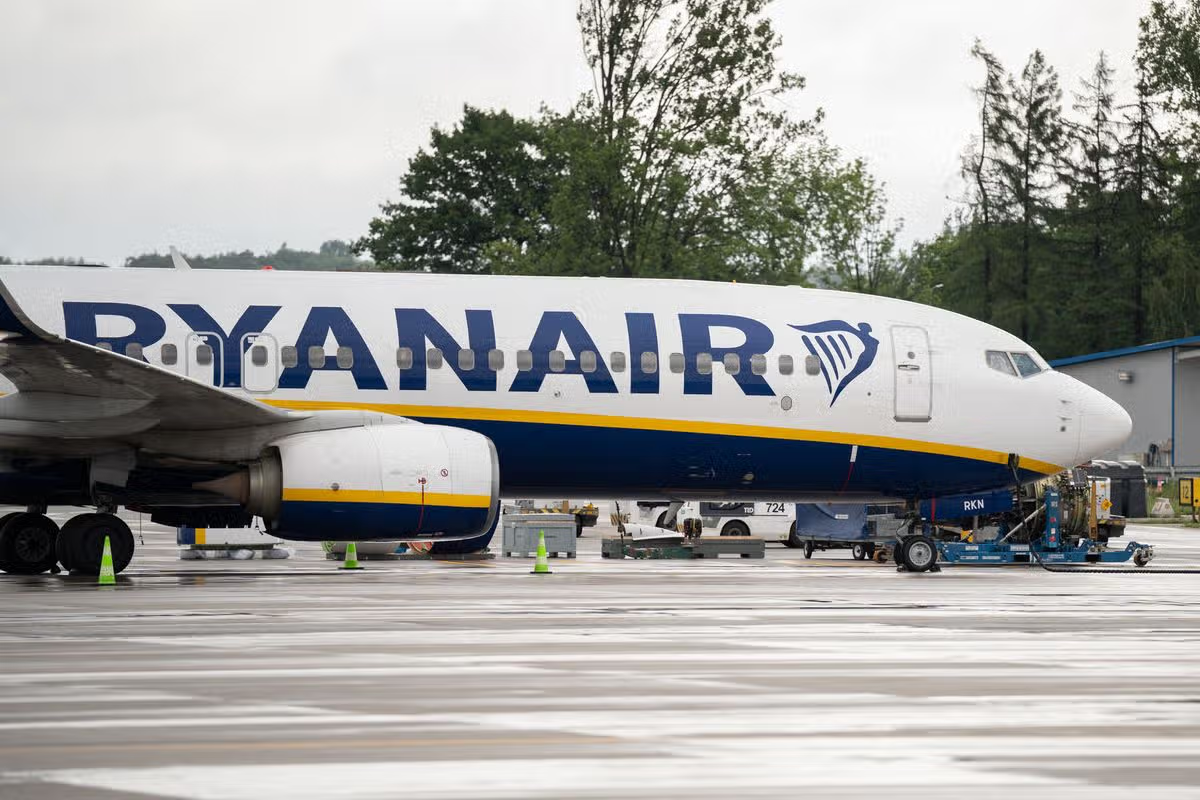
The system has failed repeatedly due to ‘errors in the machines’ – causing ‘massive headaches and a lot of worry’ for UK travellers

A woman who had travelled by Ryanair for a 60th birthday celebration was detained at the airport incorrectly and deported straight back to the UK – file image(Image: Getty)
A Ryanair passenger was detained by police at a European airport and sent straight back to the UK after being falsely accused of overstaying. Well-known UK travel writer Simon Calder revealed the incident in the new episode of his Travel Expert podcast.
He shared the woman’s story as part of a discussion about a system that was introduced fully in Europe this year. But he warned that many Brits were facing problems due to mistakes by EU machines and EU officials not counting properly.
Mr Calder explained what happened to the woman when she went on holiday to Reggio Calabria on the south-western tip of Italy near Sicily for her husband’s 60th birthday. As soon as she landed, things did not go to plan.
He told the story of “a woman called Paula Pugh from Norfolk who was flying off to beautiful Reggio Calabria – her husband’s 60th birthday. It was going to be a great event. She was apprehended at the airport.
“They said, ‘You’ve overstayed.’ She said: ‘I’ve just got off that Ryanair plane from Stansted. Of course, I haven’t overstayed.’
“Anyway, the machine had got it wrong. They said, ‘Right, come this way.’ They put her in a police car with guards.
“They took her to the nearest airport with flights still available. They marched her out to the plane in front of all the other passengers. There was nothing that she had done wrong, but they put her on the plane.
“They gave the captain her passport. They flew her back. And then afterwards, Ryanair charged her for the deportation flight. Poor woman.”
He said it was the worst case they had come across. Simon said multiple Italian authorities had been approached for comment – but no one has responded.
Her experience is all down to the Exit-Entry System. The programme requires non-EU residents to queue at airports to use special machines to gain entry to 29 so-called Schengen countries.
These are nations that have removed passport and border checks at their internal borders. It covers most of the European Union, including Germany, France, Italy and Spain.
Simon Calder’s EES advice for UK tourists over the 90-day rule
Simon’s advice was for passengers to print out all relevant boarding passes and bank statements to prove where you were, which he said should help to stop this sort of thing happening on your holiday. He said Paula’s was the only case he had come across where they did not sort it out when evidence was displayed to show a person was not in the EU when the system said it was.
He told listeners that he had been hoping problems with EES would go away but said they clearly had not. Fellow host Greg Dickinson said: “There seem to be many British passport holders who are finding that their exit is not being correctly recorded.”
He said you are now allowed to spend 90 days out of every 180 in the EU Schengen area. But he said “people’s tickers are slowly going down because as far as the machines are aware, they are still in the European Union” because the machines have wrongly recorded them as still being in the EU once they have left.
He added: “It’s creating massive headaches and a lot of worry for Travel Expert listeners.” Simon said that there is an EU tool that shows you how much time the tickers say you have spent in the European Union.
He said “in most cases they will get it right”. He said the 90 days threshold was one of the things the EES was supposed to solve.
He said the problem arises if officers are not properly registered the ins and outs. Simon said the podcast had heard from many people whose exit from the EU at the end of a stay had not been recorded – including Paula.
The EES system has caused queues and delays for a number of Brit tourists this year. Britain was particularly affected because it is no longer in the European Union.
The system was rolled out from October 2025 but was not set up fully until April this year. Some airports in Spain and Portugal among other tourist hotspots saw regular long delays as people were held up at airports by the machines.
Many Brits have complained of chaos when using the EES system – although reports differ significantly for different airports, and many travellers also say they have had few if any problems. One Brit on Reddit summed up his feelings by saying: “I have had to register 4 times now as every time I travel to Europe the new gates won’t allow me through. 2 of those times were to the same country.” Another traveller said they spent “two hours in line at Athens airport due to the EES” – adding: “It was chaos.”
However, another said: “According to reports, it’s working perfectly fine at many locations. Frankly, the problems all seem to be local – a lack of preparation, insufficient staffing levels, and equipment issues.”
Ryanair’s chief operational officer Neal McMahon said in September: “The EU’s handling of EES has been a shambles from start to finish. Airlines, airports and border authorities repeatedly warned Brussels that the rollout was not ready, that it would increase processing times and that it would create excessive queues for passengers.
“Those warnings were ignored, with EU citizens the ones delayed and disrupted. Passengers should not be made pay the price for the EU’s failed EES rollout.”
You can ensure our latest headlines appear at the top of your Google Search by making us a Preferred Source. Click here to activate or you can instead add us as a Preferred Source in your Google search settings
EU Commission spokesperson Markus Lammert said in the summer that the EU could provide extra help during an extra period of adjustment at a few border crossings. He said: “We have offered additional help to the member states concerned and asked them to further intensify the operational preparedness, including the necessary technical, organisational, and communication measures, with a view to ensuring that remaining challenges are fully addressed by the end of the year.”
Ryanair’s website states: “If the immigration authority of a country does not let you enter the country, you must pay any fines or a reasonable proportion of the fine as decided by Ryanair, which that country’s government or immigration authority charges us. You must also pay the cost of transporting you back to where you flew from or elsewhere.
“We will not refund costs relating to any flight you cannot use as a result of you being refused entry. If we pay any costs on your behalf, we will charge them to the credit card or debit card you used to make the booking.” You can listen to the full podcast here.