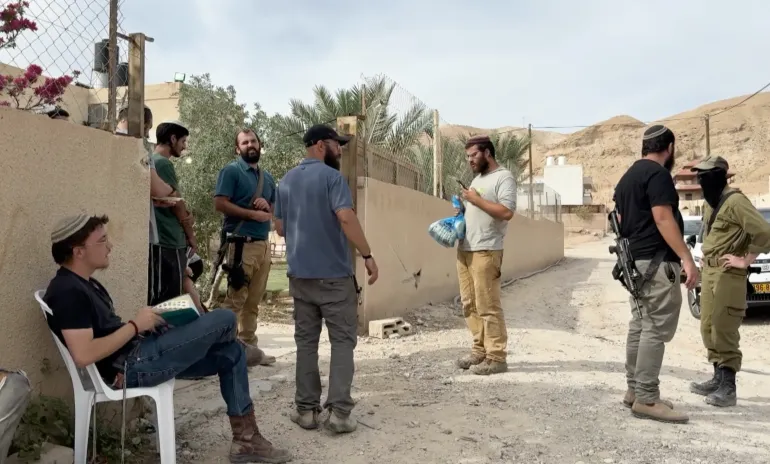
Jericho, occupied West Bank – On November 4, Israeli settlers seized eight Palestinian homes in Jericho after a months-long secretive operation spearheaded by the internationally sanctioned Nachala settler movement and with the support of the settlement council in the northern West Bank.
As soon as we arrived at the area, known as Diyouk al-Tahta, we encountered Mustafa. Israeli settlers had barred him from his land, beating him and his elderly father, who had to be treated in hospital. His uncle and cousins faced the same abuse, and other Bedouin families who live in the area were also assaulted and forced to leave their homes in the pogrom. Many of their houses were later razed by residents of Israeli settlements, which are illegal under international law.
Recommended Stories
list of 3 itemsend of list
While we were talking to Mustafa, a settler’s car sped past, and we had to quickly move out of its way. When the dust settled, a settler had left the car and appeared to be cornering a child. He slapped the boy before he managed to get away on his bike.
I asked him what happened. The child’s eyes were red. He was struggling to hold back tears. “The settler slapped me. He was speaking in Hebrew. I didn’t understand anything. I didn’t even see him coming!” I asked the child about his name, but he sped away. Perhaps it was fear or embarrassment, or both.
Many of the homes taken over by settlers in the area were under Israeli demolition orders.
A government decision this year allowing settlers to buy Palestinian property inside Palestinian-controlled areas laid the groundwork for Israeli settlement outposts to pop up in the middle of cities, which in turn would bring the Israeli army and movement restrictions to the streets of cities like Jericho.

This is what makes the precedent set in Jenin different from other settler takeovers. In occupied East Jerusalem and the Old City of Hebron, where the army maintains direct control, settlers have taken over homes by alleging they bought the properties or claiming historical Jewish ownership predating the establishment of Israel.
Palestinian owners take their battles to Israeli courts and often prove that the documents presented by settler organisations are forged. But they rarely, if ever, succeed in keeping their homes. While Jericho is run entirely by the Palestinian Authority, the Israeli settler presence here is upending people’s lives and is in effect reversing Palestinian control.
The Palestinian Authority has launched an investigation into the takeovers, trying to ascertain if anyone facilitated them via sales to settlers, and several arrests have been made. According to the law, Palestinians may not sell their homes in the West Bank to Israelis.
Legal experts told Al Jazeera that even if money changed hands in these cases, the sales would be illegal under Palestinian and international law. These are not real estate deals. They are part of a takeover campaign.
“It’s a campaign to uproot us just as they did with others in al-Mughayyir and Turmus Aya and other villages across the West Bank,” Mahmoud Abu Fkheida told me. The Jericho farmer inherited this land from his father, who inherited it from his. Working this land is their life.
“When I leave my home to tend to my farm for an hour, I stay worried. I’m now afraid when my phone rings. I keep wondering if it’s news of them burning or attacking my home,” Mahmoud told me.

As we were filming, Israeli settlers, some of them covering their faces with cloth hoods, ambushed us. They told us that our presence is a provocation and demanded we leave.
The settlers are armed, and they have Israeli army protection. We could not challenge their orders or argue with them, so we walked away towards the homes still inhabited by their Palestinian owners.
Jericho is a city that depends on tourism. Today, the cable cars leading to the Mount of Temptation run empty while the city’s facilities below waste away. Fear is ever present, as are the settlements and outposts that surround Jericho.
On the eastern edge of the city, a new settlement towers over the rubble of Palestinian villas while the fields lie barren.
We met Abdel Qader Abu Khashan, who has been overtaken by a sense of loss and dread. “Look around you. All these homes are now under threat,” he said.
Abdel Qader says what is happening in Jericho foretells a dead-end future for Palestinians.
“It’s not fear that I feel. It’s about hope and the future. I don’t want to say they’re disappearing, but they’re becoming distant,” he said.
Back at Diyouk al-Tahta, the scene was paradoxical. Children looked unbothered by the choking reality of life in Jericho. The arid hills are behind them, and the settlers are all around them, yet they play under their mothers’ watchful eyes in the small space that remains around their homes, unaware they will grow up in the shadow of this reality and bear the scars of its consequences.