settler

Why Israeli settler attacks on Palestinians in West Bank are pogroms | Explainer

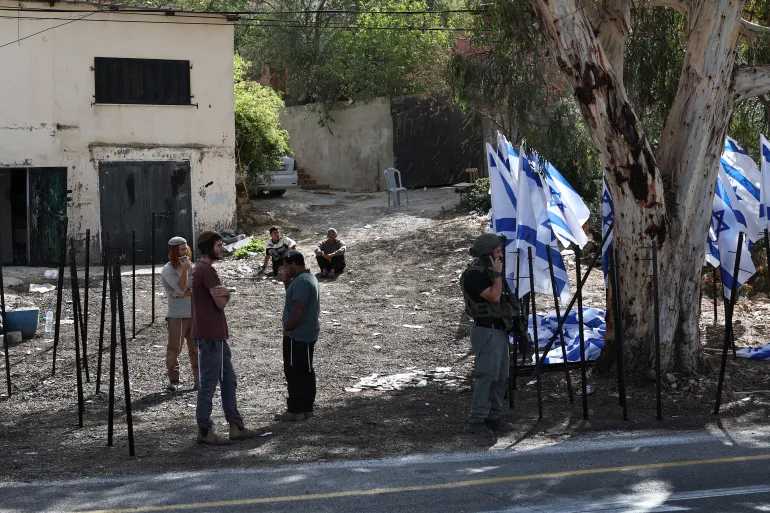
Attacks on Palestinian communities by Israeli settlers in the occupied West Bank, which are often supported by Israeli forces, have gathered pace over the past month since settlers from the Havat Gilad settlement attacked Palestinian homes on the eastern edge of Tal, southwest of Nablus.

On Sunday and Monday, the Israeli military raided multiple towns, villages and refugee camps across the occupied territory, and reports of arrests, home searches and settler attacks have continued to mount.

A 15-day siege on three families comprising 15 people, including two children, in the village of Qusra, which is ongoing, drew a rare public condemnation this month from the United States ambassador to Israel, Mike Huckabee, a staunch supporter of Israel and its West Bank settlements.

Israel is also pushing ahead with plans for the so-called E1 settlement expansion close to Jerusalem, which human rights organisations warn would essentially sever the West Bank in two, further hampering the freedom of movement of Palestinians on either side of it and endangering the possibility of a Palestinian state.

The West Bank attacks increasingly fit the definition of a pogrom, experts said. United Nations Special Rapporteur on the Occupied Palestinian Territories Francesca Albanese described these Israeli attacks against Palestinians as “pogroms against defenceless civilians”.

So why are experts calling settler attacks pogroms, and do they fit the formal definition of one?

A Palestinian man inspects the damage at a mosque that Palestinians say was damaged by Israeli settlers in Qusra near Nablus in the Israeli-occupied West Bank on July 26, 2026
A Palestinian man inspects the damage at a mosque that Palestinians say was damaged by Israeli settlers in Qusra near Nablus in the Israeli-occupied West Bank on July 26, 2026 [Mohamad Torokman/Reuters]

What’s happening in the West Bank?

Settlers, frequently supported by the Israeli military, have been attacking Palestinian homes, businesses, and agricultural fields across the occupied West Bank. Such attacks have been commonplace for decades as settlements have expanded across the territory, but they gathered pace after October 7, 2023 when Israel launched it genocidal war on Gaza, and have become particularly violent and frequent over the past month.

Israeli settlements across the West Bank are illegal under international law.

According to the Palestinian Colonization and Wall Resistance Commission, however, Israeli settlers now number roughly 780,000 across the occupied West Bank and East Jerusalem, living among 192 settlements and 400 outposts, rising to 71 percent of Area C, which is under full Israeli civil and military control, and 91 percent of the Jordan Valley.

Settlers often set up outposts without formal approval around Palestinian villages from which they launch a campaign of harassment, including killing livestock, cutting supply lines and damaging property, in order to drive local residents out. Once they establish a more formal settlement, they often receive retrospective approval from the Israeli government for the settlement.

In some places more recently, illegal settlers have laid siege to individual family homes – such as in the Ras al-Ein area of Qusra – cutting off water and other supplies and damaging orchards or harming livestock.

This has set a new pattern: settlers establish a tent adjacent to individual homes; Palestinians’ homes are besieged, with essentials cut off; and Israeli soldiers arrive not to remove the settlers, but rather to remove the family – through arrest or ostensibly for their “protection”.

In Qusra, the three besieged families were forced together into one of the family houses. Meanwhile, Israeli forces have occupied one of the other homes for use as a military post and thrown furniture and belongings from its windows, according to the Palestinian news agency Wafa.

The UN humanitarian affairs office recorded more than 1,330 settler-related attacks on Palestinians in the occupied West Bank between January and late July this year, averaging six a day and marking the fastest pace since the agency began systematic tracking two decades ago.

Separately, a UN-appointed commission of inquiry has found that the Israeli authorities have repeatedly failed to prevent foreseeable settler attacks and, in some cases, have directly enabled them through army protection and the provision of weapons and funding.

The UN Office for the Coordination of Humanitarian Affairs (OCHA) has found that settler attacks, demolitions and evictions forcibly displaced more Palestinians in the first four months of this year than in the whole of 2025.

OCHA reported that 107 communities, comprising 5,900 Palestinians, had been completely or partially displaced as a result of settler violence since January 2023. It also found that the Israeli military have expelled another 32,000 Palestinians from their homes in the occupied West Bank since January 2025, essentially emptying the Jenin, Tulkarem and Nur Shams camps.

INTERACTIVE - Settler attacks by year across the occupied West Bank_July2026
(Al Jazeera)

What is the definition of a pogrom?

Major US and UK dictionaries vary to some degree on the definition of a “pogrom”.

The British Collins Dictionary identifies a pogrom as “organised, official violence against a group of people for racial or religious reasons”, with a notable inclusion of official, or state-backed violence.

Oxford Advanced Learner’s Dictionary calls it “the organised killing of large numbers of people, because of their race or religion”, without mention of state-sanctioned violence.

Merriam-Webster says it is “an organised massacre of helpless people” – “specifically: such as a massacre of Jews”.

Cambridge Dictionary says it is “an act of organised cruel behaviour or killing that is done to a large group of people because of their race or religion”.

The word is understood to have been introduced via Yiddish and was at first used to describe the wave of violent, organised mob attacks on Jewish communities in the Russian Empire following the assassination of Tsar Alexander II in 1881.

It is important to note that unlike legal terms including “crimes against humanity” or “genocide,” “pogrom” has no established legal definition under international law.

Can attacks in the West Bank be referred to as pogroms?

Besides Francesca Albanese, the UN Special Rapporteur on the occupied Palestinian territories, who has described Israeli attacks against Palestinians in the occupied West Bank as “pogroms against defenceless civilians”, Israeli officials themselves have described such attacks as “pogroms”.

On February 26, 2023, hundreds of Israeli settlers attacked Huwara and surrounding Palestinian communities after two Israeli settlers were killed. A Palestinian was killed, hundreds were injured, and homes, businesses and cars were burned.

The Israeli military’s then-commander in the occupied West Bank, Yehuda Fuchs, called the settlers’ attack a “pogrom”, and it was also recorded as such by the US State Department.

Israeli-Palestinian human rights group B’Tselem has also previously described Israeli actions in the occupied West Bank as “pogroms”, especially after the February 2023 attacks. Later, it followed up with a report titled, “The pogroms are working – the transfer is already happening”, which argued that settler attacks were contributing to the displacement of Palestinian communities.

“Settler violence is not a new phenomenon. But over the past three years, it has become more violent, more systematic and, most importantly, part of a state mechanism intended to ethnically cleanse large parts of the West Bank,” said Yair Dvir, the spokesperson for B’Tselem.

“The government funds and arms the settlers, while the Israeli military stands by and, in many cases, actively participates in the attacks,” he told Al Jazeera. “So far, these militias have expelled 64 Palestinian communities and taken control of around one million dunams of land.”

Dvir also told Al Jazeera that the Israeli settlers are “now carrying out organised attacks on established Palestinian villages and towns in order to drive out their residents”.

“These are armed militias operating as an unofficial arm of the state, with a shared goal: to ethnically cleanse as much of the West Bank as possible,” he added.

The Lemkin Institute for Genocide Prevention, which is named after Polish-Jewish lawyer Raphael Lemkin, who is credited with coining the term genocide after the Holocaust, referred to settler attacks on Al-Mughayyir, a Palestinian village in Ramallah, as “pogroms”, reporting that hundreds of armed settlers attacked residents and burned buildings and cars while soldiers stood by earlier this year. In 2025, the Israeli military uprooted thousands of Palestinian olive trees at Al-Mughayyir.

Raheel Dhattiwala, an Indian scholar who focuses on collective violence, told Al Jazeera: “West Bank attacks fit the characteristics of a pogrom – systematic targeting of one civilian group by another with state approval. A few senior Israeli army officers have called it ‘pogroms’ in the past too, for example after attacks in Huwara.

“One might want to debate the use of the term, ‘pogrom’, but it is accurate to call settler violence systematic attacks of occupiers, with government approval, on groups of occupied people.”

Source link

US ambassador to Israel calls settler violence ‘terror’ | Newsfeed

US Ambassador to Israel Mike Huckabee says Israeli settler violence in the occupied West Bank meets the definition of ‘terror’. His comments are a rare rebuke and follow a days-long siege of a Palestinian-American family’s home by Israeli settlers in the village of Qusra.

Source link

What could stop Israeli settler attacks on Palestinians? | Israel-Palestine conflict News

Violence in the occupied West Bank has intensified under Israel’s far-right Netanyahu government.

Israeli settler attacks in the occupied West Bank are trapping Palestinian families in their homes.

The violence is taking place as Israel’s far-right government faces elections in October.

Why are attacks by settlers intensifying? And what are the consequences?

Presenter: Imran Khan

Guests:

Ofer Cassif – member of the Knesset representing the Hadash-Ta’al political alliance

Mouin Rabbani – co-editor of the Jadaliyya online magazine and non-resident fellow at the Center for Conflict and Humanitarian Studies in Qatar

Ori Goldberg – Israeli political commentator

Source link

Analysis: Israel’s government can’t disown West Bank settler violence | Israel-Palestine conflict News

Israeli settlers have marauded across the occupied West Bank for months, attacking Palestinian towns and villages with impunity.

Events in Qusra, a village south of Nablus, where Israeli settlers have laid siege to three Palestinian households since Sunday, have even led to a rare condemnation of settler behaviour by the Israeli government, with spokesperson David Mercer calling the settlers’ actions “deplorable” and “unacceptable”, and promising that Israeli authorities would investigate and arrest those responsible.

Recommended Stories

list of 4 itemsend of list

Analysts, campaigners, and Israeli parliamentarians who spoke to Al Jazeera have reacted to that with disbelief and incredulity, pointing to the inability of the Israeli military to stop the siege, in which the settlers have cut off water and electricity to Qusra. Israeli soldiers were initially even seen mingling and even praying with settlers in Qusra.

Complicity

“Government attempts to distance themselves from the violence are ridiculous,” Aida Touma-Sliman, a member of the Israeli parliament representing the left-wing Hadash party, told Al Jazeera. “They can say what they want, but they’re complicit.”

“If you look at the West Bank, you can no longer differentiate between the army and the settlers,” she said, adding that many of the settlers had been allowed to carry out their military service protecting the same illegal settlements they had come from. “The government is supplying them, protecting and arming them. It isn’t opposed to them. Supporting them is policy,” she added.

“There is nothing new in what’s happening in Qusra,” Yair Dvir of the Israeli rights organisation B’Tselem said. “We’ve been seeing this for decades. When there’s international criticism of the violence, the government condemns it, the settlers withdraw, and then return as soon as attention shifts.”

Israeli soldiers stand in front of the entrance of a besieged Palestinian house by Israeli settlers in the village of Qusra, south of Nablus, in the occupied West Bank, on August 14, 2026.
Israeli soldiers stand in front of the entrance of a besieged Palestinian house by Israeli settlers in the village of Qusra, south of Nablus, in the occupied West Bank [AFP]

“Let’s be clear, settler violence is state violence,” Dvir added. “They both have the same aim: to displace Palestinians and to take their land.”

The speed and brutality of the Israeli government’s encroachment upon Palestinian land, in defiance of both international law and the ruling of the International Court of Justice (ICJ) that it should stop its illegal settlement of Palestinian territory, has increased in recent months. United Nations Office for Humanitarian Affairs monitoring shows settler violence to be increasing with every week that Israel’s October election – and the potential end of Prime Minister Benjamin Netanyahu’s far-right government – draws nearer.

“We’re definitely seeking an escalation of violence across the occupied West Bank, East Jerusalem, and in other areas, such as Gaza, in the build-up to the election,” saidNeve Gordon, a professor of International Law at Queen Mary University, London, and the author of “Israel’s Occupation”.

“The vote is like a rallying cry for that entire [settler] constituency that they have to do as much as they can, while they can,” he said of fears among settlers and the radical Israeli right that they might lose what many regard as their allies in Netanyahu’s coalition.

Settlement unchained

The Israeli government has done little to distance itself from the actions of the settlers. Instead, prominent members of Netanyhu’s Likud party have attended prominent settlement conferences, including those explicitly focused on ethnically cleansing Gaza. Netanyahu himself responded to recent violence in the Palestinian village of Tal – which prompted the United Nations to warn that the entire West Bank was at “breaking point” – by promising to recognise even more illegal settlements.

At the heart of government policy on settlements have been the polarising figures of National Security Minister Itamar Ben-Gvir and Finance Minister Bezalel Smotrich.

Smotrich has proven to be one of the most consequential Israeli politicians in history in promoting the cause of illegal settlements.

As well as normalising political references to the annexation of the Palestinian territory, Smotrich made being granted partial administrative control over the occupied West Bank a key condition of his joining Netanyahu’s coalition. He has since overseen the expansion of illegal settlements at an unprecedented rate.

Smotrich has also boasted of making the two-state solution a practical impossibility with the announcement of the E1 settlement project, joining occupied East Jerusalem and the Maale Adumim settlement, in August of last year.

However, focusing on just two of the coalition’s more controversial figures was to miss the point, Gordon argued.

“It’s too easy to say it’s all the fault of these few people and if they were gone it would all be OK,” Gordon said. “It goes far wider.”

“The ethnic cleansing we’re seeing of the West Bank, as well as that being undertaken by the army in the territory’s refugee camps, such as Jenin, needs the complicity of the police, the attorney general, the military and, ultimately, the public,” the professor noted. “Without the umbrella they provide, none of this would be possible.”

Source link

UN, Palestinian ministry condemn Israeli settler siege of West Bank homes | Israel-Palestine conflict News

The United Nations human rights agency and the Palestinian Ministry of Foreign Affairs and Expatriates have condemned a days-long Israeli settler siege of Palestinian homes in the occupied West Bank village of Qusra.

The two statements were issued on Thursday, as dozens of Israeli settlers continue to besiege three Palestinian families in the Ras al-Ain area in western Qusra for a fifth night.

Recommended Stories

list of 4 itemsend of list

“These criminal actions by the settlers, supported or acquiesced to by Israel, the Occupying Power, are making life unbearable for these Palestinian families and are clearly aimed at forcing them to leave their homes and their land,” the UN Office of the High Commissioner for Human Rights said.

The three families – comprising 15 people, including two children – have been confined to their homes with their water and power cut off since Sunday, the agency said.

“Time is running out for these three families before they are forcibly displaced,” it warned.

Meanwhile, the Palestinian Foreign Ministry issued a statement condemning the settlers for carrying out “systematic assaults that can only be described as terroristic”.

It also accused Israel of using the settlers as an “unchecked tool to implement its criminal policies” of forced displacement and annexation of the occupied West Bank.

Earlier on Thursday, US ambassador to Israel Mike Huckabee also referred to the settlers’ actions as acts of “terror”.

‘This is all a charade’

Al Jazeera’s Nida Ibrahim, reporting from the scene of the siege on Thursday, said Israeli soldiers initially tried to move the trapped families out of their homes while settlers remained camped outside.

The families refused, not trusting that the Israeli soldiers would allow them back into their homes, and were eventually grouped together in one home. Residents have watched settlers push families out and then take over their properties in the past, she reported.

Qusra has faced settler attacks for decades, Ibrahim explained, and residents tie the rise in violence to the spread of illegal settlements and the lack of accountability for attackers.

On Thursday, the Israeli military said its troops dismantled “two illegal outposts” in Qusra and a nearby village, and detained one Israeli. It said more soldiers were sent to “carry out defensive missions and patrols”.

However, Ibrahim said most Palestinians believe the Israeli army is staging its response to the settler siege for the cameras, and they expect the settlers will eventually return.

Abdel Azim Wadi, the mayor of Qusra, told Al Jazeera that the Israeli army has been protecting and helping the settlers. “We saw them praying together, barbecuing together and dancing together,” he said. “They are not very interested in helping the besieged families.”

Qusra resident Abdul Kareem Hassan told Al Jazeera that he had been sleeping in his car for seven months in order to protect his home.

“This is all a charade,” he said. “If they [the Israeli army] were serious, the whole operation would not take them one hour. We’re talking about 20 settlers. If they would treat them the same way they treat Palestinians, they could finish in less than an hour.”

Another day without respite

Elsewhere in the occupied West Bank on Thursday, Israeli settlers and soldiers continued their elevated campaign of violence against Palestinians, the Palestinian news agency Wafa reported.

Israeli forces issued demolition notices for homes in Kafr Sur, the Jalazone camp and farmers’ shelters in al-Jiftlik.

In Qalqilya, soldiers detained seven relatives of a Palestinian fighter killed in a 2024 strike. Soldiers also detained three Palestinians amid a settler incursion in Burqa, east of Ramallah.

Settler attacks took place across several towns and villages, including an incident in which three Palestinians, including a child, were pepper-sprayed in their car.

Settlers also re-established a settlement near Jenin and erected a new outpost on land belonging to a town near Tulkarem.

Source link

Israel announces tender for 627 settler units in occupied West Bank | Human Rights News

New illegal settlement tender in West Bank deepens Israeli efforts to sever Palestinian ties to Jerusalem, officials warn.

Israeli authorities have issued a tender for 627 new housing units in the Kochav Yaakov settlement in the occupied West Bank, according to the Palestinian Colonization and Wall Resistance Commission (CRRC).

The Israel Land Authority on Thursday published the tender for the project, which will be built on land in the Ramallah and al-Bireh governorate, the commission said on Saturday.

Recommended Stories

list of 3 itemsend of list

Israel set November 30 as the deadline for construction companies to submit bids, moving the project from planning to construction just 15 months after it was first approved, it said.

CRRC slammed the expansion, saying it is designed to “deepen the separation between Jerusalem and its Palestinian surroundings”.

The illegal Israeli settlement of Kochav Yaakov sits between northern Jerusalem and the twin cities of Ramallah and el-Bireh, within a cluster of settlements Israel administers under the name “Binyamin”.

According to CRRC, the new project covers 253.7 dunams (25.37 hectares or about 63 acres) and was approved by Israeli authorities on April 27, 2025.

It says the tender marks the transition from planning to the “marketing and implementation” stage of settlement construction, with the new units expected to expand the illegal settlement’s built-up area and strengthen its links to nearby settlements and access roads. It added that the decision reflects growing investment in settlements’ economic infrastructure, not just housing.

The Israeli decision is one of several the commission has tracked this year aimed at tightening Israel’s illegal control and pressure on the Palestinian region.

According to CRRC, Israeli authorities have made 12 illegal settlement tenders in the first half of 2026, including 1,138 housing units concentrated in five main settlements, alongside a separate wave of tenders for industrial zones, offices, nursing homes and tourism facilities.

Illegal settlement expansion and settler violence have surged dramatically across the occupied West Bank this year. Palestinian monitors have recorded more than 11,000 attacks by Israeli forces and settlers across the West Bank since January 2026.

United Nations Secretary-General Antonio Guterres has repeatedly said Israeli settlements have “no legal validity” and constitute a “flagrant violation” of international law.

A 2024 International Court of Justice advisory opinion deemed Israel’s continued occupation of Palestinian territory unlawful.

Source link

Israeli settler attacks rise as West Bank residents lose land | Israel-Palestine conflict

NewsFeed

Palestinians near Bethlehem describe daily settler attacks as violence rises across the West Bank. Al Jazeera’s Nour Odeh reports that with elections looming, Israel’s right-wing government has an incentive to keep settlers happy, with their votes crucial to its re-election.

Source link

Israeli forces storm multiple West Bank towns, settler violence worsens | Israel-Palestine conflict News

Israeli soldiers have intensified their offensive in the occupied West Bank and East Jerusalem, raiding at least 20 towns and villages, demolishing homes and arresting dozens of Palestinians, as Arab states and the Arab League condemn escalating settler attacks against Palestinians and their property.

Al Jazeera reporters in the occupied West Bank reported on Monday that Israeli forces had stormed the Jabal Salman area in the town of Beita, south of Nablus, and carried out demolition operations in the town of Nilin, west of Ramallah.

Recommended Stories

list of 3 itemsend of list

In a separate incursion, forces stormed the town of Arrabeh in Jenin, accompanied by military bulldozers.

Raids and arrests were also reported in Deir al-Ghusun, north of Tulkarem, where five Palestinians were detained.

Four young men were arrested during raids on the Balata camp and Asira al-Shamaliya in Nablus, Quds News reported.

Soldiers raided homes and made arrests in several other villages and towns, including Deir Jarir, Jalbon, Kafr Qaddum, Tal, Burqa, Beit Furik, Anabta, the Aktaba suburb, Qalqilya, Arroub camp and Beit Ummar.

Quds News reported that Israeli soldiers halted an ambulance trying to transport a pregnant woman from the town of Qaryut to a Nablus hospital for treatment for a medical emergency. Her condition deteriorated, leading to a miscarriage.

As the Israeli military continues its crackdown, emboldened settlers have intensified their harassment and violent attacks. Palestinians in the Abu Fuzaa encampment near Taybeh village east of Ramallah were attacked on Monday, and in Al-Burj village, south of Hebron, settlers released cattle among olive trees, damaging agricultural land.

“Israeli settlers continue their attacks against Palestinians, mostly in their homes, at night, intimidating them,” Al Jazeera’s Nida Ibrahim reported. “And what happens is that usually Israeli forces would come in and instead of curbing these settlers, they would conduct arrests in the occupied West Bank among Palestinians.”

Palestinians felt trapped and defenceless, with “no one to protect them”, she said, “while the Israeli settlers have the support of the Israeli army and have the impunity to continue attacking Palestinians without any accountability”.

International condemnation

Palestinian President Mahmoud Abbas has sent letters to several world leaders, the European Union, the Arab League and the president of the United Nations Security Council, calling for urgent action to stop Israeli aggression and settler violence against Palestinians.

Francesca Albanese, the UN’s Special Rapporteur on the occupied Palestinian Territories, wrote in a post on X on Saturday that settler attacks were “pogroms against defenceless civilians”.

The UAE, Jordan, Egypt, Saudi Arabia, Qatar, Algeria, Morocco, Tunisia, Oman, Kuwait and Bahrain issued statements condemning the attacks, including a mosque in Tulkarem being set ablaze.

The Arab League issued a collective condemnation, warning that the situation was approaching a “moment of explosion” and calling on the international community to intervene.

The Spanish government said in a statement on Saturday that Israel “must reverse its policies of settlement expansion and of shielding settler violence against the Palestinian civilian population”.

Hamas official Mahmoud Mardawi described settler attacks on mosques as “systematic fascist crimes”.

Haaretz quoted Israeli military officials describing the situation in the West Bank as “extremely dangerous and volatile”. An editorial in the Israeli newspaper said senior army officers had warned that the government was giving “tailwind” to settler violence, with one reservist officer saying his unit lacked sufficient troops and could only “stand by and watch”.

“We have to remember that this time is very sensitive, because we’re getting closer to Israeli elections, and Netanyahu wants to stay in power. He wants to appease his far-right members and coalition by showing the voters that he will be cracking down more and more on Palestinians,” Al Jazeera’s Ibrahim said.

“He’s trying to get some sort of credit for the attacks against Palestinians and the raids in general.”

Since October 2023, the Israeli military has killed nearly 1,200 Palestinians in the occupied West Bank, according to Arab League figures, in addition to more than 73,000 killed in Gaza during Israel’s genocidal war there.

Source link

‘No accountability for settler war crimes against Palestinians’ | Occupied West Bank

NewsFeed

Israel is intensifying its crackdown on Palestinians in the occupied West Bank after an attack by Israeli settlers resulted in the deaths of six people. Author and activist Phyllis Bennis says we’re seeing an ‘increase in direct war crimes’ with no accountability.

Source link

Israel arrests nine at Tel Aviv protest against West Bank settler violence | Occupied West Bank News

Protest group says at least 200 demonstrated in Israeli capital a day after major escalation of West Bank violence.

Israeli police have arrested nine people at a Tel Aviv demonstration decrying settler violence in the occupied West Bank, according to media reports and protest organisers.

Hundreds of people gathered on Kaplan Street on Saturday to demonstrate against the settler violence and Israeli military rule in the occupied Palestinian territory, according to Israeli media. The protest was organised by the left-wing Hadash party and its allies.

Recommended Stories

list of 3 itemsend of list

The Mothers Against Violence protest group said more than 200 people took part in the demonstration, and accused police of using force against demonstrators, including the nine they confirmed were arrested.

Israeli police said demonstrations had gone ahead without authorisation and had begun to “disrupt public order and block the roadway”, according to local media.

The protest came a day after Israeli forces shot dead four Palestinians in the town of Tal, near Nablus, during a settler incursion on their land. Two Israelis were also killed in the confrontation.

On Friday, about 30 settlers entered Tal, next to the illegal Israeli settlement of Havat Gilad, and tried to break into two houses on Friday, said Essam Saifi, a local Fatah official. Residents confronted them, and the settlers opened fire.

A video shows a Palestinian man seizing a rifle from a settler and shooting him before soldiers shot him dead. Three others were killed and four wounded.

Ubai al-Aboudi, a rights activist in Ramallah, told Al Jazeera that one week prior, settlers set fire to a home in Tal with the family still inside. “It was a miracle that the residents of Tal were able to get that family out of the house before they were burned alive,” he said.

In retaliation for Friday’s shooting incident, the government of Prime Minister Benjamin Netanyahu ordered a wide-scale military operation across the West Bank, and Israeli forces arrested nearly 50 Palestinians in Tal while raiding about 70 homes.

The Palestinian Prisoner’s Society said at least 80 Palestinians were held across the West Bank the day after the incident, calling it “collective punishment”.

Funerals for the four killed were held before dawn under restrictions on attendance.

Political analyst Ori Goldberg said video of the attack on Tal had made denial impossible for the Israeli public.

“They saw the Jewish terrorist come into the villages and they saw the response … I’m not expecting the public to rise in protest in response, but I do expect this might revivify the last dregs of liberal Zionism in protest,” he told Al Jazeera.

“This may be a threshold moment in what Israelis have previously termed as ‘settler violence’ in an attempt to distance it from themselves,” Goldberg added.

At least 1,182 Palestinians have been killed, 13,000 wounded and nearly 24,000 arrested in the occupied West Bank since Israel’s genocidal war on Gaza began in October 2023, according to official Palestinian figures.

Source link

Israeli military ups pressure in West Bank as settler violence rises

Relatives of Palestinians killed during clashes with Israeli settlers mourn at Nablus hospital in the West Bank. Photo by Alaa Badarneh/EPA

July 24 (UPI) — The Israeli military is launching a major operation in the occupied West Bank after a clash between settlers and Palestinians left six people dead on Friday.

Four Palestinian residents of the village of Tell and two Israeli soldiers were killed in the incident, after a group of settlers entered the village claiming to be on a hike.

Israeli officials said violence broke out when a Palestinian man stole a weapon from local security personnel, firing at the Israelis. Palestinian officials said the men were provoked while defending their village from armed trespassers.

The incident sparked a series of settler rampages in more than a dozen villages on Friday, the Times of Israel reported.

Hundreds of Israelis torched homes and hurled stones at Palestinians, the Times reported.

Following the Friday killings, Israeli officials said they were preparing a major “counterterrorism” operation in the West Bank, Al-Jazeera reported.

Bezalel Smotrich, the far-right Israeli finance minister, called for the demolition of Palestinian villages following the Friday killings.

“The population must be evacuated for its own protection, and these villages must be cleared of terrorist infrastructure and terrorists in order to restore deterrence and security to the area,” he told CNN.

Following the funeral for one of the Israeli soldiers killed, settlers torched buildings, homes and farms belonging to Palestinians, the Times reported.

Israeli Prime Minister Benjamin Netanyahu said he instructed Israel Defense Forces to take a “series of forceful steps against terror.”

In a statement, Netanyahu said his military would “act forcefully in villages that serve as terror hotspots” as well as “accelerate the regularization of farms and the establishment of new ones.”

Israeli settlements in the West Bank are illegal under international law.

“The Israeli government is pushing the West Bank towards explosion,” said Ayman Safadi, Jordan’s foreign minister, in a statement. “Its blatant violations of the historical and legal status quo at Jerusalem’s Holy Sites are illegal and dangerous provocations. They are pushing the region towards another disastrous conflict that will reverberate beyond the occupied Palestinian territories.”

Source link