Indigenous Rights

Palestinians in occupied West Bank hold firm on Indigenous Peoples’ Day | Human Rights News

Umm al-Khair, Occupied West Bank — There were weddings in Umm al-Khair this week, but almost no one danced. The small Bedouin village, located in Masafer Yatta, was marrying off two of its sons. Cauldrons of slow-cooked lamb meat for mansaf – a large platter of traditional Arabic food – fed the whole community. But there was no dahiyya, the line dance and chant that normally opens a Bedouin wedding.

Residents said it did not feel right coming so soon after the first anniversary of the killing of Umm al-Khair activist and community leader Awdah Hathaleen, allegedly by Israeli settler Yinon Levi. The community continues to endure daily settler attacks, arrests and incursions by Israeli soldiers, and the threat of further demolitions by Israeli authorities looms.

Recommended Stories

list of 4 itemsend of list

During celebrations, families spread out in different areas rather than gathering in one place, wary of drawing any attention that, in the past, has brought soldiers to disrupt the celebrations.

“There is a wedding, but they are not letting us celebrate quietly,” said Tariq Hathaleen, an English teacher and community leader in Umm al-Khair.

On Thursday, the first day of the wedding, Shimon Atiya – the Israeli settler behind the illegal outpost of Havat Shorashim, established roughly 800 metres from the village in 2022, and who has been under a restraining order since July 2025 for harassing Umm al-Khair families — crashed the wedding in the only style he knows. He brought his livestock to graze in a resident’s vegetable garden, escorted by Israeli soldiers who stood by as it happened.

When villagers told the soldiers that the plot is recognised as Umm al-Khair land, they were told the maps had changed; when they asked to see the new maps, they were refused. That night, the outpost’s fence towards the village homes was torn down – a prelude to pushing the boundary further in, residents believe.

UMM AL-KHEIR, WEST BANK - AUGUST 7: Family and friends of Awdah Hathaleen look on at his grave moments after his burial on August 7, 2025 in Umm al-Kheir, West Bank. The 31-year-old Palestinian activist and father of three was killed on July 28 when Israeli settler Yinon Levi allegedly opened fire during a confrontation in the Bedouin village of Umm al-Kheir (or Umm al-Khair), in the Masafer Yatta region of the occupied West Bank. A group of local women had gone on hunger strike to demand an unconditional release of Hathaleen's body, as well as the release of several people who were detained by Israeli forces following the shooting incident. Levi, who is sanctioned by the UK, EU, and previously by the US, was temporarily detained on house arrest following Hathaleen's death. Hathaleen was known for his work on the Oscar-winning film 'No Other Land,' which documents the Israeli demolition of Palestinian homes in Masafer Yatta. (Photo by Tamir Kalifa/Getty Images)
Family and friends of Awdah Hathaleen look on at his grave after his burial on August 7, 2025, in Umm al-Khair, West Bank [Tamir Kalifa/Getty Images]

Hathaleen says the settlers’ timing was a reaction to Levi’s indictment days earlier — one of the few times an Israeli has been charged with the killing of a Palestinian in the occupied West Bank since October 2023.

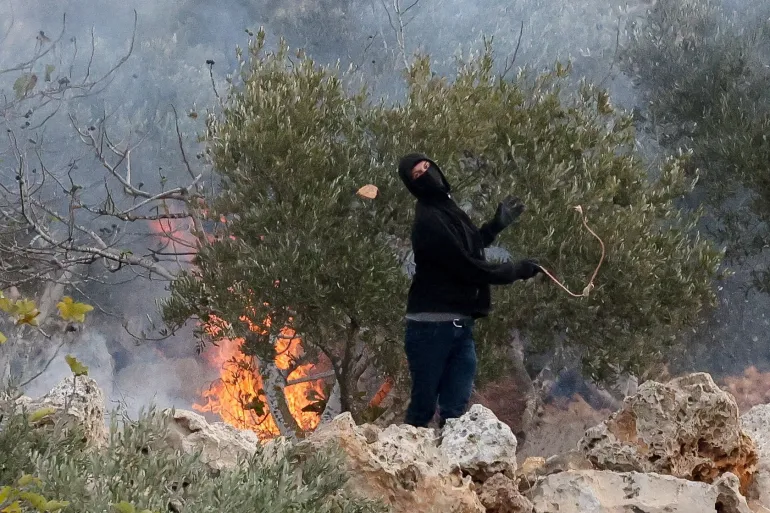
Just a couple of days before, on Thursday, Hathaleen watched as buildings and vehicles in the nearby Palestinian community of Khirbet Tuba were set ablaze by settler arsonists.

“The occupation always tried very hard to erase the Palestinian Indigenous people and their history, their legacy, their heritage,” Tariq said. “This really reminds me of the Nakba, and how the Israelis destroyed Palestinian cities and villages”, he noted, even planting cactus over the ruins to bury the evidence. “Back then it wasn’t documented. Nowadays, it’s happening, but it is documented.”

Sunday marks the United Nations’ International Day of the World’s Indigenous Peoples. In Umm al-Khair, the wedding felt symbolic of the threats to Indigenous Palestinians’ way of life and their basic presence on their own land.

‘They try to imitate us’

According to local Palestinians and watchdog NGOs, the threats facing Palestinians in the occupied West Bank, including East Jerusalem, and the Gaza Strip include detentions, killings, demolitions, restrictions on movement and evictions.

Since October 2023, Israel has killed 1,100 Palestinians in the occupied West Bank, including 242 minors, according to the Israeli NGO B’Tselem. Israel has also demolished more than 3,000 Palestinian homes since October 2023, the vast majority due to a lack of Israeli-issued permits that Palestinians in Area C are routinely denied.

According to the latest figures from the UN’s Office for the Coordination of Humanitarian Affairs (OCHA), demolitions and settler violence displaced an average of 17 people a day this year, double the rate of the previous three years.

A June report by the West Bank Protection Consortium, which includes the Norwegian Refugee Council (NRC) and monitors more than 200 communities it judges at risk of forcible transfer, said 96 percent of those who had been forcibly displaced were previously dependent on farming or herding. They have mostly lost access to these lands or pastures.

However, residents and watchdogs say such dispossession takes place within a system of Israeli permits, demolition orders and land policies controlled by the state alongside hundreds of millions of dollars in public funding for settlements and outposts. Israeli NGO Peace Now counts 146 illegal Israeli settlements in the occupied West Bank and 390 unauthorised outposts and farms.

In 2024, the International Court of Justice found Israel’s continued presence in the occupied Palestinian territory unlawful.

UMM AL-KHEIR, WEST BANK - AUGUST 7: Family and friends of Awdah Hathaleen attend his funeral on August 7, 2025 in Umm al-Kheir, West Bank. The 31-year-old Palestinian activist and father of three was killed on July 28 when Israeli settler Yinon Levi allegedly opened fire during a confrontation in the Bedouin village of Umm al-Kheir (or Umm al-Khair), in the Masafer Yatta region of the occupied West Bank. A group of local women had gone on hunger strike to demand an unconditional release of Hathaleen's body, as well as the release of several people who were detained by Israeli forces following the shooting incident. Levi, who is sanctioned by the UK, EU, and previously by the US, was temporarily detained on house arrest following Hathaleen's death. Hathaleen was known for his work on the Oscar-winning film 'No Other Land,' which documents the Israeli demolition of Palestinian homes in Masafer Yatta. (Photo by Tamir Kalifa/Getty Images)
Family and friends of Awdah Hathaleen attend his funeral on August 7, 2025, in Umm al-Khair, occupied West Bank [Tamir Kalifa/Getty Images]

Amid dispossession of their traditional grazing lands, 13 structures in Umm al-Khair were issued demolition notices last October, following demolitions in 2024 that left a third of the village homeless. The restraining order against Atiya, residents say, has done little to stop him.

Tariq argues the erasure is not only physical, but cultural also, and that it comes paired with an attempt by settlers to claim the very Palestinian identity they are displacing.

“The settlers nowadays try to imitate that lifestyle, building tents that they probably stole from Palestinians somewhere, using tractors to bring water from far away,” he said.

Young men from the hilltop outposts can be seen grazing camels, goats and sheep. All the while, Tariq observes them wearing Palestinian scarves and even attempting the Bedouin dialect when leading their own flocks.

“They know the Indigenous people of this land are the Bedouins and other Palestinians. So, they try to imitate that – to show to themselves and to the world that they are the Indigenous people of this land,” he added. “[But] this land doesn’t relate to them, because only the Indigenous people of this land know how to live in this land.”

‘We are the Indigenous people of this land’

Many outpost settlers serve as military reservists while living on the farms themselves, Tariq noted – a status that comes with state-issued weapons.

He recalled Finance Minister Bezalel Smotrich publicly distributing all-terrain vehicles to South Hebron Hills outpost settlers. He also remembers the day Awdah was killed, when soldiers let Levi point out five community members for arrest.

“This is not only settler terrorism backed up by the state,” Tariq said. “It is the state’s plan, carried out by the settlers, well planned in rooms where officials sit around a table and tell them what to do.”

Yair Dvir, spokesperson for B’Tselem, said: “Israel is carrying out ethnic cleansing in the West Bank and an all-out assault on the Palestinian people. We see it on many levels: military violence and repression, home demolitions, and the funding and backing of settler militias.”

Shaina Low, a spokesperson for the NRC, described the same pattern as a coordinated strategy across the Israeli-occupied territories.

“For nearly 80 years, we’ve seen Israeli efforts to drive Palestinians from their land play out, starting with the Nakba and continuing to the present day,” she said. Low cited an acceleration of these actions since October 2023, when the genocidal war on Gaza began, that has seen expanding settlement infrastructure, rising West Bank demolitions alongside East Jerusalem evictions in neighbourhoods like Silwan. There has been an “astronomical increase” in settler violence documented, Low added.

Gaza shows the same agenda but taken to the extreme. Since the October 2025 “ceasefire”, more than 1,200 people have been killed in Gaza, on top of a cumulative death toll that has climbed past 73,000 since October 2023, according to Gaza’s Ministry of Health.

According to UN satellite analysis, roughly 81 percent of all structures in Gaza have been damaged. Even with the “ceasefire”, OCHA reports that some 59 percent of Gaza’s population faced crisis-level food shortages or worse between April and June, a share it projects will rise again by year’s end as aid funding shrinks.

Following successive campaigns of expansionism, the Israeli military now controls at least 64.9 percent of Gaza. “These policies are all working together,” Low said. “They may be different tactics, but it’s all part of the same agenda to force Palestinians from their land and increase Israeli control over the territory and expand Israeli presence.”

Still, on the eve of a day meant to mark the world’s Indigenous peoples, Tariq was resolute.

“They will try a million ways to erase the Palestinian Indigenous people, but they will fail because this land doesn’t speak their language, it doesn’t carry their colour, it doesn’t go by their ideologies,” he said.

“This is our land, and we have always been living here in harmony – with nature, the desert, the mountains, the valleys of Palestine – because we are the Indigenous people of this land, and we always will be. Their attempts are failing, and will fail. One day, we will get our freedom.”

Source link

Goats of football: Indian village holds tournament with an indigenous twist | Football News

Chaibasa, India – As the world celebrates Spain winning its second FIFA World Cup and the “GOATS” of football who headlined the month-long tournament, a remote Indian village has also joined in – albeit with an indigenous touch.

To coincide with the FIFA event, residents of Tirilbasa village in Chaibasa, a tribal-dominated district in eastern India’s Jharkhand state, organised a football tournament from July 14 to July 17, featuring teams from 64 nearby villages.

Recommended Stories

list of 4 itemsend of list

But the star attraction at the Rangila Star Tirilbasa tournament (“rangila” means “colourful” in Hindi), besides relatively handsome prize money, was a herd of goats to be handed as trophies to the best-performing teams.

The finals were played on Friday, with NCS Maudi beating Kumbaram 1-0, a dramatic prediction of what happened between Spain and Argentina two days later in New York.

Competing teams play a football match at the Rangila Star Tirilbasa tournament in Chaibasa, Jharkhand, India
Competing teams play a football match at the Rangila Star Tirilbasa tournament in Chaibasa, Jharkhand, India [Shweta Desai/Al Jazeera]

NCS Maudi carried home prize money of 15,000 rupees ($156) and three male goats (locally known as “khassi” for their castration at a young age). Runners-up Kumbaram won 12,000 rupees ($125) and two khassis, while Kobra FC Nimdhi and Galubasa FC, the third and fourth rankers, won 9,000 rupees ($93) and one khassi each. There are also cash prizes for the man of the match, man of the series and the best goalkeeper, but they don’t get any khassi.

NCS Maudi’s captain Sachin Devam, whose team arrived on two-wheelers to play the game, told Al Jazeera he would have to arrange for an autorickshaw to carry the goats home, 10km (6 miles) away.

“It’s the first win for our team, and we are going to celebrate it with everyone in the village,” he said with a beaming smile. “It’s going to be a khassi picnic.”

‘Khassi important part of our culture’

This year was the fifth edition of the Rangila Star Tirilbasa tournament.

The organisers say they follow the FIFA rulebook and invite popular commentators and referees certified by the state football association to ensure compliance with the guidelines and “avoid fights as players can get aggressive on the field”.

But the rest of the setup is markedly different from the conventional game. Rather, it is adapted to the ancient tribal traditions of the Ho community, which is native to the Chaibasa region.

The Ho people, numbering a little more than a million across India, genetically belong to the Austroasiatic group and identify themselves as tribal (“aadivasi” in Hindi) people inhabiting the forests. The word “ho” in their language means “human” or “people” of the Kolhan region in Jharkhand, one of India’s poorest states despite being home to some of India’s biggest coal and mineral mines.

The Austroasiatic tribes such as Santhals, Ho and Munda organise their traditional, religious and sporting activities like a close-knit community. Football events are an opportunity to invite fellow tribal kin to celebrate their bond.

For the Ho people, no celebration is complete without the khassi. The animals are used for ceremonial sacrifices during religious events and rituals, and their meat is shared among the community members.

“Khassis are part of the prize as they are an important part of our culture. Their meat is tasty, and everyone loves good mutton. Most teams slaughter the goats, but some also keep them as livestock and trophy prize,” Manish Kudada, an 18-year-old player and one of the organisers of the tournament from Tirilbasa, told Al Jazeera.

Manish Kudada with his prized khassi at his home in Tirilbasa, India
Manish Kudada with his prized khassi at his home in Tirilbasa, India [Shweta Desai/Al Jazeera]

Kudada has preserved the black khassi he won in another football tournament in February, but his friends joke that the goat is being fattened up for a feast. The khassi goats are prized for their meat quality. In Chaibasa, the goats can be spotted everywhere, especially during the weekly Tuesday markets, where a baby goat costs up to 8,000 rupees ($83).

“Without khassi, our celebrations are half-hearted. At weddings, even if the hosts serve double the amount of chicken and no khassi meat, it will upset the villagers,” Raj Keshri, goalkeeper for the Tirilbasa team and one of the organisers of the tournament, told Al Jazeera.

“We therefore decided to offer cash and goats as the prize. Players get to keep their money, but with the khassis, they also get to celebrate the victory with the entire village.”

Raj Keshri with the goat his team won at the tournament
Raj Keshri with the goat his team won at the tournament [Shweta Desai/Al Jazeera]

The Ho practice what they call the Munda-Manki governance system, under which the hereditary head of a village upholds all social, legal and customary rights of the people. Their tribal codes and customs take precedence over the Indian government’s panchayat (village administration) and police systems.

The Rangila Star Tirilbasa tournament is conducted at the “ek munda” (“ek” means “one” in Hindi) level, which means that a team’s members must belong to the same village. Instead of 11 players, each team has nine, of which at least six must belong to the same village to qualify for the tournament. Organisers say the rule is strictly followed to reinforce a sense of unity among the players.

The rules of the game have also been modified. There is no offside, and players are free to score from anywhere on the field.

“This kind of match setup provides an opportunity for players like us from small villages who never get a chance to qualify in open tournaments which are dominated by seasoned players,” Sudarshan Tiu, who plays for Galubasa FC, told Al Jazeera.

Suvir Kumar Tanti, the commentator for the tournament, travels widely across the Kolhan region during the monsoon football season, when most male members return home for cultivation and agricultural festivals.

At the finals at Tirilbasa on Friday, his high-pitched, lyrical play-by-play commentary boomed through the loudspeaker, helping the spectators keep track of the fast-paced action on the football field.

“The Rangila Star tournament reflects the culture of the Ho community. And khassi goats as prizes make it even more unique. Very few tournaments in the region follow this and prefer to conduct events in a professional manner, with trophies and medals as rewards,” he told Al Jazeera.

Spectators enjoy a football game at the Rangila Star Tirilbasa tournament in Chaibasa
Spectators enjoy a football game at the Rangila Star Tirilbasa tournament in Chaibasa [Shweta Desai/Al Jazeera]

The tournament offers entertainment for the villagers, who pour in and out of the grounds through the day, squatting by the sides of the field or finding a place on the trees.

Nearby, food stalls sell fried dough balls, potato chops, yellow peas, and hooch. Men sit in circles, taking a break in between the matches to drink “madia”, a fermented rice beer that locals say helps them stay cool in the hot and humid weather.

In the evenings after the matches, men also play a rooster-catching game, which spectators can bet their money on.

Keshri, goalkeeper for the Tirilbasa team, explains the spirit behind the tournament’s eccentric name: Rangila Star Tirilbasa.

“The name was chosen because it embodies the identity of our village. ‘Rangila’ [colourful] signifies our enthusiasm to do something unique while ‘Star’ represents talent. Through our football tournament, we hope Tirilbasa will become the ground for local talent.”

The tribal-dominated state of Jharkhand has been a sports powerhouse for decades. It has produced globally-awarded field hockey players and athletes, the most famous being India’s former cricket captain, Mahendra Singh Dhoni.

The state government helps local football and hockey clubs like Rangila Star with financial grants, resulting in the rise of some of football’s next generation of players. Many such clubs, including Rangila, also hold tournaments for female teams.

But until over a decade ago, Chaibasa was not on the sporting map.

Located among remote forests and hills, the district was cut off from mainland India due to the Maoist insurgency – a tribal-led armed revolt against the Indian state over large-scale felling of forests and selling of lands to private corporates for mining and related activities.

The government regained control of Chaibasa from Maoists only in 2011. Still, until last year, private vehicles avoided taking roads crossing the district at night. Commercial buses operated from 4am to 4pm, and the region remained on the government’s list of “sensitive areas”.

In March this year, India’s Home Minister Amit Shah declared the end of the armed Maoist rebellion after a series of top commanders were killed or arrested by the security forces in Jharkhand and the surrounding states, mainly Chhattisgarh.

A football match in progress at the tournament in Chaibasa
A football match in progress at the tournament in Chaibasa [Shweta Desai/Al Jazeera]

As violence ebbed, Chaibasa turned into a busy town. Shops selling pizza, burgers and laptops, alongside offices and warehouses of mining companies extracting coal and iron ore, have come up. Christian missionary schools and colleges are dotted across the region, providing educational opportunities to tribal people.

Sporting activities are also thriving, with Chaibasa fast emerging as a football hot spot, producing players like female midfielder and forward Malati Munda.

Munda, who found national fame through local tournaments, ended up playing in league matches in Kolkata, the capital of neighbouring West Bengal state, where football is extremely popular.

“I had no coach to guide me or provide training. No one had even heard about me. After coming to Chaibasa town for higher studies, I met several brothers and sisters who taught me and improved my game,” Munda told Al Jazeera.

The weekly local tournaments gave Munda experience and skills to improve her game. They also brought rewards. “I have played at several such games where we won cash, and yes, khassi as well,” she said with a laugh.

Munda currently plays for the Home Guard paramilitary in Jharkhand’s capital city of Ranchi – a route many players from poorer families take to secure a government job in India.

Harish Hembram from Chaibasa began his career as a football content creator by covering local matches and uploading their videos on social media. His YouTube channel today has more than 211,000 subscribers, and livestreams key matches across Jharkhand.

“Football has always been popular in the villages, and many like me would attend matches at different venues. I started uploading the videos for fun for those fans who couldn’t attend. But soon the videos clocked high viewership, and I started my YouTube channel. Now organisers call me to cover their tournaments,” he told Al Jazeera.

Hembram said he earns about 20,000 rupees ($208) a month through his YouTube channel alone. He has moved to Ranchi, where he has also opened a sports shop selling football, jerseys, shoes and other accessories. Many players from Chaibasa visit his shop.

The grassroots football culture in Chaibasa defies the stereotype that India is not a football country.

Sandeep Menon, author of Sacred Grounds: A Journey Through People’s Football in India, says he has discovered and documented a football subculture across the country. He said while India does not figure prominently on the global football map, the love for the sport in the country is “unparalleled”.

“At the grassroots level, football is played with great interest across the country. And everyone has their own version of the game, to make it palatable and adaptable depending upon the availability of space, local geographical surroundings, weather and social conditions,” Menon told Al Jazeera.

Menon said hyper-local village tournaments like the Rangila Star Tirilbasa attract young players and provide them an opportunity for overnight fame. “There is a high emotional investment in playing for a village and representing it,” he said. “For some players, football becomes their identity and pride.”

Source link

America’s Indigenous Legacy | Indigenous Rights

NewsFeed

The Potomac isn’t just the name of a river, it’s part of a much older story. Al Jazeera’s Emma Withrow explains, from Alabama to Yosemite, our latest online interactive explores the Native American origins of 50 names across the United States, what they mean, and how they were originally pronounced by Indigenous speakers.

Source link

The World Cup cicada: India’s rare insect on a four-year clock | Environment

The final journey

“By mid-June it is over,” Evansis says.

The mature cicadas, dark-shelled and spent, begin flying towards the Umrong River in large numbers and drop into the rapids. The river fills with them. Along the banks, dead cicadas collect against wet stones and bamboo roots, their wings plastered flat by the current.

Locals call it niangtaser suicide. Hajong offers a simpler explanation: Cicadas are naturally drawn to sound and movement, and the fast-moving river may trigger that instinct in their final hours.

For the fish below the surface, it is a feast. For the forest above, closure.

The journey that began four years earlier beneath the ground ends in the same river that separates Livi’s home from the sanctuary.

Not everyone has watched that cycle for as long as Kewstar Majaw.

At 92, he has witnessed more emergences than almost anyone alive in the village. He served in the Indian Army. He loves watching football. And every four years, without fail, he waits for his noisy visitors.

For Kewstar, the passing of the cicadas has become another way of measuring life. World Cups came and went. Governments changed. Forests retreated. But every four years, if the rains arrived on time and the bamboo still held, the forest sang.

As a boy, he would follow his parents into the forest carrying bamboo containers, the sound reaching them before the insects came into view. In those days, the niangtaser was everywhere. Behind houses. In the trees along village paths. Young ones, mature ones – the forest floor was alive with them.

The chorus was so loud, he recalls with a laugh, that people stuffed cotton into their ears to bear it.

The insect did not need to be searched for. It found you.

Kewstar sits quietly for a moment. At his age, he has watched the forest retreat, the bamboo thin, and the chorus fade with each passing emergence. The insect that once appeared on his doorstep now requires a torch and a walk in the dark to be found.

“It was everywhere,” he says softly. “Now you have to go looking for it.”

In a few weeks, the cicadas will disappear beneath the earth once more,  keeping time in darkness until the cycle begins again. By the next emergence, another football World Cup will be under way somewhere else in the world.

Whether Saiden’s forests will still sing with them depends on what survives until then.

Source link