Israel-Palestine conflict

Pro-Palestine legal aid requests stay high in 2025 amid US campus pressure | Donald Trump News

Washington, DC – Requests for legal support related to pro-Palestine advocacy remained high in the United States last year, as President Donald Trump threatened activists and universities with penalties.

In an annual report released on Tuesday, Palestine Legal, an organisation that “supports the movement for Palestinian freedom in the US”, said it received 1,131 queries for legal support in 2025.

Recommended Stories

list of 3 itemsend of list

The figure is below the record 2,184 requests the group received in 2024, when pro-Palestine protests swept US campuses — and were regularly met with crackdowns from both school administrators and law enforcement.

Despite universities enacting new restrictions on protests across the country, the figures from 2025 show that pro-Palestine advocacy has persisted, according to Dima Khalidi, the executive director of Palestine Legal.

“Our 2025 year-end report shows that while universities have largely cowered and caved to coercive pressure from the Trump administration and its pro-Israel supporters, student activists for Palestinian and collective freedom remain a model of moral conviction and courage,” Khalidi said.

“Even when facing punitive consequences for speaking out, they are holding the line of dissent against injustice from the US to Palestine, because they understand the cost of surrender for all of us.”

Palestine Legal said that the “overwhelming majority of requests” for legal support came from university students and faculty in 2025, but a growing number, 122, were categorised as “immigration and border-related”.

The group received 851 requests from people or organisations targeted for their Palestine-related advocacy, as well as 280 more asking for legal guidance on conducting advocacy.

Despite the drop from 2024, the rate of complaints last year remained 300 percent higher than in 2022, the year before Israel began its genocidal war in Gaza on October 7, 2023.

Since then, at least 72,560 Palestinians have been killed in Gaza.

Pressure campaigns

In 2024, Trump campaigned for a second term in the White House in part on a pledge to crack down on the pro-Palestinian protest movement, which sought to shine a light on the human rights abuses unfolding during the war.

He has framed such protests as anti-Semitic, and since his inauguration in 2025, he has led a campaign to penalise schools that played host to pro-Palestinian activism.

To date, five universities have struck deals with Trump after he threatened to withhold billions in federal funding. They include Columbia University, where a pro-Palestine encampment and resulting police crackdown drew international attention.

Columbia eventually reached a $200m settlement with the Trump administration and moved to make several policy changes it said were aimed at combatting anti-Semitism.

Rights groups have condemned such policies as conflating pro-Palestine advocacy with anti-Jewish sentiment. They also warn that Trump’s actions risk dampening free speech, a protected right under the First Amendment of the US Constitution.

All told, nearly 80 of the students who took part in Columbia’s protests faced serious academic discipline, including expulsions, suspensions, and degree revocations, as of July 2025.

Meanwhile, the Trump administration used immigration enforcement to target pro-Palestine protesters and advocates, including scholars like Rumeysa Ozturk, Mohsen Mahdawi, Badar Khan Suri and Mahmoud Khalil.

To date, the deportation proceedings against Ozturk, who was in the US on a student visa, and Mahdawi, a US permanent resident detained at his citizenship hearing, have been abandoned.

Ozturk has since voluntarily returned to her native Turkiye after completing her doctoral studies at Tufts University.

The government is still proceeding with deportation efforts against Khan Suri, a Georgetown University researcher, and Mahmoud Khalil, a Columbia University graduate and permanent US resident.

Separately, the Federal Bureau of Investigation (FBI) raided five homes connected to pro-Palestine activists at the University of Michigan in April 2025, sparking outrage. Federal authorities seized properties, but no arrests were made.

Despite the restrictive climate across the country, Palestine Legal hailed a string of legal victories in 2025 that upheld the right to pro-Palestinian protest.

Last August, for instance, a federal court dismissed a complaint that sought to penalise UNRWA USA, a non-profit that supports the United Nations Relief and Works Agency for Palestine Refugees (UNRWA), under the Antiterrorism Act of 1990.

A separate lawsuit launched by Palestine Legal and the Council on American-Islamic Relations (CAIR) charged that the University of Maryland had tread on the free speech rights of students by banning Students for Justice in Palestine (UMD SJP). That case resulted in a $100,000 settlement.

Meanwhile, federal judges have sided with Harvard University and the University of California, Los Angeles (UCLA), in their challenges to the Trump administration’s defunding efforts.

“The fights that Palestine Legal and our partners have waged affirm that the Trump administration, universities, and Israel advocacy groups cannot, without consequence, run roughshod over growing demands to respect and protect Palestinian rights,” Palestine Legal said at the conclusion of its report.

“The developments throughout 2025 made crystal clear that if we allow our right to stand for Palestinian freedom to be trampled, all of our fundamental rights will be in jeopardy in the face of an authoritarian slide.”

Source link

Rabbi accused of war crimes selected for Israel’s national celebration | Israel-Palestine conflict News

As the sun sets on Israel’s Memorial Day, 12 torches, together symbolising the spirit of the nation, are lit to mark the beginning of Independence Day, the anniversary of the country’s establishment in 1948 – which led to the ethnic cleansing of at least 750,000 Palestinians.

To be selected to light one of the torches over the resting place of Theodor Herzl, the man widely credited with the creation of modern Zionism, is regarded as one of the greatest honours in Israel.

Recommended Stories

list of 4 itemsend of list

This year, among those selected to light the torch on Tuesday evening is Avraham Zarbiv, a rabbi so controversial that even the Israeli military – an organisation that admits to having killed more than 70,000 Palestinians in Gaza – has publicly distanced itself from him. A military spokesperson said last week that Zarbiv “was not selected in coordination” with the military, and was not representing it at the ceremony, despite his being an army reservist.

Obliterate

Zarbiv first came to national prominence in Israel in the early months of 2024, when the 52-year-old rabbi and state rabbinical judge was filmed throwing grenades at Palestinians in Khan Younis during a firefight.

Since then, he has recorded himself gleefully demolishing Palestinian homes – his name even becoming a verb meaning to flatten or obliterate – and has delivered sermons from the ruins of Rafah promising “victory and settlement”. Zarbiv pairs it all with the traditional mannerisms of a religious leader, punctuating his threats and violence with footage of him blowing on a traditional ram’s horn, or shofar, as well as reciting prayers and parts of the Torah.

Zarbiv has also shared footage of himself taking part in the demolition of homes in southern Lebanon, where Israeli forces are accused of deploying the same scorched earth tactics as they did during Gaza’s genocide.


Speaking to Israel’s right-wing Channel 14 in January 2025, Zarbiv boasted of the destruction inflicted on Gaza.

“There are tens of thousands of dead. The dogs and the cats ate them because no one collected them,” he said. “Tens of thousands of families – they have not a piece of paper, no childhood photo, no IDs, they have nothing. No home, there is nothing. They come, they have no idea where their house is. It’s something unbelievable.”

While the army leadership itself might be seeking to distance itself from Zarbiv, the rabbi himself says that he represents his fellow soldiers.

“I am one soldier among many, I am a soldier of the Givati Brigade,” he said in an interview last week.

Illegal settlement

Last week, the Israeli organisation Kerem Navot, which monitors illegal settlement construction in the occupied West Bank, filed a complaint to Israel’s judicial watchdog after confirming that Zarbiv had built his home illegally on private Palestinian land in the Beit El settlement, accusing him of violating the ethics rules for both judges and rabbinic judges.

That had no bearing, however, on Transport Minister Miri Regev’s decision to nominate Zarbiv for the torch-bearing ceremony.

“Rabbi Zarbiv, a father of six, continues to serve in reserve duty and combines in his life in an inspiring way between the book and the sword – between Torah and the army, between study and action, and between spiritual leadership and security responsibility,” the right-wing minister said.

She continued, describing the man now accused of multiple war crimes as representative of a generation “that refuses to part with responsibility, that chooses to bear the burden and continue to build, out of great faith in the future”.

Avraham Zarbiv
Avraham Zarbiv in Gaza, December 2023. ‘The Rabbinical Court of Khan Younis’ is graffitied on the wall behind him [Courtesy of Social Media]

Nevertheless, in January 2025, The Hind Rajab Foundation, the Belgian-based NGO that seeks to prosecute Israeli soldiers on the basis of the video evidence they themselves frequently provide, filed an official complaint against Zarbiv with the International Criminal Court (ICC). According to the foundation’s lawyers, Zarbiv’s gleeful boast of destroying 50 buildings per week in Gaza, participating in the complete destruction of entire neighbourhoods, and having publicly incited violence and hatred through his appearances on Israeli media, were clear enough breaches of the Geneva Convention and Rome Statute to deserve prosecution.

Zarbiv was not a neutral public figure being honoured for civic virtue, Dyab Abou Jahjah, cofounder of The Hind Rajab Foundation, told Al Jazeera. Rather, “he is a notorious perpetrator of grave international crimes”, Abou Jahjah said.

“His selection [for the Independence Day ceremony] is therefore not incidental – it is revealing,” Abou Jahjah added. “When an individual implicated in acts that constitute genocide is elevated in this way, it reflects the underlying logic of a state project historically rooted in the dispossession and ethnic cleansing of Palestinians. From that perspective, his selection is entirely consistent.”

Avraham Zarbiv
Avraham Zarbiv is an Israeli army reservist [Courtesy of Social Media]

B’tselem, the Israeli rights group, is also

among those objecting to Zarbiv’s selection.

“The government’s decision to laud Zarbiv as an ‘exemplary citizen’, after more than two years of genocide in Gaza and amid a reality of unprecedented state and settler violence in the West Bank, represents a state-level endorsement of the complete dehumanization of Palestinians and the systematic destruction of Palestinian life,” B’tselem said in a statement.

“This selection sends a clear message to the citizens of Israel and the entire world: In Israel, genocide, ethnic cleansing, and war crimes are the ‘spirit of the nation’,” the group added.

Source link

Palestine weekly wrap: Coordinated attacks and evictions in Gaza, West Bank | Israel-Palestine conflict News

There was a time when various developments from this past week – such as the Israeli government spending hundreds of thousands of dollars promoting ultra-nationalist marches, a sanctioned settler leading army-escorted livestock raids on a Palestinian village, and the Israeli finance minister calling for the full military occupation and settlement of Gaza while speaking at once-dismantled occupied West Bank settlements – would have been met with outcry or debate in some corners of Israeli society.

This week, however, they have become routine, as United Nations experts describe Israeli policy as “ethnically cleansing the West Bank through daily attacks resulting in killing, injury, and harassment of women and children, and the widespread destruction of Palestinian homes, farmland and livelihoods”.

Recommended Stories

list of 3 itemsend of list

Against that backdrop, this past week brought intense and coordinated settler attacks on villages near Ramallah, continued Israeli strikes on civilians in Gaza, new evictions and demolitions in occupied East Jerusalem, and US-Hamas diplomatic talks in Cairo that showed some glimmers of progress – while falling well short of what either side has demanded.

Gaza: Strikes, starvation, and a partial offer on weapons

Across the Gaza Strip, Israeli air strikes, gunfire and drone attacks continued throughout the week as the humanitarian crisis worsened.

On April 14, a strike on a police vehicle on al-Nafaq Street in Gaza City killed four people, including three-year-old Yahya al-Malahi, whose father said his family had been leaving a relative’s wedding. A strike on the Shati refugee camp later the same day killed at least five more.

On April 16, brothers Abdelmalek and Abdel Sattar al-Attar were killed in Beit Lahiya in an area that witnesses said fell outside the zone under Israeli military control along the so-called “yellow line”. On April 17, brothers Mahmoud and Eid Abu Warda were shot dead by a drone while trying to get water in Gaza City’s Shujayea neighbourhood; a drone separately struck a water desalination facility in the same area, killing one more. The following day, two civilian contractors delivering water on behalf of the United Nations Children’s Fund (UNICEF) were shot dead by Israeli troops in northern Gaza.

Since the October ceasefire, 777 Palestinians in Gaza have been killed and at least 2,193 injured, as of April 20. Since October 7, 2023, the cumulative death toll stands at 72,553 – a figure revised upwards this week after the Gaza Ministry of Health certified an additional 196 deaths.

Meanwhile, aid access into Gaza remains severely constrained. According to the UN Office for the Coordination of Humanitarian Affairs (OCHA), United Nations and partner aid inflows declined by 37 percent between the first and second three-month periods following the ceasefire. Bakeries have scaled back production due to dwindling flour and fuel, with Palestinians reporting hours-long queues for bread.

Board of Peace envoy Nickolay Mladenov told an Egyptian news channel this week that Israeli restrictions at border crossings remain “the primary obstacle” preventing sufficient aid from reaching Gaza.

On the diplomatic front, direct US-Hamas talks in Cairo this week focused on implementing phase-one commitments before any discussion of disarmament. No official agreement has been reached.

Israeli Finance Minister Bezalel Smotrich, meanwhile, called on Israeli Prime Minister Benjamin Netanyahu to order the military to “immediately prepare for the full occupation of the Gaza Strip” and establish Israeli settlements there if Hamas refuses to disarm entirely. Smotrich made the declaration while attending a ceremony commemorating the re-establishment of the illegal settlement of Sa-Nur, which had previously been dismantled by Israel in 2005 along with settlements in Gaza and several others in the northern West Bank.

Coordinated attacks and killings in the West Bank

The week’s most sustained violence in the West Bank took place across a cluster of villages northeast of Ramallah – Khirbet Abu Falah, al-Mughayyir and Turmus Aya – where three new illegal Jewish outposts have been established in the past two months, all on privately owned Palestinian land in Area B, which is supposed to be under limited administrative control of the Palestinian Authority. One such outpost was built on land from which the Abu Najjeh community – itself already forcibly displaced from Ein Samiya in the summer of 2023 – was recently violently expelled from.

On April 18, settlers launched simultaneous coordinated attacks on all three villages, according to local activists. In Turmus Aya, settlers arriving in more than a dozen vehicles burned a home and a car, with a military force near the outpost refusing to intervene, according to local activists. In Khirbet Abu Falah, dozens of settlers gathered at a newly established outpost before descending on Palestinian homes; soldiers subsequently raided the village themselves, according to locals. In al-Mughayyir, soldiers stopped two small children playing in the street, pushing them to the ground. They drove away before settlers on a government-supplied quad bike attacked a Palestinian driver on the nearby road.

The following morning, settlers raided a sheep pen in al-Mughayyir and stole 70 sheep. When residents pursued them, settlers fired live ammunition, activists said. Israeli military and police then escorted the Or Nachman outpost’s founder, Amishav Malt, back into the village, where he led a raid that he claimed was to recover stolen sheep – a tactic local activists say is routinely used to justify further theft. One Palestinian resident was beaten unconscious by police, according to local activists. Soldiers then enabled Neria Ben Pazi – the founder of another local illegal outpost who is internationally sanctioned by Australia, Belgium, France and Britain – to steal sheep from a restrained Palestinian resident. At least 20 military vehicles subsequently laid siege to the village entrance.

Beyond these villages, settler attacks on shepherds, farmers and residents were documented across numerous communities, including olive trees cut down in Yatma near Nablus, and the theft of livestock and crops in Jifna and several communities in Masafer Yatta. Settlers erected a barbed wire fence on the path that children from Umm al-Khair use to reach their school, blocking their safe access ever since.

On April 16, Israeli forces staged a raid on Beit Duqqu, northwest of Jerusalem, during which they shot dead 17-year-old Mohammed Rayan. Soldiers prevented ambulances from treating him, instead removing his body – denying his family proper Muslim burial rites. Four others were shot with live fire. On April 18, Israeli forces killed Mohammed Suwaiti, 25, in Khirbet Salama, southwest of Hebron, claiming he was approaching the illegal settlement of Negohot.

According to the latest OCHA humanitarian situation report, in 2026, more than 2,500 Palestinians have been displaced by demolitions, settler attacks, and evictions – including more than 1,100 children. Settler attacks now account for 75 percent of all displacement recorded this year, with March recording the highest monthly settler injury toll since documentation began in 2006.

Al Jazeera has reached out to the Israeli military for comment on the incidents reported on this week, but has yet to receive a reply.

East Jerusalem evictions

In occupied East Jerusalem, demolitions and evictions continued at an elevated pace. Israeli authorities demolished the home of 80-year-old cancer patient Abu Kamel Dweik in Silwan’s al-Bustan neighbourhood, at least the eighth demolition in the area this month.

According to OCHA, since January 2026, at least 86 Palestinian-owned structures have been demolished in East Jerusalem, displacing more than 250 people, with roughly half demolished by their owners to avoid additional fines.

In addition to further home demolitions in al-Bustan expected shortly, the extended Basha family – six households comprising 12 people, most over 60, who have lived in the Old City’s Muslim Quarter for nearly a century – now face court-ordered eviction by April 26.

The week also saw reports from Israeli media that the Netanyahu government is allocating approximately 1.2 million shekels ($400,000) to expand the ultra-nationalist Jerusalem Day marches across the country next month – yearly events marked by vulgar, racist slogans and violent attacks on Palestinian neighbourhoods.

With such funding, the marches are being expanded to several mixed Jewish-Arab cities including Lydd (Lod), where Jerusalem Day clashes in 2021 escalated into days of violence. That the state is now directly subsidising such events reflects the broader influence of National Security Minister Itamar Ben-Gvir, whose reach over police operations has itself become the subject of a rare legal challenge.

Israel’s High Court this week ordered Ben-Gvir to reach an agreement with the attorney general to curb his political interference in police work, after his repeated alleged violations of a prior agreement not to do so. Critics say his tenure has radicalised the police’s approach toward Palestinians – a charge given weight by documented incidents of police facilitating settler attacks and, in some cases, participating directly in violence against Palestinian residents.

Source link

EU credibility is on the line over Israel, says Spanish foreign minister | Russia-Ukraine war

NewsFeed

Spain’s foreign minister has warned the EU risks losing credibility if it fails to apply the same principles to Israel’s “perpetual war” in the Middle East as it does to Russia’s invasion of Ukraine. He urged a unified stance, citing human rights clauses in the EU–Israel agreement and criticising ongoing violence in Gaza, the West Bank and Lebanon.

Source link

Spain, Slovenia, Ireland push EU to debate Israel pact suspension | Gaza News

In a letter to EU foreign policy chief Kaja Kallas, the three governments say Israel is violating ‘human rights’.

Spain, Slovenia and Ireland have urged the European Union to debate suspending its association agreement with Israel, saying the bloc can no longer remain “on the sidelines” as conditions worsen in Gaza, the occupied West Bank and Lebanon.

Speaking before a meeting of EU foreign ministers in Luxembourg on Tuesday, Spanish Foreign Minister Jose Manuel Albares said the three countries had formally requested that the issue be placed on the agenda.

Recommended Stories

list of 4 itemsend of list

“Spain, along with Slovenia and Ireland, has requested that the suspension of the Association Agreement between the European Union and Israel be discussed and debated today,” Albares said.

“I expect every European country to uphold what the International Court of Justice and the UN say on human rights and the defence of international law. Anything different would be a defeat for the European Union,” he added.

In a joint letter sent last week to EU foreign policy chief Kaja Kallas, the three governments said Israel had taken a series of measures that “contravene human rights and violate international law and international humanitarian law”, adding that it breached the 1995 agreement that outlines political, economic and trade relations between the EU and Israel.

They said repeated appeals to Israel to reverse course had been ignored. The ministers pointed to a proposed Israeli law that would impose the death penalty by hanging on Palestinians convicted in military courts, describing it as “a grave violation of fundamental human rights” and a further step in the “systematic persecution, oppression, violence and discrimination” faced by Palestinians.

They also cited the humanitarian crisis in Gaza, saying conditions there were “unbearable”, with continuing violations of the ceasefire agreement and insufficient aid entering the territory.

The letter warned that violence in the occupied West Bank was also intensifying, with settlers acting “with absolute impunity” alongside ongoing Israeli military operations, causing civilian deaths.

“The European Union can no longer remain on the sidelines,” the ministers wrote, calling for “bold and immediate action” and saying all options should remain on the table.

The three countries argued Israel was in breach of Article 2 of the EU-Israel Association Agreement, which ties relations to respect for human rights. An earlier EU review had already found Israel was failing to meet those obligations, they said, adding that the situation had deteriorated further since then.

During a donor conference in Brussels, Kallas said the estimated cost of rebuilding Gaza had risen to $71bn.

Ireland and Spain first pushed for a review of the agreement in 2024, but the effort failed to win enough backing from member states supportive of Israel. A later Dutch-led initiative succeeded in triggering an EU assessment, which concluded Israel had “likely” breached its obligations under the pact.

Possible trade measures, including suspending parts of the relationship, were later discussed but not implemented after Israel pledged to significantly increase humanitarian aid entering Gaza.

Occupied Territories Bill

Ireland is also seeking to revive its Occupied Territories Bill, first introduced in 2018, which would ban trade in goods and services from illegal settlements in the occupied Palestinian territory, including the West Bank. Progress has stalled despite unanimous backing in the lower house of parliament, the Dail.

Meanwhile, Spain and Slovenia have moved to curb trade with illegal Israeli settlements in the occupied West Bank following sustained public protests and growing political pressure. In August last year, Slovenia banned imports of goods produced in Israeli-occupied territories, becoming one of the first European states to take such a step.

Spain followed later that year with a decree banning imports from illegal Israeli settlements, with the measure coming into force at the start of 2026.

All three countries formally recognised the State of Palestine in May 2024, in what was widely seen as a coordinated diplomatic move aimed at increasing pressure for a two-state solution.

Source link

UNICEF ‘outraged’ after Israeli forces kill water truck drivers in Gaza | Gaza News

UN Children’s Fund calls on Israeli authorities to investigate and ‘ensure full accountability’.

The United Nations Children’s Fund says it is “outraged” after Israel killed two drivers it had contracted to deliver clean water to families in Gaza.

UNICEF said in a ⁠statement the incident occurred during routine water trucking on Friday morning at the Mansoura water filling point in northern Gaza, which supplies Gaza City. Two other people ‌were wounded in the attack.

Recommended Stories

list of 3 itemsend of list

The agency said it had suspended activities at the site and called on Israeli authorities to investigate and “ensure full accountability”.

“Humanitarian workers, essential service providers, and civilian infrastructure, including critical water facilities, must never be targeted,” it said.

It said that “the protection of civilians and those delivering life-saving assistance is an obligation under international humanitarian law”.

More than 750 Palestinians have been killed by Israeli forces since the US- and Qatar-brokered “ceasefire” in Gaza took effect last October, according to Palestinian health authorities.

More than 72,000 people have been killed since Israel launched its genocidal war against Palestinians in Gaza on October 7, 2023, following a Hamas-led attack on southern Israel.

Meanwhile, in the occupied West Bank, a Palestinian man was shot and killed by Israeli forces in Khirbet Salama, the official Palestinian news agency WAFA reported.

Muhammad Ahmad Suwaiti, 25, was pronounced dead at the scene, WAFA said.

Israel’s military said a person carrying a knife in the illegal settlement of Negohot was killed. It did not say who was responsible.

Using the biblical term for the West Bank, the Israeli military said in a statement that “a terrorist who infiltrated the community of Negohot in Judea and Samaria was identified and eliminated in a rapid response”.

Israeli forces and settlers have killed more than 1,060 Palestinians in the occupied West Bank since the start of the Gaza war in October 2023, according to the Palestinian Ministry of Health.

Source link

Israeli police destroy children’s footballs at Al-Aqsa mosque | Israel-Palestine conflict

NewsFeed

Video shows Israeli police confiscating and destroying footballs that were being played with by children in the courtyards of Al-Aqsa mosque in occupied East Jerusalem, in what mosque authorities described as part of ongoing restrictions on Palestinians inside the holy site.

Source link

Israeli army says soldiers accused of abusing Palestinian to return to duty | Israel-Palestine conflict News

Some of the reservists accused of sexually assaulting a detainee have already started combat roles, reports Israeli Army Radio.

Israeli military chief Eyal Zamir has authorised five soldiers accused of sexually assaulting a Palestinian inmate in the notorious Sde Teiman detention camp to return to reserve service after charges against them were dropped, according to Israeli media reports.

The soldiers, all from the Force 100 unit assigned to guard military prisons, are being reinstated despite an ongoing, internal military inquiry into their conduct.

Recommended Stories

list of 3 itemsend of list

Israeli Army Radio reported that some of the reservists have already returned to active duty, including deployment to combat roles.

An Israeli army statement, cited by Israel’s Haaretz newspaper, said: “The investigation does not prevent them from continuing to serve … the command-level investigation will be completed as soon as possible.”

The reinstatement comes after Israel’s top military lawyer dropped all charges against the soldiers last month, closing a case that had been among the most divisive in Israel’s recent history.

The soldiers had been charged with aggravated assault and causing severe injury, after footage broadcast by Israeli television showed them abusing a Palestinian man in Sde Teiman. The military’s own indictment described soldiers stabbing the detainee with a sharp object near his rectum, causing cracked ribs, a punctured lung and an internal tear.

A doctor at the facility, Yoel Donchin, told Haaretz he was so shocked by the Palestinian inmate’s condition that he initially assumed it was the work of a rival armed group.

Military Advocate General Itay Offir said the indictments were scrapped partly because of “complexities in the evidentiary structure” and “difficulties” arising from the detainee’s release to the Gaza Strip.

Rights groups condemned the decision as a legal injustice, with Amnesty International calling it “yet another unconscionable chapter in the Israeli legal system’s long-standing history of granting impunity to perpetrators of grave crimes against Palestinians”.

“Since the start of Israel’s genocide against Palestinians in the occupied Gaza Strip, and despite overwhelming evidence of widespread torture and abuse, including sexual violence, against Palestinians in Israeli detention centers, only one Israeli soldier has so far been sentenced over torturing a Palestinian detainee,” said the rights group in a statement.

Palestinians released from Israeli detention have reported suffering widespread abuse while in custody.

A February report by the Committee to Protect Journalists also cited dozens of formerly detained Palestinian journalists describing “routine beatings, starvation and sexual assault” in Israeli custody.

Source link

As world focuses on Iran, Israel ‘engineering starvation policy’ in Gaza | Gaza News

With the global attention fixated on the diplomatic efforts to end the war on Iran, Israel has systematically escalated its attacks on Gaza and choked off vital aid, plunging the besieged enclave into what economic experts are now calling an “engineered, compounded famine”.

The number of aid trucks entering Gaza has dropped drastically in violation of the October 2025 ceasefire with Hamas. Since then, the Government Media Office in Gaza has recorded 2,400 military violations by Israeli forces, resulting in the killing of more than 700 Palestinians.

Recommended Stories

list of 4 itemsend of list

On Tuesday, Israel’s military killed at least 11 Palestinians, including two children, in separate attacks across the war-torn Strip.

The intensity of these attacks spiked during peak regional tensions. Between February 28 and April 8, while Israel and the US were engaged in a bombing campaign against Iran, Israeli forces bombed Gaza on 36 out of those 40 days.

In the last five weeks alone, more than 100 people have been killed, including Al Jazeera journalist Mohammed Wishah. Israel has killed more than 72,336 people since launching the brutal military offensive on October 7, 2023.

Interactive_40Days_Gaza_US-ISRAEL-WAR-APRIL8_2026-FOOD_SECURITY

The ‘truck deception’

While Israel frequently claims it is allowing hundreds of aid trucks into Gaza, Palestinian officials and economic experts argue these figures are a deliberate mathematical deception.

According to the Government Media Office, only 41,714 aid and commercial trucks have entered Gaza over the past six months. This represents a mere 37 percent of the 110,400 trucks stipulated under the ceasefire agreement. The fuel situation is even more critical, with only 1,366 fuel trucks entering out of a promised 9,200 – an abysmal 14 percent compliance rate.

Recent daily logs highlight the severity of the bottleneck. On April 13, a total of only 102 aid trucks and 7 fuel trucks were allowed into the entire Strip, alongside 216 commercial trucks – a fraction of the more than 600 total trucks required daily under the “ceasefire” deal. By April 14, the numbers remained critically low with 122 aid trucks and 12 fuel trucks entering.

Crucially, Israeli authorities entirely shut down additional entry points like the Zikim and Kissufim crossings, which had processed dozens of commercial and aid trucks just a day prior, bottlenecking all limited traffic exclusively through Karem Abu Salem.

Mohammed Abu Jayyab, a Palestinian economic expert based in Gaza, told Al Jazeera that Israel utilises a “technical and commercial deception” to inflate these numbers.

“An Israeli truck carries up to 32 or 34 pallets… which are then unloaded into two or three smaller, dilapidated Palestinian trucks on the Gaza side,” Abu Jayyab explained. “Consequently, the UN and Israel count double or triple the actual number of Israeli trucks entering.” One pallet holds roughly 1 tonne of goods or food items.

Furthermore, Israel recently banned mixed-load shipments. If a merchant brings in 20 pallets of sugar, the remaining 12 pallet spaces on the truck must remain empty, yet it is still registered as a full commercial truck.

“The political agreement stipulated a ‘truck’ but did not specify quantities, weights, or the number of pallets,” Abu Jayyab noted, allowing Israel to weaponise logistics to restrict aid while appearing compliant.

Engineering starvation

This logistical strangulation is part of a broader strategy. Hassan Abu Riyala, undersecretary of the Ministry of National Economy in Gaza, stated in a meeting published on the ministry’s official Telegram channel that Israel is “engineering a policy of starvation”.

To ensure chaos in the local markets and sky-high prices, Israel has deliberately dismantled civil regulatory bodies. “The occupation targeted the majority of the crews that monitored prices, and assassinated the [former] undersecretary of the Ministry of Economy and five directors general during the war,” Abu Riyala said.

The results have been devastating, basic commodities have become scarce, and bread production has plummeted to 200 tonnes daily, far below the 450 tonnes required to feed the population.

“We manage this structural deficit under exceptional and coercive conditions,” Ismail Al-Thawabteh, director general of the Government Media Office, told Al Jazeera.

He described the ongoing reduction of supplies despite the truce as a “systematic restriction of basic supplies” that pushes the population towards dangerous levels of food insecurity. Fresh produce has skyrocketed, with 1kg (2.2lb) of tomatoes jumping from $1.50 to nearly $4 in a matter of weeks.

Moreover, the humanitarian catastrophe is being accelerated by the withdrawal of major aid groups. Al-Thawabteh noted that the scaling back or suspension of operations by key international institutions, most notably the World Food Programme (WFP), due to Israeli restrictions, represents a “highly dangerous development” that threatens the complete collapse of Gaza’s relief system.

“We issue an urgent appeal to the international community and the guarantors of the agreement to immediately pressure Israel to open the crossings… before reaching a point of no return and an imminent human explosion,” he said.

A ‘compounded famine’

The crisis has evolved beyond a simple lack of food; it is now a complete collapse of the Palestinian economy.

Abu Jayyab described the current situation as a “compounded famine”. With unemployment soaring to 80 percent and the destruction of more than 160,000 jobs across industrial, agricultural, and commercial sectors, the population has entirely lost its purchasing power.

“It has become illogical to link the entry of food supplies from the crossings to their availability to Palestinian citizens,” Abu Jayyab told Al Jazeera. Even when goods reach the market, between 70 to 80 percent of families simply cannot afford to buy them due to the total absence of income.

This extreme deprivation is forcing civilians into life-threatening alternatives. “The return of long queues for bakeries, and citizens resorting to burning plastic and waste in the absence of cooking gas, are dangerous field indicators of an unprecedented deterioration,” Al-Thawabteh warned, noting that government health facilities are currently struggling to treat respiratory and skin diseases resulting from this toxic pollution.

The medical blockade

Meanwhile, the stranglehold extends to Gaza’s most vulnerable patients. While the ceasefire agreement mandated the opening of the Rafah crossing for medical evacuations, Israel has kept the borders tightly restricted.

Over the past six months, only 2,703 people have been allowed to cross through Rafah out of an expected 36,800 – a compliance rate of just 7 percent. Consequently, only 8 percent of the severely wounded and chronically ill patients slated for urgent medical evacuation have been permitted to leave. According to the World Health Organization, roughly 18,000 people are still trapped in Gaza waiting for life-saving treatment abroad.

INTERACTIVE - Israel’s closure of the Rafah crossing - OCT 15, 2025 copy 2-1775738950
(Al Jazeera)

Source link

Iran citizen held in France over pro-Palestine comments returns home | Prison News

Release of Mahdieh Esfandiari comes a week after Iran released two French citizens held on espionage charges.

Iranian national Mahdieh Esfandiari has returned home after being held in France for more than a year as part of what appears to be an exchange of detainees between the countries.

Iran’s state television reported on Wednesday that the “rights activist”, sentenced to one year in prison after making online comments supportive of Palestine and the 2023 Hamas attack on Israel that prompted the genocidal war on Gaza, had returned to Iran.

Recommended Stories

list of 2 itemsend of list

The University of Lyon graduate, who had been living in France since 2018, where she worked as a translator, was arrested in February last year on charges of promoting “terrorism”, and released on bail in October.

“I think it’s clear for everyone that there is no freedom of speech, at least not in France where I was. The court’s ruling was very unjust,” Esfandiari told state television in a Wednesday broadcast.

Esfandiari’s release comes a week after French citizens Cecile Kohler, 41, and Jacques Paris, 72, arrived in France after being held for more than three years in Iran.

Kohler and Paris were arrested by Iranian authorities in May 2022 but were freed in November last year, after more than three years in prison on espionage charges that their families vehemently deny.

They were taken by French diplomats to France’s mission in Tehran, where they lived under house arrest until their full release on April 7. Upon their release, they were driven from Iran to neighbouring Azerbaijan before taking a flight to Paris.

President Emmanuel Macron’s office said their release was the outcome of a “long-term effort”, but talks accelerated in recent weeks due to pressure from the US-Israel war on Iran, giving a sense of urgency to the situation.

While an exchange was not explicitly acknowledged by France, Iran’s state-run agency IRNA had previously said Tehran reached an agreement with Paris for the release of the French citizens in exchange for Esfandiari.

Source link

Israel and Lebanon hold direct talks for first time in decades | Israel attacks Lebanon

NewsFeed

After the first direct talks in decades, Israel and Lebanon have agreed to begin ongoing negotiations for the ‘security of both countries’. Al Jazeera’s Mike Hanna explains why US Secretary of State Marco Rubio sees this ‘milestone’ meeting as just the ‘start of the process’.

Source link

Anti-war protesters arrested in New York urging end to Israel weapon sales | US-Israel war on Iran News

Police in New York have arrested around 100 anti-war protesters who were staging a sit-in outside the offices of Senators Chuck Schumer and Kirsten Gillibrand, demanding an end to US weapons sales to Israel. The demonstration comes as Senator Bernie Sanders pushes to block more than $600m worth of bombs bound for Israel’s military.

Source link

Palestinians condemn storming of Al-Aqsa Mosque by Israel’s Ben-Gvir | Al-Aqsa Mosque News

Israel’s far-right national ‌security minister storms the mosque compound under the protection of settlers, drawing condemnation from Palestinians.

Israel’s far-right National ‌Security Minister Itamar Ben-Gvir has stormed the Al-Aqsa Mosque compound ⁠in occupied East Jerusalem’s Old ⁠City – his third incursion into Islam’s third holiest site this year – as Israel arrested at least 18 Palestinians in the occupied West Bank on Sunday.

Accompanied by Israeli settlers under heavy protection from Israeli forces, Ben-Gvir offered Jewish prayers at the site, which is not allowed for non-Muslims as part of the status quo arrangement in place since 1967, though Jewish people are permitted to visit the compound.

Recommended Stories

list of 3 itemsend of list

A statement from Jordan’s Foreign Ministry said it considered Ben-Gvir’s visit to be a violation of the status quo agreement at the site and “a desecration of its sanctity, a condemnable escalation and ⁠an unacceptable provocation”.

The Palestinian Authority’s presidency has also condemned the storming of the mosque compound, which has become more frequent in recent years.

In a statement, the presidency said the move was a blatant violation of the historical and legal status quo at the holy site, Palestinian news agency Wafa reported.

Ben-Gvir, who has stormed the mosque compound at least 16 times since taking office in 2022, is part of a growing settler movement that wants to take over the Al-Aqsa Mosque, with the far-right Israeli minister having expressed his intention to build a Jewish synagogue in place of the holy Muslim site.

“Today, I feel like the owner here,” Ben-Gvir said in a video filmed at the site and distributed by his office. “There is still more to do, more to improve. I keep pushing the prime minister [Benjamin Netanyahu] to do more and more,” he said.

There has been no comment from Netanyahu’s office so far.

Israel had closed the Al-Aqsa Mosque to the public for 40 days after launching its war on Iran on February 28. Israel often imposes restrictions, especially on Palestinian worshippers, with Israeli authorities also preventing Eid al-Fitr prayers at Al-Aqsa this year – the first such restriction since Israel’s illegal occupation of East Jerusalem in 1967.

The mosque reopened on April 9 to Palestinian worshippers. But later that day, Israeli settlers stormed the compound and performed Talmudic rituals, under the protection of Israeli police, Wafa reported.

Wafa also said that Israeli authorities had extended the daily windows for Israeli settler incursions by an additional 30 minutes.

Meanwhile, Israeli raids have continued across the occupied West Bank, with at least 18 people arrested on Sunday.

Wafa said Israel arrested six Palestinians during a raid on Dheisheh refugee camp, south of Bethlehem.

A  child and a young man were also injured by Israeli forces during a raid on the city of Nablus.

Attacks by Israeli forces across Gaza and the occupied West Bank have continued, along with Israel’s wars on Iran and Lebanon.

The United Nations Office for the Coordination of Humanitarian Affairs (OCHA) says more than 1,100 Palestinians have been killed by Israeli forces and settlers in the occupied West Bank since October 2023, with thousands forcibly displaced.

Source link

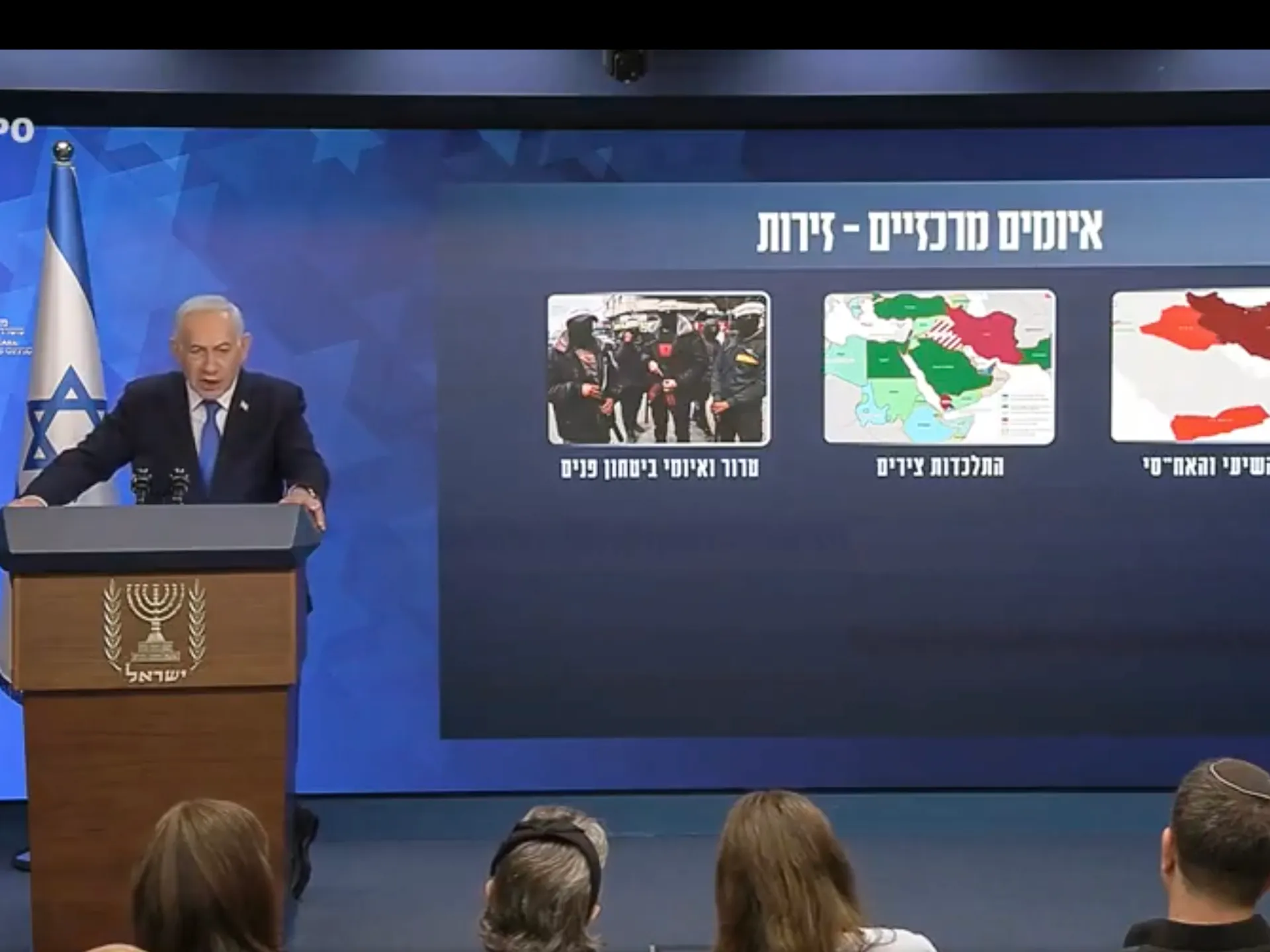
Netanyahu next to Middle East map: ‘We strangled them and have more to do’ | Benjamin Netanyahu

NewsFeed

Standing in front of a map of the Middle East, Israeli Prime Minister Benjamin Netanyahu describes how six countries ‘wanted to strangle us’ but instead ‘we strangled them… and we have more to do’. Ambassadors from Israel and Lebanon are set to hold talks in Washington DC on Tuesday, but they’ve issued conflicting statements on what will be discussed.

Source link

Israel reprimands Spanish diplomat over detonation of Netanyahu effigy | Benjamin Netanyahu

NewsFeed

Israel says it has reprimanded Spain’s top diplomat in Tel Aviv over the blowing up of an effigy of Prime Minister Benjamin Netanyahu during Easter celebrations in the Spanish town of El Burgo. Israel’s foreign ministry blamed ‘incitement’ by Spanish PM Pedro Sanchez. The municipality has previously used effigies of US President Donald Trump and Russian President Vladimir Putin during the annual event which draws hundreds of onlookers.

Source link

Palestinians appalled as Israel approves settlements in occupied West Bank | Israel-Palestine conflict

NewsFeed

Israel has approved 34 new settlements in the occupied West Bank, illegal under international law, that has Palestinians terrified they will lose their land. At an inauguration event, far-right minister Bezalel Smotrich outlined plans to expand borders across Gaza, Lebanon and Syria.

Source link

Has Israeli society become conditioned to permanent war? | US-Israel war on Iran

Opinion polls indicate opposition to ending war against Iran.

A negative political and public reaction in Israel to the ceasefire with Iran, despite the respite it brings.

No pause for Israel’s army, however – or its victims. Hundreds have been killed in Lebanon, with more dead in Gaza.

Is Israel a society effectively on a permanent war footing?

Presenter: Tom McRae

Guests:

Ilan Pappe – Historian and professor at Exeter University

Gideon Levy – Columnist at Haaretz newspaper in Tel Aviv

Haim Bresheeth – Professor at the School of Oriental and African Studies, University of London

Source link

Makeshift Gaza university offers chance to resurrect academic studies | Israel-Palestine conflict News

The new academic semester kicked off in Gaza in late March. But the mornings no longer carry the familiar vibrance of students waiting for buses, crossing cities towards universities and colleges.

That feeling has instead been replaced by the hardship of displacement.

Recommended Stories

list of 3 itemsend of list

Israel’s destructive campaign has reduced Gaza’s academic institutions to rubble, many now repurposed as crowded shelters for displaced families. With campuses gone, in-person education has largely disappeared, forcing universities to shift to online learning. But for students living in tents, struggling to secure food, water, electricity, and internet, attending a lecture, even online, has become a privilege.

Amid this chaos, a glimmer of hope has materialised.

In the densely crowded area of al-Mawasi in southern Gaza’s Khan Younis, a new academic initiative is taking shape. Scholars Without Borders, a US nongovernmental organisation, has established what it calls “University City”, a makeshift academic space designed to bring students back into lecture halls.

Built from wood, metal sheets, and whatever materials could be sourced locally, the site stands as a modest reconstruction of what Gaza’s academic life once looked like.

“Despite the hardships, our mission is to bring education closer to students in a better environment,” said Hamza Abu Daqqa, the organisation’s representative in Gaza.

“We designed this space to serve multiple academic institutions and as many students as possible,” he added. “There are six halls here, accommodating up to 600 students a day. It may look simple, but it creates a sense of normal academic life, something students have been deprived of.”

The space includes internet access powered by solar panels, improvised green areas, and even a small business incubator aimed at helping students engage on their own prospects.

According to the organisation, University City operates on a rotating weekly schedule, with each day allocated to a different academic institution. This system allows multiple institutions to share the limited space, ensuring the widest possible access for students.

Given the constraints, universities prioritise courses that require in-person instruction the most, such as practical and discussion-based classes.

Gaza’s prominent universities, such as the Islamic University and Al-Azhar University, have begun using the site, alongside other colleges like the Palestine College of Nursing.

But behind this modest structure lies a far heavier reality.

Dr. Essam Mughari giving a lecture. (Courtesy of the Scholars Without Borders team)
Dr Essam Mughari, a professor at the Palestine College of Nursing, gives a lecture at Gaza’s University City [Courtesy of Scholars Without Borders]

A glimpse of what was lost

Across Gaza, universities have been systematically damaged or destroyed since Israel began its genocidal war in October 2023. In the south, all institutions have been rendered inoperable. A limited number of campuses in northern Gaza have been partially restored, but their capacity remains extremely restricted.

The Palestine College of Nursing, for example, has been surrounded by ruins after falling within the “yellow line” where the Israeli military continues to be based since the October ceasefire, cutting off students from their classrooms entirely.

For a generation of students, university life has simply not existed, as they instead battled to survive.

Each academic year is usually marked by new beginnings, especially for freshmen stepping into a new phase of independence and discovery. But for two consecutive years, thousands of Gaza’s students have been denied that experience.

Now, inside University City, they are encountering it for the first time.

‘It feels like a real university’

Mariam Nasr, 20, a first-year nursing student displaced from Rafah, sat in one of the makeshift halls, reflecting on what the space meant to her.

“Before the genocide, everything we needed to study was available; our homes, electricity, materials, and most importantly, safety,” she said. “But for more than two years, our lives have been completely disrupted.”

Mariam began her final year of high school just as the war started. It took more than a year to complete her exams under difficult conditions before she could finally enrol in the university.

“I always dreamed of studying medicine,” she said. “But the circumstances affected my results. My late grandfather told me that healing people isn’t limited to one path, so I chose nursing.”

Still, her degree requires in-person courses, something she had never experienced until now.

“When I saw this place, I was amazed,” she said. “It was the first time I attended classes in a space that actually feels like a university. We are all excited. It feels different; it feels real.”

For students like Mariam, their first year was spent behind screens, if they were lucky to have one in their tents, disconnected from the academic environment they had hoped for.

Amr Muhammad, 20, another first-year nursing student from al-Magahzi Camp in central Gaza, shared a similar reaction.

“I expected something much simpler, just tents and basic setups,” he said. “But this was different. Being here with other students, discussing and engaging in class makes a huge difference.”

Amr Muhammad, 20. A first-year nursing student. (Courtesy of Scholars Without Borders team)
Amr Muhammad, a 20-year-old first-year nursing student at Gaza’s Palestinian College of Nursing [Courtesy of Scholars Without Borders]

Academia under fire and siege

The experience faced by students in this small space reflects a much larger tragedy.

Israel’s destruction of Gaza’s academic sector has been described by UN experts as scholasticide; the systematic dismantling of education through the targeting of institutions, students, and academic life itself. Universities have been destroyed, professors and students killed, and reconstruction efforts obstructed.

More than 7,000 university students and academics have been killed or injured by Israeli attacks, while more than 60 university buildings were completely demolished by Israeli aerial attacks or ground detonations, according to the Euro-Med Human Rights Monitor and information shared by Palestinian officials.

As a result, hundreds of thousands of students have been cut off from formal education, forced into alternatives that are not able to match their former experiences.

And those alternatives, such as University City, face enormous difficulties in just getting their work started.

“All the materials you see here were sourced from inside the Gaza Strip,” Abu Daqqa said, gesturing around the site. “We had to work within what was available, with rising costs and scarcity of resources. But we were determined to create something that gives students a sense of normalcy.”

Under the October ceasefire, Israel is obliged to allow reconstruction materials to help restore shelter, essential services for Palestinians. But Israel has not adhered to that stipulation and has continued to impose restrictions, while carrying out deadly attacks across Gaza.

And for many students, reaching the University City is itself a challenge.

“I am displaced in al-Mawasi, so I’m supposed to be relatively close, but even getting here is difficult,” Mariam said. “My classes start at 9am, and I wake up at 5 just to find transportation.”

With roads damaged and fuel scarce, options for students are limited to worn-out vehicles and donkey or horse carts.

“Getting cash is frustrating. Taxis and carts only accept coins. My father barely got me eight shekels [$2.64] today, but I couldn’t find a ride,” she said. “So I walked nearly four kilometres[2.5 miles] with my friends.”

For Amr, the journey is even longer.

“I left at 6am and waited for two hours before finding a crowded vehicle,” he said. “It was the only way to get here.”

And once the day ends, the challenges resume.

“This space is only for a few hours,” he added. “The rest of the week, we go back to struggling with electricity, internet, and basic needs. We can’t even print materials or access online lectures properly.”

Students rely on shared or damaged devices, unstable connections, and limited resources, making consistent learning difficult.

“Back in the tent, I rely on my father’s old phone just to follow lectures when I can,” Mariam said. “Most days, there’s no stable internet or power. I try to hold on and keep going, but I often wish for something as simple as a steady power source and a better device like an iPad to study properly and not fall behind.”

Holding on to education

Despite everything, a scene of resilience unfolds as students continue.

Inside the halls, discussions resume, notes are taken, and a sense of academic life slowly returns, even if temporarily.

“For medical education, in-person learning is essential,” said Dr Essam Mughari, a professor at the Palestine College of Nursing. “It’s quite hard for online education to replace practical engagement.”

He described the emotional significance of meeting students again.

“After everything they’ve been through, being able to gather, interact, and learn together, it restores something vital,” he said. “We have a responsibility to support them, despite the circumstances, because tomorrow they will be in our place”

For Mariam, that determination is deeply personal.

“Some people might think it’s impossible to study in these conditions,” she said. “But I want to continue. My cousin was a nurse. An Israeli air strike levelled her family’s three-storey house in Gaza City, killing her and several others. I remember her to remind myself why I hold onto this path to heal others and serve my people.”

The University City now serves hundreds of students each day. But thousands more remain without access to similar spaces.

Scholars Without Borders says the initiative is only the beginning of a mission that is still crippled by the Israeli siege.

“Our work is ongoing,” Abu Daqqa said. “We have established dozens of makeshift schools and established this university city, but the need is far greater. This is what we were able to build under blockade,” he said. “Imagine what could be done if the truly needed resources are allowed.”

Source link

At least seven Palestinians killed in Israeli attacks on Gaza | Israel-Palestine conflict News

An early-morning strike hits a group of civilians in ​​Bureij camp as drones attack a tent in Khan Younis displacement site.

At least seven Palestinians have been killed, and others wounded, in Israeli strikes across the central and southern Gaza Strip.

An Israeli drone fired two missiles close to a police post in Bureij refugee camp in central Gaza, Mahmoud Bassal, a spokesman for Gaza’s civil defence rescue service told the AFP news agency on Saturday.

Recommended Stories

list of 3 itemsend of list

Medical sources confirmed the early morning attack to Al Jazeera, saying the strike hit a group of civilians in the “Block 9” area of Bureij. Several people were killed and seriously wounded, they said.

Ambulance crews faced difficult conditions as they worked to transport the bodies and those injured to nearby hospitals, the sources added.

The al-Aqsa hospital in central Gaza told AFP it had received six bodies and seven wounded people, including four in critical condition. The nearby al-Awda hospital said it received one fatality and two wounded people.

Separately, in the southern Gaza Strip, Nasser Medical Complex said it received three wounded people following an Israeli drone strike against a tent of displaced people in the town of Bani Suheila, located east of Khan Younis.

Al Jazeera’s correspondent on the ground also reported Israeli artillery shelling and heavy tank fire near Bani Suheila and east of Gaza City.

Israel’s genocidal war on Gaza has killed more than 72,300 people since it began in October 2023, according to the Gaza Ministry of Health, including at least 738 since the so-called ceasefire went into effect last October.

The tally includes at least 32 deaths since the start of April alone – among them Al Jazeera journalist Mohammed Wishah, who was killed in an attack west of Gaza City earlier this week.

United Nations human rights chief Volker Turk on Friday condemned Israel’s recent violence in the Gaza Strip, saying that “the unrelenting pattern of killings” reflects Israel’s “sweeping impunity”.

“For the past 10 days, Palestinians are still being killed and injured in what is left of their homes, shelters and tents of displaced families, on the streets, in vehicles, at a medical facility and a classroom,” Turk said.

Israeli settlers stand at a water slide in the Israeli-occupied West Bank village of Ras Ein al-Auja on April on April 9, 2026. Israel vowed more strikes against Hezbollah on April 9, dismissing mounting international demands that the fragile truce between the United States and Iran in the Gulf be expanded to cover the war in Lebanon. (Photo by Ilia YEFIMOVICH / AFP)
Israeli settlers stand at a water slide in the Israeli-occupied West Bank village of Ras Ein al-Auja on April 9, 2026 [Ilia Yefimovich/AFP]

West Bank raids, arrests continue

Meanwhile, in the occupied West Bank, Israeli settlers and forces stormed homes and villages throughout the morning, continuing an escalating campaign to expand their illegal settlements.

The Palestinian Wafa news agency reported that Israeli forces arrested seven people east of Qalqilya and separately descended upon Bir al-Basha, near the city of Jenin, where they detained various residents and interrogated them.

In al-Maniya, southeast of Bethlehem, Israeli settlers fanned out across the streets, shone spotlights inside homes and provoked residents.

Another group of settlers set fire to a house in the village of Duma in the Nablus governorate, according to village council head Suleiman Dawabsheh.

Residents managed to control the fire and prevent it from spreading, Dawabsheh said.

Israeli media outlets have reported the recent secret approval of 34 new illegal West Bank settlements, adding to 68 that have been endorsed since Israeli Prime Minister Benjamin Netanyahu’s government rose to power in 2022.

Various foreign governments and organisations, including the European Union, Turkiye, Sweden and the Organisation of Islamic Cooperation, have condemned the move as a flagrant violation of international law.

Source link

Muslims hold first Friday prayers at Al-Aqsa Mosque after reopening | Israel-Palestine conflict

NewsFeed

Thousands of Muslims performed Friday prayers at Al-Aqsa Mosque in occupied East Jerusalem after it reopened to worshippers following a 40-day closure by the Israeli army that barred access to Islam’s third-holiest site after the war on Iran began.

Source link

Palestinian journalist describes losing prosthetic eye in Israeli prison | Israel-Palestine conflict

NewsFeed

Palestinian journalist Muath Amarne said his prosthetic eye fell out after an infection while in Israeli detention, leaving him in urgent need of surgery. Amarne, who lost his left eye in 2019 after being struck by an Israeli rubber bullet, was held in prison for more than seven months.

Source link